
Submitted:
17 November 2026
Posted:
18 November 2026
You are already at the latest version
Abstract
Foundation models provide transferable representations, generative priors, and multimodal understanding, offering new ways to address diverse image degradations and restoration requirements. This survey reviews three complementary directions: leveraging existing foundation models for image restoration, developing restoration-oriented foundation models, and coordinating restoration models and tools through agents. We examine how pretrained representations, generative priors, and additional supervision support image restoration. For restoration-oriented foundation models, we compare pretraining, unified modeling, and adaptation strategies across tasks and domains. For agentic image restoration, we examine how agents coordinate restoration models and tools within a unified framework for diverse tasks through task planning, tool selection, feedback-driven refinement, and experience retrieval. We summarize reported benchmark results and model budgets to examine the strengths and limitations of existing methods, taking into account differences in training coverage, adaptation, and evaluation settings. Finally, we discuss challenges and future directions in generalization and adaptation to real-world degradations, faithful and user-controllable restoration, reliable assessment for agents, and efficient and reproducible deployment. A curated list of works reviewed in this survey is available at https://github.com/mrluin/Awesome-IR-in-FM-era.
Keywords:
image restoration
; foundation models
; generative priors
; agentic restoration
1. Introduction
Image restoration aims to recover high-quality images from observations affected by noise, blur, low resolution, or other degradations. In real-world scenarios, these degradations may coexist or vary spatially, while restoration objectives also depend on the intended use of the result. For example, old photo restoration emphasizes visual quality, aiming to produce clear and natural-looking results [1]. Restoration for autonomous driving should preserve scene information needed for downstream perception [2]. In interactive photo enhancement, user instructions specify the desired changes and guide the restoration process [3,4].
Foundation models are pretrained on large-scale data and can be adapted to a range of downstream tasks [5]. For image restoration, pretrained visual and vision-language representations provide semantic and structural information for image reconstruction [6,7,8]. Generative priors guide the inference of image details that are missing or ambiguous in degraded observations [9,10,11]. Language and multimodal capabilities support the interpretation of image content and user instructions, enabling natural-language specifications of desired changes to guide restoration [3,4,12].
Related surveys focus on universal image restoration [13], language-driven restoration with semantic-aware quality assessment [14], and restoration agents [15]. This survey examines the use and development of foundation models in image restoration through three successive parts covering image restoration with foundation models, restoration-oriented foundation models, and agentic image restoration. This organization progresses from leveraging pretrained capabilities for reconstruction, supervision, and quality assessment to restoration-oriented pretraining and adaptation, and then to the coordination of restoration models and tools through agents. Figure 1 summarizes representative developments. Figure 2 presents the taxonomy, while Figure 3 illustrates representative mechanisms.
In image restoration with foundation models, visual and vision-language representations complement features learned by restoration networks with semantic and structural information [7,8]. Pretrained generative models contribute image priors that can be combined with degraded observations through inference-time constraints [16] or learned conditioning [10,11]. Natural-language instructions specify restoration requirements and desired operations [3]. For training supervision, pretrained models generate degraded inputs paired with clean targets [17] or provide diffusion-based losses for separate restoration networks [18]. Vision-language and multimodal models assess image quality through image-text correspondence [19] or quality-related instruction tuning [20].
The development of foundation models for image restoration involves restoration-oriented pretraining and downstream adaptation. Related efforts in universal restoration and multi-task pretraining investigate shared representations and priors for downstream restoration tasks [21,22]. Masked reconstruction learns clean content from partially observed degraded inputs [23], while degradation classification supervises restoration-encoder pretraining [24]. Large-scale generative training aims to broaden restoration coverage through diverse image data [25]. Depending on their design and training, pretrained models can be applied directly to supported restoration tasks or adapted through task-specific fine-tuning. Task-specific adapters provide a parameter-efficient option for such adaptation [26]. Task requirements can also be specified through model inputs. Visual in-context learning uses input-output examples to specify the desired transformation [27,28]. Multimodal conditioning provides further ways to express low-level processing requirements [29].
Agentic restoration coordinates restoration models and tools according to the input image and restoration target. Language and multimodal models help interpret image conditions and user requirements to inform tool selection [30,31]. Planning, search, and learned policies organize restoration sequences, with actions determined in advance or selected based on updated observations [32,33,34]. Existing systems also employ retrieved experience to guide action selection [35]. The selected tools, which may include instruction-guided generative foundation models, carry out these operations [36]. At inference, quality assessment can guide candidate acceptance, further operations, or stopping [35,37]. During training, quality-based rewards can optimize tool-use policies [34,38].
Section 2, Section 3, and Section 4 discuss these three parts, respectively. Section 5 summarizes reported benchmark results and model sizes under their respective evaluation settings. Section 6 discusses generalization and adaptation to real-world degradations, faithful and user-controllable restoration, reliable assessment for agentic restoration, and efficient and reproducible restoration agents. Section 7 concludes the survey.
2. Image Restoration with Foundation Models
Foundation models and related pretrained priors provide visual features, segmentation priors, text conditions, image priors, training resources, and quality judgments. Table 1 summarizes representative methods.
2.1. Image Restoration with Vision and Language Models
Pretrained vision and language models provide visual and semantic information to guide image restoration. Visual features and segmentation masks describe content and spatial regions. Vision-language models (VLMs) relate images to text, while multimodal large language models (MLLMs) describe content and degradation. Text encoders embed requested operations, while generative language models can interpret or formulate instructions.
2.1.1. Visual Features and Segmentation Priors
Pretrained visual features and segmentation priors provide content and spatial guidance for restoration. DINO-IR [7] fuses multiscale DINOv2 and restoration features with contrastive supervision. RAESR [108] learns a generative decoder from frozen DINOv3-L features without diffusion sampling. GramSR [109] instead conditions SD2.1 on DINOv3 features through pixel, semantic, and texture low-rank adaptation (LoRA) [110] branches. CLD transfers sRGB-pretrained semantic representations into a RAW denoiser through cross-domain feature fusion [111]. DiffLI2D transfers bottleneck features from a frozen ImageNet-pretrained diffusion model to a supervised restorer without reverse sampling [112]. For segmentation guidance, SAM prior tuning [39] uses trainable mask-conditioned units with SAM and the restorer fixed. SAM-Deblur [113] pools regional features, while PPTformer [114] encodes SAM parsing maps into multiscale conditions and fuses them through attention and gated feed-forward processing. Precomputed maps remain inference inputs. Distillation provides another way to transfer pretrained guidance during training. SAM distillation [40] refines initial reconstructions with a mask-guided branch. This branch supervises the original branch through output and semantic-relation losses. PTG-RM [115] guides training refinement with pretrained features. Both remove auxiliary teachers after training.
2.1.2. Degradation and Instruction Conditioning
Information about the input degradation can help determine how the image should be restored. In VL-UR, weather descriptors may be selected automatically or supplied by the user [116]. DA-CLIP [8] learns a contrastive controller around fixed CLIP encoders for content and degradation conditions, while LoRA-IR [117] routes low-rank restoration experts. ClearAIR [118] combines DeQA quality and SAM regional cues. MoFE-MLLM [119] injects Qwen2.5-VL features into a restoration encoder and decoder and routes frequency experts. For feature aggregation, QuReC [120] matches spatial queries to fixed CLIP text prototypes. MGN-AIR [121] uses text and learned visual prompts to vary pixel-level processing, while SLER-IR [122] routes layer-wise experts with distinct content and degradation representations.
Natural-language instructions can specify the restoration operations requested by the user. InstructIR [3] uses generated training instructions and projects frozen BGE embeddings to modulate channels in a NAFNet-based restorer. TextPromptIR [123] instead fine-tunes BERT. Image-based conditions can complement text cues. Generated references supply content, while degraded-clean examples indicate the degradation to remove. LMDIR [41] generates SDXL [124] content references from content and degradation descriptions. TextDegRemoval [42] maps CLIP image features into continuous textual embeddings and learns a textual restoration module to remove degradation information. The corrected embeddings condition pretrained Stable Diffusion to generate an auxiliary guidance image, whose features are integrated into a restoration backbone through coarse-to-fine matching and multiscale aggregation. AWRaCLe [125] instead extracts CLIP features from a degraded-clean context pair and injects a degradation representation at decoder levels for queries sharing that degradation.
UniProcessor combines a degradation subject prompt with a manipulation prompt to specify the degradation and the requested restoration operation. Multimodal context controls are injected into the restoration network through cross-attention [88]. Language-driven adverse-weather removal uses a VLM-derived degradation prior to select convolutional experts according to the corruption type and severity [89]. For unpaired deraining, UPID-EDM learns domain-representation prompts for rainy and clean images with frozen CLIP encoders. The learned prompts define a rain-relevance discarding energy function, while CLIP image features define a rain-irrelevance preserving energy function. These two terms guide reverse sampling in a diffusion model pretrained on clean images [90].
2.1.3. Language Model Adaptation
Beyond conditioning, pretrained language models can predict image tokens through learned image-token mappings. LM4LV [126] first adapts an MAE decoder. It then freezes visual modules and LLaMA while learning linear adapters and task tokens for autoregressive continuous-token prediction. BeyondText [127] keeps the language backbone fixed and learns an image tokenizer and decoder using its discrete vocabulary tokens. Input-output examples specify visual transformations. In contrast, PURE instruction-tunes Lumina-mGPT to generate degradation labels, semantic descriptions, and restored image tokens [128]. These methods extend pretrained language models from providing restoration guidance to directly predicting image representations, either by learning visual interfaces around a frozen language backbone or by instruction-tuning a multimodal model for restoration.
2.2. Image Restoration with Generative Priors
Generative models provide learned image priors that help resolve ambiguity in degraded observations, complementing the visual and language guidance discussed above. We review how fixed generative priors guide restoration, how conditioning and model adaptation support generative restoration, and how efficient designs reduce inference cost. We focus on the utilization of pretrained generative models and also discuss task-specific generative models to explain their restoration designs.
2.2.1. Pretrained Generative Priors
Early work on image inverse problems explored how denoisers and pretrained generators could serve as image priors. Plug-and-play reconstruction incorporates a denoiser into an iterative optimization algorithm [129], whereas regularization by denoising (RED) introduces a denoiser-dependent regularization functional [130]. Compressed sensing with generative models instead optimizes a latent code within a pretrained generator to fit linear measurements [131].
With pretrained GANs and diffusion models, image priors can be incorporated into restoration through latent optimization or observation-conditioned sampling. The model parameters remain fixed, while latent inputs, image estimates, or sampling states are adjusted to match the degraded observation. PULSE optimizes a GAN latent code for downsampling consistency [43]. RePaint conditions on known pixels and resamples the trajectory [132]. DDRM [16] uses spectral conditioning, while DDNM [133] separates measured range-space components from generated null-space content. DDNM+ handles noisy observations. For differentiable degradation operators, DPS [134] approximates likelihood gradients through denoised estimates under its noise assumptions. For linear inverse problems, PSLD [135] propagates gradients through a latent decoder. Its gluing guidance matches clean latent estimates to encoded observed and generated components.
Within this fixed-model setting, optimization can be performed at different stages of the generative process. DMPlug treats reverse diffusion as a differentiable mapping and optimizes its initial noise to fit the observation [58]. P2L instead tunes continuous text conditions during reverse sampling, alternating prompt updates with latent and pixel-level estimation while retaining the pretrained diffusion weights [59].
Image estimates can be updated through regularization or separate measurement and prior steps. RED-Diff combines measurement matching with fixed diffusion-denoiser regularization [136]. For denoising with unknown noise statistics, DiffusionVI estimates noise-precision posteriors and intermediate maximum a posteriori images using a fixed unconditional diffusion prior [137]. DiffPIR [138] combines diffusion sampling with half-quadratic splitting of data fitting and prior regularization. DCDP [139] and DAPS [140] decouple measurement updates from purification. DInG [141] instead decouples its likelihood proxy from the current transition, obtaining Gaussian posterior updates without denoiser backpropagation.
A further distinction concerns how posterior samples are constructed. MCGDiff uses sequential Monte Carlo with weighted particles for intermediate linear inverse problems [60]. PnP-DM instead uses split-Gibbs sampling to alternate likelihood sampling and Gaussian-denoising posterior sampling through a pretrained diffusion model [61].
Pretrained flow models provide an alternative to diffusion priors through a learned velocity field. D-Flow integrates this fixed field and optimizes the initial noise for observation consistency [44]. PnP-Flow instead derives time-dependent denoising from a fixed velocity field and interleaves it with data-fidelity updates and interpolation toward the flow path [64]. Unlike differentiation through the integrated D-Flow trajectory, the local operations in PnP-Flow avoid backpropagation through the generative network or ODE. Iterative Corrupted Trajectory Matching formulates inference for linear inverse problems through local objectives along a flow trajectory [65].
When the degradation operator is unknown, blind restoration can infer it jointly with the image. BlindDPS uses separately trained diffusion priors for degradation operators such as blur kernels [142]. GibbsDDRM instead uses a partially collapsed Gibbs formulation with an operator prior to alternate inference of the image and an unknown linear operator [62]. Fast Diffusion EM uses sample-based expectation maximization for deconvolution, with a trained blur-kernel denoiser regularizing its maximization step [63]. Its fast variant interleaves kernel updates with approximate image inference along a reverse trajectory.
Unknown degradations can also be handled by adapting the degradation mapping to the test image. Test-time degradation adaptation [143] learns an adapter and discriminator from the test input during denoising while keeping the diffusion prior fixed. The learned degradation mapping provides observation guidance. DreamClean takes a different route, avoiding an explicit degradation operator through diffusion inversion and refinement [144].
In low-light enhancement and denoising, inference can be tailored to illumination and noise characteristics. LLIEDiff models low-light degradation through an exposure-adaptive illumination map and constrains latent sampling with measurement and latent regularization, without paired task training [66]. For Gaussian denoising, LCDD matches the input noise level to a diffusion state and blends the resulting one-step and multistep estimates [67].
Observation constraints can also be combined with semantic control over the restored image. Text-guided explorable super-resolution combines a known downsampling constraint with semantic guidance in pretrained generative models [68]. Language steers inference toward alternative high-resolution explanations of the same low-resolution observation, without training a restoration-specific conditioning interface.
2.2.2. Conditional Generative Restoration
Learned conditional interfaces provide another way to connect degraded observations to generative priors. Conditional generative restoration uses degraded-image structure, text, or reference images to guide reconstruction, with methods differing in the conditioning modules or generator components they train or adapt.
Early learned restoration interfaces draw on GAN priors or discrete codebooks. GLEAN learns to retrieve and combine information from a pretrained generative latent bank for super-resolution [69]. GFP-GAN connects restoration features to a pretrained face generator through channel-split spatial feature transforms [70]. CodeFormer instead learns a discrete facial codebook and decoder, then fixes them while training low-quality encoding and transformer code prediction [71]. Its controllable feature transfer adjusts the balance between input fidelity and visual quality.
With pretrained diffusion models, degraded-image features can be injected through learned encoders and attention modules. StableSR [10] trains time-aware encoding and feature modulation to condition frozen Stable Diffusion on degraded-image structure. Its optional feature wrapping transfers VAE-encoder features into decoder features. DiT4SR [145] adds a low-resolution stream to pretrained multimodal transformer blocks for joint attention with noisy-image tokens. Since degraded inputs contain both corruption and scene structure, several methods seek more degradation-robust conditions. SUPIR [11] adapts a degradation-robust encoder and restoration adapter. PASD [146] trains a degradation-removal module to produce multiscale control features for pixel-aware cross-attention. DiffBIR [45] trains IRControlNet on preliminary restorations to condition frozen Stable Diffusion. During sampling, SUPIR interpolates predictions toward the input latent, while DiffBIR optionally applies spatially weighted guidance toward the preliminary estimate.
Restored proxy images can supplement degraded-image conditions with cleaner structural or semantic features. DreamClear uses a PixArt- prior with ControlFormer, combining degraded-image and SwinIR-pre-restored streams through token-wise adaptive experts [75]. Captions provide semantic conditions. LucidFlux trains dual image-conditioning branches and a connector that maps proxy-image SigLIP features into the conditioning space of a frozen Flux.1 model [77]. Its conditions vary across timesteps and layers. A fixed restoration instruction is used instead of image-specific captions.
Direct conditioning on degraded latents can use learned image-text adapters or native masked-image slots. FluxIR processes degraded latents and learned text-embedding offsets in an MM-DiT adapter and broadcasts the resulting conditions across its pretrained FLUX backbone [76]. Its image and text interfaces are trained jointly for restoration. Fill2SR uses the native masked-image slot of FLUX-Fill: a full-image mask and encoded low-quality image provide the restoration condition, with LoRA updates learning the conditional flow [78]. Optional Redux tokens add semantic guidance.
The conditioning interface can also reflect the structure of a particular restoration task. For motion deblurring, DeblurDiff repeatedly predicts spatially varying latent kernels and uses adaptive filtering to update structural guidance for Stable Diffusion [79]. UID-Diff separates structure and blur through two Q-Formers, combining synthetic paired deblurring with unpaired target-domain blur transfer and reconstruction [80].
Inpainting shifts the conditioning problem from correcting corrupted content to completing missing regions. ASUKA aligns an MAE reconstruction prior with a frozen generative model in place of text conditioning [82]. It uses observed-region conditions to support continuity across masked and unmasked areas and learns an inpainting-specialized decoder for local color harmonization.
To support multiple degradations and tasks, restoration models can select or share learned conditioning components. MPerceiver [147] weights learned prompt pools by CLIP-based degradation probabilities. Its learned branches supply global text conditions and multiscale visual features. Diff-Plugin [148] trains task plugins independently. In contrast, UnSCAR [149] learns shared control and expert components to condition a frozen diffusion backbone across 16 jointly trained tasks.
Beyond conditioning modules, restoration adaptation can modify image encoding and decoding. DarkDiff [150] adapts a residual VAE and region-conditioned latent denoiser to map noisy linear RGB to sRGB. TADSR [151] uses time-aware encoding to vary restoration with the inference timestep. Transfer VAE Training (TVT) reduces the VAE spatial compression used by a pretrained diffusion U-Net, first training a compatible decoder and then its encoder with the decoder fixed [81]. Added high-resolution boundary layers are fully fine-tuned, while low-rank adaptation connects the original U-Net to the new representation. The reduced compression targets fine structures that coarse encoding may discard.
The generative formulation can also be tailored to restoration, from autoregressive token prediction to conditional diffusion processes. RestoreVAR [152] predicts clean discrete indices scale by scale, then uses a non-generative refiner to obtain continuous decoder features. SR3 learns iterative refinement conditioned on a low-resolution input [72]. IR-SDE learns the reverse of a process whose mean is the degraded image [153], while I2SB learns an image-to-image Schrödinger bridge between paired endpoint distributions [73]. Bi-Noising combines a task-trained conditional diffusion model with an unconditional prior through re-noising and refinement [74].
Alongside image conditions, text can describe image content or specify requested changes. SeeSR [154] aligns low- and high-quality tags and features, then supplies object tags and continuous conditions. PromptFix [4] combines frozen-VLM descriptions with user instructions and updates decoding LoRAs during sampling. InstructRestore [155] trains a mask decoder and ControlNet around frozen Stable Diffusion for instructions inside and outside target regions.
Pretrained editing models offer an initialization for learning restoration operations. DNF-SR [46] uses negative-aware post-training of FLUX-Kontext with unnoised and noise-perturbed inputs. Edit2Restore trains LoRA updates for FLUX.1 Kontext using small paired task datasets and simple operation prompts [83]. It uses 32-128 paired examples per task and also studies a shared adapter trained across five restoration tasks.
Besides text, reference images can supply restoration guidance or adaptation examples. ReFIR [48] retrieves relevant images and injects textures through cross-image attention and spatial control without retraining. ADIR [156] retrieves adaptation examples for LoRA updates before measurement-guided reconstruction. PFStorer [157] learns identity modules from references once per person for later images.
2.2.3. Efficient Generative Restoration
Generative restoration can be accelerated by shortening sampling trajectories or reducing the computational cost of model components. Trajectory design, initialization, and learned one- or few-step mappings address sampling cost, while compression targets the generative backbone and autoencoder.
Trajectory design and initialization reduce the iterative work needed to connect degraded inputs to restored images. ResShift [159] learns residual-shifting trajectories, whereas InvSR [50] uses a trained noise predictor to initialize frozen diffusion at an intermediate state, with adjustable sampling steps. FideDiff [160] learns cross-time consistency by matching different blur levels to a shared sharp target, with a separate Kernel ControlNet supplying blur-kernel conditioning and adaptive timestep prediction. CCSR [84] separates content refinement from detail enhancement, using non-uniform and truncated diffusion sampling for the former and a separately fine-tuned VAE decoder for the latter. FlowIE [85] instead adapts a pretrained diffusion U-Net into a conditional rectified-flow model, with coarse restoration providing guidance for few-step generation.
One- or few-step mappings can also be learned through teacher distillation or trajectory-consistency objectives. SinSR [51] distills the ResShift trajectory into one step, while MFSR [161] learns interval-average velocity with an end-time embedding from a frozen DiT4SR teacher. AlloSR2 [162] adapts FLUX with LoRA, trajectory consistency, and allomorphic matching, using SNR initialization for one-step inference.
Reconstruction losses and score-based supervision support learning one- or few-step restoration mappings. DAVI [163] learns a measurement-conditioned approximate posterior sampler from a fixed diffusion prior, replacing the sampling trajectory with one forward pass. OSEDiff [49] trains encoder and denoiser LoRAs with reconstruction and score distillation for one denoising step. PiSA-SR [164] learns pixel then semantic LoRAs, fixing the pixel branch during perceptual and classifier score distillation. Default inference merges the two LoRAs, whereas adjustable guidance combines network outputs. IFCSR [165] instead interpolates between fidelity- and realism-oriented output images, enabling further trade-off adjustment without additional network inference.
Adversarial supervision and staged adaptation provide further training designs for single-pass restoration. ODTSR [166] trains Qwen-Image control-noise LoRA with a training-only Wan2.1 discriminator. HYPIR [167] separates degradation removal from latent restoration: it first adapts its VAE encoder, then fixes encoding and decoding while training LoRA in a diffusion-initialized restorer for a single latent forward pass.
Model and representation compression complement sampling acceleration by reducing the computation of the generative backbone and autoencoder. TinySR [52] prunes SD3, compresses the autoencoder, and removes redundant fixed-prompt conditions. NanoSD [86] co-compresses the SD1.5 U-Net and VAE using hardware-profiled architectural changes and generative distillation. Its compact pretrained components can then support downstream restoration frameworks. SANA-SR [87] combines a more compressed latent representation and a LoRA-adapted LinearDiT with one-step restoration and structured pruning.
2.3. Pretrained Models for Supervision and Quality Assessment
Pretrained models support restoration by constructing training supervision and assessing image quality. These roles connect data preparation and model optimization with the evaluation of restoration outputs.
2.3.1. Training Supervision
Training supervision uses pretrained models to construct examples and targets, define differentiable losses, and provide preference or reward signals. Training-pair synthesis can model the degraded side of a restoration pair. Yang et al. [91] train a DDPM [168] on real low-quality images and use it to refine a handcrafted degradation of a clean source image after noise injection. The generator constructs pairs offline, with only the trained restorer used at inference. GenDeg [17] synthesizes controlled degradations while correcting correspondence with clean targets. Fill2SR extracts degradation descriptors from unpaired real images and transfers the degradations onto clean targets using frozen models, producing offline restoration training pairs [78].
Clean-image synthesis can instead expand the sources or targets available for training. The GenIR pipeline in DreamClear generates and filters clean training images before restoration training [75]. GGT-100K [53] retains real degraded inputs and generates candidate clean targets using automatic checks, VLM refinement, and manual verification.
Beyond constructing examples, pretrained models define training objectives through their representations and predictions. DiffLoss [18] compares noise predictions and bottleneck features of restored and reference images under a fixed diffusion model, retaining only the trained restorer at inference. Perceive-IR [169] first learns CLIP quality prompts, then fixes them for losses while retaining DINOv2 conditions at inference. LossAgent [55] uses an LLM to select differentiable-loss weights between training stages.
Pretrained predictors also provide supervision through pseudo-targets. For unpaired measurements, SUD2 [54] denoises current reconstructions into fixed pseudo-targets without backpropagating through the denoiser, retaining only the trained reconstruction network at inference. RGSUD [170] uses training-only DACLIP-IQA rewards for deraining pseudo-pairs. SnowMaster [171] preference-tunes an assessor for updating desnowing pseudo-labels.
Quality judgments can enter optimization as preference pairs or rewards. Follow-Your-Preference uses reward-model preference pairs and direct preference optimization to adapt BrushNet branches or selected FLUX Fill attention weights [172]. IRPO applies GRPO to a stochastic control policy in an AdaIR-based restorer using generic, Qwen-VL expert, and task-specific rewards, while jointly updating the backbone with paired reconstruction and consistency supervision [92]. Hallucination Score [173] uses a differentiable reward combining clean-reference DINO or CLIP similarity with MUSIQ quality scores. Its GPT-4o fidelity assessment also uses a clean reference.
2.3.2. Quality Assessment
Quality assessors supply training signals and also evaluate restoration outputs. Their predictions range from scalar scores to comparisons, localized defects, and tool-supported judgments. For scalar quality prediction, methods differ in their representations and training targets. CLIP-IQA uses image–text relations without quality-label fitting, while LIQE fine-tunes CLIP through joint quality, scene, and distortion prediction [19,93]. QualiCLIP learns quality-sensitive alignment from rankings induced by synthetic distortions of pristine training images, without human opinion labels [94]. Q-Align learns text-defined quality levels and converts their probabilities into a score, whereas DeQA-Score learns quality-level distributions from human score distributions [20,95]. LL-Score assesses degraded–restored image pairs for quality and hallucination cues without a clean counterpart [174].
Comparisons and descriptions express relative quality and specific defects. Co-Instruct answers multi-image quality questions and explains relative differences [96]. Compare2Score compares a test image with quality anchors and converts preference probabilities into a continuous score. The anchors need not depict a clean version of the test scene [97]. Q-Instruct converts human low-level descriptions into instruction data for visual question answering [98]. DepictQA and DepictQA-Wild support descriptive assessment and comparison, with separate full-reference and no-reference modes and differing training resources [57,99].
Spatial assessment associates quality judgments with particular image regions. Q-Ground predicts text-conditioned distortion masks [100]. SEAGULL assesses mask-specified regions using local and global representations. Its synthetic supervision uses full-reference quality labels, while assessment at inference is no-reference [101]. Grounding-IQA associates quality descriptions with locations and answers questions about local regions [102]. IPAD-CLIP adapts text and visual representations for local perceptual-artifact classification and localization [103]. SR-Ground trains models to localize artifacts in super-resolved images using low-resolution references, then uses their frozen grounding predictions to condition OSEDiff fine-tuning [175].
Reasoning-oriented assessors differ in how they learn quality judgments and use reasoning at inference. Q-Insight uses reinforcement learning for score regression and degradation perception, while VisualQuality-R1 learns relative quality through ranking rewards [104,105]. Q-Ponder combines supervised reasoning initialization with subsequent reinforcement learning, and Q-Hawkeye uses rollout-score uncertainty to reweight training updates [176,177]. RALI instead transfers reasoning-derived representations into an image scorer, without an LLM or text generation during scoring [107].
Tool-supported assessment gathers additional evidence through specialized analyses. IQA-T1 gathers tool-generated visual evidence, including noise residuals, gradient statistics, and frequency spectra, for quality reasoning [56]. AgenticIQA selects compatible quality tools, combines their results, and can revise its assessment plan when evidence is insufficient [106]. It operates in full-reference or no-reference mode according to the supplied inputs. Such assessment outputs also provide evidence for the runtime restoration feedback discussed in Section 4.3.
3. Restoration-Oriented Foundation Models
This section reviews learning strategies toward restoration-oriented foundation models, together with unified restorers that provide relevant design precedents. We examine pretraining, unified restoration modeling, and transfer and adaptation. These complementary strategies concern representation learning, task coverage, and extension to new tasks or domains. Table 2 summarizes representative methods.
3.1. Pretraining for Image Restoration
Pretraining learns model parameters or components for subsequent restoration training through multiple restoration tasks, masked reconstruction, or degradation-aware learning.
3.1.1. Multi-Task Pretraining
Multi-task pretraining learns representations and image priors from multiple restoration tasks to provide a starting point for subsequent restoration training. IPT pretrains a shared transformer with task-specific heads, tails, and embeddings on synthetic ImageNet pairs, using reconstruction and patch-level contrastive losses [21]. Task-specific fine-tuning then supports transfer across degradation strengths and blur. After super-resolution (SR) fine-tuning, EDT compares peak signal-to-noise ratio (PSNR) gains from two pretraining settings. Reported gains are larger for pretraining on , , and SR than for the tested mixture of and SR with Gaussian denoising at , a difference associated with representation mismatch [194]. TAPE extracts prior queries from clean targets during pretraining and auxiliary pseudo-clean predictions during fine-tuning and inference [22]. Diffusion-inspired training uses generative pretraining before constrained reconstruction and generation fine-tuning [195]. Its unified setting orders tasks by matched diffusion timesteps and deploys the restoration network for trained-task and cross-dataset evaluations.
3.1.2. Masked Image Modeling
Masked image modeling provides a pretraining objective by reconstructing masked image content from visible regions [196]. MAEIP first pretrains its encoder through masked-pixel prediction, then pretrains the full autoencoder through whole-image reconstruction [197]. For restoration pretraining, predicting clean targets from masked degraded inputs also learns degradation removal. RAM predicts clean pixels from masked degraded inputs [23]. It uses mask attribute conductance along masked-to-unmasked inputs to rank layers, then fine-tunes the highest-ranked layers on unmasked degraded images. DyNet uses masked restoration during dynamic pretraining, randomly switching between shared-weight deep and shallow variants [198]. Module reuse determines their depth difference, and restoration fine-tuning follows pretraining. Masked reconstruction can also be combined with mixed-image separation during pretraining. CPNet uses this combination with parallel encoders and context fusion to learn representations for blind image decomposition [192].
3.1.3. Degradation-Aware Pretraining
Degradation-aware pretraining learns representations or conditioning components through tasks such as degradation transfer and classification, providing degradation-related information for subsequent image restoration. DegAE learns reference-image degradation transfer, then replaces its decoder for restoration fine-tuning [199]. DCPT alternates classification and reconstruction pretraining before restoration fine-tuning; its DC-guided cross-degradation transfer retains a frozen classifier [24]. A degradation prompter can instead remain fixed while different restorers are trained. ConStyle v2 pretrains a prompter on degraded images with auxiliary ImageNet-label classification, then freezes it to condition different restorers [188]. This method is evaluated across eight degradation types. A related staged generative approach connects prior pretraining with degradation-aware learning. BDG first learns a generation prior and then aligns degradation-discriminative and diffusion features in a bridging stage before restoration fine-tuning [189].
3.2. Unified Restoration Modeling
Unified restoration models learn to handle multiple tasks through shared parameters, visual examples, or generative components.
3.2.1. Multi-Task Joint Training
Multi-task joint training optimizes a restoration model across multiple tasks. Task-specific conditioning or expert selection can help handle different degradations. The early all-weather model uses task-specific encoders and a shared decoder [200], whereas TransWeather uses learned weather queries in one encoder-decoder [201]. IDR integrates task-specific prior hubs into a shared embedding hub queried by degraded features through cross-attention for correction [202]. AirNet learns contrastive degradation representations [203], PromptIR combines input-dependent prompts [204], and OneRestore uses scene descriptions [205]. UniRestorer selects experts at different granularities using degradation estimates and uncertainty [178]. These designs govern input-dependent responses, while the training schedule determines how tasks are learned together. MiO adds tasks progressively while retaining earlier training data [206].
3.2.2. Visual In-Context Learning
Visual in-context learning uses example input-output pairs to specify the desired transformation and restore a query image, with model parameters fixed during prediction. Painter learns masked outputs in a shared image format [181]. During training, PromptGIP masks the answer images for both example and query pairs [27]. GenLV injects separately encoded visual prompts through cross-attention [28], while Hidden-Shot adds task text and implicit prompts to one-shot examples [183]. LaVin-DiT combines a spatiotemporal VAE with an example-pair-conditioned diffusion transformer for image and video prediction using conditional flow matching [185].
Restoration quality and performance on new tasks depend on both the selected example pairs and the tasks covered during training or prior adaptation. PromptGIP analyzes the best of 20 prompts [27]. GenLV expands from 30 to 101 trained tasks, evaluating fixed-parameter inference, five-pair backbone fine-tuning, and separate task-specific fine-tuning [182]. Hidden-Shot fixes parameters during final prediction, but 3C4U includes prior full-shot adaptation whereas 3C7U retains three-task training [183]. Claims of unseen-task transfer without adaptation require excluding the target task from both training and pre-test adaptation. Painter segmentation results do not establish unseen-task restoration [181]. PromptGIP reports mixed-degradation and colorization failures [27], and GenLV reports unseen-task limitations [28]. LaVin-DiT reports good performance on related unseen tasks but difficulty with substantially different task definitions [185].
3.2.3. Multi-Task Generative Modeling
Multi-task generative models learn to restore images across different tasks through shared generative components or combinations of generalist and specialist models. Jointly training one checkpoint differs from independently training the same architecture for different tasks. Palette concatenates the source image with the noisy target and also studies one jointly trained image-to-image checkpoint [207]. FoundIR trains a residual diffusion generalist and specialists on a million-scale paired dataset combining real-captured and synthetic degradations [25]. Training progresses from isolated to coupled degradations while retaining earlier data. The complete composition is evaluated across datasets. At inference, the fixed composition uses specialists to refine the generalist output. Results on coupled degradations represented in training describe task coverage rather than unseen-task performance. Across such mixtures, task sampling and paired-target quality also shape training. FoundIR-v2 uses reference-set performance changes for sampling and multimodal assessment for target filtering [184]. Its SDXL-based soft attention MoE scheduler conditions on low-quality features and noisy target latents.
Joint generative training can combine restoration with other low-level vision tasks, with text instructions specifying the desired transformation. Lumina-OmniLV jointly trains a Lumina-Next-initialized flow backbone and condition adapters on approximately 40 million instances across over 100 subtasks, including 45 restoration subtasks [29]. Training progresses from single-image to in-context tasks and then to higher resolution. Visual examples are used for stylization.
Quality analysis can guide restoration during inference, while degradation classification can help organize the latent representation during training. UARE first trains its restoration expert, then jointly tunes assessment and restoration experts [186]. Quality-analysis tokens condition restoration at inference, supporting assessment, restoration, and enhancement with real-SR evaluation. SLAIR instead structures VAE latents through clean-versus-degraded and degradation-type classification during training, then learns a paired latent velocity field that is integrated from degraded latents at inference [187].
3.3. Transfer and Adaptation
3.3.1. Transfer to New Tasks and Domains
Transfer can involve new tasks, data distributions, or both, with model parameters either fixed or adapted. MPerceiver reports direct transfer to under-display-camera and underwater restoration, and few-shot adaptation for other tasks [147]. Its generative components are described in Section 2.2. GRIDS groups tasks by degradation statistics and selects trained group restorers according to input-descriptor distance, without test-time parameter updates [208].
For parameter-efficient adaptation, CoLoRA adapts PROD through low-rank, bias, and normalization updates [179]. PROD is pretrained with randomly ordered and potentially repeated degradations. ProRes uses an MAE-initialized ViT backbone, a decoder, and image-shaped input prompts [180]. It tunes the prompts for new data and tasks while keeping the backbone fixed. The adapter-based AdaIR trains adapters in a frozen Restormer [190], while AdaptIR trains heterogeneous experts in frozen IPT or EDT backbones [26].
Without paired target-domain data, DDTNet transfers target degradations to source clean images [209]. Degradation-consistent adaptation instead uses teacher pseudo-targets and a re-degradation generator learned from test observations [210]. It preserves parameters identified as important by Fisher information and updates the teacher through an exponential moving average.
3.3.2. Continual Image Restoration
Continual image restoration learns tasks sequentially while seeking to preserve performance on previously learned tasks. Revisiting earlier training samples helps maintain previously acquired restoration capabilities. Knowledge replay combines stored images from earlier tasks with distillation [211]. Review Learning also revisits earlier samples during sequential learning. It orders restoration tasks by degradation complexity, measured by the entropy difference between clean and degraded images, and reviews retained challenging samples when learning subsequent tasks [212].
Task-specific parameters provide another way to accommodate successive restoration tasks. MINI-Conv generates task-specific convolution parameters from lightweight embeddings [213]. Restoring Without Forgetting learns low-rank paths from paired data within a frozen denoiser and retains previously learned paths [214]. Prototype-based routing selects these paths without requiring degradation labels at test time. Its evaluation covers five sequential domains and cross-dataset transfer. Task-specific adaptation can also be localized to individual filters. Feng et al. [193] use parameter-space integrated gradients to identify degradation-critical filters, generate task-specific filters from a filter bank through compact low-rank transformations, and replace the selected filters while retaining the remaining network parameters. At the expert level, RestoreMore freezes earlier components and trains new residual experts and a router [191]. It sparsely combines experts to extend restoration from deblurring to deraining, desnowing, dehazing, and denoising.
4. Agentic Image Restoration
Agentic restoration addresses how to organize these capabilities for a particular image and goal. Controllers choose operations and their order, select and configure models, and may assess intermediate results to revise actions or stop. Foundation models can serve as controllers, assessors, or generative executors. We organize these decisions by function rather than executor type. These functions can coexist within a system. Table 3 summarizes representative methods.
4.1. Task Planning
Task planning determines which restoration operations to perform and in what order. Each operation can alter the remaining degradations or introduce artifacts that affect subsequent restoration. AgenticIR uses GPT-4 to schedule tasks, guided by summaries of offline trials [30]. A LoRA-adapted DepictQA model assesses results, guiding decisions to retain an output, roll back an operation, or revise the plan. MAIR uses hierarchical LLMs, a tool registry, and prior experience to order stages addressing compression, imaging, and scene degradations [32]. Within each stage, expert agents test tools for the remaining degradations. DepictQA guides result acceptance and retries.
Other controllers predict a complete plan before execution. RestoreAgent learns from scored paths that include intermediate decisions, rollback, and stopping [33]. It uses complete plans by default, with stepwise replanning evaluated separately. JarvisIR uses quality-ranked plans for supervised and preference training [2]. OPERA trains its planner with GRPO and updates restoration tools using losses on the final restored output [215]. It executes complete plans without intermediate replanning.
Planning can also be applied to refine the output of a task-specific restoration model. Derain-Agent uses a ResNet34-based network to select a refinement path from predefined tool sequences and predict spatially adaptive tool strengths for a preliminary derained image [223]. Offline path search provides supervision for path selection, while the strength maps are learned separately using a paired reconstruction loss. At inference, the selected sequence is executed without iterative candidate search.
4.2. Tool Selection
Tool selection determines which restoration model performs an operation. Configuration controls how selected models or their internal experts are combined or conditioned. Learned policies can select tools from the current image and action history. TIR-Agent selects both the restoration task and its model [34]. Its training combines demonstration fine-tuning with reinforcement learning using full-reference and no-reference signals. Restore-R1 selects actions through a visual actor-critic trained with DeQA-Score rewards, without runtime MLLM reflection or candidate search [38]. DiTTo uses a VLM to choose actions from the current image and tool history [224]. It first learns from simulated trajectories with action scores, then uses real trajectories for preference alignment. Adding experts requires further real alignment trajectories. These training signals are distinct from the runtime feedback discussed below.
Related executor-level mechanisms select or weight internal experts rather than schedule operations. They can configure a tool within an agent, but internal routing alone does not establish an agentic workflow. FAPE-IR trains executor-side frequency-aware LoRA-MoE modules, routed using a frozen VLM, frequency statistics, and instructions [218]. ExpertFusion uses an allocator trained on human preferences to predict diffusion task-LoRA weights from frozen VLM image and intent features [219].
4.3. Feedback and Refinement
Runtime feedback guides result acceptance, revision, and stopping, as also illustrated by AgenticIR and MAIR in Section 4.1. Q-Agent retains the candidate with the highest combined statistical and learned no-reference quality score at each round [37]. It stops when all detected targets are addressed or no candidate improves this score. Its MLLM perception module is trained through supervised fine-tuning. SkillIR verifies each tool output before accepting it as the current restoration state, then reassesses the remaining degradations to guide the next action [35]. 4KAgent uses LLM and VLM prompts and user profiles for planning and candidate assessment [225]. Its checks cover preferences, image quality, and face identity, with threshold-based criteria triggering revision.
User requests and feedback also guide execution. HybridAgent routes clear requests to a lightweight controller and ambiguous requests to an adapted multimodal controller [31]. Its trained feedback model uses restored images and tool history to decide whether processing should continue. Its tools include mixed-distortion LoRA restoration. Clarity ChatGPT supports language and regional interaction and switches restorers when users are dissatisfied [226]. IAMAgent incorporates human feedback into a multi-agent restoration framework, where a manager coordinates degradation perception, specialized restoration, and quality critique [222].
For generative executors, feedback can revise instructions or restoration conditions. HarnessIR uses frozen VLMs for diagnosis, instruction composition, and verification around a fixed generative executor [36]. OCR, face, depth, and segmentation tools provide content evidence. Verification checks corrections and protected content, using no-reference quality diagnostically rather than as a threshold. On failure, the controller revises instructions and retries from the original image for at most three rounds, retaining the better candidate. RAR uses adapters to map flow-restoration latents to assessor inputs and latent assessments to restoration conditions [220]. Joint training proceeds without decoding assessment text. Intermediate assessments update the restoration conditions, while comparisons of image quality before and after restoration determine whether processing continues. VLM-IMI tunes conditions around fixed SD2.1 and returns enhanced images to LLaVA for revised lighting instructions with user control [227].
4.4. Experience Retrieval
Controllers can retrieve experience from earlier restoration cases to supplement trained parameters and the execution history of the current image. Retrieved priorities and trajectories guide task ordering, individual actions guide the next tool call, and tool profiles summarize behavior across cases. EvoIR-Agent retrieves statistical and textual experience for tool priorities and order, with reflection, rollback, and memory updates [228]. Its fidelity and perceptual configurations use different assessment resources and incur data and assessment costs despite fixed controller weights.
SEAR evaluates a retrieved trajectory through a quality gate and falls back to tree search if it fails [216]. Its trajectory memory and search statistics can be revised or removed. SkillIR retrieves scene-aware skills that propose bounded actions [35]. Before committing to a candidate, an adapted verifier checks it for degradation reduction and content damage. Rejection preserves the current image, while accepted progress and resolved targets guide subsequent actions. Verified evidence updates skills after each case. PaAgent combines an adapted VLM for perception and task selection with behavioral-profile retrieval [229]. Its training uses GRPO, while runtime decisions use scores and descriptions. Causal-AgentIR uses multiple agents to selectively update, merge, and forget graph-memory evidence about tools, degradations, quality, cost, and preferences [217].
5. Comparative Evaluation
We summarize reported results under their respective benchmark settings and discuss the key technical components of selected representative methods. The tables provide more information, including key features, evaluation settings, performance, and parameter counts.
Evaluation Criteria. Image restoration is evaluated using reference-based, no-reference, and distribution-level metrics. PSNR measures pixel-level agreement, while SSIM compares structural similarity with a reference image [230]. LPIPS compares deep features of restored and reference images using a perceptually calibrated distance [231]. Without a reference image, MUSIQ predicts quality from multiscale image representations, CLIP-IQA uses image–text correspondence with quality prompts, and NIQE measures deviations from natural-image statistics [19,232,233]. At the distribution level, FID compares the means and covariances of Inception features extracted from restored and real image sets [234].
5.1. Single-Task Image Restoration
Super-Resolution.
The real-world SR results in Table 4 show that different approaches achieve different balances between reconstruction fidelity and perceptual quality. DNF-SR obtains higher no-reference quality scores, whereas PiSA-SR achieves better reference-based results on RealSR and DRealSR [46,164]. FreqOrtho-SR improves both PSNR and LPIPS over PiSA-SR on these datasets, showing that the two aspects can also improve together [236]. The comparison in Table 9 further shows that adding pixel-level adaptation to PiSA-SR improves reconstruction fidelity, highlighting the contribution of pixel-level supervision alongside semantic guidance [164].
For SR with known degradation operators, Table 5(a) shows that DAPS improves both reconstruction and perceptual metrics over the compared fixed-prior methods on the two datasets. DAPS uses decoupled annealing to refine the image through posterior sampling at each noise level, illustrating how the inference procedure can affect restoration with a pretrained generative prior [140].
Denoising.
Table 6 suggests that the contribution of semantic guidance depends on the image content. The results of DINO-IR are consistent with pretrained features being particularly useful for reconstructing structured urban scenes [7]. CLIPDenoising also shows that a frozen pretrained encoder can support restoration at unseen noise levels, although the same benefit is not observed at the training noise level [238]. Together, these findings identify structure preservation and robustness to changes in noise as distinct contributions of pretrained guidance.
Deblurring.

Table 7.
Single-task motion deblurring results on GoPro. We report PSNR (↑) and SSIM (↑). CSformer uses MAEIP initialization. FideDiff-S uses the original GoPro training pairs. SAM-Deblur includes its restoration network and SAM ViT-H mask preprocessing. # Params. includes the inference components. For methods with unclear configurations, we report the approximate parameter count of the restoration backbone.
Table 7.
Single-task motion deblurring results on GoPro. We report PSNR (↑) and SSIM (↑). CSformer uses MAEIP initialization. FideDiff-S uses the original GoPro training pairs. SAM-Deblur includes its restoration network and SAM ViT-H mask preprocessing. # Params. includes the inference components. For methods with unclear configurations, we report the approximate parameter count of the restoration backbone.
| Method | PSNR | SSIM | # Params |
|---|---|---|---|
| CSformer [197] | 33.36 | .965 | – |
| IR-SDE [153] | 30.70 | .901 | 34M |
| DA-CLIP [8] | 30.88 | .903 | M |
| Restormer [239] | 32.92 | .961 | 26M |
| SAM-Deblur [113] | 32.83 | .960 | M |
| DCPT-Restormer [24] | 33.12 | .962 | 26M |
| FideDiff-S [160] | 28.56 | .911 | M |
Table 8.
Single-task deraining results on Rain100L.We report PSNR (↑) and SSIM (↑). Note. The metrics of IPT and EDT-B are calculated on the Y-channel of YCbCr. CSformer uses MAEIP initialization. IPT, EDT-B, and CSformer are fine-tuned on the target task. All other methods use single-task training. # Params. includes the inference components. For methods with unclear configurations, we report the approximate parameter count of the restoration backbone.
Table 8.
Single-task deraining results on Rain100L.We report PSNR (↑) and SSIM (↑). Note. The metrics of IPT and EDT-B are calculated on the Y-channel of YCbCr. CSformer uses MAEIP initialization. IPT, EDT-B, and CSformer are fine-tuned on the target task. All other methods use single-task training. # Params. includes the inference components. For methods with unclear configurations, we report the approximate parameter count of the restoration backbone.
| Method | PSNR | SSIM | # Params |
|---|---|---|---|
| IPT [21] | 41.62 | .988 | 114M |
| EDT-B [194] | 42.14 | .990 | 12M |
| CSformer [197] | 39.49 | .978 | – |
| PromptIR [204] | 37.04 | .979 | 36M |
| DINO-IR [7] | 37.12 | .980 | M |
| VLU-Net [237] | 38.60 | .984 | M |
| Perceive-IR [169] | 38.41 | .984 | M |
| ClearAIR [118] | 38.52 | .985 | M |
| QuReC [120] | 39.14 | .986 | 30M |
Publication and Key Features. IPT (CVPR 2021), Multi-task ImageNet pretraining. EDT-B (IJCAI 2023), Related-task pretraining. CSformer (arXiv 2023), Masked pretraining. PromptIR (NeurIPS 2023), Input-conditioned prompts. DINO-IR (arXiv 2023), Multilayer DINOv2 fusion. VLU-Net (CVPR 2025), CLIP-guided unfolding. Perceive-IR (TIP 2026), CLIP loss, DINOv2 guidance. ClearAIR (AAAI 2026), DeQA and SAM guidance. QuReC (ACM MM 2026), CLIP prototype matching.
For motion deblurring, Table 7 summarizes the results on GoPro. The matched comparison in Table 9 further shows that incorporating SAM-derived region priors into NAFNet yields a substantial improvement on ReLoBlur while leaving GoPro performance nearly unchanged [113]. This result suggests that region-level structural guidance is particularly beneficial for cross-dataset generalization in this setting.
For deblurring with a known Gaussian kernel, Table 5(b) compares methods that use pretrained generative priors. DAPS employs decoupled annealing to incorporate measurement information during posterior sampling [140]. Compared with DDNM, it achieves lower LPIPS on both datasets, while the PSNR ranking differs between FFHQ256 and ImageNet256. These results show that the relative performance of the sampling methods varies with the data distribution and evaluation criterion.
Evidence Across Different Settings.
Table 9.
Single-task restoration results with benefits from foundation models or pre-training. Rows compare matched baseline-enhanced pairs under the same evaluation setting. We report PSNR (↑) and corresponding gains. EDT-B SR, ART SR, and PTG-RM deraining results use Y-channel PSNR. PTG-RM is trained on Rain13K. RGSUD replaces the CLIP-IQA reward with DACLIP-IQA while keeping the unpaired training setup unchanged.
Table 9.
Single-task restoration results with benefits from foundation models or pre-training. Rows compare matched baseline-enhanced pairs under the same evaluation setting. We report PSNR (↑) and corresponding gains. EDT-B SR, ART SR, and PTG-RM deraining results use Y-channel PSNR. PTG-RM is trained on Rain13K. RGSUD replaces the CLIP-IQA reward with DACLIP-IQA while keeping the unpaired training setup unchanged.
| Method | Task | Test dataset and setting |
Base method | Publication | Key Features (Contribution) |
Baseline PSNR |
Enhanced PSNR |
Gain PSNR |
|---|---|---|---|---|---|---|---|---|
| EDT-B [194] | Super-resolution | Urban100, bicubic | EDT-B | IJCAI 2023 | Multi-related-task pre-training | 33.80 | 34.27 | +0.47 |
| SAM prior tuning [39] | Super-resolution | Urban100, | ART | arXiv 2023 | SAM prior tuning (SPT) unit | 27.77 | 28.17 | +0.40 |
| TAPE [22] | Super-resolution | DIV2K, resized transfer | TAPE-Net (scratch) | ECCV 2022 | Task-agnostic pre-training | 31.25 | 31.66 | +0.41 |
| PiSA-SR [164] | Super-resolution | RealSR | PiSA-SR V2 | CVPR 2025 | Adding pixel-level LoRA | 24.13 | 25.50 | +1.37 |
| SAM prior tuning [39] | Denoising | BSD68, RGB | ART | arXiv 2023 | SAM prior tuning (SPT) unit | 31.84 | 31.92 | +0.09 |
| EDT-B [194] | Denoising | CBSD68, RGB | EDT-B | IJCAI 2023 | Multi-related-task pre-training | 31.73 | 31.76 | +0.03 |
| TAPE [22] | Denoising | SIDD, resized | TAPE-Net (scratch) | ECCV 2022 | Task-agnostic pre-training | 37.41 | 37.90 | +0.49 |
| CLIPDenoising [238] | Denoising | Kodak24, | RN50, random encoder | CVPR 2024 | Frozen CLIP encoder, no PFA | 20.87 | 26.87 | +6.00 |
| SAM distillation [40] | Denoising | SenseNoise | Uformer | CVPR 2024 | Semantic priors distillation | 35.14 | 35.25 | +0.11 |
| DINO-IR V5 [7] | Deraining | Rain100L | DINO-IR V0 | arXiv 2023 | Multi-scale DINOv2 fusion | 36.74 | 37.07 | +0.33 |
| MAEIP [197] | Deraining | Rain100L | CSformer-T | arXiv 2023 | Two-stage pre-training variant | 37.03 | 37.43 | +0.40 |
| SAM distillation [40] | Deraining | Rain200L | RCDNet | CVPR 2024 | Semantic priors distillation | 39.04 | 40.26 | +1.22 |
| DiffLoss [18] | Deraining | Rain100H, Rain13K-trained | EfDeRain | ACCV 2024 | DiffLoss auxiliary loss | 23.41 | 24.54 | +1.13 |
| PTG-RM [115] | Deraining | Rain100L | Restormer | CVPR 2024 | PTG-RM with CLIP priors | 38.99 | 39.27 | +0.28 |
| RGSUD [170] | Deraining | Rain100L, unpaired | RGSUD (CLIP-IQA) | CVPR 2026 | CLIP-IQA to DACLIP-IQA | 33.67 | 34.41 | +0.74 |
| DCPT [24] | Deblurring | GoPro | Restormer | ICLR 2025 | Degradation classification pre-training | 32.92 | 33.12 | +0.20 |
| SAM-Deblur [113] | Deblurring | GoPro | NAFNet32 | ICASSP 2024 | Mask average pooling + dropout | 32.85 | 32.83 | -0.02 |
| SAM-Deblur [113] | Deblurring | ReLoBlur, GoPro-trained | NAFNet32 | ICASSP 2024 | Mask average pooling + dropout | 25.26 | 32.29 | +7.03 |
| DegAE [199] | Dehazing | SOTS-Indoor | SwinIR | CVPR 2023 | DegAE pretraining | 29.83 | 36.71 | +6.88 |
| DegAE [199] | Dehazing | SOTS-Indoor | Restormer | CVPR 2023 | DegAE pretraining | 39.01 | 39.39 | +0.38 |
| DiffLoss [18] | Dehazing | Dense-Haze | TaylorFormer | ACCV 2024 | DiffLoss auxiliary loss | 15.02 | 15.19 | +0.17 |
| DiffLoss [18] | Low-light | LOL | IAT | ACCV 2024 | DiffLoss auxiliary loss | 19.89 | 20.11 | +0.22 |
| DA-CLIP [8] | Low-light | LOL | NAFNet | ICLR 2024 | DA-CLIP embedding conditioning | 23.09 | 23.72 | +0.63 |
| PFStorer [157] | Face restoration | Celeb-Ref, heavy | Face-tuned StableSR | CVPR 2024 | Reference-based personalization | 22.15 | 22.62 | +0.47 |
The matched comparisons in Table 9 show that pretrained knowledge can support restoration through different forms of training supervision. DegAE pretraining improves dehazing with both SwinIR and Restormer, although the gains vary across backbones [199]. For deraining, SAM-based distillation and diffusion-based supervision improve the respective restoration networks, while the reward ablation in RGSUD indicates the benefit of degradation-aware quality assessment under its unpaired training setting [18,40,170].
Pretrained models and reference images can also provide guidance during restoration. DA-CLIP conditioning improves low-light restoration with NAFNet, while PFStorer uses reference-based personalization to improve face restoration over its non-personalized base model [8,157]. Together, these comparisons illustrate the benefits of introducing pretrained knowledge through training supervision or inference-time guidance across different tasks.
For inpainting with known degradation operators, Table 5(c) compares different ways of using pretrained generative priors. DAPS achieves lower LPIPS than DDNM across the reported settings, whereas the PSNR ranking varies with the dataset and mask type [133,140]. This comparison shows that improvements in reference-based perceptual similarity do not always coincide with higher pixel-level fidelity.
5.2. Universal Image Restoration
Three-Task Setting.
Table 10 shows that improvements in joint restoration are not uniform across tasks. In the original DCPT comparison, degradation-classification pretraining brings more pronounced gains in dehazing and deraining than in Gaussian denoising [24]. This supports degradation-classification pretraining for weather restoration under the reported settings, while showing that its contribution remains task-dependent.
Five-Task Setting.
For the broader task set in Table 11, pretraining and expert specialization provide complementary evidence. DCPT shows that degradation-aware initialization also benefits deblurring and low-light enhancement [24]. The effectiveness of expert specialization depends on how experts are selected. Separate ablations in UniRestorer show that finer degradation groups favor in-distribution restoration, while coarser groups can better tolerate distribution shifts [178]. Together, these findings favor learning task-sensitive representations and allowing models to select appropriate specialization levels. Finer specialization should not be assumed to be consistently preferable.
Composite Degradations Setting. For composite restoration in Table 12, both degradation types and their relative effects must be considered. AllRestorer shows that combining visual and textual descriptors improves reconstruction, while removing adaptive restoration weights produces more artifacts [280]. These results suggest that degradation descriptions and adaptive restoration weights play complementary roles. The descriptions indicate what needs correction, while the weights determine how strongly each correction is applied. Thus, effective composite restoration requires coordinated treatment of coexisting degradations, not merely broader coverage of individual tasks.
Other Settings. Beyond these universal restoration settings, recent studies highlight the importance of supervision quality and knowledge retention. Transferring target-domain weather patterns to clean source images improves adaptation without paired target-domain references [209]. Generated restoration targets also provide useful supervision, but the quality-control experiments show that unfiltered targets yield less consistent improvements [53]. Meanwhile, freezing previously learned restoration paths preserves earlier capabilities during continual adaptation, although incorrect routing still reduces test performance [214]. These findings suggest that practical gains depend on suitable adaptation data and retention of existing restoration knowledge, not training-set expansion alone.
Real-weather data provide an additional acquisition distinction. WeatherStream selects time-multiplexed clear and adverse-weather observations from online camera streams through light-transport-based filtering [281]. WeatherBench instead photographs controlled physical rain, snow, and haze through sequential clean and degraded capture [282]. The former scales selection from naturally observed weather, whereas the latter increases control over paired acquisition. Neither should be described as simultaneous capture of an identical clean and degraded scene. Coverage of several weather categories also does not establish evaluation on every simultaneous degradation combination.
Generalization Performance Comparison. Unseen-task experiments show that examples can provide restoration guidance without parameter updates. The results of Hidden-Shot on tasks excluded from training support using demonstration pairs and task descriptions to specify new restoration tasks [183]. However, adaptation is still used in some settings. For example, MPerceiver reports direct transfer to some image domains and few-shot fine-tuning for other restoration tasks [147]. Pretrained models therefore support distinct forms of transfer through conditioning or parameter adaptation. Their practical generalization depends on whether the available examples or training data supply the information needed for the target task.
5.3. Agentic Image Restoration
Table 13 indicates that restoration quality depends on both planning and the tools used to execute a plan. The planner-only and joint-training comparisons of OPERA support adapting restoration tools to their role in the selected sequence [215]. SkillIR further associates scene-aware skills and candidate verification with restoration quality, while dynamic skills also affect the number of tool calls [35]. These findings highlight the importance of selecting suitable operations and preventing unsuccessful intermediate results from propagating. However, fewer restoration calls do not necessarily mean shorter runtime, since perception, retrieval, and verification also require computation. The relevant comparison is therefore the quality and cost of the complete system, not the controller or tool count alone.
On generalization, the results of Restore-R1 on held-out degradation combinations support transferring learned tool-selection policies to new combinations of degradations [38]. This is evidence for adapting operation sequences within an existing tool set, not for solving entirely new restoration tasks. User feedback provides a separate way to revise tool choices and lighting instructions, as illustrated by Clarity ChatGPT [226] and VLM-IMI [227]. Their interactive examples demonstrate controllability, but do not establish generalization to unseen degradation combinations. The available evidence therefore supports flexibility in the restoration process more clearly than unrestricted task generalization.
6. Future Directions
6.1. Generalization and Adaptation to Real Degradations
Generalization to real-world degradations depends on the coverage and quality of pretraining data. Large datasets may still under-represent rare degradations and complex combinations, while the quality of target images affects what the model learns to reconstruct. FoundIR-v2 addresses these issues through adaptive sampling and multimodal target filtering [184]. Future work should investigate how data sampling, target selection, and synthetic degradation design improve performance on under-represented cases, rather than only increasing average performance. Ablation studies with the same architecture and training budget can help identify the contribution of each component.
Even with broader training coverage, real-world inputs can violate the degradation assumptions used by a restoration method. BlindDPS estimates unknown degradations but still relies on such assumptions [142]. When they do not match the actual degradation, more accurate parameter estimates alone may be insufficient. Future work should investigate how to detect these mismatches and determine whether to refine the degradation model, select a suitable restorer, or adapt an existing model. GRIDS selects among fixed restorers [208], whereas AdaptIR introduces trainable parameters for new tasks [26]. These approaches motivate studying when existing capabilities can be reused, when additional modules are needed, and when shared model weights require updating. The choice should account for adaptation data and storage requirements, as well as the risk of degrading performance on previously learned tasks.
Evaluating these capabilities requires separating generalization from improvements obtained through additional adaptation. New degradation combinations, changes in image domains, and degradation types excluded from training should be evaluated separately. Within each setting, comparisons should distinguish models used without adaptation from those receiving additional examples or parameter updates at deployment. Adaptation methods should be compared under matched data constraints, including access to paired targets and examples from earlier tasks. This would clarify which gains arise from pretrained capabilities and which depend on additional data and model updates.
6.2. Faithful and User-Controllable Restoration
Improving perceptual quality should preserve important content, including text, identity, and geometry, while avoiding details unsupported by the input. Under certain inverse-problem assumptions, multiple reconstructions can fit the same observations [288,289], making accurate and stable recovery difficult. Uncertainty estimates may identify details weakly constrained by the observations, but high uncertainty does not necessarily indicate an error [290]. Existing uncertainty-quantification methods also rely on assumptions that may fail under real-world degradations [291]. Future work should investigate how these estimates can constrain the influence of generative priors and whether this reduces unsupported details without increasing residual degradation. A useful direction is to make this control sensitive to local evidence, so that uncertain regions do not receive the same treatment as well-observed structures.
User instructions make this preservation requirement more specific by identifying what should change and what should remain unchanged. Pixel-level, semantic, and region-specific controls provide interfaces for expressing these requests [155,164]. However, following a preference does not establish that generated details match the original scene. Future systems should distinguish requests to recover existing content from requests to modify its appearance, resolve conflicting instructions, and explain when the input provides insufficient evidence for reliable reconstruction. Evaluation should assess both adherence to the requested changes and preservation of content outside their scope.
6.3. Reliable Assessment for Agentic Restoration
Restoration agents need reliable feedback to determine whether processing removes degradation or introduces new errors. Joint quality-hallucination assessment [174] and artifact localization [175] offer complementary evidence. Future work should connect quality judgments to specific defects and regions, validating scores, explanations, and localization separately across methods and domains. The feedback should also indicate when the evidence cannot support a confident decision. This evidence should guide decisions to retain results, select another tool, or stop. SkillIR verifies candidates [35], while DiTTo adapts to new experts [224]. Learning from successful and failed attempts may improve action selection. Comparisons should hold tools and computation budgets constant, with final outputs evaluated independently of scores used for training or selection.
6.4. Efficient and Reproducible Restoration Agents
Reducing redundant assessment, planning, and candidate search is important for efficient restoration agents. Future work could investigate when intermediate assessments or plans can be reused without compromising restoration quality. Efficiency comparisons should include execution and weigh online savings against offline data generation, training, and adaptation costs. Reported savings should not omit repeated tool calls. Preparation and deployment costs should be reported separately, specifying inference components and pretraining and adaptation data [183]. Latency measurements require consistent hardware and image settings. For agents with stored experience, reproducibility also depends on prompts, tool versions, initial memory, and image order. Recording these settings and repeating runs would reveal variation in quality, content errors, and cost.
7. Conclusion
Foundation models offer pretrained guidance, adaptable restorers, and agent control. Reported restoration gains depend on the backbone and deployment conditions. Training-task coverage, fixed-parameter transfer, and adaptation demonstrate different capabilities. Agentic evaluation must also consider feedback reliability and full system cost, not tool counts alone. Future progress should preserve content while supporting user control and improve the reliability, efficiency, and reproducibility of restoration agents.
References
- Wan, Z.; Zhang, B.; Chen, D.; Zhang, P.; Chen, D.; Liao, J.; Wen, F. Bringing Old Photos Back to Life. In Proceedings of the CVPR, 2020. [Google Scholar]
- Lin, Y.; Lin, Z.; Chen, H.; Pan, P.; Li, C.; Chen, S.; Wen, K.; Jin, Y.; Li, W.; Ding, X. JarvisIR: Elevating Autonomous Driving Perception with Intelligent Image Restoration. In Proceedings of the CVPR, 2025. [Google Scholar]
- Conde, M.V.; Geigle, G.; Timofte, R. InstructIR: High-Quality Image Restoration Following Human Instructions. In Proceedings of the ECCV, 2024. [Google Scholar]
- Yu, Y.; Zeng, Z.; Hua, H.; Fu, J.; Luo, J. PromptFix: You Prompt and We Fix the Photo. In Proceedings of the NeurIPS, 2024. [Google Scholar]
- Bommasani, R.; Hudson, D.A.; Adeli, E.; Altman, R.; Arora, S.; von Arx, S.; Bernstein, M.S.; Bohg, J.; Bosselut, A.; Brunskill, E.; et al. On the Opportunities and Risks of Foundation Models. arXiv 2021, arXiv:2108.07258. [Google Scholar]
- Radford, A.; Kim, J.W.; Hallacy, C.; Ramesh, A.; Goh, G.; Agarwal, S.; Sastry, G.; Askell, A.; Mishkin, P.; Clark, J.; et al. Learning Transferable Visual Models From Natural Language Supervision. In Proceedings of the ICML, 2021. [Google Scholar]
- Lin, X.; Yue, J.; Chan, K.C.K.; Qi, L.; Ren, C.; Pan, J.; Yang, M.H. Multi-task Image Restoration Guided By Robust DINO Features. arXiv 2023, arXiv:2312.01677. [Google Scholar]
- Luo, Z.; Gustafsson, F.K.; Zhao, Z.; Sjölund, J.; Schön, T.B. Controlling Vision-Language Models for Multi-Task Image Restoration. In Proceedings of the ICLR, 2024. [Google Scholar]
- Rombach, R.; Blattmann, A.; Lorenz, D.; Esser, P.; Ommer, B. High-Resolution Image Synthesis With Latent Diffusion Models. In Proceedings of the CVPR, 2022. [Google Scholar]
- Wang, J.; Yue, Z.; Zhou, S.; Chan, K.C.K.; Loy, C.C. Exploiting Diffusion Prior for Real-World Image Super-Resolution. Int. J. Comput. Vis. 2024. [Google Scholar] [CrossRef]
- Yu, F.; Gu, J.; Li, Z.; Hu, J.; Kong, X.; Wang, X.; He, J.; Qiao, Y.; Dong, C. Scaling Up to Excellence: Practicing Model Scaling for Photo-Realistic Image Restoration In the Wild. In Proceedings of the CVPR, 2024. [Google Scholar]
- Li, J.; Li, D.; Savarese, S.; Hoi, S. BLIP-2: Bootstrapping Language-Image Pre-training with Frozen Image Encoders and Large Language Models. In Proceedings of the ICML, 2023. [Google Scholar]
- Jiang, J.; Zuo, Z.; Wu, G.; Jiang, K.; Liu, X. A Survey on All-in-One Image Restoration: Taxonomy, Evaluation and Future Trends. In IEEE Trans. Pattern Anal. Mach. Intell.; 2025. [Google Scholar]
- Liu, M.; Shu, H.; Cui, Y.; Zhou, X.; Cao, H.; Ren, W.; Shi, B.; Knoll, A. Language-Driven Image Restoration and Semantic-Aware Quality Assessment: A Survey, 2026. Preprints.org preprints202603.2366.v2.
- Sun, W.; Yin, X.; Dong, C. From Task-Specific Models to Agentic Systems: Progress and Challenges of Agents in Image Restoration. In Proceedings of the CVPR Workshops, 2026. [Google Scholar]
- Kawar, B.; Elad, M.; Ermon, S.; Song, J. Denoising Diffusion Restoration Models. In Proceedings of the NeurIPS, 2022. [Google Scholar]
- Rajagopalan, S.; Nair, N.G.; Paranjape, J.N.; Patel, V.M. GenDeg: Diffusion-based Degradation Synthesis for Generalizable All-In-One Image Restoration. In Proceedings of the CVPR, 2025. [Google Scholar]
- Tan, J.; Yu, H.; Huang, J.; Yang, Z.; Zhao, F. DiffLoss: Unleashing Diffusion Model as Constraint for Training Image Restoration Network. In Proceedings of the ACCV, 2024; pp. 1566–1584. [Google Scholar]
- Wang, J.; Chan, K.C.; Loy, C.C. Exploring CLIP for Assessing the Look and Feel of Images. In Proceedings of the AAAI, 2023. [Google Scholar]
- You, Z.; Cai, X.; Gu, J.; Xue, T.; Dong, C. Teaching Large Language Models to Regress Accurate Image Quality Scores Using Score Distribution. In Proceedings of the CVPR, 2025. [Google Scholar]
- Chen, H.; Wang, Y.; Guo, T.; Xu, C.; Deng, Y.; Liu, Z.; Ma, S.; Xu, C.; Xu, C.; Gao, W. Pre-Trained Image Processing Transformer. In Proceedings of the CVPR, 2021. [Google Scholar]
- Liu, L.; Xie, L.; Zhang, X.; Yuan, S.; Chen, X.; Zhou, W.; Li, H.; Tian, Q. TAPE: Task-Agnostic Prior Embedding for Image Restoration. In Proceedings of the ECCV, 2022. [Google Scholar]
- Qin, C.J.; Wu, R.Q.; Liu, Z.; Lin, X.; Guo, C.L.; Park, H.H.; Li, C. Restore Anything with Masks: Leveraging Mask Image Modeling for Blind All-in-One Image Restoration. In Proceedings of the ECCV, 2024. [Google Scholar]
- Hu, J.; Jin, L.; Yao, Z.; Lu, Y. Universal Image Restoration Pre-training via Degradation Classification. In Proceedings of the ICLR, 2025. [Google Scholar]
- Li, H.; Chen, X.; Dong, J.; Tang, J.; Pan, J. FoundIR: Unleashing Million-scale Training Data to Advance Foundation Models for Image Restoration. In Proceedings of the ICCV, 2025. [Google Scholar]
- Guo, H.; Dai, T.; Bai, Y.; Chen, B.; Ren, X.; Zhu, Z.; Xia, S.T. Parameter Efficient Adaptation for Image Restoration with Heterogeneous Mixture-of-Experts. In Proceedings of the NeurIPS, 2024. [Google Scholar]
- Liu, Y.; Chen, X.; Ma, X.; Wang, X.; Zhou, J.; Qiao, Y.; Dong, C. Unifying Image Processing as Visual Prompting Question Answering. In Proceedings of the ICML, 2024. [Google Scholar]
- Chen, X.; Liu, Y.; Pu, Y.; Zhang, W.; Zhou, J.; Qiao, Y.; Dong, C. Learning A Low-Level Vision Generalist via Visual Task Prompt. In Proceedings of the ACM MM, 2024. [Google Scholar]
- Pu, Y.; Zhuo, L.; Zhu, K.; Xie, L.; Zhang, W.; Chen, X.; Gao, P.; Qiao, Y.; Dong, C.; Liu, Y. Lumina-OmniLV: A Unified Multimodal Framework for General Low-Level Vision. arXiv 2025, arXiv:2504.04903. [Google Scholar]
- Zhu, K.; Gu, J.; You, Z.; Qiao, Y.; Dong, C. An Intelligent Agentic System for Complex Image Restoration Problems. In Proceedings of the ICLR, 2025. [Google Scholar]
- Li, B.; Li, X.; Lu, Y.; Chen, Z. Hybrid Agents for Image Restoration. In Proceedings of the CVPR, 2026. [Google Scholar]
- Jiang, X.; Li, G.; Chen, B.; Zhang, J. Multi-Agent Image Restoration. Int. J. Comput. Vis. 2026. [Google Scholar] [CrossRef]
- Chen, H.; Li, W.; Gu, J.; Ren, J.; Chen, S.; Ye, T.; Pei, R.; Zhou, K.; Song, F.; Zhu, L. RestoreAgent: Autonomous Image Restoration Agent via Multimodal Large Language Models. In Proceedings of the NeurIPS, 2024. [Google Scholar]
- Jia, G.; Zhang, Y.; Hu, H.; Zhao, S.; Zhao, K.; Sun, L.; Long, X.; Tian, K.; Jiang, C.; Liu, Z.; et al. TIR-Agent: Training an Explorative and Efficient Agent for Image Restoration. In Proceedings of the ECCV, 2026. [Google Scholar]
- Shao, J.; Hu, S.; Zhang, X.; Song, B.; Jing, Y.; Wu, X.; Wan, J. SkillIR: Evolving Scene-Aware Skills for Agentic Image Restoration. arXiv 2026, arXiv:2609.21468. [Google Scholar]
- Kong, X.; Liu, S.; Wu, R.; Sun, L.; Zhang, Z.; Zhao, J.; Wu, Y.; Zhang, L. HarnessIR: Harnessing Multimodal Foundation Models for Universal Real-World Image Restoration. arXiv 2026, arXiv:2610.10133. [Google Scholar]
- Zhou, Y.; Cao, J.; Wen, F.; Zhang, Z.; Zhou, Y.; Shi, Y.; Liu, X.; Timofte, R.; Gool, L.V.; Zhai, G. Q-Agent: Quality-Driven Chain-of-Thought Image Restoration Agent through Robust Multimodal Large Language Model. arXiv 2025, arXiv:2504.07148. [Google Scholar]
- Lu, J.; Wu, Y.; Zhao, Z.; Wang, H.; Jimenez, F.; Majeedi, A.; Fu, Y. Restore-R1: Efficient Image Restoration Agents via Reinforcement Learning with Multimodal LLM Perceptual Feedback. In Proceedings of the CVPR Findings, 2026. [Google Scholar]
- Xiao, Z.; Bai, J.; Lu, Z.; Xiong, Z. A Dive into SAM Prior in Image Restoration. arXiv 2023, arXiv:2305.13620. [Google Scholar]
- Zhang, Q.; Liu, X.; Li, W.; Chen, H.; Liu, J.; Hu, J.; Xiong, Z.; Yuan, C.; Wang, Y. Distilling Semantic Priors from SAM to Efficient Image Restoration Models. In Proceedings of the CVPR, 2024. [Google Scholar]
- He, X.; Li, L.; Wang, Y.; Zheng, H.; Cao, K.; Yan, K.; Li, R.; Xie, C.; Zhang, J.; Zhou, M. Training-Free Large Model Priors for Multiple-in-One Image Restoration. arXiv 2024, arXiv:2407.13181. [Google Scholar]
- Lin, J.; Zhang, Z.; Wei, Y.; Ren, D.; Jiang, D.; Tian, Q.; Zuo, W. Improving Image Restoration through Removing Degradations in Textual Representations. In Proceedings of the CVPR, 2024. [Google Scholar]
- Menon, S.; Damian, A.; Hu, S.; Ravi, N.; Rudin, C. PULSE: Self-Supervised Photo Upsampling via Latent Space Exploration of Generative Models. In Proceedings of the CVPR, 2020. [Google Scholar]
- Ben-Hamu, H.; Puny, O.; Gat, I.; Karrer, B.; Singer, U.; Lipman, Y. D-Flow: Differentiating through Flows for Controlled Generation. In Proceedings of the ICML, 2024. [Google Scholar]
- Lin, X.; He, J.; Chen, Z.; Lyu, Z.; Dai, B.; Yu, F.; Qiao, Y.; Ouyang, W.; Dong, C. DiffBIR: Toward Blind Image Restoration with Generative Diffusion Prior. In Proceedings of the ECCV, 2024. [Google Scholar]
- Han, S.; Liao, W.; Vance, H.; Dong, H.; Zhang, R.; Guo, C.L.; Li, C. DNF-SR: Dual-Input and Negative-Aware Feature Fine-Tuning for Real-World Image Super-Resolution. In Proceedings of the CVPR, 2026. [Google Scholar]
- Zhao, S.; Zhang, X.; Chen, B.; Li, W.; Xing, Q.; Zhang, K.; Wang, Y.; Li, J.; Zhang, L.; Zhang, J.; et al. OARS: Process-Aware Online Alignment for Generative Real-World Image Super-Resolution. In Proceedings of the ECCV, 2026. [Google Scholar]
- Guo, H.; Dai, T.; Ouyang, Z.; Zhang, T.; Zha, Y.; Chen, B.; tao Xia, S. ReFIR: Grounding Large Restoration Models with Retrieval Augmentation. In Proceedings of the NeurIPS, 2024. [Google Scholar]
- Wu, R.; Sun, L.; Ma, Z.; Zhang, L. One-Step Effective Diffusion Network for Real-World Image Super-Resolution. In Proceedings of the NeurIPS, 2024. [Google Scholar]
- Yue, Z.; Liao, K.; Loy, C.C. Arbitrary-steps Image Super-resolution via Diffusion Inversion. In Proceedings of the CVPR, 2025. [Google Scholar]
- Wang, Y.; Yang, W.; Chen, X.; Wang, Y.; Guo, L.; Chau, L.P.; Liu, Z.; Qiao, Y.; Kot, A.C.; Wen, B. SinSR: Diffusion-Based Image Super-Resolution in a Single Step. In Proceedings of the CVPR, 2024. [Google Scholar]
- Dong, L.; Fan, Q.; Yu, Y.; Zhang, Q.; Chen, J.; Luo, Y.; Zou, C. TinySR: Shallow Diffusion Transformers for Real-World Image Super-Resolution. In Proceedings of the CVPR Findings, 2026. [Google Scholar]
- Kong, X.; Zhao, J.; Sun, L.; Wu, R.; Zhang, L. GGT-100K: Generative Ground Truth for Generalizable Real-World Image Restoration. arXiv 2026, arXiv:2605.31039. [Google Scholar]
- Chan, M.A.; Young, S.I.; Metzler, C.A. SUD2: Supervision by Denoising Diffusion Models for Image Reconstruction. arXiv 2023, arXiv:2303.09642. [Google Scholar]
- Li, B.; Li, X.; Lu, Y.; Chen, Z. LossAgent: Towards Any Optimization Objectives for Image Processing with LLM Agents. arXiv 2024, arXiv:2412.04090. [Google Scholar]
- Wu, J.; Tang, J.; Wei, W.; Yan, Y.; Chen, J.; Geng, B.; Zhang, L.; Chen, Q. IQA-T1: Tool-based Visual Evidence Reasoning for Image Quality Assessment. In Proceedings of the ECCV, 2026. [Google Scholar]
- You, Z.; Li, Z.; Gu, J.; Yin, Z.; Xue, T.; Dong, C. Depicting Beyond Scores: Advancing Image Quality Assessment through Multi-modal Language Models. In Proceedings of the ECCV, 2024. [Google Scholar]
- Wang, H.; Zhang, X.; Li, T.; Wan, Y.; Chen, T.; Sun, J. DMPlug: A Plug-in Method for Solving Inverse Problems with Diffusion Models. In Proceedings of the NeurIPS, 2024. [Google Scholar]
- Chung, H.; Ye, J.C.; Milanfar, P.; Delbracio, M. Prompt-tuning Latent Diffusion Models for Inverse Problems. In Proceedings of the ICML, 2024. [Google Scholar]
- Cardoso, G.; el idrissi, Y.J.; Corff, S.L.; Moulines, E. Monte Carlo guided Denoising Diffusion models for Bayesian linear inverse problems. In Proceedings of the ICLR, 2024. [Google Scholar]
- Wu, Z.; Sun, Y.; Chen, Y.; Zhang, B.; Yue, Y.; Bouman, K.L. Principled Probabilistic Imaging using Diffusion Models as Plug-and-Play Priors. In Proceedings of the NeurIPS, 2024. [Google Scholar]
- Murata, N.; Saito, K.; Lai, C.H.; Takida, Y.; Uesaka, T.; Mitsufuji, Y.; Ermon, S. GibbsDDRM: A Partially Collapsed Gibbs Sampler for Solving Blind Inverse Problems with Denoising Diffusion Restoration. In Proceedings of the ICML, 2023. [Google Scholar]
- Laroche, C.; Almansa, A.; Coupete, E. Fast Diffusion EM: a diffusion model for blind inverse problems with application to deconvolution. In Proceedings of the WACV, 2024. [Google Scholar]
- Martin, S.; Gagneux, A.; Hagemann, P.; Steidl, G. PnP-Flow: Plug-and-Play Image Restoration with Flow Matching. In Proceedings of the ICLR, 2025. [Google Scholar]
- Zhang, Y.; Yu, P.; Zhu, Y.; Chang, Y.; Gao, F.; Wu, Y.N.; Leong, O. Flow Priors for Linear Inverse Problems via Iterative Corrupted Trajectory Matching. In Proceedings of the NeurIPS, 2024. [Google Scholar]
- Huang, Y.; Liao, X.; Liang, J.; Quan, Y.; Shi, B.; Xu, Y. Zero-Shot Low-Light Image Enhancement via Latent Diffusion Models. In Proceedings of the AAAI, 2025. [Google Scholar]
- Dornbusch, J.; Pfarr, E.; Vasluianu, F.A.; Werner, F.; Timofte, R. A Simple Combination of Diffusion Models for Better Quality Trade-Offs in Image Denoising. In Proceedings of the CVPR Workshops, 2025. [Google Scholar]
- Gandikota, K.V.; Chandramouli, P. Text-guided Explorable Image Super-resolution. In Proceedings of the CVPR, 2024. [Google Scholar]
- Chan, K.C.; Wang, X.; Xu, X.; Gu, J.; Loy, C.C. GLEAN: Generative Latent Bank for Large-Factor Image Super-Resolution. In Proceedings of the CVPR, 2021. [Google Scholar]
- Wang, X.; Li, Y.; Zhang, H.; Shan, Y. Towards Real-World Blind Face Restoration With Generative Facial Prior. In Proceedings of the CVPR, 2021. [Google Scholar]
- Zhou, S.; Chan, K.; Li, C.; Loy, C.C. Towards Robust Blind Face Restoration with Codebook Lookup Transformer. In Proceedings of the NeurIPS, 2022. [Google Scholar]
- Saharia, C.; Ho, J.; Chan, W.; Salimans, T.; Fleet, D.J.; Norouzi, M. Image Super-Resolution via Iterative Refinement. arXiv 2021, arXiv:2104.07636. [Google Scholar]
- Liu, G.H.; Vahdat, A.; Huang, D.A.; Theodorou, E.; Nie, W.; Anandkumar, A. I2SB: Image-to-Image Schrödinger Bridge. In Proceedings of the ICML, 2023. [Google Scholar]
- Mei, K.; Nair, N.G.; Patel, V.M. Improving Conditional Diffusion Models through Re-Noising from Unconditional Diffusion Priors. In Proceedings of the WACV, 2025. [Google Scholar]
- Ai, Y.; Zhou, X.; Huang, H.; Han, X.; Chen, Z.; You, Q.; Yang, H. DreamClear: High-Capacity Real-World Image Restoration with Privacy-Safe Dataset Curation. In Proceedings of the NeurIPS, 2024. [Google Scholar]
- Deng, J.; Wu, X.; Yang, Y.; Zhu, C.; Wang, S.; Wu, Z. Acquire and then Adapt: Squeezing out Text-to-Image Model for Image Restoration. In Proceedings of the CVPR, 2025. [Google Scholar]
- Fei, S.; Ye, T.; Wang, L.; Zhu, L. LucidFlux: Caption-Free Photo-Realistic Image Restoration via a Large-Scale Diffusion Transformer. In Proceedings of the ICLR, 2026. [Google Scholar]
- Yi, X.; Yu, X. Fill2SR: Repurposing Inpainting Diffusion Transformers for Real-World Super-Resolution. In Proceedings of the ECCV, 2026. [Google Scholar]
- Kong, L.; Zhang, J.; Zou, D.; Wang, F.L.; Ren, J.S.; Wu, X.; Dong, J.; Pan, J. DeblurDiff: Real-World Image Deblurring with Generative Diffusion Models. In Proceedings of the NeurIPS, 2025. [Google Scholar]
- Cheng, J.; Chen, W.T.; Lu, X.; Yang, M.H. Unpaired Deblurring via Decoupled Diffusion Model. arXiv 2025, arXiv:2502.01522. [Google Scholar]
- Yi, Q.; Li, S.; Wu, R.; Sun, L.; Wu, Y.; Zhang, L. Fine-structure Preserved Real-world Image Super-resolution via Transfer VAE Training. In Proceedings of the ICCV, 2025. [Google Scholar]
- Wang, Y.; Cao, C.; Yu, J.; Fan, K.; Xue, X.; Fu, Y. Towards Enhanced Image Inpainting: Mitigating Unwanted Object Insertion and Preserving Color Consistency. In Proceedings of the CVPR, 2025. [Google Scholar]
- Yılmaz, M.A.; Bilican, A.; Biner, B.C.; Tekalp, A.M. Edit2Restore: Few-Shot Image Restoration via Parameter-Efficient Adaptation of Pre-trained Editing Models. arXiv 2026, arXiv:2601.03391. [Google Scholar]
- Sun, L.; Wu, R.; Liang, J.; Zhang, Z.; Yong, H.; Zhang, L. Improving the Stability and Efficiency of Diffusion Models for Content Consistent Super-Resolution. arXiv 2024, arXiv:2401.00877. [Google Scholar]
- Zhu, Y.; Zhao, W.; Li, A.; Tang, Y.; Zhou, J.; Lu, J. FlowIE: Efficient Image Enhancement via Rectified Flow. In Proceedings of the CVPR, 2024. [Google Scholar]
- Sanyal, S.; Miriyala, S.S.; Bankar, A.J.; Arveti, M.; Vajrala, S.; Pandith, S.; Kodavanti, S.; Ameta, A.; Harshit; Unde, A.S. NanoSD: Edge Efficient Foundation Model for Real Time Image Restoration. In Proceedings of the CVPR, 2026. [Google Scholar]
- Qiao, B.; Shi, Y.; Zhou, Y.; Guo, Y.; Zhai, G.; Cao, J. Efficient One-Step Diffusion Restoration Model with Compact Token Compression and Linear Attention. arXiv 2026, arXiv:2605.23451. [Google Scholar]
- Duan, H.; Min, X.; Wu, S.; Shen, W.; Zhai, G. UniProcessor: A Text-induced Unified Low-level Image Processor. In Proceedings of the ECCV, 2024. [Google Scholar]
- Yang, H.; Pan, L.; Yang, Y.; Liang, W. Language-driven All-in-one Adverse Weather Removal. In Proceedings of the CVPR, 2024. [Google Scholar]
- Wen, Y.; Gao, T.; Chen, T. Unpaired Photo-realistic Image Deraining with Energy-informed Diffusion Model. In Proceedings of the ACM MM, 2024. [Google Scholar]
- Yang, T.; Ren, P.; xie, X.; Zhang, L. Synthesizing Realistic Image Restoration Training Pairs: A Diffusion Approach. arXiv 2023, arXiv:2303.06994. [Google Scholar]
- Xu, H.; Liu, Y.; Li, T.; Shen, R.; Jiang, B.; Peng, J.; Luo, D.; Hu, X.; Yan, S.; Li, H. IRPO: Boosting Image Restoration via Post-training GRPO. arXiv 2025, arXiv:2512.00814. [Google Scholar]
- Zhang, W.; Zhai, G.; Wei, Y.; Yang, X.; Ma, K. Blind Image Quality Assessment via Vision-Language Correspondence: A Multitask Learning Perspective. In Proceedings of the CVPR, 2023. [Google Scholar]
- Agnolucci, L.; Galteri, L.; Bertini, M. Quality-Aware Image-Text Alignment for Opinion-Unaware Image Quality Assessment. arXiv 2024, arXiv:2403.11176. [Google Scholar]
- Wu, H.; Zhang, Z.; Zhang, W.; Chen, C.; Liao, L.; Li, C.; Gao, Y.; Wang, A.; Zhang, E.; Sun, W.; et al. Q-Align: Teaching LMMs for Visual Scoring via Discrete Text-Defined Levels. In Proceedings of the ICML, 2024. [Google Scholar]
- Wu, H.; Zhu, H.; Zhang, Z.; Zhang, E.; Chen, C.; Liao, L.; Li, C.; Wang, A.; Sun, W.; Yan, Q.; et al. Towards Open-ended Visual Quality Comparison. In Proceedings of the ECCV, 2024. [Google Scholar]
- Zhu, H.; Wu, H.; Li, Y.; Zhang, Z.; Chen, B.; Zhu, L.; Fang, Y.; Zhai, G.; Lin, W.; Wang, S. Adaptive Image Quality Assessment via Teaching Large Multimodal Model to Compare. In Proceedings of the NeurIPS, 2024. [Google Scholar]
- Wu, H.; Zhang, Z.; Zhang, E.; Chen, C.; Liao, L.; Wang, A.; Xu, K.; Li, C.; Hou, J.; Zhai, G.; et al. Q-Instruct: Improving Low-level Visual Abilities for Multi-modality Foundation Models. In Proceedings of the CVPR, 2024. [Google Scholar]
- You, Z.; Gu, J.; Cai, X.; Li, Z.; Zhu, K.; Dong, C.; Xue, T. Enhancing Descriptive Image Quality Assessment with A Large-scale Multi-modal Dataset. IEEE Trans. Image Process. 2025, 34. [Google Scholar] [CrossRef]
- Chen, C.; Yang, S.; Wu, H.; Liao, L.; Zhang, Z.; Wang, A.; Sun, W.; Yan, Q.; Lin, W. Q-Ground: Image Quality Grounding with Large Multi-modality Models. In Proceedings of the ACM MM, 2024. [Google Scholar]
- Chen, Z.; Wang, J.; Wang, W.; Xu, S.; Xiong, H.; Zeng, Y.; Guo, J.; Wang, S.; Yuan, C.; Li, B.; et al. SEAGULL: No-reference Image Quality Assessment for Regions of Interest via Vision-Language Instruction Tuning. arXiv 2024, arXiv:2411.10161. [Google Scholar]
- Chen, Z.; Zhang, X.; Li, W.; Pei, R.; Song, F.; Min, X.; Liu, X.; Yuan, X.; Guo, Y.; Zhang, Y. Grounding-IQA: Grounding Multimodal Language Model for Image Quality Assessment. In Proceedings of the ICLR, 2026. [Google Scholar]
- Wang, J.; Sun, X.; Zhang, K.; Wang, J.; Li, B.; Hu, W.; Wang, L. IPAD-CLIP: Teaching CLIP to Detect Image Local Perceptual Artifacts. arXiv 2026, arXiv:2605.08664. [Google Scholar]
- Li, W.; Zhang, X.; Zhao, S.; Zhang, Y.; Li, J.; Zhang, L.; Zhang, J. Q-Insight: Understanding Image Quality via Visual Reinforcement Learning. In Proceedings of the NeurIPS, 2025. [Google Scholar]
- Wu, T.; Zou, J.; Liang, J.; Zhang, L.; Ma, K. VisualQuality-R1: Reasoning-Induced Image Quality Assessment via Reinforcement Learning to Rank. In Proceedings of the NeurIPS, 2025. [Google Scholar]
- Zhu, H.; Tian, Y.; Ding, K.; Chen, B.; Chen, B.; Wang, S.; Lin, W. AgenticIQA: An Agentic Framework for Adaptive and Interpretable Image Quality Assessment. arXiv 2025, arXiv:2509.26006. [Google Scholar]
- Zhao, S.; Zhang, X.; Li, W.; Li, J.; Zhang, L.; Xue, T.; Zhang, J. Reasoning as Representation: Rethinking Visual Reinforcement Learning in Image Quality Assessment. In Proceedings of the ICLR, 2026. [Google Scholar]
- Lei, W.; Sheng, C.; He, Y.; Li, M.; Yuan, H.; Persson, P.O.; Tang, H. Super-Resolution in The Right Latent Space: A Frozen Vision-Foundation Substrate. arXiv 2026, arXiv:2610.04781. [Google Scholar]
- D’Oronzio, F.; Putamorsi, F.; Zini, L.; Cornia, M.; Baraldi, L. GramSR: Visual Feature Conditioning for Diffusion-Based Super-Resolution. In Proceedings of the ICPR, 2026. [Google Scholar]
- Hu, E.J.; Shen, Y.; Wallis, P.; Allen-Zhu, Z.; Li, Y.; Wang, S.; Wang, L.; Chen, W. LoRA: Low-Rank Adaptation of Large Language Models. arXiv 2021, arXiv:2106.09685. [Google Scholar]
- Qiao, M.; Jiang, J.; Ma, Q.; Zhao, Z.; Hou, J.; Ma, J. RAW-CLIP Fusion: Unleashing Semantic-Aware Denoising for Sensor-Agnostic Low-Light Imaging. IEEE Trans. Image Process., 2026. [Google Scholar]
- Yang, Z.; Yu, H.; Li, B.; Zhang, J.; Huang, J.; Zhao, F. Unleashing the Potential of the Semantic Latent Space in Diffusion Models for Image Dehazing. In Proceedings of the ECCV, 2024. [Google Scholar]
- Li, S.; Liu, M.; Zhang, Y.; Chen, S.; Li, H.; Dou, Z.; Chen, H. SAM-Deblur: Let Segment Anything Boost Image Deblurring. In Proceedings of the ICASSP, 2024. [Google Scholar]
- Wang, C.; Pan, J.; Wang, L.; Wang, W. Intra and Inter Parser-Prompted Transformers for Effective Image Restoration. In Proceedings of the AAAI, 2025. [Google Scholar]
- Xu, X.; Kong, S.; Hu, T.; Liu, Z.; Bao, H. Boosting Image Restoration via Priors from Pre-trained Models. In Proceedings of the CVPR, 2024. [Google Scholar]
- Liu, Z.; Lu, Y.; Yu, H.; Yang, D. VL-UR: Vision-Language-guided Universal Restoration of Images Degraded by Adverse Weather Conditions. arXiv 2025, arXiv:2504.08219. [Google Scholar]
- Ai, Y.; Huang, H.; He, R. LoRA-IR: Taming Low-Rank Experts for Efficient All-in-One Image Restoration. arXiv 2024, arXiv:2410.15385. [Google Scholar]
- Zhang, X.; Zhang, H.; Wang, G.; Zhang, Q.; Zhang, L. ClearAIR: A Human-Visual-Perception-Inspired All-in-One Image Restoration. In Proceedings of the AAAI, 2026. [Google Scholar]
- Lee, E.; Hwang, Y.; Kawakami, R. Leveraging Multimodal Large Language Models for All-in-One Image Restoration via a Mixture of Frequency Experts. arXiv 2026, arXiv:2605.11444. [Google Scholar]
- Zhou, S.; Zhang, J.; Huang, W.; Qian, X.; Wu, Z.; Peng, G.; Li, Z.; Ding, D.; Shen, D.; Dong, F. QuReC: All-in-One Image Restoration with Query-Specific Guidance and Local-Global Response Calibration. In Proceedings of the ACM MM, 2026. [Google Scholar]
- Liu, C.; Liu, W.; Xiong, A.; Meng, E. Beyond Uniform Restoration: Empowering All-in-One Restoration with Pixel-Level Multimodal Guidance. In Proceedings of the ACM MM, 2026. [Google Scholar]
- Peng, S.; Lin, X.; Luo, S.; Ou, J.; Zhang, D.; Qi, L.; Nguyen, T.; Ren, C. SLER-IR: Spherical Layer-wise Expert Routing for All-in-One Image Restoration. arXiv 2026, arXiv:2603.05940. [Google Scholar]
- Yan, Q.; Jiang, A.; Chen, K.; Peng, L.; Yi, Q.; Zhang, C. Textual prompt guided image restoration. Eng. Appl. Artif. Intell. 2025. [Google Scholar] [CrossRef]
- Podell, D.; English, Z.; Lacey, K.; Blattmann, A.; Dockhorn, T.; Müller, J.; Penna, J.; Rombach, R. SDXL: Improving Latent Diffusion Models for High-Resolution Image Synthesis. In Proceedings of the ICLR, 2024. [Google Scholar]
- Rajagopalan, S.; Patel, V.M. AWRaCLe: All-Weather Image Restoration using Visual In-Context Learning. arXiv 2024, arXiv:2409.00263. [Google Scholar]
- Zheng, B.; Gu, J.; Li, S.; Dong, C. LM4LV: A Frozen Large Language Model for Low-level Vision Tasks. arXiv 2024, arXiv:2405.15734. [Google Scholar]
- Zhu, L.; Wei, F.; Lu, Y. Beyond Text: Frozen Large Language Models in Visual Signal Comprehension. In Proceedings of the CVPR, 2024. [Google Scholar]
- Wei, H.; Liu, S.; Yuan, C.; Zhang, L. Perceive, Understand and Restore: Real-World Image Super-Resolution with Autoregressive Multimodal Generative Models. In Proceedings of the ICCV, 2025. [Google Scholar]
- Venkatakrishnan, S.V.; Bouman, C.A.; Wohlberg, B. Plug-and-Play Priors for Model Based Reconstruction. In Proceedings of the GlobalSIP, 2013. [Google Scholar]
- Romano, Y.; Elad, M.; Milanfar, P. The Little Engine that Could: Regularization by Denoising (RED). SIAM J. Imaging Sci. 2017. [Google Scholar] [CrossRef]
- Bora, A.; Jalal, A.; Price, E.; Dimakis, A.G. Compressed Sensing using Generative Models. In Proceedings of the ICML, 2017. [Google Scholar]
- Lugmayr, A.; Danelljan, M.; Romero, A.; Yu, F.; Timofte, R.; Gool, L.V. RePaint: Inpainting Using Denoising Diffusion Probabilistic Models. In Proceedings of the CVPR, 2022. [Google Scholar]
- Wang, Y.; Yu, J.; Zhang, J. Zero-Shot Image Restoration Using Denoising Diffusion Null-Space Model. In Proceedings of the ICLR, 2023. [Google Scholar]
- Chung, H.; Kim, J.; Mccann, M.T.; Klasky, M.L.; Ye, J.C. Diffusion Posterior Sampling for General Noisy Inverse Problems. In Proceedings of the ICLR, 2023. [Google Scholar]
- Rout, L.; Raoof, N.; Daras, G.; Caramanis, C.; Dimakis, A.; Shakkottai, S. Solving Linear Inverse Problems Provably via Posterior Sampling with Latent Diffusion Models. In Proceedings of the NeurIPS, 2023. [Google Scholar]
- Mardani, M.; Song, J.; Kautz, J.; Vahdat, A. A Variational Perspective on Solving Inverse Problems with Diffusion Models. In Proceedings of the ICLR, 2024. [Google Scholar]
- Cheng, J.; Tan, S. Diffusion Priors for Variational Likelihood Estimation and Image Denoising. In Proceedings of the NeurIPS, 2024. [Google Scholar]
- Zhu, Y.; Zhang, K.; Liang, J.; Cao, J.; Wen, B.; Timofte, R.; Gool, L.V. Denoising Diffusion Models for Plug-and-Play Image Restoration. In Proceedings of the CVPR Workshops, 2023. [Google Scholar]
- Li, X.; Kwon, S.M.; Liang, S.; Alkhouri, I.; Ravishankar, S.; Qu, Q. DCDP: Decoupled Data Consistency via Diffusion Purification for Inverse Problems. Proc. ICCP 2026, 1–15. [Google Scholar] [CrossRef]
- Zhang, B.; Chu, W.; Berner, J.; Meng, C.; Anandkumar, A.; Song, Y. Improving Diffusion Inverse Problem Solving with Decoupled Noise Annealing. In Proceedings of the CVPR, 2025. [Google Scholar]
- Moufad, B.; Janati el idrissi, Y.; Bagheri Shouraki, N.; Durmus, A.O.; Hirtz, T.; Moulines, E.; Olsson, J. Efficient Zero-shot Inpainting with Decoupled Diffusion Guidance. In Proceedings of the ICLR, 2026. [Google Scholar]
- Chung, H.; Kim, J.; Kim, S.; Ye, J.C. Parallel Diffusion Models of Operator and Image for Blind Inverse Problems. In Proceedings of the CVPR, 2023. [Google Scholar]
- Gou, Y.; Zhao, H.; Li, B.; Xiao, X.; Peng, X. Test-Time Degradation Adaptation for Open-Set Image Restoration. In Proceedings of the ICML, 2024. [Google Scholar]
- Xiao, J.; Feng, R.; Zhang, H.; Liu, Z.; Yang, Z.; Zhu, Y.; Fu, X.; Zhu, K.; Liu, Y.; Zha, Z.J. DreamClean: Restoring Clean Image Using Deep Diffusion Prior. In Proceedings of the ICLR, 2024. [Google Scholar]
- Duan, Z.P.; Zhang, J.; Jin, X.; Zhang, Z.; Xiong, Z.; Zou, D.; Ren, J.S.; Guo, C.; Li, C. DiT4SR: Taming Diffusion Transformer for Real-World Image Super-Resolution. In Proceedings of the ICCV, 2025. [Google Scholar]
- Yang, T.; Wu, R.; Ren, P.; Xie, X.; Zhang, L. Pixel-Aware Stable Diffusion for Realistic Image Super-resolution and Personalized Stylization. In Proceedings of the ECCV, 2024. [Google Scholar]
- Ai, Y.; Huang, H.; Zhou, X.; Wang, J.; He, R. Multimodal Prompt Perceiver: Empower Adaptiveness, Generalizability and Fidelity for All-in-One Image Restoration. In Proceedings of the CVPR, 2024. [Google Scholar]
- Liu, Y.; Ke, Z.; Liu, F.; Zhao, N.; Lau, R.W. Diff-Plugin: Revitalizing Details for Diffusion-based Low-level Tasks. In Proceedings of the CVPR, 2024. [Google Scholar]
- Mandal, D.; Chattopadhyay, S.; Wang, Y.; Niethammer, M.; Chakravarthula, P. UnSCAR: Universal, Scalable, Controllable, and Adaptable Image Restoration. arXiv 2026, arXiv:2603.07406. [Google Scholar]
- Zheng, A.Y.; Zhang, Y.; Hu, J.; Yeh, R.A.; Chen, C. DarkDiff: Advancing Low-Light Raw Enhancement by Retasking Diffusion Models for Camera ISP. arXiv 2025, arXiv:2505.23743. [Google Scholar]
- Zhang, T.; Duan, Z.P.; Jiang, P.T.; Li, B.; Cheng, M.M.; Guo, C.L.; Li, C. Time-Aware One Step Diffusion Network for Real-World Image Super-Resolution. In Proceedings of the CVPR, 2026. [Google Scholar]
- Rajagopalan, S.; Narayan, K.; Patel, V.M. RestoreVAR: Visual Autoregressive Generation for All-in-One Image Restoration. In Proceedings of the ICLR, 2026. [Google Scholar]
- Luo, Z.; Gustafsson, F.K.; Zhao, Z.; Sjölund, J.; Schön, T.B. Image Restoration with Mean-Reverting Stochastic Differential Equations. In Proceedings of the ICML, 2023. [Google Scholar]
- Wu, R.; Yang, T.; Sun, L.; Zhang, Z.; Li, S.; Zhang, L. SeeSR: Towards Semantics-Aware Real-World Image Super-Resolution. In Proceedings of the CVPR, 2024. [Google Scholar]
- Liu, S.; Ma, J.; Sun, L.; Kong, X.; Zhang, L. InstructRestore: Region-Customized Image Restoration with Human Instructions. arXiv 2025, arXiv:2503.24357. [Google Scholar]
- Abu-Hussein, S.; Tirer, T.; Giryes, R. ADIR: Adaptive Diffusion for Image Reconstruction. In Proceedings of the BMVC, 2025. [Google Scholar]
- Varanka, T.; Toivonen, T.; Tripathy, S.; Zhao, G.; Acar, E. PFStorer: Personalized Face Restoration and Super-Resolution. In Proceedings of the CVPR, 2024. [Google Scholar]
- Yi, Q.; Li, S.; Wu, R.; Sun, L.; Zhang, Z.; Zhang, L. GDPO-SR: Group Direct Preference Optimization for One-Step Generative Image Super-Resolution. In Proceedings of the CVPR, 2026. [Google Scholar]
- Yue, Z.; Wang, J.; Loy, C.C. ResShift: Efficient Diffusion Model for Image Super-resolution by Residual Shifting. In Proceedings of the NeurIPS, 2023. [Google Scholar]
- Liu, X.; Zhou, Z.; Xu, Z.; Cao, J.; Chen, Z.; Zhang, Y. FideDiff: Efficient Diffusion Model for High-Fidelity Image Motion Deblurring. In Proceedings of the ICLR, 2026. [Google Scholar]
- Wang, R.; Zhang, K.; Zhu, Y.; Yan, H.; Lu, S.; Yang, J. MFSR: MeanFlow Distillation for One Step Real-World Image Super Resolution. arXiv 2026, arXiv:2603.20690. [Google Scholar]
- Wang, Z.; Huang, X.; Qiao, J.; Li, W.; Hu, J.; Chen, X.; Lin, S. AlloSR2: Rectifying One-Step Super-Resolution to Stay Real via Allomorphic Generative Flows. In Proceedings of the ECCV, 2026. [Google Scholar]
- Lee, S.; Park, D.; Kong, I.; Kim, H.J. Diffusion Prior-Based Amortized Variational Inference for Noisy Inverse Problems. In Proceedings of the ECCV, 2024. [Google Scholar]
- Sun, L.; Wu, R.; Ma, Z.; Liu, S.; Yi, Q.; Zhang, L. Pixel-level and Semantic-level Adjustable Super-resolution: A Dual-LoRA Approach. In Proceedings of the CVPR, 2025. [Google Scholar]
- Back, J.; Kim, J.; Kim, J.U.; Kim, E.; Jeon, M. IFCSR: Inference-Free Fidelity-Realism Control for One-Step Diffusion-based Real-World Image Super-Resolution. In Proceedings of the CVPR, 2026. [Google Scholar]
- Fang, Y.; Chen, Y.; Yin, S.; Hu, Q.; Yao, J.; Zhang, Y.; Zhang, X.; Wang, Y. One-Step Diffusion Transformer for Controllable Real-World Image Super-Resolution. In Proceedings of the CVPR, 2026. [Google Scholar]
- Lin, X.; Yu, F.; Hu, J.; You, Z.; Shi, W.; Ren, J.S.; Gu, J.; Dong, C. Harnessing Diffusion-Yielded Score Priors for Image Restoration. In ACM Trans. Graph.; 2025. [Google Scholar]
- Ho, J.; Jain, A.N.; Abbeel, P. Denoising Diffusion Probabilistic Models. In Proceedings of the NeurIPS, 2020. [Google Scholar]
- Zhang, X.; Ma, J.; Wang, G.; Zhang, Q.; Zhang, H.; Zhang, L. Perceive-IR: Learning to Perceive Degradation Better for All-in-One Image Restoration. IEEE Trans. Image Process., 2026. [Google Scholar]
- Chen, Y.; Jin, Y.; Chen, X.; Wei, Y.; Yan, Z.; Fu, Y. Unpaired Image Deraining Using Reward-Guided Self-Reinforcement Strategy. In Proceedings of the CVPR, 2026. [Google Scholar]
- Lai, J.; Chen, S.; Lin, Y.; Ye, T.; Liu, Y.; Fei, S.; Xing, Z.; Wu, H.; Wang, W.; Zhu, L. SnowMaster: Comprehensive Real-world Image Desnowing via MLLM with Multi-Model Feedback Optimization. In Proceedings of the CVPR, 2025. [Google Scholar]
- Shen, Y.; Yuan, J.; Aonishi, T.; Nakayama, H.; Ma, Y. Follow-Your-Preference: Towards Preference-Aligned Image Inpainting. In Proceedings of the ICLR, 2026. [Google Scholar]
- Ren, W.; Goyal, R.; Hu, Z.; Aumentado-Armstrong, T.T.; Mohomed, I.; Levinshtein, A. Hallucination Score: Towards Mitigating Hallucinations in Generative Image Super-Resolution. arXiv 2025, arXiv:2507.14367. [Google Scholar]
- Liu, L.; Duan, H.; Zhu, C.; Lu, J.; Jiang, H.; Yang, L.; Hu, Q.; Zhai, G.; Zhang, X. LL-Bench: Rethinking Low-Level Vision Evaluation in the Era of Large-Scale Generative Models. arXiv 2026, arXiv:2606.02535. [Google Scholar]
- Borisov, A.; Bogatyrev, E.; Abud, K.; Vatolin, D. SR-Ground: Image Quality Grounding for Super-Resolved Content. arXiv 2026, arXiv:2605.21244. [Google Scholar]
- Cai, Z.; Zhang, J.; Yuan, X.; Jiang, P.T.; Chen, W.; Tang, B.; Yao, L.; Wang, Q.; Chen, J.; Li, B. Q-Ponder: A Unified Training Pipeline for Reasoning-based Visual Quality Assessment. arXiv 2025, arXiv:2506.05384. [Google Scholar]
- Xie, W.; Dai, R.; Ding, R.; Liu, K.; Chu, X.; Hou, X.; Wen, J. Q-Hawkeye: Reliable Visual Policy Optimization for Image Quality Assessment. arXiv 2026, arXiv:2601.22920. [Google Scholar]
- Lin, J.; Zhang, Z.; Li, W.; Pei, R.; Xu, H.; Zhang, H.; Zuo, W. UniRestorer: Universal Image Restoration via Adaptively Estimating Image Degradation at Proper Granularity. In Proceedings of the ICLR, 2026. [Google Scholar]
- Park, D.; Kim, H.; Chun, S.Y. Contribution-based Low-Rank Adaptation with Pre-training Model for Real Image Restoration. In Proceedings of the ECCV, 2024. [Google Scholar]
- Ma, J.; Cheng, T.; Wang, G.; Zhang, Q.; Wang, X.; Zhang, L. ProRes: Exploring Degradation-aware Visual Prompt for Universal Image Restoration. arXiv 2023, arXiv:2306.13653. [Google Scholar]
- Wang, X.; Wang, W.; Cao, Y.; Shen, C.; Huang, T. Images Speak in Images: A Generalist Painter for In-Context Visual Learning. In Proceedings of the CVPR, 2023. [Google Scholar]
- Chen, X.; Zhu, K.; Pu, Y.; Cao, S.; Li, X.; Zhang, W.; Liu, Y.; Qiao, Y.; Zhou, J.; Dong, C. Exploring Scalable Unified Modeling for General Low-Level Vision. arXiv 2025, arXiv:2507.14801. [Google Scholar]
- Xia, S.J.; Ma, X.; Meng, Z. Hidden-Shot: Towards One-Shot Task Generalization for Low-Level Vision Generalist Models. arXiv 2026, arXiv:2607.01535. [Google Scholar]
- Chen, X.; Pan, J.; Dong, J.; Yang, J.; Tang, J. FoundIR-v2: Optimizing Pre-Training Data Mixtures for Image Restoration Foundation Model. In Proceedings of the CVPR, 2026. [Google Scholar]
- Wang, Z.; Xia, X.; Chen, R.; Yu, D.; Wang, C.; Gong, M.; Liu, T. LaVin-DiT: Large Vision Diffusion Transformer. In Proceedings of the CVPR, 2025. [Google Scholar]
- Li, W.; Zhang, X.; Chen, B.; Xie, J.; Wang, Y.; Zhang, K.; Li, J.; Zhang, L.; Zhang, J.; Zhao, S. UARE: A Unified Vision-Language Model for Image Quality Assessment, Restoration, and Enhancement. In Proceedings of the CVPR, 2026. [Google Scholar]
- Liang, S.; Yang, Y.; Lou, H.; Cui, Y.; Shi, B. SLAIR: Structured Latent Flow Matching for All-in-One Image Restoration. In Proceedings of the ECCV, 2026. [Google Scholar]
- Fan, D.; Zhang, J.; Chang, L. ConStyle v2: A Strong Prompter for All-in-One Image Restoration. arXiv 2024, arXiv:2406.18242. [Google Scholar]
- Hu, J.; Yao, Z.; Jin, L.; Lu, Y. Bridging Degradation Discrimination and Generation for Universal Image Restoration. In Proceedings of the ICLR, 2026. [Google Scholar]
- Chen, H.W.; Xu, Y.S.; Chan, K.C.K.; Kuo, H.K.; Lee, C.Y.; Yang, M.H. AdaIR: Exploiting Underlying Similarities of Image Restoration Tasks with Adapters. arXiv 2024, arXiv:2404.11475. [Google Scholar]
- Gao, H.; Chen, Y.; Ma, L. Learning to Restore More: Continual Capability Expansion for Pretrained Image Restoration Models. arXiv 2026, arXiv:2608.30305. [Google Scholar]
- Wang, C.; Zheng, Z.; Quan, R.; Sun, Y.; Yang, Y. Context-Aware Pretraining for Efficient Blind Image Decomposition. In Proceedings of the CVPR, 2023. [Google Scholar]
- Feng, X.; Zhao, J.; Zhang, Y.; Pei, W.; Chen, F.; Lu, G. Restoring without Forgetting: Filter-Level Continual Image Restoration via Parameter-Space Integrated Gradients. arXiv 2026, arXiv:2609.38591. [Google Scholar]
- Li, W.; Lu, X.; Qian, S.; Lu, J. On Efficient Transformer-Based Image Pre-training for Low-Level Vision. In Proceedings of the IJCAI, 2023. [Google Scholar]
- Lu, X.; Fu, X.; Xiao, J.; Fan, Z.; Zhu, Y.; Zha, Z.J. Elucidating and Endowing the Diffusion Training Paradigm for General Image Restoration. arXiv 2025, arXiv:2506.21722. [Google Scholar]
- He, K.; Chen, X.; Xie, S.; Li, Y.; Dollár, P.; Girshick, R. Masked Autoencoders Are Scalable Vision Learners. In Proceedings of the CVPR, 2022. [Google Scholar]
- Duan, H.; Shen, W.; Min, X.; Tu, D.; Teng, L.; Wang, J.; Zhai, G. Masked Autoencoders as Image Processors. arXiv 2023, arXiv:2303.17316. [Google Scholar]
- Dudhane, A.; Thawakar, O.; Zamir, S.W.; Khan, S.; Khan, F.S.; Yang, M.H. Dynamic Pre-training: Towards Efficient and Scalable All-in-One Image Restoration. arXiv 2024, arXiv:2404.02154. [Google Scholar]
- Liu, Y.; He, J.; Gu, J.; Kong, X.; Qiao, Y.; Dong, C. DegAE: A New Pretraining Paradigm for Low-Level Vision. In Proceedings of the CVPR, 2023. [Google Scholar]
- Li, R.; Tan, R.T.; Cheong, L.F. All in One Bad Weather Removal Using Architectural Search. In Proceedings of the CVPR, 2020. [Google Scholar]
- Valanarasu, J.M.J.; Yasarla, R.; Patel, V.M. TransWeather: Transformer-Based Restoration of Images Degraded by Adverse Weather Conditions. In Proceedings of the CVPR, 2022. [Google Scholar]
- Zhang, J.; Huang, J.; Yao, M.; Yang, Z.; Yu, H.; Zhou, M.; Zhao, F. Ingredient-Oriented Multi-Degradation Learning for Image Restoration. In Proceedings of the CVPR, 2023. [Google Scholar]
- Li, B.; Liu, X.; Hu, P.; Wu, Z.; Lv, J.; Peng, X. All-in-One Image Restoration for Unknown Corruption. In Proceedings of the CVPR, 2022. [Google Scholar]
- Potlapalli, V.; Zamir, S.W.; Khan, S.; Khan, F.S. PromptIR: Prompting for All-in-One Image Restoration. In Proceedings of the NeurIPS, 2023. [Google Scholar]
- Guo, Y.; Gao, Y.; Lu, Y.; Zhu, H.; Liu, R.W.; He, S. OneRestore: A Universal Restoration Framework for Composite Degradation. In Proceedings of the ECCV, 2024. [Google Scholar]
- Kong, X.; Dong, C.; Zhang, L. Towards Effective Multiple-in-One Image Restoration: A Sequential and Prompt Learning Strategy. arXiv 2024, arXiv:2401.03379. [Google Scholar]
- Saharia, C.; Chan, W.; Chang, H.; Lee, C.A.; Ho, J.; Salimans, T.; Fleet, D.J.; Norouzi, M. Palette: Image-to-Image Diffusion Models. arXiv 2021, arXiv:2111.05826. [Google Scholar]
- Cao, S.; Liu, Y.; Zhang, W.; Qiao, Y.; Dong, C. GRIDS: Grouped Multiple-Degradation Restoration with Image Degradation Similarity. In Proceedings of the ECCV, 2024. [Google Scholar]
- Lin, K.H.; Tsai, F.J.; Peng, Y.T.; Chen, M.H.; Lin, C.W.; Lin, Y.Y. DDTNet: Degradation Disentanglement and Transfer Network for Test-Time All-in-One De-weathering Adaptation. arXiv 2026, arXiv:2606.16298. [Google Scholar]
- Tang, N.; Nie, S.; Luo, X.; Xie, Y.; Qu, Y. Degradation-Consistent Test-Time Adaptation for All-in-One Image Restoration. In Proceedings of the CVPR, 2026. [Google Scholar]
- Cheng, D.; Ji, Y.; Gong, D.; Li, Y.; Wang, N.; Han, J.; Zhang, D. Continual All-in-One Adverse Weather Removal with Knowledge Replay on a Unified Network Structure. arXiv 2024, arXiv:2403.07292. [Google Scholar]
- Su, X.; Zheng, Z.; Wu, C. Review Learning: Advancing All-in-One Ultra-High-Definition Image Restoration Training Method. arXiv 2024, arXiv:2408.06709. [Google Scholar]
- Gong, X.; Ma, J. A Minimalistic Unified Framework for Incremental Learning across Image Restoration Tasks. In Proceedings of the NeurIPS, 2025. [Google Scholar]
- Ashrafee, A.; Krawczyk, B. Restoring Without Forgetting: Continual Learning Across Image Degradations. arXiv 2026, arXiv:2608.23799. [Google Scholar]
- Zhu, F.; Xie, S.; Zeng, Y.; Liu, M.; Zuo, W. OPERA: An Agent for Image Restoration with End-to-End Joint Planning-Execution Optimization. arXiv 2026, arXiv:2605.22104. [Google Scholar]
- Cui, S.; Ji, F.; Sun, G.; Guo, Y.; Tang, X.; Li, J.; Xu, F. Self-evolving Agentic Image Restoration via Deliberate Planning and Intuitive Execution. In Proceedings of the ECCV, 2026. [Google Scholar]
- Gao, H.; Chen, Y.; Ma, L. Causal-AgentIR: Self-Evolving Causal Memory for Adaptive Image Restoration Agents. arXiv 2026, arXiv:2607.21125. [Google Scholar]
- Liu, J.; Xu, S.; Yang, Q.; Wang, Y.; Chen, X.; Ji, Z. FAPE-IR: Frequency-Aware Planning and Execution Framework for All-in-One Image Restoration. In Proceedings of the CVPR, 2026. [Google Scholar]
- Xiong, H.; Zhu, C.; Ding, J.; Ni, Z.; Li, W.; Mi, Z.; Wang, Q. Beyond Sequential Tools: A Unified VLM Agent System for Photographic Post-Processing via Dynamic Multi-Expert Fusion. In Proceedings of the CVPR, 2026. [Google Scholar]
- Chen, I.H.; Hadji, I.; Sanchez, E.; Bulat, A.; Kuo, S.Y.; Timofte, R.; Tzimiropoulos, G.; Martinez, B. Restore, Assess, Repeat: A Unified Framework for Iterative Image Restoration. In Proceedings of the CVPR, 2026. [Google Scholar]
- Cao, J.; Meng, D.; Cao, X. Chain-of-Restoration: Multi-Task Image Restoration Models are Zero-Shot Step-by-Step Universal Image Restorers. arXiv 2024, arXiv:2410.08688. [Google Scholar]
- Wei, Y.; Zhang, Y.; Zheng, H.; Ren, J.; Xu, X.; Shi, Z.; Zhang, Z.; Wang, M. IAMAgent: Toward an Interactive and Adaptive Multi-Agent System for Image Restoration. IEEE Trans. Image Process., 2026. [Google Scholar]
- Yu, Z.; Chen, X.; Li, R.; Geng, Z.; Sun, G.; Li, H.; Jiang, K. Derain-Agent: A Plug-and-Play Agent Framework for Rainy Image Restoration. arXiv 2026, arXiv:2603.11866. [Google Scholar]
- Choi, S.; Oh, J. DiTTo: Scalable Order-aware All-in-One Image Restoration Agent. arXiv 2026, arXiv:2605.30915. [Google Scholar]
- Zuo, Y.; Zheng, Q.; Wu, M.; Jiang, X.; Li, R.; Wang, J.; Zhang, Y.; Mai, G.; Wang, L.V.; Zou, J.; et al. 4KAgent: Agentic Any Image to 4K Super-Resolution. In Proceedings of the NeurIPS, 2025. [Google Scholar]
- Wei, Y.; Zhang, Z.; Ren, J.; Xu, X.; Hong, R.; Yang, Y.; Yan, S.; Wang, M. Clarity ChatGPT: An Interactive and Adaptive Processing System for Image Restoration and Enhancement. arXiv 2023, arXiv:2311.11695. [Google Scholar]
- Sun, X.; Wang, L.; Jin, Y.; man Lam, K.; Su, Z.; Yang, Y.; Pan, J.; Wang, C. Adapting Large VLMs with Iterative and Manual Instructions for Generative Low-light Enhancement. In Proceedings of the CVPR Findings, 2026. [Google Scholar]
- Zhuang, K.; Wu, J.; Jin, Z. EvoIR-Agent: Self-Evolving Image Restoration Agentic System via Experience-Driven Learning. arXiv 2026, arXiv:2605.22208. [Google Scholar]
- Wang, Y.; Yan, Q.; Zhou, J.; Dai, D.; Dong, W. PaAgent: Portrait-Aware Image Restoration Agent via Subjective-Objective Reinforcement Learning. arXiv 2026, arXiv:2603.17055. [Google Scholar]
- Wang, Z.; Bovik, A.C.; Sheikh, H.R.; Simoncelli, E.P. Image Quality Assessment: From Error Visibility to Structural Similarity. In IEEE Trans. Image Process.; 2004. [Google Scholar]
- Zhang, R.; Isola, P.; Efros, A.A.; Shechtman, E.; Wang, O. The Unreasonable Effectiveness of Deep Features as a Perceptual Metric. In Proceedings of the CVPR, 2018. [Google Scholar]
- Ke, J.; Wang, Q.; Wang, Y.; Milanfar, P.; Yang, F. MUSIQ: Multi-scale Image Quality Transformer. In Proceedings of the ICCV, 2021. [Google Scholar]
- Mittal, A.; Soundararajan, R.; Bovik, A.C. Making a "Completely Blind" Image Quality Analyzer. IEEE Signal Process. Lett., 2013. [Google Scholar]
- Heusel, M.; Ramsauer, H.; Unterthiner, T.; Nessler, B.; Hochreiter, S. GANs Trained by a Two Time-Scale Update Rule Converge to a Local Nash Equilibrium. In Proceedings of the NeurIPS, 2017. [Google Scholar]
- Kim, A.; Jang, M.; Moon, C.; Shin, Y.; Jeong, J.; Park, S.h. FiDeSR: High-Fidelity and Detail-Preserving One-Step Diffusion Super-Resolution. In Proceedings of the CVPR, 2026. [Google Scholar]
- Hoang, M.S.; Tran, D.P.; Duc, Q.N.; Phuong, D.H.; Kim, D. FreqOrtho-SR: Frequency-Guided Orthogonal Expert Learning for Real-World Image Super-Resolution. In Proceedings of the ECCV, 2026. [Google Scholar]
- Zeng, H.; Wang, X.; Chen, Y.; Su, J.; Liu, J. Vision-Language Gradient Descent-driven All-in-One Deep Unfolding Networks. In Proceedings of the CVPR, 2025. [Google Scholar]
- Cheng, J.; Liang, D.; Tan, S. Transfer CLIP for Generalizable Image Denoising. In Proceedings of the CVPR, 2024. [Google Scholar]
- Zamir, S.W.; Arora, A.; Khan, S.; Hayat, M.; Khan, F.S.; Yang, M.H. Restormer: Efficient Transformer for High-Resolution Image Restoration. In Proceedings of the CVPR, 2022. [Google Scholar]
- Fan, Q.; Chen, D.; Yuan, L.; Hua, G.; Yu, N.; Chen, B. A general decoupled learning framework for parameterized image operators. IEEE Trans. Pattern Anal. Mach. Intell. 2019. [Google Scholar] [CrossRef]
- Chen, W.T.; Huang, Z.K.; Tsai, C.C.; Yang, H.H.; Ding, J.J.; Kuo, S.Y. Learning multiple adverse weather removal via two-stage knowledge learning and multi-contrastive regularization: Toward a unified model. In Proceedings of the CVPR, 2022. [Google Scholar]
- Shen, H.; Zhao, Z.Q.; Zhang, W. Adaptive dynamic filtering network for image denoising. In Proceedings of the AAAI, 2023. [Google Scholar]
- Song, Y.; He, Z.; Qian, H.; Du, X. Vision Transformers for Single Image Dehazing. IEEE Trans. Image Process. 2023, 32, 1927–1941. [Google Scholar] [CrossRef]
- Chen, X.; Li, H.; Li, M.; Pan, J. Learning a Sparse Transformer Network for Effective Image Deraining. In Proceedings of the CVPR, 2023. [Google Scholar]
- Cui, Y.; Ren, W.; Cao, X.; Knoll, A. Image restoration via frequency selection. In IEEE Trans. Pattern Anal. Mach. Intell.; 2023. [Google Scholar]
- Li, Z.; Lei, Y.; Ma, C.; Zhang, J.; Shan, H. Prompt-In-Prompt Learning for Universal Image Restoration. arXiv 2023, arXiv:2312.05038. [Google Scholar]
- Wang, T.; Zhang, K.; Shao, Z.; Luo, W.; Stenger, B.; Lu, T.; Kim, T.K.; Liu, W.; Li, H. GridFormer: Residual Dense Transformer with Grid Structure for Image Restoration in Adverse Weather Conditions. Int. J. Comput. Vis. 2024, 132, 4541–4563. [Google Scholar] [CrossRef]
- Guo, H.; Li, J.; Dai, T.; Ouyang, Z.; Ren, X.; Xia, S.T. MambaIR: A simple baseline for image restoration with state-space model. In Proceedings of the ECCV, 2024. [Google Scholar]
- Yao, M.; Xu, R.; Guan, Y.; Huang, J.; Xiong, Z. Neural Degradation Representation Learning for All-in-One Image Restoration. IEEE Trans. Image Process. 2024, 33, 5408–5423. [Google Scholar] [CrossRef]
- Wu, G.; Jiang, J.; Jiang, K.; Liu, X. Harmony in Diversity: Improving all-in-one image restoration via multi-task collaboration. In Proceedings of the ACM MM, 2024. [Google Scholar]
- Ren, B.; Zamfir, E.; Li, Y.; Wu, Z.; Paudel, D.P.; Timofte, R.; Sebe, N.; Gool, L.V. Any image restoration with efficient automatic degradation adaptation. arXiv 2024, arXiv:2407.13372. [Google Scholar]
- Zamfir, E.; Wu, Z.; Mehta, N.; Paudel, D.D.; Zhang, Y.; Timofte, R. Efficient degradation-aware any image restoration. arXiv 2024, arXiv:2405.15475. [Google Scholar]
- Yu, X.; Zhou, S.; Li, H.; Zhu, L. Multi-Expert Adaptive Selection: Task-balancing for all-in-one image restoration. arXiv 2024, arXiv:2407.19139. [Google Scholar]
- Xu, Y.; Gao, N.; Shan, Z.; Chao, F.; Ji, R. Unified-width adaptive dynamic network for all-in-one image restoration. arXiv 2024, arXiv:2401.13221. [Google Scholar]
- Shi, Z.; Su, T.; Liu, P.; Wu, Y.; Zhang, L.; Wang, M. Learning frequency-aware dynamic transformers for all-in-one image restoration. arXiv 2024, arXiv:2407.01636. [Google Scholar]
- Cao, J.; Cao, Y.; Pang, L.; Meng, D.; Cao, X. HAIR: Hypernetworks-based all-in-one image restoration. arXiv 2024, arXiv:2408.08091. [Google Scholar]
- Serrano-Lozano, D.; Herranz, L.; Su, S.; Vazquez-Corral, J. Adaptive blind all-in-one image restoration. arXiv 2024, arXiv:2411.18412. [Google Scholar]
- Jiang, A.; Chen, H.; Chen, Z.; Ye, J.; Wang, M. Multi-dimensional visual prompt enhanced image restoration via mamba-transformer aggregation. arXiv 2024, arXiv:2412.15845. [Google Scholar]
- Liu, M.; Yang, W.; Luo, J.; Liu, J. UP-Restorer: When unrolling meets prompts for unified image restoration. In Proceedings of the AAAI, 2025. [Google Scholar]
- Wu, G.; Jiang, J.; Wang, Y.; Jiang, K.; Liu, X. Debiased all-in-one image restoration with task uncertainty regularization. In Proceedings of the AAAI, 2025. [Google Scholar]
- Cui, Y.; Zamir, S.W.; Khan, S.; Knoll, A.; Shah, M.; Khan, F.S. AdaIR: Adaptive all-in-one image restoration via frequency mining and modulation. In Proceedings of the ICLR, 2025. [Google Scholar]
- Tang, X.; Gu, X.; He, X.; Hu, X.; Sun, J. Degradation-aware residual-conditioned optimal transport for unified image restoration. IEEE Trans. Pattern Anal. Mach. Intell. 2025. [Google Scholar] [CrossRef]
- Zamfir, E.; Wu, Z.; Mehta, N.; Tan, Y.; Paudel, D.P.; Zhang, Y.; Timofte, R. Complexity experts are task-discriminative learners for any image restoration. In Proceedings of the CVPR, 2025. [Google Scholar]
- Tang, A.; Wu, Y.; Zhang, Y. RamIR: Reasoning and action prompting with mamba for all-in-one image restoration. Appl. Intell. 2025. [Google Scholar] [CrossRef]
- Jiang, J.; Ding, T.; Zhang, K.; Zhou, J.; Chen, T.; Zharkov, I.; Zhu, Z.; Liang, L. Cat-AIR: Content and task-aware all-in-one image restoration. arXiv 2025, arXiv:2503.17915. [Google Scholar]
- Wu, G.; Jiang, J.; Jiang, K.; Liu, X. Content-aware transformer for all-in-one image restoration. arXiv 2025, arXiv:2504.04869. [Google Scholar]
- Wu, G.; Jiang, J.; Jiang, K.; Liu, X.; Nie, L. Beyond Degradation Redundancy: Contrastive prompt learning for all-in-one image restoration. arXiv 2025, arXiv:2504.09973. [Google Scholar]
- Ren, B.; Zamfir, E.; Wu, Z.; Li, Y.; Li, Y.; Paudel, D.P.; Timofte, R.; Yang, M.H.; Gool, L.V.; Sebe, N. Any image restoration via efficient spatial-frequency degradation adaptation. arXiv 2025, arXiv:2504.14249. [Google Scholar]
- Ren, B.; Li, Y.; Zheng, X.; Fu, Y.; Paudel, D.P.; Yang, M.H.; Gool, L.V.; Sebe, N. Manifold-aware representation learning for degradation-agnostic image restoration. arXiv 2025, arXiv:2505.18679. [Google Scholar]
- Tang, X.; He, X.; Gu, X.; Sun, J. BaryIR: Learning multi-source unified representation in continuous barycenter space for generalizable all-in-one image restoration. arXiv 2025, arXiv:2505.21637. [Google Scholar]
- Wu, G.; Jiang, J.; Jiang, K.; Liu, X. Boosting All-in-One Image Restoration via Self-Improved Privilege Learning. arXiv 2025, arXiv:2505.24207. [Google Scholar]
- Tian, X.; Liao, X.; Liu, X.; Li, M.; Ren, C. Degradation-aware feature perturbation for all-in-one image restoration. In Proceedings of the CVPR, 2025. [Google Scholar]
- Zamir, S.W.; Arora, A.; Khan, S.; Hayat, M.; Khan, F.S.; Yang, M.H.; Shao, L. Learning enriched features for fast image restoration and enhancement. IEEE Trans. Pattern Anal. Mach. Intell. 2022. [Google Scholar] [CrossRef]
- Mou, C.; Wang, Q.; Zhang, J. Deep generalized unfolding networks for image restoration. In Proceedings of the CVPR, 2022. [Google Scholar]
- Chen, Z.; Zhang, Y.; Ding, L.; Bin, X.; Gu, J.; Kong, L.; Yuan, X. Hierarchical integration diffusion model for realistic image deblurring. In Proceedings of the NeurIPS, 2023. [Google Scholar]
- Cai, Y.; Bian, H.; Lin, J.; Wang, H.; Timofte, R.; Zhang, Y. Retinexformer: One-stage retinex-based transformer for low-light image enhancement. In Proceedings of the ICCV, 2023. [Google Scholar]
- Zhang, J.; Huang, J.; Zhou, M.; Li, C.; Zhao, F. Decomposition ascribed synergistic learning for unified image restoration. arXiv 2023, arXiv:2308.00759. [Google Scholar]
- Wang, H.; Song, M.; Zhong, G. Dynamic degradation decomposition network for all-in-one image restoration. arXiv 2025, arXiv:2502.19068. [Google Scholar]
- Liao, R.; Li, F.; Wei, Y.; Shi, Z.; Zhang, L.; Bai, H.; Wang, M. Prompt to Restore, Restore to Prompt: Cyclic Prompting for Universal Adverse Weather Removal. IEEE Trans. Image Process. 2025, 34, 7422–7435. [Google Scholar] [CrossRef]
- Mao, J.; Yang, Y.; Yin, X.; Shao, L.; Tang, H. All-in-One Transformer for Image Restoration Under Adverse Weather Degradations. IEEE Trans. Pattern Anal. Mach. Intell. 2026, 48, 6628–6641. [Google Scholar] [CrossRef]
- Zhang, H.; Ba, Y.; Yang, E.; Mehra, V.; Gella, B.; Suzuki, A.; Pfahnl, A.; Chandrappa, C.C.; Wong, A.; Kadambi, A. WeatherStream: Light Transport Automation of Single Image Deweathering. In Proceedings of the CVPR, 2023. [Google Scholar]
- Guan, Q.; Yang, Q.; Chen, X.; Song, T.; Jin, G.; Jin, J. WeatherBench: A Real-World Benchmark Dataset for All-in-One Adverse Weather Image Restoration. In Proceedings of the ACM MM Datasets Track, 2025. [Google Scholar]
- Zhou, M.; Huang, J.; Guo, C.L.; Li, C. Fourmer: An efficient global modeling paradigm for image restoration. In Proceedings of the ICML, 2023. [Google Scholar]
- Song, B.; Chen, X.; Xu, S.; Zhou, J. Under-display camera image restoration with scattering effect. In Proceedings of the ICCV, 2023. [Google Scholar]
- Özdenizci, O.; Legenstein, R. Restoring vision in adverse weather conditions with patch-based denoising diffusion models. IEEE Trans. Pattern Anal. Mach. Intell., 2023. [Google Scholar]
- Zhu, Y.; Wang, T.; Fu, X.; Yang, X.; Guo, X.; Dai, J.; Qiao, Y.; Hu, X. Learning weather-general and weather-specific features for image restoration under multiple adverse weather conditions. In Proceedings of the CVPR, 2023. [Google Scholar]
- Cui, Y.; Ren, W.; Knoll, A. Omni-kernel network for image restoration. In Proceedings of the AAAI, 2024. [Google Scholar]
- Gottschling, N.M.; Antun, V.; Hansen, A.C.; Adcock, B. The troublesome kernel – On hallucinations, no free lunches and the accuracy-stability trade-off in inverse problems. arXiv 2020, arXiv:2001.01258. [Google Scholar]
- Iagaru, D.; Gottschling, N.M.; Hansen, A.C.; Garnier, J. On Hallucinations in Inverse Problems: Fundamental Limits and Provable Assessment Methods. arXiv 2026, arXiv:2605.13146. [Google Scholar]
- Sampson, M.L.; Melchior, P. Spotting Hallucinations in Inverse Problems with Data-Driven Priors. arXiv 2023, arXiv:2306.13272. [Google Scholar]
- Everink, J.M.; Amougou, B.T.; Pereyra, M. Self-supervised Conformal Prediction for Uncertainty Quantification in Imaging Problems. arXiv 2025, arXiv:2502.05127. [Google Scholar]
Figure 1.
Representative developments in image restoration across 2020–2026. Orange, blue, and green indicate image restoration methods with foundation models, restoration-oriented foundation model, and agentic image restoration methods, respectively.
Figure 1.
Representative developments in image restoration across 2020–2026. Orange, blue, and green indicate image restoration methods with foundation models, restoration-oriented foundation model, and agentic image restoration methods, respectively.
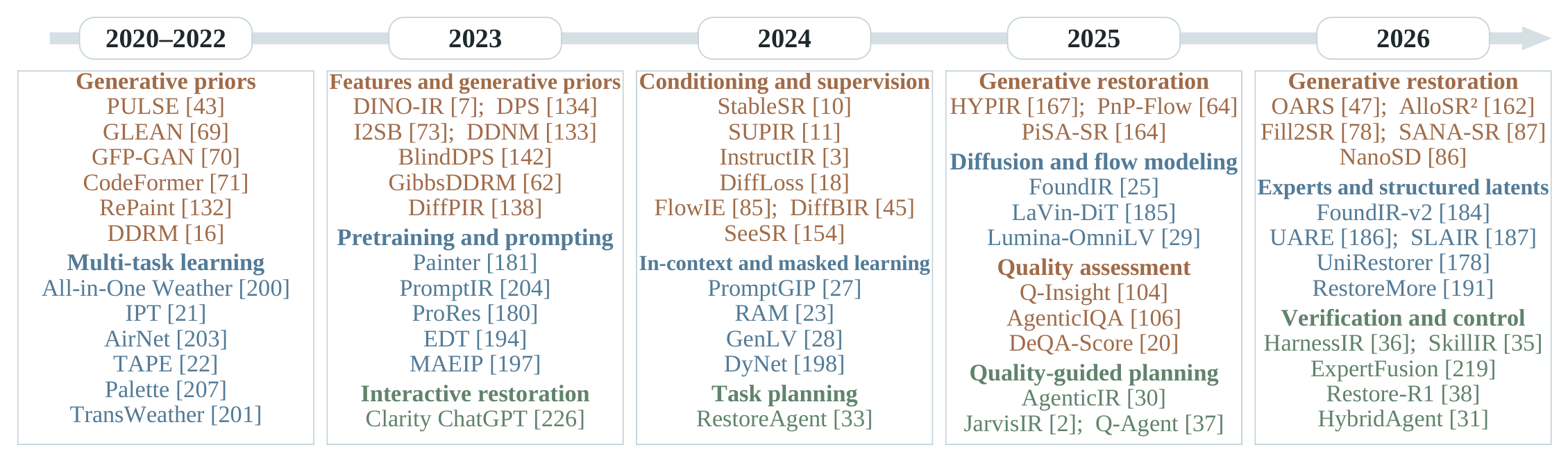
Figure 2.
Taxonomy of image restoration methods in the foundation model era.
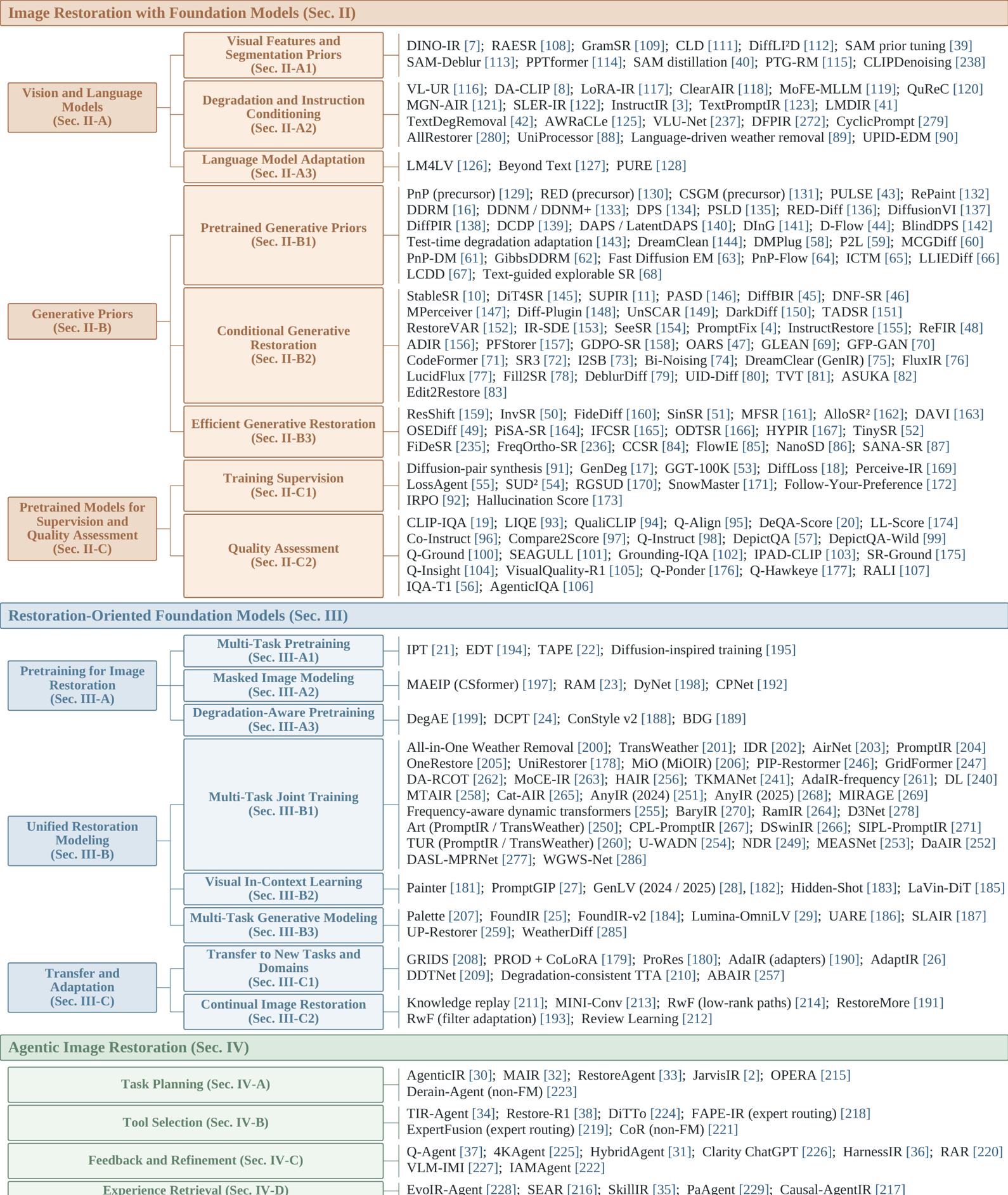
Figure 3.
Representative mechanisms for (A) restoration with foundation models, (B) restoration-oriented foundation models, and (C) agentic restoration.
Figure 3.
Representative mechanisms for (A) restoration with foundation models, (B) restoration-oriented foundation models, and (C) agentic restoration.
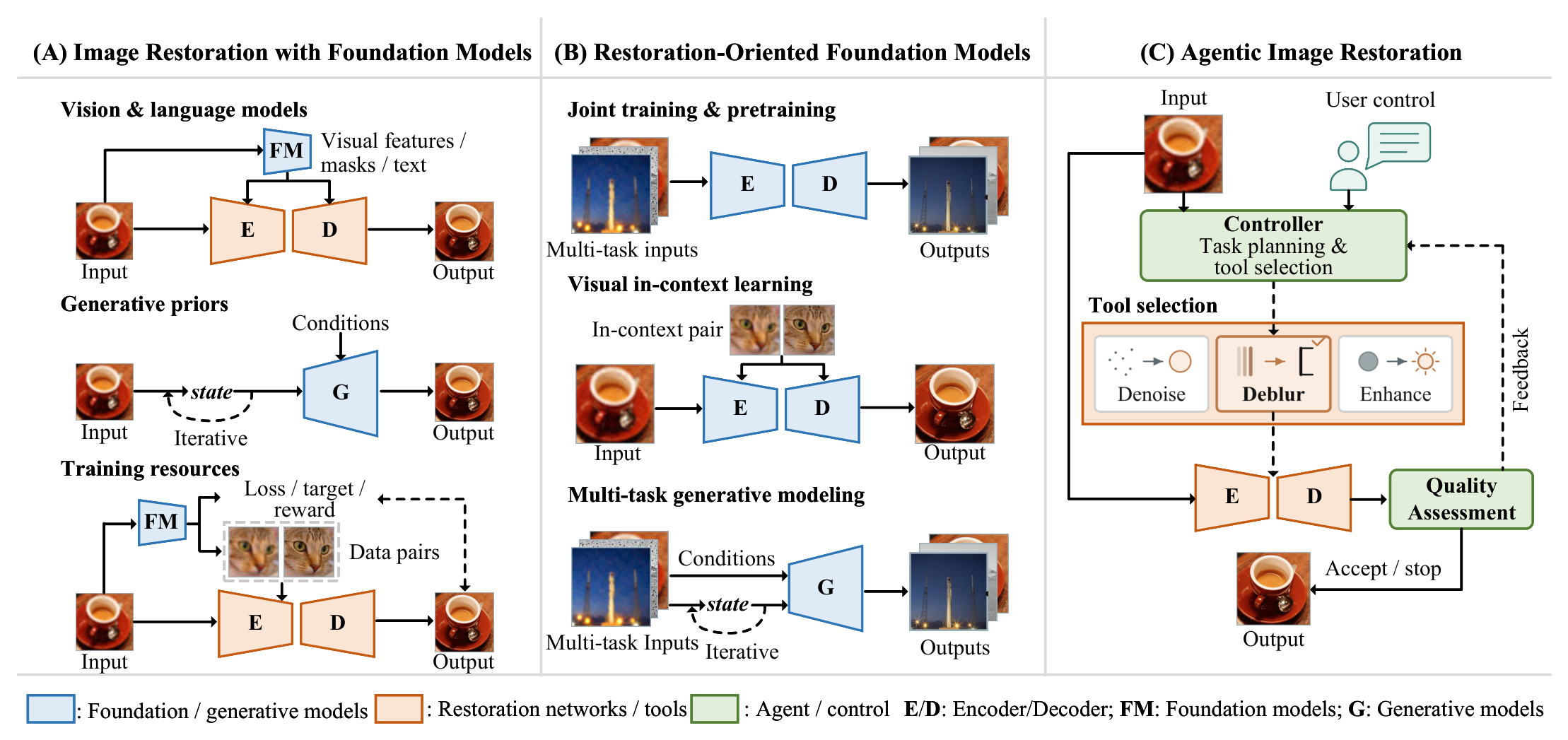
Table 1.
Representative methods that use foundation models for image restoration.
| Method | FM / Backbone | Role in restoration | Guidance information |
|---|---|---|---|
| DINO-IR [7] | DINOv2 | Semantic guidance | Multiscale DINOv2 features |
| SAM priors [39] | SAM + restorer | Segmentation guidance | SAM masks |
| SAM distillation [40] | SAM + teacher restorer | Semantic-prior distillation | SAM masks (training only) |
| DA-CLIP [8] | CLIP ViT-B/32 | Image conditioning | Content and degradation embeddings |
| InstructIR [3] | BGE + NAFNet | Instruction-guided restoration | Natural-language instructions |
| LMDIR [41] | GPT-4o + CLIP + SDXL | Reference-guided restoration | Content, degradation text, and references |
| TextDegRemoval [42] | CLIP + Stable Diffusion | Guidance-image generation | Restored text embeddings |
| DDRM [16] | ADM or DDPM | Posterior sampling | Measurements, linear operator, and noise |
| PULSE [43] | StyleGAN | Latent optimization | LR observation and downscaling loss |
| D-Flow [44] | Cond-OT or latent T2I flow | Controlled generation | Measurements and class or text conditions |
| DiffBIR [45] | Stable Diffusion 2.1 | Conditional restoration | Pre-restored image and IRControlNet |
| DNF-SR [46] | FLUX-Kontext | Generative super-resolution | LR latents, noisy LR latents, and captions |
| OARS [47] | Qwen-Image-Edit | Generative super-resolution | LR image and enhanced prompt |
| ReFIR [48] | SD2 or SDXL | Retrieval-guided restoration | LQ image and retrieved HQ references |
| OSEDiff [49] | Stable Diffusion 2.1 | One-step super-resolution | LQ latent and degradation prompts |
| InvSR [50] | SD-Turbo | Generative super-resolution | LR-derived initialization and fixed prompt |
| SinSR [51] | ResShift teacher | Restoration distillation | LR image and perturbed latent (training) |
| TinySR [52] | SD3 + VAE | Generative super-resolution | LR latent |
| GGT-100K [53] | Nano Banana 2 + Gemini | Training-target generation | LQ image and adaptive prompt |
| DiffLoss [18] | ImageNet ADM | Diffusion-based supervision | Noised restored and reference images |
| SUD2 [54] | CelebAMask-HQ DDPM | Pseudo-target generation | Noised reconstructions (training) |
| LossAgent [55] | Llama-3-8B-Instruct | Loss-weight optimization | Feedback and weight history (training) |
| CLIP-IQA [19] | CLIP | No-reference assessment | Image and antonym prompts |
| DeQA-Score [20] | mPLUG-Owl2 | No-reference assessment | Image and quality question |
| IQA-T1 [56] | Qwen3-VL-4B | No-reference assessment | Image and tool-generated evidence |
| DepictQA [57] | CLIP + Vicuna-7B | Description and comparison | Images, question, and optional reference |
| DMPlug [58] | Diffusion prior | Initial-noise optimization | Measurements and forward operator |
| P2L [59] | Latent diffusion prior | Prompt and latent optimization | Measurements and continuous text conditions |
| MCGDiff [60] | Diffusion prior | Sequential Monte Carlo | Linear measurements and particle weights |
| PnP-DM [61] | Diffusion prior | Split Gibbs sampling | Likelihood and denoising conditionals |
| GibbsDDRM [62] | Image diffusion prior | Blind inverse problems | Linear measurements and operator prior |
| Fast Diffusion EM [63] | Diffusion + kernel denoiser | Monte Carlo EM | Measurements and learned kernel prior |
| PnP-Flow [64] | Flow-matching prior | Plug-and-play restoration | Forward model and time schedule |
| ICTM [65] | Flow prior | Trajectory matching | Linear measurements and local objectives |
| LLIEDiff [66] | Stable Diffusion | Low-light posterior sampling | Illumination and measurement constraints |
| LCDD [67] | Image diffusion prior | Controllable denoising | Noise level and endpoint blending weight |
| Text-guided explorable SR [68] | Generative priors | Explorable super-resolution | LR observation, operator, and text |
| GLEAN [69] | GAN latent bank | Conditional reconstruction | LR features and latent-bank features |
| GFP-GAN [70] | Pretrained face GAN | Blind face restoration | Restoration features and facial prior |
| CodeFormer [71] | Facial codebook | Code prediction | LQ tokens and fidelity control |
| SR3 [72] | Task-trained diffusion | Iterative refinement | LR image |
| I2SB [73] | Task-trained diffusion bridge | Schrödinger bridge | Paired training boundaries and degraded input |
| Bi-Noising [74] | Conditional diffusion + prior | Re-noising and refinement | Task condition and unconditional prior |
| DreamClear [75] | PixArt- + ControlFormer | Conditional restoration | LQ image, pre-restored proxy, and caption |
| FluxIR [76] | FLUX + MM-DiT adapter | Conditioning adaptation | Degraded latent and embedding offsets |
| LucidFlux [77] | FLUX.1 + SigLIP | Caption-free conditioning | LQ image, proxy, and fixed instruction |
| Fill2SR [78] | FLUX-Fill + LoRA | Inpainting-based SR | LQ latent and full mask (Redux optional) |
| DeblurDiff [79] | Stable Diffusion + control | Adaptive convolution | Spatially varying latent kernels |
| UID-Diff [80] | Stable Diffusion + Q-Formers | Deblurring adaptation | Structure and blur representations |
| TVT [81] | Adapted VAE + diffusion U-Net | Fine-structure preservation | Compatible -compression latents |
| ASUKA [82] | MAE + inpainting generator | Image inpainting | Known pixels and MAE reconstruction features |
| Edit2Restore [83] | FLUX.1 Kontext + LoRA | Few-shot adaptation | Task prompts and degraded images |
| CCSR [84] | Stable Diffusion + ControlNet | Content refinement | LQ image and trained decoder refinement |
| FlowIE [85] | Adapted diffusion U-Net | Conditional rectified flow | Preliminary restoration and spatial controls |
| NanoSD [86] | Compressed SD1.5 + VAE | Generative backbone | Distillation and hardware profiling (training) |
| SANA-SR [87] | Autoencoder + LinearDiT | One-step restoration | Image latents and prompt-aware pruning |
| UniProcessor [88] | Q-Former + text encoder | Instruction-guided processing | Subject and manipulation prompts |
| Language-driven weather removal [89] | VLM + convolutional experts | Expert selection | Weather type and severity |
| UPID-EDM [90] | CLIP + clean-domain diffusion | Energy-informed deraining | Domain prompts and content energies |
| Diffusion-pair synthesis [91] | Real-LQ-trained DDPM | Training-pair synthesis | Clean image and simulated degradation |
| IRPO [92] | AdaIR + Qwen-VL | GRPO post-training | Expert and task rewards with paired targets |
| LIQE [93] | Adapted CLIP | Quality scoring | Scene, distortion, and quality templates |
| QualiCLIP [94] | Adapted CLIP | Opinion-unaware alignment | Image and quality-antonym prompts |
| Q-Align [95] | Multimodal language model | Quality-level prediction | Image and text-defined rating levels |
| Co-Instruct [96] | Instruction-tuned MLLM | Quality comparison | Candidate images and comparison query |
| Compare2Score [97] | Adapted MLLM | Comparison-based scoring | Image and quality-scale anchors |
| Q-Instruct [98] | Instruction-tuned MLLM | Visual question answering | Image and appearance query |
| DepictQA-Wild [99] | Adapted multimodal model | Descriptive assessment | Image, query, and optional reference |
| Q-Ground [100] | MLLM + mask decoder | Quality grounding | Image and quality text |
| SEAGULL [101] | Vision-language ROI model | Region quality assessment | Image and region mask |
| Grounding-IQA [102] | Multimodal language model | Localized quality assessment | Image and local quality question |
| IPAD-CLIP [103] | Adapted CLIP | Local artifact detection | Image and artifact-aware features |
| Q-Insight [104] | RL-adapted MLLM | IQA and degradation perception | Image and quality query |
| VisualQuality-R1 [105] | RL-adapted MLLM | Quality ranking | Image and assessment prompt |
| AgenticIQA [106] | Adapted MLLM + IQA tools | Assessment orchestration | Image, query, and optional reference |
| RALI [107] | Image encoder | Quality prediction | Reasoning-aligned image features |
Table 2.
Representative restoration-oriented foundation models and learning designs.
| Method | FM / Backbone | Role in restoration | Guidance information |
|---|---|---|---|
| IPT [21] | Transformer + task heads | Multi-task pretraining | Degraded image and task embedding |
| UniRestorer [178] | DA-CLIP + restoration experts | Expert selection and restoration | Degradation and granularity estimates |
| PROD + CoLoRA [179] | NAFNet or Restormer | Restoration adaptation | Degraded image |
| ProRes [180] | MAE ViT-L + decoder | Prompt-conditioned restoration | Image and degradation-aware visual prompt |
| Painter [181] | ViT-L | In-context prediction | Query and input-output example pair |
| GenLV [28,182] | X-Restormer + prompt encoder | In-context restoration | Query and input-output example pair |
| Hidden-Shot [183] | Painter or MAE + CLIP | In-context prediction | Query, example pair, and task text |
| FoundIR [25] | Diffusion generalist + specialists | Degradation removal and refinement | Degraded image and generalist output |
| FoundIR-v2 [184] | SDXL soft-MoE | Task-adaptive restoration | LQ features and noisy target latents |
| Lumina-OmniLV [29] | Lumina-Next | Unified low-level generation | Degraded image and text instruction |
| LaVin-DiT [185] | Spatiotemporal VAE + DiT | In-context image and video generation | Query and input-target context pairs |
| UARE [186] | BAGEL dual experts | Quality-guided image generation | Image, instruction, and quality-analysis tokens |
| SLAIR [187] | Structured VAE + latent flow | Latent-space restoration | Degraded-image latent |
| DCPT [24] | Restorer + ResNet18 | Encoder pretraining | Degraded image and degradation labels |
| ConStyle v2 [188] | ConStyle CNN + restorer | Clean visual prompt extraction | Degraded image and clean visual prompts |
| BDG [189] | ImageNet U-Net or SD2 | Degradation-aware pretraining | LQ image or latent |
| AdaIR [190] | Restormer + adapters | Restoration adaptation | Degraded image |
| RestoreMore [191] | Restorer + residual experts | Continual restoration | Degraded-image features for routing |
| CPNet [192] | Parallel transformer encoders | Context-aware pretraining | Masked reconstruction and mixed-image separation |
| Filter-level RwF [193] | Restorer + filter generators | Filter-level continual restoration | Filter attribution and task prototypes |
Table 3.
Representative restoration agents and related control mechanisms.
| Method | FM / Backbone | Role in restoration | Guidance information |
|---|---|---|---|
| AgenticIR [30] | GPT-4 + DepictQA + tools | Scheduling and quality assessment | Degradation reports and trial summaries |
| Q-Agent [37] | Qwen2-VL-7B + tools | Perception and greedy selection | Images and no-reference quality scores |
| RestoreAgent [33] | LLaVA-Llama3-8B + tools | Task sequencing and model selection | Image, prompt, and execution history |
| Restore-R1 [38] | CLIP actor–critic | Sequential tool selection | Current image and action record |
| OPERA [215] | VisualQuality-R1 + tools | Restoration planning | Image and tool-list prompt |
| SEAR [216] | GPT-4o + DepictQA + tools | Trajectory retrieval and search | Degradation profile, memory, and IQA scores |
| SkillIR [35] | GPT-4o + DepictQA + tools | Tool selection and verification | Residual degradations, skills, and feedback |
| Causal-AgentIR [217] | GPT-4o + DepictQA + tools | Memory-guided planning and critique | Image, instruction, and memory graph |
| HarnessIR [36] | Gemini + image editors | Prompt composition and verification | Image, request, and tool evidence |
| FAPE-IR [218] | Qwen2.5-VL + FLUX | Restoration expert routing | Image, instruction, and frequency features |
| ExpertFusion [219] | VLM + diffusion LoRAs | Expert LoRA allocation | Image and user-intent features |
| RAR [220] | DepictQA + SD3.5 | Latent assessment and restoration | Image latents and quality embeddings |
| CoR [221] | MobileNetV3 + restorer | Task selection and stopping | Current degradation probabilities |
| IAMAgent [222] | LLM manager + specialist agents | Multi-agent coordination | User commands, human feedback, and critique |
Table 4.
Single-task generative super-resolution results on RealSR and DRealSR. We report PSNR (↑), LPIPS (↓), MUSIQ (↑), and CLIP-IQA (↑). `–’ marks an unavailable value. IFCSR uses with one sampling step per endpoint. # Steps denotes the number of sampling steps. # Params. includes the inference components. For methods with unclear configurations, we report the approximate parameter count of the restoration backbone.
Table 4.
Single-task generative super-resolution results on RealSR and DRealSR. We report PSNR (↑), LPIPS (↓), MUSIQ (↑), and CLIP-IQA (↑). `–’ marks an unavailable value. IFCSR uses with one sampling step per endpoint. # Steps denotes the number of sampling steps. # Params. includes the inference components. For methods with unclear configurations, we report the approximate parameter count of the restoration backbone.
| Method | Publication | RealSR | DRealSR | # Steps | # Params | Key Features | ||||||
|---|---|---|---|---|---|---|---|---|---|---|---|---|
| PSNR | LPIPS | MUSIQ | CLIP-IQA | PSNR | LPIPS | MUSIQ | CLIP-IQA | |||||
| ResShift [159] | NeurIPS 2023 | 26.31 | 0.3489 | 58.10 | 0.5450 | 28.45 | 0.4073 | 49.86 | 0.5259 | 15 | 180M | Residual-shifting diffusion |
| DiffBIR [45] | ECCV 2024 | 24.88 | 0.3567 | 64.66 | 0.6412 | 26.84 | 0.4446 | 60.68 | 0.6292 | 50 | 1680M | IRControlNet-conditioned SD |
| OSEDiff [49] | NeurIPS 2024 | 25.15 | 0.2921 | 69.09 | 0.6693 | 27.92 | 0.2968 | 64.65 | 0.6963 | 1 | 1770M | Variational score distillation |
| PASD [146] | ECCV 2024 | 25.22 | 0.3392 | 68.74 | 0.6502 | 27.48 | 0.3854 | 64.55 | 0.6714 | 20 | 2310M | Pixel-aware SD cross-attention |
| SeeSR [154] | CVPR 2024 | 25.33 | 0.2985 | 69.37 | 0.6594 | 28.26 | 0.3197 | 64.84 | 0.6672 | 50 | 2510M | Hard and soft prompts |
| SinSR [51] | CVPR 2024 | 26.30 | 0.3212 | 60.41 | 0.6204 | 28.41 | 0.3741 | 55.34 | 0.6367 | 1 | 180M | ResShift distillation |
| StableSR [10] | IJCV 2024 | 24.69 | 0.3091 | 65.42 | 0.6195 | 28.04 | 0.3354 | 58.50 | 0.6171 | 200 | 1560M | SD with time-aware encoder |
| PiSA-SR [164] | CVPR 2025 | 25.50 | 0.2672 | 70.15 | 0.6702 | 28.31 | 0.2960 | 66.11 | 0.6970 | 1 | 1300M | Pixel- and semantic-level LoRAs |
| AlloSR2 [162] | ECCV 2026 | 24.97 | 0.2755 | 70.11 | 0.6750 | 27.95 | 0.2989 | 66.95 | 0.6883 | 1 | M | Allomorphic trajectory matching |
| DNF-SR [46] | CVPR 2026 | 24.97 | 0.3239 | 72.04 | 0.7257 | 28.14 | 0.3531 | 68.73 | 0.7559 | 1 | M | Dual-input FLUX-Kontext |
| FiDeSR [235] | CVPR 2026 | 26.02 | 0.2626 | 69.82 | 0.6896 | 28.90 | 0.2836 | 65.78 | 0.6974 | 1 | 1290M | SD latent residual refinement |
| FreqOrtho-SR [236] | ECCV 2026 | 26.27 | 0.2537 | 69.39 | 0.6630 | 29.08 | 0.2799 | 65.89 | 0.6879 | 1 | 1300M | Frequency-guided LoRAs + OGP |
| GDPO-SR [158] | CVPR 2026 | 25.48 | 0.2675 | 69.42 | 0.6760 | 28.18 | 0.2851 | 65.63 | 0.7020 | 1 | 1770M | Group DPO |
| GramSR [109] | ICPR 2026 | 26.81 | 0.2305 | – | – | 29.69 | 0.2603 | – | – | – | M | DINOv3 conditioning |
| IFCSR [165] | CVPR 2026 | 25.14 | 0.2866 | 69.68 | 0.6522 | 27.60 | 0.3278 | 66.57 | 0.7149 | 1300M | Endpoint image blending | |
| ODTSR [166] | CVPR 2026 | 25.07 | 0.2398 | 68.29 | – | 28.14 | 0.2592 | 62.86 | – | 1 | M | Noise-hybrid visual stream |
| TADSR [151] | CVPR 2026 | 25.17 | 0.3168 | 71.18 | 0.7283 | 28.39 | 0.3235 | 67.02 | 0.7398 | 1 | M | Time-aware SD VAE encoder |
| TinySR [52] | CVPRF 2026 | 24.79 | 0.2806 | 69.78 | 0.7035 | 27.48 | 0.3116 | 65.36 | 0.7094 | 1 | 341M | SD3 DiT pruning |
Table 5.
Image restoration results on FFHQ256 and ImageNet256 with known degradation operators and noisy measurements. The degradation settings follow DAPS [140] and comprise (a) non-blind SR, (b) non-blind Gaussian deblurring, and (c) box or random inpainting. We report PSNR (↑) and LPIPS (↓). `–’ denotes an unavailable value. # Params. includes latent autoencoders where applicable.
Table 5.
Image restoration results on FFHQ256 and ImageNet256 with known degradation operators and noisy measurements. The degradation settings follow DAPS [140] and comprise (a) non-blind SR, (b) non-blind Gaussian deblurring, and (c) box or random inpainting. We report PSNR (↑) and LPIPS (↓). `–’ denotes an unavailable value. # Params. includes latent autoencoders where applicable.
| Method | Publication | (a) SR | (b) Deblurring | (c) Box | (c) Random | # Params | Key Features | ||||
|---|---|---|---|---|---|---|---|---|---|---|---|
| PSNR | LPIPS | PSNR | LPIPS | PSNR | LPIPS | PSNR | LPIPS | ||||
| FFHQ256 | |||||||||||
| DDRM [16] | NeurIPS 2022 | 26.58 | 0.2820 | 24.93 | 0.2390 | 22.26 | 0.2070 | – | – | – | SVD conditioning |
| DDNM [133] | ICLR 2023 | 28.03 | 0.1970 | 28.20 | 0.2160 | 24.47 | 0.2350 | 29.91 | 0.1210 | – | Range-space correction |
| DPS [134] | ICLR 2023 | 25.86 | 0.2690 | 25.87 | 0.2190 | 22.51 | 0.2090 | 25.46 | 0.2030 | 94M | Approximate likelihood guidance |
| DiffPIR [138] | CVPRW 2023 | 26.64 | 0.2600 | 27.36 | 0.2360 | – | – | – | – | 94M | HQS-guided diffusion sampling |
| PSLD [135] | NeurIPS 2023 | 24.35 | 0.2870 | 23.27 | 0.3160 | 24.22 | 0.1580 | 30.31 | 0.2210 | 329M | Latent gluing guidance |
| DAPS [140] | CVPR 2025 | 29.07 | 0.1770 | 29.19 | 0.1650 | 24.07 | 0.1330 | 31.12 | 0.0980 | 94M | Decoupled annealing |
| LatentDAPS [140] | CVPR 2025 | 27.48 | 0.1820 | 27.93 | 0.2340 | 23.99 | 0.1940 | 30.71 | 0.1410 | 329M | Latent decoupled annealing |
| DCDP [139] | ICCP 2026 | 28.66 | 0.1780 | 27.50 | 0.3040 | 23.89 | 0.1630 | 30.69 | 0.1420 | 94M | Decoupled data consistency and purification |
| ImageNet256 | |||||||||||
| DDRM [16] | NeurIPS 2022 | 22.62 | 0.3240 | 21.26 | 0.4430 | 18.63 | 0.2540 | – | – | 553M | SVD conditioning |
| DDNM [133] | ICLR 2023 | 23.96 | 0.4750 | 28.06 | 0.2780 | 21.64 | 0.3190 | 31.16 | 0.1910 | 553M | Range-space correction |
| DPS [134] | ICLR 2023 | 21.13 | 0.3610 | 20.31 | 0.3970 | 18.94 | 0.2570 | 23.52 | 0.2970 | 553M | Approximate likelihood guidance |
| DiffPIR [138] | CVPRW 2023 | 23.18 | 0.3710 | 22.80 | 0.3550 | – | – | – | – | 553M | HQS-guided diffusion sampling |
| PSLD [135] | NeurIPS 2023 | 25.42 | 0.3600 | 25.86 | 0.3900 | 20.10 | 0.4650 | 31.30 | 0.3370 | M | Latent gluing guidance |
| DAPS [140] | CVPR 2025 | 25.89 | 0.2760 | 26.15 | 0.2530 | 21.43 | 0.2140 | 28.44 | 0.1350 | 553M | Decoupled annealing |
| LatentDAPS [140] | CVPR 2025 | 25.06 | 0.2760 | 25.05 | 0.3450 | 17.19 | 0.3400 | 27.59 | 0.1640 | 457M | Latent decoupled annealing |
Table 6.
Single-task Gaussian denoising results on BSD68, CBSD68, and Urban100. We report PSNR (↑) and SSIM (↑). `–’ denotes an unavailable value. # Params. includes the inference components. For methods with unclear configurations, we report the approximate parameter count of the restoration backbone.
Table 6.
Single-task Gaussian denoising results on BSD68, CBSD68, and Urban100. We report PSNR (↑) and SSIM (↑). `–’ denotes an unavailable value. # Params. includes the inference components. For methods with unclear configurations, we report the approximate parameter count of the restoration backbone.
| Method | Publication | Test set | # Params | Key Features | ||||||
|---|---|---|---|---|---|---|---|---|---|---|
| PSNR | SSIM | PSNR | SSIM | PSNR | SSIM | |||||
| PromptIR [204] | NeurIPS 2023 | BSD68 | 34.34 | .938 | 31.71 | .897 | 28.49 | .813 | 36M | Input-conditioned prompts |
| DINO-IR [7] | arXiv 2023 | BSD68 | 34.34 | .943 | 31.72 | .903 | 28.46 | .821 | M | Multilayer DINOv2 fusion |
| VLU-Net [237] | CVPR 2025 | CBSD68 | 34.35 | – | 31.72 | – | 28.46 | – | M | CLIP-guided unfolding |
| Perceive-IR [169] | TIP 2026 | CBSD68 | 34.38 | – | 31.74 | – | 28.53 | – | M | CLIP loss, DINOv2 guidance |
| ClearAIR [118] | AAAI 2026 | BSD68 | 34.39 | – | 31.73 | – | 28.52 | – | M | DeQA and SAM guidance |
| QuReC [120] | ACM MM 2026 | CBSD68 | 34.41 | .936 | 31.78 | .895 | 28.56 | .813 | 30M | CLIP prototype matching |
| PromptIR [204] | NeurIPS 2023 | Urban100 | 34.77 | .952 | 32.49 | .929 | 29.39 | .881 | 36M | Input-conditioned prompts |
| DINO-IR [7] | arXiv 2023 | Urban100 | 34.91 | .961 | 32.68 | .941 | 29.60 | .896 | M | Multilayer DINOv2 fusion |
| VLU-Net [237] | CVPR 2025 | Urban100 | 34.92 | – | 32.71 | – | 29.61 | – | M | CLIP-guided unfolding |
| Perceive-IR [169] | TIP 2026 | Urban100 | 34.86 | – | 32.55 | – | 29.42 | – | M | CLIP loss, DINOv2 guidance |
| ClearAIR [118] | AAAI 2026 | Urban100 | 34.84 | – | 32.54 | – | 29.41 | – | M | DeQA and SAM guidance |
| QuReC [120] | ACM MM 2026 | Urban100 | 35.08 | .952 | 32.91 | .931 | 29.93 | .888 | 30M | CLIP prototype matching |
Table 10.
Universal image restoration results under the three-task setting. We report PSNR (↑) and SSIM (↑). `–’ denotes an unavailable value. For most works, # Params. includes the inference components. For methods with unclear configurations, we report the approximate parameter count of the restoration backbone.
Table 10.
Universal image restoration results under the three-task setting. We report PSNR (↑) and SSIM (↑). `–’ denotes an unavailable value. For most works, # Params. includes the inference components. For methods with unclear configurations, we report the approximate parameter count of the restoration backbone.
| Method | Publication | Dehazing | Deraining | Denoising on CBSD68 | Average | # Params | Key Features | ||||||||
|---|---|---|---|---|---|---|---|---|---|---|---|---|---|---|---|
| SOTS | Rain100L | ||||||||||||||
| PSNR | SSIM | PSNR | SSIM | PSNR | SSIM | PSNR | SSIM | PSNR | SSIM | PSNR | SSIM | ||||
| DL [240] | TPAMI 2019 | 26.92 | .931 | 32.62 | .931 | 33.05 | .914 | 30.41 | .861 | 26.90 | .740 | 29.98 | .875 | 2M | Conditional weight generation |
| TKMANet [241] | CVPR 2022 | 30.41 | .973 | 34.94 | .972 | 33.02 | .924 | 30.31 | .820 | 23.80 | .556 | 30.50 | .849 | 29M | Two-stage knowledge learning |
| AirNet [203] | CVPR 2022 | 27.94 | .962 | 34.90 | .968 | 33.92 | .933 | 31.26 | .888 | 28.00 | .797 | 31.20 | .910 | 9M | Contrastive degradation cues |
| ADFNet [242] | AAAI 2023 | 28.13 | .961 | 34.24 | .965 | 33.76 | .929 | 30.83 | .871 | 27.75 | .793 | 30.94 | .904 | 8M | Dynamic filtering |
| DehazeFormer [243] | TIP 2023 | 29.58 | .970 | 35.37 | .969 | 33.01 | .914 | 30.14 | .858 | 27.37 | .779 | 31.09 | .898 | 25M | RescaleNorm, window attention |
| DRSformer [244] | CVPR 2023 | 29.02 | .968 | 35.89 | .970 | 33.28 | .921 | 30.55 | .862 | 27.58 | .786 | 31.26 | .901 | 34M | Sparse attention |
| FSNet [245] | TPAMI 2023 | 29.14 | .968 | 35.61 | .969 | 33.81 | .930 | 30.84 | .872 | 27.69 | .792 | 31.42 | .906 | 13M | Frequency selection |
| PIP-Restormer [246] | arXiv 2023 | 32.09 | .981 | 38.29 | .984 | 34.24 | .936 | 31.60 | .893 | 28.35 | .806 | 32.91 | .920 | 27M | Prompt-in-prompt learning |
| IDR [202] | CVPR 2023 | 29.87 | .970 | 36.03 | .971 | 33.89 | .931 | 31.32 | .884 | 28.04 | .798 | 31.83 | .911 | 15M | Ingredients-oriented prior hub |
| PromptIR [204] | NeurIPS 2023 | 30.58 | .974 | 36.37 | .972 | 33.98 | .933 | 31.31 | .888 | 28.06 | .799 | 32.06 | .913 | 36M | Input-conditioned prompts |
| GridFormer [247] | IJCV 2024 | 30.37 | .970 | 37.15 | .972 | 33.93 | .931 | 31.37 | .887 | 28.11 | .801 | 32.19 | .912 | 34M | Residual dense grid transformer |
| ProRes [180] | arXiv 2023 | 28.38 | .938 | 33.68 | .954 | 32.10 | .907 | 30.18 | .863 | 27.58 | .779 | 30.38 | .888 | 371M | Image-shaped input prompts |
| MambaIR [248] | ECCV 2024 | 29.57 | .970 | 35.42 | .969 | 33.88 | .931 | 30.95 | .874 | 27.74 | .793 | 31.51 | .907 | 27M | Residual state-space blocks |
| NDR [249] | TIP 2024 | 28.64 | .962 | 35.42 | .969 | 34.01 | .932 | 31.36 | .887 | 28.10 | .798 | 31.51 | .910 | 28M | Degradation dictionary queries |
| Art-PromptIR [250] | ACM MM 2024 | 30.83 | .979 | 37.94 | .982 | 34.06 | .934 | 31.42 | .891 | 28.14 | .801 | 32.48 | .917 | 36M | Active task reweighting |
| AnyIR (2024) [251] | arXiv 2024 | 31.38 | .979 | 37.90 | .981 | 33.95 | .933 | 31.29 | .889 | 28.03 | .797 | 32.51 | .916 | 6M | Local-global intertwining |
| DaAIR [252] | arXiv 2024 | 32.30 | .981 | 37.10 | .978 | 33.92 | .930 | 31.26 | .884 | 28.00 | .792 | 32.52 | .913 | 6M | Low-rank expert routing |
| MEASNet [253] | arXiv 2024 | 31.61 | .981 | 39.00 | .985 | 34.12 | .935 | 31.46 | .892 | 28.19 | .803 | 32.88 | .919 | 31M | Expert selection |
| U-WADN [254] | arXiv 2024 | 29.21 | .971 | 35.36 | .968 | 33.73 | .931 | 31.14 | .886 | 27.92 | .793 | 31.47 | .910 | 6M | Adaptive network width |
| Shi et al. [255] | arXiv 2024 | 29.20 | .972 | 37.50 | .980 | 34.59 | .941 | 31.83 | .900 | 28.46 | .814 | 32.32 | .921 | 32M | Frequency-aware transformers |
| HAIR [256] | arXiv 2024 | 30.98 | .979 | 38.59 | .983 | 34.16 | .935 | 31.51 | .892 | 28.24 | .803 | 32.70 | .918 | 29M | Classifier-guided hypernetwork |
| LoRA-IR [117] | arXiv 2024 | 30.68 | .961 | 37.75 | .979 | 34.06 | .935 | 31.42 | .891 | 28.18 | .803 | 32.42 | .914 | – | CLIP-routed low-rank experts |
| ABAIR-OH [257] | arXiv 2024 | 33.53 | .984 | 38.69 | .982 | 34.18 | .935 | 31.38 | .890 | 28.25 | .804 | 33.21 | .919 | M | One-hot LoRA routing |
| MTAIR [258] | arXiv 2024 | 31.34 | .983 | 39.15 | .984 | 34.14 | .936 | 31.50 | .893 | 28.24 | .805 | 32.87 | .920 | – | Spatial and channel prompts |
| InstructIR [3] | ECCV 2024 | 30.22 | .959 | 37.98 | .978 | 34.15 | .933 | 31.52 | .890 | 28.30 | .804 | 32.43 | .913 | M | BGE instruction guidance |
| DA-CLIP (IR-SDE) [8] | ICLR 2024 | 26.83 | .962 | 35.85 | .972 | 31.43 | .889 | 25.05 | .605 | 18.33 | .308 | 27.50 | .747 | 174M | CLIP content-degradation cues |
| DyNet-S [198] | arXiv 2024 | 30.80 | .980 | 38.02 | .982 | 34.07 | .935 | 31.41 | .892 | 28.15 | .802 | 32.49 | .918 | 16M | Shared-weight depth variants |
| DyNet-L [198] | arXiv 2024 | 31.34 | .980 | 38.69 | .983 | 34.09 | .935 | 31.43 | .892 | 28.18 | .803 | 32.75 | .919 | 16M | Shared-weight depth variants |
| UP-Restorer [259] | AAAI 2025 | 30.68 | .977 | 36.74 | .978 | 33.99 | .933 | 31.33 | .888 | 28.07 | .799 | 32.16 | .915 | 28M | Prompt-guided unrolling |
| TUR-PromptIR [260] | AAAI 2025 | 31.17 | .978 | 38.57 | .984 | 34.06 | .932 | 31.40 | .887 | 28.13 | .797 | 32.67 | .916 | 36M | Task uncertainty regularization |
| AdaIR (frequency) [261] | ICLR 2025 | 31.06 | .980 | 38.64 | .983 | 34.12 | .935 | 31.45 | .892 | 28.19 | .802 | 32.69 | .918 | 29M | Frequency modulation |
| DA-RCOT [262] | TPAMI 2025 | 31.26 | .977 | 38.36 | .983 | 33.98 | .934 | 31.33 | .890 | 28.10 | .801 | 32.61 | .917 | 50M | Residual-conditioned OT |
| MoCE-IR [263] | CVPR 2025 | 31.34 | .979 | 38.57 | .984 | 34.11 | .932 | 31.45 | .888 | 28.18 | .800 | 32.73 | .917 | 25M | Complexity experts |
| DCPT-PromptIR [24] | ICLR 2025 | 31.91 | .981 | 38.43 | .983 | 34.17 | .933 | 31.53 | .889 | 28.30 | .802 | 32.87 | .918 | 35M | Degradation classification (DCPT) |
| RamIR [264] | Appl. Intell. 2025 | 31.29 | .977 | 38.16 | .981 | 34.04 | .931 | 31.61 | .891 | 28.19 | .801 | 32.66 | .916 | 22M | Reasoning and action prompting |
| Cat-AIR [265] | arXiv 2025 | 31.49 | .980 | 38.43 | .983 | 34.11 | .935 | 31.44 | .892 | 28.14 | .803 | 32.72 | .919 | M | Content-adaptive attention |
| DSwinIR [266] | arXiv 2025 | 31.86 | .980 | 37.73 | .983 | 34.12 | .933 | 31.59 | .890 | 28.31 | .803 | 32.72 | .918 | 24M | DSwin attention |
| CPL-PromptIR [267] | arXiv 2025 | 31.27 | .980 | 38.77 | .985 | 34.15 | .933 | 31.50 | .889 | 28.23 | .800 | 32.78 | .917 | 36M | Contrastive prompt learning |
| AnyIR (2025) [268] | arXiv 2025 | 31.75 | .981 | 38.61 | .984 | 34.12 | .936 | 31.46 | .893 | 28.20 | .804 | 32.83 | .920 | 6M | Local-global gating |
| MIRAGE [269] | arXiv 2025 | 31.86 | .981 | 38.94 | .985 | 34.12 | .935 | 31.46 | .891 | 28.19 | .803 | 32.91 | .919 | 10M | Manifold contrastive learning |
| BaryIR [270] | arXiv 2025 | 31.33 | .980 | 38.95 | .984 | 34.16 | .935 | 31.54 | .892 | 28.25 | .802 | 32.85 | .919 | M | Optimal-transport barycenters |
| SIPL-PromptIR [271] | arXiv 2025 | 31.09 | .977 | 38.43 | .984 | 34.12 | .933 | 31.48 | .889 | 28.22 | .800 | 32.67 | .917 | 39M | Dictionary-guided refinement |
| TextPromptIR [123] | EAAI 2025 | 31.65 | .978 | 38.41 | .982 | 34.17 | .936 | 31.52 | .893 | 28.26 | .805 | 32.80 | .919 | 234M | BERT text guidance |
| VLU-Net [237] | CVPR 2025 | 30.71 | .980 | 38.93 | .984 | 34.13 | .935 | 31.48 | .892 | 28.23 | .804 | 32.70 | .919 | M | CLIP-guided unfolding |
| DFPIR [272] | CVPR 2025 | 31.87 | .980 | 38.65 | .982 | 34.14 | .935 | 31.47 | .893 | 28.25 | .806 | 32.88 | .919 | M | CLIP-guided feature perturbation |
| Perceive-IR [169] | TIP 2026 | 30.87 | .975 | 38.29 | .980 | 34.13 | .934 | 31.53 | .890 | 28.31 | .804 | 32.63 | .917 | M | CLIP loss, DINOv2 guidance |
| ClearAIR [118] | AAAI 2026 | 31.08 | .981 | 38.61 | .984 | 34.18 | .935 | 31.50 | .891 | 28.31 | .804 | 32.74 | .919 | M | DeQA and SAM 2 guidance |
| MoFE-MLLM [119] | arXiv 2026 | 32.13 | .982 | 38.34 | .983 | 34.23 | .938 | 31.61 | .896 | 28.39 | .812 | 32.94 | .922 | M | MLLM-guided frequency routing |
| QuReC [120] | ACM MM 2026 | 32.77 | .985 | 38.80 | .985 | 34.26 | .934 | 31.60 | .892 | 28.34 | .806 | 33.15 | .920 | 30M | CLIP prototype matching |
| MGN-AIR [121] | ACM MM 2026 | 33.21 | .987 | 39.62 | .986 | – | – | – | – | – | – | 33.17 | .915 | 34M | Pixel-wise restoration matrix |
| SLER-IR [122] | arXiv 2026 | 33.00 | .982 | 38.34 | .983 | 34.25 | .936 | 31.68 | .897 | 28.45 | .813 | 33.14 | .922 | – | CLIP-guided expert routing |
| UniRestorer [178] | ICLR 2026 | 36.44 | .984 | 41.68 | .996 | – | – | – | – | – | – | 34.48 | .958 | 627M | Multi-granularity expert routing |
Table 11.
Universal image restoration results under the five-task setting. We report PSNR (↑) and SSIM (↑). `–’ denotes an unavailable value. DCPT denotes degradation classification pre-training. For most works, # Params. includes the inference components. For methods with unclear configurations, we report the approximate parameter count of the restoration backbone.
Table 11.
Universal image restoration results under the five-task setting. We report PSNR (↑) and SSIM (↑). `–’ denotes an unavailable value. DCPT denotes degradation classification pre-training. For most works, # Params. includes the inference components. For methods with unclear configurations, we report the approximate parameter count of the restoration backbone.
| Method | Publication | Dehazing | Deraining | Denoising | Deblurring | Low-light | Average | # Params | Key Features | ||||||
|---|---|---|---|---|---|---|---|---|---|---|---|---|---|---|---|
| SOTS | Rain100L | BSD68 | GoPro | LOL | |||||||||||
| PSNR | SSIM | PSNR | SSIM | PSNR | SSIM | PSNR | SSIM | PSNR | SSIM | PSNR | SSIM | ||||
| DL [240] | TPAMI 2019 | 20.54 | .826 | 21.96 | .762 | 23.09 | .745 | 19.86 | .672 | 19.83 | .712 | 21.06 | .743 | 2M | Conditional weight generation |
| MIRNet-v2 [273] | TPAMI 2022 | 24.03 | .927 | 33.89 | .954 | 30.97 | .881 | 26.30 | .799 | 21.52 | .815 | 27.34 | .875 | 6M | Multi-scale residual blocks |
| DGUNet [274] | CVPR 2022 | 24.78 | .940 | 36.62 | .971 | 31.10 | .883 | 27.25 | .837 | 21.87 | .823 | 28.32 | .891 | 17M | Generalized unfolding |
| TransWeather [201] | CVPR 2022 | 21.32 | .885 | 29.43 | .905 | 29.00 | .841 | 25.12 | .757 | 21.21 | .792 | 25.22 | .836 | 38M | Weather queries |
| TAPE [22] | ECCV 2022 | 22.16 | .861 | 29.67 | .904 | 30.18 | .855 | 24.47 | .763 | 18.97 | .621 | 25.09 | .801 | 1M | Pseudo-clean prior queries |
| AirNet [203] | CVPR 2022 | 21.04 | .884 | 32.98 | .951 | 30.91 | .882 | 24.35 | .781 | 18.18 | .735 | 25.49 | .847 | 9M | Contrastive degradation cues |
| ADFNet [242] | AAAI 2023 | 24.18 | .928 | 32.97 | .943 | 31.15 | .882 | 25.79 | .781 | 21.15 | .823 | 27.05 | .871 | 8M | Dynamic filtering |
| DehazeFormer [243] | TIP 2023 | 25.31 | .937 | 33.68 | .954 | 30.89 | .880 | 25.93 | .785 | 21.31 | .819 | 27.42 | .875 | 25M | RescaleNorm, window attention |
| DRSformer [244] | CVPR 2023 | 24.66 | .931 | 33.45 | .953 | 30.97 | .881 | 25.56 | .780 | 21.77 | .821 | 27.28 | .873 | 34M | Sparse attention |
| HI-Diff [275] | NeurIPS 2023 | 25.09 | .935 | 33.26 | .951 | 30.61 | .878 | 26.48 | .800 | 22.01 | .870 | 27.49 | .887 | 24M | Latent diffusion priors |
| Retinexformer [276] | ICCV 2023 | 24.81 | .933 | 32.68 | .940 | 30.84 | .880 | 25.09 | .779 | 22.76 | .863 | 27.24 | .879 | 2M | Illumination-guided attention |
| FSNet [245] | TPAMI 2023 | 25.53 | .943 | 36.07 | .968 | 31.33 | .883 | 28.32 | .869 | 22.29 | .829 | 28.71 | .898 | 13M | Frequency selection |
| IDR [202] | CVPR 2023 | 25.24 | .943 | 35.63 | .965 | 31.60 | .887 | 27.87 | .846 | 21.34 | .826 | 28.34 | .893 | 15M | Ingredients-oriented prior hub |
| PIP-Restormer [246] | arXiv 2023 | 32.11 | .979 | 38.09 | .983 | 30.94 | .877 | 28.61 | .861 | 24.06 | .859 | 30.76 | .912 | 27M | Prompt-in-prompt learning |
| PromptIR [204] | NeurIPS 2023 | 26.54 | .949 | 36.37 | .970 | 31.47 | .886 | 28.71 | .881 | 22.68 | .832 | 29.15 | .904 | 36M | Input-conditioned prompts |
| DASL-MPRNet [277] | arXiv 2023 | 25.82 | .947 | 38.02 | .980 | 31.57 | .890 | 26.91 | .823 | 20.96 | .826 | 28.66 | .893 | 15M | SVD-inspired operators |
| GridFormer [247] | IJCV 2024 | 26.79 | .951 | 36.61 | .971 | 31.45 | .885 | 29.22 | .884 | 22.59 | .831 | 29.33 | .904 | 34M | Residual dense grid transformer |
| MambaIR [248] | ECCV 2024 | 25.81 | .944 | 36.55 | .971 | 31.41 | .884 | 28.61 | .875 | 22.49 | .832 | 28.97 | .901 | 27M | Residual state-space blocks |
| Art-Transweather [250] | ACM MM 2024 | 29.93 | .908 | 22.09 | .891 | 29.43 | .843 | 25.61 | .776 | 21.99 | .811 | 25.81 | .846 | 38M | Active task reweighting |
| DaAIR [252] | arXiv 2024 | 31.97 | .980 | 36.28 | .975 | 31.07 | .878 | 29.51 | .890 | 22.38 | .825 | 30.24 | .910 | 6M | Low-rank expert routing |
| AnyIR-2024 [251] | arXiv 2024 | 29.84 | .977 | 36.91 | .977 | 31.15 | .882 | 26.86 | .822 | 23.50 | .845 | 29.65 | .901 | 6M | Local-global intertwining |
| MEASNet [253] | arXiv 2024 | 31.05 | .980 | 38.32 | .982 | 31.40 | .888 | 29.41 | .890 | 23.00 | .845 | 30.64 | .917 | 31M | Expert selection |
| HAIR [256] | arXiv 2024 | 30.62 | .978 | 38.11 | .981 | 31.49 | .891 | 28.52 | .874 | 23.12 | .847 | 30.37 | .914 | 29M | Classifier-guided hypernetwork |
| ABAIR [257] | arXiv 2024 | 33.46 | .983 | 38.18 | .983 | 31.38 | .898 | 29.00 | .878 | 24.20 | .865 | 31.24 | .921 | M | Low-rank adapter routing |
| InstructIR [3] | ECCV 2024 | 27.10 | .956 | 36.84 | .973 | 31.40 | .887 | 29.40 | .886 | 23.00 | .836 | 29.55 | .908 | M | BGE instruction guidance |
| TUR-TransWeather [260] | AAAI 2025 | 29.68 | .966 | 33.09 | .952 | 30.40 | .869 | 26.63 | .815 | 23.02 | .838 | 28.56 | .888 | 38M | Task uncertainty regularization |
| AdaIR-frequency [261] | ICLR 2025 | 30.53 | .978 | 38.02 | .981 | 31.35 | .889 | 28.12 | .858 | 23.00 | .845 | 30.20 | .910 | 29M | Frequency modulation |
| DA-RCOT [262] | TPAMI 2025 | 30.96 | .975 | 37.87 | .980 | 31.23 | .888 | 28.68 | .872 | 23.25 | .836 | 30.40 | .910 | 50M | Residual-conditioned OT |
| MoCE-IR [263] | CVPR 2025 | 30.48 | .974 | 38.04 | .982 | 31.34 | .887 | 30.05 | .899 | 23.00 | .852 | 30.58 | .919 | 25M | Complexity experts |
| DCPT-PromptIR [24] | ICLR 2025 | 30.72 | .977 | 37.32 | .978 | 31.32 | .885 | 28.84 | .877 | 23.35 | .840 | 30.31 | .911 | 35M | Degradation classification (DCPT) |
| RamIR [264] | Appl. Intell. 2025 | 31.09 | .979 | 37.56 | .979 | 31.44 | .886 | 28.82 | .878 | 22.02 | .828 | 30.19 | .910 | 22M | Reasoning and action prompting |
| D3Net [278] | arXiv 2025 | 32.57 | .965 | 38.35 | .973 | 31.73 | .860 | 32.70 | .851 | 26.49 | .857 | 32.37 | .901 | 38M | Dynamic decomposition |
| Cat-AIR [265] | arXiv 2025 | 30.88 | .978 | 38.21 | .982 | 31.38 | .890 | 28.91 | .876 | 23.46 | .848 | 30.57 | .915 | M | Content-adaptive attention |
| DSwinIR [266] | arXiv 2025 | 30.09 | .975 | 37.77 | .982 | 31.34 | .885 | 29.17 | .879 | 22.64 | .843 | 30.20 | .913 | 24M | DSwin attention |
| CPL-PromptIR [267] | arXiv 2025 | 30.82 | .978 | 38.20 | .983 | 31.41 | .887 | 28.72 | .874 | 23.65 | .855 | 30.56 | .915 | 36M | Contrastive prompt learning |
| AnyIR-2025 [268] | arXiv 2025 | 31.41 | .980 | 38.51 | .983 | 31.37 | .891 | 28.85 | .883 | 23.11 | .856 | 30.65 | .919 | 6M | Local-global gating |
| MIRAGE [269] | arXiv 2025 | 31.45 | .980 | 38.92 | .985 | 31.41 | .892 | 28.10 | .858 | 23.59 | .858 | 30.69 | .915 | 10M | Manifold contrastive learning |
| BaryIR [270] | arXiv 2025 | 31.12 | .976 | 38.05 | .981 | 31.43 | .891 | 29.30 | .888 | 23.38 | .852 | 30.66 | .918 | M | Optimal-transport barycenters |
| VLU-Net [237] | CVPR 2025 | 30.84 | .980 | 38.54 | .982 | 31.43 | .891 | 27.46 | .840 | 22.29 | .833 | 30.11 | .905 | M | CLIP-guided unfolding |
| DFPIR [272] | CVPR 2025 | 31.64 | .979 | 37.62 | .978 | 31.29 | .889 | 28.82 | .873 | 23.82 | .843 | 30.64 | .912 | M | CLIP-guided feature perturbation |
| CyclicPrompt [279] | TIP 2025 | 33.02 | .983 | 37.03 | .989 | 31.33 | .941 | 29.42 | .925 | 21.79 | .837 | 30.52 | .935 | M | Cyclic CLIP prompting |
| DCPT-SwinIR [24] | ICLR 2025 | 28.67 | .973 | 35.70 | .974 | 31.16 | .882 | 26.42 | .807 | 20.38 | .836 | 28.47 | .894 | 11M | Degradation classification (DCPT) |
| DCPT-NAFNet [24] | ICLR 2025 | 29.47 | .971 | 35.68 | .973 | 31.31 | .886 | 29.22 | .883 | 23.52 | .855 | 29.84 | .914 | 68M | Degradation classification (DCPT) |
| DCPT-Restormer [24] | ICLR 2025 | 29.86 | .973 | 36.68 | .975 | 31.46 | .888 | 28.95 | .879 | 23.26 | .842 | 30.04 | .911 | 26M | Degradation classification (DCPT) |
| Perceive-IR [169] | TIP 2026 | 28.19 | .964 | 37.25 | .977 | 31.44 | .887 | 29.46 | .886 | 22.88 | .833 | 29.84 | .909 | M | CLIP loss, DINOv2 guidance |
| ClearAIR [118] | AAAI 2026 | 30.12 | .978 | 38.20 | .982 | 31.53 | .888 | 29.67 | .887 | 22.83 | .846 | 30.47 | .916 | M | DeQA and SAM 2 guidance |
| MoFE-MLLM [119] | arXiv 2026 | 32.16 | .981 | 37.86 | .982 | 31.56 | .895 | 32.23 | .932 | 23.40 | .866 | 31.44 | .931 | M | MLLM-guided frequency routing |
| QuReC [120] | ACM MM 2026 | 31.72 | .982 | 39.23 | .986 | 31.56 | .891 | 32.50 | .936 | 24.23 | .867 | 31.85 | .932 | 30M | CLIP prototype matching |
| MGN-AIR [121] | ACM MM 2026 | 31.74 | .982 | 39.47 | .986 | 31.12 | .884 | 31.18 | .917 | 23.67 | .862 | 31.44 | .926 | 34M | Pixel-wise restoration matrix |
| UniRestorer [178] | ICLR 2026 | 36.44 | .984 | 41.68 | .996 | 31.71 | .946 | 31.48 | .948 | 26.67 | .863 | 33.60 | .947 | 627M | Multi-granularity expert routing |
Table 12.
Universal restoration results on CDD-11 composite degradations. We report PSNR (↑) and SSIM (↑). `–’ denotes an unavailable value. Single-, Double-, and Triple-Deg. report means for one-, two-, and three-order composite degradation subsets. OneRestore uses automatically generated scene descriptors. For most works, # Params. includes the inference components. For methods with unclear configurations, we report the approximate parameter count of the restoration backbone.
Table 12.
Universal restoration results on CDD-11 composite degradations. We report PSNR (↑) and SSIM (↑). `–’ denotes an unavailable value. Single-, Double-, and Triple-Deg. report means for one-, two-, and three-order composite degradation subsets. OneRestore uses automatically generated scene descriptors. For most works, # Params. includes the inference components. For methods with unclear configurations, we report the approximate parameter count of the restoration backbone.
| Method | Publication | Single-Deg. Avg. | Double-Deg. Avg. | Triple-Deg. Avg. | Overall Avg. | # Params | Key Features | ||||
|---|---|---|---|---|---|---|---|---|---|---|---|
| PSNR | SSIM | PSNR | SSIM | PSNR | SSIM | PSNR | SSIM | ||||
| AirNet [203] | CVPR 2022 | 25.60 | .885 | 22.97 | .796 | 22.02 | .717 | 23.75 | .814 | 9M | Contrastive degradation cues |
| DGUNet [274] | CVPR 2022 | – | – | – | – | – | – | 26.92 | .856 | 17M | Generalized unfolding |
| MIRNet-v2 [273] | TPAMI 2022 | 28.46 | .912 | 24.11 | .818 | 22.35 | .719 | 25.37 | .834 | 6M | Multi-scale residual blocks |
| TransWeather [201] | CVPR 2022 | 24.94 | .860 | 22.42 | .764 | 21.28 | .667 | 23.13 | .781 | 22M | Weather queries |
| Fourmer [283] | ICML 2023 | 26.08 | .875 | 22.28 | .771 | 21.06 | .681 | 23.44 | .792 | 1M | Fourier spatial-channel modeling |
| PromptIR [204] | NeurIPS 2023 | 28.88 | .920 | 24.46 | .834 | 23.54 | .750 | 25.90 | .850 | 38M | Input-conditioned prompts |
| SRUDC [284] | ICCV 2023 | – | – | – | – | – | – | 27.64 | .860 | 7M | Scattering-guided dual branches |
| WeatherDiff [285] | TPAMI 2023 | 23.81 | .860 | 21.98 | .786 | 21.14 | .707 | 22.49 | .799 | 83M | Patch diffusion |
| WGWS-Net [286] | CVPR 2023 | 29.97 | .923 | 25.76 | .850 | 23.94 | .772 | 26.96 | .862 | 26M | Shared and specific features |
| CoR-HAIR [221] | arXiv 2024 | – | – | – | – | – | – | 28.33 | .869 | 30M | Discriminator-guided chaining |
| CoR-OneRestore [221] | arXiv 2024 | – | – | – | – | – | – | 28.84 | .879 | 8M | Discriminator-guided chaining |
| DA-CLIP-NAFNet [8] | ICLR 2024 | 32.29 | .926 | 27.35 | .859 | 23.14 | .732 | 28.38 | .860 | – | CLIP content-degradation cues |
| HAIR [256] | arXiv 2024 | – | – | – | – | – | – | 27.85 | .866 | 29M | Classifier-guided hypernetwork |
| InstructIR [3] | ECCV 2024 | 31.82 | .919 | 26.77 | .848 | 24.58 | .769 | 28.21 | .859 | – | BGE instruction guidance |
| OKNet [287] | AAAI 2024 | 29.31 | .926 | 25.16 | .844 | 23.31 | .762 | 26.33 | .859 | 5M | Omni-kernel network |
| OneRestore [205] | ECCV 2024 | 31.68 | .938 | 27.35 | .866 | 24.84 | .790 | 28.47 | .878 | M | Scene descriptors |
| DCPT-NAFNet [24] | ICLR 2025 | 34.50 | .947 | 29.33 | .881 | 26.32 | .806 | 30.66 | .891 | 68M | Degradation classification (DCPT) |
| MIRAGE-S [269] | arXiv 2025 | 32.79 | .944 | 28.00 | .875 | 25.73 | .800 | 29.33 | .886 | 10M | Manifold contrastive learning |
| MoCE-IR-S [263] | CVPR 2025 | 32.54 | .941 | 27.73 | .869 | 25.40 | .790 | 29.06 | .881 | 11M | Complexity experts |
| VL-UR [116] | arXiv 2025 | 31.97 | .938 | 27.59 | .868 | 25.25 | .791 | 28.76 | .879 | – | CLIP weather embeddings |
| AllRestorer [280] | TPAMI 2026 | – | – | – | – | – | – | 33.72 | .944 | 12M | CLIP scene descriptors |
| UniRestorer [178] | ICLR 2026 | 34.72 | .965 | 29.63 | .916 | 26.43 | .890 | 30.90 | .929 | 364M | Multi-granularity expert routing |
| MoFE-MLLM [119] | arXiv 2026 | 34.11 | .946 | 29.11 | .878 | 26.21 | .801 | 30.40 | .889 | M | MLLM frequency routing |
| QuReC [120] | ACM MM 2026 | 34.39 | .948 | 29.44 | .883 | 26.54 | .810 | 30.71 | .893 | 30M | CLIP prototype matching |
| MGN-AIR [121] | ACM MM 2026 | 34.57 | .946 | 29.09 | .879 | 26.21 | .802 | 30.56 | .889 | M | CLIP-conditioned pixel matrix |
Table 13.
Agentic image restoration results on MiO100. Groups A-C denote the MiO100 degradation subsets used in SkillIR [35]. We report PSNR (↑), LPIPS (↓), and MUSIQ (↑). `–’ denotes an unavailable value. OPERA, SEAR, and both HarnessIR variants report Y-channel PSNR. OPERA variants use planning-only optimization or joint planning-execution optimization. EvoIR-Agent uses the AgenticIR (I) or 4KAgent (II) tool pool with fidelity or perceptual preferences. For MiO100, HarnessIR reports MUSIQ rather than absolute MUSIQ, so its MUSIQ entries are omitted.
Table 13.
Agentic image restoration results on MiO100. Groups A-C denote the MiO100 degradation subsets used in SkillIR [35]. We report PSNR (↑), LPIPS (↓), and MUSIQ (↑). `–’ denotes an unavailable value. OPERA, SEAR, and both HarnessIR variants report Y-channel PSNR. OPERA variants use planning-only optimization or joint planning-execution optimization. EvoIR-Agent uses the AgenticIR (I) or 4KAgent (II) tool pool with fidelity or perceptual preferences. For MiO100, HarnessIR reports MUSIQ rather than absolute MUSIQ, so its MUSIQ entries are omitted.
| Method | Publication | MiO100 Group A | MiO100 Group B | MiO100 Group C | Key Features | ||||||
|---|---|---|---|---|---|---|---|---|---|---|---|
| PSNR | LPIPS | MUSIQ | PSNR | LPIPS | MUSIQ | PSNR | LPIPS | MUSIQ | |||
| MiOIR [206] | arXiv 2024 | 20.84 | 0.3715 | 47.82 | 20.56 | 0.3243 | 51.87 | 15.63 | 0.5376 | 37.95 | Sequential and prompt learning |
| 4KAgent [225] | NeurIPS 2025 | 21.48 | 0.3019 | 63.19 | 20.95 | 0.3017 | 62.69 | 19.77 | 0.4271 | 55.56 | Quality-driven MoE, reflection, rollback |
| AgenticIR [30] | ICLR 2025 | 21.04 | 0.3148 | 56.88 | 20.55 | 0.3072 | 57.57 | 18.82 | 0.4493 | 48.68 | Experience-guided scheduling and rollback |
| MAIR [32] | IJCV 2026 | 21.02 | 0.2963 | 59.19 | 20.92 | 0.2788 | 60.98 | 19.42 | 0.4142 | 51.36 | Three-stage, two-level multi-agent restoration |
| OPERA (planning) [215] | arXiv 2026 | 22.32 | 0.3300 | 59.34 | 22.28 | 0.3100 | 59.10 | 20.75 | 0.4700 | 49.91 | GRPO-trained planner, fixed tools |
| OPERA (joint) [215] | arXiv 2026 | 24.81 | 0.2300 | 57.84 | 24.63 | 0.2000 | 58.41 | 23.04 | 0.3000 | 51.27 | Joint planning–execution optimization |
| TIR-Agent [34] | ECCV 2026 | 22.07 | 0.2874 | 63.69 | 22.80 | 0.2725 | 65.24 | 19.53 | 0.4120 | 56.93 | Direct tool-calling policy, SFT then RL |
| EvoIR-Agent (I, fidelity) [228] | arXiv 2026 | 23.49 | 0.2840 | – | 23.41 | 0.2753 | – | 21.52 | 0.4108 | – | Experience retrieval, reflection, rollback |
| EvoIR-Agent (I, perceptual) | arXiv 2026 | – | – | 60.10 | – | – | 60.98 | – | – | 51.36 | Experience retrieval, reflection, rollback |
| EvoIR-Agent (II, fidelity) | arXiv 2026 | 23.86 | 0.3085 | 54.37 | 23.38 | 0.3117 | 53.28 | 22.12 | 0.4528 | 41.36 | Experience retrieval, reflection, rollback |
| EvoIR-Agent (II, perceptual) | arXiv 2026 | 22.31 | 0.2831 | 61.82 | 22.52 | 0.2694 | 61.96 | 20.69 | 0.4072 | 55.21 | Experience retrieval, reflection, rollback |
| SEAR [216] | ECCV 2026 | 21.80 | 0.3019 | 61.29 | 22.13 | 0.2890 | 60.65 | 20.61 | 0.4173 | 52.73 | Trajectory retrieval and pruning-aware MCTS |
| SkillIR [35] | arXiv 2026 | 22.39 | 0.2744 | 62.31 | 21.73 | 0.2655 | 62.60 | 20.59 | 0.4031 | 54.57 | Scene-aware skills, transition verification |
| HarnessIR-GPT [36] | arXiv 2026 | 20.19 | 0.2800 | – | 19.96 | 0.2800 | – | 18.95 | 0.3400 | – | Prompt composition and verified refinement |
| HarnessIR-NB2 [36] | arXiv 2026 | 22.45 | 0.2000 | – | 22.94 | 0.1900 | – | 21.23 | 0.2500 | – | Prompt composition and verified refinement |
Disclaimer/Publisher’s Note: The statements, opinions and data contained in all publications are solely those of the individual author(s) and contributor(s) and not of MDPI and/or the editor(s). MDPI and/or the editor(s) disclaim responsibility for any injury to people or property resulting from any ideas, methods, instructions or products referred to in the content. |
© 2026 by the authors. Licensee MDPI, Basel, Switzerland. This article is an open access article distributed under the terms and conditions of the Creative Commons Attribution (CC BY) license (http://creativecommons.org/licenses/by/4.0/).
Copyright: This open access article is published under a Creative Commons CC BY 4.0 license, which permit the free download, distribution, and reuse, provided that the author and preprint are cited in any reuse.