
Submitted:
17 November 2026
Posted:
18 November 2026
You are already at the latest version
Abstract
Background/Objectives: Pediatric intensive interdisciplinary pain treatment (IIPT) improves physical impairment and emotional functioning, yet only a few studies have examined outcomes more than a year after IIPT. Methods: Youth and young adults with a history of chronic pain (N = 77, reflecting a 49% response rate; mean age = 19.3; 86% female) completed questionnaires related to pain intensity, physical impairment, anxiety, and depression 2-6 years following completion of IIPT. Repeated measures ANOVAs (with post-hoc analyses) were conducted to compare long-term follow-up (LTFU) to pre-treatment and post-treatment clinical measures. Results: Youth who received IIPT reported significant improvements in pain intensity, physical impair-ment, and emotional functioning from pre-treatment to LTFU (p’s < .001). These participants made significant improvements in physical impairment, depression, and anxiety during treat-ment, with gains maintained to LTFU. Pain intensity improved during treatment and continued to improve significantly from post-treatment to LTFU. At LTFU the majority of participants re-ported that pain was improved after completing IIPT (77%), though only 57% considered pain to be resolved. Further, about 30-35% of individuals continued to report impairment, depression, and anxiety above a clinical threshold, and 55% of individuals reported average pain greater than 1/10 at LTFU. Conclusions: Overall, these results demonstrate that even highly impacted youth with chronic pain can make meaningful improvements, and that there is a continued need to ex-plore effective long-term supports for these youth as they transition into adulthood.
Keywords:
pediatric pain
; intensive interdisciplinary pain treatment
; long-term outcomes
; mental health
1. Introduction
Chronic or recurring pain occurs in around 20% of young people (Chambers et al., 2024) and affects physical functioning, family and social functioning, academics, and is bidirectionally related to mental health (Bateman et al., 2024; Dudeney et al., 2024). These changes can persist into adulthood, with young adults with a history of pain continuing to have poorer physical function, worse mental health, and greater medical utilization than young adults without a history of chronic pain (Kashikar-Zuck et al., 2014). Further, experiencing greater depressive symptoms over time is associated with worse physical functioning (Kashikar-Zuck et al., 2019). Multidisciplinary treatment can address these biopsychosocial factors, and when pain is causing significant impairment, intensive interdisciplinary pain treatment (IIPT) can lead to more rapid improvements (Simons et al., 2013). A meta-analysis of IIPT outcomes out to 12 months after treatment indicates potentially large improvements in pain intensity, disability, and school absences, and moderate improvements in anxiety and depression (Claus et al., 2022).
Although findings up to one year after IIPT are very promising, few studies have examined physical and emotional functioning more than one year after completion. For the studies that have, functional disability due to chronic pain remains significantly improved 4-7 years after treatment (Dogan, Zernikow, & Wager, 2021; Randall et al., 2018; Wager et al., 2021) and more than half of participants in one large-scale study were pain free 7 years after IIPT (Wager et al., 2021). Regarding function, young people with a history of IIPT have been shown to make developmentally appropriate progress in school, work, and independent living (Randall et al., 2018), though even after completing IIPT young adults with a history of chronic pain tend to have worse physical and mental health when compared to a matched community sample (Wager et al., 2021). Further, while depressive and anxiety symptoms were still improved from baseline, such improvements have been shown to attenuate by a 4-year follow-up (Dogan, Zernikow, & Wager, 2021).
The aim of the current study was to examine the maintenance of IIPT treatment gains 2-6 years after treatment completion (“long-term follow-up,” LTFU). Given previous research supporting the efficacy of IIPT (Claus et al., 2022; Dogan, Zernikow, & Wager, 2021; Randall et al., 2018; Wager et al., 2021), we hypothesized that pain intensity, functional disability, depressive symptoms, and anxiety symptoms would improve from pre-treatment to immediately post-treatment, and from pre-treatment to LTFU. Although there has been limited evaluation of the long-term maintenance of improvements in anxiety and depressive symptoms, we hypothesized that there would be no significant change from post-treatment to LTFU (i.e., treatment gains would be maintained). As a secondary purpose, we also sought to explore and describe overall functioning, impact of pain, and healthcare utilization in these older adolescents and young adults at LTFU.
2. Materials and Methods
2.1. Intensive Interdisciplinary Pain Treatment
Participants completed a pediatric outpatient intensive interdisciplinary pain treatment (IIPT) program at a large academic medical center in the Midwest of the United States between 2013 and 2017. Treatment was provided 8 hours per day, 5 days per week, with typical duration lasting 3 to 6 weeks. Treatment involved coordinated care by physical therapists, occupational therapists, psychologists, music and art therapists, yoga teachers, nurse practitioners, and physicians. As part of treatment, participants completed a set of clinically relevant measures at baseline, during the program, and at program completion.
2.2. Participants
A set of questionnaires was emailed in 3 subsequent years (2017, 2018, and 2019) to participants who had completed the program at least 2 years prior, who had indicated willingness to be contacted for future research, and who had not opted out of the study in a prior year. At the time of the final survey, 174 youth had started the program at least 2 years prior, 162 of them had completed the program (93%), and 158 had given permission to be contacted for future research (98% of program completers). Responses were received from 83 unique participants (53% of eligible participants); for participants who completed multiple time points, only their most distal data was used. Of the 83 respondents, 6 were excluded due to missing data: 3 missed most of the measures during follow-up surveys, and 3 were missing all or nearly all of the measures at pre-treatment and/or post-treatment. The study sample thus consisted of 77 youth and young adults (49% of eligible participants) with chronic pain who completed an IIPT program at least 2 years prior (M years since program completion = 3.9, SD = 1.3). Of the 77 participants, 14 (18%) had completed the program about 2 years prior, 18 (23%) 3 years prior, 19 (25%) 4 years prior, 15 (20%) 5 years prior, and 11 (14%) had completed the program 6 years prior.
2.3. Procedure
Past participants of the IIPT program were emailed a link to complete questionnaires 2-6 years following their completion of IIPT. This program routinely collects email addresses from parents and only occasionally from patients, so in most cases, the email was sent to parents with a request that they forward the invitation to the patient. These emails were sent annually for 3 subsequent years, and participants could complete multiple years, could decline to complete, or could opt out from future invitations. In addition to the questionnaires, we collected information from the medical record related to their treatment in IIPT as well as questionnaires at baseline and at completion of IIPT. The institutional review board approved the research activities for this study. Analyses were conducted with SPSS (version 29; IBM Corp, 2023).
2.4. Measures
2.4.1. Pain Intensity
Participants reported their average pain intensity over the past week on a 100mm visual analogue scale to measure pain levels from 0 (no pain) and 100 (worst pain you can imagine).
2.4.2. Functional Disability Inventory (FDI)
The FDI (Walker & Greene, 1991) is a well-established self-report measure that assesses impairments in physical functioning due to pain or other health conditions. Specifically, this 15-item measure examines the extent to which youth perceive difficulty engaging in daily and recreational activities and exercise over the past two weeks. Participants answered each item utilizing a 5-point scale that ranges from 0 (no trouble) to 4 (impossible) with higher scores suggesting greater impairment. The FDI has been widely utilized to examine functional disability in pediatric patients with chronic pain (e.g., Weiss et al., 2013) and has demonstrated acceptable reliability, test-retest reliability, and validity (Claar & Walker, 2006; Kashikar-Zuck et al., 2011). The FDI demonstrated good to excellent internal consistency in the current sample across time points (αpre-treatment= .88, αpost-treatment= .90, αfollow-up= .96).
2.4.3. Depression
Participants completed the Patient-Reported Outcomes Measurement Information System (PROMIS) Pediatric Depression Short Form v1.1 (Irwin et al., 2010) to assess cognitive and affective depressive symptoms. The PROMIS Depression Short Form is an 8-item self-report measure. For each item, participants rated how often in the past 7 days they experienced a particular symptom utilizing a 5-point frequency scale that ranges from 0 (never) to 4 (almost always). The PROMIS Depression Short Form has been shown to be reliable and valid for children and adolescents (Hitchon et al., 2020; Varni et al., 2014). This measure exhibited excellent internal consistency in the current sample at all three time points (αpre-treatment= .96, αpost-treatment= .96, αfollow-up= .98).
2.4.4. Anxiety
Participants also completed the PROMIS Pediatric Anxiety Short Form v1.1 (Irwin et al., 2010), which is an 8-item self-report measure of fear, worry, and hyperarousal. Participants rated how often in the past 7 days they experienced a certain symptom on a 5-point frequency scale that ranges from 0 (never) to 4 (almost always). The PROMIS Anxiety Short Form has been shown to be a reliable and valid measure for assessing anxiety symptoms in youth (Hitchon et al., 2020; Parkhurst et al., 2023) and exhibited excellent internal consistency in the current sample at all three time points (αpre-treatment= .92, αpost-treatment= .96, αfollow-up= .96).
2.4.5. Demographics and Descriptive Measures
In addition to the standardized questionnaires above, participants answered several questions about their health care utilization such as medication use and medical appointments (based on Kashikar-Zuck et al., 2014), as well as their current living situation, whether they felt pain was improved and/or resolved since completing IIPT, and how much pain was impacting their daily life. Participants’ age, gender, race/ethnicity, and information about pain distribution, pain duration, and treatment duration were obtained from the medical record.
2.5. Analysis Plan
Initial analyses compared participants who completed follow-up questionnaires to those who were otherwise eligible but did not complete questionnaires on demographics and clinical questionnaires. Four repeated-measures ANOVAs were conducted to compare average pain intensity, functional disability, depressive symptoms, and anxiety symptoms across three time points. Planned pairwise comparisons (Helmert contrasts) were utilized to compare ratings at the three timepoints: pre-treatment, post-treatment, and LTFU. Normality and sphericity were assessed for each variable. Each variable was found to be normally distributed; however, the sphericity assumption was violated for functional disability, average pain intensity, and anxiety. For these variables, the Greenhouse-Geisser corrected degrees of freedom are reported.
3. Results
3.1. Comparing Participants to Those Who Did Not Complete Questionnaires
Participants who completed long-term follow-up (LTFU) questionnaires were compared to those who did not complete LTFU questionnaires using a set of t-tests and chi-square analyses. There were no significant differences in gender, pain distribution (widespread vs. localized), pain duration, average pain intensity, depression, or anxiety at pre-treatment. There were also no significant differences in average pain intensity, impairment, or depression at treatment completion. Although not statistically significant, there was a trend such that those who completed LTFU questionnaires reported slightly greater functional impairment at pre-treatment (t(155) = 1.66, p = .098) and were somewhat older (t(156) = 1.92, p = .057). Also, there was a trend such that those who identified as Black or Hispanic White were less likely to complete LTFU questionnaires than those who identified as non-Hispanic White (Χ2(3) = 6.33, p = .097).
3.2. Demographics and Clinical Description of the Sample
Of those who completed LTFU surveys, the mean age at pre-treatment was 15.9 years old (SD = 1.9) and mean age at LTFU was 19.3 years old (SD = 2.1). Most participants identified as female (86%) and most identified as non-Hispanic White (90%). Sixty (78%) participants had widespread pain, and 17 (22%) had localized pain. See Table 1 for additional demographic and clinical information about the sample, including comparison between those who completed LTFU surveys and those who did not.
3.3. Pain Intensity, Functioning, and Mental Health Outcomes over Time
Mean pain intensity varied significantly across the three time points (F(1.85, 144.23) = 39.91, p < .001). Post hoc analyses (within-subject contrasts) revealed that pain intensity significantly decreased from pre-treatment to post-treatment, pre-treatment to LTFU, and post-treatment to LTFU. In addition to mean scores decreasing across time point, the percentage who fell in a clinical range (defined as > 1/10 pain intensity) decreased across time points from 100% at pre-treatment, 86% at post-treatment, and 55% at LTFU. Exploring other cutoffs shows a similar pattern; for example if using 5/10 (50/100) average pain intensity, 72% were above that cutoff at pre-treatment, 51% at post-treatment, and 29% at 2-6 year follow-up. Functional disability varied significantly across time (F(1.78, 135.59) = 93.74, p < .001). Post hoc analyses revealed significant decreases in functional disability from pre-treatment to post-treatment and pre-treatment to LTFU (M = 9.17, SD = 11.38). Functional disability did not significantly vary from post-treatment to LTFU and both average scores fell in the “minimal impairment” range. In addition to mean scores decreasing across time points, the percentage who fell in the clinical range (defined as FDI ≥13) decreased across time points from 90% at pre-treatment, 45% at post-treatment, and 31% at LTFU.
A repeated measures ANOVA determined that depressive symptoms varied significantly across time points (F(2, 146) = 9.84, p < .001). Depressive symptoms also significantly decreased from pre-treatment to post-treatment and pre-treatment to LTFU and remained stable from post-treatment to LTFU. Comparably, the percentage who fell in the clinical range (defined as depression ≥14) decreased from pre-treatment to post-treatment but increased somewhat (though not back to baseline) at LTFU. Lastly, anxiety symptoms varied significantly across time points (F(1.83, 133.65) = 9.93, p < .001). Anxiety symptoms decreased significantly from pre-treatment to post-treatment, pre-treatment to LTFU, and remained stable (p = .59) from post-treatment to LTFU. Comparably, the percentage who fell in the clinical range (defined as anxiety ≥16) decreased from pre-treatment to post-treatment, but increased somewhat (though not back to baseline) at LTFU. The means of each variable across timepoints are presented in Figure 1.
3.4. Participant Responses About Life and Functioning at LTFU
Participants’ questionnaire responses at 2-6 year follow-up provide further insight into their functioning (see Table 2). At LTFU, approximately half of the study sample was living alone (n = 8, 10%), with a roommate and/or in a college dormitory (n = 28, 36%), or with a significant other (n = 7, 9%). Related to their pain, 77 percent of participants (n = 59) rated their pain as better since completion of IIPT, and 57 percent of participants (n = 44) considered their pain resolved. Comparatively, 43 percent of participants (n = 33) endorsed continued pain after IIPT, 13 percent of participants (n = 10) rated their pain as unchanged, and 10 percent of participants (n = 8) rated their pain as worse. Forty eight percent of participants (n = 37) reported no effect of pain on their daily life in the past week, 34 percent reported some effect of pain (n = 26), and 18 percent endorsed moderate (n = 5, 6%) or significant effect (n = 9, 12%) of pain on their daily life. The majority of the study sample denied taking medications for pain (n = 56, 73%). Of participants reporting use of medication for pain, 17 percent were using only one medication (n = 13) and 10 percent were using two or more medications (n = 8). Regarding use of medical services over the past year, most participants had not been hospitalized (n = 59, 77%), and 47 percent of participants (n = 36) had no emergency room or urgent care visits. However, three quarters of the study sample (n = 58) reported 3 or more visits to their primary care doctor or a specialist. Thirteen percent of participants (n = 10) endorsed seeing a complementary or alternative medical provider (the measure listed “chiropractor, naturopath, acupuncturist” as examples) one to two times over the past year, and 19 percent of participants had 3 or more visits (n = 15) with a complementary or alternative medical provider. Regarding mental health, 62 percent of participants reported no medication use to address mental health concerns (n = 48), 14 percent (n = 11) were using one medication, and 24 percent (n = 18) reported use of two or more medications to address their mental health concerns. Most participants (n = 42, 56%) saw a counselor or other mental health professional at least three times in the past year.
4. Discussion
These results add to the growing literature supporting both the short and longer-term effectiveness of IIPT for young people who are impaired by chronic pain. More specifically, these results support hypotheses that participants would make significant improvements in pain intensity and impairment, as well as symptoms of depression and anxiety during treatment, and that they would maintain these gains up to several years after completing treatment. Furthermore, just under half of the participants responded to the survey and were included in the analyses, providing sufficient saturation.
These results are consistent with controlled studies and meta-analysis of IIPT with shorter-term outcomes (6 to 12 months), where IIPT initially has a greater effect on functioning/impairment which is followed by later improvements in pain intensity (Claus et al., 2022; Hechler et al., 2015). This reinforces a key clinical message delivered during pain treatment—that improving functioning safely but while still experiencing pain prepares the mind and body for later improvements in pain intensity. These current improvements in functioning are quite meaningful, with 90% of participants reporting clinically significant impairment at baseline, but only 45% endorsing clinically significant impairment when completing the program. Further, only 31% reported clinically significant impairment at the 2-6 year follow-up.
The trajectory for improvement in pain intensity was similar but lagged, such that 100% of participants reported clinically meaningful average pain intensity at baseline, and 85% still reported clinically significant average pain intensity by program completion. However, at 2-6 year follow-up, only 55% reported average pain of 1/10 or greater, and only 29% reported average pain intensity greater than 5/10. Thus the a majority of IIPT participants endorsed significant reductions in pain intensity, with many reporting less than 1/10 pain on average. These results are consistent with the several other studies looking at similar long-term follow-up after pediatric IIPT. For example, other studies have found that participants largely maintained gains in functioning and pain intensity after intensive treatment for up to 4 years (Banez et al., 2014), 5+ years (Randall et al., 2018), and 7 years (Wager et al., 2021). Thus, an important conclusion is that children with chronic pain can improve the intensity of their pain, even highly impacted youth requiring IIPT. Results such as these can support medical and mental health providers, physical and occupational therapists, and others working with young people affected by chronic pain, and can help educate patients and their families about the importance of working toward normalizing functioning as a component of multidisciplinary treatment.
The current results also reveal significant improvements in depression and anxiety which were largely maintained at 2-6 year follow-up. At the same time, both the mean scores of these measures and the percentage whose scores fell above a clinical cutoff suggest a trend (though not statistically significant) of worsening depression and anxiety between program completion and LTFU. To some extent this is not surprising, as these young people have been through substantial health-related challenges through important and formative years of their lives, and even after effective treatment, they will still likely experience some degree of impact (Wallace & Gauntlett-Gilbert, 2021). Additionally, it is recognized that an increasing number of young adults are experiencing significant mental health challenges in general (Lipson, Lattie, & Eisenberg, 2018). However, the divergence between (1) fairly stable mean values of anxiety and depression from treatment completion to LTFU, and (2) somewhat increasing percentage over a clinical cutoff over that same time frame, suggests that some participants are continuing to improve whereas others are worsening.
These rather mixed results are consistent with other studies which also suggest a complex picture with respect to long-term mental health after IIPT. For example, several studies have suggested maintenance of gains in depression and anxiety from 6 months up to about 4 years after intensive interdisciplinary treatment (Claus et al., 2022; Hechler et al., 2015, Zernikow et al., 2018). On the other hand, other IIPT participants have been shown to have greater anxiety (though not depression symptoms) as compared to a community sample when measured about 7 years after intensive treatment (Wager et al., 2021). One potential source of variation may be due to differences in whether more general anxiety symptoms are assessed and treated during IIPT vs. more specific pain-catastrophizing or fear of pain.
These young people would likely benefit from mental health care beyond what they receive during IIPT. IIPT programs already include considerable mental health support during active treatment. Similar to other programs, patients in the current IIPT see a mental health provider at every appointment prior to and after IIPT, five days a week during IIPT in both group and individual formats, and are supported with implementing the recommendation to engage in counseling for at least 6 months after completing IIPT. Increased mental health care after intensive pain treatment could provide meaningful support as these youth are reintegrating into school, with peers, and approaching important life milestones. As one example of this, a personalized psychosocial aftercare program extending for up to 6 months after IIPT found that participating youth had less anxiety and depression symptoms than those who had treatment as usual (Dogan, 2022). Alternately, in some cases it may be helpful to address anxiety and depression prior to starting intensive pain treatment (Long et al., 2023). However, for many of these young people, pain is a key trigger and maintaining factor for mental health symptoms and, as the current results suggest, effective pain treatment can provide a springboard toward improvements in mental health.
The current results also demonstrate that most participants did not use medication for chronic pain and few had emergency appointments or hospitalizations over the past year at LTFU. Fewer than 20% reported a moderate or significant effect of pain on their daily life, and more than half were living out of their parents’ home (which would be developmentally appropriate given the age range of this sample at LTFU). On the other hand, while 77% reported pain was better since IIPT, nearly a quarter reported it was worse or unchanged. Further, 33 (43%) reported that they did not consider pain to be resolved.
The current results should be considered in the context of potential limitations. First, these data are from the self-report of participants who chose to respond to the survey invitation. Although a 50% response rate is encouraging, half of the program graduates did not directly contribute to these findings. Relatedly, while there were no statistically significant differences between those who did and did not respond on demographics or clinical measures, some trends bear consideration. Specifically, while similar to other samples of young people with chronic pain, this sample was predominantly which and there was a trend for non-White participants to be less likely to respond which introduces a potential systemic bias. This observation continues to illustrate the need for pain treatment programs to explore ways to increase equitable access to pain management and to include cultural considerations when designing and building referral pathways. Also, participants who completed follow-up questionnaires had a trend toward greater functional impairment at pre-treatment and slightly greater depressive symptoms at post-treatment. Although any attempt to develop a reason for this would be highly speculative, it nonetheless demonstrates the importance of hearing from as many eligible participants as possible when attempting to fully describe long-term outcomes such as these. Finally, the current results do not include a control group or other source of comparison which could provide meaningful context for changes in anxiety and depression seen in individuals of a similar age but without a history of chronic pain and impairment. In one attempt to better quantify this (Wager et al., 2021), it was found that former IIPT patients did have greater health care utilization, and somewhat worse mental and physical health, but they also reported better coping strategies and similar levels of independence and attainment of life goals. Such results suggest that even if pain is not fully remediated (which may be an unfortunate reality for some patients), the skills learned during IIPT can still meaningfully improve youths’ long-term life trajectories.
Future research may address some of these limitations through the use of more robust strategies to contact former patients and with consideration of a relevant control group. Additionally, future questionnaires could be improved by expanding the measures of functioning, such as by eliciting information from other observers such as parents or loved ones, or measures of school and work functioning such as absences and milestones like level of education obtained. It may also be of interest to look in a longitudinal fashion at long-term outcomes such as these over the course of several years in a row. While there were too few participants with multiple long-term data points to do this in the current data set, a project that surveyed participants every few years could provide more context for fluctuations in physical and mental health as compared to lasting differences in people with a history of chronic pain and impairment. Also, while IIPT programs are generally effective for most participants, there are still some who continue to have pain and impairment even after completing this treatment. Further focus on predictors of success in IIPT (e.g., Banez et al., 2014; Simons et al., 2018) would not only provide meaningful information for individual patients but could lead to innovations that improve IIPT and outcomes for those individuals at risk of less improvement.
5. Conclusions
In summary, chronic pain can potentially impair young people, and IIPT offers an effective treatment with immediate effects on functioning and improvements in pain intensity that continue to evolve after completing intensive treatment. Intensive interdisciplinary pain treatment also leads to rapid improvements for depression and anxiety, likely because these are at least partly maintained by the experience of pain itself as well as pain’s effect on functioning across many life domains. Although there remains a need to improve mental health care for individuals who have experienced chronic pain, it is encouraging that improvements in pain, functioning, depressive, and anxiety symptoms are maintained 2-6 years after intensive treatment.
Author Contributions
Conceptualization, D.W., S.B-E., E.J., and C.M.; Methodology, D.W., S.B-E., E.J., and S.U.; Validation, D.W. and S.U.; Formal Analysis, S.U.; Data Curation, S.U. and D.W.; Writing – Original Draft Preparation, S.U.. J.P., J.S., and D.W.; Writing – Review & Editing, S.U., J.P., J.S., C.M., S.B-E., E.J., and D.W.; Visualization, S.U.; Project Administration, D.W. and C.M. All authors have read and agreed to the published version of the manuscript.
Funding
This research received no external funding.
Institutional Review Board Statement
The study was conducted in accordance with the Declaration of Helsinki, and approved by the Institutional Review Board of Children’s Mercy Hospital (protocol #17050327, initial approval 8/16/2017).
Informed Consent Statement
Informed consent was obtained from all subjects involved in the study.
Data Availability Statement
The data presented in this study may be available on request from the corresponding author due to institutional requirements for data use agreement.
Acknowledgments
The authors thank Asma Akhtar for significant help in developing the data collection processes for these data.
Conflicts of Interest
The authors declare no conflicts of interest.
Abbreviations
The following abbreviations are used in this manuscript:
| IIPT | Intensive interdisciplinary pain treatment |
| ANOVA | Analysis of variance |
| LTFU | Long-term follow-up (referring to 2-6 year time point) |
| FDI | Functional disability inventory |
| PROMIS | Patient-reported outcomes measurement information system |
References
- Banez, G. A., Frazier, T. W., Wojtowicz, A. A., Buchannan, K, Henry, D. E., and Benore, E. (2014). Chronic pain in children and adolescents: 24–42 month outcomes of an inpatient/day hospital interdisciplinary pain rehabilitation program. Journal of Pediatric Rehabilitation Medicine, 7(3), 197–206. [CrossRef]
- Bateman, S., Jordan, A., Noel, M., Loades, M., & Caes, L. (2024). The impact of co-occurring chronic pain and mental health symptoms on adolescent functioning, a cross-sectional survey. BMC Psychology, 12, 629. [CrossRef]
- Chambers, C. T., Dol, J., Tutelman, P. R., Langley, C. L., Parker, J. A., Cormier, B. T., ... & Marianayagam, J. (2024). The prevalence of chronic pain in children and adolescents: a systematic review update and meta-analysis. Pain, 165(10), 2215-2234.
- Claar, R. L., & Walker, L. S. (2006). Functional assessment of pediatric pain patients: Psychometric properties of the Functional Disability Inventory. Pain, 121(1-2), 77-84. [CrossRef]
- Claus, B. B., Stahlschmidt, L., Dunford, E., Major, J., Harbeck-Weber, C., Bhandari, R. P., ... & Wager, J. (2022). Intensive interdisciplinary pain treatment for children and adolescents with chronic noncancer pain: a preregistered systematic review and individual patient data meta-analysis. Pain, 163(12), 2281-2301.
- Dogan, M., Hirschfeld, G., Blankenburg, M., Frühwald, M., Ahnert, R., Braun, S., Marschall, U., Pfenning, I., Zernikow, B., & Wager, J. (2021). Effectiveness of a psychosocial aftercare program for youth aged 8 to 17 years with severe chronic pain: A randomized clinical trial. JAMA Network Open, 4(9):e2127024. [CrossRef]
- Dogan, M., Zernikow, B., & Wager, J. (2021). Short-term and long-term effectiveness of intensive interdisciplinary pain treatment for children and adolescents with chronic headache: a longitudinal observation study. Children, 8(3), 220.
- Dudeney, J., Aaron, R. V., Hathway, T., Bhattiprolu, K., Bisby, M. A., McGill, L. S., Gandy, M., Harte, N., & Dear, B. F. (2024). Anxiety and depression in youth with chronic pain: A systematic review and meta-analysis. JAMA Pediatrics,178(11), 1114-1123. [CrossRef]
- Hitchon, C. A., Zhang, L., Peschken, C. A., Lix, L. M., Graff, L. A., Fisk, J. D., Patten, S. B., Bolton, J., Sareen, J., El-Gabalawy, R., Marriott, J., Bernstein, C. N., & Marrie, R. A. (2020). Validity and Reliability of Screening Measures for Depression and Anxiety Disorders in Rheumatoid Arthritis. Arthritis Care & Research, 72(8), 1130–1139. [CrossRef]
- IBM Corp. (2023). IBM SPSS Statistics for Windows (Version 29) [Computer software]. IBM Corp.
- Irwin, D. E., Stucky, B., Langer, M. M., Thissen, D., Dewitte, E. M., Lai, J., Varni, J. W., Yeatts, K., & DeWalt, D. A. (2010). An item response analysis of the pediatric PROMIS anxiety and depressive symptoms scales. Quality of Life Research, 19, 595-607. [CrossRef]
- Kashikar-Zuck, S., Cunningham, N., Sil, S., Peugh, J., Black, W. R., Nelson, S., Lynch-Jordan, A. M., Pfeiffer, M., Tran, S. T., Ting, T. V., Arnold, L. M., Carle, A., Noll, J., Powers, S. W., & Lovell, D. J. (2019). Long-term outcomes of adolescents with juvenile-onset fibromyalgia into adulthood, and impact of depressive symptoms on functioning over time. PAIN, 160(2), 433-441. [CrossRef]
- Kashikar-Zuck, S., Cunningham, N., Sil, S., Bromberg, M. H., Lynch-Jordan, A. M., Strotman, D., Peugh, J., Noll, J., Ting, T. V., Powers, S. W., Lovell, D. J., & Arnold, L. M. (2014). Long-term outcomes of adolescents with juvenile-onset fibromyalgia in early adulthood. Pediatrics, 133(e3), e592-e600. [CrossRef]
- Kashikar-Zuck, S., Flowers, S. R., Claar, R. L., Guite, J. W., Logan, D. E., Lynch-Jordan, A. M., ... & Wilson, A. C. (2011). Clinical utility and validity of the Functional Disability Inventory among a multicenter sample of youth with chronic pain. Pain, 152(7), 1600-1607.
- Lipson, S. K., Lattie, E. G., & Eisenberg, D. (2018). Increased rates of mental health service utilization by U. S. college students: 10-year population-level trends (2007-2017). Psychiatric Services, 70(1), 60-63. [CrossRef]
- Long, R. D., Walker, A., Pan, S. C., Miller, J. V., Rayner, L., Vallely, J., & Rasic, N. (2023). Baseline Factors Associated with Pain Intensity, Pain Catastrophizing, and Pain Interference in Intensive Interdisciplinary Pain Treatment for Youth. Children, 10(7), 1229. [CrossRef]
- Parkhurst, J. T., Von Mach, T., Vesco, A. T., Kerns, C. E., & Lavigne, J. V. (2023). Comparative analysis of pediatric anxiety measures in clinical sample: evaluation of the PROMIS pediatric anxiety short forms. Quality of Life Research, 32(6), 1621-1630.
- Randall, E. T., Smith, K. R., Conroy, C., Smith, A. M., Sethna, N., & Logan, D. E. (2018). Back to living: long-term functional status of pediatric patients who completed intensive interdisciplinary pain treatment. The Clinical Journal of Pain, 34(10), 890-899.
- Simons, L. E., Sieberg, C. B., Conroy, C., Randall, E. T., Shulman, J., Borsook, D., Berde, C., Sethna, N. F., & Logan, D. E. (2018). Children with chronic pain: Response trajectories after intensive pain rehabilitation treatment. The Journal of Pain, 19(2), 207-218. [CrossRef]
- Simons, L. E., Sieberg, C. B., Pielech, M., Conroy, C., & Logan, D. E. (2013). What does it take? Comparing intensive rehabilitation to outpatient treatment for children with significant pain-related disability. Journal of Pediatric Psychology, 38(2), 2013-223. [CrossRef]
- Varni, J. W., Magnus, B., Stucky, B. D., Liu, Y., Quinn, H., Thissen, D., ... & DeWalt, D. A. (2014). Psychometric properties of the PROMIS® pediatric scales: precision, stability, and comparison of different scoring and administration options. Quality of Life Research, 23, 1233-1243.
- Wager, J., Ruhe, A., Stahlschmidt, L., Leitsch, K., Clause, B. B., … Zernikow, B. (2021). Long-term outcomes of children with severe chronic pain: Comparison of former patients with a community sample. European Journal of Pain, 25, 1329-1341. [CrossRef]
- Walker, L.S., & Greene, J. W. (1991). The functional disability inventory: Measuring a neglected dimension of child health status. Journal of Pediatric Psychology, 16(1), 39-58. [CrossRef]
- Wallace, D. P., & Gauntlett-Gilbert, J. (2021). Broadening the scope of paediatric intensive interdisciplinary pain treatment to promote future resilience and psychological flexibility. European Journal of Pain, 25, 1177-1178. [CrossRef]
- Weiss, K. E., Hahn, A., Wallace, D. P., Biggs, B., Bruce, B. K., & Harrison, T. E. (2013). Acceptance of pain: Associations with depression, catastrophizing, and functional disability among children and adolescents in an interdisciplinary chronic pain rehabilitation program. Journal of Pediatric Psychology, 38(7), 756-765.
- Zernikow, B., Ruhe, A. K., Stahlschmidt, L., Schmidt, P., Staratzke, T., Frosch, M., & Wager, J. (2018). Clinical and economic long-term treatment outcome of children and adolescents with disabling chronic pain. Pain Medicine, 19(1), 16–28. [CrossRef]
Figure 1.
Pain intensity and physical/emotional functioning at pre-treatment, post-treatment, and 2-6 year follow-up after IIPT.
Figure 1.
Pain intensity and physical/emotional functioning at pre-treatment, post-treatment, and 2-6 year follow-up after IIPT.
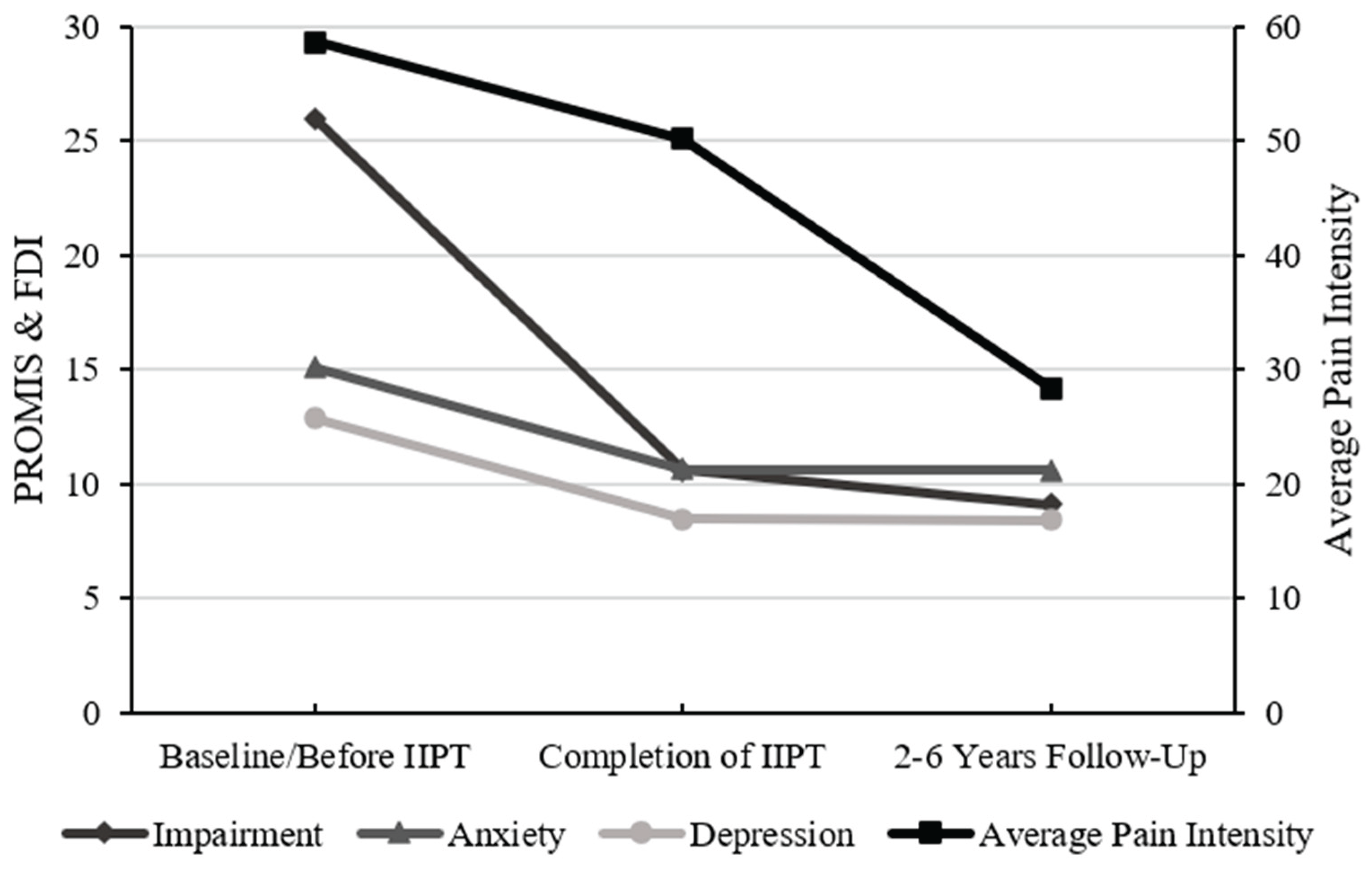

Table 1.
Demographics and comparison of patients who did and did not complete long-term (2-6 year) follow-up questionnaires.
Table 1.
Demographics and comparison of patients who did and did not complete long-term (2-6 year) follow-up questionnaires.
| Variable | Completed Long-Term Follow-up M (SD) |
No Follow-Up or incomplete M (SD) | % of sample in a clinical range b |
|---|---|---|---|
| N = 77 | N = 81 | N = 77 | |
|
Gender (% female) |
n=66, 86% |
n=64, 79% |
n/a |
|
Race/Ethnicity Non-Hispanic White Black or biracial Hispanic White Asian, Indian, or Native American |
n=69, 90% n=5, 6% n=2, 3% n=1, 1% |
n=61, 75% a n=9, 11% n=9, 11% n=2, 2% |
n/a |
| Age | 15.89 (1.94) | 15.32 (1.82)a | n/a |
|
Pain Distribution (% with widespread pain) |
n=60, 78% | n=67, 83% | n/a |
| Pain Duration | 3.40 (3.17) | 3.83 (3.48) | n/a |
| Weeks in program | 4.04 (1.22) | 3.95 (0.81) | n/a |
| PRE-TREATMENT | |||
| Average Pain Intensity | 58.65 (16.85) | 56.96 (16.57) | n=77, 100% |
| Functional Disability | 25.96 (9.72) | 23.58 (8.23)a | n=69, 90% |
| Depressive symptoms | 12.95 (10.05) | 11.70 (8.24) | n=34, 44% |
| Anxiety symptoms | 15.01 (7.43) | 14.54 (7.69) | n=38, 49% |
| POST-TREATMENT | |||
| Average Pain Intensity | 50.82 (30.95) | 47.21 (25.00) | n=66, 86% |
| Functional Disability | 10.61 (8.54) | 11.49 (9.38) | n=35, 45% |
| Depressive symptoms | 8.51 (9.06) | 6.45 (6.30) | n=19, 25% |
| Anxiety Symptoms | 10.61 (9.40) | 8.96 (7.09) | n=21, 27% |
| 2-6 year FOLLOW-UP | |||
| Average Pain Intensity | 28.19 (29.20) | n/a | n=42, 55% |
| Functional Disability | 9.17 (11.38) | n/a | n=24, 31% |
| Depressive symptoms | 9.05 (9.42) | n/a | n=26, 34% |
| Anxiety Symptoms | 10.66 (8.78) | n/a | n=24, 31% |
| Notes: a Trend for statistically significant difference (p ≤ .10), b Cut-offs for clinical ranges are: pain intensity >1/10 (or 10/100), FDI score ≥13, Depression score ≥14, and Anxiety score ≥16 | |||
Table 2.
Questionnaire responses about life and functioning at 2-6 year follow-up.
| Question | Response options, or range |
Mean ± SD, or n (%) |
|---|---|---|
| What is your current age? |
14 to 24 | 19.3 ± 2.10 |
| What is your current living situation? | With parents With roommate/dorms With spouse/significant other Alone |
34 (44%) 28 (36%) 7 (9%) 8 (10%) |
| On average, how much has pain affected your daily life in the past week? | No effect Some effect Moderate effect Significant effect |
37 (48%) 26 (34%) 5 (6%) 9 (12%) |
| Is pain better since IIPT? | Better Worse Unchanged |
59 (77%) 8 (10%) 10 (13%) |
| Do you consider pain resolved? | Yes No |
44 (57%) 33 (43%) |
| How many medications do you currently take for pain? | None 1 2 or more |
56 (73%) 13 (17%) 8 (10%) |
| How many medications do you currently take for mental health? | None 1 2 or more |
48 (62%) 11 (14%) 18 (24%) |
| In the past year, how many days have you spent in the hospital? | None 1-2 3 or more |
59 (77%) 5 (6%) 13 (17%) |
| In the past year, how many times have you gone to the emergency room or urgent care? | None 1-2 3 or more |
36 (47%) 25 (32%) 16 (21%) |
| In the past year, how many times have you seen your primary care doctor or a specialist? | None 1-2 3 or more |
7 (9%) 12 (16%) 58 (75%) |
| In the past year, how many times have you seen a counselor or other mental health professional? | None 1-2 3 or more |
29 (38%) 5 (6%) 43 (56%) |
| In the past year, how many times have you seen a complementary or alternative medical provider? | None 1-2 3 or more |
52 (68%) 10 (13%) 15 (19%) |
Disclaimer/Publisher’s Note: The statements, opinions and data contained in all publications are solely those of the individual author(s) and contributor(s) and not of MDPI and/or the editor(s). MDPI and/or the editor(s) disclaim responsibility for any injury to people or property resulting from any ideas, methods, instructions or products referred to in the content. |
© 2026 by the authors. Licensee MDPI, Basel, Switzerland. This article is an open access article distributed under the terms and conditions of the Creative Commons Attribution (CC BY) license (http://creativecommons.org/licenses/by/4.0/).
Copyright: This open access article is published under a Creative Commons CC BY 4.0 license, which permit the free download, distribution, and reuse, provided that the author and preprint are cited in any reuse.