

Submitted:
17 November 2026
Posted:
18 November 2026
You are already at the latest version
Abstract
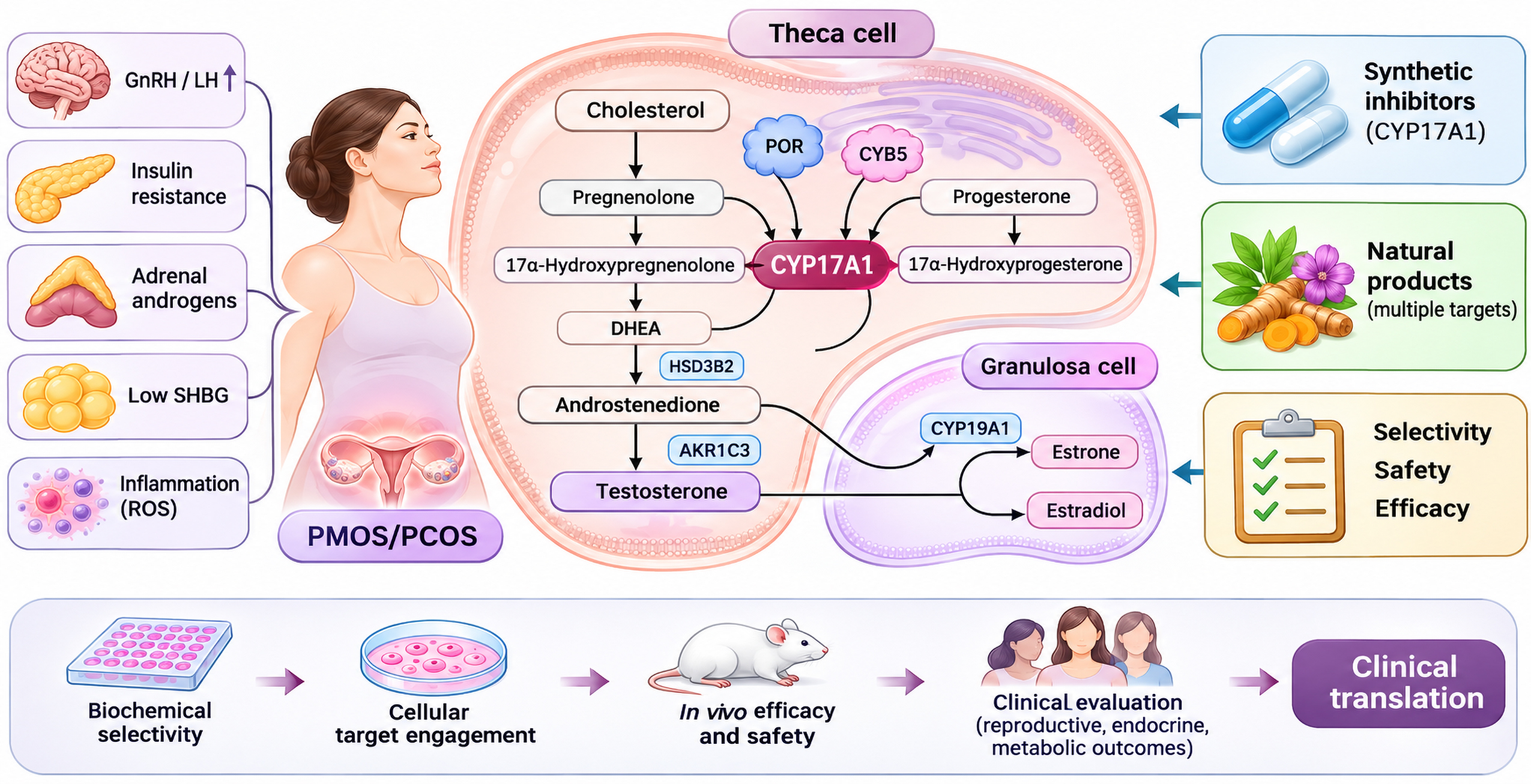
Developing steroidogenesis-directed treatments for polyendocrine metabolic ovarian syndrome (PMOS), previously termed polycystic ovary syndrome (PCOS), requires reducing pathological androgen excess while preserving adrenal and ovarian function. The Cytochrome P450 enzyme CYP17A1 offers a compelling pharmacological target, but its dual 17α-hydroxylase and 17,20-lyase activities complicate selective targeting. This critical narrative review integrates CYP17A1 enzymology with ovarian–adrenal steroidogenesis, peripheral androgen activation and the pharmacology of synthetic inhibitors and natural products. We examine how substrate availability, P450 oxidoreductase, cytochrome b5 and tissue context influence the CYP17A1 catalytic activity and apparent inhibitor selectivity. AKR1C3-dependent androgen activation, 11-oxygenated androgens and neuroendocrine regulation provide complementary perspectives on treatment response. Across candidate interventions, biochemical inhibition, altered enzyme expression and reduced circulating testosterone represent distinct findings; none alone establishes clinically useful target engagement or therapeutic benefit. Selected natural products, including dihydrotanshinone and curcuminoids, provide biochemical evidence of steroidogenic enzyme modulation, whereas clinical studies of botanical preparations remain insufficient to establish CYP17A1-mediated efficacy. Experience with synthetic inhibitors further demonstrates that preferential lyase inhibition cannot be assumed to preserve adrenal or reproductive function. We propose a translational evaluation framework combining direct activity measurements, steroidogenic selectivity panels, assay-interference controls, exposure assessment and endocrine and reproductive safety with patient-relevant outcomes. CYP17A1-directed treatment remains investigational in PMOS/PCOS. Its clinical promise depends on demonstrating a therapeutic window that improves androgen-related symptoms or reproductive outcomes without compromising essential steroid physiology.
Keywords:
PMOS
; PCOS
; steroidogenesis
; hyperandrogenism
; 17
; 20‐lyase
; AKR1C3
; 11‐oxygenated androgens
Copyright: This open access article is published under a Creative Commons CC BY 4.0 license, which permit the free download, distribution, and reuse, provided that the author and preprint are cited in any reuse.