
Submitted:
17 November 2026
Posted:
18 November 2026
You are already at the latest version
Abstract
In oilfield chemical flooding, chemical agents such as surfactants and polymers are susceptible to loss through adsorption, retention, and degradation, which can limit their effectiveness in deep-reservoir profile control and flooding. Sustained-release microcapsules provide an emerging approach for the deep delivery of chemical agents by encapsulating and protecting them within a shell to achieve controlled release. In this review, the microcapsule shell is considered a key functional interface linking chemical-agent protection, reservoir transport, and deep release. Focusing on shell composition, structural regulation, and stimuli-responsive properties, the effects of shell thickness, porosity, crosslinking density, and multilayer structures on microcapsule stability and release behavior are systematically analyzed. Different release mechanisms are summarized, and the effects of shell design on the controlled release and deep-reservoir performance of typical oilfield chemical agents, including surfactants, polymers, gels, and gel breakers, are discussed. In response to the challenges of insufficient stability under high-temperature and high-salinity conditions and the difficulty in coordinating transport with release, future research directions are proposed, including multiscale shell structural design, synergistic responses to multiple stimuli, and coupled transport–release mechanisms, with the aim of enabling precise controlled release and reservoir-adaptive design.
Keywords:
microcapsules
; shell regulation
; polymers
; controlled-release mechanisms
; chemical flooding
1. Introduction
With the continued development of oil and gas resources, a substantial amount of residual oil remains inaccessible after conventional water flooding. This challenge is particularly pronounced in complex reservoirs characterized by low permeability, strong heterogeneity, and high temperature and salinity. Chemical flooding, which involves the injection of chemical agents such as polymers, surfactants, alkalis, and gels into formations, can improve mobility control, reduce oil–water interfacial tension, alter rock wettability, and regulate high-permeability channels, thereby increasing sweep efficiency and improving oil displacement efficiency. It is therefore an important enhanced oil recovery (EOR) technology [1,2,3]. However, during their entry into and transport through reservoirs, chemical agents are subject to rock adsorption, mechanical retention, precipitation, and shear degradation, resulting in substantial loss of active components. Consequently, maintaining a sufficiently high effective concentration and delivering chemical agents to deep regions of the reservoir remain challenging. Previous studies have shown that both alkali and surfactants undergo significant losses during alkali–surfactant–polymer (ASP) flooding. In some reservoirs, surfactant loss can exceed 90%, and chemical-agent loss is strongly correlated with formation permeability damage [4]. Surfactant adsorption also directly increases the cost of chemical flooding and reduces the effective range of chemical agents within reservoirs [5,6] whereas polymers are subject to adsorption, mechanical degradation, and reduced viscosity retention under high-temperature and high-salinity conditions [7,8]. Therefore, reducing chemical-agent loss in near-wellbore regions and extending their effective residence time in deep reservoirs have become important research directions for improving the efficiency of chemical flooding.
To address these challenges, previous studies have explored the use of sacrificial agents, nanomaterials, ionic liquids, and emulsions/nanoemulsions to reduce direct contact between chemical agents and reservoir rocks, as well as optimized injection strategies for targeted chemical delivery [6,9]. For example, Kittisrisawai et al. [9] employed inclusion complexation between β-cyclodextrin and sodium dodecyl sulfate (SDS), reducing the dynamic adsorption of SDS on sand, clay, and shale surfaces by up to 74%. This finding demonstrates that carrier-based delivery can effectively reduce direct contact between chemical agents and solid surfaces. Nevertheless, such approaches still face limitations in chemical-agent protection, long-distance transport, and precisely timed and dosed release.
Microencapsulation provides a promising strategy for addressing these challenges. The basic concept is to encapsulate chemical agents within a shell possessing sufficient mechanical strength and environmental stability, thereby temporarily isolating the core material from the reservoir environment and enabling controlled release through shell permeation, swelling, degradation, or responses to external stimuli. In recent years, encapsulation-based delivery has gradually expanded from applications in pharmaceuticals, food, and agriculture to the delivery of oilfield chemical agents. Previous studies have demonstrated that encapsulated systems can be used for the sustained release and deep-reservoir application of surfactants, polymers, crosslinkers, and other oilfield chemical agents [10]. Xia et al. [11] recently reviewed the development of micro- and nanocapsules for chemical-agent encapsulation, reservoir transport, and release under the concept of “Capsule-Based Chemical EOR”, providing an overall framework for capsule-based chemical flooding. However, further systematic investigation is still needed into how the shell itself regulates mass transfer, mechanical behavior, and reservoir transport through the combined effects of material composition, thickness, pore structure, crosslinking network, and stimuli-responsive properties.
The controlled-release performance of microcapsules is determined not only by the core material but also directly by the shell material, thickness, pore structure, crosslinking degree, and responsive properties. The shell serves both as a protective barrier and mechanical support, while also acting as the primary interface governing mass transfer from the core and the release rate. Accordingly, microcapsule research is gradually shifting from the early emphasis on whether encapsulation can be achieved toward how release behavior can be precisely regulated through shell design. For oilfield applications, the shell must also maintain stability under high-temperature, high-salinity, high-pressure, and complex shear conditions while simultaneously ensuring adequate transport of microcapsules through porous media and release at the target region.
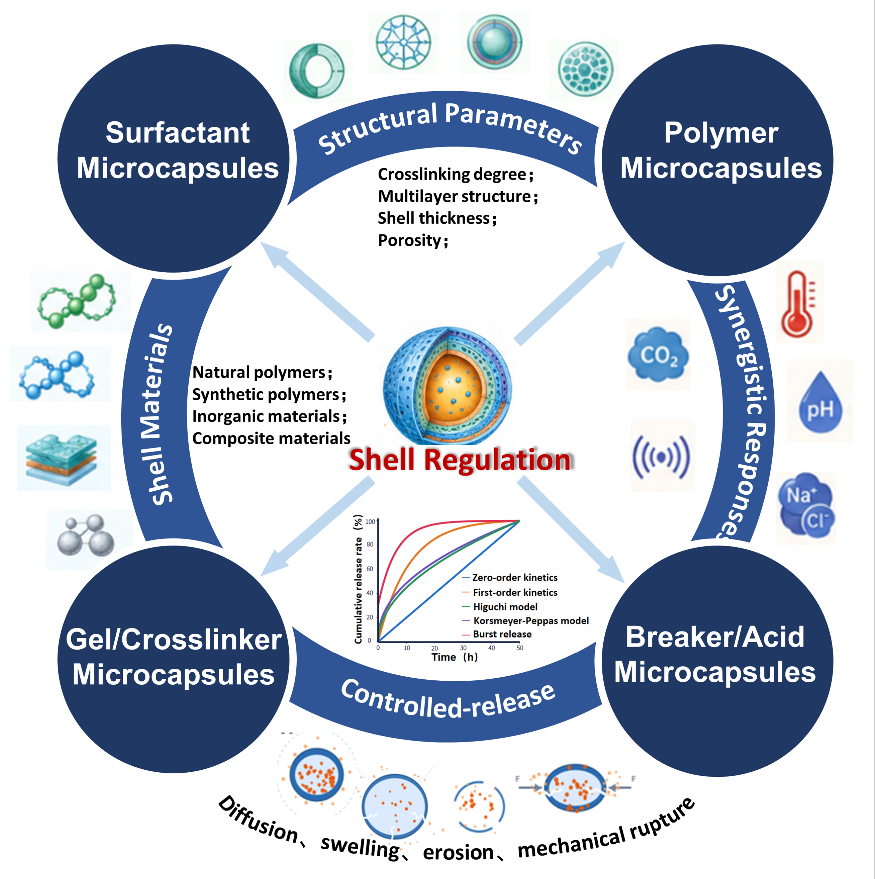
Accordingly, this review focuses on shell regulation and systematically discusses the relationships among shell composition, structural parameters, mechanical properties, release behavior, and reservoir transport. First, the functional characteristics and applicable boundaries of different shell systems are analyzed according to their material compositions. The effects of shell thickness, pore structure, crosslinking degree, and multilayer structures on mass-transfer resistance, mechanical stability, and release kinetics are then examined. Subsequently, the roles of temperature, pH, salinity, CO2, and external-field stimuli in regulating shell structure and release behavior are discussed. Shell properties are further linked to the transport, retention, and release location of microcapsules in porous media. In addition, the effects of shell design on the deep-reservoir performance of typical oilfield chemical agents, including surfactants, polymers, gels/crosslinkers, and gel breakers, are reviewed. Finally, current challenges and future research directions are summarized from the perspectives of multiscale shell design and transport–release coupling, with the aim of advancing precise controlled release and reservoir-adaptive design.
2. Shell Materials and Regulation Strategies for Sustained-Release Microcapsules
2.1. Shell Material Composition and Its Functional Boundaries
The shell of a microcapsule is not merely an encapsulation barrier but a functional interface connecting the core material with the reservoir environment. Its composition and microstructure collectively determine its mechanical support, mass transport, and environmental responsiveness. In oilfield applications, microcapsules must also undergo injection, migration, retention, and release processes. Therefore, shell materials need to achieve a balance among barrier properties, mechanical stability, and release rate [12].
Among natural polymers, alginate, chitosan, and their derivatives have received considerable attention because of their broad availability and ease of modification. George et al. [13] summarized the applications of alginate and chitosan in drug delivery systems and pointed out that their favorable biocompatibility and ionic crosslinking properties make them suitable as microcapsule wall materials. At the molecular level, Braccini et al. [14] elucidated the mechanism by which Ca2+ induces the formation of an “egg-box” structure in alginate, as shown in Figure 1a, demonstrating that the degree of crosslinking further affects network compactness and swelling behavior. Related studies have also shown that the molecular weight, degree of deacetylation, and protonation state of chitosan can influence its solubility and network structure [15]. These findings indicate that the structure of natural polymer shells can be readily tuned. The primary challenge is therefore not their processability, but rather how to regulate network stability through crosslinking and composite formation so that controlled mass transport can be maintained under reservoir ionic conditions.
In contrast, synthetic polymers offer greater flexibility in structural design. As shown in Figure 1b, Sánchez-Silva et al. [16] employed a styrene–methyl methacrylate copolymer as the shell material for phase-change material microcapsules and investigated the effects of monomer ratio and core–shell composition on microcapsule morphology and thermal properties, demonstrating that shell performance can be tailored through polymer composition and polymerization conditions. Polydopamine (PDA) exhibits excellent interfacial deposition and film-forming properties, and its layer thickness can be regulated by parameters such as dopamine concentration and deposition time. Previous studies have shown that PDA coatings can form an additional diffusion barrier on the surface of microcapsules; within an appropriate coating thickness range, increasing the PDA layer thickness can extend the diffusion path of the encapsulated material and reduce passive leakage. Therefore, PDA can serve as an ultrathin functional interfacial layer to further regulate the mass-transfer resistance and interfacial stability of composite shells [17,18]. For example, Agnihotri et al. [19] reported that poly(N-isopropylacrylamide-co-methacrylic acid) (PNIPAM-co-MAA) microgels can respond simultaneously to temperature and pH changes, while their adsorption and release behavior can be tuned by adjusting polymer composition and crosslinking structure. Therefore, for high-temperature oilfield environments, directional tuning of the response window through copolymerization and crosslinking is more advantageous than relying on materials with a single response mode.
On this basis, the incorporation of inorganic materials such as SiO2 and Fe3O4 into polymeric shells can further improve their thermal stability and mechanical properties. Jeong et al. [20] developed polyelectrolyte/SiO2 layered hydrogel microcapsules and found that the SiO2 layer increased the compactness and barrier properties of the shell, thereby enhancing cargo retention. As shown in Figure 1c, the fluorescence intensity change from III to IV after composite formation indicates less leakage and a more compact shell compared with the change from I to II for the non-composite system, suggesting that the inorganic phase can also serve as a rigid framework within the shell. Cao et al. [21] further developed graphene oxide (GO)-Fe3O4/PNIPAM/alginate composite microcapsules and demonstrated that they could simultaneously respond to near-infrared irradiation, magnetic fields, and pH changes. This finding indicates that magnetic nanomaterials can not only reinforce the shell structure but also function as externally responsive units. Therefore, shell-material development is gradually shifting from the selection of single materials toward organic/inorganic composites and multifunctional synergistic designs. The value of this approach lies not only in improving shell stability but also in exploiting the functional complementarity of different components to enable synergistic regulation of shell properties.
2.2. Shell Structural Parameters and Their Effects on Mass Transfer and Mechanical Properties
In addition to material composition, shell thickness, porosity, crosslinking degree, and multilayer architecture further determine the mass-transfer resistance, mechanical stability, and response behavior of the shell, ultimately affecting the encapsulation, transport, and release performance of microcapsules [22,23].
Conventional emulsion methods are relatively simple in terms of equipment and operation; however, the fabrication process is readily affected by factors such as stirring intensity, emulsifier concentration, and phase ratio, resulting in a certain degree of variation in particle size and shell thickness. In recent years, the development of precision fabrication techniques such as microfluidics has gradually shifted microcapsule structural control from empirical adjustment toward quantitative design [24]. Microfluidic technology provides an effective platform for precisely tuning shell thickness. Nisisako et al. [25] prepared polymer microcapsules through the structural transition from Janus droplets to core–shell droplets, as shown in Figure 2a. By adjusting the flow-rate ratio of different phases, they achieved relative shell thicknesses ranging from 0.004 to 0.3 while maintaining a low coefficient of variation in particle size. This result demonstrates that microfluidics can treat droplet size and shell thickness as two relatively independent design parameters. As shown in Figure 2b, Guo et al. [26] further employed osmotic-pressure regulation to continuously fabricate ultrathin shells with good particle-size uniformity. These studies indicate that the value of microfluidic technology lies not only in improving particle-size uniformity, but more importantly in enabling independent control over droplet size and shell thickness, thereby providing an experimental basis for establishing quantitative relationships among shell thickness, mass-transfer resistance, and release rate.
Coaxial electrospraying also offers considerable capability for controlling core–shell structures. Previous studies have demonstrated that core–shell polymeric particles can be fabricated by coaxial electrospraying, while their morphology and size can be regulated by varying the material properties and processing parameters, such as polymer concentration, molecular weight, and solvent composition [27,28]. Tanhaei et al. [29] further reviewed recent applications of electrospraying in particle engineering and encapsulation, highlighting that coaxial nozzles, multinozzle systems, and multiphase electrospraying can be used to construct different types of core–shell and composite particles. Compared with conventional emulsion methods, electrospraying therefore offers advantages in the precise construction of core–shell structures, although challenges remain in continuous processing and large-scale production [30,31].
Pore structure directly determines the mass-transfer pathway of the encapsulated material. Zhang et al. [32] prepared porous microcapsules with tunable pore sizes and found that altering the pore structure could regulate the release behavior of active substances and consequently affect their biological activity. This finding indicates that a higher porosity is not necessarily better; rather, the pore architecture determines the primary transport pathways through which the core material crosses the shell and should therefore be matched to the size of the encapsulated material and the target release period. Chen et al. [33] used a microfluidic approach to construct microcapsules with porous ultrathin shells, as shown in Figure 2c. This architecture enabled selective permeation and allowed the release behavior to be further regulated by external stimuli. Therefore, shell thickness and pore structure should be designed in a coordinated manner to achieve an appropriate balance between encapsulation stability and subsequent release efficiency.
Optimization of the crosslinked network is mainly aimed at addressing the trade-off between shell strength and toughness. As shown in Figure 2d, Lee et al. [34] constructed microcapsules with double-network hydrogel shells and found that the double-network structure substantially enhanced resistance to rupture. The rupture threshold of the shell approached 10 times that of the corresponding single-network system, while the microcapsules remained structurally intact under relatively strong shear conditions. These results indicate that, compared with simply increasing the crosslinking density, a double-network architecture is more effective in simultaneously improving shell strength and deformation resistance. This strategy therefore provides useful guidance for oilfield microcapsules that must withstand injection, shear, and transport through pore throats.
In addition, multilayer and multicompartment structures can further enable functional compartmentalization. Chen et al. [35] developed a temperature/pH dual-stimuli-responsive multicompartment microcapsule that achieved programmed release through the design of distinct compartments and responsive units. This strategy provides a new design direction for the synergistic release of oilfield chemicals. For example, different functional components can be separately encapsulated in different compartments, followed by sequential release through the use of distinct response windows of the respective shells [36,37].
2.3. Molecular Mechanisms and Reservoir Adaptability of Intelligent Shell Responses
Building on the tunability of material composition and structural parameters, the incorporation of environmental responsiveness can further transform microcapsules from passive sustained release systems into actively controlled release systems. The underlying mechanism is based on the use of stimuli such as temperature, pH, salinity, CO2, or external magnetic fields to alter polymer chain conformation, network swelling, or interfacial structures, thereby regulating the mass-transfer resistance of the encapsulated core material [38].
Thermoresponsive shells mainly rely on lower critical solution temperature (LCST) or upper critical solution temperature (UCST) transitions. For example, PNIPAM exhibits a typical LCST behavior. When the temperature increases above the LCST, the polymer chains transition from an extended state to a contracted or collapsed state, accompanied by changes in network volume and hydration, thereby affecting mass transfer through the shell and diffusion of the core material [39]. As shown in Figure 3a, Chu et al. [40] developed a core–shell microcapsule incorporating PNIPAM as a thermoresponsive “gating” structure. By grafting PNIPAM onto the pores of a porous membrane, the opening and closing of the microcapsule pores and the resulting release behavior could be regulated by temperature. When the temperature exceeded the LCST of PNIPAM, the release rate of the microcapsules changed markedly. Therefore, the response window of thermoresponsive materials can be further tuned by varying copolymer composition and crosslinking structure, providing a useful reference for designing responsive shells according to the temperature of different reservoirs.
pH responsiveness mainly originates from the protonation and deprotonation of ionizable groups, such as carboxyl and amino groups. These processes alter the charge distribution along polymer chains and the electrostatic interactions between chains, thereby inducing changes in network swelling, contraction, and permeability [41,42]. Previous studies have prepared monodisperse pH-responsive microcapsules using microfluidic methods and demonstrated that the trigger pH can be tuned by changing the type of responsive polymer, while the release delay time and release rate can be independently regulated by controlling shell thickness and composition, respectively [43] (Figure 3b). These results demonstrate that pH-responsive shells can regulate core-material release through structural and compositional design. Therefore, pH-responsive shells have potential for application in reservoirs where substantial pH variations occur, such as alkaline flooding and acidification processes; however, their practical applicability still needs to be evaluated in conjunction with the specific formation-water chemistry.
For highly saline reservoirs, salt-responsive materials offer more direct environmental adaptability. Studies have shown that salt ions can alter the interactions between polyelectrolyte chains, causing microcapsules to swell, contract, or undergo changes in interfacial structure, thereby affecting cargo release. As shown in Figure 3c, Duan et al. [44] developed salt-responsive polyelectrolyte microcapsules and found that increasing the ionic strength of the solution could trigger microcapsule release, indicating that salinity can serve as an external signal for regulating shell structure and release behavior. In addition, the zwitterionic nanocapsules prepared by Sun et al. [45] exhibited pronounced dual responsiveness to salinity and temperature, and the release of the encapsulated cargo could be regulated by varying the salt concentration. These findings indicate that salinity itself can serve as a potential triggering signal. However, actual formation water generally also contains multivalent ions such as Ca2+ and Mg2+; therefore, the long-term stability and response selectivity of such systems require further validation.
CO2 responsiveness is potentially well suited to CO2 flooding. Du et al. [46] developed a CO2-responsive viscoelastic gel-particle system to address CO2 channeling in ultralow-permeability reservoirs. Their results showed that changes in the CO2 environment could regulate the structure of the system and exert a certain inhibitory effect on CO2 breakthrough. This study demonstrates the practical basis of CO2-responsive materials for CO2-flooding control. However, studies directly applying CO2-responsive mechanisms to microcapsule shells to achieve selective release under reservoir conditions remain relatively limited. Therefore, this approach may be more appropriately regarded as a promising direction for further development.
Magnetic-responsive shells utilize magnetic particles such as Fe3O4 to provide external stimulation. Yan et al. [47] in situ constructed Fe3O4 nanoparticles within polyglutamic acid–chitosan microcapsules. The resulting magnetic microcapsules could be directionally manipulated under an external magnetic field while exhibiting sustained release characteristics, indicating that the incorporation of magnetic nanoparticles not only imparts magnetic responsiveness to the shell but also provides a basis for the external-field regulation of the cargo release. Such magnetically responsive systems offer a new approach for the remote regulation of microcapsule transport and release. However, for oilfield applications, the effects of underground porous media on magnetic-field transmission, the content of magnetic particles, and the efficiency of long-distance response still need to be further considered.
Overall, intelligent stimuli-responsive shells are evolving from single temperature- or pH-responsive systems toward synergistic responses to multiple environmental factors, including temperature, salinity, CO2, and magnetic fields. As shown in Figure 4, Cao et al. [21] developed microcapsules with a synergistic response to near-infrared light, magnetic fields, and pH. The key is not simply to increase the number of response modes, but to establish a clear correspondence among reservoir environmental signals, changes in shell structure, and cargo release behavior. This enables microcapsules to remain stable during injection, minimize premature leakage during transport, and achieve on-demand release in the target region. Accordingly, shell regulation is gradually shifting from a simple material-selection problem toward the synergistic design of material composition, structural parameters, and reservoir environment.
3. Mechanisms of Shell Regulation in Controlling Release Behavior
3.1. Release Mechanisms Governed by Shell Regulation
The release of microcapsules is essentially governed by the combined effects of mass transfer of the core material across the shell and structural evolution of the shell. Diffusion, swelling/erosion, stimuli-responsive processes, and mechanical rupture may dominate at different time scales, while the shell composition, thickness, pore structure, crosslinking degree, and environmental responsiveness determine the conditions under which these mechanisms occur and their relative contributions. As illustrated in Figure 5, these mechanisms can be broadly classified into diffusion-, swelling-, degradation/erosion-, and mechanically induced release. For microcapsules used in oilfield profile control and flooding, the three stages of injection, migration, and deep-reservoir release must also be considered simultaneously, making the release process strongly dependent on the surrounding environment.
From the perspective of release mechanisms, shell regulation ultimately needs to be related to the mass transfer and release kinetics of the core material. The Higuchi model describes drug release from suspension-type semisolid matrices based on diffusion processes [48]; Korsmeyer et al. [49] further proposed that the contribution of different mechanisms, such as diffusion and swelling, can be evaluated using the release exponent. For polymeric sustained-release systems, Siepmann and Peppas further pointed out [50] that polymer swelling, diffusion, and structural changes in the material may jointly affect the release process. Therefore, in microcapsule studies, release profiles alone are insufficient to determine the “release rate”; shell thickness, pore structure, swelling behavior, and diffusion mechanisms should also be considered to elucidate the release behavior. This provides a theoretical basis for further establishing quantitative relationships between shell structure and release performance.
Diffusion-controlled release is one of the fundamental release mechanisms of microcapsules. When a concentration gradient exists between the core material and the external medium, molecules can migrate outward through shell pores, free volume, or gaps between polymer chains. Under ideal steady-state conditions, the diffusion flux can be expressed according to Fick’s law as:
where J is the diffusion flux, Deff is the effective diffusion coefficient, ΔC is the concentration difference, and L is the shell thickness. Thus, under otherwise comparable conditions, increasing the shell thickness extends the diffusion pathway and decreases the release rate. Both the Higuchi and Korsmeyer–Peppas models also take diffusion as an important theoretical basis for polymer-controlled release behavior [48,49,50]. In practical systems, Deff is not a fixed material parameter; it is also affected by porosity, pore tortuosity, pore-size distribution, and interactions between the core and shell [51], thereby reflecting the mass-transfer resistance and release behavior of the core material.
In contrast to diffusion-controlled release, the rate of erosion- or degradation-controlled release is mainly determined by structural changes in the shell itself. As polymer chains undergo cleavage, the network becomes less compact, or the shell gradually becomes thinner, the diffusion pathways for the core material continuously expand, resulting in an increased release rate. Shell thickness is also an important parameter governing this process. Wang et al. [52] found that regulating the thickness and structure of microcapsule shells during interfacial polymerization could significantly prolong the release time of the encapsulated core material. The degree of crosslinking also affects shell swelling and mass transfer. A higher crosslinking density generally results in a denser network structure and consequently a lower molecular migration rate [50,53].
Stimuli-responsive release further exploits environmental changes to alter the shell structure. Thermoresponsive polymers undergo a volume phase transition near the critical temperature, accompanied by changes in the hydration state and network structure of the shell, thereby regulating mass transfer of the core material. Jeong et al. [53] prepared PNIPAM-co-poly(ethylene glycol) diacrylate (PEGDA) hydrogel-shell microcapsules and demonstrated that the release temperature could be regulated by varying the crosslinker content and shell thickness, with the maximum release temperature reaching 62°C. pH-responsive systems achieve triggered release by altering the ionization state, swelling degree, or degradation rate of the polymer. Eriksson et al. [54] found that polyanhydride microcapsules underwent rapid release within the pH range of 6.4–6.9, and a good correspondence was observed between the degradation rate of the shell and the release process. In addition, salinity and CO2 can regulate shell structure by altering electrostatic interactions between polyelectrolytes or the protonation state of functional groups [44,45,46].
Mechanical rupture represents another important release mechanism. During injection and migration through pore throats, microcapsules are subjected to shear forces, pressure differences, and collisions. When the external load exceeds the mechanical strength of the shell, rupture may occur, causing the core material to transition from slow diffusion to rapid release. Hu et al. [55] prepared microcapsules with different shell thicknesses and sizes using a microfluidic method and investigated their critical rupture behavior through indentation experiments, demonstrating that the mechanical response threshold could be altered by regulating shell thickness and capsule size. Leopércio et al. [56] investigated the deformation and rupture behavior of microcapsules in confined channels using constricted capillary experiments. They found that capsule size, shell thickness, and the pressure difference during flow significantly affected the stress imposed on the shell. Once deformation and stress reached a certain level, membrane rupture occurred, resulting in the release of the internal material. In addition, Hamonangan et al. [57]constructed elastic-shell microcapsules that underwent rapid destabilization when subjected to mechanical stresses exceeding a critical threshold. Shell recoil enabled the encapsulated material to be released within milliseconds, further demonstrating that mechanical loading can directly transform microcapsules from a stable storage state into a rapid-release state. Therefore, for oilfield microcapsules, diffusion, degradation, stimuli-responsive release, and mechanical rupture are not independent processes. Instead, the dominant release mechanism may shift with changes in injection conditions, migration behavior, and reservoir environment.
3.2. Shell Structural Parameters and Release Kinetics
Establishing the relationship between shell structural parameters and release kinetics is fundamental to the rational design of microcapsules. Commonly used models include the zero-order, first-order, Higuchi, and Korsmeyer–Peppas models. However, most of these models treat the internal shell structure as an equivalent medium and are therefore more suitable for describing macroscopic release profiles than for fully resolving the specific contributions of shell thickness, pore structure, and crosslinking degree to the release process.
The Higuchi model is based on Fickian diffusion and is applicable to controlled-release systems in which diffusion is the dominant mechanism [48]. Its main characteristic is an approximately linear relationship between the cumulative amount released and the square root of time. The Korsmeyer–Peppas model, in contrast, uses the release exponent n to assess the relative contributions of diffusion, polymer-chain relaxation, and related processes [49,50]. For spherical carriers, the value of n varies with the release mechanism; however, the corresponding critical values also depend on the carrier geometry and the fitting interval. Therefore, a specific n value should not be simply assigned to a unique release mechanism.
From the perspective of structural parameters, shell thickness and pore structure are two of the most direct factors governing the release rate. Increasing shell thickness extends the diffusion pathway, whereas increasing porosity and pore size generally reduces mass-transfer resistance [26,32,52]. In addition, interactions between the core material and polymer matrix may decrease the effective diffusion coefficient and thereby further prolong the release time [51]. As shown in Figure 6, Asri and Mert [58] prepared Ca-alginate microcapsules by electrospraying and introduced Fmoc-protected tyrosine (Fmoc-Y) and Fmoc-protected proline (Fmoc-Pro) into the alginate network to generate hybrid structures. Through noncovalent interactions, these modifications altered the network structure and compactness, thereby regulating the release of quercetin. The pristine Ca-alginate microcapsules exhibited relatively rapid release, with release essentially completed within approximately 7 h, and the zero-order model provided the best fit. After incorporation of Fmoc-Y or Fmoc-Pro, the shell became more compact and the release time was extended to approximately 24 h. The Korsmeyer–Peppas model then provided the most appropriate description, with n values of 0.51 and 0.65, respectively, suggesting non-Fickian transport in which both diffusion and matrix swelling contributed to release. Meanwhile, the Higuchi model also showed a good fitting performance, further indicating that diffusion remained an important component of the release process in the hybrid microcapsules. Therefore, even for shells with the same thickness, differences in pore structure or interactions between the core and shell can result in substantially different release profiles.
For stimuli-responsive systems, environmental variables such as temperature, pH, and salinity should also be incorporated into kinetic analyses. For example, thermoresponsive microcapsules can alter the swelling or contraction state of the shell in response to temperature, thereby changing the effective diffusion coefficient [53]. Liu et al. [59] investigated the release behavior of polymers from microcapsules with a polyurethane shell and an acrylamide (AM) / 2-acrylamido-2-methylpropane sulfonic acid (AMPS) copolymer core at different triggering temperatures and fitted the release profiles using the Ritger–Peppas model. The fitted release exponents n were 1.3452 and 1.8905 at 65 and 75°C, respectively, but decreased to 0.4979 and 0.4496 at 85 and 95°C. These results indicate that, with increasing triggering temperature, the dominant mass-transfer behavior gradually shifted from super Case II transport to anomalous transport and eventually to Fickian diffusion. In pH-responsive microcapsules, the release process may similarly shift rapidly from diffusion control to shell-degradation control within a specific pH range. Therefore, for oilfield applications, release half-life alone is insufficient for evaluating controlled-release performance. Quantitative relationships should instead be established among shell thickness, porosity, crosslinking degree, environmental stimuli, and release rate.
The Weibull model can provide a complementary description of the overall shape of release profiles, with its shape parameter characterizing the temporal variation in the release rate. For rapidly triggered release systems, the Weibull model can adequately describe the release profile; however, its parameters are empirical and cannot be used independently to determine the underlying release mechanism [60]. Therefore, in practical studies, the Weibull, Higuchi, and Korsmeyer–Peppas models should be combined with structural characterization of the shell. Release mechanisms should not be inferred solely from the goodness of fit of kinetic models.
3.1. Shell Properties in Porous Media and Migration–Release Coupling
The practical performance of microcapsules in oilfield applications depends not only on their release rate but also on their migration, deformation, and retention within reservoir pore spaces. Microcapsules that exhibit good sustained-release performance under laboratory conditions may still have limited deep-reservoir performance if they cannot pass through pore throats during injection or become prematurely retained in the near-wellbore region.
To describe the relationship between particle size and pore-throat size, a matching coefficient, ψ, can be introduced as the ratio of particle diameter to the characteristic pore-throat diameter, which represents the relative size compatibility between particles and pore throats. Studies on polymer microspheres have shown that the matching coefficient, particle elasticity, flow velocity, and particle concentration can all affect particle migration and plugging behavior in porous media, and that the plugging ability increases markedly with increasing matching coefficient and elasticity [61]. Therefore, there is no fixed microcapsule size suitable for all reservoirs; instead, the particle size should be designed according to the pore-throat scale and reservoir heterogeneity.As illustrated in Figure 7, particle–pore-throat matching and shell deformability jointly determine microcapsule transport, retention, and subsequent release in porous media. Although much of the available evidence is derived from polymer microspheres or microgels rather than core–shell microcapsules in the strict sense, these studies provide useful insights into the roles of particle size, elasticity, and pore-throat confinement.
For microcapsules with flexible shells, shell elasticity enables deformation at narrow pore throats, thereby improving passage through confined spaces; however, such deformation can also affect retention and plugging behavior. Zhao et al. [62] found that microgels exhibited a distinct threshold pressure when entering high-permeability channels. Smaller particles were more readily transported into the channels, whereas larger particles required a higher driving force to penetrate them. In addition, the mechanical properties of the shell directly determine whether microcapsules can maintain their structural integrity during migration. An excessively rigid shell is prone to mechanical retention at narrow pore throats, whereas an excessively soft shell may undergo excessive deformation or even rupture prematurely during injection. These findings indicate that particle size, shell thickness, elasticity, and rupture strength should be considered in conjunction with the pore-throat structure and deformability of the reservoir [55,61,62].
In studies of microcapsule-assisted polymer flooding, microencapsulation has been shown to improve the shear resistance and injectivity of polymers. The formation of pores and cracks in the shell can facilitate the release of the encapsulated polymer, while the triggering process can substantially alter the flow behavior of the overall system [63]. Overall, the design of sustained-release microcapsules for oilfield applications requires a balance between structural stability and triggerability. During injection and migration, the shell should maintain sufficient mechanical stability to prevent premature release of the core material. After reaching the target region, environmental stimuli such as temperature, pH, salinity, CO2, or local stress can be used to alter the shell structure, reduce mass-transfer resistance, and promote core-material release [44,45,46,53,54,55]. In this way, microcapsules can form a continuous and integrated process involving protection, transport, retention, and ultimately triggered release.
4. Shell-Controlled Release for Different EOR Objectives
From the perspective of the specific application requirements of oilfield chemicals, different chemicals impose different functional requirements on microcapsule shells: surfactants place greater emphasis on adsorption resistance and interfacial release, polymers on shear protection and deep-reservoir viscosity recovery, gels/crosslinkers on delayed crosslinking and gelation location, while breakers and acids place greater emphasis on release timing and triggering conditions [64,65]. Therefore, oilfield applications are not simply a matter of “encapsulating” different chemicals. Instead, the barrier, mechanical, and responsive properties of the shell need to be designed in accordance with the action mechanisms of the chemicals and the reservoir environment.
4.1. Surfactant Microcapsules for Anti-Adsorption and Interfacial Localized Release
Surfactant flooding enhances oil recovery mainly by reducing oil–water interfacial tension, altering rock wettability, and promoting crude oil emulsification. However, after entering the reservoir, surfactants are prone to loss through rock adsorption, pore retention, and phase changes, resulting in a continuous decrease in effective concentration along the transport path. Such nonproductive losses are particularly pronounced in reservoirs with high clay-mineral contents [66]. To address this issue, Zhu et al. and Yang et al. [65,67] summarized, from the perspective of controlled release of oilfield chemicals, that microcapsule shells can temporarily isolate the core material from the reservoir medium and regulate the release process through mechanisms such as diffusion, temperature, and oil-phase triggering. This approach can extend the effective action time of chemicals and reduce adsorption losses. Accordingly, research on surfactant microcapsules has gradually shifted from simply pursuing high encapsulation efficiency toward controlling the entire process of “protection, transport, release, and interfacial action.”
Fang et al. [68] prepared monodisperse microcapsules encapsulating an EOR surfactant using a microfluidic method and systematically investigated the relationship between shell structure and release performance. They found that shell thickness and crosslinking degree altered membrane permeability and thereby regulated the release rate of the core material. The narrow size distribution obtained by microfluidic fabrication was also beneficial for achieving more consistent release behavior. Liao et al. [69] further prepared polyurethane-shell alcohol ethoxylate (AEO-3) surfactant microcapsules using microfluidics, with an average particle size of approximately 67.4 μm. The microcapsules maintained relatively intact morphology at 80°C in the presence of 10 wt% NaCl and 7 wt% CaCl2. After release, AEO-3 reduced the oil–water interfacial tension from 27.68 mN·m−1 to 6.67 mN·m−1 and exhibited favorable microscopic oil-displacement performance. Unlike Fang et al., who mainly focused on particle-size uniformity and shell permeability, Liao et al. incorporated high-temperature/high-salinity stability and recovery of interfacial activity into the evaluation, reflecting the development of surfactant microcapsules from material fabrication toward reservoir adaptability.
Wang et al. [70] investigated shell swelling behavior from the perspective of polyurethane molecular structure and found that different diisocyanate structures altered the flexibility of polyurethane segments and the network structure, thereby affecting the temperature response and swelling-induced release behavior of the microcapsules. Among them, toluene diisocyanate (TDI)-based polyurethane provided a favorable balance between structural stability and thermal responsiveness, while the introduction of anionic groups further enhanced shell swelling. This study extended the regulation of surfactant microcapsules from macroscopic shell thickness to the molecular-structure level, and also demonstrated that temperature responsiveness does not necessarily rely solely on conventional thermoresponsive polymers such as PNIPAM; it can also be regulated through the network structure of the shell itself.
As research has progressed, researchers have increasingly integrated surfactant release with capsule migration. Shi et al. [72] constructed targeted, stimuli-responsive nanocapsules using Janus silica and thermoresponsive polymers, providing the system with both temperature responsiveness and a certain degree of targeted migration capability, and evaluated their oil displacement performance using parallel cores with different permeability contrasts. Yang et al. [73] combined Fe3O4, multilayer polyelectrolytes, and thermoresponsive polymers to prepare magnetically driven multilayer microcapsules, in which capsule behavior was regulated by temperature and an external magnetic field. In 2025, Wang et al. [71] further used ethyl cellulose as the shell material to encapsulate oleic acid and a green composite surfactant, as shown in Figure 8. The capsules remained stable in brine but ruptured upon entering the oil phase, releasing the surfactant in situ and rapidly reducing the interfacial tension by 2–3 orders of magnitude. These studies demonstrate from different perspectives that surfactant microcapsules have evolved from early designs focused on “adsorption resistance + sustained release” toward systems featuring temperature responsiveness, targeted migration, and oil-triggered release [65,67,71,72,73].
From a methodological perspective, Fang et al. primarily evaluated capsule performance in terms of particle size, shell structure, and release profiles, whereas Liao et al. additionally considered high-temperature/high-salinity stability and interfacial tension. Shi et al. and Yang et al. further incorporated core-scale transport and oil displacement performance into the evaluation framework [68,69,72,73]. These studies indicate that the evaluation of surfactant microcapsules is gradually expanding from static material properties to dynamic behavior in porous media. For practical reservoir applications, comparing release efficiency alone is insufficient to fully assess capsule performance. Whether the surfactant can be transported with the capsules to the target region and recover its interfacial activity near the oil–water interface is equally important in determining its ultimate utilization efficiency.
4.2. Polymer Microcapsules for Injection and Viscosity-Controlled Flooding
Polymer flooding improves the mobility ratio by increasing the viscosity of the aqueous phase and is an important approach for expanding the swept volume. However, conventional polymers such as partially hydrolyzed polyacrylamide (HPAM) are susceptible to mechanical shear during injection and also suffer from adsorption, retention, and viscosity loss under high-temperature and high-salinity conditions. In low- and medium-permeability reservoirs, the injection of highly viscous polymer solutions may further increase the injection pressure [74,75,76]. To address this trade-off, Zhu et al. [65] and Yang et al. [67] identified controlled release from microcapsules as a promising strategy for reconciling chemical-agent injectability with effective performance in reservoirs. Accordingly, polymer-loaded microcapsules have been developed based on the concept of low-viscosity particle transport, in situ triggering within the reservoir, and gradual viscosity enhancement [59,77,78].
As shown in Figure 9, Liu et al. [59] investigated the time-dependent characteristics and flow behavior of microencapsulated polymers and found that the temperature-triggered release process could be well described by the Ritger–Peppas model. With increasing release, the system gradually changed from a dispersed particle state to a polymeric system with pronounced non-Newtonian characteristics, accompanied by a transition in rheological behavior from particle transport to viscosity-enhanced displacement. Liu et al. [78] further investigated the in situ triggering of microencapsulated polymers in porous media through visualization experiments and found that the capsules gradually released the polymer during transport, while variations in triggering time significantly affected the flow behavior and the mobilization of crude oil. Unlike conventional polymers, which exhibit relatively high viscosity from the injection stage, these studies highlight the time- and space-dependent behavior of microencapsulated polymers.Hou et al. [77] further investigated the porous-media flow and oil-displacement mechanisms of capsule-based polymer flooding using multiscale experiments and numerical simulations (Figure 10). The results showed that capsule-based polymers exhibited good injectability, shear resistance, and deep transport capability. As the release progressed, their ability to suppress viscous fingering increased, resulting in a more uniform polymer front and a further expansion of the swept region. The release process was also sensitive to temperature, whereas salinity had a relatively limited effect on the rate of viscosity enhancement.
Beyond the release process itself, the ability of particles to enter the target pore throats is also an important factor governing the deep placement of polymer microcapsules. Li et al. [79] divided the transport of polymer microspheres through porous media into several stages, including transport, bridging and plugging, elastic plugging, and fatigue fragmentation, and showed that the injection rate could alter particle retention and plugging locations. Chen et al. [80] used a matching coefficient to characterize the relationship between particle size and pore-throat dimensions and found that a matching coefficient of approximately 1.0–1.3 provided favorable plugging performance. Zhao et al. [61] further analyzed microsphere migration and plugging behavior in terms of the matching coefficient, particle elasticity, flow velocity, and particle concentration, thereby clarifying the relationship between particle properties and pore-throat structures. A field study by Hou et al. [81] in an ultra-low-permeability reservoir showed that nanoscale polymer microspheres could enter smaller pore throats and improve the water-absorption profile through deep transport and selective plugging. Although these studies mainly concerned polymer microspheres rather than core–shell microcapsules in the strict sense, the established relationships among particle size, pore-throat dimensions, deformation, and retention provide important guidance for the design of polymer microcapsules.
Overall, polymer microcapsules should not simply be designed to achieve longer release times. Liu et al. focused on changes in the rheological state during release, Hou et al. further linked the degree of release to sweep efficiency, while studies on microsphere transport explained deep retention from the perspective of pore-throat matching [59,61,77,78,79,80,81]. Therefore, capsule size, shell thickness, and release rate should be considered together with reservoir temperature, permeability, and pore-throat dimensions so that the polymer can recover its viscosity-enhancing function at the appropriate location.
4.3. Gel/Crosslinker Microcapsules for Delayed Crosslinking and Deep Profile Control
The key to gel-based profile control lies in controlling the location and timing of gelation. In conventional systems such as HPAM/Cr3+, crosslinking begins immediately after mixing, and excessively rapid gelation can result in the formation of a high-strength gel near the wellbore, thereby increasing injection pressure and hindering the subsequent entry of fluids into deeper regions. Yang et al. [67] identified delayed crosslinker release as an important application of microcapsules in their review of controlled-release oilfield chemicals. They suggested that the core–shell structure can partially decouple the timing of crosslinking from that of chemical-agent injection, thereby providing a certain degree of temporal and spatial separation between chemical transport and gel formation.
As shown in Figure 11, Kang et al. [82] developed responsive micro/nanocapsules by self-assembly of hydrophobic SiO2 in an aqueous phase, with the crosslinker encapsulated inside the capsules. The capsules gradually released the crosslinker in response to temperature and pH stimuli. At 30, 60, 90, and 120°C, the gelation times reached 12.5, 13.2, 15.2, and 21.1 times those of the conventional system, respectively, indicating a more pronounced delayed-gelation effect at elevated temperatures. Meanwhile, the gel yield stress increased from 78 to 322 Pa, suggesting that the hydrophobic SiO2 micro/nanocapsules not only delayed crosslinker release but may also enhance the final gel network through particle filling and framework-support effects.
Fang et al. [83] noted in their review of high-temperature functional gels that gel systems used in high-temperature oil and gas wells need to simultaneously consider thermal stability, gelation time, and subsequent gel-breaking performance. Compared with simply adjusting the crosslinker concentration, microcapsules can independently regulate the crosslinker release rate through their shell structure, thereby creating a time interval between injection/transport and crosslinking gelation. Studies by Li et al. [79] and Chen et al. [80] on polymer-microsphere transport and pore-throat matching have shown that particle size, elasticity, and pore-throat structure jointly affect particle transport, bridging, and retention. Therefore, combining delayed crosslinker release from microcapsules with deep transport of the particles may establish a continuous process involving particle transport, pore-throat retention, crosslinker release, and in situ gelation.
Compared with preformed gels, the focus of such systems is not limited to the final gel strength, but rather on whether shell regulation can control crosslinker release so that the particles reach the desired location before gelation occurs. Studies of polymer microspheres have established the matching relationship between particle size and pore-throat dimensions [79,81], while Kang et al. [82] demonstrated from the perspective of shell structure that the crosslinker release time can be substantially prolonged. Combining these two aspects may potentially shift the gelation process toward deeper regions of the reservoir without significantly increasing the initial injection pressure. However, studies correlating the actual migration location of the capsules, the location of crosslinker release, and the final gelation location remain limited. Establishing such correlations is therefore an important issue that must be addressed when translating material-level research into reservoir applications.
4.4. Stimuli-Responsive Release of Gel Breakers, Acids, and Other Oilfield Chemicals
2During hydraulic fracturing, the fracturing fluid needs to maintain relatively high viscosity during the treatment stage to facilitate proppant transport, whereas rapid gel breaking and flowback are required after the treatment. Oxidative gel breakers such as ammonium persulfate (APS) exhibit pronounced temperature dependence: their reaction rates are insufficient at low temperatures, whereas premature decomposition may occur at high temperatures. Consequently, the release time of gel breakers can be difficult to match with the fracturing treatment cycle [67,84]. Microencapsulation isolates the gel breaker from the fracturing fluid through a protective shell, allowing it to remain relatively stable during the treatment stage and subsequently undergo gradual release in response to temperature, diffusion, or other stimuli, thereby providing a new strategy for temporal control of fracturing fluids.
For high-temperature reservoirs, Zhang et al. [85] prepared a high-temperature-resistant microencapsulated gel breaker. Shell encapsulation reduced direct contact between the gel breaker and fracturing fluid. The resulting capsules exhibited distinct core–shell structures and porous surfaces, with an encapsulation efficiency of approximately 90%, together with favorable delayed-release and gel-breaking performance. Compared with the direct addition of APS, this design converts the action of the gel breaker from an immediate process to a delayed one, which is beneficial for matching the gel-breaking time with the fracturing treatment cycle. Gel breaking in low-temperature reservoirs is also challenging. As shown in Figure 12a, Zhu et al. [86] prepared microencapsulated acids by coating oxalic acid with acrylonitrile–butadiene–styrene (ABS) or ethyl cellulose shells using a coacervation method. The shells possessed a porous structure and enabled approximately 2.5 h of delayed gel breaking at 30 and 50°C, while also exhibiting a synergistic effect with enzyme-based gel breakers. Compared with oxidative gel breakers that rely primarily on high-temperature activation, this study controlled acid diffusion through a porous shell, making the system more suitable for delayed release under low-temperature conditions.
Barati et al. [88] used polyethyleneimine (PEI)–dextran sulfate (DS) polyelectrolyte complex nanoparticles to encapsulate pectinase for fracturing-fluid gel breaking. The encapsulated enzyme maintained good dispersion in the fracturing fluid and significantly delayed the gel-breaking process of borate-crosslinked guar gum, extending the gel-breaking time from approximately 2 h to approximately 12 h. This finding demonstrates that controlled release of gel breakers is not limited to conventional micron-sized capsules; nanoscale polyelectrolyte carriers can also provide hour-scale release control through diffusion barriers.
In acidizing operations, Sun et al. [87] developed a slow-release acid-generating material and further encapsulated it with a polymer shell, as shown in Figure 12b. The resulting system remained relatively stable at low temperatures, whereas gradual hydrolysis occurred at elevated temperatures, continuously generating acid. After microencapsulation, continuous acid generation was maintained for more than 10 h, with a maximum encapsulation efficiency of approximately 60%. Compared with the one-time injection of acid, this approach converts acid generation from an instantaneous process into a sustained-release process, thereby extending the effective acidizing period.
In addition to temperature responsiveness, mechanical stimuli have also been explored for controlling the release of oilfield chemicals. As shown in Figure 13b, Zang et al. [90] prepared mechanically triggered microcapsules by in situ polymerization for lost circulation control. Upon exposure to contact pressure, the capsules released their internal active components, thereby further enhancing the plugging strength of the lost circulation zone. Guo et al. [89] prepared epoxy resin microcapsules by complex coacervation and combined them with inert particles to form a composite lost circulation control material. The resulting microcapsules exhibited good thermal stability (Figure 13a), and their incorporation produced a denser plugging layer, increased the maximum plugging pressure, and reduced drilling-fluid loss. Thus, the functions of microcapsules in fracturing and drilling/completion operations have gradually expanded from delayed release of gel breakers to slow-release acids, mechanically triggered release, and synergistic chemical–physical lost circulation control.
Overall, considerable progress has been made in the use of different types of microcapsules for surfactant sustained release, deep-reservoir polymer viscosity enhancement, delayed crosslinking of gel systems, and temporal control of gel breakers. However, existing studies still focus primarily on specific materials, temperatures, and reservoir conditions. A unified quantitative relationship among shell structure, release behavior, particle transport, and ultimate reservoir stimulation performance remains lacking. Future research should therefore focus more on the coupling of processes across multiple length and time scales and on establishing correlations between structural parameters obtained under laboratory conditions and actual reservoir development performance. Such efforts will facilitate the transition of microcapsule technology from material-performance studies toward engineering applications under complex reservoir conditions.
5. Summary and Outlook
Overall, the key challenge in applying sustained-release microcapsules for oilfield chemical delivery is not simply to achieve successful encapsulation, but to achieve coordinated control of shell composition, structure, and interfacial properties so that the encapsulated chemicals can obtain protection and release behavior that are compatible with the reservoir environment throughout injection, transport, and reservoir treatment. Different shell materials provide distinct mechanical stability, mass-transfer resistance, and environmental responsiveness, while structural parameters such as shell thickness, pore structure, degree of crosslinking, and multilayer architecture further determine the mass-transfer pathways and release kinetics of the encapsulated agents. This perspective is consistent with the central role assigned to the shell as the interface linking chemical protection, reservoir transport, and deep release in this review.
From the perspective of the release process, diffusion, swelling or degradation, stimuli-responsive release, and mechanical rupture should not be regarded as independent mechanisms. Rather, their relative contributions may shift with changes in temperature, salinity, pH, flow-induced shear, and pore-throat confinement. Therefore, future studies should move beyond simply comparing release times or encapsulation efficiencies and establish quantitative relationships among shell composition, structural parameters, effective mass-transfer coefficients, and release rates. In addition, once microcapsules enter the reservoir, the mechanical properties of the shell interact with particle size, pore-throat dimensions, and flow conditions to determine transport, deformation, and retention. Consequently, the location at which release occurs should be regarded as an important factor governing the utilization efficiency of the delivered chemicals. This transport–release coupling has also been emphasized throughout this review as a key consideration for deep reservoir applications.
Future shell design for microcapsules should therefore shift from optimizing individual properties toward the coordinated design of materials, structures, environmental responses, and application performance. On the one hand, molecular simulation and machine learning could be combined to establish predictive relationships between shell structures and release behavior, enabling the precise design of microcapsules for specific reservoir conditions. On the other hand, stronger connections should be established among microscale models, core-flooding experiments, and field trials, with real reservoir data used to refine theoretical models and design parameters. Meanwhile, the development of multifunctional composite shells with tunable responses to temperature, salinity, pressure, the oil phase, and mechanical forces is needed to achieve a balance between mechanical stability and controlled release. From an engineering perspective, continuous and low-cost fabrication technologies should also be developed, together with standardized approaches for evaluating particle–pore-throat matching and reservoir adaptability.
Finally, the subsurface environment after completion of microcapsule release also deserves greater attention. In addition to meeting requirements for temperature resistance, salt tolerance, and mechanical strength, shell materials should also provide adequate degradability and environmental safety. Overall, microcapsule technology remains at the transition from laboratory-scale research toward field application. As shell regulation advances toward greater precision, intelligence, and sustainability, microcapsules are expected to become an important technological approach for chemical flooding and deep-profile-control applications in complex reservoirs.
Author Contributions
Conceptualization and funding acquisition, Guorui Xu. and Yan Xia.; methodology, Xiaoyang Lu.; validation, Jingjing Zhou.and Xiaoyang Lu; formal analysis, Xiaoyang, writing—original draft preparation, XiaoyangLu.; writing—review and editing, Guorui Xu, Yan Xia.; visualization, Meng Yu; supervision, Yan Xia.
Funding
This research was funded by State Key Laboratory of Offshore Oil and Gas Exploitation Open Project Fund (2025) Sponsored.
Institutional Review Board Statement
Not applicable.
Informed Consent Statement
Not applicable.
Data Availability Statement
No primary research results, software or code have been included and no new data were generated or analysed as part of this review.
Conflicts of Interest
The authors declare no conflicts of interest.
References
- Mohsenatabar Firozjaii, A.; Saghafi, H.R. Review on chemical enhanced oil recovery using polymer flooding: fundamentals, experimental and numerical simulation. Petroleum 2020, 6, 115–122. [Google Scholar] [CrossRef]
- Habib, S.H.; Yunus, R.; Zakaria, R.; Awang Biak, D.R.; Mohamed Jan, B.H.; Amir, Z. Chemical enhanced oil recovery: synergetic mechanism of alkali, surfactant and polymer with overview of methyl ester sulfonate as a green alternative for EOR surfactant. Fuel 2024, 363, 130957. [Google Scholar] [CrossRef]
- Kang, W.; Zhou, B.; Issakhov, M.; Gabdullin, M. Advances in enhanced oil recovery technologies for low permeability reservoirs. Pet. Sci. 2022, 19, 1622–1640. [Google Scholar] [CrossRef]
- Wang, Z.; Yu, T.; Lin, X.; Wang, X.; Su, L. Chemicals loss and the effect on formation damage in reservoirs with ASP flooding enhanced oil recovery. J. Nat. Gas. Sci. Eng. 2016, 33, 1381–1389. [Google Scholar] [CrossRef]
- Liu, Z.; Zhao, G.; Brewer, M.; Lv, Q.; Sudhölter, E.J.R. Comprehensive review on surfactant adsorption on mineral surfaces in chemical enhanced oil recovery. Adv. Colloid Interface Sci. 2021, 294, 102467. [Google Scholar] [CrossRef]
- Kalam, S.; Abu-Khamsin, S.A.; Kamal, M.S.; Patil, S. A review on surfactant retention on rocks: mechanisms, measurements, and influencing factors. Fuel 2021, 293, 120459. [Google Scholar] [CrossRef]
- Gbadamosi, A.; Patil, S.; Kamal, M.S.; Adewunmi, A.A.; Yusuff, A.S.; Agi, A.; Oseh, J. Application of polymers for chemical enhanced oil recovery: a review. Polymers 2022, 14, 1433. [Google Scholar] [CrossRef]
- Kamal, M.S.; Sultan, A.S.; Al-Mubaiyedh, U.A.; Hussein, I.A. Review on polymer flooding: rheology, adsorption, stability, and field applications of various polymer systems. Polym. Rev. 2015, 55, 491–530. [Google Scholar] [CrossRef]
- Kittisrisawai, S.; Romero-Zerón, L.B. Complexation of surfactant/β-cyclodextrin to inhibit surfactant adsorption onto sand, kaolin, and shale for applications in enhanced oil recovery processes. part Ⅱ: dynamic adsorption analysis. J. Surfactants. Deterg. 2015, 18, 783–795. [Google Scholar] [CrossRef]
- Wang, S.; Zhang, Q.; Xiu, J.; Ma, Y.; Huang, L.; Yi, L.; Fu, H. Microcapsule preparation process research and current status of oilfield application. Micro Nano Lett. 2024, 19, e70000. [Google Scholar] [CrossRef]
- Xia, W.; Lu, X.; Guo, C.; Li, P.; Zhang, F.; Wang, W.; Wen, B.; Luo, Z.; Bai, B. Capsule-based chemical delivery for enhanced oil recovery. Adv. Colloid Interface Sci. 2026, 348, 103743. [Google Scholar] [CrossRef]
- Yazdian Kashani, S.; Afzalian, A.; Shirinichi, F.; Keshavarz Moraveji, M. Microfluidics for core–shell drug carrier particles – a review. RSC Adv. 2021, 11, 229–249. [Google Scholar] [CrossRef]
- George, M.; Abraham, T.E. Polyionic hydrocolloids for the intestinal delivery of protein drugs: alginate and chitosan — a review. J. Control. Release 2006, 114, 1–14. [Google Scholar] [CrossRef]
- Braccini, I.; Pérez, S. Molecular basis of Ca2+-induced gelation in alginates and pectins: the egg-box model revisited. Biomacromolecules 2001, 2, 1089–1096. [Google Scholar] [CrossRef]
- Dash, M.; Chiellini, F.; Ottenbrite, R.M.; Chiellini, E. Chitosan—a versatile semi-synthetic polymer in biomedical applications. Prog. Polym. Sci. 2011, 36, 981–1014. [Google Scholar] [CrossRef]
- Sánchez-Silva, L.; Rodríguez, J.F.; Romero, A.; Borreguero, A.M.; Carmona, M.; Sánchez, P. Microencapsulation of PCMs with a styrene-methyl methacrylate copolymer shell by suspension-like polymerisation. Chem. Eng. J. 2010, 157, 216–222. [Google Scholar] [CrossRef]
- Ball, V.; Frari, D.D.; Toniazzo, V.; Ruch, D. Kinetics of polydopamine film deposition as a function of pH and dopamine concentration: insights in the polydopamine deposition mechanism. J. Colloid Interface Sci. 2012, 386, 366–372. [Google Scholar] [CrossRef]
- Lee, H.; Nam, G.; Han, D. Polydopamine-coated double emulsion capsules for on-demand drug release with reduced passive leakage. Sci. Rep. 2025, 15, 31112. [Google Scholar] [CrossRef]
- Agnihotri, P.; Sangeeta; Aery, S.; Dan, A. Temperature- and pH-responsive poly(N-isopropylacrylamide-co-methacrylic acid) microgels as a carrier for controlled protein adsorption and release. Soft Matter 2021, 17, 9595–9606. [Google Scholar] [CrossRef]
- Jeong, E.; Lee, G.; Han, S.W.; Lee, W.J.; Choi, H.S.; Lee, Y.; Kim, J.W. Polyelectrolyte/silica-layered hydrogel microcapsules as vehicles with remarkable shell impermeability. J. Ind. Eng. Chem. 2017, 46, 192–198. [Google Scholar] [CrossRef]
- Cao, Y.; Cheng, Y.; Zhao, G. Near-infrared light-, magneto-, and pH-responsive GO–Fe3O4/poly(N-isopropylacrylamide)/alginate nanocomposite hydrogel microcapsules for controlled drug release. Langmuir 2021, 37, 5522–5530. [Google Scholar] [CrossRef]
- Neubauer, M.P.; Poehlmann, M.; Fery, A. Microcapsule mechanics: from stability to function. Adv. Colloid Interface Sci. 2014, 207, 65–80. [Google Scholar] [CrossRef]
- Duran, M.; Serrano, A.; Nikulin, A.; Dauvergne, J.-L.; Derzsi, L.; Palomo del Barrio, E. Microcapsule production by droplet microfluidics: a review from the material science approach. Mater. Des. 2022, 223, 111230. [Google Scholar] [CrossRef]
- Kim, J.-W.; Han, S.H.; Choi, Y.H.; Hamonangan, W.M.; Oh, Y.; Kim, S.-H. Recent advances in the microfluidic production of functional microcapsules by multiple-emulsion templating. Lab Chip 2022, 22, 2259–2291. [Google Scholar] [CrossRef]
- Nisisako, T.; Hatsuzawa, T. Microfluidic fabrication of oil-filled polymeric microcapsules with independently controllable size and shell thickness via Janus to core–shell evolution of biphasic droplets. Sens. Actuators B 2016, 223, 209–216. [Google Scholar] [CrossRef]
- Guo, J.; Hou, L.; Hou, J.; Yu, J.; Hu, Q. Generation of ultra-thin-shell microcapsules using osmolarity-controlled swelling method. Micromachines 2020, 11, 444. [Google Scholar] [CrossRef]
- Gao, Y.; Zhao, D.; Chang, M.-W.; Ahmad, Z.; Li, J.-S. Optimising the shell thickness-to-radius ratio for the fabrication of oil-encapsulated polymeric microspheres. Chem. Eng. J. 2016, 284, 963–971. [Google Scholar] [CrossRef]
- Zamani, M.; Prabhakaran, M.P.; Thian, E.S.; Ramakrishna, S. Protein encapsulated core–shell structured particles prepared by coaxial electrospraying: investigation on material and processing variables. Int. J. Pharm. 2014, 473, 134–143. [Google Scholar] [CrossRef]
- Tanhaei, A.; Mohammadi, M.; Hamishehkar, H.; Hamblin, M.R. Electrospraying as a novel method of particle engineering for drug delivery vehicles. J. Control. Release 2021, 330, 851–865. [Google Scholar] [CrossRef]
- Hwang, Y.K.; Jeong, U.; Cho, E.C. Production of uniform-sized polymer core-shell microcapsules by coaxial electrospraying. Langmuir 2008, 24, 2446–2451. [Google Scholar] [CrossRef]
- Yan, W.; Tong, Y.W.; Wang, C. Coaxial electrohydrodynamic atomization toward large scale production of core-shell structured microparticles. AIChE J. 2017, 63, 5303–5319. [Google Scholar] [CrossRef]
- Zhang, X.; Luo, J.; Zhang, D.; Jing, T.; Li, B.; Liu, F. Porous microcapsules with tunable pore sizes provide easily controllable release and bioactivity. J. Colloid Interface Sci. 2018, 517, 86–92. [Google Scholar] [CrossRef]
- Chen, L.; Xiao, Y.; Zhang, Z.; Zhao, C.; Guo, B.; Ye, F.; Chen, D. Porous ultrathin-shell microcapsules designed by microfluidics for selective permeation and stimuli-triggered release. Front. Chem. Sci. Eng. 2022, 16, 1643–1650. [Google Scholar] [CrossRef]
- Lee, S.; Hamonangan, W.M.; Kim, J.H.; Kim, S. Soft and tough microcapsules with double-network hydrogel shells. Adv. Funct. Mater. 2022, 32, 2203761. [Google Scholar] [CrossRef]
- Chen, Y.; Wei, W.; Zhu, Y.; Luo, J.; Liu, R.; Liu, X. Synthesis of temperature/pH dual-stimuli-response multicompartmental microcapsules via Pickering emulsion for preprogrammable payload release. ACS Appl. Mater. Interfaces 2020, 12, 4821–4832. [Google Scholar] [CrossRef]
- He, F.; Wang, W.; He, X.-H.; Yang, X.-L.; Li, M.; Xie, R.; Ju, X.-J.; Liu, Z.; Chu, L.-Y. Controllable multicompartmental capsules with distinct cores and shells for synergistic release. ACS Appl. Mater. Interfaces 2016, 8, 8743–8754. [Google Scholar] [CrossRef]
- Mou, C.; Wang, W.; Li, Z.; Ju, X. Trojan-horse-like stimuli-responsive microcapsules. Adv. Sci. 2018, 5, 1700960. [Google Scholar] [CrossRef]
- Wei, J.; Ju, X.; Zou, X.; Xie, R.; Wang, W. Multi-stimuli-responsive microcapsules for adjustable controlled-release. Adv. Funct. Mater. 2014, 24, 3312–3323. [Google Scholar] [CrossRef]
- Zhang, X.-Z.; Xu, X.-D.; Cheng, S.-X.; Zhuo, R.-X. Strategies to improve the response rate of thermosensitive PNIPAAm hydrogels. Soft Matter 2008, 4, 385–391. [Google Scholar] [CrossRef]
- Chu, L.-Y.; Park, S.-H.; Yamaguchi, T.; Nakao, S. Preparation of thermo-responsive core-shell microcapsules with a porous membrane and poly(N-isopropylacrylamide) gates. J. Membr. Sci. 2001, 192, 27–39. [Google Scholar] [CrossRef]
- Dai, S.; Ravi, P.; Tam, K.C. pH-Responsive polymers: synthesis, properties and applications. Soft Matter 2008, 4, 435–449. [Google Scholar] [CrossRef]
- Singh, J.; Nayak, P. pH-Responsive polymers for drug delivery: trends and opportunities. J. Polym. Sci. 2023, 61, 2828–2850. [Google Scholar] [CrossRef]
- Abbaspourrad, A.; Datta, S.S.; Weitz, D.A. Controlling release from pH-responsive microcapsules. Langmuir 2013, 29, 12697–12702. [Google Scholar] [CrossRef]
- Duan, G.; Haase, M.F.; Stebe, K.J.; Lee, D. One-step generation of salt-responsive polyelectrolyte microcapsules via surfactant-organized nanoscale interfacial complexation in emulsions (SO NICE). Langmuir 2018, 34, 847–853. [Google Scholar] [CrossRef]
- Sun, Z.; Li, Y.; Zheng, S.Y.; Mao, S.; He, X.; Wang, X.; Yang, J. Zwitterionic nanocapsules with salt- and thermo-responsiveness for controlled encapsulation and release. ACS Appl. Mater. Interfaces 2021, 13, 47090–47099. [Google Scholar] [CrossRef]
- Du, D.; Chen, B.; Pu, W.; Zhou, X.; Liu, R.; Jin, F. CO2-responsive gel particles and wormlike micelles coupling system for controlling CO2 breakthrough in ultra-low permeability reservoirs. Colloids Surf. A 2022, 650, 129546. [Google Scholar] [CrossRef]
- Yan, S.; Zhang, X.; Sun, Y.; Wang, T.; Chen, X.; Yin, J. In situ preparation of magnetic Fe3O4 nanoparticles inside nanoporous poly(L-glutamic acid)/chitosan microcapsules for drug delivery. Colloids Surf. B 2014, 113, 302–311. [Google Scholar] [CrossRef]
- Higuchi, T. Rate of release of medicaments from ointment bases containing drugs in suspension. J. Pharm. Sci. 1961, 50, 874–875. [Google Scholar] [CrossRef]
- Korsmeyer, R.W.; Gurny, R.; Doelker, E.; Buri, P.; Peppas, N.A. Mechanisms of solute release from porous hydrophilic polymers. Int. J. Pharm. 1983, 15, 25–35. [Google Scholar] [CrossRef]
- Siepmann, J.; Peppas, N.A. Modeling of drug release from delivery systems based on hydroxypropyl methylcellulose (HPMC). Adv. Drug Deliv. Rev. 2001, 48, 139–157. [Google Scholar] [CrossRef]
- Jeong, H.-S.; Kim, E.; Nam, C.; Choi, N.; Lee, Y.-J. Hydrogel microcapsules with a thin oil layer: smart triggered release via diverse stimuli. Adv. Funct. Mater. 2021, 31, 2009553. [Google Scholar] [CrossRef]
- Wang, T.; Liu, X.; Luo, J.; Sun, G.; Liu, R. Reduction of interfacial polycondensation self-limitation through solvent swelling to dynamically modulate shell thickness and structure of microcapsules. Polymer 2023, 285, 126369. [Google Scholar] [CrossRef]
- Jeong, H.-S.; Kim, E.; Park, J.P.; Lee, S.-J.; Lee, H.; Choi, C.-H. Broad-temperature-range mechanically tunable hydrogel microcapsules for controlled active release. J. Control. Release 2023, 356, 337–346. [Google Scholar] [CrossRef]
- Eriksson, V.; Beckerman, L.; Aerts, E.; Andersson Trojer, M.; Evenäs, L. Polyanhydride microcapsules exhibiting a sharp pH transition at physiological conditions for instantaneous triggered release. Langmuir 2023, 39, 18003–18010. [Google Scholar] [CrossRef]
- Hu, M.; Ma, Z.; Kim, M.; Kim, D. Self-reporting multiple microscopic stresses through tunable microcapsule arrays. Adv. Mater. 2025, 37, 2410945. [Google Scholar] [CrossRef]
- Leopércio, B.C.; Michelon, M.; Carvalho, M.S. Deformation and rupture of microcapsules flowing through constricted capillary. Sci. Rep. 2021, 11, 7707. [Google Scholar] [CrossRef]
- Hamonangan, W.M.; Lee, S.; Choi, Y.H.; Li, W.; Tai, M.; Kim, S.-H. Microballoons: osmotically-inflated elastomer shells for ultrafast release of encapsulants and mechanical energy. J. Colloid Interface Sci. 2024, 668, 272–281. [Google Scholar] [CrossRef]
- Asri, H.; Mert, S. Electrosprayed alginate–Fmoc amino acid microcapsules for quercetin loading and release. ACS Omega 2026, 11, 36813–36827. [Google Scholar] [CrossRef]
- Liu, Y.; Wei, B.; Hou, J.; Yuan, F.; Xue, Y. Study on time-varying characteristics and flow behavior of microencapsulated polymer. Fuel 2024, 366, 131372. [Google Scholar] [CrossRef]
- Lu, T.; ten Hagen, T.L.M. A novel kinetic model to describe the ultra-fast triggered release of thermosensitive liposomal drug delivery systems. J. Control. Release 2020, 324, 669–678. [Google Scholar] [CrossRef]
- Zhao, S.; Pu, W. Migration and plugging of polymer microspheres (PMs) in porous media for enhanced oil recovery: experimental studies and empirical correlations. Colloids Surf. A 2020, 597, 124774. [Google Scholar] [CrossRef]
- Zhao, Y.; Bai, B. Selective penetration behavior of microgels in superpermeable channels and reservoir matrices. J. Pet. Sci. Eng. 2022, 210, 109897. [Google Scholar] [CrossRef]
- Liu, Y.; Hou, J.; Cao, X.; Wei, B.; Ji, Y.; Wang, H. Laboratory studies of the feasibility for microencapsulated polymer flooding. Fuel 2023, 354, 129378. [Google Scholar] [CrossRef]
- Lobel, B.T.; Baiocco, D.; Al-Sharabi, M.; Routh, A.F.; Zhang, Z.; Cayre, O.J. Current challenges in microcapsule designs and microencapsulation processes: a review. ACS Appl. Mater. Interfaces 2024, 16, 40326–40355. [Google Scholar] [CrossRef]
- Zhu, J.; He, J.; Zhou, J.; Yang, Z.; Li, X.; Li, Y.; You, Z. Recent progress in microencapsulation technology and its applications in petroleum industry. J. Mol. Liq. 2024, 407, 125162. [Google Scholar] [CrossRef]
- Aghdam, S.K.; Rezaei, H.; Smerat, A. A comprehensive review on surfactant-based enhanced oil recovery in clay-rich sandstone reservoirs. J. Dispers. Sci. Technol. 2026. [Google Scholar] [CrossRef]
- Yang, J.; Chen, Y.; Zhao, X.; Ma, C.; Li, Y.; He, X. Controlled-release chemicals in oilfield application: a review. J. Pet. Sci. Eng. 2022, 215, 110616. [Google Scholar] [CrossRef]
- Fang, Z.; Cao, X.-R.; Yu, Y.-L.; Li, M. Fabrication and characterization of microcapsule encapsulating EOR surfactants by microfluidic technique. Colloids Surf. A 2019, 570, 282–292. [Google Scholar] [CrossRef]
- Liao, K.; Ye, M.; Fu, L.; Ren, Z.; Chen, H.; Shao, M.; You, Q.; Jin, J.; Chang, A.; Li, Q. Polyurethane microcapsules based on microfluidic technology for enhanced oil recovery. Energy Fuels 2026, 40, 1953–1967. [Google Scholar] [CrossRef]
- Wang, T.; Liu, Y.; Li, J.; Zhang, J.; Hou, J.; Yan, Y.; Wang, X. Designing polyurethane-based microcapsules with tailored swelling behaviours for enhanced oil recovery. Mol. Syst. Des. Eng. 2024, 9, 46–55. [Google Scholar] [CrossRef]
- Wang, Z.; Zhang, M.; Zhang, Y.; Li, Y.; Li, Z.; Li, Q.; Li, Y. Oil-targeted microcapsules based on ethyl cellulose containing green surfactant systems with high interfacial activity: a new generation of flooding agents for enhanced oil recovery. Langmuir 2025, 41, 29387–29399. [Google Scholar] [CrossRef]
- Shi, F.; Wu, J.; Jin, Z.; Zhuang, T.; Yin, S.; Zhao, B. Preparation and application of targeted response nanocapsules for oil displacement. Energy Rep. 2021, 7, 6222–6233. [Google Scholar] [CrossRef]
- Yang, N.; Yuan, R.; Li, W.; Tan, X.; Liu, Z.; Zhang, Q.; Li, C.; Ge, L. Magnetic-driving giant multilayer polyelectrolyte microcapsules for intelligent enhanced oil recovery. Colloids Surf. A 2023, 664, 131107. [Google Scholar] [CrossRef]
- Seright, R.S.; Wang, D. Polymer flooding: current status and future directions. Pet. Sci. 2023, 20, 910–921. [Google Scholar] [CrossRef]
- Jouenne, S. Polymer flooding in high temperature, high salinity conditions: selection of polymer type and polymer chemistry, thermal stability. J. Pet. Sci. Eng. 2020, 195, 107545. [Google Scholar] [CrossRef]
- Díaz, F.A.; Torné, J.P.; Prada, A.; Perez, G. Shear degradation model of HPAM solutions for the design of regulator valves in polymer flooding EOR. J. Pet. Explor. Prod. Technol. 2020, 10, 2587–2599. [Google Scholar] [CrossRef]
- Hou, J.; Liu, Y.; Wei, B.; Cao, X.; Sun, J.; Du, Q.; Song, K.; Yuan, F.; Sun, P.; Ji, Y. Capsule polymer flooding for enhanced oil recovery. Pet. Explor. Dev. 2024, 51, 1261–1270. [Google Scholar] [CrossRef]
- Liu, Y.; Wei, B.; Cao, X.; Song, K.; Yuan, F.; Xue, Y.; Wang, J.; Tang, L.; Liu, Y.; Wei, Z. Visualization experimental study on in-situ triggered displacement mechanism by microencapsulated polymer in porous media. SPE J. 2024, 29, 4305–4318. [Google Scholar] [CrossRef]
- Li, J.; Niu, L.; Lu, X. Migration characteristics and deep profile control mechanism of polymer microspheres in porous media. Energy Sci. Eng. 2019, 7, 2026–2045. [Google Scholar] [CrossRef]
- Chen, X.; Li, Y.; Liu, Z.; Zhang, J.; Chen, C.; Ma, M. Investigation on matching relationship and plugging mechanism of self-adaptive micro-gel (SMG) as a profile control and oil displacement agent. Powder technol. 2020, 364, 774–784. [Google Scholar] [CrossRef]
- Hou, G.; Zhao, W.; Jia, Y.; Yuan, X.; Zhou, J.; Liu, T.; Hou, J. Field application of nanoscale polymer microspheres for in-depth profile control in the ultralow permeability oil reservoir. Front. Chem. 2020, 8, 805. [Google Scholar] [CrossRef]
- Kang, C.-H.; Guo, J.-X.; Fei, D.-T.; Kiyingi, W. Intelligent responsive self-assembled micro-nanocapsules: used to delay gel gelation time. Pet. Sci. 2024, 21, 2433–2443. [Google Scholar] [CrossRef]
- Fang, J.; Zhang, X.; Li, L.; Zhang, J.; Shi, X.; Hu, G. Research progress of high-temperature resistant functional gel materials and their application in oil and gas drilling. Gels 2023, 9, 34. [Google Scholar] [CrossRef]
- Mao, Z.; Cheng, L.; Liu, D.; Li, T.; Zhao, J.; Yang, Q. Nanomaterials and technology applications for hydraulic fracturing of unconventional oil and gas reservoirs: a state-of-the-art review of recent advances and perspectives. ACS Omega 2022, 7, 29543–29570. [Google Scholar] [CrossRef]
- Zhang, X.; Zhao, H.; Deng, J.; Wei, K.; Zheng, H.; Deng, Z.; Wang, Z.; Lian, H.; Zhuang, Y.; Yuan, H. Preparation and evaluation of microencapsulated gel-breaking agents with high-temperature resistance and a high encapsulation rate. Pet. Sci. Technol. 2026, 44, 1097–1112. [Google Scholar] [CrossRef]
- Zhu, J.; Zhou, J.; Yang, Z.; Xie, X.; Li, X.; Li, P. Preparation and performance evaluation of microencapsulated acid used for gel breaking of fracturing fluid in low-temperature reservoirs. J. Mol. Liq. 2024, 403, 124844. [Google Scholar] [CrossRef]
- Sun, X.; Chen, C.; Li, M.; Yao, Y.; Guo, B.; Xu, J. Preparation of novel slow-release acid materials for oilfield development via encapsulation. Materials 2025, 18, 83. [Google Scholar] [CrossRef]
- Barati, R.; Johnson, S.J.; McCool, S.; Green, D.W.; Willhite, G.P.; Liang, J.-T. Fracturing fluid cleanup by controlled release of enzymes from polyelectrolyte complex nanoparticles. J. Appl. Polym. Sci. 2011, 121, 1292–1298. [Google Scholar] [CrossRef]
- Guo, P.; Qiu, Z.; Zang, X.; Zhong, H.; Zhao, X.; Zhang, Y.; Mu, T. Epoxy resin microencapsulated by complex coacervation as physical-chemical synergetic lost circulation control material. Energy 2024, 293, 130630. [Google Scholar] [CrossRef]
- Zang, X.; Qiu, Z.; Guo, P.; Zhong, H.; Zhao, X.; Mu, T. Development and performance evaluation of a mechanically triggered release microcapsule based on in-situ polymerization for lost circulation control. Colloids Surf. A 2025, 705, 135720. [Google Scholar] [CrossRef]
Figure 1.
Applications of three typical shell materials. (a) Ca2+-induced “egg-box” cross-linked network of alginate; (b) Styrene-methyl methacrylate (St-MMA) copolymer shell and regulation of the core-shell composition [16]; (c) Polyelectrolyte/SiO2 layered composite shell.
Figure 1.
Applications of three typical shell materials. (a) Ca2+-induced “egg-box” cross-linked network of alginate; (b) Styrene-methyl methacrylate (St-MMA) copolymer shell and regulation of the core-shell composition [16]; (c) Polyelectrolyte/SiO2 layered composite shell.
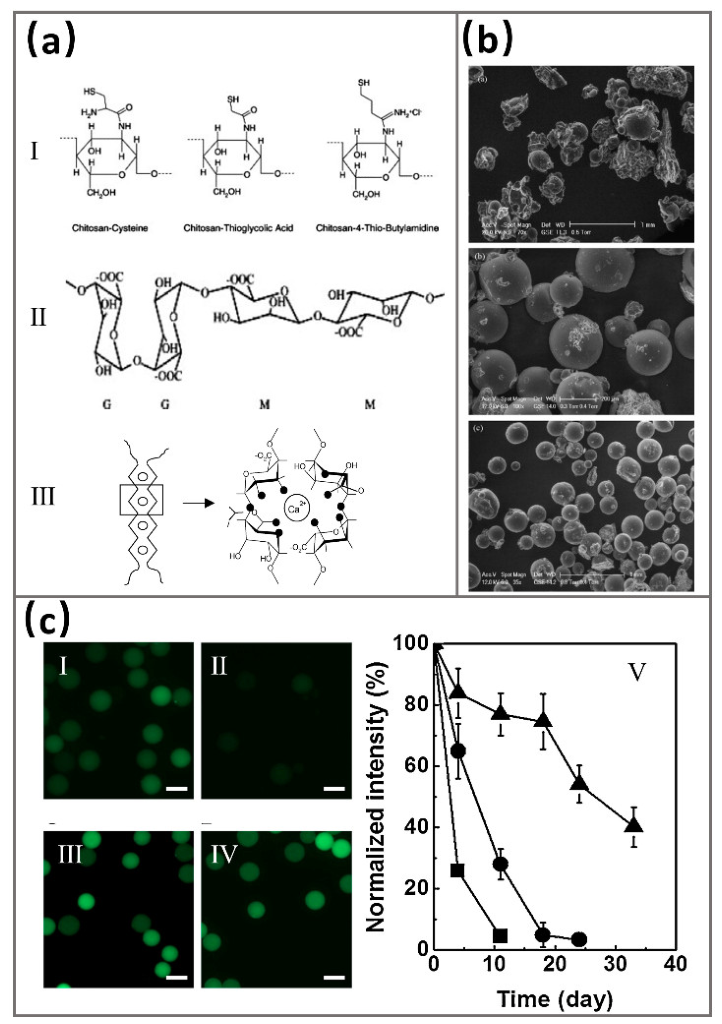
Figure 2.
Precise regulation of shell structure. (a) Microfluidic flow-rate ratio independently regulates droplet size and shell thickness; (b) Fabrication of ultrathin shells via osmotic pressure regulation; (c) Porous ultrathin shells enabling selective permeation and stimuli-triggered release profiles; (d) Double-network hydrogel shells significantly enhancing rupture resistance.
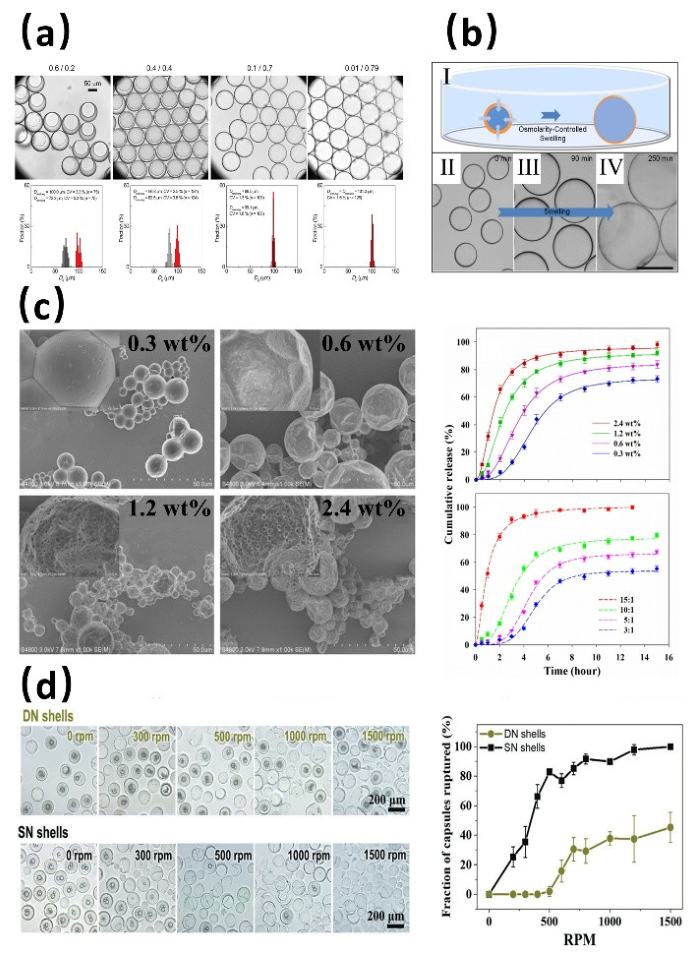
Figure 3.
Three stimuli-responsive mechanisms and release behaviors. (a) Thermoresponsive: PNIPAM-grafted porous membrane with a thermosensitive “gating” mechanism and release profiles at different temperatures; (b) pH-responsive: swelling/shrinkage of the shell induced by protonation/deprotonation of ionizable groups and release profiles at different pH values; (c) Salt-responsive: conformational changes of polyelectrolyte chains induced by salt ions and release profiles at different salt concentrations.
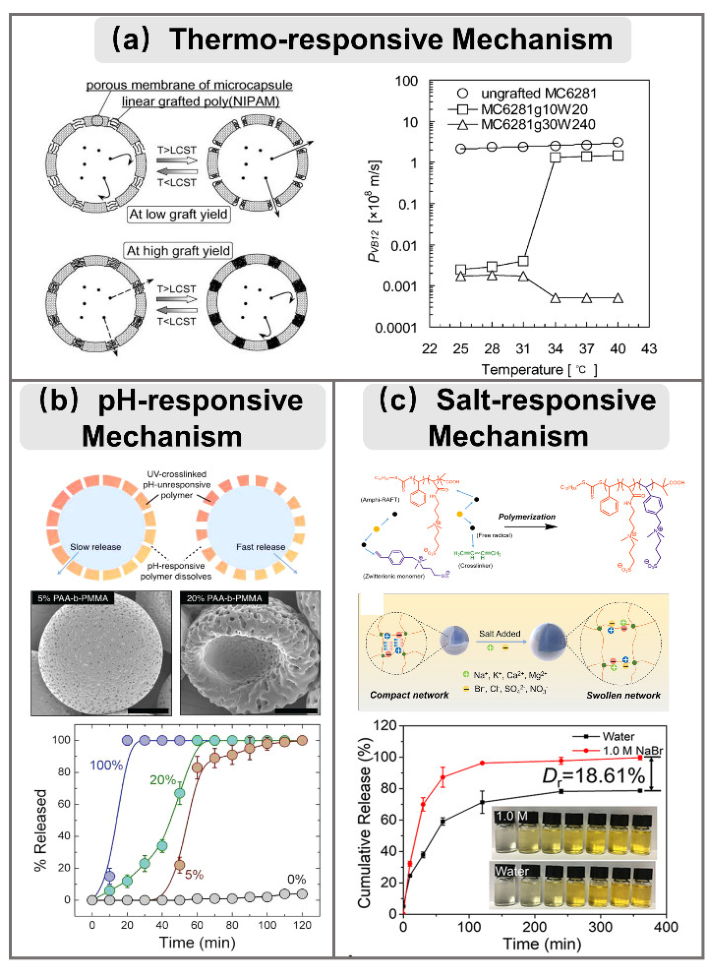
Figure 4.
Synergistic response mechanism to multiple stimuli [21]. (a) Microfluidic fabrication process; (b) Mechanism of synergistic release triggered by pH, temperature, near-infrared (NIR) light, and magnetic fields; (c) Cumulative release profiles at different temperatures and pH values, and on/off release regulated by NIR laser switching.
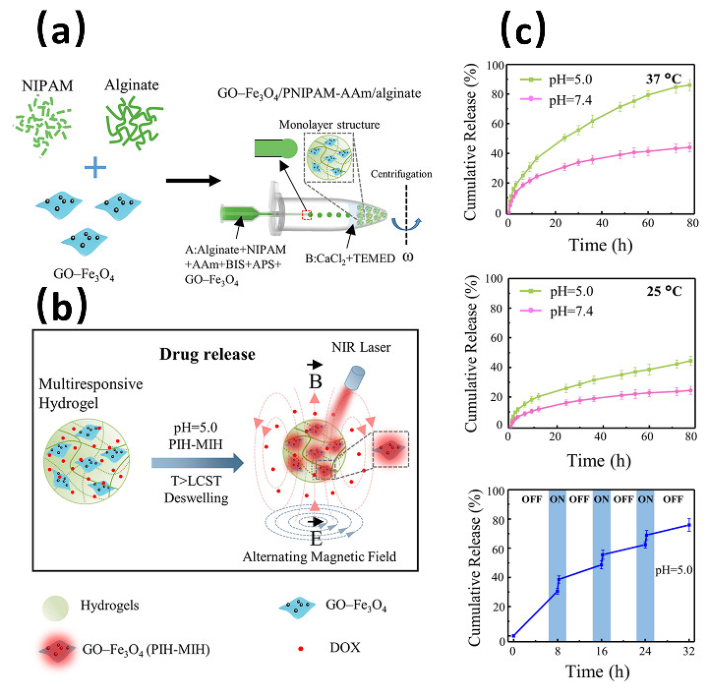
Figure 5.
Schematic illustration of four release mechanisms of microcapsules. (a) Diffusion-controlled; (b) swelling-controlled; (c) degradation/erosion-controlled; (d) mechanically induced rupture.
Figure 5.
Schematic illustration of four release mechanisms of microcapsules. (a) Diffusion-controlled; (b) swelling-controlled; (c) degradation/erosion-controlled; (d) mechanically induced rupture.
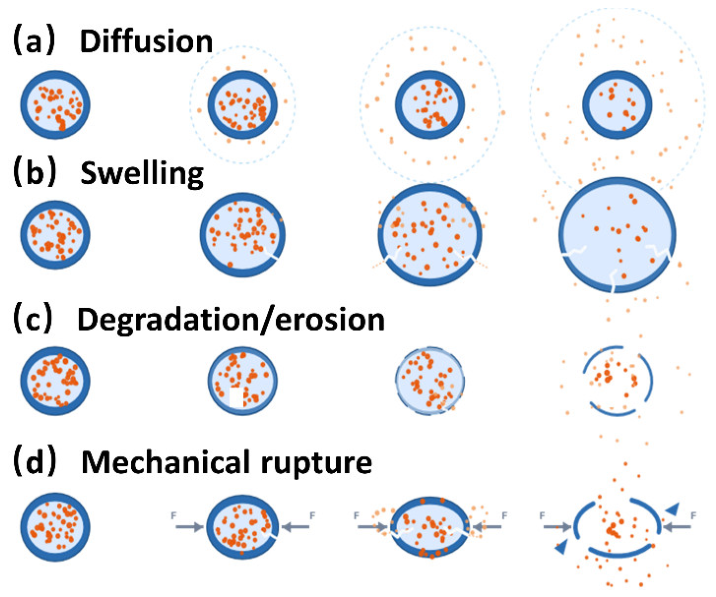
Figure 6.
Effect of structural regulation on release [58]. (a) Quercetin release from Ca-alginate (Capsule 5), Ca-alginate/Fmoc-Y (Capsule 7), and Ca-alginate/Fmoc-Pro (Capsule 9) microcapsules; kinetic models for quercetin release: (b) Zero-order model, (c) First-order model, (d) Hixson–Crowell model, (e) Korsmeyer–Peppas model, and (f) Higuchi model .
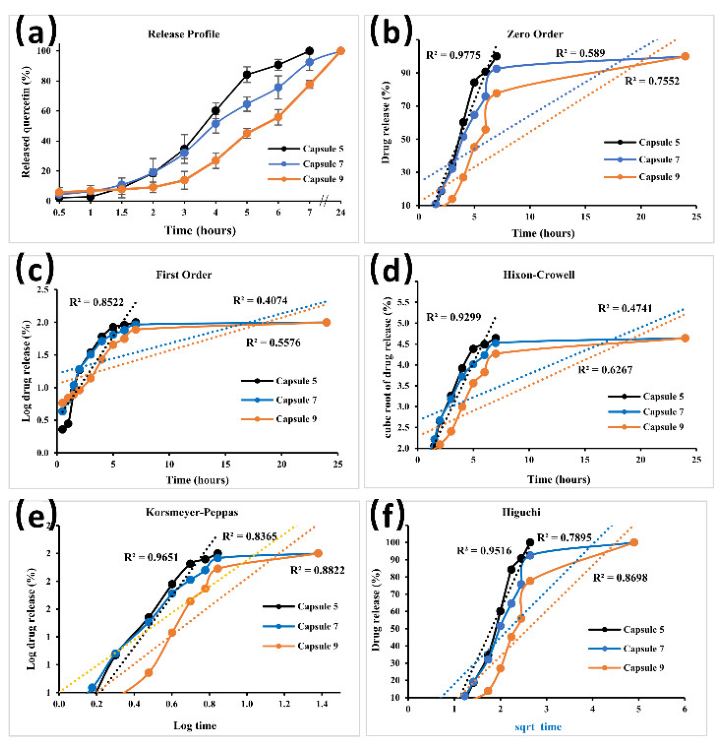
Figure 7.
Migration–release coupling of microcapsules in porous media. Left: matching relationship between particle size and pore-throat size and deformation behavior of elastic-shell and rigid-shell microcapsules passing through pore throats; right: transport and release processes of microcapsules in reservoirs.
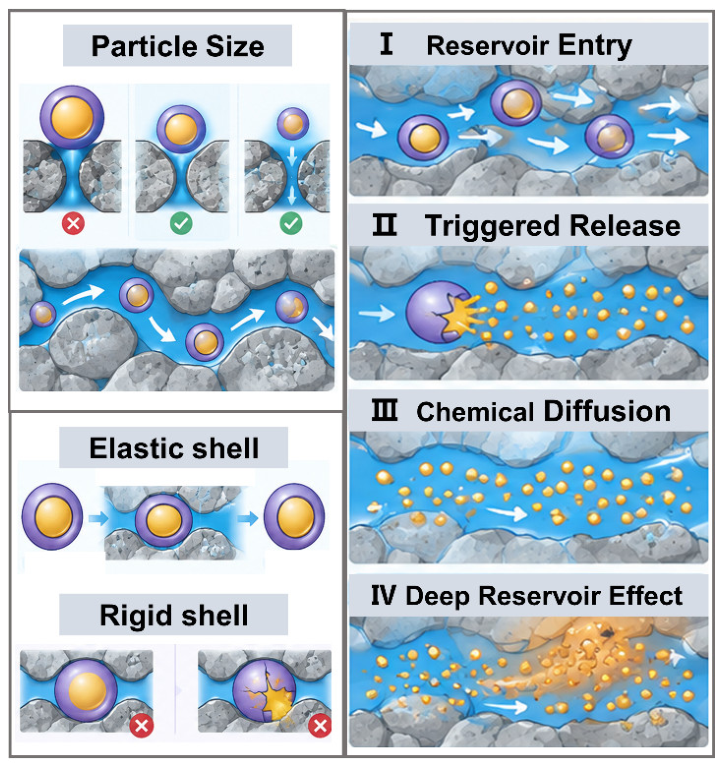
Figure 8.
Oil-triggered rupture and interfacial behavior of ethyl cellulose-shell microcapsules [71]. (a) SEM morphology of the microcapsules; (b) Particle size distributions at different stirring speeds; (c–d) Contact angle of the microcapsules in water and their behavior in the oil phase; (e) Gradual rupture and release of the microcapsules in the oil phase over time; (f) Variation in oil–water interfacial tension with time after addition of the microcapsules and microscopic oil displacement performance; (g) Comparison of the contact angles of pure oil and the oil + microcapsules system.
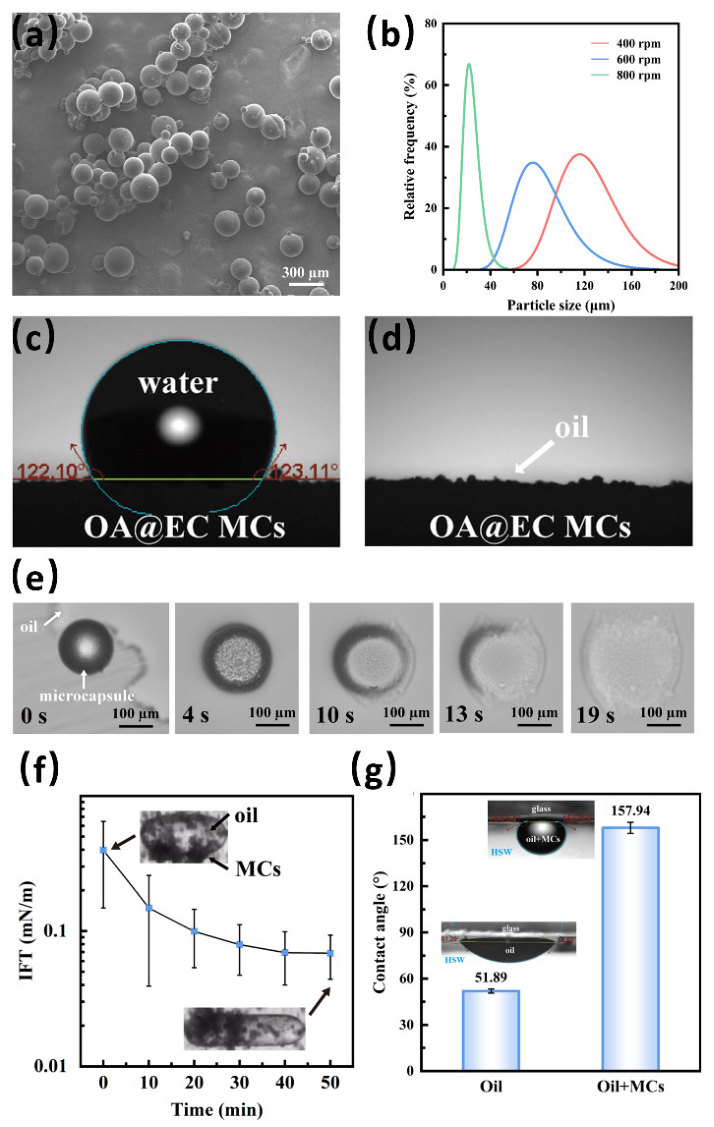
Figure 9.
Controlled release of thermosensitive microcapsules for delayed viscosity enhancement [59]. (a) TEM, AFM, and SEM images showing morphological changes of microcapsules upon temperature triggering; (b) Changes in viscosity and cumulative release during triggered release, together with kinetic model fitting (left), and changes in viscosity with triggering time at different temperatures (right); (c) Microcapsule states at different degrees of cumulative release in the pore-throat model.
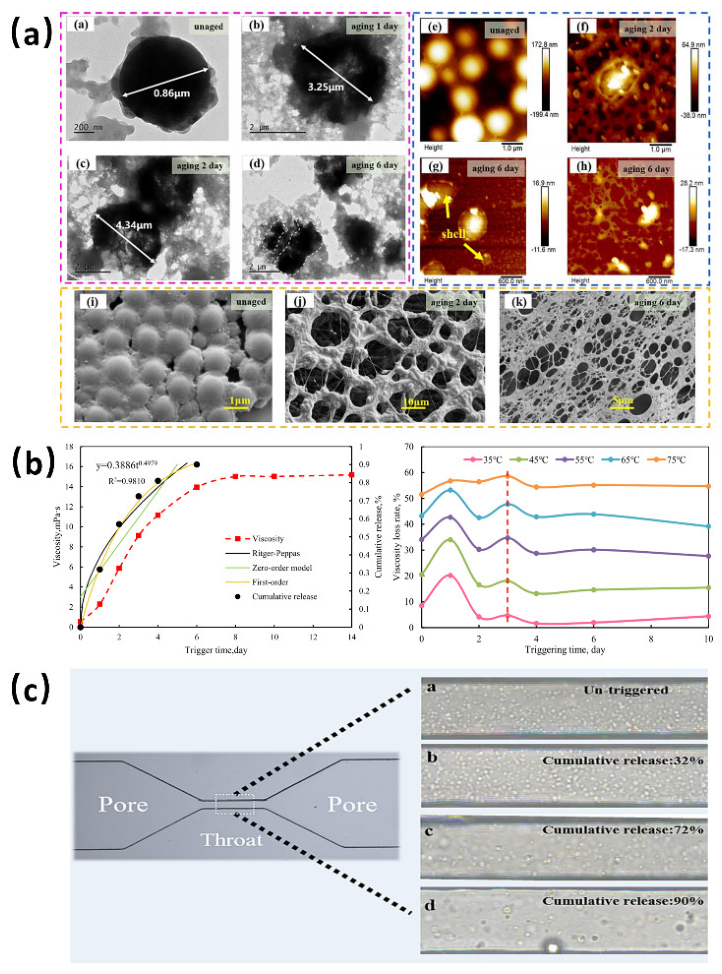
Figure 10.
Porous-media flow characteristics and oil-displacement performance of capsule-based polymer flooding [77]. (a) Flow velocity fields in the pore-throat model at different degrees of viscosity enhancement; (b) Comparison of two-dimensional core viscosity distributions between conventional polymer flooding and capsule-based polymer flooding at the end of polymer injection and during subsequent water flooding; (c) Comparison of the swept regions of capsule-based polymer flooding and water flooding in a microscopic model.
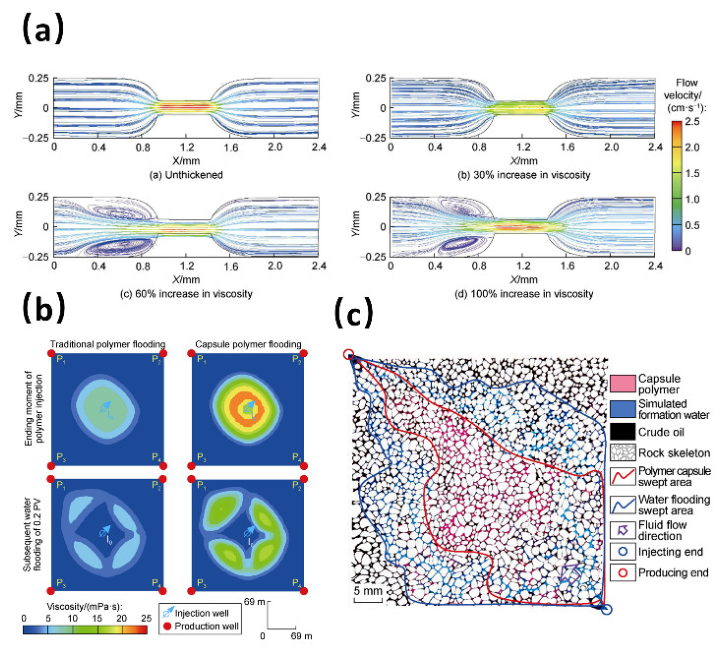
Figure 11.
Delayed crosslinking gelation behavior and gel properties of hydrophobic SiO2 micro/nanocapsules [82]. (a–d) Effects of temperature on gelation time; (e) Rheological properties of gels at different hydrophobic particle contents; (f) SEM images before and after SiO2 particle incorporation.
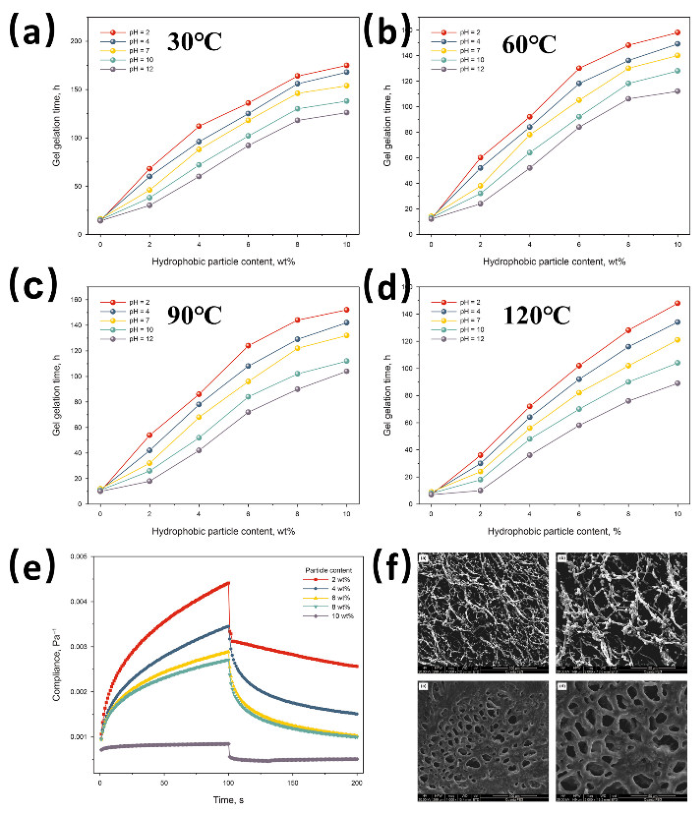
Figure 12.
Microencapsulated acid for low-temperature delayed gel breaking and hydrolysis-based slow-release acid for high-temperature applications [86,87]. (a) Coacervation-based preparation process (I), porous structure (II), and cumulative release profiles at different temperatures (III) of the microencapsulated acid; (b) Degree of hydrolysis of different chloroformate forms at different pH values (I–II), degree of hydrolysis of different chloroformate forms and encapsulated slow-release acid systems at 70°C (III), and hydrolysis mechanism of the shell materials (IV).
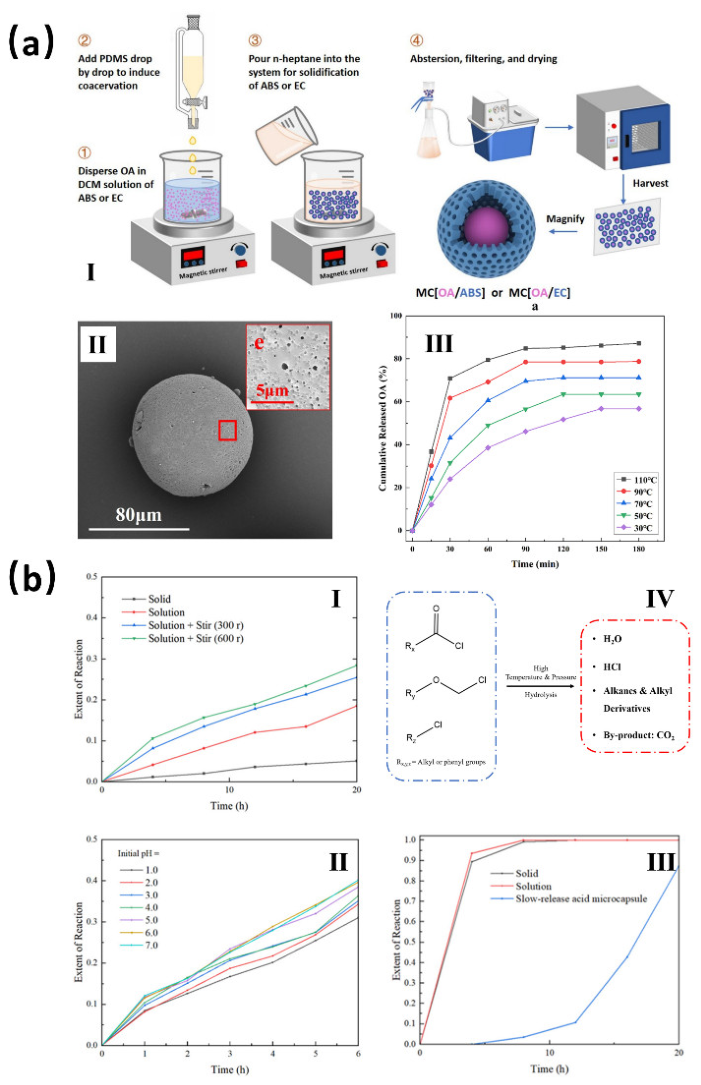
Figure 13.
Preparation and targeted release of mechanically triggered microcapsules. (a) Fabrication process of core–shell epoxy resin microcapsules and plugging formation in lost circulation zones through bridging, accumulation, and squeeze-induced rupture [89]; (b) Transport and release of microcapsules in wellbores and fractures [90].
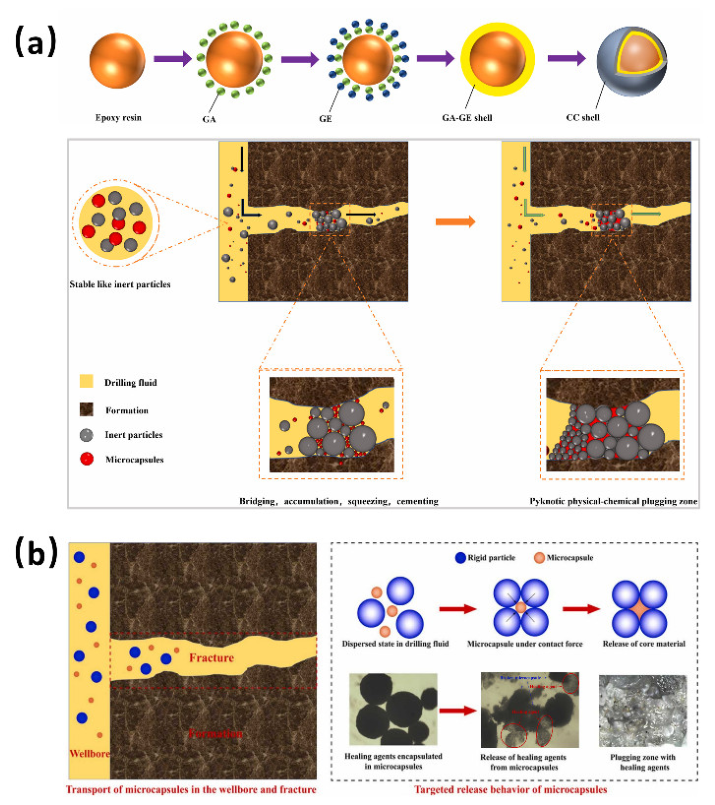
Disclaimer/Publisher’s Note: The statements, opinions and data contained in all publications are solely those of the individual author(s) and contributor(s) and not of MDPI and/or the editor(s). MDPI and/or the editor(s) disclaim responsibility for any injury to people or property resulting from any ideas, methods, instructions or products referred to in the content. |
© 2026 by the authors. Licensee MDPI, Basel, Switzerland. This article is an open access article distributed under the terms and conditions of the Creative Commons Attribution (CC BY) license (http://creativecommons.org/licenses/by/4.0/).
Copyright: This open access article is published under a Creative Commons CC BY 4.0 license, which permit the free download, distribution, and reuse, provided that the author and preprint are cited in any reuse.