
Submitted:
16 November 2026
Posted:
18 November 2026
You are already at the latest version
Abstract
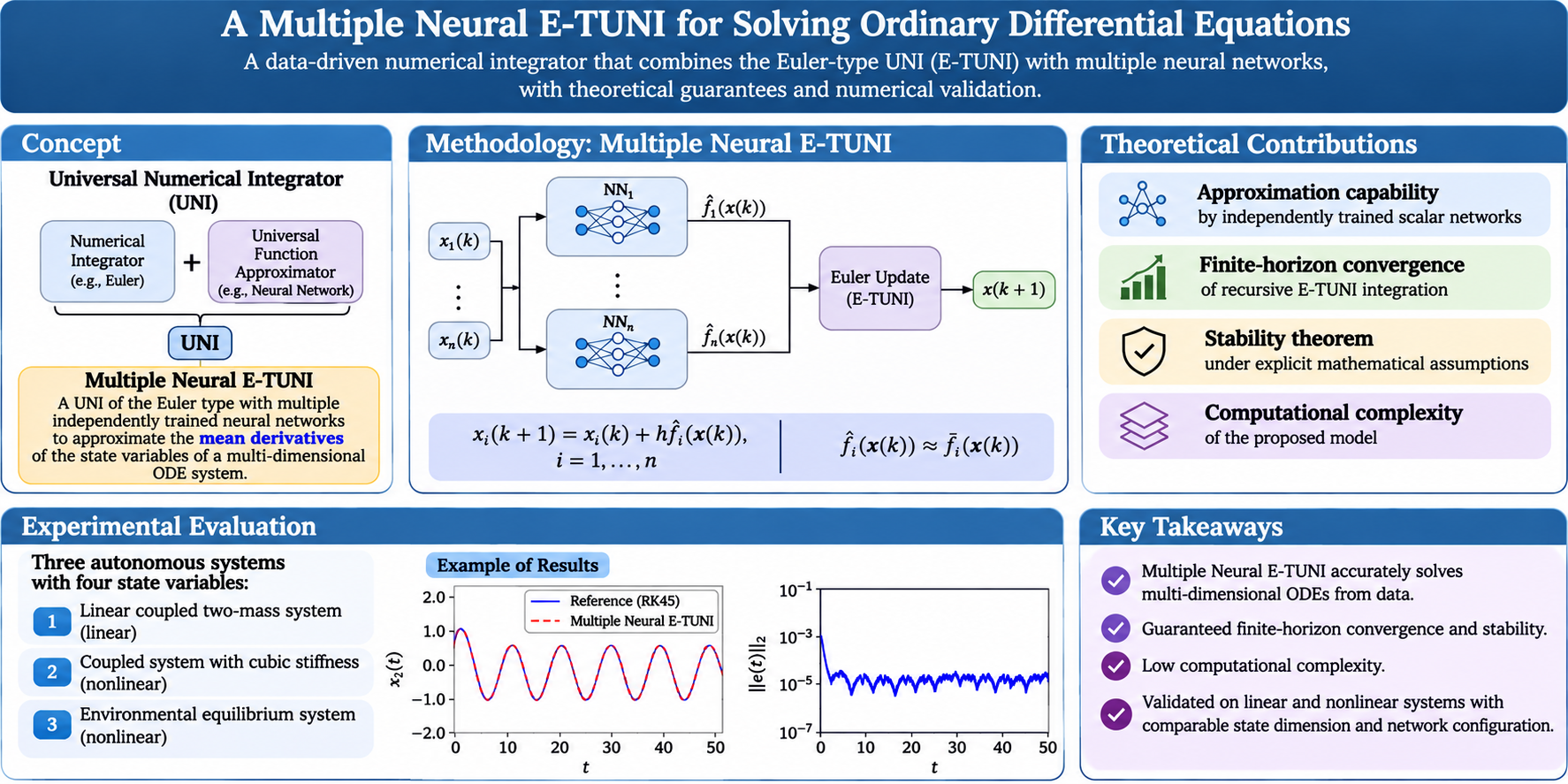
This paper introduces the Multiple Neural Euler-Type Universal Numerical Integrator (Multiple Neural E-TUNI), a new neural numerical integration architecture for multivariable nonlinear dynamical systems. The proposed formulation extends the E-TUNI concept by assigning an independent feedforward neural network to each state variable, while preserving the dynamic coupling of the original system by providing the complete state vector as input to every network. Instead of directly approximating the instantaneous derivatives of the differential system, each neural network is trained to approximate the corresponding mean derivative over a finite integration step, thereby retaining the Euler-type additive structure of E-TUNI. Classical approximation results, including the Stone–Weierstrass theorem and universal approximation properties of feedforward neural networks, are employed to establish the theoretical capability of the multiple-network architecture to approximate the vector mean-derivative mapping on compact domains. Based on this formulation, a finite-horizon convergence theorem is developed for the recursive Multiple Neural E-TUNI integration process. Under compactness, invariance, Lipschitz continuity, and bounded componentwise neural approximation-error assumptions, an explicit upper bound for the accumulated trajectory error is derived. In particular, the analysis shows that the local state error is proportional to the integration step multiplied by the neural mean-derivative approximation error, providing a direct connection between neural approximation accuracy and numerical integration accuracy. Additional results are established for contractive sampled dynamics and for the relationship between componentwise neural errors and vector-state errors. The resulting framework provides a theoretical foundation for Multiple Neural E-TUNI models and establishes a basis for their application to the numerical solution of coupled nonlinear ordinary differential equations. The proposed methodology is computationally evaluated using representative dynamical systems from two distinct application domains: mechanical engineering and environmental modeling. Linear and nonlinear coupled mechanical systems are considered together with a nonlinear Nutrient–Phytoplankton–Zooplankton–Detritus (NPZD) environmental model, providing a diversified experimental assessment of the applicability of the Multiple Neural E-TUNI framework.
Keywords:
Euler-Type Universal Numerical Integrator
; finite-horizon convergence
; mean derivative
; multiple neural networks
; neural numerical integration
; universal approximation
Copyright: This open access article is published under a Creative Commons CC BY 4.0 license, which permit the free download, distribution, and reuse, provided that the author and preprint are cited in any reuse.