

Submitted:
16 November 2026
Posted:
18 November 2026
You are already at the latest version
Abstract
Purpose – The Philippine fast-food market has long been read as a two-player story: Jollibee owns the Filipino heart, and McDonald's owns the global standard. This article asks how Crispy King, a fried-chicken chain founded in Ormoc City in 2015 by a former street bread vendor without a college degree, scaled to more than a thousand outlets within a decade in a market that seemed to leave no room for newcomers. Design/methodology/approach – The study adopts a qualitative, single-case design built on longitudinal document analysis of founder interviews, company materials, franchise disclosures, trade and news reports, and prior consumer research covering 2015 to 2025. The data were temporally bracketed into four phases and analysed through pattern matching against theories of entry barriers, disruptive innovation, and franchising. Findings – The positions of the two incumbents are complementary rather than redundant: together they close off the premium differentiation space, a condition we term complementary positional foreclosure. Crispy King did not break through by out-differentiating the giants. It moved beneath and beside them through four mutually reinforcing mechanisms: spatial-price repositioning toward provincial towns, micro-capital partner franchising (a ₱500,000 total investment with no franchise fee), a vernacular lutong-bahay (home-cooked) value proposition, and relational and narrative capital built from the founder's biography and from keeping workers on partial pay during the COVID-19 lockdowns. Originality/value – The article introduces the constructs of complementary positional foreclosure and vernacular low-end disruption, extending disruption theory beyond its technological origins and showing how franchising can mobilise dispersed household and migrant capital in an emerging economy. Five propositions are offered for future testing. Research limitations/implications – The analysis relies on publicly available secondary sources; its findings generalise analytically rather than statistically. Practical implications – The case offers lessons for emerging-market entrepreneurs, franchisors, and micro, small and medium enterprise (MSME) policy.
Keywords:
complementary positional foreclosure
; low-end disruption
; franchising
; entry barriers
; quick-service restaurants
; philippines
1. Introduction
Ask a Filipino to name a fast-food chain and the answer almost always comes as a pair: Jollibee or McDonald's. For more than four decades these two brands have defined what fried chicken should taste like, where it should be eaten, and how much it should cost. By the end of 2025 the Jollibee brand alone operated roughly 1,340 stores in the Philippines, part of a Jollibee Foods Corporation (JFC) network of more than 3,300 domestic outlets across its brands (JFC, 2025, 2026). McDonald's Philippines closed 2024 with 792 stores and opened its 800th in mid-2025 (Manila Bulletin, 2025; MindaNews, 2025). With deep capital, entrenched supply networks, prime commercial sites, and decades of emotional branding, the two giants built what looked like an unbreachable wall around the country's favourite meal.
Yet within that wall something unexpected grew. Crispy King was founded in 2015 in Ormoc City, Leyte, by Eric Joseph Quitalig Tolo, who began his working life selling bread on the streets before dawn and never finished college (Gancenia, 2023; InfoCebu, 2025). From a 20-square-metre store on Lopez Jaena Street, the chain grew to about 100 outlets by 2020, more than 300 by early 2023, and an estimated 1,200 by mid-2025, with the founder himself claiming close to 1,700 (Pinoyentre, 2023; InfoCebu, 2025; Tolo, 2025). Measured by outlet count, at least, a provincial chain had drawn level with, and possibly passed, the Philippine operations of the world's largest restaurant brand.
This growth is a theoretical puzzle. Industrial organisation and strategy scholarship predicts that markets dominated by heavily capitalised incumbents deter entry through scale economies, brand loyalty, and pre-emptive control of scarce assets (Bain, 1956; Caves & Porter, 1977; Salop, 1979; Schmalensee, 1978). Research on fast food in the Philippines has examined how Jollibee out-localised McDonald's and how the global chain adapted in turn (Watson, 1997; Matejowsky, 2010; Garcia et al., 2022; Basa & Basa, 2025). Far less is known about how provincial Filipino enterprises break into such hierarchies. The literature on disruptive innovation, meanwhile, grew from technology industries in advanced economies (Christensen, 1997; Markides, 2006), and the base-of-the-pyramid and frugal-innovation literatures have mostly asked how multinationals can serve low-income consumers (Prahalad, 2005; Zeschky et al., 2011), rather than how indigenous entrepreneurs scale against them.
This article addresses that gap through an in-depth case study guided by one central question: How did a resource-poor provincial entrant scale against a dominant, capital-intensive duopoly in the Philippine quick-service restaurant (QSR) market? Three sub-questions follow. First, what structural barriers did the incumbents' combined positions create? Second, what mechanisms enabled Crispy King to enter and scale despite those barriers? Third, how were these mechanisms sustained through the exogenous shock of the COVID-19 pandemic?
The article makes three contributions. First, it conceptualises complementary positional foreclosure: a market condition in which two incumbents occupy distinct but mutually reinforcing premium positions, one cultural-emotional and one global-modern, so that the whole space of premium differentiation is closed to newcomers. Second, it develops the notion of vernacular low-end disruption, in which the disruptive foothold rests not on a simpler technology but on locally rooted taste, ownership, and place. Third, it extends resource-scarcity explanations of franchising by showing that low-barrier franchise packages mobilise capital at the level of the franchisee, drawing in small store owners and overseas Filipino workers (OFWs) who are locked out of conventional franchise systems.
The rest of the article is organised as follows. Section 2 reviews the relevant literature and sets out the theoretical framing. Section 3 describes the methodology. Section 4 presents the market context, and Section 5 reports the findings in four phases and four mechanisms. Section 6 discusses the theoretical model and advances five propositions, Section 7 draws practical and policy implications, and Section 8 discusses limitations before the article concludes.
2. Literature Review and Theoretical Framing
2.1. Entry Barriers, Mobility Barriers, and Strategic entry Deterrence
The idea that established firms enjoy structural protection against newcomers goes back to Bain (1956), who identified scale economies, product differentiation, and absolute cost advantages as the main barriers to new competition. Caves and Porter (1977) refined this into the notion of mobility barriers, which protect not just an industry but particular strategic groups within it, so that firms find it costly to move from one competitive position to another. Salop (1979) drew attention to strategic entry deterrence, the deliberate actions incumbents take to make entry unprofitable, while Schmalensee (1978) showed how brand proliferation in the breakfast-cereal industry left no unoccupied product niches for entrants to fill.
These ideas fit the Philippine fast-food market closely. JFC's portfolio, which includes Chowking, Greenwich, Red Ribbon, Mang Inasal, and several international brands, resembles Schmalensee's proliferation logic: each new brand occupies a niche that might otherwise invite an entrant. Beyond formal assets, incumbents also benefit from relational advantages. Uzzi (1997) showed that embedded ties built on trust and reciprocity give firms preferential access to suppliers and partners. An entrant seeking chicken supply, commercial leases, or distribution deals must therefore contend not only with incumbents' prices but with their long-standing relationships and their ability to guarantee long-term contracts.
2.2. Complementary Positioning and the Closure of Premium Differentiation
Porter (1980, 1985) argued that firms gain advantage through cost leadership, differentiation, or focus. Most analyses of duopolies assume that the two leaders contest the same position. The Philippine case suggests a different configuration. Jollibee holds what may be called the cultural-emotional position. Its sweet-style spaghetti, Chickenjoy, and family-centred advertising have made it what Holt (2004) calls an iconic brand, one that carries cultural myths that competitors cannot easily copy regardless of product quality. In Keller's (2001) terms, Jollibee has achieved brand resonance, the deepest level of customer-brand relationship. Chickenjoy functions as the unwitting standard of comparison against which Filipinos judge any other fried chicken.
McDonald's, by contrast, holds the global-modern position. It signals international quality standards, operational sophistication, and modern convenience through drive-thrus, 24-hour stores, and digital ordering (Shastri, 2024). Close to 70% of its Philippine stores are free-standing with drive-thru facilities (GMA Network, 2025).
We argue that these positions are complementary rather than redundant. A challenger that claims greater authenticity or "Filipino-ness" collides with Jollibee's decades of accumulated cultural identity and risks appearing merely provincial. A challenger that claims greater modernity or global standards collides with McDonald's far superior resources. Together, the two incumbents close off the entire spectrum of premium differentiation. We label this condition complementary positional foreclosure. It is a structural barrier that goes beyond the sum of each firm's individual advantages, because it removes the escape routes that strategy theory normally offers a differentiated entrant.
2.3. Low-End Disruption, Value Innovation, and Cost Focus in Emerging Markets
If premium differentiation is closed, theory points to three adjacent routes. Christensen's (1997) theory of disruptive innovation holds that entrants can succeed by serving overlooked or over-served customers with simpler, cheaper offerings that incumbents rationally ignore because those customers are less profitable. Low-end disruption targets customers at the bottom of an existing market (Christensen et al., 2015). Critics note that the theory was developed mainly in technology industries and needs refinement to explain business-model disruption (Markides, 2006; Terry, 2020).
Kim and Mauborgne's (2005) blue ocean strategy proposes value innovation: creating uncontested market space by simultaneously lowering cost and raising buyer value, which makes competition less relevant. Porter's (1980) cost focus strategy describes firms that narrow their competitive scope to a segment where they can achieve a cost advantage.
Emerging-market scholarship adds that these strategies take distinctive forms where incomes are low and institutions thin. Prahalad and Hart (2002) and Prahalad (2005) argued that the poor constitute a large and underserved market, and Hart and Christensen (2002) linked base-of-the-pyramid strategy to disruption. The frugal-innovation literature describes products and business models designed around severe resource constraints (Zeschky et al., 2011; Radjou et al., 2012), and Khanna and Palepu (1997, 2010) showed that firms in emerging markets often succeed by building capabilities that fill institutional voids. Much of this work, however, is about multinationals adapting to the poor. Less attention has gone to local entrepreneurs who were themselves poor and who build scalable firms from that position.
2.4. Franchising as a Growth Engine
Franchising theory offers two main explanations for why firms franchise. Resource-scarcity theory holds that young firms use franchising to access capital, managerial talent, and local knowledge that they cannot obtain otherwise (Oxenfeldt & Kelly, 1969; Combs & Ketchen, 1999). Agency theory holds that franchising aligns incentives because franchisees, as residual claimants, have stronger motivation to manage outlets well than salaried managers do (Rubin, 1978). Both perspectives agree that franchising accelerates growth and improves survival in new systems (Shane, 1996; Combs et al., 2004), and franchising has been identified as an important entrepreneurial growth path in emerging markets (Hoffman & Preble, 2004; Gillis & Castrogiovanni, 2012). Rapid franchise expansion also brings risks, chiefly variation in quality and difficulties in monitoring (Gillis & Castrogiovanni, 2012).
The franchising literature has mostly examined capital scarcity from the franchisor's side. In markets where incumbents' franchise packages require tens of millions of pesos, scarcity also exists on the franchisee's side: a large pool of would-be entrepreneurs is excluded from franchise ownership altogether. How a franchisor might design a system to mobilise this excluded capital remains under-theorised.
2.5. Embeddedness, Founder Narratives, and Cultural Legitimacy
New ventures need legitimacy to acquire resources. Lounsbury and Glynn (2001) showed that entrepreneurial stories help create the legitimacy that attracts investors, partners, and customers. Granovetter (1985) argued that economic action is embedded in social relations, and in the Philippine context the value of kapwa, the shared self that links a person to others, shapes expectations of reciprocity between employers, workers, and communities (Enriquez, 1992). Consumer research shows that perceived brand authenticity, including continuity with origins and sincerity of values, increases trust and attachment (Beverland, 2005; Morhart et al., 2015). Crisis-management research adds that firms' responses to shocks, whether retrenching, persevering, innovating, or exiting, shape their post-crisis trajectories (Wenzel et al., 2020; Kuckertz et al., 2020).
2.6. Research Gap
Taken together, the literature explains well why incumbents are hard to dislodge and offers several candidate routes for entrants. It does not explain how these routes combine in an emerging-market setting where the incumbents' positions are complementary, nor how a founder without capital or formal education can assemble them into a scalable system. The present study addresses this gap by tracing the case of Crispy King over a decade.
3. Methodology
3.1. Research Design
The study uses a qualitative, single-case design. Single cases are appropriate when a case is revelatory or extreme, that is, when it makes visible a phenomenon that is otherwise hard to observe (Yin, 2018; Siggelkow, 2007). Crispy King qualifies on both counts. Its growth is unusually fast for a Philippine QSR, and it occurred against one of the most concentrated fast-food markets in Southeast Asia. The aim is analytical generalisation: building theory that can be tested in other settings, rather than estimating population parameters (Eisenhardt, 1989; Yin, 2018).
3.2. Data Sources
Because the company is privately held and does not publish financial statements, the study relies entirely on documentary evidence from publicly available sources. The authors did not conduct interviews or surveys. Bowen (2009) notes that document analysis is well suited to case studies where events have already unfolded and records are rich. Table 1 summarises the five categories of data used. The founder’s perspective comes from interviews and features he gave to media programmes and content creators, together with his own video updates, all publicly posted on YouTube and Facebook (e.g., Gancenia, 2023; Sanchez-Roxas, 2019; Tolo, 2025). These recordings are mostly in Filipino and Cebuano; the authors watched them in full and translated into English the passages used in the analysis. Because these are secondary accounts produced for public audiences, they were treated as the founder’s self-presentation and cross-checked against other sources wherever possible (see Section 3.4).
3.3. Data Analysis
Analysis proceeded in three stages. First, the authors built a chronological event history of the firm, its founder, and its competitive environment. Second, following Langley's (1999) temporal bracketing strategy, the event history was divided into four phases separated by discontinuities in the firm's activities: capability accumulation (late 1990s to 2014), provincial foothold (2015 to 2019), crisis and perseverance (2020 to 2021), and accelerated partner-led expansion (2021 to 2025). Third, the evidence in each phase was compared against the patterns predicted by the theories reviewed in Section 2, a pattern-matching logic that allows rival explanations to be assessed (Yin, 2018). Emergent mechanisms that the existing theories did not fully anticipate were coded separately and refined iteratively.
3.4. Trustworthiness
To strengthen credibility, every substantive claim was cross-checked against at least two types of source wherever possible (Lincoln & Guba, 1985). For example, the founder’s own accounts in publicly posted interviews were compared with news reports, company materials, and third-party sources. Where sources disagreed, as on store counts and on the scale of pandemic closures, the discrepancy is reported rather than resolved silently. The authors reviewed the documentary evidence and its interpretation together, and resolved differences through discussion. The authors have no commercial relationship with Crispy King, Jollibee, or McDonald’s. As educators based in the Visayas, the authors are also consumers in the markets they study. This insider familiarity aided interpretation of cultural cues but was checked against documentary evidence throughout.
4. Case Context: The Philippine Fried-Chicken Market
4.1. A Nation that Turned to Chicken
The Philippines, with a population of 112.7 million (Presidential Communications Office, 2025), has become a nation that loves chicken. Pork was long the preferred protein, but chicken overtook it for the first time in 2019 and has stayed ahead since, a shift that Poultry World attributes partly to the spread of fast-food outlets (Kinsley, 2022). Chicken is affordable, versatile, and culturally embedded in dishes such as tinola and adobo, and fried chicken has become everyday comfort food, eaten at ordinary meals and at celebrations alike. Fried chicken was reported as the most-ordered food among Filipino consumers (Purnell, 2022), and during the holidays Filipinos may forgo salads and sweets but rarely fried food (Llemit, 2022).
This demand is shaped by price as much as by taste. Food-choice research consistently identifies price as one of the strongest determinants of what people eat (Fernqvist et al., 2024). In the Philippines, nearly half of families rate themselves as poor (Garcia, 2024). Long before Crispy King, a large informal market of street stalls and mobile vendors already sold cheap fried chicken to these households, demonstrating latent demand that the formal chains were not serving.
4.2. The Incumbents
Jollibee. Tony Tan Caktiong founded Jollibee in 1978 as an ice-cream parlour. When customers asked for hot meals, he added hamburgers, spaghetti, and fried chicken, and the hot meals soon outsold the ice cream. When McDonald's entered the Philippines in 1981, Caktiong reportedly declined an offer to become its franchisee and chose to compete instead, having concluded that the Western palate did not fully suit Filipino taste (Garcia et al., 2022). Jollibee's menu of the Yumburger, Jolly Spaghetti, and Chickenjoy, characterised by the sweetness and savouriness Filipinos prefer, allowed it to outperform the global giant. In 1989 it became the first Philippine fast-food chain to pass one billion pesos in sales. Its smiling-bee mascot, children's programming, and short films about family, love, and sacrifice extended its emotional reach across generations (Basa & Basa, 2025). Abroad, Jollibee followed the Filipino diaspora, serving not just fried chicken but nostalgia in a tray.
McDonald's. McDonald's Philippines, operated by Golden Arches Development Corporation under a master franchise held since 1981 and renewed in 2025 for twenty more years (Leyco, 2025; Manila Bulletin, 2025), adapted in turn. From the mid-1980s it introduced steamed rice, spaghetti, and fried chicken, located stores in high-traffic commercial districts, and pioneered 24-hour service. Its advantage lies in international recognition, standardised quality, and operational sophistication.
Table 2 compares the scale and entry requirements of the three chains. The comparison underlines the size of the wall that any entrant faced.
5. Findings
The findings are presented in two parts. Section 5.1 to 5.4 trace the four phases of Crispy King's development. Section 5.5 to 5.8 then identify the four mechanisms that, taken together, explain how the firm scaled.
5.1. Phase I: Accumulating Frugal Capabilities (Late 1990s to 2014)
Like many success stories, Crispy King's begins in poverty. Tolo grew up in Ormoc City; his mother died when he was young, and his father struggled with gambling. He sold bread on the streets before sunrise and, with the support of an aunt, finished high school, though college remained out of reach (Gancenia, 2023; Sanchez-Roxas, 2019). In the late 1990s he moved to Cebu City. He was turned down for a fast-food crew job because he did not yet know how to answer interview questions, and he worked instead as a dishwasher and then as a salesman of stoves.
The way Tolo built his first business is a textbook case of what Sarasvathy (2001) calls effectual reasoning: starting from the means at hand and investing only what one can afford to lose. When his sales contract was not renewed, he turned a part-time sideline, selling liquefied petroleum gas (LPG) to the customers who had bought stoves from him, into a business. He borrowed ₱30,000 from an in-law's retirement money and divided it into three equal parts: ₱10,000 as a down payment on a delivery motorcycle, ₱10,000 for LPG tanks, and ₱10,000 as a cash buffer for his family's daily needs. He reportedly soon earned almost double the salary of a regular Cebu employee (Gancenia, 2023).
The move into baking shows bricolage, the recombination of resources at hand (Baker & Nelson, 2005). A bakery-owning customer let him buy bread in bulk to deliver between four and six in the morning. When this proved profitable, Tolo asked whether he could open his own bakery far enough away to avoid competing with her; she agreed and lent him a baker paid by the hour. Within a year he had four Cebu branches earning around ₱50,000 each. At 25 he returned to Ormoc to give his siblings work, opened bakeries there, and then diversified into grilled chicken under the Estong Lechon Manok brand, which grew to about 20 stores (Gancenia, 2023; InfoCebu, 2025).
Three capabilities accumulated in this phase would prove decisive later: a habit of frugal, staged investment; experience replicating small, standardised outlets; and a network of relationships built on reciprocity with mentors, family, and workers.
5.2. Phase II: Provincial Foothold (2015 to 2019)
Tolo entered the fried-chicken business in 2015 and registered it as Crispy King. The first store, on Lopez Jaena Street in Ormoc, occupied just 20 square metres (Pinoyentre, 2023). Long queues formed almost immediately, a clear sign that the product had found the mass market. Expansion followed to Tacloban, Cebu, and Dumaguete, cities with a strong appetite for quick, affordable meals. The company's stated mission, to bring the best quality crispy fried chicken to the masses at a very affordable price with the comforts of dine-in (Crispy King, n.d.-a), defined the target from the start: ordinary Filipinos in the middle and lower classes, many of whom could not regularly afford the incumbents' chicken.
This phase fits the low-end foothold pattern predicted by disruption theory. The incumbents had little reason to defend small provincial towns with low per-customer spending, and Crispy King grew there largely unopposed, reaching roughly 100 stores by 2020 (Gancenia, 2023).
5.3. Phase III: Crisis and Perseverance (2020 to 2021)
Then the pandemic came. In early 2020 lockdowns emptied streets and malls, and dine-in operations stopped. Sales collapsed but rent, utilities, and wages did not. Whereas the incumbents could shift quickly to delivery through established digital platforms (Manila Bulletin, 2025), Crispy King had neither the systems nor the reserves to do so. In an interview with Agribusiness (2023), Tolo described the uncertainty as overwhelming because no one knew when business could safely resume. Accounts differ on the scale of the shutdown: founder interviews describe a network of about 100 stores, while the Agribusiness interview refers to more than 40 branches brought to a halt. The difference may reflect the distinction between company-run and partner-run stores, or the timing of each account.
Tolo's response is analytically important. Rather than laying off his workforce, he placed employees on forced leave and paid them about a third of their regular salary for close to a year while the company focused on what he called "cleansing" its systems (Gancenia, 2023). In the terms of Wenzel et al. (2020), this combined retrenchment of operations with perseverance in preserving core assets, here the workforce. The decision was costly, but Tolo judged that abandoning his workers would destroy the loyalty and trust that had carried the company from its beginnings.
As months passed, Tolo faced a second decision. Food is essential, and he expected demand to return. Expansion, however, required capital, risk, and confidence at a moment when none was guaranteed. He chose to expand.
5.4. Phase IV: Accelerated Partner-Led Expansion (2021 to 2025)
The aggressive bet paid off. Table 3 traces the chain's growth as reported by different sources. By mid-2025 the network had reached an estimated 1,200 outlets and more than 7,700 employees, with growth concentrated in provincial cities and towns rather than in Metro Manila, where competition is fiercest and operating costs highest (InfoCebu, 2025).
The growth figures should be read with care. The founder's own claim of about 1,700 stores in May 2025 is considerably higher than the third-party estimate two months later, and outlet counts across the three chains are not equivalent: a 40-square-metre Crispy King store is a very different unit from a free-standing McDonald's drive-thru. Even on the most conservative reading, however, the chain grew more than tenfold in five years, one of the fastest expansions in the history of the Philippine QSR industry.
5.5. Mechanism 1: Spatial-Price Repositioning Beneath the Duopoly
The first mechanism is a deliberate repositioning on two dimensions the incumbents under-served: price and geography. At the time of data collection, a one-piece chicken-with-rice meal cost about ₱52 at Crispy King, compared with roughly ₱100 for a comparable meal at Jollibee or McDonald's, nearly half the price (InfoCebu, 2025). Spatially, the chain avoided the advertising-intensive, mall-centred "red ocean" of Metro Manila and placed small stores in neighbourhoods and provincial town centres where rents are lower and the incumbents' presence thinner.
This repositioning combines all three routes reviewed in Section 2.3. It is a cost focus strategy in Porter's (1980) sense, narrowing scope to price-sensitive provincial households. It is value innovation in Kim and Mauborgne's (2005) sense, because cost is reduced without reducing the value customers perceive. And it is a low-end disruption foothold in Christensen's (1997) sense, because it serves customers whom the incumbents found less attractive. What the case adds is that the three routes are not alternatives but layers of a single move: geography lowers cost, cost permits price, and price unlocks a segment that the giants' cost structures prevent them from following without cannibalising their own margins.
5.6. Mechanism 2: Micro-Capital Partner Franchising
The second mechanism, and arguably the engine of Phase IV, is the franchise model. Table 2 shows the difference starkly. A Jollibee franchise reportedly requires an investment of ₱30 to ₱35 million excluding land and building, and applicants must demonstrate a substantial net worth (Nick, 2025; Jollibee, 2025). Crispy King, by contrast, offers a "partner" package with a total investment of ₱500,000 covering construction or renovation, a complete set of equipment and utensils, signage, marketing materials, initial stock, and a security bond. It charges no franchise fee, requires a site of at least 40 square metres, and supplies the full food inventory and packaging to partners (Crispy King, n.d.-b; InfoCebu, 2025). Partners also receive on-site support at opening and continuing operational assistance.
This model inverts the usual resource-scarcity story. The literature emphasises that young franchisors lack capital (Oxenfeldt & Kelly, 1969; Combs & Ketchen, 1999). Crispy King's design instead targets scarcity on the franchisee side. By lowering the entry threshold by roughly two orders of magnitude, it opens franchise ownership to small store owners, provincial families, and OFWs and their households, a group whose savings are substantial in aggregate but too small, individually, for conventional franchises. The franchisor gains capital and local knowledge from this dispersed pool; the partners gain access to a proven system. Central supply of inventory also gives the franchisor a revenue stream and a control lever over product consistency, addressing part of the agency problem that a low-fee model might otherwise create (Rubin, 1978).
Growth came with little paid advertising. Visibility spread through word of mouth and social media, and each new partner became a local ambassador for the brand.
5.7. Mechanism 3: A Vernacular Value Proposition
Cheapness alone does not explain the brand's appeal. Consumer research consistently finds that taste and product quality drive satisfaction and loyalty in fast food (Hidayat et al., 2019; Iglesias et al., 2019). Crispy King's offer is framed around lutong-bahay, the taste of home-cooked fried chicken, together with unlimited gravy, a small but symbolically generous feature (InfoCebu, 2025). A qualitative study of Crispy King customers found that they valued its taste, portion size, and affordability (Pelesco et al., 2023).
This matters theoretically. Classic low-end disruption describes a "good enough" product that is inferior on the incumbent's main performance dimension (Christensen et al., 2015). Crispy King's product is not positioned as an inferior copy of Chickenjoy. It draws instead on a different and older reference point, the home kitchen and the street-side fried chicken that ordinary Filipinos already ate. We call this a vernacular value proposition: the low-cost offer is anchored in local taste and consumption practices rather than in a stripped-down imitation of the incumbents. It avoids the trap described in Section 2.2, because it claims neither more Filipino identity than Jollibee nor more modernity than McDonald's, but simply familiarity at a fair price.
5.8. Mechanism 4: Relational and Narrative Capital
The fourth mechanism operates through relationships and story. The founder's biography, from street bread vendor to owner of a national chain, is widely retold in interviews and media features that describe him as a "Mr. Cinderella" figure (Gancenia, 2023; Tolo, 2025). It mirrors the struggles of many of the brand's customers and partners. Consistent with Lounsbury and Glynn (2001), this narrative provides legitimacy that substitutes for advertising spend. Consistent with research on brand authenticity (Beverland, 2005; Morhart et al., 2015), it makes the brand's claim to serve "the everyday Filipino" credible.
Tolo's success was also built on a chain of relationships: the aunt who helped him finish school, the in-law whose retirement savings funded the LPG business, the bakery owner who mentored him and lent him a baker, the siblings who motivated his return to Ormoc, and the employees he kept on partial pay during the lockdowns. In the language of embeddedness (Granovetter, 1985; Uzzi, 1997), these ties constitute relational capital that incumbents cannot buy. The decision to retain workers during the pandemic converted a crisis into an investment in loyalty and gave the company a committed core of experienced staff precisely when it needed to train hundreds of new partner stores. In Filipino terms, it expressed kapwa, the obligation of reciprocity between people bound together (Enriquez, 1992), and it was understood as such.
6. Discussion
6.1. Toward a Model of Vernacular Low-End Disruption
Figure 1 integrates the findings into a process model. Complementary positional foreclosure closes the premium differentiation space. Capabilities accumulated in Phase I, namely effectual investment, replication of small outlets, and relational ties, enable four mechanisms that move the entrant beneath and beside the incumbents rather than against them. The pandemic acts as a stress test that, through the perseverance response, converts relational capital into expansion capacity. The outcome is a sustainable niche of national scale, accompanied by new tensions that arise from the speed of growth.
The central insight is that Crispy King did not out-perform Jollibee or McDonald's; it did not need to. The duopoly had built a wall of emotion and modernity, and the wall was real. The firm's achievement was to recognise that the wall enclosed only the premium space, and that a vast territory of price-sensitive provincial consumers and would-be small owners lay outside it.
6.2. Propositions
The case suggests five propositions for future research.
Proposition 1. Where incumbents occupy complementary premium positions (cultural-emotional and global-modern), entrants that reposition along under-served dimensions of price and geography are more likely to survive and scale than entrants that contest either premium position directly.
Proposition 2. In emerging economies, low-end disruption is more likely to succeed when the low-cost offering is anchored in vernacular taste and consumption practices than when it is a simplified imitation of the incumbents' products.
Proposition 3. Franchise systems with low total investment and no franchise fee scale faster in capital-scarce markets because they mobilise dispersed household and migrant savings; resource-scarcity logic operates at the level of the franchisee as well as the franchisor.
Proposition 4. During exogenous shocks, a perseverance response that retains employees builds relational capital that increases a firm's capacity for rapid post-crisis expansion.
Proposition 5. The mechanisms that enable rapid micro-capital expansion also generate scale tensions, in quality consistency, digital capability, and imitation, and the management of these tensions determines whether a disruptive foothold becomes durable.
6.3. Theoretical Contributions
The study contributes to three bodies of literature. To the literature on entry barriers (Caves & Porter, 1977; Schmalensee, 1978; Salop, 1979), it adds the concept of complementary positional foreclosure, which describes a barrier arising not from any one firm's assets but from the fit between two incumbents' positions. This sharpens the analysis of duopolies, which are often treated as two firms fighting over the same ground.
To disruption theory (Christensen, 1997; Markides, 2006), it adds vernacular low-end disruption, in which the disruptive foothold rests on locally rooted taste, place, and ownership rather than on a cheaper technology. This answers calls to extend disruption theory beyond technological change (Markides, 2006; Terry, 2020) and connects it with the frugal-innovation literature (Zeschky et al., 2011; Radjou et al., 2012), but from the vantage point of an indigenous entrepreneur rather than a multinational.
To franchising theory (Oxenfeldt & Kelly, 1969; Rubin, 1978; Combs & Ketchen, 1999), it adds the insight that franchise design can be used to unlock capital that conventional systems exclude, and that central supply of inventory can partly substitute for high fees as a mechanism of control and revenue.
6.4. Tensions of Scale
The same mechanisms that propelled Crispy King now generate tensions. These tensions, summarised in Table 4, should not be read as a simple list of weaknesses; each is the shadow side of a strength.
The first tension is between speed and consistency. Rapid franchising is well known to increase variation in quality (Gillis & Castrogiovanni, 2012), and customers have already raised concerns about waiting times at peak hours (Pelesco et al., 2023). The second is between frugality and digital capability. Food delivery adoption continues to rise in Southeast Asia (Google et al., 2023), and smaller food enterprises tend to lag in digital presence (Kemp, 2023); the pandemic showed how costly this gap can be. The third is between low cost and input volatility: as a low-margin chicken seller, the chain is exposed to swings in poultry and food prices (FAO, 2025; Reardon & Vos, 2021). The fourth is between openness and imitation: a model this simple is easy to copy, and market overcrowding raises imitation risk (Porter, 2008). Finally, the incumbents may respond. Their advertising budgets and media visibility far exceed those of local brands (Balita, 2025), and the more Crispy King grows, the less rational it becomes for them to ignore it.
7. Implications
7.1. For Entrepreneurs and Managers
The case offers three lessons for entrepreneurs in emerging markets. First, when incumbents hold the premium ground, the most promising path may be to redraw the market's boundaries rather than to fight for that ground. Second, franchise design is itself a strategic choice: a lower entry threshold can enlarge the pool of partners and spread the costs and risks of expansion. Third, relational capital, including how a firm treats its workers in hard times, can be converted into growth capacity.
For Crispy King itself, the analysis suggests priorities that follow from the tensions in Table 4. Quality assurance systems, such as standardised training, audits, and partner performance monitoring, should keep pace with network growth. Investment in digital ordering and delivery partnerships would close the gap exposed by the pandemic. Menu development could add flavours, sauces, and healthier options in response to rising health consciousness (Hidayat et al., 2019), provided the brand's vernacular core is preserved. Improving store ambience and reducing peak-hour waiting times would strengthen customer satisfaction (Pelesco et al., 2023). Expansion into larger cities and into markets with large Filipino communities abroad, a path Jollibee has already proved (Michaels, 2025), is possible, but such moves would bring the firm closer to the incumbents' home ground and should be weighed against Proposition 1.
7.2. For Policy
The case also speaks to MSME and inclusive-growth policy. Low-threshold franchise systems can act as vehicles for entrepreneurship among provincial households and returning OFWs, channelling savings and remittances into productive local enterprises. Agencies supporting MSMEs could study such models when designing financing, training, and reintegration programmes, while ensuring that partners are protected through clear disclosure of franchise terms.
8. Limitations and Future Research
The study has several limitations. First, it relies on publicly available secondary data. Founder interviews and media features may present the firm favourably, and the firm does not publish audited figures on sales, profitability, or store closures. Store counts in particular vary across sources, as Table 3 shows. Second, as a single-case study, it supports analytical rather than statistical generalisation. Third, outlet counts are an imperfect measure of competitive standing because store formats and revenues differ greatly across the three chains.
These limitations point to a research agenda. Primary interviews with the founder, company managers, partners, and employees would test and deepen the mechanisms identified here. Surveys of partners could examine who invests in low-threshold franchises, including the share of OFW households, and how partner outlets perform. Comparative studies of similar provincial chains in the Philippines and elsewhere in Southeast Asia could test Propositions 1 to 5. Longitudinal work could trace whether, and how, the incumbents respond, and whether the scale tensions identified in Section 6.4 erode the foothold over time.
9. Conclusion
The story of Crispy King is more than a business success story. It shows how local ingenuity can grow inside an industry long controlled by giants. Through Eric Joseph Tolo, it embodies the Filipino spirit of diskarte, the ability to succeed through resourcefulness and hard work. Tolo did not finish his education, yet he turned a small business born of necessity into a brand that now stands alongside the giants.
The analysis shows that this outcome was not luck. The duopoly of Jollibee and McDonald's had closed every premium position: one owned the heart, the other owned the standard. Crispy King broke the "monopoly of taste" not by claiming either position, but by moving to where the giants were not: to provincial towns, to the price that ordinary families can pay, to the taste of the home kitchen, and to the savings of small owners who had never been invited to own a franchise. It held this ground through a crisis by keeping faith with its workers.
Whether Crispy King can sustain its rise depends on how it manages the tensions that its speed has created. Whatever its future, its first decade already shows that a Filipino enterprise rooted in the common people can earn a seat at the table of giants, wearing the crown not of conquest, but of endurance and heart.
Author Contributions
Joven M. Jalbuna: Investigation, Writing – original draft, Writing – review and editing. Joseph D. Valiao: Investigation, Writing – original draft. Luke Ivan N. Cuer: Investigation, Writing – original draft. All authors read and approved the final manuscript.
Funding
This research received no specific grant from any funding agency in the public, commercial, or not-for-profit sectors.
Conflicts of Interest
The authors declare no conflict of interest.
References
- Agribusiness How It Works Mr. Cinderella update: Crispy King may 1,700 stores na, may venture sa mga gustong matuto ng negosyo [Video. YouTube, 4 May 2025. Available online: https://www.youtube.com/watch?v=dSZ0Ly80UPA.
- Bain, J. S. Barriers to new competition: Their character and consequences in manufacturing industries; Harvard University Press, 1956. [Google Scholar]
- Baker, T.; Nelson, R. E. Creating something from nothing: Resource construction through entrepreneurial bricolage. Adm. Sci. Q. 2005, 50(3), 329–366. [Google Scholar] [CrossRef]
- Balita, C. Fast food industry in the Philippines – statistics & facts. Statista. 15 September 2025. Available online: https://www.statista.com/topics/13799/fast-food-in-the-philippines/.
- Basa, J. R.; Basa, S. The Jollycious journey: Exploring Jollibee's cultural marketing and branding strategy [Working paper]. ResearchGate 2025. [Google Scholar] [CrossRef]
- Beverland, M. B. Crafting brand authenticity: The case of luxury wines. J. Manag. Stud. 2005, 42(5), 1003–1029. [Google Scholar] [CrossRef]
- Bowen, G. A. Document analysis as a qualitative research method. Qual. Res. J. 2009, 9(2), 27–40. [Google Scholar] [CrossRef]
- Caves, R. E.; Porter, M. E. From entry barriers to mobility barriers: Conjectural decisions and contrived deterrence to new competition. Q. J. Econ. 1977, 91(2), 241–261. [Google Scholar] [CrossRef]
- Christensen, C. M. The innovator's dilemma: When new technologies cause great firms to fail; Harvard Business School Press, 1997. [Google Scholar]
- Christensen, C. M.; Raynor, M. E.; McDonald, R. What is disruptive innovation? Harv. Bus. Rev. 2015, 93(12), 44–53. [Google Scholar]
- Combs, J. G.; Ketchen, D. J., Jr. Can capital scarcity help agency theory explain franchising? Revisiting the capital scarcity hypothesis. Acad. Manag. J. 1999, 42(2), 196–207. [Google Scholar] [CrossRef]
- Combs, J. G.; Michael, S. C.; Castrogiovanni, G. J. Franchising: A review and avenues to greater theoretical diversity. J. Manag. 2004, 30(6), 907–931. [Google Scholar] [CrossRef]
- King, Crispy. About. n.d.-a. Available online: https://www.crispykinginc.com/about.
- King, Crispy. Frequently asked questions. n.d.-b. Available online: https://crispykinginc.squarespace.com/faqs-1.
- Eisenhardt, K. M. Building theories from case study research. Acad. Manag. Rev. 1989, 14(4), 532–550. [Google Scholar] [CrossRef]
- Enriquez, V. G. From colonial to liberation psychology: The Philippine experience; University of the Philippines Press, 1992. [Google Scholar]
- Euromonitor International. Consumer foodservice by location in the Philippines. Market research report. 2025. Available online: https://www.euromonitor.com/consumer-foodservice-by-location-in-the-philippines/report.
- FAO. FAO food price index. Food and Agriculture Organization of the United Nations. 2025. Available online: https://www.fao.org/worldfoodsituation/foodpricesindex/en/.
- Fernqvist, F.; Spendrup, S.; Tellström, R. Understanding food choice: A systematic review of reviews. Heliyon 2024, 10(12), e32492. [Google Scholar] [CrossRef]
- Gancenia, B. Ang lalaking Cinderella: Paano nag-transform ang kanyang buhay at yumaman ng todo? In [Video; YouTube, 2023; Available online: https://www.youtube.com/watch?v=c9kKi737388.
- Garcia, L. R.; Lovelock, C.; Wirtz, J. Case study: Jollibee Foods Corporation. ResearchGate. 2022. Available online: https://www.researchgate.net/publication/353953889_Case_Study_Jollibee_Foods_Corporation.
- Garcia, N. Are you poor, middle class, or rich? Here's how much Filipino income groups are earning. Philstar Life. 24 January 2024. Available online: https://philstarlife.com/news-and-views/847218-how-much-filipino-income-groups-earning.
- Gillis, W.; Castrogiovanni, G. J. The franchising business model: An entrepreneurial growth alternative. Int. Entrep. Manag. J. 2012, 8(1), 75–98. [Google Scholar] [CrossRef]
- GMA Network. Staying golden: McDonald's Corporation grants George and Kenneth Yang a new 20-year license term to operate McDonald's in the Philippines. 4 April 2025. Available online: https://gmanetwork.com/news/cbb/content/941696/.
- Google; Temasek; Bain (Eds.) e-Conomy SEA 2023. 2023. Available online: https://services.google.com/fh/files/misc/e_conomy_sea_2023_report.pdf.
- Granovetter, M. Economic action and social structure: The problem of embeddedness. Am. J. Sociol. 1985, 91(3), 481–510. [Google Scholar] [CrossRef]
- Hart, S. L.; Christensen, C. M. The great leap: Driving innovation from the base of the pyramid. MIT Sloan Manag. Rev. 2002, 44(1), 51–56. [Google Scholar]
- Hidayat, A.; Adanti, A. P.; Darmawan, A.; Setyaning, A. N. Factors influencing Indonesian customer satisfaction and customer loyalty in local fast-food restaurant. Int. J. Mark. Stud. 2019, 11(3), 131–139. [Google Scholar] [CrossRef]
- Hoffman, R. C.; Preble, J. F. Global franchising: Current status and future challenges. J. Serv. Mark. 2004, 18(2), 101–113. [Google Scholar] [CrossRef]
- Holt, D. B. How brands become icons: The principles of cultural branding; Harvard Business School Press, 2004. [Google Scholar]
- Iglesias, O.; Markovic, S.; Rialp, J. How does sensory brand experience influence brand equity? Considering the roles of customer satisfaction, customer affective commitment, and employee empathy. J. Bus. Res. 96 2019, 343–354. [Google Scholar] [CrossRef]
- InfoCebu. The phenomenal rise of Crispy King: How a local brand took over the fried chicken throne. 18 July 2025. Available online: https://infocebu.com/2025/07/18/the-phenomenal-rise-of-crispy-king-how-a-local-brand-took-over-the-fried-chicken-throne/.
- JFC [Jollibee Foods Corporation. Jollibee Group reports strong Q1 2025, fueled by global expansion with strong PH and international growth. Media OutReach Newswire Press release. 2025. [Google Scholar]
- JFC [Jollibee Foods Corporation. Jollibee named No. 1 chicken quick service restaurant in Southeast Asia by Euromonitor International; Press release; Media OutReach Newswire, 8 May 2026. [Google Scholar]
- Jollibee. Franchise business in the Philippines: Own a Jollibee franchise. 2025. Available online: https://www.jollibee.com.ph/franchising.
- Jonas, J. R. How to franchise: McDonald's in the Philippines. In Pinoy Money Talk; 16 August 2017; Available online: https://www.pinoymoneytalk.com/how-to-franchise-mcdonalds-philippines/.
- Keller, K. L. Building customer-based brand equity: A blueprint for creating strong brands. Mark. Manag. 2001, 10(2), 14–19. [Google Scholar]
- Kemp, S. Digital 2023: The Philippines; DataReportal, 2023; Available online: https://datareportal.com/reports/digital-2023-philippines.
- Khanna, T.; Palepu, K. Why focused strategies may be wrong for emerging markets. Harv. Bus. Rev. 1997, 75(4), 41–51. [Google Scholar]
- Khanna, T.; Palepu, K. G. Winning in emerging markets: A road map for strategy and execution; Harvard Business Press, 2010. [Google Scholar]
- Kim, W. C.; Mauborgne, R. Blue ocean strategy: How to create uncontested market space and make the competition irrelevant; Harvard Business School Press, 2005. [Google Scholar]
- Kinsley, N. Popularity of chicken meat continues in the Philippines. Poultry World. 2022. Available online: https://www.poultryworld.net/the-industrymarkets/market-trends-analysis-the-industrymarkets-2/popularity-of-chicken-meat-continues-in-the-philippines/.
- Kuckertz, A.; Brändle, L.; Gaudig, A.; Hinderer, S.; Morales Reyes, C. A.; Prochotta, A.; Steinbrink, K. M.; Berger, E. S. C. Startups in times of crisis – A rapid response to the COVID-19 pandemic. J. Bus. Ventur. Insights 13 2020, e00169. [Google Scholar] [CrossRef]
- Langley, A. Strategies for theorizing from process data. Acad. Manag. Rev. 1999, 24(4), 691–710. [Google Scholar] [CrossRef]
- Leyco, C. S. The unlikely story of McDonald's Philippines founder George Yang. Manila Bulletin. 14 June 2025. Available online: https://mb.com.ph/2025/06/14/the-unlikely-story-of-mcdonalds-philippines-founder-george-yang.
- Lincoln, Y. S.; Guba, E. G. Naturalistic inquiry; Sage, 1985. [Google Scholar]
- Llemit, K. A. Fried is in, sugar is out": Philippines is "fried food nation" this holiday season – study. Philstar.com. 31 December 2022. Available online: https://www.philstar.com/lifestyle/food-and-leisure/2022/12/31/2234364/.
- Lounsbury, M.; Glynn, M. A. Cultural entrepreneurship: Stories, legitimacy, and the acquisition of resources. Strateg. Manag. J. 2001, 22(6–7), 545–564. [Google Scholar] [CrossRef]
- Manila Bulletin. Yangs ramp up McDonald's expansion, target 1,000 stores in 2 years. 6 April 2025. Available online: https://mb.com.ph/2025/4/6/yangs-ramp-up-mc-donald-s-expansion-target-1-000-stores-in-2-years.
- Markides, C. Disruptive innovation: In need of better theory. J. Product. Innov. Manag. 2006, 23(1), 19–25. [Google Scholar] [CrossRef]
- Matejowsky, T. Fast food globalization in the provincial Philippines; Lexington Books, 2010. [Google Scholar]
- Michaels, L. Philippines ripe for franchise growth, reports country profile. Franchise Times. 28 July 2025. Available online: https://www.franchisetimes.com/international_franchising/philippines-ripe-for-franchise-growth-reports-country-profile/.
- MindaNews. McDonald's 800th store in PH opens in Davao City. July 2025. Available online: https://mindanews.com/business/2025/07/mcdonalds-800th-store-in-ph-opens-in-davao-city/.
- Morhart, F.; Malär, L.; Guèvremont, A.; Girardin, F.; Grohmann, B. Brand authenticity: An integrative framework and measurement scale. J. Consum. Psychol. 2015, 25(2), 200–218. [Google Scholar] [CrossRef]
- Nick. How much is Jollibee franchise in the Philippines 2025. Best Fast Food Franchise. 23 January 2025. Available online: https://www.bestfastfoodfranchise.com/archives/15356.
- Oxenfeldt, A. R.; Kelly, A. O. Will successful franchise systems ultimately become wholly-owned chains? J. Retail. 1969, 44(4), 69–83. [Google Scholar]
- Pelesco, J.; Delfin, M. A.; Cepe, M. G. Exploring customer perceptions and experiences: A qualitative study of Crispy King – fast food. Am. J. Multidiscip. Res. Innov. 2023, 2(4), 42–47. [Google Scholar] [CrossRef]
- Pinoyentre. Crispy King – franchise, business and entrepreneur. Pinoy Entrepreneur. 7 February 2023. Available online: https://www.pinoy-entrepreneur.com/2023/02/07/crispy-king/.
- Porter, M. E. Competitive strategy: Techniques for analyzing industries and competitors; Free Press, 1980. [Google Scholar]
- Porter, M. E. Competitive advantage: Creating and sustaining superior performance; Free Press, 1985. [Google Scholar]
- Porter, M. E. The five competitive forces that shape strategy. Harv. Bus. Rev. 2008, 86(1), 78–93. [Google Scholar]
- Prahalad, C. K. The fortune at the bottom of the pyramid: Eradicating poverty through profits; Wharton School Publishing, 2005. [Google Scholar]
- Prahalad, C. K.; Hart, S. L. The fortune at the bottom of the pyramid. Strateg. 26 2002, 54–67. [Google Scholar]
- Presidential Communications Office. PBBM declares 112.7M Philippine population count as official [News release]. July 2025. Available online: https://pco.gov.ph/news_releases/pbbm-declares-112-7m-philippine-population-count-as-official/.
- Purnell, K. Fried chicken is the most-ordered food by Filipinos – report. Philstar.com. 10 December 2022. Available online: https://www.philstar.com/lifestyle/food-and-leisure/2022/12/10/2229228/.
- Radjou, N.; Prabhu, J.; Ahuja, S. Jugaad innovation: Think frugal, be flexible, generate breakthrough growth; Jossey-Bass, 2012. [Google Scholar]
- Reardon, T.; Vos, R. Food supply chains: Business resilience, innovation, and adaptation. In 2021 Global food policy report: Transforming food systems after COVID-19; International Food Policy Research Institute, 2021. [Google Scholar] [CrossRef]
- Rubin, P. H. The theory of the firm and the structure of the franchise contract. J. Law Econ. 1978, 21(1), 223–233. [Google Scholar] [CrossRef]
- Salop, S. C. Strategic entry deterrence. Am. Econ. Rev. 1979, 69(2), 335–338. [Google Scholar]
- Sanchez-Roxas, K. Tagumpay sa tinapay [Television segment, Rated K]; YouTube, 2019; Available online: https://www.youtube.com/watch?v=diKAsyh83wU.
- Sarasvathy, S. D. Causation and effectuation: Toward a theoretical shift from economic inevitability to entrepreneurial contingency. Acad. Manag. Rev. 2001, 26(2), 243–263. [Google Scholar] [CrossRef]
- Schmalensee, R. Entry deterrence in the ready-to-eat breakfast cereal industry. Bell J. Econ. 1978, 9(2), 305–327. [Google Scholar] [CrossRef]
- Shane, S. A. Hybrid organizational arrangements and their implications for firm growth and survival: A study of new franchisors. Acad. Manag. J. 1996, 39(1), 216–234. [Google Scholar] [CrossRef]
- Shastri, A. Insight into McDonald's business model. IIDE. 7 August 2024. Available online: https://iide.co/case-studies/mcdonalds-business-model/.
- Siggelkow, N. Persuasion with case studies. Acad. Manag. J. 2007, 50(1), 20–24. [Google Scholar] [CrossRef]
- Terry, O. Disruption innovation and theory. J. Serv. Sci. Manag. 2020, 13(3), 449–458. [Google Scholar] [CrossRef]
- Tolo, E. J. Mr. Cinderella update: Crispy King may 1,700 stores na. [Video; YouTube, 4 May 2025. Available online: https://www.youtube.com/watch?v=dSZ0Ly80UPA.
- Uzzi, B. Social structure and competition in interfirm networks: The paradox of embeddedness. Adm. Sci. Q. 1997, 42(1), 35–67. [Google Scholar] [CrossRef]
- Watson, J. L. (Ed.) Golden arches east: McDonald's in East Asia; Stanford University Press, 1997. [Google Scholar]
- Wenzel, M.; Stanske, S.; Lieberman, M. B. Strategic responses to crisis. Strateg. Manag. J. 2020, 41(7), V7–V18. [Google Scholar] [CrossRef]
- Yin, R. K. Case study research and applications: Design and methods, 6th ed.; Sage, 2018. [Google Scholar]
- Zeschky, M.; Widenmayer, B.; Gassmann, O. Frugal innovation in emerging markets. Res.-Technol. Manag. 2011, 54(4), 38–45. [Google Scholar] [CrossRef]
Figure 1.
A process model of vernacular low-end disruption under complementary positional foreclosure.
Figure 1.
A process model of vernacular low-end disruption under complementary positional foreclosure.
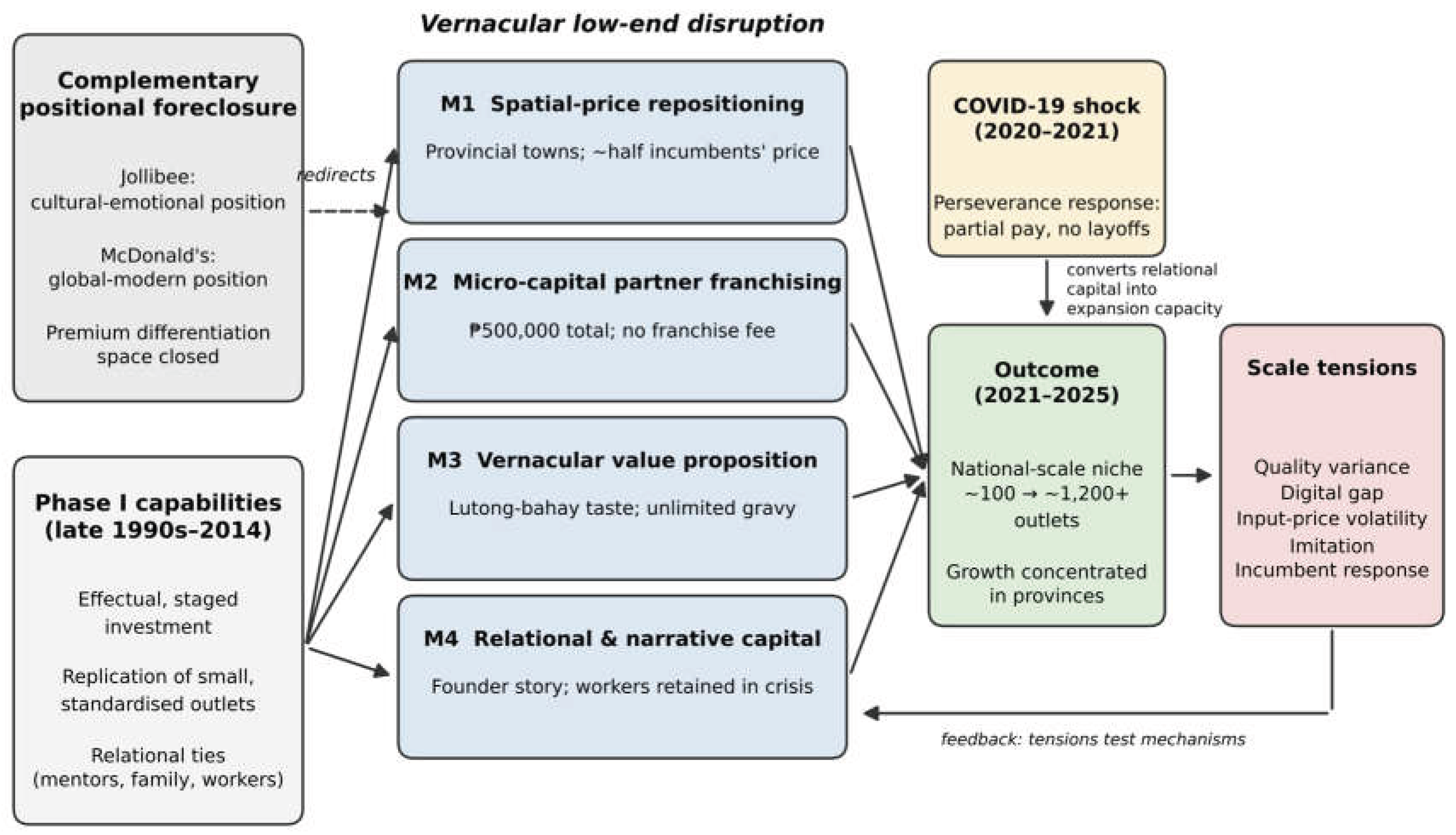

Table 1.
Publicly posted founder interviews and video features.
| Category | Sources | Use in analysis |
|---|---|---|
| Founder interviews and video features | Gancenia (2023); Sanchez-Roxas (2019); Tolo (2025); Agribusiness (2023) | Founder biography; key decisions; pandemic response; store counts |
| Company materials | Crispy King website and partner FAQ (n.d.-a, n.d.-b) | Mission; franchise package; partner requirements |
| Trade and news reports | InfoCebu (2025); Pinoyentre (2023); Manila Bulletin (2025); MindaNews (2025); Philstar reports (Llemit, 2022; Purnell, 2022) | Store counts; prices; market and competitor data |
| Incumbent disclosures | JFC press releases (2025, 2026); Jollibee (2025); GMA Network (2025) | Incumbent scale and franchise requirements |
| Prior academic and industry research | Pelesco et al. (2023); Garcia et al. (2022); Basa & Basa (2025); Euromonitor International (2025); Balita (2025) | Consumer perceptions; incumbent strategies; market structure |
Note: All sources are publicly accessible in social medias and YouTube.
Table 2.
Scale, positioning, and entry requirements of the three chains.
| Indicator | Jollibee | McDonald's Philippines | Crispy King |
|---|---|---|---|
| Start in the Philippines | 1978 | 1981 (master franchise) | 2015 (Ormoc City) |
| Philippine outlets | c. 1,340 Jollibee-brand stores (Dec 2025); 3,393 across JFC brands (Mar 2025) | 792 (Dec 2024); 800th store opened mid-2025 | c. 1,200 (Jul 2025, third-party); c. 1,700 (May 2025, founder claim) |
| Strategic position | Cultural-emotional | Global-modern | Price-and-place (provincial mass market) |
| Typical format | Mall and street-front restaurants | Close to 70% free-standing with drive-thru | Small store; minimum 40 m² site |
| Franchisee entry cost | ₱30–35 million excluding land and building; high net-worth requirement | Large capital commitment; sub-franchising through GADC | ₱500,000 total investment; no franchise fee |
| One-piece chicken with rice | c. ₱100 | c. ₱100 | c. ₱52 |
Sources: JFC (2025, 2026); Manila Bulletin (2025); MindaNews (2025); GMA Network (2025); Nick (2025); Jollibee (2025); Jonas (2017); Crispy King (n.d.-b); InfoCebu (2025); Tolo (2025). The Jollibee-brand Philippine count is derived from JFC's report of 1,658 Southeast Asian stores, 317 of them outside the Philippines. Outlet counts are not directly comparable because formats differ.
Table 3.
Reported growth of the Crispy King network, 2015–2025.
| Date | Reported outlets | Source | Remarks |
|---|---|---|---|
| 2015 | 1 (20 m², Lopez Jaena St., Ormoc City) | Pinoyentre (2023) | First store |
| Early 2020 | c. 100 | Gancenia (2023) | Founder account, before lockdowns |
| 2020–2021 | More than 40 halted | Agribusiness (2023) | Scale of shutdown differs across accounts |
| February 2023 | More than 300 | Pinoyentre (2023) | Visayas and Mindanao, incl. Butuan, Cebu, Davao, Iloilo |
| May 2025 | c. 1,700 | Tolo (2025) | Founder claim |
| July 2025 | c. 1,200; more than 7,700 employees | InfoCebu (2025) | Third-party estimate |
Table 4.
Tensions of scale arising from the growth mechanisms.
| Source of strength | Shadow tension | Supporting evidence | Possible response |
|---|---|---|---|
| Rapid partner expansion (M2) | Quality variation across outlets | Gillis & Castrogiovanni (2012); waiting-time concerns (Pelesco et al., 2023) | Standardised training, audits, partner scorecards |
| Frugal, low-overhead model (M1) | Digital and delivery gap | Google et al. (2023); Kemp (2023); pandemic experience | Delivery partnerships; digital ordering |
| Low price point (M1, M3) | Exposure to chicken and input-price volatility | FAO (2025); Reardon & Vos (2021) | Supplier contracts; menu engineering |
| Simple, replicable format (M2, M3) | Imitation by other local brands | Porter (2008) | Deepen vernacular identity and founder narrative |
| Growing visibility (all) | Incumbent response | Balita (2025) | Avoid head-on urban contests; build provincial density |
Disclaimer/Publisher’s Note: The statements, opinions and data contained in all publications are solely those of the individual author(s) and contributor(s) and not of MDPI and/or the editor(s). MDPI and/or the editor(s) disclaim responsibility for any injury to people or property resulting from any ideas, methods, instructions or products referred to in the content. |
© 2026 by the authors. Licensee MDPI, Basel, Switzerland. This article is an open access article distributed under the terms and conditions of the Creative Commons Attribution (CC BY) license (http://creativecommons.org/licenses/by/4.0/).
Copyright: This open access article is published under a Creative Commons CC BY 4.0 license, which permit the free download, distribution, and reuse, provided that the author and preprint are cited in any reuse.