

Submitted:
17 November 2026
Posted:
18 November 2026
You are already at the latest version
Abstract
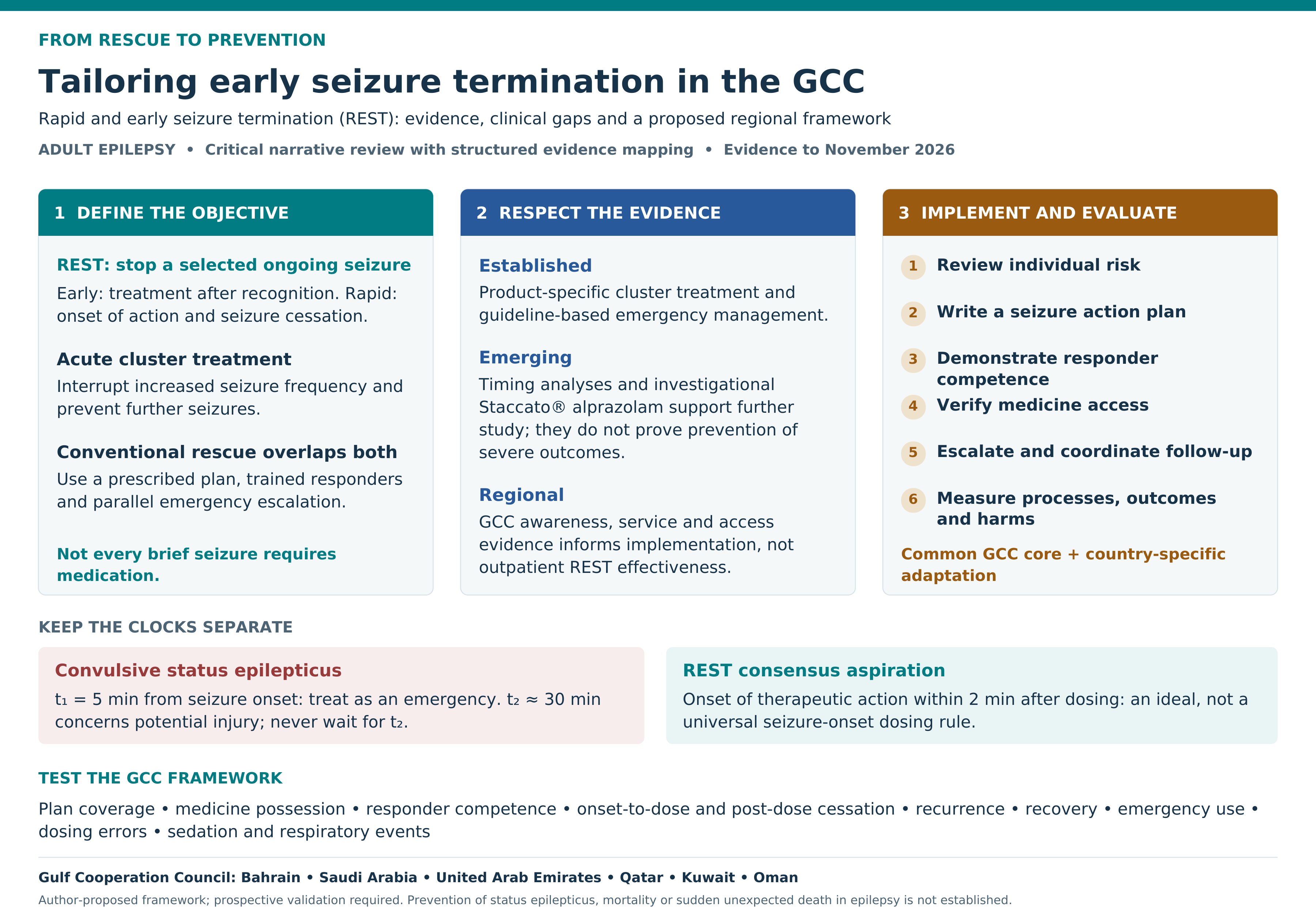
Background: Adults with epilepsy need timely treatment of recognisable seizure emergencies without indiscriminate benzodiazepine use. Rapid and early seizure termination (REST) introduces a useful treatment objective, but consensus aspirations, product efficacy and the effectiveness of earlier intervention require separate appraisal. Objectives: To distinguish selected early seizure termination from established cluster and status-epilepticus management; map evidence and implementation gaps in Bahrain, Saudi Arabia, the United Arab Emirates, Qatar, Kuwait and Oman; and propose an auditable regional framework suitable for phased prospective evaluation across GCC countries. Methods: Six exploratory PubMed searches were supplemented by targeted publications, trial registries and official guideline and regulatory sources. Searches were rerun to 16 November 2026, with an overlapping entry-date check. Evidence was mapped by study design, therapeutic objective, population, setting, sponsorship and GCC applicability. Selection remained purposive; complete export was not equated with complete screening or formal certainty grading. Findings: Product-specific trials support community seizure-cluster treatment and professional treatment of convulsive status epilepticus. Observational timing analyses and emerging rapid-delivery studies do not establish that a universal earlier threshold prevents severe outcomes. The ILAE five-minute operational threshold, NICE’s individualised prolonged-seizure recommendations and the REST aspiration for drug action within two minutes after administration address different decisions. GCC emergency-care, awareness, education and service studies identify actionable needs but do not demonstrate adult outpatient REST effectiveness. Regional provider reports complement, without replacing, formulation-specific regulatory and dispensing verification. Conclusions: The proposed GCC framework combines clinical risk review, an individualised seizure action plan, demonstrated responder competency, verified medicine access, parallel emergency escalation and safety-balanced measurement. Phased GCC pilot studies should evaluate feasibility, acceptability and safety before comparative effectiveness research. “Prevention” denotes the intended prevention of escalation and avoidable harm; prevention of epilepsy, mortality or SUDEP is not established.
Keywords:
epilepsy
; seizure clusters
; rapid and early seizure termination
; rescue benzodiazepines
; seizure action plan
; status epilepticus
; Gulf Cooperation Council
; implementation science
1. Introduction
Epilepsy affects approximately 50 million people worldwide, but population prevalence does not describe the smaller, clinically heterogeneous group at risk of seizure-related emergencies.[1] Adults with seizure clusters, stereotypical prolonged seizures or recurrent bilateral tonic–clonic seizures may require an individualised approach that connects long-term epilepsy management with timely intervention during recognisable high-risk events. The interval between seizure recognition and professional care can expose weaknesses in otherwise effective management: prescribed medication may be unavailable when needed; caregivers may recognise convulsions without identifying the patient’s characteristic cluster pattern; and emergency personnel may receive incomplete information about treatments already administered. Improving outcomes therefore requires attention to recognition, treatment decisions, practical delivery and continuity of care.
Established emergency treatment and selected earlier intervention occupy overlapping but distinguishable positions. The International League Against Epilepsy (ILAE) defines an operational time point, t₁, beyond which seizure activity should be regarded as abnormally prolonged and treatment initiated, and a later time point, t₂, beyond which continuing seizure activity may carry a risk of long-term consequences. For convulsive status epilepticus, these are five and thirty minutes, respectively; t₂ does not justify deferring treatment.[2] The National Institute for Health and Care Excellence (NICE) separately addresses convulsive status epilepticus, repeated or cluster seizures, and prolonged seizures, including the use of individualised emergency management plans.[3] These distinctions support treatment tailored to the clinical event and the patient’s established seizure pattern, rather than a single timing rule applied indiscriminately to all seizures.
Rapid and early seizure termination (REST) is a proposed treatment approach that combines early recognition of a clinically significant ongoing seizure with prompt administration of a rapidly acting treatment intended to terminate that seizure. “Early” refers to intervention following recognition of an appropriate patient-specific seizure pattern or treatment trigger, whereas “rapid” refers to the speed of therapeutic action after administration. The distinction is primarily one of treatment objective: REST targets ongoing seizure activity, while acute cluster treatment (ACT) aims to prevent the next or further seizures within a recognised cluster. These objectives overlap because conventional rescue medications may also terminate ongoing seizures, and a treatment used for REST may additionally suppress recurrence. The 2024 expert consensus described an ideal REST medication as beginning to act within two minutes of administration; this is an aspirational pharmacological target, not a universally established requirement to administer treatment within two minutes of seizure onset.[4]
In this review, REST is considered within an individualised, clinician-prescribed seizure action plan for selected adults with recognisable high-risk seizure patterns. It does not justify treating every brief, self-limiting seizure or replace established emergency management. The ILAE five-minute operational treatment threshold for convulsive status epilepticus remains distinct from both an individualised earlier treatment trigger and the interval between drug administration and clinical response.[2,3,4] Consequently, evidence that a medication can terminate seizures must be distinguished from evidence that an earlier administration strategy improves clinically important outcomes. Expert agreement, pharmacological plausibility and observational associations provide a rationale for investigation, but do not independently establish the benefits of a universal earlier treatment threshold.
For the Gulf Cooperation Council (GCC), comprising Bahrain, Saudi Arabia, the United Arab Emirates, Qatar, Kuwait and Oman, these clinical distinctions must be considered alongside regional evidence and differences in healthcare delivery. Published Bahrain epilepsy-awareness research and a six-country survey of epilepsy-monitoring-unit practices provide relevant information about public understanding and institutional care.[5,6] They do not, however, establish the effectiveness of outpatient REST. Regional emergency-care, caregiver-education and self-management studies address additional implementation questions, while medicine registration, actual dispensing, reimbursement and caregiver access require separate assessment. A regional framework must therefore combine shared clinical principles with country-specific arrangements for treatment access, training, emergency services and governance.
The term “prevention” in this review denotes the intended prevention of seizure escalation, recurrence and avoidable harm in selected high-risk patterns. It does not mean prevention of epilepsy itself, nor does it imply that outpatient REST has been shown to reduce status epilepticus, hospitalisation, mortality or sudden unexpected death in epilepsy (SUDEP). The immediate clinical priority is to make established emergency preparedness reliable and measurable; the incremental benefit of selected earlier intervention remains a research question.
The distinctive contribution of this review is the integration of a clinically explicit treatment-objective distinction with a testable regional implementation programme for adults with epilepsy. Its originality lies in examining how selected early termination of ongoing seizures relates to conventional rescue treatment, suppression of seizure-cluster recurrence and established emergency escalation, while separating medication efficacy from the effectiveness of an earlier treatment strategy. Accordingly, the review has four objectives: first, to clarify the clinical boundaries, timing concepts and evidential limitations of REST; second, to critically map international treatment evidence and GCC-specific clinical, educational, service and access gaps; third, to propose a GCC Adult Seizure Action Plan and implementation framework combining shared clinical safeguards with country-specific adaptations; and fourth, to define measurable indicators and a phased multicentre evaluation pathway addressing feasibility, safety, acceptability, equity and subsequent comparative effectiveness. Domain III provides the principal conceptual contribution, and Domain VI translates that analysis into an operational research framework, supported by the regional evidence in Domain IV. Together, these contributions establish a pathway from critical evidence appraisal to prospective regional testing, without presuming that the proposed framework has been endorsed, validated or shown to prevent severe seizure-related outcomes.
2. Methods
2.1. Review Design and Retrieval
This is a critical narrative review with structured evidence mapping, not a systematic review or scoping review. The original six exploratory PubMed queries were executed through the National Center for Biotechnology Information E-utilities on 6 November 2026, covering REST and inhaled alprazolam; rescue-treatment trials; GCC seizure emergencies and awareness; patient, caregiver and implementation issues; prehospital status epilepticus; and seizure duration or clustering. Searches used a publication-date window of 1 January 2000 to 6 November 2026. Older seminal trials were retrieved separately. Exact executed strings, returned counts and export limitations are supplied in Supplementary Table S1.
Searches returned 2,311 exported identifier occurrences and 2,268 distinct PubMed identifiers. One broad patient/implementation query returned 3,148 results but exported only the first 1,000; it was used for exploratory discovery, not exhaustive screening. These counts describe retrieval, not a fully screened evidence set. Targeted publication searches and reference checking supplemented the exports. Full texts, abstracts, official product information and registry records were reviewed according to accessibility and relevance. Selected source limitations are recorded in Supplementary Table S4. Embase, Scopus and Web of Science were not directly searched; no comprehensive Cochrane Library or WHO ICTRP search was completed. Publicly retrievable Cochrane material was consulted contextually. This restricted search coverage limits completeness.
Additional candidate publications were verified on 6 November 2026 by exact title, DOI or PMID against PubMed and publisher records. Eleven additional indexed publications and one Saudi caregiver-education paper were incorporated; the former were retrieved together by an eleven-identifier E-utilities request. These additions are documented separately in Supplementary Table S1b and do not alter the original exploratory-search counts. This was targeted verification, not a comprehensive update search.
On 16 November 2026, all six strings were rerun with the publication cut-off extended to that date and a retrieval limit sufficient to export every match. The reruns yielded 4,472 identifier occurrences and 4,403 unique identifiers; the larger export principally reflects removal of the original P4 cap, not a sudden increase in eligible studies. An overlapping check combined PubMed entry dates of 1–16 November with publication dates of 7–16 November and returned 18 distinct records. Their titles and available abstracts were assessed for relevance; one observational status-epilepticus study was incorporated. Targeted retrieval added an Emirati adult cohort, a paediatric rescue-prescription study and a phase I trial registry. The update log, decisions and complete executed strings are provided in Supplementary Table S1c and accompanying CSV files. The full historical export was not comprehensively screened; this remains a purposive narrative review.
2.2. Eligibility and Evidence Mapping
Priority was given to adult or mixed-age clinical trials, relevant observational cohorts, authoritative guidelines, primary GCC studies, patient/caregiver research and official regulatory information. Paediatric efficacy evidence was retained when necessary to interpret adult extrapolation or formulation development. Regional eligibility depended on recruitment or data-collection location, rather than author affiliation. Publications describing the same trial population were grouped conceptually to avoid treating post hoc analyses as independent replication.
Extraction considered study design, setting, population, intervention, comparator, endpoint, safety, sponsorship and relevance to community adult care. Critical appraisal examined randomisation, blinding, selection, outcome ascertainment, missing observations, confounding, follow-up and indirectness. No completed RoB 2, ROBINS-I, AGREE II or GRADE assessment is claimed. Four independent attributes were retained: study design and limitations; clinical relevance to the treatment objective; directness to adults in GCC community settings; and regulatory or implementation status. Funding was recorded separately. Regulatory permission was not treated as a level of efficacy evidence, and consensus agreement was not ranked as a clinical treatment effect. Secondary syntheses informed context; their constituent studies were not added to primary-study denominators. Supplementary Table S6 links related publications to their parent programmes. SANRA informed narrative transparency, and selected PRISMA-S reporting principles informed the search record without implying compliance with a systematic-review design.[7,8]
2.3. Regulatory Verification and Synthesis
Official sources were sought for all six countries. Registration, formulary or directory listing, procurability, current dispensing, reimbursement and prescribing were treated as separate attributes. A listing of injectable midazolam was not accepted as evidence for a licensed nasal or oromucosal product. Historical or undated documents were not treated as current stock inventories. Where relevant evidence could not be established, the designation was “not verified”, rather than “unavailable”. The phase III alprazolam record was checked directly through the ClinicalTrials.gov API because indexed search summaries displayed older dates.[9]
The 16 November update rechecked NICE emergency recommendations, US nasal-product labels, EMA Buccolam information, the named Saudi register entry and three ClinicalTrials.gov records. Country-level documentary findings retain their actual verification dates. Bahrain directory retrieval was blocked during the update; its earlier documentary findings were retained as historical observations, not upgraded to current access confirmation. No patient-level stock, dispensing or reimbursement audit was performed.
The synthesis was organised into six domains. International efficacy findings were separated from local contextual evidence and from the authors’ proposed implementation measures. Framework components were developed through critical synthesis; there was no GCC stakeholder Delphi, patient co-design exercise, independent duplicate screening or prospective validation. These activities form part of the subsequent research agenda.
NICE NG217 was cited in its updated form, including the January 2025 update; this date should not be interpreted as the date on which all seizure-emergency recommendations were newly issued. Policy analysis was documentary and comparative. No regulator, payer or pharmacy interview was undertaken, and no national access score was constructed.
3. Domain I—Epidemiology and Clinical Risk
3.1. Definitions Determine the Apparent Burden
Seizure clusters lack a single operational definition across research and practice. An individual’s recognisable departure from baseline can be clinically important without satisfying a universal count-based definition. Conversely, recurrent habitual seizures do not automatically identify an episode requiring emergency benzodiazepines. For research, both the patient-specific trigger and an explicit counting window should be recorded, allowing analyses under alternative definitions (Table 1).
In a prospective adult study, Detyniecki and colleagues defined clusters as at least two seizures within six hours. Among participants with active epilepsy, 45.8% experienced such clusters; higher baseline seizure frequency and previous day-clusters were associated with subsequent clustering.[10] These are cohort findings, not estimates for all adults with epilepsy or GCC populations. Rescue use was associated with fewer injuries and emergency visits, but treatment selection and caregiver capability could confound that association. The study supports targeted preparedness; it does not establish the causal effect of a particular early-treatment threshold.
3.2. Selection Should Prioritise Clinical History
Patients with previous prolonged seizures, established clusters or status epilepticus warrant explicit review of emergency preparedness. Recurrent bilateral tonic–clonic seizures, particularly when caregivers recognise a consistent sequence, also justify assessment. Drug-resistant epilepsy identifies persistent treatment need but is neither synonymous with clustering nor a validated indication to treat every seizure. The ILAE definition requires failure of two adequately tried, tolerated and appropriately selected medication schedules to achieve sustained seizure freedom.[11]
A practical assessment asks whether a harmful pattern has occurred, whether it can be recognised early, whether treatment is deliverable and whether escalation remains feasible (Table 2). Missed medication, intercurrent illness, disrupted sleep and changes in medication schedules should be documented as potential contributors, with their predictive relevance established for the individual. A list of plausible factors should not be converted into an unvalidated numerical risk score. Maintenance treatment optimisation, adherence support and appropriate specialist assessment remain essential even when rescue medication is prescribed.
Preparedness review and prescribing are separate decisions. A recognisable pattern may support a plan, while an uncertain onset, unreliable administration, product contraindication or lack of a responder may favour a predominantly professional emergency pathway. The assessment should document previous episode duration, recovery between seizures, previous rescue response and the circumstances of treatment failure. Each factor informs judgement without assigning an unvalidated probability of escalation.
Adults living alone, those with cognitive impairment, frailty or respiratory disease, and those without a reliable caregiver present distinct implementation problems. Their need for a plan may be greater while the feasibility of community treatment is lower. First seizures, acute symptomatic seizures, new neurological deficits and suspected metabolic or pregnancy-related causes require diagnostic emergency pathways; an established-epilepsy action plan cannot safely encompass these presentations by default.
3.3. Emergency Severity and Mortality Require Careful Interpretation
Prehospital status-epilepticus trials establish the value of treating an ongoing emergency, not the incidence of preventable deterioration among ordinary brief seizures. Alldredge and colleagues demonstrated superior termination with intravenous benzodiazepines over placebo in out-of-hospital status epilepticus.[12] In RAMPART, seizure absence without additional rescue treatment on emergency-department arrival occurred in 73.4% with intramuscular midazolam versus 63.4% with intravenous lorazepam.[13] These findings also show that practical administration delay matters; faster drug action after vascular access need not produce faster overall care.
Repeated tonic–clonic seizures are associated with SUDEP risk, and seizure freedom is an important preventive goal.[14] However, no retrieved evidence establishes that outpatient REST prevents SUDEP. Mortality, injury and progression to status epilepticus should remain distinct outcomes rather than presumed consequences of an improved seizure-cessation endpoint. Hospital cohorts are enriched for severe disease and cannot quantify the absolute benefit of treating earlier in the community.
A newly indexed two-centre observational study associated late EEG abnormalities and restricted diffusion on MRI with neurological deficits after status epilepticus.[15] This supports assessing injury through more than elapsed time alone. It does not establish a safer waiting interval, validate community early-treatment thresholds or alter the ILAE operational treatment threshold. The biological risk represented by t₂ should not be interpreted as an exact boundary between harmless and injurious seizures for every patient.
4. Domain II—Pharmacological Rescue Therapies
4.1. Compare Formulations and Endpoints
Benzodiazepines enhance inhibitory GABA-A receptor activity, but route, formulation, dose, delivery conditions and patient selection determine clinical usefulness. Intranasal products, rectal gel or solution and oromucosal preparations are not interchangeable simply because their active ingredients belong to the same class. Pharmacokinetic time to maximum concentration is not the time to seizure cessation. Apparent termination shortly after administration may reflect drug effect, spontaneous termination or both; controlled comparisons are therefore important.
The relevant time intervals are recognition-to-decision, decision-to-administration and administration-to-clinical response. Measuring only the final interval overlooks medication retrieval, device preparation and caregiver hesitation. Conversely, measuring total seizure duration can create an apparently favourable association with early treatment because treatment delay is itself part of the total duration. Table 3 compares evidence and limitations without an unsupported cross-product efficacy ranking.
4.2. Intranasal Midazolam
The pivotal placebo-controlled outpatient trial enrolled people aged at least 12 years with seizure clusters. Treatment success—termination within ten minutes with no recurrence from ten minutes to six hours—occurred in 53.7% with midazolam nasal spray and 34.4% with placebo.[16] This supports the specific composite endpoint in selected participants and trained-caregiver circumstances; it does not demonstrate universal seizure termination within two minutes or superiority to another active rescue product. A preceding supervised test-dose phase also affects safety generalisability.
The open-label extension treated 1,998 cluster episodes in 161 participants aged at least 12 years. Single-dose treatment success was reported for 1,108 episodes (55%); repeated intermittent use provided additional safety experience but lacked a concurrent comparator.[17] It extends the pivotal programme rather than independently replicating its randomised findings. Analyses of repeated episodes must also account for their concentration within individuals.
The US NAYZILAM label covers seizure clusters from age 12 years. It specifies an initial 5 mg spray and, when appropriate, one further 5 mg spray in the opposite nostril after ten minutes. A second dose should not be given with breathing difficulty or uncharacteristic excessive sedation. The label limits treatment to two doses per episode, no more than one episode every three days and five episodes per month.[18] These are product-specific US instructions, not a GCC prescription. Local authorisation, interactions, respiratory vulnerability and the prescriber’s written plan must govern use.
4.3. Intranasal Diazepam
Diazepam nasal spray has a different development pathway. Its US authorisation draws on rectal-diazepam efficacy, bioavailability and pharmacokinetic bridging, and nasal safety data; the current label includes patients from age two years.[19] In the long-term open-label study, 163 treated participants received treatment for 3,853 clusters. A second dose was recorded for 12.6% of clusters within 24 hours, and no serious treatment-emergent event was considered treatment-related.[20] This supports tolerability under study conditions. Absence of redosing is a proxy influenced by instructions, recognition, caregiver choice and spontaneous resolution; it is not a randomised estimate of seizure prevention.
The US label permits a second dose no sooner than four hours, with no more than two doses per episode, one treated episode every five days and five episodes per month.[19] A patient with persistent convulsions must enter emergency care; the four-hour redosing interval is not a period to wait through an uncontrolled seizure. Regulatory distinctions must be preserved when translating label instructions into an action plan.
Clinical recovery deserves assessment separately from electroclinical cessation. A post hoc analysis of the midazolam extension examined return to baseline function, while a diazepam safety-study analysis assessed quality of life in 72 adults.[21,22] These observations support measuring recovery, seizure worry and participation, but cannot establish that a product causes better function or that earlier dosing is superior. The recovery analysis used different time origins for one-dose and two-dose episodes, which further limits comparison between those groups.
4.4. Oromucosal Midazolam and Rectal Diazepam
Buccal midazolam has established use for prolonged convulsive seizures, with substantial paediatric trial evidence. In McIntyre and colleagues’ paediatric emergency-room trial, therapeutic success was greater with buccal midazolam than rectal diazepam, but the population and setting preclude an adult outpatient superiority claim.[23] The current European Medicines Agency (EMA) description of Buccolam includes adults; adult authorisation incorporates pharmacokinetic extrapolation from paediatric evidence.[24] Describing all adult buccal midazolam use as necessarily off-label would therefore be outdated, although GCC product indications require separate verification.
Caregivers must distinguish prescribed buccal administration into the cheek–gum space from giving an oral tablet or liquid to swallow. During convulsions they should not force the jaw open, insert fingers or give food, drink or tablets. Administration should follow the trained technique and product instructions. Buccolam’s caregiver instruction is a single dose, with medical help if the seizure has not stopped within ten minutes; emergency triggers may require an earlier call.[24,25]
Rectal diazepam remains clinically useful when accessible and acceptable. A placebo-controlled home-treatment trial demonstrated reduced repetitive-seizure frequency and longer time to recurrence when trained caregivers administered rectal gel.[26] That evidence should not be dismissed because newer delivery systems offer practical advantages. Privacy, positioning and consent may affect feasibility, especially outside the home. Nor should results for a particular gel automatically validate every rectal preparation. Dose, presentation and permitted repetition must be checked against the actual dispensed product.
4.5. Safety and the Boundary with Professional Care
Sedation, impaired coordination, respiratory compromise and interacting central nervous system depressants require explicit counselling. Rare adverse events may not be well characterised by selected trials, and the absence of observed respiratory depression is not proof of zero risk.
A risk modifier must not be confused with a contraindication. For example, the European Buccolam information lists sleep apnoea syndrome and severe respiratory insufficiency among contraindications.[24] Local product information must determine whether a formulation is permissible; vulnerability cannot always be addressed simply by closer observation. Opioid co-exposure, repeated benzodiazepine administration and an incomplete handover can increase concern. At the same time, undertreatment of established convulsive status epilepticus is dangerous: the American Epilepsy Society guideline notes that respiratory problems also arise from untreated seizures.[27]
A community plan should define one initial product, its exact dose, authorised repetition and emergency triggers. Sequential use of different benzodiazepines must not be improvised. Intramuscular midazolam is an evidence-based prehospital professional option, while persistent status epilepticus requires monitored escalation.[13,27] ESETT found broadly similar success for intravenous levetiracetam, fosphenytoin and valproate in benzodiazepine-refractory convulsive status epilepticus; this is hospital evidence, not an extension of unsupervised home rescue.[28] Clinician-directed oral alternatives may have a role in selected cluster plans when the patient can safely swallow, but must not be presented as rapid treatment during impaired consciousness or active convulsions.
5. Domain III—The REST Paradigm and Conventional Rescue
|
Box 1. Interpreting REST: clinical distinctions, evidence boundaries and GCC implementation 1. Define the therapeutic objective: Rapid and early seizure termination (REST) aims to stop a selected ongoing seizure through prompt recognition and prescribed treatment. “Early” concerns treatment initiation; “rapid” concerns therapeutic onset and cessation. REST is a treatment objective, not a distinct medicine class or universally validated protocol.[4] 2. Distinguish overlapping indications: Conventional rescue already includes treatment before status epilepticus develops. REST targets an ongoing seizure; acute cluster treatment (ACT) interrupts abnormally increased seizure frequency. These indications overlap, but cessation and prevention of further seizures require separate assessment.[4] 3. Interpret timing correctly: The consensus aspiration is therapeutic onset within two minutes after administration, not universal dosing two minutes after seizure onset.[4] For convulsive status epilepticus, ILAE t₁ is five minutes; t₂, approximately 30 minutes, concerns potential long-term consequences and is not a waiting period.[2] NICE separately addresses status epilepticus, clusters and prolonged seizures through individualised emergency plans.[3] 4. Match claims to evidence: Product-specific efficacy does not establish superiority of earlier treatment. Distinguish treatment delay, post-dose cessation, recurrence and recovery. Prevention of status epilepticus, hospitalisation, injury or death requires direct evaluation. Explicitly appraise industry sponsorship and overlapping study populations. 5. Specify appropriate use: Require a clinician-confirmed target pattern, individualised prescription, trained responder and written plan specifying recognition, dose, route, repeat-dose limits, observation and escalation. Avoid indiscriminate treatment of brief seizures or delayed emergency care. Verify formulations and prescribing requirements in each GCC jurisdiction.[3,4] 6. Make GCC implementation testable: Record onset, recognition, administration and cessation separately. Audit plan coverage, medicine possession and responder competence; measure recurrence, recovery, emergency attendance, dosing errors, excessive sedation and respiratory events. Report feasibility, outcomes and harms separately. Country-specific adaptation and prospective evaluation are essential; regional effectiveness remains unestablished. |
5.1. Treatment Objective Is More Useful than a Rigid Drug Category
REST concerns terminating an ongoing seizure; acute cluster treatment (ACT) concerns preventing the next or further seizures in a cluster. Conventional “rescue” is an umbrella term spanning both objectives and emergency treatment. The same formulation may contribute to more than one objective, and established buccal treatment already aims to stop ongoing convulsions. Accordingly, REST should not be presented as discovering early intervention or as a pharmacological class that makes existing rescue obsolete (Table 4).
We propose classifying each treatment episode by three independent features: the immediate objective, the recognition trigger and the evidence supporting that trigger. This permits meaningful comparisons even when terminology differs. For example, a medicine administered after a cluster has been recognised but between seizures primarily targets recurrence; the same medicine administered during a prolonged event may target both termination and recurrence. Outcomes should be recorded separately. A composite that combines cessation with freedom from recurrence is informative, but does not identify which component accounts for benefit.
This classification produces four clinically useful scenarios: a recognised cluster with recovery between events; a stereotyped ongoing seizure selected for an individual early trigger; convulsive status epilepticus requiring established emergency management; and an ordinary self-limited seizure without a prescribed rescue indication. The same patient may experience more than one scenario. A credible REST strategy therefore requires both accurate recognition and a usable action, not merely a fast formulation (Figure 1).
5.2. Three Different Clocks Must Remain Separate
The 2024 expert consensus proposed five minutes for prolonged focal seizures and two minutes for prolonged absence seizures and the convulsive phase of bilateral tonic–clonic seizures. Separately, it described an ideal medication beginning to act within two minutes of administration.[4] The latter is a post-dose development aspiration, not an instruction to administer benzodiazepines two minutes after every seizure begins. Its phenotype proposals also do not replace ILAE status-epilepticus criteria.
The ILAE convulsive t₁ clock starts at seizure onset. NICE additionally recognises a convulsive seizure lasting more than two minutes beyond that person’s usual duration as an emergency, while directing all convulsions lasting five minutes or more to the status-epilepticus pathway.[2,3] Thus, the clocks are absolute duration, deviation from individual baseline and drug response after administration. Confusing them can produce either indiscriminate treatment or unsafe delay (Figure 2).
Operationally, the patient’s usual pattern informs recognition, while the care system must respond to continuing seizure activity and physiological danger. These “patient” and “system” clocks are an explanatory aid, not additional thresholds: giving a medicine does not restart the seizure-onset clock. A specialist-directed earlier trigger may advance care, but cannot authorise waiting beyond emergency criteria. NICE’s prolonged-seizure category likewise requires clinical interpretation and an individual plan; it is not a universal lay instruction to calculate and administer a dose without prescription.
The clinically defensible response is a prespecified, observable, individual trigger. A history of stereotypical seizures that repeatedly become prolonged may justify specialist-directed treatment before the conventional status threshold. An isolated brief seizure with usual recovery may require observation and documentation rather than medication. A vague feeling of being unwell should not become an automatic benzodiazepine trigger without evidence that it reliably identifies the patient’s high-risk pattern.
5.3. Biological Rationale and Its Limits
Experimental work provides a rationale for avoiding prolonged untreated seizure activity. In an in vitro model, sustained epileptiform activity accelerated GABA-A receptor internalisation and reduced inhibitory synaptic transmission.[29] Such changes help explain time-dependent loss of benzodiazepine responsiveness during sustained status epilepticus. They do not establish a human community threshold at which a brief seizure becomes resistant, or prove that dosing at two rather than five minutes produces a net benefit. Biological plausibility strengthens the case for testing early treatment; patient selection and comparative clinical evidence remain necessary.
5.4. Consensus Disagreement and the Problem of Causal Inference
Later literature is not uniform. A 2025 Spanish consensus proposed home treatment at two minutes or with a specified increase in seizure frequency, while also emphasising individualisation.[30] These recommendations are broader than interpreting two minutes solely as an ideal post-dose onset target. Their existence should be acknowledged, but agreement among specialists does not resolve the sensitivity, specificity or net benefit of the threshold. This review does not adopt a universal two-minute administration rule. NICE’s rationale similarly acknowledges the absence of direct evidence for its particular shorter-than-five-minute prolonged-convulsion category.[3]
Exploratory diazepam nasal-spray analyses associated earlier administration with shorter seizure duration. In one analysis, median post-dose cessation time was two minutes in episodes treated before five minutes and ten minutes in those treated later.[31] These observations are clinically interesting but non-randomised. Early-recognisable episodes may differ in severity, semiology and caregiver support; diary timing is imprecise; repeated observations arise within the same patients; and late-treated episodes necessarily remain active long enough to enter that category. Comparing total duration further incorporates the exposure being studied. These problems require prospective methods, not stronger causal language.
A subsequent analysis applied ACT and REST terminology to the same diazepam safety dataset.[32] It illustrates potential overlap of therapeutic objectives, but does not constitute independent confirmation of a new indication. Prompt dosing, cessation after dosing and causal prevention of status epilepticus are different claims. Neither low redosing rates nor a shortened episode establishes a reduction in hospitalisation, injury, neuronal damage or mortality. Future trials should report these outcomes directly, alongside unnecessary treatment and delayed emergency activation.
Stern and colleagues subsequently pooled a study in children aged 2–5 years with the diazepam nasal-spray safety cohort aged 6–65 years. Among 402 episodes classified as tonic–clonic status epilepticus, 248 (61.7%) ended by thirty minutes from onset.[33] The retrospective, uncontrolled analysis adds relevant emergency-treatment observations, but combines age groups and reuses the established safety programme. Its thirty-minute endpoint is not an acceptable waiting target. It does not estimate prevention of status epilepticus by an earlier trigger or replace prospective comparison with established rescue care.
The central evidentiary distinction is between product efficacy and strategy effectiveness. A placebo-controlled product trial asks whether a formulation improves its prespecified endpoint. A timing-strategy trial asks whether the same or comparable treatment, delivered under a clearly defined earlier rule, improves net outcomes over usual guideline-based care. The latter must include all qualifying events, including spontaneous resolution, missed triggers and unnecessary doses. Retrospective comparisons restricted to treated episodes cannot fully answer that question.
5.5. Staccato® Alprazolam: Pharmacological Rationale, Clinical Evidence and Unresolved Implementation Questions
Staccato® alprazolam is an investigational, single-use drug–device combination that generates an aerosol for deep-lung delivery. A normal inhalation activates the handheld device without requiring forceful inspiration or coordination between manual actuation and breathing.[68] This delivery approach is being investigated for rapid termination of recognisable, stereotypical prolonged seizures.
Healthy-adult phase I studies reported median times to maximum plasma concentration ((T_{\max})) of approximately 1.5–2 minutes. Overall exposure was broadly similar across the smoking and ethnic groups studied, although peak concentrations varied; these findings should not be interpreted as pharmacokinetic equivalence across all populations.[68] A separate randomised crossover study involving 21 healthy adults, reported as a conference abstract, compared nominal 2-mg inhaled and oral doses. Median (T_{\max}) was 2 versus 45 minutes, respectively. After adjustment for the emitted inhaled dose, the inhaled-to-oral ratios for peak concentration and total exposure were approximately 1.59 and 0.95.[69] These observations support rapid systemic delivery but do not demonstrate comparative seizure-control efficacy. Furthermore, (T_{\max}) is not synonymous with clinical onset: an effective concentration may be reached before the plasma peak.
Adolescent evidence requires separate interpretation. In an open-label phase I study of 14 patients aged 12–17 years receiving 2 mg, median (T_{\max}) was 10.5 minutes, with a range of 2–120 minutes. Population pharmacokinetic modelling supported the 2-mg dose for adolescent development, and no severe or serious treatment-emergent adverse events were reported.[70] However, this small study evaluated exposure and tolerability, not seizure termination, and its absorption findings should not be replaced by the faster adult estimates.
Initial pharmacodynamic evidence came from a randomised, placebo-controlled crossover study involving five adults with photosensitive epilepsy. Doses of 0.5, 1 and 2 mg reduced the EEG photoparoxysmal response at two minutes, the earliest assessment, with effects sustained for four to six hours depending on dose.[71] This establishes proof of anticonvulsant activity in a selected experimental model; suppression of a provoked EEG response is not equivalent to termination of a spontaneous clinical seizure.
The phase IIb inpatient study, ENGAGE-E-001/NCT03478982, provided direct clinical evidence in adults with predictable prolonged or repetitive seizure episodes. Among 116 treated participants, cessation within two minutes without recurrence for two hours occurred in 65.8% of each alprazolam group—1 mg and 2 mg—versus 42.5% with placebo (p = 0.0392 for each comparison).[34] A post hoc analysis pooling active doses found median cessation times of 30 seconds versus 60 seconds with placebo. This exploratory timing result should be distinguished from the prespecified responder endpoint. Cough, somnolence and dysgeusia were common adverse events; no treatment-related serious adverse events were reported. The selected population, supervised administration and substantial placebo response limit extrapolation to routine community emergencies.
Pulmonary safety remains relevant to translation. A phase I study in healthy adults and adults with mild asthma identified respiratory symptoms and reductions in forced expiratory volume at selected assessments.[36] Although investigators did not identify clinically relevant treatment-related airway obstruction, these findings do not establish safety during seizures, in severe respiratory disease or under repeated emergency-use conditions. Successful administration, respiratory effects and cumulative exposure to other benzodiazepines therefore require evaluation alongside seizure cessation.
The phase III programme addresses outpatient efficacy and longer-term safety. At direct registry verification on 16 November 2026, EP0162/NCT05077904 was recruiting participants aged ≥12 years, with estimated enrolment of 350 and estimated primary and study completion on 29 March 2027.[9] Its primary measures assess cessation within 90 seconds after administration and a composite additionally requiring no recurrence through two hours and no additional rescue treatment from 90 seconds to two hours. EP0165/NCT05076617 remained enrolling by invitation, with estimated completion on 30 November 2028.[35] Neither registry contained posted results at that verification. UCB’s study listing, checked on 17 November 2026, continued to describe both studies as ongoing without displayed results. Estimated completion dates should not be presented as publication forecasts.
A separate completed phase I study, NCT07020988, compared quantitative EEG onset measures after inhaled alprazolam, intravenous midazolam and nasal diazepam in healthy adults; no results were posted at the manuscript’s registry check.[37] Such comparisons may inform pharmacodynamic development but cannot independently establish comparative seizure termination or emergency prevention.
For GCC implementation, the programme illustrates the distinction between rapid drug delivery, demonstrated seizure cessation and the effectiveness of an earlier-treatment strategy. Staccato alprazolam remains investigational in the sources reviewed and should not be incorporated into routine GCC action plans as an established treatment. Future assessment should examine seizure-pattern eligibility, administration success during impaired awareness, caregiver training, respiratory safety, comparative effectiveness, regulatory authorisation, access and cost. Meanwhile, development of this technology does not alter established emergency-treatment thresholds or justify delaying indicated rescue medication or emergency escalation.
5.6. Commercial Sponsorship and Evidential Independence
The 2024 REST project was funded by UCB, including project management and editorial support; all panel members received honoraria. The report states that UCB did not formulate recommendations and was blinded to voting.[4] These disclosures warrant explicit consideration without invalidating the consensus. The relevant concerns are how questions were framed, whether aspirational outcomes were mistaken for demonstrated benefits, and how commercial interest in rapid-delivery products might shape perceived unmet need.
The pivotal intranasal-midazolam trial was funded by Proximagen, with UCB-supported publication assistance; the diazepam nasal-spray safety programme was funded by Neurelis.[16,20] The alprazolam programme also has manufacturer involvement.[9,34] Sponsorship must be assessed alongside design, endpoint choice, reporting and generalisability.
The newer combined diazepam analysis was also manufacturer-supported, and the UK prescribing study involved UCB-employed authors.[33,38] These reports remain informative, but interpretations advocating a new treatment paradigm require the same scrutiny as their underlying data. Appendix-level parent-study linkage prevents a commercially sponsored publication series from appearing to be multiple independent confirmations. The GCC framework should remain formulation-neutral, avoid procurement commitments to investigational products, and use independently adjudicated outcomes. Manuscript authors must disclose their own relationships individually; declarations cannot be inferred from this review.
6. Domain IV—GCC Evidence
6.1. A Regional Evidence Base with Distinct Levels of Applicability
The regional literature is informative but uneven. Awareness surveys describe beliefs; patient studies describe self-management; hospital cohorts describe selected emergencies; and regulatory documents describe products or administrative status. These sources cannot be pooled into an estimate of community rescue coverage. Table 5, Figure 3 and Supplementary Table S2 retain country, setting and evidential boundaries. An inability to verify a service or medicine online is not evidence that it does not exist.
Bahrain. Elmazny and colleagues’ online public survey identified misconceptions about seizure manifestations and attitudes towards education, employment and marriage.[5] It supports more precise communication about epilepsy and disclosure. It does not measure caregiver competency, action-plan coverage or rescue-treatment outcomes. The public-survey abstract reports inconsistent participant denominators; no denominator-dependent estimate from that discrepancy is adopted.
A separate survey of 367 Bahrain elementary schoolteachers found that only 2.2% reported seizure first-aid training.[39] This supports education in school settings but is indirect evidence for adult outpatient care. Neither survey evaluates the effect of a prescribed rescue plan. Bahrain’s Ministry of Health medicine directory lists a diazepam rectal tube and injectable midazolam.[40,41] These are documentary listings, not confirmation of current NHRA registration, public or private pharmacy stock, reimbursement, or an adult home-rescue indication. They provide a starting point for pharmacy verification rather than justification for describing Bahrain as lacking rescue treatment.
Saudi Arabia. A two-hospital retrospective study examined 420 adult status-epilepticus episodes and reported frequent benzodiazepine underdosing and an association with non-response.[42] This identifies a concrete emergency-care quality issue. The non-randomised comparison of medication classes is vulnerable to treatment-stage and indication confounding; it must not be read as evidence that benzodiazepines should be bypassed. The SFDA register lists Oroxelam 10 mg oromucosal midazolam, registration number 2806260010, with valid authorisation and a marketed status.[43] The entry also gives a pack price, but does not establish adult prescribing eligibility, reimbursement or stock at a particular pharmacy. Saudi Ministry of Health seizure-first-aid resources offer a possible educational foundation, although their existence does not measure uptake.[44]
Saudi intervention evidence should also be acknowledged. Al Misnid and colleagues studied 586 caregivers before and after a brief educational programme: inadequate first-aid knowledge decreased from 84% to 32.4%.[45] The uncontrolled design and same-day or next-day reassessment support an educational effect on questionnaire performance, not sustained device competence or fewer emergencies. The paper’s child-caregiver framing further limits direct adult inference. Thus, a claim that GCC caregiver-education research is absent would be inaccurate.
United Arab Emirates. A Sharjah public survey describes knowledge and stigma-related concerns.[46] These findings are local and historical, and should not be generalised to all emirates or current patient behaviour. The Emirates Drug Establishment provides the official registered-product directory.[47] A formulation-specific current registration or access conclusion for the four core community rescue options was not established in this review. Institutional procurement, payer coverage and dispensing must be verified separately; hospital access to injectable benzodiazepines would not answer those questions.
A 2026 cohort from Tawam Hospital, Al Ain, adds adult clinical evidence: among 204 Emirati adults, drug resistance was documented in 36 of 150 with adequate prior-treatment information (24.0%), or 17.6% of the full cohort.[48] The single-centre selection and missing treatment histories limit generalisation. These findings support better risk documentation, but do not quantify rescue access or demonstrate REST effectiveness.
Qatar. A 2026 Hamad Medical Corporation study analysed 1,492 seizure-related emergency visits around Ramadan during 2021–2023. It found no significant increase in seizure-related emergency burden or measured severity markers during Ramadan.[49] This cautions against assuming that religious fasting uniformly increases emergencies. It also demonstrates a regional data source capable of supporting future emergency-care audits. Its retrospective, hospital-based design does not test REST. Earlier Qatar work on adults with first seizures further illustrates why acute diagnostic presentations must be separated from recurrent emergencies in established epilepsy.[50] Pharmaceutical registration is administered through Ministry of Public Health processes; community rescue availability and reimbursement were not independently established.[51]
Kuwait. A public survey documented misconceptions about epilepsy and seizure first aid.[52] Because it is an older cross-sectional sample, it cannot estimate current rescue access or the competence of trained caregivers. The Ministry of Health publishes medicine price information through its pharmaceutical registration and control structures.[53] Neither an administrative price list nor a successful public-information search establishes actual supply, eligibility for reimbursement or routine rescue prescribing. A current institutional and community pharmacy audit remains necessary.
Oman. A 2026 cross-sectional study of 200 adults attending three Muscat tertiary hospitals examined epilepsy knowledge, self-management and quality of life.[54] Its patient-level focus adds regional relevance beyond public-awareness surveys, but associations cannot prove that education alone improves seizure outcomes. An official Khawla Hospital adult-epilepsy guideline documents an institutional care resource, not a nationally validated outpatient REST pathway.[55] The Ministry of Health Drug Safety Center provides registration and pharmaceutical-price resources; formulation-level current access remained unverified.[56]
6.2. What the Multicountry EMU Study Can and Cannot Show
Aljafen and colleagues surveyed 17 EMUs across the six GCC countries. All reported written acute-seizure and status-epilepticus protocols, alongside variation in observation and safety practices.[6] The findings demonstrate regional specialist infrastructure and opportunities for collaboration. EMU admissions often involve medication withdrawal, close observation and a selected case mix. These conditions differ fundamentally from home care. Unit-level reports of adverse events are also not patient-level incidence rates. The study should inform institutional process improvement without being cited as evidence that GCC outpatient REST is effective, widely available or already standardised.
6.3. Regional Access and First-Aid Evidence
A 2026 Eastern Mediterranean provider survey analysed 93 eligible experts from 206 responses and described disparities in treatment access across country income groups.[57] It extends the regional evidence beyond awareness and EMU practice. However, clinician-reported access is neither a national stock audit nor a patient-level measure of affordability or possession. The peer-reviewed report is prioritised over a related earlier conference abstract; their differing response totals are not pooled or treated as independent samples.
An Eastern Mediterranean systematic review included 75 studies and 61,681 participants, with searches through January 2024.[58] It reinforces the regional relevance of first-aid misconceptions and stigma, but its pooled estimates combine different populations and countries. They are not six-country GCC rates. As a secondary synthesis it complements the primary studies above; overlapping surveys must not be counted twice.
6.4. The Regional Inference
The strongest defensible conclusion is that several prerequisites for safer care are identifiable, while the connections between them remain poorly measured. A patient may receive specialist treatment without a portable plan, or a product may be registered without being practically obtainable. These are hypotheses for local assessment, not established national failure rates. A formulation-specific GCC access audit should measure the complete sequence from registration to prescription, dispensing, possession, correct administration and follow-up, with public and private settings analysed separately.
7. Domain V—Patient and Caregiver Needs
7.1. Recognition and Treatment Decisions
A treatment plan is usable only if the patient and caregiver can recognise the prescribed trigger and act under stress. Recognition should cover the person’s usual semiology, duration and recovery, not merely a generic description of convulsions. Persistent confusion may reflect a postictal state, medication effect, non-convulsive status or another illness; an action plan cannot reliably resolve every diagnostic uncertainty at home. New or atypical events require assessment rather than automatic repetition of rescue medication.
Adult international practice illustrates why both underuse and indiscriminate use require investigation. In a German multicentre survey of 486 adults, 125 reported rescue-medication use; 35 of these users (28%) reported administration for every seizure.[59] In the UK, a database study found seizure-emergency prescriptions in 6.7% of people with recorded epilepsy in 2019.[38] These figures measure different constructs. Neither the absence of a prescription nor ongoing seizures alone proves unmet rescue need; eligibility must be assessed. Prescription records also do not establish possession or administration.
7.2. What Action-Plan Studies Establish
International evidence supports acceptability and educational outcomes more clearly than prevention of severe emergencies. An exit survey from the diazepam nasal-spray programme reported favourable patient and caregiver experience, including comfort outside the home.[60] Responders were selected trial participants, and comparisons with previous rectal use were not randomised. An adult epilepsy-centre implementation project reported improved knowledge and comfort after introducing a structured action plan.[61] Its uncontrolled before–after design cannot establish a reduction in emergency utilisation. Published action-plan recommendations and adult-focused analyses provide useful content frameworks but remain distinct from comparative outcome evidence.[62,63]
A Chinese pilot followed 62 children after a locally adapted action plan and reported fewer children with an emergency visit over six months.[64] Its self-paired design, paediatric population and lack of a concurrent control prevent an adult GCC effectiveness inference. It nevertheless illustrates how adaptation, caregiver engagement and follow-up can be evaluated prospectively. Regional education studies and international implementation pilots therefore justify testing a pathway, not assuming its clinical effect.
A contrasting 2026 US paediatric study of 3,216 patients found no reduction in emergency-department use when rescue prescriptions included cluster treatment rather than status epilepticus alone (odds ratio 1.12, 95% confidence interval 0.74–1.71).[65] Prescription indication was the exposure; actual timely administration was not established. This indirect evidence neither disproves appropriate rescue treatment nor establishes adult GCC effects. It reinforces the need to measure access, administration and social barriers separately before attributing changes in utilisation to a prescription or action plan.
7.3. Practical Adaptation and Retained Competence
For the GCC, Arabic and English materials are a practical starting point rather than an assumption of universal comprehension. Preferred-language assessment, interpreter support, pictorial sequences and demonstration should be tested with intended users. Privacy and willingness to disclose epilepsy may influence workplace planning, but cannot be assigned uniformly to a nationality or community. The adult patient should participate in decisions about who receives the plan and who may administer medication.
Co-design should include adults with different literacy levels, caregiver arrangements and public or private care experiences. A concise patient-facing plan can be paired with a more detailed clinical record. Translation requires cognitive testing of trigger and escalation language rather than literal equivalence alone. Interviews should explore why treatment was withheld, why unnecessary treatment occurred, and whether privacy or uncertainty about responsibility prevented action.
Training should include demonstration followed by teach-back: recognise the event, time it, identify the correct product, administer safely, observe breathing and activate emergency care when indicated. Confidence alone is insufficient. Simulation should test failure scenarios, including a missing device, an expired product, continuing convulsions and uncertainty about a prior dose.
Competence should be reassessed after training and at a prospectively specified pilot follow-up, with critical errors recorded separately from confidence scores. This measures skill retention without asserting an established universal refresher interval. A named responder is useful only when available at the relevant event; the plan should specify an alternative arrangement for work, travel or periods alone. A person living alone may need a different arrangement from someone with continuous family support. Technology may assist detection or communication, but cannot substitute for an available responder. Table 6 links these needs to proposed adaptations and evaluation measures.
8. Domain VI—A Proposed GCC Implementation Framework
8.1. Purpose and Governance
The proposed GCC Seizure Emergency Prevention and Early Intervention Framework (GCC-SEPEIF) is a research and quality-improvement model, not an endorsed GCC guideline. Its immediate aim is reliable delivery of established emergency preparedness; selected early treatment is a separately documented clinical decision. Implementation should proceed with local neurological, emergency, nursing and pharmacy oversight and patient participation. Responsibility for maintaining the plan must be assigned explicitly rather than assumed to belong to whichever service last saw the patient.
The framework has six components: risk review, an individualised action plan, training, treatment access, escalation and continuity, and measurement (Table 7; Figure 4). A shared minimum dataset could support regional comparison while preserving national licensing, formulary and emergency-service requirements. The framework should be revised after stakeholder review and prospective testing. A proposed regional steering group, with clinical, pharmacy, emergency-service and patient representation from participating countries, would maintain the common core and indicator definitions. National leads would oversee country-specific adaptations, approvals and service coordination. No regional authority or country participation is presumed.
Policy implementation requires agreement on who may prescribe, dispense, train, administer and update the plan under each jurisdiction’s rules. The neurologist defines the phenotype and treatment decision; nursing or trained educators assess competency; pharmacy verifies the actual product and supply; emergency services receive a standard handover; and the coordinating service maintains the current version. The adult patient determines consent-based sharing. These are proposed accountable functions, not assertions that every GCC service already operates this model.
8.2. Risk Review and an Executable Action Plan
The first component identifies adults needing an emergency-preparedness review from clinical history, without a numerical score. The second converts that assessment into an executable plan. It records the usual seizure phenotype and recovery, the observable high-risk pattern, the precise trigger for prescribed treatment and the circumstances that require emergency assessment. It must distinguish treatment during an ongoing seizure from treatment for recurrence within a cluster.
Supplementary Figure S2 supplies the proposed GCC Adult Seizure Action Plan for clinician completion and review. The common core covers recognition, prescribed treatment, escalation, dose handover and follow-up. Country-specific modules should specify locally authorised products, prescribing and administration arrangements, emergency contacts, access pathways and language adaptations. Before use, the prescriber must enter the exact product, strength, route, dose, repeat-dose eligibility, minimum interval and maximum permitted use, after checking local product information. No generic benzodiazepine instruction should be copied across formulations. The plan must specify how prior doses are communicated to emergency personnel.
The common GCC plan should have a country-specific annex identifying the approved product and presentation, legal administration arrangements, local emergency contact, dispensing and replacement pathway, and reimbursement responsibilities. The core clinical fields should remain consistent across sites. Arabic and other preferred-language versions should undergo clinician review and patient/caregiver comprehension testing; translation alone does not establish usability. Institutions should approve and date their annex before enrolling patients, with revision after relevant product or policy changes.
It should identify the version date, responsible prescriber, named responders, expected recovery, contraindications, relevant interactions, and review or expiry dates. All doses already given during the episode must be reconciled, including treatment by a different responder. A template is not clinically executable until these fields and product-specific instructions are completed and checked. If treatment is unavailable, cannot be given safely, or has uncertain effect, the caregiver should follow the emergency pathway rather than improvise.
Emergency escalation is a parallel safety function, not the final step after all home options are exhausted. Within the proposed regional plan, an ongoing convulsion reaching five minutes, recurrence without recovery, breathing compromise, serious injury, a seizure in water, a first or markedly atypical seizure, or pregnancy-related concern should prompt immediate emergency contact. Some patients require an earlier trigger.[2,25] These proposed operational rules intentionally preserve a low threshold for professional assessment. They do not require waiting until the maximum permitted repeat-dose time or until a drug-specific observation period has elapsed.
8.3. Training and Verified Access
Training should be documented for the patient and each intended responder. Completion means demonstrated competency with the actual device or an appropriate trainer, not receipt of a leaflet. Refreshers are proposed after a product or plan change, an administration error, an emergency attendance, or loss of confidence. Participating sites should determine a feasible routine refresher interval rather than claim an evidence-based universal schedule.
Access verification must establish that an in-date, correctly labelled product is physically available where needed. A prescription alone is insufficient. The pharmacist should confirm supply arrangements, storage requirements, expiry replacement and product consistency. Portability and temperature exposure deserve explicit planning in GCC settings, following the actual label rather than assumed heat stability. Families need an agreed response to stock interruptions.
Access confirmation should be repeated after a product change, use or expiry. Controlled-drug storage and transport requirements must be checked locally. A substitution requires a new clinical and pharmacy check where formulation, device or instructions differ; apparent similarity in active ingredient is insufficient. Audits should distinguish financial barriers, administrative delays, unavailable stock and a patient’s informed decision not to obtain treatment.
8.4. Escalation and Continuity
A standard handover should contain seizure onset or recognition time, observed pattern, medication name, dose, route, administration time, response and any concern about breathing or injury. If the exact onset is unknown, it should remain “unknown” rather than being reconstructed from arrival time. Emergency-department records should incorporate prehospital doses to reduce both duplication and apparent undertreatment caused by incomplete documentation.
Post-event review should address why the episode occurred, whether the trigger was recognised correctly, whether medication was used as prescribed and whether emergency contact was timely. Recurrent rescue use should trigger reassessment of long-term management and the plan itself. Successful community treatment is not a reason to overlook deteriorating seizure control. Conversely, an appropriate emergency attendance should not be classified as programme failure merely because admission avoidance is a desired outcome.
8.5. Measurement and Phased GCC Implementation
The proposed GCC implementation and evaluation programme would proceed through regional adaptation, site-readiness assessment, sentinel-site feasibility testing and staged expansion. Participation would be sought across Bahrain, Saudi Arabia, the United Arab Emirates, Qatar, Kuwait and Oman, without requiring simultaneous activation in all six countries. Initial sites should be selected by readiness, medicine access, training capacity and ability to report safety outcomes; subsequent expansion should test transferability across different health-service settings. Bahrain could be an initial pilot location within this regional programme, subject to local agreement.
An illustrative twelve-month site cycle would allocate months 1–2 to approvals, stakeholder adaptation and baseline measurement; months 3–4 to enrolment and training; months 5–10 to implementation and safety review; and months 11–12 to analysis and revision. This is a planning template for each participating site or national cohort, not a timetable for completing GCC-wide implementation. Countries may enter at different times. Participating centres, enrolment targets, resources and approvals require agreement before registration.
The primary evaluation should concern feasibility and safety: identification of eligible patients, plan coverage, medication possession, competency, event documentation, inappropriate administration and delayed emergency activation. Emergency visits, admissions and patient-reported outcomes should be exploratory, with observation time and baseline seizure burden recorded. Supplementary Table S5 specifies numerators, denominators, data sources, measurement periods and limitations. Proposed percentages are not presented as validated performance benchmarks.
Two linked evaluation questions should be prespecified. The implementation question is whether the programme increases complete plans, verified possession and competent responses. The later treatment-strategy question is whether a clearly defined earlier trigger improves patient outcomes beyond established care. The first can be studied without mandating earlier benzodiazepine administration. For the second, record all qualifying events, including untreated events and spontaneous cessation, and distinguish time-to-treatment from post-dose response. A fall in emergency attendance alone is insufficient evidence of success if necessary escalation was delayed.
The fifteen core indicators cover reach, plan completeness, training, competence, possession, appropriate timing, errors, escalation, suspected harm, emergency use, follow-up, acceptability, equity and data quality. Paired competence assessments and interviews add information about maintenance and reasons for failure. Events should be classified by treatment objective and trigger, so success in delivering an established cluster plan is not mislabelled as validation of a REST strategy.
Process improvement can alter case ascertainment: better documentation may initially increase recorded clusters, adverse events or emergency referrals. Analyses should therefore report event rates per patient-time and the completeness of reporting, not only percentages among documented episodes. Repeated events require patient-level clustering in subsequent statistical models. Report indicators by site and country, with case mix, access and observation periods described. Regional pooling should be prespecified and justified by comparability; analyses should account for site and country differences, and unadjusted country rankings should be avoided. A prospective comparative study will be needed to estimate effects on hospital use or status epilepticus; a small uncontrolled pilot should not be marketed as an effectiveness trial.
Before recruitment, investigators should agree progression criteria with clinical governance and patient representatives: acceptable completion and retention, reliable event documentation, feasible medication supply and resolution of critical safety failures. Numerical targets should follow the baseline audit and available capacity. A serious suspected treatment-related respiratory event, systematic dosing error or delayed emergency response requires immediate review rather than waiting for a scheduled analysis. The final decision to expand, modify or stop should consider implementation and harm together.
9. Pharmacoeconomic and Health-Policy Implications
Improved preparedness may increase planned expenditure through medicines, training, nurse time, translation, documentation and expiry replacement. Potential offsets include fewer emergency journeys, admissions or missed work, but those benefits cannot be assumed. Economic analyses of seizure-cluster care emphasise the need to estimate progression risk, treatment effectiveness and the costs of both medication and adverse outcomes.[66] A registered retail price is neither an institutional procurement price nor a measure of affordability to a particular patient.
Within each participating GCC country, the initial evaluation should collect costs prospectively from both payer and societal perspectives. Resource items include dispensing and replacement, training, ambulance attendance, emergency care, inpatient and intensive-care days, patient absence and caregiver time. Costs of inappropriate treatment, sedation-related disruption and programme administration should be retained.
Report quantities of resources separately from local unit costs, distinguish start-up from recurrent expenditure, specify the price year and currency, and record who bears each cost. Patient and caregiver productivity losses require separate measurement to avoid double counting. Missing cost data and differences between public provision, insurance and out-of-pocket payment should remain visible. Country-specific costs should be reported before any regional comparison, with explicit currency conversion and price-year assumptions where used. No GCC cost-effectiveness ratio can be defensibly estimated from the evidence assembled here.
A subsequent model could compare usual care with an action-plan and access programme, separating the effect of improved organisation from any incremental effect of a particular medication or earlier trigger. Scenarios should include no reduction in emergency use, because this remains plausible, including where prescribing improves without demonstrable change in utilisation.[65] Uncertainty should cover event frequency, caregiver availability, treatment effect, procurement costs and expiry wastage. Reporting should follow CHEERS 2022.[67]
An initial cost-consequence analysis is more defensible than committing to a complex state-transition model before local event rates and comparative effects are known. Quality-adjusted life-year modelling could follow if appropriate utility data and a justified causal structure become available; it is not necessary to establish the feasibility of the first pilot. Equity analysis should examine insurance arrangements, sector, geography and preferred language without treating citizenship as a proxy for clinical need.
10. Research Priorities
The research sequence should first establish what care is delivered. A coordinated GCC multicentre survey can assess action plans, actual medicine possession, training and barriers using linked patient, caregiver, clinician and pharmacy perspectives. A retrospective emergency-department audit can then characterise treatment timing, prehospital exposure, adequacy of doses, status epilepticus, disposition and follow-up. The Saudi underdosing findings demonstrate why professional treatment quality belongs in this programme alongside community rescue.[42]
A six-country access study should obtain dated formulation-specific confirmation from regulators, institutional formularies, pharmacy procurement teams and payers. A positive registration entry should not complete all fields. Phased feasibility studies in participating GCC sites should then refine recognition criteria and training, with independent review of uncertain events and medication-associated harm. A drug or trigger comparison should follow only when the pathway itself is deliverable.
Embedded qualitative interviews with patients, caregivers, clinicians, pharmacists and emergency staff should explain differences in uptake and identify burdens that routine indicators miss. Sampling should include non-users and people who decline treatment or training, rather than only successful participants. Findings can refine the intervention before controlled evaluation and guide which components can be shared regionally.
For prospective effectiveness research, randomisation or a carefully designed controlled implementation study is preferable to comparing episodes selected retrospectively by time to treatment. Both groups must retain established rescue and emergency escalation. Prespecified outcomes should include cessation, recurrence, emergency care, adverse effects, unnecessary dosing and patient-defined recovery. Status epilepticus and mortality may require much larger samples or linked registries. Table 8 prioritises these projects; Supplementary Appendix S2 provides a GCC multicentre implementation and evaluation protocol outline, with a common core and country-specific adaptations.
11. Strengths and Limitations
This synthesis separates therapeutic objectives, timing conventions and levels of evidence, and connects them to a practical regional evaluation strategy. It incorporates recent GCC and wider regional evidence, direct trial-registry verification, explicit parent-study linkage and product-specific regulatory uncertainty. It uses awareness, education, patient experience and provider reports for their appropriate implementation questions, while preserving the distinction from adult outpatient treatment effectiveness. Its action-plan and indicator package makes the proposed contribution testable.
However, the search was restricted, purposive and not independently duplicated; the original P4 export was capped, and the complete 16 November rerun did not retrospectively provide comprehensive screening or full-text appraisal. Subscription databases, complete national formularies and actual dispensing data were unavailable. Some GCC findings rely on indexed abstracts, and regional samples are neither nationally representative nor directly comparable. No formal pooled estimate, risk-of-bias rating or certainty grade was calculated. Manufacturer-supported studies dominate parts of the rescue literature, and several apparently separate reports analyse overlapping participants. Regulatory sources can change and must be rechecked before submission and clinical use. Finally, the framework has not undergone patient co-design, national endorsement or prospective validation.
The dated update improves currency and removes the export cap for the archived rerun, but does not remedy restricted database coverage or purposive selection. Several implementation sources concern children or non-GCC health systems; the new UAE cohort addresses adult case mix rather than rescue effectiveness. No retrieved primary GCC study directly tested the proposed outpatient REST strategy. Proposed indicators require feasibility testing, and apparent improvement could reflect more complete documentation rather than better outcomes. Statements of absence are therefore bounded by the sources and methods reported.
12. Conclusions
Safer seizure-emergency care requires more than a faster delivery device. It requires identification of the patient’s high-risk pattern, appropriate access to established treatment, a usable plan, competent responders and timely professional escalation. REST offers a useful question: whether selected ongoing seizures can be recognised and treated earlier with net clinical benefit. Answering it requires separation of product efficacy from timing-strategy effectiveness, and of seizure cessation from recurrence, recovery and emergency outcomes. It does not establish a universal administration threshold or proven prevention of severe outcomes.
Across the GCC, the immediate priority is to make existing preparedness measurable while evaluating selected earlier-treatment strategies separately. The proposed GCC action plan and phased evaluation programme provide a basis for regional collaboration, country-level feasibility research and subsequent comparative studies. Regional scope does not imply regional validation: transferability must be demonstrated across participating settings. Epilepsy care in the Arabian Gulf must move beyond responding to seizure emergencies towards recognising, anticipating and appropriately treating high-risk seizure patterns before they escalate. That direction is clinically credible only when its benefits, risks and implementation assumptions are tested.
Declarations
Supplementary Materials
The following supporting information can be downloaded at the website of this paper posted on Preprints.org.
Funding
Author confirmation required: specify all financial and material support for this review, including publication charges, or confirm that no specific funding was received.
Author contributions
Proposed contribution statement for author confirmation: Isa A. Alsharoqi: conceptualisation, methodology, investigation, evidence synthesis, development of the GCC framework, project administration, and writing—original draft. Ayman Khalil: clinical interpretation, refinement of the action plan and implementation indicators, and assessment of Bahrain feasibility. Abdulla I S Alsharoqi: methodological input, evidence appraisal and interpretation, and refinement of the clinical framework. Abu-baker Almadani: regional clinical interpretation and refinement of the GCC framework, including UAE applicability. All four authors: writing—review and editing. Each author should confirm these roles and approve the final manuscript before submission.
Data availability
All clinical evidence is drawn from the cited publications and public sources. Search strings, retrieved identifiers, update decisions and the reference/claim map accompany the supplementary materials. No original patient-level dataset was generated. The action plan, indicators and protocol outline are author-proposed tools for subsequent adaptation and evaluation.
Competing interests
Individual author confirmation required: disclose relevant employment, consultancy, advisory-board participation, honoraria, travel support, grants and other relationships, or confirm the absence of relevant competing interests.
Ethics approval and consent to participate
This review synthesises published literature and publicly accessible sources and reports no newly collected participant data or identifiable patient information. Ethics approval and participant consent are not applicable to the review itself. Any subsequent GCC implementation study will require the relevant institutional approvals, consent arrangements and data-governance permissions before recruitment.
Consent for publication
Not applicable; no identifiable individual patient information is presented.
Declaration of generative artificial intelligence use
During preparation and revision, ChatGPT (OpenAI) was used to assist with literature-search support, organisation, preliminary drafting, language refinement and formatting. The authors retain responsibility for checking the original sources, clinical interpretation, accuracy and integrity of the manuscript and supplementary materials. AI assistance does not constitute authorship or independent expert review.
Abbreviations
ACT, acute cluster treatment; AI, artificial intelligence; ASM, antiseizure medication; AGREE II, Appraisal of Guidelines for Research and Evaluation II; API, application programming interface; CHEERS, Consolidated Health Economic Evaluation Reporting Standards; CSV, comma-separated values; CI, confidence interval; DOI, digital object identifier; DRE, drug-resistant epilepsy; ED, emergency department; EDE, Emirates Drug Establishment; EEG, electroencephalography; EMA, European Medicines Agency; EMR, Eastern Mediterranean Region; EMS, emergency medical services; EMU, epilepsy monitoring unit; ESETT, Established Status Epilepticus Treatment Trial; EU, European Union; GABA-A, gamma-aminobutyric acid type A; GCC, Gulf Cooperation Council; GCC-SEPEIF, GCC Seizure Emergency Prevention and Early Intervention Framework; GRADE, Grading of Recommendations Assessment, Development and Evaluation; HMC, Hamad Medical Corporation; ICTRP, International Clinical Trials Registry Platform; ILAE, International League Against Epilepsy; IM, intramuscular; IQR, interquartile range; IV, intravenous; MOH, Ministry of Health; MRI, magnetic resonance imaging; MOPH, Ministry of Public Health; NHRA, National Health Regulatory Authority, Bahrain; NICE, National Institute for Health and Care Excellence; NINDS, National Institute of Neurological Disorders and Stroke; OR, odds ratio; PMID, PubMed identifier; qEEG, quantitative electroencephalography; PRISMA-S, Preferred Reporting Items for Systematic Reviews and Meta-Analyses extension for reporting literature searches; RAMPART, Rapid Anticonvulsant Medication Prior to Arrival Trial; REST, rapid and early seizure termination; RoB 2, revised Cochrane risk-of-bias tool for randomised trials; ROBINS-I, Risk Of Bias In Non-randomised Studies—of Interventions; SANRA, Scale for the Assessment of Narrative Review Articles; SFDA, Saudi Food and Drug Authority; SUDEP, sudden unexpected death in epilepsy; t₁, operational time point beyond which seizure activity should be regarded as abnormally prolonged and treatment initiated; t₂, time point beyond which continuing seizure activity may carry a risk of long-term consequences; UAE, United Arab Emirates; UK, United Kingdom; URL, uniform resource locator; US, United States; WHO, World Health Organization.
References
- World Health Organization. Epilepsy [Internet]; WHO: Geneva, 2024; Available online: https://www.who.int/news-room/fact-sheets/detail/epilepsy (accessed on 6 November 2026).
- Trinka, E.; Cock, H.; Hesdorffer, D.; Rossetti, A.O.; Scheffer, I.E.; Shinnar, S.; et al. A definition and classification of status epilepticus--Report of the ILAE Task Force on Classification of Status Epilepticus. Epilepsia 2015, 56(10), 1515–23. [Google Scholar] [CrossRef] [PubMed]
- National Institute for Health and Care Excellence. Epilepsies in children, young people and adults. NG217. Section 7: Treating status epilepticus, repeated or cluster seizures, and prolonged seizures [Internet]. Guideline updated 2025 Jan 30; emergency recommendations originally issued in 2022. Available online: https://www.nice.org.uk/guidance/ng217/chapter/7-Treating-status-epilepticus-repeated-or-cluster-seizures-and-prolonged-seizures (accessed on 16 November 2026).
- Pina-Garza, J.E.; Chez, M.; Cloyd, J.; Hirsch, L.J.; Kälviäinen, R.; Klein, P.; et al. Outpatient management of prolonged seizures and seizure clusters to prevent progression to a higher-level emergency: Consensus recommendations of an expert working group. Epileptic Disord. 2024, 26(4), 484–497. [Google Scholar] [CrossRef] [PubMed]
- Elmazny, A.; Alkharisi, M.A.A.; Ibrahim, Y.S.J.; Albarakati, A.B.A.; Almutairi, S.S.; Altalhi, L.A.; et al. Public misconceptions and attitudes towards persons diagnosed with epilepsy in the Kingdom of Bahrain: A cross-sectional study. Epilepsy Behav. 2024, 153, 109731. [Google Scholar] [CrossRef] [PubMed]
- Aljafen, B.N.; Alneseyan, R.A.; Bahr, M.H.; Muayqil, T.A.; Al-Otaibi, F. Current practice and safety measures in epilepsy monitoring units in the Gulf Cooperation Council Countries: A cross-sectional study. Epilepsy Res. 2024, 202, 107361. [Google Scholar] [CrossRef] [PubMed]
- Baethge, C.; Goldbeck-Wood, S.; Mertens, S. SANRA-a scale for the quality assessment of narrative review articles. Res. Integr. Peer Rev. 2019, 4, 5. [Google Scholar] [CrossRef] [PubMed]
- Rethlefsen, M.L.; Kirtley, S.; Waffenschmidt, S.; Ayala, A.P.; Moher, D.; Page, M.J.; et al. PRISMA-S: an extension to the PRISMA Statement for Reporting Literature Searches in Systematic Reviews. Syst. Rev. 2021, 10(1), 39. [Google Scholar] [CrossRef] [PubMed]
- UCB Biopharma SRL. EP0162: Staccato alprazolam in participants aged 12 years and older with stereotypical prolonged seizures. NCT05077904 [Internet]. ClinicalTrials.gov. Updated 2026 Nov 6; API record accessed 2026 Nov 16. Available online: https://clinicaltrials.gov/study/NCT05077904.
- Detyniecki, K.; O'Bryan, J.; Choezom, T.; Rak, G.; Ma, C.; Zhang, S.; et al. Prevalence and predictors of seizure clusters: A prospective observational study of adult patients with epilepsy. Epilepsy Behav. 2018, 88, 349–356. [Google Scholar] [CrossRef] [PubMed]
- Kwan, P.; Arzimanoglou, A.; Berg, A.T.; Brodie, M.J.; Allen Hauser, W.; Mathern, G.; et al. Definition of drug resistant epilepsy: consensus proposal by the ad hoc Task Force of the ILAE Commission on Therapeutic Strategies. Epilepsia 2010, 51(6), 1069–77. [Google Scholar] [CrossRef] [PubMed]
- Alldredge, B.K.; Gelb, A.M.; Isaacs, S.M.; Corry, M.D.; Allen, F.; Ulrich, S.; et al. A comparison of lorazepam, diazepam, and placebo for the treatment of out-of-hospital status epilepticus. N Engl. J. Med. 2001, 345(9), 631–7. [Google Scholar] [CrossRef] [PubMed]
- Silbergleit, R.; Durkalski, V.; Lowenstein, D.; Conwit, R.; Pancioli, A.; Palesch, Y.; et al. Intramuscular versus intravenous therapy for prehospital status epilepticus. N Engl. J. Med. 2012, 366(7), 591–600. [Google Scholar] [CrossRef] [PubMed]
- Harden, C.; Tomson, T.; Gloss, D.; Buchhalter, J.; Cross, J.H.; Donner, E.; et al. Practice guideline summary: Sudden unexpected death in epilepsy incidence rates and risk factors: Report of the Guideline Development, Dissemination, and Implementation Subcommittee of the American Academy of Neurology and the American Epilepsy Society. Neurology 2017, 88(17), 1674–1680. [Google Scholar] [CrossRef] [PubMed]
- Ohno, N.; Neshige, S.; Okada, R.; Abe, T.; Ishihara, K.; Nonaka, M.; et al. Late electroencephalographic seizure-risk findings and restricted diffusion on magnetic resonance imaging as seizure-burden markers associated with neurological deficits after status epilepticus in a remote or chronic cohort. Epilepsia online ahead of print. 2026. [Google Scholar] [CrossRef] [PubMed]
- Detyniecki, K.; Van Ess, P.J.; Sequeira, D.J.; Wheless, J.W.; Meng, T.C.; Pullman, W.E. Safety and efficacy of midazolam nasal spray in the outpatient treatment of patients with seizure clusters-a randomized, double-blind, placebo-controlled trial. Epilepsia 2019, 60(9), 1797–1808. [Google Scholar] [CrossRef] [PubMed]
- Wheless, J.W.; Meng, T.C.; Van Ess, P.J.; Detyniecki, K.; Sequeira, D.J.; Pullman, W.E. Safety and efficacy of midazolam nasal spray in the outpatient treatment of patients with seizure clusters: An open-label extension trial. Epilepsia 2019, 60(9), 1809–1819. [Google Scholar] [CrossRef] [PubMed]
- UCB Inc. NAYZILAM (midazolam) nasal spray: US prescribing information [Internet]. DailyMed. Label updated 2026 Oct 16. Available online: https://dailymed.nlm.nih.gov/dailymed/drugInfo.cfm?setid=2b29422e-54d5-4a49-8522-e9cf752368c3 (accessed on 16 November 2026).
- Neurelis Inc. VALTOCO (diazepam nasal spray): US prescribing information [Internet]. DailyMed. Label updated 2026 Jun 3; Available online: https://dailymed.nlm.nih.gov/dailymed/drugInfo.cfm?setid=1a8bcc90-68fa-474d-832c-0df01e825f39 (accessed on 16 November 2026).
- Wheless, J.W.; Miller, I.; Hogan, R.E.; Dlugos, D.; Biton, V.; Cascino, G.D.; et al. Final results from a Phase 3, long-term, open-label, repeat-dose safety study of diazepam nasal spray for seizure clusters in patients with epilepsy. Epilepsia 2021, 62(10), 2485–2495. [Google Scholar] [CrossRef] [PubMed]
- Detyniecki, K.; Brunnert, M.; Campos, R.; Dimova, S.; Wheless, J.W. Return to full baseline functionality after repeated intermittent use of midazolam nasal spray in patients with seizure clusters: Post hoc analysis of an open-label extension trial. Epilepsy Behav. 2023, 148, 109483. [Google Scholar] [CrossRef] [PubMed]
- Cramer, J.A.; Faught, E.; Davis, C.; Misra, S.N.; Carrazana, E.; Rabinowicz, A.L. Quality-of-life results in adults with epilepsy using diazepam nasal spray for seizure clusters from a long-term, open-label safety study. Epilepsy Behav. 2022, 134, 108811. [Google Scholar] [CrossRef] [PubMed]
- McIntyre, J.; Robertson, S.; Norris, E.; Appleton, R.; Whitehouse, W.P.; Phillips, B.; et al. Safety and efficacy of buccal midazolam versus rectal diazepam for emergency treatment of seizures in children: a randomised controlled trial. Lancet 2005, 366(9481), 205–10. [Google Scholar] [CrossRef] [PubMed]
- European Medicines Agency. Buccolam: European public assessment report and medicine overview [Internet]. Includes adult indication; overview updated 2024 Nov 13 [cited 2026 Nov 16]. Available online: https://www.ema.europa.eu/en/medicines/human/EPAR/buccolam.
- American Heart Association and American Red Cross. 2024 guidelines for first aid: seizures [Internet]. 2024 [cited 2026 Nov 6]. Available online: https://cpr.heart.org/en/resuscitation-science/2024-first-aid-guidelines.
- Dreifuss, F.E.; Rosman, N.P.; Cloyd, J.C.; Pellock, J.M.; Kuzniecky, R.I.; Lo, W.D.; et al. A comparison of rectal diazepam gel and placebo for acute repetitive seizures. N Engl. J. Med. 1998, 338(26), 1869–75. [Google Scholar] [CrossRef] [PubMed]
- Glauser, T.; Shinnar, S.; Gloss, D.; Alldredge, B.; Arya, R.; Bainbridge, J.; et al. Evidence-Based Guideline: Treatment of Convulsive Status Epilepticus in Children and Adults: Report of the Guideline Committee of the American Epilepsy Society. Epilepsy Curr. 2016, 16(1), 48–61. [Google Scholar] [CrossRef] [PubMed]
- Kapur, J.; Elm, J.; Chamberlain, J.M.; Barsan, W.; Cloyd, J.; Lowenstein, D.; et al. Randomized Trial of Three Anticonvulsant Medications for Status Epilepticus. N Engl. J. Med. 2019, 381(22), 2103–2113. [Google Scholar] [CrossRef] [PubMed]
- Goodkin, H.P.; Yeh, J.L.; Kapur, J. Status epilepticus increases the intracellular accumulation of GABAA receptors. J. Neurosci. 2005, 25(23), 5511–20. [Google Scholar] [CrossRef] [PubMed]
- Toledo, M.; García Morales, I.; Serratosa, J.M.; Carreño Martínez, M.; Soto Insuga, V.; Serrano Castro, P.; et al. Treatment administration during a seizure in home-settings: Time to treat (TT). Med. Clin. (Barc) 2025, 165(2), 106996. [Google Scholar] [CrossRef] [PubMed]
- Misra, S.N.; Jarrar, R.; Stern, J.M.; Becker, D.A.; Carrazana, E.; Rabinowicz, A.L. Rapid Rescue Treatment with Diazepam Nasal Spray Leads to Faster Seizure Cluster Termination in Epilepsy: An Exploratory Post Hoc Cohort Analysis. Neurol. Ther. 2024, 13(1), 221–231. [Google Scholar] [CrossRef] [PubMed]
- Chez, M.; Klein, P.; Becker, D.; Peters, J.M.; Carrazana, E.; Rabinowicz, A.L. Exploring proposed recommendations for immediate-use seizure medication: Treating both cluster and prolonged seizures with diazepam nasal spray. Epilepsia Open 2025, 10(4), 999–1008. [Google Scholar] [CrossRef] [PubMed]
- Stern, J.M.; Ngo, L.Y.; Segal, E.B.; Becker, D.A.; Jarrar, R.G.; Glauser, T.A.; et al. Outcomes of out-of-hospital treatment of impending tonic-clonic status epilepticus with diazepam nasal spray: A retrospective combined cohort analysis. Epilepsia 2026, 67(11), 5692–5702. [Google Scholar] [CrossRef] [PubMed]
- French, J.; Biton, V.; Dave, H.; Detyniecki, K.; Gelfand, M.A.; Gong, H.; et al. A randomized phase 2b efficacy study in patients with seizure episodes with a predictable pattern using Staccato® alprazolam for rapid seizure termination. Epilepsia 2023, 64(2), 374–385. [Google Scholar] [CrossRef] [PubMed]
- UCB Biopharma SRL. EP0165: safety and tolerability of Staccato alprazolam in participants aged 12 years and older with stereotypical prolonged seizures. NCT05076617 [Internet]. ClinicalTrials.gov. Updated 2026 Sep 25; API record accessed 2026 Nov 16; Available online: https://clinicaltrials.gov/study/NCT05076617.
- Miller, S.D.; LaForce, C.F.; Barlow, L.; Watanabe, S.; King, A.; Burian, M.; et al. Pulmonary safety of Staccato alprazolam in healthy participants and participants with mild asthma: Phase 1, randomized, double-blind, placebo-controlled trial. Pulm. Pharmacol. Ther. 2026, 93, 102411. [Google Scholar] [CrossRef] [PubMed]
- UCB Biopharma SRL. Quantitative electroencephalogram crossover study of Staccato alprazolam versus intravenous midazolam and nasal diazepam in healthy participants. NCT07020988 [Internet]. ClinicalTrials.gov. Updated 2026 Feb 20; API record accessed 2026 Nov 16. Available online: https://clinicaltrials.gov/study/NCT07020988.
- Ma, Y.; Lu, C.; Hastie, P.; Bartmann, A.P.; Laloyaux, C.; Borghs, S. Medications used for seizure-emergency management in the UK community: A clinical practice research datalink retrospective database study. Epilepsia Open 2025, 10(4), 1023–1033. [Google Scholar] [CrossRef] [PubMed]
- Elmazny, A.; Alzayani, S.; Shehata, M.H.; Magdy, R. Knowledge, awareness, and attitudes towards epilepsy among elementary schoolteachers in the Kingdom of Bahrain. Eur. J. Paediatr. Neurol. 2023, 47, 13–17. [Google Scholar] [CrossRef] [PubMed]
- Bahrain Ministry of Health. Drug information: diazepam [Internet]. Undated directory entry [cited 2026 Nov 6]. Available online: https://www.moh.gov.bh/HealthInfo/DrugDetail/124?lang=en.
- Bahrain Ministry of Health. Drug information: midazolam [Internet]. Undated directory entry [cited 2026 Nov 6]. Available online: https://www.moh.gov.bh/HealthInfo/DrugDetail/126?lang=en.
- Alghadeer, S.M.; Alsuwayegh, A.; AlMuqati, H.; Alammari, M.A.; Almohammed, O.A. Underdosing and response to pharmacotherapy in patients with status epilepticus: a retrospective study from Saudi Arabia. Ann. Med. 2025, 57(1), 2496797. [Google Scholar] [CrossRef] [PubMed]
- Saudi Food and Drug Authority. Human drug register: Oroxelam, midazolam 10 mg, oromucosal solution; registration 2806260010 [Internet]. [cited 2026 Nov 16]. Available online: https://sfda.gov.sa/en/details_data?id=2806260010&nid=17582&page=442.
- Saudi Ministry of Health. First aid: convulsions [Internet]. [cited 2026 Nov 6]. Available online: https://www.moh.gov.sa/en/healthawareness/educationalcontent/firstaid/pages/010.aspx.
- Al Misnid, O.S.; Al Beabe, S.A.; Loganathan, M.; Algargoosh, S.E.; Alqahtani, A.S.; Oun, S.M.; et al. Assessing knowledge and first-aid practice scores of caregivers of epilepsy patients before and after an educational programme in the Kingdom of Saudi Arabia. Open Public Health J. 2024, 17, e18749445252851. [Google Scholar] [CrossRef]
- Abduelkarem, A.R. Societal problems that patients with epilepsy are facing in Sharjah, UAE. Epilepsy Behav. 2016, 59, 142–6. [Google Scholar] [CrossRef] [PubMed]
- Emirates Drug Establishment. Registered medical product directory [Internet]. [cited 2026 Nov 6]. 6 Nov 2026. Available online: https://services.ede.gov.ae/drugdirectory?lang=en-US.
- Alhammadi, M.; Alblooshi, B.K.; Ahmed, A.; Alshaer, M.; Almazrouei, R.; Al-Shamsi, S. Clinical Characteristics, Treatment Patterns, and Drug-Resistant Epilepsy Among Emirati Adults with Epilepsy. Neurol. Ther. 2026, 15, 1863–1879. [Google Scholar] [CrossRef] [PubMed]
- Zammar, K.; Rizwan, H.; Khaled, M.; Bouhali, I.; Abualrob, M.; Meer, A.; et al. Impact of Ramadan on seizure-related emergency department visits in Qatar. Epilepsy Res. 2026, 228, 107929. [Google Scholar] [CrossRef] [PubMed]
- Pathan, S.A.; Abosalah, S.; Nadeem, S.; Ali, A.; Hameed, A.A.; Marathe, M.; et al. Computed tomography abnormalities and epidemiology of adult patients presenting with first seizure to the emergency department in Qatar. Acad. Emerg. Med. 2014, 21(11), 1264–8. [Google Scholar] [CrossRef] [PubMed]
- Qatar Ministry of Public Health. Apply for registration of pharmaceutical or biological product or vaccine [Internet]. Hukoomi service description [cited 2026 Nov 6]. Available online: https://hukoomi.gov.qa/en/categories/environment-health-and-safety/apply-for-registration-of-pharmaceutical-or-biological-product-or-vaccine.
- Awad, A.; Sarkhoo, F. Public knowledge and attitudes toward epilepsy in Kuwait. Epilepsia 2008, 49(4), 564–72. [Google Scholar] [CrossRef] [PubMed]
- Kuwait Ministry of Health. Pharmaceutical and Herbal Medicines Registration and Control Administration, Pricing Section. Drug price list [Internet]. File labelled DrugPrice2024.pdf; document header references 2023 and supplements [cited 2026 Nov 6]. Available online: https://www.moh.gov.kw/UserGuides/DrugPrice2024.pdf.
- Al-Hajri, S.; Lazarus, E.R.; Omari, O.A.; Zaabi, O.A.; Altwalbeh, D.; Hatmi, S.A. Knowledge, self-management, and health-related quality of life among Omani adults with generalized epilepsy: A cross-sectional study. Epilepsy Res. 2026, 228, 107947. [Google Scholar] [CrossRef] [PubMed]
- Oman Ministry of Health; Khawla Hospital. Guideline for adult patient with epilepsy disorder [Internet]. [cited 2026 Nov 6]. Available online: https://moh.gov.om/en/approved-documents/khawla-hospital/guideline-for-adult-patient-with-epilepsy-disorder/.
- Oman Ministry of Health. Drug Safety Center: registration and pharmaceutical product price resources [Internet]. [cited 2026 Nov 6]. Available online: https://moh.gov.om/en/hospitals-directorates/directorates-and-centers-at-hq/drug-safety-center/.
- Shaaban, S.; Al-Ramadhani, R.; Alkalbani, L.; Kurdi, D.; Almasaad, B.; Tilako, A.; et al. Challenges in epilepsy management in the Eastern Mediterranean (Part I): Disparities in pharmacological treatment and ketogenic diet access. Epileptic Disord. 2026, 28(3), 832–845. [Google Scholar] [CrossRef] [PubMed]
- Shaaban, S.; Mohamed, L.A.; Rakab, M.S.; Daawa, M.N.; Radwan, E.; Aldossary, D.A.; et al. Attitudes and misconceptions surrounding epilepsy and first aid of seizures in the Eastern Mediterranean Region: a systematic review and meta-analysis. BMC Public Health 2026, 26(1), 1272. [Google Scholar] [CrossRef] [PubMed]
- Maltseva, M.; Rosenow, F.; von Podewils, F.; Habermehl, L.; Langenbruch, L.; Bierhansl, L.; et al. Predictors for and use of rescue medication in adults with epilepsy: A multicentre cross-sectional study from Germany. Seizure 2024, 118, 58–64. [Google Scholar] [CrossRef] [PubMed]
- Penovich, P.; Wheless, J.W.; Hogan, R.E.; Guerra, C.; Cook, D.F.; Carrazana, E.; et al. Examining the patient and caregiver experience with diazepam nasal spray for seizure clusters: Results from an exit survey of a phase 3, open-label, repeat-dose safety study. Epilepsy Behav. 2021, 121 Pt A, 108013. [Google Scholar] [CrossRef] [PubMed]
- Long, L.; Reynolds, S.S.; Lewis, L.S.; Webb, M.A.; Epley, C.; Maturu, S. Evaluation of a Seizure Action Plan in an Adult Epilepsy Center. Neurol. Clin. Pract. 2024, 14(3), e200275. [Google Scholar] [CrossRef] [PubMed]
- Penovich, P.; Glauser, T.; Becker, D.; Patel, A.D.; Sirven, J.; Long, L.; et al. Recommendations for development of acute seizure action plans (ASAPs) from an expert panel. Epilepsy Behav. 2021, 123, 108264. [Google Scholar] [CrossRef] [PubMed]
- Herman, S.T.; Detyniecki, K.; O'Hara, K.; Penovich, P.; Rao, V.R.; Tatum, W.; et al. Written seizure action plans for adult patients with epilepsy: Distilling insights from emergency action plans for other chronic conditions. Epilepsy Behav. 2023, 140, 109002. [Google Scholar] [CrossRef] [PubMed]
- Zhang, N.; Li, S.; Wang, T.; Xia, Q.; Cui, C. The role of China's acute seizure action plan in the management of out-of-hospital seizures in children with epilepsy: a pilot study. Front Public Health 2026, 14, 1707312. [Google Scholar] [CrossRef] [PubMed]
- Mangold, S.A.; Eisner, M.; Brown-Mitchell, G.; Beatty, C.W.; Ahrens, S.M.; Twanow, J.E.; et al. Prescriptions for seizure cluster rescue therapy are not associated with decreased pediatric ED utilization. Epilepsia Open online ahead of print. 2026. [Google Scholar] [CrossRef] [PubMed]
- Faught, E. Economic aspects of treating seizure clusters. Epilepsia 2022, 63 Suppl 1, S45–S54. [Google Scholar] [CrossRef] [PubMed]
- Husereau, D.; Drummond, M.; Augustovski, F.; de Bekker-Grob, E.; Briggs, A.H.; Carswell, C.; et al. Consolidated Health Economic Evaluation Reporting Standards 2022 (CHEERS 2022) statement: updated reporting guidance for health economic evaluations. BMJ 2022, 376, e067975. [Google Scholar] [CrossRef] [PubMed]
Figure 1.
Clinical pathways across the seizure emergency continuum. The diagram separates an ordinary self-limited event, a selected ongoing high-risk seizure and an evolving cluster. These categories may overlap; progression is neither inevitable nor quantified. REST denotes the objective of terminating an ongoing seizure, whereas ACT denotes prevention of further seizures within a cluster. Either objective must operate within an individualised plan and preserve emergency escalation. Dotted arrows indicate possible escalation rather than measured transition probabilities. Convulsive status thresholds and first-aid safeguards remain applicable.[2,3,4,25].
Figure 1.
Clinical pathways across the seizure emergency continuum. The diagram separates an ordinary self-limited event, a selected ongoing high-risk seizure and an evolving cluster. These categories may overlap; progression is neither inevitable nor quantified. REST denotes the objective of terminating an ongoing seizure, whereas ACT denotes prevention of further seizures within a cluster. Either objective must operate within an individualised plan and preserve emergency escalation. Dotted arrows indicate possible escalation rather than measured transition probabilities. Convulsive status thresholds and first-aid safeguards remain applicable.[2,3,4,25].
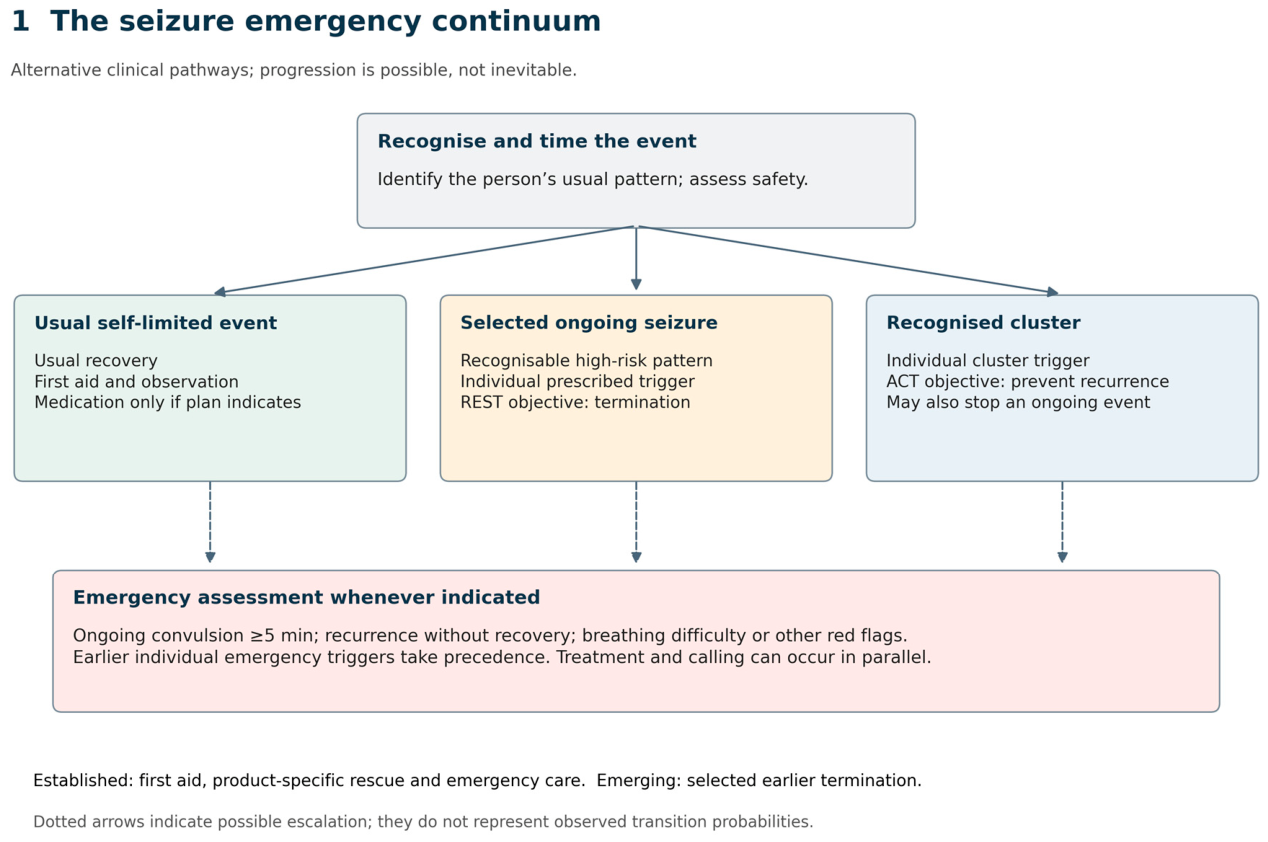
Figure 2.
Three timing concepts that must not be conflated. Absolute duration from seizure onset, deviation from a person’s usual duration and time after drug administration answer different questions. For convulsive status epilepticus, ILAE t₁ is five minutes and t₂ is thirty minutes; t₂ must never be used as a waiting threshold. NICE treats a convulsive seizure lasting more than two minutes longer than usual as a medical emergency. The REST consensus aspiration concerns onset of treatment action within two minutes after administration. It does not create a universal two-minute dosing rule. An individualised earlier treatment trigger requires its own clinical justification.[2,3,4].
Figure 2.
Three timing concepts that must not be conflated. Absolute duration from seizure onset, deviation from a person’s usual duration and time after drug administration answer different questions. For convulsive status epilepticus, ILAE t₁ is five minutes and t₂ is thirty minutes; t₂ must never be used as a waiting threshold. NICE treats a convulsive seizure lasting more than two minutes longer than usual as a medical emergency. The REST consensus aspiration concerns onset of treatment action within two minutes after administration. It does not create a universal two-minute dosing rule. An individualised earlier treatment trigger requires its own clinical justification.[2,3,4].
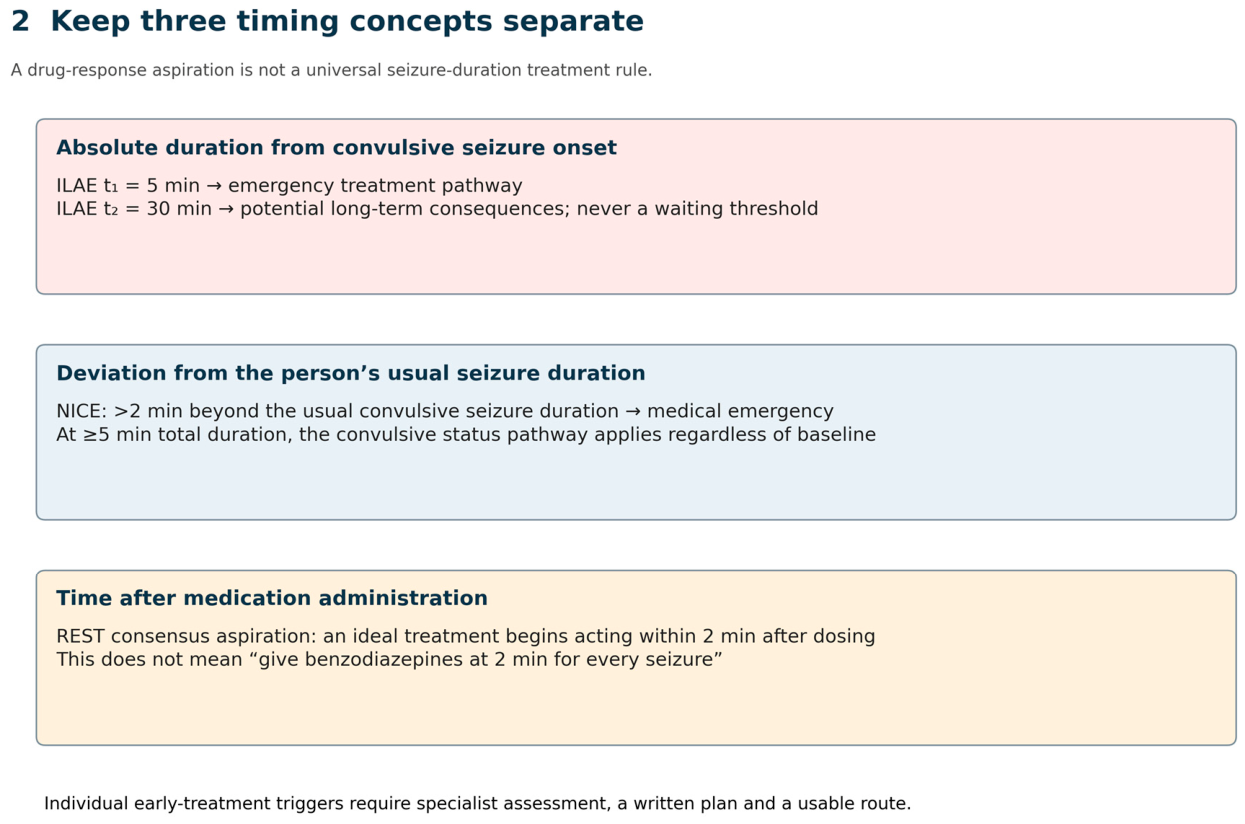
Figure 3.
Country-level GCC evidence and unresolved access questions. This schematic evidence map is not a geographic or availability map. It identifies the type of relevant primary evidence and official documentary finding for each country. NV means not verified in the sources consulted, not unavailable. Registration, listing, stock, reimbursement, prescription and possession are distinct attributes. Public, teacher, caregiver and provider evidence describes distinct implementation questions; none establishes outpatient REST effectiveness. Product and source details appear in Table 5 and Supplementary Tables S2–S3. Evidence map updated 16 November 2026; documentary verification dates vary by source (Supplementary Table S3).
Figure 3.
Country-level GCC evidence and unresolved access questions. This schematic evidence map is not a geographic or availability map. It identifies the type of relevant primary evidence and official documentary finding for each country. NV means not verified in the sources consulted, not unavailable. Registration, listing, stock, reimbursement, prescription and possession are distinct attributes. Public, teacher, caregiver and provider evidence describes distinct implementation questions; none establishes outpatient REST effectiveness. Product and source details appear in Table 5 and Supplementary Tables S2–S3. Evidence map updated 16 November 2026; documentary verification dates vary by source (Supplementary Table S3).
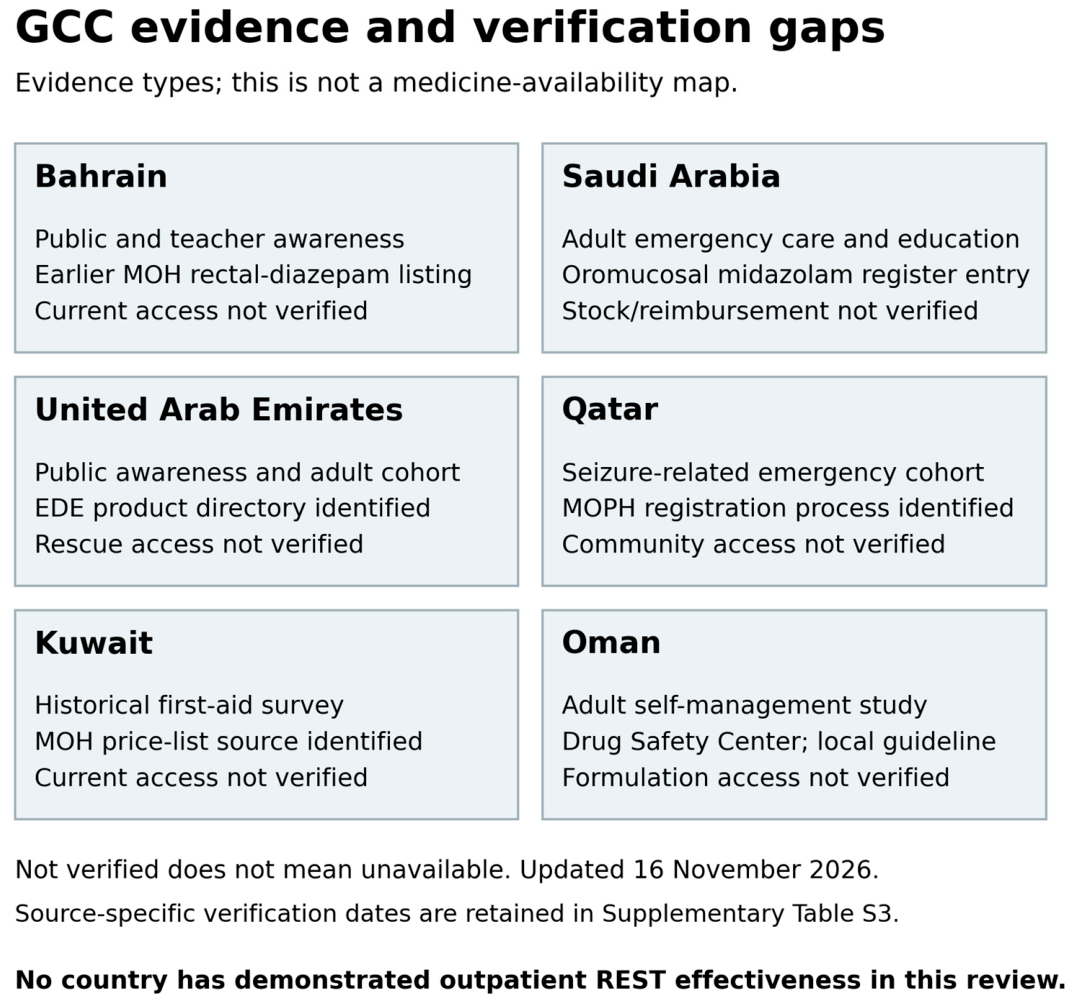
Figure 4.
Proposed GCC Seizure Emergency Prevention and Early Intervention Framework. The six components are risk review; an individualised action plan; training; verified treatment access; escalation and continuity; and measurement. The diagram groups training and access within delivery preparation and shows both emergency response and follow-up within continuity. Emergency activation can occur in parallel with prescribed treatment. The feedback loop represents prospective safety and implementation review, not a validated effectiveness model. EMS, emergency medical services; ED, emergency department. This framework is an author-proposed model requiring local adaptation, governance and evaluation.
Figure 4.
Proposed GCC Seizure Emergency Prevention and Early Intervention Framework. The six components are risk review; an individualised action plan; training; verified treatment access; escalation and continuity; and measurement. The diagram groups training and access within delivery preparation and shows both emergency response and follow-up within continuity. Emergency activation can occur in parallel with prescribed treatment. The feedback loop represents prospective safety and implementation review, not a validated effectiveness model. EMS, emergency medical services; ED, emergency department. This framework is an author-proposed model requiring local adaptation, governance and evaluation.
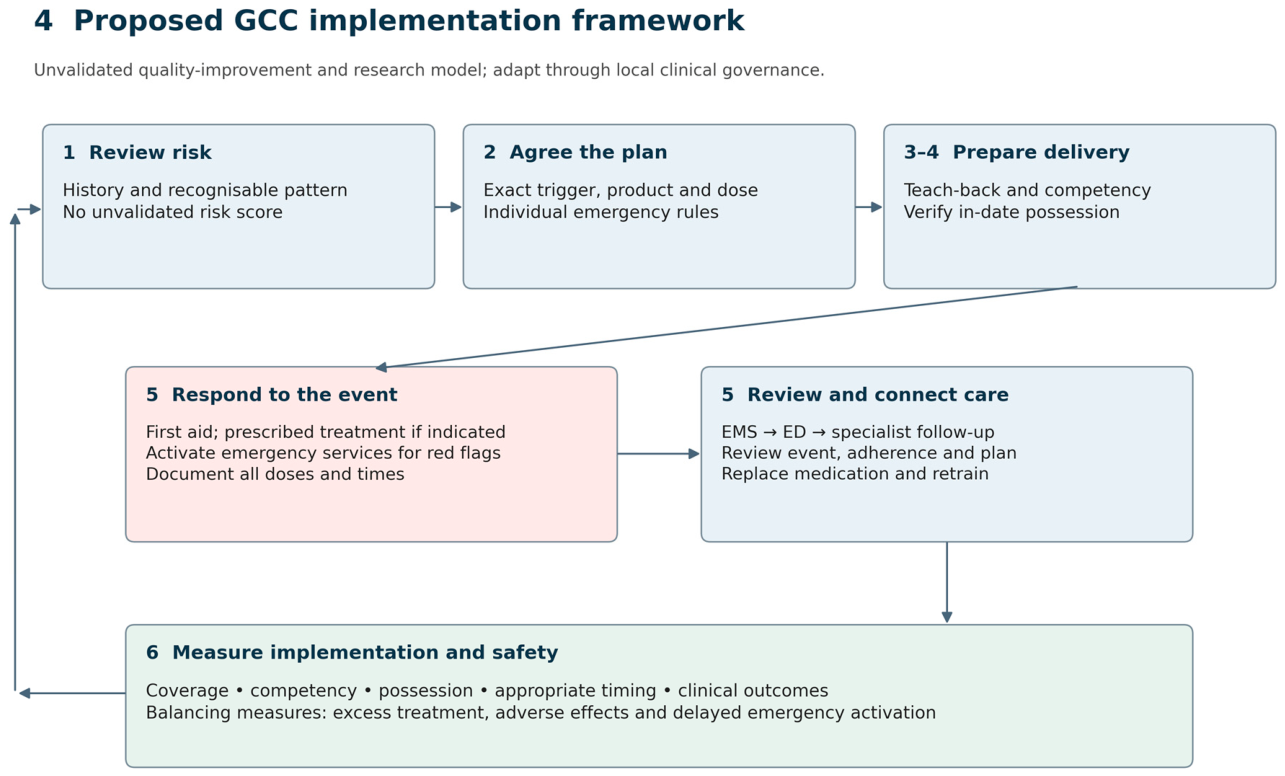

Table 1.
Definitions and clinical distinctions.
| Term | Operational meaning | Evidence or authority | Clinical boundary |
| Seizure cluster | Recognisable increase or grouping relative to baseline; research count windows vary. | Individualised assessment; NICE uses a typical pattern of ≥3 self-terminating seizures/24 h.[3] | Do not delay a prescribed cluster intervention solely to reach a generic count. |
| Prolonged convulsive seizure | NICE: >2 min beyond the person’s usual seizure duration. | Guideline recommendation; direct evidence for this specific early category is limited.[3] | At ≥5 min use the convulsive status pathway, regardless of baseline duration. |
| REST | Treatment directed at an ongoing seizure. | Expert-consensus concept; proposed very rapid post-dose action.[4] | Not a universal instruction to medicate every brief seizure. |
| ACT | Treatment directed at subsequent seizures within a cluster. | Cluster-treatment trials and consensus terminology.[4,16,26] | The same drug may have both termination and recurrence effects. |
| Convulsive status epilepticus | ILAE t₁ = 5 min; t₂ = 30 min. | ILAE operational framework.[2] | Treat at t₁; never wait for t₂. Recurrent convulsions without recovery need emergency care. |
| Focal impaired-awareness or absence status | Different phenotype-specific operational thresholds; EEG may be needed. | ILAE t₁: focal impaired awareness 10 min; absence 10–15 min.[2] | Do not apply a single convulsive threshold to all non-convulsive events. |
| Conventional rescue | Umbrella description of acute treatment for prolonged seizures, clusters or emergencies. | Established practice with formulation- and setting-specific evidence. | Not synonymous with deliberately late treatment. |
ACT, acute cluster treatment; EEG, electroencephalography; ILAE, International League Against Epilepsy; REST, rapid and early seizure termination. Thresholds apply to the named phenotype; t₂ estimates are not treatment deadlines.
Table 2.
Adult groups warranting emergency-preparedness review.
| Clinical group | Supporting evidence | Planning implication | Limitation |
| Previous prolonged seizure or status | Guidelines and individual recurrence history.[3,27] | Review rescue indication, observable trigger and escalation. | No validated GCC probability score. |
| Established recurrent clusters | Prospective adult observational evidence.[10] | Describe personal cluster pattern and an actionable trigger. | Definitions and baseline seizure burden influence risk estimates. |
| Frequent tonic–clonic seizures | Clinically important morbidity and SUDEP risk.[14] | Optimise maintenance care and emergency preparedness. | No evidence that outpatient REST prevents SUDEP. |
| Drug-resistant epilepsy | Persistent seizures after appropriate treatment trials.[11] | Specialist review including rescue needs and long-term options. | Drug resistance alone does not justify treating every seizure. |
| Recognisable progression to prolonged events | Clinical history and consensus rationale.[4] | Consider earlier specialist-defined intervention. | Recognition accuracy and net benefit require evaluation. |
| Limited support, frailty or respiratory vulnerability | Individual feasibility assessment and product-specific contraindications.[18,19,24] | Tailor responder arrangements, route and observation. | Some conditions prohibit a particular product; closer observation does not override contraindications. |
| First, atypical or acute symptomatic seizure | Emergency assessment and aetiological treatment.[27] | Use diagnostic emergency pathways. | Do not classify automatically as an established-epilepsy REST candidate. |
This table guides review, not automatic prescribing. SUDEP, sudden unexpected death in epilepsy. Proposed factors are not a validated risk score.
Table 3.
Community rescue formulations and professional escalation.
| Formulation | Evidence and endpoint | Administration and pharmacology | Safety and limitations |
| Midazolam nasal spray | Controlled cluster trial plus open-label extension; cessation and recurrence endpoints.[16,17] | Ready-to-use nasal product; post-dose efficacy is not equivalent to pharmacokinetic peak. | US age ≥12; product-specific repetition and respiratory precautions. No active head-to-head ranking.[18] |
| Diazepam nasal spray | Rectal-diazepam efficacy bridging plus pharmacokinetics and open-label nasal safety.[19,20] | Non-invasive delivery; longer exposure does not establish superior clinical prevention. | US age ≥2; second dose ≥4 h when prescribed. Continuing convulsions require emergency care, not waiting. |
| Oromucosal midazolam | Prolonged-convulsion evidence predominantly paediatric; adult EMA indication incorporates extrapolation.[23,24] | Deliver into cheek–gum space by trained technique; not swallowed tablets. | Do not force the mouth open. Licensed age, indication and caregiver repetition vary by product/jurisdiction. |
| Rectal diazepam | Controlled home cluster-treatment evidence, including an adult subgroup.[26] | Formulation-specific absorption; useful when feasible and acceptable. | Privacy, positioning and product differences matter. Gel evidence cannot establish equivalence of every rectal preparation. |
| IM midazolam — professional care | Randomised prehospital status-epilepticus evidence.[13] | Administration without IV access may reduce delivery delay. | Requires trained services and monitoring; not a generic lay-caregiver option. |
| Oral clinician-directed alternatives | Selected cluster plans; variable and often indirect evidence.[3] | Requires safe swallowing and an explicitly prescribed scenario. | Not for active convulsions, impaired consciousness or indiscriminate substitution. |
All benzodiazepines may cause sedation and respiratory compromise. EMA, European Medicines Agency; IM, intramuscular; IV, intravenous. US/EU indications do not imply GCC authorisation. No universal dose schedule is intended.
Table 4.
REST and established rescue compared by treatment objective.
| Dimension | Selected early termination | Cluster treatment | Established emergency management |
| Immediate objective | Stop the current seizure. | Prevent additional seizures; may also stop an ongoing event. | Terminate status and manage physiological/aetiological threats. |
| Trigger | Patient-specific recognisable high-risk event. | Patient-specific evolving cluster pattern. | Convulsive t₁ or other clinical emergency; do not wait for injury threshold. |
| Evidence | Consensus; nonrandomised timing analyses; inpatient phase II evidence.[4,31,34] | Product-specific trials and bridging/safety evidence.[16,20,26] | Guidelines and prehospital/hospital randomised trials.[13,27,28] |
| Timing interpretation | Separate seizure onset from drug administration and response. | Do not confuse inter-seizure prevention with measured cessation. | Prior treatment must not reset the seizure-duration clock. |
| Comparison required | Earlier rule versus usual timing with established care retained. | Product-specific recurrence control over a defined window. | Timely guideline-based treatment and escalation. |
| Main uncertainty | Who can be recognised early enough, and who benefits rather than being overtreated? | Which recurrence outcomes and time windows are transferable across products? | Adequate dose, delivery delay, refractory seizures and underlying cause. |
| Essential safeguard | Specific written trigger; assess inappropriate administrations. | Clear maximum use and escalation for recurrence without recovery. | Immediate emergency pathway and accurate cumulative-dose handover. |
The columns overlap clinically and are not mutually exclusive drug classes. Framework comparisons are the authors’ critical synthesis; no head-to-head superiority or validated REST threshold is implied. The combined diazepam analysis adds retrospective emergency observations, not proof that earlier dosing prevents status epilepticus.[33].
Table 5.
Six-country clinical and rescue-access evidence map.
| Country | Directly relevant regional evidence | Official documentary finding | Access and practice gaps |
| Bahrain | Public and schoolteacher awareness surveys; indirect to adult rescue outcomes.[5,39] | Earlier MOH directory finding: rectal diazepam and injectable midazolam.[40,41] Recheck blocked on 16 November. | Current product registration, stock, reimbursement, adult rescue indication and prescribing not verified. |
| Saudi Arabia | Adult ED underdosing study and caregiver education study; distinct questions.[42,45] | SFDA Oroxelam 10 mg oromucosal solution: valid/marketed entry rechecked 16 November 2026.[43] | Adult indication, actual dispensing, payer coverage and community use require verification. |
| UAE | Sharjah awareness survey and 2026 Emirati adult treatment cohort; neither evaluates REST.[46,48] | EDE official registered-product directory identified.[47] | Core rescue formulations, current stock, coverage and action-plan uptake not verified. |
| Qatar | HMC seizure-related ED cohort; first-seizure ED study.[49,50] | MOPH registration process identified.[51] | Formulation-specific authorisation, supply, reimbursement and home use not verified. |
| Kuwait | Historical public first-aid misconceptions.[52] | MOH pharmaceutical price-list source identified.[53] | Current formulation status, procurement, coverage and caregiver training not verified. |
| Oman | Muscat adult knowledge/self-management study; institutional adult guideline.[54,55] | Drug Safety Center registration/price resources identified.[56] | Product-level status, dispensing, reimbursement and outpatient REST outcomes not verified. |
Evidence map updated 16 November 2026; source-specific verification dates are retained in SupplementaryTable S3. GCC EMU findings are multicountry institutional evidence, not national outpatient coverage.[6] MOH, Ministry of Health; HMC, Hamad Medical Corporation; MOPH, Ministry of Public Health; EDE, Emirates Drug Establishment; SFDA, Saudi Food and Drug Authority. Not verified does not mean unavailable. Directory listing is not equivalent to current formulary inclusion or registration. Wider regional provider reports and the EMR awareness synthesis are contextual, not national GCC coverage estimates.[57,58].
Table 6.
Patient and caregiver needs and proposed adaptations.
| Barrier or need | Evidence basis | Proposed GCC response | Evaluation measure |
| Misrecognition of seizure type | Regional awareness surveys.[5,46,52] | Use individual descriptions and visual examples with consent. | Correct trigger identification in simulation. |
| Uncertain administration technique | Saudi caregiver education and adult action-plan implementation.[45,61] | Device demonstration followed by teach-back. | Observed competence at training and follow-up; critical errors. |
| Language or literacy mismatch | Plausible implementation concern; local magnitude unmeasured. | Preferred-language, pictorial and interpreter-supported materials. | Comprehension and competency by language group. |
| Privacy and disclosure concerns | Stigma surveys and international route-preference findings.[46,60] | Shared route choice; consent-based workplace and caregiver planning. | Acceptability, possession outside home and reported avoidance. |
| No consistent responder | Individual feasibility concern. | Named responder arrangements and explicit alternative emergency pathway. | Uncovered episodes; successful responder contact. |
| Fear of sedation or respiratory harm | Product warnings and trial safety limitations.[18,19] | Teach observation, repeat-dose restrictions and emergency triggers. | Inappropriate withholding, excess dosing and delayed escalation. |
| Prescription without actual access | Regional provider survey; patient-level access remains unverified.[57] | Pharmacy verification, expiry checks and replacement arrangements. | In-date possession and time from prescription to dispensing. |
| Inappropriate use or absent instructions | German adult and UK prescribing studies; different denominators.[38,59] | Assess indication, trigger, possession and behaviour separately. | Correctly treated qualifying events and unnecessary doses. |
Adaptations and metrics are proposed, not validated GCC interventions. Confidence and satisfaction must not substitute for observed competency or clinical safety.
Table 7.
Proposed GCC-SEPEIF delivery components.
| Component | Accountable function | Minimum deliverable | Evaluation |
| Risk review | Neurologist with primary-care support | Documented event history and individual treatment rationale. | Eligible patients reviewed; reasons for prescribing or not prescribing. |
| Action plan | Prescriber and patient/caregiver | Signed phenotype, trigger, exact product, dose, cumulative exposure, escalation and review date. | Complete plans / eligible patients; completeness audit. |
| Education | Epilepsy nurse or trained educator | Actual-device demonstration, teach-back and reassessment of retained skill. | Competency and critical errors; not attendance alone. |
| Access | Pharmacy and care coordinator | Verified supply, in-date possession and replacement plan. | Possession, dispensing delay and unmet prescriptions. |
| Escalation and continuity | EMS, ED and neurology | Dose/time handover and post-event review. | Escalation delay; handover completeness; follow-up. |
| Measurement | Local clinical governance and research team | Prospective event log, adverse-event review and equity analysis. | Process indicators, harms and exploratory utilisation per patient-time. |
GCC-SEPEIF, GCC Seizure Emergency Prevention and Early Intervention Framework; EMS, emergency medical services; ED, emergency department. This is an author-proposed model. Detailed indicator definitions are in SupplementaryTable S5.
Table 8.
Prioritised research agenda.
| Priority and question | Suggested design | Key measures | Feasibility and interpretation |
| A — What preparedness exists across GCC services? | Coordinated GCC multicentre survey linking patient, caregiver, clinician and pharmacy reports; report site and country coverage. | Plans, in-date medication possession, training and barriers. | First priority; triangulate reports rather than assume prescription equals access. |
| B — Where do emergency delays arise? | Retrospective ED/EMS audit with repeated-event linkage. | Timing, prior doses, dose adequacy, status, disposition and follow-up. | Requires record access; missing onset times must remain missing. |
| C — Which GCC products are accessible? | Six-country regulatory, formulary, procurement and payer verification. | Separate registration, listing, stock, dispensing, reimbursement and utilisation. | National collaborators and dated evidence required. |
| D — Can the framework be delivered safely? | Phased GCC sentinel-site feasibility studies with qualitative interviews and country-specific cost-consequence analyses. | Reach, competency, access, fidelity, errors, escalation, acceptability and resource use. | No mortality or definitive effectiveness claim from a small uncontrolled pilot. |
| E — Does selected earlier intervention improve outcomes? | Randomised or carefully controlled prospective study with standard emergency care retained. | Cessation, recurrence, emergency use, harms and patient-defined recovery. | Requires reliable recognition and sample-size estimation after feasibility work. |
All projects are proposals. No participating institutions, approvals, recruitment, sample sizes or study outcomes are implied.
Disclaimer/Publisher’s Note: The statements, opinions and data contained in all publications are solely those of the individual author(s) and contributor(s) and not of MDPI and/or the editor(s). MDPI and/or the editor(s) disclaim responsibility for any injury to people or property resulting from any ideas, methods, instructions or products referred to in the content. |
© 2026 by the authors. Licensee MDPI, Basel, Switzerland. This article is an open access article distributed under the terms and conditions of the Creative Commons Attribution (CC BY) license.
Copyright: This open access article is published under a Creative Commons CC BY 4.0 license, which permit the free download, distribution, and reuse, provided that the author and preprint are cited in any reuse.