

Submitted:
14 November 2026
Posted:
17 November 2026
You are already at the latest version
Abstract
Our world continues to struggle with conflict, widening inequality, and deep ideological division, and because of this, the familiar call for “unity in diversity” often sounds more idealistic than helpful. It is repeated often but rarely explained in a way that people and communities can actually use. This article develops the concept of universitification as a grounded, philosophical account of how unity can be pursued without erasing difference. Using a qualitative philosophical–historical method, it reads Aristotle’s Nicomachean Ethics, Politics, and Metaphysics closely, engages scholarship on pluralism, participation, and globalization, and examines how pre-colonial and colonial experiences shaped Philippine society, especially its poverty, corruption, and social division. The analysis shows that Aristotle’s account of eudaimonia, the formation of virtue through habit, the mean, and the polis as a community (koinōnia) oriented to the common good offers a practical way of thinking about personal and social well-being together. The historical discussion shows that early forms of local governance and cooperation were disrupted by colonization and later reshaped by market pressures and political patronage, yet moments of collective moral action persisted. From these findings, universitification is defined as a gradual process through which communities become conscious of their interconnectedness and reorient their institutions toward what is good, just, and inclusive. It rests on participation, respect for difference, and an “equal hierarchy” in which roles differ but dignity does not. Unlike globalization or internationalization, its axis is ethical rather than economic or diplomatic. The article concludes that social transformation is slow and difficult, but unity remains possible when people cultivate virtue and work together toward the common good.
Keywords:
universitification
; unity in diversity
; Aristotle
; common good
; virtue ethics
; Philippine history
; pluralism
I. Introduction
The contemporary world lives in a state of almost permanent tension. Conflicts, wars, social unrest, and sharp ideological divides shape not only global politics but also the everyday lives of ordinary people. In many societies, including the Philippines, these divisions are deepened by inequalities in wealth, power, and access to resources. Those with influence and capital often hold positions of dominance, while the poor and marginalized remain structurally excluded from the full benefits of social life.
Yet alongside this reality of fragmentation, humanity has never stopped dreaming of unity. Philosophers, theologians, and political thinkers across the centuries have searched for ways to bind communities together without erasing their differences (Parekh, 2005; Ang, 2014). In the Philippines, the writings of José Rizal and Apolinario Mabini—Rizal’s novels Noli Me Tángere (1887/2006) and El Filibusterismo (1891/2011), and Mabini’s El Verdadero Decálogo (1898; Mabini, 1931/2007)—continue to echo in the national consciousness as calls to moral renewal, national dignity, and collective responsibility (Diokno, 2011). Their work suggests that ideas, when deeply rooted in ethical conviction and historical experience, can become powerful instruments of transformation.
This study arises from a similar conviction: that a conceptual framework drawn from critical engagement with history, culture, and philosophy can help address the ongoing crisis of division. It begins from the observation that plurality—of cultures, religions, languages, and political affiliations—is an undeniable feature of contemporary societies, particularly in a multi-island nation like the Philippines.
Pluralism in itself, however, does not guarantee unity. The country continues to witness armed conflict between government forces and insurgent groups, tensions among political factions, and misunderstandings between religious communities. Its geography, an archipelago of more than seven thousand islands, further complicates communication, governance, and the building of national solidarity.
In response, slogans such as “unity in diversity” have been widely used. They point toward an ideal in which difference is a source of enrichment rather than a threat. Yet such slogans often remain abstract, and scholars of multiculturalism and cosmopolitanism have themselves noted the limits of the phrase (Parekh, 2005; Ang, 2014). It rarely comes with a clear account of how unity is to be achieved in practice, especially when structural injustice, historical wounds, and entrenched interests stand in the way. Recognizing this gap, the present study moves “beyond slogans” by developing a more concrete, philosophically grounded, and process-oriented concept: universitification.
Universitification is conceived as a long-term, dynamic process of personal and societal transformation, inspired primarily by Aristotle’s ethics, politics, and metaphysics, and informed by historical and contemporary realities in the Philippines and beyond. At its core is an image: a community or nation can be understood as a kind of “university,” a complex whole composed of diverse parts—colleges, departments, and individuals—unified not by uniformity but by a shared pursuit of the good. In this image, society is the classroom, the people are the students, and the shared project is the cultivation of virtue and the formation of a just, stable, and humane social order. The term also carries the sense of the Latin universitas, a whole made up of many members, which is precisely the kind of unity this study has in mind.
Beneath this image lies an older philosophical question: the problem of the One and the Many. The Presocratic thinkers struggled to understand whether reality is ultimately one, many, or a flux of changing elements. Parmenides insisted on a single, unchanging being; Heraclitus saw everything as becoming and change; Democritus explained the world as a combination of countless atoms (Hamlyn, 1987).
Modern cosmology offers a suggestive parallel. In the standard Big Bang model, the universe emerges from an extremely hot and dense early state and expands outward into multiplicity, dispersion, and increasing entropy. The parallel is offered here as an analogy, not as a scientific argument: if reality itself unfolded from unity into diversity, then the human longing for unity in a plural world need not be dismissed as mere nostalgia. It may express a deep intuition about interconnectedness.
In the Philippines, the same tension between unity and division is visible in history. Pre-colonial communities lived in largely self-governing barangays led by datus and bound together by kinship, customary law, and trade (Scott, 1994). Under colonial rule and later state-building, new forms of power, class, and inequality emerged (Rafael, 2019). The country has known moments of extraordinary unity, such as the 1986 EDSA People Power Revolution, but also long periods of despair, when people feel that the system is beyond repair and that corruption and violence are irreversible.
Against this backdrop, the present study asks: Is a different path possible? If the world is indeed plural and dynamic, can there be a form of unity that does not suppress diversity but transforms it into a source of strength? Can Filipino society, and humanity more broadly, move toward a renewed form of political and moral community founded on virtue, mutual participation, and the recognition of our intrinsic connectedness?
The study does not enter an empty field. Contemporary virtue ethics and communitarian thought have argued that moral life is formed within communities and traditions (MacIntyre, 2007), and Karol Wojtyła’s theory of participation describes how persons realize themselves by acting together with others (Wojtyła, 1993; Mejos, 2007). In Filipino thought, kapwa—the recognition of a shared self with others—has been described as a core value of Philippine social life (Enriquez, 1992) and has been read alongside Aristotelian and Thomistic virtue ethics (Reyes, 2015). Universitification draws on these conversations but adds something distinct: it treats unity not only as a value to be affirmed but as a process to be undertaken, and it ties that process explicitly to the reform of institutions, from the barangay to the international order.
To answer these questions, this research turns first to Aristotle, whose reflections on the good, virtue, the polis, and human nature offer a rich foundation for rethinking unity and social order. It then revisits historical experience—especially pre-colonial social structures and contemporary Philippine conditions—to uncover patterns of cohesion and fragmentation. Drawing these threads together, it advances universitification as a philosophical and socio-political framework that reconciles diversity with unity through goodness, participation, and equal dignity.
The study therefore pursues four interrelated aims: (1) to reinterpret Aristotle’s Nicomachean Ethics, Politics, and Metaphysics in light of present-day fragmentation; (2) to articulate the concept of universitification; (3) to reflect on the possibility of equal justice in a stratified society; and (4) to examine whether personal and structural transformation can realistically lead toward peace and unity.
2. Methodology
Because the questions at stake are fundamentally philosophical and historical, this study adopts a qualitative, philosophical–historical research design. It does not seek to measure phenomena statistically or to test hypotheses through experiments. Instead, it analyzes texts, interprets concepts, and reflects on historical narratives in order to articulate a coherent framework for understanding and transformation.
The research draws on four bodies of sources. First, it engages closely with the primary texts of Aristotle, particularly the Nicomachean Ethics, Politics, and Metaphysics. Through close reading and interpretive analysis, the study identifies key themes—the nature of the good, eudaimonia, virtue, the mean, the role of the polis, and the idea that the human being is by nature a political animal—and explores how these can be extended into a contemporary framework. Aristotle’s works are cited by book, chapter, and Bekker number, using the following abbreviations: NE for the Nicomachean Ethics (Aristotle, 1928), Pol. for the Politics (Aristotle, 1999), and Metaph. for the Metaphysics (Aristotle, 1941).
Second, it engages secondary literature on unity in diversity, pluralism, participation, and globalization, including Ang (2014), Roumeas (2015), Parekh (2005), Coward (1985), Wojtyła (1993), Daly (1999), and Gemelli (1963). These works discuss cosmopolitan identities, religious pluralism, multicultural societies, participation and alienation, the ethics of globalization, and Franciscan approaches to human relations. They provide a dialogical backdrop against which the originality and limits of universitification can be assessed.
Third, the study turns to historical and anthropological sources on the Philippines, especially the Laguna Copperplate Inscription (Postma, 1992) and William Henry Scott’s (1994) reconstruction of pre-colonial Tagalog social classes: the maginoo, the maharlika, the timawa, and the alipin. These sources show that long before colonization, the archipelago had complex polities with legal mechanisms, social mobility, and well-developed systems of hierarchy and obligation.
Fourth, the study incorporates the reflections of a local expert, Dr. Eduardo Lagos, DepEd Supervisor in Bayawan City Division, obtained through a semi-structured interview in February 2019. He was asked about the root causes of corruption, division, and conflict in the Philippines. His answers, which highlight basic needs, survival, poverty, and the distortions of capitalism, serve as grounded testimony linking philosophical analysis to lived reality. His views are cited as personal communication and are treated as an informed perspective rather than as representative data.
The analysis proceeds in four stages. The first is hermeneutic interpretation: philosophical and historical texts are read closely and in context, with attention to nuance and internal coherence. The second is thematic synthesis, in which recurring motifs such as the good, virtue, participation, justice, hierarchy, and unity in diversity are identified across sources and compared. The third is conceptual construction, in which these motifs are woven together to shape universitification as a distinct but related concept within the broader family of theories about unity and social order.
The fourth is a critical-reflective phase, in which the strengths and limits of the framework are evaluated, particularly in relation to the metaphysical grounding of interconnectedness (such as the “great chain of being”) and the theological question of whether God, the unmoved mover of Aristotelian metaphysics (Metaph. XII.7, 1072a25–b30), must be acknowledged as the ultimate source of all being and order.
No surveys or experimental interventions were conducted, as these would not suit the philosophical nature of the inquiry. Instead, the study aims to offer a rich, coherent, and critically informed account that can inspire further research, both theoretical and empirical, into the possibilities of unity, virtue, and social transformation.
3. Results
- A.
- Aristotle’s Vision of the Good Life and the Political Community
The first set of results centers on Aristotle’s vision of the good life and the political community, read in light of present social fragmentation. For Aristotle, every art and inquiry, and every action and choice, aims at some good (NE I.1, 1094a1–3). The highest human good is eudaimonia, a flourishing realized through the activity of the soul in accordance with virtue across a complete life (NE I.7, 1098a16–20). This happiness is not mere pleasure or material success; it is the fulfillment of human nature as rational and social.
Virtue, in Aristotle’s account, is not an innate disposition fully formed at birth. Intellectual virtue grows mainly through teaching, while moral virtue comes about through habit: we become just by doing just acts, temperate by doing temperate acts, and brave by doing brave acts (NE II.1, 1103a14–b2). The study underscores a further insight: critical situations—moments of fear, crisis, or temptation—reveal who we have already become (cf. NE III.8, 1117a17–22). A person who has habituated themselves to justice, temperance, and courage will respond to adversity differently from one whose habits have been formed by selfishness, cowardice, or greed.
These strands come together in the doctrine of the mean. Virtue is a settled disposition concerned with choice, lying in a mean relative to us and determined by reason (NE II.6, 1106b36–1107a2); courage, for instance, lies between cowardice and rashness (NE II.7, 1107a33–b4). The “middle state” is not mediocrity but a reasoned balance attuned to what is genuinely good for human beings. The study extends this idea: just as individuals must find a mean in their passions and actions, societies too must seek a balanced state that avoids the extremes of total alienation on the one hand and oppressive uniformity on the other.
In the Politics, Aristotle describes the human being as by nature a political animal (Pol. I.2, 1253a2–3; see also Papadis, 2006) and the polis as a community that comes into being for the sake of life but continues in existence for the sake of the good life (Pol. I.2, 1252b29–30). It should be organized so that citizens can live virtuously and take part in shaping their common destiny. A correct regime, for Aristotle, is one that aims at the common advantage rather than the private interest of the rulers (Pol. III.7, 1279a17–21) and is governed by law guided by virtue. He favors a “polity” that blends features of oligarchy and democracy, tempering extremes of wealth and poverty and securing stability through a large middle class (Pol. IV.11, 1295b1–1296a21).
Aristotle accepted the hierarchies of his time and even defended a doctrine of natural slavery (Pol. I.5, 1254a17–1255a3), a position this study rejects. Yet his deeper insight—the linkage of the good life, virtue, and the political community—provides a crucial foundation. It suggests that any serious attempt to address division and injustice must go beyond technical fixes and attend to character formation, a shared pursuit of the good, and a political structure oriented to the common good.
- B.
- Historical and Structural Roots of Division in the Philippines
The second set of results concerns the historical and structural context of division in the Philippines. Expert reflection points to basic human needs and the pressures of survival as key drivers of corruption, crime, and social conflict (E. Lagos, personal communication, 2019). When people cannot adequately meet their needs for food, housing, and livelihood, they may resort to theft, violence, or other illicit means, especially where social safety nets are weak.
Institutional analyses support this reading. The Asian Development Bank (ADB, 2009) identifies weak economic growth, low agricultural productivity, rapid population growth, and high inequality as root causes of persistent poverty in the country. These in turn produce effects such as malnutrition, child labor, and the spread of crime.
The study reads these conditions as a breeding ground for distrust: people who feel abandoned by formal institutions may lose faith in the state and be drawn into clientelistic or even criminal networks. Dr. Lagos further observes that capitalism, in its current form, often widens the gap between rich and poor, while democracy can function merely as a façade for elite domination; political office becomes a means of accumulating wealth rather than a vocation of service (E. Lagos, personal communication, 2019). Such patterns of exploitation and inequality reinforce the perception that the system is rigged, feeding apathy, cynicism, or radicalization.
To counterbalance this picture of fragmentation, the study revisits pre-colonial political and social structures. The Laguna Copperplate Inscription, dated to 900 CE (Śaka 822), reveals a world in which polities such as Tondo exercised legal authority, managed debt relations, and maintained ties with neighboring chiefs. It records the release of the heirs of a man named Namwaran from a debt in gold, witnessed by several local leaders (Postma, 1992), indicating that complex legal and political practices were already in place.
Scott’s (1994) reconstruction of sixteenth-century Tagalog society describes a ruling class, the maginoo, which included the datus; the maharlika, a lesser aristocracy of free warriors who owed military service; the timawa, or free commoners; and the alipin, or dependents, including those bound by debt. While this structure was hierarchical, mobility was possible, and social roles were embedded in kinship and community obligations.
The study suggests that, had these indigenous structures developed without colonial interruption, they might have evolved into more complex but also more organic systems of governance. This is a counterfactual and cannot be proven, but it serves a purpose: it reminds us that division is not the only story the archipelago knows.
Colonialism, however, disrupted this trajectory. Spanish rule reconfigured political authority, absorbed former datus into a colonial principalía, and marginalized many native institutions; later colonial and postcolonial governments continued patterns of extraction and centralization (Rafael, 2019). This legacy, combined with modern economic and ideological forces, helps explain why the Philippines today struggles so intensely with corruption, inequality, and fragmentation. At the same time, episodes such as the 1986 EDSA People Power Revolution attest that the Filipino people retain a capacity for unity and collective moral action when confronted with clear injustice.
- C.
- Emergence and Definition of Universitification
The third set of results is the articulation of universitification itself. Drawing on Aristotle’s ethics and politics, on historical reflection, and on contemporary analyses of globalization and pluralism, the study advances universitification as both a concept and a process.
Universitification is defined as a profound and dynamic process of hand-in-hand adaptation to change and to the challenges of time, without compromising the welfare of anyone, in order to form a new koinōnia, or community bonded by goodness.
Figure 1 presents this definition in summary form. Individuals and institutions, through the cultivation of virtue, move together toward the common good, and it is this shared movement, rather than any single reform, that constitutes societal transformation.
The term koinōnia is Aristotle’s own. He opens the Politics by observing that every polis is a kind of community and that every community is established with a view to some good (Pol. I.1, 1252a1–7), and in the Ethics he ties community closely to friendship and justice (NE VIII.9, 1159b25–32). In the Christian tradition the same word carries the sense of fellowship or communion. In both senses it names a bond in which people share not only space and institutions but also responsibilities and care for one another.
Several elements structure this concept. First, universitification presupposes pluralism. It does not deny diversity of religion, culture, or ideology; rather, it assumes that difference is an enduring feature of human societies (Roumeas, 2015). Second, it insists on participation. A society becomes universitified not when a single ideology is imposed from above, but when individuals and groups actively take part in shaping common life, taking responsibility not only for their own interests but also for the common good (Wojtyła, 1993). Third, it places goodness at the center. While love and faith are powerful forces, not all people share the same religious convictions or experiences of love. Goodness, however, can be recognized by human reason across religious and cultural lines. It becomes the fundamental virtue from which other virtues—love, patience, temperance, benevolence—derive.
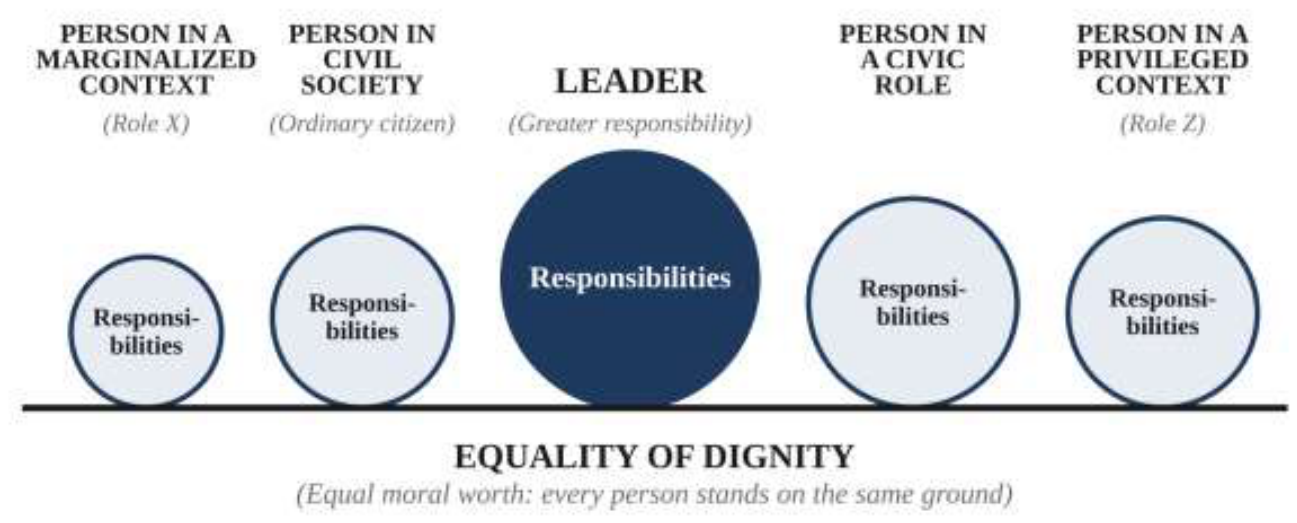
Universitification also advances the notion of equal hierarchy. Unlike classical hierarchies that place some persons as naturally superior and others as naturally inferior, equal hierarchy affirms that all human beings share equal dignity and worth, even when they occupy different roles and bear different responsibilities. Leaders, in this view, are not higher beings but servant-leaders, entrusted with a greater share of responsibility and accountability. Figure 2 and Figure 3 illustrate this. Figure 2 shows that persons may differ greatly in responsibility while standing at exactly the same point of worth and dignity, and Figure 3 presents the same idea as a hierarchy of roles resting on a single, shared ground: the poor and the rich, the respected and even the morally compromised (for instance, persons who use illegal drugs) stand on the same level of dignity while differing in function and obligation within the community.
The concept becomes clearer when compared with two major contemporary dynamics: globalization and internationalization. Globalization, in Daly’s (1999) distinction, erases national boundaries for economic purposes so that the world becomes, in effect, a single market. While it promises a kind of unity, it often widens inequality, weakens national communities, and erodes local cultures (Daly, 1999; Mir, 2014). Internationalization, by contrast, keeps nations as the basic units and builds cooperation among them through treaties, alliances, and exchange (Daly, 1999; Hawawini, 2016), but it frequently remains limited by strategic interest and imbalances of power.
Universitification shares with globalization the aspiration to think beyond narrow boundaries, and with internationalization a concern for cooperation. Yet it differs fundamentally in that it is not primarily an economic or diplomatic project. Its axis is ethical. It envisions a world where nations and communities keep their unique identities and systems but consciously refine them so that they increasingly aim at the good of all. Larger and wealthier countries are called not to dominate or exploit but to assist those in need without hidden agendas. The goal is not uniformity or conformity, but a worldwide sharing of resources and mutual strengthening, grounded in the recognition that all are part of a single, interdependent community.
Finally, the study gives new life to the familiar phrase “unity in diversity” by insisting that unity is not only the end goal—a distant ideal we hope to reach someday—but also the starting point from which a community must operate. If people truly understand themselves as already interconnected, their task is not to create unity out of nothing, but to heal relationships that have been damaged, to reconcile differences, and to reorder institutions so that this underlying unity can be expressed in just and life-giving ways.
4. Discussion
The findings offer rich ground for reflection. They suggest that any serious answer to contemporary fragmentation must address both moral character and structural conditions, both personal virtue and political arrangements.
First, the retrieval of Aristotle’s ethics shows that the question of unity cannot be reduced to institutional engineering. Aristotle himself held that lawgivers make citizens good by forming habits in them, and that this is what separates a good constitution from a bad one (NE II.1, 1103b2–6). A society of individuals who lack virtue will continue to reproduce injustice, no matter how refined its legal or political mechanisms. Eudaimonia, understood as a life of rational, virtuous activity, is not only a private ideal; it has public implications. A citizenry habituated to honesty, fairness, and responsibility is more likely to support just laws, hold leaders accountable, and resist corrupt practices. Conversely, a culture of vice will bend even the best institutions toward selfish ends.
Second, the historical analysis reveals that structures of exploitation, inequality, and foreign domination have left deep scars on the Philippines. Those who argue that the country is hopeless are responding to real and painful patterns of abuse, from colonial expropriation to contemporary political dynasties and systemic corruption.
Nevertheless, pre-colonial records and moments of successful collective action show that Filipinos have also known forms of unity, cooperation, and relatively just governance. Values such as kapwa point in the same direction (Enriquez, 1992; Reyes, 2015). These memories, though often obscured, can serve as sources of inspiration and critical comparison.
In this light, universitification emerges as a mediating concept. It neither accepts the status quo of fragmentation nor proposes an unrealistic utopia. Rather, it invites a different way of seeing: to regard every human person, community, and institution as part of an interconnected whole, bound together by intrinsic goodness and mutual responsibility, even when they fail to recognize it. To universitify a society is to help it become conscious of this fact and to align its practices—personal, political, economic, and religious—with this reality.
This has several implications. In politics, universitification suggests that leaders must be selected, formed, and evaluated not only on the basis of competence or popularity but on virtue and commitment to the common good. They must see themselves as servant-leaders within an equal hierarchy, not as masters entitled to privilege. In religion, it calls for dialogue that begins from a shared concern for human dignity and the good of all, while respecting doctrinal differences (Coward, 1985). The Franciscan example of humility, closeness to the poor, and readiness to heal wounds becomes a powerful model for such engagement (Gemelli, 1963).
In economics, universitification challenges systems in which profit is pursued at the expense of people and the environment. It urges a reorientation toward transparent distribution of resources, the eradication of corruption, and sustainable stewardship of nature. In culture, it asks communities to embrace diversity not as a threat but as a source of richness, recognizing that each person’s uniqueness contributes to the fullness of the whole.
The study does not pretend that this transformation will be easy or quick. Entrenched systems resist change, and individuals often find it difficult to break habits of selfishness or fear. The study also has its own limitations. It does not fully resolve the metaphysical question of the ultimate source of unity, that is, whether God as unmoved mover must be explicitly affirmed. It does not yet provide empirical indicators for assessing progress toward universitification. Its account of the present relies on a single expert voice, and its reconstruction of pre-colonial society draws mainly on Tagalog sources. Future work could develop such indicators and test the framework in concrete settings, such as local governance in the barangay, and could extend the historical analysis to Visayan and Mindanao societies.
Nevertheless, the study holds that personal and societal transformation is feasible if understood as a long-term, iterative process. Peace and unity are not unreachable ideals but possible outcomes when people take their interconnectedness seriously, cultivate virtue, and reshape their institutions accordingly.
5. Conclusions
This research has sought to respond to the enduring problem of division in an age of diversity by bringing classical philosophy, historical reflection, and contemporary analysis into conversation. Beginning from Aristotle’s account of the good, virtue, and the political community, it has explored how a society might move beyond chaos and fragmentation toward a more just and unified order.
The concept of universitification is its central contribution. It names a dynamic process through which individuals and communities—aware of their intrinsic connections to one another, to nature, and to the wider universe—undertake the long work of transformation. It is not a rigid ideology to be imposed but a guiding vision that invites reflection, dialogue, and action. It reminds us that unity is not uniformity; that diversity need not lead to conflict; and that the good, when pursued with sincerity and courage, can bind even the most fragmented societies into a living, humane, and hopeful whole.
In the end, the real alternative to despair is not naive optimism but committed, virtuous participation in the shared project of building a decent society. In such a project, every person—poor or rich, leader or follower, believer or non-believer—has a role. If universitification takes root as both a personal conviction and a collective orientation, then the dream of a just, peaceful, and united world, starting from the Philippines, need not remain an abstraction. It can become a lived and evolving reality.
References
- Ang, I. Beyond unity in diversity: Cosmopolitanizing identities in a globalizing world; SAGE, 2014. [Google Scholar]
- Aristotle. The Nicomachean ethics; Ross, W. D., Translator; Oxford University Press, 1928. [Google Scholar]
- Aristotle. The basic works of Aristotle; McKeon, R., Ed.; Random House, 1941. [Google Scholar]
- Aristotle Politics; Jowett, B., Translator; Batoche Books, 1999. [Google Scholar]
- Asian Development Bank. Poverty in the Philippines: Causes, constraints, and opportunities. In Asian Development Bank.; 2009. [Google Scholar]
- Coward, H. Pluralism: Challenge to world religions; Orbis Books, 1985. [Google Scholar]
- Daly, H. E. Globalization versus internationalization—Some implications. Ecol. Econ. 1999, 31(1), 31–37. [Google Scholar]
- Diokno, M. S. I. Corruption and the moral imperative, through the lens of Rizal. Philipp. Rev. Econ. 2011, 48(2), 23–40. [Google Scholar]
- Enriquez, V. G. From colonial to liberation psychology: The Philippine experience; University of the Philippines Press, 1992. [Google Scholar]
- Gemelli, A. The message of St. Francis; Oligny, P. J., Translator; Franciscan Herald Press, 1963. [Google Scholar]
- Hamlyn, D. W. The Pelican history of Western philosophy; Penguin Books, 1987. [Google Scholar]
- Hawawini, G. What is internationalization? In The internationalization of higher education and business schools; Springer, 2016; pp. 3–16. [Google Scholar] [CrossRef]
- Mabini, A. The Philippine revolution (with other documents of the period); Original work published 1931; National Historical Institute, 2007; Vol. 2. [Google Scholar]
- MacIntyre, A. After virtue: A study in moral theory, 3rd ed.; University of Notre Dame Press, 2007. [Google Scholar]
- Mejos, D. E. Against alienation: Karol Wojtyła’s theory of participation. Kritike 2007, 1(1), 71–85. [Google Scholar] [CrossRef]
- Mir, U. Understanding globalization and its future: An analysis. Pak. J. Soc. Sci. 2014, 34(2), 607–621. [Google Scholar]
- Papadis, D. Is man by nature a political and good animal, according to Aristotle? Phronimon 2006, 7(1), 21–[end page. [Google Scholar]
- Parekh, B. Unity and diversity in multicultural societies; International Institute for Labour Studies, 2005. [Google Scholar]
- Postma, A. The Laguna copper-plate inscription: Text and commentary. Philipp. Stud. 1992, 40(2), 183–203. [Google Scholar] [CrossRef]
- Rafael, V. L. Colonial contractions: The making of the modern Philippines. In Oxford research encyclopedia of Asian history; Oxford University Press, 2019; Available online: http://oxfordre.com/asianhistory/abstract/10.1093/acrefore/9780190277727.001.0001/acrefore-9780190277727-e-268.
- Reyes, J. Loób and kapwa: An introduction to a Filipino virtue ethics. Asian Philos. 2015, 25(2), 148–171. [Google Scholar] [CrossRef]
- Rizal, J. Noli me tangere (Touch me not); (Original work published 1887); Augenbraum, H., Translator; Penguin Classics, 2006. [Google Scholar]
- Rizal, J. El filibusterismo; (Original work published 1891); Augenbraum, H., Translator; Penguin Classics, 2011. [Google Scholar]
- Roumeas, E. What is religious pluralism? In European University Institute; 2015; Available online: https://core.ac.uk/display/35308276.
- Scott, W. H. Barangay: Sixteenth-century Philippine culture and society; Ateneo de Manila University Press, 1994. [Google Scholar]
- Wojtyła, K. The person: Subject and community. In Person and community: Selected essays; Sandok, T., Translator; Peter Lang, 1993. [Google Scholar]
Figure 1.
The Universitification Framework. Note. Individuals and institutions are both oriented toward the common good through virtue cultivation; the enclosing circle represents the society within which, and through which, this transformation takes place.
Figure 1.
The Universitification Framework. Note. Individuals and institutions are both oriented toward the common good through virtue cultivation; the enclosing circle represents the society within which, and through which, this transformation takes place.
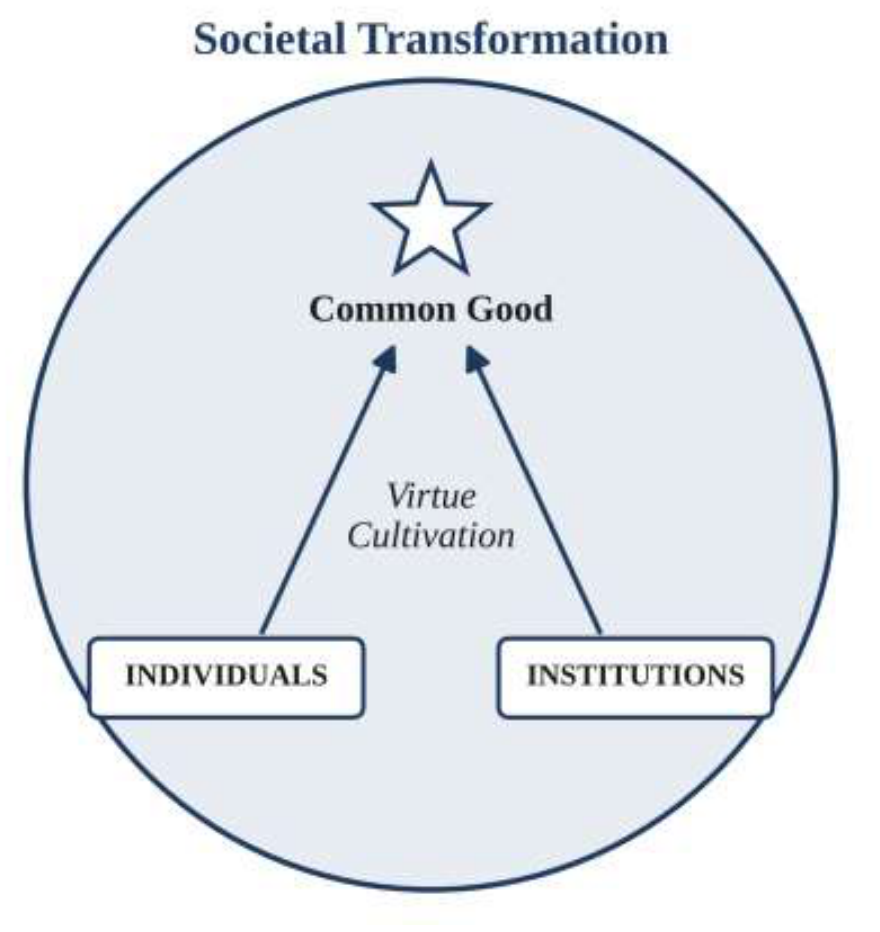
Figure 2.
Dignity in Relation to Responsibilities. Note. Each role bears a different degree of responsibility, but all stand on the same line of worth and dignity.
Figure 2.
Dignity in Relation to Responsibilities. Note. Each role bears a different degree of responsibility, but all stand on the same line of worth and dignity.
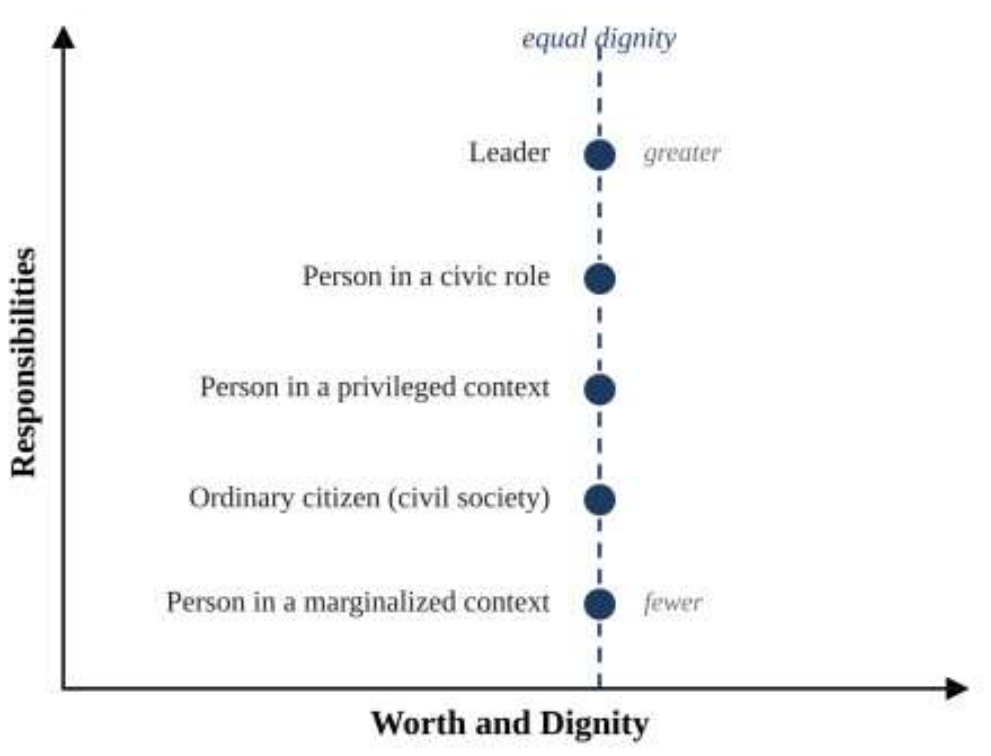
Figure 3.
Equal Hierarchy. Note. Circle size represents the degree of responsibility attached to a role; the shared baseline represents the equal moral worth of every person. Roles X and Z are illustrative placeholders.
Figure 3.
Equal Hierarchy. Note. Circle size represents the degree of responsibility attached to a role; the shared baseline represents the equal moral worth of every person. Roles X and Z are illustrative placeholders.
Disclaimer/Publisher’s Note: The statements, opinions and data contained in all publications are solely those of the individual author(s) and contributor(s) and not of MDPI and/or the editor(s). MDPI and/or the editor(s) disclaim responsibility for any injury to people or property resulting from any ideas, methods, instructions or products referred to in the content. |
© 2026 by the author. Licensee MDPI, Basel, Switzerland. This article is an open access article distributed under the terms and conditions of the Creative Commons Attribution (CC BY) license.
Copyright: This open access article is published under a Creative Commons CC BY 4.0 license, which permit the free download, distribution, and reuse, provided that the author and preprint are cited in any reuse.