

Submitted:
14 November 2026
Posted:
17 November 2026
You are already at the latest version
Abstract
Background/Objectives: Anxiety is common in multiple sclerosis (MS), but screening relies on general instruments that may miss specific presentations. We described anxiety subtypes in people with MS in Argentina, estimated how many cases a general screen would miss, and explored correlates and pre-diagnostic psychiatric symptoms. Methods: Cross-sectional online survey (March–May 2026) of adults with self-reported MS using the anxiety subscale of the Hospital Anxiety and Depression Scale (HADS-A), GAD-7, Social Phobia Inventory, Obsessive-Compulsive Inventory-Revised, Patient Health Questionnaire panic module and Fear Questionnaire, plus questions on pre-onset symptoms. Results: Of 84 participants (76.2% women; 79.8% relapsing-remitting), 41.7% scored HADS-A ≥ 8. Social anxiety (26.2%) was the most frequent subtype, followed by generalized anxiety (21.4%), obsessive-compulsive symptoms (20.2%) and panic disorder (11.9%). Among HADS-A-negative participants, 14.3% (95% CI 7.1–26.7%) screened positive for at least one subtype. Female gender and relapsing-remitting MS were associated with higher general and generalized anxiety scores, younger age with social anxiety, and disability with agoraphobic avoidance. Overall, 71.4% reported anxiety-related symptoms before MS onset; of these, 38.3% had consulted a specialist and 20.0% had received a psychiatric diagnosis. Conclusions: Anxiety in MS is frequent and heterogeneous. General screening alone may miss subtype-specific cases, and psychiatric symptoms often precede the MS diagnosis.
Keywords:
multiple sclerosis
; anxiety
; social anxiety disorder
; obsessive-compulsive disorder
; panic disorder
; generalized anxiety disorder
; screening
; prodrome
; Argentina
1. Introduction
Multiple sclerosis (MS) is a chronic immune-mediated disease of the central nervous system and a leading cause of non-traumatic neurological disability in young adults [1]. About 3.1 million people live with MS worldwide [2], and its prevalence in Buenos Aires has risen over the last decades [3]. Beyond motor, sensory and visual deficits, MS carries a substantial psychiatric burden that affects quality of life, adherence and disease outcomes [4,5].
Anxiety is among the most frequent psychiatric comorbidities in MS. A systematic review estimated a prevalence of 21.9% for anxiety disorders [4], a meta-analysis reported 22.1% [5], and a more recent meta-analysis pooled a prevalence of anxiety symptoms of 36% across 32 studies [6]. Despite this, anxiety often goes unrecognized and untreated: in a clinic sample assessed with structured interviews, most patients with an anxiety disorder had never been diagnosed or treated [7]. Anxiety also amplifies other psychiatric morbidity, including depression and suicidal ideation [8,9]. In Argentina, Chertcoff et al. found that 45% of outpatients with MS in Buenos Aires had clinically relevant anxiety on the Hospital Anxiety and Depression Scale (HADS), and that anxiety was associated with younger age and shorter time since diagnosis [10].
Most studies, including the Argentine one, measured anxiety with general screening tools, mainly the anxiety subscale of the HADS (HADS-A) [6,10,11]. The HADS-A was designed to capture general anxious distress in medical settings [11,12]; it was not designed to identify specific anxiety disorders such as social anxiety, panic disorder or obsessive-compulsive disorder (OCD). Recent Cochrane reviews showed that, at their usual cut-offs, both the HADS-A and the GAD-7 are less sensitive for anxiety disorders overall than for GAD (HADS-A ≥ 8: 74% vs. 82%; GAD-7 ≥ 10: 48% vs. 64%) [13,14]. Studies that used disorder-specific measures report a heterogeneous picture. Social anxiety affected 26.9–32% of people with MS (pwMS) screened with the Social Phobia Inventory (SPIN) [15,16,17]. OCD was found in 14.9–16.1% of patients assessed with structured interviews [18,19], and up to 31% in self-report studies [17]; a recent meta-analysis pooled a prevalence of 10.7% [20]. Panic disorder reached 10% in clinic samples [7], and generalized anxiety disorder (GAD) 18.6–26% [7,21]. These subtypes differ in phenomenology and treatment, and are classified separately in current nosology [22]. A general screen that does not distinguish them may therefore under-detect clinically relevant presentations, particularly those dominated by avoidance or obsessive symptoms rather than diffuse worry.
A second line of evidence concerns timing. Psychiatric symptoms and health-care use for mental health problems increase in the years before the first demyelinating event, suggesting that they may form part of an MS prodrome [23,24,25]. In a recent population-based cohort, mental health-related physician visits were elevated from 14 years before symptom onset, and psychiatry visits from 12 years before [26]. Whether this pattern is visible in Latin American patients, and how often these early symptoms lead to consultations or psychiatric diagnoses before MS is recognized, is largely unknown.
This study had four aims: (1) to describe the frequency of anxiety subtypes (generalized, social, panic, obsessive-compulsive and phobic avoidance) in pwMS in Argentina; (2) to estimate how many subtype-positive cases a general screen (HADS-A) would miss; (3) to explore associations of anxiety with sociodemographic and clinical variables, including MS phenotype; and (4) to describe anxiety-related symptoms, consultations and psychiatric diagnoses before MS onset. Based on previous work, we hypothesized that anxiety would be more frequent in women and in patients with shorter disease duration, and that social anxiety would be associated with greater disability, lower education and unemployment.
2. Materials and Methods
2.1. Study Design and Participants
We conducted a cross-sectional, observational study using an anonymous online survey (SurveyMonkey) between 17 March and 15 May 2026. The study is reported following the STROBE guidelines for cross-sectional studies. The survey link was offered to patients attending a neurology outpatient clinic and to members of MS patient associations in Argentina (convenience sampling).
Eligible participants were adults (≥ 18 years) living in Argentina diagnosed with MS [27]. Responses were excluded if the survey was incomplete, if they were duplicates (identified by matching date of birth and initials, retaining the complete response), or if the respondent reported radiologically isolated syndrome rather than MS. Participants self-reported MS phenotype as relapsing-remitting, primary progressive or secondary progressive [28].
2.2. Sociodemographic and Clinical Variables
We collected date of birth, gender, marital status, years of formal education, employment status, date of symptom onset, date of diagnosis and MS phenotype. Age, years since symptom onset and years since diagnosis were calculated from the response date. Employment was dichotomized into employed (self-employed, salaried or informal work) and unemployed.
Disability was self-reported with a nine-level ordinal item whose descriptors were anchored in the Expanded Disability Status Scale (EDSS) [29], from 1 ("no symptoms attributable to MS") to 9 ("completely dependent"). Intermediate levels described walking ability, for example level 3 ("symptoms partially limit me, but I can walk more than 1 km without difficulty") and level 6 ("I need a cane, crutch or rail to walk more than 100 m").
2.3. Anxiety Measures
All instruments were administered in Spanish.
- Patient Health Questionnaire panic module (PHQ-PD). Panic disorder was classified as present when participants reported an anxiety attack in the last four weeks, previous attacks, unexpected attacks, and worry or distress about attacks, plus at least four of 11 somatic symptoms during the last attack [39]. We used the Spanish version [40].
2.4. Pre-Diagnostic Symptoms
Participants were asked whether they had experienced any of the symptoms described in the survey before the onset of MS symptoms, how long before (≤ 1 year, 2–5 years, 5–10 years or > 10 years), whether they had consulted a specialist for these symptoms before the MS diagnosis, and whether they had received a psychiatric diagnosis. Optional free-text fields allowed participants to describe the symptoms and diagnoses. Because the timing question was shown regardless of the previous answer, participants who answered "no" but reported a timing (n = 17) were coded as having had previous symptoms.
2.5. Statistical Analysis
Categorical variables are presented as frequencies and percentages, and continuous variables as mean (SD) or median (interquartile range, IQR). The frequency of each subtype was calculated with 95% confidence intervals (CI, Wilson score method). Internal consistency was assessed with Cronbach's α. Normality was assessed with the Shapiro–Wilk test; because all scale scores departed from normality (all p ≤ .004), we used non-parametric tests.
To estimate missed cases, we cross-tabulated HADS-A status against a positive screen on at least one specific subtype (GAD-7, SPIN, OCI-R or PHQ-PD). Associations with continuous variables were tested with Spearman's ρ; group comparisons with the Mann–Whitney U test (effect size: rank-biserial correlation, r_rb) and the Kruskal–Wallis test (effect size: ε²); and proportions with Fisher's exact test. Relapsing-remitting MS was compared with the progressive forms combined.
Finally, for each scale we fitted a multiple linear regression including age, gender (women vs. men), years of education, years since diagnosis, disability and phenotype (relapsing-remitting vs. progressive). The participant who preferred not to report gender and participants with missing covariates were excluded (n = 80). Multicollinearity was acceptable (all variance inflation factors < 2). Tests were two-tailed with α = .05. Given the exploratory aims, no correction for multiple comparisons was applied. Analyses were performed in jamovi 2.7 [43], based on R 4.5 [44].
2.6. Use of Generative Artificial Intelligence
Generative artificial intelligence (Claude Opus 5.5, Anthropic) was used to assist with drafting the manuscript text and with English-language editing. The authors reviewed and edited all output and take full responsibility for the content of this publication.
3. Results
3.1. Participants
Of 108 respondents, 22 did not complete the survey, 4 were duplicates and 2 reported radiologically isolated syndrome, leaving 84 pwMS for analysis. Most were women with relapsing-remitting MS, and the median disability level was 3 (symptoms partially limiting, walking > 1 km unaided) (Table 1).
3.2. Frequency of Anxiety Subtypes
Half of the sample (42/84, 50.0%) screened positive on at least one anxiety measure. General anxiety (HADS-A ≥ 8) was the most frequent finding, and social anxiety the most frequent specific subtype (Table 2). Subtypes overlapped: among the 33 participants positive for at least one specific subtype, 19 (57.6%) were positive for two or more. Using the stricter HADS-A cut-off of > 8 applied in the previous Argentine study [10], the frequency of general anxiety was 32.1% (27/84).
The FQ agoraphobia (mean 7.76, SD 8.89) and blood-injury (mean 8.01, SD 7.94) subscales showed low average scores. All instruments showed adequate to excellent internal consistency, including the FQ subscales, which lack a Spanish validation.
Of the 28 participants who reported an anxiety attack in the last four weeks, 10 met the PHQ-PD criteria for panic disorder. Among the 18 who did not, the most common reasons were that the attacks did not worry or bother them (n = 8) or were not unexpected (n = 7).
3.3. Cases Not Detected by the HADS-A
Of the 49 participants below the HADS-A cut-off, 7 (14.3%, 95% CI 7.1–26.7%) were positive for at least one specific subtype: 4 for social anxiety, 2 for obsessive-compulsive symptoms, 1 for generalized anxiety and 1 for panic disorder (one participant had two subtypes). Conversely, 7 of the 33 participants (21.2%, 95% CI 10.7–37.8%) with at least one specific subtype would not have been identified by the HADS-A alone. The HADS-A detected 94.4% of GAD-7-positive cases, 90.0% of PHQ-PD-positive cases, 88.2% of OCI-R-positive cases and 81.8% of SPIN-positive cases.
3.4. Associations with Phenotype
Positive screens concentrated in relapsing-remitting MS (Figure 1). Compared with progressive MS, participants with relapsing-remitting MS more often exceeded the cut-offs of the HADS-A (47.8% vs. 17.6%, p = .029), GAD-7 (26.9% vs. 0%, p = .017) and OCI-R (25.4% vs. 0%, p = .018), but not of the SPIN (28.4% vs. 17.6%, p = .539) or PHQ-PD (14.9% vs. 0%, p = .201). Continuous scores showed the same pattern for the HADS-A (Mdn 7 vs. 4; p = .002; r_rb = .48), GAD-7 (6 vs. 3; p = .005; r_rb = .44) and OCI-R (13 vs. 9; p = .034; r_rb = .34). Participants with progressive MS were older (Mdn 55 vs. 41 years), more disabled (Mdn level 6 vs. 2) and had longer disease duration (Mdn 9.2 vs. 4.5 years since diagnosis).
3.5. Associations with Sociodemographic and Clinical Variables
Gender. Women scored higher than men on the HADS-A (Mdn 7 vs. 4; U = 367; p = .009; r_rb = .40) and the GAD-7 (Mdn 6 vs. 3; U = 363; p = .008; r_rb = .40). No gender differences were found for the SPIN (p = .431), OCI-R (p = .753), FQ agoraphobia (p = .090) or FQ blood-injury (p = .309).
Disease duration. Participants who met PHQ-PD criteria had been diagnosed more recently than those who did not (Mdn 1.2 vs. 6.1 years; U = 218; p = .040; r_rb = .40). Years since onset did not differ (p = .177), and neither years since onset nor years since diagnosis correlated with any scale score (all |ρ| ≤ .19; all p ≥ .087).
Disability. Disability correlated with FQ agoraphobia (ρ = .37; p < .001), most strongly with the items "walking alone along busy streets" (ρ = .39) and "going a long distance from home alone" (ρ = .30). Disability was not correlated with SPIN (ρ = .00; p = .999), FQ social phobia (ρ = .06; p = .616) or any other scale.
Age. Younger participants had higher SPIN scores (ρ = −.27; p = .015); the association persisted when the four SPIN items describing physical symptoms (blushing, sweating, palpitations and trembling) were removed (ρ = −.28; p = .012). Age was not associated with other scales.
Education, employment and marital status. Education did not correlate with any scale (all p ≥ .054). Unemployed participants (n = 11) had higher median scores than employed participants (n = 57) on all scales, but no difference reached significance (all p ≥ .070). Marital status was not associated with any scale (Kruskal–Wallis, all p ≥ .091).
3.6. Multivariable Analysis
All models except FQ blood-injury were significant and explained 16–28% of the variance (Table 3). After adjustment, female gender and relapsing-remitting phenotype were associated with higher HADS-A and GAD-7 scores; relapsing-remitting phenotype with higher OCI-R scores; younger age with higher SPIN scores; and greater disability, shorter time since diagnosis and female gender with higher FQ agoraphobia scores.
3.7. Symptoms Before MS Onset
Sixty participants (71.4%) reported having had anxiety-related symptoms before MS onset; restricting the count to those who answered "yes" directly, the frequency was 51.2% (43/84). Among those who reported timing (n = 57), symptoms began ≤ 1 year before onset in 31.6%, 2–5 years in 24.6%, 5–10 years in 15.8% and > 10 years in 28.1%. Among the 60 participants with pre-onset symptoms, 23 (38.3%) had consulted a specialist for these symptoms before the MS diagnosis, and 12 (20.0%) had received a psychiatric diagnosis.
Participants who reported pre-onset symptoms screened positive on a current anxiety measure more often than those who did not (56.7% vs. 33.3%), although the difference was not significant (p = .090). The same trend was seen for a previous psychiatric diagnosis (64.3% vs. 47.8%; p = .379).
4. Discussion
In this Argentine sample, half of the pwMS screened positive on at least one anxiety measure, and anxiety took heterogeneous forms. Social anxiety was the most frequent specific subtype, and subtypes often co-occurred. One in seven participants below the HADS-A cut-off screened positive for a specific subtype, and many participants reported anxiety-related symptoms, consultations or psychiatric diagnoses before MS was recognized. Together, these findings suggest that anxiety in MS is frequent, heterogeneous, partly missed by general screening, and sometimes present long before the neurological diagnosis.
4.1. Anxiety Is Frequent in MS
The frequency of general anxiety (41.7%) is consistent with the 36% pooled in a recent meta-analysis [6] and with the 45% reported in Buenos Aires by Chertcoff et al. [10]. That study used a stricter HADS-A threshold (> 8); with the same threshold, our frequency was 32.1%. The difference may reflect sampling: their participants were consecutive clinic attendees, whereas ours combined clinic patients and patient-association members who chose to respond online, with a high educational level. Frequencies of the specific subtypes were close to those reported with the same instruments: social anxiety 26.2% vs. 26.9–32% [15,16,17], and generalized anxiety 21.4% vs. 26% [21]. Our panic disorder frequency (11.9%) was similar to interview-based estimates [7], whereas obsessive-compulsive symptoms (20.2%) exceeded interview-based OCD rates of 14.9–16.1% [18,19] and the 10.7% pooled in a recent meta-analysis [20], as expected for a self-report screen.
4.2. Anxiety in MS Is Heterogeneous
Social anxiety was the most frequent specific subtype. This agrees with studies using the SPIN [15,16,17] but contrasts with those using structured interviews, where generalized anxiety predominates [7,18]. Part of this difference may be instrumental. As Poder et al. noted, the SPIN includes physical symptoms (blushing, sweating, palpitations and trembling in front of others) that may arise from MS itself [15]. However, the association between younger age and social anxiety persisted after these items were removed, which suggests that the signal is not purely somatic. Social anxiety in MS may also reflect fear of negative evaluation of visible symptoms, such as gait instability, tremor or fatigue, in a young population that is socially and professionally active.
Subtypes also overlapped: most participants with one specific subtype had at least two. This pattern is consistent with the high comorbidity among anxiety disorders and supports describing anxiety in MS as a profile rather than a single score [22]. The distinction matters clinically because the subtypes respond to different interventions. Cognitive-behavioral therapy is effective across anxiety disorders, but its techniques differ by subtype, for example exposure for social anxiety and exposure with response prevention for OCD [45,46].
4.3. Screening Tools May Underdiagnose Anxiety
The HADS-A is the most widely used anxiety measure in MS [6,12] and was the only one used in the previous Argentine study [10]. In our sample, it missed 14.3% of participants who screened positive for a specific subtype, and one in five subtype-positive participants would not have been identified with the HADS-A alone. Missed cases were mostly social anxiety and obsessive-compulsive symptoms. This is expected, because the HADS-A items focus on tension, worry, restlessness and sudden panic feelings, and do not explore social avoidance, obsessions or compulsions [11]. The HADS-A performed well for generalized anxiety and panic, which share its item content. This pattern mirrors recent Cochrane reviews, in which both the HADS-A and the GAD-7 were more sensitive for GAD than for anxiety disorders overall [13,14].
These results add to evidence that anxiety in MS is often unrecognized [7]. A practical approach would be a two-step strategy: a general screen followed, in positive cases and in patients with suggestive complaints, by brief subtype-specific measures such as the SPIN or OCI-R. Given the imprecision of our estimate (95% CI 7.1–26.7%), this should be confirmed in larger samples against structured diagnostic interviews.
4.4. Correlates of Anxiety
Women scored higher on general and generalized anxiety, in line with meta-analytic evidence [6] and with the Saudi multicenter study [21]. The sex difference did not extend to social anxiety, obsessive-compulsive symptoms or panic, so our gender hypothesis was only partly confirmed.
Participants with panic disorder had been diagnosed more recently. This supports the hypothesis that shorter disease duration is associated with more anxiety and agrees with the bivariate findings of Chertcoff et al. [10]. The period around diagnosis carries uncertainty about prognosis and treatment, and intolerance of uncertainty has been proposed as a key driver of distress in MS [47,48]. Neuroimaging also suggests that anxiety in early MS is associated with alterations in limbic and fronto-temporal networks [49], and pwMS with anxiety show overgeneralization of fear linked to reduced temporal-lobe connectivity [50]. With only 10 positive cases and p = .040, this finding should be considered preliminary.
Relapsing-remitting MS was associated with higher general anxiety, generalized anxiety and obsessive-compulsive scores, both in univariate analyses and after adjustment for age, disability and disease duration. Previous evidence on disease course is mixed: a meta-analysis found a weak association with relapsing MS [6], while other studies found none [10,21]. Several mechanisms are plausible. The unpredictability of relapses may sustain anticipatory worry. Inflammatory activity may also affect emotional processing circuits, which are altered in relapsing-remitting MS [51]. Alternatively, patients with progressive MS may adapt their expectations over time. This finding should be interpreted cautiously: the progressive group was small (n = 17), older and more disabled, and residual confounding is possible.
Disability was associated with agoraphobic avoidance but not with social anxiety, contrary to our hypothesis and to Khatri et al., who linked walking difficulty with social anxiety [17]. Other studies also found no association between disability and anxiety [10,16,21]. The association with agoraphobia was driven by items such as walking alone along busy streets and going far from home alone. These items may capture motor limitation and fear of falling rather than phobic fear. Agoraphobia scales should therefore be interpreted with caution in pwMS with gait impairment.
Younger age was associated with social anxiety, an association that was not hypothesized but agrees with Chertcoff et al., who found that patients with anxiety were younger [10]. Education, employment and marital status were not associated with anxiety. Unemployed participants scored higher on all scales, but this group was small (n = 11).
4.5. Psychiatric Symptoms Before the MS Diagnosis
Most participants reported anxiety-related symptoms before MS onset, over a third of them had consulted a specialist for these symptoms, and one in five had received a psychiatric diagnosis. These findings agree with population-based evidence that psychiatric comorbidity and health-care use increase in the years before MS onset, as part of a prodrome that may begin more than a decade earlier [23,24,25,26]. Almost a third of those who reported timing placed symptom onset within the year before MS onset, but another 28% placed it more than 10 years earlier. The latter may reflect pre-existing anxiety traits, although an early prodrome cannot be excluded. Participants with pre-onset symptoms tended to have more current anxiety, which suggests continuity between early and current symptoms. For clinicians, these results support asking about previous psychiatric symptoms and consultations, and considering that early non-specific complaints may be misattributed to psychological causes.
4.6. Limitations
This study has several limitations. First, the sample was small, especially the progressive (n = 17) and panic-positive (n = 10) groups, which limits statistical power and produces wide confidence intervals. Second, all data were self-reported, including MS diagnosis, phenotype and disability, which were not confirmed by a neurologist; the disability item was anchored in the EDSS but not validated. Third, the anxiety measures are screening instruments, not diagnostic interviews, and positive screens should not be interpreted as diagnoses. The FQ subscales also lack validation in Spanish.
Fourth, several items overlap with MS symptoms. Palpitations, sweating, trembling, dizziness, paresthesia and shortness of breath appear in the SPIN and the PHQ-PD and may reflect autonomic dysfunction, which is common in MS [52], or other MS symptoms rather than anxiety; for this reason, screening tools weighted toward somatic symptoms perform worse in MS [53]. Similarly, agoraphobia items may capture motor limitation. Fifth, recruitment through one outpatient clinic and patient associations produced a convenience sample with a high educational level; association members may also be more engaged with their disease than the general MS population, which limits generalizability. Sixth, we did not assess depression, fatigue, cognition, disease-modifying treatment or recent relapses, which may confound the associations observed. Seventh, pre-onset symptoms were recalled retrospectively and are subject to recall bias. The timing question was shown to all participants, so classification depended on a coding rule; with a stricter definition, the frequency fell from 71.4% to 51.2%. Finally, the cross-sectional design precludes causal inference, and multiple exploratory tests were performed without correction.
4.7. Future Directions
Larger, multicenter studies with neurologist-confirmed diagnoses and structured psychiatric interviews are needed to validate subtype frequencies and the performance of a two-step screening strategy. Future work should also measure autonomic function and depression, and use MS-adapted versions of instruments that exclude items overlapping with neurological symptoms. Prospective cohorts could clarify whether pre-diagnostic anxiety forms part of the MS prodrome.
5. Conclusions
Anxiety is frequent and heterogeneous in pwMS in Argentina. Social anxiety, generalized anxiety, obsessive-compulsive symptoms and panic disorder each affect a substantial minority and often co-occur. A general screen such as the HADS-A may miss subtype-specific cases, particularly social anxiety and obsessive-compulsive symptoms. Anxiety-related symptoms, consultations and psychiatric diagnoses frequently precede the MS diagnosis. Clinicians should consider subtype-specific assessment and ask about pre-diagnostic psychiatric history, while accounting for the overlap between anxiety items and MS symptoms such as dysautonomia and gait impairment.
Author Contributions
Conceptualization, G.V.; methodology, G.V.; formal analysis, G.V. and D.G.; resources, A.G.R.V., V.J.S., M.C.C., A.M. and A.C.; writing—original draft preparation, G.V.; writing—review and editing, G.V., D.G., A.G.R.V., V.J.S., M.C.C., A.M. and A.C. All authors have read and agreed to the published version of the manuscript.
Funding
This research received no external funding.
Institutional Review Board Statement
The study was conducted in accordance with the Declaration of Helsinki and approved by the Bioethics Committee of Hospital Universitario Fundación Favaloro (reference DDI 1728 2525; approval date 7 November 2025).
Informed Consent Statement
Informed consent was obtained from all subjects involved in the study. Consent was given online before starting the survey, and data were handled in accordance with Argentine Personal Data Protection Law No. 25.326.
Data Availability Statement
The anonymized data presented in this study are available on request from the corresponding author. The data are not publicly available to protect participant privacy under Law No. 25.326.
Acknowledgments
The authors thank all participants. During the preparation of this manuscript, the authors used Claude Opus 5.5 (Anthropic) for drafting the text and English-language editing. The authors have reviewed and edited the output and take full responsibility for the content of this publication.
Conflicts of Interest
The authors declare no conflicts of interest.
Abbreviations
The following abbreviations are used in this manuscript:
| Abbreviation | Meaning |
| CI | Confidence interval |
| EDSS | Expanded Disability Status Scale |
| FQ | Fear Questionnaire |
| GAD | Generalized anxiety disorder |
| GAD-7 | Generalized Anxiety Disorder-7 |
| HADS-A | Hospital Anxiety and Depression Scale, anxiety subscale |
| IQR | Interquartile range |
| MS | Multiple sclerosis |
| OCD | Obsessive-compulsive disorder |
| OCI-R | Obsessive-Compulsive Inventory-Revised |
| PHQ-PD | Patient Health Questionnaire, panic disorder module |
| pwMS | People with multiple sclerosis |
| SPIN | Social Phobia Inventory |
References
- Jakimovski, D.; Bittner, S.; Zivadinov, R.; Morrow, S.A.; Benedict, R.H.B.; Zipp, F.; Weinstock-Guttman, B. Multiple sclerosis. Lancet 2024, 403, 183–202. [Google Scholar] [CrossRef] [PubMed]
- Multiple Sclerosis International Federation. 3.1 Million People Living with MS Worldwide: The Atlas of MS 2026. Available online: https://www.atlasofms.org (accessed on 6 November 2026).
- Cristiano, E.; Patrucco, L.; Miguez, J.; Giunta, D.; Correale, J.; Fiol, M.; Ysrraelit, M.C.; Cáceres, F.; Fernández Liguori, N.; Saladino, M.L.; et al. Increasing prevalence of multiple sclerosis in Buenos Aires, Argentina. Mult. Scler. Relat. Disord. 2016, 9, 91–94. [Google Scholar] [CrossRef] [PubMed]
- Marrie, R.A.; Reingold, S.; Cohen, J.; Stuve, O.; Trojano, M.; Sorensen, P.S.; Cutter, G.; Reider, N. The incidence and prevalence of psychiatric disorders in multiple sclerosis: A systematic review. Mult. Scler. 2015, 21, 305–317. [Google Scholar] [CrossRef] [PubMed]
- Boeschoten, R.E.; Braamse, A.M.J.; Beekman, A.T.F.; Cuijpers, P.; van Oppen, P.; Dekker, J.; Uitdehaag, B.M.J. Prevalence of depression and anxiety in multiple sclerosis: A systematic review and meta-analysis. J. Neurol. Sci. 2017, 372, 331–341. [Google Scholar] [CrossRef] [PubMed]
- Zhang, X.; Song, Y.; Wei, Z.; Chen, X.; Zhuang, X.; Yi, L. The prevalence and risk factors of anxiety in multiple sclerosis: A systematic review and meta-analysis. Front. Neurosci. 2023, 17, 1120541. [Google Scholar] [CrossRef] [PubMed]
- Korostil, M.; Feinstein, A. Anxiety disorders and their clinical correlates in multiple sclerosis patients. Mult. Scler. 2007, 13, 67–72. [Google Scholar] [CrossRef] [PubMed]
- Feinstein, A.; O'Connor, P.; Gray, T.; Feinstein, K. The effects of anxiety on psychiatric morbidity in patients with multiple sclerosis. Mult. Scler. 1999, 5, 323–326. [Google Scholar] [CrossRef]
- Silveira, C.; Guedes, R.; Maia, D.; Curral, R.; Coelho, R. Neuropsychiatric symptoms of multiple sclerosis: State of the art. Psychiatry Investig. 2019, 16, 877–888. [Google Scholar] [CrossRef] [PubMed]
- Chertcoff, A.; Curbelo, M.C.; Bauer, J.; Ferrandina, F.; Martinez, A.; Steinberg, J.; Carrá, A. Anxiety in Argentinian patients with multiple sclerosis: Prevalence and associated factors. Mult. Scler. Relat. Disord. 2020, 41, 102042. [Google Scholar] [CrossRef] [PubMed]
- Zigmond, A.S.; Snaith, R.P. The Hospital Anxiety and Depression Scale. Acta Psychiatr. Scand. 1983, 67, 361–370. [Google Scholar] [CrossRef] [PubMed]
- Jerković, A.; Proroković, A.; Matijaca, M.; Vuko, J.; Poljičanin, A.; Mastelić, A.; Ćurković Katić, A.; Košta, V.; Kustura, L.; Dolić, K.; et al. Psychometric properties of the HADS measure of anxiety and depression among multiple sclerosis patients in Croatia. Front. Psychol. 2021, 12, 794353. [Google Scholar] [CrossRef] [PubMed]
- Fomenko, A.; Dümmler, D.; Aktürk, Z.; Eck, S.; Teusen, C.; Karapetyan, S.; Dawson, S.; Löwe, B.; Hapfelmeier, A.; Linde, K.; et al. Hospital Anxiety and Depression Scale Anxiety subscale (HADS-A) for detecting anxiety disorders in adults. Cochrane Database Syst. Rev. 2025, 7, CD015456. [Google Scholar] [CrossRef] [PubMed]
- Aktürk, Z.; Hapfelmeier, A.; Fomenko, A.; Dümmler, D.; Eck, S.; Olm, M.; Gehrmann, J.; von Schrottenberg, V.; Rehder, R.; Dawson, S.; et al. Generalized Anxiety Disorder 7-item (GAD-7) and 2-item (GAD-2) scales for detecting anxiety disorders in adults. Cochrane Database Syst. Rev. 2025, 3, CD015455. [Google Scholar] [CrossRef] [PubMed]
- Poder, K.; Ghatavi, K.; Fisk, J.D.; Campbell, T.L.; Kisely, S.; Sarty, I.; Stadnyk, K.; Bhan, V. Social anxiety in a multiple sclerosis clinic population. Mult. Scler. 2009, 15, 393–398. [Google Scholar] [CrossRef] [PubMed]
- Jiménez-Zambrano, J.; Zambrano-Llaguno, K.; Acuña-Chong, M.G. Social anxiety disorder among patients with multiple sclerosis: A population-based case-control study in Ecuador. Rev. Neurol. 2020, 70, 45–52. [Google Scholar] [CrossRef] [PubMed]
- Khatri, I.A.; Aljwair, S.; Alammar, H.; Altariq, A.; Masud, N.; Al Malik, Y.; Kojan, S. Social anxiety and obsessive-compulsive disorder are common among persons with multiple sclerosis at King Abdulaziz Medical City, Riyadh. Cureus 2021, 13, e13619. [Google Scholar] [CrossRef] [PubMed]
- Uguz, F.; Akpinar, Z.; Ozkan, I.; Tokgoz, S. Mood and anxiety disorders in patients with multiple sclerosis. Int. J. Psychiatry Clin. Pract. 2008, 12, 19–24. [Google Scholar] [CrossRef] [PubMed]
- Foroughipour, M.; Behdani, F.; Hebrani, P.; Nabizadeh Marvast, M.; Esmatinia, F.; Akhavanrezayat, A. Frequency of obsessive-compulsive disorder in patients with multiple sclerosis: A cross-sectional study. J. Res. Med. Sci. 2012, 17, 248–253. [Google Scholar] [PubMed]
- Mirmosayyeb, O.; Khodadadi, H.; Saberian, P.; Vaheb, S.; Yazdan Panah, M.; Shaygannejad, V. Obsessive-compulsive disorder in people with multiple sclerosis: A systematic review and meta-analysis. Acta Neurol. Belg. 2026, 126, 1857–1865. [Google Scholar] [CrossRef] [PubMed]
- Alswat, A.M.; Altirkistani, B.A.; Alserihi, A.R.; Baeshen, O.K.; Alrushid, E.S.; Alkhudair, J.; Aldbas, A.A.; Wadaan, O.M.; Alsaleh, A.; Al Malik, Y.M.; et al. The prevalence of major depression and generalized anxiety disorder in patients with multiple sclerosis in Saudi Arabia: A cross-sectional multicentered study. Front. Psychiatry 2023, 14, 1195101. [Google Scholar] [CrossRef] [PubMed]
- American Psychiatric Association. Diagnostic and Statistical Manual of Mental Disorders, 5th ed., text rev.; American Psychiatric Association Publishing: Washington, DC, USA, 2022. [Google Scholar] [CrossRef]
- Tremlett, H.; Marrie, R.A. The multiple sclerosis prodrome: Emerging evidence, challenges, and opportunities. Mult. Scler. 2021, 27, 6–12. [Google Scholar] [CrossRef] [PubMed]
- Chertcoff, A.S.; Yusuf, F.L.A.; Zhu, F.; Evans, C.; Fisk, J.D.; Zhao, Y.; Marrie, R.A.; Tremlett, H. Psychiatric comorbidity during the prodromal period in patients with multiple sclerosis. Neurology 2023, 101, e2026–e2034. [Google Scholar] [CrossRef] [PubMed]
- Tremlett, H.; Munger, K.L.; Makhani, N. The multiple sclerosis prodrome: Evidence to action. Front. Neurol. 2022, 12, 761408. [Google Scholar] [CrossRef] [PubMed]
- Ruiz-Algueró, M.; Zhu, F.; Chertcoff, A.; Zhao, Y.; Marrie, R.A.; Tremlett, H. Healthcare use before multiple sclerosis symptom onset. JAMA Netw. Open 2025, 8, e2524635. [Google Scholar] [CrossRef] [PubMed]
- Montalban, X.; Lebrun-Frénay, C.; Oh, J.; Arrambide, G.; Moccia, M.; Amato, M.P.; Amezcua, L.; Banwell, B.; Bar-Or, A.; Barkhof, F.; et al. Diagnosis of multiple sclerosis: 2024 revisions of the McDonald criteria. Lancet Neurol. 2025, 24, 850–865. [Google Scholar] [CrossRef] [PubMed]
- Lublin, F.D.; Reingold, S.C.; Cohen, J.A.; Cutter, G.R.; Sørensen, P.S.; Thompson, A.J.; Wolinsky, J.S.; Balcer, L.J.; Banwell, B.; Barkhof, F.; et al. Defining the clinical course of multiple sclerosis: The 2013 revisions. Neurology 2014, 83, 278–286. [Google Scholar] [CrossRef] [PubMed]
- Kurtzke, J.F. Rating neurologic impairment in multiple sclerosis: An expanded disability status scale (EDSS). Neurology 1983, 33, 1444–1452. [Google Scholar] [CrossRef] [PubMed]
- Herrero, M.J.; Blanch, J.; Peri, J.M.; De Pablo, J.; Pintor, L.; Bulbena, A. A validation study of the Hospital Anxiety and Depression Scale (HADS) in a Spanish population. Gen. Hosp. Psychiatry 2003, 25, 277–283. [Google Scholar] [CrossRef] [PubMed]
- Bjelland, I.; Dahl, A.A.; Haug, T.T.; Neckelmann, D. The validity of the Hospital Anxiety and Depression Scale: An updated literature review. J. Psychosom. Res. 2002, 52, 69–77. [Google Scholar] [CrossRef] [PubMed]
- Spitzer, R.L.; Kroenke, K.; Williams, J.B.W.; Löwe, B. A brief measure for assessing generalized anxiety disorder: The GAD-7. Arch. Intern. Med. 2006, 166, 1092–1097. [Google Scholar] [CrossRef] [PubMed]
- García-Campayo, J.; Zamorano, E.; Ruiz, M.A.; Pardo, A.; Pérez-Páramo, M.; López-Gómez, V.; Freire, O.; Rejas, J. Cultural adaptation into Spanish of the generalized anxiety disorder-7 (GAD-7) scale as a screening tool. Health Qual. Life Outcomes 2010, 8, 8. [Google Scholar] [CrossRef] [PubMed]
- Terrill, A.L.; Hartoonian, N.; Beier, M.; Salem, R.; Alschuler, K. The 7-item generalized anxiety disorder scale as a tool for measuring generalized anxiety in multiple sclerosis. Int. J. MS Care 2015, 17, 49–56. [Google Scholar] [CrossRef] [PubMed]
- Connor, K.M.; Davidson, J.R.T.; Churchill, L.E.; Sherwood, A.; Foa, E.; Weisler, R.H. Psychometric properties of the Social Phobia Inventory (SPIN): New self-rating scale. Br. J. Psychiatry 2000, 176, 379–386. [Google Scholar] [CrossRef] [PubMed]
- Bravo, M.A.; González Betanzos, F.; Castillo Navarro, A.; Padrós Blázquez, F. Evidencias de validez de la versión en español del Inventario de Fobia Social (SPIN). Univ. Psychol. 2017, 16, 1–12. [Google Scholar] [CrossRef]
- Foa, E.B.; Huppert, J.D.; Leiberg, S.; Langner, R.; Kichic, R.; Hajcak, G.; Salkovskis, P.M. The Obsessive-Compulsive Inventory: Development and validation of a short version. Psychol. Assess. 2002, 14, 485–496. [Google Scholar] [CrossRef]
- Fullana, M.A.; Tortella-Feliu, M.; Caseras, X.; Andión, Ó.; Torrubia, R.; Mataix-Cols, D. Psychometric properties of the Spanish version of the Obsessive-Compulsive Inventory–Revised in a non-clinical sample. J. Anxiety Disord. 2005, 19, 893–903. [Google Scholar] [CrossRef] [PubMed]
- Spitzer, R.L.; Kroenke, K.; Williams, J.B.W. Validation and utility of a self-report version of PRIME-MD: The PHQ Primary Care Study. JAMA 1999, 282, 1737–1744. [Google Scholar] [CrossRef] [PubMed]
- Diez-Quevedo, C.; Rangil, T.; Sanchez-Planell, L.; Kroenke, K.; Spitzer, R.L. Validation and utility of the Patient Health Questionnaire in diagnosing mental disorders in 1003 general hospital Spanish inpatients. Psychosom. Med. 2001, 63, 679–686. [Google Scholar] [CrossRef] [PubMed]
- Marks, I.M.; Mathews, A.M. Brief standard self-rating for phobic patients. Behav. Res. Ther. 1979, 17, 263–267. [Google Scholar] [CrossRef] [PubMed]
- Van Zuuren, F.J. The Fear Questionnaire: Some data on validity, reliability and layout. Br. J. Psychiatry 1988, 153, 659–662. [Google Scholar] [CrossRef] [PubMed]
- The jamovi project. jamovi (Version 2.7) [Computer Software]. 2025. Available online: https://www.jamovi.org (accessed on 6 November 2026).
- R Core Team. R: A Language and Environment for Statistical Computing (Version 4.5) [Computer Software]. 2025. Available online: https://cran.r-project.org (accessed on 6 November 2026).
- Kaczkurkin, A.N.; Foa, E.B. Cognitive-behavioral therapy for anxiety disorders: An update on the empirical evidence. Dialogues Clin. Neurosci. 2015, 17, 337–346. [Google Scholar] [CrossRef] [PubMed]
- Hofmann, S.G.; Smits, J.A.J. Cognitive-behavioral therapy for adult anxiety disorders: A meta-analysis of randomized placebo-controlled trials. J. Clin. Psychiatry 2008, 69, 621–632. [Google Scholar] [CrossRef] [PubMed]
- Alschuler, K.N.; Beier, M.L. Intolerance of uncertainty: Shaping an agenda for research on coping with multiple sclerosis. Int. J. MS Care 2015, 17, 153–158. [Google Scholar] [CrossRef] [PubMed]
- Cáceres Hernández, E.S.; Garrido-Hernansaiz, H. Incertidumbre, estrés, ansiedad, depresión e información en personas con esclerosis múltiple. Rev. Psicol. Salud 2025, 13, 2. [Google Scholar] [CrossRef]
- Ellwardt, E.; Muthuraman, M.; Gonzalez-Escamilla, G.; Chirumamilla, V.C.; Luessi, F.; Bittner, S.; Zipp, F.; Groppa, S.; Fleischer, V. Network alterations underlying anxiety symptoms in early multiple sclerosis. J. Neuroinflammation 2022, 19, 119. [Google Scholar] [CrossRef] [PubMed]
- Meyer-Arndt, L.; Rust, R.; Bellmann-Strobl, J.; Schmitz-Hübsch, T.; Marko, L.; Forslund, S.; Scheel, M.; Gold, S.M.; Hetzer, S.; Paul, F.; et al. Neurobehavioral mechanisms of fear and anxiety in multiple sclerosis. Commun. Med. 2025, 5, 345. [Google Scholar] [CrossRef] [PubMed]
- Passamonti, L.; Cerasa, A.; Liguori, M.; Gioia, M.C.; Valentino, P.; Nisticò, R.; Quattrone, A.; Fera, F. Neurobiological mechanisms underlying emotional processing in relapsing-remitting multiple sclerosis. Brain 2009, 132, 3380–3391. [Google Scholar] [CrossRef] [PubMed]
- Racosta, J.M.; Kimpinski, K. Autonomic dysfunction, immune regulation, and multiple sclerosis. Clin. Auton. Res. 2016, 26, 23–31. [Google Scholar] [CrossRef] [PubMed]
- Litster, B.; Fiest, K.M.; et al. Screening tools for anxiety in people with multiple sclerosis: A systematic review. Int. J. MS Care Complete the author list (first 10) and verify pages.. 2016, 18, 273–281. [Google Scholar] [CrossRef] [PubMed]
Figure 1.
Percentage of participants above the cut-off of each anxiety measure, by MS phenotype. RRMS, relapsing-remitting multiple sclerosis (n = 67); Progressive MS, primary or secondary progressive multiple sclerosis (n = 17). p values from Fisher's exact test. Values in green indicate p < .05.
Figure 1.
Percentage of participants above the cut-off of each anxiety measure, by MS phenotype. RRMS, relapsing-remitting multiple sclerosis (n = 67); Progressive MS, primary or secondary progressive multiple sclerosis (n = 17). p values from Fisher's exact test. Values in green indicate p < .05.
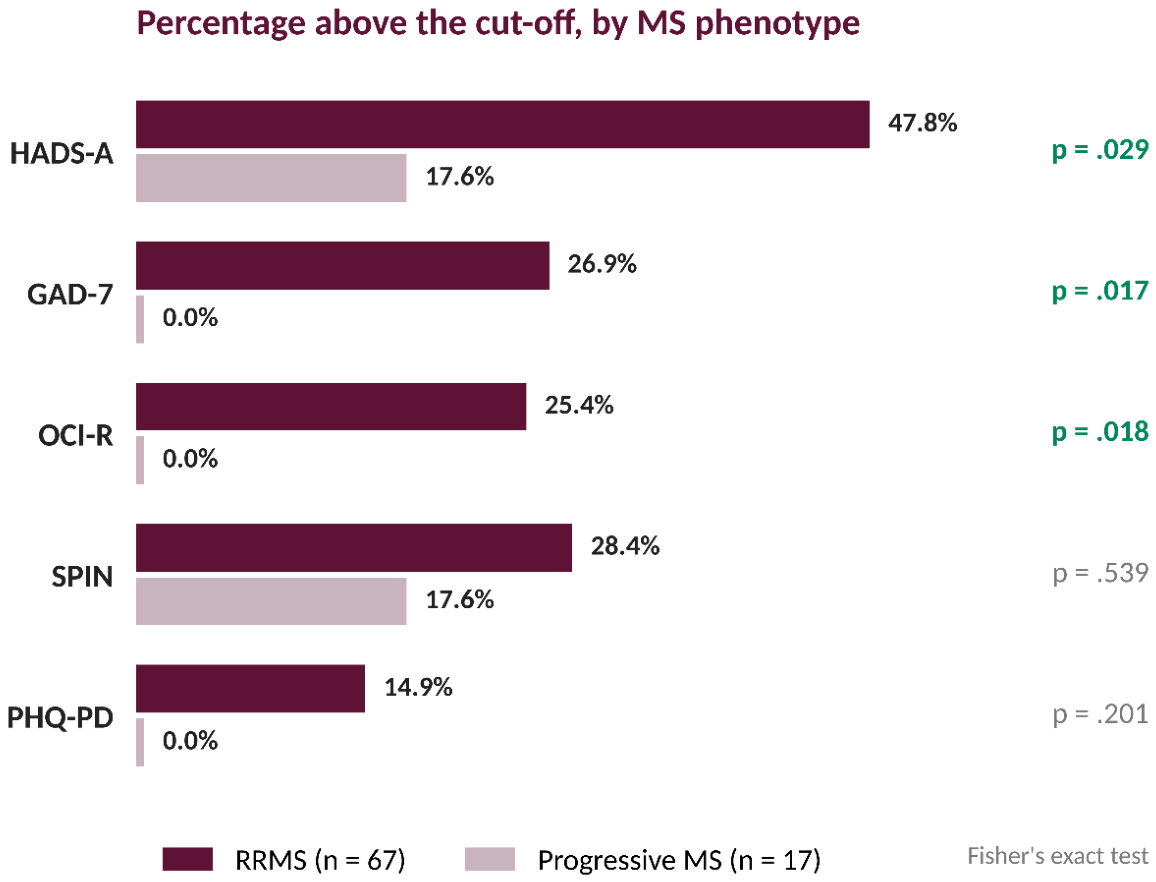

Table 1.
Sociodemographic and clinical characteristics of the sample (n = 84).
| Characteristic | Value |
|---|---|
| Age, years, mean (SD) ᵃ | 43.1 (11.9) |
| Women, n (%) ᵇ | 64 (76.2) |
| Education, years, mean (SD) ᶜ | 17.2 (4.1) |
| Marital status: single / married / divorced / widowed, n | 46 / 23 / 13 / 2 |
| Employment: salaried / self-employed / informal, n | 44 / 11 / 2 |
| Employment: unemployed / retired / student, n | 11 / 12 / 4 |
| Phenotype: relapsing-remitting, n (%) | 67 (79.8) |
| Phenotype: secondary progressive / primary progressive, n | 9 / 8 |
| Years since symptom onset, median (IQR) ᵈ | 7.5 (3.2–12.3) |
| Years since diagnosis, median (IQR) ᶜ | 5.7 (1.6–9.5) |
| Self-reported disability level (1–9), median (IQR) | 3.0 (2.0–4.0) |
| Disability level ≥ 6 (needs walking aid), n (%) | 12 (14.3) |
SD, standard deviation; IQR, interquartile range. ᵃ n = 82. ᵇ One participant preferred not to report gender; 19 (22.6%) were men. ᶜ n = 83. ᵈ n = 81.
Table 2.
Scores, internal consistency and frequency of positive screens for each anxiety measure (n = 84).
Table 2.
Scores, internal consistency and frequency of positive screens for each anxiety measure (n = 84).
| Measure (cut-off) | Median (IQR) | Cronbach's α | Positive, n (%) [95% CI] | Previous studies |
|---|---|---|---|---|
| HADS-A, general anxiety (≥ 8) | 6 (4–9) | 0.85 | 35 (41.7) [31.7–52.3] | 45% [10] ᵃ |
| SPIN, social anxiety (≥ 19) | 9.5 (4–19) | 0.93 | 22 (26.2) [18.0–36.5] | 26.9–32% [15,16,17] |
| GAD-7, generalized anxiety (≥ 10) | 5 (2.75–9) | 0.91 | 18 (21.4) [14.0–31.3] | 26% [21] |
| OCI-R, obsessive-compulsive (≥ 21) | 13 (8–19.25) | 0.91 | 17 (20.2) [13.0–30.0] | 14.9–16.1% ᵇ [18,19] |
| PHQ-PD, panic disorder (algorithm) | — | — | 10 (11.9) [6.6–20.5] | 10% ᵇ [7] |
| FQ agoraphobia (no cut-off) | 5 (0–13) | 0.81 | — | — |
| FQ blood-injury (no cut-off) | 6 (2–12) | 0.74 | — | — |
| FQ social phobia (no cut-off) | 7 (2–16) | 0.76 | — | — |
| Any specific subtype (GAD-7, SPIN, OCI-R or PHQ-PD) | — | — | 33 (39.3) [29.5–50.0] | — |
CI, confidence interval (Wilson). ᵃ HADS-A > 8. ᵇ Structured clinical interview.
Table 3.
Multiple linear regression models for each anxiety measure (n = 80). Values are unstandardized coefficients B [95% CI].
Table 3.
Multiple linear regression models for each anxiety measure (n = 80). Values are unstandardized coefficients B [95% CI].
| Predictor | HADS-A | GAD-7 | SPIN | OCI-R | FQ agoraphobia |
|---|---|---|---|---|---|
| Age (years) | −0.04 [−0.13, 0.05] | −0.07 [−0.18, 0.03] | −0.36 [−0.64, −0.07] | 0.00 [−0.26, 0.25] | 0.01 [−0.18, 0.20] |
| Female gender | 2.62 [0.51, 4.73] | 3.08 [0.47, 5.68] | 4.65 [−2.15, 11.46] | −0.16 [−6.29, 5.97] | 4.97 [0.39, 9.55] |
| Education (years) | −0.03 [−0.24, 0.18] | −0.16 [−0.42, 0.10] | −0.20 [−0.88, 0.48] | −0.41 [−1.02, 0.20] | 0.03 [−0.43, 0.49] |
| Years since diagnosis | −0.03 [−0.16, 0.09] | 0.01 [−0.14, 0.16] | −0.18 [−0.57, 0.21] | 0.15 [−0.20, 0.50] | −0.36 [−0.63, −0.10] |
| Disability level | 0.31 [−0.31, 0.93] | 0.55 [−0.22, 1.31] | 1.27 [−0.72, 3.27] | 1.77 [−0.03, 3.57] | 2.38 [1.04, 3.73] |
| Relapsing-remitting phenotype | 2.83 [0.07, 5.60] | 3.55 [0.13, 6.96] | 2.42 [−6.50, 11.35] | 12.69 [4.64, 20.73] | −2.63 [−8.64, 3.38] |
| R² (adjusted R²) | 0.20 (0.14) | 0.20 (0.14) | 0.17 (0.10) | 0.16 (0.09) | 0.28 (0.22) |
| F(6,73); p | 3.11; .009 | 3.12; .009 | 2.46; .032 | 2.27; .046 | 4.73; < .001 |
Bold, p < .05. Reference categories: men; progressive MS. The FQ blood-injury model was not significant (R² = 0.08; p = .365).
Disclaimer/Publisher’s Note: The statements, opinions and data contained in all publications are solely those of the individual author(s) and contributor(s) and not of MDPI and/or the editor(s). MDPI and/or the editor(s) disclaim responsibility for any injury to people or property resulting from any ideas, methods, instructions or products referred to in the content. |
© 2026 by the authors. Licensee MDPI, Basel, Switzerland. This article is an open access article distributed under the terms and conditions of the Creative Commons Attribution (CC BY) license (http://creativecommons.org/licenses/by/4.0/).
Copyright: This open access article is published under a Creative Commons CC BY 4.0 license, which permit the free download, distribution, and reuse, provided that the author and preprint are cited in any reuse.