

Submitted:
16 November 2026
Posted:
17 November 2026
You are already at the latest version
Abstract
Background. Bangladesh has established extensive cyclone preparedness arrangements and adopted a National Adaptation Plan (NAP) that explicitly recognizes people with diverse gender identities. Nonetheless, inclusive policy language does not establish whether gender-diverse people can use cyclone shelters, emergency warnings, humanitarian assistance, and recovery services safely. Objective. This paper assesses the relationship between documentary commitments and available evidence on sexual and gender minority inclusion in climate-related disaster management in Bangladesh. Methods. A structured, purposive critical review was conducted of Bangladesh government instruments, a United Nations-supported rapid gender analysis of Cyclone Remal (2024), international disaster-risk guidance, and relevant peer-reviewed studies available as of 17 November 2026. Claims were classified as directly documented policy provisions, reported empirical observations, contextual comparative evidence, or untested implementation questions. No original survey or field data were collected. Findings. The Bangladesh NAP provides comparatively advanced recognition of gender-diverse populations and includes provisions concerning participation, budgeting, and adaptation monitoring. The 2024 Cyclone Remal rapid gender analysis directly reports discomfort and insecurity among some transgender shelter users, alongside privacy, sanitation, and power-supply problems. Nationally representative measures of sexual and gender minority warning receipt, shelter admission, relief access, or recovery are not established by these sources. Published analyses of other populations document inequality across the disaster cycle but cannot be repurposed as LGBTQ+ estimates. Conclusion. The most important unresolved issue is not whether gender diversity is ever mentioned in climate policy, but whether recognition is translated into independently verifiable, safe, and accountable disaster protection. A staged institutional audit and an ethics-led research agenda are proposed.
Keywords:
LGBTQ+
; sexual and gender minorities
; cyclone shelters
; disaster risk reduction
; climate adaptation
; climate justice
; Cyclone Remal
; gender diversity
; humanitarian response
1. Introduction
Bangladesh is exposed to a combination of tropical cyclones, storm surges, coastal flooding, saline-water intrusion, and related livelihood shocks. The distribution of these hazards is physical, but the capacity to survive and recover is shaped by social relations and institutions. Flood depth or cyclone wind speed alone cannot indicate who receives a warning, who can travel to a safe building, whose identity is accommodated during shelter registration, or whose household qualifies for relief. The Intergovernmental Panel on Climate Change (IPCC) treats risk as the interaction of hazards, exposure, and vulnerability, emphasizing that adaptive capacities are unevenly distributed [1]. In Bangladesh, a substantial history of cyclone preparedness and protective infrastructure coexists with documented disparities in information, shelter experience, and access to assistance [2,3,4,8,9].
The inquiry is particularly pertinent for lesbian, gay, bisexual, transgender, queer, intersex, and other people whose sexual orientation, gender identity or expression, or sex characteristics may not correspond to institutional assumptions. The shorthand “LGBTQ+” is retained in the title because of its recognizability; the body uses “sexual and gender minorities” (SGM) where evidence encompasses multiple groups and more specific terms where a source concerns transgender or gender-diverse people. These categories must not be collapsed. In South Asia, hijra identities have distinct histories and social meanings, and neither all hijra people nor all transgender people identify with the same categories used in global LGBTQ+ research [6,10]. This distinction affects both the validity of research and the safety of participants.
A simplistic claim that Bangladesh's climate policies uniformly exclude gender-diverse people would be inaccurate. The National Adaptation Plan of Bangladesh (2023–2050), issued in 2022, repeatedly names people with diverse gender identities in its formulation, consultation, local adaptation, and financing language. It also envisages public expenditure tracking for people with non-binary genders [2]. Goodwin and Goldsmith’s 2026 global assessment places Bangladesh among the uncommon national cases with the *capacity* for transformative inclusion on paper [5]. That assessment does not demonstrate equal disaster outcomes. Conversely, a Bangladesh rapid gender analysis conducted following Cyclone Remal in May 2024 records that some transgender individuals who sought refuge experienced communal sleeping arrangements as uncomfortable and unsafe [4]. This combination of explicit recognition and observed obstacles provides the starting problem for the present review.
The research asks three questions. First, what do authoritative Bangladesh adaptation and disaster instruments say about gender diversity, shelter protection, and participation? Second, what can existing Bangladesh-specific and regional evidence actually establish about access barriers during warning, evacuation, shelter, relief, and recovery? Third, which feasible and privacy-preserving indicators could distinguish policy intent from institutional practice and the experience of service users? The contribution is a structured interpretation of existing evidence and a reproducible audit design, not a new estimate of discrimination prevalence.
2. Conceptual Foundations
2.1. Disaster Vulnerability Is Socially Mediated
A hazard becomes a disaster through the encounter between environmental exposure and unequal resources, capacities, and services. Structural conditions such as poverty, informal housing, disability, isolation, insecure work, and access to local political networks may influence safety long before a cyclone makes landfall. A useful SGM-sensitive assessment therefore asks not only whether individuals possess minority identities, but whether local procedures transform those identities into barriers: for example, through compulsory binary registration, inadequate privacy, stigma, mismatched household documentation, or the absence of an effective complaint mechanism. These are potential mechanisms; each needs contextual verification rather than assumption.
Intersectionality directs attention to how different relations of power operate together rather than treating gender, poverty, disability, or age as separable and additive variables [15]. It also cautions against representing marginalized communities as passive victims. Local support networks, trusted community organizations, mutual aid, and experience navigating institutions may contribute to disaster resilience. Sharan and Gaillard [6] emphasize that South and Southeast Asian gender-diverse populations should be understood through culturally grounded histories and capacities rather than imposed universal categories. Any empirical evaluation must allow people to describe their own needs without compulsory disclosure of sexuality or gender identity.
2.2. From Policy Recognition to Delivered Protection
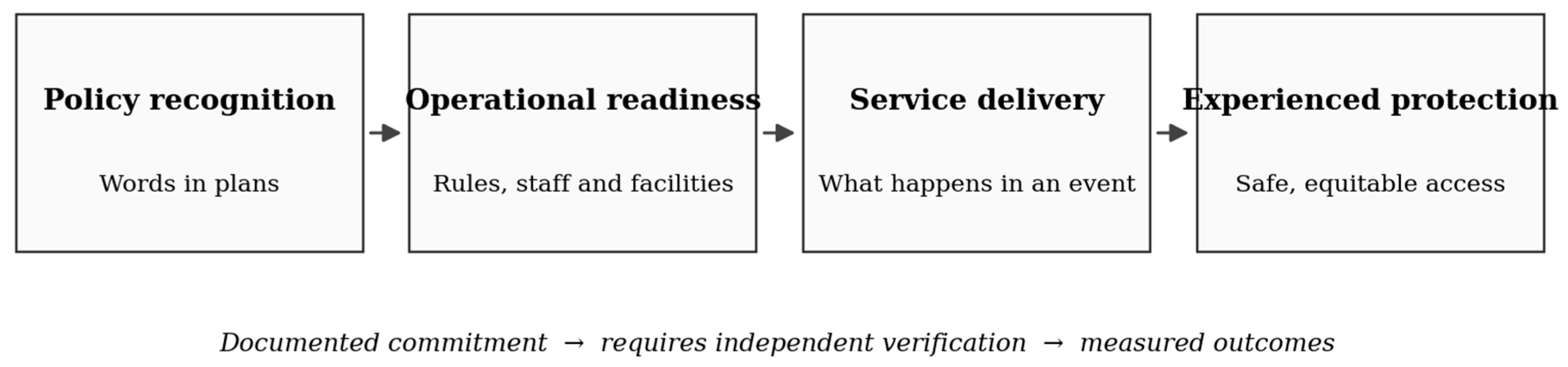
This paper distinguishes four levels of evidence. Recognition means that a document explicitly refers to particular communities or adopts a general non-discrimination commitment. Operational readiness requires written procedures, budgets, responsibilities, staff preparation, facilities, and accessible complaint channels. Delivered services means those procedures were actually used during a disaster. Experienced protection refers to whether people received timely warnings, could enter and remain in shelter safely, and obtained appropriate support during recovery. A national plan can provide convincing evidence of recognition without independently establishing any of the three downstream levels.
The distinction matters because multiple organizations can be responsible for a single service. A NAP may guide multi-year adaptation investment, whereas a Standing Order specifies responsibilities during warning and response, and a local shelter committee determines space arrangements under emergency conditions [2,3]. The institutional route from a national policy commitment to a safe night's shelter passes through staffing, procurement, building maintenance, training, communication, and accountability. Figure 4 presents the resulting analytical pathway; the arrows indicate a conceptual mechanism, not an estimated causal effect.
2.3. Scope and Terminology
The evidence reviewed here concerns climate-related disaster management, especially cyclones and associated flooding in Bangladesh. Some source material concerns broader gender or women's experiences, while a smaller body explicitly discusses gender-diverse people. Both are important, but they answer different questions. The analysis never assumes that statistics calculated for female-headed households or women are estimates for LGBTQ+ groups. Similarly, published observations about hijra people in India are treated as contextual evidence of a possible mechanism, not proof that the same practice occurs at the same frequency in Bangladesh.
3. Materials and Methods
3.1. Study Design and Date of Evidence
The design is a structured critical narrative review and documentary policy analysis. Sources were assembled through targeted searches of official government and multilateral websites, humanitarian publications, and peer-reviewed journal records available on 17 November 2026. Searches used combinations of terms including Bangladesh, national adaptation plan, standing orders on disaster, Cyclone Remal, transgender, gender-diverse, hijra, sexual and gender minorities, cyclone shelter, evacuation, social inclusion, and disaster risk reduction. Priority was given to primary documents and traceable original studies. This was not an exhaustive database search, a registered systematic review, or a PRISMA review; the source selection is purposive and should not be represented as exhaustive.
The central documentary materials are Bangladesh's NAP [2], the Standing Orders on Disaster (SOD) 2019 [3], and the Gender in Humanitarian Action Working Group's *Rapid Gender Analysis of Cyclone Remal* [4]. Secondary interpretation draws on a 2026 global NAP mapping [5], South Asian comparative research [6,7], Bangladesh disaster studies [8,9], and humanitarian inclusion guidance [10,11,12,13]. Supplementary frameworks address climate vulnerability, intersectionality, coastal experiences, and infrastructure design [1,14,15,16]. The documents differ substantially in purpose and evidentiary strength; this difference is made explicit throughout.
3.2. Source Eligibility and Extraction
Sources were included if they were: (a) identifiable government or intergovernmental guidance relevant to Bangladesh climate adaptation or disaster response; (b) published empirical evidence about disaster-protection inequalities in Bangladesh; (c) peer-reviewed evidence directly examining SGM disaster inclusion; or (d) relevant guidance on ethical and operational inclusion. Press releases were used only to establish institutional announcements, not to infer implementation outcomes. Each substantive claim was extracted by publication, geography, target population, disaster-cycle stage, evidence type, and inferential boundary. Table 1 summarizes the principal evidence streams.
3.3. Rules for Interpretation
Three rules governed interpretation. First, direct documentary references are evidence about what a policy says, not necessarily what administrators do. Second, rapid qualitative assessments can demonstrate that particular experiences occurred but cannot supply representative rates without an appropriate sampling design and denominator. Third, association estimates for other gender groups must not be transferred to SGM populations. To make the strength of inference visible, the results use four labels: D = documented primary policy; O = observed/reported in a named empirical source; C = comparative or contextual evidence; U = unmeasured implementation question.
No interviews, observations, administrative datasets, satellite images, or original statistical analyses were undertaken for this manuscript. The numerical charts are explicitly attributed reproductions of summary counts or published group percentages. There is therefore no newly generated sample, p-value, odds ratio, or estimate of LGBTQ+ shelter denial to report. Because the manuscript uses publicly accessible documents and published aggregate evidence only, no research participants were recruited or contacted during its preparation.
4. Findings
4.1. International Inclusion Remains Uncommon, but Bangladesh Is Not a Zero-Inclusion Case
Goodwin and Goldsmith examined 256 NAPs or supporting adaptation documents pertaining to the 198 UNFCCC member states. They identified explicit SGM mentions in 23 states (approximately 11.6%), leaving 175 without explicit mentions in the materials they reviewed [5]. This statistic concerns documentary mentions and should not be read as a measure of actual national protection. Figure 1 reproduces the two counts reported in that study.
Within the 23 states with explicit inclusion, Goodwin and Goldsmith classified 15 (approximately 65%) as SGM-sensitive, six (26%) as SGM-responsive, and two (9%) as SGM-transformative in their *planning capacity* [5]. Their framework distinguishes acknowledgement of vulnerability from specific actions and from planning arrangements intended to change structural barriers. Bangladesh and Argentina were the two examples identified as transformative. The designation is noteworthy but explicitly does not certify realized outcomes. Figure 2 presents these published categories as absolute counts to avoid misleading comparisons with the full sample of 198 states.
A separate global flood-risk study by Mortensen and colleagues demonstrates why social context must be considered when assessing environmental exposure. The authors examined the overlap between flood exposure and national legal and social environments affecting SGM populations [7]. Their global affected-population estimates are not counts of LGBTQ+ individuals: they represent total people exposed to flooding in countries with particular legal conditions. The distinction is essential when translating macro-scale vulnerability analysis into claims about individuals.
4.2. Bangladesh's NAP Recognizes Gender Diversity and Also Acknowledges Monitoring Weaknesses
The NAP was prepared for the 2023–2050 period and published by the Ministry of Environment, Forest and Climate Change in 2022. Its executive summary states that people with diverse gender identities were among groups considered in a participatory formulation process. It further identifies them in adaptation priorities, local participation mechanisms, and institutional coordination [2, executive summary]. In Section 4.8, *Gender, Disability, Youth and Social Inclusion*, the plan discusses the accessibility of infrastructure, shelters, sanitation facilities, and public services; its budgeting text expressly includes people with non-binary genders and groups with diverse gender identities [2, p. 118].
The same document, however, states that adaptation monitoring and evaluation remains weak in tracking stakeholder engagement, including participation by people with diverse gender identities [2, p. 53]. This admission is methodologically significant. It offers direct evidence that the plan's authors recognized an implementation-measurement problem at the time of writing. The NAP should therefore neither be described as silent on gender diversity nor treated as proof that field-level mechanisms are already functional.
At the governance level, this is a translation problem: how do consultation language, finance commitments, and inclusive infrastructure principles become testable local procedures? The NAP can answer whether explicit commitments exist. It generally cannot, without supplementary field documentation, answer whether a given shelter permits confidential grievance reporting, whether a person experiences harassment when asking for a private sleeping place, or whether relief administrators accept a variety of household circumstances.
4.3. Standing Orders on Disaster: Operational Responsibility and Binary Accommodation
The Standing Orders on Disaster (2019; English edition issued in 2020) specifies roles for disaster committees, officials, and responders at national and local levels [3]. The document includes warning dissemination, evacuation, rescue, shelter operations, relief coordination, and recovery. Certain local responsibilities explicitly include keeping women and children in separate shelter rooms, providing safe water, and addressing gender-based violence [3, local-level disaster-stage responsibilities]. These provisions reflect legitimate protection objectives for groups already recognized as at risk.
However, arrangements written mainly in terms of men, women, and children may leave practical questions for staff when a shelter user does not fit expected classifications, prefers a more private space, or declines to disclose a sensitive identity. A targeted search of the accessed English text found no explicit occurrences of the terms “transgender” or “hijra”; because terminology can vary and local procedures may supplement national text, this observation is not evidence that all SOD-related operations exclude gender-diverse people. A credible operational assessment would inspect actual entry forms, locally issued shelter rules, staff instructions, and disciplinary or complaints practices rather than equating the absence of a keyword with denial of service.
4.4. Direct Bangladesh-Specific Observations After Cyclone Remal
The most directly relevant Bangladesh-specific operational evidence in the reviewed corpus is the GiHA Working Group's *Rapid Gender Analysis of Cyclone Remal*, published in June 2024 [4]. The working group was chaired by Bangladesh's Department of Women Affairs and co-chaired by UN Women, with support from UN and civil-society partners. The assessment used focus-group discussions, key-informant interviews, and secondary rapid-assessment sources across Khulna, Satkhira, Barguna, Bagerhat, and Patuakhali; field collection occurred on 29–30 May 2024 [4, pp. 2, 6–7]. It was explicitly a preliminary response-oriented assessment, not a probability sample of LGBTQ+ people.
Under emergency shelter findings, the report describes loss of power, inadequate sanitation access, difficulties associated with shared sleeping areas, and perceived insecurity. Crucially, it states that stigma deterred some gender-diverse people from seeking shared shelters and that some transgender individuals from Banishanta who did seek refuge felt uncomfortable and insecure because of communal sleeping arrangements [4, p. 8]. This is direct qualitative evidence of a reported protection concern in Bangladesh. It does not supply a count of individuals denied entry, a comparison rate with non-transgender evacuees, or proof that a specific practice prevailed across districts. The distinction between unsafe experience, self-exclusion caused by anticipated stigma, and formal refusal by shelter staff must remain explicit.
The Remal assessment also recommended that warning dissemination reach gender-diverse groups, that dignity supplies and safe spaces serve gender-diverse individuals, and that food packages and emergency cash programs consider the transgender community [4, pp. 15–16]. These are recommendations within a response document, not evidence that each intervention was implemented or evaluated. Notably, the report's direct mention of gender-diverse experiences demonstrates that the community is neither entirely absent from humanitarian knowledge nor comprehensively measured in existing outcomes data.
4.5. Indirect but Relevant Evidence on Uneven Service Access
A 2026 study of cyclone-prone coastal Bangladesh examined 279 households, 14 focus-group discussions, and 21 key-informant interviews across seven districts [8]. The author reported that female-headed households were 11.8 percentage points less likely to receive tropical-cyclone warnings than male-headed households. Female-headed households were also more likely to rate shelters as inadequate (40.0% versus 26.5%) and experienced a reported 12.4 percentage point deficit in aid receipt [8]. The data concern household headship, not sexual orientation or gender diversity. Figure 3 reproduces only the published shelter-inadequacy percentages and explicitly labels the comparison population.
An earlier mixed-methods study from Dacope Upazila found that gender and local political connectedness were associated with relief and rehabilitation access, underscoring the importance of institutional relationships in post-disaster distribution [9]. These studies provide a credible rationale for examining whether access depends on information networks, assumptions about households, staff discretion, or confidence in service providers. They cannot establish that such barriers operate identically for sexual and gender minority residents.
A qualitative study of women and girls in cyclone-affected Khulna likewise used an intersectional climate-justice approach to analyze sexual and reproductive health impacts [14]. Its results help demonstrate why locally specific research methods matter, but should not be relabeled as evidence about LGBTQ+ participants. Similarly, a 2025 Asian Development Bank policy brief identifies ways Bangladesh can strengthen gender-responsive disaster management in its legislative and institutional frameworks; its focus is primarily women and girls [13].
4.6. Regional Evidence Makes Particular Mechanisms Plausible, Not Universal
Sharan and Gaillard analyzed disaster experiences among hijra people in India and bakla communities in the Philippines, illustrating how official categories and exclusionary rules can interact with local histories [6]. Their India vignette includes interviews concerning Cyclone Fani in Odisha. Eight of eleven interviewed hijra participants reported that they could not access shelters, with the authors linking this to binary shelter arrangements and the lack of guidance for staff [6]. This striking observation pertains to a small, purposive, place-specific qualitative sample and must not be presented as an 8/11 refusal rate for Bangladesh or for all hijra people. Its relevance is analytical: it identifies a concrete question to test in local shelter rules and admission practices.
UN Women's SOGIESC inclusion guidance describes the case for removing discriminatory barriers and involving people with diverse gender expressions and sexual orientations in disaster risk reduction [10]. In May 2026, UNDRR announced an LGBTIQ+ Persons constituency in the Sendai Stakeholder Engagement Mechanism [12]. Both strengthen the normative rationale for inclusion, but neither measures Bangladeshi service performance. Together with the Sendai Framework's commitments to inclusive risk governance [11], they support designing operational indicators that can be verified without requiring public disclosure of identity.
4.7. What the Evidence Permits Us to Conclude
Table 2 separates established propositions from hypotheses requiring direct evaluation. The clearest findings are that formal inclusion exists in Bangladesh's NAP, the NAP itself recognizes tracking gaps, and a Bangladesh humanitarian assessment documented shelter-related insecurity among some transgender people. What remains unavailable from the sources reviewed is a defensible national prevalence estimate for LGBTQ+ warning exclusion, refused shelter entry, relief denial, disaster mortality, or recovery outcomes. A gap in the reviewed evidence is a research priority, not a license to invent a statistic.
5. Potential Barriers Across the Disaster Cycle
5.1. Risk Communication and Preparedness
Early warning must be timely, understandable, trusted, and actionable. Some people may be missed by information networks organized around established households, workplace structures, mobile coverage, or community gatekeepers. A study should test whether warning dissemination reaches informal households, isolated residents, and people whose safety concerns deter contact with official structures. These conditions are not exclusive to SGM groups. Suitable institutional measures include diversified broadcast channels, accessibility testing, anonymous feedback, and opt-in consultation through trusted intermediaries. Publishing identifiable lists of LGBTQ+ households as an outreach tool would create needless privacy and safety risks.
5.2. Evacuation Mobility and Personal Safety
Travel to shelter depends on road conditions, transport, physical access, caregiving responsibilities, and confidence that admission will be safe. The Remal assessment reports transport disruptions and concerns about shelter conditions [4], but does not present a population-specific estimate of how many SGM individuals abandoned evacuation. Local audits could inspect transport assistance arrangements and whether staff are instructed to admit any person in danger without discriminatory screening. Voluntary simulations can assess ease of access without exposing participants' identities.
5.3. Shelter Admission, Sleeping Arrangements, Lighting, and Sanitation
Shelter quality is not defined solely by structural integrity or number of beds. Users also require usable toilets, adequate light, reasonable privacy, safe reporting channels, and protection from harassment. The Remal assessment provides direct testimony relevant to shared sleeping and stigma [4, p. 8]. A useful engineering and management response is to audit partitions, privacy screens, lighting redundancy, locked or inaccessible toilets, and staff response procedures. Binary-labeled spaces may meet some needs yet produce dilemmas for some gender-diverse users. Any redesign should be negotiated with multiple user groups and should avoid forcing people to publicly self-identify to obtain a protected space.
5.4. Relief Registration and Recovery
Humanitarian aid often passes through local lists, named household heads, documents, or community verification. Discretion can support flexibility but can also create inconsistent treatment. As Sultana and colleagues found in southwest Bangladesh, political connectedness can shape relief distribution [9]. The analysis should examine whether people lacking conventional documentation or a recognizable household arrangement can obtain assistance, correct errors, or appeal decisions. Document flexibility should be balanced with fraud controls through transparent rules, confidential review, and outcome audits that avoid recording sensitive traits by default.
5.5. Participation and Accountability
Inclusion is more credible when organizations familiar with a community can participate in risk mapping, shelter design, warning outreach, and complaint-system testing. Participation should not require a vulnerable individual to speak publicly about identity. Confidential advisory arrangements, protected and compensated consultation, and anonymous grievance channels are preferable where public exposure could create harm. The NAP's attention to participation and weak monitoring suggests that decision traceability—whether a consultation led to a changed operating procedure—deserves special scrutiny [2].
6. A Proposed Framework for Institutional Evaluation
6.1. The Policy-to-Protection Audit
This article proposes a *Policy-to-Protection Audit* (PPA) for use in follow-up research. It is an unvalidated proposal, not an instrument applied to Bangladesh's shelters in the present paper. The audit separates process documentation from experienced outcomes so that high policy scores cannot disguise failures in actual service provision. A preliminary institutional score can cover six equally weighted domains: (i) warning accessibility; (ii) nondiscriminatory admission and evacuation; (iii) privacy, sanitation, and safe space; (iv) relief and documentation flexibility; (v) complaint and accountability procedures; and (vi) inclusive participation and training.
Each domain would be coded: 0, no accessible supporting procedure; 1, stated commitment without documented operating steps; 2, an explicit procedure with named responsibility, resources, or training; 3, procedure plus independently verifiable implementation evidence. Missing documents should be recorded separately as not assessable rather than automatically assigned zero. For fully observed domains, the illustrative normalized index is PPA = 100 × (sum of six domain scores / 18). This index represents documented institutional readiness, not observed equity, and should not be compared across localities before content validity, inter-rater agreement, and weighting sensitivity analyses have been completed.
The audit must include a second service-experience module with indicators derived from safe, voluntary, ethically approved research—such as successful admission, perceived privacy, willingness to return during a future warning, use of the complaint channel, and receipt of needed supplies. These outcomes should never be mechanically added to a documentation score. Table 3 lists concrete evidence that auditors could seek. Figure 4 illustrates where independent observation and participant experience are necessary.

Table 3.
Proposed Policy-to-Protection Audit domains and verifiable materials (not yet piloted).
| Audit domain | Documents / physical checks | Implementation verification | Safeguard |
|---|---|---|---|
| Warning access | Dissemination plan; channels; translations; contingency power | Drill records, accessible message tests | No identity-tagged address lists |
| Evacuation and entry | Admission instructions; transport support; forms | Staff scenarios; anonymized admission audit | Never require disclosure for entry |
| Privacy and sanitation | Toilet access; lighting; partitions; occupancy controls | Site inspection; maintenance logs; user feedback | Private option without public classification |
| Relief flexibility | Eligibility criteria; appeal and document-alternative rules | De-identified case review; decision consistency | Protect household and identity information |
| Complaint procedures | Anonymous mechanism; named officer; escalation times | Test submissions; response and correction log | No public complainant registers |
| Participation and training | Consultation procedure; staff training; budget | Training attendance; change-control documentation | Voluntary confidential consultation |
Figure 4.
Proposed policy-to-protection evidence continuum. Boxes and arrows are a conceptual model developed for this article, not quantitative or causal findings.
Figure 4.
Proposed policy-to-protection evidence continuum. Boxes and arrows are a conceptual model developed for this article, not quantitative or causal findings.
6.2. Sampling Strategy for a Future Study
A practical follow-up might begin with purposive selection of several cyclone-prone districts (for example, Khulna, Satkhira, Bagerhat, Barguna, and Patuakhali), using cyclone exposure, shelter density, accessibility, and local partnerships rather than presumed concentrations of LGBTQ+ residents. Phase 1 would review district and union disaster plans, shelter standard operating procedures, training manuals, physical facilities, and grievance processes. Phase 2 would involve interviews with disaster-management officials, volunteers, infrastructure staff, and community-service organizations. Phase 3—only with appropriate ethics review and demonstrated participant safety—could invite voluntary confidential interviews or small-group consultations. The current paper does not claim that any phase has been conducted.
A comparative design should include facilities of different age, capacity, location, and operating organization; otherwise, findings may reflect selective high-performing sites. Auditors should document the hazard context and distinguish permanent cyclone shelters from schools or other temporary refuge buildings. In a later quantitative phase, sample design, denominators, attrition, and non-response should be pre-specified; a convenience sample recruited through a small advocacy network cannot support population-level claims. Where sample sizes permit, relevant correlates could include age, disability, housing conditions, distance, income, prior disaster experience, and household support, but never at the expense of confidentiality.
6.3. Pre-Specified Research Hypotheses
H1: Facilities with explicit flexible-admission procedures and trained staff will be associated with greater perceived shelter accessibility among voluntary respondents, conditional on local context. H2: Privacy partitions, reliable lighting, and functioning sanitation facilities will be associated with higher perceived safety, including among gender-diverse users. H3: Mechanisms for confidential consultation will be associated with better traceability between identified access barriers and changes to local procedures. H4: A written appeal process and flexible proof-of-eligibility rules will be associated with fewer unresolved relief-access complaints. These propositions are testable associations; observational evidence would not, by itself, demonstrate causality.
6.4. Research Ethics, Confidentiality, and Do-No-Harm
Identity-linked disaster research can create distinctive risks in contexts where stigma or social sanctions are possible. Researchers should begin with a safety assessment: Is asking about sexuality or gender identity necessary to answer the question? Can an environmental or service-quality audit answer much of the question without collecting it? If sensitive identity data are necessary, participants should receive clear consent information, the right to skip questions, and the right to withdraw without loss of services. Recruitment should not be conducted through exposed lists, public shelter queues, location-based identification, or speculative inference from appearance.
Secure data handling requires data minimization, separation of contact information and interviews, encrypted storage, restricted access, predetermined retention schedules, and suppression of small or potentially identifying cells. Exact residences and sensitive combinations of age, occupation, disaster experience, and identity should not appear in publicly released datasets. Research teams should co-design language with relevant communities, provide appropriate referral information if participation causes distress, and obtain a competent institutional ethics assessment before collecting human-participant data. “Third gender,” “hijra,” “transgender,” and broad LGBTQ+ labels should not be conflated through forced coding [6,10].
7. Discussion
7.1. A Defensible Interpretation of the Policy-Implementation Relationship
The contrast identified here is more nuanced than a simple absence-versus-presence narrative. Bangladesh's NAP contains comparatively advanced language about diverse gender identities and non-binary genders [2,5]. The same plan acknowledges weak monitoring of stakeholder inclusion [2]. The 2024 Remal analysis, meanwhile, records specific experiences of discomfort and insecurity in shared shelters among some transgender evacuees [4]. The evidence thus points to uneven translation from ambition to accessible services, while the degree and geographical distribution of that unevenness remain unmeasured.
This conclusion avoids two errors. The first is erasing existing policy commitments and the participation reflected in the NAP. The second is allowing national policy recognition to substitute for verification of infrastructure design, staff conduct, and individual safety during emergencies. A defensible evaluation must maintain a clear hierarchy: text can establish a promise, independent observation can establish a process, and carefully designed outcome research can establish how those processes are experienced.
7.2. Practical Implications for Shelter Engineering and Management
Several interventions appear practical regardless of whether shelter administrators can identify specific population groups. Backup lighting, clear access to functioning toilets, flexible private spaces, confidential reporting options, nondiscriminatory conduct rules, and clear escalation procedures can improve usability for many residents. Infrastructure and management changes must be evaluated for trade-offs involving capacity, accessibility, privacy, safety, cost, and staffing. The Global Center on Adaptation's 2026 work on socially inclusive climate-resilient infrastructure in Bangladesh provides a contemporary reference point for incorporating these considerations into design and project appraisal [16].
Measures should not stop at material upgrades. A partition cannot protect a person if a staff member refuses entry, and a non-discrimination poster cannot resolve a locked toilet or a poorly lit dormitory. Joint review by engineers, disaster-management officials, local service organizations, and relevant users can identify which barriers are design-related, which require procedures, and which arise from conduct or accountability. In this sense, inclusive DRR is both an infrastructure and governance problem.
7.3. Universal Design and Targeted Protection Are Complementary
Universal improvements do not eliminate the need to test whether a marginalized population is still underserved. Conversely, targeted outreach can become counterproductive if it requires public categorization of residents during an emergency. A proportionate strategy is to improve baseline service conditions for everyone while offering discreet optional support and confidential channels for concerns that universal arrangements may overlook. Evidence-based targeting should rest on voluntary consultation and clear need, not assumptions attached to a category or the appearance of an individual.
7.4. Institutional Monitoring and Accountability
The NAP calls attention to weaknesses in monitoring inclusion. A minimum institutional scorecard should therefore ask: (a) was an inclusion concern identified, (b) did an authorized actor accept responsibility, (c) was a procedure or facility altered, (d) was a change practiced during a drill or event, and (e) was its safety verified with users? Audits should distinguish a blank answer from a negative one and publish methods and confidence limitations. Local administrators should be able to describe corrective actions without disclosing any complainant's identity. A small, auditable set of process measures could be integrated into existing disaster management reviews rather than creating a parallel surveillance system.
7.5. Relevance Beyond Bangladesh
The Sendai Framework calls for inclusive risk governance and the protection of people and assets, while subsequent SOGIESC guidance and the 2026 UNDRR constituency give this concern greater institutional visibility [10,11,12]. Bangladesh offers an analytically important case because its formal adaptation language is stronger than a simplistic account of national exclusion would suggest [5], yet local experiences documented after Remal show why implementation still merits evaluation [4]. This pattern may be relevant elsewhere: meaningful inclusion is not the presence of an acronym in a policy but the capacity to deliver safe protection under emergency pressure.
8. Strengths, Limitations, and Future Research
This review's principal strength is its use of source-specific evidence boundaries. It integrates the text of Bangladesh's NAP and SOD with a directly relevant humanitarian field assessment and newer peer-reviewed studies. The inclusion of the 2024 Remal findings strengthens the argument beyond hypothetical shelter barriers; the 2026 global NAP study also prevents the mistaken claim that Bangladesh's adaptation policy ignores gender diversity. Explicit separation of populations and evidence levels minimizes overinterpretation of adjacent research.
There are significant limitations. The literature selection was purposive and non-exhaustive, without a registered protocol, formal systematic risk-of-bias instrument, independent dual screening, or inter-rater coding. The Remal rapid gender analysis was designed for immediate humanitarian response, not representative estimation of sexual and gender minorities' experiences. The present review did not inspect shelters in person, verify the availability of local operating procedures, interview disaster managers, or measure complaints and outcomes. The SOD discussion concerns an accessible English national text and does not establish the content of every local protocol. Published counts and percentages are attributed secondary figures rather than new analyses. Policy documents, social conditions, and operational guidance may change after 17 November 2026.
A high-value next step is a pre-registered multi-site audit with clear document provenance, independent coders, participant-safety review, and public reporting of aggregate facility findings. A subsequent qualitative study could explore why gender-diverse people accept, avoid, or leave shelters, while an implementation evaluation could test whether specific low-cost changes improve safety. Only after those stages would population-level outcome estimation be defensible. Future research should also ask whether the patterns differ across place, poverty, disability, age, and local identity terminology rather than presuming uniform LGBTQ+ experience.
9. Conclusion
The available evidence supports a precise conclusion: Bangladesh has made explicit national commitments to gender-diverse inclusion in climate adaptation, while a 2024 UN-supported humanitarian assessment documents shelter-related stigma and insecurity among some transgender residents during Cyclone Remal. These facts do not prove nationwide exclusion, nor do formal policies establish equal service access. The unresolved task is to measure how disaster warnings, admissions, shelter conditions, relief decisions, and accountability practices convert adaptation commitments into protection. The proposed Policy-to-Protection Audit provides an ethically cautious starting design. Its value will depend on independent validation, community-informed interpretation, and rigorous avoidance of forced identity disclosure.
Article type and peer-review status
Critical narrative review and policy analysis. Working manuscript prepared for author review; not peer reviewed.
Data availability
No original individual-level dataset was generated. Aggregate figures reproduce published values attributed in their captions. Source documents and persistent links appear in the reference list.
Ethical review
No human participants were recruited, interviewed, or observed for this desk-based review. Any future participant research requires appropriate ethics approval and a context-specific safeguarding protocol.
Funding and competing interests
To be confirmed by the named author before public dissemination; this draft does not independently verify a funding or conflict-of-interest declaration.
Use of assisted drafting
Text development and document preparation received generative-AI assistance. The named author should independently verify source interpretations, originality, applicable disclosure rules, and all declarations, and make substantive scholarly revisions before posting the manuscript.
Appendix A. Proposed Source-Coding and Institutional Audit Protocol
The review can be independently extended by recording, for every source: bibliographic identifier, access date, page or section, population named, hazard context, disaster-cycle stage, direct excerpt, evidence class (D/O/C/U), and inferential boundary. An auditor should store the original file version where licensing permits and log all coding disagreements. A revised systematic review would require a registered search strategy, duplicate screening, standardized risk-of-bias appraisal, and an explicitly justified date boundary.
For each proposed PPA domain, auditors should request the documented standard operating procedure, responsible office, last staff training record, physical or digital evidence of implementation, and an independently recorded verification outcome. Information unavailable to researchers should be marked “not assessable,” not assumed absent. Pilot testing should evaluate the wording of items, coder reliability, and whether each item is feasible across urban, rural, permanent, and temporary shelters.
Appendix B. Minimum Field-Validation Safeguards
Before fieldwork, obtain an institutional ethics opinion, establish community consultation with more than one representative perspective, assess local legal and personal risks, and create an emergency referral protocol. No respondent should be outed through recruitment, public attendance sheets, photographs, exact GPS coordinates, or dissemination. Consent should be independent of access to disaster aid. Recruitment criteria, data retention, small-cell suppression, translation of culturally specific terms, and plans for adverse events should be approved before collecting sensitive data. Research teams should explicitly document what will not be collected as well as what will be collected.
References
- Intergovernmental Panel on Climate Change (IPCC). Climate Change 2022: Impacts, Adaptation and Vulnerability. Working Group II contribution to the Sixth Assessment Report. Cambridge University Press; 2022. https://www.ipcc.ch/report/ar6/wg2/.
- Government of the People's Republic of Bangladesh, Ministry of Environment, Forest and Climate Change. National Adaptation Plan of Bangladesh (2023–2050). October 2022. https://www.undp.org/bangladesh/publications/national-adaptation-plan-bangladesh-2023-2050.
- Ministry of Disaster Management and Relief, Government of Bangladesh. Standing Orders on Disaster 2019. English edition; 2020. https://modmr.gov.bd/pages/policies/standing-orders-on-disaster-2019-english-version-2296f0-6940313ac4774958d7b41e98.
- Gender in Humanitarian Action (GiHA) Working Group, Bangladesh. Rapid Gender Analysis of Cyclone Remal. Department of Women Affairs and UN Women; June 2024. https://bangladesh.un.org/sites/default/files/2024-06/RGA%20Cyclone%20Remal%202024%20-%20FINAL%202%20JUNE%202024.pdf.
- Goodwin S, Goldsmith L. Mapping sexual and gender minority inclusion in national adaptation plans globally. npj Climate Action. 2026;5:67. https://www.nature.com/articles/s44168-026-00363-5. [CrossRef]
- Sharan A, Gaillard JC. Re-Gendering the Sendai Framework for Disaster Risk Reduction: Experiences of Gender Diverse Groups from India and the Philippines. International Journal of Disaster Risk Science. 2025;16:92–102. https://link.springer.com/article/10.1007/s13753-024-00612-3. [CrossRef]
- Mortensen E, Cassanti AC, Tiggeloven T, Twaalfhoven A, Ward PJ, Haer T. On moving towards a more inclusive understanding of disaster risk reduction: A sexual and gender minorities perspective through the lens of global flood risk. Progress in Disaster Science. 2025;26:100442. [CrossRef]
- Hossain ML. Gendered barriers to disaster protection in coastal Bangladesh. npj Climate Action. 2026;5:77. https://www.nature.com/articles/s44168-026-00388-w. [CrossRef]
- Sultana Z, Mallick B, Biswas B, et al. Role of gender and political connectedness after extreme events in coastal Bangladesh. npj Climate Action. 2022;1:7. https://www.nature.com/articles/s44168-022-00008-3. [CrossRef]
- UN Women. Tool 8: Inclusion of sexual orientations, gender identities, expressions, and sex characteristics (SOGIESC) in Disaster Risk Reduction and Resilience. 2022. https://wrd.unwomen.org/sites/default/files/2022-07/Tool%208%20-%20Tools%20and%20guidance%20for%20Inclusion%20of%20SOGIESC%20in%20DRR%20-%2015072022.pdf.
- United Nations Office for Disaster Risk Reduction (UNDRR). Sendai Framework for Disaster Risk Reduction 2015–2030. United Nations; 2015. https://www.undrr.org/publication/sendai-framework-disaster-risk-reduction-2015-2030.
- United Nations Office for Disaster Risk Reduction (UNDRR). UNDRR expands Sendai Stakeholder Engagement Mechanism to LGBTIQ+ Persons constituency. 5 May 2026. https://www.undrr.org/news/undrr-expands-sendai-stakeholder-engagement-mechanism-lgbtiq-persons-constituency.
- Picard M. How Laws and Policies Support Gender-Responsive Disaster Risk Management in Bangladesh. ADB Briefs. Asian Development Bank; July 2025. https://www.adb.org/publications/gender-responsive-disaster-risk-management-bangladesh. [CrossRef]
- Dijkerman S, Hossain J, et al. Applying an intersectional climate justice lens to understand climate crisis impacts on sexual and reproductive health and rights and identify local solutions: Qualitative findings from Khulna, Bangladesh. Women's Health. 2025;21. https://pmc.ncbi.nlm.nih.gov/articles/PMC12106992/. [CrossRef]
- Crenshaw K. Demarginalizing the intersection of race and sex: A Black feminist critique of antidiscrimination doctrine, feminist theory and antiracist politics. University of Chicago Legal Forum. 1989;1989(1):139–167. https://chicagounbound.uchicago.edu/uclf/vol1989/iss1/8/.
- Global Center on Adaptation. Gender-Responsive, Socially Inclusive, and Climate-Resilient Infrastructure: A Practitioner’s User Guide and Case Study Booklet. 27 May 2026. https://gca.org/reports/gender-responsive-socially-inclusive-and-climate-resilient-infrastructure/.
Figure 1.
Explicit references to sexual and gender minorities (SGM) in national adaptation planning: 23 of 198 UNFCCC member states were identified in the 2026 mapping; 175 were not identified as explicitly mentioning SGM in the examined documents. Replotted from Goodwin and Goldsmith [5]. Not a measure of disaster service access.
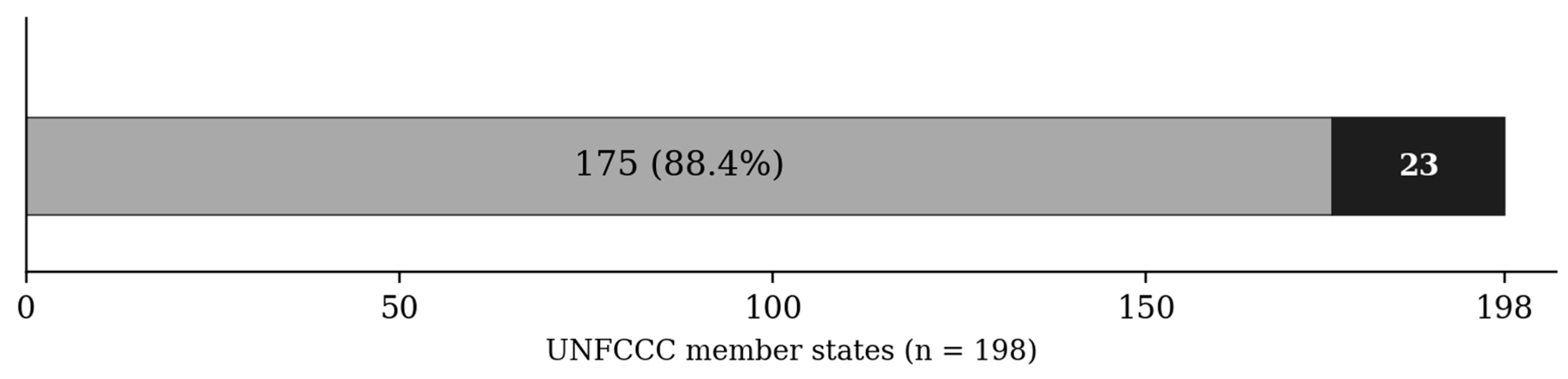
Figure 2.
Highest classified degree of SGM inclusion among the 23 countries with explicit references: sensitive, n = 15; responsive, n = 6; transformative planning capacity, n = 2. Counts are calculated from the classifications reported in Goodwin and Goldsmith [5]. Categories describe policy capacity, not verified protection outcomes.
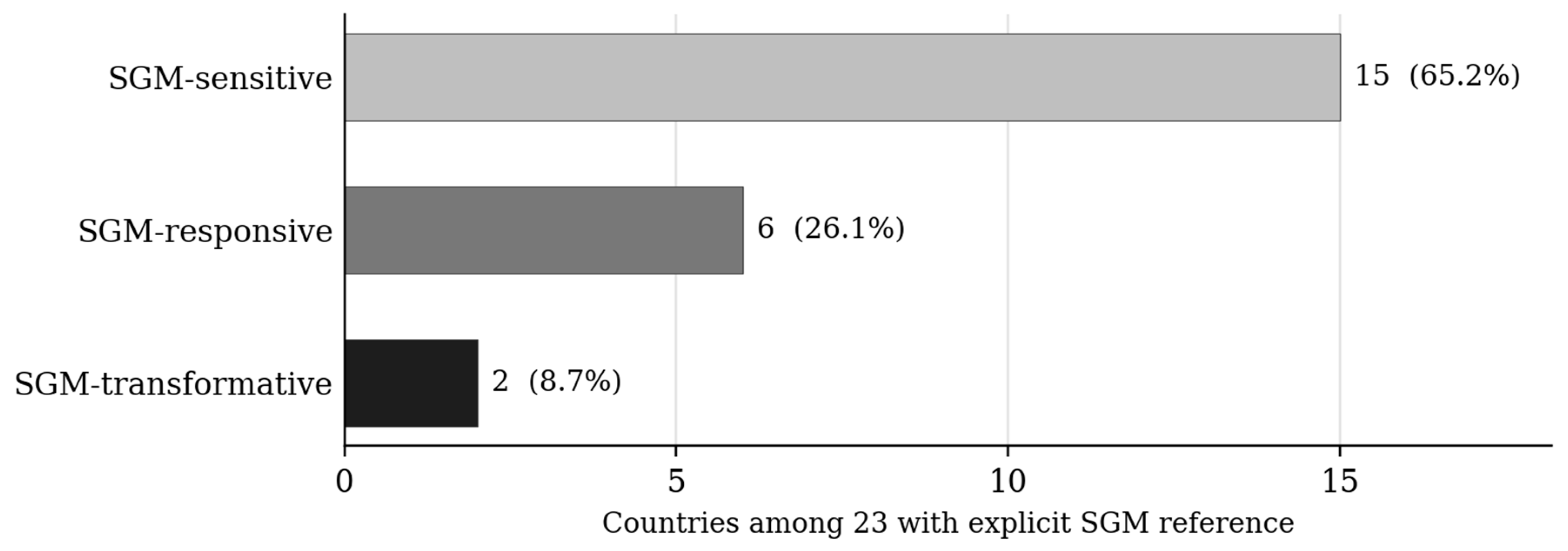
Figure 3.
Perceived inadequacy of cyclone shelters among female-headed and male-headed households in a Bangladesh study (279 households overall). Replotted from Hossain [8]. The comparison is by household headship; these are NOT LGBTQ+ or transgender group estimates.
Figure 3.
Perceived inadequacy of cyclone shelters among female-headed and male-headed households in a Bangladesh study (279 households overall). Replotted from Hossain [8]. The comparison is by household headship; these are NOT LGBTQ+ or transgender group estimates.
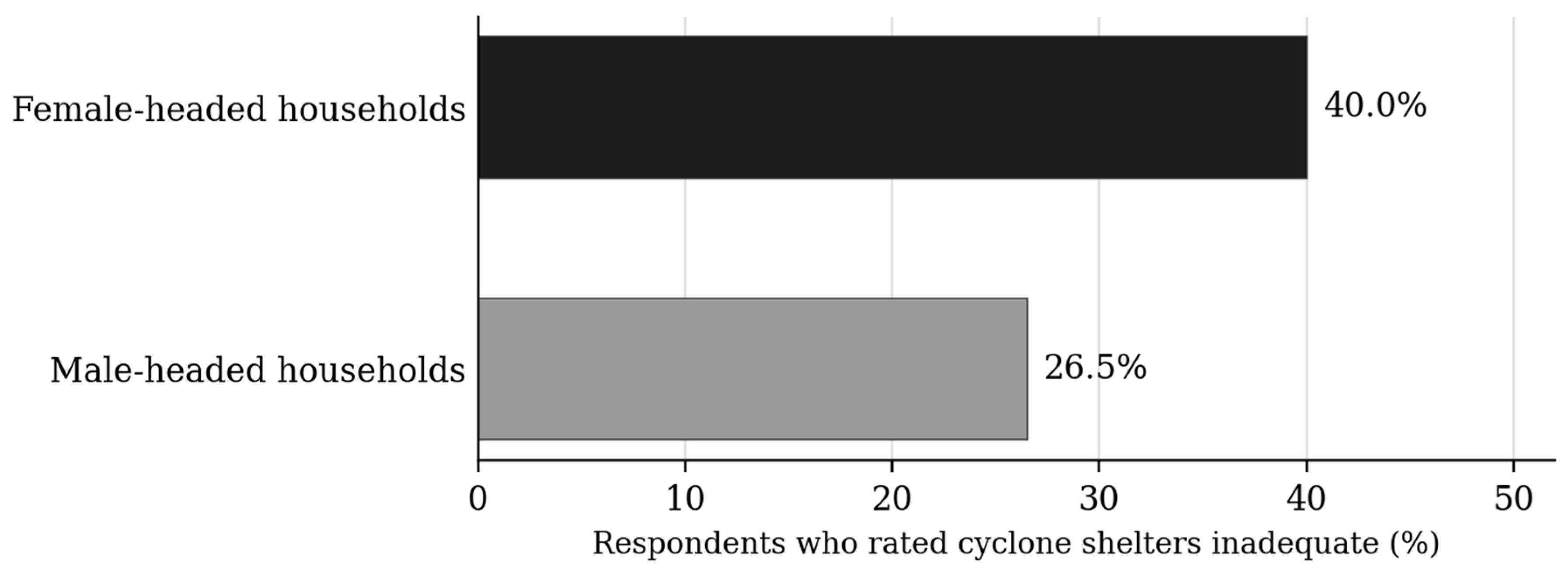
Table 1.
Core evidence streams, population coverage, and inferential boundaries.
| Source | Evidence type / setting | What it contributes | What it cannot establish |
|---|---|---|---|
| Bangladesh NAP [2] | National policy; adaptation, 2023–2050 | Explicit gender-diverse participation, inclusive budgeting, M&E concerns | Actual local shelter access or service outcomes |
| SOD 2019 [3] | Operational governance instrument; Bangladesh | Roles for warning, evacuation, shelter, relief and local committees | Compliance with each rule at every shelter |
| Cyclone Remal GiHA [4] | Rapid qualitative and secondary-data assessment; five districts | Direct reported insecurity and stigma relating to some transgender shelter users | Prevalence of exclusion, denial or disaster risk among all LGBTQ+ people |
| Goodwin and Goldsmith [5] | Global mapping of 256 documents; 198 states | Frequency and planning depth of explicit SGM inclusion | National or local implementation outcomes |
| Sharan and Gaillard [6] | Place-specific qualitative comparative research; India/Philippines | Possible shelter-admission mechanisms involving culturally specific gender identities | Frequency of analogous barriers in Bangladesh |
| Hossain [8]; Sultana et al. [9] | Household studies; coastal Bangladesh | Gendered access, trust, political connectedness and relief disparities | Any LGBTQ+ subgroup rate or causal effect |
| UN Women [10]; UNDRR [11,12] | International guidance and governance changes | Operational inclusion principles and accountability rationale | Implementation quality in a Bangladesh district |
Table 2.
Evidence-weighted conclusions and remaining uncertainties.
| Proposition | Classification | Supporting basis | Interpretive limit |
|---|---|---|---|
| Bangladesh NAP explicitly references diverse gender identities | D — directly documented | NAP summary, pp. 53 and 118 [2] | Recognition does not verify implementation |
| The NAP identifies difficulty tracking inclusive engagement | D — directly documented | NAP monitoring discussion, p. 53 [2] | Does not identify each affected locality |
| Some transgender shelter users reported discomfort and insecurity during Remal | O — reported observation | GiHA rapid assessment, p. 8 [4] | Not representative or a measured refusal rate |
| Other Bangladeshi groups face unequal warning, shelter and aid access | O — reported observation | Coastal household research [8,9] | No LGBTQ+ disaggregation |
| Binary accommodation rules may pose issues for some users | C/U — plausible mechanism | SOD clauses [3]; India comparison [6] | Requires inspection of local rules and practice |
| National rate of LGBTQ+ shelter denial, violence, or mortality | U — unmeasured in review | No suitable representative source identified | Must not be estimated from adjacent studies |
Disclaimer/Publisher’s Note: The statements, opinions and data contained in all publications are solely those of the individual author(s) and contributor(s) and not of MDPI and/or the editor(s). MDPI and/or the editor(s) disclaim responsibility for any injury to people or property resulting from any ideas, methods, instructions or products referred to in the content. |
© 2026 by the authors. Licensee MDPI, Basel, Switzerland. This article is an open access article distributed under the terms and conditions of the Creative Commons Attribution (CC BY) license (http://creativecommons.org/licenses/by/4.0/).
Copyright: This open access article is published under a Creative Commons CC BY 4.0 license, which permit the free download, distribution, and reuse, provided that the author and preprint are cited in any reuse.