

Submitted:
16 November 2026
Posted:
17 November 2026
You are already at the latest version
Abstract
Second-life lithium-ion batteries are commonly evaluated through state-of-health indi-cators such as residual capacity and internal resistance. However, these metrics do not fully capture the chemical and interfacial ageing processes that determine the safety, reliability, and long-term performance of repurposed batteries. This review critically examines the degradation pathways that are particularly relevant for second-life appli-cations, including solid–electrolyte interphase evolution, cathode–electrolyte interphase instability, electrolyte oxidation and gas generation, lithium plating, transition-metal dissolution, particle cracking, loss of electrical contact, and thermal instability. Special attention is given to the mismatch between apparent electrochemical performance and hidden safety-critical degradation. The review discusses how first-life ageing history influences second-life behavior, why batteries with similar state-of-health values may present different risk profiles, and how advanced diagnostic tools can support safer screening, grading, and repurposing decisions. Electrochemical impedance spectroscopy, differential voltage analysis, incremental capacity analysis, gas analysis, thermal testing, post-mortem characterization, and operando techniques are evaluated as complementary tools for identifying degradation signatures beyond conventional capacity-based metrics. Finally, a mechanism-informed framework is proposed to connect interfacial degradation, diagnostic uncertainty, battery management strategies, and second-life suitability. This perspective aims to support the development of safer, more reliable, and scientifically grounded pathways for the reuse of lithium-ion batteries in stationary energy storage and circular-economy applications.
Keywords:
second-life lithium-ion batteries
; state of health
; interfacial degradation
; battery degradation
; diagnostic uncertainty
; battery diagnostics
; battery safety
; repurposing
1. Introduction
The rapid expansion of electric mobility and stationary energy-storage technologies is generating an increasing population of lithium-ion batteries (LIBs) that no longer satisfy the performance requirements of their original application but may retain substantial electrochemical functionality. Rather than being directed immediately to recycling, many of these batteries can potentially be repurposed for less demanding applications, particularly stationary battery energy-storage systems (BESSs), thereby extending their useful lifetime and delaying material recovery. Such second-life strategies can contribute to more efficient use of battery resources and support circular-economy approaches, provided that the technical condition, reliability, and safety of retired batteries can be adequately established before redeployment [1,2].
The transition from first to second life has traditionally been associated with a decline in available capacity to approximately 70–80% of the initial value, although this threshold is primarily application-dependent rather than a fundamental electrochemical end-of-life criterion [2,3]. Consequently, the State of Health (SoH), most commonly expressed through residual capacity and, in some cases, resistance or power capability, has become one of the principal metrics used to classify retired LIBs and evaluate their potential for further use [3]. SoH is valuable because it provides a relatively accessible macroscopic description of performance loss. However, its interpretation becomes substantially more complex for second-life batteries, whose degradation histories may differ widely as a consequence of variations in temperature, state-of-charge windows, charging rates, depth of discharge, storage periods, and other first-life operating conditions [3].
This heterogeneity creates a fundamental limitation in assessments based predominantly on residual capacity or internal resistance. Battery ageing results from multiple coupled electrochemical, chemical, structural, and thermal processes whose relative contributions depend strongly on operating history. Importantly, ageing does not affect performance and safety in an identical or necessarily proportional manner. Different ageing pathways can modify thermal stability and failure susceptibility even when the corresponding changes in conventional electrochemical performance indicators remain comparatively modest [4]. This issue becomes particularly relevant for second-life deployment, where cells or modules originating from different service histories may exhibit apparently similar SoH values while possessing substantially different internal degradation states and safety margins [5].
For this reason, the suitability of a retired LIB for second-life operation cannot be regarded solely as a question of how much capacity remains. Reliable qualification requires consideration of the underlying physicochemical condition of the battery and of the uncertainty associated with inferring that condition from externally measurable quantities. Recent work on second-life battery assessment has therefore increasingly emphasized the need to complement conventional SoH estimation with degradation-sensitive screening, health assessment, and safety evaluation approaches [3,5]. The challenge is not simply to obtain a more accurate numerical estimate of SoH, but to determine whether the available diagnostic information is sufficient to identify degradation states that may compromise reliability or safety during a subsequent service period.
This distinction is particularly important for stationary second-life applications. Although these applications generally impose less stringent power and energy requirements than electric-vehicle operation, repurposed batteries may remain in service for extended periods and are commonly assembled into systems containing cells or modules with different ageing trajectories. Accordingly, second-life suitability should be considered an application-specific property that integrates remaining performance, degradation state, safety margin, and the operating conditions anticipated during reuse [1,2,5]. A battery that remains electrochemically functional is therefore not necessarily equally suitable for every second-life duty, and batteries exhibiting comparable capacity-based SoH should not automatically be assumed to possess equivalent risk profiles.
Against this background, this review examines second-life LIBs from a mechanism-informed perspective that extends beyond conventional SoH classification. Particular attention is given to the relationship between first-life ageing history, interfacial and physicochemical degradation, diagnostic uncertainty, and safety-critical ageing. The review first considers why similar macroscopic SoH values can correspond to different internal battery conditions, and subsequently analyzes the degradation processes most relevant to second-life reliability and safety. Advanced electrochemical, thermal, gas-analysis, structural, post-mortem, and operando diagnostic approaches are then evaluated according to the degradation information they can provide beyond capacity-based assessment. Finally, these elements are integrated into a framework intended to connect degradation mechanisms and diagnostic signatures with screening, grading, battery-management strategies, and application-specific second-life suitability.
2. Beyond State of Health: Why Similar SoH Can Represent Different Battery Conditions
State of Health (SoH) is widely used to quantify the progressive deterioration of lithium-ion batteries, but it should not be interpreted as a unique descriptor of their internal physicochemical condition. Rather, SoH is an operational health index whose value depends on the physical quantity selected to represent ageing, the reference state used for normalization, and the protocol under which that quantity is measured. Capacity, internal resistance, and energy have all been employed as SoH indices, and their definitions and interpretation differ further when moving from cell to module and pack levels [6]. This distinction is particularly important for second-life batteries. In this context, the objective is not merely to determine how much performance has been lost during first life, but to establish whether a retired battery remains suitable for subsequent use. Such assessment is complicated by incomplete or unavailable operating histories, non-uniform ageing within battery packs, differences in chemistry and system design, and variations in charging and thermal-management strategies [3]. Consequently, batteries assigned similar conventional SoH values cannot automatically be assumed to possess equivalent internal degradation states. The central issue is therefore one of information content. A scalar SoH value provides a useful description of a selected performance attribute, but it compresses a multidimensional ageing state into a single quantity. The extent to which that quantity can be used to infer underlying degradation depends on both the selected SoH definition and the additional diagnostic information available. This distinction provides the basis for examining why batteries with apparently similar health may nevertheless differ in degradation pathway, subsequent ageing behavior, and ultimately their suitability for second-life operation.
2.1. What Does State of Health Actually Represent?
Capacity-based SoH remains one of the most widely used definitions and can be expressed as:
where Qmeas is the discharge capacity measured at the current ageing state and Qref is an appropriate reference capacity, typically the corresponding beginning-of-life capacity determined under defined test conditions [6]. Although conceptually simple, this definition already illustrates an important limitation: SoHQ is meaningful only in relation to the conditions under which capacity is measured. The accessible capacity of a lithium-ion battery depends on factors including temperature, charge and discharge rate, voltage limits, relaxation periods, and the specific test protocol. Thus, two capacity values obtained under different experimental conditions cannot necessarily be interpreted as directly equivalent measures of battery health [6].
SoHQ = (Qmeas / Qref) × 100
Alternative SoH definitions describe different aspects of battery performance. Internal-resistance-based indices reflect the progressive increase in cell opposition to current flow and are therefore more closely related to power capability and voltage losses than to available charge. Energy-based indices incorporate both accessible charge and the voltage delivered during discharge. These metrics are related to ageing, but they are not interchangeable: a battery may exhibit relatively modest capacity loss while showing a more pronounced increase in resistance, or vice versa [6]. Consequently, the statement that a battery has a given percentage SoH is incomplete unless the underlying health metric is specified.
The distinction becomes still more important when moving from individual cells to modules and packs. At cell level, capacity-, resistance-, or energy-based indices refer directly to the behavior of a single electrochemical unit. At module and pack levels, however, the measured response also depends on electrical topology, cell-to-cell inconsistency, balancing strategy, and the operational limits imposed by individual cells. Su et al. showed that SoH definitions and estimation approaches therefore require different treatment at cell, module, and pack levels rather than simple extrapolation from single-cell metrics [6].
For retired batteries, this hierarchical dependence has practical consequences. A pack-level capacity measurement may characterize the usable capacity of the assembly while providing limited information about the distribution of degradation among its constituent cells. Similarly, an acceptable overall resistance or energy value does not establish that all cells within the system have aged uniformly. This is particularly relevant when batteries enter second-life evaluation after non-uniform first-life operation, a condition identified as one of the principal challenges in SoH assessment of second-life batteries [3].
The distinction between a health indicator and the underlying degradation state is therefore essential. An accurately measured SoHQ quantifies accessible capacity relative to a defined reference under specified conditions; it does not by itself identify the physical or chemical origin of the observed capacity loss. Likewise, resistance- or energy-based SoH indices quantify other performance attributes without uniquely resolving the degradation processes responsible for their evolution.
From the perspective of battery repurposing, this limitation explains why SoH assessment increasingly relies on multiple non-destructive health indicators rather than on a single capacity measurement. Vignesh et al. examined a range of non-destructive indicators applicable to second-life batteries and showed that different observables provide different levels of information regarding battery degradation and practical suitability for repurposing [7]. Their analysis also highlights an important operational constraint: diagnostic methods for second-life batteries must balance information content against testing time, equipment requirements, and the need to preserve the battery for subsequent use [7]. Accordingly, SoH should be treated as a performance-related descriptor rather than as a complete representation of battery condition. This distinction does not reduce its value for screening; instead, it defines the limits of the conclusions that can be drawn from it. The next step is therefore to examine whether batteries exhibiting similar macroscopic SoH values can nevertheless correspond to different degradation states and ageing trajectories.
2.2. Similar SoH, Different Degradation States
Interpreting SoH requires a clear distinction between three different levels of description: performance indicators, degradation modes, and degradation mechanisms. Capacity, resistance, and energy are measurable or estimable performance quantities from which health indicators can be constructed. Degradation modes describe changes in the electrochemical balance or accessible active material of the cell and are commonly expressed as loss of lithium inventory (LLI), loss of active material at the negative electrode (LAMNE), and loss of active material at the positive electrode (LAMPE). Degradation mechanisms, in contrast, are the underlying physical and chemical processes that generate these changes. Maintaining this distinction is essential because a single degradation mode can result from more than one mechanism, while several mechanisms may occur simultaneously and interact during ageing [8].
This hierarchy also reveals a fundamental limitation of conventional SoH assessment. The relationship between internal degradation and macroscopic performance is not necessarily unique. Different combinations of degradation modes and mechanisms can produce similar trajectories of capacity retention or resistance increase. Consequently, reproducing or accurately measuring these macroscopic quantities does not necessarily identify the internal degradation state responsible for them. This non-unique relationship between apparent health and internal degradation state is summarized conceptually in Figure 1. Batteries exhibiting a similar capacity-based SoH may have reached that condition through different degradation pathways and may therefore differ in diagnostic signatures, subsequent ageing behavior, and safety-relevant characteristics.
Li et al. recently demonstrated this non-uniqueness using physics-based degradation modelling constrained by experimental ageing data [8]. Three models of increasing mechanistic complexity—SEI growth only, SEI growth coupled with electrolyte dry-out, and a model incorporating five coupled degradation mechanisms—were able to reproduce conventional performance observables with comparatively similar accuracy. As illustrated for ageing at 25 °C in Figure 2a,b, the predicted capacity-based SoH trajectories remain close to the experimental data, while the models also reproduce the general evolution of short-timescale resistance. On the basis of SoH and resistance alone, therefore, discrimination between physically different degradation descriptions remains difficult [8]. The situation changes substantially when the same models are evaluated against experimentally derived degradation modes, as shown in Figure 2c–e.
Figure 2 makes the identifiability problem particularly apparent. In panel (a), all three models reproduce the overall experimental SoH evolution despite representing substantially different sets of degradation mechanisms. Li et al. reported that all three models yielded low SoH errors across the investigated temperatures, and at 25 °C the SEI-only model achieved an especially close fit despite its highly simplified physical description [8]. The resistance response in panel (b) provides additional information but still does not clearly discriminate between the competing models. The degradation-mode comparison reveals information that is hidden in these macroscopic observables. All three models predict increasing LLI (Figure 2c), but with substantially different magnitudes. More importantly, the SEI-only model necessarily predicts zero LAM at both electrodes (Figure 2d,e), whereas the experimental analysis indicates measurable LAMNE and LAMPE. Introducing electrolyte dry-out allows non-zero LAM to emerge, while the five-coupled-mechanism model provides a more complete description of the experimentally derived degradation modes [8]. Thus, a model can reproduce capacity fade with high numerical accuracy while representing the internal origin of that fade incorrectly.
For second-life assessment, the implication extends beyond model parameterization. A low error in a capacity-based SoH estimate should not be interpreted as equivalent to low uncertainty in degradation-state identification. Batteries can exhibit similar macroscopic performance while differing in lithium inventory, accessible active material, and the mechanisms responsible for those changes. Figure 2 therefore provides a quantitative illustration of why degradation-sensitive observables are required when the intended decision depends on internal condition rather than on remaining capacity alone.
The importance of this distinction has also been demonstrated experimentally under conditions explicitly designed to examine second-life behavior. Tasnim Mowri et al. aged commercial lithium-ion cells under different first-life cycling conditions until they reached approximately the same capacity-based retirement SoH and subsequently subjected them to a common second-life duty cycle [9]. Despite their similar first-life SoH, cells characterized by different first-life degradation modes did not necessarily exhibit the same degradation behavior during subsequent operation. Conversely, cells with similar SoH and similar identified degradation modes showed more comparable second-life ageing trajectories [9]. The associated post-mortem observations further supported differences in electrode condition between groups exhibiting different second-life behavior.
These results provide direct experimental support for an important distinction in second-life qualification: reaching the same capacity-retention threshold does not establish that batteries have reached that threshold through the same degradation pathway. First-life operating conditions therefore affect more than the rate at which a battery reaches its retirement criterion; they can influence the internal degradation state present when second-life operation begins [9].
The scope of this conclusion should nevertheless remain precise. The experiments of Tasnim Mowri et al. were performed on a specific commercial cell type under controlled first- and second-life protocols [9]. They demonstrate that similar capacity-based SoH can coexist with different degradation states and subsequent ageing trajectories, but they do not establish that this relationship will have the same magnitude for every cell chemistry, design, ageing history, or second-life application. Nor does similarity or dissimilarity in degradation state alone establish equivalent or different safety behavior; that question requires consideration of the specific physicochemical mechanisms involved and is addressed later in this review.
First-life history can therefore provide useful contextual information when assessing a retired battery, but it cannot substitute for present-state diagnosis. Even when operational records are available, they constrain the range of plausible degradation states rather than uniquely determining the current internal condition. Conversely, when such records are incomplete, the ambiguity associated with a conventional SoH value becomes more significant.
For second-life screening, the relevant conclusion is not that SoH lacks value, but that similar SoH should not be interpreted as proof of degradation-state equivalence. Additional information capable of discriminating between degradation modes becomes necessary whenever the subsequent application depends on characteristics that cannot be inferred reliably from capacity or resistance alone. At module and pack level, this already non-unique relationship is further complicated by cell-to-cell variability, which is considered in the following section.
2.3. Cell-to-Cell Heterogeneity and Diagnostic Uncertainty
The interpretation of battery health becomes more complex when moving from individual cells to modules and packs because ageing is not spatially uniform. Cell-to-cell variability may originate from manufacturing tolerances and initial differences in electrochemical properties, but it can increase during operation as cells experience unequal thermal environments, current distributions, mechanical conditions, and balancing histories. The result is a distribution of cell states within the same battery system rather than a single homogeneous ageing state.
Recent fleet-scale evidence has quantified the magnitude and consequences of this effect under real operating conditions. Zhou et al. analyzed data from 116 passenger vehicles equipped with NMC batteries and 17 buses equipped with LFP batteries, with individual vehicles monitored for more than three years and up to 300,000 km [10]. Their analysis showed that capacity and resistance distributions became progressively more dispersed as the batteries aged and that pack performance was constrained by the most limiting cells. Across the investigated fleets, cell-to-cell inconsistency reduced usable pack-level SoH by 6.2% and 7.5% for passenger cars and buses, respectively, and shortened pack lifetime by 17.7% and 22.8% relative to the mean lifetime of the constituent cells [10]. Resistance heterogeneity also reduced the estimated pack power capability.
These findings relate to automotive first-life operation rather than to second-life ageing itself, and this distinction is important. Their relevance to repurposing lies in demonstrating that substantial cell-level heterogeneity can already be present at the point at which an EV battery approaches retirement. A battery entering a second-life pathway should therefore not be assumed to constitute a population of cells with equivalent remaining capability merely because those cells have shared the same pack and nominal operating history.
The implications depend on pack topology. In series-connected cells, usable capacity is constrained by cells that reach voltage limits earlier than the rest of the string, while cells with comparatively high resistance can restrict power capability and generate greater local heat under load [10]. Accordingly, an aggregate pack measurement can characterize the performance of the assembly while obscuring the distribution of individual cell states responsible for that performance. For second-life qualification, information about dispersion and outlying cells may therefore be relevant in addition to central or average health indicators.
Heterogeneity also complicates the decision to retain, dismantle, sort, or regroup retired batteries. Cell-level characterization offers the greatest resolution but increases testing and handling requirements, whereas module- or pack-level assessment is faster but necessarily provides less information about internal variability. This trade-off is particularly important in industrial repurposing, where diagnostic depth must be balanced against throughput, cost, and the requirement to avoid unnecessary destructive testing [7].
Experimental second-life studies confirm that the grouping problem cannot be reduced to matching cells according to a single initial characteristic. Wang et al. investigated 86 retired lithium-ion cells over a 30-month second-life ageing campaign and showed that achieving long-term grouping consistency was challenging when previous operating histories were unknown and ageing trajectories were heterogeneous [11]. Their proposed sorting strategy used features extracted from a single charge cycle and incorporated not only initial values but also derivative-based information associated with ageing evolution. The significance of this result for the present discussion is not the particular sorting algorithm, but the demonstration that apparent similarity at the beginning of second-life operation may be insufficient to guarantee similar subsequent evolution [11]. These considerations introduce a second source of ambiguity beyond that discussed in Section 2.2. There, the problem concerned state identifiability at the individual-cell level: different degradation states can correspond to similar macroscopic health indicators. At module and pack levels, an additional problem arises because measurements may also aggregate a distribution of non-equivalent cell states. The diagnostic question is therefore not only whether a measured quantity uniquely represents the condition of one cell, but also whether the measurement has sufficient spatial resolution to identify the cells that determine system-level behavior.
In this review, the term diagnostic uncertainty is used in this operational sense: the residual uncertainty associated with inferring the degradation-relevant condition of a retired battery from the measurements and historical information that are practically available. It should be distinguished from ordinary measurement uncertainty or from the numerical error of a SoH-estimation algorithm. A capacity estimate can be highly precise while the internal distribution of degradation states remains poorly resolved. Likewise, accurate pack-level measurements do not necessarily identify which cells are approaching limiting conditions.
Incomplete first-life records further increase this uncertainty, although they are not its sole cause. Detailed operational history can help constrain plausible ageing pathways, but it cannot eliminate cell-specific variability or replace characterization of the battery at retirement. Conversely, when history is unavailable, diagnostic information obtained from the retired battery itself becomes more important for determining whether apparently similar cells can be safely and reliably regrouped [7,11].
The practical consequence is that second-life screening should account for both battery condition and its distribution within the system. This does not imply that every retired pack requires exhaustive cell-level characterization. Rather, the required diagnostic resolution should depend on the degree of observed heterogeneity, the architecture of the battery being repurposed, and the demands of the intended second-life application. Having established the limitations imposed by non-unique degradation states and cell-to-cell heterogeneity, the following section examines the specific ageing mechanisms that can remain insufficiently represented by conventional performance-based health indicators.
3. Safety-Critical Degradation Mechanisms in Aged Lithium-Ion Batteries
Ageing in lithium-ion batteries arises from coupled electrochemical, chemical, structural, and thermal processes occurring at different spatial and temporal scales. Their relative importance depends strongly on cell chemistry and design, and the mechanisms active during first life may continue to evolve, interact, or become limiting during subsequent operation. For second-life assessment, the relevant question is therefore not simply which mechanisms contribute to capacity or power fade, but which alterations of the aged cell can modify its reliability or response to normal and off-normal operating conditions.
This distinction is particularly important because degradation does not have a uniform relationship with safety. Some ageing pathways primarily reduce accessible capacity or increase impedance, whereas others introduce highly reactive species, destabilize interfaces, or modify the conditions under which exothermic reactions can initiate. Recent second-life safety studies consequently emphasize that the safety response of an aged cell depends on the dominant degradation pathway and cannot be inferred solely from the extent of capacity fade [5]. The following discussion focuses on interfacial and electrochemical degradation, electrolyte- and gas-related processes, and mechanical/electrical degradation and thermal instability, while recognizing that these categories are coupled rather than independent [12].
3.1. Interfacial and Electrochemical Degradation
Electrode–electrolyte interfaces are central to both normal lithium-ion battery operation and long-term ageing. In conventional graphite-based LIBs with liquid carbonate electrolytes, the solid–electrolyte interphase (SEI) formed on the negative electrode is essential because it passivates the electrolyte against continuous reductive decomposition while remaining sufficiently permeable to Li+ transport. The SEI is nevertheless a dynamic interphase rather than a permanently fixed layer. Its composition, morphology, thickness, and transport properties evolve during storage and cycling and are strongly affected by temperature, state of charge, current density, and excursions beyond the intended operating window [13]. Continued SEI growth consumes cyclable lithium and electrolyte and contributes to impedance increase. Mechanical or chemical destabilization of the existing interphase can also expose fresh electrode surface, promoting additional electrolyte reduction and subsequent SEI reformation. These processes constitute an important contribution to loss of lithium inventory during normal ageing, particularly in graphite-containing cells [12,13]. However, SEI evolution should not automatically be equated with increased safety hazard. Its consequences depend on the resulting composition, morphology, resistance, and interaction with other degradation processes.
This point has direct experimental support. Preger et al. compared uncycled commercial cells with cells aged under conditions selected to promote SEI growth as the dominant ageing mechanism, considering NCA, NMC, and LFP positive-electrode chemistries [14]. Across thermal, electrical, and mechanical abuse tests, aged cells dominated by SEI growth generally showed safety responses similar to, and in some cases less severe than, those of uncycled cells, although individual test metrics did reveal degradation-related changes [14]. These results are important for second-life assessment because they demonstrate that electrochemical ageing and safety degradation are not necessarily proportional.
At the positive electrode, electrolyte oxidation and reactions involving highly delithiated cathode surfaces produce a cathode–electrolyte interphase (CEI). As with the SEI, a stable CEI can be beneficial by limiting continued parasitic reactions, whereas an unstable or excessively resistive interphase contributes to impedance growth and continued electrolyte consumption. CEI formation and evolution are strongly dependent on cathode chemistry, upper cut-off voltage, electrolyte composition, and temperature, with high-voltage and Ni-rich layered oxides imposing particularly demanding interfacial conditions [12,15]. The CEI should therefore be viewed as a dynamically evolving boundary region rather than as a simple static coating.
Interfacial processes at the two electrodes are also chemically coupled through the electrolyte. Transition-metal dissolution from the positive electrode provides an important example of such electrode cross-talk. Dissolved Mn, Ni, Co, or Fe species can migrate through the electrolyte and reach the negative electrode, where their deposition may alter SEI chemistry and promote additional parasitic reactions [12]. The magnitude of this process is chemistry- and operating-condition-dependent and is particularly relevant for transition-metal oxides subjected to elevated potentials or chemically aggressive electrolyte environments.
Direct operando evidence for this cross-talk has recently been provided by Gajan et al., who monitored transition-metal dissolution and transport in operating lithium-ion cells [16]. Using LNMO-based electrodes, the authors showed that transition-metal dissolution increased at higher operating potentials and in electrolytes with lower oxidative stability, while dissolved species could be detected and trapped after migration through the cell [16]. Although the quantitative behavior reported for LNMO cannot be generalized to all commercial cathodes, the study provides direct evidence that cathode-side degradation can propagate chemically to the opposite electrode rather than remaining spatially confined.
Among interfacial ageing mechanisms, lithium plating deserves particular attention because of its different implications for both degradation and safety. Metallic lithium can deposit on the negative electrode when the local graphite potential approaches or falls below 0 V versus Li/Li+, making deposition kinetically competitive with lithium intercalation. Conditions that favor plating include low-temperature charging, high charging currents, high states of charge, and transport limitations that increase electrode polarization [12]. Once deposited, metallic lithium may be partly stripped during subsequent discharge, become electrically isolated as inactive or “dead” lithium, or react with electrolyte to form additional interphase products. These pathways contribute to loss of cyclable lithium while also leaving a highly reactive metallic phase within the aged cell.
The safety implications of lithium plating have been demonstrated experimentally in commercial cells intended to represent conditions relevant to subsequent reuse. Gerosa et al. examined graphite||NCA 18650 cells aged at low temperature to induce lithium plating and confirmed its presence using electrochemical evaluation and post-mortem analysis [17]. Compared with cells without plating, the plated cells exhibited a markedly lower onset temperature for self-heating and generally higher hazard levels across several electrical, thermal, and mechanical abuse tests [17]. In accelerating-rate calorimetry, lithium plating was associated with earlier self-heating, consistent with the high reactivity of metallic lithium toward carbonate-based electrolytes.
The contrast between this result and the SEI-dominated ageing examined by Preger et al. [14] is particularly relevant. Both SEI growth and lithium plating can contribute to loss of lithium inventory and capacity fade, yet their effects on abuse response were not equivalent. Cells dominated by SEI growth generally retained safety characteristics similar to those of fresh cells, whereas cells containing substantial lithium plating showed a significantly less favorable response in several safety tests [14,17]. This provides direct evidence that apparently related electrochemical degradation modes can have substantially different safety consequences depending on the mechanism responsible for them.
For second-life qualification, interfacial ageing must therefore be interpreted mechanistically rather than simply through the magnitude of its contribution to capacity loss. SEI and CEI evolution, transition-metal cross-talk, and lithium plating are coupled through lithium inventory, electrolyte stability, interfacial resistance, and electrode reactivity, but they do not carry equivalent implications for subsequent use. In particular, the presence of reactive metallic lithium represents information that a conventional capacity measurement cannot resolve and that may be critical to safety assessment. The next subsection considers degradation of the electrolyte itself and the associated generation of gaseous products, which provide additional pathways linking ageing to changes in cell stability.
3.2. Electrolyte Degradation and Gas Generation
The electrolyte is progressively modified throughout battery life through reactions occurring both at electrode interfaces and within the bulk liquid phase. In conventional lithium-ion batteries, carbonate solvents and lithium salts are thermodynamically unstable over parts of the operating potential range and are kinetically stabilized by passivating interphases. Ageing, elevated temperature, high electrode potentials, and the continuous formation of reactive intermediates can nevertheless sustain electrolyte decomposition over extended periods. The resulting changes include solvent and salt consumption, accumulation of soluble and insoluble decomposition products, changes in electrolyte composition, and generation of gaseous species [18]. Electrolyte degradation should therefore not be regarded simply as a consequence of electrode ageing. Because the electrolyte provides the ionic connection between both electrodes, its progressive chemical modification can affect transport properties and promote additional interfacial reactions throughout the cell. Liao et al. distinguish electrolyte ageing associated with electrode–electrolyte interphase formation from degradation occurring within the bulk electrolyte and emphasize that residual electrolyte composition can evolve substantially during battery lifetime [18]. For second-life batteries, this distinction is important because the electrolyte present at retirement has already undergone an extended history of electrochemical and chemical exposure and may differ significantly from its beginning-of-life composition.
Gas evolution is one observable consequence of these reactions. In carbonate-based lithium-ion batteries, gaseous products can arise from reductive solvent decomposition at the negative electrode, oxidative reactions at the positive electrode, chemical decomposition of electrolyte components, and reactions involving residual water or other impurities. Commonly reported species include CO2, CO, H2, C2H4, and other light hydrocarbons, although their relative abundance depends strongly on electrode chemistry, electrolyte formulation, state of charge, temperature, voltage history, and the specific degradation pathway [19]. Consequently, no single gas composition can be considered a universal signature of lithium-ion battery ageing.
Electrolyte salt chemistry introduces an additional degradation pathway. LiPF6, widely used in commercial carbonate electrolytes, can generate reactive phosphorus- and fluorine-containing products through chemical and thermal decomposition, particularly in the presence of trace water. These products can further promote electrolyte decomposition and electrode corrosion [18,19]. Such reactions illustrate why electrolyte ageing is chemically coupled to degradation at both electrodes rather than being confined to the bulk liquid phase.
Importantly, gas generation is not restricted to thermal abuse. Long-term electrochemical and calendar ageing can produce measurable quantities of gas under conditions that remain within, or close to, the intended operating range. Gasper et al. investigated commercial large-format NMC/graphite pouch cells subjected to approximately two years of calendar and cycle ageing and observed substantial gas generation together with electrode-stack expansion and other degradation signatures [20]. Their combined electrochemical and post-mortem analysis identified electrolyte decomposition as an important contributor to cell failure and concluded that electrolyte stability ultimately limited cell lifetime under several of the investigated conditions [20]. This provides direct evidence that gas accumulation can be an ageing phenomenon established before any subsequent abuse event.
The consequences of gas accumulation depend strongly on cell design. In pouch cells, internal gas generation can produce readily observable swelling because the flexible enclosure provides limited mechanical restraint. In prismatic or cylindrical cells, the same process may instead manifest as increasing internal pressure until mechanical deformation or activation of a venting mechanism occurs. Gas accumulation can also reduce effective electrolyte–electrode contact and contribute to local electrolyte depletion or dry regions, thereby increasing transport non-uniformity and potentially accelerating local degradation [19,20]. The magnitude of these effects cannot be inferred from gas generation alone, because cell geometry, free volume, mechanical constraint, electrolyte quantity, and vent design all influence the resulting response.
For safety assessment, a distinction must be maintained between gas generated progressively during ageing and off-gas released during thermal runaway or severe abuse. These phenomena are related but are not equivalent. Progressive ageing can produce relatively limited quantities of gas over long timescales, whereas thermal runaway involves rapid decomposition reactions capable of generating large quantities of flammable, toxic, and corrosive species. During severe heating or electrical abuse, decomposition of the electrolyte and reactions between the electrolyte and highly reactive electrode materials can rapidly increase both gas production and internal pressure [19]. The composition and amount of this off-gas depend on cell chemistry, state of charge, ageing state, and the conditions that initiate failure.
This distinction is particularly relevant when considering aged cells. Pre-existing electrolyte degradation can alter the chemical inventory available for subsequent reactions, while accumulated gases, reduced electrolyte quantity, or pressure-related mechanical changes may modify the conditions under which failure develops. However, ageing does not imply a simple monotonic increase in gas-related hazard: different degradation histories alter electrolyte composition and reactive material inventories in different ways. The effect on subsequent thermal behavior must therefore be established for the specific ageing pathway rather than inferred solely from cell age or capacity loss.
Gas generation nevertheless provides an important link between chemical degradation and macroscopic cell condition. Unlike capacity fade, which represents an integrated electrochemical consequence of many processes, swelling or pressure evolution can indicate that chemical reactions have produced volatile products within the sealed cell. Such information is potentially relevant to second-life screening because significant internal gas accumulation may reveal degradation not fully represented by conventional electrical metrics. The diagnostic value of pressure, gas composition, and operando gas monitoring is considered separately in Section 4.
For second-life applications, electrolyte condition is thus relevant for two related reasons. First, progressive decomposition can alter ionic transport, interfacial stability, and the remaining chemical environment in which the electrodes must operate during an additional service period. Second, gas generation can create pressure, swelling, loss of electrode–electrolyte contact, and an inventory of potentially reactive gaseous products. These processes establish a direct connection between ageing chemistry and cell-level failure modes, while their ultimate thermal consequences depend on the simultaneous evolution of electrodes, interfaces, mechanical integrity, and heat generation. These coupled mechanical and thermal aspects are considered in the following subsection.
3.3. Mechanical, Electrical, and Thermal Degradation
Repeated lithiation and delithiation impose cyclic dimensional and lattice changes on electrode materials. When these strains are spatially non-uniform or exceed the mechanical tolerance of particles and composite electrodes, progressive damage can develop at several hierarchical levels, from cracking within active-material particles to deterioration of binders, loss of adhesion, and deformation of the electrode stack. Unlike the interfacial processes discussed in Section 3.1, these phenomena directly affect the mechanical integrity and connectivity of the electrode architecture.
Recent experimental work has demonstrated that mechanical properties themselves evolve substantially with electrochemical ageing. Kawashima et al. examined cathodes extracted from cells aged to different SoH levels and identified particle cracking and binder deterioration as dominant features of mechanical degradation [21]. Increasing ageing was accompanied by reductions in Young’s modulus and yield stress, while pre-existing microcracks promoted earlier mechanical failure under subsequent loading [21]. These observations show that ageing does not merely accumulate structural defects; it can progressively weaken the electrode composite and reduce its resistance to further mechanical damage.
At the cell level, structural degradation can extend beyond individual particles. Blažek et al. followed commercial 18650 cells during 800 cycles using periodic X-ray computed tomography and complementary post-mortem characterization [22]. Progressive geometric changes in the electrode assembly included bending and delamination within the jelly roll, while higher-resolution analyses revealed void formation and cracking within the cathode active material [22]. Such observations are relevant to second-life batteries because these structural changes can already be established during first-life cycling and remain present when the cell is considered for reuse.
Mechanical damage becomes electrochemically relevant when it alters the conductive network of the electrode. Cracking, binder deterioration, delamination, or loss of adhesion to the current collector can electrically isolate portions of active material and increase contact resistance, thereby contributing to loss of active material and impedance growth [12,21,22]. The resulting current distribution may become increasingly heterogeneous as current is redirected through the remaining electrically connected pathways. At cell level, geometric deformation and non-uniform contact can similarly modify local current density and heat generation. These effects provide a direct link between structural deterioration and electrical performance without requiring a change in the intrinsic electrochemical properties of the remaining active material.
The relationship is bidirectional. Non-uniform electrochemical utilization generates non-uniform strain and heat, which can promote further structural damage, while mechanical degradation subsequently increases electrical and electrochemical heterogeneity. This feedback is particularly relevant for aged electrodes because pre-existing cracks, weakened binders, and partially disconnected regions reduce the mechanical margin available for an additional service period. The severity of these effects is nevertheless strongly dependent on electrode chemistry, particle morphology, cell design, mechanical constraint, and previous operating conditions; mechanical degradation observed in one cell architecture should therefore not be quantitatively extrapolated to another.
Supporting cell components can also undergo degradation that is not fully represented by electrode-level LLI or LAM. Separator pore blockage, local deformation, shrinkage, or loss of mechanical integrity can increase ionic-transport resistance and, in severe cases, compromise the physical isolation between the positive and negative electrodes. Current collectors may likewise undergo corrosion, surface-film formation, or local loss of electrical contact, contributing to impedance growth and increasingly non-uniform current distribution. These changes become particularly safety-relevant when they interact with lithium plating, conductive deposits, electrode deformation, or other localized defects capable of promoting an internal short circuit. Internal-short susceptibility should not, however, be inferred from ageing alone, because it depends on defect geometry, separator integrity, plating morphology, cell design, and previous mechanical and electrochemical history [12,17,22,23]. For second-life assessment, such latent failure modes are important because conventional capacity or resistance measurements may provide limited warning of a localized defect before it becomes electrically active.
Mechanical and electrical deterioration also contribute to the thermal behavior of aged cells. Increased internal or contact resistance raises irreversible heat generation under load, while spatially non-uniform resistance can produce localized temperature differences. However, the thermal stability of an aged LIB cannot be inferred from resistance growth alone. As reviewed by Wang et al., ageing modifies several quantities that influence thermal response simultaneously, including internal resistance, electrode and electrolyte inventories, interfacial condition, and the amount and distribution of electrochemically active material [4]. The net effect on safety therefore depends on the degradation pathway rather than solely on the extent of ageing.
This dependence has been examined quantitatively by Kabra et al., who combined physics-based degradation modelling with electrochemical testing and accelerating rate calorimetry to relate specific degradation states to thermal-runaway characteristics [24]. Their framework showed that different degradation modes can produce different changes in thermal-runaway onset temperature, self-heating behavior, and peak temperature even when macroscopic capacity degradation is comparable [24]. The importance of this result is mechanistic: thermal stability is an evolving property of the aged cell and cannot be represented by a universal correction based on SoH or cycle number.
Recent experiments on large-capacity aged lithium-ion cells further illustrate that thermal-safety evolution can be non-linear. Li et al. reported changes in thermal-runaway onset and peak temperatures as ageing progressed and found that the deterioration of several safety indicators was not proportional to the decrease in SoH [25]. In their investigated cells, the largest change in the composite hazard assessment occurred between the fresh state and approximately 90% SoH rather than uniformly across the complete ageing range [25]. Although these results are specific to the cells and ageing conditions investigated, they reinforce the need to treat thermal safety as an independently evolving characteristic rather than as a direct surrogate of remaining capacity.
Chemistry dependence is illustrated particularly clearly by graphite/LFP systems. In a long-term study designed around second-life-relevant ageing, Wheeler et al. compared pristine 18650 graphite/LFP cells with cells aged to approximately 30–40% SoH and found the LFP positive electrode to remain comparatively stable, whereas the negative electrode exhibited strongly heterogeneous degradation, including LiF-rich deposits, SEI thickening, graphite cracking and exfoliation, and local loss of contact [26]. Under the investigated conditions, substantial full-cell capacity loss was therefore associated predominantly with negative-electrode and electrolyte-related degradation rather than with structural deterioration of the LFP positive electrode [26]. This comparatively stable cathode response should not, however, be interpreted as safety invariance at cell or module level. Tao et al. recently examined field-aged 120 Ah LFP cells and modules under overcharge and showed that ageing modified thermal-runaway triggering, temperature evolution, gas generation, and toxicity in non-uniform ways [27]. Ageing reduced gas generation and overall toxicity in the investigated cells, while aged modules under higher-rate overcharge still exhibited severe thermal and combustion-related hazards [27]. These observations reinforce that the relative importance of degradation and safety pathways is both chemistry- and system-scale-dependent.
For second-life qualification, mechanical integrity, electrical connectivity, and thermal stability therefore represent related but distinct dimensions of battery condition. Particle cracking or electrode delamination may reduce electrically accessible active material and increase heterogeneity; increased contact resistance can modify heat generation; and the resulting thermal response depends on the complete degradation state of the cell. These processes are especially relevant because some of them can remain poorly resolved by conventional capacity measurements while materially affecting operation during a prolonged second service period.
Taken together with the interfacial and electrolyte-related processes discussed above, these mechanisms show that ageing produces a multidimensional battery state in which performance loss and safety evolution need not progress in parallel. The principal degradation processes discussed in this section and their distinct implications for second-life performance, reliability, and safety are summarized in Table 1.
Identifying these degradation states without destructive disassembly requires diagnostic observables capable of resolving different degradation signatures. The following section therefore evaluates the principal electrochemical, thermal, gas-based, structural, and chemical techniques available for second-life battery assessment.
4. Diagnostic Tools Beyond Conventional State of Health
Mechanism-informed assessment requires measurements that provide information complementary to conventional capacity and resistance metrics. The relevant diagnostic techniques differ substantially in the type of information they provide, their sensitivity to specific degradation processes, measurement time, required instrumentation, and suitability for implementation at cell, module, or pack level. Importantly, most non-destructive techniques detect signatures associated with degradation rather than directly observing the underlying physicochemical mechanism. Their diagnostic value therefore depends on measurement conditions, data interpretation, and, where necessary, validation against complementary characterization.
For second-life batteries, this distinction is particularly important. Diagnostic methods must provide sufficient information to support screening and grading while remaining compatible with the time, cost, and non-destructive character required for repurposing. Electrochemical methods are attractive in this context because they can be applied without opening the cell. Voltage and current data acquired during controlled charge or discharge can support techniques such as incremental capacity analysis (ICA) and differential voltage analysis (DVA), provided that sufficient resolution and appropriate operating conditions are available. Electrochemical impedance spectroscopy (EIS), in contrast, requires dedicated small-signal excitation and frequency-resolved acquisition, although such capability can in principle be integrated into advanced battery-testing or management systems. EIS, ICA, and DVA therefore provide complementary information on kinetic limitations, electrode balancing, and degradation evolution.
4.1. Electrochemical Diagnostics
Electrochemical impedance spectroscopy probes the small-signal response of a battery over a range of frequencies and thereby separates electrochemical processes according to their characteristic timescales. Depending on cell chemistry, state of charge, temperature, and measurement conditions, different portions of the impedance spectrum can contain contributions from ohmic resistance, interfacial films, charge-transfer kinetics, double-layer response, and solid-state or electrolyte transport. This frequency resolution gives EIS greater diagnostic content than a single direct-current resistance measurement and has made it an important tool for studying battery ageing [28].
The interpretation of EIS nevertheless requires caution. Features in a full-cell impedance spectrum generally contain overlapping contributions from the positive electrode, negative electrode, electrolyte, contacts, and cell hardware. Equivalent-circuit models can parameterize these contributions, but fitted circuit elements are not necessarily in one-to-one correspondence with individual physical processes. Similarly, distribution-of-relaxation-times analysis can improve the separation of processes occurring at different timescales but does not, by itself, establish their physicochemical origin. Electrode-level attribution is considerably more robust when supported by three-electrode measurements, half-cell or symmetric-cell experiments, or independent characterization [28]. EIS should therefore be regarded as a degradation-sensitive technique rather than as an intrinsically mechanism-specific measurement.
Measurement conditions are also critical. Impedance spectra depend strongly on temperature and state of charge, while inappropriate perturbation amplitudes, insufficient equilibration, or violation of linearity and stationarity assumptions can distort the response. Comparisons between retired cells consequently require standardized measurement conditions and appropriate data-quality validation. These constraints are particularly relevant for second-life screening, where differences caused by test conditions must not be mistaken for differences in degradation state [28].
Despite these limitations, recent work demonstrates the practical potential of EIS specifically for second-life batteries. Raza et al. investigated 18 large-format NMC/graphite pouch cells recovered from real EV use and subsequently aged under nine laboratory conditions [29]. EIS features were used in a machine-learning model for SoH estimation, while a fractional-order equivalent-circuit model was used to relate impedance evolution to degradation-mode indicators. The study achieved low prediction errors under the investigated conditions and demonstrated that EIS can provide information beyond a conventional capacity test in a heterogeneous second-life population [29]. However, the degradation-mode assignments derived from equivalent-circuit parameters remain model-dependent and should not be interpreted as direct physicochemical identification.
Incremental capacity analysis and differential voltage analysis extract diagnostic information from the evolution of the cell voltage–capacity relationship. ICA is commonly expressed as dQ/dV, whereas DVA uses dV/dQ. Differentiation transforms relatively subtle changes in the voltage profile into peaks, valleys, and shifts that can be associated with electrochemical transitions of the constituent electrodes. Changes in the position, amplitude, width, or relative separation of these features can therefore provide information on electrode balancing and degradation modes that may remain difficult to distinguish from total capacity alone [30].
The diagnostic interpretation of ICA and DVA is fundamentally linked to electrode thermodynamics. Features observed in full-cell curves arise from the superposition of the voltage responses of the positive and negative electrodes. Consequently, changes attributed to loss of lithium inventory or loss of active material are most rigorously determined when full-cell data are interpreted using appropriate electrode reference curves or validated degradation models. Peak disappearance, displacement, or broadening alone is generally not sufficient to assign a unique degradation mechanism, particularly when several ageing processes occur simultaneously.
ICA and DVA are also highly sensitive to data acquisition and processing. Numerical differentiation amplifies measurement noise, making sampling resolution, interpolation, smoothing procedure, current rate, temperature, and selected voltage window important determinants of the resulting curves. Beatty et al. compared methodologies for generating IC and DV curves and emphasized that no standardized processing procedure has yet been universally adopted; different filtering and calculation approaches can materially alter extracted features [30]. Diagnostic comparisons therefore require consistent protocols rather than visual comparison of curves generated under dissimilar conditions.
This issue has practical consequences for second-life characterization, where complete low-rate charge and discharge tests can be too time-consuming for high-throughput screening. Vignesh et al. examined voltage- and capacity-profile reconstruction for ICA specifically from a repurposer perspective [31]. Using retired Nissan Leaf modules and validation against an independent dataset, they identified partial voltage regions containing diagnostically useful ICA features and reported reductions in characterization time ranging from 16% to 83%, depending on the sampling strategy and selected operating window [31]. The result illustrates a potentially important compromise between diagnostic information and industrial testing time, although the optimum voltage window remains chemistry- and application-dependent.
ICA and DVA may also be useful for identifying ageing signatures associated with safety-relevant processes, but specificity must be demonstrated rather than assumed. Herrán et al. recently combined ICA, DVA, and EIS with CT, SEM, XRD, solid-state 7Li NMR, and electrolyte analysis in commercial NCA/SiOx–graphite cells aged under conditions designed to promote or suppress lithium plating [32]. Changes in electrochemical signatures were correlated with independent physical and chemical evidence, while metallic lithium was confirmed by solid-state 7Li NMR only in the low-temperature-aged cells [32]. This multimodal validation is important because it shows how non-destructive electrochemical signatures can be linked to a particular degradation process while also demonstrating that the electrochemical response alone may not uniquely isolate that process.
EIS, ICA, and DVA therefore offer complementary rather than interchangeable diagnostic information. EIS is particularly sensitive to changes in kinetic and transport processes distributed across different timescales, whereas ICA and DVA exploit changes in the quasi-equilibrium voltage response and electrode balancing. Their common advantage is that they can provide degradation-sensitive information without destructive cell disassembly. Their common limitation is that interpretation is conditional: signatures depend on chemistry, operating state, measurement protocol, and the coexistence of multiple ageing processes.
For second-life screening, the most robust use of these techniques is consequently not to assign a degradation mechanism from a single isolated feature, but to combine multiple electrochemical observables under controlled conditions and evaluate whether their evolution is mutually consistent. Where a diagnostic decision has direct safety implications, complementary thermal, gas-based, or physicochemical evidence may be required. These additional diagnostic dimensions are considered in the following sections.
4.2. Thermal and Gas Diagnostics
Thermal measurements provide a diagnostic dimension that is complementary to electrochemical observables because heat generation reflects the combined effects of current, internal resistance, electrochemical polarization, and reaction kinetics. Under controlled operating conditions, quantities such as surface temperature rise, heating rate, relaxation behavior, and spatial temperature distribution can therefore contain information about battery condition. Their principal advantage for second-life screening is that temperature can be measured non-invasively using conventional sensors or infrared methods without modifying the cell.
The interpretation of thermal signatures nevertheless requires carefully controlled boundary conditions. Surface temperature depends not only on internal heat generation but also on current profile, ambient temperature, cell geometry, thermal mass, sensor position, cooling conditions, and heat transfer to neighboring cells or fixtures. Consequently, temperature differences between retired batteries cannot automatically be attributed to different degradation states unless the thermal and electrical test conditions are sufficiently standardized.
Recent work specifically addressing second-life batteries illustrates both the potential and the limitations of this approach. Azizghalehsari et al. developed a screening framework based on temperature-derived features obtained from NMC 18650 cells subjected to different first- and second-life cycling conditions [33]. Machine-learning models using these thermal features produced SoH estimates with residual errors predominantly within ±0.3% and classified degradation backgrounds with an overall accuracy of 98% in the investigated dataset [33]. The study demonstrates that thermal response can contain diagnostically useful information beyond conventional electrical measurements and can potentially be acquired using relatively simple instrumentation.
These results should not, however, be interpreted as establishing universal thermal markers of degradation. The study used eight cells of a specific chemistry and format, and the reported performance refers to models trained and evaluated within the corresponding experimental domain [33]. Thermal signatures can therefore support classification and screening, but their transferability across cell formats, chemistries, cooling conditions, and ageing histories requires independent validation. Moreover, a statistically discriminative temperature feature does not necessarily identify the physicochemical process responsible for the observed difference.
A different level of thermal characterization is provided by calorimetric and abuse-testing methods. Whole-cell approaches such as accelerating rate calorimetry (ARC) can characterize self-heating behavior, the onset and progression of exothermic reactions, and thermal-runaway response under controlled conditions. Differential scanning calorimetry (DSC), by contrast, is generally applied to electrode materials, electrolyte, or other harvested cell components and provides information on component-level exothermic reactions and thermal stability. ARC and DSC therefore offer complementary rather than equivalent information on the thermal behavior of aged batteries. Their experimental complexity and, depending on the method and test endpoint, destructive or hazardous character make them less suitable for high-throughput screening of individual batteries intended for reuse. Their principal role is more appropriately safety characterization, validation of representative ageing states, investigation of specific material-level reactions, and definition of operating limits rather than routine grading of every retired cell.
The distinction is illustrated by Leonhardt et al., who investigated three types of NMC cells originating from EV and hybrid-EV applications at representative ageing states of approximately 100%, 80%, and 60% SoH [34]. Thermal abuse, overcharge, and ARC experiments showed that ageing altered several safety-relevant thermal parameters. In the investigated cells, the onset temperature of thermal runaway at 60% SoH was reduced by 17–69 °C relative to beginning-of-life cells, whereas the maximum temperature reached during thermal runaway under inert conditions decreased with ageing [34]. Selected experiments were also coupled with online gas analysis. These apparently opposing trends emphasize why thermal characterization should not be reduced to a single scalar safety indicator: ageing may increase susceptibility to initiation while simultaneously reducing the energy available during the subsequent runaway event.
Gas-related measurements provide a second, chemically sensitive diagnostic dimension. Several fundamentally different quantities can be monitored, including changes in cell volume or internal pressure, total evolved-gas volume, and the concentration or composition of individual gaseous species. These levels of measurement provide progressively different information. Swelling or pressure sensing can reveal that gas-producing reactions have occurred but generally provides limited chemical specificity. Compositional analysis can offer substantially greater insight into the reactions responsible for gas evolution, although at the cost of greater experimental complexity.
Gas-analysis approaches span operando or online techniques such as differential electrochemical mass spectrometry (DEMS) and online electrochemical mass spectrometry (OEMS), sampling-based methods including gas chromatography and GC–MS, pressure- or volume-based measurements, and increasingly compact optical or spectroscopic sensors [35]. Mass-spectrometric and chromatographic methods can provide species-resolved information and allow volatile products to be correlated with electrochemical conditions, although their temporal resolution and degree of invasiveness depend strongly on the sampling architecture. Specialized cells or gas-sampling interfaces are often required, and continuous gas removal or modification of the cell headspace can perturb the system being investigated [35].
This distinction between analytical resolution and measurement invasiveness has been examined directly by Lyu et al. [36]. The authors compared DEMS with internal non-dispersive infrared (NDIR) gas sensors for monitoring CO2, CO, H2, and CH4 evolution in graphite/NMC811 batteries. In their experimental configurations, continuous gas sampling associated with DEMS substantially affected the small electrochemical cells, whereas the internal NDIR approach enabled continuous monitoring in 800 mAh pouch cells with less than 1% capacity loss during the initial cycles [36]. The embedded sensors also captured both accumulation and subsequent consumption of gaseous species, information that can be difficult to recover when gases are continuously removed from the cell during analysis.
The result highlights an important diagnostic issue. Gas evolution is dynamic: gaseous species may be generated, consumed in secondary reactions, dissolve in the electrolyte, or remain within the cell headspace. Consequently, the absence of a particular species at a given sampling time does not necessarily demonstrate that the corresponding reaction has not occurred. Likewise, the detection of a gas species is not automatically mechanism-specific because the same product can originate from more than one chemical pathway. Gas composition should therefore be interpreted together with electrochemical state, temperature, cell chemistry, and operating history rather than as an isolated fingerprint [35,36].
Pressure and gas sensors have particular potential for future second-life monitoring because they can, in principle, provide information on chemical activity that is not directly available from voltage and current measurements. However, practical deployment requires sufficient sensitivity, selectivity, long-term stability, compatibility with sealed commercial cells, and resistance to cross-interference. Zheng et al. noted that although several real-time gas-monitoring approaches are well established at laboratory scale, continuous gas sensing remains uncommon in commercial battery systems [35]. This currently limits its immediate use as a standardized second-life screening method.
Thermal and gas diagnostics therefore occupy different positions within a second-life assessment workflow. Controlled temperature measurements are comparatively inexpensive, non-invasive, and potentially scalable, but their interpretation is indirect and highly dependent on boundary conditions. Calorimetric testing provides much stronger information on thermal stability but is less suited to high-throughput individual-cell screening. Gas analysis can offer chemically informative signatures, while simpler pressure, strain, or embedded gas sensors may ultimately provide more practical routes to continuous monitoring.
Their greatest diagnostic value is consequently likely to arise from combination with electrochemical measurements rather than from isolated use. A cell displaying an anomalous thermal response, pressure evolution, or gas signature can be distinguished from one whose capacity and impedance appear comparable, thereby providing an additional basis for identifying batteries that require more detailed characterization. Structural and chemical techniques can then be used to determine the material-level origin of such anomalous signatures, as considered in the following section.
4.3. Structural, Chemical, and Advanced Characterization
Structural and chemical characterization provides information that is generally inaccessible from electrochemical, thermal, or gas-based measurements alone. Its principal role in second-life assessment is not necessarily routine screening, but the identification and validation of the material-level changes responsible for anomalous diagnostic signatures. The available techniques span markedly different length scales and degrees of invasiveness, from non-destructive X-ray imaging of complete commercial cells to post-mortem microscopy and surface-sensitive chemical analysis.
X-ray computed tomography (CT) is particularly attractive because it can visualize the internal architecture of intact cells without physical disassembly. Depending on spatial resolution and X-ray energy, CT can reveal electrode-stack deformation, jelly-roll displacement, delamination, cracking, void formation, gas-related expansion, and other structural defects. Recent reviews of non-destructive battery characterization identify X-ray imaging as an important route for examining commercial batteries throughout their life cycle, including the evaluation of cells approaching end of life or potential second-life use [37]. Its principal limitation for large-scale repurposing remains the combination of equipment cost, acquisition time, data volume, and the trade-off between spatial resolution and the dimensions of the cell being examined.
The value of CT is illustrated by the ageing study of Blažek et al. discussed in Section 3.3 [22]. Periodic micro-CT of commercial 18650 cells enabled progressive deformation of the electrode assembly to be followed without cell disassembly, while subsequent higher-resolution and post-mortem analyses identified delamination, void formation, and other localized damage. From a diagnostic perspective, the relevant point is that imaging can spatially resolve structural heterogeneity that would otherwise be condensed into a single cell-level electrical response.
Post-mortem analysis provides substantially greater spatial and chemical resolution but sacrifices the cell and may introduce artifacts during disassembly, washing, transfer, or exposure to air. Scanning electron microscopy (SEM) can resolve particle fracture, surface deposits, porosity changes, and electrode morphology, while transmission electron microscopy (TEM) extends characterization to nanoscale and atomic-scale structural changes. Energy-dispersive X-ray spectroscopy (EDS) can add elemental information, although its sensitivity and quantitative capability depend on acquisition conditions and sample geometry. These methods are particularly valuable when the objective is to determine the physical origin of a diagnostic signature rather than to screen batteries intended for immediate reuse.
Diffraction and spectroscopic methods add complementary structural and chemical information. X-ray diffraction (XRD) can identify crystalline phases, lattice changes, and changes in phase evolution associated with ageing. X-ray photoelectron spectroscopy (XPS) is primarily sensitive to near-surface elemental composition and chemical states and is therefore useful for studying electrode surface films and interfacial products. Raman and infrared spectroscopy provide information on bonding, structural disorder, and molecular or lattice vibrations, whereas nuclear magnetic resonance (NMR) can distinguish local chemical environments that may be difficult to resolve using diffraction alone. No single technique is sufficient to reconstruct the complete degradation state; the information obtained is inherently selective with respect to spatial scale, chemical sensitivity, and sampling depth [38].
The distinction between detection and mechanistic attribution remains important. Herrán et al. provide a useful example of this approach [32]. Electrochemical signatures associated with low-temperature ageing were complemented by CT, SEM, XRD, solid-state 7Li NMR, and electrolyte analysis. Metallic lithium was directly confirmed by 7Li NMR in the cells aged under lithium-plating-promoting conditions, allowing the electrochemical observations to be validated against independent structural and chemical evidence [32]. The significance of such multimodal analysis is that a mechanism is not assigned solely because one diagnostic feature is consistent with it; instead, mutually independent measurements are used to reduce ambiguity.
Conventional post-mortem characterization, however, provides only a snapshot of the battery after operation has stopped. Some degradation phenomena are strongly state-dependent or evolve during charge, discharge, relaxation, or heating. In situ and operando techniques address this limitation by following structural or chemical changes while the battery remains under controlled electrochemical operation. Recent developments include operando XRD, X-ray absorption methods, Raman and infrared spectroscopy, NMR, electron microscopy, and related multimodal approaches [38]. These techniques can distinguish reversible electrochemical transformations from persistent degradation and can reveal transient heterogeneities that may disappear or change after the cell is opened.
Operando X-ray methods are particularly powerful when structural information must be resolved spatially within commercial-format cells. Mombrini et al. used synchrotron XRD-CT to compare pristine and aged commercial 18650 cells during cycling [39]. After 1200 cycles, the aged cell displayed pronounced structural deformation and a spatially heterogeneous distribution of graphite lithiation states. The differences between the central and outer regions of the cell became more pronounced after ageing, particularly at higher current rates [39]. This experiment demonstrates an important capability of advanced operando characterization: degradation can be mapped not only as a change in average electrode structure but also as a spatial distribution of electrochemical states within an intact commercial cell.
Such information is scientifically valuable but is not presently compatible with routine high-throughput second-life grading. Synchrotron XRD-CT, advanced NMR, high-resolution microscopy, and many surface-analysis techniques require specialized facilities, expert interpretation, and measurement times or sample preparation incompatible with industrial screening of large battery populations. Their role is therefore different from that of EIS, ICA, thermal sensing, or simple pressure measurements. Advanced structural and chemical techniques are most useful for validating degradation assignments, establishing diagnostic markers, investigating ambiguous cases, and building reference datasets against which faster non-destructive methods can be calibrated.
This distinction suggests a practical diagnostic hierarchy. Non-destructive measurements applicable to intact commercial cells can provide the first diagnostic layer, whereas advanced imaging, spectroscopy, and post-mortem analysis can be reserved for representative or anomalous batteries when greater mechanistic resolution is required. The diagnostic approaches discussed in this section therefore differ not only in the type of information they provide, but also in mechanistic specificity, practical scalability, and suitability for routine second-life screening. These characteristics are compared in Table 2.
Table 2 highlights a fundamental trade-off in second-life diagnostics. The methods most compatible with rapid screening, such as capacity, resistance, and controlled thermal measurements, provide useful information on battery performance or anomalous behavior but relatively limited mechanistic specificity. EIS, ICA, DVA, and selected non-destructive imaging techniques can reduce this ambiguity, although their interpretation remains conditional on measurement protocol and cell chemistry. In contrast, advanced chemical, structural, calorimetric, and operando techniques can provide substantially greater mechanistic resolution but are generally unsuitable for routine characterization of large retired-battery populations. Diagnostic depth should therefore be increased selectively when the information obtained at a simpler level is insufficient for the intended reuse decision. In this context, structural and chemical characterization reduces diagnostic uncertainty not by replacing rapid screening methods, but by establishing which measurable signatures genuinely correspond to specific internal conditions. This relationship between diagnostic depth, residual uncertainty, and practical screening requirements provides the basis for the mechanism-informed second-life assessment framework developed in the following section.
5. A Mechanism-Informed Framework for Second-Life Assessment
The evidence discussed in the preceding sections suggests that second-life qualification should be treated as a decision problem rather than as the application of a single health threshold. The purpose of a mechanism-informed assessment is not to identify every degradation process in every retired battery, which would be incompatible with practical repurposing, but to determine whether the available measurements provide sufficient confidence for a specific reuse decision. The relevant outputs are therefore threefold: remaining performance, evidence of degradation that may affect subsequent reliability or safety, and the uncertainty associated with that assessment.
A practical framework should consequently follow a progressive diagnostic strategy in which testing depth increases only when the information obtained at a simpler level is insufficient for the intended decision. Progressive screening approaches have already been proposed for second-life batteries [5], but the framework considered here places particular emphasis on diagnostic uncertainty and application requirements as the criteria for escalation. It should be regarded as a decision architecture rather than as a validated universal grading standard: chemistry-independent numerical thresholds for capacity, impedance, temperature, or other diagnostic quantities cannot presently be justified across all cell designs and second-life applications.
The first level comprises rapid baseline screening. Its purpose is to identify batteries that are clearly unsuitable for further evaluation and to establish the basic performance and consistency of those that remain. Depending on whether repurposing is performed at pack, module, or cell level, this stage may include identification of chemistry and configuration, inspection for physical damage or abnormal deformation, voltage and temperature consistency, capacity or energy measurement where practicable, resistance or pulse-power assessment, self-discharge behavior, and comparison among constituent cells. These measurements are relatively accessible and compatible with industrial screening, but their role should remain limited to what they directly establish. A battery that performs consistently at this level can proceed to application matching when the diagnostic confidence is sufficient; anomalous, internally heterogeneous, or poorly characterized batteries require additional assessment rather than automatic classification solely from an SoH value [7,11].
The second level consists of enhanced non-destructive diagnostics intended to reduce ambiguity without sacrificing the battery. EIS can provide additional information on kinetic and transport evolution [29], while ICA or DVA can help discriminate changes in electrode balance when suitable voltage–capacity data are available [31]. Controlled thermal signatures can identify atypical heat-generation behavior [33], and pressure, swelling, or gas-related measurements may provide complementary evidence of chemical activity. X-ray imaging can also be considered selectively when structural integrity is uncertain and the required equipment is available [37]. The objective at this level is not necessarily to assign a unique degradation mechanism, but to determine whether independent observables converge toward a sufficiently consistent description of battery condition.
Escalation to a third level is justified when substantial diagnostic ambiguity remains, when non-destructive measurements indicate a potentially safety-relevant condition, or when representative characterization is required to validate a screening methodology. Mechanistic validation may include calorimetric testing, advanced imaging, chemical or spectroscopic analysis, and post-mortem characterization. Such methods should not be viewed as routine tests for every cell intended for reuse. Destructive analysis is more appropriately applied to representative cells from a sufficiently homogeneous batch, to rejected cells, or to specimens specifically selected for validation. In this way, high-resolution characterization can establish relationships between non-destructive signatures and internal degradation without unnecessarily sacrificing large numbers of reusable batteries [32,34,37].
The outcome of this diagnostic hierarchy should not be a simple binary classification between “usable” and “unusable”. Second-life suitability is inherently application-specific. A battery that no longer meets the current, power, temperature, or reliability requirements of one application may remain technically suitable for another operating under narrower or less demanding conditions. Accordingly, the diagnostic result should be evaluated against the expected current profile, required power and energy, permissible state-of-charge and depth-of-discharge ranges, thermal environment, cycling frequency, expected service duration, and consequence of failure in the intended application.
This principle also applies to cell grouping. Piombo et al. demonstrated that incorporating the requirements of the target second-life application directly into the regrouping process can outperform application-agnostic sorting [40]. In their study, application-aware optimization reduced module current and thermal gradients by 34.4% and 20.2%, respectively, and increased predicted remaining useful life by 22.7% relative to conventional grouping approaches [40]. Although these quantitative results are specific to the investigated modelling framework, they support a broader principle: the most appropriate grouping of retired cells depends on how the resulting module will actually be operated, rather than on similarity in a single initial health metric.
The same logic should extend from qualification to battery management. Diagnostic information obtained before repurposing should inform the operating envelope imposed during second life. Cells or modules with reduced power capability, greater thermal sensitivity, or increased internal dispersion may require lower current limits, narrower SoC windows, more conservative temperature limits, or stronger balancing and monitoring requirements. Recent second-life BMS research has explicitly incorporated ageing-related variability into control strategies, including active balancing and operation within a defined safe operating envelope [41]. The BMS should therefore not be considered merely a means of estimating SoC and SoH after repurposing, but as the mechanism through which the limitations identified during qualification are translated into operational constraints.
A mechanism-informed decision process can consequently lead to several outcomes. Batteries showing satisfactory and sufficiently well-characterized behavior may be reused within the intended application; heterogeneous populations may require regrouping or reconfiguration; batteries with identifiable limitations may remain suitable under a restricted operating envelope; ambiguous cases may require additional diagnosis; and batteries presenting unacceptable physical or safety-related abnormalities should be excluded from reuse and directed toward appropriate end-of-life treatment. The specific acceptance boundaries must depend on chemistry, design, application, and validated test procedures rather than on universal thresholds proposed without sufficient evidence.
Diagnostic uncertainty is central to this decision logic. Additional testing is useful only when the information it provides can materially change the reuse decision. Conversely, the absence of an observable anomaly does not justify unlimited diagnostic escalation when the intended application is low-demand and the available evidence already provides adequate confidence. A rational screening process should therefore balance three quantities: the consequence of an incorrect classification, the residual diagnostic uncertainty, and the cost and complexity of obtaining additional information. Higher-consequence applications justify a greater diagnostic burden than low-power, non-critical uses. The proposed mechanism-informed qualification strategy is summarized in Figure 3. The framework is structured as a progressive decision process in which batteries undergo increasingly detailed diagnosis only when the information obtained at an earlier stage is insufficient for a reliable application-specific decision.
The framework can thus be summarized as a conditional sequence linking first-life information and baseline battery identity to rapid screening, followed, when necessary, by enhanced non-destructive diagnosis and selective mechanistic validation. The resulting evidence is then interpreted in relation to application-specific requirements to support reuse, regrouping, restricted operation, further diagnosis, or rejection for recycling. In this structure, conventional performance metrics are not discarded, but placed within a broader decision architecture in which diagnostic confidence and the consequence of an incorrect classification determine how much additional characterization is justified.
6. Conclusions and Outlook
Second-life qualification of lithium-ion batteries cannot be reduced to the determination of a single State-of-Health value. Capacity, resistance, and related performance indicators remain useful for screening and comparison, but they do not uniquely identify the physicochemical state of an aged battery. Cells with similar apparent health may have reached that condition through different degradation pathways, may contain different distributions of damage within the electrode structure, and may not exhibit equivalent reliability or safety margins during subsequent operation.
The evidence reviewed here shows that this distinction is particularly important when degradation affects interfaces, electrolyte stability, lithium deposition, transition-metal transport, electrode integrity, electrical connectivity, or thermal response. These processes do not evolve in a uniform manner and do not necessarily scale directly with capacity loss. Their influence on second-life behavior depends on chemistry, cell design, first-life operating history, and the interaction between multiple ageing mechanisms. A mechanism-informed assessment therefore requires interpretation of conventional performance metrics within a broader description of battery condition rather than their replacement by another single health indicator.
No individual diagnostic technique can provide that description in all cases. Electrochemical methods such as EIS, ICA, and DVA offer scalable and non-destructive access to degradation-sensitive signatures, whereas thermal and gas measurements provide complementary information on heat generation and chemical activity. Structural, spectroscopic, and post-mortem techniques offer greater mechanistic resolution but are less compatible with routine high-throughput screening. Their most effective use is therefore hierarchical and complementary: rapid measurements can identify batteries requiring additional attention, while advanced characterization can validate degradation assignments and establish the physical meaning of diagnostic signatures.
This diagnostic hierarchy also implies that second-life suitability should be treated as an application-specific decision. The same battery may be acceptable for one operating profile and unsuitable for another because the relevant limits depend on current demand, usable energy, temperature, duty cycle, expected service duration, and consequence of failure. Qualification should therefore connect measured battery condition with the requirements of the intended second-life application and translate the resulting limitations into appropriate grouping, operating windows, monitoring requirements, and battery-management strategies.
A major challenge for future work is the development of validated relationships between non-destructive diagnostic signatures and degradation states that are directly relevant to long-term reliability and safety. This will require datasets that combine electrochemical, thermal, structural, chemical, and operational information across different chemistries, cell formats, ageing histories, and second-life duty cycles. Validation across independent laboratories and commercial battery populations will be particularly important if diagnostic indicators are to move from research-scale demonstrations to generally applicable qualification procedures.
Standardization is equally important. Differences in temperature, state of charge, current rate, equilibration time, data processing, and cell configuration can substantially alter diagnostic observables. Without harmonized test protocols, thresholds derived for one battery population cannot be transferred reliably to another. Future second-life qualification methods should therefore report not only the diagnostic quantity used, but also the measurement protocol, operating conditions, uncertainty, and domain over which the resulting classification has been validated.
Further progress will also depend on integrating diagnostics with battery-management systems throughout the second-life period. Qualification should not be viewed as a one-time decision made at the beginning of reuse. Degradation continues after repurposing, and cells grouped according to an initially similar condition may subsequently diverge. Monitoring strategies capable of detecting emerging electrical, thermal, or chemical anomalies could therefore allow operating limits to be adapted as the battery ages, reducing the dependence on fixed acceptance thresholds established only at the beginning of second life.
The resulting perspective is one in which State of Health remains useful but no longer serves as the sole descriptor of battery condition. A more robust second-life strategy combines performance assessment, degradation-sensitive diagnostics, explicit treatment of diagnostic uncertainty, and application-specific operating requirements. The objective is not exhaustive characterization of every retired battery, but a defensible level of diagnostic confidence commensurate with the consequences of the reuse decision. Such an approach offers a practical route toward safer and more reliable second-life deployment while preserving the economic and environmental benefits associated with extending lithium-ion battery service life.
Author Contributions
Conceptualization, F.M.; methodology, F.M.; formal analysis, F.M.; investigation, C.M.-P., M.C.C., F.D., J.D., F.M.; resources, F.M., M.C.C.; writing—original draft preparation, C.M.-P., M.C.C., F.D., J.D., F.M.; writing—review and editing, C.M.-P., M.C.C., F.D., J.D., F.M.; supervision, F.M.; project administration, F.M.; funding acquisition, F.M. All authors have read and agreed to the published version of the manuscript.
Funding
The authors gratefully acknowledge financial support from the NSF Center for the Advancement of Wearable Technologies (CAWT, Grant 1849243), the Consortium of Hybrid Resilient Energy Systems (CHRES, Grant DE-NA0003982).
Institutional Review Board Statement
Not applicable.
Informed Consent Statement
Not applicable.
Data Availability Statement
No new data were created or analyzed in this study. Data sharing is not applicable to this article.
Acknowledgments
Generative artificial intelligence tools were used to assist in the graphical preparation of Figure 1 and Figure 3 and for limited language and grammatical editing of the manuscript. All scientific content, interpretations, conclusions, and final graphical elements were reviewed and approved by the authors, who take full responsibility for the published work. The authors gratefully acknowledge Dock García, and Dina Márquez, for their valuable assistance in organizing and updating the research databases, as well as for their support in coordinating the bibliography.
Conflicts of Interest
The authors declare no conflict of interest.
Abbreviations
The following abbreviations are used in this manuscript:
ARC — Accelerating rate calorimetry
BESS — Battery energy storage system
BMS — Battery management system
CEI — Cathode–electrolyte interphase
CT — Computed tomography
DC — Direct current
DEMS — Differential electrochemical mass spectrometry
DSC — Differential scanning calorimetry
DVA — Differential voltage analysis
EDS — Energy-dispersive X-ray spectroscopy
EIS — Electrochemical impedance spectroscopy
EV — Electric vehicle
GC — Gas chromatography
GC–MS — Gas chromatography–mass spectrometry
ICA — Incremental capacity analysis
LAM — Loss of active material
LAMNE — Loss of active material at the negative electrode
LAMPE — Loss of active material at the positive electrode
LFP — Lithium iron phosphate
LIB — Lithium-ion battery
LLI — Loss of lithium inventory
LNMO — Lithium nickel manganese oxide
NCA — Lithium nickel cobalt aluminum oxide
NDIR — Non-dispersive infrared
NMC — Lithium nickel manganese cobalt oxide
OEMS — Online electrochemical mass spectrometry
SEI — Solid–electrolyte interphase
SoC — State of charge
SoH — State of Health
XRD–CT — X-ray diffraction computed tomography
References
- Roslan, M.F.; Satpathy, P.R.; Prasankumar, T.; Ramachandaramurthy, V.K.; Mansor, M.; Walker, S.L. Second-Life Battery Energy Storage System for Energy Sustainability: Recent Advancements, Key Takeaways and Future Perspectives. J. Energy Storage 2025, 123, 116808. [Google Scholar] [CrossRef]
- Nazim, M.S.; Madurai Elavarasan, R. Extending Battery Lifecycles: A Holistic Review of Second-Life Lithium-Ion Technology in Sustainable Energy Systems from Assessment to Emerging Trends. Renew. Sustain. Energy Rev. 2026, 233, 116848. [Google Scholar] [CrossRef]
- S, V.; Che, H.S.; Selvaraj, J.; Tey, K.S.; Lee, J.W.; Shareef, H.; Errouissi, R. State of Health (SoH) Estimation Methods for Second Life Lithium-Ion Battery—Review and Challenges. Appl. Energy 2024, 369, 123542. [Google Scholar] [CrossRef]
- Wang, Z.; Zhao, Q.; Wang, S.; Song, Y.; Shi, B.; He, J. Aging and Post-Aging Thermal Safety of Lithium-Ion Batteries under Complex Operating Conditions: A Comprehensive Review. J. Power Sources 2024, 623, 235453. [Google Scholar] [CrossRef]
- Hasan, M.I.; Lei, G.; Lu, D.; Durruty, P.P. A Review of Thermal Safety and Management of Second-Life Batteries: Cell Screening, Pack Configuration and Health Estimation. Batteries 2026, 12, 99. [Google Scholar] [CrossRef]
- Su, L.; Xu, Y.; Dong, Z. State-of-health Estimation of Lithium-ion Batteries: A Comprehensive Literature Review from Cell to Pack Levels. Energy Convers. Econom. 2024, 5, 224–242. [Google Scholar] [CrossRef]
- Vignesh, S.; Che, H.S.; Selvaraj, J.; Tey, K.S. State of Health Indicators for Second Life Battery through Non-Destructive Test Approaches from Repurposer Perspective. J. Energy Storage 2024, 89, 111656. [Google Scholar] [CrossRef]
- Li, R.; Kirkaldy, N.D.; Oehler, F.F.; Marinescu, M.; Offer, G.J.; O’Kane, S.E.J. The Importance of Degradation Mode Analysis in Parameterising Lifetime Prediction Models of Lithium-Ion Battery Degradation. Nat. Commun. 2025, 16, 2776. [Google Scholar] [CrossRef] [PubMed]
- Tasnim Mowri, S.; Barai, A.; Moharana, S.; Gupta, A.; Marco, J. Assessing the Impact of First-Life Lithium-Ion Battery Degradation on Second-Life Performance. Energies 2024, 17, 501. [Google Scholar] [CrossRef]
- Zhou, L.; Bian, X.; Zhang, Y.; Wang, Z.; Chen, Z.; Mao, Z.; Zou, C. Quantifying the Impact of Cell-to-Cell Inconsistency on Electric Vehicle Battery Degradation and Utilization. Nat. Energy 2026. [Google Scholar] [CrossRef]
- Wang, S.; Gao, F.; Tian, H. Deep Sorting of Reused Batteries for Enabling Long-Term Consistency Grouping with Unknown Prior Conditions. Cell Rep. Phys. Sci. 2025, 6, 102657. [Google Scholar] [CrossRef]
- Jeon, D.H.; Kim, S.; Hempelmann, R. State-of-the-Art Review of Degradation Mechanisms of Commercial Lithium-Ion Batteries. J. Power Sources 2025, 646, 237242. [Google Scholar] [CrossRef]
- Hao, M.; Weng, S.; Zhong, C.; Li, Y.; Wang, X. Structure and Evolution of Solid Electrolyte Interphase (SEI) at the Electrode-Electrolyte Interface. Mater. Today Energy 2025, 53, 101998. [Google Scholar] [CrossRef]
- Preger, Y.; Feinauer, M.; Torres-Castro, L.; Hogrefe, C.; Gray, L.; Gerosa, G.; Langendorf, J.; Häfele, S.; Wittman, R.M.; Wörz, M.; et al. Impact of Testing Method on Safety Assessment of Aged Li-Ion Cells: Part II – Aged Cells Without Li Plating. J. Electrochem. Soc. 2025, 172, 080503. [Google Scholar] [CrossRef]
- Zhang, Y.; Wang, J. Stabilizing the Cathode-Electrolyte Interphase for Superior Li-Ion Batteries. Green Chem. Eng. 2025, 6, 447–455. [Google Scholar] [CrossRef]
- Gajan, A.; Var, K.; Rajendiran, R.; Lemineur, J.-F.; Guiader, O.; Mortemard De Boisse, B.; Simon, B.; Demeaux, J.; Lucas, I.T. Dynamics of Transition Metal Dissolution and Cross-Contamination in Operating Lithium-Ion Batteries. J. Power Sources 2025, 630, 236031. [Google Scholar] [CrossRef]
- Gerosa, G.G.; Feinauer, M.; Hogrefe, C.; Häfele, S.; Bischof, K.; Wörz, M.; Böse, O.; Wohlfahrt-Mehrens, M.; Hölzle, M.; Waldmann, T. Impact of Testing Method on Safety Assessment of Aged Li-Ion Cells: Part I – Li Plating as Main Aging Mechanism. J. Electrochem. Soc. 2025, 172, 030502. [Google Scholar] [CrossRef]
- Liao, Y.; Zhang, H.; Peng, Y.; Hu, Y.; Liang, J.; Gong, Z.; Wei, Y.; Yang, Y. Electrolyte Degradation During Aging Process of Lithium-Ion Batteries: Mechanisms, Characterization, and Quantitative Analysis. Adv. Energy Mater. 2024, 14, 2304295. [Google Scholar] [CrossRef]
- Gong, T.; Duan, X.; Shan, Y.; Huang, L. Gas Generation in Lithium-Ion Batteries: Mechanisms, Failure Pathways, and Thermal Safety Implications. Batteries 2025, 11, 152. [Google Scholar] [CrossRef]
- Gasper, P.; Sunderlin, N.; Dunlap, N.; Walker, P.; Finegan, D.P.; Smith, K.; Thakkar, F. Lithium Loss, Resistance Growth, Electrode Expansion, Gas Evolution, and Li Plating: Analyzing Performance and Failure of Commercial Large-Format NMC-Gr Lithium-Ion Pouch Cells. J. Power Sources 2024, 604, 234494. [Google Scholar] [CrossRef]
- Kawashima, Y.; Sun, S.; Sumiya, D.; Yonezu, A.; Xu, J. Aging-Driven Mechanical Degradation of Lithium-Ion Battery Cathodes. J. Power Sources 2026, 663, 238949. [Google Scholar] [CrossRef]
- Blažek, P.; Klvač, O.; Šedina, M.; Čech, O.; Tkadlecová, M.; Stravová, Z.; Kazda, T.; Zikmund, T.; Schmitt, R.H.; Kaiser, J. Comprehensive Analysis of Degradation Mechanisms in 18650 Li-Ion Cells under Prolonged Cycling Conditions. J. Energy Storage 2025, 130, 117436. [Google Scholar] [CrossRef]
- Setta, J.; Lecocq, A.; Desprez, P.; Origuchi, M.; Destriau, L.; Marlair, G.; Carlier, D.; Croguennec, L.; Bordes, A. Internal Short Circuits in Lithium-Ion Batteries; Origins, Detection, and Experimental Reproduction: A Review. J. Power Sources 2025, 658, 238265. [Google Scholar] [CrossRef]
- Kabra, V.; Karmakar, A.; Vishnugopi, B.S.; Mukherjee, P.P. Quantifying the Effect of Degradation Modes on Li-Ion Battery Thermal Instability and Safety. Energy Storage Mater. 2025, 74, 103878. [Google Scholar] [CrossRef]
- Li, Y.; Huang, S.; Kang, J.; Qi, C. Quantifying the Safety Evolution of Aging Large-Capacity Lithium-Ion Batteries. Energy Storage 2026, 8, e70437. [Google Scholar] [CrossRef]
- Wheeler, W.; Bultel, Y.; Venet, P.; Sari, A.; Riviere, E. Postmortem Analysis of 18650 Graphite/LFP Cells in a Long-Term Aging Study for Second-Life Applications. Batteries 2024, 10, 119. [Google Scholar] [CrossRef]
- Tao, Z.; Zhou, H.; Yang, B.; Wang, Y.; Zhao, L.; Zhang, H. Experimental Study of Thermal Runaway Characteristics and Quantitative Risk Assessment of Field-Aged LiFePO4 Batteries under Overcharging. J. Energy Storage 2026, 161, 121975. [Google Scholar] [CrossRef]
- Yin, S.; Liu, Y.; Wang, Y.; Si, Y.; Xiao, Y.; Su, M.; Zhou, X. Impedance Characterization for Electrode-Level Aging Diagnosis of Lithium-Ion Battery: A Critical Review. Appl. Energy 2026, 412, 127736. [Google Scholar] [CrossRef]
- Raza, K.; Samadi, A.F.; Berecibar, M.; Hosen, M.S. From EV to Stationary Energy Storage: EIS-Based SoH Estimation for Second Life Li-Ion Batteries. J. Energy Storage 2026, 141, 119316. [Google Scholar] [CrossRef]
- Beatty, M.; Strickland, D.; Ferreira, P. A Review of Methods of Generating Incremental Capacity–Differential Voltage Curves for Battery Health Determination. Energies 2024, 17, 4309. [Google Scholar] [CrossRef]
- S, V.; Che, H.S.; Selvaraj, J.; Tey, K.S. Need of Voltage and Capacity Profile Reconstruction in Incremental Capacity Analysis for Second Life Batteries from Repurposer Perspective. J. Energy Storage 2024, 100, 113453. [Google Scholar] [CrossRef]
- Herrán, Á.; Torrano, I.; Lian, J.X.; Monsalve-Serrano, J.; Garcia, A.; Bekaert, E. Advanced Electrochemical Diagnostics Validation for Early Detection of Lithium Plating in Lithium-Ion Batteries. ACS Omega 2026, 11, 24976–24990. [Google Scholar] [CrossRef] [PubMed]
- Azizghalehsari, S.; Venugopal, P.; Soeiro, T.B.; Rietveld, G. Hybrid Screening and Diagnostic Model for Second-Life Li-Ion Batteries Using Thermal Signatures. J. Energy Storage 2026, 163, 122208. [Google Scholar] [CrossRef]
- Leonhardt, R.; Lecocq, A.; Krug Von Nidda, J.; Part, F.; Jandric, A.; Prenner, S.; Berthaud, M.; Rabette, C.; Marlair, G.; Schmidt, A.; et al. Effects of Ageing on Thermal Stability and Gas Emissions in Lithium-Ion Cells Regarding Second-Life Applications. Energy Rep. 2026, 15, 109240. [Google Scholar] [CrossRef]
- Zheng, T.; Muneeswara, M.; Bao, H.; Huang, J.; Zhang, L.; Hall, D.S.; Boles, S.T.; Jin, W. Gas Evolution in Li-Ion Rechargeable Batteries: A Review on Operando Sensing Technologies, Gassing Mechanisms, and Emerging Trends. ChemElectroChem 2024, 11, e202400065. [Google Scholar] [CrossRef]
- Lyu, S.; Zhang, K.-L.; Xin, Y.; Li, N.; Guo, X.-H.; Liang, Z.; Zhang, Y.; Chen, H.-S.; Song, W.-L. Comparison of Monitoring Gas Evolution in Commercial Li-Ion Batteries: Differential Electrochemical Mass Spectrometry versus Operando Internal Non-Destructive Gas Sensors. Chem. Phys. Lett. 2025, 876, 142284. [Google Scholar] [CrossRef]
- Gervillié-Mouravieff, C.; Bao, W.; Steingart, D.A.; Meng, Y.S. Non-Destructive Characterization Techniques for Battery Performance and Life-Cycle Assessment. Nat. Rev. Electr. Eng. 2024, 1, 547–558. [Google Scholar] [CrossRef]
- Zhao, X.; Lou, J.; Gao, J.; Pang, S.; Wang, L.; Wang, L.; Wang, Y.; Xu, Y.; Cheng, D.; He, X.; et al. From Synthesis to Failure: In Situ Characterization of Lithium-Ion Battery Cathodes. Small 2026, 22, e74917. [Google Scholar] [CrossRef] [PubMed]
- Mombrini, I.; Heenan, T.M.M.; Checchia, S.; Jnawali, A.; Tan, C.; Johnson, M.J.; Di Michiel, M.; Jervis, R.; Rettie, A.J.E.; Brett, D.J.L.; et al. Operando Phase Transition Mapping of the Negative Electrode of a Li-Ion 18 650 Battery at High C-Rates through Fast Synchrotron XRD-CT Measurements. Sustain. Energy Fuels 2025, 9, 1848–1858. [Google Scholar] [CrossRef]
- Piombo, G.; Faraji Niri, M.; Marco, J. A Novel Application-Aware Retired Lithium-Ion Batteries Regrouping Approach to Enable Improved Second Life. J. Clean. Prod. 2025, 489, 144526. [Google Scholar] [CrossRef]
- Ong, K.H.; Ramasamy, A.K.; Hashim, T.J.T.; Lee, J.Y. Logic-Based Battery Management System for Second-Life Batteries Enabling Rapid Fault Mitigation in Malaysian Photovoltaic Integrated Distribution Networks. Energy Storage 2026, 8, e70408. [Google Scholar] [CrossRef]
Figure 1.
Conceptual illustration of how similar capacity-based State-of-Health (SoH) values can correspond to different internal degradation states in retired lithium-ion batteries. The examples contrast SEI-dominated ageing, lithium plating, and electrolyte/structural degradation to illustrate that comparable residual capacity does not imply equivalent physicochemical condition, diagnostic signature, or safety margin. The depicted first-life histories and degradation states are illustrative and do not imply a unique or quantitative correspondence between operating history, SoH, and degradation mechanism.
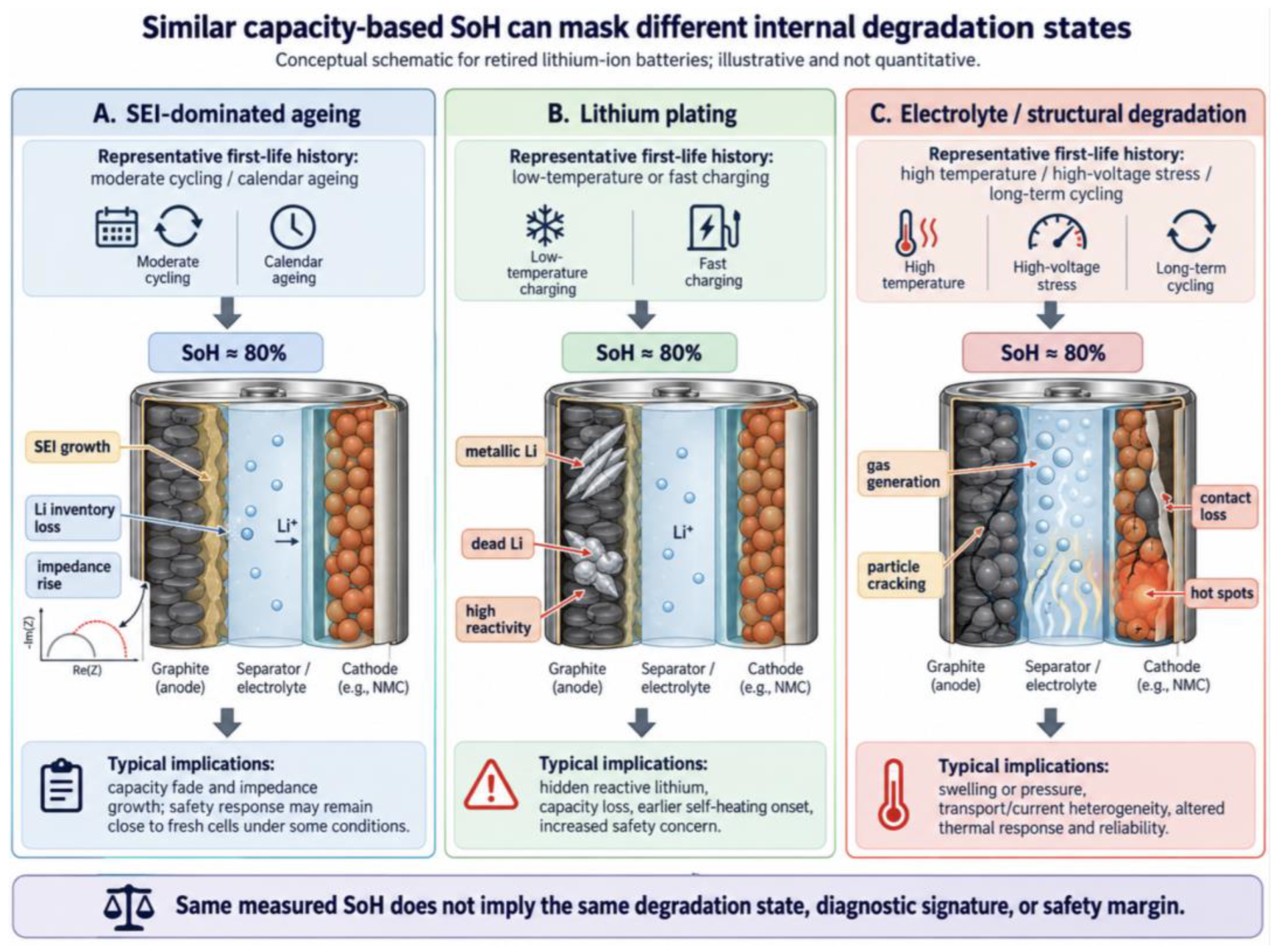
Figure 2.
Comparison of macroscopic performance indicators and degradation-mode predictions for three physics-based lithium-ion battery degradation models evaluated at 25 °C. (a) Capacity-based State of Health (SoH); (b) 0.1 s resistance; (c) loss of lithium inventory (LLI); (d) loss of active material at the negative electrode (LAMNE); and (e) loss of active material at the positive electrode (LAMPE), as functions of charge throughput. Grey curves represent the two experimental cells, the black curve their average, and the colored curves the SEI-only, SEI + dry-out, and five-coupled-mechanism models. Similar agreement with SoH and resistance can coexist with markedly different predictions of the underlying degradation modes, illustrating the non-unique relationship between conventional health indicators and internal degradation state. Adapted from Li et al. [8] under the Creative Commons Attribution 4.0 International License.
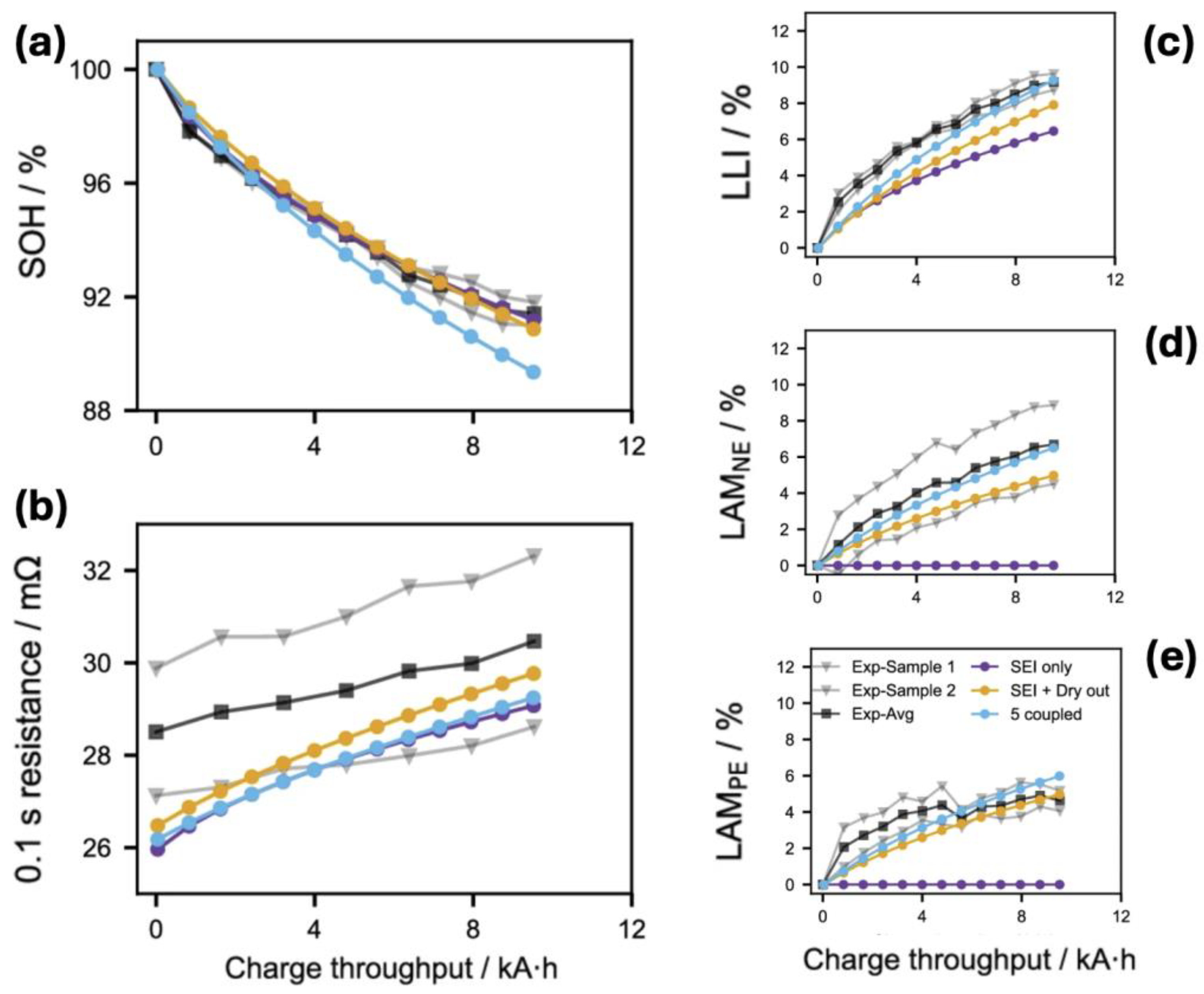
Figure 3.
Mechanism-informed framework for second-life lithium-ion battery qualification. The workflow begins with first-life information and battery identity, followed by Tier 1 rapid screening. When confidence is sufficient, batteries proceed directly to application matching; otherwise, enhanced non-destructive diagnostics (Tier 2) are used to reduce uncertainty. Persistent uncertainty or safety-relevant anomalies may justify Tier 3 mechanistic validation. The resulting evidence supports application-specific assessment and a final decision regarding reuse, regrouping, restricted operation, further diagnosis, or rejection for recycling. Batteries selected for reuse proceed to second-life BMS monitoring and adaptive operating limits. Overall, diagnostic depth increases with residual uncertainty and with the consequence of misclassification.
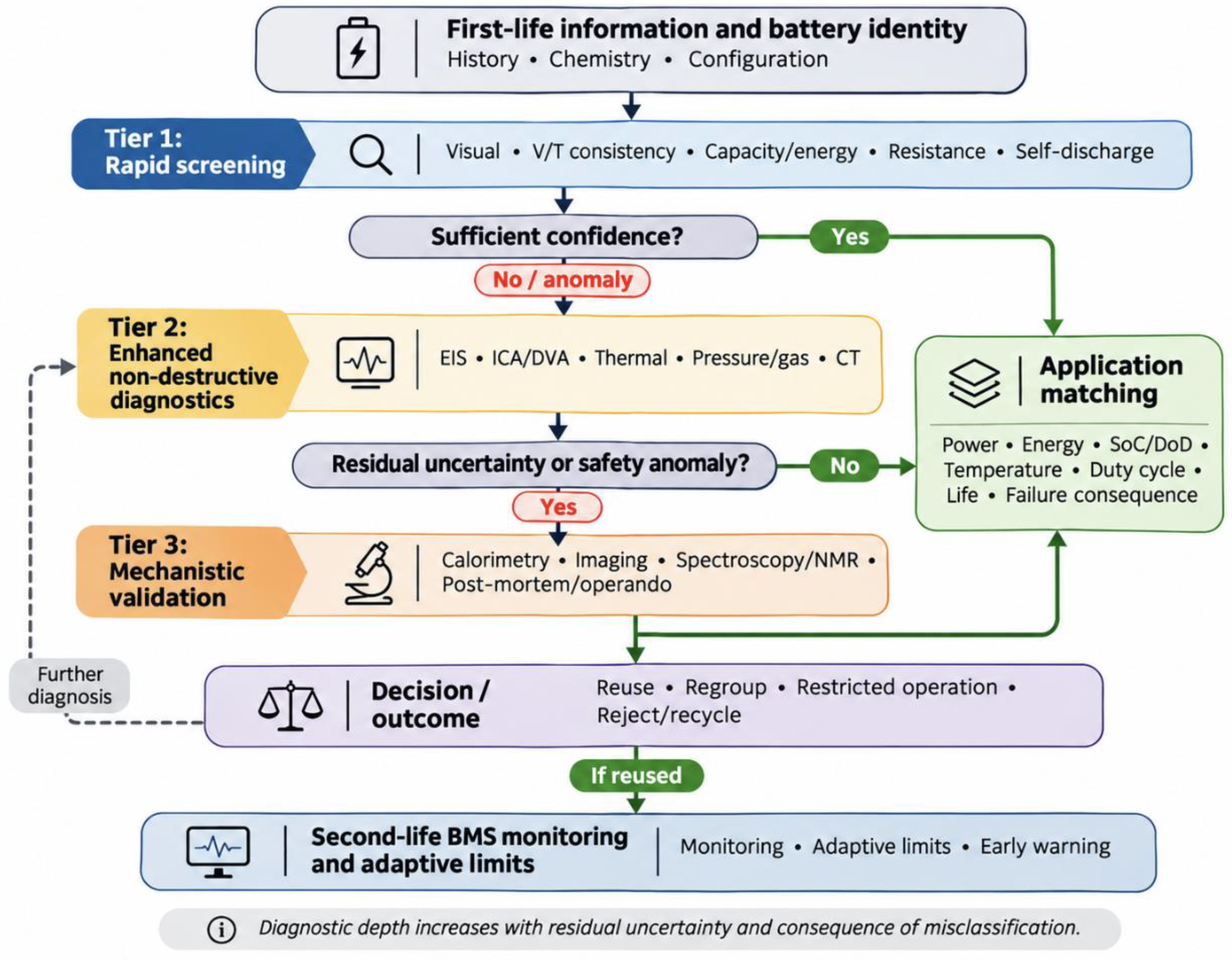

Table 1.
Major degradation processes relevant to second-life lithium-ion batteries and their implications for performance, reliability, and safety.
Table 1.
Major degradation processes relevant to second-life lithium-ion batteries and their implications for performance, reliability, and safety.
| Degradation process | Main physicochemical change | Typical manifestation | Reliability / safety relevance and caveats | Refs. |
|---|---|---|---|---|
| SEI growth and evolution | Electrolyte reduction, interphase thickening and reformation | LLI, electrolyte consumption, impedance rise, capacity fade | May increase polarization, but SEI-dominated ageing does not necessarily produce a more severe abuse response. Strongly dependent on operating history and interphase properties | [12,13,14] |
| CEI evolution and transition-metal cross-talk | Cathode-side electrolyte oxidation; dissolution and migration of Mn, Ni, Co or Fe | Interfacial resistance, electrolyte consumption, altered SEI chemistry and parasitic reactions | Particularly relevant at high voltage and for transition-metal oxides. Magnitude and consequences are strongly chemistry-dependent | [12,15,16] |
| Lithium plating | Metallic Li deposition, partial stripping, dead-Li formation and further electrolyte reaction | LLI, capacity loss, additional interphase growth | Reactive metallic Li can lower self-heating onset and increase abuse hazard. Favored by low temperature, high charge rate, high SoC and transport limitations | [12,17] |
| Electrolyte degradation and gas generation | Solvent/salt decomposition, electrolyte depletion and gaseous-product formation | Transport limitations, swelling/pressure, loss of contact | Can modify mechanical and thermal behavior. Gas amount/composition depends on chemistry, SoC, temperature, history and cell design; no universal gas signature exists | [18,19,20] |
| Particle cracking, delamination and contact loss | Fracture, binder deterioration, loss of adhesion and local electrical isolation | LAM, contact-resistance increase, heterogeneous current distribution | Can promote local current concentration and non-uniform heating. Severity depends strongly on material, morphology and cell construction | [12,21,22,26] |
| Supporting component and Cell-level structural deformation | Separator deformation or loss of integrity, current-collector degradation, jelly-roll/stack displacement and void formation | Transport/resistance changes, heterogeneous current distribution and possible loss of electrical isolation | May promote localized heating or contribute to internal-short susceptibility; consequences depend strongly on defect geometry, cell format and mechanical constraint | [12,17,22,23] |
| Altered thermal stability during ageing | Combined evolution of resistance, interfaces, electrolyte inventory and reactive species | Changes in self-heating, thermal-runaway onset and peak temperature | Safety metrics may evolve non-monotonically and independently of capacity-based SoH; no universal SoH–safety relationship exists | [4,24,25,27] |
Table 2.
Comparison of diagnostic and characterization techniques relevant to second-life lithium-ion battery assessment.
Table 2.
Comparison of diagnostic and characterization techniques relevant to second-life lithium-ion battery assessment.
| Technique | Main information obtained | Mechanistic specificity | Screening practicality | Most appropriate role | Main limitation | Refs. |
|---|---|---|---|---|---|---|
| Capacity / energy measurement | Accessible charge or energy under defined conditions | Low | High | Baseline performance screening and grading | Protocol-dependent; does not identify degradation origin | [3,6,7] |
| DC / pulse resistance | Overall resistance and power capability | Low | High | Rapid screening and identification of high-resistance cells | Aggregates multiple physical contributions | [6,7] |
| EIS | Frequency-dependent interfacial, kinetic and transport response | Low–medium | Medium | Enhanced non-destructive diagnosis | Strong dependence on SoC, temperature, model and test protocol | [28,29] |
| ICA / DVA | Voltage–capacity features, electrode balance and degradation modes | Medium | Medium | Discrimination of LLI/LAM-related evolution | Noise and processing sensitivity; features are not uniquely mechanism-specific | [30,31] |
| Thermal signatures / thermography | Surface temperature rise, heating rate and spatial thermal response | Low | High–medium | Low-cost anomaly detection and complementary screening | Strongly dependent on load, cooling, geometry and sensor conditions | [33] |
| ARC / calorimetric abuse testing | Self-heating, exothermic onset and thermal-runaway response | Medium–high | Low | Safety validation and definition of operating limits | Time, cost, hazard and limited compatibility with routine screening | [24,25,34] |
| Pressure / swelling sensing | Evidence of gas accumulation or dimensional change | Low | Medium–high | Detection of gas-producing ageing; potential online monitoring | Limited chemical specificity; strongly format-dependent | [19,20,35] |
| DEMS / OEMS / GC–MS | Identity and evolution of volatile reaction products | Medium–high | Low | Mechanistic investigation of gas-related degradation | Specialized equipment; sampling may perturb the cell | [35,36] |
| X-ray CT | Internal deformation, delamination, cracking and void formation | Medium | Low–medium | Selective investigation of structural anomalies in intact cells | Cost, acquisition time and resolution/size trade-off | [22,37] |
| SEM / TEM / EDS | Morphology, particle fracture, deposits and elemental distribution | High for targeted features | Very low | Post-mortem mechanistic validation | Destructive; limited sampled volume and preparation artifacts | [21,22,32] |
| XRD / XPS / Raman / IR / NMR | Crystal structure, surface chemistry, bonding and local chemical environment | Medium–high | Low | Validation of specific material-level degradation processes | Each method probes only selected aspects of the degradation state | [32,38] |
| Advanced in situ / operando methods | Dynamic structural or chemical evolution during operation | High for targeted phenomena | Very low | Mechanistic validation and development of diagnostic markers | Specialized facilities, complexity and limited scalability | [38,39] |
Note: Mechanistic specificity and screening practicality are qualitative, relative classifications intended for comparison within second-life battery assessment. Their effective values depend on cell chemistry and format, measurement protocol, instrumentation, and the specific implementation of each technique.
Disclaimer/Publisher’s Note: The statements, opinions and data contained in all publications are solely those of the individual author(s) and contributor(s) and not of MDPI and/or the editor(s). MDPI and/or the editor(s) disclaim responsibility for any injury to people or property resulting from any ideas, methods, instructions or products referred to in the content. |
© 2026 by the authors. Licensee MDPI, Basel, Switzerland. This article is an open access article distributed under the terms and conditions of the Creative Commons Attribution (CC BY) license (http://creativecommons.org/licenses/by/4.0/).
Copyright: This open access article is published under a Creative Commons CC BY 4.0 license, which permit the free download, distribution, and reuse, provided that the author and preprint are cited in any reuse.