

Submitted:
14 November 2026
Posted:
17 November 2026
You are already at the latest version
Abstract
Zimbabwe’s proposed Wealth Tax on high-value residential property has the potential to broaden the tax base, mobilise revenue from accumulated property wealth and contribute to a more equitable distribution of wealth. However, the tax is yet to be implemented, and its effectiveness will depend on the property valuation infrastructure available to support its administration. This paper examines whether Zimbabwe’s existing property information and valuation arrangements provide an adequate foundation for Wealth Tax administration. Drawing on literature and documentary evidence and using the Philippines and Cayman Islands as comparative cases, the paper identifies the information, valuation and institutional requirements for a workable property-based tax. Results indicate that property identification, ownership records, cadastral information, property characteristics, transaction data and valuation processes need to operate as an integrated system. The paper proposes an integrated national property valuation information system that connects these components while retaining the statutory roles of existing institutions.
Keywords:
wealth tax
; property valuation
; property taxation
; property information
; Zimbabwe
1. Introduction
Zimbabwe faces persistent challenges in mobilising public revenue. Fiscal instability, high public debt and the size of the informal sector constrain the capacity to raise revenue through conventional tax sources [1,2]. These conditions have increased interest in alternative approaches to broadening the tax base. At the same time, income and wealth represent different dimensions of economic capacity. While income taxation focuses on flows of earnings and consumption, wealth taxation concerns accumulated assets and the capacity associated with their ownership [3,4,5].
Real estate represents a visible and relatively immobile form of accumulated wealth for wealth tax considerations. It provides a basis for identifying and taxing wealth that may not be fully captured through income-based taxation [6,7]. However, taxing property based on its value creates an important administrative requirement: the state must be able to identify the property, establish the relevant ownership, determine its characteristics and produce a sufficiently reliable value. Valuation is the anchor of the property-based wealth tax infrastructure through which the tax base itself is constructed.
Zimbabwe introduced a Wealth Tax through the Finance Act No. 13 of 2023, with effect from 1 January 2024. The tax applies at 1% to the value of a qualifying dwelling above US$250,000, subject to a maximum annual liability of US$50,000 per taxable dwelling [8]. The legislation established the tax, but implementation requires information and a system capable of identifying qualifying properties and determining their taxable values. This creates a practical question: what infrastructure is required for a property-based Wealth Tax to operate effectively?
In the Zimbabwean context, the relevant property information is scattered across several institutions. Local authorities maintain information associated with property assessment and municipal rating. The Deeds Registry records ownership interests, while the Surveyor-General’s Office is responsible for cadastral and survey information. Planning authorities hold information relating to land use and development, while the Office of the Valuer General performs valuation functions for certain local authorities that do not have adequate valuation capacity. The Zimbabwe Revenue Authority administers national taxation. These institutions hold different elements of information that are relevant to identifying, valuing and taxing property.
The existence of these institutions does not, however, mean that the information they hold forms an integrated property valuation infrastructure. Property taxation requires reliable property identification, ownership information, property characteristics, spatial information, market evidence and valuation processes that can be updated over time. Evidence from South Africa similarly demonstrates the problems that arise when property-related information held by different institutions is inconsistent. [9] for example, identify differences between survey information, deeds records, valuation rolls and municipal information, illustrating the broader importance of data consistency for property-related policymaking.
International experience provides useful evidence on how these challenges can be addressed. The Philippines has developed reforms aimed at strengthening property identification, appraisal, assessment, valuation standards and information systems. The Cayman Islands provides another example in which cadastral, land registration, GIS, valuation and market information are connected through a broader land information environment. These cases provide lessons concerning the infrastructure required to support property taxation.
This paper examines the property valuation infrastructure required to support the implementation of Zimbabwe’s Wealth Tax. The paper is structured around three questions. First, what information and valuation infrastructure is required for a property-based Wealth Tax? Second, what weaknesses exist in Zimbabwe’s current arrangements? Third, what lessons can be drawn from the Philippines and Cayman Islands in developing an integrated system for Zimbabwe? The paper contributes a conceptual framework for integrating existing property information and valuation functions rather than proposing a new tax or a new valuation methodology.
2. Materials and Methods
The paper adopts a qualitative documentary and comparative approach. It draws on published literature, legislation, government documents, institutional information and existing research concerning property taxation, property valuation, mass appraisal and property information systems. The Zimbabwean analysis focuses on the legal and institutional arrangements relevant to property identification, ownership, cadastral information, property assessment and valuation. The comparative analysis considers the Philippines and Cayman Islands because the evidence available for these jurisdictions illustrates different but complementary aspects of property valuation infrastructure.
The analysis is descriptive and conceptual rather than empirical. It does not estimate the revenue that Zimbabwe could obtain from the Wealth Tax, test alternative tax rates or develop a new automated valuation model. Instead, the paper identifies the information and institutional components required to administer a value-based property tax and considers how these components could be connected within the Zimbabwean context. The proposed framework is therefore intended as a conceptual representation of an integrated property valuation information system.
The author used Generative AI when developing this paper, Scopus AI was used during the conceptual stage to conceptualise the authors’ ideas, ChatGPT was used to convert the citations and references from the APA referencing style and Copilot AI was used to improve the author’s English language.
3. Results
3.1. Property Valuation Infrastructure and Wealth Taxation
Wealth taxation has attracted renewed attention because of concerns about the concentration of wealth and the limitations of relying exclusively on income taxation. The choice between taxing wealth and taxing capital income involves questions concerning equity, efficiency, administration and behavioural responses [4,5,10]. Evidence from wealth tax jurisdictions also shows that taxpayers may respond to wealth taxes through changes in asset holdings, reporting behaviour and other forms of avoidance or adjustment [11,12,13]. These issues make the design of a wealth tax important, but they also demonstrate that effective administration is central to its operation.
Residential property presents an opportunity and challenge. Property is a significant component of household wealth, but its value is not directly observable in the same way as a financial balance. A property value normally must be estimated using information about the property, its location and market conditions. [7] show that valuation for wealth tax purposes raises specific questions concerning valuation dates, valuation methods and the treatment of property. [6] similarly highlights the importance of housing characteristics in the design of wealth taxes. A property-based Wealth Tax therefore depends on the capacity to generate values that are sufficiently consistent and defensible for taxation.
Property taxation more generally demonstrates the importance of assessment capacity and quality assurance. [14] in comparing Malaysia and South Africa, identify assessment capacity and quality assurance as important issues in property taxation. [15] similarly show the importance of institutional and administrative capacity in property taxation in Southern and East Africa. Property tax reform therefore requires more than legislation. It requires systems that can identify the tax base and translate property information into reliable assessments.
Computer-assisted mass appraisal (CAMA) can support valuation where large numbers of properties need to be valued. [16] demonstrate the application of CAMA in a property tax context, while [17] show the growing use of machine learning models in mass appraisal research. [18] further discuss the potential of artificial intelligence in property assessment. These developments suggest that technology can increase the capacity to value large property populations. However, technology does not eliminate the need for reliable underlying data, appropriate valuation methodology, quality assurance and professional oversight.
The use of artificial intelligence should not be regarded as the starting point for Zimbabwe. The Artificial Intelligence Task Force of the [19] identifies methodological and implementation challenges associated with artificial intelligence in property assessment. A sophisticated valuation model cannot compensate for incomplete property identification, incorrect ownership records or unreliable market data. The logical sequence is therefore to establish the information infrastructure first, followed by the valuation systems required to process those data. CAMA and potentially more advanced analytical tools can then form part of that infrastructure.
3.2. Zimbabwe's Property Valuation and Tax Administration Architecture
Zimbabwe's Wealth Tax provides the legal basis for taxing qualifying residential property, but the administration of the tax depends on information that is not held by a single institution. The Finance Act No. 13 of 2023 establishes the tax parameters, including the threshold and rate, but does not itself create a comprehensive national property valuation information system [8]. Implementation therefore depends on the ability of existing institutions and systems to provide the information required by the tax administrator.
Local authorities are an important component of the existing property information environment. Under the Urban Councils Act [Chapter 29:15], residential properties are assessed for municipal rating purposes through rating units and rating zones [20]. This provides an established framework for property assessment at local government level. However, municipal rating is designed for local government revenue purposes and does not necessarily provide the individual monetary values required to administer a national Wealth Tax based on a statutory property-value threshold. This creates a direct gap between the Wealth Tax and residential rating frameworks. Wealth Tax requires the value of an individual dwelling to determine whether the US$250,000 threshold is exceeded, whereas the residential rating system is not designed to produce an individual market value for each dwelling. The “value” contemplated by the Income Tax Act therefore cannot simply be assumed to be available from the residential rating roll.
This challenge is compounded by the way property information is organised. Information relevant to establishing a dwelling’s value is distributed across local authorities, the Deeds Registry, the Surveyor-General, planning authorities, the Office of the Valuer General and other sources. These institutions perform different statutory functions and maintain separate records in different formats. Consequently, ownership, cadastral information, property characteristics, development information, assessment records and market evidence are scattered across institutional systems rather than maintained as an integrated property valuation dataset.
The problem is that the relevant property data is scattered across institutions with different statutory functions. This creates the possibility of gaps or inconsistencies between property identification, cadastral information, ownership records, property characteristics and valuation information. Evidence from South Africa concerning differences between survey, deeds, valuation-roll and municipal information illustrates the importance of addressing such inconsistencies when property information is used for policy and revenue purposes [9].
Also, municipal rating systems can establish a basis for determining liability for local rates, but a national Wealth Tax based on the value of individual dwellings requires values that can be compared against the statutory threshold. This means that the state needs an individual property valuation capability that can operate across jurisdictions and property types.
Traditional individual valuation of every property would require substantial professional resources. CAMA offers a mechanism for addressing large populations of properties by using property and market characteristics to estimate values consistently. However, CAMA requires structured and sufficiently reliable input data. The valuation engine therefore cannot be separated from the property information infrastructure that feeds it.
The Zimbabwean infrastructure gap can consequently be understood across several linked dimensions: property identification, ownership linkage, cadastral and spatial information, property characteristics, market and transaction information, individual property valuation, valuation consistency, updating mechanisms, institutional coordination and professional and technological capacity. These gaps do not necessarily imply that existing institutions must be replaced. They indicate a need to connect existing functions so that information can move across institutional boundaries for a defined tax purpose.
3.3. International Lessons
3.3.1. Philippines
The Philippines provides an important example of the relationship between property identification, assessment and property taxation. Before the Real Property Tax Administration Project, property identification depended heavily on owner declarations, while maps and records were incomplete or outdated in some local government areas. The Real Property Tax Administration Project therefore placed emphasis on improving property identification, mapping and assessment information [21].
This experience demonstrates a basic principle relevant to Zimbabwe: a property tax system cannot be stronger than the information used to identify its tax base. If properties are missing from records, incorrectly identified or inadequately mapped, subsequent valuation and taxation will also be affected. Property identification is therefore not an administrative detail that can be addressed after valuation. It is the first stage of valuation infrastructure.
The Philippines subsequently developed formal guidance for property appraisal and assessment. The Bureau of Local Government Finance (BLGF) Manual on Real Property Appraisal and Assessment Operations provides guidance for property appraisal and assessment, while the Mass Appraisal Guidebook provides guidance for mass appraisal [22,23]. The updated manual further reflects continuing development of the assessment framework [24]. These instruments illustrate the importance of standardised approaches where property values are required across large numbers of properties.
A further development was the enactment of Republic Act No. 12001, the Real Property Valuation and Assessment Reform Act. The legislation provides for national valuation standards and establishes market value as the single valuation base for real-property-related taxation and other government purposes. It also provides for electronic databases and information sharing and strengthens the role of the BLGF in the valuation and assessment system [25].
The Philippine experience also illustrates the importance of institutional integration. [26] reported an initiative to enhance local government revenue-generating capacity through greater integration of information systems for property taxation, involving institutions with property and tax information. [27] similarly documents continuing work concerning residential property price information. These developments demonstrate that valuation reform involves both technical valuation standards and the infrastructure through which property information is collected, stored and shared.
For Zimbabwe, the main lesson is therefore not to replicate the Philippine institutional model. It is that property taxation requires a progressively integrated information system. Property identification, mapping, appraisal, valuation standards, electronic information and institutional data sharing need to develop together. The experience also suggests that a national framework can provide greater consistency where property valuation is undertaken across multiple local jurisdictions.
3.3.2. Cayman Islands
The Cayman Islands provides a different but complementary example because its land information environment integrates several functions associated with property identification and valuation. The Department of Lands and Survey provides land-related services that include surveying, land registration, valuation and geographic information. Cayman Land Info provides access to land information and services associated with these functions [28,29].
The cadastral system provides the spatial basis for identifying land parcels, while the Land Registry records ownership and changes in ownership. The integration of land information with GIS provides a mechanism for connecting spatial information with other property records. The mutation history function further provides information about changes affecting parcels over time [30]. This illustrates the importance of maintaining property information rather than treating the cadastral record as a static database.
Valuation and market information provide another component. The Cayman Islands' valuation function includes information associated with property transfers and market values. The government also introduced a Residential Property Price Index based on residential property transactions, providing a structured source of information on movements in residential property prices [31]. Such information can support an understanding of market conditions and therefore contributes to the broader valuation environment.
The main lesson for Zimbabwe is the value of integration. The Cayman Islands example demonstrates how cadastral information, land registration, GIS, valuation and market information can operate within a connected land information environment. This does not mean that Zimbabwe needs to reproduce the Cayman Islands system. The relevant lesson is that valuation is strengthened when the valuer can access reliable spatial, ownership and market information through an integrated information environment.
4. Discussion
The two cases illustrate complementary dimensions of property valuation infrastructure. The Philippines demonstrates the importance of strengthening property identification, appraisal, valuation standards, mass appraisal and institutional information sharing. The Cayman Islands demonstrates the value of integrating cadastral, ownership, GIS, valuation and market information.
These lessons are relevant because Zimbabwe already has institutions performing many of these functions. The challenge is to connect them around a common property information and valuation architecture. The objective should not be to create parallel institutions for Wealth Tax administration. Rather, existing information should be connected in a manner that enables the Zimbabwe Revenue Authority (ZIMRA) to obtain reliable information for tax assessment while allowing the institutions responsible for each function to retain their statutory roles. The comparative lessons are summarised in Table 1.
The foregoing analysis points to a need for an integrated property valuation information system for Zimbabwe. Its purpose would be to connect property information currently held by different institutions and use it to support valuation and Wealth Tax assessment. This is a conceptual framework rather than a specification of the information technology architecture required for implementation.
Property identification. A national property inventory would establish which properties exist and assign each a unique identifier. This would provide a common reference for linking cadastral, ownership, property and valuation records. Existing local authority and cadastral records could provide the starting point, subject to verification and standardisation.
Cadastral and GIS information. Cadastral and GIS data would locate each property and link it to its physical parcel. As demonstrated by the Cayman Islands, integrating cadastral information with GIS and other land information can provide a spatial framework for connecting property, ownership and valuation records.
Ownership information. Effective taxation requires a clear link between each taxable property and its owner. Deeds Registry records could therefore be linked to the unique property identifier, allowing changes in ownership to flow into tax records.
Property characteristics. Valuation requires reliable information about physical and locational characteristics. Local authority, planning, cadastral and valuation records could be combined to create a consistent property dataset capable of supporting valuation across locations.
Market and transaction information. Valuation also requires evidence of market behaviour. Transaction data and residential price indices, as illustrated by the Cayman Islands, can support valuation and monitor market movements. Philippine reforms similarly demonstrate the importance of strengthening property valuation and assessment information. Zimbabwe therefore requires a market information component capable of providing reliable evidence for residential property valuation.
Property valuation database. Data from cadastral, ownership, property and market sources could feed into a structured valuation database. This would support consistent valuation across large property populations and provide an auditable record of the data and assumptions underlying taxable values.
Given the potential scale of the tax base, CAMA could provide an efficient means of producing consistent property values. Research demonstrates its application in property taxation and the growing use of machine learning in mass appraisal [17]. CAMA should, however, function as the valuation engine within the wider infrastructure, not as a substitute for reliable property data.
Quality assurance and validation. Taxable values must be reliable and defensible. Quality controls should therefore cover property records, ownership, market evidence and valuation outputs. Professional oversight remains necessary because automated models can reproduce errors in their underlying data. More advanced artificial intelligence should consequently follow, rather than precede, sound data and governance arrangements [19].
Wealth Tax assessment. Validated property values could then be applied to the statutory Wealth Tax threshold and rate. The ZIMRA could coordinate tax-related information requirements and use the resulting valuations for assessment, while existing institutions retain their statutory responsibilities for cadastral, registration, planning and professional valuation functions. Figure 1 illustrates the proposed framework.
The framework is intended to show that property valuation is dependent on a chain of information rather than on the valuation model alone. If property identification is incomplete, the valuation database will also be incomplete. If ownership information is not linked to properties, the tax authority may not be able to establish liability. If property characteristics or market evidence are unreliable, the resulting valuation may be unreliable. If information is not updated, values may become outdated as properties, ownership and market conditions change.
The framework also emphasises institutional coordination. Local authorities, the Deeds Registry, Surveyor-General's Office, planning authorities, the Office of the Valuer General and valuation professionals already perform functions relevant to the system. Their continued involvement would therefore be important. The proposed change is primarily the creation of an integrated information environment through which these functions can support a common property valuation and tax administration objective.
The proposal also places technology in its appropriate position. CAMA can assist with valuation at scale, while artificial intelligence and machine learning may provide further analytical capacity. However, these tools depend on the availability of appropriate property and market data. The development of an integrated property information system should therefore precede the large-scale adoption of more sophisticated analytical technologies. This sequencing is consistent with the broader evidence on mass appraisal and artificial intelligence in property assessment [19].
5. Conclusions
This paper shows that legislation alone is not enough to administer the Wealth tax. A value-based property tax requires the state to know what properties exist, where they are located, who owns them, what characteristics they possess, what similar properties transact for and what each taxable property is worth. These requirements make property valuation infrastructure a central component of Wealth Tax administration.
Zimbabwe already has many of the institutional components required for such infrastructure. Local authorities hold property assessment information, the Deeds Registry provides ownership information, the Surveyor-General's Office provides cadastral information, planning authorities hold development-related information, the Office of the Valuer General provides valuation capacity in relevant local authorities, and ZIMRA administers national taxation. The challenge is on integration of these components into an information environment capable of supporting consistent national property valuation.
The Philippines demonstrates the importance of reliable property identification, mapping, appraisal, valuation standards, mass appraisal and institutional information sharing. The Cayman Islands demonstrates the benefits of connecting cadastral, ownership, GIS, valuation and market information. These experiences suggest that Zimbabwe should not approach Wealth Tax implementation simply as a tax collection exercise. It should be accompanied by the development of the property information and valuation infrastructure needed to identify and value the tax base.
This paper proposes an integrated national property valuation information system linking property identification, cadastral and GIS information, ownership, property characteristics, market and transaction data, valuation databases, CAMA, quality assurance and Wealth Tax assessment. ZIMRA could coordinate the tax-related information requirements while existing institutions retain their respective statutory responsibilities.
The proposed framework is conceptual and does not provide a detailed technical specification for implementation. Its central argument is more basic: a Wealth Tax based on residential property value requires reliable property information and valuation infrastructure. Building that infrastructure would support not only Wealth Tax administration but also wider property taxation and property-related public policy. The effectiveness of the Wealth Tax will therefore depend not only on the tax legislation itself, but also on the state's capacity to identify, value and continuously update the property wealth on which the tax is based.
Funding
Please add: This research received no external funding.
Data Availability Statement
No new data were created or analysed in this study. Data sharing is not applicable to this article.
Conflicts of Interest
The authors declare no conflicts of interest.
Abbreviations
The following abbreviations are used in this manuscript:
| GIS | Geographic Information Systems |
| ZIMRA | Zimbabwe Revenue Authority |
| CAMA | Computer Aided Mass Appraisal |
| IAAO | International Association of Assessing Officers |
References
- Chamisa, M.G.; Sunde, T. Key determinants of tax revenue in Zimbabwe: assessment using autoregressive distributed lag (ARDL) approach. Cogent Econ. Financ. 2024, 12(1), 2386130. [Google Scholar] [CrossRef]
- Munjeyi, E.; Schutte, D. A framework for enhancing inclusive taxation ecosystem in contemporary Zimbabwe. Cogent Soc. Sci. 2026, 12(1). [Google Scholar] [CrossRef]
- Adam, S.; Miller, H. The economic arguments for and against a wealth tax. Fisc. Stud. 2021, 42(3-4), 457–483. [Google Scholar] [CrossRef]
- Boadway, R.; Pestieau, P. The wealth tax and the tax mix. Can. Tax. Journal/Revue Fisc. Can. 2023, 70, 185–208. [Google Scholar] [CrossRef]
- Scheuer, F.; Slemrod, J. Taxing our wealth. J. Econ. Perspect. 2021, 35(1), 207–230. [Google Scholar] [CrossRef]
- Rotberg, M. The implications of housing for design of wealth taxes. Int. Econ. Rev. 2022, 63(1), 125–159. [Google Scholar] [CrossRef]
- Daly, S.; Hughson, H.; Loutzenhiser, G. Valuation for the purposes of a wealth tax. Fisc. Stud. 2021, 42(3-4), 615–650. [Google Scholar] [CrossRef]
- Government of Zimbabwe. Finance Act, 2023 (No. 13); Government of Zimbabwe: Harare, 2023. [Google Scholar]
- Venter, P.H.; Paradza, P.; Benita, Z.; Masenge, A. Data consistency and implications for municipal policymaking in South Africa: Survey, deeds, valuation rolls, municipal budgets. Munic. Econ. Cities 2025, 2(190), 2–14. [Google Scholar] [CrossRef]
- Bastani, S.; Waldenström, D. Taxing the wealthy: The choice between wealth and capital income taxation. Oxf. Rev. Econ. Policy 2023, 39(3), 604–616. [Google Scholar] [CrossRef]
- Brülhart, M.; Gruber, J.; Krapf, M.; Schmidheiny, K. Behavioral responses to wealth taxes: Evidence from Switzerland. Am. Econ. J. Econ. Policy 2022, 14(4), 111–150. [Google Scholar] [CrossRef]
- Jakobsen, K.; Kleven, H.; Kolsrud, J.; Landais, C.; Muñoz, M. Wealth taxation and wealth accumulation: Theory and evidence from Denmark. Q. J. Econ. 2020, 135(1), 329–388. [Google Scholar] [CrossRef]
- Seim, D. Behavioral responses to wealth taxes: Evidence from Sweden. Am. Econ. J. Econ. Policy 2017, 9(4), 395–421. [Google Scholar] [CrossRef]
- Daud, D.Z.; Kamarudin, N.; Franzsen, R.C.D.; McCluskey, W.J. Property tax in Malaysia and South Africa: A question of assessment capacity and quality assurance. J. Prop. Tax. Assess. Adm. 2013, 10(4), 5–15. [Google Scholar] [CrossRef]
- Franzsen, R.C.D.; Olima, W.H.A. Property taxation in Southern and East Africa: Lessons from South Africa and Kenya. South Afr. Merc. Law J. 2003, 15(3), 309–325. [Google Scholar]
- Pena, S.; Fuentes, C. M.; Cervera, L. E.; Hernandez, V. Planning support systems: a computer-assisted mass appraisal (CAMA) system for Ciudad Juarez, Mexico. J. Prop. Tax. Assess. Adm. 2012, 9(4), 25–40. [Google Scholar] [CrossRef]
- Zilli, C.A.; Bastos, L.C.; da Silva, L.R. Machine learning models in mass appraisal for property tax purposes: Systematic mapping study. Aestimum 2024, 84, 31–52. [Google Scholar] [CrossRef]
- Gloudemans, R.; Sanderson, P. The potential of artificial intelligence in property assessment. J. Prop. Tax. Assess. Adm. 2021, 18(2), 1–10. [Google Scholar]
- IAAO Artificial Intelligence Task Force. A review of the methods, applications, and challenges of adopting artificial intelligence in the property assessment office. J. Prop. Tax. Assess. Adm. 2022, 19(1), 1–10. [Google Scholar]
- Government of Zimbabwe. Urban Councils Act (Chapter 29:15); Government of Zimbabwe: Harare, 1995. [Google Scholar]
- World Bank. Urban property tax reform: The case of the Philippines’ Real Property Tax Administration Project; World Bank: Washington, DC, 1991. [Google Scholar]
- Bureau of Local Government Finance. Manual on real property appraisal and assessment operations. Department of Finance, Republic of the Philippines, 2004. [Google Scholar]
- Bureau of Local Government Finance. Mass appraisal guidebook: A supplement to the manual on real property appraisal and assessment operations. Department of Finance, Republic of the Philippines, 2011. [Google Scholar]
- Bureau of Local Government Finance. Updated manual on real property appraisal and assessment operations. Department of Finance, Republic of the Philippines, 2023. [Google Scholar]
- Republic of the Philippines. Republic Act No. 12001: Real Property Valuation and Assessment Reform Act. Supreme Court E-Library, 2024. [Google Scholar]
- Department of Finance; Republic of the Philippines. Agreement to enhance LGUs’ revenue generating capacity and integrate information systems for property taxation signed. Bureau of Local Government Finance, 11 May.
- IMF. Philippines: Technical assistance report: Report on the residential property price index mission . In International Monetary Fund; 2025. [Google Scholar] [CrossRef]
- Cayman Islands Government. Department of Lands and Survey. Cayman Land Info. Available online: https://www.caymanlandinfo.ky/About-Us (accessed on 9 September 2026).
- Cayman Islands Government. Cayman Land Information: Land Registry. Available online: https://www.caymanlandinfo.ky/Services/Land-Registry (accessed on 9 September 2026).
- Cayman Islands Government. Mutation history. Cayman Land Information. 2026b. Available online: https://www.caymanlandinfo.ky/services/ngis/mutation-history (accessed on 9 September 2026).
- Cayman Islands Government. Gov. launches CI Residential Property Price Index (RPPI). https://gov.ky/w/gov.-launches-ci-residential-property-price-index-rppi-?refererPlid=3611&redirect=%2Fw%2Fgov.-launches-ci-residential-property-price-index-rppi-%3FrefererPlid%3D3611%26redirect%3D%252Fw%252Fgov.-launches-ci-residential-property-price-index-rppi-%253FrefererPlid%253D3611%2526redirect%253D%25252Fw%25252Fgov.-launches-ci-residential-property-price-index-rppi-. Accessed; (accessed on 30 September 2026).
Figure 1.
Conceptual framework for an integrated property valuation information system. Source: Author’s illustration
Figure 1.
Conceptual framework for an integrated property valuation information system. Source: Author’s illustration
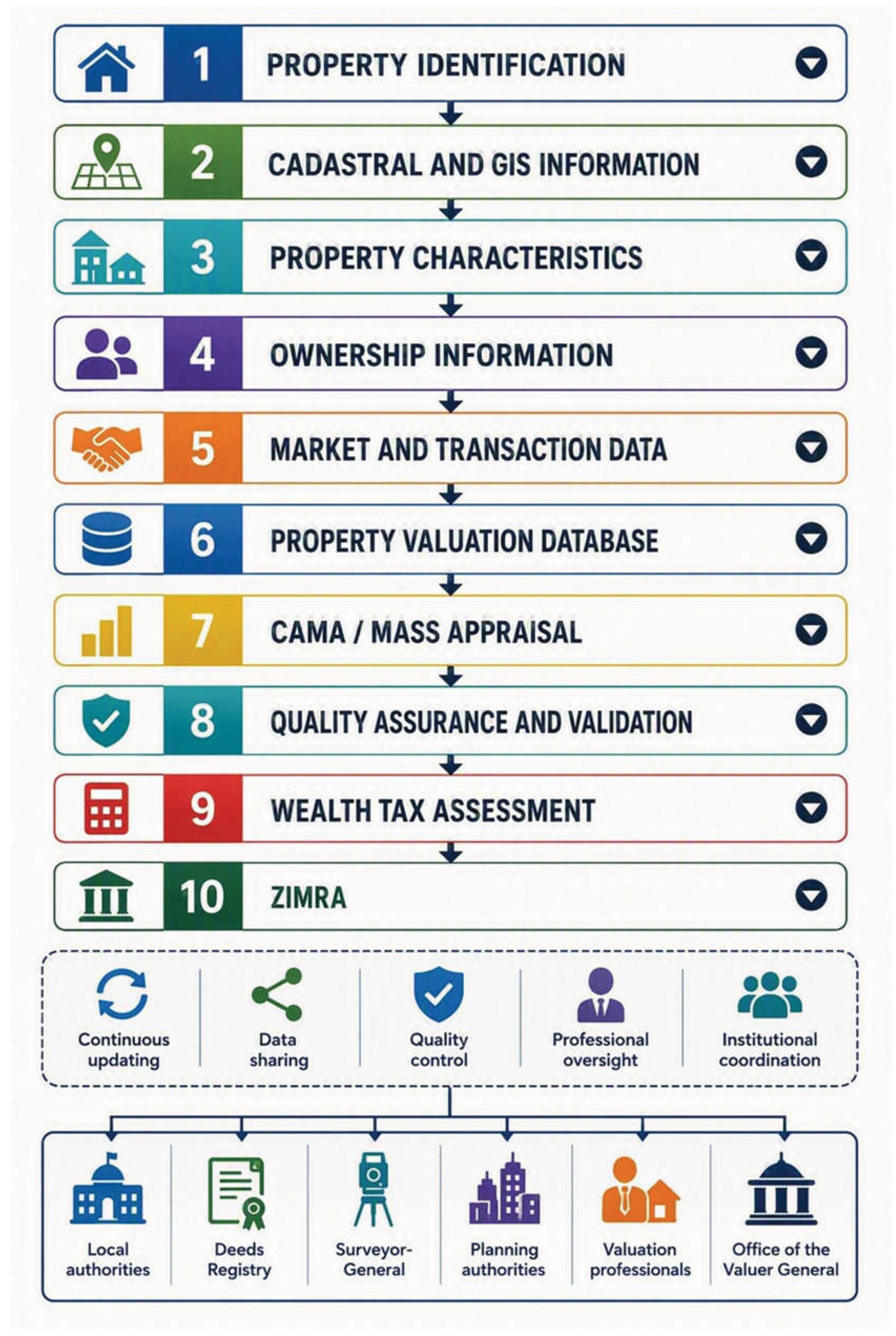

Table 1.
Lessons from international property valuation infrastructure.
| Infrastructure requirement | Philippines | Cayman Islands | Implication for Zimbabwe |
|---|---|---|---|
| Property identification | Mapping, field verification and property records | Integrated cadastral and land information | Establish a reliable national property inventory |
| Spatial information | Property mapping and cadastral information | GIS and cadastral information | Link taxable properties to spatial information |
| Ownership information | Land registration and related institutional information | Land Registry | Link properties to identifiable owners |
| Property characteristics | Appraisal and assessment records | Land and property information | Maintain information required for valuation |
| Market information | Property valuation and assessment systems | Transaction and price information | Develop reliable market evidence |
| Valuation | Appraisal manuals, standards and mass appraisal | Valuation within the land information environment | Establish consistent valuation processes |
| Data integration | Electronic databases and institutional information sharing | Integrated land information environment | Connect existing Zimbabwean institutions |
| Technology | Electronic databases and CAMA development | GIS and digital land information | Use technology within a reliable information framework |
Source: Author's illustration.
Disclaimer/Publisher’s Note: The statements, opinions and data contained in all publications are solely those of the individual author(s) and contributor(s) and not of MDPI and/or the editor(s). MDPI and/or the editor(s) disclaim responsibility for any injury to people or property resulting from any ideas, methods, instructions or products referred to in the content. |
© 2026 by the authors. Licensee MDPI, Basel, Switzerland. This article is an open access article distributed under the terms and conditions of the Creative Commons Attribution (CC BY) license (http://creativecommons.org/licenses/by/4.0/).
Copyright: This open access article is published under a Creative Commons CC BY 4.0 license, which permit the free download, distribution, and reuse, provided that the author and preprint are cited in any reuse.