

Submitted:
14 November 2026
Posted:
17 November 2026
You are already at the latest version
Abstract
Background: Rebleeding after initial control of upper gastrointestinal bleeding (UGIB) is clinically important, but institutional data require reproducible case definitions and separation of persistent bleeding from recurrence. We examined characteristics associated with in-hospital rebleeding in an adult surgical cohort in Astana, Kazakhstan. Methods: We conducted a single-center retrospective cohort study of surgical admissions during 2021-2025. Of 756 initially identified hospitalization episodes, 63 with incomplete or unverifiable required information were excluded. The complete-record dataset contained 693 episodes, including 674 instrumentally confirmed and 19 probable upper sources. The primary analysis included 658 confirmed episodes with initial bleeding control. A five-covariate exploratory logistic model evaluated age, admission hemoglobin, systolic blood pressure, variceal etiology, and active bleeding at first endoscopy. Follow-up ended at discharge, transfer, or in-hospital death. Results: Rebleeding occurred in 42/658 episodes (6.38%; Wilson 95% CI 4.76-8.52). Median admission systolic blood pressure was 99.0 mmHg in episodes with rebleeding and 119.0 mmHg in those without it. Higher systolic blood pressure was associated with lower adjusted odds of rebleeding (odds ratio per 10 mmHg, 0.83; 95% CI 0.70-0.97). Estimates for age, hemoglobin, variceal etiology, and active bleeding were imprecise and their confidence intervals included unity. Within the confirmed-source cohort, persistent bleeding occurred in 16/674 episodes (2.37%) and in-hospital death in 17/674 (2.52%). Conclusion: Lower admission systolic blood pressure was associated with in-hospital rebleeding after initial control in this selected surgical cohort. The small number of events, complete-record selection, and absence of linked post-discharge follow-up limit interpretation. These exploratory findings require confirmation and do not constitute a validated prediction model.
Keywords:
upper gastrointestinal bleeding
; rebleeding
; systolic blood pressure
; retrospective cohort
; endoscopic hemostasis
; Kazakhstan
Introduction
Upper gastrointestinal bleeding (UGIB) requires assessment of circulatory status, identification of the bleeding lesion, and appropriate hemostatic treatment. Endoscopy supports both diagnosis and treatment, while recurrent or uncontrolled bleeding may require repeat endoscopy, arterial embolization, or surgery [1,2]. Variceal hemorrhage has a distinct pathophysiology and management pathway, making etiological classification important when interpreting mixed UGIB cohorts [3].
Initial control and subsequent rebleeding are separate clinical events. Patients whose bleeding never stops should not be placed in the same recurrence denominator as those who first achieve hemostasis. Similarly, operations and endoscopic procedures are not mutually exclusive treatment groups because an admission may involve several sequential interventions. These distinctions are necessary for interpreting associations between presenting characteristics and subsequent events.
Evidence from peptic-ulcer bleeding identifies hemodynamic instability and endoscopic lesion features as relevant prognostic characteristics [4]. Established scores summarize different aspects of UGIB risk, but their performance depends on the endpoint: prediction of intervention or death is not interchangeable with prediction of rebleeding [5]. Institutional analyses should therefore define the outcome and the at-risk population before selecting explanatory variables.
A previous study in Astana examined gastroduodenal bleeding and perforation among patients with diabetes and metabolic syndrome using data collected from 2003 to 2017 [6]. We used individual hospitalization records from a surgical service in Astana to describe confirmed UGIB episodes and examine characteristics associated with rebleeding after initial control. The primary objective was an exploratory association analysis of in-hospital recurrence. We did not aim to estimate population incidence, establish treatment superiority, or track subsequent admissions across hospitals.
Materials and Methods
Study Design and Setting
This single-center retrospective cohort study included adults admitted to the surgical departments of a multidisciplinary hospital in Astana, Kazakhstan, from January 1, 2021, through December 31, 2025. Outcomes were followed until completion of the index hospitalization, including discharge after the end of the calendar inclusion period. Reporting was organized using applicable STROBE and RECORD principles [7,8].
Identification and Selection of Hospitalization Episodes
Potential episodes were identified from the hospital electronic information system and admission registers using diagnostic designations and clinical terms for bleeding peptic ulcer, variceal bleeding, Mallory-Weiss syndrome, hematemesis, melena, and unspecified gastrointestinal bleeding. The list was cross-checked against emergency endoscopy records. Diagnostic labels identified records for review and were not treated as independent proof of an upper source.
Record review covered admission assessments, initial laboratory results, endoscopy reports, intervention reports, and discharge or death summaries. Eligible episodes concerned adults aged 18 years or older admitted because of acute overt suspected UGIB. Episodes of lower or small-bowel bleeding, swallowed nasopharyngeal blood, hemoptysis, isolated chronic anemia or occult blood loss without overt acute bleeding, and bleeding first developing during admission for another condition were outside the clinical scope. Duplicate documentation of the same hospitalization was consolidated.
The initial clinically selected set comprised 756 episodes. Completeness and documentary verification of information required for the planned analyses were additional eligibility requirements. Sixty-three episodes were excluded because required information was missing, lost, or unverifiable, leaving 693 complete records. Structural nonapplicability of lesion-specific variables was distinguished from incomplete required information. An unresolved precise bleeding source could be retained as a documented probable-upper-source category and was not equated with an instrumentally confirmed source.
The unit of analysis was the hospitalization episode. We used de-identified hospitalization records that contained no patient names, personal identification numbers, or other information that could identify individual patients. Subsequent admissions after completion of an episode were not linked, and the same individual may therefore have contributed more than one episode. Transfers between departments during a single hospitalization were not new episodes.
Source Confirmation and Etiological Classification
An upper source was located proximal to the ligament of Treitz. Instrumental confirmation required active bleeding or evidence of recent hemorrhage attributable to a lesion on endoscopy or, where applicable, angiography or surgery. A potentially relevant lesion without evidence linking it to bleeding was not sufficient on its own. Clinical documentation and subsequent examinations were reviewed when the first endoscopy was nondiagnostic. Melena alone did not establish the location, whereas hematochezia could accompany a confirmed upper source.
Sources were classified as confirmed or probable. The primary clinical cohort comprised 674 instrumentally confirmed episodes. Nineteen probable upper-source episodes were retained only for descriptive sensitivity analysis. Confirmed etiologies were categorized as gastric ulcer, duodenal ulcer, erosions/esophagitis, Mallory-Weiss tear, esophageal or gastric varices, tumor, vascular lesion, or another identified cause. Variceal origin was not inferred solely from esophageal localization. Forrest classification and ulcer dimensions were recorded for ulcer bleeding when applicable.
Clinical Variables and Extraction Procedures
Variables included age, sex, presenting symptoms, first recorded blood pressure and pulse, hemoglobin, platelets, urea, creatinine, INR, albumin, comorbidity, and pre-admission medication exposure. Initial measurements were used; preceding fluid administration or red-cell transfusion was recorded. Glasgow-Blatchford Score (GBS) and AIMS65 were calculated from presenting variables. Child-Pugh variables were retained for cirrhosis. These scores described baseline risk and were not assumed to predict recurrence equally well [5].
Procedural variables included timing of the first endoscopy, diagnostic and therapeutic endoscopy, hemostatic modality, initial bleeding control, recurrent or persistent bleeding, repeat hemostasis, embolization, surgery, and TIPS. Red-cell use, ICU care, length of stay, and discharge status were also recorded. Multiple investigators extracted information and checked entries against medical records; ambiguous cases underwent joint review. Electronic checks assessed score calculations, outcome/disposition consistency, and event chronology.
Outcomes and Observation Window
The primary endpoint was documented rebleeding after initial bleeding control during the same hospitalization. Initial bleeding control meant documented cessation after the primary management strategy. Rebleeding required renewed overt hemorrhage with objective clinical or laboratory evidence of further blood loss, or instrumental confirmation of recurrent hemorrhage. Persistent melena or an isolated hemoglobin decrease without corroboration was not sufficient. Failure of the initial strategy to stop bleeding was classified separately as persistent bleeding and was excluded from the recurrence denominator.
The primary at-risk cohort therefore consisted of confirmed-source episodes with initial control (n = 658). Secondary descriptive endpoints were persistent bleeding, repeat interventions, red-cell transfusion, ICU care, in-hospital all-cause death, length of stay, and transfer. Follow-up ended at discharge, transfer to another institution, or death. Events after that point, including 30-day recurrence, six-week mortality, and readmission elsewhere, were not ascertained.
Statistical Analysis
Counts and percentages were calculated using explicit denominators. Continuous variables were summarized as median [interquartile range]. Wilson 95% confidence intervals were calculated for selected episode-level outcome proportions. These intervals reflect model-based precision and do not incorporate selection, misclassification, or unrecognized within-person dependence. No imputation was performed because the supplied analytic records met the complete-information eligibility criterion; the 63 exclusions were retained in the selection flow.
An exploratory multivariable logistic regression evaluated the odds of in-hospital rebleeding among the 658 at-risk episodes. Five clinically selected covariates were entered together: age per 10 years, admission hemoglobin per 10 g/L, admission systolic blood pressure per 10 mmHg, variceal etiology, and active bleeding at first endoscopy. Covariates were chosen for clinical interpretability and relevance to existing evidence, rather than by univariable P-value screening [4,5]. Continuous terms were modeled linearly. Adjusted odds ratios (aORs), Wald 95% CIs, and two-sided P values were reported. With 42 events and five covariate parameters, estimates were treated as exploratory; no prediction rule or treatment-effect model was developed.
Sensitivity analyses included a logistic model restricted to nonvariceal episodes, using the same covariates except etiology, and descriptive inclusion of probable upper sources. Logistic results depend on the duration of inpatient observation and do not estimate a fixed 30-day risk. Later transfusions, rescue procedures, and total length of stay were not baseline predictors. Analyses used Python 3.12.14, NumPy 2.3.5, pandas 3.0.1, and statsmodels 0.15.0.
Ethical Considerations
The study was approved by the Local Ethics Committee of the Department of Surgical Diseases, Bariatric Surgery and Neurosurgery (Decision No. 2, dated February 21, 2026).
Results
Selection and Composition of the Cohort
Of 756 initially selected episodes, 63 (8.3%) were excluded for incomplete or unverifiable required information. Among 693 complete records, 674 (97.3%) had an instrumentally confirmed upper source and 19 (2.7%) had a probable upper source. Initial bleeding control was recorded in 658 confirmed episodes; 16 had persistent bleeding and did not enter the recurrence analysis (Figure 1). Identifiers were episode codes and were not interpreted as proof of 693 unique patients.
Among the 674 confirmed-source episodes, 455 (67.5%) were male and median age was 60.0 [48.2-71.0] years. Gastric and duodenal ulcers together accounted for 373 episodes (55.3%); variceal bleeding accounted for 118 (17.5%). The remaining etiologies were erosions/esophagitis (70), Mallory-Weiss tear (58), tumor (24), vascular lesions (20), and other identified sources (11).
Presenting Characteristics and Recurrence
In the primary at-risk cohort, rebleeding occurred in 42/658 episodes (6.38%; 95% CI 4.76-8.52). Median time from initial control to recurrence was 1.4 [0.9-1.9] days. Median observed time from initial control to recurrence or hospital completion was 3.9 [2.6-5.6] days. There were 616 episodes without recorded in-hospital recurrence; this group included 14 deaths without a preceding recorded recurrence and 12 transfers, with no observation after hospital completion.
Episodes with recurrence had lower admission systolic blood pressure (99.0 [89.2-127.8] vs 119.0 [103.8-134.2] mmHg) and higher pulse (96.5 [86.2-109.8] vs 89.0 [76.0-100.0] beats/min). Median GBS was 10.0 [7.0-14.0] with recurrence and 8.0 [5.0-12.0] without recurrence. Baseline descriptors are shown in Table 1; additional presenting characteristics are provided in Supplementary Table S1.
Characteristics Associated with Rebleeding
In the five-covariate model, each 10-mmHg higher admission systolic blood pressure was associated with lower odds of recurrence (aOR 0.83; 95% CI 0.70-0.97; P = 0.019). Adjusted estimates were 0.93 per 10 years for age, 1.01 per 10 g/L for hemoglobin, 1.34 for variceal versus nonvariceal bleeding, and 1.29 for active bleeding at first endoscopy; all four corresponding CIs included unity (Table 2; Figure 2). These estimates do not exclude clinically important associations and should not be interpreted as evidence of equivalence or absence of risk.
Treatment and Inpatient Course
Within the 674 confirmed episodes, hemostasis at the first endoscopy was recorded in 366 (54.3%), red-cell transfusion in 232 (34.4%), and ICU care in 117 (17.4%). Repeat endoscopy occurred in 58 (8.6%) and repeat endoscopic hemostasis in 57 (8.5%). Arterial embolization, surgery for hemostasis, and TIPS were recorded in seven, 11, and two episodes, respectively. These interventions could occur sequentially within one episode.
Persistent bleeding was recorded in 16/674 episodes (2.37%; 95% CI 1.47-3.82). Seventeen in-hospital deaths occurred (2.52%; 95% CI 1.58-4.00), and median length of stay was 4.8 [3.5-6.7] days. All 42 recurrence episodes had repeat endoscopy and red-cell transfusion recorded. Three deaths occurred in recurrence episodes. Treatment and outcome patterns are descriptive and do not establish that recurrence caused later intervention or death (Table 3).
Sensitivity Analyses
Observed recurrence was 31/544 (5.7%) in nonvariceal episodes and 11/114 (9.6%) in variceal episodes after initial control. In the nonvariceal logistic model, the aOR per 10-mmHg higher systolic pressure was 0.83 (95% CI 0.69-1.00; unrounded upper limit 0.996; P = 0.045). The full nonvariceal model estimates are provided in Supplementary Table S2. Adding the 19 probable-source episodes descriptively yielded 42 recurrences among 677 episodes with initial control (6.2%).
Discussion
Principal Findings
This study examined in-hospital recurrence after initial control in a clinically verified surgical cohort. Of 674 confirmed upper-source episodes, 658 achieved initial control and 42 subsequently rebled. The main exploratory finding was an association between lower admission systolic pressure and recurrence after adjustment for age, hemoglobin, variceal etiology, and active bleeding at first endoscopy. Associations for the other included characteristics remained uncertain.
The distinction between all complete records, confirmed-source episodes, and episodes at risk after initial control is central to interpretation. Using 693 as the recurrence denominator would mix probable sources with confirmed disease and would include episodes in which initial bleeding control was never achieved. Likewise, the 17 deaths describe in-hospital all-cause mortality rather than a fixed-time or bleeding-specific endpoint.
Hemodynamic Presentation and Recurrence
The association with admission pressure is directionally compatible with evidence that hemodynamic instability identifies patients at greater risk after bleeding peptic ulcer [4]. Blood pressure may summarize the physiological consequences of blood loss and comorbidity, but its meaning also depends on timing, prior resuscitation, medication, and individual baseline values. The present continuous association does not establish a clinically useful pressure threshold, and it should not be translated into a treatment target.
The adjusted association had a similar direction in the nonvariceal sensitivity analysis. Nevertheless, the modest event count and broad intervals prevent strong claims of robustness. The logistic model estimates an episode-level association over the observed hospital stay, whose length varied; it does not account for differences in observation time or the competing occurrence of death.
Etiology and Risk Stratification
Variceal recurrence was numerically more frequent than nonvariceal recurrence, but the adjusted variceal estimate was imprecise. The mixed etiology is clinically relevant: variceal hemorrhage depends on portal hypertension and liver disease, whereas ulcer recurrence relates to lesion characteristics and hemostatic treatment [2,3,4]. A single etiology indicator cannot fully represent this heterogeneity. The study does not support ranking etiologies by intrinsic risk or excluding a meaningful association because a confidence interval crosses unity.
GBS and AIMS65 were retained as descriptive summaries rather than combined with their own components in the primary model. International evidence shows that commonly used scores perform differently across intervention, mortality, and recurrence endpoints [5]. The present work did not validate a low-risk discharge rule, compare score calibration, or develop a new score. Such objectives would require a dedicated evaluation with adequate events and independent validation.
Treatment Sequences and Implications
Repeat endoscopy, transfusion, and rescue interventions were concentrated in episodes with persistent or recurrent bleeding. These are components of the subsequent clinical course and cannot be interpreted as baseline causes of recurrence. In particular, patients receiving surgery or embolization are selected by severity, failure of earlier treatment, and local availability. Unadjusted outcome comparisons across treatment modalities would therefore be vulnerable to confounding by indication.
Contemporary recommendations support lesion-specific care and escalation for recurrent hemorrhage [1,2,3]. The dataset can describe recorded pathways, but it does not establish adherence to every element of those recommendations or comparative effectiveness. The 2026 ESGE update also postdates the inclusion period and is used here for interpretation rather than to imply that it governed historical practice [2].
Strengths and Limitations
Strengths include individual episode-level variables, separation of confirmed and probable sources, documented timing of control and recurrence, and separation of persistent bleeding from recurrence. The supplied GBS and AIMS65 values matched recalculation from their components, and checked event sequences were chronologically consistent. These checks strengthen internal coherence but are not a substitute for source-record verification.
Several limitations are important. First, excluding 63 episodes with incomplete or unverifiable information may introduce selection bias. Their outcome and severity distributions were unavailable, so the direction of this bias cannot be quantified. Complete analytic fields do not demonstrate complete capture of all UGIB in the hospital. Second, the surgical-department setting limits applicability to UGIB managed elsewhere, including patients admitted directly to other services.
Third, unique individuals were not reliably identified across episodes. Potential within-person dependence could not be modeled, and precision estimates may be optimistic. Fourth, only 42 recurrences supported a five-parameter model. Residual confounding, limited precision, the assumed linear forms of continuous covariates, and model instability remain concerns. A single statistically significant coefficient is not sufficient to establish a validated prognostic factor.
Fifth, observation ended at discharge, transfer, or death. Early discharge and death can preclude a recorded inpatient recurrence, and transferred patients may have events elsewhere. The study therefore does not estimate 30-day recurrence, six-week variceal mortality, or risk across subsequent hospitalizations. Sixth, retrospective clinical documentation can misclassify recurrence or source attribution despite review. Finally, the probable-source sensitivity analysis was descriptive; it cannot eliminate diagnostic uncertainty.
Conclusion
Among 658 confirmed UGIB hospitalization episodes with initial bleeding control, 42 had documented in-hospital recurrence. Lower admission systolic blood pressure was associated with recurrence in an exploratory adjusted analysis. The estimates require confirmation in a prospectively documented, patient-linked cohort with standardized outcome ascertainment and follow-up after discharge. These findings describe associations within the selected surgical cohort and do not establish causality or treatment superiority.
Data availability statement
The analysis used de-identified hospitalization-level records. Access to the analytic dataset and supporting hospital documentation is governed by institutional authorization and applicable ethical requirements. Aggregate results, operational definitions, and supplementary analyses are provided with the manuscript.
Funding
The authors declare that no specific funding was received for this work.
Conflicts of Interest
The authors declare that the research was conducted in the absence of commercial or financial relationships that could be construed as a potential conflict of interest.
Author Contributions
M.I., B.I., and N.D. contributed to conceptualization. B.I., A.A., R.F., and N.D. contributed to methodology. M.I., I.V., R.F., and A.I. contributed to investigation. I.V., T.K., and A.I. curated the data. A.A., I.V., and A.I. contributed to validation. R.F. and T.K. contributed to formal analysis. T.K. contributed to visualization. M.I. and N.D. supervised the study. N.S. prepared the original draft and coordinated the project. M.I., B.I., A.A., I.V., R.F., T.K., N.D., and A.I. contributed to writing, review, and editing. All authors read and approved the submitted version of the manuscript.
Acknowledgments
The authors thank the clinical colleagues who provided the hospitalization-level records and assisted with verification of the medical documentation.
Supplementary Materials
The following supporting information can be downloaded at the website of this paper posted on Preprints.org. Supplementary Material contains additional baseline characteristics (Table S1) and the nonvariceal subgroup sensitivity analysis (Table S2).
References
- Laine, L.; Barkun, A.N.; Saltzman, J.R.; Martel, M.; Leontiadis, G.I. ACG Clinical Guideline: Upper Gastrointestinal and Ulcer Bleeding. Am. J. Gastroenterol. 2021, 116, 899–917. [Google Scholar] [CrossRef] [PubMed]
- Gralnek, I.M.; Morris, J.; Laursen, S.B.; et al. Endoscopic diagnosis and management of peptic ulcer bleeding: European Society of Gastrointestinal Endoscopy (ESGE) Guideline-Update 2026. Endoscopy 2026, 58, 899–924. [Google Scholar] [CrossRef] [PubMed]
- de Franchis, R.; Bosch, J.; Garcia-Tsao, G.; Reiberger, T.; Ripoll, C. Baveno VII Faculty. Baveno VII-Renewing consensus in portal hypertension. J. Hepatol. 2022, 76, 959–974. [Google Scholar] [CrossRef] [PubMed]
- García-Iglesias, P.; Villoria, A.; Suarez, D.; et al. Meta-analysis: predictors of rebleeding after endoscopic treatment for bleeding peptic ulcer. Aliment Pharmacol. Ther. 2011, 34, 888–900. [Google Scholar] [CrossRef] [PubMed]
- Stanley, A.J.; Laine, L.; Dalton, H.R.; et al. Comparison of risk scoring systems for patients presenting with upper gastrointestinal bleeding: international multicentre prospective study. BMJ 2017, 356, i6432. [Google Scholar] [CrossRef] [PubMed]
- Imashev, M.; Fursov, A.; Imasheva, B.; et al. Gastroduodenal Bleeding and Perforation in Diabetic Patients with Metabolic Syndrome (The Results of a 15-Year Observation of City Residents with Intensive Urbanization). Iran. J. Public Health 2019, 48, 1786–1793. [Google Scholar] [CrossRef]
- von Elm, E.; Altman, D.G.; Egger, M.; Pocock, S.J.; Gøtzsche, P.C.; Vandenbroucke, J.P. STROBE Initiative. The Strengthening the Reporting of Observational Studies in Epidemiology (STROBE) statement: guidelines for reporting observational studies. PLoS Med. 2007, 4, e296. [Google Scholar] [CrossRef] [PubMed]
- Benchimol, E.I.; Smeeth, L.; Guttmann, A.; et al. The REporting of studies Conducted using Observational Routinely-collected health Data (RECORD) statement. PLoS Med. 2015, 12, e1001885. [Google Scholar] [CrossRef] [PubMed]
Figure 1.
Selection of hospitalization episodes and formation of the primary recurrence cohort. Completeness of required information and confirmation of the bleeding source are distinct selection steps.
Figure 1.
Selection of hospitalization episodes and formation of the primary recurrence cohort. Completeness of required information and confirmation of the bleeding source are distinct selection steps.
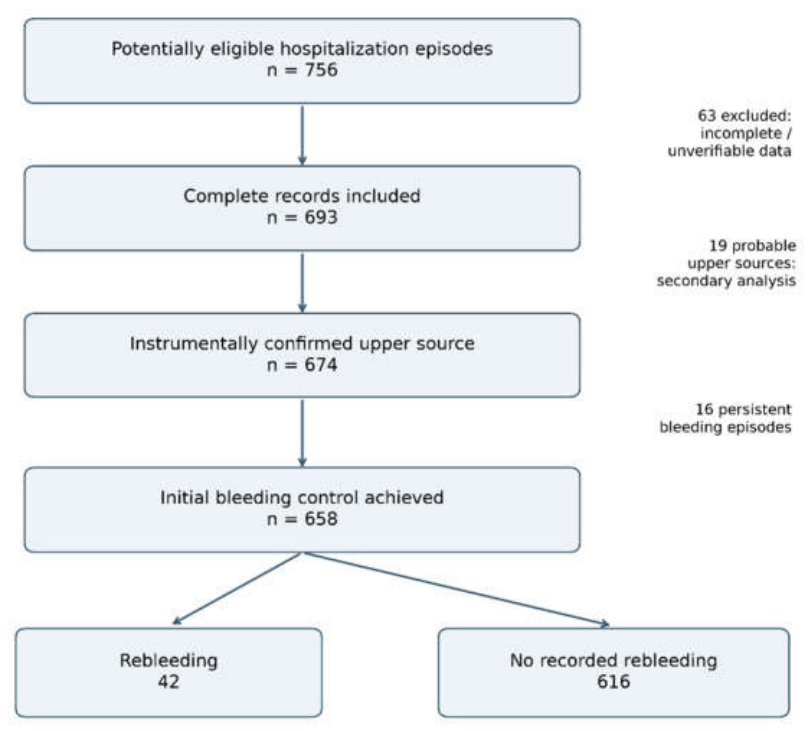
Figure 2.
Adjusted odds ratios and Wald 95% confidence intervals from the five-covariate logistic model. Continuous estimates are per increment shown. The dashed line indicates OR = 1.
Figure 2.
Adjusted odds ratios and Wald 95% confidence intervals from the five-covariate logistic model. Continuous estimates are per increment shown. The dashed line indicates OR = 1.
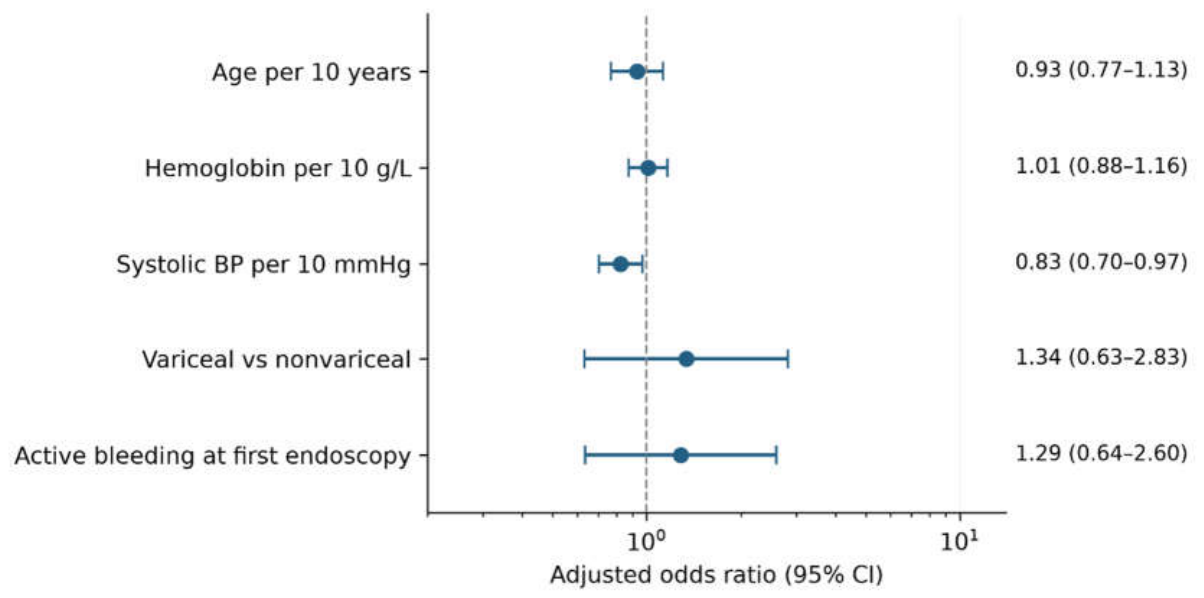

Table 1.
Baseline characteristics of confirmed episodes after initial control.
| Characteristic |
All N = 658 |
No recurrence n = 616 |
Recurrence n = 42 |
| Age, years | 60.0 [48.0-71.0] | 60.0 [49.0-71.0] | 59.0 [45.0-68.0] |
| Male sex | 448 (68.1) | 417 (67.7) | 31 (73.8) |
| Fresh hematemesis | 217 (33.0) | 199 (32.3) | 18 (42.9) |
| Melena | 568 (86.3) | 531 (86.2) | 37 (88.1) |
| Systolic BP, mmHg | 118.0 [102.0-134.0] | 119.0 [103.8-134.2] | 99.0 [89.2-127.8] |
| Pulse, beats/min | 90.0 [76.0-101.0] | 89.0 [76.0-100.0] | 96.5 [86.2-109.8] |
| Hemoglobin, g/L | 100.0 [82.0-116.0] | 100.0 [82.0-117.0] | 93.5 [81.2-113.0] |
| Urea, mmol/L | 8.5 [6.1-11.5] | 8.6 [6.1-11.6] | 7.9 [5.8-10.2] |
| Cirrhosis | 136 (20.7) | 125 (20.3) | 11 (26.2) |
| Anticoagulant exposure | 39 (5.9) | 35 (5.7) | 4 (9.5) |
| Variceal bleeding | 114 (17.3) | 103 (16.7) | 11 (26.2) |
| Active bleeding at first endoscopy | 155 (23.6) | 141 (22.9) | 14 (33.3) |
| Glasgow-Blatchford Score | 8.0 [6.0-12.0] | 8.0 [5.0-12.0] | 10.0 [7.0-14.0] |
| AIMS65 | 1.0 [0.0-1.0] | 1.0 [0.0-1.0] | 1.0 [0.0-2.0] |
Values are n (%) or median [interquartile range]. BP, blood pressure.
Table 2.
Exploratory adjusted associations with in-hospital rebleeding.
| Characteristic | Adjusted OR | 95% CI | P value |
| Age per 10 years | 0.93 | 0.77-1.13 | 0.458 |
| Hemoglobin per 10 g/L | 1.01 | 0.88-1.16 | 0.890 |
| Systolic BP per 10 mmHg | 0.83 | 0.70-0.97 | 0.019 |
| Variceal vs nonvariceal | 1.34 | 0.63-2.83 | 0.444 |
| Active bleeding at first endoscopy | 1.29 | 0.64-2.60 | 0.483 |
The model included 658 episodes and 42 recurrences. OR, odds ratio. CI, confidence interval.
Table 3.
Treatment and hospital course by observed recurrence status.
| Measure |
Confirmed N = 674 |
No recurrence n = 616 |
Recurrence n = 42 |
| Hemostasis at first endoscopy | 366 (54.3) | 325 (52.8) | 28 (66.7) |
| Repeat endoscopy | 58 (8.6) | 0 (0.0) | 42 (100.0) |
| Repeat endoscopic hemostasis | 57 (8.5) | 0 (0.0) | 42 (100.0) |
| Arterial embolization | 7 (1.0) | 0 (0.0) | 5 (11.9) |
| Surgery for hemostasis | 11 (1.6) | 0 (0.0) | 6 (14.3) |
| TIPS | 2 (0.3) | 0 (0.0) | 2 (4.8) |
| ICU admission | 117 (17.4) | 88 (14.3) | 23 (54.8) |
| In-hospital death | 17 (2.5) | 14 (2.3) | 3 (7.1) |
| RBC transfusion | 232 (34.4) | 174 (28.2) | 42 (100.0) |
| Length of stay, days | 4.8 [3.5-6.7] | 4.7 [3.4-6.2] | 8.1 [6.8-10.5] |
Values are n (%) or median [interquartile range]. The confirmed cohort also includes 16 episodes with persistent bleeding. Interventions could overlap. RBC, red blood cell. ICU, intensive care unit. TIPS, transjugular intrahepatic portosystemic shunt.
Disclaimer/Publisher’s Note: The statements, opinions and data contained in all publications are solely those of the individual author(s) and contributor(s) and not of MDPI and/or the editor(s). MDPI and/or the editor(s) disclaim responsibility for any injury to people or property resulting from any ideas, methods, instructions or products referred to in the content. |
© 2026 by the authors. Licensee MDPI, Basel, Switzerland. This article is an open access article distributed under the terms and conditions of the Creative Commons Attribution (CC BY) license.
Copyright: This open access article is published under a Creative Commons CC BY 4.0 license, which permit the free download, distribution, and reuse, provided that the author and preprint are cited in any reuse.