

Submitted:
14 November 2026
Posted:
16 November 2026
You are already at the latest version
Abstract
Every minute, a ride-hailing platform decides which driver to send, what to charge, where idle cars should wait and when a courier should leave for a kitchen—while the software platform underneath must itself reshape to the load. We present ATLAS Go, an open ride-hailing and food-delivery system in which each of these decisions is made by an explicit algorithm, rehearsed before it is executed and checked before anyone sees it. The system is organised in four layers on top of an adaptive platform. The platform chooses every five seconds which software modules run inside a monolith and which run as microservices, by solving a binary integer program (BIP) in three phases—perceive; optimise by exact enumeration (2a) or LP relaxation (2b); round, repair and transition—cutting p99 latency from 129.6 ms to 90.0 ms at 22% lower cost than tuned microservices. Layer 1 (learning) runs on the phone: an LSTM forecasts demand, a policy-gradient agent dispatches rides, two Q-learning agents time couriers and add drivers, and an LSTM+RL loop retrains both models every night but keeps a new model only if it beats the old one on held-out data. Layer 2 (agents) is a digital twin of the city in which a dispatch agent and a pricing agent rehearse their decisions 200 times before acting; trained as actor–critic learners with one shared critic (MAPPO), the dispatch agent's learning signal becomes about 40% less noisy. Layer 3 is the Guardian, a runtime shield that blocks any out-of-bounds decision; it caught 3000 of 3000 injected faults with no false alarm. Layer 4 is the phone itself: riders, drivers and kitchens see explained decisions, and whenever Layer 2 fails or is switched off, every screen falls back to Layer 1. We compare the design with Uber, Ola and FREENOW at feature level. All code, data, tests and 44 teaching experiments are public.
Keywords:
ride-hailing
; digital twin
; binary integer programming
; LSTM
; reinforcement learning
; Q-learning
; actor–critic
; multi-agent reinforcement learning
; MAPPO
; safe reinforcement learning
; runtime shielding
1. Introduction
It is 23:00 on the Saturday of the Cork Jazz Festival. Demand at the Mardyke is twice an ordinary Saturday. The nearest free driver, Ava, is the last free car in a zone that will be swamped in ten minutes. Send her, and this rider is happy while the next five wait. Keep her there, and this rider waits three minutes longer. Raise the price, and some riders walk away; raise it too far, and the platform makes the news. In the same second, the platform’s own payment service is running hot, and the question whether to split it out of the monolith must be answered before the next five-second tick. In the kitchen two streets away, a cook wants to know when to start the food so that it is hot when the courier walks in.
Large operators answer such questions with proprietary machine-learning stacks [1,2,3]. Only part of that machinery is public, and the safety logic around it is invisible to riders, drivers, regulators and students. This paper takes the opposite approach. ATLAS Go [4] is an open, reproducible system in which:
- every decision is made by an algorithm short enough to write on one page;
- no learned decision reaches a person without first being rehearsed in a digital twin and then checked by a Guardian;
- if anything above the learning layer fails, the service falls back to a tested answer instead of failing.

Contributions: The paper makes six contributions.
- 1.
- A four-layer architecture with a guaranteed fallback (Section 2): learning, agents, Guardian and phone layers over an adaptive platform; if Layer 2 fails, Layer 1 answers.
- 2.
- A coupling BIP for the platform (Section 3): one objective that balances delay, cost, failure risk and switching, solved in three phases with two sub-phases.
- 3.
- A self-checking LSTM+RL loop on a phone (Section 4): forecasting, policy-gradient dispatch, two Q-learning agents, and nightly retraining with champion/challenger validation.
- 4.
- A city digital twin with rehearsal agents (Section 5): mirror, 30-minute foresight and Monte Carlo rehearsal of dispatch and pricing, and the same two agents trained as actor–critic learners with one shared critic (MAPPO).
- 5.
- The Guardian (Section 6): a runtime shield with a simple, proven safety invariant.
- 6.
- The phone layer and a market comparison (Sections 7 and 9): explained decisions for riders, drivers and kitchens, and a feature-level comparison with Uber, Ola and FREENOW.
Every algorithm is first explained in words, then as numbered steps, then with a few equations in simple notation (Table 2).
2. Overall Architecture
Figure 1 shows the whole system. Read it from the bottom up: the platform keeps the software healthy; Layer 1 learns; Layer 2 rehearses; Layer 3 checks; Layer 4 shows the result to people. Information flows up; outcomes flow back down into Layer 1’s experience log.

Table 1.
The four layers and the platform at a glance.
| Layer | Job | Methods | Runs | Code |
|---|---|---|---|---|
| Platform | keep the software fast, cheap and safe | coupling BIP, LSTM load forecast, Isolation Forest | server, every 5 s | cluster.py |
| Layer 1 ·learning | forecast demand; dispatch; time couriers; add drivers; retrain | LSTM, REINFORCE, Q-learning, LSTM+RL loop | phone, every request / hour / night | intelligence.py, loop.py |
| Layer 2 ·agents | see the next 30 min; rehearse rides and prices | digital twin, Monte Carlo, A2C, MAPPO | phone, every request / 5 min | twin.py |
| Layer 3 ·Guardian | block anything outside the limits; fall back; re-test | runtime shield | phone, every decision | twin.py (checks) |
| Layer 4 ·phone | show decisions and reasons to riders, drivers, kitchens | explanations, hints, Layer 2 switch | phone screens | app.py |
The life of one ride: A rider books at the Mardyke (Layer 4). Layer 1 ranks the nearby drivers and offers its top three. Layer 2 rehearses each of them 200 times in the twin and proposes the one that keeps the total waiting lowest over the next 30 minutes; Agent 2 proposes the price. Layer 3 checks both proposals; if either breaks a limit, it is replaced by Layer 1’s own answer. Layer 4 shows the rider the driver, the price and a one-line reason, shows the driver the pickup, and records the outcome for Layer 1’s nightly update.

Table 2.
Simple notation used in this paper.
| Symbol | Meaning | Symbol | Meaning |
|---|---|---|---|
| module i inside (0) or outside (1) the monolith | requests per second | ||
| delay, cost, failure risk | price of changing a module | ||
| forecast demand k hours ahead, ÷ ordinary | LSTM memory at hour t | ||
| policy: chance of action a in situation s | critic: how good s is | ||
| value of action a in situation s | r, A | reward, advantage | |
| twin’s demand ratio for the next 30 min | m | price multiplier, | |
| W | rehearsed total waiting (minutes) | learning rates |
3. The Platform: Objective Function and the Coupling BIP
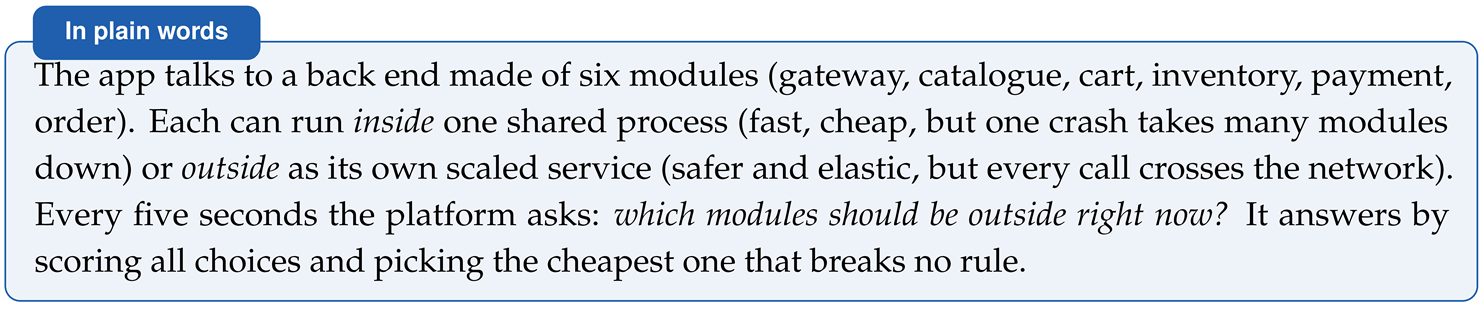
3.1. Objective Function
Let if module i runs outside the monolith and . For the expected load , the platform predicts the delay , the cost in cores and the failure risk , and minimises one score:
The first three terms are divided by their all-monolith values at 650 req/s, so they are comparable. The last term is a switching price (): moving a module is never free, so the platform only moves one when it pays. The choice must respect four rules:
Delay, cost and risk in simple terms: With T the modules inside the monolith, how often a request visits module i and its CPU time,
The blast radius is the key idea: a crash inside the monolith takes down the traffic of its busiest module, whereas a crash outside takes down only that module. The crash chance grows when a host is overloaded and when an Isolation Forest [5] flags module i as anomalous (score a):
3.2. Three Phases, Two Sub-Phases
| Algorithm 1 Platform decision every s (coupling BIP, three phases with two sub-phases). |
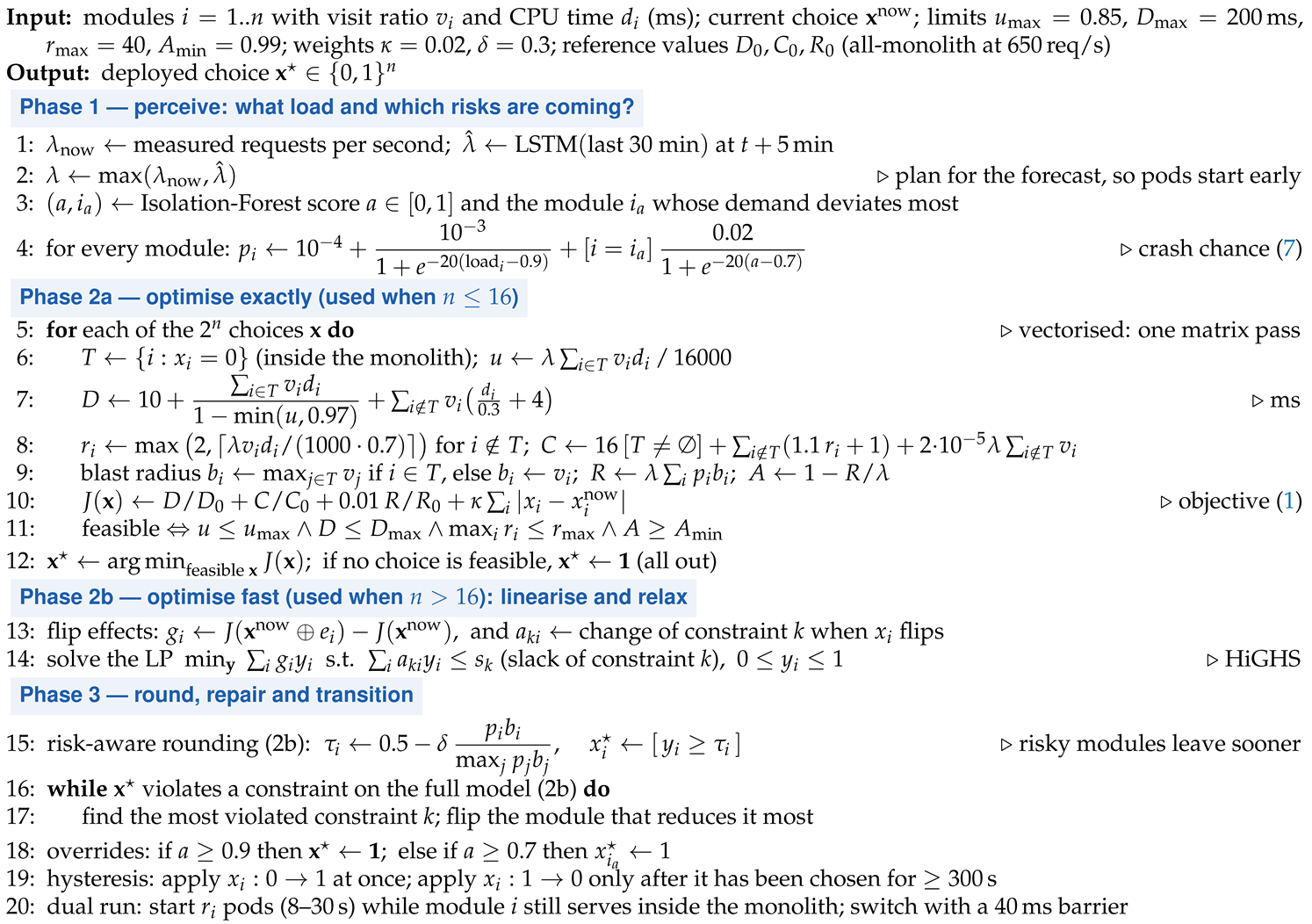 |
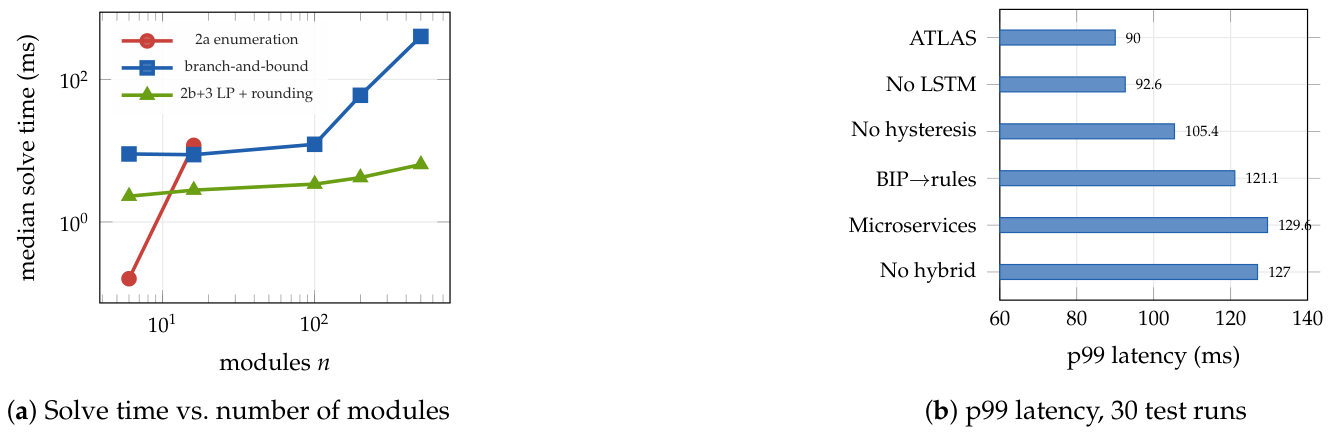
Figure 2.
The platform in numbers [6]. (a) LP + rounding stays under 7 ms even at 500 modules (median gap to optimum 0.23%). (b) Removing any part of the controller costs latency; a pure monolith reaches 3.56 s.
Figure 2.
The platform in numbers [6]. (a) LP + rounding stays under 7 ms even at 500 modules (median gap to optimum 0.23%). (b) Removing any part of the controller costs latency; a pure monolith reaches 3.56 s.
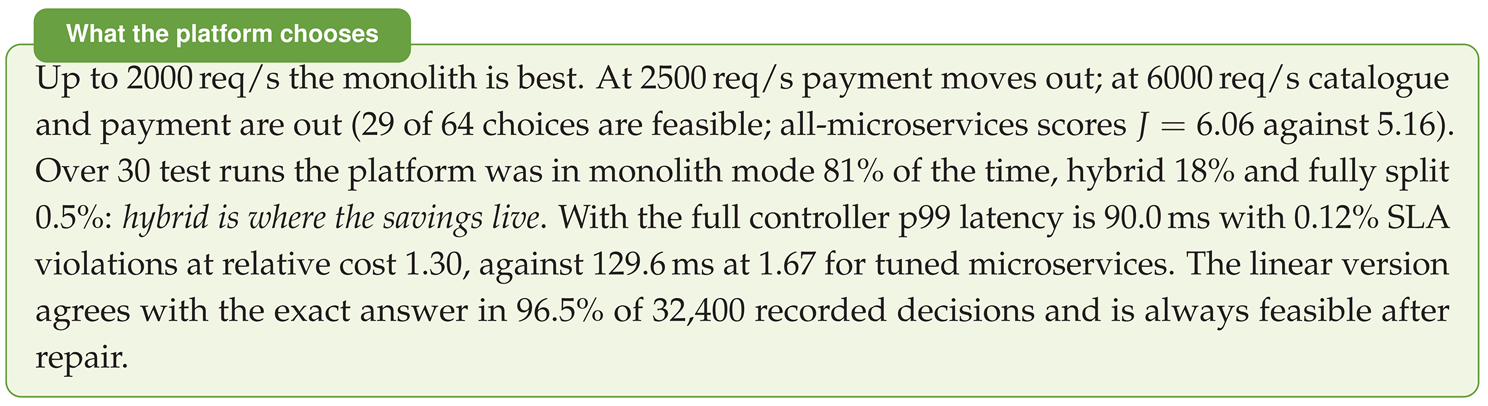
4. Layer 1: Learning on the Phone (LSTM, RL, Q-Learning and the LSTM+RL Loop)
Layer 1 runs entirely on the phone, in plain Python, without a network connection. It holds four learners (Table 3).
4.1. The LSTM Demand Forecaster

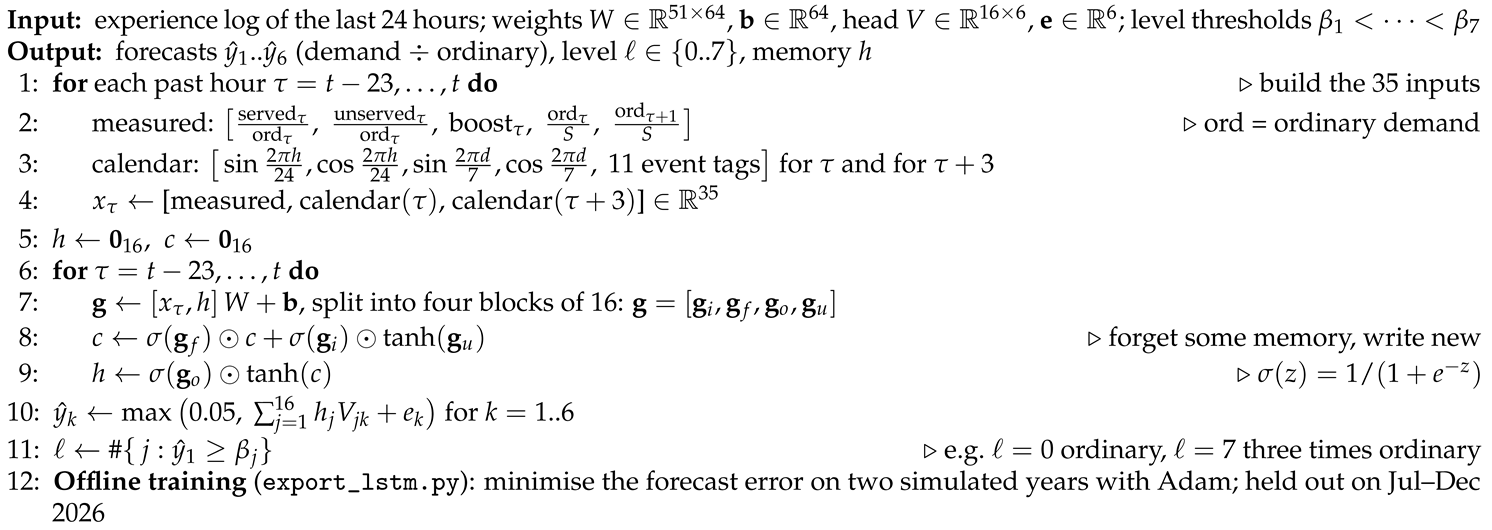
Each hour t is a list of 35 numbers. The LSTM keeps a memory and an output of 16 numbers and updates them with four small gates [7]:
The weights are trained offline with Adam [8] on two simulated years of Cork. Held out on July–December 2026, the next-hour error is 9.3%, and 81% of surge hours are caught. The phone’s plain-Python version agrees with the numpy original to .
Algorithm 2 lists every step of one forecast.
| Algorithm 2 LSTM demand forecast for the next six hours (runs every city hour on the phone). |
 |
4.2. Ride Dispatch by Policy Gradient (RL)
| Algorithm 3 Ride dispatch policy trained with REINFORCE (Layer 1). |
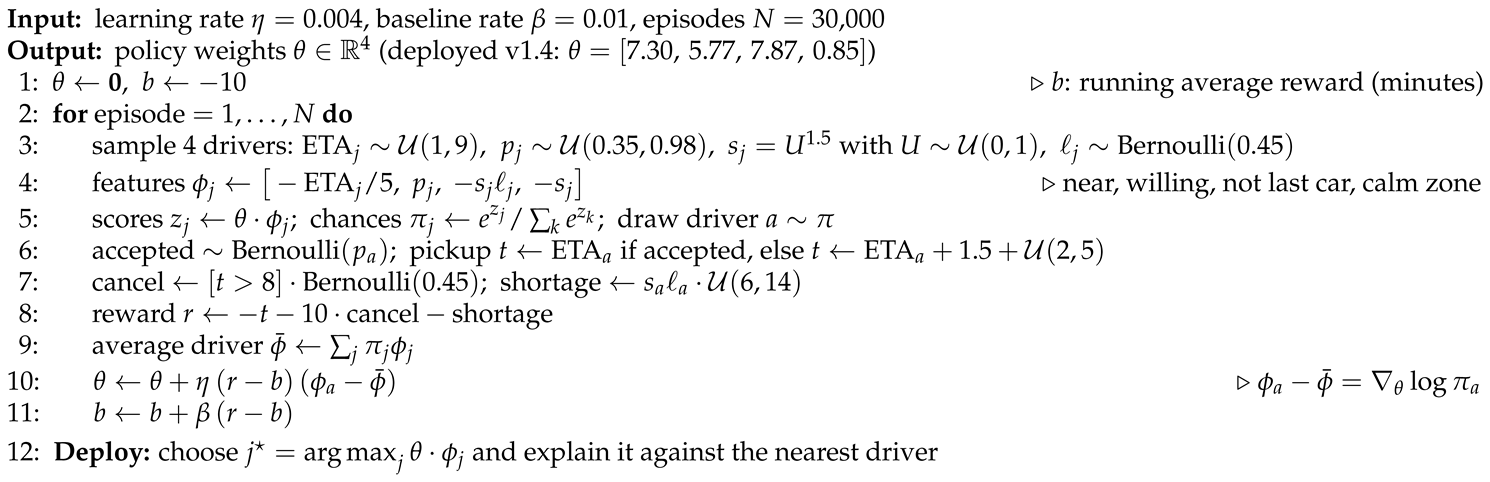 |
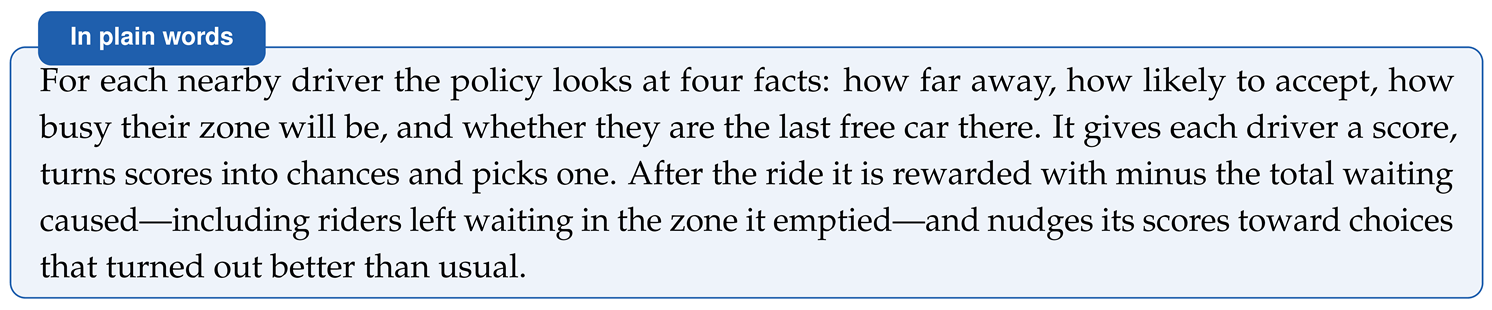
Here is the average driver under the current policy [9]. After 30,000 simulated rides the deployed policy (v1.4) waits 5.38 min per ride against 6.42 min for “nearest driver” (). Its largest weight is on “last free car in a zone about to surge”: it has learned not to empty a zone just before the rush.
4.3. Q-Learning: Courier Timing and Extra Drivers

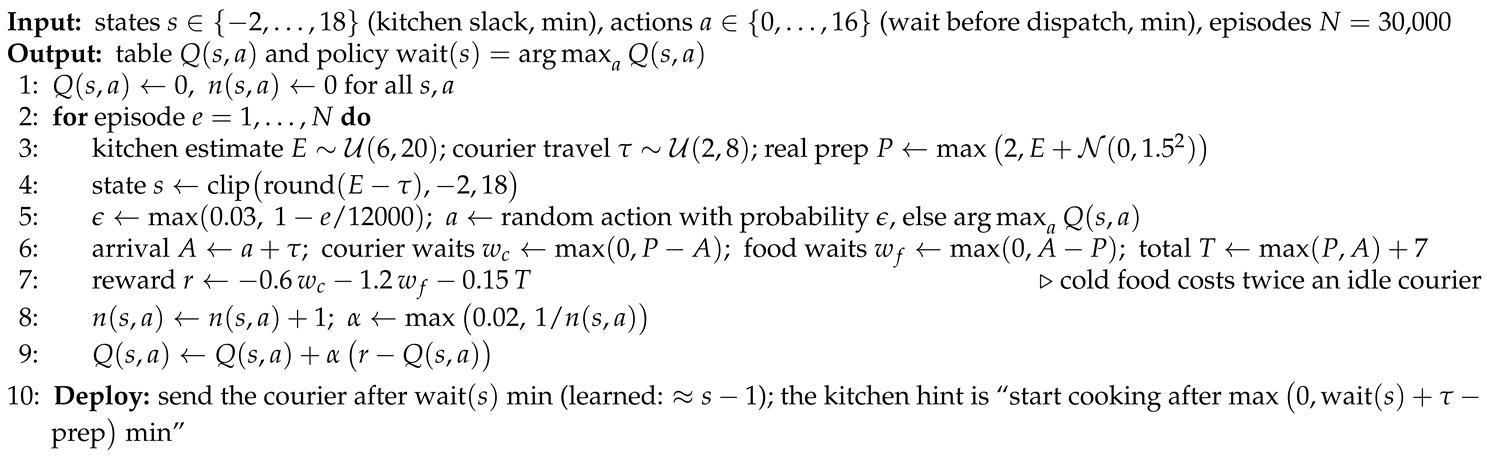
Courier timing: The situation is the kitchen slack, (minutes); the action is how long to wait before sending the courier, . The reward punishes a courier waiting at the counter, food going cold and the total time:
Starting fully random and becoming greedy ( from 1.0 to 0.03), it learns the rule “wait slack minus one minute”: combined courier-and-food waiting falls from 8.12 to 1.44 min.
| Algorithm 4 Courier timing with tabular Q-learning (Layer 1). |
 |
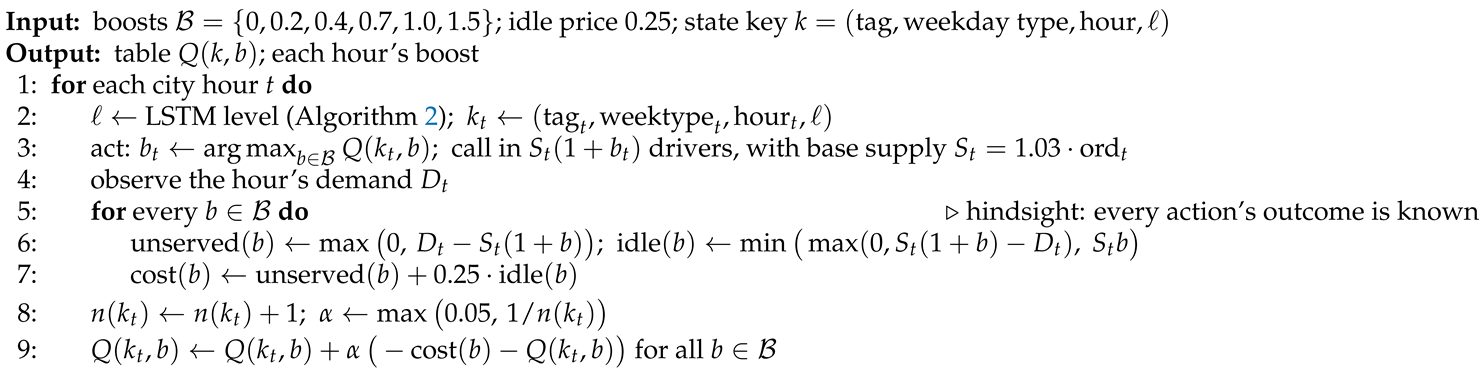
Extra drivers with hindsight: Each hour the supply agent chooses how many extra drivers to call in, , from the calendar context and the LSTM’s forecast level. The cost of an hour is
Because the real demand is known after the hour, the cost of every action can be computed, so all six table entries are updated at once (a “hindsight” update). With the forecast level in its state it costs 18% less than the calendar-only agent on the held-out half-year.
| Algorithm 5 Extra-driver (supply) agent with hindsight Q-learning (Layer 1). |
 |
4.4. The LSTM+RL Loop: Forecast, Act, Record, Retrain, Validate

| Algorithm 6 Layer 1 live loop: forecast, act, record, retrain, validate (every hour; nightly at 23:00). |
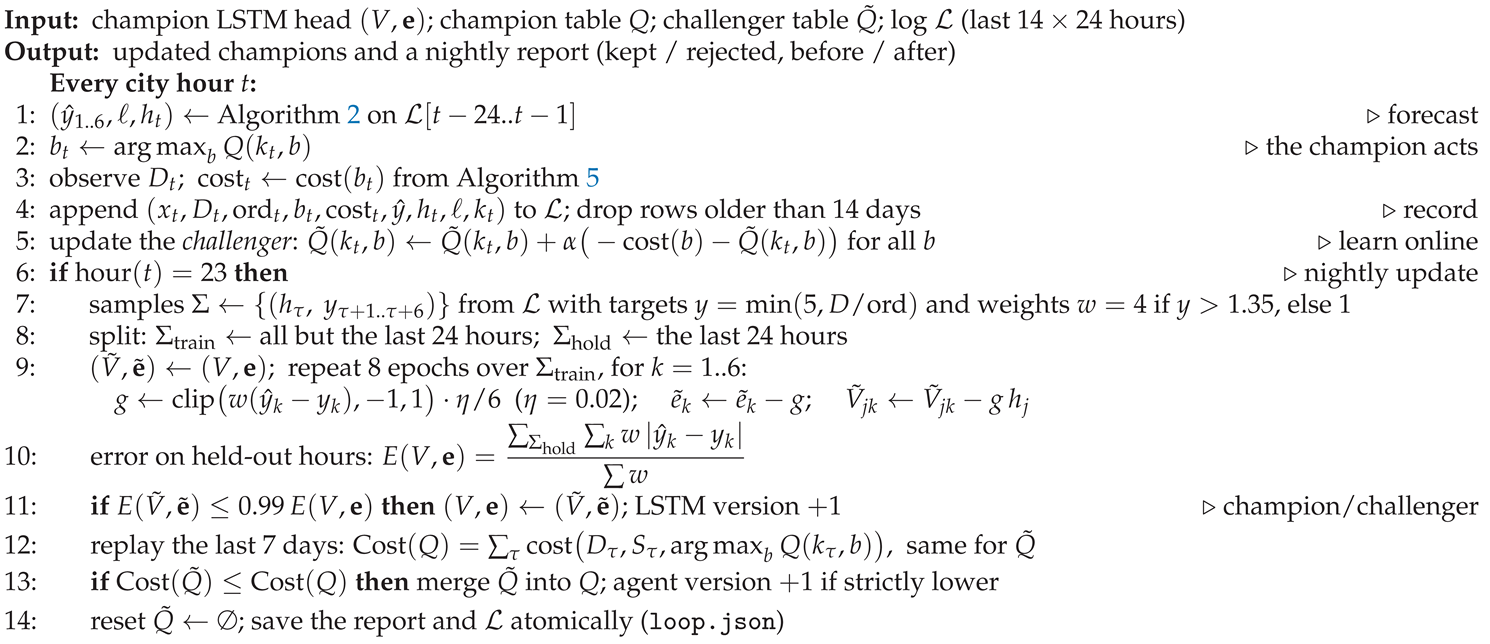 |
The acceptance tests are simply
Figure 3.
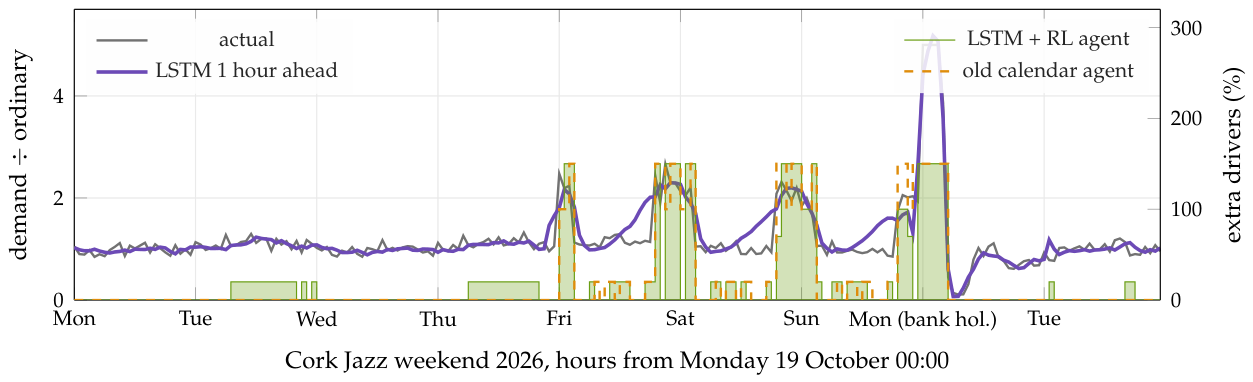
The loop at work: A recorded run of loop.py over nine city days. The forecast sees the Jazz nights coming; the agent’s extra drivers (green) follow the forecast instead of a fixed calendar (dashed). Cost over the period: loop 3329, calendar agent 3579, no extra drivers 9880.
Figure 3.
The loop at work: A recorded run of loop.py over nine city days. The forecast sees the Jazz nights coming; the agent’s extra drivers (green) follow the forecast instead of a fixed calendar (dashed). Cost over the period: loop 3329, calendar agent 3579, no extra drivers 9880.

5. Layer 2: The Digital Twin and Its Two Agents
A digital twin is a living model of a real system that is kept in step with it and used to try decisions before making them [11,12]. Layer 1 asks “which driver now?”; the twin asks “what will this do to the city in thirty minutes?” Figure 4 shows how it works. The twin reads Layer 1 but never changes it.
5.1. Mirror and Foresee
The mirror copies every driver, the active car and the courier. It also measures how well it knows them (fidelity): a driver with a live position counts 1, a registered driver known only by home area counts 0.6. Foresight turns Layer 1’s calendar-aware outlook into a 30-minute demand ratio per pickup place and a pressure per area:
(260 is the reference hourly demand; one car serves about 2.2 rides per half-hour.) In festival and holiday weeks this foresight is off by 0.12–0.16, against 0.43–0.65 for “same as the last hour”.
5.2. Agent 1: Dispatch by Rehearsal

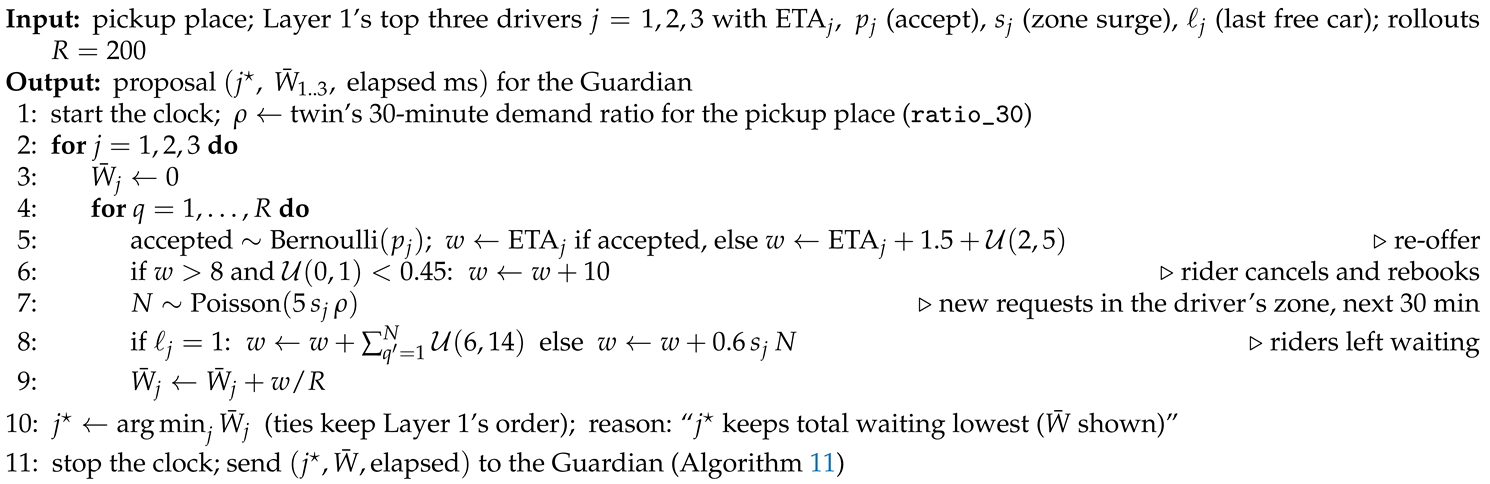
One rollout for driver j gives
where N, the number of new requests in the driver’s zone, is drawn from a Poisson distribution with mean . Agent 1 proposes over the top three (ties keep Layer 1’s order). 200 rollouts agree with a 5000-rollout reference on 100% of decisions on Cork’s driver pools.
| Algorithm 7 Agent 1: dispatch by Monte Carlo rehearsal in the twin (Layer 2). |
 |
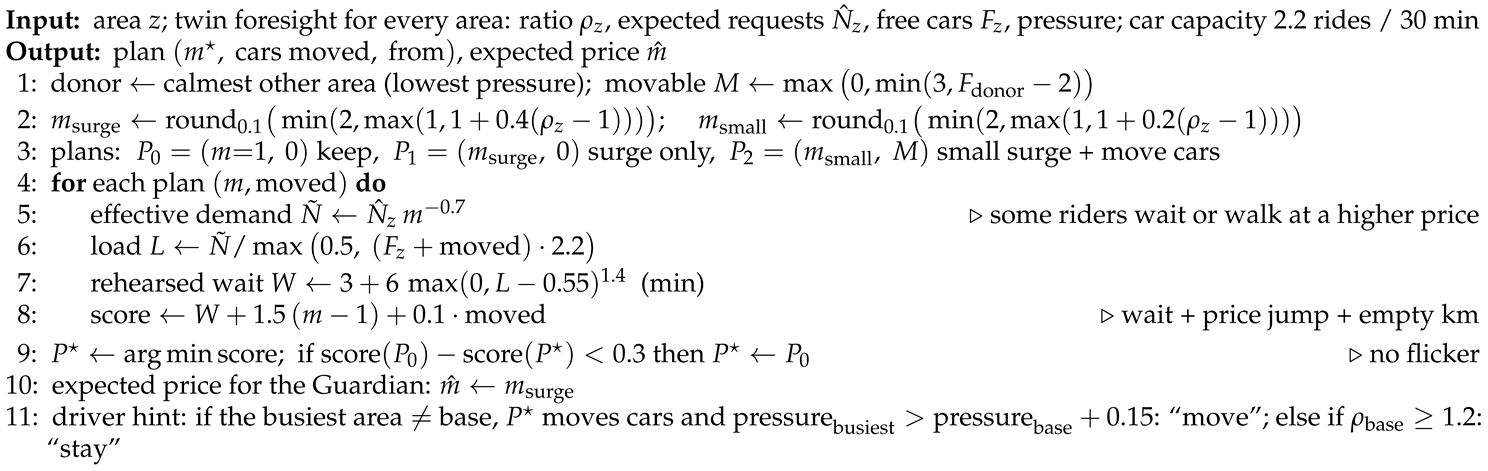
5.3. Agent 2: Prices and Idle Cars

With m the price multiplier, demand is damped as , the rehearsed waiting of the area is , and each plan is scored
A plan replaces “keep prices” only if its score is at least 0.3 lower. At 13:00 on St Patrick’s Day in the City Centre, the twin’s plan ( and two cars moved in) cuts the rehearsed wait from 11.4 to 4.2 min, against 6.7 min for a surge of alone.
| Algorithm 8 Agent 2: pricing and idle-car repositioning (every 5 minutes per area, Layer 2). |
 |
5.4. When the Agents Learn: Actor and Critic Networks

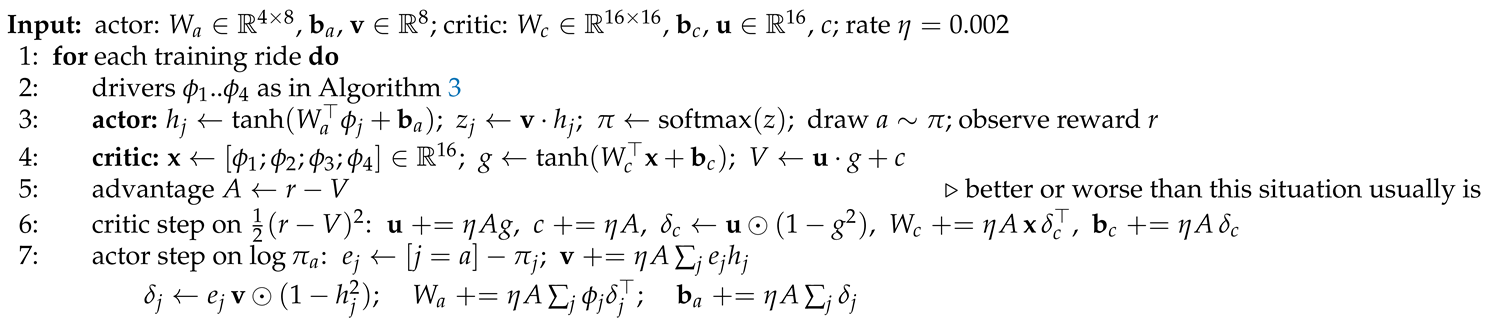
The single running average b of Algorithm 3 is replaced by a critic :
The actor is a small network per driver (4 inputs → 8 hidden → 1 score); the critic reads all four drivers (16 → 16 → 1) [13,14]. With the same rides, the actor–critic reaches the deployed policy’s quality (within 0.1 min) after 2000 rides; REINFORCE needs 8000 (Figure 5a). The variance of the learning signal falls from 23.4 () to 18.9 ().
Algorithm 9 gives the complete update.
| Algorithm 9 Advantage actor–critic (A2C) for dispatch (Layer 2 learning mode). |
 |
5.5. Two Agents, One Shared Critic (MAPPO)

| Algorithm 10 Two agents with one shared critic (MAPPO; IPPO differs only in line 8). |
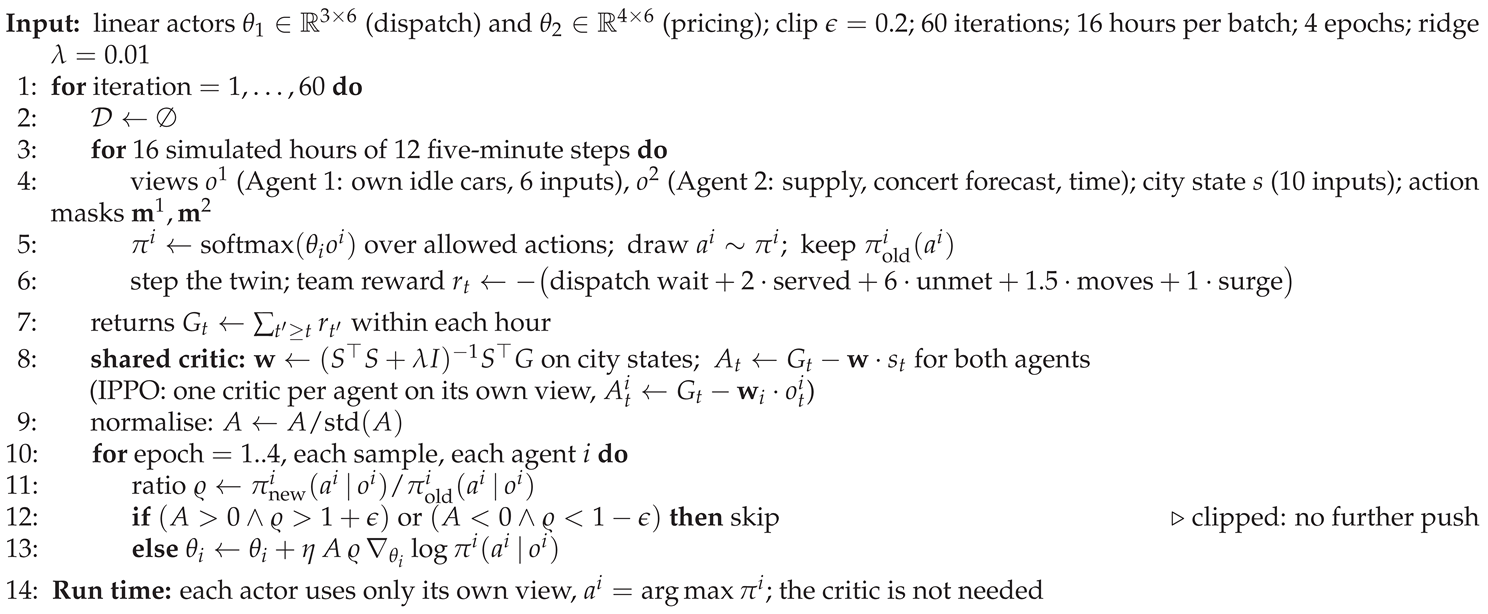 |
The test twin has three zones (Mardyke, City Centre, Kent Station), twelve five-minute steps, and a concert that ends at the Mardyke halfway through the hour. Agent 1 sees only its idle cars; Agent 2 sees supply, the concert forecast and the time. The team reward is .
Figure 5.
Learning in Layer 2: (a) A critic cuts the rides needed to reach the deployed policy to a quarter (mean of 3 seeds). (b) Both multi-agent learners beat “nearest car” by about 20%; MAPPO improves faster in mid-training (mean of 4 seeds, 5-iteration average).
Figure 5.
Learning in Layer 2: (a) A critic cuts the rides needed to reach the deployed policy to a quarter (mean of 3 seeds). (b) Both multi-agent learners beat “nearest car” by about 20%; MAPPO improves faster in mid-training (mean of 4 seeds, 5-iteration average).
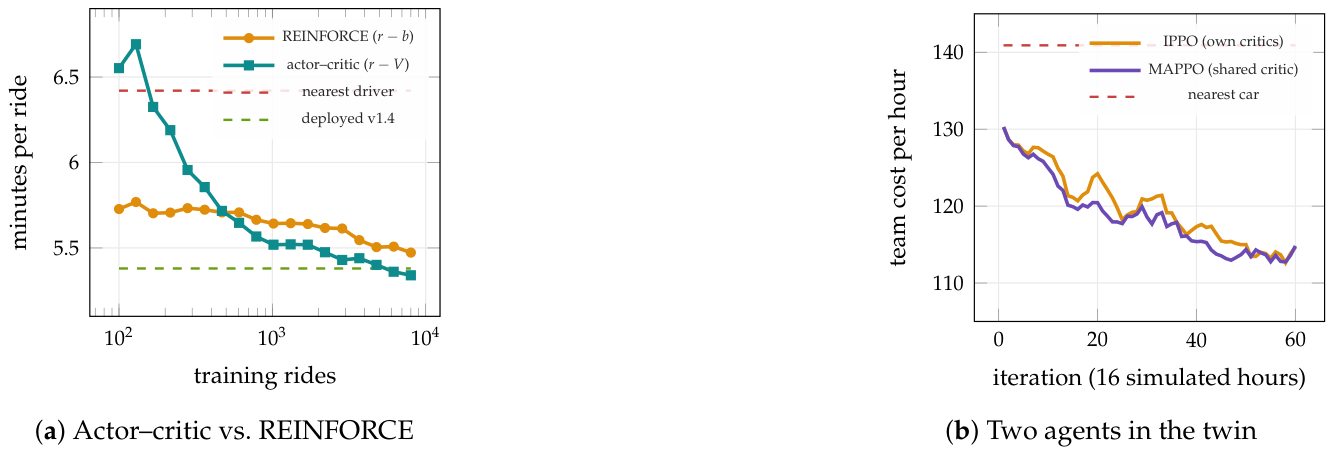
Table 4.
Two agents, one reward (4 seeds, 60 iterations, 500 test hours).
| Policy | Team cost / hour | Spread of advantages | |
|---|---|---|---|
| Agent 1 | Agent 2 | ||
| Nearest car, never move | 140.9 | — | — |
| Random | 130.3 | — | — |
| IPPO (own critics) | 112.5 ± 3.7 | 29.9 | 18.1 |
| MAPPO (one shared critic) | 113.3 ± 5.0 | 17.4 | 17.4 |

6. Layer 3: The Guardian

Definition 1
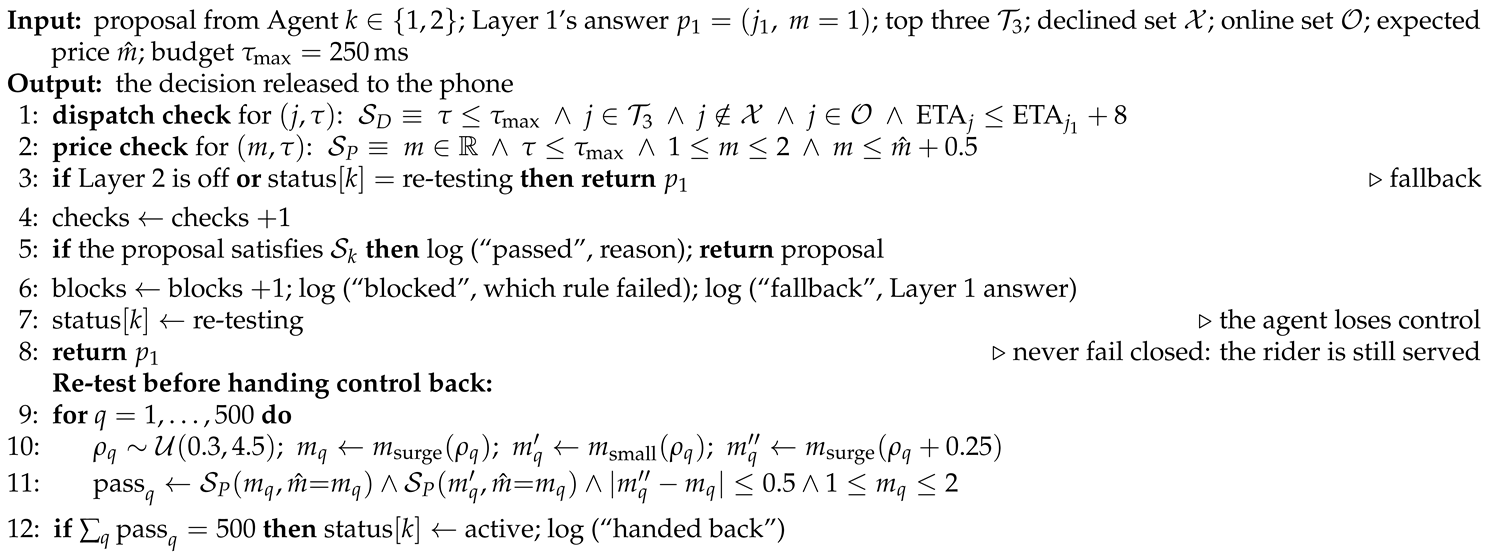
(Safe decision). Adispatchproposal is safe if it arrived within 250 ms; the driver is in Layer 1’s top three, online, and has not declined this ride; and the pickup is at most 8 minutes longer than Layer 1’s first choice. Apriceis safe if it is a number, arrived within 250 ms, satisfies , and is at most 0.5 above the twin’s expected price.
| Algorithm 11 Agent 3, the Guardian: check, fall back, re-test (Layer 3). |
 |
Proposition 1
(Nothing unsafe reaches the phone). If Layer 1’s answer is always safe, every decision released by Algorithm 11 is safe, whatever Agents 1 and 2 do.
Proof.
The algorithm releases either p—only after checking that it is safe—or . Layer 1’s answer is safe by construction: its driver is its own first choice (so it is in the top three and the pickup rule holds trivially), declined and offline drivers are removed from its list, its price lies in and below the twin’s price plus 0.5, and it is a table look-up that finishes far within 250 ms. So every exit releases a safe decision. □
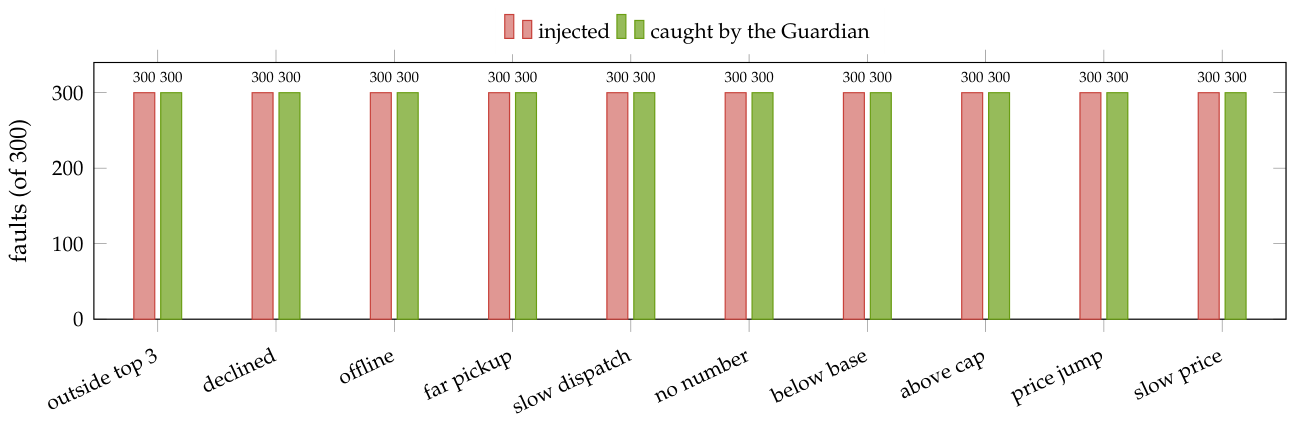
Figure 6.
Fault drill: Ten fault types, 300 each: 3000 of 3000 caught, no false alarm on 6000 normal decisions; the re-test passes 500/500 before control is handed back.
Figure 6.
Fault drill: Ten fault types, 300 each: 3000 of 3000 caught, no false alarm on 6000 normal decisions; the re-test passes 500/500 before control is handed back.
7. Layer 4: The Phone—Riders, Drivers and Kitchens

Table 5.
What each person sees in Layer 4, and where it comes from.
| Who | What the phone shows | Comes from |
|---|---|---|
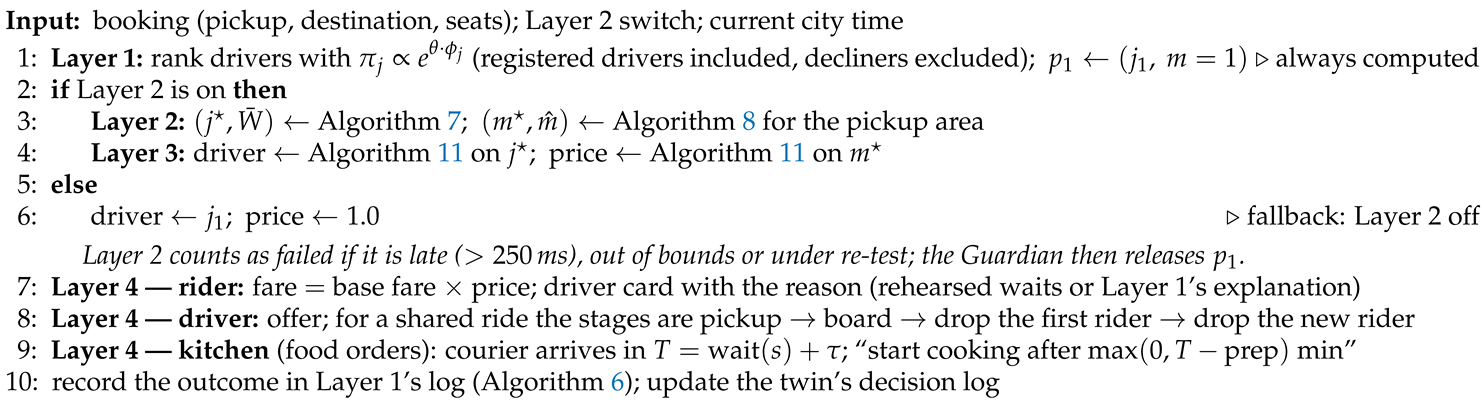
| Rider | driver card with the reason (“Morgan keeps total waiting lowest; Ava is the last car at the busy Mardyke”), capped price, four-stage shared ride (the rider already on board is dropped first) | Agent 1, Agent 2, Guardian; or Layer 1 |
| Driver | ride offers; move towards City Centre / stay hint with the expected extra requests | Agent 2 plan (driver_hint) |
| Kitchen | “courier arrives in T min; start cooking after min” | Layer 1 courier plan + twin ETA (kitchen_hint) |
| Operator | twin tab: fidelity, foresight table, agents’ state, decision log, Layer 2 on/off switch, fault drill | Layers 2–3 |
| Everyone | “How ATLAS learns”: this hour’s forecast, extra drivers, outcome, model versions, nightly updates | Layer 1 loop |
| Algorithm 12 One booking end to end across the four layers, with the fallback (Layer 4 view). |
 |
8. Implementation and Reproducibility
The platform is the Python simulator of ATLAS [6] (30 test seeds; tuning on 10 separate validation seeds). ATLAS Go 1.4.0 is a Python/Kivy Android app: Layer 2 and the Guardian live in twin.py, the loop in loop.py, the LSTM weights in lstm_weights.py. It passes 173 unit tests, 314 desktop interface checks and 373 checks on an Android 16 emulator; a unit test confirms that Layer 1’s original models are byte-identical. The repository also holds 44 teaching experiments—including ML 21 (twin), ML 22 (actor–critic), ML 23 (MAPPO) and ML 24 (the loop)—and a browser explorer in which the twin, the Guardian, the actor–critic, MAPPO and the phone’s LSTM run live [4]. Every figure in this paper is drawn from CSV files exported from that code.
9. Comparison with Uber, Ola and FREENOW
Commercial platforms operate at a scale no research prototype approaches, and much of their technology is private. The comparison is therefore feature-level and evidence-based: Table 6 records what each operator documents publicly (as of November 2026); “n.d.” means not documented in the public sources we reviewed, not “absent”.
Table 6 is the heart of the comparison and is honest in both directions. The commercial apps lead on everything that needs scale and operations: footprint, pre-booking, emergency buttons and ride-safety monitoring (note that Ola’s “Guardian” [34] watches rides for safety incidents, whereas the ATLAS Go Guardian checks algorithmic decisions; the two are complementary). ATLAS Go leads on what makes the algorithms themselves inspectable and safe. Three differences stand out. Pricing safety: commercial surge caps are usually set by regulators and differ by market (for example the base fare under India’s 2025 guidelines [23]); in ATLAS Go the cap is a property of the software, checked on every decision. Look-ahead: Uber describes learning long-term values of driver states and using them to steer matching [1]; ATLAS Go rehearses each concrete candidate in a twin, which is easier to explain and audit. Openness: every algorithm here can be run by a student in a browser.

10. Related Work
Order dispatch has been cast as learning and planning with value functions [2] and as mean-field multi-agent RL [37], and is surveyed in [3]; industry increasingly blends temporal-difference value learning with online matching [1]. ATLAS Go differs in being small, explicit and on-device, and in separating learning (Layer 1) from rehearsal (Layer 2) and checking (Layer 3). Digital twins come from manufacturing and product life-cycle management [11,12]; here the twin is a rehearsal space rather than a dashboard. Our learners build on actor–critic methods [13], PPO [15], MAPPO [16] and IPPO [17], and on centralised critics [38,39]. The Guardian follows shielded and safe RL [40,41], with a fallback that is itself a validated policy. The platform’s coupling BIP is introduced in ATLAS [6] and solved with HiGHS [42].
11. Discussion and Limitations
The layered design keeps each concern small: Layer 1 can learn aggressively because Layer 3 bounds what any learner can do, and Layer 2 can be switched off without harming service because Layer 1 always answers. The main limits are:
- Synthetic data: Demand, drivers, kitchens and traffic are simulated; results illustrate the methods, not a real market.
- A small multi-agent twin: Three zones and two agents; a larger benefit of the shared critic is expected but not shown.
- Partial retraining on the phone: Only the LSTM’s output layer is retrained nightly; short validation windows (24 h, 7 days) and no significance test yet.
- Planner in the app, learner in the lab: The shipped Agents 1 and 2 plan by rehearsal; the actor–critic and MAPPO agents are evaluated in the lab.
- Twin input: The twin reads the calendar outlook rather than the live LSTM forecast.
- Software faults: The fallback covers late, out-of-bounds and re-testing agents; wrapping Layer 2 in an exception guard, so that a crash in its code also falls back to Layer 1, is a simple next step.
12. Conclusions
ATLAS Go shows that a ride-hailing system can be learned, rehearsed, guarded and explained at the same time, and that each part fits on a page: a BIP that reshapes the platform in under 7 ms; a phone-sized LSTM+RL loop that retrains every night yet never deploys a worse model; a digital twin that plays every ride and price thirty minutes ahead; a shared critic that gives two agents a common sense of credit; a Guardian whose invariant keeps every decision in the box; and a phone layer that tells riders, drivers and kitchens what was decided and why—and falls back to Layer 1 whenever anything above it fails. Next steps are to put the MAPPO actors behind the Guardian in the app, feed the live forecast into the twin, and validate the stack on real, consented trip data.
Author Contributions
Conceptualization, B.P. and P.P.; methodology, B.P.; software, B.P.; validation, B.P. and P.P.; formal analysis, B.P.; investigation, B.P.; writing—original draft preparation, B.P.; writing—review and editing, B.P. and P.P.; visualization, B.P.; supervision, P.P. All authors have read and agreed to the published version of the manuscript.
Funding
This research received no external funding.
Data Availability Statement
Code, data, tests, the 44 experiments and the live explorer are openly available at https://github.com/FUllSCIPTS/ATLAS and https://fullscipts.github.io/ATLAS/.
Acknowledgments
The authors thank the University College Cork.
Conflicts of Interest
The authors declare no conflicts of interest.
Abbreviations
The following abbreviations are used in this manuscript:
| A2C | Advantage actor–critic |
| BIP | Binary integer program |
| IPPO | Independent proximal policy optimisation |
| LP | Linear program |
| LSTM | Long short-term memory |
| MAPPO | Multi-agent proximal policy optimisation |
| PPO | Proximal policy optimisation |
| RL | Reinforcement learning |
| SLA | Service-level agreement |
References
- Jain, P.; Sadeghi, S.; Bakhtiari, M. Reinforcement Learning for Modeling Marketplace Balance. Uber Engineering Blog. 2 July 2025. Available online: https://www.uber.com/blog/reinforcement-learning-for-modeling-marketplace-balance/ (accessed on 14 November 2026).
- Xu, Z.; Li, Z.; Guan, Q.; Zhang, D.; Li, Q.; Nan, J.; Liu, C.; Bian, W.; Ye, J. Large-Scale Order Dispatch in On-Demand Ride-Hailing Platforms: A Learning and Planning Approach. In Proceedings of the ACM SIGKDD International Conference on Knowledge Discovery & Data Mining, 2018; pp. 905–913. [Google Scholar]
- Qin, Z.T.; Zhu, H.; Ye, J. Reinforcement Learning for Ridesharing: An Extended Survey. Transp. Res. Part C Emerg. Technol. 2022, 144, 103852. [Google Scholar] [CrossRef]
- Palaniswamy, B.; Palmieri, P. ATLAS supplementary code and data, ATLAS Go 1.4.0 and the ATLAS Architecture Explorer. https://github.com/FUllSCIPTS/ATLAS; MIT licence, 2026; Available online: https://fullscipts.github.io/ATLAS/.
- Liu, F.T.; Ting, K.M.; Zhou, Z.H. Isolation Forest. In Proceedings of the IEEE International Conference on Data Mining (ICDM), 2008; pp. 413–422. [Google Scholar]
- Palaniswamy, B.; Palmieri, P. ATLAS: Learning to Rewire the Web — Predictive Architecture Transformation for Autonomous Cloud Systems. Future Internet 2026, Accepted, to appear. [Google Scholar] [CrossRef]
- Hochreiter, S.; Schmidhuber, J. Long Short-Term Memory. Neural Comput. 1997, 9, 1735–1780. [Google Scholar] [CrossRef] [PubMed]
- Kingma, D.P.; Ba, J. Adam: A Method for Stochastic Optimization. In Proceedings of the International Conference on Learning Representations (ICLR), 2015. [Google Scholar]
- Williams, R.J. Simple Statistical Gradient-Following Algorithms for Connectionist Reinforcement Learning. Mach. Learn. 1992, 8, 229–256. [Google Scholar] [CrossRef]
- Watkins, C.J.C.H.; Dayan, P. Q-Learning. Mach. Learn. 1992, 8, 279–292. [Google Scholar] [CrossRef]
- Grieves, M.; Vickers, J. Digital Twin: Mitigating Unpredictable, Undesirable Emergent Behavior in Complex Systems. In Transdisciplinary Perspectives on Complex Systems; Springer, 2017; pp. 85–113. [Google Scholar]
- Tao, F.; Zhang, H.; Liu, A.; Nee, A.Y.C. Digital Twin in Industry: State-of-the-Art. IEEE Trans. Ind. Inform. 2019, 15, 2405–2415. [Google Scholar] [CrossRef]
- Mnih, V.; Badia, A.P.; Mirza, M.; Graves, A.; Lillicrap, T.; Harley, T.; Silver, D.; Kavukcuoglu, K. Asynchronous Methods for Deep Reinforcement Learning. In Proceedings of the International Conference on Machine Learning (ICML), 2016; pp. 1928–1937. [Google Scholar]
- Sutton, R.S.; Barto, A.G. Reinforcement Learning: An Introduction, 2nd ed.; MIT Press, 2018. [Google Scholar]
- Schulman, J.; Wolski, F.; Dhariwal, P.; Radford, A.; Klimov, O. Proximal Policy Optimization Algorithms. arXiv 2017, arXiv:1707.06347. [Google Scholar]
- Yu, C.; Velu, A.; Vinitsky, E.; Gao, J.; Wang, Y.; Bayen, A.; Wu, Y. The Surprising Effectiveness of PPO in Cooperative Multi-Agent Games. In Proceedings of the Advances in Neural Information Processing Systems (NeurIPS), Datasets and Benchmarks Track, 2022. [Google Scholar]
- de Witt, C.S.; Gupta, T.; Makoviichuk, D.; Makoviychuk, V.; Torr, P.H.S.; Sun, M.; Whiteson, S. Is Independent Learning All You Need in the StarCraft Multi-Agent Challenge? arXiv 2020, arXiv:2011.09533. [Google Scholar]
- Uber. Making Spring Break Travel More Effortless (Uber Reserve, Uber Eats at airports). 2023. Available online: https://www.uber.com/us/en/newsroom/spring-break/ (accessed on 14 November 2026).
- ANI Technologies. Ola: Book Cab, Auto, Bike Taxi — App Store listing. Available online: https://apps.apple.com/us/app/-/id539179365 (accessed on 14 November 2026).
- Lyft, Inc. Lyft Goes Global: FREENOW Acquisition Complete. 31 July 2025. Available online: https://www.businesswire.com/news/home/20250731202512/en (accessed on 14 November 2026).
- Intelligent Apps GmbH. Freenow by Lyft — App Store listing (UK). Available online: https://apps.apple.com/gb/app/id357852748 (accessed on 14 November 2026).
- Uber. How Surge Pricing Works. Available online: https://www.uber.com/au/en/drive/driver-app/how-surge-works/ (accessed on 14 November 2026).
- Business Standard. Govt Permits Surge Fares of up to 2x Base Rate for Cab Aggregators. Ministry of Road Transport and Highways: India, 2025. Available online: https://www.business-standard.com/india-news/cab-aggregators-surge-pricing-rapido-uber-ola-125070200228_1.html (accessed on 14 November 2026). On the Motor Vehicle Aggregator Guidelines 2025.
- TaxiPoint. FREENOW Fixed Prices: More Detail Around the Fixed Price Zones, Pricing Algorithm and Transparent Commission. Available online: https://www.taxi-point.co.uk/post/freenow-fixed-prices-more-detail-around-the-fixed-price-zones-pricing-algorithm-and-transparent-co (accessed on 14 November 2026).
- Free Press Journal. Maharashtra Transport Department Caps Surge Pricing for Ride Aggregators During Festivals and Emergencies. 2025. Available online: https://www.freepressjournal.in/amp/mumbai/relief-for-commuters-maharashtra-transport-department-caps-surge-pricing-for-ride-aggregators-during-festivals-emergencies (accessed on 14 November 2026).
- Uber. Introducing Taxi Fixed Price. Uber Ireland blog. 29 May 2026. Available online: https://www.uber.com/ie/en/blog/introducing-taxi-fixed-price/ (accessed on 14 November 2026).
- TaxiPoint. FREENOW Scraps Fixed Price Fares for On-Demand Black Taxis Just a Month after Its Introduction. Available online: https://www.taxi-point.co.uk/post/freenow-scraps-fixed-price-fares-for-on-demand-black-taxis-just-a-month-after-its-introduction (accessed on 14 November 2026).
- Uber. How Surge Pricing Works (Canada). Available online: https://uber.com/ca/en/drive/driver-app/how-surge-works/ (accessed on 14 November 2026).
- Uber. How Surge Works — Driver App. Available online: https://www.uber.com/do/en/drive/driver-app/how-surge-works/ (accessed on 14 November 2026).
- Uber. Schedule Rides in Advance with Uber Reserve. Available online: https://www.uber.com/en-IE/blog/schedule-rides-in-advance-with-uber-reserve/ (accessed on 14 November 2026).
- Uber Technologies. H3: Hexagonal Hierarchical Geospatial Indexing System. Available online: https://github.com/uber/h3 (accessed on 14 November 2026).
- Business, Outlook. Ola Cabs Exits Google Maps, Transitions to In-House Ola Maps. 2024. Available online: https://www.outlookbusiness.com/corporate/ola-cabs-google-maps-ola-maps (accessed on 14 November 2026).
- Uber. Safety: Safety Toolkit, RideCheck, emergency button, Share My Trip. Available online: https://www.uber.com/ride/safety/ (accessed on 14 November 2026).
- The News Minute. Ola Launches `Guardian’ Feature to Improve Customer Safety During Rides. Available online: https://www.thenewsminute.com/atom/ola-rolls-out-guardian-feature-improve-customer-safety-during-rides-114626 (accessed on 14 November 2026).
- Uber. Introducing UberX Share. Uber Newsroom. 21 June 2022. Available online: https://www.uber.com/newsroom/uberx-share/ (accessed on 14 November 2026).
- Business Standard. Ola Cabs Rebranded to Ola Consumer; Relaunch of Ola Share. Available online: https://www.business-standard.com/topic/ola-cabs (accessed on 14 November 2026).
- Li, M.; Qin, Z.; Jiao, Y.; Yang, Y.; Wang, J.; Wang, C.; Wu, G.; Ye, J. Efficient Ridesharing Order Dispatching with Mean Field Multi-Agent Reinforcement Learning. In Proceedings of the The World Wide Web Conference (WWW), 2019; pp. 983–994. [Google Scholar]
- Lowe, R.; Wu, Y.; Tamar, A.; Harb, J.; Abbeel, P.; Mordatch, I. Multi-Agent Actor-Critic for Mixed Cooperative-Competitive Environments. In Proceedings of the Advances in Neural Information Processing Systems (NeurIPS), 2017. [Google Scholar]
- Foerster, J.; Farquhar, G.; Afouras, T.; Nardelli, N.; Whiteson, S. Counterfactual Multi-Agent Policy Gradients. In Proceedings of the AAAI Conference on Artificial Intelligence, 2018. [Google Scholar]
- Alshiekh, M.; Bloem, R.; Ehlers, R.; Könighofer, B.; Niekum, S.; Topcu, U. Safe Reinforcement Learning via Shielding. In Proceedings of the AAAI Conference on Artificial Intelligence, 2018. [Google Scholar]
- García, J.; Fernández, F. A Comprehensive Survey on Safe Reinforcement Learning. J. Mach. Learn. Res. 2015, 16, 1437–1480. [Google Scholar]
- Huangfu, Q.; Hall, J.A.J. Parallelizing the Dual Revised Simplex Method. Math. Program. Comput. 2018, 10, 119–142. [Google Scholar] [CrossRef]
Figure 1.
The ATLAS Go architecture: four layers on an adaptive platform: Layer 1 learns, Layer 2 rehearses in a digital twin, Layer 3 (the Guardian) checks, Layer 4 shows explained decisions to riders, drivers and kitchens. The red path is the fallback: whenever Layer 2 fails, is switched off or is being re-tested, every screen is served by Layer 1. The teal path returns outcomes to Layer 1, which retrains itself every night.
Figure 1.
The ATLAS Go architecture: four layers on an adaptive platform: Layer 1 learns, Layer 2 rehearses in a digital twin, Layer 3 (the Guardian) checks, Layer 4 shows explained decisions to riders, drivers and kitchens. The red path is the fallback: whenever Layer 2 fails, is switched off or is being re-tested, every screen is served by Layer 1. The teal path returns outcomes to Layer 1, which retrains itself every night.
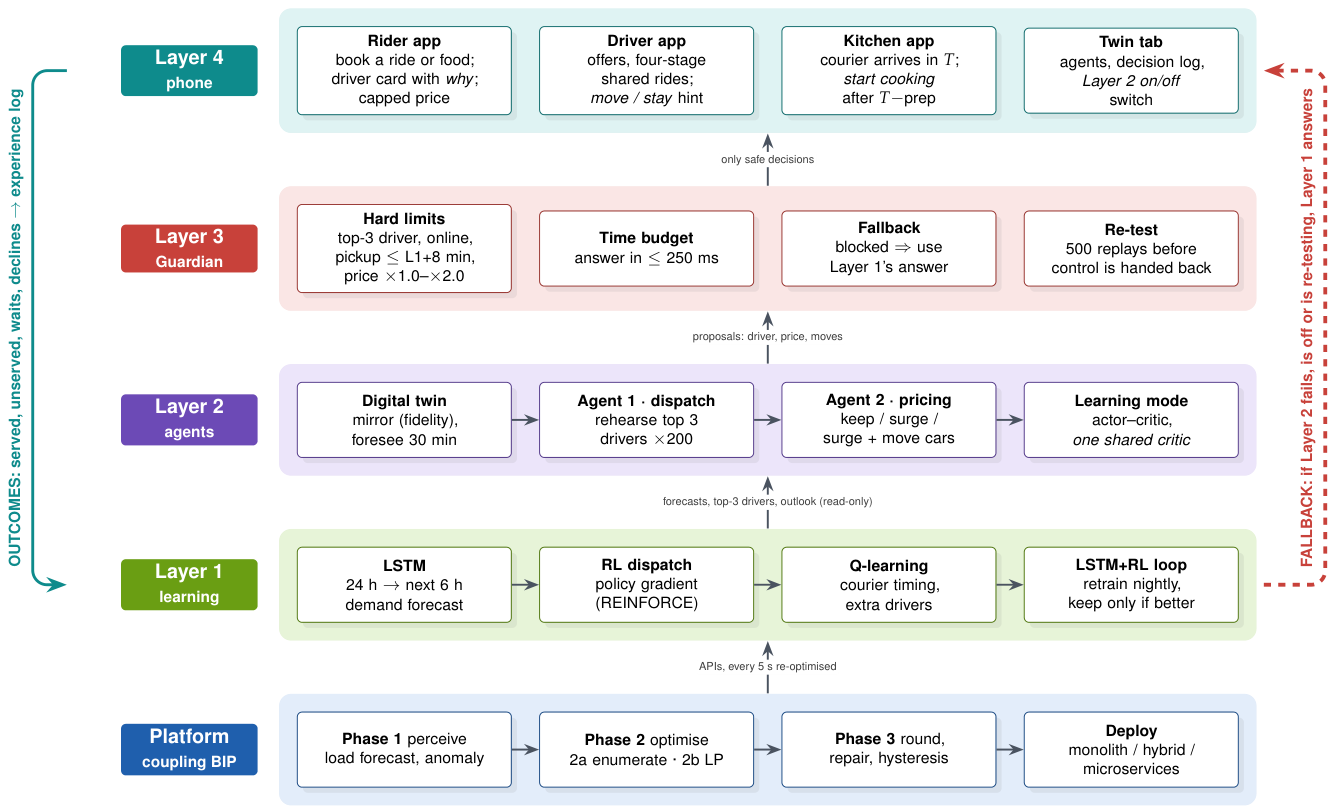
Figure 4.
The digital twin and its three agents: (1) The twin mirrors the real city and scores how well it knows it (fidelity). (2) It foresees demand for the next 30 minutes per place. Agent 1 plays the next 30 minutes 200 times for each of Layer 1’s top three drivers and proposes the lowest average total waiting —Morgan, not the nearest driver Ava, because Ava is the last free car at the busy Mardyke. Agent 2 compares three price and repositioning plans for the busiest area and proposes ×1.4 with two idle cars moved in. Agent 3, the Guardian, checks both proposals against hard limits; anything that fails is replaced by Layer 1’s answer and the agent is re-tested. Safe decisions reach the rider, driver and kitchen; outcomes flow back to the twin and to Layer 1. (Example values are illustrative.)
Figure 4.
The digital twin and its three agents: (1) The twin mirrors the real city and scores how well it knows it (fidelity). (2) It foresees demand for the next 30 minutes per place. Agent 1 plays the next 30 minutes 200 times for each of Layer 1’s top three drivers and proposes the lowest average total waiting —Morgan, not the nearest driver Ava, because Ava is the last free car at the busy Mardyke. Agent 2 compares three price and repositioning plans for the busiest area and proposes ×1.4 with two idle cars moved in. Agent 3, the Guardian, checks both proposals against hard limits; anything that fails is replaced by Layer 1’s answer and the agent is re-tested. Safe decisions reach the rider, driver and kitchen; outcomes flow back to the twin and to Layer 1. (Example values are illustrative.)
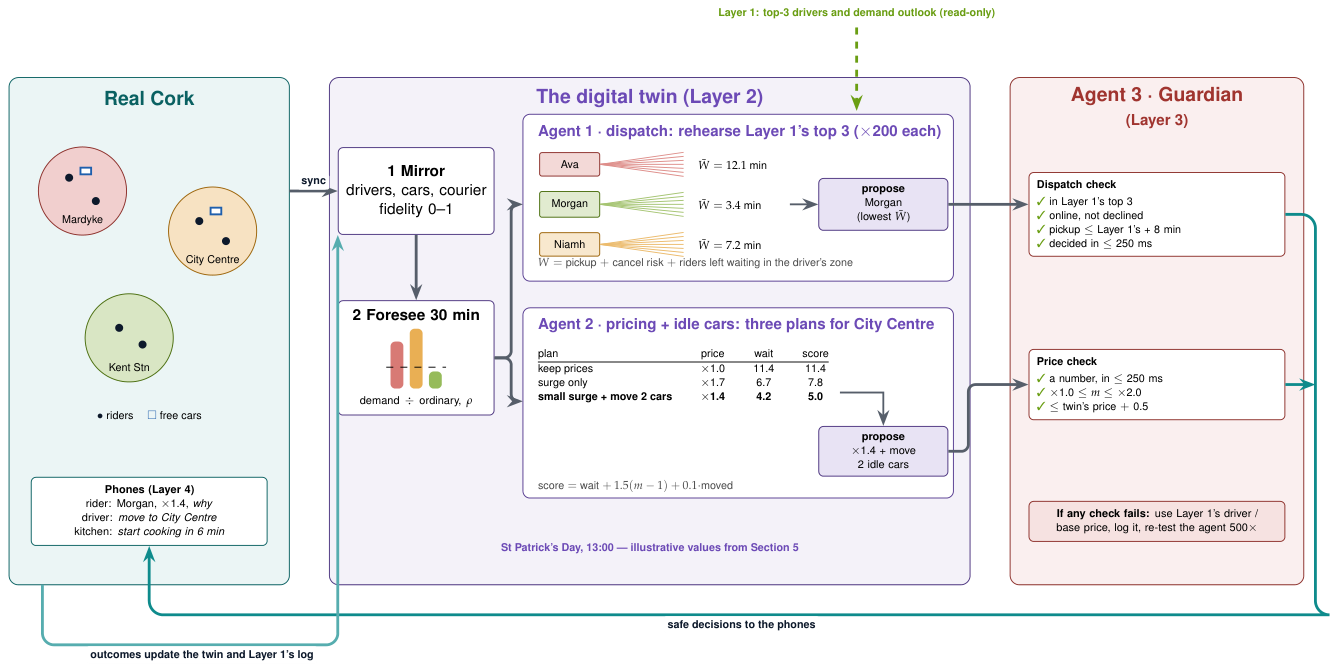
Table 3.
Layer 1 learners in ATLAS Go 1.4 (simulated Cork, held-out data).
| Learner | Method | Sees → decides | Result |
|---|---|---|---|
| Demand forecast | LSTM | last 24 hours → demand for the next 6 hours | 9.3% next-hour error |
| Ride dispatch | policy gradient | 4 facts per driver → which driver | 5.38 vs 6.42 min (nearest) |
| Courier timing | Q-learning | kitchen slack → minutes to wait | idle + cold food 8.12 → 1.44 min |
| Extra drivers | Q-learning (hindsight) | calendar + forecast level → 0–150% extra | 18% cheaper than calendar |
Table 6.
ATLAS Go against Uber, Ola and FREENOW, feature by feature (sources as of November 2026). ✓ documented; ● partial; n.d. not documented in the sources we reviewed; ✗ not offered.
Table 6.
ATLAS Go against Uber, Ola and FREENOW, feature by feature (sources as of November 2026). ✓ documented; ● partial; n.d. not documented in the sources we reviewed; ✗ not offered.
| Feature | Uber | Ola | FREENOW (by Lyft) | ATLAS Go 1.4 (this work) |
|---|---|---|---|---|
| A. Market and scope | ||||
| Footprint | ✓ global; rides, Reserve, Eats [18] | ✓ India; cabs, autos, bike taxis [19] | ✓ taxis, PHVs, micro-mobility in 9 countries; Lyft since July 2025 [20,21] | ✗ research prototype on a simulated city (Cork); rides and food delivery |
| Food delivery | ✓ Uber Eats [18] | n.d. | n.d. | ✓ kitchen and courier flow with learned courier timing |
| B. Pricing and fairness | ||||
| Dynamic pricing | ✓ surge folded into the upfront fare [22] | ✓ surge [23] | ● taxi meter; fixed fares in some zones [24] | ✓ Agent 2 rehearses keep / surge / small surge + move cars |
| Surge ceiling | ● set by regulators where they exist (e.g. base in India) [23] | ✓ base under India’s MVAG 2025 [23]; in Maharashtra [25] | ● regulated taxi tariffs | ✓ hard limit and above the twin’s price, checked on every decision |
| Upfront or fixed price | ✓ upfront; Taxi Fixed Price, a maximum-price guarantee (Ireland) [26] | n.d. | ● optional fixed fares in zones [24]; night fixed fares withdrawn after a month [27] | ✓ upfront, capped |
| Surge and drivers | ✓ service-fee percentage unchanged in surge [28]; surge shown on the offer card [29] | n.d. | ✓ driver sees the same fixed fare as the rider [24] | ✗ earnings not modelled |
| Cancellation rules | ✓ Reserve: free until 60 min before pickup [30] | ✓ driver penalty 10% of fare, ≤ Rs. 100, under MVAG 2025 [23] | n.d. | ● a decline triggers a re-offer; the Guardian never re-sends a driver who declined |
| C. Dispatch and intelligence | ||||
| Learned matching | ✓ temporal-difference values steer online matching [1] | n.d. | n.d. | ✓ REINFORCE policy with open weights; actor–critic in the lab |
| Look-ahead before dispatch | ● long-term value of driver states [1] | n.d. | n.d. | ✓ 30-minute twin rehearsal of the top three drivers, 200 rollouts each |
| Demand forecasting | ● marketplace models from completed trips [1] | n.d. | n.d. | ✓ on-phone LSTM, 6 hours ahead, 9.3% next-hour error |
| Digital twin of the city | n.d. | n.d. | n.d. | ✓ mirror with fidelity score; 30-minute foresight per place |
| Multi-agent learning | n.d. | n.d. | n.d. | ✓ dispatch and pricing actors with one shared critic (MAPPO, lab) |
| Continual learning with validation | n.d. | n.d. | n.d. | ✓ nightly champion/challenger on the phone |
| Maps and spatial index | ✓ open-source H3 index [31] | ✓ in-house Ola Maps [32] | n.d. | ● OpenStreetMap tiles with offline fallback |
| D. Safety, governance and resilience | ||||
| Ride-safety monitoring | ✓ RideCheck: sensors and GPS flag off-route trips and crashes [33] | ✓ “Ola Guardian”: AI real-time ride monitoring [34] | ✓ real-time trip sharing [21] | ✗ not implemented |
| Emergency (SOS) button | ✓ in-app emergency button [33] | ✓ SOS to a safety response team; up to five emergency contacts [19] | n.d. | ✗ not implemented |
| Shield on algorithmic decisions | n.d. | n.d. | n.d. | ✓ Guardian: hard limits, 250 ms budget, proven invariant |
| Fallback to a tested model | n.d. | n.d. | n.d. | ✓ Layer 1 answers whenever Layer 2 fails, is off or is re-tested |
| Fault-injection testing | n.d. | n.d. | n.d. | ✓ 3000/3000 injected faults caught; 500-case re-test |
| E. Rider, driver and kitchen experience | ||||
| Shared rides | ✓ UberX Share, up to 20% off [35] | ✓ Ola Share relaunched [36] | ● shared micro-mobility [21] | ✓ four stages; the rider on board is dropped first (enforced) |
| Pre-booking | ✓ up to 90 days [30] | ✓ scheduled rides [19] | ✓ up to 90 days [21] | ✗ on-demand only |
| Explains the driver choice | n.d. | n.d. | n.d. | ✓ one-line reason with the rehearsed waits |
| Driver move / stay hint | n.d. | n.d. | n.d. | ✓ from Agent 2’s plan and the twin’s pressure |
| Kitchen cook-start hint | n.d. | n.d. | n.d. | ✓ “start cooking after min” |
| F. Openness and reproducibility | ||||
| Open algorithms and code | ✗ | ✗ | ✗ | ✓ MIT licence; every algorithm in this paper |
| Tests and live teaching labs | n.d. | n.d. | n.d. | ✓ 173 unit tests, 373 emulator checks, 44 experiments, browser explorer |
Disclaimer/Publisher’s Note: The statements, opinions and data contained in all publications are solely those of the individual author(s) and contributor(s) and not of MDPI and/or the editor(s). MDPI and/or the editor(s) disclaim responsibility for any injury to people or property resulting from any ideas, methods, instructions or products referred to in the content. |
© 2026 by the authors. Licensee MDPI, Basel, Switzerland. This article is an open access article distributed under the terms and conditions of the Creative Commons Attribution (CC BY) license (http://creativecommons.org/licenses/by/4.0/).
Copyright: This open access article is published under a Creative Commons CC BY 4.0 license, which permit the free download, distribution, and reuse, provided that the author and preprint are cited in any reuse.