

Submitted:
13 November 2026
Posted:
16 November 2026
You are already at the latest version
Abstract
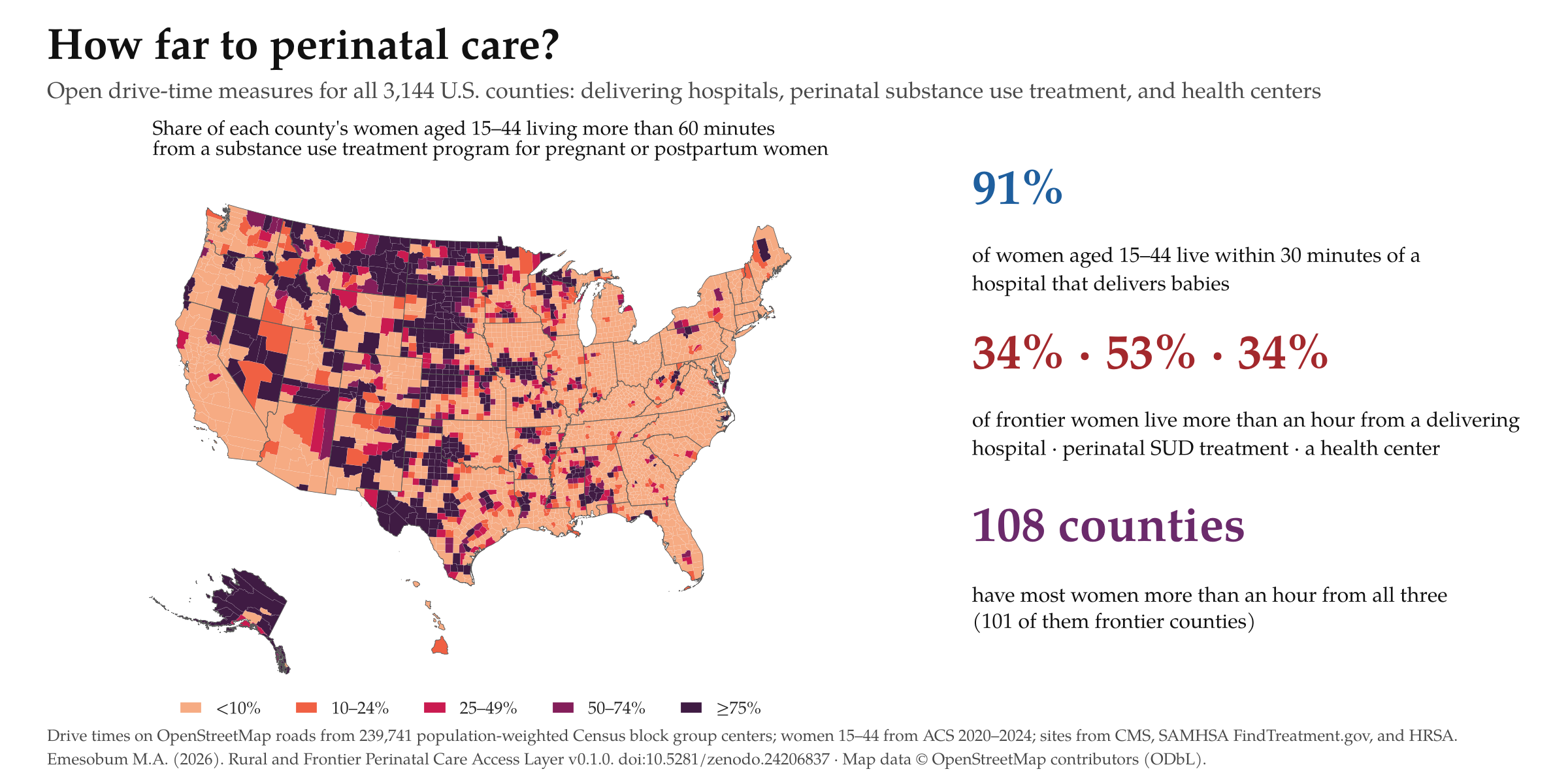
Counting facilities inside county lines does not show how far a pregnant or postpartum woman must travel for care. We built the Rural and Frontier Perinatal Care Access Layer, an open, versioned dataset that measures, for all 3,144 counties of the 50 states and the District of Columbia, the share of women aged 15–44 who live more than 30 and more than 60 minutes’ drive from three types of care: a hospital providing inpatient labor and delivery care (2,424 hospitals confirmed in Centers for Medicare & Medicaid Services, CMS, maternal health data), a substance use disorder (SUD) treatment facility with a program for pregnant or postpartum women (4,600 FindTreatment.gov listings), and a federally funded health center site (11,769). Drive times run from 239,741 population-weighted Census block group centers over a national OpenStreetMap road graph of 24.4 million points, using the speed rules of the Open Source Routing Machine (OSRM) car profile and an exact multi-source shortest-path search, and are weighted by the 66.0 million women aged 15–44 counted in the 2020–2024 American Community Survey. Nationally, 91.0% of women live within 30 minutes of a delivering hospital and 99.0% within 60 minutes, but the median frontier woman drives 43.3 minutes and 34.1% of frontier women live more than an hour away. Perinatal SUD treatment is the least accessible of the three: 13.3% of rural and 53.4% of frontier women live more than an hour from it, and in 556 rural or frontier counties most women do. 108 counties, 101 of them frontier, have most women more than an hour from all three care types. Because CMS does not report delivery status for many critical access hospitals, we also bound the hospital measure from above; the upper bound roughly halves the frontier share beyond an hour (15.8%). A check of 450 randomly drawn trips against the public OSRM server on the same roads gave a median time ratio of 0.992 and 99.1% agreement on the 60-minute cutoff, and the national mean drive to a delivering hospital (14.0 minutes) matches a published estimate from a commercial network (14.1 minutes). The data, code, routing method notes, and quality report are openly released (doi:10.5281/zenodo.24206837).
Keywords:
perinatal behavioral health
; travel time
; geographic access
; obstetric care
; substance use treatment
; rural and frontier health
; OpenStreetMap
; open data
Copyright: This open access article is published under a Creative Commons CC BY 4.0 license, which permit the free download, distribution, and reuse, provided that the author and preprint are cited in any reuse.