

Submitted:
13 November 2026
Posted:
16 November 2026
You are already at the latest version
Abstract
Financial critical infrastructures face mounting cyber threats across heterogeneous, fragmented digital ecosystems. Existing Security Operations Centre architectures, spanning SIEM platforms, XDR systems, and threat intelligence feeds, lack the contextual reasoning, governance alignment, and explainability that highly regulated environments require. We propose a trustworthy multi-agent cybersecurity architecture that integrates LLM-enhanced contextual orchestration grounded in shared semantic security knowledge, human-in-the-loop governance, compliance-aware runtime control, and collaborative threat intelligence. Rather than treating cyber resilience as a purely technical detection problem, our framework conceptualises it as a socio-technical orchestration challenge explicitly designed to support compliance with DORA, NIS2, GDPR, PSD2, and the EU AI Act. We describe a six-layer architecture, analyse its governance and resilience implications, and identify open research challenges. The central argument is that AI agents should augment cybersecurity professionals, not replace them, preserving human authority over high-stakes decisions while reducing alert fatigue and enabling privacy-preserving collaborative defence across institutions.
Keywords:
cybersecurity
; trustworthy AI
; financial critical infrastructures
; multi-agent systems
; LLM orchestration
; security knowledge models
; cyber threat intelligence
; human-in-the-loop
; federated threat intelligence
; operational resilience
1. Introduction
Financial critical infrastructures; banking systems, payment networks, trading platforms, clearing houses, and insurance ecosystems, underpin economic continuity and attract disproportionate adversarial attention [1]. The past decade’s digital transformation has dramatically expanded the attack surface: cloud adoption, open banking APIs, algorithmic trading, and third-party fintech integrations have introduced both new capabilities and new vulnerabilities [2,3]. The financial sector now ranks among the most targeted critical infrastructure domains globally, confronting ransomware campaigns, Advanced Persistent Threats (APTs), supply-chain compromises, insider fraud, and increasingly AI-assisted social engineering [4,5].
What makes financial cybersecurity particularly challenging is not threat sophistication alone, but operational fragmentation. A typical large bank operates many independent security tools, such as SIEMs, behavioural fraud engines, vulnerability scanners, endpoint agents, identity platforms, and threat feeds, from different generations and vendors [6]. These tools produce alert volumes that overwhelm analysts. Alert fatigue, excessive false positives, inconsistent prioritisation, and opaque AI-generated recommendations are documented symptoms of this fragmentation [7,8]. Analysts must manually correlate signals across disconnected consoles during incidents that evolve in minutes.
The problem deepens when we consider regulatory obligations. DORA, NIS2, the AI Act, GDPR, and PSD2 collectively impose obligations concerning incident reporting timelines, explainability of automated decisions, third-party risk governance, and meaningful human oversight [9]–[13], against the backdrop of the EU’s wider digital finance and cybersecurity strategies [14,15]. These requirements carry enforcement consequences, yet most current cybersecurity architectures treat governance as an external audit layer rather than a live operational capability. The gap between what regulators require and what deployed systems actually provide is substantial.
AI presents both opportunity and risk in this context. Large Language Models and multi-agent orchestration systems can correlate heterogeneous telemetry, generate natural-language incident summaries, reason across complex infrastructure relationships, and may adapt to evolving threats more readily than rule-based systems, although this remains to be validated in operational SOC settings [16]. At the same time, LLMs are vulnerable to prompt injection, adversarial semantic manipulation, hallucination, and the extraction of sensitive training data [17,18], risks that are amplified rather than mitigated by fully autonomous deployment in high-stakes environments [19].
Financial organisations also face a novel adversarial risk as they integrate AI-enhanced services into core operations. Algorithmic decision systems, AI-driven fraud detection, and conversational interfaces create new attack surfaces: model poisoning, adversarial perturbation, and behavioural exploitation of AI-driven workflows are documented attack classes in the machine-learning security literature and in threat-landscape reports [20,21]. A cybersecurity architecture designed for today’s threat landscape must account for adversaries who understand and target the AI layer, not just the network perimeter.
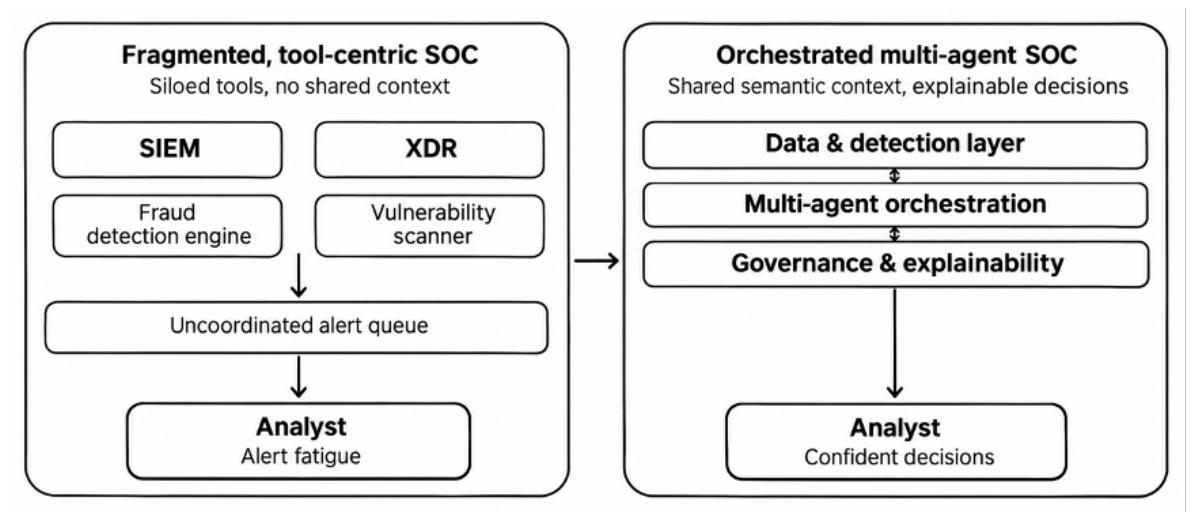
These challenges converge on a structural problem: existing cybersecurity architectures were designed for fragmented, tool-centric operations and cannot be easily reconfigured for governance-aware, contextually rich, human-centred orchestration. We argue that the solution is not more tools but a different orchestration paradigm; one that treats cyber resilience as a socio-technical challenge involving continuous interaction between intelligent agents, human analysts, regulatory obligations, and distributed institutional knowledge.
This paper proposes a trustworthy multi-agent cybersecurity architecture for financial critical infrastructures. Our framework contributes: (i) a governance-oriented orchestration model integrating six specialised architectural layers with a shared semantic knowledge foundation for contextual reasoning; (ii) a human-in-the-loop governance design that preserves analyst authority without sacrificing automation efficiency; (iii) compliance-aware runtime orchestration aligned with DORA, NIS2, and the AI Act; and (iv) an integrated annotation and information-sharing model for privacy-preserving cyber-defence collaboration.
Figure 1.
Transition from fragmented, tool-centric SOC to governance-aware orchestrated multi-agent SOC.
Figure 1.
Transition from fragmented, tool-centric SOC to governance-aware orchestrated multi-agent SOC.
2. Related Work
AI has become central to cybersecurity research, particularly for intrusion detection, behavioural anomaly analysis, malware classification, and fraud detection [22,23]. Machine learning techniques achieve strong performance on well-defined analytical tasks, but most deployed systems operate in isolation; separate models for separate problems, with no shared situational awareness. Broadening detection coverage typically means adding more tools, which compounds fragmentation rather than resolving it.
SIEM platforms [24] and, more recently, XDR systems represent the dominant architectural responses to this fragmentation problem. Both aggregate telemetry from heterogeneous sources and apply correlation logic to identify incidents. However, their correlation engines remain predominantly rule-based, and their machine learning components, where present, are narrow classifiers rather than contextual reasoners. The result is systems that generate high alert volumes but provide limited situational context, precisely the condition that drives analyst overload.
The emergence of Large Language Models has opened a new research direction. LLMs can interpret natural-language incident descriptions, summarise threat intelligence, explain vulnerability reports, and engage in dialogue with analysts. Several studies demonstrate promising LLM capabilities for malware analysis, automated incident reporting, and semantic log interpretation [25]. Recent multi-agent frameworks extend this further to collaborative alert triage and orchestrated incident response [26,27].
Alongside these capabilities, researchers have documented significant risks. Hallucination phenomena, prompt injection vulnerabilities, and adversarial robustness failures are well-established LLM limitations [28]. Fully autonomous deployment amplifies these risks in high-stakes settings where incorrect recommendations carry direct operational consequences. Explainable AI research acknowledges the gap between local feature attribution methods and the orchestration-level explainability that analysts actually need [29,30].
Human-in-the-loop research addresses a related concern: cybersecurity professionals are not merely fallback mechanisms but essential contributors to situational reasoning, strategic prioritisation, and adversarial interpretation [31]. Studies show that excessive automation can induce automation bias, erode human expertise, and degrade situational awareness over time, a serious long-term risk for high-reliability organisations [32,33].
Federated learning offers a technically sound approach to collaborative threat intelligence that preserves privacy obligations [34,35]. Financial institutions are uniquely constrained in their ability to share operational data; federated frameworks allow distributed model training without centralising sensitive telemetry. Practical deployment remains challenging, governance of federated processes, verifying model update integrity, and managing trust across competing institutions are active research problems [36]. In this paper, “federated” denotes a federation of operational intelligence, that is, the controlled exchange of semantic context, abstractions, and artefacts across institutional trust boundaries (Section 6), rather than federated model training.
To our knowledge, the gap our work addresses is the absence of an integrated, governance-aware framework combining multi-agent orchestration, LLM-enhanced contextual reasoning, HITL governance, runtime compliance control, and privacy-preserving collaborative intelligence sharing, specifically engineered for the regulatory and operational constraints of financial critical infrastructures. Recent multi-agent SOC frameworks already provide collaborative triage with evidence-grounded, auditable decisions; what we propose to add is the combination, within one architecture, of a shared semantic security knowledge model, a governance engine tied to regulatory obligations at runtime, and policy-controlled exchange of semantic context across institutions. Whether this integration yields measurable benefits is a hypothesis to be validated (Section 7.1). Table 1 summarises, at a conceptual level, how the proposed architecture relates to the typical characteristics of the approaches discussed above.
3. Proposed Trustworthy Multi-Agent Architecture
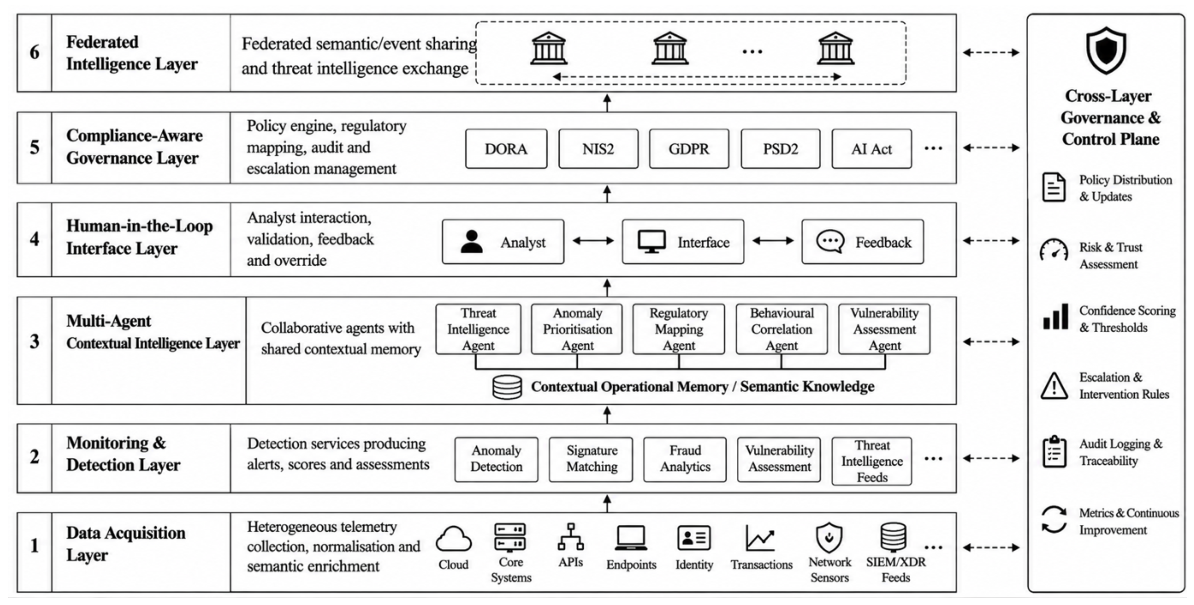
We conceptualise cyber resilience in financial infrastructures as a dynamic orchestration challenge, not a static detection problem. The proposed framework does not simply add AI to existing tooling; it introduces a layered architecture where intelligent agents, human analysts, governance constraints, and distributed intelligence collectively produce contextually aware, explainable, and accountable cybersecurity operations. The architecture comprises six interdependent layers.
Figure 2.
Six-layer trustworthy multi-agent cybersecurity architecture for financial critical infrastructures.
Figure 2.
Six-layer trustworthy multi-agent cybersecurity architecture for financial critical infrastructures.
3.1. Data Acquisition Layer
The foundation layer continuously ingests telemetry from heterogeneous sources: cloud services, core banking systems, endpoint agents, transactional monitors, API gateways, digital identity platforms, network sensors, and behavioural analytics streams. Raw logs and events retain their source context for traceability and forensic analysis; relevant fields are extracted and normalised, and observations are linked to known entities (assets, identities, vulnerabilities, threats) in a shared operational representation before being exposed to higher layers. This layer performs normalisation and entity linking only; correlation, inference, and hypothesis generation over the linked observations take place in the Multi-Agent Contextual Intelligence Layer (Section 3.3). Existing SIEM and XDR deployments are not replaced; their outputs are consumed as inputs alongside other telemetry sources.
3.2. Monitoring and Detection Layer
Anomaly detection, signature matching, fraud analytics, and vulnerability assessment operate at this layer [37]. The key architectural shift is treating these services as distributed intelligence contributors rather than authoritative decision-makers. Their outputs - anomaly scores, alert classifications, and vulnerability assessments - feed into the contextual orchestration layer rather than directly triggering actions on monitored systems. Detection alerts may initiate investigation or notification workflows, but response actions remain subject to applicable authorisation and governance controls. This decouples detection from operational action, creating space for contextual reasoning before escalation.
3.3. Multi-Agent Contextual Intelligence Layer
This is the architectural centrepiece. Multiple specialised agents collaborate: a threat intelligence agent correlates external threat feeds with internal telemetry, drawing on standardised threat-intelligence exchange formats [38]; an anomaly prioritisation agent ranks candidate incidents by operational severity and contextual significance; a regulatory mapping agent identifies potentially applicable obligations and the evidence required to assess them; a behavioural correlation agent tracks evolving attack patterns across sessions and systems; and a vulnerability assessment agent contextualises patch priorities against live infrastructure dependencies. The regulatory mapping agent identifies obligations and evidence, while the governance engine described in Section 3.5 applies approved policies, escalation rules, and compliance workflows.
These agents communicate through shared contextual operational memory, a continuously updated semantic representation of the current operational state. Unlike traditional alert queues that present isolated events, contextual memory integrates behavioural history, infrastructure topology, prior incident patterns, organisational risk profiles, and active regulatory constraints. This memory can be supported by a Security Knowledge Model that links relevant cybersecurity and financial-domain entities, such as threats, vulnerabilities, assets, incidents, controls, risks, and regulatory obligations, through explicit semantic relationships [39]. Cyber Threat Intelligence can be progressively validated, normalised, correlated, and enriched before being incorporated into this shared representation, while retaining relevant provenance, confidence, temporal validity, and supporting evidence [40]. Where appropriate, the interconnected knowledge can also be represented through graph-oriented structures to support contextual correlation, dependency analysis, and relationship-based exploration [41]. Agent access to external security tools is mediated through a Tool Adapter Layer that validates inputs and enforces the requesting context, permissions, and applicable controls before calls are executed. This enables the system to reason about whether two anomalies separated by 48 hours on different subsystems constitute a coordinated campaign, or whether a failed authentication event carries elevated regulatory significance given current DORA incident reporting thresholds.
LLMs support natural-language reasoning within this layer: translating technical telemetry into analyst-readable summaries, generating counterfactual explanations, and enabling conversational incident investigation. LLM outputs are subject to governance constraints and to a multi-factor assessment before influencing orchestration decisions. Because the confidence an LLM reports about its own output is calibrated only under limited conditions [42], it is never used as the sole criterion. The assessment instead distinguishes four separate signals: (i) model consistency, measured as agreement across repeated or independently configured model runs, which is distinct from calibrated probabilistic confidence and is treated as confidence only where calibration has been empirically established; (ii) evidence quality, based on the provenance, temporal validity, and independent corroboration of the supporting observations held in the contextual memory; (iii) residual uncertainty, made explicit to the analyst when evidence is incomplete or conflicting; and (iv) policy compliance, evaluated deterministically by the governance engine described in Section 3.5. To limit correlated errors across agents, high-impact conclusions must be grounded in verifiable evidence rather than in agreement among LLM-based agents alone. The system escalates to human validation when these signals fall below configurable thresholds, when they conflict, or when incident severity exceeds risk-tolerance bounds. The concrete scoring and calibration methods are left to implementation and evaluation (Section 7.1).
3.4. Human-in-the-Loop Interface Layer
Analysts interact with the system through a structured collaboration interface that presents ranked incidents with semantic explanations, contextual dependency maps, regulatory implications, and recommended actions. The interface supports bidirectional engagement: analysts can challenge AI reasoning, add contextual knowledge the system lacks, adjust prioritisation thresholds, and approve or redirect proposed responses. Every analyst action is recorded in contextual memory and in the audit and case record. Validated feedback may subsequently inform controlled updates to rules, models, or reasoning components, rather than being assumed to improve the system automatically.
This layer implements escalation-aware orchestration: under routine conditions the system operates with limited analyst intervention; under high-impact conditions or when regulatory thresholds are approached, intervention requirements automatically increase. The goal is to maximise automation efficiency in low-stakes situations while ensuring meaningful human authority over decisions that carry financial continuity, regulatory, or reputational consequences.
3.5. Compliance-Aware Governance Layer
Governance constraints are embedded in the orchestration pipeline rather than applied as an external audit. A governance engine continuously evaluates operational events against a policy knowledge base encoding DORA resilience obligations, NIS2 reporting thresholds, AI Act transparency requirements, GDPR data handling constraints, and organisational risk policies. When an event triggers a governance obligation, such as DORA’s requirement to submit an initial notification of a major ICT-related incident as early as possible and in any case within four hours of its classification as major and no later than 24 hours after the entity became aware of it (where the incident is classified as major only after those 24 hours, the four hours run from the moment of classification, and specific rules apply to weekends and bank holidays) [43], the engine annotates the incident, adjusts escalation thresholds, and initiates required reporting workflows. The engine therefore treats detection, classification, and notification as distinct, time-stamped steps, because the regulatory clock depends on classification.
Runtime governance also generates audit trails: semantic traces of orchestration reasoning, analyst interactions, escalation pathways, and governance constraint evaluations. These traces support forensic investigation, regulatory reporting, and accountability assessment without requiring manual reconstruction of decision sequences [44].
3.6. Federated Intelligence Layer
The outermost layer enables privacy-preserving collaborative defence across participating institutions. Rather than sharing raw telemetry, institutions may contribute event-level updates and semantic threat abstractions through a federated information-sharing network. Local intelligence - anomaly patterns, behavioural signatures, and campaign indicators - can be generalised before transmission; only abstracted representations are shared. Where semantic threat abstractions are exchanged, relevant provenance, confidence, temporal validity, and handling constraints should remain associated with the shared information so that receiving components can evaluate its origin, reliability, and permitted use. Different levels of sharing may include contextual or semantic data (such as guidelines, guardrails, or skill configurations), specific function code through common tool repositories, or processed function outputs and events. The granularity of sharing can be adapted to the relevant trust boundary, from user-level and intra-organisational sharing to inter-organisational collaboration.
This approach can support GDPR-aligned information sharing and competitive confidentiality, in line with data-protection-by-design principles [45], subject to data minimisation, an assessment of re-identification risk, access controls, and institutional governance, while enabling collective improvement of detection capabilities. An institution that encounters a novel phishing campaign variant can contribute a behavioural abstraction to the network; other institutions benefit from improved detection without receiving any transactional or identity data. Governance of the collaborative sharing process - including validation of contributed artefacts (including integrity and provenance checks on shared code, tool descriptions, and configurations to guard against supply-chain compromise), participation trust, access control, and detection of malicious or misleading contributions - is handled by the compliance-aware layer [46]. Received code, tool descriptions, and configurations are treated as untrusted until validated; they are executed only in isolated environments and are activated only after explicit authorisation by the receiving institution’s governance process.
3.7. Illustrative Scenario
To illustrate how the layers interact, consider a coordinated, low-intensity campaign against two financial institutions, A and B, combining a phishing variant with subsequent credential abuse against a payment API. The scenario is conceptual; it does not report experimental results. (1) At institution A, existing detection tools raise two weak anomaly alerts on different subsystems; the Data Acquisition Layer normalises them and enriches them with asset and identity context. (2) The Monitoring and Detection Layer passes the scores on as inputs, without triggering any action. (3) In the Multi-Agent Contextual Intelligence Layer, the behavioural correlation agent relates the two alerts through the Security Knowledge Model and proposes the hypothesis of a coordinated campaign; the threat intelligence agent attaches supporting evidence with its provenance and confidence, and the regulatory mapping agent flags that the classification criteria for a major ICT-related incident need to be assessed. (4) The Compliance-Aware Governance Layer checks the hypothesis and the proposed actions against policy, opens the classification assessment, and raises the escalation level; any regulatory reporting deadline starts only once the incident has been classified as major. (5) The Human-in-the-Loop Interface Layer presents the ranked incident with its evidence and the proposed containment actions; the analyst authorises, modifies, or rejects them, and the decision is recorded in the audit trail. (6) Finally, the Federated Intelligence Layer shares an abstracted behavioural indicator, with its provenance and handling constraints, to institution B within the agreed trust boundary, where it increases confidence in an otherwise weak local signal. No raw telemetry leaves institution A at any point.
4. Human-in-the-Loop Governance and Explainability
The literature on cybersecurity automation consistently distinguishes between automation that reduces cognitive burden and automation that degrades human capability over time. Our architecture is specifically designed to deliver the former. The central design principle is that cybersecurity analysts remain operationally central throughout the resilience lifecycle: they are not supervisors of autonomous systems but participants in a collaborative orchestration process where AI agents handle scale and speed while humans handle strategic judgement and contextual authority.
Explainability within our framework is not a post-hoc interpretability module; it is an integral component of every orchestration output. When the system prioritises an incident, it generates a structured explanation identifying the contributing signals, the contextual dependencies involved, the applicable regulatory implications, and the confidence level of the assessment. Analysts can interrogate any element of this explanation, request alternative hypotheses, or override the system’s prioritisation with contextual knowledge that the system lacks. These interactions are recorded in contextual memory and the audit trail; after controlled evaluation, validated feedback may inform future rule or model adaptation.
Trust calibration is a particular challenge our architecture addresses through adaptive escalation logic. Research on human-automation interaction demonstrates that trust failures run in two directions: overtrust leads to automation bias and passive acceptance of incorrect recommendations; undertrust leads to excessive intervention that defeats the efficiency benefits of automation [47]. Our system addresses both by presenting confidence-calibrated explanations that make uncertainty explicit, and by adapting intervention requirements to incident severity. Analysts learn the system’s reasoning patterns, while structured analyst feedback can be evaluated and, where appropriate, incorporated through controlled updates to preferences, rules, or contextual knowledge.
The governance implications of HITL design extend beyond operational efficiency. The EU AI Act requires meaningful human oversight, transparency, and accountability for high-risk AI systems. Whether a component of the proposed architecture falls into that category depends on its concrete intended purpose: Annex III covers AI systems intended to be used as safety components in the management and operation of critical digital infrastructure, whereas Recital 55 clarifies that components intended to be used solely for cybersecurity purposes should not qualify as safety components. The classification must therefore be assessed case by case for each deployed component. Where high-risk obligations apply, or where an institution adopts them voluntarily as good practice, the architecture is designed to support them: human validation checkpoints, explainable reasoning traces, and audit-ready interaction logs are native features of the orchestration pipeline, not compliance add-ons.
A further consideration concerns long-term expertise maintenance. As AI-assisted systems become more capable, there is a documented risk that analysts gradually delegate reasoning to automated components and lose the deep situational awareness that makes human oversight valuable [48]. Our design counters this through structured engagement: analysts are prompted to actively reason about incidents rather than merely approve recommendations, and the system periodically presents training scenarios to maintain analytic sharpness. Human oversight must remain substantive, not ceremonial [49].
5. Compliance-Aware Orchestration and Runtime Governance
The convergence of cybersecurity operations and regulatory governance is perhaps the most distinctive feature of the financial sector’s cybersecurity challenge. Financial institutions cannot treat compliance as a periodic audit exercise; under DORA, NIS2, and related frameworks, governance obligations are continuous and time-critical. Figure 3 shows how these obligations are embedded in the runtime governance of the architecture.
DORA is particularly consequential for orchestration design. It mandates continuous ICT risk management, prescribes incident classification criteria, requires reporting of major ICT-related incidents within defined timeframes, and imposes third-party risk governance obligations across the digital supply chain. These are not documentation requirements, they demand that cybersecurity operations dynamically identify, classify, and escalate incidents against regulatory criteria in real time.
Our governance engine addresses this by maintaining a live regulatory knowledge base encoding obligation structures from relevant frameworks. As incidents evolve, the engine continuously re-evaluates their regulatory status: an incident that begins as a low-severity anomaly may cross a DORA reporting threshold as its scope expands, triggering automatic escalation and notification initiation. The engine also tracks third-party exposure: when an anomaly affects a cloud provider or fintech partner, it automatically evaluates whether DORA’s third-party risk provisions apply and what governance actions are required.
The AI Act introduces an additional governance dimension. High-risk AI systems must maintain human oversight mechanisms, generate explainable outputs, and provide audit trails demonstrating appropriate governance. Whether a given AI component is high-risk is a legal determination that depends on its intended purpose (Section 4). Once an institution has made that determination and encoded the resulting obligations in the policy knowledge base, our compliance layer is designed to apply them at runtime: escalation thresholds, explainability granularity, and audit trail depth adjust according to the risk classification of the AI component involved and the sensitivity of the incident context. Translating legal obligations into executable rules nevertheless requires legal interpretation, institutional parameterisation, and version-controlled maintenance of the policy knowledge base as regulation and supervisory guidance evolve.
Runtime governance also addresses consistency across heterogeneous environments. Financial institutions increasingly combine on-premises infrastructure with cloud services, often supplied by a small number of third-party providers [50]. Maintaining governance consistency across this diversity under conventional static compliance models is extremely difficult. Our policy-aware orchestration layer abstracts governance constraints from specific infrastructure configurations, enabling more consistent application across heterogeneous environments and reducing the need for platform-specific policy adaptation.
5.1. Quantum-Safe Cryptography and Authentication
Compliance-aware orchestration must also anticipate the cryptographic transition caused by quantum computing. This is a runtime governance concern, not only an infrastructure one, because migration milestones and cryptographic inventories are time-bound obligations that the governance layer must track, and because the CyberAId project includes a quantum-token authentication prototype that is discussed below. Sufficiently powerful quantum computers would break the RSA and elliptic-curve schemes that secure the authenticity and integrity of financial systems [51]. “Harvest-now, decrypt-later” strategies mean that long-lived data captured today may be decrypted once such capabilities emerge [52], and European financial supervisors warn that these threats could materialise earlier than any viable commercial application of quantum computing [53]. The regulatory response is technology neutral. DORA and its Regulatory Technical Standards (RTS) on ICT risk management require cryptographic controls selected according to leading practices and recognised standards, and adapted to developments in cryptanalysis [54]. Strong customer authentication (SCA) under PSD2 likewise sets functional rather than technical requirements [55]. Migration timelines exist only as guidance. Following recommendation (EU) 2024/1101 [56], the coordinated EU roadmap asks member states to establish national post-quantum cryptography (PQC) transition roadmaps by the end of 2026, and targets completion of the transition for high-risk use cases by 2030 and for medium-risk use cases by 2035 [57]. This is in line with NIST’s transition schedule [58], which builds on NIST’s principal post-quantum standards, the Federal Information Processing Standards (FIPS): FIPS 203 (ML-KEM) for key establishment and FIPS 204 (ML-DSA) and FIPS 205 (SLH-DSA) for digital signatures, all based on candidates evaluated and selected through a multi-year process [59].
Standardisation is therefore decisive. For PQC, standardised algorithms are becoming the leading practice. For quantum key distribution (QKD), first evaluation frameworks exist with ETSI GS QKD 016 and ISO/IEC 23837 [60,61]. Quantum token-based authentication, derived from [62] and applied for simulation and demonstration within the CyberAId project, differs from QKD: the single-use, physically unclonable quantum token is itself the transaction cryptogram. No dedicated standard, protection profile or certification scheme exists yet for this approach. Under DORA it can therefore only complement standardised PQC, not serve as a stand-alone safeguard yet. For payment services, SCA requires at least two independent elements from the categories of knowledge, possession and inherence, with remote transactions dynamically linked to amount and payee. The RTS on SCA does not prescribe a specific technology, but requires possession elements to be protected by “measures designed to prevent replication of the elements”. Quantum-token approaches may be aligned in principle with this requirement, since their security model is designed to prevent cloning and exchange between endpoints connected through a quantum (optical fibre) channel could bind possession to a specific device. The relationship between quantum token, authentication, transaction cryptogram, and SCA compliance is, however, a hypothesis that depends on the implementation and has not been demonstrated. Whether this satisfies the applicable SCA requirements in a concrete deployment would still depend on the full implementation and regulatory assessment. Beyond payments, DORA’s RTS requires strong authentication for remote and privileged access and for access to ICT assets supporting critical or important functions across all financial entities, and NIS2 calls for multi-factor authentication more broadly. Q2FA could therefore be relevant to the wider financial sector, not only to payment services.
Within CyberAId, a prototype of quantum two-factor authentication (Q2FA) will be simulated and tested in selected project use cases, intended to follow a hybrid approach with PQC. Depending on the outcomes of these simulations and tests, Q2FA could subsequently be integrated into the proposed architecture in two ways. First, Q2FA authentication outcomes could be fed into the Data Acquisition Layer (Section 3.1) as identity telemetry, allowing the contextual intelligence agents (Section 3.3) to correlate failed or anomalous token verifications with other authentication events. Second, the Compliance-Aware Governance Layer (Section 3.5) could encode the associated crypto-agility obligations as runtime constraints alongside other DORA obligations, such as cryptographic inventories, migration milestones and PQC fallback status. Whether and to what extent such integration is feasible will be assessed within the project. In either case, the prototype can contribute early evidence to future standardisation of quantum tokenisation, in line with the piloting phase foreseen in the EU roadmap.
6. Federated Operational Intelligence
Cyber threats targeting financial institutions increasingly operate at ecosystem scale: coordinated campaigns exploit shared software dependencies, common cloud platforms, and interconnected payment networks to propagate across multiple institutions simultaneously, as documented in high-profile cross-border cyber campaigns [63,64]. Institution-centric cybersecurity architectures are structurally blind to these cross-institutional patterns until damage has already occurred.
Collective defence requires intelligence sharing, but financial institutions face legitimate barriers: GDPR obligations, competitive sensitivity, reputational risk, and legal uncertainty about liability all constrain participation in conventional sharing arrangements [65]. Existing mechanisms such as FS-ISAC provide valuable high-level intelligence but are typically limited to indicator-level information rather than the fine-grained behavioural context that early detection may require.
Rather than relying on joint or federated model training, our architecture supports controlled exchange of semantic context, event-level abstractions, guardrails, tool descriptions or code, and processed outputs across defined trust boundaries. Institutions can choose the granularity of collaboration according to operational need and governance constraints, while retaining raw telemetry within their own environments. This enables cross-institutional learning from relevant context and events without requiring a shared training process or centralised data pool.
The collaborative intelligence layer addresses a common detection blind spot: adversaries who probe multiple institutions at low intensity before launching a coordinated attack often fall below individual detection thresholds. A combinatorial view across institutions can trigger appropriate rules or increase confidence in otherwise weak detection patterns. Cross-institutional intelligence aggregation can therefore surface precursor patterns even when no single member has sufficient local signal to generate an alert.
Production deployment of cross-institutional operational intelligence at this scale remains an open research challenge; the current framework provides the architectural foundation, but empirical validation requires further work, as discussed in Section 7.1.
7. Discussion
The architecture we have described reframes cybersecurity from a collection of detection tools into a governance-aware orchestration ecosystem. This shift has implications that extend well beyond the technical.
The most immediate implication concerns the role of SOC analysts. In our framework, analysts engage with AI systems through structured, bidirectional interfaces rather than monitoring dashboards. This changes what analysts need to know: less emphasis on tool-specific query languages and alert tuning, more emphasis on contextual reasoning, regulatory interpretation, and human-AI collaborative judgement. Organisations adopting governance-aware orchestration architectures will need corresponding investments in analyst skills and organisational processes.
A second implication concerns institutional responsibilities under emerging AI regulation. Where an AI component qualifies as high-risk, the AI Act’s requirements on transparency, meaningful human oversight, audit trails, and conformity assessment are not automatically satisfied by deploying explainability modules. They require architectural choices that embed these properties in the operational pipeline itself. Our framework suggests that this is architecturally plausible; regulatory clarity on how exactly these requirements apply to cybersecurity AI systems, including the scope of Recital 55 of the final Regulation, would be beneficial, as analyses of the draft Act already pointed to ambiguities in its scoping [66].
The collaborative intelligence model raises governance questions that go beyond technology. Who governs the federation? How are global rules generated and informed by enriched shared information? How is liability allocated when shared intelligence contributes to an incorrect decision? These are primarily governance and legal problems, not technical ones [67]. European financial sector regulators - EBA, ECB, and ESRB - would be natural candidates to develop federation governance frameworks aligned with DORA’s cross-entity resilience provisions [68], within the broader EU cybersecurity research and innovation agenda [69].
A further implication concerns the quality and governance of the knowledge used by the multi-agent system. Contextual reasoning is only as reliable as the information on which it is grounded. Semantic integration should therefore preserve relevant provenance, confidence, temporal validity, and evidence associations rather than treating all integrated knowledge as equally authoritative. This allows agents and analysts to distinguish between validated knowledge, preliminary observations, and derived information when correlating CTI, monitoring, organisational, and regulatory sources.
7.1. Limitations
This paper presents a conceptual architecture without empirical validation in a production environment. Several significant limitations follow from this.
First, the proposed contextual operational memory relies on semantic normalisation, enrichment, and integration of heterogeneous cybersecurity information into a shared knowledge representation. While the architecture defines the role of a Security Knowledge Model and a logical CTI processing approach, their implementation and operational validation remain outside the scope of this conceptual work. Real-world deployments will still need to address heterogeneous log formats, evolving CTI schemas, vendor-specific APIs, entity reconciliation, knowledge freshness, and semantic inconsistencies across independently maintained information sources.
Second, we do not demonstrate computational feasibility, and the paper provides no performance analysis. LLM-enhanced multi-agent orchestration at SOC scale generates substantial inference overhead; whether latency remains acceptable under high-volume incident conditions requires empirical measurement.
Third, the adversarial robustness of LLM-based orchestration components remains an open problem. Prompt injection attacks against cybersecurity AI systems are documented, and our HITL design mitigates but does not eliminate this risk. Relatedly, the confidence, evidence-quality, and uncertainty measures introduced in Section 3.3 are specified at the architectural level only; their calibration, and their robustness to correlated errors across LLM-based agents, require empirical study.
Fourth, the collaborative intelligence layer’s theoretical benefits depend on achieving sufficient institutional participation, resolving governance and legal barriers, and ensuring robust generation and validation of shared detection rules and artefacts, none of which is straightforward in practice.
Future work should address these limitations through prototype implementation, formal verification of governance constraint enforcement, and empirical evaluation with SOC practitioners.
8. Conclusions
We have proposed a trustworthy multi-agent cybersecurity architecture for financial critical infrastructures, grounded in the argument that cyber resilience is a socio-technical orchestration challenge rather than a purely technical detection problem. The framework integrates six architectural layers - data acquisition, monitoring and detection, multi-agent contextual intelligence, human-in-the-loop governance, compliance-aware runtime control, and collaborative intelligence sharing - designed to support compliance with DORA, NIS2, GDPR, PSD2, and the AI Act.
The central contribution is an architectural integration, whose benefits remain to be validated empirically, in which AI agents augment human analysts rather than replacing them [70], where contextual reasoning can be grounded in shared semantic security knowledge, where governance is a runtime capability rather than an audit layer, and where collaborative intelligence sharing is supported through privacy-preserving, policy-controlled exchange across institutional boundaries.
Significant open questions remain, particularly regarding empirical validation, adversarial robustness, semantic interoperability across heterogeneous operational environments, governance of collaborative intelligence sharing, and computational performance at SOC scale. Each of these remains to be validated; in particular, whether contextual orchestration improves analyst triage quality, whether governance annotations remain accurate as regulatory interpretation evolves, and whether latency is acceptable at SOC scale. These are the immediate directions for future work. Trustworthy cyber resilience in financial critical infrastructures will ultimately depend on organisations, regulators, and researchers working together to turn conceptual frameworks like ours into empirically validated, operationally accountable systems.
Author Contributions
Conceptualization, F.L.-F. and J.S.; methodology, F.L.-F., J.S. and G.K.; investigation, F.L.-F., C.L.-R., E.V.P., S.M., P.R., L.K., T.G., N.P., E.d.G. and S.F.; writing, original draft preparation, F.L.-F.; writing, review and editing, C.L.-R., J.S., E.V.P., S.M., P.M., G.K., P.R., L.K., T.G., N.P., E.d.G., S.F., K.T. and I.C.; visualization, F.L.-F. and C.L.-R.; supervision, F.L.-F. and J.S.; project administration, F.L.-F.. All authors have read and agreed to the submitted version of the manuscript.
Funding
This work has received funding from the European Union under the DIGITAL EUROPE Programme, grant agreement No. 101249596 (CyberAId), managed by the European Cybersecurity Competence Centre (ECCC).
Data Availability Statement
No new data were created or analysed in this study. Data sharing is not applicable to this article.
Acknowledgments
The authors thank the CyberAId consortium partners and the wider financial-cybersecurity community for the discussions that shaped this paper.
Conflicts of Interest
The authors declare no conflicts of interest. The funders had no role in the design of the study; in the collection, analyses, or interpretation of data; in the writing of the manuscript; or in the decision to publish the results.
References
- European Central Bank. Cyber Resilience Oversight Expectations for Financial Market Infrastructures, ECB, Frankfurt, Germany. 2018. Available online: https://www.ecb.europa.eu/paym/pdf/cons/cyberresilience/Cyber_resilience_oversight_expectations_for_financial_market_infrastructures.pdf.
- ENISA, Threat Landscape 2024, European Union Agency for Cybersecurity, Heraklion, Greece. 2024. Available online: https://www.enisa.europa.eu/publications/enisa-threat-landscape-2024.
- ENISA, ENISA Threat Landscape: Finance Sector, European Union Agency for Cybersecurity. 2025. Available online: https://enisa.europa.eu/publications/enisa-threat-landscape-finance-sector.
- Verizon, 2024 Data Breach Investigations Report, Verizon Business, New York, NY, USA, 2024. Available online: https://www.verizon.com/about/news/2024-data-breach-investigation-report-dbir-media-resources.
- IBM X-Force, Threat Intelligence Index 2024, IBM Security. 2024. Available online: https://www.ibm.com/think/x-force/2024-x-force-threat-intelligence-index.
- Vielberth, M.; Böhm, F.; Fichtinger, I.; Pernul, G. Security operations center: A systematic study and open challenges. IEEE Access 2020, vol. 8, 227756–227779. [Google Scholar] [CrossRef]
- Alahmadi, B. A.; Axon, L.; Martinovic, I. 99% false positives: A qualitative study of SOC analysts’ perspectives on security alarms. Proc. 31st USENIX Security Symposium, Boston, MA, USA, 2022; pp. 2783–2800. Available online: https://www.usenix.org/conference/usenixsecurity22/presentation/alahmadi.
- Sommer, R.; Paxson, V. Outside the closed world: On using machine learning for network intrusion detection. Proc. IEEE Symposium on Security and Privacy, Oakland, CA, USA, 2010; pp. 305–316. [Google Scholar] [CrossRef]
- European Union. Regulation (EU) 2022/2554 on Digital Operational Resilience for the Financial Sector (DORA). Official Journal of the European Union. 2022. Available online: https://eur-lex.europa.eu/eli/reg/2022/2554.
- European Union. Directive (EU) 2022/2555 on measures for a high common level of cybersecurity across the Union (NIS2). Official Journal of the European Union. 2022. Available online: https://eur-lex.europa.eu/eli/dir/2022/2555.
- European Union, “Artificial Intelligence Act,” European Parliament and Council of the European Union, Brussels, Belgium. 2024. Available online: https://eur-lex.europa.eu/eli/reg/2024/1689.
- European Union. General Data Protection Regulation (GDPR). Official Journal of the European Union. 2016. Available online: https://eur-lex.europa.eu/eli/reg/2016/679.
- European Union. Directive (EU) 2015/2366 on payment services in the internal market (PSD2). Official Journal of the European Union. 2015. Available online: https://eur-lex.europa.eu/eli/dir/2015/2366.
- European Commission. EU Cybersecurity Strategy for the Digital Decade, Brussels, Belgium. 2020. Available online: https://eur-lex.europa.eu/legal-content/EN/TXT/?uri=JOIN:2020:18:FIN.
- European Commission, Digital Finance Strategy for the EU, Brussels, Belgium. 2020. Available online: https://eur-lex.europa.eu/legal-content/EN/TXT/?uri=COM:2020:591:FIN.
- Xu, H.; et al. Large language models for cyber security: A systematic literature review. arXiv 2024, arXiv:2405.04760. [Google Scholar] [CrossRef]
- Liu, Y.; Jia, Y.; Geng, R.; Jia, J.; Gong, N. Z. Formalizing and benchmarking prompt injection attacks and defenses. Proc. 33rd USENIX Security Symposium, Philadelphia, PA, USA, 2024. [Google Scholar] [CrossRef]
- Carlini, N.; et al. Extracting training data from large language models. in USENIX Security Symposium, 2021. [Google Scholar] [CrossRef]
- European Commission, Ethics Guidelines for Trustworthy AI, Brussels, Belgium. 2019. Available online: https://digital-strategy.ec.europa.eu/en/library/ethics-guidelines-trustworthy-ai.
- Papernot, N.; McDaniel, P.; Sinha, A.; Wellman, M. P. SoK: Security and privacy in machine learning. Proc. IEEE European Symposium on Security and Privacy (EuroS&P), London, UK, 2018; pp. 399–414. [Google Scholar] [CrossRef]
- ENISA, Artificial Intelligence Cybersecurity Challenges: Threat Landscape for Artificial Intelligence, European Union Agency for Cybersecurity, Heraklion, Greece. 2020. Available online: https://www.enisa.europa.eu/publications/artificial-intelligence-cybersecurity-challenges.
- Buczak, L.; Guven, E. A survey of data mining and machine learning methods for cyber security intrusion detection. IEEE Commun. Surv. Tutor. 2016, vol. 18(no. 2), 1153–1176. [Google Scholar] [CrossRef]
- Apruzzese, G.; et al. The role of machine learning in cybersecurity. Digit. Threat. Res. Pract. 2023, vol. 4(no. 1), art. 8. [Google Scholar] [CrossRef]
- Gonzalez-Granadillo, G.; Gonzalez-Zarzosa, S.; Diaz, R. Security information and event management (SIEM): Analysis, trends, and usage in critical infrastructures. Sensors 2021, vol. 21(no. 14), art. 4759. [Google Scholar] [CrossRef]
- Ferrag, M. A.; et al. Generative AI in cybersecurity: A comprehensive review of LLM applications and vulnerabilities. Internet Things Cyber-Phys. Syst. 2025, vol. 5, 1–46. [Google Scholar] [CrossRef]
- Wei, B.; et al. CORTEX: Collaborative LLM agents for high-stakes alert triage. arXiv 2025, arXiv:2510.00311. [Google Scholar] [CrossRef]
- Ismail, et al. Toward robust security orchestration and automated response in security operations centers with a hyper-automation approach using agentic artificial intelligence. Information 2025, vol. 16(no. 5), art. 365. [Google Scholar] [CrossRef]
- Ji, Z.; et al. Survey of hallucination in natural language generation. ACM Comput. Surv. 2023, vol. 55(no. 12), art. 248. [Google Scholar] [CrossRef]
- Doshi-Velez, F.; Kim, B. Towards a rigorous science of interpretable machine learning. arXiv 2017, arXiv:1702.08608. [Google Scholar] [CrossRef]
- Miller, T. Explanation in artificial intelligence: Insights from the social sciences. Artif. Intell. 2019, vol. 267, 1–38. [Google Scholar] [CrossRef]
- Kokulu, F. B.; et al. Matched and mismatched SOCs: A qualitative study on security operations center issues. Proc. ACM SIGSAC Conference on Computer and Communications Security (CCS), 2019; pp. 1955–1970. [Google Scholar] [CrossRef]
- Bainbridge, L. Ironies of automation. Automatica 1983, vol. 19(no. 6), 775–779. [Google Scholar] [CrossRef]
- Parasuraman, R.; Manzey, D. H. Complacency and bias in human use of automation: An attentional integration. Hum. Factors 2010, vol. 52(no. 3), 381–410. [Google Scholar] [CrossRef]
- McMahan, H. B.; et al. Communication-efficient learning of deep networks from decentralized data. Proc. Artificial Intelligence and Statistics (AISTATS), 2017. [Google Scholar] [CrossRef]
- Kairouz, P.; et al. Advances and open problems in federated learning. Found. Trends Mach. Learn. 2021, vol. 14(no. 1–2), 1–210. [Google Scholar] [CrossRef]
- Mothukuri, V.; et al. A survey on security and privacy of federated learning. Future Gener. Comput. Syst. 2021, vol. 115, 619–640. [Google Scholar] [CrossRef]
- Scarfone, K.; Mell, P. Guide to Intrusion Detection and Prevention Systems (IDPS), NIST Special Publication 800-94, 2007. Available online: https://csrc.nist.gov/publications/detail/sp/800-94/final.
- OASIS, STIX Version 2.1 Specification. 2021. Available online: https://www.oasis-open.org/standard/stix-version-2-1/.
- Syed, Z.; Padia, A.; Mathews, M. L.; Finin, T.; Joshi, A. UCO: A Unified Cybersecurity Ontology. Proc. AAAI Workshop on Artificial Intelligence for Cyber Security, Phoenix, AZ, USA, 2016; Available online: https://mdsoar.org/handle/11603/11804.
- Mitra, S.; Piplai, A.; Mittal, S.; Joshi, A. Combating Fake Cyber Threat Intelligence using Provenance in Cybersecurity Knowledge Graphs. 2021 IEEE International Conference on Big Data (Big Data), 2021; pp. 3316–3323. [Google Scholar] [CrossRef]
- Sikos, L. F. Cybersecurity knowledge graphs. Knowl. Inf. Syst. 2023, vol. 65, 3511–3531. [Google Scholar] [CrossRef]
- Kadavath, S.; et al. Language models (mostly) know what they know. arXiv 2022, arXiv:2207.05221. [Google Scholar] [CrossRef]
- European Commission. Commission Delegated Regulation (EU) 2025/301 supplementing Regulation (EU) 2022/2554 with regard to regulatory technical standards specifying the content and time limits for the initial notification of, and intermediate and final report on, major ICT-related incidents, and the content of the voluntary notification for significant cyber threats. Official Journal of the European Union. 2025. Available online: https://eur-lex.europa.eu/eli/reg_del/2025/301/oj.
- NIST, Security and Privacy Controls for Information Systems and Organizations, SP 800-53 Rev. 5. 2020. Available online: https://csrc.nist.gov/publications/detail/sp/800-53/rev-5/final.
- European Data Protection Board, Guidelines on Data Protection by Design and by Default, 2020. Available online: https://www.edpb.europa.eu/our-work-tools/our-documents/guidelines/guidelines-42019-article-25-data-protection-design-and_en.
- Wagner, T. D.; Mahbub, K.; Palomar, E.; Abdallah, A. E. Cyber threat intelligence sharing: Survey and research directions. Comput. Secur. 2019, vol. 87, art. 101589. [Google Scholar] [CrossRef]
- Lee, J. D.; See, K. A. Trust in automation: Designing for appropriate reliance. Hum. Factors 2004, vol. 46(no. 1), 50–80. Available online: https://journals.sagepub.com/doi/10.1518/hfes.46.1.50_30392. [CrossRef]
- Endsley, M. Situation awareness misconceptions and misunderstandings. J. Cogn. Eng. Decis. Mak. 2015, vol. 9(no. 1), 4–32. Available online: https://journals.sagepub.com/doi/10.1177/1555343415572631. [CrossRef]
- Luís-Ferreira, F.; Loureiro-Rodrigues, C. Engineering Dignity: A Design Framework for Ethics, Affect and Agency in Human-Robot Collaboration; Preprints, 2026. [Google Scholar] [CrossRef]
- European Central Bank, Guide on Outsourcing Cloud Services to Cloud Service Providers, ECB Banking Supervision, Frankfurt am Main, Germany. 2025. Available online: https://www.bankingsupervision.europa.eu/ecb/pub/pdf/ssm.supervisory_guides202507.en.pdf.
- Shor, P. W. Polynomial-time algorithms for prime factorization and discrete logarithms on a quantum computer. SIAM J. Comput. 1997, vol. 26(no. 5), 1484–1509. [Google Scholar] [CrossRef]
- Europol, Harvest Now, Decrypt Later; Publications Office of the European Union: Luxembourg, 2026. [CrossRef]
- Joint Committee of the European Supervisory Authorities (EBA; EIOPA; ESMA). Joint Committee Update on Risks and Vulnerabilities in the EU Financial System – Autumn 2026. JC 2026 29 2026. [Google Scholar]
- European Commission. Delegated Regulation (EU) 2024/1774 supplementing Regulation (EU) 2022/2554 with regard to RTS on ICT risk management. Official Journal of the European Union. 2024. Available online: https://eur-lex.europa.eu/eli/reg_del/2024/1774.
- European Commission. Delegated Regulation (EU) 2018/389 on RTS for strong customer authentication and common and secure open standards of communication. Official Journal of the European Union. 2018. Available online: https://eur-lex.europa.eu/eli/reg_del/2018/389.
- European Commission. Recommendation (EU) 2024/1101 on a Coordinated Implementation Roadmap for the transition to Post-Quantum Cryptography. Official Journal of the European Union. 2024. Available online: https://eur-lex.europa.eu/eli/reco/2024/1101.
- NIS Cooperation Group, A Coordinated Implementation Roadmap for the Transition to Post-Quantum Cryptography, Part 1, Version 1.1; European Commission: Brussels, Belgium, Jun 2025; Available online: https://digital-strategy.ec.europa.eu/en/library/coordinated-implementation-roadmap-transition-post-quantum-cryptography.
- Moody, D.; et al. Transition to Post-Quantum Cryptography Standards, NIST IR 8547; National Institute of Standards and Technology: Gaithersburg, MD, USA, 2026. [Google Scholar] [CrossRef]
- NIST, FIPS 203 (ML-KEM), FIPS 204 (ML-DSA), FIPS 205 (SLH-DSA). Gaithersburg, MD, USA, Aug 2024. Available online: https://csrc.nist.gov/projects/post-quantum-cryptography.
- ETSI, GS QKD 016 V2.1.1; Common Criteria Protection Profile – Pair of Prepare and Measure Quantum Key Distribution Modules. Jan 2024. Available online: https://www.etsi.org/deliver/etsi_gs/QKD/001_099/016/02.01.01_60/gs_QKD016v020101p.pdf.
- ISO/IEC 23837-1/-2:2023; Information security – Security requirements, test and evaluation methods for quantum key distribution – Part 1: Requirements; Part 2: Evaluation and testing methods.
- Schiansky, P.; et al. Demonstration of quantum-digital payments. Nat. Commun. 2023, vol. 14, art. 3849. [Google Scholar] [CrossRef]
- Greenberg, Sandworm: A New Era of Cyberwar and the Hunt for the Kremlin’s Most Dangerous Hackers; Doubleday: New York, NY, USA, 2019.
- ENISA, Threat Landscape for Supply Chain Attacks, European Union Agency for Cybersecurity. 2021. Available online: https://www.enisa.europa.eu/publications/threat-landscape-for-supply-chain-attacks.
- Skopik, F.; Settanni, G.; Fiedler, R. A problem shared is a problem halved: A survey on the dimensions of collective cyber defense through security information sharing. Comput. Secur. 2016, vol. 60, 154–176. [Google Scholar] [CrossRef]
- Veale, M.; Zuiderveen Borgesius, F. Demystifying the Draft EU Artificial Intelligence Act. Comput. Law Rev. Int. 2021, vol. 22(no. 4), 97–112. [Google Scholar] [CrossRef]
- Luís-Ferreira, F.; Loureiro-Rodrigues, C. Ethical Challenges in the Current Digital Landscape: AI, Robotics and Quantum Computing; Preprints, 2025. [Google Scholar] [CrossRef]
- European Systemic Risk Board, Mitigating Systemic Cyber Risk, ESRB, Frankfurt, Germany. 2022. Available online: https://www.esrb.europa.eu/pub/pdf/reports/esrb.SystemiCyberRisk.220127~b6655fa027.en.pdf.
- European Cybersecurity Competence Centre, ECCC Strategic Agenda, ECCC, Bucharest, Romania. 2023. Available online: https://cybersecurity-centre.europa.eu/system/files/2023-03/20230224%20-%20ECCC%20Strategic%20Agenda%20with%20cover.pdf.
- . Russell, Human Compatible: Artificial Intelligence and the Problem of Control; Viking: New York, NY, USA, 2019.
Figure 3.
Regulatory obligations and their embedding in the runtime governance of the architecture.
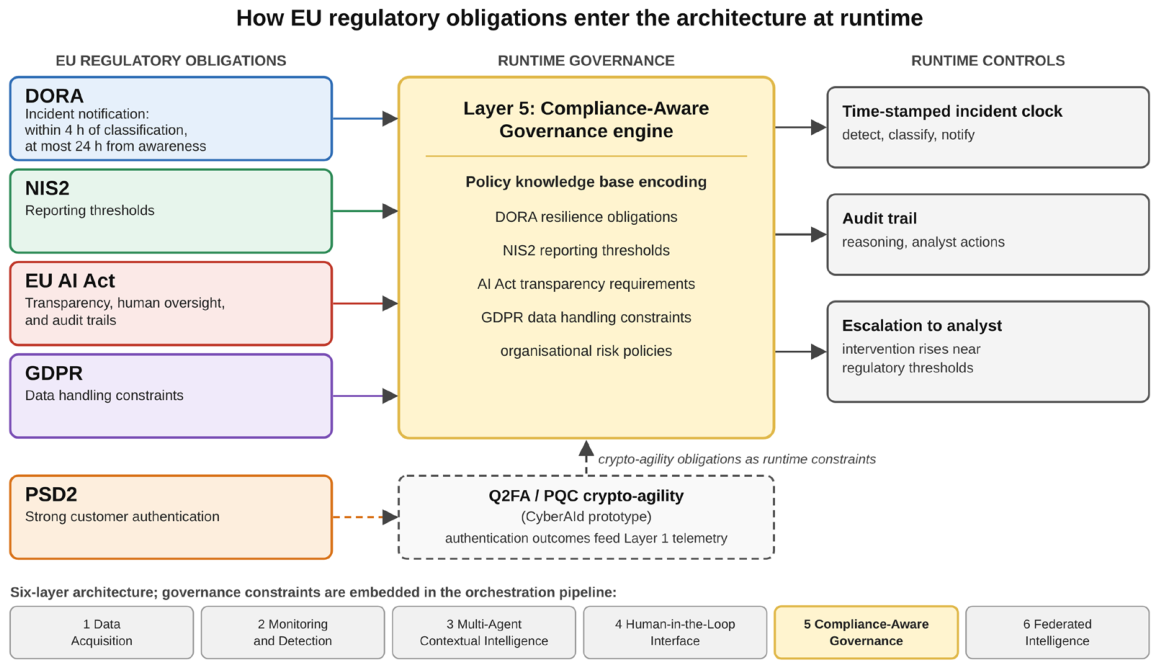

Table 1.
Conceptual positioning of the proposed architecture relative to existing approaches (author synthesis of typical characteristics reported in the literature cited above; not universal limitations and not an empirical comparison).
Table 1.
Conceptual positioning of the proposed architecture relative to existing approaches (author synthesis of typical characteristics reported in the literature cited above; not universal limitations and not an empirical comparison).
| Rule-based SIEM/XDR | LLM-assisted SOC tools | Federated-learning collaboration | Proposed architecture | |
| Contextual reasoning | Rule-based correlation; limited situational context | Natural-language reasoning and summarisation; context often limited to the tool’s own data | Not a primary focus; improves shared detection models | Shared semantic operational memory used by specialised agents |
| Runtime regulatory governance | Typically external to the tool (periodic audit) | Varies; typically not a primary design focus | Governance of participants and model updates is an open problem | Governance engine evaluates policies and obligations during operation |
| Auditability and human oversight | Event logs and case records | Varies; explanations may be opaque | Model-level rather than incident-level | Reasoning traces, analyst actions, and escalation paths recorded; human authority over high-impact actions |
| Inter-institutional exchange | Indicator feeds and sharing platforms | Typically institution-local | Shared model updates; raw data stays local | Policy-controlled exchange of semantic context, abstractions, and artefacts; no joint training required |
Disclaimer/Publisher’s Note: The statements, opinions and data contained in all publications are solely those of the individual author(s) and contributor(s) and not of MDPI and/or the editor(s). MDPI and/or the editor(s) disclaim responsibility for any injury to people or property resulting from any ideas, methods, instructions or products referred to in the content. |
© 2026 by the authors. Licensee MDPI, Basel, Switzerland. This article is an open access article distributed under the terms and conditions of the Creative Commons Attribution (CC BY) license.
Copyright: This open access article is published under a Creative Commons CC BY 4.0 license, which permit the free download, distribution, and reuse, provided that the author and preprint are cited in any reuse.