

Submitted:
13 November 2026
Posted:
16 November 2026
You are already at the latest version
Abstract
Alcohol use disorder (AUD) and personality disorders (PD) co-occur in up to two thirds of treatment-seeking patients, and comorbidity predicts poorer engagement and relapse. Current diagnostic frameworks (DSM-5 Alternative Model, ICD-11, HiTOP) describe personality pathology dimensionally, which is expected to be less stigmatizing, more acceptable to patients and more useful for treatment planning. We aimed to identify programs that assess personality dimensionally in patients with AUD and adapt treatment to the profile obtained. Following a PROSPERO-registered protocol (CRD420260656442), PubMed/MEDLINE, Embase, Scopus and Web of Science were searched (February–March 2025). Of 2,529 records, 72 were assessed in full text; none met the pre-specified criteria, so the review was converted into a narrative synthesis of the 44 closest reports plus one case report identified outside the search. Reports fell into three groups: dimensional assessment without consequences for treatment; treatment adapted to a categorical PD diagnosis (schema, psychodynamic or mentalization-based therapies) or transdiagnostic treatments that did not assess personality; and contextual evidence on comorbidity, typologies and assessment. The only near-miss relied on a categorical Millon inventory. We discuss why assessment and intervention remain disconnected and propose brief dimensional screening at treatment entry as a pathway to person-centered, less stigmatizing AUD care.
Keywords:
alcohol use disorder
; personality disorders
; dimensional assessment
; Alternative Model of Personality Disorders
; ICD-11
; HiTOP
; stigma
; person-centered care
; treatment adaptation
; narrative review
1. Introduction
According to the World Health Organization, alcohol consumption was associated with approximately 2.6 million deaths in 2019 (4.7% of all deaths), around 400 million people (7% of the population aged 15 years and over) were estimated to live with an alcohol use disorder (AUD), and 209 million with alcohol dependence [1]. High relapse rates and the difficulty of maintaining abstinence continue to be regarded as core features of the disorder, and personality has repeatedly been proposed as one of the factors explaining why alcohol-focused interventions do not reach their full therapeutic potential [2,3].
Comorbidity between AUD and personality disorders (PD) is substantial and bidirectional. A systematic review and meta-analysis of 16 studies estimated a lifetime prevalence of AUD of 38.9% in people with PD other than borderline (BPD) or antisocial (ASPD), 52.2% in BPD and 76.7% in ASPD [4]. Conversely, the prevalence of PD among people with AUD ranges widely depending on setting, population and instruments [5,6]; a meta-analysis of treatment samples found that any comorbid PD was present in 34–71% of patients with AUD (median 55%), ASPD in 15–41% (median 28%) and BPD in 11–27% (median 18%), so that up to two thirds of patients presenting for AUD treatment may have a comorbid PD [7]. DSM-5 itself notes a strong association between AUD and paranoid, antisocial, borderline and narcissistic PD [8]. Beyond prevalence, personality pathology in AUD is associated with greater clinical complexity, lower retention and poorer outcomes, and it shapes drinking patterns, affective dysregulation, interpersonal functioning and relapse risk [3,5,7].
The link between addictive behavior and personality is not new. In DSM-I and DSM-II, substance use disorders were subsumed under PD, and DSM-I classified alcoholism and drug addiction as subcategories of “sociopathic personality disturbance”, reflecting the view that addiction was a symptomatic expression of an underlying personality disturbance [9,10]. What has changed is the way personality pathology is conceptualized. Categorical diagnosis, as in ICD-10 and DSM-IV, relies on counting criteria against an arbitrary threshold and has well-documented limitations: poor coverage (“not otherwise specified” diagnoses), heterogeneity within categories, artificially high comorbidity among PD and low reliability [10,11]. In response, DSM-5 Section III introduced the Alternative Model of Personality Disorders (AMPD), which combines a level of personality functioning (Criterion A) with maladaptive trait domains (Criterion B) and explicitly states that “pathological personality traits may be relevant whether an individual has a personality disorder or not” [8,12]. ICD-11 has gone further and adopted a fully dimensional classification based on severity and five trait domain qualifiers (negative affectivity, detachment, dissociality, disinhibition and anankastic) [13], and the Hierarchical Taxonomy of Psychopathology (HiTOP) places AUD and Cluster B pathology within a common externalizing superspectrum [14].
Dimensional description has three properties that matter for the quality of care. First, clinicians rate dimensional models as more useful than categories for communication with patients and for treatment planning [15], and describing a person by severity and trait profile avoids the pejorative connotations attached to labels such as “borderline” or “antisocial”, which are a documented source of stigma among health providers [16]. Second, a profile of traits and functioning is more easily shared with the patient and lends itself to collaborative feedback, which has therapeutic effects in its own right [17]. Third, dimensional profiles open the door to matching treatment to transdiagnostic targets (e.g., emotional dysregulation or interpersonal dysfunction) rather than to diagnoses [18], which is precisely what a large body of evidence on personality and AUD outcome has been calling for [3,5].
This rationale motivated the present review. Our initial question was whether there are treatment programs that assess personality pathology dimensionally in patients with AUD, as contemporary frameworks recommend, and then adapt treatment according to the profile obtained. Because a PROSPERO-registered systematic search identified no study meeting these criteria, the work was converted into a narrative review whose aims are (1) to document transparently the search and the reasons why no study qualified, (2) to synthesize the closest available evidence in three groups, and (3) to discuss why assessment and treatment remain disconnected and how a dimensional approach could improve the quality, acceptability and equity of AUD care.
2. Materials and Methods
2.1. Design and Registration
A systematic review was planned in accordance with PRISMA 2020 [19] and the protocol was registered in PROSPERO (CRD420260656442, after an initial submission of 23 February 2025 (ID 656442) had been classified as out of scope). Deviations from the registered protocol were: the planned risk-of-bias assessment (Newcastle–Ottawa Scale and JBI checklists) was not applicable because no study met the eligibility criteria; the narrative synthesis of the closest reports (Section 2.5) was decided after full-text assessment; and one report published in Slovak with an English abstract [20] was assessed through a translation, although the protocol restricted languages to English, Spanish and French. In addition, ScienceDirect, listed as a source in the registered protocol, was not searched, and whereas the protocol anticipated independent title and abstract screening by at least four authors and independent full-text assessment, titles and abstracts were screened by two reviewers per record and full texts were assessed by one reviewer and checked by a second (Section 2.4); the record was updated accordingly. The full search strategies are provided in Supplementary Table S1. The review question, framed in PICO terms, was: in adults with AUD, with or without other substance use disorders (P), do programs that include a dimensional or transdiagnostic assessment of personality (I), compared with categorical assessment or no personality assessment (C), improve treatment outcomes such as retention, relapse or functioning (O)? Because no eligible study was identified, the work was reported as a narrative review following the SANRA recommendations for quality of narrative reviews [21], while retaining the full transparency of the original search and screening.
2.2. Search Strategy
Searches were run in PubMed/MEDLINE, Embase, Scopus and Web of Science between 19 and 23 February 2025 (main search), with supplementary searches in Scopus (2 and 17 March 2025) and Embase (12 March 2025) and preliminary searches in CINAHL and Google Scholar in December 2024. No date or language limits were applied at the search stage; the protocol limits (publications from 1980 onwards in English, Spanish or French) were applied during screening. Three blocks of terms were combined with Boolean operators: alcohol use disorder and its synonyms (MeSH “Alcoholism”; alcohol dependence, alcohol abuse, alcohol addiction); personality (MeSH “Personality Assessment”; dimensional, transdimensional, transdiagnostic); and treatment outcome (MeSH “Treatment Outcome”; efficacy, effectiveness). The full strategy for each database is provided in Supplementary Table S1. Additional records were identified by hand-searching reference lists of relevant reviews. One further report, a case study published in late 2024, was identified from the authors’ own files after the database searches and was assessed against the same criteria (Figure 1, right-hand column).
2.3. Eligibility Criteria
Inclusion criteria were: (a) original research of any design (descriptive, associative, experimental, quasi-experimental or case studies; cross-sectional or longitudinal); (b) adult participants (≥18 years) with problematic alcohol use, alcohol misuse or a formal diagnosis of AUD, regardless of other substance use; (c) a dimensional or transdiagnostic assessment of personality applied or adapted with the aim of improving treatment or outcomes; and (d) publication in English, Spanish or French. Exclusion criteria were: non-empirical publications (systematic reviews, meta-analyses, protocols, editorials, letters), theses, books and book chapters, qualitative-only designs, animal studies, child or adolescent samples, substance-induced psychotic disorder and, at full-text stage, studies that assessed personality but did not use the assessment to inform treatment (“wrong outcome”).
2.4. Study Selection
Records were imported into Rayyan [22], where duplicates were detected and removed. Title and abstract screening were performed independently and blind, with the workload distributed across the seven-member team in predefined subsets so that every record was screened by two reviewers. Screening followed a hierarchical set of criteria (publication type; population; intervention; outcome; study design; language), and each reviewer recorded a single reason for exclusion, selected in that order from predefined labels (wrong publication type, wrong population, wrong intervention—recorded in Rayyan under its default label “wrong drug”—, wrong outcome, wrong study design, background article, foreign language); when the two reviewers recorded different reasons for the same record, the reason higher in the hierarchy was retained, so that one reason is reported per record. Records with insufficient information were retained for full-text assessment. Full texts were then assessed by one reviewer and checked by a second against the criterion of a relevant intervention and outcome, i.e., original studies that applied or adapted personality assessment to improve treatment or outcomes in AUD; disagreements were resolved by discussion with a third reviewer.
2.5. From Systematic to Narrative Review
After full-text screening no study met all eligibility criteria (see Section 3.1). Rather than reporting an “empty” systematic review alone, the team decided, after full-text assessment and outside the registered protocol (post hoc), to synthesize narratively the full-text reports that came closest to the question. Of the 72 reports assessed in full text, the 44 closest to the question were classified into three groups defined by the two components of the review question: (A) studies that measured personality dimensionally but did not use the results to adapt treatment; (B) studies that adapted treatment to a categorical PD diagnosis without a dimensional assessment; and (C) studies providing contextual evidence on mechanisms of comorbidity, typologies of alcohol use or the reliability of personality assessment in addiction settings. The remaining 28 reports were used only for context and are cited where relevant. Data extracted were design, sample, personality instrument, whether the assessment was dimensional, and whether and how treatment was adapted. The single-case report identified outside the database searches [23] was excluded from the systematic review as a conceptual article with an illustrative case, but was retained for the narrative synthesis as a near-miss (Section 3.5; Table 1, last row).
2.6. Use of Generative Artificial Intelligence
During the preparation of this manuscript, the authors used Claude (Anthropic) for language editing and translation, reference formatting and document formatting. The authors have reviewed and edited the output and take full responsibility for the content of this publication.
3. Results
3.1. Study Selection
The searches yielded 2,529 records (Embase, n = 1,148; PubMed/MEDLINE, n = 573; Scopus, n = 457; Web of Science, n = 349; CINAHL, n = 1; Google Scholar, n = 1); 915 duplicates were removed and 1,614 records were screened by title and abstract, of which 1,542 were excluded (wrong population, n = 1,088; wrong outcome, n = 284; wrong publication type, n = 116; wrong intervention, n = 29; wrong study design, n = 14; background article, n = 10; foreign language, n = 1). Of the remaining 72 reports, 70 were retrieved and assessed in full text and two, whose full text could not be obtained (one contextual report and the 1979 study [24]), were assessed on the basis of their abstracts. None met all eligibility criteria: 28 were background or contextual reports that did not address alcohol-using populations or personality assessment directly, and 44 addressed the question but did not combine a dimensional assessment of personality with a treatment adaptation based on that assessment—19 used dimensional personality measures without linking them to treatment, 15 adapted treatment to personality pathology without a dimensional assessment (8 adapted or proposed treatment for a categorical PD diagnosis and 7 applied a transdiagnostic treatment that neither measured personality nor identified a PD), and 10 provided contextual evidence on comorbidity, typologies or assessment. One reason per report was recorded (Table S2): wrong outcome (personality assessed but not used to adapt treatment), n = 34; wrong intervention (treatment not based on a dimensional personality assessment), n = 24; wrong publication type (non-empirical report or protocol), n = 10; wrong population (not a clinical sample with alcohol use disorder), n = 4. These 44 reports were carried forward to the narrative synthesis (Figure 1; Table 1). One additional report identified from the authors’ files was assessed and excluded for the same reason (a conceptual article with a single illustrative case) and is discussed as a near-miss in Section 3.5 (Figure 1; Table 1, last row).
3.2. Group A: Dimensional Assessment of Personality Without Treatment Adaptation
Across the included studies, dimensional approaches were used to characterize personality pathology and individual differences in personality among individuals with alcohol use disorder (AUD), either alone or alongside other substance use disorders. These approaches varied in their theoretical foundations and operationalization, encompassing dimensional trait models, psychobiological models of temperament and character, and frameworks assessing personality organization. Their primary aims were to identify characteristic personality profiles associated with substance use, examine relationships between personality dimensions and AUD severity, psychiatric comorbidity, and psychosocial functioning, and explore how these dimensions relate to clinical outcomes over time. Although several studies identified personality characteristics associated with treatment response, relapse, or changes in psychopathology, dimensional assessment was generally used to describe clinical heterogeneity rather than to guide the selection or adaptation of treatment.
The largest subgroup comprised studies using the Five-Factor Model (FFM), the Alternative Model for Personality Disorders (AMPD), or related dimensional trait frameworks to characterize personality in individuals with AUD or other substance use disorders. Using the NEO-PI-R in 123 patients receiving specialized addiction treatment in Norway, Fodstad et al. found higher neuroticism and lower conscientiousness, agreeableness, extraversion, and openness than population norms. However, the observed profile was not extreme, challenging the view that PD can be understood simply as the extreme manifestations of normal personality traits [36]. Among the reports retained for context, a case–control study of 100 Indian patients with alcohol dependence and 100 controls using the NEO-FFI found the same pattern of higher neuroticism and lower openness, agreeableness and conscientiousness; neuroticism correlated with the severity of alcohol problems and, at six-month follow-up, the 26 patients who had relapsed scored higher on neuroticism and lower on openness, agreeableness and conscientiousness than the 42 who remained abstinent [66]. In a representative community sample of 1,630 adults aged 55–64, personality pathology assessed through interviews, self-report, and informant reports was associated with lifetime and past-year alcohol dependence, with Cluster B pathology showing the strongest association [30]. These findings highlight the importance of examining personality–AUD associations across different life stages, as midlife transitions involving intimate relationships, family responsibilities, and occupational demands may influence the nature and strength of these associations. Applying the AMPD trait model, De la Rosa-Cáceres et al. used network analysis in 742 community participants and 243 patients to identify risk-taking, callousness, and irresponsibility, facets of disinhibition and antagonism, as bridge nodes connecting personality traits with AUD criteria. This finding was consistent with the externalizing superspectrum described by the Hierarchical Taxonomy of Psychopathology (HiTOP) [14,35]. These dimensions may therefore be clinically relevant when distinguishing potentially pre-existing personality pathology from features associated with alcohol addiction. A cross-sectional study involving Indian treatment samples similarly identified the characteristic pattern of higher neuroticism and lower conscientiousness [41]. Another study adopted a dimensional trait-based approach independent of the FFM and found that avoidant and dependent personality disorders, together with traits including social withdrawal, depressivity, guilt/shame, irresponsibility, and separation insecurity, predicted functional impairment in a Latvian sample of individuals with AUD. Conversely, higher orderliness was associated with fewer difficulties in everyday functioning [67].
Cloninger’s psychobiological model was the second most frequently used framework. Alcohol-dependent inpatients differed from drug-dependent inpatients in novelty seeking, reward dependence, self-directedness, and cooperativeness. The authors proposed that Temperament and Character Inventory (TCI) dimensions should be considered in treatment planning, although they did not evaluate whether these dimensions could inform specific treatment decisions [27]. Similarly, alcohol-dependent individuals differed from matched controls in novelty seeking, harm avoidance, and self-directedness, with these differences also related to frontal symptoms and Cloninger’s Type I/II classification [29]. The reported associations between personality traits and frontal lobe dysfunction suggested that impairments in cortico-frontal systems involved in behavioral planning might contribute to rigid behavioral patterns and provide a shared etiological explanation for the co-occurrence of disorders. The authors consequently highlighted the potential value of cognitive rehabilitation to improve frontal functioning before individuals with alcohol addiction engage in more cognitively demanding therapeutic interventions. A Slovak study compared 30 inpatients with alcohol dependence with 375 population controls on the TCI-R and concluded that structural character deficiencies (primarily low self-directedness), combined with an unstable temperament (high novelty seeking and harm avoidance), hinder emotional self-regulation and the maintenance of abstinence [20]. Authors therefore suggest focusing on psychotherapy on strengthening maturity and personal responsibility. Additionally, a Korean inpatient study congress compared 50 male patients with alcohol dependence with 93 controls using the Korean TCI and classified patients according to age at onset and family history. This study also emphasized the relevance of personality assessment to prevention and treatment planning without translating its findings into specific treatment recommendations [68]. Janowsky et al. found differences in Myers–Briggs and Cloninger personality dimensions between patients with AUD with and without an affective disorder, highlighting the importance of considering concurrent Axis I psychopathology when assessing personality in this population [25]. Other studies examined temperament using theoretical frameworks distinct from Cloninger’s model. Research using the TEMPS-A found higher cyclothymic and irritable temperament scores in drug-dependent patients than in controls, irrespective of psychiatric comorbidity, consistent with earlier findings in heroin addiction [9,34]. Although these studies did not exclusively include individuals with AUD, they provide complementary evidence that may help contextualize affective temperament profiles within the broader spectrum of substance use disorders. Two Polish studies applied Kernberg’s dimensional model of personality organization. One examined the relationship between temperamental properties, based on Pavlov’s theory, and levels of personality organization in individuals with alcohol dependence [38]. The other found that identity diffusion was associated with poorer mentalizing capacity in individuals with AUD, highlighting potential implications for the therapeutic relationship [40]. Within this framework, personality organization may also have implications for therapeutic approaches: individuals with a more integrated personality may benefit more from insight-oriented therapies, whereas those with less organized personalities may respond better to supportive and psychoeducational interventions that strengthen identity integration and promote self-reflection [69].
A subset of studies examined dimensional personality characteristics in relation to treatment course and clinical outcomes, although personality profiles were generally not used to tailor interventions. In a three-month prospective study conducted in South India, extraversion-related characteristics, particularly elevated activity levels, were associated with greater alcohol consumption and an increased risk of early relapse [33]. In a secondary analysis of the Self-Match Study, in which patients chose between treatment options, personality traits did not moderate the effect of self-matching on treatment outcomes; the overall effect of self-matching was also null [37]. Two randomized trials of psychological interventions for co-occurring alcohol misuse and depression (N = 290) found that baseline PD cluster profiles were associated with symptom trajectories, despite the interventions not being specifically designed to address personality pathology [32]. Cluster C pathology was primarily associated with poorer overall change during follow-up, whereas Cluster A pathology was more closely associated with less favorable treatment outcomes, particularly regarding depressive symptoms and psychosocial functioning. The study also suggested that integrated interventions may be more effective than single-focus approaches among individuals with higher PD cluster scores. Among women participating in a perinatal addiction program, MMPI-2 cluster analysis distinguished subgroups with high and low levels of psychopathology and different psychological outcomes [26,70]. These findings support the potential value of cluster analysis for characterizing heterogeneity among individuals with substance use disorders, including pregnant women with drug dependence, and highlight the importance of considering individual psychiatric profiles in treatment planning. However, the findings primarily supported subgroup identification rather than the systematic adaptation of treatment to dimensional profiles. More proximal mechanisms linking personality traits to alcohol use were also investigated. In social drinkers, Cluster B traits and rash impulsiveness were indirectly associated with alcohol use severity through positive alcohol expectancies [39]. Similarly, drinking motives, impulsivity, and affective instability mediated the association between borderline personality disorder (BPD) features and alcohol-related problems [71]. Longitudinal findings further indicated that decreases in neuroticism and increases in conscientiousness between ages 21 and 35 were associated with the developmental reduction in problematic alcohol involvement commonly described as maturing out, suggesting that personality change may represent a clinically relevant outcome [72]. Another contextual report points in the same direction: among 72 residents of a therapeutic community for drug dependence who completed the MCMI-II every three months, dimensional scores for the schizoid, avoidant, schizotypal, passive-aggressive and borderline patterns decreased during treatment whereas the narcissistic, antisocial and paranoid scores did not, and a high schizotypal score predicted early dropout, which led the authors to recommend monitoring dimensional change in personality throughout treatment [73].
One contribution warrants separate consideration because it came closest to incorporating dimensional personality assessment into an intervention. A pilot randomized trial of brief Therapeutic Assessment of personality among 30 veterans entering a 90-day residential alcohol and drug program, first reported as a conference abstract and later published in full, used collaborative feedback on NEO-PI-R results to enhance early engagement: patients rated the feedback highly and, among those without previous residential treatment, reported a stronger alliance with the program and better relationships with other residents one month after entry, with a non-significant seven-day longer stay [31]. This approach treated the assessment process itself as a therapeutic intervention; however, it did not involve adapting subsequent treatment to patients’ dimensional personality profiles.
Study [24] was excluded from the synthesis of psychotherapy-related findings because it focused on pharmacological treatment rather than psychological interventions. Similarly, study [28], a registered randomized trial comparing routine personality disorder assessment with individual feedback against a general life-situation interview in patients seeking treatment for substance dependence in Copenhagen, was subsequently reported with 75 participants: personality assessment followed by individual psychoeducation did not improve functioning compared with an attention-placebo condition, although the experimental group showed a greater reduction in substance use [74]. Because the assessment was tested as an intervention in itself and was not used to adapt subsequent treatment, the trial did not meet the eligibility criteria.
Taken together, only three of the 19 Group A studies approached personality functioning or organization (the two Kernberg-based studies [38,40] and the Latvian study that measured everyday functioning with the WHODAS 2.0 [67]); the remainder described traits, temperament or symptom profiles without assessing the severity of personality dysfunction, a point taken up in Section 4.2.
3.3. Group B: Treatment Adapted to a Categorical Personality Disorder Diagnosis
Eight reports adapted or proposed AUD treatment for patients with a PD, invariably defined categorically, most often BPD. Gregory et al. conducted the first randomized trial of a manualized psychodynamic treatment, dynamic deconstructive psychotherapy (DDP), for co-occurring BPD and AUD (N = 30), reporting significant improvements in parasuicide, alcohol misuse, institutional care, depression, dissociation and core BPD symptoms with 67–73% retention, and sustained, cost-effective gains at 30 months [43,75]. Boog et al. delivered integrated schema therapy to 20 patients with BPD and comorbid AUD in a multiple-baseline case series, with reductions in both BPD and AUD symptoms largely maintained at one-year follow-up [53]; the same group showed that BPD patients with and without AUD did not differ in behavioral impulsivity but did differ in schema modes, and argued for treating both conditions within the same frame and contract [51], and proposed automaticity as the mechanism linking schema modes to addiction [52]. Ball’s randomized comparison of dual-focus schema therapy with single-focus drug counseling in 105 substance-dependent patients with and without PD found, contrary to expectation, that the addiction-focused therapy produced more sustained symptom reductions for several PD, questioning the added value of integrative treatments [44], although an earlier trial in opioid-dependent patients with PD had shown faster reductions in substance use with the dual-focus approach [76]. Mentalization-based treatment combined with usual SUD treatment was feasible but not superior to SUD treatment alone in a randomized feasibility study of 46 patients with BPD and SUD [77]; secondary analyses found that subclinical autistic traits were not a barrier and were associated with improvement in mentalizing [50]. Most recently, Patzelt et al. proposed good psychiatric management (GPM) as a generalist, multimodal approach for comorbid BPD and AUD that stabilizes and broadens the social network and combines indicated AUD interventions with a common-factors approach to BPD, explicitly because “no widely available treatments have been found to be effective for both diagnoses concurrently” [55]. We would note, however, that this proposal rests on the assumption that patients with an addictive disorder will reject longer or more intensive psychotherapeutic commitments. In our clinical experience, and in the literature reviewed here, this is not the usual pattern: patients’ subjective experience of these psychotherapeutic settings tends to be positive, as the retention figures reported above suggest [53,75], with the exception of patients with antisocial personality disorder.
A related set of studies applied transdiagnostic, emotion-regulation-based treatments to AUD without a PD diagnosis. Stand-alone dialectical behavior therapy skills training (DBT-ST) for AUD reduced concurrent addictive behaviors, with emotion regulation and experiential avoidance as therapeutic mechanisms [48], and appeared feasible as a fully outpatient program [49]. Mindfulness and modification therapy, a transdiagnostic treatment for “behavioral dysregulation”, reduced alcohol use and aggression in 14 court-referred women in an open pilot and, in a 20-week comparison trial against treatment as usual (n = 21), in self-referred women [45,46]; participants were selected by the co-occurrence of dysregulated behaviors (alcohol or drug use and aggression), and neither study assessed personality or diagnosed a personality disorder. Likewise, an emotion-regulation treatment was piloted in young people with complex substance use and mental health problems [47], an emotion-regulation treatment for AUD improved both mental health and drinking outcomes in a stage II randomized efficacy trial [56], and acceptance- and compassion-based approaches have been proposed to support abstinence [54]. None of these interventions measured personality or identified a personality disorder: they target processes that are central to personality pathology (emotion dysregulation, impulsive and aggressive behavior), but patients were selected by the presence of AUD or of dysregulated behavior, not by a personality profile.
Although all of these programs define the patient’s problems categorically, they share a structured form of intervention that requires an assessment, a case formulation and a treatment plan with explicit goals. Each is grounded in its own theoretical model and has evidence support, and each provides a treatment frame that sets limits of treatability; yet they converge on common elements—[78,79,80,81] assessment, psychoeducation, a structured intervention, and engaging the patient in a collaborative process in which they take responsibility for the treatment. These elements are delivered by specifically trained and, in many cases, supervised therapists, and they often incorporate transdiagnostic components [82,83,84,85]: the deconstruction of narratives, emotion regulation, the integration and acceptance of negative affect, and the enhancement of reflective functioning. Beyond the diagnosis of a personality disorder, these are transdiagnostic elements in the treatment of addiction, and clinicians with specific training in them can overcome the limitations of categorical diagnosis. A further problem we observe in this group is that these evidence-based psychotherapies do, in most cases, include a dimensional assessment of personality (schema modes, difficulties in emotion regulation, behavioral dysregulation, mentalizing capacity), but this assessment is not connected to, or unified with, the main diagnostic classifications, ICD-11 and DSM-5. As a result, there is no common language for understanding the patient or for classifying severity, and there will be none until the importance of adopting such assessments as a shared element across all treatments is recognized.
3.4. Group C: Contextual Evidence on Comorbidity, Typologies and Assessment
Several reviews and mechanistic studies framed the comorbidity question. Stetsiv et al. summarized [10] prevalence and mechanisms of PD–SUD co-occurrence, emphasizing impulsivity, affective and aggressive symptoms and both externalizing and internalizing pathways ; Koudys et al. proposed transdiagnostic impulsivity-relevant phenotypes, mapped onto the AMPD and HiTOP, as shared mediators of PD and alcohol/substance use disorders, and suggested ecological momentary assessment to capture them [64]; and a Norwegian twin study found that specific ASPD and BPD criteria, particularly those reflecting norm violation, conduct problems and impulsivity, share genetic liability with general substance use [63]. Helle et al. showed in epidemiological data that two individual PD symptoms, affective instability and impulsivity, predicted AUD and heaviness of drinking as well as the categorical diagnoses of BPD and ASPD, supporting brief transdiagnostic screening [11]. Conrod’s review of personality-targeted interventions for substance use, mostly school-based prevention programs selected by a brief trait screen (SURPS), reported a moderate mean effect across eight randomized trials and noted that targeting personality is less stigmatizing than targeting substance use [60].
Latent-structure and typology studies addressed whether alcohol problems and related personality pathology are best represented categorically or dimensionally. Taximetrics analysis of the PAI Alcohol Problems scale supported a dimensional latent structure of AUD, more clearly in men than in women [59], whereas ASPD and conduct disorder showed taxonic structures in the general population with and without SUD [86]. Babor et al.’s classic multi-site comparison of alcoholic typologies (gender, primary/secondary psychopathology, gamma/delta, familial alcoholism, PD subtyping) concluded that no single scheme was superior and that multidimensional models, including MMPI-based ones, had the best predictive validity, an early argument for individualized treatment planning [57]. In cocaine-dependent men, MCMI psychopathology subgroups differed in substance-related problems and post-treatment status [87]. Two studies from Copenhagen examined the reliability of PD assessment in addiction services: social workers’ ratings of comorbid PD were only moderately concordant with structured assessment [58], highlighting the limits of dichotomous diagnoses in routine settings. Emotional processing differed between patients with SUD alone and those with dual diagnosis [65], and neurobehavioural phenotyping of AUD has identified a three-domain structure (negative emotionality, executive function, incentive salience) that parallels trait models [88]. Conference abstracts on dopaminergic gene variation and impulsivity and on compulsive sexual behavior in AUD were retained for context only [33].
3.5. Two Near-Misses: Personality-Guided Treatment for Alcohol Dependence and a Case Report Guided by Personality Functioning
One study approximated the review question. Nielsen et al. allocated 108 inpatients with ICD-10 alcohol dependence at Ringgården (Denmark) to the Center’s standard 10-week cognitive group program with structured relapse prevention (n = 61) or to the same program with an added dual focus on addiction and personality pathology (n = 47), later reported as personality-guided treatment for alcohol dependence (PETAD) [42]. The project report [42] describes a sequence close to the pathway proposed in Section 4.4: MCMI-II testing at admission, a case formulation, a therapeutic stance tailored to the patient’s core personality pattern, structured feedback of the formulation to the patient to build a collaborative alliance, psychoeducation, coping-skills training for dysfunctional schemas and a shortened relapse-prevention module. Inspired by dual-focus schema therapy, Millon’s personality-guided therapy and Retzlaff’s MCMI-based tactical psychotherapy, the method was manualized and deliberately simplified so that the social workers who led the groups could deliver it under the supervision of a clinical psychologist. Patients were graded on a five-level severity scale derived from MCMI base-rate cut-offs; 31% fell in the moderate-to-severe range. In the whole sample the dual-focus group had more abstinent days (85% vs 71%) and a longer time to first relapse (17 vs 10 weeks), with a non-significant advantage in completion (81% vs 67%); in the moderate-to-severe subgroup the differences were larger (completion 85% vs 58%; abstinent days 90% vs 68%), whereas patients with no or mild personality pathology benefited equally from both programs, and dropout among patients with a borderline pattern fell from 53% to 24%. MCMI profiles improved in both groups during treatment, but at six months the control group had drifted back towards baseline while the dual-focus group continued to improve. The authors explicitly criticized programs that merely identify personality pathology without intervening. The study was nevertheless excluded because personality was assessed with the MCMI-I/II, whose scales are built around categorical DSM personality disorder prototypes, and both the severity grading and the therapeutic stance were derived from these prototypes rather than from a dimensional profile of traits or functioning; allocation was quasi-random, follow-up relied on a postal questionnaire answered by 55% of the sample, and few comparisons reached statistical significance.
The second near-miss was identified outside the database searches. George et al. [23] proposed integrating Criterion A personality functioning into brief psychotherapy for substance use disorders in India and illustrated the approach with a single case: a 28-year-old man with alcohol, cannabis and tobacco use disorders and bipolar disorder was assessed with the Level of Personality Functioning Scale, the formulation and the treatment targets were derived from the impaired domains (identity, intimacy and empathy), and a 15-session, three-month therapy combining motivational interviewing, relapse prevention, emotion-regulation skills and schema strategies was reported to improve personality functioning, emotion regulation, abstinence days and self-efficacy. This is the only report we located in which a dimensional assessment of personality was explicitly used to adapt treatment in a patient with AUD. It was excluded because it is a conceptual article in which the case serves as an illustration and outcomes are described without measures, but it shows that the pathway proposed in Section 4.4 is already being attempted in routine settings.
4. Discussion
4.1. Main Finding: Assessment and Intervention Are Disconnected
Despite more than four decades of research showing that personality dimensions predict the onset, course and treatment outcome of AUD [3,7], and despite nosological reform that now describes personality pathology dimensionally [12,13], we found no study in which a dimensional personality assessment was used to adapt AUD treatment. The only report we located that explicitly links a dimensional assessment to treatment is a single illustrative case [23]. Almost every paper in Group A ended by recommending that personality be taken into account in treatment, yet none did so. Conversely, the treatments in Group B that do address personality pathology in AUD select patients by categorical diagnosis, usually BPD, and were developed as specialized psychotherapies (DDP, schema therapy, MBT, dual-focus schema therapy) whose evidence base in AUD remains small, sometimes negative [44,77], and largely confined to BPD; ASPD, the PD most strongly associated with AUD [4], is almost absent from treatment research. PETAD illustrates the cost of this disconnection: an effect moderated by personality severity was obtained with an author-defined grading of MCMI base-rate scores, which cannot be replicated, compared across trials or communicated to mental-health services unless severity is expressed in the consensus metric of ICD-11 or the AMPD [12,13]. The result is a gap that Patzelt et al. describe as leaving patients and clinicians “stranded between two clinical domains that rarely overlap despite shared features” [55].
4.2. Why Does the Gap Persist?
Several explanations emerge from the reviewed literature. First, the treatments that exist for comorbid PD and AUD require extensive training and supervision, which limits implementation in addiction services [89]; the recent turn towards generalist models such as GPM [55] and towards stand-alone skills training [48] is an implicit acknowledgment of this barrier. The Ringgården program is a partial exception, since it was designed to be delivered by social workers under psychological supervision [42]; it is still taught to Danish addiction counselors as a supplement to the new national diploma in substance use treatment, whose curriculum mentions dual diagnosis but contains no learning objective on personality pathology or its assessment. Insufficient training in the dimensional classification systems themselves, and in their clinical application, is a related barrier to their use in both research and routine care. Second, service organization separates addiction and mental-health networks in many countries, including Spain, where the two operate through distinct care pathways although dual pathology affects more than a third of mental-health outpatients and two thirds of those in substance misuse services [90], so that personality is assessed, if at all, in one network and treated in the other; given the high comorbidity, this separation fragments assessment and treatment, with personality pathology and alcohol problems addressed independently despite their constant clinical interaction.
Third, most research still operates with categorical logic: eligibility for trials is defined by DSM diagnoses, patients with comorbidity are frequently excluded [32], and the instruments most often used in AUD research (NEO, TCI, MMPI, MCMI) predate the AMPD and ICD-11 and are not linked to treatment algorithms. The Group A studies illustrate this lag. Those published during the 2000s and early 2010s relied mainly on Cloninger’s psychobiological model, which offered a clinically oriented account of vulnerability, behavioral regulation and the maintenance of abstinence; the FFM-based studies are almost all recent (all but one from the last seven years) and, with well-developed instruments such as the NEO-PI-R, have facilitated comparisons with population norms. In both traditions, however, dimensional measures were used to describe personality variation, not to assess the severity of personality pathology or impairment in self and interpersonal functioning, which is what DSM-5 and ICD-11 made central in 2013 and 2018, respectively. Only three of the 19 studies came close to assessing functioning or organization (the two Kernberg-based studies [38,40] and the Latvian study using the WHODAS 2.0 [67]) and even the one study that used AMPD-derived trait facets [35] assessed the severity of AUD with DSM-5 criteria without a corresponding assessment of the severity of personality dysfunction. This gap between diagnostic conceptualization and empirical research may itself explain why personality-informed adaptation remains unexplored: when studies identify traits without assessing the severity and functional consequences of personality pathology, the information available to guide individualized treatment decisions remains limited.
Fourth, findings from Ball’s trials [44,76] suggest that simply adding a PD focus to addiction treatment may not add value, which may have discouraged further trials; the untested alternative is that matching should be driven by the profile (e.g., emotional dysregulation versus interpersonal/antagonistic pathology) rather than by the diagnosis, as proposed by Clark et al.[18]. Fifth, reliance on self-report in patients with active alcohol use and the influence of concurrent affective disorders on trait scores [25] raise legitimate questions about when and how to assess [91]
4.3. The Quality-of-Care Case for Dimensional Assessment
We argue that the absence of evidence should not be read as evidence of absence of benefit, and that there are three quality-of-care reasons to move dimensional assessment into routine AUD care. The first is stigma. Personality disorder labels, and BPD in particular, elicit more negative attitudes from health providers than most other diagnoses [16]; people with AUD already face substantial stigma [92], and a second categorical label compounds it. Describing a patient as showing, for example, moderate personality dysfunction with prominent negative affectivity and disinhibition conveys the same clinically relevant information in language that is descriptive rather than pejorative, and personality-targeted approaches have been found less stigmatizing than substance-targeted ones [60]. The second is respect for and involvement of the patient. A dimensional profile can be shared and discussed, and collaborative feedback of assessment results has measurable effects on treatment process and symptoms [17]; the Therapeutic Assessment pilot with veterans [31] and the Copenhagen feedback trial [28,74] show that this is feasible in addiction settings. Clinicians themselves rate the dimensional model as more useful for communication with patients [15]. The third is quality of care. Dimensional traits are relatively easy to measure with brief [93,94,95], free instruments, they predict retention and relapse [3], they map onto treatable mechanisms such as emotion dysregulation and impulsivity [11,64], and they allow stepped allocation of scarce specialized resources to those with the most severe personality dysfunction, as suggested by the subgroup effect in PETAD [42], a program in which feedback of the personality formulation to the patient was itself a treatment component .
4.4. Clinical Implications: A Pragmatic Pathway
Pending trial evidence, we propose a pragmatic pathway that can be implemented in ordinary AUD services. At intake, once acute withdrawal has been managed, a brief dimensional screen of personality functioning and traits (e.g., LPFS-BF and PID-5-BF, or the ICD-11 severity and trait domains) is administered and its results are fed back to the patient in plain language [93,94,95]. Patients with mild dysfunction receive standard AUD treatment enriched with the common factors of PD care (structure, psychoeducation, attention to the relationship). Patients with prominent negative affectivity or disinhibition are offered skills-based emotion-regulation interventions such as DBT-ST, which do not require a PD diagnosis [48]. Patients with severe dysfunction, marked identity diffusion or interpersonal/antagonistic pathology are referred to integrated specialized treatment (schema therapy, DDP, MBT or transference-focused psychotherapy [96] delivered with an explicit contract that includes alcohol use) or, where unavailable, GPM [55]. Dimensional assessment is thus not an end but the first step in a process that links clinical formulation to treatment decisions. The profile, not the label, is what is documented and communicated across the addiction and mental-health networks. Such a pathway would allow the two components that the reviewed literature keeps apart, assessment and adaptation, to be linked and evaluated as a quality-of-care indicator. Implementation requires three steps: training clinicians in dimensional personality assessment, integrated mental-health services, and embedding the screen in the intake assessment so that it is linked to individualized treatment planning.
4.5. Research Agenda
The empty review defines the research needed. Pragmatic, randomized trials should compare AUD treatment allocated by dimensional profile with treatment as usual, using retention, relapse and personality functioning as outcomes and including patients with ASPD and with polysubstance use. Existing trials of DBT-ST, schema therapy, DDP and MBT could be re-analyzed by dimensional moderators. Assessment research should establish the optimal timing of trait measurement relative to abstinence, the incremental validity of informant and interview data over self-report [30], and the acceptability of dimensional feedback to patients. Finally, implementation studies are needed on how to embed dimensional screening in services that are organizationally separated from mental-health care.
4.6. Limitations
This narrative synthesis inherits the limitations of an empty systematic review: the absence of eligible studies means that no quality assessment or quantitative synthesis was possible, and the classification of the 44 reports into three groups is interpretative. Only English, Spanish and French publications were considered. The searches were completed in February–March 2025 and the search strings differed across databases, and the exact strings of the PubMed search and of part of the Scopus exports were not preserved, so Supplementary Table S1 provides reconstructed strategies for future updates. Full texts were assessed by one reviewer and checked by a second rather than independently by two reviewers. Several relevant reports are conference abstracts with incomplete information. The proposed pathway is a hypothesis derived from indirect evidence, not a tested algorithm.
5. Conclusions
Diagnostic manuals and expert consensus now recommend assessing personality pathology dimensionally [97,98,99], and a large literature shows that personality dimensions matter for the course of AUD. Yet a PROSPERO-registered systematic search found no program in which a dimensional personality assessment was used to adapt AUD treatment. Studies either describe personality without consequence for care or adapt care to categorical labels that carry stigma and exclude most patients. Dimensional assessment is less stigmatizing, easier to share with patients and more informative for treatment planning; embedding brief dimensional screening in AUD services, feeding results back to patients and linking profiles to scalable interventions is a feasible next step whose effect on quality of care should now be tested.
Supplementary Materials
The following supporting information can be downloaded at the website of this paper posted on Preprints.org. Table S1: search strategies and records retrieved per source; Table S2: reports assessed at full-text stage (n = 72) and the report identified from the authors’ files, with the reason for exclusion and allocation to the narrative synthesis; Table S3: PRISMA 2020 checklist.
Author Contributions
Conceptualization, A.D.G.; methodology, A.D.G., A.M., A.E., A.Es., S.G., J.D.M. and S.A.; screening and data curation, all authors; writing—original draft preparation, A.D.G. and A.M.; writing—review and editing, all authors; supervision, A.D.G. All authors have read and agreed to the published version of the manuscript.
Funding
This research received no external funding.
Institutional Review Board Statement
Not applicable.
Informed Consent Statement
Not applicable.
Data Availability Statement
The full search strategies are provided in Supplementary Table S1; the protocol is available in PROSPERO (CRD420260656442) and the screening decisions (Rayyan export) are available from the corresponding author on reasonable request.
Acknowledgments
During the preparation of this manuscript, the authors used Claude (Anthropic) for language editing and translation, reference formatting and document formatting. The authors have reviewed and edited the output and take full responsibility for the content of this publication.
Conflicts of Interest
The authors declare no conflicts of interest.
Abbreviations
The following abbreviations are used in this manuscript:
| AMPD | Alternative Model of Personality Disorders (DSM-5 Section III) |
| ASPD | Antisocial personality disorder |
| AUD | Alcohol use disorder |
| BPD | Borderline personality disorder |
| DBT-ST | Dialectical behavior therapy skills training |
| DDP | Dynamic deconstructive psychotherapy |
| GPM | Good psychiatric management |
| HiTOP | Hierarchical Taxonomy of Psychopathology |
| LPFS-BF | Level of Personality Functioning Scale—Brief Form |
| MBT | Mentalization-based treatment |
| MCMI | Millon Clinical Multiaxial Inventory |
| MMPI | Minnesota Multiphasic Personality Inventory |
| PD | Personality disorder |
| PETAD | Personality-guided treatment for alcohol dependence |
| PID-5-BF | Personality Inventory for DSM-5—Brief Form |
| SUD | Substance use disorder |
| TCI | Temperament and Character Inventory |
References
- World Health Organization. Global Status Report on Alcohol and Health and Treatment of Substance Use Disorders; World Health Organization: Geneva, Switzerland, 2024.
- Lebiecka, Z.; Tyburski, E.; Skoneczny, T.; Samochowiec, J.; Jędrzejewski, A.; Kucharska-Mazur, J. Do Personality, Alcohol Abstinence Self-Efficacy, and Depressive Symptomatology Affect Abstinence Status in Treatment-Seeking Patients with Alcohol Use Disorder? Int. J. Environ. Res. Public Health 2022, 19, 9023. [CrossRef]
- Foulds, J.; Newton-Howes, G.; Guy, N.H.; Boden, J.M.; Mulder, R.T. Dimensional Personality Traits and Alcohol Treatment Outcome: A Systematic Review and Meta-Analysis. Addiction 2017, 112, 1345–1357. [CrossRef]
- Guy, N.; Newton-Howes, G.; Ford, H.; Williman, J.; Foulds, J. The Prevalence of Comorbid Alcohol Use Disorder in the Presence of Personality Disorder: Systematic Review and Explanatory Modelling. Personal. Ment. Health 2018, 12, 216–228. [CrossRef]
- Helle, A.C.; Watts, A.L.; Trull, T.J.; Sher, K.J. Alcohol Use Disorder and Antisocial and Borderline Personality Disorders. Alcohol Res. 2019, 40, 05. [CrossRef]
- Trull, T.J.; Freeman, L.K.; Vebares, T.J.; Choate, A.M.; Helle, A.C.; Wycoff, A.M. Borderline Personality Disorder and Substance Use Disorders: An Updated Review. Borderline Personal. Disord. Emot. Dysregul. 2018, 5, 15. [CrossRef]
- Newton-Howes, G.M.; Foulds, J.A.; Guy, N.H.; Boden, J.M.; Mulder, R.T. Personality Disorder and Alcohol Treatment Outcome: Systematic Review and Meta-Analysis. Br. J. Psychiatry 2017, 211, 22–30. [CrossRef]
- American Psychiatric Association. Diagnostic and Statistical Manual of Mental Disorders; 5th ed.; American Psychiatric Publishing: Arlington, VA, USA, 2013.
- Maremmani, I.; Pacini, M.; Popovic, D.; Romano, A.; Maremmani, A.G.; Perugi, G.; Deltito, J.; Akiskal, K.; Akiskal, H. Affective Temperaments in Heroin Addiction. J. Affect. Disord. 2009, 117, 186–192. [CrossRef]
- Stetsiv, K.; McNamara, I.A.; Nance, M.; Carpenter, R.W. The Co-Occurrence of Personality Disorders and Substance Use Disorders. Curr. Psychiatry Rep. 2023, 25, 545–554. [CrossRef]
- Helle, A.C.; Sher, K.J.; Trull, T.J. Individual Symptoms or Categorical Diagnoses? An Epidemiological Examination of the Association Between Alcohol Use, Personality Disorders, and Psychological Symptoms. Personal. Disord. 2021, 12, 484–490. [CrossRef]
- Hopwood, C.J.; Kotov, R.; Krueger, R.F.; Watson, D.; Widiger, T.A.; Althoff, R.R.; Ansell, E.B.; Bach, B.; Bagby, R.M.; Blais, M.A.; et al. The Time Has Come for Dimensional Personality Disorder Diagnosis. Personal. Ment. Health 2018, 12, 82–86. [CrossRef]
- Bach, B.; First, M.B. Application of the ICD-11 Classification of Personality Disorders. BMC Psychiatry 2018, 18, 351. [CrossRef]
- Krueger, R.F.; Hobbs, K.A.; Conway, C.C.; Dick, D.M.; Dretsch, M.N.; Eaton, N.R.; Forbes, M.K.; Forbush, K.T.; Keyes, K.M.; Latzman, R.D.; et al. Validity and Utility of Hierarchical Taxonomy of Psychopathology (HiTOP): II. Externalizing Superspectrum. World Psychiatry 2021, 20, 171–193. [CrossRef]
- Morey, L.C.; Skodol, A.E.; Oldham, J.M. Clinician Judgments of Clinical Utility: A Comparison of DSM-IV-TR Personality Disorders and the Alternative Model for DSM-5 Personality Disorders. J. Abnorm. Psychol. 2014, 123, 398–405. [CrossRef]
- Sheehan, L.; Nieweglowski, K.; Corrigan, P. The Stigma of Personality Disorders. Curr. Psychiatry Rep. 2016, 18, 11. [CrossRef]
- Durosini, I.; Aschieri, F. Therapeutic Assessment Efficacy: A Meta-Analysis. Psychol. Assess. 2021, 33, 962–972. [CrossRef]
- Clark, L.A.; Nuzum, H.; Shapiro, J.L.; Vanderbleek, E.N.; Daly, E.J.; Simons, A.D.; Ro, E. Personality Profiles as Potential Targets for Intervention: Identification and Replication. Personal. Ment. Health 2020, 14, 142–163. [CrossRef]
- Page, M.J.; McKenzie, J.E.; Bossuyt, P.M.; Boutron, I.; Hoffmann, T.C.; Mulrow, C.D.; Shamseer, L.; Tetzlaff, J.M.; Akl, E.A.; Brennan, S.E.; et al. The PRISMA 2020 Statement: An Updated Guideline for Reporting Systematic Reviews. PLoS Med. 2021, 18, e1003583. [CrossRef]
- Smolejová, E.; Heretik, A., Jr.; Hajdúk, M. Špecifiká temperamentu a charakteru pacientov závislých od alkoholu. Adiktologie 2016, 16, 8–17.
- Baethge, C.; Goldbeck-Wood, S.; Mertens, S. SANRA-A Scale for the Quality Assessment of Narrative Review Articles. Res. Integr. Peer Rev. 2019, 4, 5. [CrossRef]
- Ouzzani, M.; Hammady, H.; Fedorowicz, Z.; Elmagarmid, A. Rayyan—a Web and Mobile App for Systematic Reviews. Syst. Rev. 2016, 5, 210. [CrossRef]
- George, R.S.; Narayanan, G.; Kandasamy, A. Integrating Personality Functioning in Brief Psychotherapy for Substance Use Disorders: A Case Study. Discov. Ment. Health 2024, 4, 49. [CrossRef]
- Pena-Ramos, A.; Hornberger, R. MMPI and Drug Treatment in Alcohol Withdrawal. J. Clin. Psychiatry 1979, 40, 361–364.
- Janowsky, D.S.; Hong, L.; Morter, S.; Howe, L. Underlying Personality Differences Between Alcohol/Substance-Use Disorder Patients with and Without an Affective Disorder. Alcohol Alcohol. 1999, 34, 370–377. [CrossRef]
- Ingersoll, K.S.; Knisely, J.S.; Dawson, K.S.; Schnoll, S.H. Psychopathology and Treatment Outcome of Drug Dependent Women in a Perinatal Program. Addict. Behav. 2004, 29, 731–741. [CrossRef]
- Evren, C.; Evren, B.; Yancar, C.; Erkiran, M. Temperament and Character Model of Personality Profile of Alcohol- and Drug-Dependent Inpatients. Compr. Psychiatry 2007, 48, 283–288. [CrossRef]
- Hesse, M.; Pedersen, M.K. Protocol: Personality Assessment as a Support for Referral and Case-Work in Treatment for Substance Use Disorders (PASRC-Study). BMC Psychiatry 2008, 8, 30. [CrossRef]
- Pedrero Pérez, E.J.; Ruiz Sánchez de León, J.M.; Olivar Arroyo, A.; Rojo Mota, G.; Llanero Luque, M.; Puerta García, C. Diferencias de personalidad entre adictos al alcohol y controles emparejados: Relación con sintomatología frontal y subtipos de adictos. Psicothema 2011, 23, 100–106.
- Agrawal, A.; Narayanan, G.; Oltmanns, T.F. Personality Pathology and Alcohol Dependence at Midlife in a Community Sample. Personal. Disord. 2013, 4, 55–61. [CrossRef]
- Blonigen, D.M.; Timko, C.; Jacob, T.; Moos, R.H. Patient-Centered Feedback on the Results of Personality Testing Increases Early Engagement in Residential Substance Use Disorder Treatment: A Pilot Randomized Controlled Trial. Addict. Sci. Clin. Pract. 2015, 10, 9. [CrossRef]
- McCarter, K.L.; Halpin, S.A.; Baker, A.L.; Kay-Lambkin, F.J.; Lewin, T.J.; Thornton, L.K.; Kavanagh, D.J.; Kelly, B.J. Associations Between Personality Disorder Characteristics and Treatment Outcomes in People with Co-Occurring Alcohol Misuse and Depression. BMC Psychiatry 2016, 16, 210. [CrossRef]
- Soundararajan, S.; Narayanan, G.; Agrawal, A.; Murthy, P. Personality Profile and Short-Term Treatment Outcome in Patients with Alcohol Dependence: A Study from South India. Indian J. Psychol. Med. 2017, 39, 169–175. [CrossRef]
- Charfi, N.; Mseddi, N.; Sallemi, R.; Zahaf, A.; Maâlej-Bouali, M.; Omri, S.; Feki, R.; Zouari, L.; Ben Thabet, J.; Maâlej, M. Tempéraments affectifs des toxicomanes : étude cas-témoins. Encephale 2019, 45, 226–231. [CrossRef]
- De la Rosa-Cáceres, A.; Narvaez-Camargo, M.; Blanc-Molina, A.; Romero-Pérez, N.; Dacosta-Sánchez, D.; González-Ponce, B.M.; Parrado-González, A.; Torres-Rosado, L.; Mancheño-Velasco, C.; Lozano-Rojas, Ó.M. Bridge Nodes Between Personality Traits and Alcohol-Use Disorder Criteria: The Relevance of Externalizing Traits of Risk Taking, Callousness, and Irresponsibility. J. Clin. Med. 2022, 11, 3468. [CrossRef]
- Fodstad, E.C.; Ushakova, A.; Pallesen, S.; Hagen, E.; Erga, A.H.; Erevik, E.K. Personality and Substance Use Disorder: Characteristics as Measured by NEO-Personality Inventory–revised. Front. Psychol. 2022, 13, 982763. [CrossRef]
- Hell, M.E.; Müller, A.; Horn, C.G.; Søgaard Nielsen, A. Personality Traits and Alcohol Consumption: Secondary Analysis of the Self-Match Study. Alcohol. Clin. Exp. Res. 2022, 46, 1110–1120. [CrossRef]
- Basińska, P.; Czerwińska, A. Temperamental Properties and Personality Organisation in Individuals with Alcohol Dependence. Psychiatr. Psychol. Klin. 2023, 23, 245–251. [CrossRef]
- Guillot, C.R.; Lucke, H.R.; Ramsey, A.J.; Kearns, N.T.; Blumenthal, H.; Berman, M.E. Cluster B Personality Disorder Traits and Impulsivity: Indirect Associations with Alcohol Use Severity Through Positive Alcohol Expectancies. Exp. Clin. Psychopharmacol. 2023, 31, 423–432. [CrossRef]
- Mamełka, K.I.; Fabjanowicz, A. Personality Organisation and Mentalisation in Group of Individuals with Alcohol Use Disorder. Psychiatr. Psychol. Klin. 2023, 23, 260–267. [CrossRef]
- Joseph, M.; Kumar, K.S.A.; Bhagyavathi, H.D. Personality Traits in Patients with Alcohol Dependence Syndrome: A Cross-Sectional Study Among Patients Undergoing Treatment in a Tertiary Care Hospital. Indian Journal of Psychiatry 2025, 67 (Suppl. 1), S74. [CrossRef]
- Nielsen, P.; Røjskjaer, S.; Hesse, M. Personality-Guided Treatment for Alcohol Dependence: A Quasi-Randomized Experiment. Am. J. Addict. 2007, 16, 357–364. [CrossRef]
- Gregory, R.J.; DeLucia-Deranja, E.; Mogle, J.A. Dynamic Deconstructive Psychotherapy Versus Optimized Community Care for Borderline Personality Disorder Co-Occurring With Alcohol Use Disorders: A 30-Month Follow-Up. J. Nerv. Ment. Dis. 2010, 198, 292–298. [CrossRef]
- Ball, S.A.; Maccarelli, L.M.; LaPaglia, D.M.; Ostrowski, M.J. Randomized Trial of Dual-Focused Vs. Single-Focused Individual Therapy for Personality Disorders and Substance Dependence. J. Nerv. Ment. Dis. 2011, 199, 319–328. [CrossRef]
- Wupperman, P.; Cohen, M.G.; Haller, D.L.; Flom, P.; Litt, L.C.; Rounsaville, B.J. Mindfulness and Modification Therapy for Behavioral Dysregulation: A Comparison Trial Focused on Substance Use and Aggression. J. Clin. Psychol. 2015, 71, 964–978. [CrossRef]
- Wupperman, P.; Marlatt, G.A.; Cunningham, A.; Bowen, S.; Berking, M.; Mulvihill-Rivera, N.; Easton, C. Mindfulness and Modification Therapy for Behavioral Dysregulation: Results from a Pilot Study Targeting Alcohol Use and Aggression in Women. J. Clin. Psychol. 2012, 68, 50–66. [CrossRef]
- Sloan, E.; Hall, K.; Simpson, A.; Youssef, G.J.; Moulding, R.; Mildred, H.; Staiger, P.K. An Emotion Regulation Treatment for Young People With Complex Substance Use and Mental Health Issues: A Case-Series Analysis. Cogn. Behav. Pract. 2018, 25, 427–441. [CrossRef]
- Cavicchioli, M.; Ramella, P.; Vassena, G.; Simone, G.; Prudenziati, F.; Sirtori, F.; Movalli, M.; Maffei, C. Dialectical Behaviour Therapy Skills Training for the Treatment of Addictive Behaviours Among Individuals with Alcohol Use Disorder: The Effect of Emotion Regulation and Experiential Avoidance. Am. J. Drug Alcohol Abuse 2020, 46, 368–384. [CrossRef]
- Cavicchioli, M.; Movalli, M.; Ramella, P.; Vassena, G.; Prudenziati, F.; Maffei, C. Feasibility of Dialectical Behavior Therapy Skills Training as an Outpatient Program in Treating Alcohol Use Disorder: The Role of Difficulties with Emotion Regulation and Experiential Avoidance. Addict. Res. Theory 2020, 28, 103–115. [CrossRef]
- Kaltenegger, H.C.; Philips, B.; Wennberg, P. Autistic Traits in Mentalization-Based Treatment for Concurrent Borderline Personality Disorder and Substance Use Disorder: Secondary Analyses of a Randomized Controlled Feasibility Study. Scand. J. Psychol. 2020, 61, 416–422. [CrossRef]
- Boog, M.; Dugonjic, H.; Arntz, A.; Goudriaan, A.E.; van de Wetering, B.J.M.; Franken, I.H.A. Borderline Personality Disorder With Versus Without Alcohol Use Disorder: Comparing Impulsivity and Schema Modes. J. Pers. Disord. 2022, 36, 1–18. [CrossRef]
- Boog, M.; Tibboel, H. Automaticity: Schema Modes in Addiction. Front. Psychiatry 2023, 14, 1158067. [CrossRef]
- Boog, M.; Visser, M.C.; Clarijs, L.; Franken, I.H.A.; Arntz, A. One-Year Follow-Up: Schema Therapy for Patients With Borderline Personality Disorder and Comorbid Alcohol Use Disorder. Clin. Psychol. Psychother. 2024, 31, e3040. [CrossRef]
- Murys-Chaix, E.; Iakimova, G.; Szekely, D. Interest of Acceptance and Commitment Psychotherapy and Compassion-Based Therapy for Supporting the Abstinence and Its Maintenance in Patients with Polyaddictions. Ann. Med. Psychol. (Paris) 2025, 183, 903–915. [CrossRef]
- Patzelt, E.H.; Conway, S.; Mermin, S.A.; Jurist, J.; Choi-Kain, L.W. Enhancing the Social Network: Multimodal Treatment for Comorbid Borderline Personality Disorder and Alcohol Use Disorder. Am. J. Psychother. 2025, 78, 55–62. [CrossRef]
- Knapp, K.S.; Linn, B.K.; Zhao, J.; Wilding, G.E.; Coffey, S.F.; Gulliver, S.B.; Bradizza, C.M.; Stasiewicz, P.R. Emotion Regulation Treatment for Alcohol Use Disorder: Results of a Stage II Randomized Clinical Efficacy Trial. Alcohol. Clin. Exp. Res. 2026, 50, e70350. [CrossRef]
- Babor, T.F.; Dolinsky, Z.S.; Meyer, R.E.; Hesselbrock, M.; Hofmann, M.; Tennen, H. Types of Alcoholics: Concurrent and Predictive Validity of Some Common Classification Schemes. Br. J. Addict. 1992, 87, 1415–1431. [CrossRef]
- Hesse, M. Social Workers' Ratings of Comorbid Personality Disorders in Substance Abusers. Addict. Behav. 2005, 30, 1241–1246. [CrossRef]
- Walters, G.D.; Diamond, P.M.; Magaletta, P.R. What Is the Latent Structure of Alcohol Use Disorders? A Taxometric Analysis of the Personality Assessment Inventory Alcohol Problems Scale in Male and Female Prison Inmates. Psychol. Addict. Behav. 2010, 24, 26–37. [CrossRef]
- Conrod, P.J. Personality-Targeted Interventions for Substance Use and Misuse. Curr. Addict. Rep. 2016, 3, 426–436. [CrossRef]
- Brem, M.J.; Shorey, R.C.; Anderson, S.; Stuart, G.L. Alcohol Use Disorder with and Without Co-Occurring Compulsive Sexual Behavior: Differences in Clinically-Relevant Factors. Alcohol. Clin. Exp. Res. 2019, 43 (Suppl. 1). [CrossRef]
- Soundararajan, S.; Stangl, B.L.; Ortega, N.E.; Vaughan, C.L.; Sun, H.; Lohoff, F.W.; Schwandt, M.L.; Ramchandani, V.A. Associations Among Dopamine Gene Variation, Impulsivity and Alcohol-Seeking and Consumption Behaviors in Non-Dependent Drinkers. Alcohol. Clin. Exp. Res. 2019, 43 (Suppl. 1). [CrossRef]
- Rosenström, T.; Torvik, F.A.; Ystrom, E.; Aggen, S.H.; Gillespie, N.A.; Krueger, R.F.; Czajkowski, N.O.; Kendler, K.S.; Reichborn-Kjennerud, T. Specific Antisocial and Borderline Personality Disorder Criteria and General Substance Use: A Twin Study. Personal. Disord. 2021, 12, 228–240. [CrossRef]
- Koudys, J.W.; Cane, C.; Nikolova, Y.S.; Ruocco, A.C. Transdiagnostic Impulsivity-Relevant Phenotypes and the Comorbidity of Personality Disorders with Substance and Alcohol Use Disorders. Curr. Addict. Rep. 2023, 10, 122–130. [CrossRef]
- Gómez-Bujedo, J.; Dacosta-Sánchez, D.; Pérez-Moreno, P.J.; García García, A.; Díaz-Batanero, C.; Fernández-Calderón, F.; Delgado-Rico, E.; Moraleda-Barreno, E. Comparison of Emotional Processing Between Patients with Substance Use Disorder and Those with Dual Diagnosis: Relationship with Severity of Dependence and Use During Treatment. J. Psychoactive Drugs 2024, 56, 97–108. [CrossRef]
- Yadav, P.; Saini, R.; Chauhan, V.S.; Sood, S. Personality Traits Associated with Alcohol Dependence Syndrome and Its Relapse. Med. J. Armed Forces India 2023, 79, 80–86. [CrossRef]
- Koļesņikova, J.; Perepjolkina, V.; Sudraba, V.; Mārtinsone, K.; Stepens, A. Relationship Between Personality Disorders Scales, Pathological Personality Traits, and Six Domains of Functioning in Sample With Alcohol Use Disorder. Front. Psychiatry 2020, 11, 498. [CrossRef]
- Lee, J.S.; Kim, H.K.; Ahn, E.S.; Oh, H.S. Personality Trait of Alcoholic Patients Using the Korean Version of Temperament and Character Inventory. Eur. Neuropsychopharmacol. 2008, 18 (Suppl. 4), S519. [CrossRef]
- Caligor, E.; Kernberg, O.F.; Clarkin, J.F.; Yeomans, F.E. Psychodynamic Therapy for Personality Pathology: Treating Self and Interpersonal Functioning; American Psychiatric Association Publishing: Washington, DC, USA, 2018.
- Tran, G.Q.; Bux, D.A.; Haug, N.A.; Stitzer, M.L.; Svikis, D.S. MMPI–2 Typology of Pregnant Drug-Dependent Women in Treatment. Psychol. Assess. 2001, 13, 336–346. [CrossRef]
- Kaufman, E.A.; Perez, J.; Lazarus, S.; Stepp, S.D.; Pedersen, S.L. Understanding the Association Between Borderline Personality Disorder and Alcohol-Related Problems: An Examination of Drinking Motives, Impulsivity, and Affective Instability. Personal. Disord. 2020, 11, 213–221. [CrossRef]
- Littlefield, A.K.; Sher, K.J.; Wood, P.K. Is “Maturing Out” of Problematic Alcohol Involvement Related to Personality Change? J. Abnorm. Psychol. 2009, 118, 360–374. [CrossRef]
- de Groot, M.H.; Franken, I.H.; van der Meer, C.W.; Hendriks, V.M. Stability and Change in Dimensional Ratings of Personality Disorders in Drug Abuse Patients During Treatment. J. Subst. Abuse Treat. 2003, 24, 115–120. [CrossRef]
- Hesse, M. Psychoeducation for Personality Disorders as an Add-On to Substance Abuse Treatment Versus Attention Placebo: A Controlled Trial. Drugs Alcohol Today 2010, 10, 25–32. [CrossRef]
- Gregory, R.J.; Chlebowski, S.; Kang, D.; Remen, A.L.; Soderberg, M.G.; Stepkovitch, J.; Virk, S. A Controlled Trial of Psychodynamic Psychotherapy for Co-Occurring Borderline Personality Disorder and Alcohol Use Disorder. Psychotherapy 2008, 45, 28–41. [CrossRef]
- Ball, S.A. Comparing Individual Therapies for Personality Disordered Opioid Dependent Patients. J. Pers. Disord. 2007, 21, 305–321. [CrossRef]
- Philips, B.; Wennberg, P.; Konradsson, P.; Franck, J. Mentalization-Based Treatment for Concurrent Borderline Personality Disorder and Substance Use Disorder: A Randomized Controlled Feasibility Study. Eur. Addict. Res. 2018, 24, 1–8. [CrossRef]
- Weinberg, I.; Ronningstam, E.; Goldblatt, M.J.; Schechter, M.; Maltsberger, J.T. Common Factors in Empirically Supported Treatments of Borderline Personality Disorder. Curr. Psychiatry Rep. 2011, 13, 60–68. [CrossRef]
- American Psychiatric Association. The American Psychiatric Association Practice Guideline for the Treatment of Patients With Borderline Personality Disorder; American Psychiatric Association Publishing: Washington, DC, USA, 2024.
- Delaney, J.C.; Clarkin, J.F. Object Relations–Informed Psychotherapy: Introduction to Festschrift Honoring Otto F. Kernberg, M.D. Am. J. Psychother. 2023, 76, 1–2. [CrossRef]
- Doering, S.; Hörz, S.; Rentrop, M.; Fischer-Kern, M.; Schuster, P.; Benecke, C.; Buchheim, A.; Martius, P.; Buchheim, P. Transference-Focused Psychotherapy v. Treatment by Community Psychotherapists for Borderline Personality Disorder: Randomised Controlled Trial. Br. J. Psychiatry 2010, 196, 389–395. [CrossRef]
- Sloan, E.; Hall, K.; Moulding, R.; Bryce, S.; Mildred, H.; Staiger, P.K. Emotion Regulation as a Transdiagnostic Treatment Construct Across Anxiety, Depression, Substance, Eating and Borderline Personality Disorders: A Systematic Review. Clin. Psychol. Rev. 2017, 57, 141–163. [CrossRef]
- Navarro-Haro, M.V.; Abanades-Morillo, A.; Péris-Baquero, Ó.; Martínez-Borba, V.; Crespo-Delgado, E.; Baquero-Escribano, A.; Masferrer-Boix, L.; Osma, J. Implementation of Two Transdiagnostic Interventions Based on Emotional Regulation for Professionals Who Treat Alcohol Addiction in the Spanish Mental Health System: A Multicenter Study. PLoS One 2025, 20, e0318512. [CrossRef]
- Ensink, K.; Deschênes, M.; Bégin, M.; Cimon, L.; Gosselin, T.; Wais, M.; Normandin, L.; Fonagy, P. Dimensional Model of Adolescent Personality Pathology, Reflective Functioning, and Emotional Maltreatment. Front. Psychiatry 2024, 14, 1302137. [CrossRef]
- Levy, K.N.; Meehan, K.B.; Kelly, K.M.; Reynoso, J.S.; Weber, M.; Clarkin, J.F.; Kernberg, O.F. Change in Attachment Patterns and Reflective Function in a Randomized Control Trial of Transference-Focused Psychotherapy for Borderline Personality Disorder. J. Consult. Clin. Psychol. 2006, 74, 1027–1040. [CrossRef]
- Kerridge, B.T.; Saha, T.D.; Hasin, D.S. DSM-IV Antisocial Personality Disorder and Conduct Disorder: Evidence for Taxonic Structures Among Individuals with and Without Substance Use Disorders in the General Population. J. Stud. Alcohol Drugs 2014, 75, 496–509. [CrossRef]
- McMahon, R.C. Substance Abuse Problems, Psychiatric Symptoms, and Post-Treatment Status in MCMI Psychopathology Subgroups of Cocaine Dependent Males. Am. J. Drug Alcohol Abuse 2008, 34, 195–202. [CrossRef]
- Kwako, L.E.; Schwandt, M.L.; Ramchandani, V.A.; Diazgranados, N.; Koob, G.F.; Volkow, N.D.; Blanco, C.; Goldman, D. Neurofunctional Domains Derived from Deep Behavioral Phenotyping in Alcohol Addiction. Am. J. Psychiatry 2019, 176, 744–753. [CrossRef]
- Iliakis, E.A.; Sonley, A.K.I.; Ilagan, G.S.; Choi-Kain, L.W. Treatment of Borderline Personality Disorder: Is Supply Adequate to Meet Public Health Needs? Psychiatr. Serv. 2019, 70, 772–781. [CrossRef]
- Arias, F.; Szerman, N.; Vega, P.; Mesias, B.; Basurte, I.; Morant, C.; Ochoa, E.; Poyo, F.; Babín, F. Estudio Madrid sobre prevalencia y características de los pacientes con patología dual en tratamiento en las redes de salud mental y de atención al drogodependiente. Adicciones 2013, 25, 118–127. [CrossRef]
- Verheul, R.; Kranzler, H.R.; Poling, J.; Tennen, H.; Ball, S.; Rounsaville, B.J. Axis I and Axis II Disorders in Alcoholics and Drug Addicts: Fact or Artifact? J. Stud. Alcohol 2000, 61, 101–110. [CrossRef]
- Kilian, C.; Manthey, J.; Carr, S.; Hanschmidt, F.; Rehm, J.; Speerforck, S.; Schomerus, G. Stigmatization of People with Alcohol Use Disorders: An Updated Systematic Review of Population Studies. Alcohol. Clin. Exp. Res. 2021, 45, 899–911. [CrossRef]
- Bach, B.; Brown, T.A.; Mulder, R.T.; Newton-Howes, G.; Simonsen, E.; Sellbom, M. Development and Initial Evaluation of the ICD-11 Personality Disorder Severity Scale: PDS-ICD-11. Personal. Ment. Health 2021, 15, 223–236. [CrossRef]
- Weekers, L.C.; Hutsebaut, J.; Kamphuis, J.H. The Level of Personality Functioning Scale-Brief Form 2.0: Update of a Brief Instrument for Assessing Level of Personality Functioning. Personal. Ment. Health 2019, 13, 3–14. [CrossRef]
- Anderson, J.L.; Sellbom, M.; Ayearst, L.; Quilty, L.C.; Chmielewski, M.; Bagby, R.M. Associations Between DSM-5 Section III Personality Traits and the Minnesota Multiphasic Personality Inventory 2-Restructured Form (MMPI-2-RF) Scales in a Psychiatric Patient Sample. Psychol. Assess. 2015, 27, 801–815. [CrossRef]
- Yeomans, F.E.; Clarkin, J.F.; Kernberg, O.F. Transference-Focused Psychotherapy for Borderline Personality Disorder: A Clinical Guide; American Psychiatric Publishing: Washington, DC, USA, 2015.
- Drummond, C.; Hillyard, M.; Leonhardt, M.; Wurst, F.; Dom, G.; Mann, K.; Bramness, J.G. Comparison of European Clinical Guidelines on the Management of Alcohol Use Disorders. Eur. Addict. Res. 2021, 27, 227–236. [CrossRef]
- Kiefer, F.; Batra, A.; Petersen, K.U.; Ardern, I.S.; Tananska, D.; Bischof, G.; Funke, W.; Lindenmeyer, J.; Mueller, S.; Preuss, U.W.; et al. German Guidelines on Screening, Diagnosis, and Treatment of Alcohol Use Disorders: Update 2021. Eur. Addict. Res. 2022, 28, 309–322. [CrossRef]
- Haber, P.S.; Riordan, B.C.; Winter, D.T.; Barrett, L.; Saunders, J.; Hides, L.; Gullo, M.; Manning, V.; Day, C.A.; Bonomo, Y.; et al. New Australian Guidelines for the Treatment of Alcohol Problems: An Overview of Recommendations. Med. J. Aust. 2021, 215 (Suppl. 7), S3–S32. [CrossRef]
Figure 1.
PRISMA 2020 flow diagram of the search, screening and conversion to narrative synthesis. Numbers per database are taken from the Rayyan import log; one reason for exclusion is reported per record. The right-hand column shows the single report identified from the authors’ files.
Figure 1.
PRISMA 2020 flow diagram of the search, screening and conversion to narrative synthesis. Numbers per database are taken from the Rayyan import log; one reason for exclusion is reported per record. The right-hand column shows the single report identified from the authors’ files.
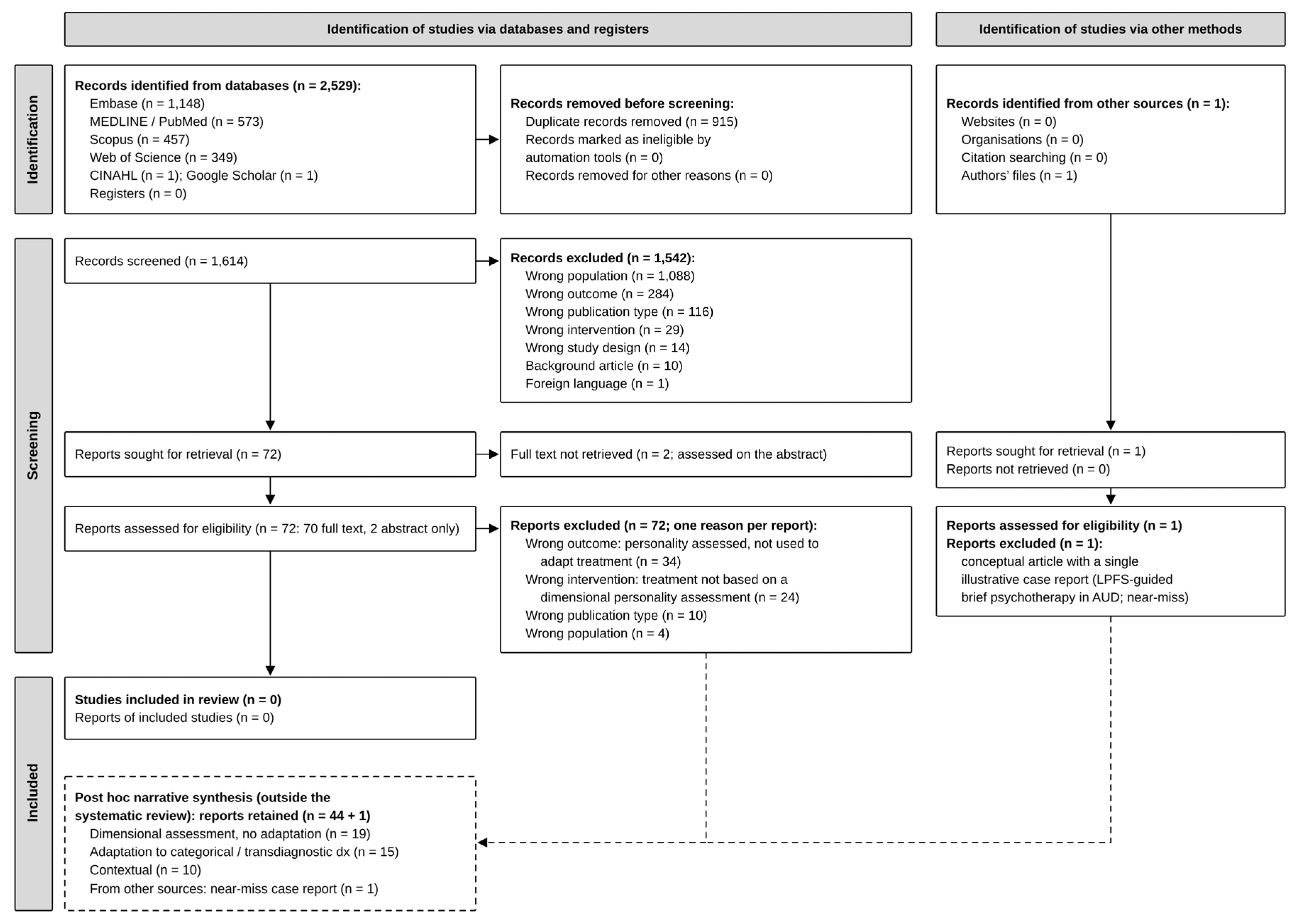

Table 1.
Reports assessed in full text and retained for narrative synthesis (n = 44 from the database searches; the last row is the single report identified from the authors’ files), ordered by group and, within each group, by year of publication: A = dimensional assessment without treatment adaptation; B = treatment adapted to a categorical personality disorder diagnosis or transdiagnostic treatment without personality-based selection; C = contextual evidence.
Table 1.
Reports assessed in full text and retained for narrative synthesis (n = 44 from the database searches; the last row is the single report identified from the authors’ files), ordered by group and, within each group, by year of publication: A = dimensional assessment without treatment adaptation; B = treatment adapted to a categorical personality disorder diagnosis or transdiagnostic treatment without personality-based selection; C = contextual evidence.
| Study | Design | Sample | Personality measure | Dimensional? | Treatment adapted? | Group |
|---|---|---|---|---|---|---|
| Pena-Ramos et al. (1979) [24] | Clinical study | Alcohol withdrawal | MMPI | Yes | No | A |
| Janowsky et al. (1999) [25] | Cross-sectional | AUD/SUD ± affective disorder | MBTI; TPQ | Yes | No | A |
| Ingersoll et al. (2004) [26] | Prospective cohort | 105 drug-dependent pregnant women | MMPI-2 clusters | Yes | No | A |
| Evren et al. (2007) [27] | Cross-sectional | 111 alcohol- + 93 drug-dependent inpatients | TCI | Yes | No (recommends) | A |
| Hesse et al. (2008) [28] | RCT protocol | SUD treatment seekers (Copenhagen) | PD assessment + feedback | Partly | Assessment as intervention | A |
| Pedrero Pérez et al. (2011) [29] | Case–control | Alcohol abusers vs matched controls (Spain) | TCI-R; frontal symptoms | Yes | No | A |
| Agrawal et al. (2013) [30] | Community cohort | 1,630 adults 55–64 + informants | Interview, self- and informant-report PD | Yes | No | A |
| Blonigen et al. (2015) [31] | Pilot RCT (RSA 2012 abstract; full report 2015) | 30 veterans entering 90-day residential SUD treatment | NEO-PI-R with patient-centered feedback | Yes | Assessment as intervention (feedback); no adaptation of subsequent treatment | A |
| McCarter et al. (2016) [32] | Secondary analysis of 2 RCTs | 290 alcohol misuse + depression | PD cluster characteristics | Partly | No (PD not targeted) | A |
| Smolejová et al. (2016) [20] | Cross-sectional | 30 alcohol-dependent inpatients vs 375 population controls (Slovakia) | TCI-R | Yes | No | A |
| Soundararajan et al. (2017) [33] | Prospective, 3-month | Alcohol dependence (India) | Personality profile | Yes | No | A |
| Charfi et al. (2019) [34] | Case–control | Drug addicts vs controls (Tunisia) | TEMPS-A | Yes | No | A |
| De la Rosa-Cáceres et al. (2022) [35] | Network analysis | 742 community + 243 patients (Spain) | PID-5 (AMPD facets) | Yes | No | A |
| Fodstad et al. (2022) [36] | Cross-sectional vs norms | 123 SUD in treatment (Norway) | NEO-PI-R | Yes | No | A |
| Hell et al. (2022) [37] | Secondary analysis of RCT | AUD (Self-Match Study, Denmark) | Personality traits | Yes | No (self-matching, not personality-based) | A |
| Basińska et al. (2023) [38] | Cross-sectional | Alcohol dependence (Poland) | Temperament; personality organization (Kernberg) | Yes | No | A |
| Guillot et al. (2023) [39] | Cross-sectional | 200 social drinkers | Cluster B traits; impulsivity; expectancies | Yes | No | A |
| Mamełka et al. (2023) [40] | Cross-sectional | AUD (Poland) | Personality organization; mentalization | Yes | No | A |
| Joseph et al. (2025) [41] | Cross-sectional (abstract) | Alcohol dependence, India | Big Five | Yes | No | A |
| Nielsen et al. (2007) [42] | Quasi-randomized trial | 108 alcohol-dependent inpatients | MCMI-I/II | No (categorical prototypes) | Yes (PETAD) — near-miss | B |
| Gregory et al. (2008) [43] | RCT | 30 BPD + AUD | Categorical (BPD) | No | Yes (DDP) | B |
| Ball et al. (2011) [44] | RCT | 105 substance-dependent, with/without PD | Categorical PD (SCID-II) | No | Yes (dual-focus schema therapy) | B |
| Wupperman et al. (2012) [45] | Open pilot | 14 court-referred women | None (treatment target: behavioral dysregulation) | Not assessed | Transdiagnostic (MMT), not personality-based | B |
| Wupperman et al. (2015) [46] | Comparison trial | 21 women, substance use + aggression | None (treatment target: behavioral dysregulation) | Not assessed | Transdiagnostic (MMT), not personality-based | B |
| Sloan et al. (2018) [47] | Case series | Young people, SUD + mental health | None (treatment target: emotion regulation) | Not assessed | Transdiagnostic (ER treatment), not personality-based | B |
| Cavicchioli et al. (2020) [48] | Secondary analysis of open trials | 186 AUD | None (DERS and experiential avoidance as mediators) | Not assessed | Transdiagnostic (DBT-ST), not personality-based | B |
| Cavicchioli et al. (2020) [49] | Feasibility study | AUD outpatients (Italy) | None (DERS and experiential avoidance as mediators) | Not assessed | Transdiagnostic (outpatient DBT-ST), not personality-based | B |
| Kaltenegger et al. (2020) [50] | Secondary analysis of RCT | 46 BPD + SUD | Autistic traits (AQ) | Yes | Yes (MBT + SUD treatment) | B |
| Boog et al. (2022) [51] | Case–control | BPD, BPD + AUD, non-patients | Impulsivity tasks; schema modes | Partly | No (argues same frame/contract) | B |
| Boog et al. (2023) [52] | Theoretical | SUD | Schema modes | Partly | Proposed (schema therapy phases) | B |
| Boog et al. (2024) [53] | Case series, 1-year follow-up | 20 (17 at FU) BPD + AUD | Categorical (BPD); schema modes | Partly (modes) | Yes (integrated schema therapy) | B |
| Murys-Chaix et al. (2024) [54] | Narrative | AUD | None | Not assessed | Proposed (ACT, compassion), not personality-based | B |
| Patzelt et al. (2025) [55] | Narrative proposal | BPD + AUD | Categorical (BPD) | No | Yes (GPM, multimodal) | B |
| Knapp et al. (2026) [56] | RCT (stage II efficacy trial) | AUD | None (treatment target: emotion regulation) | Not assessed | Transdiagnostic (ER treatment), not personality-based | B |
| Babor et al. (1992) [57] | Multi-site typology | Alcoholics | Multiple typologies incl. MMPI, PD | Mixed | No (argues for individualized treatment) | C |
| Hesse (2005) [58] | Reliability study | Substance abusers (Copenhagen) | Social workers’ PD ratings vs structured | No (categorical) | No | C |
| Walters et al. (2010) [59] | Taxometric | Prison inmates | PAI Alcohol Problems scale | Yes | No | C |
| Conrod (2016) [60] | Review of 8 RCTs | Adolescents/young adults at risk | SURPS trait screen | Yes | Yes (prevention, not AUD treatment) | C |
| Brem et al. (2019) [61] | RSA 2019 abstract | AUD ± compulsive sexual behavior | Clinical characteristics | — | No | C |
| Soundararajan et al. (2019) [62] | RSA 2019 abstract | Non-treatment-seeking drinkers | Impulsivity; DA genes | Yes | No | C |
| Rosenström et al. (2021) [63] | Twin study | Norwegian twins | ASPD/BPD criteria | Yes (criterion-level) | No | C |
| Koudys et al. (2023) [64] | Review | PD + SUD/AUD | Transdiagnostic impulsivity phenotypes (AMPD/HiTOP) | Yes | No | C |
| Stetsiv et al. (2023) [10] | Review | PD + SUD | — | — | No | C |
| Gómez-Bujedo et al. (2024) [65] | Cross-sectional | SUD vs dual diagnosis | Emotional processing | — | No | C |
| George et al. (2024) [23] | Case report in a conceptual article (other sources) | 1 man, AUD + cannabis and tobacco use disorders (India) | LPFS (AMPD Criterion A) | Yes | Yes (brief psychotherapy targeted at impaired domains) — near-miss | — |
ACT = acceptance and commitment therapy; AQ = Autism Quotient; DA = dopamine; DERS = Difficulties in Emotion Regulation Scale; FU = follow-up; MBTI = Myers–Briggs Type Indicator; MMT = mindfulness and modification therapy; PAI = Personality Assessment Inventory; SCID-II = Structured Clinical Interview for DSM-IV Axis II; SURPS = Substance Use Risk Profile Scale; TPQ = Tridimensional Personality Questionnaire. “Partly” = personality construct measured dimensionally but within a categorical diagnostic frame; “Not assessed” = personality neither measured nor diagnosed (patients selected by AUD or by dysregulated behavior).
Disclaimer/Publisher’s Note: The statements, opinions and data contained in all publications are solely those of the individual author(s) and contributor(s) and not of MDPI and/or the editor(s). MDPI and/or the editor(s) disclaim responsibility for any injury to people or property resulting from any ideas, methods, instructions or products referred to in the content. |
© 2026 by the authors. Licensee MDPI, Basel, Switzerland. This article is an open access article distributed under the terms and conditions of the Creative Commons Attribution (CC BY) license (http://creativecommons.org/licenses/by/4.0/).
Copyright: This open access article is published under a Creative Commons CC BY 4.0 license, which permit the free download, distribution, and reuse, provided that the author and preprint are cited in any reuse.