

Submitted:
14 November 2026
Posted:
16 November 2026
You are already at the latest version
Abstract
Volume Theory begins with the postulate that physical spatial volume can support different local states, including localized concentrations, without changing the total volume of the domain. I develop a conservative complex state field and couple its squared amplitude to a constrained volume response, then assign a corresponding spatial metric and derive its volume identity and scalar-curvature relation. The response equation requires a compensating change elsewhere in the domain, while a coupled spherical numerical solution has finite energy, nonzero intrinsic spatial curvature, and zero net volume change. These calculations provide a definite geometric realization of the postulate under the stated assumptions and establish the relations on which further physical applications can be built.
Keywords:
spatial volume
; volume-state theory
; volume conservation
; localized field configurations
; nonlinear scalar fields
; intrinsic spatial curvature
; emergent geometry
; nontopological solitons
1. Introduction
Volume Theory begins with the postulate that spatial volume supports physical states capable of differing from one region to another, so a localized concentration can be treated as a state of the common spatial domain rather than a primitive object placed into it. The first question is whether this idea can be given a definite mathematical form in which localization changes the geometry assigned to a region while the total volume remains fixed.
Consider reaching into the air and making a plucking motion. The hand moves through gas occupying a spatial region, and the gesture raises a basic question about what that region itself can support. The motion does not establish the physical nature of empty space, but it provides a starting point for considering whether spatial volume may possess its own changing states. Veneziano’s scattering construction preceded the interpretation of fundamental strings developed in subsequent work, and the mathematical foundations of string descriptions continue to be examined [1,2,3,4]. Volume Theory begins with the proposition that spatial volume itself may carry local physical states, allowing concentrations and boundaries to arise as configurations of the same underlying domain rather than requiring separate fundamental objects to be assumed at the outset. Localized physical structures already have a substantial theoretical history, including Wheeler’s geons [5], quantum-liquid models [6], and collective excitations [7]. Emergent gravitational response in condensates [8,9], spatial and spacetime metrics assigned to superfluid systems [10], and analogue-gravity research [11] make it important to specify what the present construction actually supplies. The different meanings of spacetime emergence have also been examined directly [12], and here I confine the calculation to a spatial metric defined on a stated domain.
The wider suggestion that matter may be a manifestation of space was raised by Clifford and developed in a different form in the geometrodynamical work of Misner and Wheeler [13,14]. Related physical-continuum proposals exist, including Carmesin’s volume-dynamics formulation [15]. Those precedents make the scope of the present construction important. I consider a complex localized state coupled to a second field that carries the spatial-volume response, with the total response constrained to vanish and the associated metric specified by a constitutive relation. The contribution being examined is this constrained coupling and its calculated geometric consequences, rather than an assertion that spatial states or solitons had not previously been considered.
Volume-preserving spatial conformal transformations are also central to Shape Dynamics, for which coupling to matter has been studied [16,17]. In that setting the conformal transformations are gauge symmetries, while the response used below is assigned its own kinetic and gradient terms. Unimodular gravity restricts the local metric volume element, and vacuum-energy sequestering employs global spacetime-volume dependence for a different physical purpose [18,19]. Fixed-spatial-volume constraints have also been studied in Euclidean quantum-gravity partition functions by Jacobson and Visser and subsequently by Wu, Cheng, and Wei [20,21]. Here the imposed constraint acts on the integrated spatial volume, and the localized state sources the response through the field equations. These distinctions identify the specific mathematical proposal without attributing newness to the individual conservation or conformal-curvature identities.
2. A Volume-State Postulate
Let be a ball of reference radius L with Euclidean measure and reference volume
Introduce a real response satisfying
Here J is proposed as a local spatial-volume factor. The spatial metric associated with it is defined as
Taking the determinant gives
The physical volume assigned by this metric is therefore
A positive u increases the local metric volume element relative to the reference measure, while a negative u supplies the compensating change elsewhere in the same domain. The two signs specify geometric responses and do not require that either state be identified in advance with matter.
A density assigned to volume without a metric can be changed by a choice of coordinates, a point made precise by results concerning volume forms [22,23]. For that reason I assign a full spatial metric in Eq. (3) and calculate its intrinsic curvature below, so the geometric effect can be stated independently of coordinate labels. This metric is a constitutive choice rather than a result derived from a four-dimensional gravitational action, while work on emergent geometry identifies further conditions relevant to a gravitational interpretation [24,25].
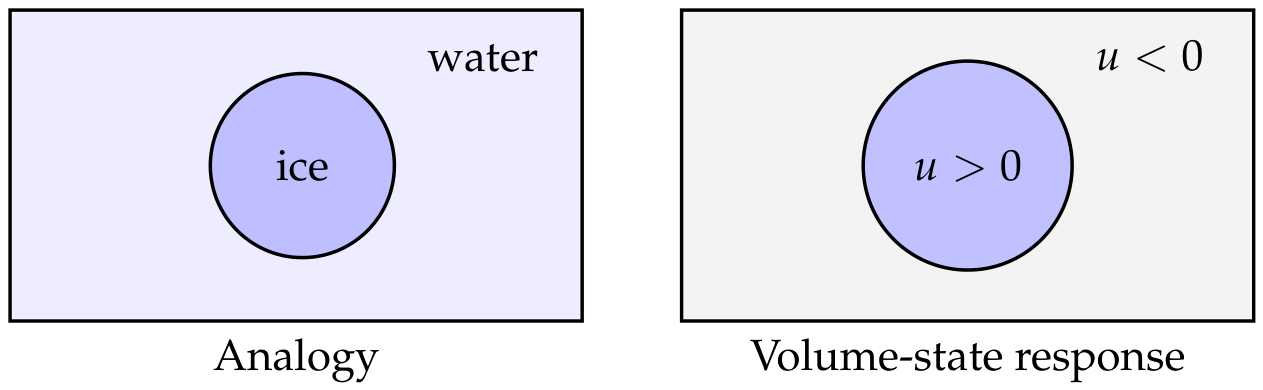
Figure 1.
Ice in water illustrates one substance in two distinguishable states with a definite interface. The second outline represents a locally increased volume factor with compensation elsewhere in the same fixed domain. The drawings illustrate state differentiation without implying that the vacuum is water or that freezing obeys the model’s global-volume constraint.
3. Conservative State and Volume Dynamics
To model a conservative localized state, I introduce a complex internal state field and write . In normalized units, with the quadratic mass coefficient set to unity, I use the positive nonlinear potential
The phase symmetry supplies a conserved charge capable of supporting a localized state, following the established theory of nontopological solitons [26,27,28,29]. Friedberg, Lee, and Sirlin showed in 1976 that a charged scalar state coupled to a neutral scalar can admit three-dimensional soliton solutions [30]. The present construction retains such a two-field setting but imposes a fixed-total-volume condition on the neutral response and assigns that response to a spatial volume element. The restriction on static real scalar lumps also remains relevant [31].
I define a two-field action on the reference domain,
with and coupling g, while the multiplier enforces Eq. (2). The derivatives in this action are taken with the reference measure, and the spatial metric in Eq. (3) is assigned through the response rather than varied as an independent dynamical gravitational field. Whether physical probes follow that metric is a separate question for a later theory. Variation in gives
Variation in u gives
Integrate Eq. (11) over . Since at every time, and on the boundary, the left side integrates to zero. Thus
The complete response equation is
The mean subtraction follows from the total-volume constraint, so a positive localized response cannot occur without compensation somewhere in the remaining domain. For the initial-value problem, let . Integrating Eq. (13) gives
The initial conditions are therefore imposed to preserve the zero-mean constraint. The geometric interpretation applies only to solutions and time intervals for which . The evolution equation does not guarantee positivity for arbitrary initially admissible data.
The phase symmetry of conserves
The same action has conserved total energy under vanishing boundary flux,
4. The Constrained Geometric Response
For a stationary radial state, put
Substitution into the field equations yields
The boundary conditions are , , and . The mean is evaluated over the same ball. The response can be written with the positive elliptic operator ,
The operator is invertible when . Taking the integral of Eq. (20) gives . Thus follows for every smooth solution with the stated boundary conditions. Positive u must be accompanied by negative u elsewhere.
There is an immediate energy consequence. The static u sector is
Multiplying Eq. (20) by u and integrating gives
where every integral is over . Substitution yields
For two well-separated positive concentrations, the static interaction is attractive when boundary corrections are negligible, with screened length . It is a scalar-mediated interaction and is not identified with Newtonian gravity.
5. Intrinsic Curvature at Fixed Total Volume
The volume element of Eq. (3) is fixed globally, but its metric can still carry intrinsic curvature. Define
The three-dimensional conformal transformation of scalar curvature gives
Substituting gives
The curvature is a coordinate-invariant property of the assigned metric. In the weak-response limit ,
For the stationary response, Eq. (20) then gives
Under the assigned constitutive metric, the localized state and its compensating volume response determine an intrinsic curvature pattern through Eq. (29). This is a curvature consequence of the metric definition and response law, not an independently derived dynamical equation of gravity.
A useful integral identity follows without approximating u. Since , multiply Eq. (27) by J and integrate. Using ,
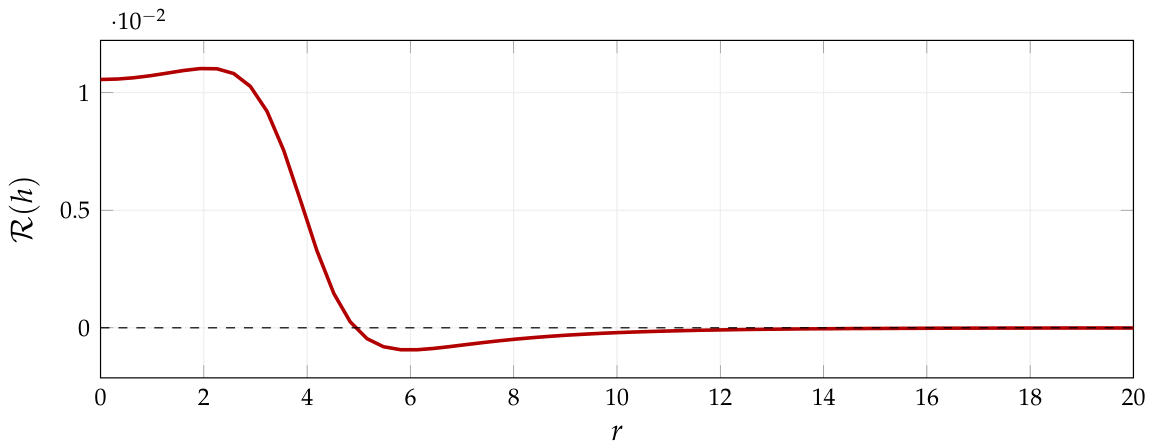
The integral is strictly positive for nonconstant positive J, even though the total metric volume remains unchanged, and this establishes a geometric consequence of the constitutive metric under the stated boundary conditions. The result concerns intrinsic curvature of the assigned three-dimensional metric, leaving its relation to a four-dimensional gravitational field for further development.
6. Numerical Example
I solved Eqs. (19) and (20) on in dimensionless units. The parameters were
The coupled boundary-value problem was solved by iteration between the two radial equations until the maximum change in u between iterations was below . The radial equations were solved with adaptive collocation and numerical quadrature was used for the conserved quantities and curvature integral.

Table 1.
Results for the stationary coupled solution in normalized units.
| Quantity | Computed value |
|---|---|
| Central state amplitude | |
| Central volume response | |
| Minimum volume response | |
| Mean response | |
| Relative total-volume change | |
| Central scalar curvature | |
| Minimum scalar curvature | |
| Curvature integral | |
| Conserved phase charge Q | |
| Total energy H | |
| Ratio |
Independent evaluations of Eq. (32) agreed to about in absolute units, while the response was positive near the center and negative in the surrounding region. For the reported stationary profile , so this example lies within the admissible metric sector. The positive and negative contributions cancel in the total-volume integral to the reported numerical accuracy, leaving a nonuniform metric with the same total volume as the reference domain.
Figure 2.
Computed radial volume response for the coupled stationary solution. The volume factor increases near the localized state and is compensated by a negative response farther out, preserving the total domain volume.
Figure 2.
Computed radial volume response for the coupled stationary solution. The volume factor increases near the localized state and is compensated by a negative response farther out, preserving the total domain volume.
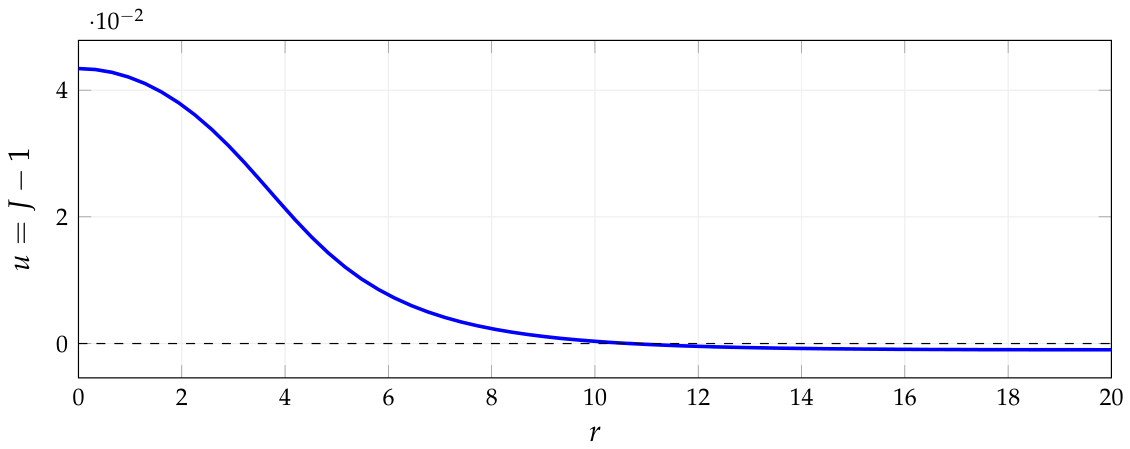
Figure 3.
Computed intrinsic scalar curvature of the assigned spatial metric for the same stationary solution. The curvature changes sign across the domain despite the exact total-volume constraint.
Figure 3.
Computed intrinsic scalar curvature of the assigned spatial metric for the same stationary solution. The curvature changes sign across the domain despite the exact total-volume constraint.
The branch of solutions also retains a negative charge slope at the chosen frequency. Re-solving the coupled system gave , , and . Thus
This finite-step slope estimate establishes the negative sign of the local trend and supports the usual ground-state charge-slope stability check, although it does not replace a full perturbation spectrum for the coupled two-field system, particularly in view of known limitations of slope criteria for other classes of solitons [32,33,34,35].
7. Conclusion
Volume Theory is introduced here through a conserved localized state coupled to a constrained volume response and a definite spatial metric. Because the response has zero integral, a local increase in the volume factor must be accompanied by a change elsewhere, and the constitutive metric assigns nonzero intrinsic curvature to that redistributed configuration while preserving the domain’s total volume. The coupled numerical example satisfies the stated field equations and provides a finite-energy localized configuration with a negative charge slope. The result provides a candidate spatial-volume geometry within the model, with an explicit path toward asking how physical distances and moving probes would respond to it. Existing gravitating soliton studies [36,37], work on emergent gravitational structure [24,25], and investigations of collective constraints on motion [38] provide relevant contexts for that subsequent question, without adding a gravitational interaction to the present calculation.
The central proposal is that a physical state of a shared spatial domain can be localized and can require a compensating volume response which, under an assigned constitutive metric, carries nonzero intrinsic curvature without changing total volume. The field equations, geometric identities, and numerical example provide a precise first construction on which further physical tests can be based.
Author Contributions
This article is the sole work of the author.
Funding
No external funding was received for this work.
Data Availability Statement
Conflicts of Interest
The author declares no conflicts of interest.
Ethical Approval
Not applicable.
References
- Veneziano, G. Construction of a crossing-symmetric, Regge-behaved amplitude for linearly rising trajectories. Il Nuovo Cim. A 1968, 57(1), 190–197. [Google Scholar] [CrossRef]
- Susskind, L. Harmonic-oscillator analogy for the Veneziano model. Phys. Rev. Lett. 1969, 23(10), 545–547. [Google Scholar] [CrossRef]
- Planella Planas, G. Emergent strings from quantum field theory. J. High Energy Phys. 2026, 2026(9), 28. [Google Scholar] [CrossRef]
- Krátký, M.; Narra, B.; Read, J. Is string field theory background independent? Found. Phys. 2026, 56(3), 26. [Google Scholar] [CrossRef]
- Wheeler, J. A. Geons. Phys. Rev. 1955, 97(2), 511–536. [Google Scholar] [CrossRef]
- Volovik, G. E. The universe in a helium droplet; Oxford University Press, 2003. [Google Scholar]
- Levin, M.; Wen, X.-G. Colloquium: Photons and electrons as emergent phenomena. Rev. Mod. Phys. 2005, 77(3), 871–879. [Google Scholar] [CrossRef]
- Girelli, F.; Liberati, S.; Sindoni, L. Gravitational dynamics in Bose-Einstein condensates. Phys. Rev. D. 2008, 78(8), 084013. [Google Scholar] [CrossRef]
- Girelli, F.; Liberati, S.; Sindoni, L. Emergence of Lorentzian signature and scalar gravity. Phys. Rev. D. 2009, 79(4), 044019. [Google Scholar] [CrossRef]
- Zloshchastiev, K. G. Derivation of emergent spacetime metric, gravitational potential and speed of light in superfluid vacuum theory. Universe 2023, 9(5), 234. [Google Scholar] [CrossRef]
- Barceló, C.; Liberati, S.; Visser, M. Analogue gravity. Living Rev. Relativ. 2026, 29, 2. [Google Scholar] [CrossRef]
- Jaksland, R.; Salimkhani, K. The many problems of spacetime emergence in quantum gravity. Br. J. Philos. Sci. 2026, 77(3), 795–821. [Google Scholar] [CrossRef]
- Clifford, W. K. On the space-theory of matter. Proc. Camb. Philos. Soc. 1876, 2, 157–158. [Google Scholar] [CrossRef]
- Misner, C. W.; Wheeler, J. A. Classical physics as geometry. Ann. Phys. 1957, 2(6), 525–603. [Google Scholar] [CrossRef]
- Carmesin, H.-O. How volume portions form and found light, gravity and quanta; Verlag Dr. Köster: Berlin, 2024; ISBN 978-3-96831-051-0. [Google Scholar]
- Gomes, H.; Gryb, S.; Koslowski, T. Einstein gravity as a 3D conformally invariant theory. Class. Quantum Gravity 2011, 28(4), 045005. [Google Scholar] [CrossRef]
- Gomes, H.; Koslowski, T. Coupling Shape Dynamics to Matter Gives Spacetime. General. Relativ. Gravit. 2012, 44, 1539–1553. [Google Scholar] [CrossRef]
- Henneaux, M.; Teitelboim, C. The cosmological constant and general covariance. Phys. Lett. B 1989, 222(2), 195–199. [Google Scholar] [CrossRef]
- Kaloper, N.; Padilla, A. Sequestering the Standard Model vacuum energy. Phys. Rev. Lett. 2014, 112(9), 091304. [Google Scholar] [CrossRef] [PubMed]
- Jacobson, T.; Visser, M. R. Partition function for a volume of space. Phys. Rev. Lett. 2023, 130(22), 221501. [Google Scholar] [CrossRef] [PubMed]
- Wu, S.-P.; Cheng, P.; Wei, S.-W. Gravitational partition function under volume constraints. Phys. Rev. D. 2026, 113(10), 104049. [Google Scholar] [CrossRef]
- Moser, J. On the volume elements on a manifold. Trans. Am. Math. Soc. 1965, 120, 286–294. [Google Scholar] [CrossRef]
- Khesin, B.; Volk, L. Morse-Bott volume forms. Arnold Math. J. 2026, 12(1), 141–159. [Google Scholar] [CrossRef]
- Duque, E. I. Emergent modified gravity: The perfect fluid and gravitational collapse. Phys. Rev. D. 2024, 109(4), 044014. [Google Scholar] [CrossRef]
- Alonso-Serrano, A.; Liška, M. Thermodynamics as a framework for understanding gravitational dynamics and quantum gravity. General. Relativ. Gravit. 2025, 57, 10. [Google Scholar] [CrossRef]
- Coleman, S. Q-balls. Nucl. Phys. B 1985, 262(2), 263–283, Addendum, Nuclear Physics B, 269, 744 (1986). [Google Scholar] [CrossRef]
- Lee, T. D.; Pang, Y. Nontopological solitons. Phys. Rep. 1992, 221(5–6), 251–350. [Google Scholar] [CrossRef]
- Zhou, S.-Y. Non-topological solitons and quasi-solitons. Rep. Prog. Phys. 2025, 88(4), 046901. [Google Scholar] [CrossRef] [PubMed]
- Aiello, D.; Heeck, J. Q-balls across dimensions. Phys. Rev. D. 2026, 114(1), 015008. [Google Scholar] [CrossRef]
- Friedberg, R.; Lee, T. D.; Sirlin, A. Class of scalar-field soliton solutions in three space dimensions. Phys. Rev. D. 1976, 13(10), 2739–2761. [Google Scholar] [CrossRef]
- Derrick, G. H. Comments on nonlinear wave equations as models for elementary particles. J. Math. Phys. 1964, 5(9), 1252–1254. [Google Scholar] [CrossRef]
- Chen, Q.; Andersson, L.; Li, L. Stability analysis for Q-balls with spectral method. J. High Energy Phys. 2026, 2026(2), 78. [Google Scholar] [CrossRef]
- Kinach, M. P.; Choptuik, M. W. Dynamics of U(1) gauged Q-balls in three spatial dimensions. Phys. Rev. D. 2024, 110(7), 075033. [Google Scholar] [CrossRef]
- Panin, A. G.; Smolyakov, M. N. Problem with classical stability of U(1) gauged Q-balls. Phys. Rev. D. 2017, 95(6), 065006. [Google Scholar] [CrossRef]
- Rajaraman, A. Instabilities of gauged Q-balls. J. High Energy Phys. 2025, 2025(3), 82. [Google Scholar] [CrossRef]
- Kleihaus, B.; Kunz, J.; List, M. Rotating boson stars and Q-balls. Phys. Rev. D. 2005, 72(6), 064002. [Google Scholar] [CrossRef]
- Brihaye, Y.; Hartmann, B. Angularly excited and interacting boson stars and Q-balls. Phys. Rev. D. 2009, 79(6), 064013. [Google Scholar] [CrossRef]
- You, Y. Quantum liquids: Emergent higher-rank gauge theory and fractons. Annu. Rev. Condens. Matter Phys. 2025, 16, 83–102. [Google Scholar] [CrossRef]
Disclaimer/Publisher’s Note: The statements, opinions and data contained in all publications are solely those of the individual author(s) and contributor(s) and not of MDPI and/or the editor(s). MDPI and/or the editor(s) disclaim responsibility for any injury to people or property resulting from any ideas, methods, instructions or products referred to in the content. |
© 2026 by the author. Licensee MDPI, Basel, Switzerland. This article is an open access article distributed under the terms and conditions of the Creative Commons Attribution (CC BY) license (http://creativecommons.org/licenses/by/4.0/).
Copyright: This open access article is published under a Creative Commons CC BY 4.0 license, which permit the free download, distribution, and reuse, provided that the author and preprint are cited in any reuse.