

Submitted:
12 November 2026
Posted:
16 November 2026
You are already at the latest version
Abstract
This study comprehensively evaluates the thermochemical valorization of agricultural residues into biochar, examining its integration into advanced closed-loop agro-ecological frameworks such as the plant-driven enhanced rock weathering (ERW) system (e.g., the Lupinus albus–basalt model). By classifying precursor biomass feedstocks into three primary categories—leguminous and specialty herbaceous residues, staple cereal straws and stalks, and lignocellulosic woody biomass and orchard prunings—the review investigates how biochemical composition and pyrolysis operational parameters (such as peak temperature, heating rate, and residence time) critically dictate solid mass recovery, structural porosity, Cation Exchange Capacity (CEC), and carbon stability. While leguminous and herbaceous residues yield nutrient-rich biochars with high inorganic alkalinity optimal for neutralizing soil acidity, cereal straws offer versatile porous networks suitable for soil conditioning and environmental remediation. Conversely, lignin-rich woody residues and orchard prunings provide exceptional environmental recalcitrance and multi-century mean residence times, making them premier candidates for permanent carbon sequestration, structural construction materials, and phase-change material encapsulation. The findings demonstrate that strategic feedstock selection and precise thermal control enable the design of bespoke biochars that simultaneously drive negative emission technologies, soil restoration, and circular bioeconomy pathways.
Keywords:
biochar
; pyrolysis
; agricultural residues
; enhanced rock weathering
; carbon sequestration
; soil amendment
; biomass valorization
1. Introduction
In a recent discussion (Sparavigna & Giorcelli, 2026) on the lupinus albus–basalt system—which integrates the biochemical root mechanisms of the plant to drive enhanced rock weathering (ERW)—we proposed the strategic addition of converting agricultural residues into biochar. We emphasize that ERW of basalt is fundamental for the geological removal of atmospheric carbon dioxide, converting it into bicarbonates that are transported by water systems to the oceans for permanent storage (Berner, 1997; Goll et al., 2021; Hartmann, 2013). The framework of our proposal was rooted in the system of Bio-Enhanced Mineral Weathering accompanied by Soil Restoration (Hinsinger et al., 2001). The core engine of the system relies on the rhizosphere chemistry of the white lupin (Lupinus albus) (Shu et al., 2007; Veneklaas et al.. 2003; Lambers et al., 2006). Driven by the Krebs–Johnson cycle, lupin root clusters exude massive amounts of carboxylates—predominantly citric acid (Krebs & Johnson, 1980). Citrate acts as a natural hexadentate ligand, forming stable soluble complexes with divalent cations (Ca2+ , Mg2+) and trace metals (Fe3+). This pulls cations out of the rock matrix, preventing the passivation of mineral surfaces and releasing bioavailable plant nutrients (Jones, 1998; Drever & Vance, 1994). When fine-grained basalt or volcanic tuffs (rich in pozzolanic and zeolitic phases) are applied as soil amendments, they provide a rich mineral reservoir. The biological dissolution of volcanic materials liberates critical macro and micronutrients (Ca, Mg, K, Fe), enhancing soil fertility and counteracting soil degradation. The released Ca2+ and Mg2+ ions combine with dissolved inorganic carbon () derived from root/microbial respiration, converting atmospheric CO2 into stable bicarbonate ions and secondary carbonate minerals (Van Straaten, 2006).
To maximize the system’s agronomic efficiency and carbon removal potential, converting crop residues into biochar establishes a powerful three-way synergy. Biochar acts as a stable, highly porous carbon backbone in the soil, providing a high specific surface area and elevated Cation Exchange Capacity (CEC) that effectively retain mineral nutrients (Bates et al., 2024). In this manner, we achieve carbon synergies through a dual carbon removal pathway, combining recalcitrant organic carbon storage (via pyrolysis) with permanently sequestered inorganic carbon (via basalt weathering and subsequent bicarbonate/carbonate formation) (Heredia Salgado, et al., 2018). Moreover, the porous structure of biochar fosters rhizosphere microflora, which further amplifies root exudation and mineral dissolution dynamics (Vienne et al., 2022). A schematic view of our proposal is given in Figure 1. Let us note that the biochar suggested for soil emendation can be obtained from the processing of any residual.
Given the compelling synergy between plant-driven enhanced rock weathering and biochar amendment, conducting a comprehensive review on biochar yields and the relative properties derived from agronomically interesting plants represents a highly promising and timely research avenue. Before starting the review, let us briefly summarize what biochar is and its applications.
2. Biochar
Biochar is the black, fine-grained product of pyrolysis—a biomass conversion technology based on thermochemical decomposition processes conducted at moderate temperatures (350–700 °C) under oxygen-limiting conditions (Brassard et al., 2019; Bartoli & Giorcelli, 2022). Besides biochar proper, which constitutes the primary product of biomass pyrolysis (Kan et al., 2016), liquid (bio-oil) and gaseous (syngas) fractions are also obtained from the thermal decomposition (Han & Kim, 2008; Bartoli et al., 2020). The principal use of biochar is as an amendment in agricultural soils (Brassard et al., 2019; Ok et al., 2015). However, due to its high compatibility with cement, asphalt, and polymers, biochar is also proposed as a filler for these materials (Tan et al., 2021). The state of the art of biochar-enhanced construction materials is detailed by Zhang et al. (2022), where their key merits are highlighted, such as humidity regulation, thermal insulation, and noise reduction. The incorporation of biochar into cementitious materials has also been extensively investigated by Danish et al. (2021), Maljaee et al. (2021), Tan et al. (2021), and Suarez-Riera et al. (2022). Regarding other non-soil applications of biochar—specifically as a filler in polymeric composites—comprehensive reviews have been provided by Bartoli et al. (2020, 2022), Ziegler et al. (2017), and Lepak-Kuc et al. (2021).
Biochar possesses a hierarchical pore structure, resulting in a large specific surface area accompanied by a strong adsorption capacity (Liang et al., 2022). Moreover, physical and chemical activation of this porous network can be used to convert biochar into a cost-effective and environmentally friendly, activated carbon material for multiple applications (Tan et al., 2017). Beyond its role as a filler, the significant presence of mesopores enables biochar to serve multifunctional roles in storage applications—ranging from the adsorption of pollutant gases, such as carbon dioxide (Chen et al., 2017), to the shape-stabilization of phase-change materials (PCMs) used for thermal energy management (Du et al., 2018; Liang et al., 2022). Biochar overcomes the leakage problem of PCMs in their fluid phase through encapsulation within its mesopores, while these same mesopores act as conduits to the micropores, which provide the effective packing space for adsorption (Sparavigna, 2022). Biochar can also act as a filter—for instance, in water pollution treatment (He et al., 2022)—or serve as a medium for electrical energy storage in supercapacitors (Cheng et al., 2017).
For buildings, besides its use in PCM encapsulation, biochar has been proposed for CO2 adsorption (Schmidt, 2014; Legan et al., 2022; Pandey et al., 2022; Jiang et al., 2023) and for improving construction materials (Zhang et al., 2022). Consequently, biochar holds significant potential for the massive market of building materials (Sivanathan et al., 2020). Given the recognized importance of biochar, understanding its yield and specific characteristics derived from the pyrolysis of agricultural residues becomes fundamental to our integrated approach, which aims coupling plants such as the white lupin with CO2 sequestration and thermochemical valorization. Building upon these foundations, we are now fully prepared to proceed with the comprehensive review.
The following Table 1 provides a summary of biochar applications.
3. Amendment and CO2 Sequestration
As mentioned in the previous section, the primary use of biochar is as a soil amendment. This means that biochar is used to improve soil properties, correct acidity, and enhance overall fertility (Lehmann & Joseph, 2024; Glaser et al., 2002; Jeffery et al., 2011). However, when we use biochar as a soil amendment, the carbon it contains is effectively sequestered (trapped in the long term) (Lehmann, 2007). This happens for a fundamental chemical and environmental reason. During its growth, the plant absorbs carbon dioxide (CO2) from the atmosphere through photosynthesis. When plant residues are converted into biochar via oxygen-limited pyrolysis, a large portion of that carbon is stabilized into a highly aromatic and recalcitrant form, which is very resistant to microbial decomposition (Woolf et al., 2010, Sohi et al., 2010). The exceptional recalcitrance of this aromatic form stems from its dense condensed aromatic ring structure, where carbon atoms are bound in fused benzene-like rings with strong, delocalized covalent bonds. This polycyclic configuration creates a highly thermodynamically stable matrix that severely restricts enzymatic access and lacks the simple functional groups required for typical microbial catabolism. Conversely, the labile fraction of biochar and its peripheral surfaces are characterized by oxygen-containing functional groups—such as carboxylic (-COOH), phenolic hydroxyl (-OH), and carbonyl (>C=O) moieties—which provide the essential chemical handles and accessible energy sources required for microbial colonization and enzymatic catabolism (Lehmann & Joseph, 2024; Enders et al., 2012).
Although biochar carbon is remarkably durable, long-term degradation can slowly occur over decades or centuries through abiotically driven photo-oxidation (exposure to UV radiation at the soil surface) and chemical weathering by ambient atmospheric oxygen and reactive oxygen species (Spokas, 2010; Zimmerman, 2010). Additionally, specialized fungal lineages—such as white-rot fungi capable of producing extracellular lignin-degrading enzymes —along with slow, surface-bound abiotic chemical oxidation, can gradually alter its peripheral structure over extended timeframes (Lehmann et al., 2012; Kuzyakov et al., 2009). Nevertheless, because these oxidative processes (Figure 2) act extremely slowly and are largely restricted to the outer surfaces of the biochar particles, the core fused-ring structure remains overwhelmingly intact, confirming its long-term stability and permanence as a robust carbon sink. Consequently, the moment biochar is incorporated into the soil, that carbon is removed from the natural carbon cycle for decades or even centuries, preventing it from quickly returning to the atmosphere as carbon dioxide. It is for this reason that the use of biochar is considered a carbon-negative process; not only does it improve soil fertility and correct acidity, but it also represents a concrete method for climate change mitigation through stable carbon sequestration.
4. Pyrolysis Operational Parameters & Biochar Yield Dynamics
To systematically evaluate the agronomic and technological potential of biochar derived from agricultural residues, it is essential to first analyze how thermochemical conversion parameters dictate product yields and physicochemical properties. Pyrolysis performance is primarily governed by the peak pyrolysis temperature (highest treatment temperature, HTT), heating rate, residence time, and the intrinsic biochemical composition of the precursor biomass (i.e., relative ratios of cellulose, hemicellulose, and lignin) (Tomczyk et al., 2020; Enders et al., 2012).
Primary thermal decomposition occurs across distinct temperature regimes: hemicellulose undergoes rapid devolatilization at lower temperatures (220–315 °C), followed by cellulose degradation (315–400 °C), whereas lignin degrades slowly over a wide temperature span (160–900 °C) (Yang et al., 2007). Consequently, biomass feedstocks enriched in lignin—such as woody residues or sclerified seed coats—consistently deliver higher biochar yields (wt %) due to the formation of highly stable, recalcitrant carbonaceous networks (Amonette & Joseph, 2012). Conversely, herbivore-derived or herbaceous residues richer in cellulose and hemicellulose yield higher proportions of volatiles and bio-oil (Kan et al., 2016).
Furthermore, increasing the operating temperature generally results in a progressive decline in solid biochar yield alongside a concurrent rise in fixed carbon content, aromaticity, specific surface area (BET), and mesopore/micropore volume (Keiluweit et al., 2010). However, excessively high temperatures (>700 °C) may induce pore wall collapse or sintering, thereby diminishing surface reactivity (Lua et al., 2004). The Cation Exchange Capacity (CEC) typically exhibits a trend which is declining at elevated temperatures due to the loss of oxygen-containing functional groups (e.g., carboxyl, hydroxyl, and carbonyl moieties) (Bo et al., 2026).
Understanding these trade-offs between quantitative biochar yield and qualitative surface functionality is crucial when integrating crop-residue biochar into our dual carbon removal paradigm alongside plant-driven enhanced rock weathering (Lupinus albus–basalt system).
5. Classification and Behavioral Dynamics of Agro-Biomass Feedstocks
To evaluate the feasibility of biochar production within closed-loop agricultural systems, precursor biomass feedstocks can be broadly classified into three primary categories: herbaceous crop residues (including legume by-products), cereal straws and stalks, and woody/pruning wastes (Leng & Huang, 2018). Each biomass class exhibits a unique compositional footprint that fundamentally dictates pyrolytic conversion behavior, structural evolution, and functional properties (Tripathi et al., 2016; et al., 2013, Zhao et al., 2013).
5.1. Leguminous and Specialty Herbaceous Residues
Residual biomass derived from leguminous crops (such as white lupin harvest residues) and high-altitude specialty crops (e.g., quinoa stalks) represents a highly strategic feedstock for integrated agro-ecological systems. These residues are characterized by moderate lignin content, elevated hemicellulose levels, and a rich organic nutrient matrix (notably residual nitrogen and trace elements) (Heredia Salgado et al., 2022). Upon pyrolysis at moderate temperatures (400–500 °C), they yield biochar with balanced porous architectures and superior native Cation Exchange Capacity (CEC), making them exceptionally suited for re-application to the rhizosphere to support nutrient retention and microbial activity (Novak, et al., 2009).
5.2. Cereal Straws and Crop Stalks (Wheat, Corn, Rice)
Herbaceous residues from staple cereals represent the largest volume of agricultural waste globally. These feedstocks possess high hemicellulose content alongside significant intrinsic mineral ash (silica, potassium, calcium) (Dodson, 2011; Praspaliauskas et al., 2020). During pyrolysis, the elevated ash content acts as a natural inorganic template, fostering high mesopore development and providing immediate mineral alkalinity upon soil application (Bo et al., 2026). However, their lower relative lignin content generally results in moderate mass yields (wt %) compared to woody precursors (Verheijen et al., 2009).
5.3. Lignocellulosic Woody Residues and Orchard Prunings (Olive, Vine, Fruit Trees)
Perennial orchard prunings and forestry by-products are rich in structural lignin and dense cellular matrices. Thermal degradation of these lignified feedstocks consistently yields high proportions of fixed, recalcitrant carbonaceous solids with remarkable mechanical stability and high specific surface area (BET) (Tomczyk et al., 2020). Consequently, biochars derived from woody residues excel in long-term carbon sequestration pathways, as structural fillers in composite/construction materials, and as robust matrices for phase-change material (PCM) encapsulation (Sparavigna, 2022).
Categorizing biomass feedstocks according to their biochemical constituent profiles enables the deliberate selection and tuning of biochar properties to complement specific environmental and agronomic functions within our bio-enhanced mineral weathering framework. Let us start with the first category by examining the specific biochar yields of its most widely cultivated crop species.
6. Yield Dynamics and Feedstock Profiles of Leguminous and Specialty Herbaceous Residues
Categorizing biomass feedstocks according to their biochemical constituent profiles enables the deliberate selection and tuning of biochar properties to complement specific environmental and agronomic functions within our bio-enhanced mineral weathering framework. Let us start with the first category by examining the specific biochar yields of its most widely cultivated crop species.
6.1. Soybean
Within leguminous crops, soybean (Glycine max) residues represent a major agricultural by-product. As demonstrated by Sun et al. (2021), soybean residue generated as solid waste during soybean oil extraction (such as processing meal or okara) is traditionally used as a vegetable protein feed, but it also serves as a potential feedstock for producing biofuels and biochar via pyrolysis. The experimental results of Sun and coworkers show that the thermal decomposition of the organic components in soybean residue reaches completion near 500 °C due to their lower thermal stability compared to lignocellulosic biomass. Consequently, the resulting biochar exhibits a lower high heating value (HHV) and lower energy yield than typical woody biochars. Yields of biochar, bio-oil, and gases listed in Sun et al. (2021) indicate that pyrolysis temperature and heating rates critically govern thermochemical conversion: slow pyrolysis yields approximately 53.2% of solid residue at 350 °C, decreasing to 40.3% at 500 °C and 37.0% at 650 °C. Medium pyrolysis modes display a similar decreasing trend, yielding 48.7%, 35.9%, and 32.9% of solid product at 350 °C, 500 °C, and 650 °C, respectively.
From a compositional standpoint, it is essential to emphasize that these mass recovery figures encompass a substantial inorganic and nitrogenous fraction rather than pure fixed carbon. Due to the rapid thermal decomposition of non-ligninic organic components below 500 °C, the resulting solid matrix is characterized by high ash concentration and significant nitrogen retention from feedstock proteins (Sun et al., 2021). While these features result in a lower higher heating value (HHV) and reduced carbon purity compared to woody biochars, their distinct structural and chemical attributes—combined with targeted activation—offer unique pathways for specialized agronomic applications and functional carbon materials. Therefore, pyrolysis of soybean processing residues can be evaluated for biofuel production (bio-oil and gases) or proposed as a promising precursor for functional nitrogen-doped carbon materials after appropriate activation (Sun et al., 2021).
Beyond industrial processing by-products, the soybean plant yields substantial field residues post-harvest, consisting of structural tissues left in the field—specifically stalks, empty pods, and dry foliage. These agricultural residues, collectively termed soybean straw, serve as a valuable lignocellulosic biomass feedstock for fast pyrolysis, yielding mineral-rich biochar suitable for soil amendment within bio-enhanced mineral weathering frameworks. Boateng et al., 2010, evaluated the potential of soybean straws for the co-production of bio-oil and soil-amending biochar using fluidized-bed fast pyrolysis. Their findings demonstrated high bio-oil yields of approximately 70 wt% with heating values exceeding 20 MJ/kg, accompanied by 22 wt% of mineral-rich biochar and up to 10 wt% of combustible gas capable of powering the pyrolysis system.
The forms of alkalis, physicochemical properties, and acid-buffering capacities of biochars derived from crop straws were comprehensively systematically investigated by Yuan et al. (2011) across a temperature range of 300 °C to 700 °C under oxygen-limited pyrolysis. Examining residues from canola (Brassica campestris), corn (Zea mays), soybean (Glycine max), and peanut (Arachis hypogaea), key findings regarding soybean straw highlight its high initial total nitrogen content (23.8 g kg⁻¹), which exceeded that of the other tested residues. During pyrolysis, base cations and phosphorus were concentrated within the biochar matrix. Soybean straw biochar exhibited a progressive increase in pH and total alkalinity with rising pyrolysis temperatures (from pH 7.66 at 300 °C to 11.10 at 700 °C) (Yuan et al., 2011). Acid-base titration curves for biochars generated at 500 °C and 700 °C revealed a distinct buffer plateau region between pH 5.5 and 8.0, driven primarily by the formation of inorganic carbonates (such as calcite, confirmed via XRD). Complementary FTIR-PAS and zeta potential analyses demonstrated that lower-temperature biochars derive their alkalinity and negative surface charges predominantly from oxygen-containing functional groups (such as −COO⁻ and −OH), whereas higher-temperature biochars rely more heavily on stable inorganic carbonates (Yuan et al., 2011). Yuan and coworkers conclude that, when applied as an amendment to an acidic Ultisol (a highly weathered, strongly acidic soil typical of humid warm-temperate and tropical regions, characterized by low base saturation and nutrient deficiencies often accompanied by aluminum toxicity), soybean straw biochar effectively raised soil pH by up to 1.28 units, proving to be a highly effective liming agent for soil acidity neutralization.
6.2. Sunflower
In addition to leguminous crops like soybean, non-leguminous specialty oilseed crops—most notably sunflower (Helianthus annuus)—share a remarkably similar biochemical profile and thermochemical fate. Grouping sunflower residues alongside soybean within this category is justified by their shared nature as high-yield industrial oilseed residues and nutrient-rich field biomass (stalks and empty flower heads). Upon pyrolysis, both biomasses exhibit rapid thermal decomposition of non-ligninic components below 500 °C, high mineral ash accumulation, and elevated concentrations of basic cations (Ca2+, Mg2+, K+) (Sánchez et al., 2009; Yue et al., 2018). Consequently, sunflower-derived biochars display comparable liming potential and carbonate-driven buffering capacities, making them functionally equivalent candidates for amending acidic soils within bio-enhanced mineral weathering frameworks (Yuan & Xu, 2011).
In Klimek-Kopyra et al., 2021, the sunflower husk biochar is proposed “as a key agrotechnical factor enhancing sustainable soybean production”. The research investigated the impact of this biochar on physical soil properties—specifically soil respiration (SR), soil water flux (SWF), and soil temperature (ST)—as well as on soybean seed yield, depending on biochar application rates and soil cover (with and without vegetation). Field experiments were conducted over two growing seasons (2018–2019) on Calcaric/Dolomitic Leptosols (sandy-textured soil). Different biochar doses were tested on bare soil and in plots cultivated with soybean. The study demonstrated that sunflower husk biochar significantly enhances soybean production when applied at an optimal rate. The most effective dose for both maximizing soil respiratory activity and achieving the highest soybean seed yield was 60 t ha-1. At this optimal rate, soybean yield increased significantly (by an average of 2 t ha-1 compared to the control. The interaction between biochar and soybean cultivation was particularly noticeable during the summer months (August and September), which correspond to the period of intensive plant biomass and root growth. During these months, plots with soybean combined with high biochar doses showed significant peaks in soil respiration, reflecting enhanced microbial and root activity. Sunflower husk biochar improved the physical properties of sandy soil (such as water retention and temperature regulation) and increased soil pH and total organic carbon (TOC). These improvements correlate with findings from previous literature cited in the paper by Klimek-Kopyra et al., 2021, suggesting that biochar benefits soybean cultivation through enhanced nutrient retention (such as nitrogen, phosphorus, and potassium) and improved water availability in the root zone.
6.3. Beans (Common Bean and Adzuki Bean)
Bean husks are an agricultural residue which is generated by the processing of beans (Phaseolus vulgaris). In Okoro et al., 2026, and references therein, it is pointed out that, because of a global annual production of common beans of approximately 27 million tonnes, a large amount of husk waste is produced during harvesting and grain separation. Although bean husks can be used as a supplement for animal feed, due to their minimal economic revenue value, they are often discarded in landfills (Okoro et al., 2026). For this reason, the biochar obtained from the pyrolysis of bean husks can represent a viable manner of recycling this waste. The research made by Okoro and coworkers investigates the conversion of bean husks in low-cost biochar (designated as BHB) to evaluate its efficiency in removing lead and hexavalent chromium from aqueous solutions.
Okoro and coworkers carbonized bean husks using a top-lit updraft reactor at a peak temperature of 320 °C for 110 minutes under limited oxygen conditions, achieving a biochar yield of 38.4%. BET analysis revealed that carbonization significantly enhanced the material’s properties, increasing the specific surface area from 3.36 m2/g (raw bean husk) to 24.28 m2/g and the pore volume from 0.0037 cm3/g to 0.5105 cm3/g. Moreover, BHB showed a fixed carbon content of 44.96%, volatile matter of 27.20%, and an ash content of 21.03%. SEM imaging demonstrated an irregular, porous network, while FTIR and EDX analyses confirmed the presence of abundant oxygen-containing functional groups and major metal oxides like K2O, CaO, SiO2, and MgO. The article by Okono et al. continues illustrating the optimal removal conditions for lead and hexavalent chromium.
Besides the use of biochar from agricultural waste for soil emendation and as an effacement means for removing pollutants from aqueous solutions, another research is focusing on the use of non-food materials as feedstock for renewable energy production. The study by Mohammed et al., 2018, gives the first report on thermochemical characteristics, pyrolysis kinetics and pyrolysis product distribution from adzuki bean waste (pod). The pyrolysis characteristic was evaluated under a non-isothermal condition at a different heating rate (10, 15 and 20 °C/min) and kinetic parameters determined using distributed activation energy model. The result of pyrolysis study revealed that adzuki bean pod could be valorized into solid, liquid (bio-oil) and gas products with maximum bio-oil yield of 46.57 wt% at 600 °C. The bio-oil collected contains high-value fuel precursors and value-added chemicals such as phenol and phenol derivatives, benzene and methyl ester. The gas product comprises of combustible gases, which can serve as an alternative energy source to the pyrolysis system. The solid bio-char product is predominately a porous carbon material with indicators of high stability. This material can also be utilized for energy applications in addition to carbon sequestration. The presence of macronutrients suggests its suitability for bio-fertilizer application. The study by Mohammed et al., 2018, shows that adzuki bean waste is a potential feedstock for production of alternative energy and valuable biomaterials; it provides valuable and detailed insights into the pyrolysis process, kinetics, and multi-product valorization of leguminous crop waste.
6.4. Faba Bean (Vicia faba) Crop Residues
In Krenz et al., 2024, we can find research on the valorization of faba bean (Vicia faba) by-products. Faba beans are globally cultivated legumes categorized by seed size into major (broad bean), equina (medium seeds), and minor (tick/field/horse bean), with annual global production exceeding 5.5 million tons. Cultivation is on the rise due to the dietary shift toward plant proteins and the environmental benefits of legumes. Krenz and coworkers specify that faba beans fix atmospheric nitrogen via Rhizobia symbiosis, therefore reducing greenhouse gas emissions, and playing a crucial role in soil carbon sequestration. However, during the cultivation, harvesting, and industrial or domestic processing of faba beans, substantial amounts of residues are generated. Harvest residues (stalks and leaves) constitute about 40% to 60% (w/w, dry matter) of the total aboveground biomass.
When harvested fresh, the empty pods account for roughly 11.4% of the aboveground biomass (or about 20% of the dry pod weight). Moreover, we have the seed husks generated during the dehulling ¥process of dry or fresh seeds. Seed husks represent approximately 5.8% of the aboveground biomass (or 10–15% of the seed dry matter). As evidenced by Krenz and coworkers, the harvest residues are predominantly composed of lignocellulosic fibers (hemicellulose, cellulose, and lignin totaling over 60%). Due to these features, they can be properly used to obtain biochar.
In Yuan and Xu, 2012, we find a special focus on faba bean biochar. According to their experiments faba bean straw yielded 24.1% biochar with an ash content of 26.3%. The biochar exhibited an extremely high pH of 10.33, making it one of the strongest alkaline materials among the tested feedstocks (closely comparable to mung-bean biochar at 10.35). Mineralogy XRD analysis confirmed the presence of crystalline sylvite (KCl), while carbonates predominantly existed in non-crystalline (amorphous) forms at this pyrolysis temperature. Boehm titration displayed low levels of oxygen-containing surface groups, Consequently, its alkalinity was heavily driven by inorganic carbonates rather than organic anions. When added at 1% (w/w) to various acidic soils, faba bean biochar demonstrated profound ameliorative effects.
6.5. Pea and Mung-Bean
In Yuan and Xu, we also find an analysis of the biochar obtained from pea and mung-bean plant residues. These residues are mentioned as straws and are consisting of high alkalinity, large amounts of base cations (such as potassium, calcium, and magnesium), non-crystalline carbonates, and very low contents of oxygen-containing surface functional groups (carboxylic and phenolic groups), with their alkalinity being predominantly driven by inorganic forms rather than organic anions. Both pea and mung-bean straw biochars were produced via oxygen-limited pyrolysis at 350 °C. They exhibited exceptionally high pH values of 10.26 (pea) and 10.35 (mung-bean). Total base cations were high, with pea biochar recording 305.0 cmolc kg-1 and mung-bean recording 267.0 cmoc kg-1. Both biochar types contained quartz and sylvite (KCl), while mung-bean also showed evidence of dolomite (CaMg(CO3)2). Carbonate-C accounted for 3.0% in mung-bean biochar, contributing significantly to its inorganic alkalinity. Due to high alkalinity, both biochars effectively neutralized soil acidity and decreased exchangeable aluminum (Al3+). Regarding the soil pH enhancement, incubation experiments showed significant soil pH increases when these legume biochars were applied to acidic tropical and subtropical soils. Their incorporation substantially raised exchangeable base cations like potassium, calcium, and magnesium in treated soils. These biochars successfully enhanced cation exchange capacity of soils possessing low initial CEC levels. Overall, pea and mung-bean biochars demonstrated superior performance in correcting soil acidity and boosting agricultural fertility.
6.6. White Lupin and Quinoa
In Heredia-Salgado et al. (2018), the residual biomass generated during lupin threshing (mainly consisting of stems and seedcases/pods) is examined as a feedstock for a pyrolysis process aimed at the co-production of biochar (to be used as a soil amendment) and thermal energy (useful for replacing fossil fuels in industrial saponin removal processes). Approximately 87.5% of lupin crops are discarded during threshing in the form of plant residues (stems and pods). In a typical processing facility handling 240 tonnes of lupin per year, approximately 1,686 tonnes per year of residual biomass (on a wet basis) are generated. Lupin residues exhibit a high content of ash (approx. 5.3% in stems and 8.5% in pods on a dry basis), nitrogen (up to 11.5% in stems), and sulfur. Although direct combustion of these residues can cause corrosion issues due to these elements, pyrolysis conversion into biochar enables the recycling of inorganic nutrients into the soil and leverages the high nitrogen content to benefit agricultural soils. Operating pyrolysis at a temperature of 450 °C yields approximately 479 tonnes per year of biochar (on a dry basis). Increasing the temperature to 550 °C causes biochar production to decrease to approximately 377.4 tonnes per year in favor of a higher pyrolysis gas yield. From a financial perspective, the sale of the biochar produced represents by far the most significant revenue stream compared to fossil fuel savings or carbon credit trading for avoided emissions, ensuring positive cash flows across the analyzed scenarios.
The study by Heredia-Salgado et al. (2018) demonstrates that pyrolyzing lupin residues (threshing waste stems and pods) is technically feasible. However, its processing requires specific operational precautions. During grinding, lupin stems generate long, elastic fibers that can cause blockages or tangling inside the reactor, making fine pre-shredding mandatory. Extracting weight percentages relative to the initial residual biomass from the article (specifically from Table 6), quinoa yields a biochar mass fraction of 28.37 wt% at 450 °C and 22.35 wt% at 550 °C. In the case of lupin, the yield is 28.41 wt% at 450 °C and 22.38 wt% at 550 °C.
Regarding the pyrolysis method, the article describes a process conducted under an inert atmosphere (typical of slow pyrolysis for biochar production). From a system engineering standpoint, the modeled configuration features a pyrolysis reactor fed with residual biomass (stems and husks/pods of quinoa or lupin) for biochar and pyrolysis gas production, alongside an additional combustion chamber where the captured pyrolysis gas is burned. The heat generated by this combustion satisfies both the thermal demand of the pyrolysis reactor itself and the downstream industrial process (saponin removal and drying).
In a more recent study, Heredia-Salgado et al. (2022) investigated the process using a pilot-scale continuous auger pyrolysis reactor. Following the European Biochar Certificate (EBC) guidelines, the pyrolyzed quinoa stems can be classified as biochar, whereas the pyrolyzed quinoa husks are classified as pyrogenic carbonaceous material. Both can be utilized for soil amendment based on their molar ratios (H/Corg, O/Corg) and carbon content. However, it was not possible to carbonize lupin stems and seedcases in this setup. It is important to emphasize once more that converting lupin residues into biochar is technically feasible; however, its practical implementation is strictly conditional on the mechanical preparation of the feedstock. In pilot-scale continuous auger reactors—such as the one tested by Heredia-Salgado et al. (2022)—lupin stems and seedcases failed to carbonize due to physical and hydrodynamic constraints during feeding. The primary obstacle arises during the grinding phase, where lupin stems generate long, elastic, and fibrous strands that tangle within the mill and form small, scourer-like agglomerates. These fibrous aggregates cause dynamic bridging and void formation in the feed hopper, disrupting mass flow and leading to pyrolysis gas leakages and thermal instability. Consequently, to pyrolyze lupin residues in continuous systems, a specialized pre-treatment involving intensive mechanical comminution and fine fiber-shredding is mandatory to prevent physical interlocking and ensure a consistent feedstock flow.
To successfully convert lupin residues into biochar without extensive pre-treatment, the mechanical and feeding bottlenecks of continuous auger reactors can be avoided by utilizing alternative technologies. Suitable options include rotary kiln reactors, which continuously tumble the material to prevent bridging, or simple batch-operated fixed-bed/flame-curtain kilns (such as Kon-Tiki kilns; Cornelissen et al., 2016; Pandit et al., 2017) that bypass mechanical feeding altogether. Alternatively, applying intensive pre-treatment—such as fine fiber-shredding or pelletization—can enable the use of standard continuous systems.
Regarding quinoa, according to numerical modeling of Andean crop residues (Heredia-Salgado et al., 2018), the theoretical yield of biochar produced from quinoa ranges from 28.4 wt% at 450 °C down to 22.4 wt% at 550 °C. The study further demonstrates that the thermal energy required to sustain the pyrolysis process and drive this conversion yields can be efficiently supplied through the combustion of the generated pyrolysis gases.
The following Table 2 provides a summary of biochar yields seen in this section.
7. Cereal Straws and Crop Stalks (Wheat, Rice, Corn)
As previously said, the herbaceous residues from staple cereals give the largest volume of agricultural waste globally. Since these feedstocks possess high hemicellulose content but a lower relative lignin content, the result of pyrolysis gives moderate mass yields (wt %) compared to woody precursors. A closer examination of the primary cereal crops reveals distinct thermochemical behaviors and solid product yields:
7.1. Wheat Straw (Triticum aestivum) Biochar Yield and Properties
Wheat straw is one of the most abundant cereal residues worldwide. Its high content of volatile matter and alkali metals (particularly silicon and potassium) influences the obtained biochar. The resulting biochar features a well-developed mesoporous network (Muzyka et al., 2023), making it highly effective for serving as a mineral-rich soil amendment. Muzyka and coworkers, 2023, determine the physical properties of wheat straw biochar by analyzing its sorption, porosity, and pore size distribution, including a high surface area of 400 m²/g and an average pore size of 2.34 nm under optimal conditions. The chemical analysis proposed in the article employs several analytical techniques, including elemental analysis, BET-N₂ surface area analysis, ICP‒OES, and Fourier transform infrared spectroscopy (FTIR) to characterize the material’s chemical composition and surface functional groups. The study compares the chemical composition of raw wheat straw and the resulting biochar, noting changes in trace element concentrations and confirming the presence of functional groups like alcoholic, phenolic, and hydroxyl groups via FTIR.
Hassan and Strezov, 2025, report that wheat straw biochar exhibited a higher carbon content of 73% compared to the raw wheat straw biomass (46.16%) and had a low particle density, which are beneficial properties for its use as a soil amendment. The wheat straw biochar had an alkaline nature and contained essential elements vital for soil health and plant growth, confirmed by elemental analysis. Sedmihradská and coworkers, 2020, determined that the practical pyrolysis temperature for wheat straw to produce biochar that complies with European Biochar Certificate standards is around 600 °C. Regarding the pyrolysis reactor conditions, the article notes that wheat straw pellets were pyrolyzed in a quartz fixed-bed reactor at temperatures ranging from 400 °C to 800 °C, using helium as a carrier inert gas. At 600 °C, the resulting biochar from wheat straw has a carbon content of 67.2 mass%, an H:C atomic ratio of 0.032, and a specific surface area of 217 m²∙g⁻¹.
In the comparative study conducted by Yuan and Xu, 2012, investigating crop residue biochars produced via oxygen-limited pyrolysis at 350 °C, wheat (Triticum aestivum) straw was evaluated alongside other non-legume and legume residues. Specifically, the pyrolysis production rate (mass yield) for wheat straw biochar was recorded at 30.3%, with an ash content of 24.8%.
From a physicochemical standpoint, wheat straw biochar exhibited a relatively mild pH of 6.42 and a cation exchange capacity (CEC) of 151 cmolc kg-1. Its total base cation content reached 107.8 cmolc kg-1, which included contributions from calcium, magnesium, potassium, and sodium. X-ray diffraction (XRD) and spectroscopic analyses confirmed that wheat straw biochar contains crystalline mineral phases such as sylvite nd quartz (Yuan & Xu, 2012). When incorporated into strongly acidic tropical and subtropical soils (such as Ultisols and Oxisols) at an addition level of 1%, wheat straw biochar contributed to soil amelioration by reducing exchangeable acidity and increasing soil pH and exchangeable base cations, although its overall buffering capacity and alkalinity were comparatively lower than those derived from leguminous residues.
The research paper by Khan et al., 2021, investigates the conversion of wheat straw agricultural waste into biochar via slow pyrolysis at 300—350,°C to develop an eco-friendly slow-release nano-fertilizer. The synthesized wheat biochar (WBC) was successfully impregnated with aqueous macro- and micro-nutrient salt solutions to produce wheat nano-biochar (WBNC). Comprehensive characterization techniques—including XRD, SEM, EDX, FTIR, TGA, and BET analyses—confirmed a stable carbonaceous structure, enhanced porosity, and successful nutrient absorption. Physical and chemical evaluations demonstrated that the nano-biochar produced at 350 °C (WBNC350) achieved superior properties, such as a near-neutral pH of 7.22, a low salt index (0.055), and significantly enhanced water retention and swelling capacities. Furthermore, slow-release assays over a 10-day period revealed a steady, prolonged liberation of essential nutrients like nitrates, phosphates, and potassium. Overall, the study concludes that wheat straw-derived nano-biochar serves as an efficient, sustainable, and low-cost fertilizer that minimizes nutrient leaching and improves soil fertility for green agriculture.
In Naeem et al., 2017, we can find investigated the effects of wheat and rice straw biochars, produced at varying pyrolysis temperatures (300 °C, 400 °C, and 500 °C), on nutrient dynamics and maize growth in an alkaline calcareous soil. Laboratory incubation and greenhouse experiments revealed that wheat straw biochar produced at 300 °C (WSB300) significantly decreased soil pH while enhancing cation exchange capacity (CEC) and available nitrogen, phosphorus, and potassium after 50 weeks. Furthermore, greenhouse trials demonstrated that WSB300 application increased shoot and root dry matters by 36% and 38%, respectively, compared to the control. The highest nutrient concentrations in both shoots and roots were also achieved with WSB300 treatment. Consequently, the research concludes that low-temperature wheat straw biochar can effectively improve soil properties and promote plant growth in calcareous soils.
Applications of wheat biochar, different form soil emendation, are regarding nitrate and phosphate removal from water (Li et al., 2016) and the methylene blue adsorption (Liu et al., 2012).
7.2. Rice Straw (Oryza sativa) Biochar
The study by Wu et al., 2012, investigates rice straw-derived (RSD) biochars produced at temperatures ranging from 300 °C to 700 °C and residence times (that is, the duration for which the feedstock is maintained at the target pyrolysis temperature inside the reactor) of 1 to 5 hours to optimize biochar properties for soil amendment applications. Pyrolysis temperature exhibits a much greater influence on chemical composition and structure than residence time under low heating rates. The biochar yield decreases with increasing temperature, dropping from approximately 49.5% at 300 °C} down to 34.7% at 700 °C. Volatile matter content similarly decreases from ~40.2% to ~13.8%, while ash content increases from ~22.9% to ~29.3% across the same temperature range. Elemental analysis shows carbon content increases significantly, whereas hydrogen and oxygen decrease, resulting in lower atomic ratios (H/C and O/C). Specifically, biochars produced at 400 °C display exceptionally high alkalinity, cation exchange capacity (CEC), and high levels of extractable macro-nutrients. Compared to the original rice straw, RSD biochar produced at 400 °C preserves significant percentages of total nutrients in available forms: 29.1% for P, 79.3% for K, 31.8% for Ca, 57.2% for Na, and 24.4% for Mg. Solid-state 13C NMR and FTIR spectroscopies confirm that higher temperatures promote condensation reactions and aromaticity, reaching 82.9% aromatic C at 400 °C and 98.5% at 500 °C. X-ray diffraction (XRD) patterns reveal that RSD biochars contain inorganic components like SiO2, KCl, and CaCO3, developing turbostratic crystallites at 400 °C. Overall, the findings conclude that 400 °C is optimal for maximizing nutrient availability and soil fertility benefits, while higher temperatures yield more recalcitrant carbon structures.
In Peng et al., 2011, we find another study regarding rice straw-derived biochars produced across a temperature range of 250 °C to 450 °C and charring durations of 2 to 8 hours to evaluate their impact on a typical Ultisol in southern China. Pyrolysis yield ranges from 63% (at low temperature and short duration) down to 26% (at high temperature and long duration), while ash content increases from 20% to 53%. Proximate and elemental analyses indicate that volatile matter decreases with higher temperature and duration, whereas carbon content generally increases. Scanning electron microscopy (SEM) reveals that elevated temperatures produce smaller, less structured fragments with reduced original cellular organization. Infrared (FTIR) spectral properties demonstrate that increasing charring temperature and duration reduce O, H, and aliphatic C-H bonds while concentrating aromatic C structures.
Based on short-term carbon mineralization rates via CO2 efflux during incubation, Peng and coworkers estimated the mean residence time (MRT) of the biochars to range from 244 to 1700 years and that the biochar longevity generally increases with both charring temperature and duration due to a higher degree of aromatic condensation. The Mean Residence Time (MRT) represents the estimated duration for which biochar carbon remains sequestered in the soil before being microbially decomposed into CO2. A MRT with broad multi-century to millennial lifespan highlights that biochar derived from crop residues under elevated pyrolysis temperatures and longer durations undergoes extensive aromatic condensation, making it a highly recalcitrant carbon pool for long-term atmospheric carbon sequestration.
Peng and coworkers determined that amending the soil with 1% biochar increases soil pH by 0.1 to 0.46 units (P < 0.01) and enhances cation exchange capacity (CEC) by 3.9% to 17.3% (P < 0.05). In greenhouse pot trials, biochar amendment significantly boosts maize biomass yield, increasing it by 64% without NPK (Nitrogen, Phosphorus, Potassium) and up to 146% with NPK application. Therefore, this study highlights that biochar acts primarily as a soil conditioner rather than a direct fertilizer, contributing 53% to crop growth improvement largely through pH and CEC amelioration.
Foong and coworkers, 2022, propose a review which highlights that rice straw-derived biochar acts as a green, low-cost adsorbent for wastewater remediation, effectively removing heavy metals, organic pollutants, and radioactive waste. Physical, chemical, and hybrid modifications significantly enhance its surface area, porosity, and functional groups to maximize contaminant adsorption capacity. Furthermore, optimizing pyrolysis parameters and addressing regeneration stability are crucial for scaling up its sustainable application in industrial wastewater treatment. Other articles regarding such research on biochar rice straw applications for heavy metals removal are Bhadoria et al., 2022, Sakhiya et al., 2021, 2023, Venkatraman et al., 2023.
The optimal production yield of biochar from rice straw feedstock is given in a study of chemical pre-treatment and pyrolysis operating conditions by Griffin et al., 2022. The researchers determined the optimal conditions for rice straw biochar production, which include a pyrolysis temperature of 400 °C, 30-minute dwell time, and 0.2 mol l-1 diammonium phosphate (DAP) pre-treatment. The study reports that the optimized pyrolysis conditions resulted in a 52.2% biochar yield from rice straw feedstock. The pre-treatment of rice straw increased char yields compared with untreated rice straw, which typically yields about 35 wt% biochar under slow pyrolysis below 700 °C.
Ibitoye and coworkers, 2025, studied the optimization of rice straw properties, obtained by means of torrefaction. The researchers achieved an approximate optimal solid yield of 64% after an optimization process designed to maximize solid recovery and enhance biochar quality for energy applications. They identified the optimal process parameters for achieving the maximum yield as an optimal temperature of 270° C. The solid yield achieved under varying process parameters ranged from 44.67% to 96.43%, while liquid and syngas yields ranged from 1.50% to 22.39% and 2.07% to 36.79%, respectively.
To end our discussion about biochar from rice straw, let us mention an article regarding comparisons of biochar from wood material and crop residues proposed by Wang and coworkers, 2013. The research recommends an optimal set of pyrolysis conditions (700 °C for 4–8 hours) for rice, wheat, and maize straw to achieve a high yield of biochar (≥25 wt% feedstock). Increasing pyrolysis temperature from 500 °C to 700 °C generally decreased the overall biochar yield for a given feedstock. Prolonging the residence time (from 4 to 16 hours) had a negative effect on biochar yield, particularly for crop straw-based biochars.
7.3. Corn Stover / Maize Stalks (Zea mays)
Corn stover represents a massive global reservoir of lignocellulosic waste, comprising stalks, leaves, and cobs (Kenney et al., 2013). The mechanical recovery and separation of these distinct morphological fractions—particularly the cobs versus the stalks and leaves—depend heavily on harvesting machinery configurations and operational settings (Kenney et al., 2013; Shinners et al., 2010). During combine harvesting, specialized corn header attachments and on-board cob collection systems can be integrated to selectively harvest and separate the cobs from the stover matrix (Shinners et al., 2010). While stalks and leaves are typically chopped and returned to the field or baled in a secondary pass, cob separation requires dedicated concave clearances and sieve adjustments within the harvesting unit to prevent excessive soil contamination and physical breakage (Lacey et al., 2016; Steponavičius et al., 2023). This mechanical fractionation is of paramount importance because cobs exhibit a denser, more lignified structural profile compared to leafy residues, directly influencing the subsequent thermochemical behavior, mechanical durability, and mass yields during pyrolysis (Wang et al., 2022; Zhao et al., 2013).
The study by Wang and coworkers, 2022, investigates the slow pyrolysis of corn cobs (CC) and corn stalks (CS) at 600 °C, comparing them with spruce wood (SW). The investigation highlights that the type of biomass significantly influences product properties. Biochars obtained from CC and CS show solid yields comparable to that of wood (around 25–26%), but they stand out for their high concentration of inorganic elements, particularly potassium (K), phosphorus (P), magnesium (Mg), and silicon (Si), which are highly favorable for enhancing soil fertility and correcting acidity. Conversely, spruce wood biochar exhibits a higher specific surface area and pore volume in the nanometer range due to its higher initial lignin content. Structural analyses via NMR and FTIR spectroscopy confirm that corn-derived biochars possess high aromaticity and chemical stability, which are essential requirements for climate change mitigation and long-term carbon sequestration in the soil. Finally, the energy balance demonstrates that the gaseous and liquid condensable by-products retain over 50% of the biomass’ initial energy, representing a strategic resource for achieving thermal self-sufficiency in the pyrolysis process.
In Suo et al., 2021, we find the co-pyrolysis of Enteromorpha prolifera and corn straw. Integrating corn straw into the co-pyrolysis process is particularly advantageous, as its lignocellulosic framework provides a highly stable, carbon-rich porous skeleton that effectively offsets the low surface area and high salinity of algal biochar, while simultaneously modulating the release rate of essential nutrients. Actually, as shown by Suo and coworkers, the co-pyrolysis process showed significant synergistic effects, enhancing the overall physicochemical properties of the resulting biochars compared to single-feedstock materials. The co-pyrolysis-derived biochars (CPECS) exhibited higher water-soluble nitrogen and phosphorus contents than corn straw biochar. CPECS also showed a larger specific surface area, lower sodium content, and a slower nutrient release rate compared to pure algae biochar. Pot experiments demonstrated that amending soil with CPECS at optimal mixing ratios (1:1 and 7:3) significantly increased cherry tomato plant biomass. The plant growth promotion was primarily attributed to improved soil properties, such as higher pH, water-holding capacity, and soil organic matter. Furthermore, the amendments successfully enhanced the total nitrogen and phosphorus uptake by the plants. The nutrient release kinetics followed specific mathematical models, indicating a controlled and sustained release mechanism suitable for long-term agricultural use. Let us stress that the experimental work by Suo and coworkers highlights that co-pyrolysis effectively dilutes undesirable algal sodium levels while combining nutrient-rich and carbon-rich attributes. Consequently, this approach offers a promising strategy for producing “designer” biochars tailored for effective soil amelioration and sustainable agricultural production.
Qiu and coworkers, 2023, systematically compared the yields, surface topographies, and structural characteristics of corn straw biochars produced via electrical pyrolysis versus microwave-assisted pyrolysis. The investigation evaluates the influence of critical operational parameters, including pyrolysis temperatures (700–900 °C), biomass loads (9–21 g), and residence times (60–180 min). Experimental results indicate that biochar yields ranged from 21.14% to 38.7%, progressively decreasing with lower biomass loads, higher temperatures, or extended residence times. Conversely, higher temperatures, longer residence times, and smaller biomass loads enhanced porosity and pore densities while reducing pore sizes. Notably, microwave pyrolysis yielded higher solid residues than electrical pyrolysis under identical conditions (e.g., 25.3% vs. 21.4% at 800 °C) due to volumetric internal heating. Furthermore, electrical pyrolysis produced biochars with heterogeneous pore distributions, whereas microwave pyrolysis generated surfaces featuring uniform, round-shaped pores.
To end our discussion about biochar from corn stover, let us propose some conclusions regarding its potential for large-scale applications. First, we have a massive biomass availability. The global and regional availability of agricultural residues, particularly corn stalks and cobs, is colossal—amounting to hundreds of millions of tons annually in China alone and vast volumes worldwide—ensuring an abundant supply of feedstock that does not compete with food crops. Utilizing the derived biochar as a soil amendment stably improves fertility, water-holding capacity, and long-term carbon sequestration, serving as a key strategy for climate change mitigation. However, although pyrolysis (especially advanced approaches such as microwave-assisted pyrolysis or co-pyrolysis with other organic waste streams) demonstrates a favorable energy balance where gaseous and liquid by-products cover much of the thermal demand, transitioning to an industrial scale requires substantial investment in distributed thermochemical processing facilities near agricultural hubs. To conclude, let us stress that a proper logistics and supply chain management is necessary. A primary operational bottleneck for a widespread adoption of pyrolysis lies in the collection, transportation, and pre-treatment—such as drying and grinding—of low-density, bulky crop residues spread over extensive geographical areas. For mass adoption to occur, the direct financial gains from enhanced crop yields or carbon credit markets must offset the operational costs of acquiring and spreading biochar in the field.
In summary, the solid scientific foundations, immense raw material availability, and clear ecological benefits make this technology highly suitable for large-scale implementation, provided that efficient logistical networks and economically sustainable circular economy models are established.

Table 3.
Biochar Yields of Cereal Residues by Feedstock and Pyrolysis Conditions.
| Feedstock | Pyrolysis Technology / Pre-treatment | Temperature (°C) | Residence Time | Biochar Yield (wt%) | Bibliographic Reference |
|---|---|---|---|---|---|
| Wheat Straw | Fixed-bed (quartz reactor, He atmosphere) | 600 °C | — | 67.2% (carbon content basis) / Standard yield range 400–800 °C | Sedmihradská et al., 2020 |
| Wheat Straw | Oxygen-limited slow pyrolysis | 350 °C | — | 30.3% | Yuan & Xu, 2012 |
| Wheat Straw | Slow pyrolysis | 300–350 °C | — | Optimized high yield (WBNC350) | Khan et al., 2021 |
| Wheat Straw | Slow pyrolysis | 300 °C, 400 °C, 500 °C | — | Variable (WSB300 optimal for calcareous soils) | Naeem et al., 2017 |
| Rice Straw | Slow pyrolysis | 300 °C to 700 °C | 1 to 5 hours | 34.7% – 49.5% (49.5% at 300 °C; 34.7% at 700 °C) | Wu et al., 2012 |
| Rice Straw | Slow pyrolysis / Charring | 250 °C to 450 °C | 2 to 8 hours | 26% – 63% (63% at low T/short t; 26% at high T/long t) | Peng et al., 2011 |
| Rice Straw | DAP pre-treatment ( ) + Slow pyrolysis |
400 °C | 30 min | 52.2% (vs. ~35% for untreated rice straw) | Griffin et al., 2022 |
| Rice Straw | Torrefaction | 270 °C (optimal) | — | 44.67% – 96.43% (Optimal solid yield ~64%) | Ibitoye et al., 2025 |
| Crop Straws | Comparative slow pyrolysis | 700 °C (vs. 500 °C) | 4 to 8 hours (vs. up to 16 h) | ≥ 25% | Wang et al., 2013 |
| Corn Cobs & Corn Stalks | Slow pyrolysis | 600 °C | — | ~25% – 26% | Wang et al., 2022 |
| Corn Straw + E. prolifera | Co-pyrolysis (Mass ratios 3:7, 1:1, 7:3) | 400 °C | 2 hours | 35.44% – 41.76% (vs. 31.6% single corn straw, 47.6% single algae) | Suo et al., 2021 |
| Corn Straw | Electrical pyrolysis | 700 °C to 900 °C | 60 to 180 min | 21.4% – 38.7% (Max 38.7% at 700 °C, 120 min, 15 g) | Qiu et al., 2023 |
| Corn Straw | Microwave-assisted pyrolysis | 700 °C to 900 °C | 60 to 180 min | 23.1% – 35.9% (Higher yield than electrical, e.g., 25.3% vs. 21.4% at 800 °C, 180 min) | Qiu et al., 2023 |
Table 3. The table summarizes the biochar yields (wt%) of various cereal crop residues—specifically wheat straw (Triticum aestivum), rice straw (Oryza sativa), and corn stover (Zea mays)—under different pyrolysis temperatures, technologies, and pre-treatments, along with their corresponding bibliographic references.
8. Lignocellulosic Woody Residues and Orchard Pruning (Olive, Vine, Fruit Trees)
As previously said, being materials rich in structural lignin and dense cellular matrices, the orchard pruning and forestry by-products are feedstocks which yields high proportions of fixed, recalcitrant carbonaceous solids with stability and high specific surface. Therefore, the biochars derived from woody residues are the best candidates for long-term carbon sequestration. Here in the following, the discussion of some biochar obtained from them.
8.1. Spruce Wood (Picea abies).
Slow pyrolysis at 600 °C yields approximately 25.60% solid biochar, characterized by an exceptionally high specific surface area (465.14 m2 g−1 via BET method) and specific pore volume (0.216 cm3 g−1) due to its high initial lignin content (Wang et al., 2022). In Kloss et al., 2012, we find the study of spruce wood slow pyrolysis which produces stable biochar with low ash, alkaline pH, and elevated carbon content. Higher treatment temperatures (up to 525 °C) yield low H/C ratios (approx. 0.46), reflecting strong aromaticity and high environmental recalcitrance. Surface area remains minimal at lower temperatures but expands considerably at 525 °C to enhance structural porosity and sorption potential. X-ray diffraction shows mineral transformations during thermal treatment, shifting raw matrices toward stable carbonate phases like calcite. Other biomass types considered by Kloss and coworkers are poplar wood (Populus tremula) and wheat straw (Triticum aestivum).
The study by Grojzdek et al., 2024, investigates the thermogravimetric slow pyrolysis of three Central European wood species—beech, oak, and spruce—to evaluate the influence of process parameters on biochar properties and gas-phase composition. Evolved gas analysis (EGA) combined with mass spectrometry reveals that thermal decomposition occurs through distinct temperature stages, yielding consistent major gases including water vapor, carbon monoxide, carbon dioxide, and volatile organic compounds. Lower pyrolysis temperatures, reduced heating rates, and longer isothermal times generally favor higher biochar yields while decreasing fixed carbon content. Oak demonstrates a higher carbon sequestration potential (>24% fixed carbon yield) compared to beech and spruce (approximately 21%). Specific surface area (SSA) increases significantly within the temperature range of 500 °C to 700 °C, achieving values above 200 m2 g-1. An isothermal holding stage is essential for pore development at 500 °C, whereas it is unnecessary at 600 °C or 700 °C. Excessive temperatures (such as 800 °C) lead to a marked reduction in specific surface area, likely driven by the structural rearrangement of char toward graphitic carbon. Replacing conventional combustion with pyrolysis reduces carbon dioxide emissions by nearly half due to stable biochar-based carbon sequestration. Given the large volumes of forestry residues available (such as in Slovenia), the study concludes that slow pyrolysis offers a promising strategy to simultaneously address climate change mitigation and energy production.
8.2. Pine Wood
The study by Crombie et al., 2015, evaluates how slow pyrolysis conditions influence biochar’s potential for soil enhancement and carbon sequestration. Pine wood chips (PC), raw wheat straw (WS), and wheat straw pellets (WSP) were tested across four peak temperatures (350–650 °C) and two heating rates (5 and 100 °C min⁻¹). Highest treatment temperature (HTT) and feedstock selection played critical roles in determining the functional properties of the resulting biochar. Overall heating rate had no statistically significant effect on biochar pH, stable carbon, or labile carbon concentrations within the ranges investigated. Increasing the HTT reduced biochar yield and labile carbon content while systematically increasing stable carbon yield and alkalinity. Extractable nutrient concentrations were mainly dictated by feedstock selection, whereas cation exchange capacity (CEC) peaked between 450–550 °C. Biochars produced at temperatures >550 °C exhibited high combined values for carbon stability, pH, and CEC. Conversely, lower pyrolysis temperatures (around 450 °C) favored higher nutrient availability and labile carbon fractions. Maximizing carbon sequestration potential through high-temperature pyrolysis can therefore create trade-offs by reducing short-term nutrient availability. Understanding these production-property relationships allows for the design of tailored “bespoke biochars” optimized for specific environmental functions. In the document (specifically in Table S1 of the Supplementary Material, referenced in the text), the data regarding the percentage yields of biochar derived from pine wood chips (PC) across different highest treatment temperatures (HTT) and heating rates show that at 350 °C the biochar yield ranges from 34% to 35% (approximately 34.6% at 5 °C min⁻¹ and 34.2% at 100 °C min⁻¹). At 450 °C the yield drops to around 28% – 29% (approximately 28.6% and 28.3%). At 550 °C the yield decreases further to around 25% – 26% (approximately 25.7% and 25.8%). Ans finally, at 650 °C, the yield ranges between 24% and 25% (approximately 24.3% and 24.5%).
The study by Handiso et al. (2024) investigates the impact of slow pyrolysis temperatures (300 °C, 450 °C, 500 °C, and 800 °C) on the physicochemical properties of pine wood biochar. Using a horizontal tube furnace under an N2 atmosphere, pine wood lumber was converted into biochar to evaluate structural and elemental changes. The findings demonstrate that higher pyrolysis temperatures decrease solid yield, oxygen, and hydrogen contents while increasing total carbon concentration, specific surface area (BET), and pore volume. As treatment temperatures rose from 450 °C to 800 °C, a steady decline in H/C, O/C, and (O+N)/C atomic ratios confirmed an advanced degree of carbonization and aromatic condensation. FTIR spectroscopy revealed progressive evolution and diminution of surface functional groups across the full temperature range. Physical measurements at 300 °C and 500 °C yielded biochar densities between 1.28 g/cm³ and 1.39 g/cm³. Overall, the study highlights how temperature selection fundamentally dictates the structural compactness, surface functionality, and stability of pine wood biochar.
For some applications of pine wood biochar see please the works by Vijayaraghavan and Balasubramanian, 2021, Essandoh et al., 2015, Jang et al., 2019, Wang et al., 2015
A critical review on biochar production from pine wastes was given by Sharma et al., 2023. This review investigates recent technological advancements in synthesizing biochar from needles, cones, and wood of pine to address environmental issues such as forest fires. It examines various thermochemical conversion methods, including torrefaction, conventional pyrolysis, vacuum pyrolysis, microwave-assisted pyrolysis, and solar pyrolysis. The paper highlights solar pyrolysis as a promising, eco-friendly, and cost-effective technology, though its commercialization faces hurdles like high reactor costs and mass-transfer challenges. Biochar upgrading and activation techniques—such as physical/chemical activation, nutrient enrichment, composting, blending, and coating—are evaluated to optimize material properties. The review details diverse environmental and industrial applications, emphasizing the effectiveness of pine waste biochar in wastewater treatment, heavy metal and dye removal, and soil remediation. It also explores its role in carbon sequestration and energy storage, noting its utility as an efficient sorbent for carbon dioxide capture and as a supercapacitor electrode material. Despite significant progress, the review identifies critical knowledge gaps regarding the long-term persistence of biochar in agricultural soils and its complex interactions with environmental matrices. Specific operational challenges include the lack of real-world wastewater testing, as most studies focus solely on synthetic single-contaminant solutions. Sharma and coworkers stress that surface modifications improving adsorption can negatively impact the chemical regeneration process of the spent biochar. Finally, the study calls for scalable, energy-efficient industrial systems integrated with renewable energy and carbon capture technologies to foster a circular bioeconomy.
Then, in Sharma et al., 2023, several criticisms are raised and key knowledge gaps are identified regarding the current state of research on pine-waste biochar. An example is the use of synthetic rather than real wastewater. Most research focuses on the adsorption of a single contaminant in synthetic solutions, an approach considered unrealistic compared to real industrial wastewater, which contains a complex mixture of pollutants. There are also issues related to biochar regeneration. Many surface modification and activation techniques designed to enhance adsorption capacity ultimately have a negative impact on the ease and completeness of the material’s chemical regeneration. Let us remember that biochar regeneration is the process of restoring the adsorption capacity and surface properties of spent biochar through chemical, thermal, or biological treatments so it can be reused in multiple operational cycles.
The study by Sharma and coworkers also highlights that very few studies are conducted to analyze the shape, porosity, and functionality of biochar after each individual regeneration cycle, hindering the development of predictive models (e.g., based on artificial intelligence) for long-term use. Furthermore, significant gaps remain regarding the long-term persistence of biochar in agricultural soils, the variability of responses among different crops, and the specific interaction mechanisms with soil biota. Obviously, these criticisms apply to any plant-derived biochar.
8.3. Olive Prunings (Olea europaea)
The study by Crespo-Barreiro and coworkers, 2023, investigates the scaling-up of biochar production from olive tree pruning using semi-pilot, pilot, and industrial reactors to evaluate its characteristics and phytotoxicity. At the semi-pilot scale, testing temperatures of 400 °C, 500 °C, and 600 °C revealed that 600 °C was optimal, yielding a high carbon content and a phytostimulating effect. Regarding the biochar yield data across different scales and temperatures, we can find that, for the semi-pilot reactor, the yield progressively decreases as the temperature rises, producing approximately 34–35% at 400 °C (sample B400), 28–29% at 500 °C (sample B500), and down to roughly 24–25% at 600 °C (sample B600). When the production was upscaled to the pilot reactor at 600 °C, the resulting biochar (sample BF600) maintained a comparable solid recovery within the similar thermal range. At the industrial scale (sample BMEC), operating at an average temperature of 600 °C, the process achieved stable carbon structures but encountered temperature fluctuations. Strict temperature control is proven to be critical, as temperatures exceeding 650 °C at the industrial scale caused extreme alkalinity (pH above 11), leading to severe phytotoxicity. Conversely, lower production temperatures (400 °C and 500 °C) showed increased concentrations of polycyclic aromatic hydrocarbons (PAHs), which also triggered phytotoxic effects. The recalcitrance index (R50) demonstrated that higher temperatures and longer retention times enhance carbon stability, making biochars produced at 600 °C excellent carbon sinks. Heavy metal concentrations generally stayed within international limits, though copper exceeded strict European Biochar Certificate (EBC) guidelines due to field phytosanitary treatments. Ultimately, the research proves that while exact semi-pilot reproducibility is challenging during scale-up, producing high-quality agronomic and environmental biochar is entirely feasible with careful operational monitoring.
In Bartoli et al., 2020, the researchers investigate the low-temperature microwave-assisted pyrolysis (MAP) of olive pruning residues using various microwave absorbers. The choice of microwave absorbers—such as carbon, iron, silicon carbide, silica, alumina, or sodium hydroxide—significantly influences the process speed, peak temperature, and product distribution. The system allows for high selectivity, enabling the targeted production of large amounts of biochar (up to 61.2%) or substantial yields of bio-oil (up to 56.2%) and gas. The recovered bio-oils are low-viscosity, dark-brown liquids containing large concentrations of valuable chemicals, notably acetic acid, aromatics, and furans. Biochars exhibit favorable calorific values, making them suitable for solid fuels, soil remediation, or carbon sequestration applications. Overall, MAP proves to be an efficient, eco-friendly technology that effectively transforms agricultural pruning residues into useful energy and chemicals while mitigating environmental disposal risks.
Since we have previously mentioned the torrefaction, let us spend some words on it. Torrefaction is a thermochemical treatment process conducted at relatively low temperatures under oxygen-depleted or oxygen-free conditions, typically ranging between 200 °C and 300 °C. While conventional pyrolysis for biochar production operates at higher temperatures (usually between 400 °C and 600 °C or more), torrefaction is considered a form of “mild pyrolysis.” The key characteristics of torrefaction and of the solid product it generates are the following. The process objective of torrefaction is the removal of moisture and lighter volatile organic compounds from raw plant biomass (such as wood, pine needles, or pruning residues). It is significantly increasing the solid material’s energy density and chemical stability. At these mild temperatures, biomass decomposition is only partial; consequently, the solid yield is high, but the product retains more labile organic matter and a lower fixed carbon content compared to biochar produced at 500–600 °C. The resulting material (often referred to as torrefied biomass or torrefied char) becomes strongly hydrophobic, preventing water re-absorption and making it easier to store outdoors without risks of biological degradation. Rather than being applied as a high-recalcitrance soil amendment or for ultra-long-term carbon sequestration (where biochar pyrolyzed at higher temperatures is preferred), torrefied biomass is mainly utilized as a high-efficiency solid biofuel (often densified into pellets) to replace fossil coal.
8.4. Vineyard Pruning (Vitis vinifera)
Nunes and coworkers, 2021, evaluated the valorization of vine pruning residues from the wine industry through pyrolysis, converting agricultural waste into valuable biochar. The authors stress that traditional disposal methods like open-air burning cause greenhouse gas emissions and environmental problems, prompting the need for circular economy solutions. Thermochemical conversion significantly densifies energy, raising the higher heating value (HHV) of the carbonized material by over 50%. Pyrolysis processes drastically increase the fixed carbon content from 19.58% in dry samples to 58.82% in biochar, while dropping volatile matter. Elemental analysis shows a marked increase in carbon content from 46.28% to 73.53%, alongside a reduction in oxygen content. Carbonization process effectively eliminates unwanted chlorine content, dropping it from 41 ppm to approximately 5 ppm. The resulting biochar becomes hydrophobic and non-perishable, offering major logistical and storage advantages for outdoor management. Beyond energy recovery, the produced biochar serves as an effective soil amendment for nutrient retention and pollutant adsorption. The material acts as a carbon sink, providing a negative emission technology that directly contributes to climate change mitigation. Overall, this waste-to-resource approach promotes sustainable practices and establishes new circular value chains within the agricultural sector.
In Dorosh et al., 2025, we can find a study about nutrient-enriched biochars from vineyard pruning to be used as enhanced efficiency fertilizers (EEFs). Four distinct biochars were produced utilizing industrial-scale pyrolysis, carbon dioxide-assisted pyrolysis, and chemical pretreatments with magnesium or aluminum chloride. The research evaluated their adsorption capacities for nitrogen, phosphorus, and potassium across a broad pH range from 2 to 13. Results demonstrated maximum Langmuir adsorption capacities of 10.4 mg N/g for the industrially produced biochar and 12.7 mg P/g for the magnesium-modified biochar. Phosphorus removal by the magnesium-modified biochar occurred through a dual mechanism combining surface adsorption and magnesium phosphate precipitation. Conversely, potassium adsorption was negligible, indicating that this biochars function primarily as a supplementary source of potassium rather than an adsorbent. The valorization of vineyard prunings helps mitigate environmental problems associated with open-field burning and agricultural waste disposal. Furthermore, these biochars improve nutrient retention, reduce nutrient leaching, and contribute to overall soil-health improvement. The integration of residue utilization with targeted chemical modifications successfully links agricultural waste management to environmental remediation. Ultimately, this approach establishes a novel circular pathway for sustainable nutrient delivery and supports circular economy practices within the wine industry.
Cvitan and coworkers, 2025, consider the physicochemical properties of biochar produced from grapevine pruning residues of 12 cultivars across Croatia. Slow pyrolysis was carried out in a muffle furnace under oxygen-limited conditions at a constant temperature of 400 °C. The overall biochar mass yield ranged between 32% and 35% (specifically 32.65% to 35.21% across the studied cultivars). Conversion via pyrolysis shifted the acidic pruning residues (pH 4.79–5.45) into alkaline biochars with pH values between 10.20 and 11.13. Total carbon increased significantly from 43.77–45.36% in the raw biomass to 65.88–71.57% in the resulting biochars. Ash content in the biochar samples ranged from 6.76% to 8.35%, reflecting a concentration of inorganic mineral elements. Specific surface area of the produced biochars varied between 1.63 and 4.13 m²/g depending on the specific grapevine cultivar. Spectroscopic and SEM analyses confirmed increased aromatic condensation, structural porosity, and reduced aliphatic functionality post-pyrolysis. Indigenous cultivars like Malvazija istarska and Plavac mali yielded biochars with higher alkalinity and carbon stability. The research confirms that cultivar-dependent biomass traits govern biochar performance, providing sustainable solutions for viticultural waste management and carbon sequestration.
8.5. Fruit Tree Prunings (Apple, Peach, Citrus spp.)
The thermal conversion of orchard residues drives the progressive thermal decomposition of primary lignocellulosic biopolymers, specifically hemicellulose and cellulose fractions, alongside the gradual condensation of more thermally resilient lignin matrices. The resulting carbonaceous material combines moderate ash contents with stable, highly developed micro- and mesoporous structural frameworks. These properties make orchard-derived biochars exceptionally well-suited for comprehensive agricultural conditioning, such as ameliorating soil acidity, enhancing cation exchange capacity (CEC), and elevating moisture retention. Furthermore, the structural evolution during pyrolysis results in an extensive internal surface area and an enrichment of surface oxygen-containing functional groups (such as hydroxyl, carboxyl, and phenolic moieties), which critically augment the material’s adsorption dynamics and chemical reactivity in complex soil-water systems.
Kazimierski and coworkers, 2021, investigated the feasibility of biochar production through the pyrolysis of pruning residues from the three most common fruit trees in Poland: apple (AP), pear (PR), and plum (PL). Both slow pyrolysis (SP at 15 °C/min) and fast pyrolysis (FP at 100 °C/min) were evaluated across three distinct final temperatures: 400 °C, 500 °C, and 600 °C. The thermal decomposition processes yielded solid biochar products ranging from 26.4% to 53.4% by mass of the initial raw biomass depending on the operating parameters. Specifically, the highest biochar yields were obtained during slow pyrolysis at 400 °C, reaching 53.4% for plum, 50.4% for apple, and 47.4% for pear prunings. Conversely, increasing the final pyrolysis temperature up to 600 °C progressively decreased the overall solid biochar yield down to between 26.4% and 33.3%. Despite lower yields at higher temperatures, the carbonization process significantly elevated the carbon content in the resulting biochars, exceeding 80% under intensive conditions. Higher temperatures and heating rates also successfully enhanced the higher heating value (HHV) of the solid products from approximately 23.45 MJ/kg up to over 30 MJ/kg. Elemental analysis indicated that nitrogen content remained consistently low at around 1 wt%, while ash content increased proportionally with process temperature. The type of fruit tree biomass was found to be of secondary importance compared to the operational parameters like heating rate and peak temperature. Overall, orchard pruning residues demonstrated a strong potential for conversion into high-quality solid biofuels or precursors for activated carbon applications.
As stressed by Liu et al., 2023, annual orchard management produces substantial volumes of branch and stem trimmings that represent a promising, underutilized biomass resource for energy and material production. To evaluate their conversion potential, their study investigated biochar synthesized via pyrolysis from the pruning waste of seven representative Northern Chinese fruit tree species. The research systematically analyzed how variations in tree species, specific branch/stem sampling locations, and processing temperatures influenced both the thermal conversion dynamics and the resulting structural and chemical characteristics of the material. At a fixed pyrolysis temperature of 500 °C, the process achieved solid biochar yields between 27.5% and 33.3%. The resulting carbonaceous material retained up to 60% of the initial feedstock’s elemental carbon while exhibiting favorable fuel attributes, including low ash contents (around 4%) and high energy densities with higher heating values of approximately 30 MJ/kg. Elevating the treatment temperature from 400 °C to 700 °C led to a expected decline in mass yield (dropping from 35.8% to 24.3%), but significantly enhanced material quality—increasing the higher heating value from 29.2 to 31.3 MJ/kg and boosting the iodine adsorption capacity from 234 to 252 mg/g. The optimized biochar demonstrated a well-developed porous framework characterized by a specific surface area of 237 m²/g, a total pore volume of 0.175 cm³/g, and an average pore diameter of 2.96 nm. Overall, the findings confirm that thermochemical conversion of fruitwood pruning residues yields a high-quality carbonaceous precursor exceptionally well-suited for high-value applications, including solid biofuels, activated carbons, and electrochemical storage media.
Sánchez-García and coworkers, 2019, studied eleven representative Mediterranean agricultural residues as feedstocks to produce biochars for carbon sequestration and soil water retention. The evaluation covered tree prunings, herbaceous residues, and lignocellulosic secondary wastes pyrolyzed at peak temperatures of 400 °C and 600 °C. Mass yields after the pyrolysis process generally ranged between 28% and 49% depending on the specific original biomass and operating temperature. Herbaceous residues yielded higher solid mass fractions compared to other groups, primarily due to their significantly greater initial ash content. Conversely, tree prunings exhibited higher fixed carbon contents and lower volatile matter, producing stable, highly aromatic structures. Pyrolysis at 400 °C was identified as optimal for woody prunings to maximize carbon stability and porosity without inducing permanent hydrophobicity. Increasing the treatment temperature to 600 °C decreased overall solid yields but enhanced total pore area, surface aromaticity, and pH levels. Mercury porosimetry revealed that pore size distribution is predominantly governed by the feedstock type rather than the pyrolysis temperature. Pores within the 0.2 to 30 µm range—which are crucial for plant-available water retention—increased notably at the higher temperature of 600 °C. Overall, tailoring biochar properties through feedstock selection and temperature control offers a sustainable recycling strategy for Mediterranean agro-ecosystems.
Table 4.
Mass Yields and Pyrolysis Conditions Across Various Lignocellulosic Woody and Orchard Pruning Feedstocks.
Table 4.
Mass Yields and Pyrolysis Conditions Across Various Lignocellulosic Woody and Orchard Pruning Feedstocks.
| Feedstock / Section | Pyrolysis Type / Conditions | Biochar Yield (%) | Scholar Reference |
|---|---|---|---|
| Spruce Wood (Picea abies) | Slow Pyrolysis at 600 °C | ~25.60% | Wang et al. (2022) |
| Spruce Wood (Picea abies) | Slow Pyrolysis at 525 °C | Not specified | Kloss et al. (2012). |
| Wood Species (Beech, Oak, Spruce) | Thermogravimetric Slow Pyrolysis (500–800 °C) | ~21% (Beech & Spruce), >24% fixed carbon yield (Oak) | Grojzdek, A., et al. (2024) |
| Pine Wood (Chips, PC) | Slow Pyrolysis at 350 °C (5 and 100 °C min⁻¹) | 34% – 35% (34.6% at 5 °C/min; 34.2% at 100 °C/min) | Crombie et al. (2015) |
| Pine Wood (Chips, PC) | Slow Pyrolysis at 450 °C (5 and 100 °C min⁻¹) | 28% – 29% (28.6% at 5 °C/min; 28.3% at 100 °C/min) | Crombie et al. (2015) |
| Pine Wood (Chips, PC) | Slow Pyrolysis at 550 °C (5 and 100 °C min⁻¹) | 25% – 26% (25.7% at 5 °C/min; 25.8% at 100 °C/min) | Crombie et al. (2015) |
| Pine Wood (Chips, PC) | Slow Pyrolysis at 650 °C (5 and 100 °C min⁻¹) | 24% – 25% (24.3% at 5 °C/min; 24.5% at 100 °C/min) | Crombie et al. (2015) |
| Pine Wood | Slow Pyrolysis (300 °C, 450 °C, 500 °C, 800 °C) | Decreases with increasing temperature | Handiso, A. B., et al. (2024) |
| Pine Wastes (Review) | Various (Torrefaction, Conventional, Vacuum, MAP, Solar) | Variable depending on process | Sharma, A., et al. (2023) |
| Olive Tree Pruning (Olea europaea) | Semi-pilot Reactor at 400 °C | ~34% – 35% (Sample B400) | Crespo-Barreiro, A., et al. (2023) |
| Olive Tree Pruning (Olea europaea) | Semi-pilot Reactor at 500 °C | 28% – 29% (Sample B500) | Crespo-Barreiro, A., et al. (2023) |
| Olive Tree Pruning (Olea europaea) | Semi-pilot / Pilot Reactor at 600 °C | ~24% – 25% (Samples B600 / BF600) | Crespo-Barreiro, A., et al. (2023) |
| Olive Pruning Residues | Low-Temperature Microwave-Assisted Pyrolysis (MAP) | Up to 61.2% | Bartoli et al. (2020) |
| Vineyard Pruning (Vitis vinifera) | Pyrolysis | Not explicitly specified in text | Nunes, L. J. R., et al. (2021) |
| Vineyard Pruning (Vitis vinifera) | Industrial / CO₂-assisted Pyrolysis | Not explicitly specified in text | Dorosh, et al. (2025) |
| Grapevine Pruning (12 Cultivars) | Slow Pyrolysis at 400 °C | 32% – 35% (32.65% to 35.21%) | Cvitan, et al. (2025) |
| Fruit Tree Prunings (Apple, Pear, Plum) | Slow Pyrolysis at 400 °C | 47.4% – 53.4% (Plum: 53.4%, Apple: 50.4%, Pear: 47.4%) | Kazimierski et al. (2021) |
| Fruit Tree Prunings (Apple, Pear, Plum) | Fast Pyrolysis (100 °C/min) & Slow Pyrolysis (15 °C/min) up to 600 °C | 26.4% – 33.3% | Kazimierski et al. (2021) |
| Fruit Tree Prunings (7 Northern Chinese Species) | Pyrolysis at 500 °C | 27.5% – 33.3% | Liu et al. (2023) |
| Fruit Tree Prunings (7 Northern Chinese Species) | Pyrolysis at 400 °C to 700 °C | 35.8% (at 400 °C) down to 24.3% (at 700 °C) | Liu et al. (2023) |
| Mediterranean Agroindustry Residues | Pyrolysis at 400 °C and 600 °C | 28% – 49% (Herbaceous residues higher, woody tree prunings lower) | Sánchez-García et al.(2019). |
Table 4. Summary of biochar mass yields (%), operational pyrolysis conditions (heating rates and peak temperatures), and corresponding literature references for various forestry residues (spruce, pine, oak, beech) and orchard/vineyard prunings (olive, vine, apple, pear, plum, and Mediterranean agro-industrial wastes).
9. Merits, Deficiencies, and Production Challenges Across Biomass Feedstock Categories
The integration of biochar production into advanced agricultural frameworks—such as the Lupinus albus–basalt enhanced rock weathering (ERW) system—requires a nuanced understanding of how precursor selection dictates both material functionality and processing feasibility. The evaluation of the three primary biomass categories examined in this review reveals distinct trade-offs regarding their physicochemical properties, agronomic efficacy, and industrial-scale production bottlenecks.
9.1. Leguminous and Specialty Herbaceous Residues
Residues derived from leguminous crops (e.g., soybean, faba bean, white lupin, and peas) and specialty herbaceous plants (e.g., quinoa) possess unique biochemical footprints characterized by moderate lignin levels, elevated nitrogen retention, and high concentrations of base cations (Ca2+, Mg2+, K+). Upon pyrolysis at moderate temperatures (350–500 °C), these feedstocks yield biochars with exceptional native Cation Exchange Capacity (CEC) and powerful inorganic alkalinity. Because their buffering capacity is heavily driven by non-crystalline carbonates and mineral phases rather than solely organic anions, these biochars serve as highly efficient liming agents capable of neutralizing strongly acidic soils (such as Ultisols and Oxisols) and mitigating exchangeable aluminum toxicity. Furthermore, their nutrient-rich matrix promotes microbial activity and synergistically enhances rhizosphere interactions when co-applied with mineral rock powders.
However, due to the rapid thermal degradation of non-ligninic components below 500 °C, leguminous and herbaceous residues typically deliver moderate-to-low solid mass recovery (ranging from ~22% to 40% depending on peak temperature) compared to woody biomass. They also exhibit lower fixed carbon purity and reduced high heating values (HHV), making them less optimal for high-energy fuel applications or ultra-long-term carbon sequestration sinks.
Regarding the production difficulties, let us note that the primary bottleneck associated with this category lies in severe mechanical and hydrodynamic constraints during industrial processing. As demonstrated with white lupin residues, stems and seedcases generate long, elastic, and fibrous strands during grinding that severely entangle within milling machinery. These fibrous aggregates cause dynamic bridging, void formation, and mass-flow disruptions in continuous auger-type reactors, leading to feeding failures and pyrolysis gas leakages. Consequently, continuous thermochemical conversion of leguminous residues strictly mandates intensive pre-treatments—such as fine fiber-shredding, pelletization—or a technological shift toward alternative reactor designs like rotary kilns and batch-operated flame-curtain kilns (e.g., Kon-Tiki systems).
9.2. Staple Cereal Straws and Crop Stalks (Wheat, Rice, Corn)
Representing the largest volume of agricultural waste globally, cereal residues (wheat, rice, and corn stover/cobs) provide an abundant, non-food-competing feedstock reservoir. Their high hemicellulose content and intrinsic inorganic mineral ash (particularly silica, potassium, and calcium) act as natural catalytic templates during pyrolysis, fostering well-developed mesoporous networks and high specific surface areas. Cereal-derived biochars demonstrate remarkable versatility: beyond agricultural soil conditioning (enhancing water retention, CEC, and macro-nutrient availability), their tailored porous structures make them exceptionally effective low-cost green adsorbents for wastewater remediation (removal of heavy metals, phosphates, nitrates, and dyes) and as carriers for slow-release nano-fertilizers.
Cereal straws generally suffer from lower relative lignin contents, translating to moderate solid mass yields under standard slow pyrolysis conditions. The high concentration of alkali and alkaline earth metals (AAEMs), while beneficial for soil liming and nutrient supply, can catalyze secondary cracking reactions or induce ash-related sintering at elevated temperatures. Furthermore, high silica and salt contents in certain straws (such as rice straw) require careful management to avoid undesirable antagonistic effects in specific soil textures.
The operational challenges of cereal residues are predominantly logistical and thermodynamic. Due to the bulky, low-density nature of field straws and stalks, large-scale processing requires extensive geographical collection, transportation, drying, and pre-treatment networks. While advanced thermochemical techniques—such as microwave-assisted pyrolysis, co-pyrolysis with nutrient-rich or complementary organic wastes (e.g., algae), and chemical pre-treatments (e.g., diammonium phosphate)—successfully optimize biochar yields and surface functionalities, scaling these technologies near decentralized agricultural hubs involves substantial capital investment and complex supply chain management.
9.3. Lignocellulosic Woody Residues and Orchard Prunings (Olive, Vine, Fruit Trees)
Perennial woody biomass and orchard/vineyard prunings (olive, grapevine, apple, pear, and plum) are naturally enriched in structural lignin and dense cellular matrices. Upon thermal conversion (typically at 400–600 °C), these feedstocks consistently deliver the highest proportions of fixed, recalcitrant carbonaceous solids with superior mechanical stability, extensive specific surface areas (BET), and low volatile matter. Owing to their dense polycyclic aromatic carbon structures, woody biochars exhibit exceptional environmental recalcitrance and multi-century mean residence times (MRT), establishing them as the premier candidates for permanent climate change mitigation and long-term carbon sequestration. Beyond soil amendment, their hierarchical porosity and high mechanical strength render them ideal precursors for high-value industrial applications, including structural fillers in sustainable construction materials (cement and concrete composites), reinforcing agents in polymers, electrode materials for supercapacitors, and shape-stabilizing matrices for phase-change materials (PCMs) in thermal energy storage.
Woody biomass biochars produced at excessively high temperatures (>650–700 °C) or via unoptimized industrial scales can develop extreme alkalinity (pH > 11) and persistent hydrophobicity, which may trigger severe phytotoxicity or hinder immediate hydrological benefits in agricultural soils (Crespo-Barreiro et al., 2023). Additionally, lower-temperature woody biochars may retain higher concentrations of polycyclic aromatic hydrocarbons (PAHs) or trace contaminants (such as copper derived from field phytosanitary treatments in vineyards and olive groves), occasionally exceeding strict regulatory thresholds like the European Biochar Certificate (EBC).
The operational hurdle for orchard and vineyard prunings centers on strict process control and scaling reproducibility. Semi-pilot to industrial-scale transitions reveal that minor temperature fluctuations significantly alter product distribution. While lower temperatures (400–500 °C) maximize solid recovery and nutrient retention, they risk higher PAH formation and transient hydrophobicity; conversely, higher temperatures (≥600 °C) optimize carbon stability and pore development but increase energy demands and risk over-alkalinization. Balancing these parameters requires precise thermal monitoring to prevent structural pore collapse, sintering, or excessive pore network tortuosity that could otherwise impede plant-available water retention in amended soils.
10. Conclusions
The thermochemical conversion of agricultural residues into biochar establishes a powerful, multi-functional strategy for sustainable waste management, soil restoration, and long-term climate change mitigation. By bridging biomass valorization with plant-driven enhanced rock weathering (such as the Lupinus albus–basalt system), biochar acts as a stable, highly porous carbon backbone that enhances nutrient retention, promotes rhizosphere microflora, and securely locks carbon away for decades to centuries.
Key insights and conclusions drawn from this comprehensive review include:
- a)
- Feedstock-Dependent Properties: Precursor biochemical composition dictates pyrolytic behavior. Leguminous and herbaceous residues generate nutrient-dense biochars with high inorganic alkalinity and liming efficacy; cereal residues provide versatile, mesoporous structures excellent for soil conditioning and contaminant adsorption; and woody prunings yield highly aromatic, stable carbon matrices tailored for permanent carbon sinks and high-value industrial applications.
- b)
- Operational Control: Pyrolysis parameters—chiefly peak temperature and heating rate—govern the trade-offs between quantitative mass yield and qualitative functionality. While lower temperatures preserve labile nutrients and enhance CEC, elevated temperatures promote aromatic condensation, structural porosity, and environmental recalcitrance.
- c)
- Logistical and Technical Challenges: Scaling biochar production from laboratory to industrial levels requires overcoming specific hurdles, such as mechanical feeding bottlenecks associated with fibrous legume stems, the bulky logistics of decentralized crop straws, and strict temperature monitoring to prevent over-alkalinization or phytotoxic contaminant accumulation.
Ultimately, tailoring biochar characteristics through informed feedstock selection and precise thermal tuning links agricultural waste reduction directly to circular economy targets, providing an efficient pathway toward negative emissions and resilient agro-ecosystems.
References
- Amonette, J. E.; Joseph, S. Characteristics of biochar: microchemical properties. In Biochar for environmental management; Routledge, 2012; pp. 65–84. [Google Scholar]
- Bartoli, M.; Giorcelli, M. (Eds.) Recent Perspectives in Pyrolysis Research; IntechOpen Editions, 2022. [Google Scholar]
- Bartoli, M.; Giorcelli, M.; Jagdale, P.; Rovere, M.; Tagliaferro, A. A review of nonsoil biochar applications. Materials 2020, 13(2), 261. [Google Scholar] [CrossRef]
- Bartoli, M.; Rosi, L.; Giovannelli, A.; Frediani, P.; Frediani, M. Characterization of bio-oil and bio-char produced by low-temperature microwave-assisted pyrolysis of olive pruning residue using various absorbers. Waste Manag. Res. 2020, 38(2), 213–225. [Google Scholar] [CrossRef]
- Bhadoria, P.; Shrivastava, M.; Khandelwal, A.; Das, R.; Langyan, S.; Rohatgi, B.; Singh, R. Preparation of modified rice straw-based bio-adsorbents for the improved removal of heavy metals from wastewater. Sustain. Chem. Pharm. 2022, 29, 100742. [Google Scholar] [CrossRef]
- Bates, A.; Kathleen, D.; Giorcelli, M.; Brusegan, L. Biochar. Carbon r-evolution. Come rendere il carbonio un alleato del clima; Ediciclo Editore, 2024; ISBN 9788865494684. [Google Scholar]
- Berner, R. A. The rise of plants and their effect on weathering and atmospheric CO2. Science 1997, 276(5312), 544–546. [Google Scholar] [CrossRef]
- Bo, Y.; Xinyi, Z.; Xinyu, C.; Jialei, K.; Junqi, Z.; Hongyan, N. Deciphering the distinct roles of endogenous and exogenous alkali/alkaline earth metals in modulating biochar surface charge and electron donating capacity: A mechanistic study. J. Environ. Chem. Eng. 2026, 123460. [Google Scholar] [CrossRef]
- Boateng, A. A.; Mullen, C. A.; Goldberg, N. M.; Hicks, K. B.; Devine, T. E.; Lima, I. M.; McMurtrey, A. J. E. Sustainable production of bioenergy and biochar from the straw of high-biomass soybean lines via fast pyrolysis. Environ. Prog. Sustain. Energy 2010, 29(2), 175–183. [Google Scholar] [CrossRef]
- Brassard, P.; Godbout, S.; Lévesque, V.; Palacios, J. H.; Raghavan, V.; Ahmed, A.; Hogue, R.; Jeanne, T.; Verma, M. Biochar for soil amendment. In Char and carbon materials derived from biomass; Elsevier, 2019; pp. 109–146. [Google Scholar]
- Chen, Y.; Zhang, X.; Chen, W.; Yang, H.; Chen, H. The structure evolution of biochar from biomass pyrolysis and its correlation with gas pollutant adsorption performance. Bioresour. Technol. 2017, 246, 101–109. [Google Scholar] [CrossRef]
- Cheng, B. H.; Tian, K.; Zeng, R. J.; Jiang, H. Preparation of high performance supercapacitor materials by fast pyrolysis of corn gluten meal waste. Sustain. Energy Fuels 2017, 1(4), 891–898. [Google Scholar] [CrossRef]
- Cornelissen, G.; Pandit, N. R.; Taylor, P.; Pandit, B. H.; Sparrevik, M.; Schmidt, H. P. Emissions and char quality of flame-curtain” Kon Tiki” Kilns for Farmer-Scale charcoal/biochar production. PLoS ONE 2016, 11(5), e0154617. [Google Scholar] [CrossRef]
- Crespo-Barreiro, A.; Gómez, N.; González-Arias, J.; Ortiz-Liébana, N.; González-Andrés, F.; Cara-Jiménez, J. Scaling-up of the production of biochar from olive tree pruning for agricultural use: evaluation of biochar characteristics and phytotoxicity. Agriculture 2023, 13(5), 1064. [Google Scholar] [CrossRef]
- Crombie, K.; Mašek, O.; Cross, A.; Sohi, S. Biochar–synergies and trade-offs between soil enhancing properties and C sequestration potential. GCb Bioenergy 2015, 7(5), 1161–1175. [Google Scholar] [CrossRef]
- Cvitan, D.; Anđelini, D.; Prelac, M.; Javed, Q.; Užila, Z.; Pasković, I.; Major, N.; Černe, M.; Goreta Ban, S.; Bubola, M.; Jeromel, A. Physicochemical Properties of Biochar Produced from Grapevine-Pruning Residues of 12 Cultivars. Horticulturae 2025, 12(1), 4. [Google Scholar] [CrossRef]
- Danish, A.; Mosaberpanah, M. A.; Salim, M. U.; Ahmad, N.; Ahmad, F.; Ahmad, A. Reusing biochar as a filler or cement replacement material in cementitious composites: A review. Constr. Build. Mater. 2021, 300, 124295. [Google Scholar] [CrossRef]
- Dodson, J. Wheat straw ash and its use as a silica source. Doctoral dissertation, University of York, 2011. [Google Scholar]
- Dorosh, O.; Peixoto, A. F.; Delerue-Matos, C.; Castro, P. M.; Moreira, M. M. Optimizing vineyard pruning biochars for nutrient adsorption: toward sustainable fertilizer applications. Environments 2025, 12(12), 491. [Google Scholar] [CrossRef]
- Drever, J. I.; Vance, G. F. Role of soil organic acids in mineral weathering processes. In Organic acids in geological processes; Springer Berlin Heidelberg: Berlin, Heidelberg, 1994; pp. 138–161. [Google Scholar]
- Du, K.; Calautit, J.; Wang, Z.; Wu, Y.; Liu, H. A review of the applications of phase change materials in cooling, heating and power generation in different temperature ranges. Appl. Energy 2018, 220, 242–273. [Google Scholar] [CrossRef]
- Enders, A.; Hanley, K.; Whitman, T.; Joseph, S.; Lehmann, J. Characterization of biochars to evaluate recalcitrance and agronomic performance. Bioresour. Technol. 2012, 114, 644–653. [Google Scholar] [CrossRef]
- Essandoh, M.; Kunwar, B.; Pittman, C. U., Jr.; Mohan, D.; Mlsna, T. Sorptive removal of salicylic acid and ibuprofen from aqueous solutions using pine wood fast pyrolysis biochar. Chem. Eng. J. 2015, 265, 219–227. [Google Scholar] [CrossRef]
- Foong, S.Y.; Chan, Y.H.; Chin, B.L.F.; Lock, S.S.M.; Yee, C.Y.; Yiin, C.L.; Peng, W.; Lam, S.S. Production of biochar from rice straw and its application for wastewater remediation− An overview. Bioresour. Technol. 2022, 360, 127588. [Google Scholar] [CrossRef]
- Glaser, B.; Lehmann, J.; Zech, W. Ameliorating physical and chemical properties of highly weathered soils in the tropics with charcoal–a review. Biol. Fertil. Soils 2002, 35(4), 219–230. [Google Scholar] [CrossRef]
- Goll, D.S.; Ciais, P.; Amann, T.; Buermann, W.; Chang, J.; Eker, S.; Hartmann, J.; Janssens, I.; Li, W.; Obersteiner, M.; Penuelas, J. Potential CO2 removal from enhanced weathering by ecosystem responses to powdered rock. Nat. Geosci. 2021, 14(8), 545–549. [Google Scholar] [CrossRef]
- Griffin, G. J.; Ward, L. P.; Madapusi, S.; Shah, K. V.; Parthasarathy, R. A study of chemical pre-treatment and pyrolysis operating conditions to enhance biochar production from rice straw. J. Anal. Appl. Pyrolysis 2022, 163, 105455. [Google Scholar] [CrossRef]
- Grojzdek, M.; Novosel, B.; Klinar, D.; Golob, J.; Žgajnar Gotvajn, A. Pyrolysis of different wood species: influence of process conditions on biochar properties and gas-phase composition. Biomass Convers. Biorefinery 2024, 14(5), 6027–6037. [Google Scholar] [CrossRef]
- Han, J.; Kim, H. The reduction and control technology of tar during biomass gasification/pyrolysis: an overview. Renew. Sustain. Energy Rev. 2008, 12(2), 397–416. [Google Scholar] [CrossRef]
- Handiso, B.; Pääkkönen, T.; Wilson, B. P. Effect of pyrolysis temperature on the physical and chemical characteristics of pine wood biochar. Waste Manag. Bull. 2024, 2(4), 281–287. [Google Scholar] [CrossRef]
- Hartmann, J.; West, A.J.; Renforth, P.; Köhler, P.; De La Rocha, C.L.; Wolf-Gladrow, D.A.; Dürr, H.H.; Scheffran, J. Enhanced chemical weathering as a geoengineering strategy to reduce atmospheric carbon dioxide, supply nutrients, and mitigate ocean acidification. Rev. Geophys. 2013, 51(2), 113–149. [Google Scholar] [CrossRef]
- Hassan, M.; Strezov, V. Wheat straw pyrolysis fundamentals during production of biochar: M. Hassan, V. Strezov. J. Therm. Anal. Calorim. 2025, 150(19), 14903–14914. [Google Scholar]
- He, M.; Xu, Z.; Hou, D.; Gao, B.; Cao, X.; Ok, Y.S.; Rinklebe, J.; Bolan, N.S.; Tsang, D.C. Waste-derived biochar for water pollution control and sustainable development. Nat. Rev. Earth Environ. 2022, 3(7), 444–460. [Google Scholar] [CrossRef]
- Heredia Salgado, M. A.; Tarelho, L. A.; Matos, A.; Robaina, M.; Narváez, R.; Peralta, M. E. Thermoeconomic analysis of integrated production of biochar and process heat from quinoa and lupin residual biomass. Energy Policy 2018, 114, 332–341. [Google Scholar] [CrossRef]
- Heredia Salgado, M. A.; Coba S, J. A.; Cianferoni, A.; Säumel, I.; Tarelho, L. A. Conversion of quinoa and lupin agro-residues into biochar in the Andes: An experimental study in a pilot-scale auger-type reactor. Front. Bioeng. Biotechnol. 2022, 10, 1087933. [Google Scholar] [CrossRef]
- Ibitoye, S.E.; Loha, C.; Mahamood, R.M.; Olayemi, O.A.; Alam, M.; Jen, T.C.; Abdullahi, M.J.; Akinlabi, E.T. Optimization of rice straw properties via torrefaction for solid fuel applications. Bioenergy Res. 2025, 18(1), 95. [Google Scholar] [CrossRef]
- Jang, H. M.; Yoo, S.; Park, S.; Kan, E. Engineered biochar from pine wood: Characterization and potential application for removal of sulfamethoxazole in water. Environ. Eng. Res. 2019, 24(4), 608–617. [Google Scholar] [CrossRef]
- Jeffery, S.; Verheijen, F. G.; van der Velde, M.; Bastos, A. C. A quantitative review of the effects of biochar application to soils on crop productivity using meta-analysis. Agric. Ecosyst. Environ. 2011, 144(1), 175–187. [Google Scholar] [CrossRef]
- Jiang, D.; Li, H.; Wang, S.; Cheng, X.; Bartocci, P.; Fantozzi, F. Insight the CO2 adsorption onto biomass-pyrolysis derived char via experimental analysis coupled with DFT calculation. Fuel 2023, 332, 125948. [Google Scholar] [CrossRef]
- Jones, D. L. Organic acids in the rhizosphere–a critical review. Plant Soil 1998, 205(1), 25–44. [Google Scholar] [CrossRef]
- Kan, T.; Strezov, V.; Evans, T. J. Lignocellulosic biomass pyrolysis: A review of product properties and effects of pyrolysis parameters. Renew. Sustain. Energy Rev. 2016, 57, 1126–1140. [Google Scholar] [CrossRef]
- Kazimierski, P.; Hercel, P.; Suchocki, T.; Smoliński, J.; Pladzyk, A.; Kardaś, D.; Łuczak, J.; Januszewicz, K. Pyrolysis of pruning residues from various types of orchards and pretreatment for energetic use of biochar. Materials 2021, 14(11), 2969. [Google Scholar] [CrossRef]
- Keiluweit, M.; Nico, P. S.; Johnson, M. G.; Kleber, M. Dynamic molecular structure of plant biomass-derived black carbon (biochar). Environ. Sci. Technol. 2010, 44(4), 1247–1253. [Google Scholar] [CrossRef]
- Kenney, K. L.; Smith, W. A.; Gresham, G. L.; Westover, T. L. Understanding biomass feedstock variability. Biofuels 2013, 4(1), 111–127. [Google Scholar] [CrossRef]
- Khan, H. A.; Naqvi, S. R.; Mehran, M. T.; Khoja, A. H.; Niazi, M. B. K.; Juchelková, D.; Atabani, A. A performance evaluation study of nano-biochar as a potential slow-release nano-fertilizer from wheat straw residue for sustainable agriculture. Chemosphere 2021, 285, 131382. [Google Scholar] [CrossRef]
- Klimek-Kopyra, A.; Sadowska, U.; Kuboń, M.; Gliniak, M.; Sikora, J. Sunflower husk biochar as a key agrotechnical factor enhancing sustainable soybean production. Agriculture 2021, 11(4), 305. [Google Scholar] [CrossRef]
- Kloss, S.; Zehetner, F.; Dellantonio, A.; Hamid, R.; Ottner, F.; Liedtke, V.; Schwanninger, M.; Gerzabek, M.H.; Soja, G. Characterization of slow pyrolysis biochars: effects of feedstocks and pyrolysis temperature on biochar properties. J. Environ. Qual. 2012, 41(4), 990–1000. [Google Scholar] [CrossRef]
- Krebs, H. A.; Johnson, W. A. The role of citric acid in intermediate metabolism in animal tissues. FEBS Lett. 1980, 117(S1), K2–K10. [Google Scholar] [CrossRef]
- Krenz, L. M. M.; Grebenteuch, S.; Zocher, K.; Rohn, S.; Pleissner, D. Valorization of faba bean (Vicia faba) by-products. Biomass Convers. Biorefinery 2024, 14(21), 26663–26680. [Google Scholar] [CrossRef]
- Kuzyakov, Y.; Subbotina, I.; Chen, H.; Bogomolova, I.; Xu, X. Black carbon decomposition and incorporation into soil microbial biomass estimated by 14C labeling. Soil Biol. Biochem. 2009, 41(2), 210–219. [Google Scholar] [CrossRef]
- Lacey, J. A.; Emerson, R. M.; Thompson, D. N.; Westover, T. L. Ash reduction strategies in corn stover facilitated by anatomical and size fractionation. Biomass Bioenergy 2016, 90, 173–180. [Google Scholar] [CrossRef]
- Lambers, H.; Shane, M. W.; Cramer, M. D.; Pearse, S. J.; Veneklaas, E. J. Root structure and functioning for efficient acquisition of phosphorus: matching morphological and physiological traits. Ann. Bot. 2006, 98(4), 693–713. [Google Scholar] [CrossRef]
- Legan, M.; Gotvajn, A. Ž.; Zupan, K. Potential of biochar use in building materials. J. Environ. Manag. 2022, 309, 114704. [Google Scholar] [CrossRef]
- Lehmann, J. A handful of carbon. Nature 2007, 447(7141), 143–144. [Google Scholar] [CrossRef]
- Lehmann, J.; Czimczik, C.; Laird, D.; Sohi, S. Stability of biochar in soil. In Biochar for environmental management; Routledge, 2012; pp. 215–238. [Google Scholar]
- Lehmann, J.; Joseph, S. (Eds.) Biochar for environmental management: science, technology and implementation; Taylor & Francis, 2024. [Google Scholar]
- Leng, L.; Huang, H. An overview of the effect of pyrolysis process parameters on biochar stability. Bioresour. Technol. 2018, 270, 627–642. [Google Scholar] [CrossRef]
- Lepak-Kuc, S.; Kiciński, M.; Michalski, P. P.; Pavlov, K.; Giorcelli, M.; Bartoli, M.; Jakubowska, M. Innovative Biochar-Based Composite Fibres from Recycled Material. Materials 2021, 14(18), 5304. [Google Scholar] [CrossRef]
- Li, J. H.; Lv, G. H.; Bai, W. B.; Liu, Q.; Zhang, Y. C.; Song, J. Q. Modification and use of biochar from wheat straw (Triticum aestivum L.) for nitrate and phosphate removal from water. Desalin. Water Treat. 2016, 57(10), 4681–4693. [Google Scholar] [CrossRef]
- Liang, Q.; Pan, D.; Zhang, X. Construction and application of biochar-based composite phase change materials. Chem. Eng. J. 2022, 139441. [Google Scholar] [CrossRef]
- Liu, Y.; Zhao, X.; Li, J.; Ma, D.; Han, R. Characterization of bio-char from pyrolysis of wheat straw and its evaluation on methylene blue adsorption. Desalin. Water Treat. 2012, 46(1-3), 115–123. [Google Scholar] [CrossRef]
- Liu, X.; Ren, X.; Dong, J.; Wang, B.; Gao, J.; Wang, R.; Yao, J.; Cao, W. Preparation and Physicochemical Properties of Biochar from the Pyrolysis of Pruning Waste of Typical Fruit Tree in North China. BioResources 2023, 18(4), 8536. [Google Scholar] [CrossRef]
- Lua, A. C.; Yang, T.; Guo, J. Effects of pyrolysis conditions on the properties of activated carbons prepared from pistachio-nut shells. J. Anal. Appl. Pyrolysis 2004, 72(2), 279–287. [Google Scholar] [CrossRef]
- Maljaee, H.; Madadi, R.; Paiva, H.; Tarelho, L.; Ferreira, V. M. Incorporation of biochar in cementitious materials: A roadmap of biochar selection. Constr. Build. Mater. 2021, 283, 122757. [Google Scholar] [CrossRef]
- Mohammed, I. Y.; Abakr, Y. A.; Mokaya, R. Valorisation of adzuki bean waste to biofuel precursors via pyrolysis: kinetics, product distribution and characterisation. Biomass Convers. Biorefinery 2018, 8(3), 699–710. [Google Scholar] [CrossRef]
- Muzyka, R.; Misztal, E.; Hrabak, J.; Banks, S. W.; Sajdak, M. Various biomass pyrolysis conditions influence the porosity and pore size distribution of biochar. Energy 2023, 263, 126128. [Google Scholar] [CrossRef]
- Naeem, M.A.; Khalid, M.; Aon, M.; Abbas, G.; Tahir, M.; Amjad, M.; Murtaza, B.; Yang, A.; Akhtar, S.S. Effect of wheat and rice straw biochar produced at different temperatures on maize growth and nutrient dynamics of a calcareous soil. Arch. Agron. Soil Sci. 2017, 63(14), 2048–2061. [Google Scholar] [CrossRef]
- Novak, J.M.; Lima, I.; Xing, B.; Gaskin, J.W.; Steiner, C.; Das, K.C.; Ahmedna, M.; Rehrah, D.; Watts, D.W.; Busscher, W.J.; Schomberg, H. Characterization of designer biochar produced at different temperatures and their effects on a loamy sand. Ann. Environ. Sci. 2009, 195. [Google Scholar]
- Nunes, L. J.; Rodrigues, A. M.; Matias, J. C.; Ferraz, A. I.; Rodrigues, A. C. Production of biochar from vine pruning: Waste recovery in the wine industry. Agriculture 2021, 11(6), 489. [Google Scholar] [CrossRef]
- Ok, Y. S.; Uchimiya, S. M.; Chang, S. X.; Bolan, N. (Eds.) Biochar: Production, characterization, and applications; CRC press, 2015. [Google Scholar]
- Okoro, H. K.; Emenike, E. C.; Iwuozor, K. O.; Emeghai, J.; Zvinowada, C.; Ngila, C. J.; Adeniyi, A. G. Biochar derived from bean husk for the removal of lead and hexavalent chromium from aqueous solutions. Discov. Chem. 2026, 3(1), 500. [Google Scholar] [CrossRef]
- Pandey, D.; Chhimwal, M.; Srivastava, R. K. Engineered Biochar as Construction Material. In Engineered Biochar; Springer: Singapore, 2022; pp. 303–318. [Google Scholar]
- Pandit, N. R.; Mulder, J.; Hale, S. E.; Schmidt, H. P.; Cornelissen, G. Biochar from” Kon Tiki” flame curtain and other kilns: Effects of nutrient enrichment and kiln type on crop yield and soil chemistry. PLoS ONE 2017, 12(4), e0176378. [Google Scholar] [CrossRef]
- Peng, X. Y. L. L.; Ye, L. L.; Wang, C. H.; Zhou, H.; Sun, B. Temperature-and duration-dependent rice straw-derived biochar: Characteristics and its effects on soil properties of an Ultisol in southern China. Soil Tillage Res. 2011, 112(2), 159–166. [Google Scholar] [CrossRef]
- Praspaliauskas, M.; Pedišius, N.; Čepauskienė, D.; Valantinavičius, M. Study of chemical composition of agricultural residues from various agro-mass types. Biomass Convers. Biorefinery 2020, 10(4), 937–948. [Google Scholar] [CrossRef]
- Qiu, T.; Liu, C.; Cui, L.; Liu, H.; Muhammad, K.; Zhang, Y. Comparison of corn straw biochars from electrical pyrolysis and microwave pyrolysis. Energy Sources Part A Recovery Util. Environ. Eff. 2023, 45(1), 636–649. [Google Scholar] [CrossRef]
- Sakhiya, A. K.; Kaushal, P.; Vijay, V. K. Process optimization of rice straw-derived activated biochar and biosorption of heavy metals from drinking water in rural areas. Appl. Surf. Sci. Adv. 2023, 18, 100481. [Google Scholar] [CrossRef]
- Sakhiya, A. K.; Kaushal, P.; Vijay, V. K. Potential of rice straw derived activated biochar to remove arsenic and manganese from groundwater: A cleaner approach in the Indo-Gangetic Plain. Appl. Surf. Sci. Adv. 2023, 17, 100443. [Google Scholar] [CrossRef]
- Sakhiya, A. K.; Baghel, P.; Anand, A.; Vijay, V. K.; Kaushal, P. A comparative study of physical and chemical activation of rice straw derived biochar to enhance Zn+ 2 adsorption. Bioresour. Technol. Rep. 2021, 15, 100774. [Google Scholar] [CrossRef]
- Sánchez, M. E.; Lindao, E.; Margaleff, D.; Martínez, O.; Morán, A. Pyrolysis of agricultural residues from rape and sunflowers: Production and characterization of bio-fuels and biochar soil management. J. Anal. Appl. Pyrolysis 2009, 85(1-2), 142–144. [Google Scholar] [CrossRef]
- Sánchez-García, M.; Cayuela, M. L.; Rasse, D. P.; Sánchez-Monedero, M. A. Biochars from mediterranean agroindustry residues: physicochemical properties relevant for C sequestration and soil water retention. ACS Sustain. Chem. Eng. 2019, 7(5), 4724–4733. [Google Scholar] [CrossRef]
- Schmidt, H. P. The use of biochar as building material; The Biochar Journal: Arbaz, Switzerland, 2014; ISSN 2297-1114. [Google Scholar]
- Sedmihradská, A.; Pohořelý, M.; Jevič, P.; Skoblia, S.; Beňo, Z.; Farták, J.; Čech, B.; Hartman, M. Pyrolysis of wheat and barley straw. Res. Agric. Eng. 2020, 66(1), 8. [Google Scholar] [CrossRef]
- Shu, L.; Shen, J.; Rengel, Z.; Tang, C.; Zhang, F.; Cawthray, G. R. Formation of cluster roots and citrate exudation by Lupinus albus in response to localized application of different phosphorus sources. Plant Sci. 2007, 172(5), 1017–1024. [Google Scholar] [CrossRef]
- Shinners, K. J.; Boettcher, G. C.; Muck, R. E.; Weimer, P. J.; Casler, M. D. Harvest and storage of two perennial grasses as biomass feedstocks. Trans. ASABE 2010, 53(2), 359–370. [Google Scholar] [CrossRef]
- Sivanathan, A.; Dou, Q.; Wang, Y.; Li, Y.; Corker, J.; Zhou, Y.; Fan, M. Phase change materials for building construction: An overview of nano-micro-encapsulation. Nanotechnol. Rev. 2020, 9(1), 896–921. [Google Scholar] [CrossRef]
- Sohi, S. P.; Krull, E.; Lopez-Capel, E.; Bol, R. A review of biochar and its use and function in soil. Adv. Agron. 2010, 105, 47–82. [Google Scholar] [CrossRef]
- Sparavigna, A.C. Biochar for Shape Stabilized Phase-Change Materials. ChemRxiv 2022. [Google Scholar] [CrossRef]
- Sparavigna, A. C.; Giorcelli, M. Integrazione Tra Biogeochimica e Agricoltura Circolare: Un Modello Piante-Silicati per un Enhanced Rock Weathering con Sequestro Permanente di CO_2. Zenodo 2026. [Google Scholar] [CrossRef]
- Spokas, K. A. Review of the stability of biochar in soils: predictability of O: C molar ratios. Carbon Manag. 2010, 1(2), 289–303. [Google Scholar] [CrossRef]
- Steponavičius, D.; Kemzūraitė, A.; Pužauskas, E.; Domeika, R.; Grigas, A.; Karalius, D. Shape optimization of concave crossbars to increase threshing performance of moist corn ears. Agriculture 2023, 13(5), 983. [Google Scholar] [CrossRef]
- Suarez-Riera, D.; Lavagna, L.; Bartoli, M.; Giorcelli, M.; Pavese, M.; Tagliaferro, A. The influence of biochar shape in cement-based materials. Mag. Concr. Res. 2022, 1–13. [Google Scholar] [CrossRef]
- Suo, F.; You, X.; Yin, S.; Wu, H.; Zhang, C.; Yu, X.; Sun, R.; Li, Y. Preparation and characterization of biochar derived from co-pyrolysis of Enteromorpha prolifera and corn straw and its potential as a soil amendment. Sci. Total Environ. 2021, 798, 149167. [Google Scholar] [CrossRef]
- Tan, X. F.; Liu, S. B.; Liu, Y. G.; Gu, Y. L.; Zeng, G. M.; Hu, X. J.; Wang, X.; Liu, S. H.; Jiang, L. H. Biochar as potential sustainable precursors for activated carbon production: multiple applications in environmental protection and energy storage. Bioresour. Technol. 2017, 227, 359–372. [Google Scholar] [CrossRef]
- Tan, K. H.; Wang, T. Y.; Zhou, Z. H.; Qin, Y. H. Biochar as a partial cement replacement material for developing sustainable concrete: An overview. J. Mater. Civ. Eng. 2021, 33(12), 03121001. [Google Scholar] [CrossRef]
- Tomczyk, A.; Sokołowska, Z.; Boguta, P. Biochar physicochemical properties: pyrolysis temperature and feedstock kind effects. Rev. Environ. Sci. Bio/Technology 2020, 19(1), 191–215. [Google Scholar] [CrossRef]
- Tripathi, M.; Sahu, J. N.; Ganesan, P. Effect of process parameters on production of biochar from biomass waste through pyrolysis: A review. Renew. Sustain. Energy Rev. 2016, 55, 467–481. [Google Scholar] [CrossRef]
- Van Straaten, P. Farming with rocks and minerals: challenges and opportunities. An. Da Acad. Bras. De Ciências 2006, 78(4), 731–747. [Google Scholar] [CrossRef]
- Veneklaas, E. J.; Stevens, J.; Cawthray, G. R.; Turner, S.; Grigg, A. M.; Lambers, H. Chickpea and white lupin rhizosphere carboxylates vary with soil properties and enhance phosphorus uptake. Plant Soil 2003, 248(1), 187–197. [Google Scholar] [CrossRef]
- Venkatraman, Y.; Arunkumar, P.; Kumar, N. S.; Osman, A. I.; Muthiah, M.; Al-Fatesh, A. S.; Koduru, J. R. Exploring modified rice straw biochar as a sustainable solution for simultaneous Cr (VI) and Pb (II) removal from wastewater: Characterization, mechanism insights, and application feasibility. ACS Omega 2023, 8(41), 38130. [Google Scholar] [CrossRef]
- Verheijen, F. G. A.; Jeffery, S.; Bastos, A. C.; van der Velde, M.; Diafas, I. EUR 24099 EN; Biochar application to soils: A critical scientific review of effects on soil properties, processes and functions. Office for Official Publications of the European Communities, 2009.
- Vienne, A.; Poblador, S.; Portillo-Estrada, M.; Hartmann, J.; Ijiehon, S.; Wade, P.; Vicca, S. Enhanced weathering using basalt rock powder: carbon sequestration, co-benefits and risks in a mesocosm study with Solanum tuberosum. Front. Clim. 2022, 4, 869456. [Google Scholar] [CrossRef]
- Vijayaraghavan, K.; Balasubramanian, R. Application of pinewood waste-derived biochar for the removal of nitrate and phosphate from single and binary solutions. Chemosphere 2021, 278, 130361. [Google Scholar] [CrossRef]
- Wang, S.; Gao, B.; Zimmerman, A. R.; Li, Y.; Ma, L.; Harris, W. G.; Migliaccio, K. W. Removal of arsenic by magnetic biochar prepared from pinewood and natural hematite. Bioresour. Technol. 2015, 175, 391–395. [Google Scholar] [CrossRef]
- Wang, Y.; Hu, Y.; Zhao, X.; Wang, S.; Xing, G. Comparisons of biochar properties from wood material and crop residues at different temperatures and residence times. Energy Fuels 2013, 27(10), 5890–5899. [Google Scholar] [CrossRef]
- Wang, L.; Olsen, M.N.; Moni, C.; Dieguez-Alonso, A.; de la Rosa, J.M.; Stenrød, M.; Liu, X.; Mao, L. Comparison of properties of biochar produced from different types of lignocellulosic biomass by slow pyrolysis at 600 C. Appl. Energy Combust. Sci. 2022, 12, 100090. [Google Scholar] [CrossRef]
- Woolf, D.; Amonette, J. E.; Street-Perrott, F. A.; Lehmann, J.; Joseph, S. Sustainable biochar to mitigate global climate change. Nat. Commun. 2010, 1(1), 56. [Google Scholar] [CrossRef]
- Wu, W.; Yang, M.; Feng, Q.; McGrouther, K.; Wang, H.; Lu, H.; Chen, Y. Chemical characterization of rice straw-derived biochar for soil amendment. Biomass Bioenergy 2012, 47, 268–276. [Google Scholar] [CrossRef]
- Yang, H.; Yan, R.; Chen, H.; Lee, D. H.; Zheng, C. Characteristics of hemicellulose, cellulose and lignin pyrolysis. Fuel 2007, 86(12-13), 1781–1788. [Google Scholar] [CrossRef]
- Yuan, J. H.; Xu, R. K. The amelioration effects of low temperature biochar generated from nine crop residues on an acidic Ultisol. Soil Use Manag. 2011, 27(1), 110–115. [Google Scholar] [CrossRef]
- Yuan, J. H.; Xu, R. K.; Zhang, H. The forms of alkalis in the biochar produced from crop residues at different temperatures. Bioresour. Technol. 2011, 102(3), 3488–3497. [Google Scholar] [CrossRef]
- Yuan, J. H.; Xu, R. K. Effects of biochars generated from crop residues on chemical properties of acid soils from tropical and subtropical China. Soil Res. 2012, 50(7), 570–578. [Google Scholar] [CrossRef]
- Yue, Y.; Lin, Q.; Irfan, M.; Chen, Q.; Zhao, X.; Li, G. Slow pyrolysis as a promising approach for producing biochar from sunflower straw. BioResources 2018, 13(4), 7455–7469. [Google Scholar] [CrossRef]
- Zhang, Y.; He, M.; Wang, L.; Yan, J.; Ma, B.; Zhu, X.; Ok, S. Y.; Mechtcherine, V.; Tsang, D. C. Biochar as construction materials for achieving carbon neutrality. Biochar 2022, 4(1), 1–25. [Google Scholar] [CrossRef]
- Zhao, L.; Cao, X.; Mašek, O.; Zimmerman, A. Heterogeneity of biochar properties as a function of feedstock sources and production temperatures. J. Hazard. Mater. 2013, 256, 1–9. [Google Scholar] [CrossRef]
- Ziegler, D.; Palmero, P.; Giorcelli, M.; Tagliaferro, A.; Tulliani, J. M. Biochars as innovative humidity sensing materials. Chemosensors 2017, 5(4), 35. [Google Scholar] [CrossRef]
- Zimmerman, A. R. Abiotic and microbial oxidation of laboratory-produced black carbon (biochar). Environ. Sci. Technol. 2010, 44(4), 1295–1301. [Google Scholar] [CrossRef]
Figure 1.
Integrated biochar and mineral weathering carbon cycle in the Lupinus albus–basalt system. Dual carbon sequestration combining: (i) organic storage via crop residue pyrolysis (350--700,°C), producing recalcitrant, highly porous biochar with elevated Cation Exchange Capacity (CEC) alongside bio-oil and syngas for process heat; and (ii) inorganic storage driven by Lupinus albus cluster-root carboxylate exudation (citric acid), which accelerates basalt dissolution. Released cations (Ca2+, Mg2+) react with respiratory CO2 to form stable bicarbonate ions (HCO3-) for long-term oceanic transport. Biochar amendment further enhances rhizosphere microflora and nutrient retention (the image is a Gemini AI courtesy).
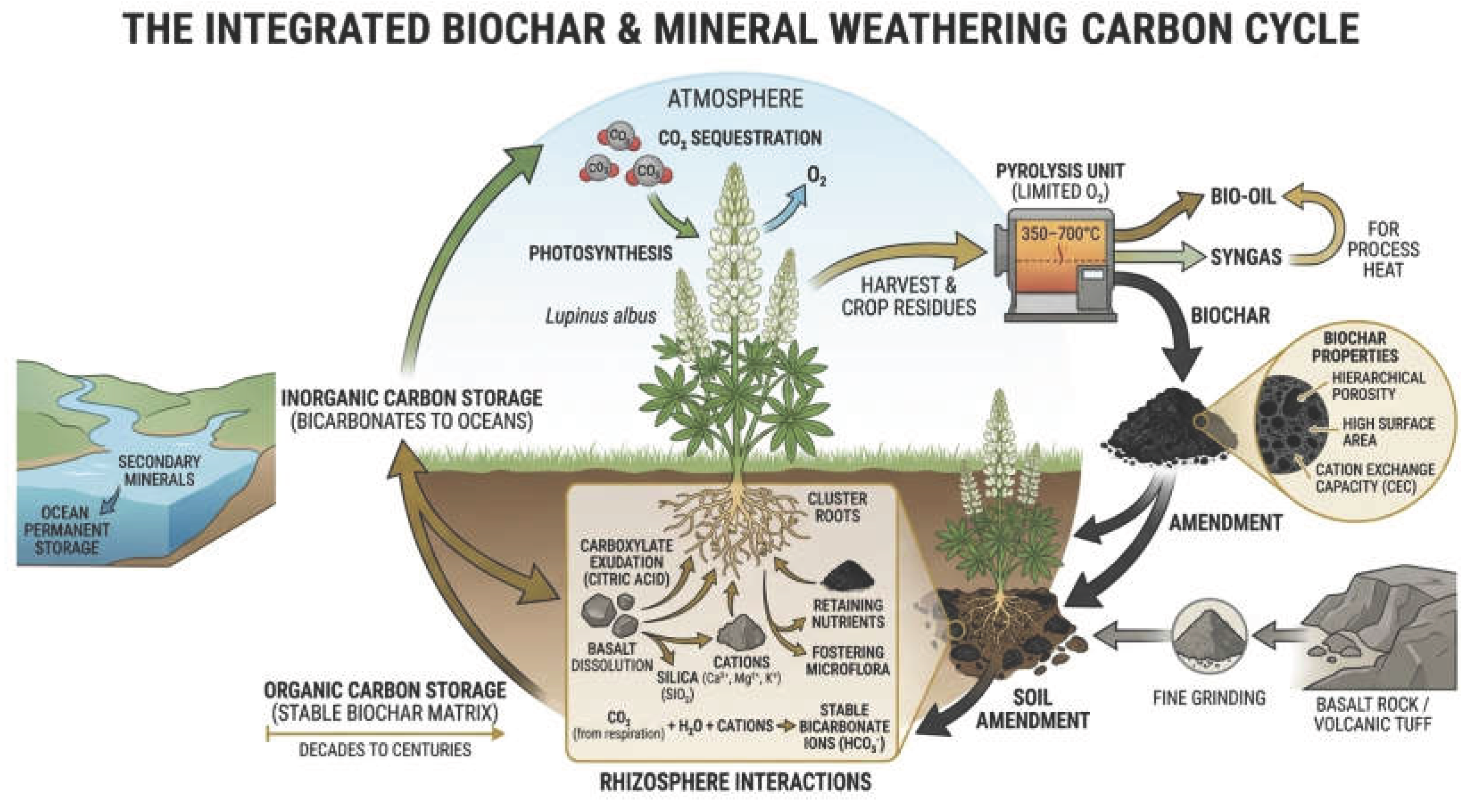
Figure 2.
Schematic representation of the biochar carbon sequestration cycle and molecular stability mechanisms. Left: The carbon-negative sequestration pathway initiated by photosynthetic carbon dioxide fixation, followed by thermochemical conversion of plant residues via oxygen-limited pyrolysis into syngas, bio-oil, and recalcitrant biochar applied as a soil amendment. Right: Chemical basis of biochar recalcitrance, highlighting the condensed aromatic ring structure composed of fused benzene-like rings with delocalized π-electrons that resist enzymatic catabolism. Peripheral degradation mechanisms acting over decades to centuries include abiotic oxidation (surface UV photo-oxidation and atmospheric weathering and biotic breakdown by specialized fungal lineages (e.g., white-rot fungi producing extracellular lignin-degrading enzymes), leaving the core condensed carbon matrix intact as a durable long-term carbon sink (the image is a Gemini AI courtesy).
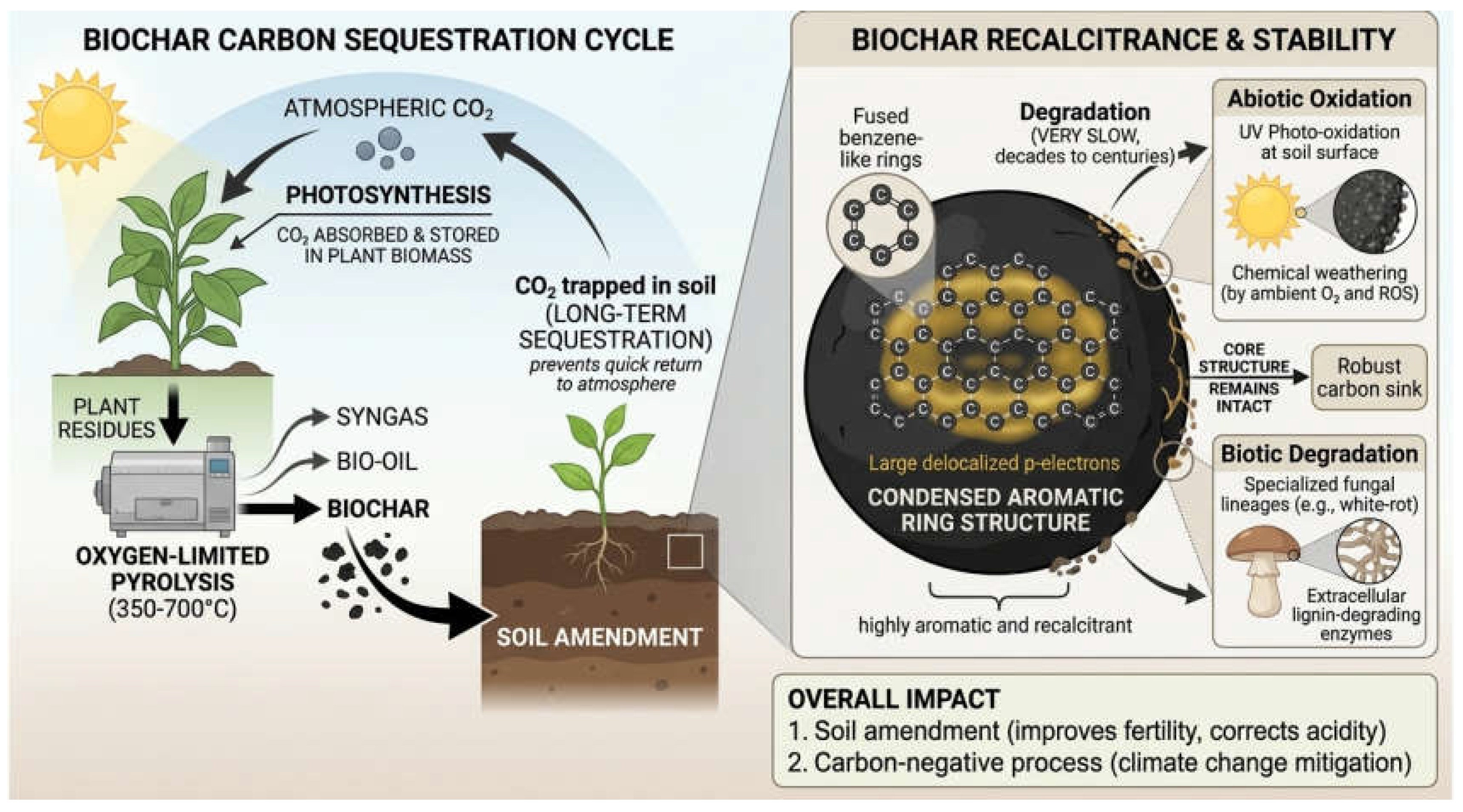
Table 1.
Summary of Biochar Applications Based on Textual Evidence.
| Application Category | Primary Function & Mechanism | Key Merits / Attributes | References |
|---|---|---|---|
| Agricultural Soil Amendment | Soil improvement and amendment | Enhances agricultural soil properties | Brassard et al. (2019); Ok et al. (2015) |
| Construction & Building Materials | Structural filler in cement, asphalt, and building composites | Humidity regulation, thermal insulation, noise reduction, and overall material improvement | Zhang et al. (2022); Danish et al. (2021); Maljaee et al. (2021); Tan et al. (2021); Suarez-Riera et al. (2022); Sivanathan et al. (2020) |
| Polymeric Composites | Reinforcing filler in polymeric matrices | Sustainable integration and compatibility as a composite filler | Bartoli et al. (2020, 2022); Ziegler et al. (2017); Lepak-Kuc et al. (2021) |
| Gas Adsorption & CO₂ Capture | Adsorption of pollutant gases and atmospheric carbon dioxide | High specific surface area and strong adsorption capacity via porous network | Chen et al. (2017); Schmidt (2014); Legan et al. (2022); Pandey et al. (2022); Jiang et al. (2023) |
| Thermal Energy Storage (PCM Encapsulation) | Shape-stabilization of Phase-Change Materials (PCMs) | Mesopore encapsulation prevents fluid-phase leakage during thermal management | Du et al. (2018); Liang et al. (2022); Sparavigna (2022) |
| Water Pollution Treatment | Filtration medium | Removal of pollutants from water | He et al. (2022) |
| Energy Storage Systems | Conductive medium for supercapacitors | Electrical energy storage capabilities | Cheng et al. (2017) |
| Activated Carbon Precursor | Multi-application activated carbon material | Cost-effective and environmentally friendly alternative derived via physical/chemical activation | Tan et al. (2017) |
Table 1: Summary of diverse biochar applications beyond traditional agricultural soil amendment, encompassing construction materials, polymeric composites, gas adsorption, phase-change material (PCM) encapsulation, water treatment, and energy storage.
Table 2.
Summary of Biochar Yields from Leguminous and Specialty Herbaceous Residues.
| Feedstock / Crop | Pyrolysis Mode / Temperature Conditions | Biochar Yield (wt% or %) | Reference |
|---|---|---|---|
| Soybean residue (processing meal/okara) | Slow pyrolysis (350 °C) Slow pyrolysis (500 °C) Slow pyrolysis (650 °C) |
53.2% 40.3% 37.0% |
Sun et al. (2021) |
| Soybean residue (processing meal/okara) | Medium pyrolysis (350 °C) Medium pyrolysis (500 °C) Medium pyrolysis (650 °C) |
48.7% 35.9% 32.9% |
Sun et al. (2021) |
| Soybean straw (field residues) | Fluidized-bed fast pyrolysis | ~22 wt% | Boateng et al. (2010) |
| Bean husk (Phaseolus vulgaris) | Top-lit updraft reactor (320 °C for 110 min) | 38.4% | Okoro et al. (2026) |
| Faba bean straw (Vicia faba) | Oxygen-limited pyrolysis | 24.1% | Yuan and Xu (2012) |
| Quinoa (stems and husks/pods) | Slow pyrolysis / Inert atmosphere (450 °C) Slow pyrolysis / Inert atmosphere (550 °C) |
~28.4 wt% ~22.4 wt% |
Heredia-Salgado et al. (2018) |
| White lupin (stems and pods/seedcases) | Slow pyrolysis / Inert atmosphere (450 °C) Slow pyrolysis / Inert atmosphere (550 °C) |
28.4 wt% 22.4 wt% |
Heredia-Salgado et al. (2018) |
Table 2. Experimental biochar mass yields (wt%) from leguminous and specialty herbaceous residues under various pyrolysis modes and temperature conditions.
Disclaimer/Publisher’s Note: The statements, opinions and data contained in all publications are solely those of the individual author(s) and contributor(s) and not of MDPI and/or the editor(s). MDPI and/or the editor(s) disclaim responsibility for any injury to people or property resulting from any ideas, methods, instructions or products referred to in the content. |
© 2026 by the authors. Licensee MDPI, Basel, Switzerland. This article is an open access article distributed under the terms and conditions of the Creative Commons Attribution (CC BY) license (http://creativecommons.org/licenses/by/4.0/).
Copyright: This open access article is published under a Creative Commons CC BY 4.0 license, which permit the free download, distribution, and reuse, provided that the author and preprint are cited in any reuse.