

Submitted:
12 November 2026
Posted:
16 November 2026
You are already at the latest version
Abstract
Incorporating photochromic materials into rewritable paper enables light-based printing, reducing both the pollution associated with papermaking and that arising from ink use. Most existing photochromic materials respond primarily to ultraviolet (UV) light, and printing systems employing UV lasers are substantially more expensive than visible-light-based inkless printing systems. In this study, a visible-light-responsive CDots-doped PMoA/ZnO/PVP composite system was developed and used to fabricate rewritable printing paper. Atomic force microscopy (AFM) and Fourier-transform infrared (FTIR) spectroscopy revealed changes in morphology and local chemical structure upon composite formation and visible-light irradiation. The hybrid films changed from colorless to blue under visible light, and the incorporation of carbon dots (CDots) enhanced their photochromic performance. Visible-light excitation induced photoreduction through the transfer of photogenerated electrons and protons, reducing Mo⁶⁺ to Mo⁵⁺ and forming heteropoly blue species. Rewritable inkless printing paper prepared from the CDots@PMoA/ZnO/PVP composite solution produced clearly legible text, and the printed patterns remained clear through repeated erasing and rewriting cycles, demonstrating good stability.
Keywords:
organic–inorganic composites
; polyoxometalates
; visible-light response
; photochromism
; inkless printing paper
1. Introduction
The pulp and paper industries are a major source of environmental pollution: papermaking consumes large quantities of wood, water, and energy and generates substantial pollutant emissions. Reusing paper could markedly reduce this demand and thereby mitigate pollution at its source [1]. Applying photochromic materials to paper enables inkless printing with light, which reduces paper consumption while avoiding the pollution associated with inks and conventional printing processes [2,3,4]. Therefore, laser-based inkless printing combined with paper reuse is regarded as a promising route toward addressing pollution from paper products [5,6].
Most photochromic systems developed to date are switched by ultraviolet (UV) light. UV sources are expensive and hazardous to operators, and UV light is absorbed so strongly by lignin and cellulose that it degrades the paper substrate itself. A UV laser writing head is consequently far more expensive than a visible diode or LED source operating at 405–660 nm. Visible-light photochromism has therefore attracted increasing attention [7].
Heteropolyoxometalates (POMs) are important candidates for photochromic materials owing to their distinctive structures, strong oxidizing ability, and efficient electron and proton transport. In Keggin-structured phosphomolybdic acid (H3PMo12O40, PMoA), twelve MoO6 octahedra surround a central PO4 tetrahedron, and the MoVI centers are readily reduced to MoV by the uptake of electrons and protons to give the mixed-valence “heteropoly blue” [8]. The resulting intervalence charge-transfer absorption is intense and broad, so that a thin film develops a deep blue color with high contrast, and the colored state can be bleached by oxygen or mild heating, which restores the MoVI centers and closes the cycle [9]. POMs are thermally and photochemically robust and compositionally tunable, and they can be immobilized in films and fibers without loss of the Keggin geometry [10]. Pristine PMoA, however, absorbs predominantly in the UV region, and under visible light the reduction of MoVI is inefficient because photogenerated carriers recombine rapidly. Therefore, sensitization is essential. Organic matrices such as polyaniline can donate electrons and protons; polyaniline converts PMoA to heteropoly blue through a protonation-induced proton-transfer pathway, with 36% of the MoV species formed after 40 min [11], and ethyl cellulose–polyvinylpyrrolidone blends behave similarly [12].
Zinc oxide is an appealing sensitizer for PMoA because its conduction-band edge lies well above the reduction potential of the MoVI/MoV couple, so that photogenerated electrons can be injected into the cluster. Its band gap of approximately 3.2 eV, however, confines absorption to the UV, and visible activity must be introduced deliberately, either by doping and defect engineering [13] or by interfacial charge-transfer sensitization, in which a second component absorbs the visible photon and donates the electron [14]. Following the latter route, we previously prepared PMoA/ZnO/PVP ternary films by a sol–gel method, in which rod-like ZnO and spherical PMoA were dispersed in a polyvinylpyrrolidone matrix. The films turned blue under visible light through photoinduced electron transfer from ZnO to PMoA, with the Keggin structure preserved [15]. Coating a related PMoA–PWA/ZnO/PVP composite onto A4 paper yielded a printable, erasable, visible-light photochromic paper [16]. Nevertheless, the coloration rate, optical contrast, and cycling stability remain insufficient for practical writing applications, because electron–hole recombination at the ZnO interface still limits the sensitization efficiency.
Carbon dots (CDots) are quasi-spherical carbon nanoparticles, typically smaller than 10 nm, that consist of an sp2-conjugated core and oxygen- and nitrogen-containing surface groups. They absorb strongly across the visible region, exhibit up-conversion photoluminescence, possess a tunable band structure, and are inexpensive, nontoxic, and photostable, which has made them versatile sensitizers and charge mediators [17,18]. CDots can also extend the light-harvesting range of composites, improve light utilization, and facilitate interfacial photoreduction and photooxidation [19]. Their incorporation as photosensitive components into heteropolyoxometalates may therefore provide more efficient charge-transfer pathways for visible-light photochromism.
Despite these advances, most existing systems are binary composites comprising a single heteropolyoxometalate and a single matrix. Achieving a balance among visible-light sensitivity, coloration intensity, bleaching reversibility, and stability remains challenging. A systematic understanding of multicomponent synergy, the construction of charge-transfer bridges, and the underlying visible-light photochromic processes is still lacking, which limits their practical application in inkless printing paper. To address these issues, CDots were incorporated into the PMoA/ZnO/PVP system through an organic–inorganic composite approach. Ultrasonic dispersion and drop-casting were used to construct multicomponent heteropolyacid-based, visible-light-responsive hybrid films, denoted CDots@PMoA/ZnO/PVP. Photochromic tests were performed to identify hybrid films with an optimal visible-light response and good reversibility. The photochromic behavior was investigated in relation to the energy-level structure of CDots and the charge-transfer-bridge mechanism of heteropolyacids. Finally, the CDots@PMoA/ZnO/PVP hybrid material was deposited onto ordinary A4 paper to fabricate visible-light photochromic paper, and its suitability for rewritable inkless printing was evaluated, with particular attention to the stability and reversibility of the photochromic response.
2. Experimental
2.1. Reagents and Instrumentation
Zinc acetate dihydrate, absolute ethanol, N,N-dimethylformamide (DMF), citric acid, urea, concentrated sulfuric acid, and polyvinylpyrrolidone (PVP, K90) were of analytical grade and were purchased from Sinopharm Chemical Reagent Co., Ltd. Phosphomolybdic acid (microanalytical grade) was purchased from Tianjin Fengchuan Chemical Reagent Technology Co., Ltd. All reagents were used as received without further purification.
The instruments used were an ASAP 2010M surface area and porosimetry analyzer (Micromeritics, USA), an Auto Probe CP atomic force microscope (AFM; Quantum Design, USA), a Vertex 70 Fourier-transform infrared spectrometer (FTIR; Bruker, Germany), a U-4100 UV–vis spectrophotometer (Hitachi, Japan), and an ESCALAB 250Xi X-ray photoelectron spectrometer (XPS, Thermo Scientific, USA).
2.2. Experimental Procedures
2.2.1. Preparation of the Composite Materials
Zinc acetate dihydrate (8.23 g) was dissolved in 250 mL of absolute ethanol and stirred in a water bath at 60 °C for 0.5 h. Ethanolamine (2.25 mL) was added slowly, and magnetic stirring was continued at 60 °C for a further 0.5 h until a homogeneous, transparent solution was obtained. The solution was aged for 24 h to obtain a ZnO sol–gel precursor. Separately, PMoA (3.69 g) was dissolved in 50 mL of absolute ethanol at room temperature and stirred for 30 min to obtain a transparent, pale-yellow solution. Anhydrous citric acid (0.002 mol) and urea (0.01 mol) were dissolved in 10 mL of DMF, and the mixture was transferred to an autoclave and heated at 170 °C for 4 h. After cooling to room temperature, a carbon-dot (CDots) solution was obtained. PVP (1.00 g) was added gradually to 100 mL of absolute ethanol and stirred magnetically for 30 min to yield a transparent, colorless solution.
A measured volume of the ZnO sol was added slowly to the PMoA solution under stirring to prepare 20 mL of a composite solution with a PMoA:ZnO volume ratio of 1:2, and the mixture was sonicated with stirring for 30 min. Subsequently, 1 mL of the CDots solution was added slowly under continuous stirring at room temperature to obtain a CDots-doped PMoA/ZnO solution. An aliquot (1 mL) of the CDots@PMoA/ZnO solution was then added slowly to 10 mL of the PVP solution in ethanol, and the mixture was stirred and sonicated in the dark for 1 h until a homogeneous, transparent, colorless composite solution was obtained. The beaker was sealed throughout preparation to minimize ethanol evaporation. The composite solution was drop-cast uniformly onto the desired substrates with a pipette and dried naturally in the dark to form films for subsequent measurements. A control film was prepared by the same procedure using a PMoA/ZnO solution without CDots.
2.2.2. Photochromic Measurements
The composite films were irradiated using a 75 W xenon lamp as the visible-light source (λ > 422 nm), with a source-to-sample distance of 15 cm. An absorption spectrum was recorded with a UV–vis spectrophotometer after every 1 min of irradiation, and irradiation was stopped when consecutive spectra overlapped; the total irradiation time was then recorded. All photochromic measurements were performed at room temperature.
2.2.3. Preparation and Evaluation of Rewritable Paper
Ordinary A4 paper was immersed in the CDots@PMoA/ZnO/PVP composite solution for 5 min and then dried naturally at room temperature in the dark. The resulting rewritable paper was evaluated using a laser marking system (model 355EP10-1) operated at 1 W.
3. Results and Discussion
3.1. Characterization of the Cdots@pmoa/zno/pvp Hybrid Film
Figure 1 compares AFM images of the CDots@PMoA/ZnO/PVP film before and after visible-light irradiation, with a PVP film included as a reference. Compared with the smooth PVP surface, the composite film exhibits numerous protrusions and a markedly increased roughness, which is attributed to organic–inorganic interfacial interactions arising from the incorporation of CDots@PMoA/ZnO into the PVP matrix. After visible-light irradiation, the surface roughness decreases, whereas the height variations become more pronounced. This behavior is associated with the formation of heteropoly blue species upon irradiation.
Figure 2 shows the FTIR spectra recorded over the 500–4000 cm−1 range for the CDots@PMoA/ZnO/PVP film before and after visible-light irradiation. For comparison, the spectra of pure PVP, PMoA, and ZnO are also shown. The characteristic bands at 2922, 1682, and 1286 cm−1 in the composite are assigned to the C–H, C=O, and C–N vibrations of PVP, respectively, indicating that the basic PVP structure is retained during composite formation. Four bands at 1064, 960, 867, and 784 cm−1, assigned to the P–O, Mo–Od, Mo–Ob–Mo, and Mo–Oc–Mo vibrations of the Keggin structure, respectively, shift only slightly relative to pure Keggin PMoA, which indicates preservation of the Keggin structure together with strong interfacial interactions between PMoA and the other components. Pure ZnO exhibits a characteristic Zn–O vibration at 669 cm−1. This band is also present in the composite film with a slight shift to a higher wavenumber, which indicates retention of the original ZnO structure and strong interfacial interactions between ZnO and the other components. The Mo–Ob–Mo and Mo–Oc–Mo modes of Keggin-type PMoA are sensitive to interactions between the constituent phases. After visible-light excitation, these bands shift by 5 cm−1 to a higher wavenumber and by 2 cm−1 to a lower wavenumber, respectively. These shifts indicate photoreduction of the composite, during which the heteropolyacid molecules accept photogenerated electrons and protons to form heteropoly blue species.
3.2. Photochromic Properties of the Composite Films
Figure 3 shows the UV–vis absorption spectra of the CDots@PMoA/ZnO/PVP film before and after irradiation. For comparison, the corresponding spectra of the PMoA/ZnO/PVP film are also shown. Before visible-light irradiation, neither film exhibits a distinct absorption band in the 350–1100 nm region. After irradiation, both films change from colorless to blue and develop characteristic absorption bands at 520 and 770 nm, which are assigned to an enhanced d–d transition and an intervalence charge-transfer (IVCT) transition associated with the reduction of Mo6+ to Mo5+, respectively. These results indicate that visible-light excitation induces photoreduction and the formation of heteropoly blue species in the composite films.
Figure 4a shows the evolution of the absorbance at 770 nm with visible-light irradiation time for the PMoA/ZnO/PVP and CDots@PMoA/ZnO/PVP films. In both films, the characteristic absorption band increases rapidly at first and then more slowly, reaching coloration saturation after 8 min. The maximum absorbances at saturation are 0.124 and 0.184, respectively, demonstrating that the incorporation of CDots enhances the visible-light photochromic response. This enhancement is attributed primarily to the quantum-confinement effect of CDots. They capture electrons photogenerated in ZnO, suppress electron–hole recombination, improve charge separation, and thereby allow more electrons to participate in the photoreduction of PMoA. In addition, CDots can generate electron–hole pairs upon illumination and modify the band structure of ZnO, facilitating its excitation by visible light and promoting electron transitions to the conduction band.
Figure 4b presents the coloration kinetics at 770 nm for the two hybrid films. The coloration processes follow first-order kinetics, with rate constants of 0.460 and 0.740 min−1 for PMoA/ZnO/PVP and CDots@PMoA/ZnO/PVP, respectively, confirming that the incorporation of CDots markedly accelerates coloration, in agreement with Figure 4a.
Figure 5a,b show the bleaching spectra and coloration–bleaching cycles of the CDots@PMoA/ZnO/PVP film, respectively. The saturated absorbance remains essentially unchanged after the colored film is stored in the dark at room temperature for 3 months, indicating that bleaching is closely associated with oxygen and is characteristic of oxidative bleaching. After the colored film is kept in air in the dark at room temperature for 1, 2, and 7 d, its absorbance decreases to approximately 80%, 65%, and 39% of the saturated value, respectively. The bleaching therefore proceeds rapidly at first and slows with time. Heating the colored film at 100 °C for 5 min rapidly reduces its absorbance to approximately 3% of the saturated value, indicating that heating promotes oxidation. To evaluate cycling performance, the film was irradiated with the xenon lamp until its absorbance reached saturation and then heated in an oven at 100 °C until it became colorless. Absorption spectra were recorded, and this coloration–bleaching sequence was repeated seven times. As shown in Figure 5b, the saturated absorbance remains almost unchanged over seven cycles, although the baseline absorbance increases slightly. These results demonstrate stable and reversible photochromic behavior with excellent cycling performance.
3.3. Photochromic Mechanism of the Composite Film
Visible-light irradiation induces photoreduction in the CDots@PMoA/ZnO/PVP film, changing its color from colorless to blue. The IVCT absorption band at 770 nm indicates the reduction of Mo6+ to Mo5+. To further elucidate the visible-light photochromic mechanism, the Mo3d electronic structure was examined by XPS before and after irradiation (Figure 6). Gaussian deconvolution of the Mo3d spectra resolves the Mo3d5/2 and Mo3d3/2 spin–orbit components. In addition to the characteristic Mo6+ peaks, Mo5+ peaks are detected in the unirradiated film (Figure 6a), which is attributed to excitation by the X-rays used during measurement. After visible-light irradiation, the Mo5+ contribution increases substantially, indicating photoreduction of the composite. The Mo3d5/2 and Mo3d3/2 binding energies and the Mo5+/Mo ratios before and after irradiation are listed in Table 1. Relative to the unirradiated sample, the binding energies shift to higher values after illumination, indicating a change in the local chemical environment of Mo. The Mo5+/Mo ratios were calculated from the integrated areas of the fitted components. The ratio is 0.13 before irradiation, reflecting the X-ray-induced photochromic response during measurement, and increases to 0.67 after visible-light irradiation, showing that Mo6+ undergoes photoreduction to generate a substantial Mo5+ population.
Figure 7 illustrates the electron transfer between the components of the (a) PMoA/ZnO/PVP and (b) CDots@PMoA/ZnO/PVP films. The valence-band maximum of ZnO lies substantially below that of PMoA, and the conduction-band edge of ZnO lies above that of PMoA, which favors the transfer of photogenerated electrons from ZnO to PMoA. As a commonly used photosensitizer, ZnO generates electrons under light excitation, and the lower conduction-band position of PMoA relative to ZnO facilitates the injection of these electrons into PMoA. Electron acceptance induces the photoreduction of PMoA, reducing Mo6+ to Mo5+ and forming heteropoly blue species; photochromism in the PMoA/ZnO/PVP film therefore proceeds through photogenerated electron transfer between ZnO and PMoA. The enhancement produced by CDots is attributed to two principal effects. First, CDots exhibit the distinctive optoelectronic properties of quantum-dot materials, particularly quantum confinement, and thus act as effective electron traps, capturing and retaining the electrons photogenerated in ZnO, thereby promoting electron–hole separation and allowing more electrons to participate in the photoreduction of PMoA. Second, CDots can themselves be photoexcited to generate electron–hole pairs and to induce band bending and band-gap narrowing in ZnO, which facilitates the visible-light excitation of ZnO and the promotion of electrons into its conduction band. Together, these effects account for the enhanced photochromic performance of the CDots-containing composite.
3.4. Performance of the Rewritable Paper
Figure 8 shows the performance of the rewritable inkless printing paper prepared with the visible-light-responsive CDots@PMoA/ZnO/PVP composite. The printed text appears clearly in blue (Figure 8a), and no fading is observed after the printed paper is stored in a vacuum bag for 15 d, consistent with the bleaching behavior of the composite (Figure 8b). After 3 d of natural bleaching in air in the dark, the text becomes substantially paler and less distinct, although its outlines remain recognizable (Figure 8c). Heating the printed paper in air at 100 °C for 30 min renders the outlines barely visible (Figure 8d), indicating that thermal treatment promotes bleaching, as observed for the composite film. Figure 8e shows the paper after seven repeated print–erase cycles. The paper remains intact, which indicates stable performance during repeated use.
4. Conclusions
The CDots@PMoA/ZnO/PVP hybrid film was prepared by ultrasonic-assisted mixing, and strong noncovalent interfacial interactions were identified among the components. The films change from colorless to blue under visible-light excitation, and the coloration follows first-order kinetics. The photoreduction proceeds through the transfer of photogenerated electrons and protons, whereas the bleaching is characteristic of an oxidation process. The hybrid film exhibits excellent coloration–bleaching cycling performance. Rewritable paper fabricated with this composite system shows stable and reversible visible-light photochromism during laser-based inkless printing, which demonstrates the feasibility of repeated paper use.
Acknowledgments
This work was supported by the Major Projects of the National Natural Science Foundation of China (Grant No. 52293443) and by the Science and Technology Department of Jilin Province, China (Grant No. 20240304178SF).
References
- White Paper: Environmental Issues Associated with Toner and Ink Usage; Preton Ltd.: Colchester, UK, 2010.
- Ge, J.; Goebl, J.; He, L.; Lu, Z.; Yin, Y. Rewritable photonic paper with hygroscopic salt solution as ink. Adv. Mater. 2009, 21, 4259–4264. [Google Scholar] [CrossRef]
- Sun, H.; Gao, N.; Ren, J.; Qu, X. Polyoxometalate-based rewritable paper. Chem. Mater. 2015, 27, 7573–7576. [Google Scholar] [CrossRef]
- Deng, H.; Jia, S.; Zhang, Y.; Zhang, Y.; Shao, J.; Afzal, M.W.; Liu, X.; Dang, D.; Bai, Y. Multi-stimulus responsive polyoxometalate–viologen hybrid ionic liquids for rewritable inkless printing and environmental monitoring. RSC Adv. 2025, 15, 40491–40500. [Google Scholar] [CrossRef] [PubMed]
- Jeong, W.; Khazi, M.I.; Park, D.; Jung, Y.; Kim, J. Full color light responsive diarylethene inks for reusable paper. Adv. Funct. Mater. 2016, 26, 5230–5238. [Google Scholar] [CrossRef]
- Li, D.; Wei, J.; Dong, S.; Li, H.; Xia, Y.; Jiao, X.; Wang, T.; Chen, D. Novel PVP/HTA hybrids for multifunctional rewritable paper. ACS Appl. Mater. Interfaces 2018, 10, 1701–1706. [Google Scholar] [CrossRef] [PubMed]
- Sun, Y. Preparation and Photochromic Properties of Heteropolyacid-Based Composite Films under Visible Light. Master’s Thesis, Jilin University, Changchun, China, 2016. [Google Scholar]
- Wang, Y.; Li, H.; Wu, C.; Yang, Y.; Shi, L.; Wu, L. Chiral heteropoly blues and controllable switching of achiral polyoxometalate clusters. Angew. Chem. Int. Ed. 2013, 52, 4577–4581. [Google Scholar] [CrossRef] [PubMed]
- Fan, G.; Deng, L.; Gu, Y. Preparation and capacitive properties of a free-standing phosphomolybdic acid heteropoly blue modified reduced graphite oxide composite. Sustain. Energy Fuels 2021, 5, 1892–1903. [Google Scholar] [CrossRef]
- Liang, Z.; Yao, Y.; Wang, H. Recent advancements in polyoxometalate-functionalized fiber materials: A review. Nanotechnol. Rev. 2024, 13, 20230199. [Google Scholar] [CrossRef]
- Zeng, Q.; Guo, S.; Sun, Y.; Li, Z.; Feng, W. Protonation-induced enhanced optical-light photochromic properties of an inorganic–organic phosphomolybdic acid/polyaniline hybrid thin film. Nanomaterials 2020, 10, 1839. [Google Scholar] [CrossRef] [PubMed]
- Hussain, M.; Kalulu, M.; Ahmad, Z.; Ejeromedoghene, O.; Fu, G. Rapid fabrication of polyoxometalate-enhanced photo responsive films from ethyl cellulose (EC) and polyvinylpyrrolidone (PVP). Int. J. Biol. Macromol. 2024, 280, 136051. [Google Scholar] [CrossRef] [PubMed]
- Samadi, M.; Zirak, M.; Naseri, A.; Khorashadizade, E.; Moshfegh, A.Z. Recent progress on doped ZnO nanostructures for visible-light photocatalysis. Thin Solid Films 2016, 605, 2–19. [Google Scholar] [CrossRef]
- Banerjee, S.; Pillai, S.C.; Falaras, P.; O’Shea, K.E.; Byrne, J.A.; Dionysiou, D.D. New insights into the mechanism of visible light photocatalysis. J. Phys. Chem. Lett. 2014, 5, 2543–2554. [Google Scholar] [CrossRef] [PubMed]
- Song, T.; Li, J.; Deng, Q.; Gao, Y. Preparation, characterization, photochromic properties, and mechanism of PMoA/ZnO/PVP composite film. Molecules 2023, 28, 7605. [Google Scholar] [CrossRef] [PubMed]
- Zhao, W.; Zhao, H.; Feng, W.; Zhao, H. Preparation and printing performance of visible light photochromic paper based on PMoA-PWA/ZnO/PVP composite. Surfaces 2024, 7, 460–471. [Google Scholar] [CrossRef]
- Khojiev, S.; Hojiyeva, G.; Tursunkulov, O.; Chen, D.; Mohamed, H.S.H.; Kholikov, A.; Akbarov, K.; Liu, J.; Li, Y. Red emissive upconversion carbon quantum dots modifying TiO2 for enhanced photocatalytic performance. ACS Appl. Nano Mater. 2023, 6, 14669–14679. [Google Scholar] [CrossRef]
- Baragau, I.A.; Buckeridge, J.; Nguyen, K.G.; Heil, T.; Sajjad, M.T.; Thomson, S.A.J.; Rennie, A.; Morgan, D.J.; Power, N.P.; Nicolae, S.A.; et al. Outstanding visible light photocatalysis using nano-TiO2 hybrids with nitrogen-doped carbon quantum dots and/or reduced graphene oxide. J. Mater. Chem. A 2023, 11, 9791–9806. [Google Scholar] [CrossRef]
- Huang, J.; Huang, Y.; Guo, P.; Li, Y. Enhancing the photoelectrochemical performance of TiO2 photoanode by employing carbon nanoparticles as electron reservoirs and photothermal materials. Front. Chem. 2024, 12, 1471340. [Google Scholar] [CrossRef] [PubMed]
Figure 1.
AFM images of (a) a PVP film and a CDots@PMoA/ZnO/PVP hybrid film (b) before and (c) after visible-light irradiation.
Figure 1.
AFM images of (a) a PVP film and a CDots@PMoA/ZnO/PVP hybrid film (b) before and (c) after visible-light irradiation.
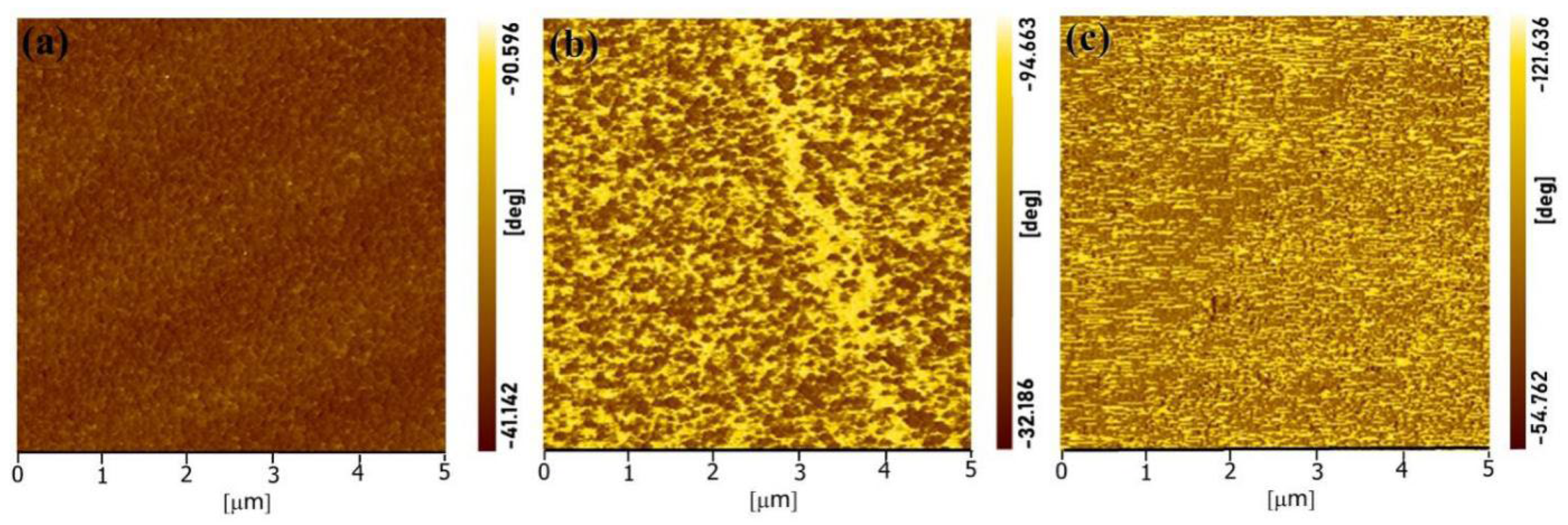
Figure 2.
FTIR spectra of (a) PMoA, (b) CDots, (c) PVP, and the CDots@PMoA/ZnO/PVP hybrid film (d) before and (e) after visible-light irradiation.
Figure 2.
FTIR spectra of (a) PMoA, (b) CDots, (c) PVP, and the CDots@PMoA/ZnO/PVP hybrid film (d) before and (e) after visible-light irradiation.
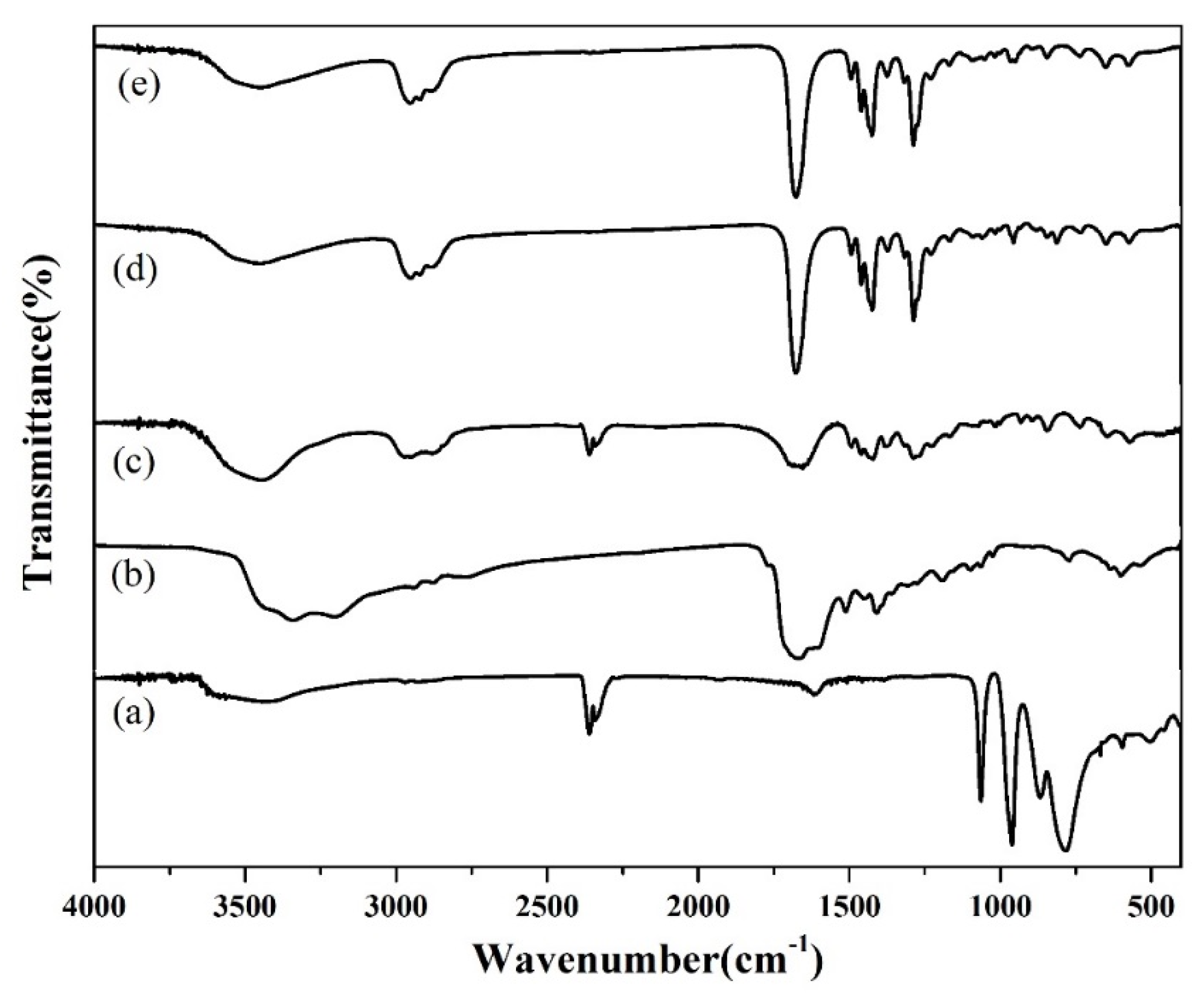
Figure 3.
UV–Vis absorption spectra recorded during coloration of (a) PMoA/ZnO/PVP and (b) CDots@PMoA/ZnO/PVP composite films.
Figure 3.
UV–Vis absorption spectra recorded during coloration of (a) PMoA/ZnO/PVP and (b) CDots@PMoA/ZnO/PVP composite films.
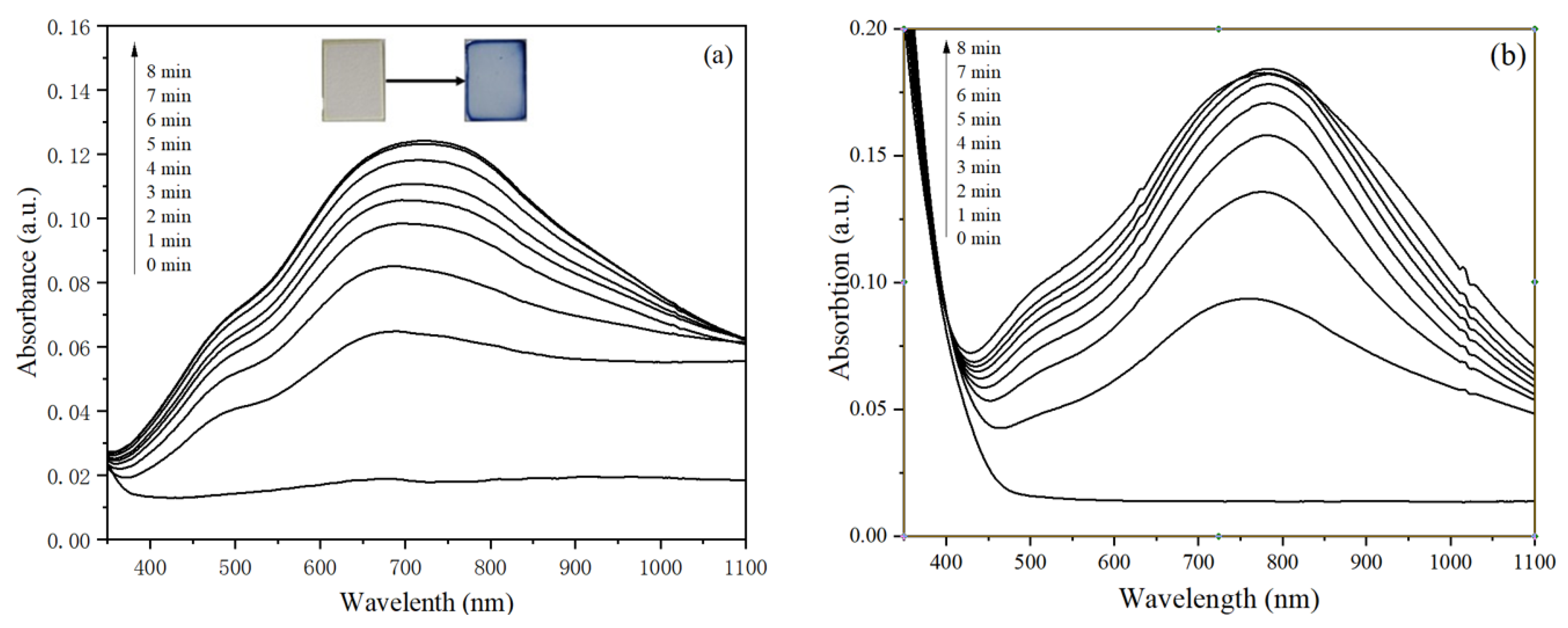
Figure 4.
(a) Absorbance at 770 nm as a function of visible-light irradiation time and (b) kinetic plots for the coloration of PMoA/ZnO/PVP and CDots@PMoA/ZnO/PVP hybrid films.
Figure 4.
(a) Absorbance at 770 nm as a function of visible-light irradiation time and (b) kinetic plots for the coloration of PMoA/ZnO/PVP and CDots@PMoA/ZnO/PVP hybrid films.
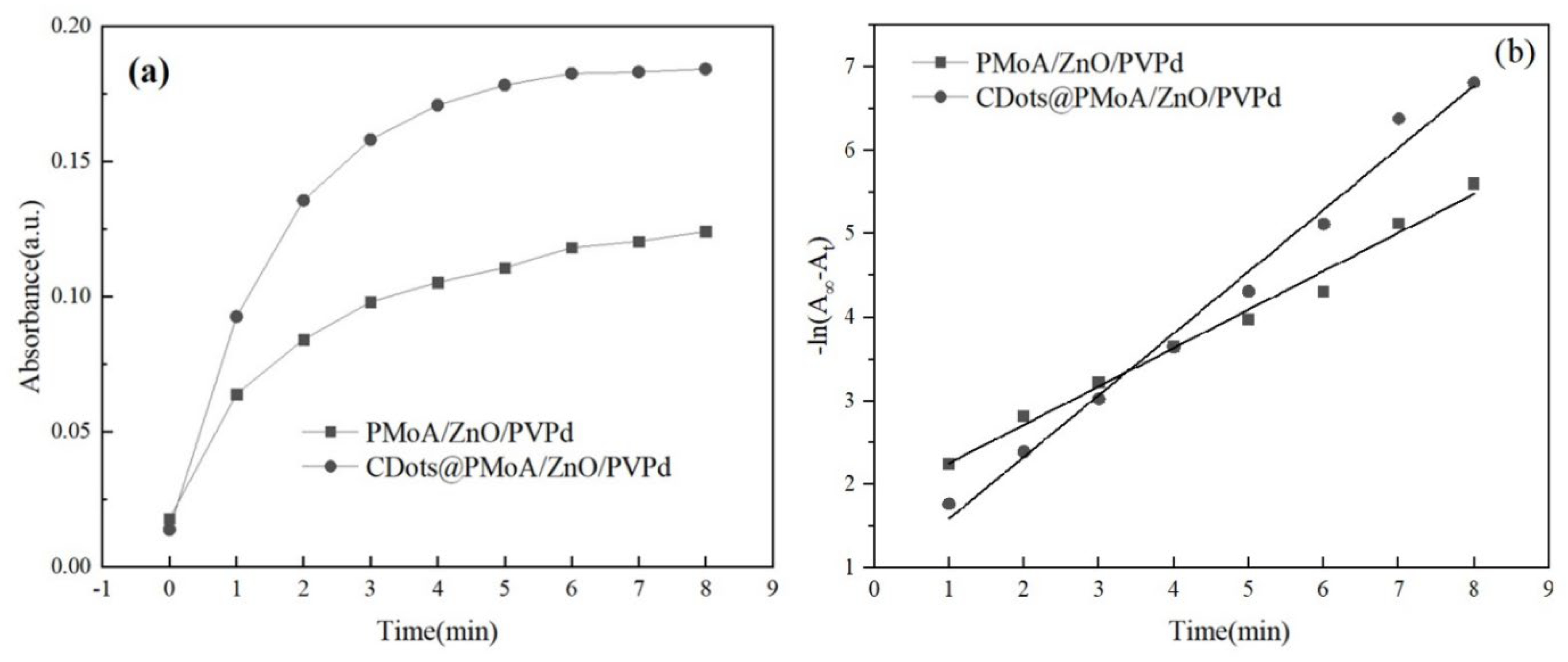
Figure 5.
(a) Bleaching of the colored CDots@PMoA/ZnO/PVP film: curve (a) the initial state before irradiation, (b) after 8 min of visible-light irradiation, (c) after storage under vacuum for 3 months, (d) after 1 d in air, (e) after 2 d in air, (f) after 7 d in air and (g) after heating at 100 °C for 5 min. (b) Coloration–bleaching cycles of the CDots@PMoA/ZnO/PVP hybrid film.
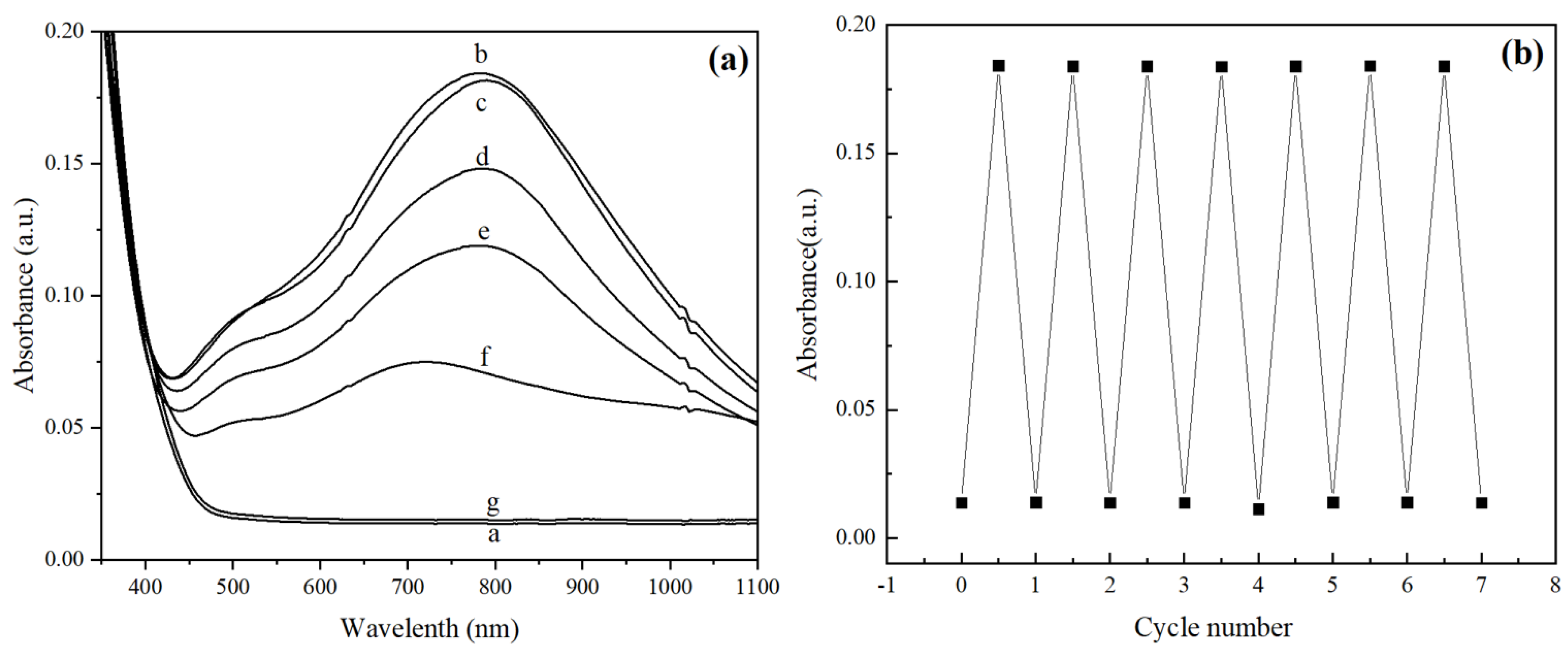
Figure 6.
Mo3d XPS spectra of the CDots@PMoA/ZnO/PVP film (a) before and (b) after visible-light irradiation.
Figure 6.
Mo3d XPS spectra of the CDots@PMoA/ZnO/PVP film (a) before and (b) after visible-light irradiation.
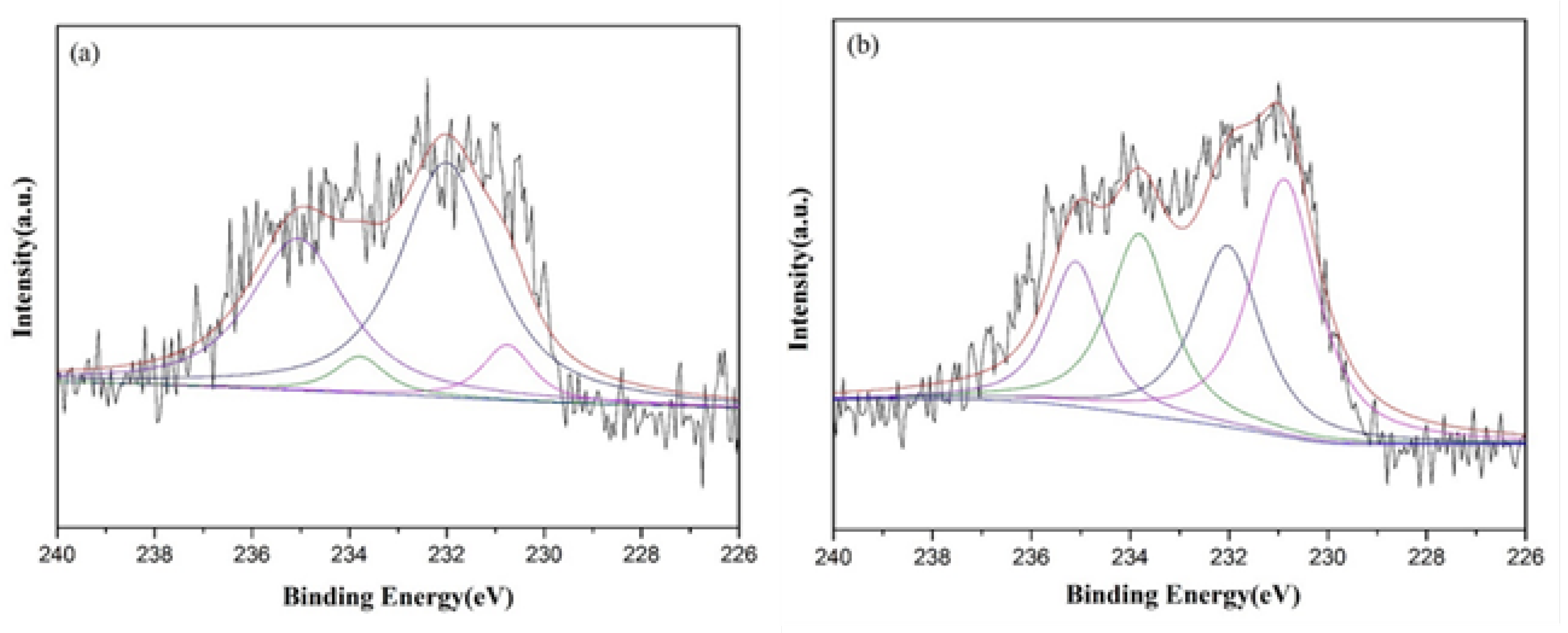
Figure 7.
Schematic illustration of electron transfer between the components of (a) PMoA/ZnO/PVP and (b) CDots@PMoA/ZnO/PVP films.
Figure 7.
Schematic illustration of electron transfer between the components of (a) PMoA/ZnO/PVP and (b) CDots@PMoA/ZnO/PVP films.
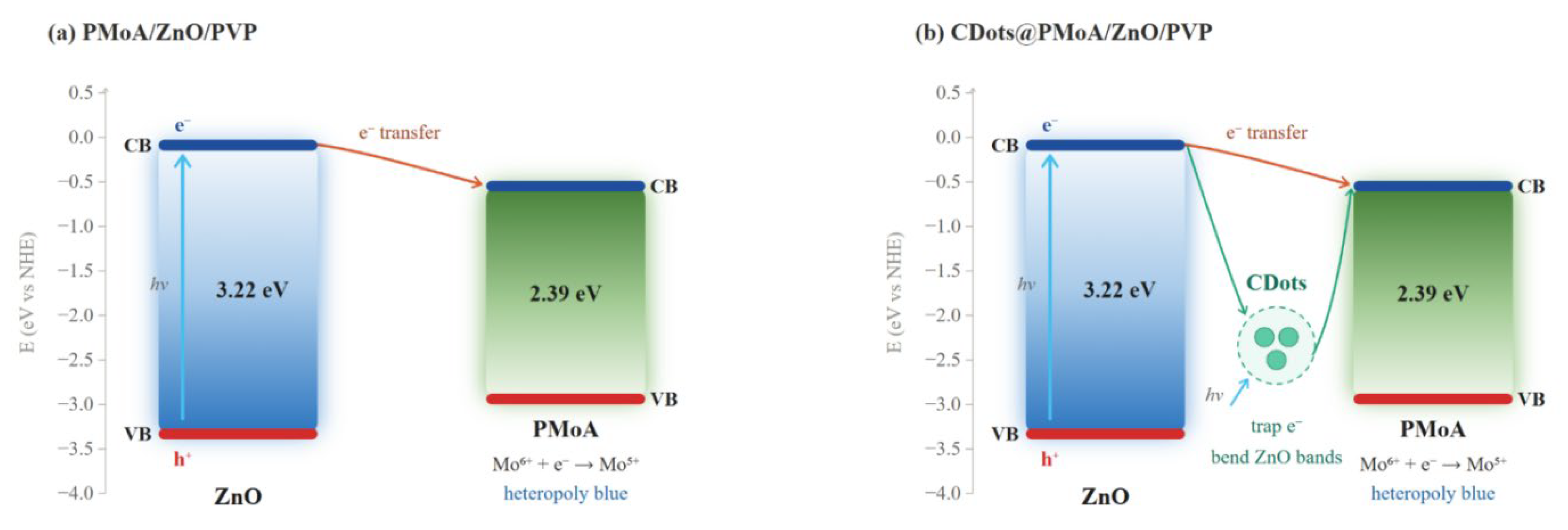
Figure 8.
Photographs of the photochromic paper (a) immediately after printing, (b) after storage under vacuum for 15 d following printing, (c) after natural bleaching in air for 3 d, (d) after heating at 100 °C for 30 min following printing and (e) after seven reuse cycles.
Figure 8.
Photographs of the photochromic paper (a) immediately after printing, (b) after storage under vacuum for 15 d following printing, (c) after natural bleaching in air for 3 d, (d) after heating at 100 °C for 30 min following printing and (e) after seven reuse cycles.
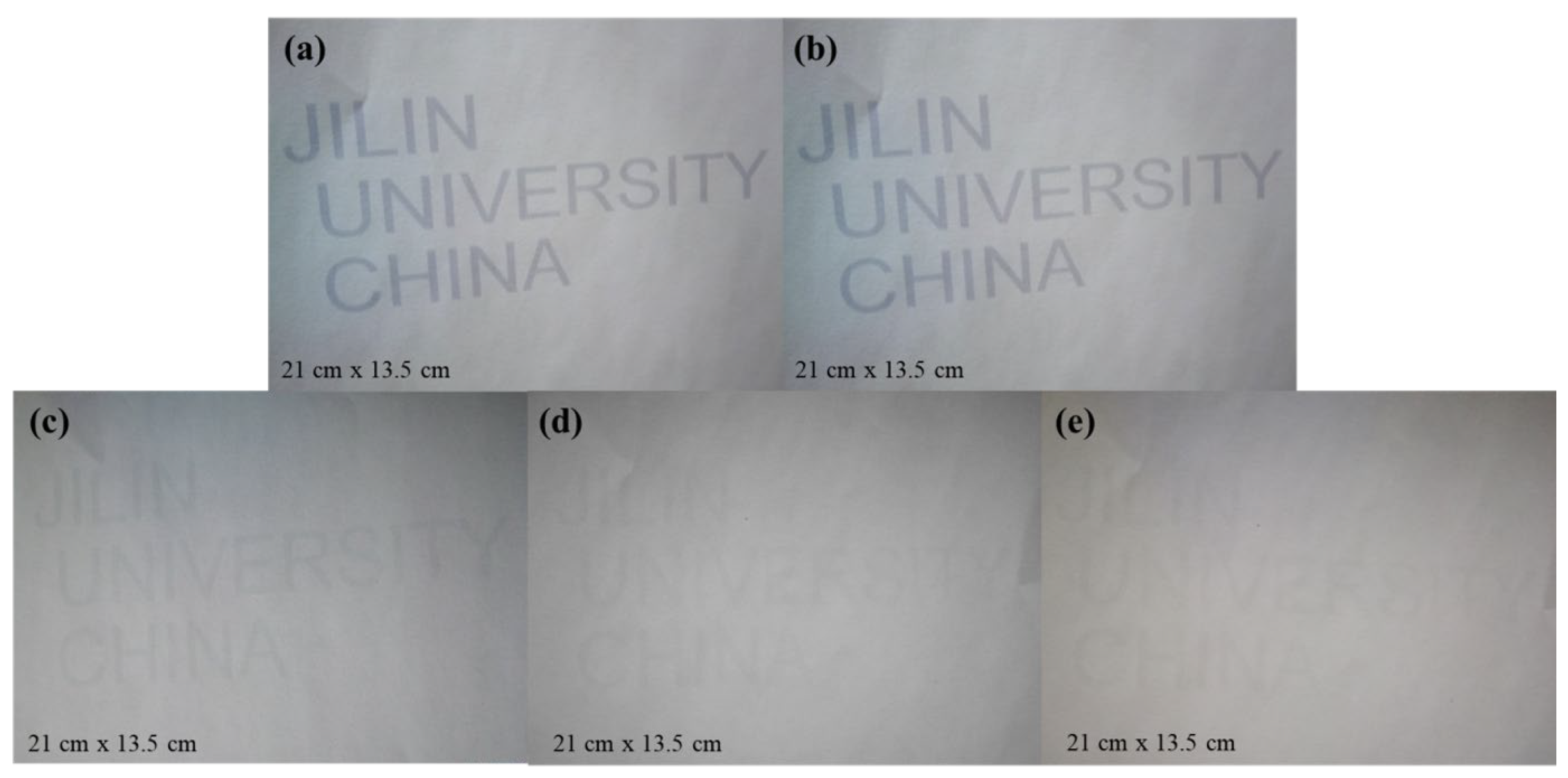

Table 1.
Mo3d binding energies and Mo5+/Mo ratios in the CDots@PMoA/ZnO/PVP film before and after visible-light irradiation.
Table 1.
Mo3d binding energies and Mo5+/Mo ratios in the CDots@PMoA/ZnO/PVP film before and after visible-light irradiation.
| Condition | Mo5+ (eV) | Mo6+ (eV) | Mo5+/ Mo | ||
|---|---|---|---|---|---|
| 3d5/2 | 3d3/2 | 3d5/2 | 3d3/2 | Ratios | |
| Before irradiation | 230.75 | 233.78 | 232.01 | 235.05 | 0.13 |
| After irradiation | 230.89 | 233.90 | 232.01 | 235.09 | 0.67 |
Disclaimer/Publisher’s Note: The statements, opinions and data contained in all publications are solely those of the individual author(s) and contributor(s) and not of MDPI and/or the editor(s). MDPI and/or the editor(s) disclaim responsibility for any injury to people or property resulting from any ideas, methods, instructions or products referred to in the content. |
© 2026 by the authors. Licensee MDPI, Basel, Switzerland. This article is an open access article distributed under the terms and conditions of the Creative Commons Attribution (CC BY) license (http://creativecommons.org/licenses/by/4.0/).
Copyright: This open access article is published under a Creative Commons CC BY 4.0 license, which permit the free download, distribution, and reuse, provided that the author and preprint are cited in any reuse.