
Submitted:
13 November 2026
Posted:
13 November 2026
You are already at the latest version
Abstract
Background: Glucagon-like peptide-1 receptor (GLP1R) agonists are widely used for the treatment of diabetes and obesity and have demonstrated anti-inflammatory and immunomodulatory properties. However, the causal relationship between GLP1R agonists and inflammatory skin diseases is still unclear. Objectives: To investigate the causal relationship between genetically proxied GLP1R agonist exposure and the risk of inflammatory skin diseases, specifically psoriasis and atopic dermatitis (AD), in individuals of European ancestry using a drug-target Mendelian randomization approach. Methods: The available cis-eQTLs for drug target gene (GLP1R) were used as proxies for exposure to GLP1R agonists. Obesity and type 2 diabetes mellitus (T2DM) were used as positive controls to ensure the validity of the genetic instruments. Mendelian randomization (MR) was performed to assess the causal association of genetically proxied GLP1R agonist exposure with 2 inflammatory skin diseases, psoriasis and AD, from the IEU OpenGWAS database. The IVW estimates were meta-analyzed and further validated using independent GWAS summary statistics from the FinnGen Consortium (R12). Results: A total of 22 significant cis-eQTL single-nucleotide polymorphisms were included as genetic instruments. Positive control analysis revealed that GLP1R agonists were significantly associated with obesity (OR = 0.85, 95% CI: 0.77–0.94, p < 0.01) and T2DM (OR = 0.56, 95% CI: 0.51–0.62, p < 0.01), which is consistent with the meta-analysis. MR analysis indicated that genetically predicted GLP1R agonist exposure was a risk factor for both psoriasis (OR = 1.85, 95% CI: 1.56–2.20, p < 0.01) and AD (OR = 1.39, 95% CI: 1.26–1.54, p < 0.01). Validation using data from the FinnGen Consortium yielded results consistent with the meta-analysis findings. Conclusions: Our study suggests that GLP1R agonists may increase the risk of psoriasis and AD. These findings provide genetic evidence to inform pharmacovigilance strategies for the clinical use of GLP1R agonists and offer novel insights for the development of targeted therapeutic interventions in inflammatory dermatoses.
Keywords:
inflammatory skin disease
; drug target
; GLP1R agonists
; Mendelian randomization
; psoriasis
; atopic dermatitis
1. Introduction
The glucagon-like peptide-1 receptor (GLP1R) is a key member of the G protein-coupled receptor family and is primarily expressed on the surface of various cell types in the human body. Through specific binding to its endogenous ligand, glucagon-like peptide-1, GLP1R plays a crucial role in the regulation of blood glucose homeostasis and lipid metabolism, while also exerting anti-inflammatory and antioxidative effects [1,2]. Commercially available GLP1R agonists, including liraglutide, exenatide, and semaglutide, are increasingly used for the treatment of diabetes mellitus and weight management. Emerging evidence suggests that, beyond their metabolic benefits, GLP1R agonists may also exert anti-inflammatory and immunomodulatory effects [3,4]. Limited prior studies have indicated the beneficial role of GLP1R agonists in the management of inflammatory skin conditions. Lin et al. reported that the GLP1R agonist liraglutide can improve the skin lesions of psoriasis patients with type 2 diabetes mellitus (T2DM) effectively, especially for extremely severe psoriasis patients [5,6]. However, existing evidence is limited by relatively small sample sizes and a focus predominantly on populations with diabetes, and no direct causal relationship between GLP1R agonists and psoriasis has been conclusively established. Therefore, further investigation into this association is both warranted and necessary.
Chronic inflammatory skin diseases comprise a heterogeneous group of disorders characterized by dysregulated cutaneous immune responses and chronic inflammation [7]. Among them, psoriasis represents a prototypical type 1 inflammatory skin disease, driven predominantly by Th1/Th17-mediated immune responses, whereas atopic dermatitis (AD) is a representative type 2 inflammatory skin disease, characterized by Th2-dominant immune activation and barrier dysfunction [8,9]. Accumulating epidemiological and clinical evidence indicates that psoriasis and AD, two major chronic and relapsing inflammatory dermatoses, are closely associated with obesity [9,10,11,12,13,14]. Previous studies have shown that each unit increase in relative fat mass was associated with a 7% higher risk of psoriasis (95% CI: 1.03–1.12) [10], and each unit increase in body roundness index was associated with a 9% higher odds of psoriasis (95% CI: 1.04–1.13) [14]. Moreover, obesity was significantly associated with the presence of atopic diseases (OR = 3.2; 95% CI: 1.8–5.7) [15] and with greater AD severity, as reflected by higher SCORAD scores per unit increase in body mass index (adjusted β= 1.24, 95% CI: 1.05–1.46, p = 0.013) [16]. Given the central role of GLP1R signaling in metabolic regulation and immune modulation, investigating its association with psoriasis and AD may provide important insights into the potential involvement of GLP1R in inflammatory skin diseases.
Drug target Mendelian randomization analysis is a method that uses MR principles to study the relationships between drugs and target genes [17]. Genetic variants that are associated with drug target messenger RNA expression or protein levels, also referred to as expression or protein quantitative trait loci (eQTLs or pQTLs, respectively), can be used as MR instruments for drug exposure [18]. This study employed a drug target MR approach, using cis-expression quantitative trait loci (cis-eQTLs) of GLP1R as genetic instrumental variables to investigate the causal associations between genetically proxied GLP1R agonist exposure and the risk of psoriasis and AD. The findings were further replicated using data from the FinnGen consortium, thereby providing genetic evidence to inform the clinical application of GLP1R agonists and to advance research into inflammatory skin diseases.
2. Materials and Methods
2.1. Study Design
The overall investigation of this study is presented in Figure 1. Firstly, we selected genetic instruments for GLP1R and carried out a positive control analysis between GLP1R agonists and both obesity and T2DM to guarantee the reliability of the genetic instruments. Secondly, we conducted a drug target MR to investigate the causal associations between GLP1R agonists and 2 inflammatory skin diseases, psoriasis and AD, and the results were further synthesized using meta-analysis. Finally, we verified the results of the drug target MR using the FinnGen database.
2.2. Selection of Genetic Instruments
The procedure for the selection of genetic variations for GLP1R adhered to a recent study [1]. As presented in Figure 1, the available cis-eQTLs for the drug target gene (GLP1R) were used as the proxy of exposure to the GLP1R agonists. The summary-level data for cis-eQTLs including 235 single-nucleotide polymorphisms (SNPs) were obtained from eQTLGen Consortium [19] (https://www.eqtlgen.org/), the details of which are shown in Table S1.
The subsequent quality control measures were employed to select IVs. Firstly, common cis-eQTL SNPs significantly associated with GLP1R expression (p < 5.0 × 10⁻⁸) were selected as IVs. Secondly, the threshold of linkage disequilibrium was set as r2 < 0.001. Thirdly, an F-statistic > 10 was required to ensure instrument strength associated with exposure traits. After the IVs for GLP1R agonists were selected, a positive control analysis was conducted between GLP1R agonists and both obesity and T2DM to ensure the reliability of the IVs.
2.3. Data Sources
To minimize potential bias due to population diversity, this drug target MR analysis was restricted to individuals of European ancestry. We obtained GWAS datasets for obesity, T2DM, and two common inflammatory skin diseases, psoriasis and AD, from the IEU OpenGWAS (https://gwas.mricieu.ac.uk/). For each disease, two independent GWAS datasets were retrieved. Detailed information on the data sources is provided in Table S2.
2.4. Meta-Analysis and Replication
Subsequently, we performed a meta-analysis of the inverse-variance weighted (IVW) estimates derived from the two independent GWAS datasets to assess the overall associations of GLP1R agonists with psoriasis and AD. These findings were then replicated using independent outcome datasets for psoriasis and AD from the FinnGen Consortium (R12) (https://www.finngen.fi/en). Detailed information on the data sources is provided in Table S2.
2.5. Statistical Analysis
To reveal the causal effects of GLP1R agonists on two inflammatory skin diseases, we performed MR analysis utilizing the “TwoSampleMR” package (version 0.6.24). Associations between the cis-eQTLs and the outcomes were estimated as odds ratios (ORs) with 95% confidence intervals (CIs), using the random-effects IVW method. An IVW p value < 0.05 was considered evidence of an association consistent with a causal effect. Positive control analysis was conducted to validate the genetic instruments for GLP1R. Since GLP1R agonists are already approved by the FDA for controlling blood glucose and body weight, we thus verified the association of genetic instruments from eQTLs with obesity and T2DM as a positive control. Horizontal pleiotropy was assessed via the MR-Egger test. If the intercept p > 0.05, there is no horizontal pleiotropy [20]. Heterogeneity was assessed by Cochran’s Q test, and p > 0.05 was considered to indicate no heterogeneity among the IVs [21]. We performed a meta-analysis utilizing the “meta” package (version 7.0-0). OR and 95% CI were used to estimate whether the results were significant. All analysis were performed with R software (version 4.3.0).
3. Results
3.1. Selection of Genetic Instruments
A total of 22 significant cis-eQTL SNPs were selected from eQTLGen as genetic instruments for drug target gene GLP1R. Details regarding these SNPs are provided in Table S3. The F-statistic of all instrument variants was over 47, which indicates no bias caused by weak instruments in our study. A meta-analysis of the MR results from two independent GWAS datasets was performed. Positive control analysis revealed that GLP1R agonists were significantly associated with obesity (OR = 0.85, 95% CI: 0.77–0.94, p < 0.01) and T2DM (OR = 0.56, 95% CI: 0.51–0.62, p < 0.01) (Figure 2A and B), thereby further verifying the validity of the IVs in this study.
3.2. Discovery MR Analysis of GLP1R Agonists in Inflammatory Skin Disease
MR analyses were conducted in the IEU OpenGWAS database to evaluate the associations between GLP1R agonists and two inflammatory skin diseases. Furthermore, we conducted a meta-analysis of the IVW estimates from two independent GWAS datasets, and the results indicated that genetically predicted GLP1R exposure was a risk factor for both psoriasis (OR = 1.85, 95% CI: 1.56–2.20, p < 0.01) and AD (OR = 1.39, 95% CI: 1.26–1.54, p < 0.01) (Figure 3A and B). Cochran’s Q test and MR-Egger intercept test indicated no significant heterogeneity or horizontal pleiotropy in IVW-MR, as shown in Table S4.
3.3. Replication with FinnGen Study
We used inflammatory skin disease GWAS datasets derived from the FinnGen Consortium to replicate and validate the MR results obtained from the IEU OpenGWAS database. The results revealed that the causal relationships between GLP1R expression and psoriasis (OR = 1.30, 95% CI: 1.18–1.42, p < 0.01), AD (OR = 1.13, 95% CI: 1.06–1.20, p < 0.01) were consistent with the results from the IEU OpenGWAS database (Figure 4A and B). The heterogeneity and horizontal pleiotropy results are presented in Table S5.
4. Discussion
In this drug-target MR study, we used 22 independent cis-eQTLs for GLP1R as instruments for genetically proxied GLP1R agonist exposure. Higher genetically predicted GLP1R expression was associated with an increased risk of psoriasis (OR = 1.85, 95% CI: 1.56–2.20, p < 0.01) and AD (OR = 1.39, 95% CI: 1.26–1.54, p < 0.01) in a meta-analysis of two independent discovery datasets, and both the direction and the significance of these associations were reproduced in the FinnGen R12 replication. The same instruments reproduced the established protective effects of GLP1R agonism on obesity and T2DM, which supports instrument validity and argues against an error in instrument orientation.
The use of GLP1R agonist therapy for type 2 diabetes and weight loss has increased substantially [22]. Beyond their glucose-lowering effects, their anti-inflammatory potential has garnered considerable attention, suggesting that these agents may delay the progression of diabetic complications through dual mechanisms [23]. Preclinical studies indicate that GLP1R signaling activates several intracellular cascades — PI3K/Akt, MAPK/ERK, cAMP/PKA/CREB and AMPK — that may promote cytoprotection, regeneration and anti-inflammatory activity, and thereby help maintain tissue homeostasis. GLP1R signaling also modulates immune responses, for instance by suppressing NF-κB-dependent inflammation, and influences invariant natural killer T (iNKT) cell function and IL-17 signaling, suggesting a possible role in chronic inflammatory skin diseases [24]. Randomized controlled trials have shown that GLP1R agonists such as liraglutide can reduce psoriasis severity in patients with T2DM [5], whereas no therapeutic benefit was observed in normoglycaemic individuals [25]. This discrepancy is most plausibly attributable to indirect effects: in patients with metabolic dysfunction, drug-induced weight loss and metabolic improvement may secondarily attenuate cutaneous inflammation, whereas such indirect benefits are absent in euglycaemic individuals and the direct immunomodulatory actions of GLP1R signaling remain poorly characterized. Human tissue and pharmacovigilance data also indicate that GLP1R expression is increased in psoriatic plaque biopsies relative to non-lesional and healthy skin [26]; in addition, a flare of previously well-controlled plaque psoriasis has been reported after initiation of tirzepatide [27]. Although these observations appear to contradict the anti-inflammatory actions outlined above, they may indicate that GLP1R signaling acts in a context-dependent manner in metabolic and immune regulation, and that responses vary between individuals [28]. Vigilance is therefore warranted when these agents are prescribed.
At least three differences between the two bodies of evidence may reconcile these observations. First, pharmacological interventions are given mainly to individuals with obesity or T2DM, who already carry an elevated baseline inflammatory burden; the benefit observed in trials therefore probably reflects, at least in part, correction of underlying metabolic dysfunction. MR estimates, by contrast, capture the long-term consequences of intrinsic GLP1R signaling in the general population, independent of metabolic improvement. Second, short-term, high-dose pharmacological activation is not equivalent to a lifelong, genetically determined alteration in receptor expression. Third, GLP1R is expressed on immune cells infiltrating lesional skin, where it may shape the local immune microenvironment and modulate processes such as Th2 differentiation and epidermal barrier function in atopic dermatitis [26], and the IL-23/Th17 axis that drives psoriasis [29]; under metabolically normal conditions, such local immunoregulatory effects may disturb immune homeostasis and increase susceptibility to inflammatory skin disease.
The main strengths of this study are as follows. First, by leveraging large-scale genome-wide association study (GWAS) data and meta-analytic approaches, we validated the established protective effects of GLP1R agonists on obesity and T2DM, which served as positive controls. We further systematically evaluated, for the first time from a genetic perspective, their potential causal effects on two major inflammatory skin diseases. In addition, external replication using data from the FinnGen consortium strengthened the robustness of our findings. Several limitations should also be acknowledged. MR estimates reflect the effects of lifelong genetically proxied exposure and may not fully correspond to the short-term effects observed in clinical trials; however, they provide valuable genetic evidence to guide future mechanistic and clinical research. Moreover, as the study population was restricted to individuals of European ancestry, caution is warranted when generalizing these findings to other populations.
In summary, this study has implications for both clinical practice and biology. Our findings suggest that the regulatory effects of GLP1R signaling are highly context-dependent. Clinically, enhanced dermatological monitoring may be warranted in patients predisposed to inflammatory skin disease who are receiving GLP1R agonist therapy. From a drug-development perspective, these results underscore the value of target-based genetic analyses for the early identification of both potential indications and unintended adverse effects.
5. Conclusions
This study employed a drug target MR approach to investigate the associations between GLP1R signaling and inflammatory skin diseases. The findings suggest that genetically proxied GLP1R expression may be associated with an increased risk of psoriasis and AD, offering a novel perspective for research into the targeted modulation of the GLP1R signaling pathway.
Supplementary Materials
The following supporting information can be downloaded at the website of this paper posted on Preprints.org, Table S1: Information of cis-eQTL and GWAS summary data for GLP1R; Table S2: Characteristics of outcomes data in this study; Table S3: Genetic instrumental variables of GLP1R for the drug target Mendelian randomization; Table S4: Heterogeneity and horizontal pleiotropy tests (IEU OpenGWAS); Table S5: Heterogeneity and horizontal pleiotropy tests (FinnGen Consortium R12).
Author Contributions
Conceptualization, Yuanyuan Wan and Yan Li; methodology, Yuanyuan Wan and Nouman Tahir; software, Yuanyuan Wan and Ayan.Hasen; validation, Nouman Tahir and Ayan.Hasen; formal analysis, Wei Ren; investigation, Xiaoya Wu; resources, Xinyu Du; data curation, Wei Ren and Xiaoya Wu; writing—original draft preparation, Yuanyuan Wan; writing—review and editing, Yan Li; visualization, Yan Li; supervision, Yan Li; project administration, Yuanyuan Wan; funding acquisition, Yan Li. All authors have read and agreed to the published version of the manuscript.
Funding
This research was funded by National Natural Science Foundation of China, grant number 82273536.
Institutional Review Board Statement
Not applicable.
Informed Consent Statement
Not applicable.
Data Availability Statement
The data underlying this article are available in the article and in its online supplementary material.
Conflicts of Interest
The authors declare no conflicts of interest.
Abbreviations
The following abbreviations are used in this manuscript:
| GLP1R | Glucagon-like peptide-1 receptor |
| MR | Mendelian randomization |
| AD | atopic dermatitis |
| T2DM | type 2 diabetes mellitus |
| Cis-eQTLs | cis-expression quantitative trait loci |
| SNPs | single-nucleotide polymorphisms |
| IVW | inverse-variance weighted |
| OR | odds ratios |
| 95% CI | 95% confidence interval |
References
- Yang, Y.; et al. Exploring glucagon-like peptide-1 receptor agonists as potential disease-modifying agents in autoimmune diseases. J. Autoimmun. 2025, 153, 103414. [Google Scholar] [CrossRef] [PubMed]
- Zheng, Z.; et al. Glucagon-like peptide-1 receptor: mechanisms and advances in therapy. Signal Transduct. Target Ther. 2024, 9, 234. [Google Scholar] [CrossRef] [PubMed]
- Latif, W.; et al. Compare and Contrast the Glucagon-Like Peptide-1 Receptor Agonists (GLP1RAs). In StatPearls; StatPearls Publishing LLC.: Treasure Island (FL), 2025. [Google Scholar]
- Patino, W.; et al. A Review of Glucagon-like Peptide-1 in Dermatology. J. Clin. Aesthet. Dermatol. 2025, 18, 42–50. [Google Scholar] [PubMed]
- Lin, L.; et al. Glucagon-like peptide-1 receptor agonist liraglutide therapy for psoriasis patients with type 2 diabetes: a randomized-controlled trial. J. Dermatol. Treat. 2022, 33, 1428–1434. [Google Scholar] [CrossRef] [PubMed]
- Xu, X.; et al. Treatment with liraglutide, a glucagon-like peptide-1 analogue, improves effectively the skin lesions of psoriasis patients with type 2 diabetes: A prospective cohort study. Diabetes Res. Clin. Pract. 2019, 150, 167–173. [Google Scholar] [CrossRef] [PubMed]
- Yang, S.C.; et al. Anti-Inflammatory microRNAs for Treating Inflammatory Skin Diseases. Biomolecules 2022, 12. [Google Scholar] [CrossRef] [PubMed]
- Leung, D.Y.; Guttman-Yassky, E. Deciphering the complexities of atopic dermatitis: shifting paradigms in treatment approaches. J. Allergy Clin. Immunol. 2014, 134, 769–779. [Google Scholar] [CrossRef] [PubMed]
- Kanda, N.; Hoashi, T.; Saeki, H. Nutrition and Psoriasis. Int. J. Mol. Sci. 2020, 21. [Google Scholar] [CrossRef] [PubMed]
- Chen, Z.; et al. Exploring the association between relative fat mass and psoriasis risk: insights from the NHANES data. Lipids Health Dis. 2025, 24, 210. [Google Scholar] [CrossRef] [PubMed]
- Jensen, P.; Skov, L. Psoriasis and Obesity. Dermatology 2016, 232, 633–639. [Google Scholar] [PubMed]
- Guo, Z.; et al. Emerging Roles of Adipose Tissue in the Pathogenesis of Psoriasis and Atopic Dermatitis in Obesity. JID Innov. 2022, 2, 100064. [Google Scholar] [CrossRef] [PubMed]
- Wang, H.; et al. BMI matters: understanding the link between weight and severe psoriasis. Sci. Rep. 2025, 15, 11158. [Google Scholar] [CrossRef] [PubMed]
- Xie, Y.; et al. Association between body roundness index and psoriasis: a cross-sectional study. Sci. Rep. 2025, 15, 10796. [Google Scholar] [CrossRef] [PubMed]
- Luo, X.; et al. Association between obesity and atopic disorders in Chinese adults: an individually matched case-control study. BMC Public Health 2013, 13, 12. [Google Scholar] [CrossRef] [PubMed]
- Traidl, S.; et al. Obesity is linked to disease severity in moderate to severe atopic dermatitis-Data from the prospective observational TREATgermany registry. J. Eur. Acad. Dermatol. Venereol. 2025, 39, 136–144. [Google Scholar] [CrossRef] [PubMed]
- Ference, B.A. Interpreting the Clinical Implications of Drug-Target Mendelian Randomization Studies. J. Am. Coll. Cardiol. 2022, 80, 663–665. [Google Scholar] [CrossRef] [PubMed]
- Chauquet, S.; et al. Association of Antihypertensive Drug Target Genes With Psychiatric Disorders: A Mendelian Randomization Study. JAMA Psychiatry 2021, 78, 623–631. [Google Scholar] [PubMed]
- Võsa, U.; et al. Large-scale cis- and trans-eQTL analyses identify thousands of genetic loci and polygenic scores that regulate blood gene expression. Nat. Genet 2021, 53, 1300–1310. [Google Scholar] [CrossRef] [PubMed]
- Verbanck, M.; et al. Detection of widespread horizontal pleiotropy in causal relationships inferred from Mendelian randomization between complex traits and diseases. Nat. Genet 2018, 50, 693–698. [Google Scholar] [CrossRef] [PubMed]
- Bowden, J.; et al. Improving the accuracy of two-sample summary-data Mendelian randomization: moving beyond the NOME assumption. Int. J. Epidemiol. 2019, 48, 728–742. [Google Scholar] [CrossRef] [PubMed]
- Watanabe, J.H.; et al. Trends in glucagon-like peptide 1 receptor agonist use, 2014 to 2022. J. Am. Pharm. Assoc. 2024, 64, 133–138. [Google Scholar] [CrossRef] [PubMed]
- Yaribeygi, H.; et al. Anti-inflammatory potentials of incretin-based therapies used in the management of diabetes. Life Sci. 2020, 241, 117152. [Google Scholar] [CrossRef] [PubMed]
- Andrzejczak, K.; et al. GLP-1 Receptor Agonists in Chronic Inflammatory Skin Diseases: Immunometabolic Mechanisms and Translational Perspectives. Pharmaceutics 2026, 18. [Google Scholar] [CrossRef] [PubMed]
- Faurschou, A.; et al. Lack of effect of the glucagon-like peptide-1 receptor agonist liraglutide on psoriasis in glucose-tolerant patients--a randomized placebo-controlled trial. J. Eur. Acad. Dermatol. Venereol. 2015, 29, 555–559. [Google Scholar] [CrossRef] [PubMed]
- Faurschou, A.; et al. Increased expression of glucagon-like peptide-1 receptors in psoriasis plaques. Exp. Dermatol. 2013, 22, 150–152. [Google Scholar] [CrossRef] [PubMed]
- Neptune Rosa, J.M.; Oquendo, B.R.; De La Torre Lugo, E. Psoriasis flare following tirzepatide initiation in a patient with plaque psoriasis in remission: A case report. JAAD Case Rep. 2026. 71, 28–30. [Google Scholar] [CrossRef] [PubMed]
- Marani, A.; et al. Effects of GLP-1 Receptor Agonists on Psoriasis: An “Agent-Specific” Systematic Review of the Literature. J. Clin. Med. 2026, 15. [Google Scholar] [CrossRef] [PubMed]
- Nestle, F.O.; Kaplan, D.H.; Barker, J. Psoriasis. N Engl. J. Med. 2009, 361, 496–509. [Google Scholar] [PubMed]
Figure 1.
Study design overall flowchart. GLP1R, glucagon-like peptide-1 receptor; AD, atopic dermatitis; T2DM, type 2 diabetes mellitus; SNP, single-nucleotide polymorphism; IVW, inverse-variance weighted.
Figure 1.
Study design overall flowchart. GLP1R, glucagon-like peptide-1 receptor; AD, atopic dermatitis; T2DM, type 2 diabetes mellitus; SNP, single-nucleotide polymorphism; IVW, inverse-variance weighted.
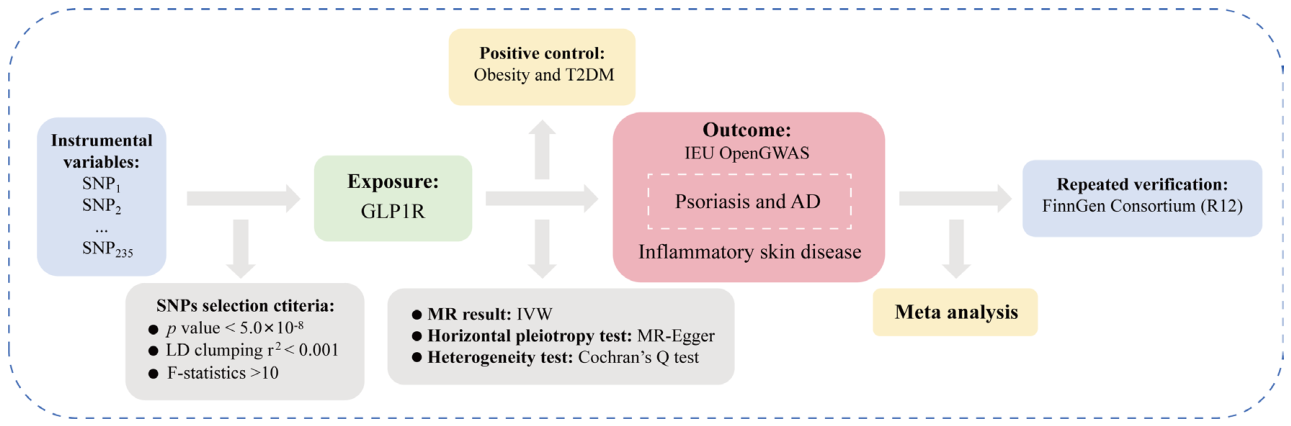
Figure 2.
GLP1R associated with obesity and T2DM in meta-analysis. (A) The forest plot of MR analysis on the risk correlation between GLP1R and obesity in IEU OpenGWAS; (B) The forest plot of MR analysis on the risk correlation between GLP1R and T2DM in IEU OpenGWAS.
Figure 2.
GLP1R associated with obesity and T2DM in meta-analysis. (A) The forest plot of MR analysis on the risk correlation between GLP1R and obesity in IEU OpenGWAS; (B) The forest plot of MR analysis on the risk correlation between GLP1R and T2DM in IEU OpenGWAS.
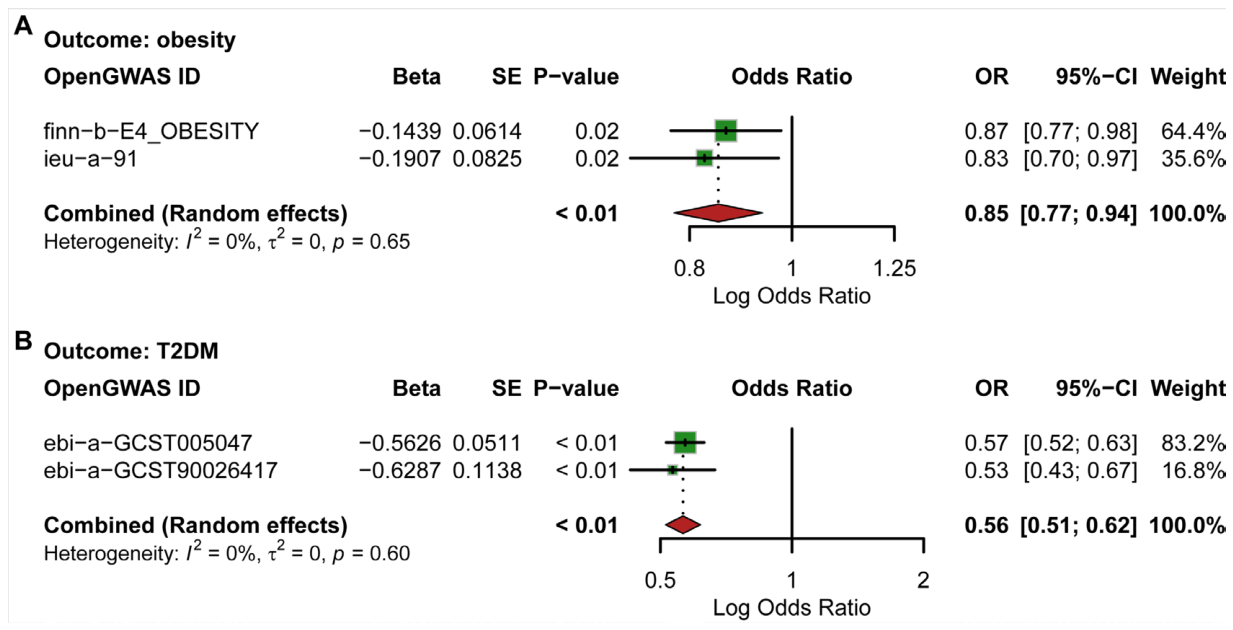
Figure 3.
GLP1R associated with psoriasis and AD in meta-analysis. (A) The forest plot of MR analysis on the risk correlation between GLP1R and psoriasis in IEU OpenGWAS; (B) The forest plot of MR analysis on the risk correlation between GLP1R and AD in IEU OpenGWAS.
Figure 3.
GLP1R associated with psoriasis and AD in meta-analysis. (A) The forest plot of MR analysis on the risk correlation between GLP1R and psoriasis in IEU OpenGWAS; (B) The forest plot of MR analysis on the risk correlation between GLP1R and AD in IEU OpenGWAS.
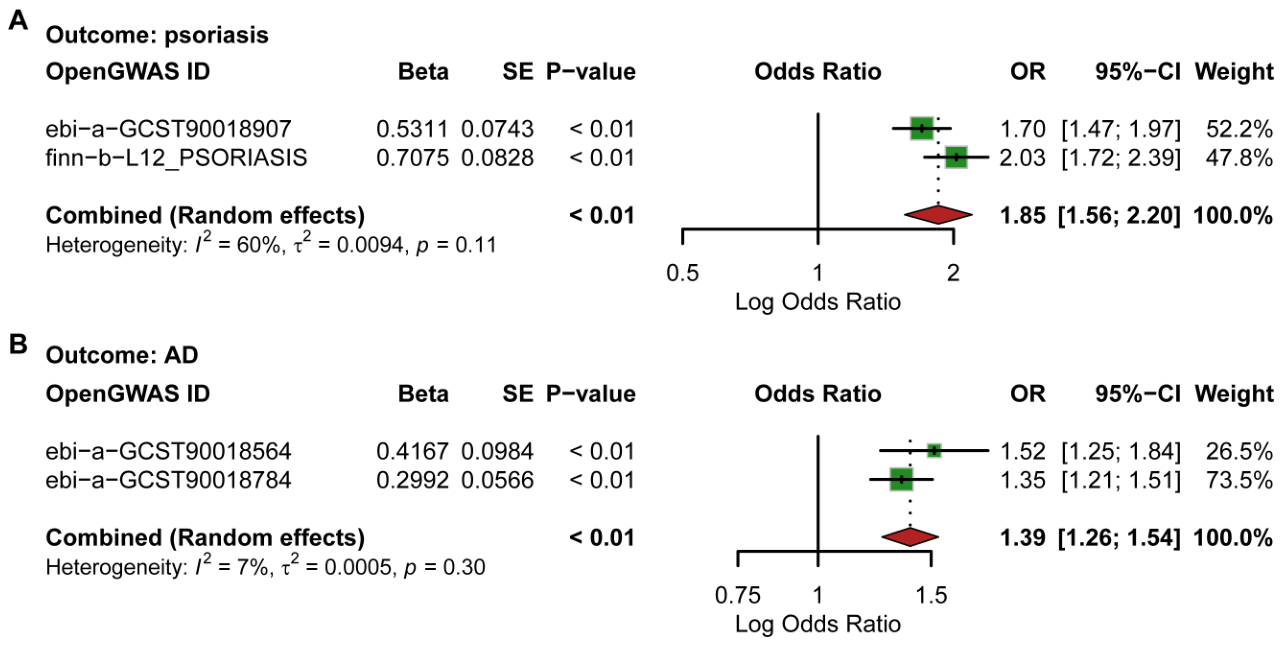
Figure 4.
Forest plot of MR analysis showing the associations of GLP1R with psoriasis and AD in the FinnGen Consortium. (A) The forest plot of MR analysis on the risk correlation between GLP1R and psoriasis in the FinnGen Consortium; (B) The forest plot of MR analysis on the risk correlation between GLP1R and AD in the FinnGen Consortium.
Figure 4.
Forest plot of MR analysis showing the associations of GLP1R with psoriasis and AD in the FinnGen Consortium. (A) The forest plot of MR analysis on the risk correlation between GLP1R and psoriasis in the FinnGen Consortium; (B) The forest plot of MR analysis on the risk correlation between GLP1R and AD in the FinnGen Consortium.

Disclaimer/Publisher’s Note: The statements, opinions and data contained in all publications are solely those of the individual author(s) and contributor(s) and not of MDPI and/or the editor(s). MDPI and/or the editor(s) disclaim responsibility for any injury to people or property resulting from any ideas, methods, instructions or products referred to in the content. |
© 2026 by the authors. Licensee MDPI, Basel, Switzerland. This article is an open access article distributed under the terms and conditions of the Creative Commons Attribution (CC BY) license (http://creativecommons.org/licenses/by/4.0/).
Copyright: This open access article is published under a Creative Commons CC BY 4.0 license, which permit the free download, distribution, and reuse, provided that the author and preprint are cited in any reuse.