

Submitted:
12 November 2026
Posted:
13 November 2026
You are already at the latest version
Abstract
Technical textile quality is expressed through laboratory indicators such as fabric strength, seam strength, colour fastness, durability, dimensional stability, and abrasion resistance, yet consumers usually judge apparel through cues that are visible, tactile, experiential, or brand-related. This study examines the Textile Quality Communication Gap: the difference between technical quality information produced by textile and apparel professionals and consumers’ ability to understand and use it. Fifty semi-structured interviews were conducted in Bangladesh and Russia with 30 apparel consumers, 10 textile professionals, and 10 marketing or brand professionals. Ethics approval was obtained and all participants gave informed verbal consent. Thematic analysis identified five themes. Consumers relied mainly on fabric feel, appearance, finishing, price, brand reputation, and previous experience; many found technical terminology difficult to interpret; and their descriptions did not always match professional language. Technical information became more useful when translated into practical benefits. Clear communication was associated with consumer confidence and perceived brand credibility, and consistency between claims and performance was emphasised. Shared patterns appeared in both countries, alongside context-specific differences: proximity to garment manufacturing in Bangladesh and post-sanction market shifts in Russia. The study offers a communication-centred account of the link between objective and perceived quality. For managers, the findings support translating technical terms into concrete benefits, avoiding vague claims, and aligning communication with actual product performance.
Keywords:
Textile Quality Communication Gap
; perceived apparel quality
; brand credibility
; quality communication
; consumer understanding
; Bangladesh
; Russia
1. Introduction
Quality is central to apparel purchasing, yet it is defined in two registers that rarely align. Marketing research separates objective quality, assessed against technical criteria, from perceived quality, the consumer’s overall judgement of a product’s excellence [1]. Within production and trade, quality is specified through measurable properties: fabric strength, seam strength, colour fastness, dimensional stability, abrasion resistance, and durability. The literature documents how professionals manage these properties through total quality management in Bangladeshi garment manufacturing [2] and through buyer specifications, sample approval, and supervision in textile export coordination [3]. Such accounts describe how quality is handled in production and trade; they do not show how the resulting information is interpreted by the people who wear the garments.
Consumers seldom receive laboratory results in an interpretable form. They meet quality information in product titles, descriptions, detail pages, and reviews, as a study of silk products on cross-border e-commerce platforms illustrates [4], and the perceived credibility of electronic word of mouth is associated with purchase intention in fashion e-commerce [5]. Information economics explains why interpretability matters. When buyers cannot observe quality, information asymmetry creates uncertainty [6], and firms use price, advertising, and branding as signals [7]. Cue utilisation theory proposes that consumers rely on the most accessible and diagnostic cues available [8], so reliance on fabric feel or brand reputation is a rational response to limited technical knowledge rather than a deficiency.
The study is organised around a sequential pathway: technical textile quality, quality communication, consumer understanding, perceived apparel quality, and brand credibility. Each link can weaken. The pathway shares structural logic with Gap 4 of the service-quality model, the communication gap between delivery and what is communicated to customers [10]. Existing work addresses parts of the pathway in separate streams: quality management and export coordination [2,3], product communication [4,5], and brand credibility [11]. These streams rarely converge on the communication of technical textile quality. The study therefore develops the Textile Quality Communication Gap, defined as the difference between technical quality information communicated by textile and apparel producers and consumers’ ability to understand, interpret, and use it when evaluating apparel. The gap lies in communication and interpretation, not in a presumed consumer deficiency. The claim to novelty is modest and limited to the literature consulted.
Five research questions guide the study:
- RQ1: How do consumers in Bangladesh and Russia evaluate apparel product quality?
- RQ2: How well do consumers understand technical textile quality information?
- RQ3: What communication gaps exist between technical textile quality standards and consumer perceptions?
- RQ4: How does the communication of textile quality relate to perceived apparel quality and brand credibility?
- RQ5: What similarities and differences exist between Bangladesh and Russia?
The study contributes conceptually (a communication-centred lens combining Gap 4, cue utilisation theory, and means-end reasoning), empirically (comparative evidence from 50 interviews in two contrasting markets), and practically (communication principles for apparel brands and manufacturers). Figure 1 summarises the research problem.
2. Literature Review and Conceptual Framework
Objective textile quality refers to characteristics measured against defined technical standards through laboratory testing. This study focuses on six indicators that recur across industrial quality control contexts and carry direct consumer-relevant consequences. Table 1 pairs each indicator with a consumer-relevant meaning to make the communication problem explicit.
Objective quality describes what a product does under specified test conditions, whereas perceived quality describes the judgement a consumer forms about it [1]. Measurement is therefore necessary evidence but not a complete explanation of consumer judgement. Translation between customer language and technical language is a recognised professional activity: quality function deployment teams convert customer requirements into technical characteristics [12], and quality management and export coordination rely on specifications, sample approval, and supervision [2,3]. These practices are documented in relation to production and orders, not consumer comprehension. Figure 2 shows quality communication as the bridge between the two registers.
Consumers form quality judgements from intrinsic cues (fabric, construction, finishing) and extrinsic cues (price, brand, reputation), revising them through use and care [1]. Perceived quality has been defined as a judgement of overall superiority relative to alternatives, positioned alongside relative price, information costs, and perceived risk [11]. Quality is described as important to apparel consumers yet difficult to define [13], and a review of wine markets treats price and reputation as imperfect indicators of quality rather than direct measures [14]. In textiles and apparel, perceived quality mediates the link between corporate social responsibility and purchase intention [15], and consumer comments on organic apparel brands combine remarks on fabric quality with complaints about colour discrepancies and sizing [16]. Cue utilisation theory [8] adds a qualification: relying on accessible cues is not a failure to evaluate quality but an allocation of attention to the most diagnostic, least costly signals. The communication gap may therefore be partly a rational response to information that is present but unusable.
Information asymmetry makes quality communication necessary: sellers know more about quality than buyers, and guarantees, certification, price, advertising, and branding may reduce the uncertainty [6,7]. Signals work only if receivers can read them. The gap between what a claim states and what a recipient infers has been examined most clearly outside textiles. In pharmaceutical communication, identical wording may rest on different evidence, and a verifiable signal may still produce a broader belief than the sender asserted [17]. Traceability and storytelling have been proposed to support geographical-indication claims for specialty coffee [18]; halal certification is described as an external quality signal that may reduce asymmetry and strengthen trust [19]; an online authentication platform uses inspection, certificates, and tags as institutional signals [20]; and electronic word of mouth has been analysed as a market signal [21]. Greenwashing research frames misleading communication as an information-asymmetry problem [22], separates consumers’ perceptions of misleading communication from firms’ objective performance [23], and links trust to consistency between claims and practice [24].
Textile and apparel communication shows similar concerns about usability. Translating textile company profiles is argued to require attention to target readers and terminology [25]; guidance for textile and clothing firms recommends clear titles and readable content because visitors may scan rather than read closely [26]; online fashion product information can include fabric details and size charts that consumers compare across media [27]; and small clothing companies communicate sustainability information to guide consumers [28]. These accounts document choices about expression, not whether the information was understood or believed. Availability should not be equated with usability. Translation is therefore the missing step: means-end reasoning links product attributes to benefits and value [1], and the pairings in Table 1 apply that logic to textiles.
Brand credibility is the believability of the product-position information a brand communicates, resting on perceived willingness and ability to deliver what was promised, including trustworthiness and expertise [29]. Park et al. treat perceived quality and relative price as brand attributes, information costs saved and lower perceived risk as benefits, and consistency, clarity, and brand investment as antecedents of credibility [11]. Another account defines credibility by whether performance matches promised features [30], and perceived quality and brand familiarity have been examined as correlates of credibility for a skincare brand [31]. Brand trust mediates some service-quality effects in online retail [32], greenwashing has been studied in relation to brand credibility [33], and in the Indian textile business-to-business setting trust is associated with consistent service and transparent communication [34]. Credibility can also attach to a message or messenger, as work on influencer credibility [35] and electronic word of mouth [36] shows, so its object must be specified. Here, brand trust is the belief that a brand will deliver, brand expertise perceived ability, brand reliability consistency over time, and claim credibility the believability of a specific statement. Reverse causality is a genuine concern, because prior trust may make claims easier to accept regardless of clarity. The relationship is therefore treated as interpretive and bidirectional, not causal.
Bangladesh and Russia are contrasting contexts. Bangladesh’s ready-made garment sector is a major economic contributor embedded in global supply chains and social-compliance requirements [37,38], which may shape quality perceptions among consumers and professionals through proximity to production. Russia has experienced changing consumer behaviour and market structures after the COVID-19 pandemic and international sanctions, including the departure of foreign fashion brands [39]. Brand credibility effects have been compared across countries with both common and differing results [11], so national context is treated as an empirical question, and comparative claims are limited to patterns supported by the interviews.
The Textile Quality Communication Gap is the difference between technical quality information generated or communicated by producers and consumers’ ability to understand, interpret, and use it, and it is consistent with Gap 4 [10] adapted to textiles. Four mechanisms guide the analysis. First, technical information may be too complex for routine consumer use, since standards and terminology are designed for specialist work [25,26]. Second, familiarity differs from expertise, and using product information requires skills beyond general experience [9]. Third, without an attribute-to-benefit link [1], indicators such as dimensional stability remain abstract. Fourth, consumers consequently rely on accessible cues such as fabric feel, appearance, price, brand reputation, and experience [1,8], which is rational when technical information is not interpretable. These mechanisms are propositions that organise interpretation, not tested hypotheses. Figure 3 presents the framework; its arrows indicate analytical progression, not causal hypotheses.
3. Methodology
A qualitative comparative design based on semi-structured interviews was used. It suited research questions about the meanings participants attach to quality, the language they use, and how they interpret technical information, which fixed-response instruments may capture incompletely. Ethical approval was granted by the institutional ethics committee of the lead author’s university before data collection. Participants were told the study’s purpose, that participation was voluntary, that they could withdraw without consequence, and that responses were confidential. Informed verbal consent was obtained before each interview. No personal identifiers are reported, and the material is stored securely and accessible only to the research team.
The sample comprised 50 participants, 25 per country, each contributing 15 apparel consumers, 5 textile professionals, and 5 marketing or brand professionals (30, 10, and 10 in total). Purposive sampling identified information-rich participants [40]. Consumers were adults aged 18 or older who had bought clothing for personal use in the previous 12 months. Textile professionals worked in manufacturing, fabric inspection, quality control, or product development, and marketing or brand professionals in brand communication, retail or product marketing, or merchandising in apparel, each with at least two years of experience. Recruitment used personal and professional networks, snowball referrals, and direct approaches at professional associations and retail sites. Table 2 presents the sample distribution and demographics.
In-person interviews were conducted in Dhaka and Moscow and lasted 35 to 65 minutes. The guide covered definitions of apparel quality, cues used to evaluate quality, understanding of technical quality information, use of labels and claims, and perceived links between communication and brand credibility. Bangladeshi interviews were held in Bengali and Russian interviews in Russian. All were audio-recorded with consent and transcribed verbatim in the original language. The researcher, who is proficient in both languages, translated Bengali transcripts. Russian transcripts were translated with a qualified bilingual translator with a social-research background, and 20% were back-translated by a second bilingual reviewer, with discrepancies resolved through discussion. Original technical terms were recorded beside their translations where ambiguity arose.
Analysis followed the six phases of reflexive thematic analysis [41]: familiarisation, code generation, category sorting, theme development and review, cross-country comparison, and interpretation against the framework. Organising codes into themes and checking candidate themes against the dataset clarifies the analytic path [42]. Coding was manual with a consistent code key. Table 3 illustrates how codes became themes. Afterwards, the dataset was reviewed to count how many participants were associated with each pattern, by group and country. Counts are descriptive and overlapping, not population estimates or statistical inference, and Braun and Clarke [41] caution that counts should not substitute for interpretation. Figure 4 summarises the process.
Trustworthiness was supported in four ways. For credibility, a summary of the five themes was shared with eight participants (four per country, one per group), who suggested minor clarifications of emphasis and did not challenge the structure. For dependability, an audit trail recorded coding decisions, theme development, and revisions. For confirmability, a reflexivity statement recorded the lead author’s prior assumptions that quality communication matters and that consumers are under-served by technical terminology, which were revisited during analysis. Transferability is not claimed beyond the sample. The study follows the COREQ checklist [43].
4. Findings
The 50 interviews produced five themes: consumer evaluation of apparel quality, limited understanding of technical information, the Textile Quality Communication Gap, consumer-friendly quality communication, and the relation between communication and brand credibility. Statements are given in English translation, with descriptive counts from Table 7 in the text.
The first theme concerns how consumers evaluate quality. Participants in both countries relied on accessible, experiential cues: fabric feel, appearance, finishing, price, brand reputation, and previous experience. Laboratory indicators such as seam strength or colour fastness were rarely used. The pattern was associated with 43 of 50 participants (86%), including 29 of 30 consumers (97%); professionals described consumer reliance on these cues from the other side of the communication interface.
“When I pick up a piece of clothing, I first feel the fabric. If it feels smooth and not too thin, I think it is good quality. I look at the stitching too; if it is neat, I assume it will last. I do not really look at labels.” (consumer, Bangladesh)
“I usually check how the garment feels in my hands and look at the seams. If I know the brand, that tells me a lot already. I would not know what to do with numbers or test results on a label.” (consumer, Russia)
The second theme concerns limited understanding of technical information, which applies mainly to consumers. Of 30 consumers, 28 (93%) showed limited understanding of technical terminology and standards when such terms arose. All 10 textile professionals clearly understood the indicators in Table 1; of 10 marketing and brand professionals, 7 were familiar with technical terms and 3 reported partial understanding, particularly of specific test standards. For the whole sample, 42 of 50 (84%) were associated with this theme when professionals are counted as contextual reference points who confirmed the gap from experience. Two Russian consumers showed above-average technical familiarity, one having briefly studied textile technology, which suggests that technical knowledge is specific and experiential, consistent with the distinction between familiarity and expertise [9].
“I have heard words like colour fastness, but I do not really know what it means in practice. I just wash the clothes and see what happens.” (consumer, Bangladesh)
“Consumers do not have the vocabulary we use in the lab. When I explain ‘dimensional stability’ to a customer, I have to say ‘it won’t shrink’ for it to register.” (textile professional, Russia)
The third theme, the central finding, is the Textile Quality Communication Gap between professionals’ technical language and consumers’ practical language. Professional language referred to measured properties and standards, consumer language to feel, appearance, finishing, cost, brand meaning, and previous purchases, and the two did not consistently correspond. The gap was associated with 40 of 50 participants (80%), consisting of 26 consumers experiencing it and 14 professionals (9 textile, 5 marketing) recognising it. About 10 participants (20%), mostly professionals, did not primarily associate with it, either because they worked on the production side where technical language is shared or because adapting to consumer language was routine practice. Figure 5 illustrates the gap.
“We test everything in the factory: fabric weight, seam strength, colour fastness. But by the time the product reaches the consumer, that information is gone. The label says ‘100% cotton’ and that is it.” (marketing professional, Bangladesh)
“I see numbers and codes on some labels but I do not know what they mean. I just trust the brand or I do not.” (consumer, Russia)
The fourth theme concerns consumer-friendly communication. Technical information became more meaningful when put in clear language linked to a practical benefit. Consumers reported, and professionals confirmed, that explanations of what a property means in everyday use were clearer and more useful. This theme rests on participant reports, not a stimulus-response experiment, and was associated with 39 of 50 participants (78%): 28 consumers and 11 professionals. Durability was explained as longer use, colour fastness as colour retention after washing, dimensional stability as retention of fit after care, and seam strength as lower risk of seam failure, so each technical property became an outcome consumers could recognise [1]. Translation changes the usability of the message, not the underlying measurement.
“If the label said ‘stays true to colour after 20 washes’, I would understand that immediately. ‘Colour fastness grade 4-5’ means nothing to me.” (consumer, Bangladesh)
“When we ran a campaign explaining that our fabric keeps its shape even after repeated washing, the response was much better than when we used technical spec language.” (marketing professional, Russia)
The fifth theme links communication and brand credibility. Clear, understandable communication was associated with consumer confidence and perceived credibility. The association is interpretive: clarity, confidence, and credibility co-occurred in many accounts, but causation is not established, and prior brand trust may make information easier to accept. Clear communication was linked with credibility by 38 participants (76%), and 36 (72%) emphasised consistency between claims and actual performance. About eight participants described credibility as dependent on prior trust rather than communication, so clarity is one contributor among several.
“If a brand says the colour won’t fade and it does not, I trust them more next time. If they say it and it fades in two washes, I never buy from them again.” (consumer, Russia)
“I trust brands that explain things clearly. If they tell me what the fabric can do, I feel like they are not hiding something.” (consumer, Bangladesh)
Table 4 summarises the five themes.
The five themes appeared in both countries, with context-specific differences. In Bangladesh, consumers more often related durability to cost-per-wear and economic value; some showed implicit awareness of production terminology (GSM, thread count) absent from Russian accounts, and professionals more often cited ISO and AATCC standards. In Russia, consumers more often described post-sanction market disruption as a quality reference point, with reduced access to international brands and uncertainty about domestic substitutes; professionals cited GOST and EAEU labelling requirements; and scepticism about claims was more frequent, with several participants assuming that quality claims were marketing rather than technical statements. Table 5 compares the themes across countries.
Table 7 and Figure 7 report descriptive counts for each finding by participant group.

Table 7.
Descriptive prevalence of major interview findings by group.
| Finding | Consumers (n=30) | Textile prof. (n=10) | Marketing prof. (n=10) | Total (n=50) | % |
| Relied on accessible quality cues | 29 | 7* | 7* | 43 | 86% |
| Limited understanding of technical terms† | 28 | 0 | 3 | 42 | 84% |
| Communication gap identified | 26 | 9 | 5 | 40 | 80% |
| Consumer-friendly explanations preferred | 28 | 6* | 5* | 39 | 78% |
| Clear communication linked with credibility | 26 | 5* | 7* | 38 | 76% |
| Consistency between claims and performance | 24 | 5* | 7* | 36 | 72% |
Note: * Professionals describing consumer behaviour or practice, not personal evaluators. † 93% of consumers (28 of 30); 84% when professionals are counted as contextual reference points. Counts overlap because participants could be associated with several findings.
5. Discussion
That participants in both countries judged quality through feel, appearance, finishing, price, brand, and experience is consistent with research on intrinsic and extrinsic cues [1,11,13,16]. Cue utilisation theory [8] supplies the interpretation: when technical information is uninterpretable, fabric feel and brand reputation are more diagnostic and less costly cues, so reliance on them is a rational response to the information environment, not a knowledge deficit. The same pattern in an export-oriented garment economy and a disrupted import-dependent market suggests a response to the communication interface rather than a culture-specific habit.
Research on quality management and export coordination shows how professionals handle quality through specifications and supervision [2,3], and research on product communication shows how information reaches buyers [4,27]. Evidence from other categories shows that information can be present without being interpreted as intended [17,23]. This study locates the gap in the language through which technical quality is communicated, in line with Gap 4 [10]: producers deliver technically sound products but describe them in terms consumers cannot connect to use. Closing the gap therefore requires expressing existing quality in interpretable form, through attribute-to-benefit translation, not necessarily producing higher quality.
The findings suggest an interpretive pathway from clarity to understanding, confidence, perceived quality, and brand credibility. Credibility depends on perceived ability and willingness to deliver promises [29], and understandable information gives consumers a basis for that judgement. The emphasis on consistency between claims and performance accords with accounts treating consistency and clarity as antecedents of credibility [11] and defining credibility as the match between performance and promised features [30], and with work linking verifiable signals to trust and reduced risk [18,19,20]. The design supports interpretation, not causality. The eight participants who described credibility as prior-trust-dependent illustrate the reverse-causality risk, so the pathway needs quantitative testing.
The gap had a similar structure in Bangladesh and Russia, suggesting it is not confined to one regulatory, economic, or cultural setting, consistent with cross-country evidence that brand-signal effects can be compared across markets [11]. Production proximity in Bangladesh and market disruption and scepticism in Russia indicate that context shapes how the gap is experienced. Given the qualitative, purposive sample, these differences are directional, not conclusive.
6. Contributions and Implications
Conceptually, the Textile Quality Communication Gap reframes the distinction between objective and perceived quality [1] as a communication problem sustained by four mechanisms: technical complexity, limited expertise, weak attribute-to-benefit links, and consequent reliance on accessible cues. It extends Gap 4 [10] to textile quality and uses cue utilisation theory [8] to show that such reliance is rational. The mechanisms are propositions for testing. Across disciplines, the study links textile quality measurement, consumer cue evaluation, information usability, and brand credibility. Comparatively, evidence from Bangladesh and Russia shows a similar pattern in two contrasting markets without implying national representativeness.
The implications below are not tested prescriptions.
Manufacturers can support these practices by giving brands consumer-relevant interpretations of test results alongside the technical results.
7. Limitations and Future Research
The sample of 50 suits exploring meanings but not estimating prevalence or generalising, and the two-country focus limits transferability. Professional groups are small (five per group per country), and perceptions may differ across categories such as sportswear, denim, and luxury apparel. One researcher conducted and coded all interviews, so no second coder checked the full dataset, which limits confirmability. Back-translation covered a sample of Russian transcripts, not all material, so concept equivalence is not fully controlled. All evidence is self-reported, and no actual labels, hang-tags, or claim materials were shown to participants. Social desirability may affect consumer accounts, and marketing professionals have an interest in presenting quality communication positively. Links among communication, confidence, and credibility cannot be treated as causal, and reverse causality cannot be resolved with this design.
Future research could test the pathway in Figure 3 through larger surveys and structural equation modelling; compare technical and benefit-translated formulations of the same information on actual labels; extend the qualitative work to other countries and product categories; analyse brand-level communication practice; and link laboratory measurements with consumer perceptions of the same garments.
8. Conclusions
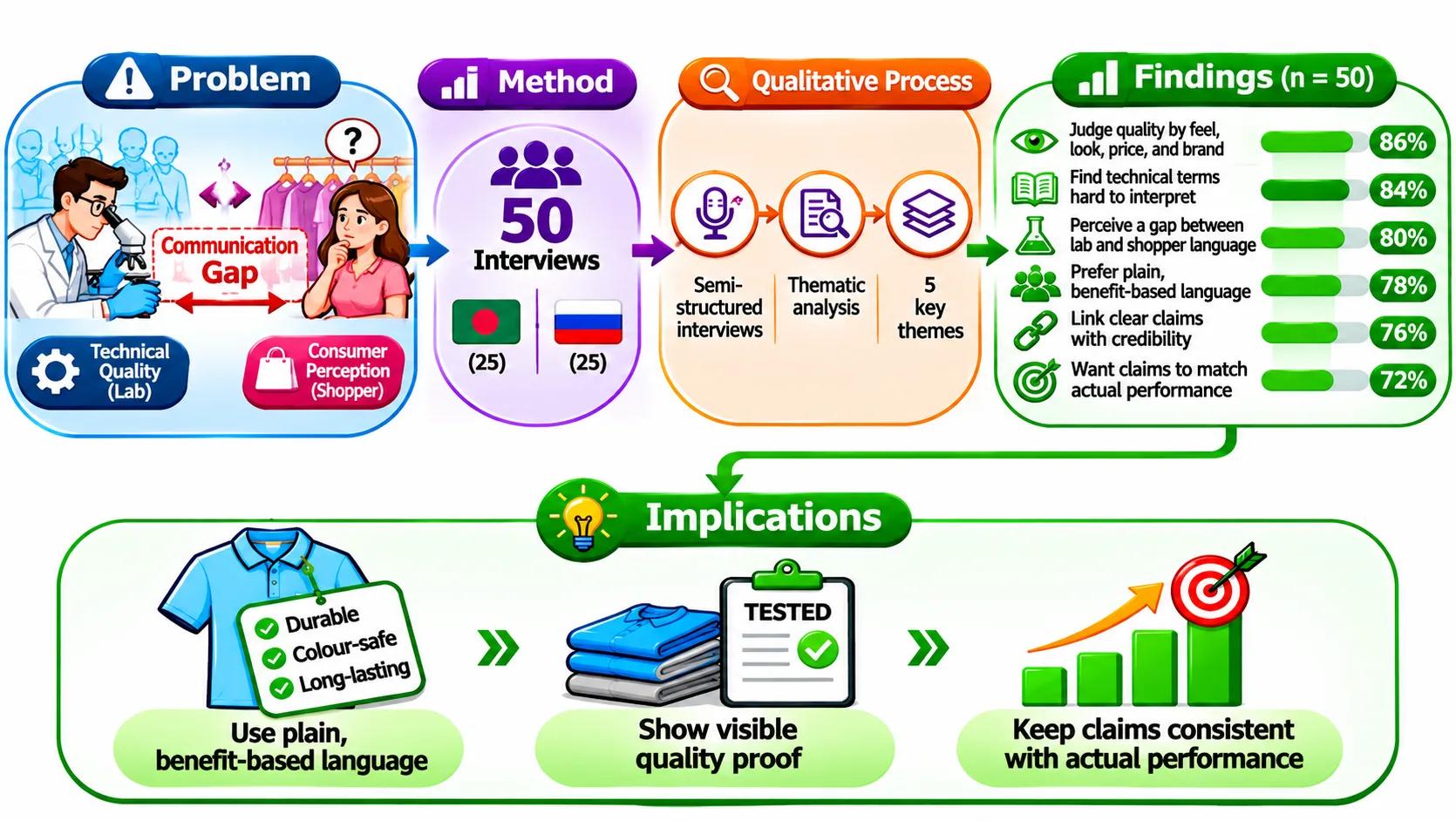
This study examined how technical textile quality information relates to consumers’ understanding and evaluation of apparel. Across 50 interviews in Bangladesh and Russia, consumers evaluated quality through accessible and experiential cues, showed limited understanding of technical terminology, and used practical language that did not consistently match professional vocabulary. The study conceptualises this disconnect as the Textile Quality Communication Gap, drawing on Gap 4, cue utilisation theory, and the distinction between objective and perceived quality.
Technical information became more meaningful when explained through practical benefits, and understandable communication was associated with consumer confidence and perceived brand credibility. The pattern was broadly similar in both countries, with differences linked to production proximity in Bangladesh and market disruption and scepticism in Russia.
The theoretical contribution is a communication-centred lens connecting objective and perceived quality through four mechanisms. In practice, brands and producers should translate technical information into consumer-relevant language, avoid vague claims, and align communication with performance. The design supports interpretation, not causal inference, so the pathway requires further testing. Technical quality creates the conditions for product value, and effective communication helps consumers recognise, understand, and evaluate it.
Funding
This research received no external funding.
Institutional Review Board Statement
Ethical approval was granted by the institutional ethics committee of the lead author’s university before data collection.
Informed Consent Statement
All participants gave informed verbal consent.
Data Availability Statement
Interview transcripts are not publicly available, to protect confidentiality. Anonymised summary data may be made available on reasonable request to the corresponding author.
Conflicts of Interest
The authors declare no conflicts of interest.
References
- Zeithaml, V. A. Consumer perceptions of price, quality, and value: A means-end model and synthesis of evidence. J. Mark. 1988, vol. 52(no. 3), 2–22. [Google Scholar] [CrossRef]
- Setu, S. M. R. R.; Hossain, Md. H.; Hossain, Md. T.; Sarkar, J. Development of a framework for more effective implementation of total quality management principles in apparel manufacturing. Eur. Sci. J. 2016, vol. 12(no. 28). [Google Scholar] [CrossRef]
- Pamela, M.; Kustyadji, G.; Wardhana, A. N.; Tutuko, B. Improving the work effectiveness of textile export agents in addressing operational barriers: A qualitative case study. RIGGS J. Artif. Intell. Digit. Bus. 2026, vol. 4(no. 4). [Google Scholar] [CrossRef]
- Chen, J. Cross-border e-commerce English communication strategies for silk products targeting the Belt and Road market: Language style, cultural adaptation, and platform optimization. Text. Leather Rev. 2026, vol. 9. [Google Scholar] [CrossRef]
- Edrees, M. E. A. The impact of electronic word of mouth on consumer purchase intention in Saudi Arabia e-commerce fashion market: Exploring trends, credibility, and social media influence. Int. Rev. Manag. Mark. 2025, vol. 15(no. 5). [Google Scholar] [CrossRef]
- Akerlof, G. A. The market for ‘lemons’: Quality uncertainty and the market mechanism. Q. J. Econ. 1970, vol. 84(no. 3), 488–500. [Google Scholar] [CrossRef]
- Kirmani; Rao, A. R. No pain, no gain: A critical review of the literature on signaling unobservable product quality. J. Mark. 2000, vol. 64(no. 2), 66–79. [Google Scholar] [CrossRef]
- Olson, J. C.; Jacoby, J. Cue utilization in the quality perception process. In Proc. 3rd Annu. Conf. Assoc. Consum. Res.; Venkatesan, M., Ed.; 1972; pp. 167–179. [Google Scholar]
- Alba, J. W.; Hutchinson, J. W. Dimensions of consumer expertise. J. Consum. Res. 1987, vol. 13(no. 4), 411–454. [Google Scholar] [CrossRef] [PubMed]
- Parasuraman; Zeithaml, V. A.; Berry, L. L. A conceptual model of service quality and its implications for future research. J. Mark. 1985, vol. 49(no. 4), 41–50. [Google Scholar] [CrossRef]
- Park, J.; Chenghui, X.; Kim, R. B. The effect of brand credibility on search and credence goods: A cross-country analysis of Korea, China & France. J. Int. Stud. 2022, vol. 15(no. 2). [Google Scholar] [CrossRef]
- Militaru, C.; Burghelea, C.; Stefan, D. L.; Zanfir, A. QFD: a modern method of products development in the textile and clothing industry. Int. J. Acad. Res. Account. Financ. Manag. Sci. 2014, vol. 4(no. 3). [Google Scholar] [CrossRef] [PubMed]
- Chalapathi, B.; Rajini, G. Millennial consumer’s stance toward sustainable fashion apparel. Salud Cienc. Tecnol. Ser. Conf. 2024, vol. 3. [Google Scholar] [CrossRef]
- Heussner, J.; Hanf, J. Wine quality as a source of information asymmetry: Signals, screens, and the role of emerging technologies. Wine Econ. Policy 2026, vol. 15(no. 1). [Google Scholar] [CrossRef]
- Cheng, Y.; Zhao, Y.; Zhao, Y. The contributions of corporate social responsibility in textile and apparel industry toward consumers’ purchase intention: Perceived quality and corporate image as mediators. Sustain. Econ. 2024, vol. 2(no. 1). [Google Scholar] [CrossRef]
- Laddha, S.; Bhosale, S.; Singh, S.; Ghosh, S. Understanding consumer sentiments of selecting organic brands of fashion apparel. Int. J. Environ. Sci. 2025, vol. 11(no. 9s). [Google Scholar] [CrossRef]
- Miller, E.; Carter, O.; Anderson, J. Evidentiary distance and the translation of surrogate-endpoint evidence into pharmaceutical marketing claims. Int. J. Pharma Growth Res. Rev. 2025, vol. 2(no. 2). [Google Scholar] [CrossRef]
- Chen, C. Cross-disciplinary analysis of digital marketing for agricultural products under the three-dimensional framework of information credibility, legal compliance, and brand value: A case study of Yunnan small-lot coffee. Glob. J. Adv. Res. Rev. 2026, vol. 4(no. 4). [Google Scholar] [CrossRef]
- F. Amri, A. Muhiban, Sumarsid, and S. P. S. D. Utari The effect of halal certification on SME competitiveness through consumer trust. Al-Amwal J. Ekon. Perbank. Syari’ah 2026, vol. 18(no. 1). [CrossRef]
- Xu, J. Institutional signals, consumer trust, and price premium: Evidence from Dewu’s C2B2C pre-authentication model. Adv. Econ. Manag. Polit. Sci. 2026, vol. 285(no. 1). [Google Scholar] [CrossRef]
- Williams, S. Electronic word-of-mouth as market signal: The economic impact on consumer satisfaction and digital market efficiency in South African e-commerce. In Proc. Int. Conf. Econ., Finance Bus.; Rome, 2025. [Google Scholar] [CrossRef]
- Simoes, R.; Correia, M.; Provera, T.; Chkoniya, V. A. Greenwashing and information asymmetry: A theoretical perspective. Eur. J. Mark. Econ. 2026, vol. 9(no. 1). [Google Scholar] [CrossRef]
- Sidhad, R. From greenwashing to green trust: A conceptual review of consumer evaluation of sustainability claims. Int. J. Multidiscip. Res. 2026, vol. 8(no. 4). [Google Scholar] [CrossRef]
- Martins, M. C. S.; Pinho, P. T.; Costa, L. M. A.; Chkoniya, V. Green marketing and market efficiency: Consumer behaviour and the risks of greenwashing. Eur. J. Mark. Econ. 2026, vol. 9(no. 2). [Google Scholar] [CrossRef]
- Yin, W. A study on Chinese-English translation of company profile from the perspective of skopos theory: A case study of Ningbo textile companies. US-China Foreign Lang. 2016, vol. 14(no. 12). [Google Scholar] [CrossRef]
- Dimitrijević, D.; Dimitrijević, N.; Adamović, Ž. Digital marketing from the perspective of the producer/seller in the SMEs of textile and clothing industry. Tekst. Ind. 2023, vol. 71(no. 3). [Google Scholar] [CrossRef]
- Siddiqui, F. A.; Zafar, H.; Naseem, A. The impact of social media marketing, content marketing and online convenience on consumer buying decision process in fashion apparel industry of Pakistan. Crit. Rev. Soc. Sci. Stud. 2025, vol. 3(no. 1). [Google Scholar] [CrossRef]
- Härri; Jarkko, L.; Lassi, L. Sufficiency-related strategies and activities of small Finnish clothing companies. Circ. Econ. Sustain. 2024, vol. 4(no. 4). [Google Scholar] [CrossRef]
- Erdem, T.; Swait, J. Brand credibility, brand consideration, and choice. J. Consum. Res. 2004, vol. 31(no. 1), 191–198. [Google Scholar] [CrossRef] [PubMed]
- Setyawan, R. Sutanto So; Honantha, C. R. Does religious orientation matter? Reassessing the role of brand credibility and customer loyalty on the controversial brand in emerging market. Proc. 17th Int. Symp. Manag. (INSYMA 2020), 2020. [Google Scholar] [CrossRef]
- Salsabila, R. Z.; Yuliana, L.; Diandra, D. Pengaruh brand familiarity dan perceived quality terhadap brand credibility (studi kasus merek Skintific). J. Manaj. Bisnis Madani 2025, vol. 7(no. 1). [Google Scholar] [CrossRef]
- Iqbal, M.; Tanveer, A.; Ul Haq, H. B.; Baig, M. D.; Kosar, A. Enhancing customer satisfaction in e-commerce: The role of service quality and brand trust. Forum Econ. Financ. Stud. 2023, vol. 1(no. 1). [Google Scholar] [CrossRef]
- Amer, S. M.; Ezz, M. E. S. M. A. E. The impact of greenwashing on brand reputation, brand credibility, and green brand equity: Evidence from the household appliances market. Int. J. Mark. Stud. 2023, vol. 15(no. 2). [Google Scholar] [CrossRef]
- Pansuriya, M.; Shewale, B.; Sharma, B. A study on B2B marketing and sales strategies in the Indian textile sector. Adv. Int. J. Res. 2025, vol. 6(no. 6). [Google Scholar] [CrossRef]
- Suganya, R. V.; Bawa, S. Asan. Exploring the influence of social media influencers’ credibility on consumer behavior: An empirical study. ComFin Res. 2024, vol. 12(no. 1). [Google Scholar] [CrossRef]
- Anastasiei, B.; Dospinescu, N.; Dospinescu, O. Beyond credibility: Understanding the mediators between electronic word-of-mouth and purchase intention. Int. J. Bus. Soc. 2026, vol. 27(no. 1). [Google Scholar] [CrossRef]
- Akter, P.; Nakamoto, R.; Mahmud, M. T. A comprehensive bibliometric analysis of Bangladesh’s ready-made garment industry research. BUFT J. Bus. Econ. 2025, vol. 6. [Google Scholar] [CrossRef]
- Alam, M. M.; Uddin, M. S.; Rana, M. S. The impact of social compliance practices on the ready-made garment industry in Bangladesh. J. Bus. Stud. (Pabna Univ. Sci. Technol.) 2023, vol. 4(no. 1), 70–87. [Google Scholar] [CrossRef]
- Skorobogatykh, I.; Shirochenskaya, I. P.; Timokhina, G. S.; Murtuzalieva, T. V.; Mkhitaryan, S. V. Behavior of Russian premium fashion consumers and designers after the COVID-19 pandemic and international sanctions. Emerg. Sci. J. 2023, vol. 7, Special Issue, 128–144. [Google Scholar] [CrossRef]
- Palinkas, L. A.; Horwitz, S. M.; Green, C. A.; Wisdom, J. P.; Duan, N.; Hoagwood, K. Purposeful sampling for qualitative data collection and analysis in mixed method implementation research. Adm. Policy Ment. Health 2015, vol. 42(no. 5), 533–544. [Google Scholar] [CrossRef] [PubMed]
- Braun, V.; Clarke, V. Using thematic analysis in psychology. Qual. Res. Psychol. 2006, vol. 3(no. 2), 77–101. [Google Scholar] [CrossRef]
- Hossain, Md. S.; Alam, Md. K.; Ali, Md. S. Phenomenological approach in the qualitative study: Data collection and saturation. ICRRD Qual. Index Res. J. 2024, vol. 5(no. 2). [Google Scholar] [CrossRef]
- Tong; Sainsbury, P.; Craig, J. Consolidated criteria for reporting qualitative research (COREQ): A 32-item checklist for interviews and focus groups. Int. J. Qual. Health Care 2007, vol. 19(no. 6), 349–357. [Google Scholar] [CrossRef] [PubMed]
Figure 1.
Overview of the research problem.
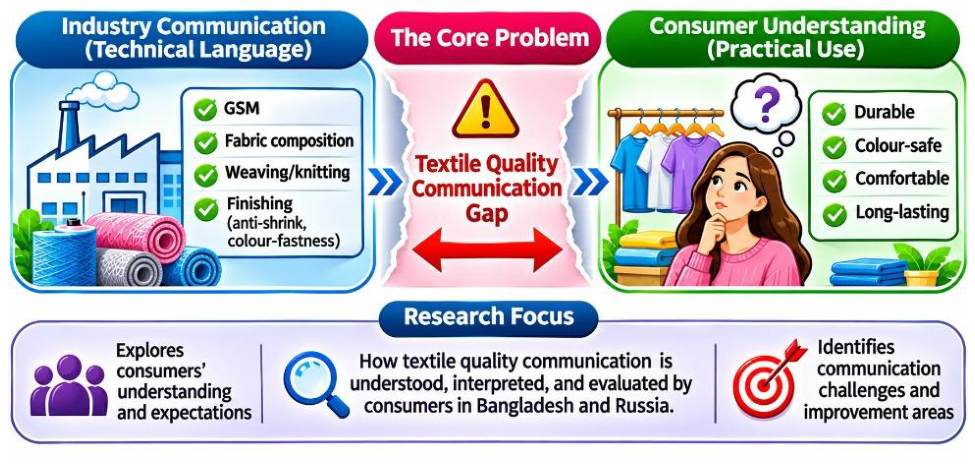
Figure 2.
Objective quality and consumer-perceived quality.
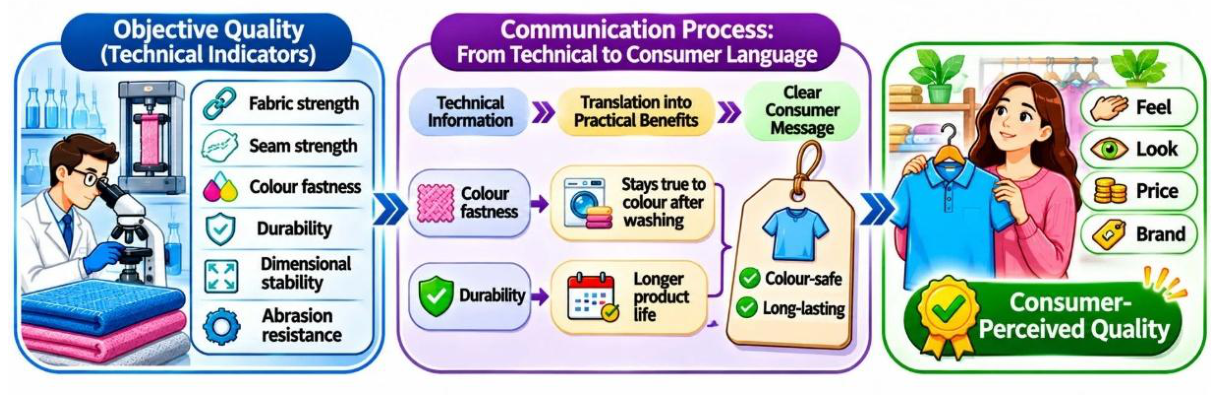
Figure 3.
Proposed theoretical framework.
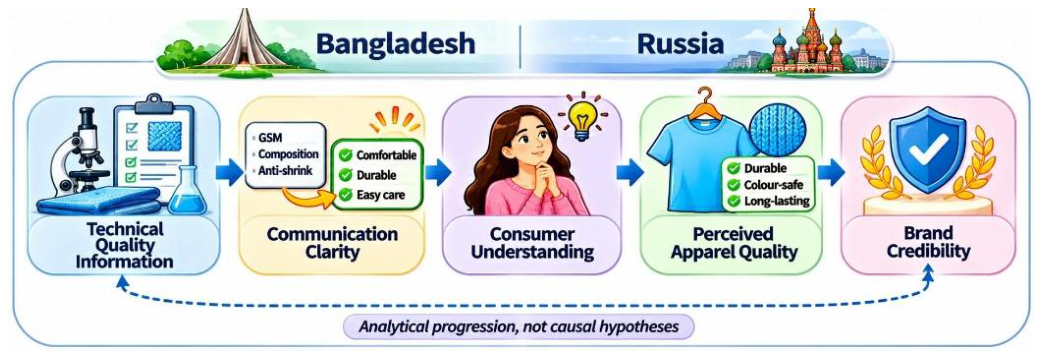
Figure 4.
Research methodology process.
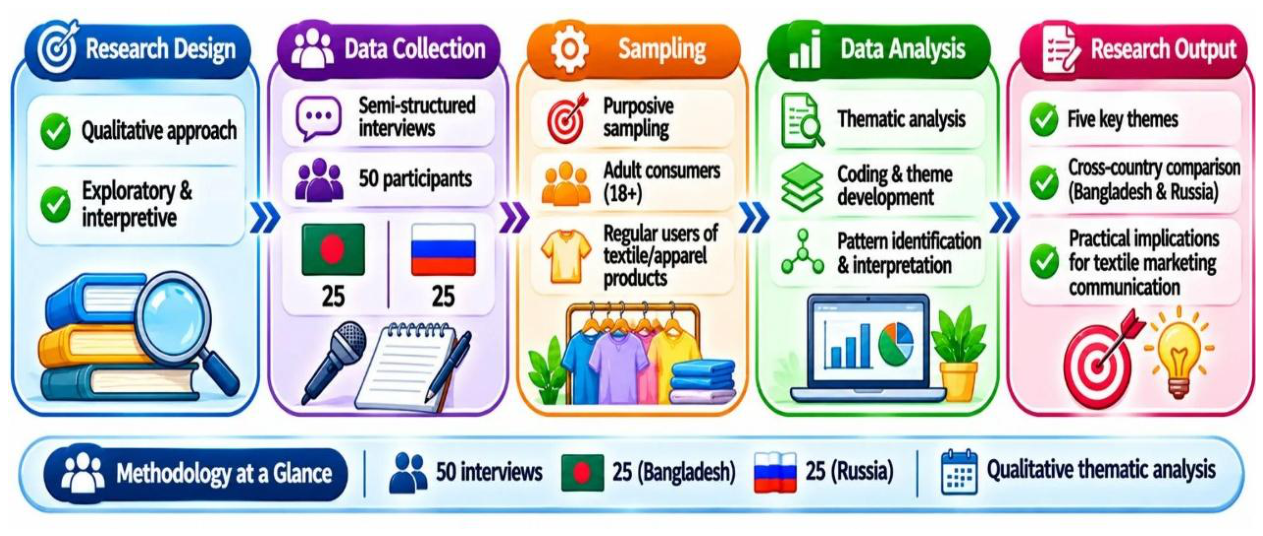
Figure 5.
Textile Quality Communication Gap identified through interview findings.
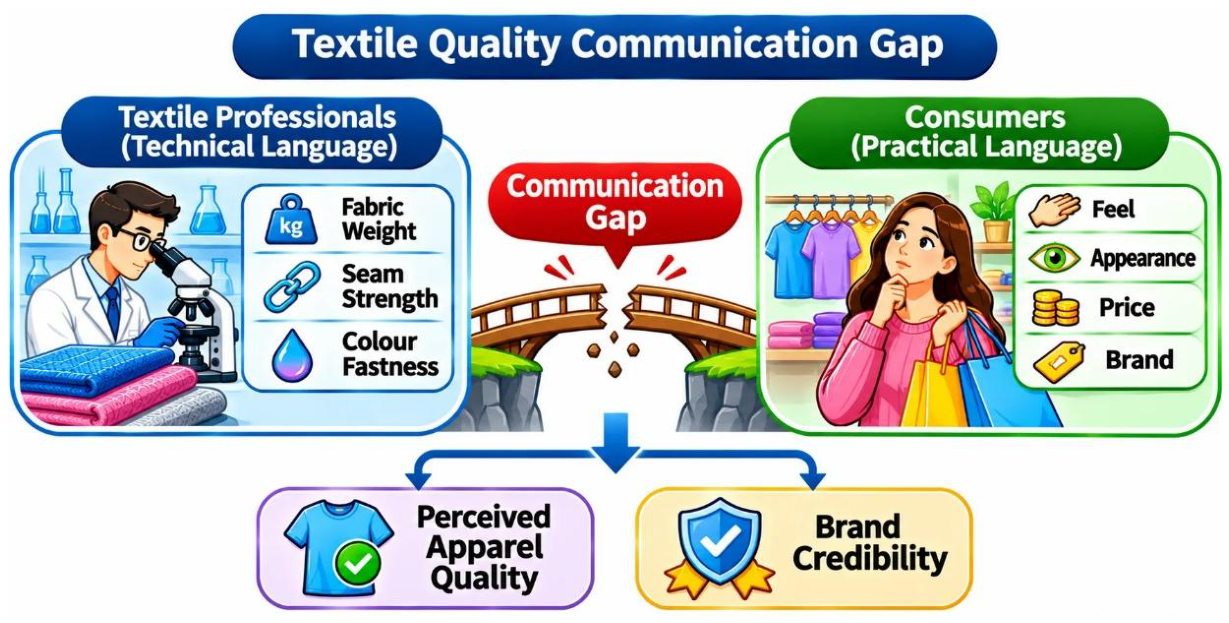
Figure 6.
Integrated thematic model of the interview findings.
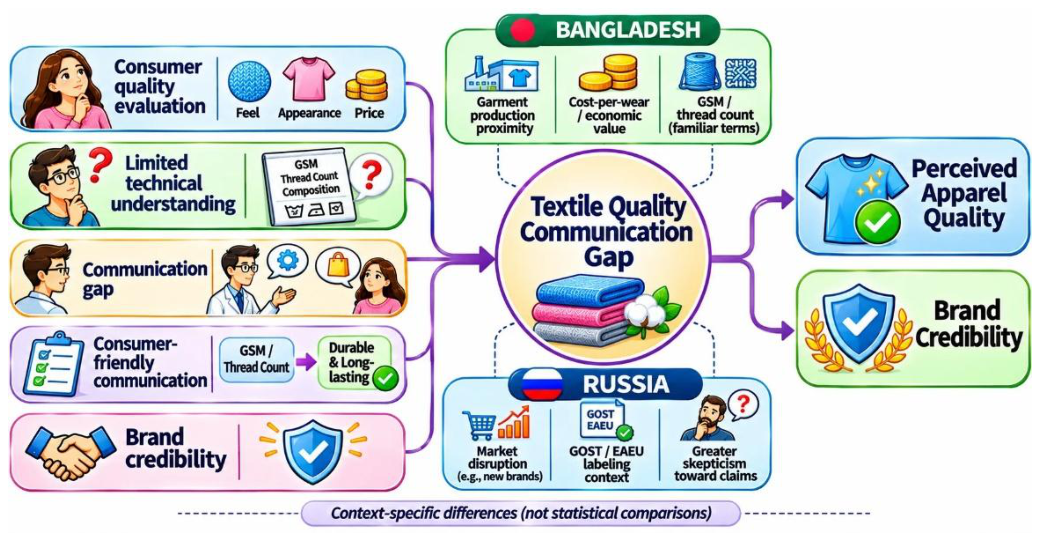
Figure 7.
Descriptive prevalence of major interview findings.
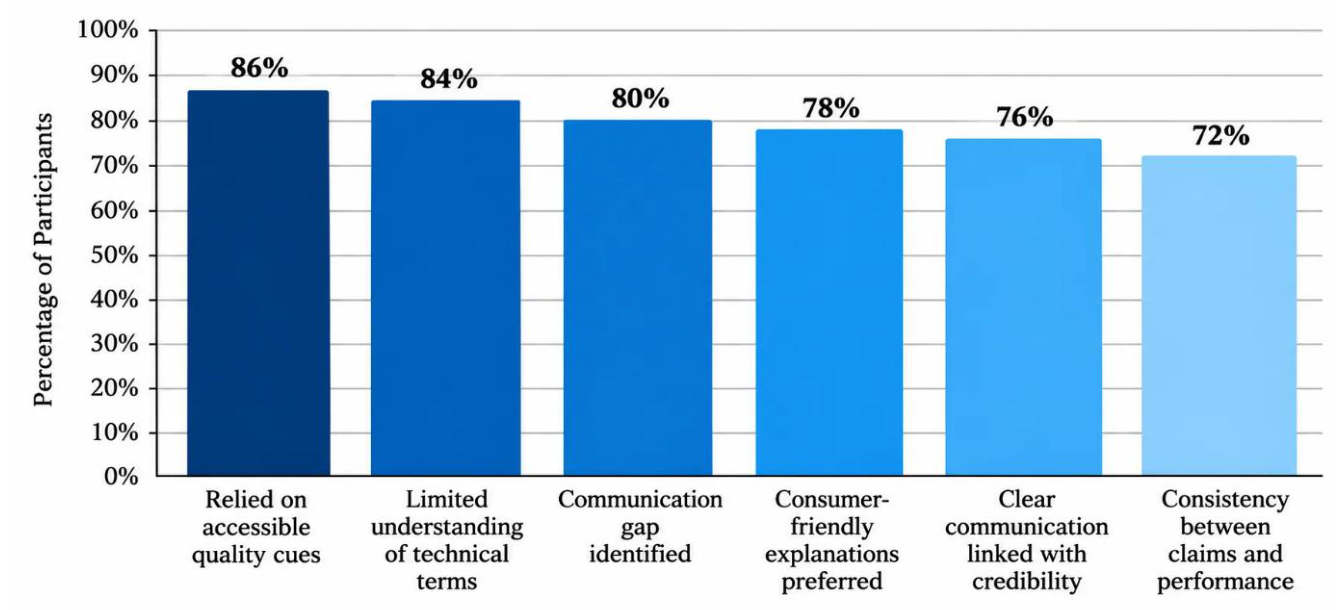
Table 1.
Technical textile quality indicators and their consumer-relevant meanings.
| Technical indicator | Technical meaning | Consumer-relevant meaning |
| Fabric strength | Resistance to breaking or tearing | Greater resistance to damage in use |
| Seam strength | Ability of seams to resist failure | Reduced risk of seam tearing during wear |
| Colour fastness | Resistance to fading, bleeding, or colour loss | Colour retention after washing |
| Durability | Maintenance of performance over time | Longer product life |
| Dimensional stability | Retention of dimensions after care | Fit and shape retained |
| Abrasion resistance | Resistance to surface wear | Appearance maintained over time |
Note: Working definitions used to analyse quality communication; they do not replace formal test-method specifications.
Table 2.
Participant profile, sample distribution, and demographics.
| Participant group | Bangladesh | Russia | Total | Age range | Gender (F/M) | Role in the study |
| Apparel consumers | 15 | 15 | 30 | 21 to 58 | 17/13 | Quality evaluation |
| Textile professionals | 5 | 5 | 10 | 27 to 49 | 4/6 | Technical quality and standards |
| Marketing/brand professionals | 5 | 5 | 10 | 25 to 44 | 6/4 | Quality communication and credibility |
| Total | 25 | 25 | 50 | 21 to 58 | 27/23 | Comparative evidence |
Note: Consumer education ranged from secondary to postgraduate, reflecting purposive rather than representative sampling.
Table 3.
Thematic analysis framework.
| Example initial codes | Category | Final theme |
| Fabric feel, appearance, finishing | Accessible product cues | Consumer evaluation of apparel quality |
| Price, reputation, previous experience | Extrinsic and experiential cues | Consumer evaluation of apparel quality |
| Unfamiliar technical terminology | Knowledge barrier | Limited technical understanding |
| Difficulty interpreting technical claims | Information barrier | Textile Quality Communication Gap |
| Simple explanations improve relevance | Consumer-oriented translation | Consumer-friendly quality communication |
| Confidence, reliability, trust | Brand response | Quality communication and brand credibility |
Note: The table illustrates the analytic path and is not an exhaustive code inventory.
Table 4.
Major themes identified through the interviews.
| Major theme | Core finding | Interpretation |
| Consumer quality evaluation | Accessible, experiential cues dominated | Consistent with cue utilisation theory |
| Technical understanding | Terminology was difficult for most consumers | Information has limited value without explanation |
| Communication gap | Professional and consumer language did not correspond | A disconnect observed in both countries |
| Consumer-friendly communication | Practical explanations improved meaning | Attribute-to-benefit translation improves usability |
| Brand credibility | Clear communication linked with confidence | Interpretive association; prior trust also relevant |
Note: Descriptive counts by group are reported inTable 7.
Table 5.
Cross-country comparison of major interview themes.
| Major theme | Bangladesh | Russia | Similarity or difference |
| Quality evaluation | Accessible cues; GSM and thread count familiarity from production proximity | Accessible cues; brand availability disruption shapes reference points | Similar structure; different contextual influences |
| Technical understanding | Limited among consumers; ISO and AATCC cited | Limited among consumers; GOST and EAEU cited; higher scepticism | Similar gap; different regulatory frameworks |
| Communication barriers | Technical language not tied to benefits | Same, plus doubt that claims reflect quality | Shared structure; added credibility barrier in Russia |
| Consumer-friendly communication | Practical explanations helped; cost-per-wear resonated | Practical explanations helped; performance after use resonated | Similar preference; benefit framing differs |
| Brand credibility | Clarity linked with confidence; consistency emphasised | Same; stronger prior-trust dependence and scepticism | Similar association; stronger prior trust in Russia |
Note: Observations come from the interviews and the context inSection 2; no statistical differences are claimed.
Table 6.
Relationship between interview themes and the conceptual framework.
| Interview theme | Key finding | Position in framework |
| Consumer quality evaluation | Reliance on accessible cues | Perceived apparel quality |
| Limited technical understanding | Terminology hard to interpret | Consumer understanding |
| Communication gap | Vocabularies do not match | Central communication gap |
| Consumer-friendly communication | Benefit explanations add meaning | Communication clarity |
| Brand credibility | Clarity supports confidence; prior trust relevant | Brand credibility |
Note: Positions refer to the framework inFigure 3.
Disclaimer/Publisher’s Note: The statements, opinions and data contained in all publications are solely those of the individual author(s) and contributor(s) and not of MDPI and/or the editor(s). MDPI and/or the editor(s) disclaim responsibility for any injury to people or property resulting from any ideas, methods, instructions or products referred to in the content. |
© 2026 by the authors. Licensee MDPI, Basel, Switzerland. This article is an open access article distributed under the terms and conditions of the Creative Commons Attribution (CC BY) license (http://creativecommons.org/licenses/by/4.0/).
Copyright: This open access article is published under a Creative Commons CC BY 4.0 license, which permit the free download, distribution, and reuse, provided that the author and preprint are cited in any reuse.