

Submitted:
12 November 2026
Posted:
13 November 2026
You are already at the latest version
Abstract
Great British Railways is being established at the same moment the railway is beginning to rely on machine learning, including systems that act and generate on their own. These systems share a property the railway has never had to assure before: they keep changing as they learn. The safety system they must pass through was built for the opposite case, for equipment approved once and then held as approved. This paper is about that mismatch and what to do about it. The sector’s strategy treats safety and assurance as problems of coordination, of aligning frameworks and convening the right bodies; we argue the binding constraint is structural. The change-assurance regime for Great Britain’s railways, the Common Safety Method for Risk Evaluation and Assessment, assesses discrete, deliberate changes to defined systems, and has no concept of a component that is, in its own terms, significant every day of its operational life. We make this precise. We re-classify the known hazards of rail AI by the assurance assumption each one breaks, rather than by the technique that produces them, yielding four families of failure; we show that a safety-relevant model which retrains satisfies the significance criteria permanently and at every retraining, leaving the regime’s additionality rule, its hazard record and its independent-assessment function without the fixed object each requires; and we show that the regime’s operational-phase instrument, the Common Safety Method for monitoring, detects the resulting divergence without supplying any route back to acceptance. We then propose a mechanism that works within the regime’s own instruments: a pre-assessed change envelope that shifts the object of assessment from the model to the retraining protocol that produces it, adapting precedents from medical-device, aviation and general-AI regulation to a setting where the significance decision is the proposer’s alone. We specify the four classes of bound such an envelope must declare, work it through on a track-geometry degradation model, and apply it to three named industry pathfinders, where it returns three different answers (proceed, proceed within bounds, and do not yet proceed), which is what shows it to be proportionate. The diagnosis is firm; the remedy bounds an open problem rather than dissolving it.
Keywords:
machine learning
; railway transport
; safety assurance
; Common Safety Method (CSM-RA)
; change envelope
; non-stationarity
; artificial intelligence regulation
; risk assessment
1. Introduction
The case for artificial intelligence in the railway is a strong one, and this paper does not contest it. The sector’s strategy sets the pressures out with force: a network operating close to the limits of its capacity, under sustained cost pressure, and losing experienced engineering and operational knowledge as its workforce ages [9]. These are real reasons to augment human judgement with data-driven inference. The convergence of structural reform in Great British Railways with a step change in AI capability is a genuine opportunity, and the ambition to act on it is warranted.
That strategy also does something more unusual for a document of its kind: it is candid about the difficulty. It names safety, assurance, governance and regulation as the foundational enablers on which adoption depends, and it acknowledges that AI “behaves differently” from the deterministic systems the railway is built to certify: that its outputs are probabilistic, that its performance depends on data quality, and that models require ongoing monitoring to detect drift or degradation [9]. We take these admissions as the starting point of this paper. Our argument is that the strategy, having named the difficulty, reaches for the wrong kind of solution to it. It treats assurance and governance as problems of coordination: of aligning frameworks across organisations, convening the right boards, and agreeing shared standards. These are necessary. They are not sufficient, and they are not the binding constraint.
The binding constraint is structural, and it is specific. The change-assurance regime for Great Britain’s railways, the Common Safety Method for Risk Evaluation and Assessment together with the duty-holder safety case it serves, is built to assess changes. A proposer identifies a change, judges whether it is significant, and, if it is, subjects it to a risk-management process that ends in acceptance of a defined system in a defined configuration. The whole apparatus presupposes that a change is a discrete, deliberate event with a before and an after. A machine-learning component that retrains, whether on a schedule, on a trigger, or continuously, is not a discrete change: it is a system whose nature is to change, between the moments the regime is built to assess, without the deliberate act the regime is built to catch. No amount of coordination resolves this, because the mismatch is not between organisations but between the regime’s concept of a change and the behaviour of a learning system. Until that mismatch is addressed, aligning governance frameworks aligns them around a gap.
This paper makes three contributions, which correspond to naming the gap, demonstrating it, and proposing what could hold in its place.
- 1.
- We re-classify the hazards of rail AI by the assurance assumption each breaks, rather than by technique or application domain as the established taxonomies do, yielding four failure families and making the taxonomy continuous with the regime it must inform (Section 4).
- 2.
- We show that non-stationarity does not strain the change-assurance regime but structurally forecloses it, in the sense that the regime’s instruments lose the fixed object on which they operate: a retraining safety-relevant model satisfies the significance criteria in the direction of significance at every retraining, the additionality prohibition makes no compliant decomposition of a retraining schedule possible, and the hazard record and independent-assessment function lose the fixed object they require (Section 5). We extend the analysis to the architectural and generative systems the strategy favours most, and show these break the regime’s boundary and specifiability assumptions in turn (Section 6).
- 3.
- We propose the pre-assessed change envelope, a mechanism that resolves the impasse within the regime’s own instruments by shifting the object of assessment from the model to the retraining protocol, and we apply it, through a proportional tiering, to three named industry pathfinders (Sections 7 and 8).
The posture throughout is one we state plainly, because it governs how the argument should be read. This is not a critique of the sector’s strategy but a completion of it: the strategy named the enablers correctly and identified the right difficulty, and this paper supplies the technical substance that the enabler it calls assurance requires.
2. The Railway as an Assurance Environment
Artificial intelligence does not enter the railway as a blank technology meeting a blank regulator. It enters a system with a mature, deeply embedded apparatus for deciding whether a change is safe enough to make, and that apparatus encodes assumptions about what a change is. The argument of this paper turns on those assumptions, so we set them out before we examine where they fail. We do so at the level of principle rather than clause-by-clause, for two reasons given at the end of this section; the principles are what determine whether a learning system can be assured, and it is the principles that the later analysis engages.
2.1. The Change-Assurance Regime
Safety-relevant change in Great British rail is governed by the Common Safety Method for Risk Evaluation and Assessment, assimilated in GB law as Commission Implementing Regulation (EU) No 402/2013 [7]. Its logic is a gate. A party proposing a change, the proposer (a term the regulation assigns to infrastructure managers, railway undertakings, and certain other duty-holders), must first judge whether the change has any impact on safety, and if it does, whether it is significant. That judgement is the proposer’s alone, taken by expert judgement against six criteria, and it is not reviewable by any external body [7,13]. A change assessed as not significant requires only that the decision be documented. A change assessed as significant triggers the full risk-management process: a structured hazard identification, a demonstration that the resulting risks are acceptable, and, since the regime’s post-exit tightening removed the proposer’s discretion to opt out, independent assessment by an assessment body [13].
Three features of this machinery matter for what follows. First, the risk-management process begins from a system definition that fixes the system’s boundary, its interfaces, and, critically, “the assumptions that determine the limits for the risk assessment” [7]. The assessment is valid for the system as defined and within the limits those assumptions set. Second, acceptability is demonstrated through one or more of three risk acceptance principles (application of codes of practice, comparison with a similar reference system, or explicit risk estimation), with the choice resting with the proposer and no order of priority imposed between them [7].1 Third, the independent assessment produces a safety assessment report on which the proposer confers safety acceptance: a status given once, to the defined system, at a discrete point [7].
Of the six significance criteria, two govern how a change is to be watched and undone, and these will prove decisive in Section 5. The monitoring criterion concerns the inability to observe an implemented change through its life and intervene appropriately; the reversibility criterion concerns the inability to return the system to its prior state [7]. Both are framed as aggravating factors: it is the inability to monitor or to revert that pushes a change toward significance. ORR’s guidance treats the two together as a single question of whether the proposer can detect a problem and intervene in time [13]. We introduce them here only to note their place in the machinery; their application to a system that changes itself is the subject of the later analysis.
2.2. A Culture Built for Deterministic Systems
The change-assurance regime does not stand alone. It sits atop an engineering-safety tradition (expressed in the EN 5012x standards for railway RAMS and safety-related systems, and in the functional-safety lineage behind them) whose foundational assumption is that a safety-related component is specifiable: its required behaviour can be written down, it can be tested against that specification, and once it has passed, it does not change until someone deliberately changes it. This is the assumption that lets a safety case be an argument about a fixed artefact, and it is the assumption that makes the discrete, once-per-change structure of CSM-RA coherent. A railway signalling component is approved against its specification and then behaves as approved for years; its assurance does not decay because the component does not drift.
This assumption is not incidental to the regime; it is the condition that makes the regime’s economy possible. Assessment is expensive, independent assessment more so, and the regime is affordable precisely because assessment is a one-time cost amortised over a long, stable operational life. Long asset lives (infrastructure measured in decades, rolling stock in decades) are the counterpart of this: a change regime that moves slowly is tolerable because the things it governs change slowly. The tempo of the regime and the tempo of its subjects are matched. Nothing in this is a defect. It is a well-adapted fit between a method and the deterministic systems it was built to assure, and it has kept a safety-critical network safe over many decades.
2.3. Scope: Why We Engage at the Level of Principle
We engage this regime at the level of its governing principles (the significance test, the system definition and its limiting assumptions, the three acceptance principles, the role of independent assessment, the maintenance of the hazard record) rather than at the level of specific clause mappings within any single duty-holder’s implementation. Two considerations make this the right level. The first is that it is the principles, not the local procedural detail, that determine whether a learning system can be assured; a clause-level treatment would multiply particulars without touching the structural question. The second is that the detail does not yet exist to be engaged. We are aware of no published GB rail standard, duty-holder safety document or regulatory guidance that treats an adaptive or learning component as a distinct category of change, and the regulator’s own position, set out in 2026, is that the existing frameworks suffice and that wholly new assurance models are not required [14]. Whether that position can be sustained is the central question of this paper. We proceed at the level of principle not to avoid the detail but because the detail, where it exists, does not yet reach the problem.
3. Related Work and Positioning
The problem this paper addresses sits at the intersection of three bodies of work that have largely developed apart: rail-specific AI taxonomy and roadmapping, the assurance of learning-enabled systems, and the regulatory treatment of post-approval change. Each has established part of what is needed. None has occupied the position this paper takes, and the gap between them is not incidental: it is the space in which the question of assuring a learning system within a national duty-holder regime falls.
3.1. Rail-specific AI Taxonomy and Roadmapping
The most developed body of rail-AI research comes from the work associated with the EU RAILS project and its collaborators. Bešinovi´c et al. [1] provide the field’s reference taxonomy, classifying AI in rail by technique and by railway subdomain and surveying applications across the sector; the companion roadmaps order the integration of AI by grade of autonomy and set research directions across safety and automation, maintenance, and traffic management [2]. This work is the foundation on which any rail-AI paper builds, and Section 4 builds on it explicitly, taking its catalogue of applications as given and re-classifying the hazards by assurance assumption rather than by technique. Its treatment of regulation, however, is pitched at the level of ethics guidance and high-level principle; it identifies the need for certification frameworks as a research direction rather than engaging the machinery of any specific assurance regime. The autonomy ladder it offers encodes learning only at its highest grade, and attaches no assurance route to that grade. The result is a thorough map of what AI can do in rail and where, with the question of how a changing system is to be assured left open, which is the question we take up.
3.2. Trustworthy and Continuous Assurance of Learning Systems
A second body of work engages assurance directly. Within rail, the position paper of Lefebvre Renard et al. [11] is the nearest neighbour to this one: it argues that trustworthy rail AI rests on robustness, a defined operational design domain, and explainability, and it observes, in a single telling sentence, that acting on a detected drift may require retraining, and that retraining in turn requires costly change management of the operational domain. That observation is the problem this paper analyses; the Alstom work states it and calls for certification frameworks without proposing how an assurance regime should absorb the change. The engineering response has been most fully developed by Zeller et al. [20], whose safe-MLOps pipeline integrates the machine-learning lifecycle with safety assurance for the continuous development of rail ML; this is a mature treatment of the engineering of continuous assurance, but it is a development process, not an analysis of how the output of that process meets a regulator’s significance decision or an assessment body’s independence.
Outside the rail industry, the assurance of learning-enabled and self-adaptive systems has a substantial literature. The dynamic-safety-case line of work argues that static, once-and-for-all safety cases cannot support through-life assurance and proposes cases that are monitored and updated in operation [3]. This is the conceptual root of the position we take, and we adopt its premise that assurance of a changing system must itself be a living thing. At the level of functional-safety standards, the critique of Ladkin [10] makes an argument structurally parallel to ours one layer down: the functional-safety treatment of AI assumes a static, queried model (an “oracular” component) and does not fit systems whose behaviour adapts in operation. Our contribution relative to this band is to carry the insight from the level of the generic safety case and the functional-safety standard to the level of a specific national change-assurance regime, where the abstract claim “static assurance cannot hold” becomes the concrete claim that a named significance test, hazard record, and independent-assessment function are structurally foreclosed.
3.3. Change-envelope Precedents in Adjacent Regulated Domains
The mechanism this paper proposes in Section 7 is not without precedent, but the precedents lie outside rail. Medical-device regulation has confronted the non-stationarity of AI directly: the predetermined change control plan permits specified post-market modifications to an AI-enabled device, pre-authorised through a modification protocol, without a fresh submission [18]. AI regulation of general application has reached the same construction, providing that changes pre-determined at initial conformity assessment do not constitute a substantial modification [8]. Both are instances of the move we adapt for rail: shifting the object of assessment from the artefact to the bounded space of change the artefact may undergo. Aviation has gone furthest of all, and in a direction that bears directly on the present problem. EASA’s learning assurance framework, developed with Daedalean in the CoDANN reports and consolidated in the Agency’s concept paper for level 1 and level 2 machine-learning applications, replaces the V-shaped development process of conventional airborne software with a W-shaped process whose additional limb covers data management, learning process verification, and verification of the trained model [4,5]; the MLEAP research programme has since examined how those objectives can be met in practice, including the derivation of generalisation bounds [12]. This is the closest adjacent-sector analogue to the question of this paper, and closer in kind than the medical-device precedent, because aviation certification shares the specifiability and development-assurance lineage that Section 2.2 identified behind EN 5012x. It answers a different question, however. The W-shaped process governs how a learning component is developed and first approved; its treatment of post-approval change is correspondingly thin, and it attaches to a type-certification regime rather than to a duty-holder’s significance decision. Our concern begins where it ends, at the point at which an approved model is retrained in service and a national change-assurance regime must decide what to do about it. The adaptation is not mechanical, because the GB rail regime has features these precedents do not share (significance as the proposer’s unreviewable judgement, and the additionality prohibition on decomposing a change), which is why Section 7 must reconstruct the mechanism within the regime’s own instruments rather than transplant it. Walter and Hegemann [19] have applied the three CSM-RA risk acceptance principles to an ML inspection system, the closest existing engagement between rail ML and the GB risk-acceptance machinery, but the treatment takes the model as a single change and does not ask whether retraining is itself a significant change: the question on which this paper turns.
3.4. The Empty Quadrant
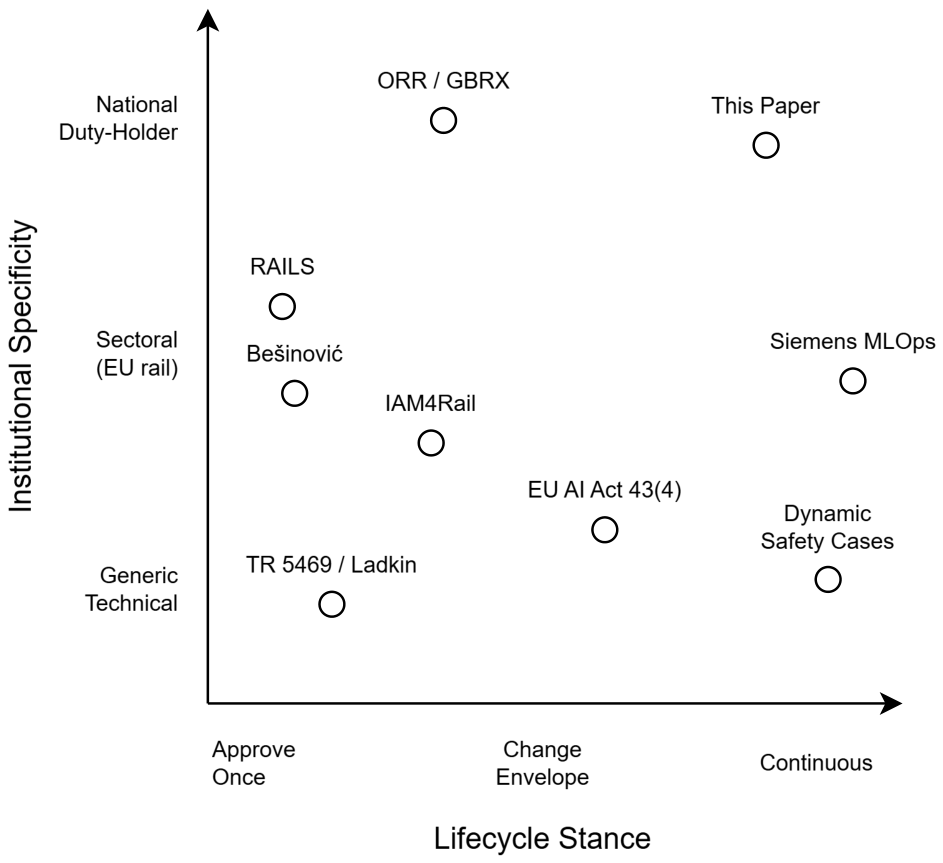
Positioned together, these bodies of work occupy a plane with two axes. The first is lifecycle stance: how a body of work treats change after approval, ranging from an approve-once posture that assesses a fixed artefact, through the pre-assessed change envelope of the medical-device and general-AI precedents, to the fully continuous assurance of the dynamic-safety-case line. The second is institutional specificity: how closely a body of work engages a particular assurance regime, from generic technical standards, through sectoral EU-level rail frameworks, to a national duty-holder regime with named instruments and accountable parties. Figure 1 places the work surveyed here on these axes. The rail taxonomies sit at sectoral specificity but approve-once lifecycle stance; the dynamic-safety-case and MLOps work sits at continuous lifecycle stance but generic or engineering specificity; the change-envelope precedents sit at the right lifecycle stance but outside rail entirely. The upper-right region (a continuous or change-enveloped lifecycle stance engaged at the level of a national rail duty-holder regime) is unoccupied. It is the region in which the question of assuring a learning system for a specific, accountable railway must be answered, and it is where this paper is situated. Figure 1 makes the gap visible and Table 1 states the basis of each placement: every prior body of work sits low or to the left, and the upper-right corner, where a changing system must be assured within a national duty-holder regime, is empty.
Figure 1.
Prior work positioned by lifecycle stance (horizontal: how change after approval is treated, from approve-once, through a pre-assessed change envelope, to continuous assurance) against institutional specificity (vertical: from generic technical standards, through sectoral frameworks, to a national duty-holder regime). The upper-right region, a change-enveloped or continuous stance at the level of a national duty-holder regime, is unoccupied, and is where this paper is situated. Axis placements are the authors’ positioning of each body of work, not measured quantities; Table 1 states the basis of each placement.
Figure 1.
Prior work positioned by lifecycle stance (horizontal: how change after approval is treated, from approve-once, through a pre-assessed change envelope, to continuous assurance) against institutional specificity (vertical: from generic technical standards, through sectoral frameworks, to a national duty-holder regime). The upper-right region, a change-enveloped or continuous stance at the level of a national duty-holder regime, is unoccupied, and is where this paper is situated. Axis placements are the authors’ positioning of each body of work, not measured quantities; Table 1 states the basis of each placement.
4. A Threat Taxonomy Keyed to Broken Assurance Assumptions
The hazards that AI introduces to the railway have been catalogued before. The established rail-AI taxonomies organise the field by technique and by application domain: the reference taxonomy of Bešinovi´c et al. [1] classifies AI in rail by the method employed (machine learning, evolutionary computing, logic programming) and by the railway subdomain in which it is applied, and the RAILS roadmaps order capability by grade of autonomy [2]. These organisations answer the question an engineer asks when selecting a technology. They do not answer the question an assessor asks when deciding whether a technology can be assured, because they are not keyed to the thing assurance depends on. We therefore do not propose a new catalogue of threats. We re-classify the existing one, organising failure modes not by what technique produces them but by which assurance assumption each one breaks.
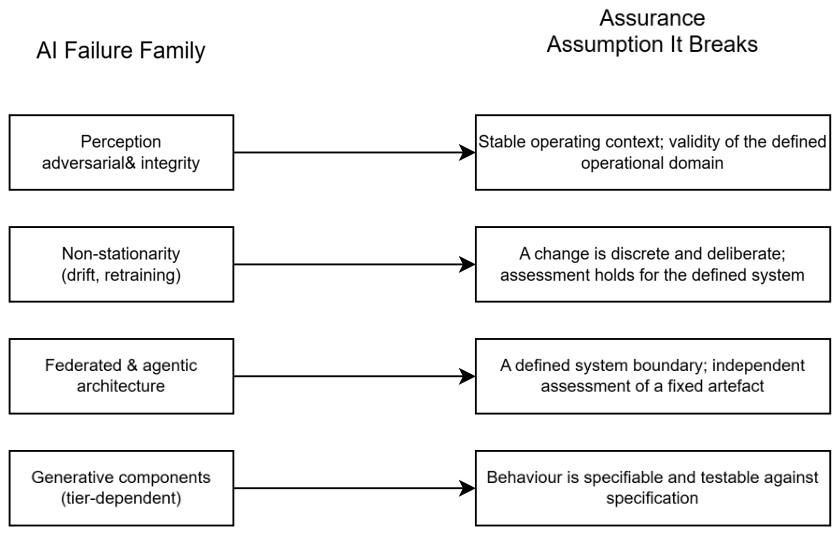
This reclassification is the taxonomy’s purpose and its contribution. Section 2 established that the change-assurance regime rests on a small set of assumptions: that a system is defined by a fixed boundary, that a change is a discrete and deliberate event, that a component’s behaviour is specifiable and testable, that the hazards identified at assessment remain the hazards in operation, and that the artefact assessed is the artefact that runs. A failure mode matters to assurance in proportion to which of these it violates and how deeply. Ordered this way, the disparate hazards of AI resolve into four families, each breaking a different assumption, and each, as the later sections show, requiring a different response from the regime. Table 2 summarizes the families and carries the mapping through to the instrument each disables and the response Section 7 offers, which is the sense in which the reclassification is continuous with the remedy rather than a relabeling of a known catalog. Figure 2 shows the mapping that gives the taxonomy its shape: each family set against the single assurance assumption it breaks, with non-stationarity marked as the case the rest of the paper turns on. The subsections introduce them in turn. The analysis of their consequences is deferred: non-stationarity is treated in Section 5, and the generative and agentic families in Section 6.

Table 2.
Four families of AI failure mode, keyed to the assurance assumption each breaks. The fourth column names the instrument of the regime that the broken assumption first disables, and the fifth states what the mechanism of Section 7 does about it. The entry for the architectural family records that the mechanism does not reach it, which is the limit identified in Section 6.1.
Table 2.
Four families of AI failure mode, keyed to the assurance assumption each breaks. The fourth column names the instrument of the regime that the broken assumption first disables, and the fifth states what the mechanism of Section 7 does about it. The entry for the architectural family records that the mechanism does not reach it, which is the limit identified in Section 6.1.
| Family | Representative failure modes (rail instantiation) | Assurance assumption broken | Instrument first disabled | Envelope response |
|---|---|---|---|---|
| Perception adversarial & integrity | Evasion and poisoning of vision-based inspection and detection (wheel-impact monitors, automated vehicle inspection, pantograph and intrusion cameras); sensor spoofing of condition telemetry | Stable operating context; validity of the defined operational domain | The system definition and its limiting assumptions | Input bounds, with data provenance as a first-class gate condition (Section 7.2) |
| Non-stationarity | Distribution shift into degraded or rare operating states; scheduled, triggered, or continuous retraining | A change is a discrete, deliberate event; assessment holds for the defined system | The significance test, the hazard record, and independent assessment | The mechanism entire: behavioural, operational and procedural bounds (Section 7) |
| Federated & agentic architecture | Byzantine behaviour across duty-holder boundaries; manipulation or compromise of one agent propagating through a coupled network | A defined system boundary; a single accountable proposer | The system boundary, and the proposer role itself | Not resolved. The envelope presumes one proposer and one boundary (Section 6.1) |
| Generative components | Prompt injection; hallucination; the unspecifiability of a generative output space | Behaviour is specifiable and testable against specification | Risk acceptance by code of practice or reference system; the tier classification itself | Tier set by the consumer of the output, not the model; loss of human interposition is itself a change (Section 6.2) |
Figure 2.
The four failure families, each keyed to the assurance assumption it breaks and to the section that traces its consequence. Non-stationarity is the paper’s central case: the assumption it breaks, that a change is discrete and deliberate, is the one the whole change-assurance regime rests on.
Figure 2.
The four failure families, each keyed to the assurance assumption it breaks and to the section that traces its consequence. Non-stationarity is the paper’s central case: the assumption it breaks, that a change is discrete and deliberate, is the one the whole change-assurance regime rests on.
4.1. Perception Adversarial and Integrity Failures
The first family comprises deliberate manipulation of the perception layer on which an increasing share of rail AI depends. Evasion attacks perturb an input so that a model misclassifies it; poisoning corrupts the data from which a model learns; sensor spoofing falsifies the telemetry a model consumes. In rail these are not abstract: the vision systems the sector is deploying for infrastructure inspection and for intrusion detection are susceptible to inputs crafted to defeat them, and the condition-monitoring telemetry that feeds asset models can be falsified at source. What this family breaks is the assumption that the operating context is stable and lies within the domain for which the system was assessed. An adversarial input is, in assurance terms, an input from outside the validated operational domain, introduced on purpose. The family bears most heavily where perception discharges a safety function, and its sharpest rail-specific form, poisoning through shared data, is amplified by the sector’s federated-data ambition, a point Section 8.2 takes up concretely.
4.2. Non-Stationarity
The second family is the one that gives this paper its title. A model drifts when the world it operates in moves away from the world it was trained on, and it is retrained when it is updated to catch up. Both are changes to the behaviour of a deployed system that occur without any deliberate modification to its specification or configuration. This family breaks the most structurally load-bearing of the regime’s assumptions: that a change is a discrete, deliberate event, assessed once, after which the assessed system is the operating system. A learning system violates this not through malfunction but through normal operation, because changing is what it does. We introduce it here only to place it in the taxonomy; it is the subject of Section 5, where its collision with the significance test is the paper’s central analysis.
4.3. Federated and Agentic Architecture Failures
The third family arises not from any single model but from the architecture in which models are deployed. The sector’s plans envisage data and agency distributed across organisational boundaries: data federated across duty-holders, and agentic systems acting across cross-system workflows [9]. A distributed system of semi-trusted parties is subject to Byzantine failure (the condition in which a component behaves arbitrarily, including in ways that appear valid to its neighbours), and a network of interacting agents admits the propagation of one compromised or manipulated agent’s behaviour through the whole. What this family breaks is the assumption of a defined system with a fixed boundary and a single artefact to assess: when agency spans duty-holders, there is no single system to define, no single hazard record to maintain, and no single artefact for an assessment body to judge. This family, together with the next, is analysed in Section 6.
4.4. Generative Component Failures
The fourth family is specific to generative models. Hallucination, confident output unsupported by any input, and prompt injection, the subversion of a model’s instructions through its inputs, are failure modes with no counterpart in a classifier or a regressor; they share a root, in that a generative model’s output space is not specifiable in advance, and what cannot be specified cannot be tested against a specification. This family therefore breaks the specifiability assumption directly. Alone among the four its consequence is fixed not by the technology but by the model’s role in the decision, so that one failure may be a mere quality defect or a safety-relevant one; Section 6 develops this: a generative component sits in Tier 1 for as long as a human stands between its output and any decision, and migrates upward through the tiers of Section 7.3 the moment that human is removed, without any change to the model itself.
4.5. The Grid as a Bridge
Keyed this way the taxonomy is not a terminus but a bridge: each family names an assurance instrument from Section 2, and the sections that follow trace specific routes across the grid, Section 5 taking non-stationarity into the significance test and Section 6 taking the architectural and generative families into the boundary and specifiability assumptions. Ordering threats by broken assumption makes the taxonomy continuous with the remedy: classifying a failure is already the first step toward assuring against it.
5. The Learning-System Assurance Gap
The preceding taxonomy locates ML non-stationarity as one failure family among four. This section argues that it is the decisive one: the point at which the behaviour of a machine-learning component and the structure of the GB change-assurance regime become mutually incompatible. The argument is not that the regime fails to perceive the risk a learning system poses. It is the opposite. The regime perceives the risk precisely, and its own logic drives the assessment toward a conclusion it has no machinery to act upon.
5.1. The Significance Test Applied to a Model That Retrains
Under the Common Safety Method for Risk Evaluation and Assessment, assimilated in Great Britain as Commission Implementing Regulation (EU) No 402/2013, a proposer who makes a safety-relevant change must first decide whether that change is significant. The decision rests on six criteria set out in Article 4(2), lettered (a) to (f): (a) the consequence of failure, (b) novelty, (c) complexity, (d) monitoring, (e) reversibility, and (f) additionality [7]. Two of the six, the fourth and the fifth, are decisive for a learning system, and both are drafted as aggravating factors, conditions whose presence points toward significance. We quote them with the regulation’s own lettering:
(d) monitoring: the inability to monitor the implemented change throughout the system life-cycle and intervene appropriately;
(e) reversibility: the inability to revert to the system before the change.2
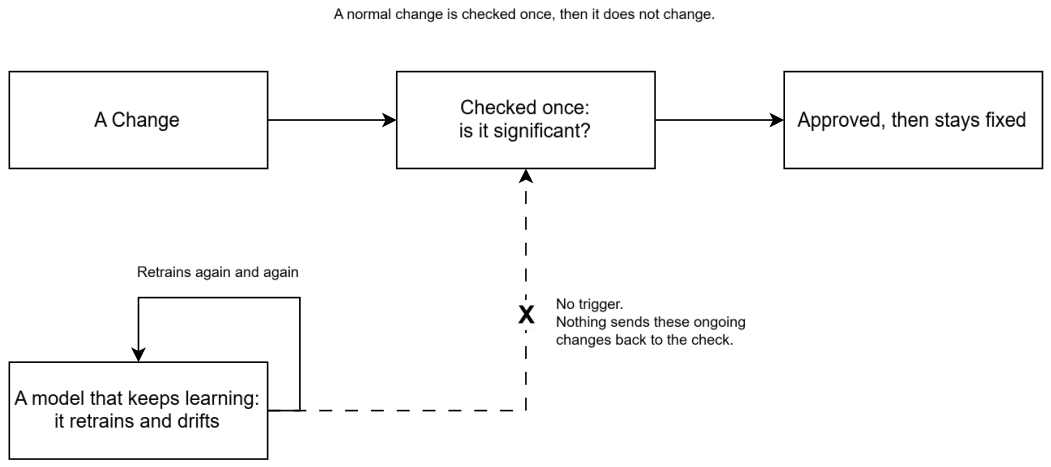
A conventionally engineered change is assessed against these criteria once, at the point of change, and the assessment then holds for the defined system that results. A machine-learning component that is retrained (on a schedule, on a drift trigger, or continuously) does not present a change once. It presents a stream of changes, each of which alters the behaviour of the deployed system without any accompanying modification to its specification, its code, or its physical configuration. Applied to that stream, criteria (d) and (e) do not merely lean toward significance; they are satisfied structurally and permanently. Figure 3 shows the contrast that results: a conventional change is checked once and then stays fixed, while a learning model keeps changing on its own and nothing sends those changes back to be checked.
Figure 3.
The regime has a single checkpoint, the significance test: a change passes through it once and is then approved and left fixed (top). A model that keeps learning retrains and drifts on its own (bottom), yet nothing sends those ongoing changes back through the checkpoint. The regime never re-checks a system that changes itself.
Figure 3.
The regime has a single checkpoint, the significance test: a change passes through it once and is then approved and left fixed (top). A model that keeps learning retrains and drifts on its own (bottom), yet nothing sends those ongoing changes back through the checkpoint. The regime never re-checks a system that changes itself.
Monitoring.
The monitoring criterion asks whether the proposer is unable to observe the change through life and intervene in time. For a retrained model the honest answer is that monitoring is available but not sufficient, and the reason is structural rather than a matter of engineering effort. A drift detector is itself a statistical procedure, calibrated on observed data, and its power against a given shift depends on that shift being expressed in the statistics it computes over the window it observes. The shifts that matter most to a safety function are those that are rare, those concentrated in a small region of input space, and those that alter the relation between inputs and labels without altering the input distribution the detector watches. Each is a case in which a detector retains high aggregate accuracy while failing to fire, and the empirical literature reports exactly this pattern: methods reliable against large covariate shifts degrade against subtle and localised ones, and model confidence degrades under shift in ways the model does not itself signal [15,16]. A proposer can install drift monitoring; what it cannot do is demonstrate, in the sense Article 4 requires, that the monitoring “gives sufficient warning early enough to permit effective intervention” [13]. The capability the criterion demands is not absent, but neither is it assured, and under the criterion’s own logic an inability to assure timely intervention is an inability to monitor.
Reversibility.
The reversibility criterion asks whether the system can be returned to its state before the change. A model can, trivially, be rolled back to a prior set of weights. But reversibility in the regime’s sense is not the restoration of an artefact; it is the undoing of the change’s effects. ORR’s guidance makes this explicit, widening reversibility to “the ability …to intervene in a timely manner to prevent or mitigate any hazard arising from the change” [13]. A retrained model that has already influenced maintenance decisions, operational interventions, or (through a shared data environment) the training of other models, has produced effects that rolling back its weights does not reverse. The decisions it shaped stand; the data it emitted persists. In the regime’s own terms the change is irreversible.
A retrained safety-relevant model therefore satisfies both criteria in the direction of significance, and does so not once but at every retraining event. Novelty and complexity, which ORR reads as proxies for “uncertainty of outcome” [13], compound this: a model whose behaviour is a function of data it has not yet seen is, by construction, a change whose outcome cannot be fully predicted before it is made.
5.2. The Additionality Trap
A proposer facing this conclusion might reason that any single retraining event is minor, and assess each as non-significant in isolation. The additionality criterion forecloses that route. Article 4(2)(f) requires significance to be judged “taking into account all recent safety-related changes to the system under assessment” [7], and ORR states plainly that “breaking down a significant change into a series of smaller changes (which individually are not significant) so that the risk management process is then not applied to the overall significant change is not permitted” [13]. The look-back runs from the last application of the risk management process [7].
This produces a closed trap for a continuously retraining system. Assessed individually, each retraining may be argued non-significant. Assessed cumulatively, as additionality requires, the sequence of retrainings is an unbounded accumulation of behavioural change to the same system, against the same hazards, with no resetting event other than a full reapplication of the process. There is no decomposition of a retraining schedule that is both compliant with additionality and administratively survivable. The regime permits a model to be assessed; it does not permit a model to keep changing.
A second route suggests itself and must be closed with equal care. Nothing prevents a proposer from applying the full risk-management process voluntarily to a change it has not judged significant; the regulation sets a floor, not a ceiling, and a conscientious duty-holder might simply run the process at every retraining and let additionality take care of itself. The difficulty is not that this is forbidden but that it is unaffordable in a specific and structural way. Since the regime’s post-exit tightening, application of the process entails independent assessment by an assessment body [13], and the AsBo’s engagement is not a documentation exercise but a judgement on a defined system reached over weeks. A model retrained monthly would require twelve such judgements a year, each on an artefact that will have been superseded before the report is issued, and the assurance would be chasing an object that has already moved. Voluntary over-application therefore does not escape the trap; it converts an assurance gap into a scheduling impossibility, and the cost falls hardest on exactly the high-cadence, safety-relevant models for which assurance matters most.
5.3. The Hazard Record and the Assessment Body Under Drift
The incompatibility extends beyond the significance decision into the two instruments on which the regime’s post-acceptance integrity depends.
The hazard record is handed, on acceptance, into the operator’s safety management system (SMS), where it is maintained for the system in operation [7]. Its validity is tethered to the “assumptions that determine the limits for the risk assessment” recorded in the system definition [7]. RSSB’s guidance states the dependency directly: the assumptions record “the particular circumstances for which the risk assessment and derived safety requirements are valid,” and “if these assumptions change later, the risk assessment can be reviewed” [17]. Drift is precisely the silent violation of those assumptions. A model operating outside its training distribution has breached the limits for which its hazard analysis was valid, but the breach generates no change event, no modification, and no entry: the hazard record remains formally intact while the assurance it represents has lapsed. The regime’s trigger for revisiting the record, “assumptions about the system are changed” [13], presumes a proposer who changes an assumption, not a system that outgrows one.
The assessment body is subject to a parallel dislocation. Its role is to provide an independent judgement on the application of the risk management process to a defined system, culminating in a safety assessment report for that system [7]. The object of its assessment is a fixed artefact. An automated retraining pipeline removes that fixity: the artefact the AsBo assessed is not the artefact in operation a month later, and the AsBo has no standing to reassess each successor, both because the significance decision is the proposer’s alone [13] and because independent assessment of every model in a continuous stream is not a process the regime contemplates. Independence of assessment and automation of change are, under the current regime, mutually exclusive.
5.4. Why the Monitoring CSM Does Not Close the Gap
The regime has a second instrument addressed to the operational phase, and the obvious objection to the foregoing is that it, rather than CSM-RA, is the natural home for a learning system. The Common Safety Method for monitoring, Commission Regulation (EU) No 1078/2012, applies to infrastructure managers and railway undertakings after a safety authorisation or certificate has been granted, and establishes a process for checking during operation and maintenance that the management system is correctly applied and that risk control measures are effective and achieve their expected outcomes [6]. Its annex is explicitly repetitive and iterative, and its object is the continuing achievement of safety performance rather than a one-off acceptance. A reader might reasonably ask why a model that drifts is not simply a risk control measure whose effectiveness CSM-M already requires to be monitored.
The answer is that the two methods do different work, and the gap of Sections 5.1 and 5.3 falls between them. CSM-M asks whether the risk control measures a duty-holder has adopted are being applied and are achieving their expected outcome; it presupposes that those measures are the ones that were assessed. It supplies no significance test, confers no safety acceptance, and involves no assessment body. Applied to a retrained model it will faithfully report that a control is underperforming, which is detection, not assurance: it tells the duty-holder that the assessed artefact and the operating artefact have diverged, without providing any means, short of reapplying CSM-RA, of re-establishing that the operating artefact is acceptable. CSM-M is therefore the instrument that would reveal the problem this paper describes, and it is no accident that the mechanism of Section 7 is designed so that what CSM-M observes becomes the trigger an instrument of CSM-RA can act on. The two are complements, and the envelope is the coupling between them that the regime currently lacks.
5.5. Why Approve-Once Cannot Hold
No provision of the regime states that a safety case is valid only for a frozen configuration. The assumption is nowhere declared because it is everywhere assumed. It is carried by the system definition’s limiting assumptions, by safety acceptance as a discrete status conferred once, by the mutual-recognition rule that holds “conditional upon demonstration that the system will be used under the same functional, operational and environmental conditions” [7], and by the handover of the hazard record into the SMS as a maintained but closed artefact. Each of these presumes a system that is changed deliberately, by a proposer, at identifiable moments. A learning system changes itself, continuously, between moments. The regime has no trigger for a system that alters its own behaviour absent a proposer’s act, and no mechanism for a change that is significant every day of its operational life.
We do not claim that this gap has gone unnoticed, and the argument does not require that claim. It requires only that the regime contains no instrument addressed to it, which is a property of the regulation’s text rather than of any duty-holder’s practice. What can be said of the published record is that we are aware of no GB rail standard or published guidance treating an adaptive component as a distinct category of change, and that the regulator, in its 2026 action plan, holds that “wholly new assurance models are not required” [14]. That position is the one this section’s analysis contests: the significance test, the hazard record and the independent-assessment function are not merely strained by non-stationarity but deprived by it of the fixed object each requires. Whether individual duty-holders have developed internal practice that anticipates the problem is a question we are not positioned to answer, and Section 5.6 takes up the possibility that some have.
5.6. Three Objections
Three objections to the foregoing are strong enough to be stated in their own terms rather than answered in passing.
That Article 4(2) is a judgement in the round, not a set of triggers.
The six criteria are weighed together by the proposer, and nothing in the regulation provides that the presence of two aggravating factors compels a finding of significance. A proposer could therefore judge a bounded retraining non-significant and remain within the regulation. We accept this as a matter of law, and it is why we do not claim that the regime forbids a learning system. The claim is narrower and concerns assurance rather than legality: a proposer who reaches that judgement has no instrument through which to evidence it, because the evidence that would support it, namely that each successor model’s behaviour remains within assessed limits, is precisely what the regime offers no vehicle to pre-assess. The judgement is available; the demonstration is not. What Section 7 supplies is the missing vehicle, which is also why the mechanism requires no amendment to the regulation.
That retraining is maintenance, not change.
A model retrained under a documented procedure, it may be said, is no more a change to the assured system than the replacement of a component under an approved maintenance regime: the retraining is an operational activity governed by the SMS, and CSM-RA never engages. This is the strongest objection, and it turns on what the safety case was an argument about. A like-for-like component replacement is maintenance because the replacement is specified to behave as the assessed component behaved; the configuration changes and the behaviour does not. A retrained model is the converse. Its configuration may be described by the same pipeline, and its behaviour is by construction different, because a retraining that left behaviour unchanged would have no purpose. Maintenance preserves the thing the safety argument was about; retraining alters it. Where a retraining genuinely is behaviour-preserving within declared limits, it is maintenance, and that condition is exactly what the envelope of Section 7 exists to define and to evidence.
That competent practice already does this.
Mature ML deployments freeze weights, revalidate before promotion, and hold a human approval gate, and a duty-holder operating this way might see nothing here it does not already do. We agree, and take it as support rather than refutation: such a duty-holder has built an envelope informally. The contribution is not to invent the practice but to give it standing in the regime, so that the significance decision, the hazard record and the assessment body attach to it. An informal envelope assures nothing, because no instrument of the regime is bound to it and no assessment body has judged it. The same artefact, declared and assessed, discharges all three.
5.7. The Diagnosis Stated
Taking those objections into account, the conclusion is narrow and we state it plainly. Within the existing regime, a safety-relevant model that retrains is either assessed afresh at every retraining, which no proposer can sustain, or operated outside the assurance the regime was built to provide. Neither is acceptable, and no reinterpretation of the six criteria resolves the tension, because the tension is not in their interpretation but in their architecture: they assess changes to systems, and a learning system is not a sequence of changes but a system whose nature is to change. The remainder of this paper takes this diagnosis as settled and asks what assurance mechanism could hold in its place. That the diagnosis is firm does not make the remedy obvious: continuous assurance of a safety-critical learning component is an open problem, and Section 7 proposes a bound on it, not a dissolution of it.
6. Failure in the Architectures the Plan Favours Most
The two families introduced but not analysed in Section 4, architectural and generative failure, share a feature that makes them worth treating together. They are the failure modes of precisely the two technologies the industry plan is most enthusiastic about. The plan is emphatic that agentic AI, systems that “act on our behalf” across cross-system workflows, is transformational for a distributed operational railway, and it foregrounds generative models for passenger-facing assistance and for turning free text into structured operational data [9]. These are the sector’s showcase ambitions. They are also the applications that break the assurance assumptions of Section 2 most directly. This section shows how, and the alignment is not incidental: the properties that make these technologies attractive—autonomy across boundaries, open-ended generation—are the same properties that defeat assessment.
6.1. The Federated and Agentic Architecture Dissolves the Defined System
The change-assurance regime assesses a defined system: a thing with a boundary, interacting systems named across that boundary, and a single proposer accountable for the whole [7]. The plan’s architectural ambition is to dissolve exactly this. Data is to be federated across duty-holders, and agency distributed across organisational lines so that workflows span track and train, public and private [9]. An architecture of this shape has no single boundary to draw and no single proposer to hold, and it is subject to a class of failure the regime’s instruments were never designed to catch.
A distributed system composed of semi-trusted parties is exposed to Byzantine failure: the condition in which a component behaves arbitrarily: not by failing silent, which is detectable, but by continuing to emit outputs that appear valid to the components that depend on them while being wrong. In a federated data environment, a Byzantine source is one that supplies plausible but corrupted data to models trained by other duty-holders, who have neither visibility of the corruption nor authority over its source. In a network of interacting agents, Byzantine behaviour by one agent (whether through compromise, manipulation, or simple misalignment with the others’ assumptions) propagates through the workflows that consume its outputs. The assurance consequence is structural. There is no defined system to assess because the system’s behaviour is a function of parties outside any single proposer’s definition; there is no stable hazard record because the hazards arise at interfaces no one party owns; and there is no fixed artefact for an assessment body to judge because the artefact is a running federation, not a component. The regime can assess each duty-holder’s contribution in isolation, and that is precisely the failure: Byzantine hazards live in the interactions, which isolated assessment does not see.
We characterise this failure rather than formalise it. The formal treatment of Byzantine fault tolerance (the conditions on the number of faulty parties under which a distributed system can still reach correct agreement, and the consensus protocols that achieve it) is a developed field, and bringing its guarantees to bear on a safety case for a rail agent federation is a substantial undertaking that we identify as necessary future work rather than attempt here. The point for the present argument is prior to the formalism: the regime has no concept of a federated system as an object of assessment at all, and until it does, the formal guarantees have nothing to attach to.
6.2. Generative Output Breaks Specifiability, and the Break Is Tier-Dependent
The second family breaks a different assumption. A safety case is an argument that a component meets its specification; this presupposes that the component’s correct behaviour can be specified and that its actual behaviour can be tested against the specification [7]. A generative model defeats both halves. Its output space is open (it can produce text or structure it has never produced before and that no specification enumerated), so there is no specification to test against, and its two characteristic failure modes exploit exactly this openness. Hallucination is the production of confident output unsupported by the input; prompt injection is the subversion of the model’s instructions through content in its input. Neither has a counterpart in a classifier whose outputs are drawn from a fixed, enumerable set, and neither can be excluded by testing, because testing a generative model samples its behaviour rather than bounding it.
The decisive observation is that the safety consequence of this unspecifiability is not fixed by the technology. It is fixed by the model’s role in the decision, and the plan’s own use-cases span the full range without marking the transitions. A generative fares assistant that a passenger reads and acts on is a case where hallucination is a quality defect, bounded by the human who checks it: the unspecifiable output reaches a human judgement before it reaches any consequence. But the plan also proposes generative models to turn unstructured operational records (control-centre incident logs, free-text engineering reports) into structured data for downstream analysis [9]. Here the same failure mode has a different consequence entirely. A hallucinated field in a structured record is not read and checked by a passenger; it enters an analytical pipeline, feeds planning or asset decisions, and carries its error silently downstream, laundered from unverified generation into apparently authoritative data. The generative failure has migrated from a bounded, human-checked role into an unchecked one, and in doing so it has migrated up the tiers of Section 7.3, without any change to the model, and without any point in the plan’s framing at which the migration is flagged.
This is the finding the generative family contributes. The hazard of a generative model is not readable from the model; it is readable only from where the model’s output goes. A generative component is low-consequence exactly as long as a human stands between its output and any decision, and it silently ceases to be low-consequence the moment that human is removed: an event that, as Section 8.1 shows for the agent case, is a change of role rather than of technology and is therefore invisible to any assessment that classifies by technology. An assurance regime for generative AI must track the consumer of the output, not the output alone. Both families of this section thus deliver the same lesson from different directions: the architectural family shows that assessment cannot stop at the boundary of a single system when behaviour is distributed, and the generative family shows that assessment cannot stop at the model when consequence is determined downstream of it. The regime’s instruments stop at exactly these two places.
7. A Proportionate Assurance Mechanism: The Pre-Assessed Change Envelope
Section 5 established a structural impasse: a safety-relevant model that retrains is, under the existing regime, either reassessed at every retraining or operated outside assurance. This section proposes the mechanism that breaks the impasse without abandoning the regime that produced it. The proposal is deliberately conservative. It does not ask the regime to tolerate unassessed change; it relocates the object of assessment from the model to the process that generates models, so that a single assessment can hold across a bounded space of successor models rather than a single frozen one.
7.1. Shifting the Object of Assessment
The regime’s incompatibility with learning systems arises because it assesses artefacts and a learning system is not a stable artefact. The resolution is to assess the artefact that is stable: the retraining protocol. A retraining protocol specifies the data sources and admissibility criteria, the training procedure, the validation gates a candidate model must pass before promotion, the monitoring that governs it in operation, and the fallback invoked when monitoring or validation fails. Unlike the models it produces, the protocol does not change between retrainings. It is specifiable, testable, and stable once approved: the three properties Section 2 identified as the regime’s prerequisites and Section 5 found absent in the model itself.
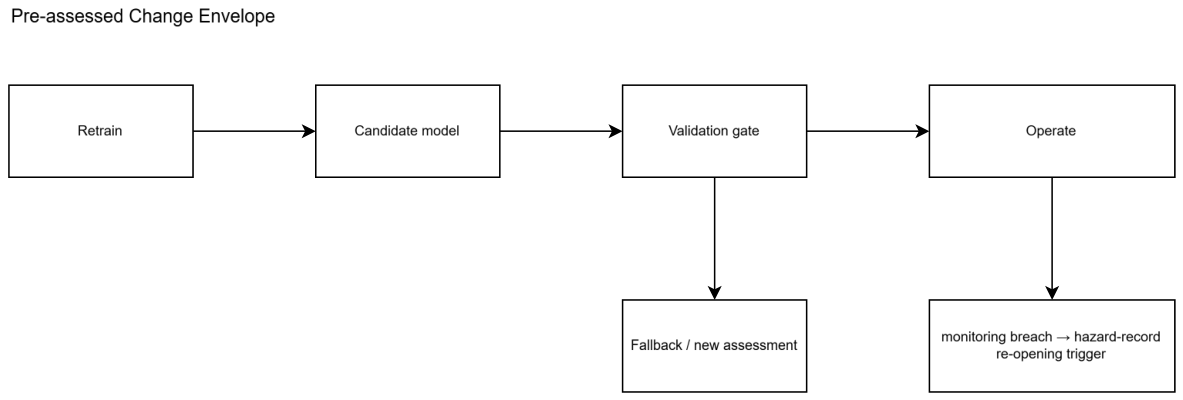
We term the assessed protocol, together with the bounded space of model behaviours it is permitted to produce, a pre-assessed change envelope. Significance is judged once, on the envelope. A retraining that produces a model falling within the envelope’s validated bounds is not a new change requiring a fresh Article 4 decision; it is the operation of an already-assessed system within its accepted limits. A retraining that would produce a model outside those bounds is not permitted to promote: it triggers either fallback or a new assessment. The envelope thus converts the perpetual-significance problem of Section 5.2 into a single significance decision with a defined boundary, which is the form the regime is built to handle.
Figure 4.
The pre-assessed change envelope. The object of assessment is the retraining protocol, not the model: the significance decision and the independent assessment attach once, to the protocol and its bounds. The validation gate then runs on every retraining, promoting a within-bounds model to operation and diverting an out-of-bounds one to fallback or fresh assessment; a breach of the monitoring thresholds is the event that re-opens the hazard record.
Figure 4.
The pre-assessed change envelope. The object of assessment is the retraining protocol, not the model: the significance decision and the independent assessment attach once, to the protocol and its bounds. The validation gate then runs on every retraining, promoting a within-bounds model to operation and diverting an out-of-bounds one to fallback or fresh assessment; a breach of the monitoring thresholds is the event that re-opens the hazard record.
This is not a novel regulatory invention but the adaptation of an established one. The United States Food and Drug Administration’s predetermined change control plan authorises specified post-market modifications to an AI-enabled device, described through a modification protocol and impact assessment, without a new submission, provided the changes fall within the pre-authorised description [18]. The European Union’s AI Act reaches the same construction from the opposite direction: a change to a high-risk system that has been “pre-determined by the provider at the moment of the initial conformity assessment …shall not constitute a substantial modification” [8]. Both regimes have confronted the non-stationarity problem and resolved it by pre-assessing a bounded envelope of change. Aviation’s learning assurance framework [4] is the nearest safety-engineering analogue, but it addresses the development of a learning component rather than its subsequent retraining. None has been applied to GB rail, and the GB regime’s distinctive features (significance as the proposer’s unreviewable judgement, and the additionality prohibition on decomposition) require the construction to be adapted rather than imported.
7.2. What Bounds an Envelope
An envelope that is not specified is not an instrument, and the question of what its bounds consist of is the one on which the proposal’s usefulness rests. We distinguish four classes of bound. Each must be declared in the protocol, evidenced at assessment, and testable at every promotion.
Input bounds declare the region of input space within which the model is assessed to operate: the operational design domain, stated as admissible ranges of the observable conditions (for a vision system, illumination, weather, occlusion and site geometry; for an asset model, asset classes, instrumentation types and operating regimes), together with the data sources from which training data may be drawn and the provenance conditions those sources must satisfy. A retraining whose training data departs from the declared sources, or whose deployment context departs from the declared domain, is outside the envelope regardless of how the resulting model performs.
Behavioural bounds declare the performance a successor model must exhibit on evidence available at promotion. They are properties of a candidate measured against held-out data, and they are two-sided: a ceiling on the safety-relevant error mode, expressed as a maximum false-negative rate on a curated set of known hazardous cases; a floor on calibration; and, critically, a ceiling on the divergence between the candidate’s outputs and the incumbent’s over a fixed reference set. The last of these is what makes the bound an envelope rather than a quality threshold: it constrains the distance travelled from the assessed model, not merely the destination reached. A candidate that is better in aggregate but behaves differently in a region on which the hazard analysis relied is caught by a divergence bound and missed by an accuracy bound.
Operational bounds declare the conditions under which a promoted model remains assured: the monitoring statistics, their thresholds, and the window over which each is evaluated. A breach is the event that Section 7.4 makes the trigger for re-opening the hazard record.
Procedural bounds declare what may change about the protocol itself without re-opening the envelope. The protocol is stable relative to the models it produces, but it is not immortal: validation sets age, asset populations turn over, and a gate calibrated against one decade’s failure data is not the same gate against the next. We therefore require that every envelope carry an explicit review period together with re-opening conditions independent of monitoring breach, including a material change in the asset population or operating concept, a change in the composition of the validation set, and the expiry of a stated maximum interval. Without this the envelope would reproduce, one level up, the approve-once posture that Section 5.5 rejects.
The four classes are not independent, and the relation between them is where the mechanism can fail. An envelope whose behavioural bounds are wide enough to admit every retraining the proposer anticipates assures nothing; one narrow enough to be meaningful will reject retrainings the proposer wanted. That tension is not a defect to be engineered away. It is the price the mechanism charges, and the point at which the bounds cannot simultaneously be met is the point at which Section 7.5 applies.
7.3. Proportionality: Not Every Model Needs an Envelope
The change envelope is an instrument for safety-relevant models. Applying it indiscriminately would reproduce the failure the regulator itself warns against: treating all AI as high-risk by default and subjecting low-consequence tools to assurance they do not warrant [9]. Proportionality requires that the envelope’s weight scale with the consequence of the model being wrong, which is a function of the model’s role in the decision, not of the technology it uses. We distinguish three tiers.
Tier 1 comprises models whose outputs inform a human who remains in command, where the decision is reversible and no safety function depends on the output. A retail fares assistant is the archetype. Here the significance test returns its ordinary answer (the change is not significant) and no envelope is required; performance monitoring and a documented human override suffice. The tier’s boundary is behavioural, not technological: a Tier 1 model that comes to feed an automated decision without human interposition has left the tier, a transition we return to in Section 8.
Tier 2 comprises models whose outputs materially shape maintenance or operational decisions with indirect safety or availability consequence. Predictive asset degradation is the archetype. These models are where the change envelope does its principal work: the consequence of error is real but mediated, the retraining cadence is high, and reassessment-per-retraining is both necessary on the regime’s own logic and impossible in practice. The envelope’s validation gates and drift-triggered fallback are the mechanism that makes continuous operation assurable.
Tier 3 comprises models discharging a direct safety function or on which a safety case depends. Vision-based intrusion detection is the archetype. Here the envelope is necessary but not sufficient: it is bounded additionally by a defined operational design domain, a runtime assurance monitor independent of the model, a conservative fallback that fails safe rather than failing silent, and the stipulation that no model promotes to operation without passing the full validation gate. Silent retraining (promotion without gate passage) is prohibited outright.
7.4. How the Envelope Attaches to the Regime
The proposal’s conservatism lies in its reusing the regime’s existing instruments rather than building parallel ones, as both the regulator and the industry plan have insisted assurance must [9,14]. Four attachments are required, each mapping onto an instrument Section 5 found foreclosed by non-stationarity.
The significance decision is taken once, on the envelope, by the proposer as the regime requires. What the proposer assesses as significant is the retraining protocol and its behavioural bounds, not the first model instance. This preserves the proposer’s exclusive authority over significance [13] while giving that authority a stable object to act on.
Additionality is satisfied rather than evaded. The prohibition on decomposition exists to prevent a significant change being disguised as a sequence of minor ones [13]; the envelope does the opposite, declaring the entire space of future retrainings significant and assessing it as a whole at the outset. A retraining within bounds adds nothing to assess because it was assessed in advance; a retraining out of bounds is a new change by construction. The additionality clock resets not at each retraining but at each re-opening of the envelope.
The hazard record gains a defined re-opening trigger where Section 5.3 found it had none. The envelope’s monitoring thresholds are recorded as the operational limits of the assessed system; a breach is the event that “assumptions about the system are changed” [13], converting the silent assumption-violation of drift into an explicit, logged trigger that the hazard record and the SMS can act on. Monitoring ceases to be an unassurable aspiration and becomes the mechanism by which the envelope’s boundary is enforced.
The assessment body assesses the protocol and its bounds, not each successor model. This restores the AsBo’s object of assessment to something fixed, resolving the dislocation of Section 5.3: independence is preserved because what is independently assessed (the envelope) does not change when the model within it does. The AsBo’s judgement attaches to the validation gate and the fallback logic, the two guarantees that a within-bounds model is safe and an out-of-bounds model cannot promote.
7.5. What the Mechanism Does Not Claim
The change envelope bounds the assurance problem; it does not dissolve it. Its guarantees are only as strong as the validation gate that enforces the envelope’s bounds and the monitor that detects departures from them, and both inherit the limits Section 5 identified: a validation gate cannot test behaviour on data that does not yet exist, and a drift monitor retains the false-negative floor that makes the most dangerous shifts the hardest to detect. The envelope relocates these limits to a place where they can be assessed, bounded, and assigned a fallback; it does not remove them. A Tier 3 model whose envelope cannot be drawn tightly enough for its validation gate to be trusted is a model that is not yet assurable for that function, and the honest output of the mechanism in such a case is refusal, not approval. This is a feature. A proportionate regime must be able to return the answer that a proposed use is not yet safe to deploy, and the envelope makes the conditions for that answer explicit rather than leaving them to the default caution the current ambiguity produces.
The mechanism also introduces hazards of its own, which an honest proposal must name. A validation gate is a specification, and specifications are optimised against: a retraining protocol tuned until its candidates pass is a gate that has stopped discriminating, and nothing internal to the mechanism detects this. Thresholds set at assessment tend to be relaxed under operational pressure, and an envelope supplies a documented surface on which such relaxation can be made to appear procedural. A fallback that is never invoked is a fallback whose effectiveness is never evidenced, so an envelope should require periodic exercise of its fallback rather than merely its declaration. And an envelope, once assessed, concentrates assurance attention on the statistics it declares, which is a benefit when those are the right statistics and a hazard when the failure arrives through a channel the envelope did not anticipate. These are arguments for review periods, for independent re-assessment at those reviews, and for treating the envelope as an assured artefact subject to the same scrutiny as the models it governs. They are not arguments against the mechanism. They are the reasons it cannot be a one-time cost.
7.6. What Adoption Would Require
The mechanism is designed to need no change to the regulation, but it is not free, and three conditions on its adoption are worth stating because none of them is technical.
The first concerns competence and the market for independent assessment. An assessment body accredited for conventional rail change is not thereby competent to judge a retraining protocol, and the judgement the envelope asks of it is a different one: not whether a model is safe, but whether a declared bound is defensible against a stated hazard analysis, whether a reference set is representative of the operational domain, and whether a fallback is adequate and has been exercised. Section 8.2 argued that this is the kind of judgement an AsBo can make, and that it sits closer to conventional assessment practice than judging model behaviour would. It nonetheless requires that assessment bodies acquire competence in validation design and in the statistics of deployed models, and that the accreditation regime recognise that competence. The binding constraint on adoption is a supply of qualified assessors, and it binds earlier than any duty-holder’s willingness does.
The second concerns cost and where it falls. The regime’s economy, as Section 2.2 observed, rests on assessment being a one-time cost amortised over a long operational life. The envelope preserves that economy in form, since the assessment attaches once to the protocol, but it introduces a recurring cost the regime does not currently contemplate: the review period of Section 7.2, the maintenance and periodic re-curation of the hazard and reference sets, the exercise of the fallback, and the monitoring itself. These are the running costs of keeping a learning system assurable, and they fall on the proposer continuously rather than at the point of change. A duty-holder assessing the business case for a Tier 2 model should price them at the outset, because an envelope whose review period is allowed to lapse does not become a weaker assurance than the one originally assessed; it becomes none.
The third concerns liability, on which we can state the question but not settle it. An envelope records, in advance and in writing, the bounds within which a proposer has judged successor models acceptable. Where a within-bounds model contributes to harm, that record is evidence both that the proposer anticipated the class of change and that it defined the limits the model was operating within. Whether this strengthens a duty-holder’s position, by evidencing a considered and independently assessed approach, or weakens it, by establishing foreseeability with particularity, is a question of law rather than of assurance, and one on which a duty-holder should take its own advice before declaring a first envelope. We observe only that the alternative, the undocumented informal practice that Section 5.6 describes, is unlikely to be the safer position in either sense.
8. Worked Application to Industry Pathfinders
The mechanism of Section 7 is proposed against real deployment candidates, not hypothetical ones. The industry action plan names a set of priority pathfinders [9]; we take three, one at each tier, and run each through the four attachments of Section 7.4. The purpose is not to assure these systems (that is the duty-holder’s task, discharged through the regime) but to demonstrate that the mechanism discriminates correctly, that it bites hardest where consequence is highest, and that it exposes failure conditions the plan’s own framing does not surface.
8.1. Retail Fares Assistance: a Tier 1 System and Its Migration Risk
The plan’s integrated-fares and retail-agent pathfinders apply generative models to help a passenger navigate fares and resolve ticketing queries [9]. As specified, this is the clearest Tier 1 case in the plan. The passenger remains in command of the decision to travel and to buy; an erroneous recommendation is reversible before purchase and carries no safety consequence. The significance test returns its ordinary answer (not significant) and no change envelope is required. The generative failure modes of Section 6, hallucination and prompt injection, are real here but are bounded by the human in the loop and by the reversibility of the transaction; they are quality and consumer-protection concerns, not assurance concerns, and should be governed as such rather than escalated into the safety regime.
The instructive point is not the classification but its fragility. The plan also envisages fares and retail reform in which such agents increasingly automate the retail decision itself, with the human progressively removed from the loop [9]. This is the silent migration of Section 6.2: at the point an agent’s output is actioned without human interposition, the output has become a decision rather than advice, the tier boundary of Section 7.3 is crossed, and no retraining or code change marks the crossing. The practical implication is that Tier 1 classification cannot be permanent; it is contingent on the human-in-command condition holding, and the loss of that condition is itself a change requiring reassessment.
8.2. Predictive Asset Degradation: the Tier 2 Core
A model predicting the degradation of a rolling-stock or infrastructure asset shapes maintenance decisions with indirect but genuine safety and availability consequence: a missed degradation is a safety-relevant failure deferred into operation, a false alarm is availability needlessly lost. Such models retrain frequently, as asset condition data accumulates and as fleets and infrastructure change. This is the exact profile Section 5 showed the regime cannot absorb: safety-relevant, high-cadence, individually-minor-but-cumulatively-unbounded change. We instantiate the mechanism on a track-geometry degradation model, which predicts, for each track section, the date at which a measured geometry parameter will cross an intervention threshold.
Table 3 states an envelope for this model across the four classes of bound of Section 7.2. The values are illustrative: what the mechanism fixes is the form of each bound, the evidence that closes it, and the consequence of failing it, while the values themselves are the duty-holder’s to set and the assessment body’s to judge. This division is deliberate and is the point on which the proposal’s institutional feasibility rests. An assessment body cannot meaningfully judge whether a particular set of model weights is safe; it can judge whether a declared false-negative ceiling is defensible against a stated hazard analysis, whether a reference set is representative, and whether a fallback is adequate. The envelope asks of the AsBo only the second kind of judgement.
Run through the four attachments of Section 7.4, the envelope resolves the impasse. Significance is assessed once, on the protocol and the bounds of Table 3, rather than on the first model instance. Additionality is satisfied rather than evaded, by declaring the whole space of future retrainings significant at the outset. The hazard record takes the operational bounds as the limiting assumptions of the assessed system, so that a monitoring breach is the logged event that re-opens it, replacing the silent assumption-violation of Section 5.3 with an explicit trigger. The assessment body assesses the protocol and its gates, not each monthly model, which restores to it a fixed object to judge.
Two features of the worked envelope are worth drawing out, because neither is visible from the mechanism stated abstractly. The first is that the divergence ceiling, not the error ceiling, is what makes this an envelope. An accuracy threshold admits any candidate that is good enough on aggregate, including one that has become good in a different way: a model that improves overall while reclassifying a population of sections the hazard analysis had treated as quiescent is, on an accuracy threshold alone, a successful retraining. The divergence bound is what refuses it, and it does so by constraining the distance travelled from the assessed model rather than the quality of the destination. This is the formal content of the intuition that a retraining is assessable only relative to what was assessed.
The second is that the envelope’s weakest component is the curated hazard set. Every behavioural bound is measured against it, so the envelope’s guarantees are inherited from its representativeness, and it is a fixed artefact in a changing world: a set of confirmed degradations curated in one period will progressively fail to represent the failure modes of the next, and the bound will continue to be met while meaning less. This is drift displaced one level up, from the model to the evidence base that bounds it, and it is the reason Section 7.2 requires a review period and makes any change to the curated set a re-opening condition rather than a maintenance activity. The envelope does not escape non-stationarity; it relocates it to an artefact that a review cycle can interrogate, which is the most the mechanism claims.
One hazard specific to this pathfinder cuts across the mechanism and is not closed by Table 3. The plan’s ambition for federated data access, in which asset data curated by one duty-holder trains models used by another [9], places the integrity of the training data outside the assessing proposer’s control. The change envelope assesses a retraining protocol on the assumption that its data admissibility criteria are enforceable; a poisoned or silently corrupted upstream source, of the kind Section 4 identified, violates that assumption without breaching the envelope’s behavioural bounds, because the model may remain within its validated output space while being wrong for reasons the validation gate was never designed to catch. The envelope must therefore treat data provenance as a first-class gate condition, not a background assumption: a requirement the plan’s data strategy does not currently reflect.
8.3. Vision-based Intrusion Detection: the Tier 3 Limit
The network-operations pathfinders include computer-vision systems for trespass and intrusion detection [9]. This is a direct safety function, and the application exercises the mechanism at its limit. The envelope is necessary but, as Section 7.5 anticipated, not sufficient on its own: it is bounded additionally by a defined operational design domain (the lighting, weather, and site conditions within which detection performance is validated), by a runtime monitor independent of the detection model, by a fallback that fails safe rather than silent, and by the prohibition on silent retraining.
The attachments apply as in Tier 2, but with the limit of Section 7.5 now binding rather than latent. The adversarial failure modes of Section 4 are acute here: an evasion attack that defeats intrusion detection is a safety failure, and robustness to it must be evidenced within the validation gate, not assumed. The decisive question the mechanism forces is whether the envelope can be drawn tightly enough. If the operational design domain required to bound the model’s behaviour is narrower than the conditions the system must actually operate in (if trespass must be detected in weather and light the validation gate cannot certify), then the validation gate cannot be trusted, and the honest output of the mechanism is that this function is not yet assurable for autonomous safety action. The system may still be deployable as a Tier 2 alerting aid to a human observer who retains the safety decision, which is a different and lower-consequence role; what it may not do is discharge the safety function autonomously on an envelope its own validation cannot close.
A proportionate regime is one that can return the answer that a proposed safety-critical use is not yet safe to deploy, and can say so for a stated reason, an envelope that will not close, rather than through the undifferentiated caution that the present ambiguity produces [9]. The three pathfinders together show the mechanism returning three different answers: proceed without an envelope, proceed within one, and, where the envelope cannot be closed, do not yet proceed to autonomous safety action. That the same mechanism yields all three is the evidence that it is proportionate.
9. Conclusions
The sector’s strategy set a defensible direction and, unusually, named the difficulty honestly: AI behaves differently from the deterministic systems the railway is built to certify. What it left unspecified is the technical substance of the enabler it calls assurance, and this paper has supplied part of it. We located the binding constraint not in the coordination of frameworks but in their architecture: the change-assurance regime assesses discrete changes to defined systems, and a learning system is a system whose nature is to change. We re-classified the hazards of rail AI by the assurance assumption each breaks; we showed that non-stationarity deprives the significance test, the hazard record and independent assessment of the fixed object each requires, rather than merely straining them; we showed that the regime’s own operational-phase instrument, the monitoring Common Safety Method, detects the resulting divergence without supplying any route back to acceptance; and we proposed a pre-assessed change envelope that restores to each of those instruments a stable object to act on, specified the four classes of bound such an envelope must declare, and worked it through on a track-geometry degradation model to show what it demands in practice.
The diagnosis is firm. The remedy bounds an open problem rather than dissolving it. The envelope’s guarantees are only as strong as the validation gate and the monitor that enforce them; its behavioural bounds are measured against a curated evidence base that ages; and the mechanism introduces failure modes of its own that a review cycle must be designed to catch. Three problems remain open and we name them as such: the formal treatment of Byzantine failure in a federated agent architecture, for which the regime has as yet no object of assessment at all; the ageing of the curated hazard and reference sets on which every behavioural bound depends; and the development, within the assessment-body community, of the competence the mechanism assumes. What the envelope changes is that these become things a regime can locate, assess and assign a fallback to, rather than absorb as undifferentiated caution. That is the difference between a railway that can adopt machine learning at the pace its reform intends and one that defaults to refusing what it cannot yet assess.
Author note
Both authors are employed by Network Rail Infrastructure Limited, the infrastructure manager for the mainline railway in Great Britain and therefore a proposer within the meaning of the regime analysed here. The views expressed are the authors’ own and are not a statement of Network Rail’s position, nor of any position held by the Office of Rail and Road or by Great British Railways. The paper is based entirely on published sources: the assimilated regulations, published regulatory guidance, and the industry and regulatory documents cited. No internal Network Rail material is relied upon, and no claim is made about the internal practice of any duty-holder.
Data Availability Statement
This paper analyses published regulatory and industry documents only. No datasets were generated or analysed. The illustrative envelope of Table 3 is a worked specification, not a report of a deployed system.
Acknowledgments
We are grateful to Martin Mason for his encouragement and support throughout this research, and for consistently making room for work of this kind alongside operational delivery.
References
- Bešinović, N.; De Donato, L.; Flammini, F.; Goverde, R. M. P.; Lin, Z.; Liu, R.; Marrone, S.; Nardone, R.; Tang, T.; Vittorini, V. Artificial intelligence in railway transport: Taxonomy, regulations and applications. IEEE Trans. Intell. Transp. Syst. 2022, 23(9), 14011–14024. [Google Scholar] [CrossRef]
- De Donato, L.; Tang, R.; Bešinović, N.; Flammini, F.; Goverde, R. M. P.; Lin, Z.; Liu, R.; Marrone, S.; Napoletano, E.; Nardone, R.; Santini, S.; Vittorini, V. Recommendations and roadmaps towards intelligent railways (RAILS). Transport Research Arena (TRA), 2024. [Google Scholar]
- Denney, E.; Pai, G.; Habli, I. Dynamic safety cases for through-life safety assurance. 37th IEEE/ACM International Conference on Software Engineering (ICSE), 2015. [Google Scholar]
- European Union Aviation Safety Agency. EASA artificial intelligence concept paper issue 2: Guidance for level 1 and 2 machine learning applications. March 2024. [Google Scholar]
- European Union Aviation Safety Agency and Daedalean AG. Concepts of design assurance for neural networks (CoDANN). Public report. March 2020. [Google Scholar]
- European Commission. Commission Regulation (EU) No 1078/2012 of 16 November 2012 on a common safety method for monitoring to be applied by railway undertakings, infrastructure managers after receiving a safety certificate or safety authorisation and by entities in charge of maintenance. Assimilated law as it applies in Great Britain. legislation.gov.uk (revised text), 2012.
- European Commission. Commission Implementing Regulation (EU) No 402/2013 of 30 April 2013 on the common safety method for risk evaluation and assessment, Article 4 and Annex I. Assimilated law as it applies in Great Britain. legislation.gov.uk (revised text), 2013. [Google Scholar]
- European Parliament and Council. Regulation (EU) 2024/1689 laying down harmonised rules on artificial intelligence (Artificial Intelligence Act). In Official Journal of the European Union; 2024. [Google Scholar]
- Great British Railways Transition Team (GBRX). Artificial intelligence in rail: The industry action plan. Industry report, April 2026. [Google Scholar]
- Ladkin, P. B. Functional safety and oracular subsystems: An observation on ISO/IEC TR 5469. Saf.-Crit. Syst. eJournal 2024, 3(2). [Google Scholar]
- Lefebvre Renard, C.; Lébé, V.; Da Silva Ribeiro Pereira, R.; Sundell, J.; Jaoul, A.; Saiah, K.; Mijatović, N. Building trust in artificial intelligence: A necessity for railway applications. arXiv 2026, arXiv:2609.18278. [Google Scholar]
- MLEAP Consortium. EASA research — machine learning application approval (MLEAP) final report; European Union Aviation Safety Agency, May 2024. [Google Scholar]
- Office of Rail and Road. Common safety method for risk evaluation and assessment: guidance. December 2024. [Google Scholar]
- Office of Rail and Road (ORR). Safe AI innovation action plan. Regulatory report, May 2026. [Google Scholar]
- Ovadia, Y.; Fertig, E.; Ren, J.; Nado, Z.; Sculley, D.; Nowozin, S.; Dillon, J. V.; Lakshminarayanan, B.; Snoek, J. Can you trust your model’s uncertainty? Evaluating predictive uncertainty under dataset shift. Advances in Neural Information Processing Systems (NeurIPS), 2019. [Google Scholar]
- Rabanser, S.; Günnemann, S.; Lipton, Z. C. Failing loudly: An empirical study of methods for detecting dataset shift. Advances in Neural Information Processing Systems (NeurIPS), 2019. [Google Scholar]
- Rail Safety and Standards Board. GEGN8646: Guidance on the application of the common safety method for risk evaluation and assessment, Issue 1.1. December 2024.
- U.S. Food and Drug Administration. Marketing submission recommendations for a predetermined change control plan for AI-enabled device software functions. In Final guidance; 2025. [Google Scholar]
- Walter, L.; Hegemann, J. Safe AI in railway asset management: Applying the common safety method to a machine-learning inspection system. IAM4Rail / Europe’s Rail whitepaper, 2025. [Google Scholar]
- Zeller, M.; Waschulzik, T.; Schmid, R.; Bahlmann, C. Toward a safe MLOps process for the continuous development and safety assurance of ML-based systems in the railway domain. AI Ethics 2024, 4, 123–130. [Google Scholar] [CrossRef]
| 1 | |
| 2 | We quote the assimilated-law text as published on legislation.gov.uk. The Office of Rail and Road’s December 2024 guidance reproduces the earlier wording of Regulation (EC) No 352/2009 for these criteria (“take appropriate interventions”); the legal text is the 402/2013 phrasing given here [13]. |
Table 1.
The basis of each placement in Figure 1. Lifecycle stance is judged by how the work treats change after the point of approval; institutional specificity by the closeness of its engagement with a named assurance regime. The final column states what each body of work leaves open with respect to the question of this paper.
Table 1.
The basis of each placement in Figure 1. Lifecycle stance is judged by how the work treats change after the point of approval; institutional specificity by the closeness of its engagement with a named assurance regime. The final column states what each body of work leaves open with respect to the question of this paper.
| Body of work | Lifecycle stance | Institutional specificity | What it leaves open |
|---|---|---|---|
| Bešinović et al. [1] | Approve-once | Sectoral (EU rail) | Classifies by technique and subdomain; identifies certification as a research direction without engaging an assurance regime |
| RAILS roadmaps [2] | Approve-once | Sectoral (EU rail) | Orders capability by grade of autonomy; encodes learning only at the highest grade and attaches no assurance route to it |
| Lefebvre Renard et al. [11] | Approve-once | Sectoral (EU rail) | Observes that acting on drift requires retraining and costly change management; proposes no mechanism by which a regime absorbs it |
| Zeller et al. [20] (safe MLOps) | Continuous | Engineering process | A mature development process for continuous ML assurance, but not an account of how its output meets a significance decision or an assessment body |
| Denney et al. [3] (dynamic safety cases) | Continuous | Generic | Establishes that static cases cannot support through-life assurance; names no regime, no instrument and no accountable duty-holder |
| Ladkin [10] (ISO/IEC TR 5469) | Approve-once (under critique) | Generic standard | Shows functional safety assumes a static, oracular component; the argument sits one layer below change assurance |
| EASA learning assurance [4,5,12] | Approve-once (development assurance) | Sectoral (aviation) | The W-shaped process governs development and first approval; its treatment of post-approval retraining is thin, and it attaches to type certification rather than to a duty-holder’s significance decision |
| FDA predetermined change control plan [18] | Change envelope | Sectoral (medical devices) | Pre-authorises bounded post-market modification, but in a regime with a central authorising body and no additionality prohibition |
| EU AI Act Art. 43(4) [8] | Change envelope | Cross-sector regulation | Reaches the same construction at the level of conformity assessment; not a safety-engineering regime and not applied to rail |
| IAM4Rail [19] | Approve-once | National/sectoral rail risk acceptance | Applies the three CSM-RA acceptance principles to an ML inspection system, but treats the model as a single change |
| ORR and GBRX [9,14] | Approve-once | National duty-holder regime | Asserts that existing frameworks suffice and that wholly new assurance models are not required; supplies no treatment of retraining |
| This paper | Change envelope | National duty-holder regime | Shifts the object of assessment to the retraining protocol and attaches it to the named instruments of CSM-RA |
Table 3.
An illustrative pre-assessed change envelope for a Tier 2 track-geometry degradation model. Numerical values are illustrative and are the duty-holder’s to set; what the mechanism fixes is the form of each bound, the evidence that closes it at promotion, and the consequence of failing it. “Fallback” means reversion to the incumbent model where it remains within its own bounds, and otherwise to the pre-existing inspection and intervention cadence for the affected sections.
Table 3.
An illustrative pre-assessed change envelope for a Tier 2 track-geometry degradation model. Numerical values are illustrative and are the duty-holder’s to set; what the mechanism fixes is the form of each bound, the evidence that closes it at promotion, and the consequence of failing it. “Fallback” means reversion to the incumbent model where it remains within its own bounds, and otherwise to the pre-existing inspection and intervention cadence for the affected sections.
| Class | Declared bound | Evidence at promotion | On failure |
|---|---|---|---|
| Input | Admissible sources. Named measurement systems and asset registers only, each with a current calibration record; at most a declared residual fraction (illustratively 2%) of training records from any other origin | Automated provenance check: every record traced to a declared source with a valid calibration state at the time of measurement | Retraining aborted; no candidate produced |
| Operational design domain. Declared strata over track category, traffic tonnage band, formation and ballast type, region and season | Coverage report showing every declared stratum populated above a minimum support threshold | Promotion blocked; envelope re-opened if an ODD extension is intended | |
| Behavioural | Safety-relevant error ceiling. False-negative rate on a frozen curated set of historically confirmed degradations that preceded an intervention, evaluated at the operating threshold | Candidate evaluated on the curated set; must not exceed the declared ceiling, nor exceed the incumbent’s rate by more than a declared margin | Fallback |
| Divergence ceiling. On a reference set held fixed across the envelope’s life, the proportion of sections whose predicted intervention date moves by more than a declared horizon (illustratively 30 days) must not exceed a declared fraction; no section inside the current intervention window may be moved out of it without explicit flagging | Paired comparison of incumbent and candidate predictions over the reference set | Out of envelope: fresh assessment, not fallback | |
| Subgroup floor. No declared ODD stratum may degrade against the incumbent by more than a declared margin, whatever the aggregate change | Per-stratum breakdown of the two bounds above | Fallback | |
| Operational | Monitoring statistics. Realised false-negative rate against confirmed in-service degradations; input-distribution divergence per ODD stratum; error between predicted and realised intervention dates. Each with a declared threshold over a declared rolling window | Thresholds recorded in the system definition as the operational limits of the assessed system | Breach logged as a change of assumption; hazard record re-opened; model to fallback pending review |
| Fallback exercise. The fallback is invoked and its adequacy evidenced at a declared interval, whether or not a breach has occurred | Exercise record | Envelope suspended until exercised | |
| Procedural | Review period. A maximum interval before re-assessment regardless of breach (illustratively 24 months) | Date recorded at acceptance | Envelope lapses; model may not promote |
| Re-opening conditions. Material change in the asset population or measurement system; any change to the reference set or the curated hazard set; any change to the fallback regime; extension of the ODD | Declared in the protocol and checked at each promotion | Fresh significance decision |
Disclaimer/Publisher’s Note: The statements, opinions and data contained in all publications are solely those of the individual author(s) and contributor(s) and not of MDPI and/or the editor(s). MDPI and/or the editor(s) disclaim responsibility for any injury to people or property resulting from any ideas, methods, instructions or products referred to in the content. |
© 2026 by the authors. Licensee MDPI, Basel, Switzerland. This article is an open access article distributed under the terms and conditions of the Creative Commons Attribution (CC BY) license (http://creativecommons.org/licenses/by/4.0/).
Copyright: This open access article is published under a Creative Commons CC BY 4.0 license, which permit the free download, distribution, and reuse, provided that the author and preprint are cited in any reuse.