
Submitted:
11 November 2026
Posted:
13 November 2026
You are already at the latest version
Abstract
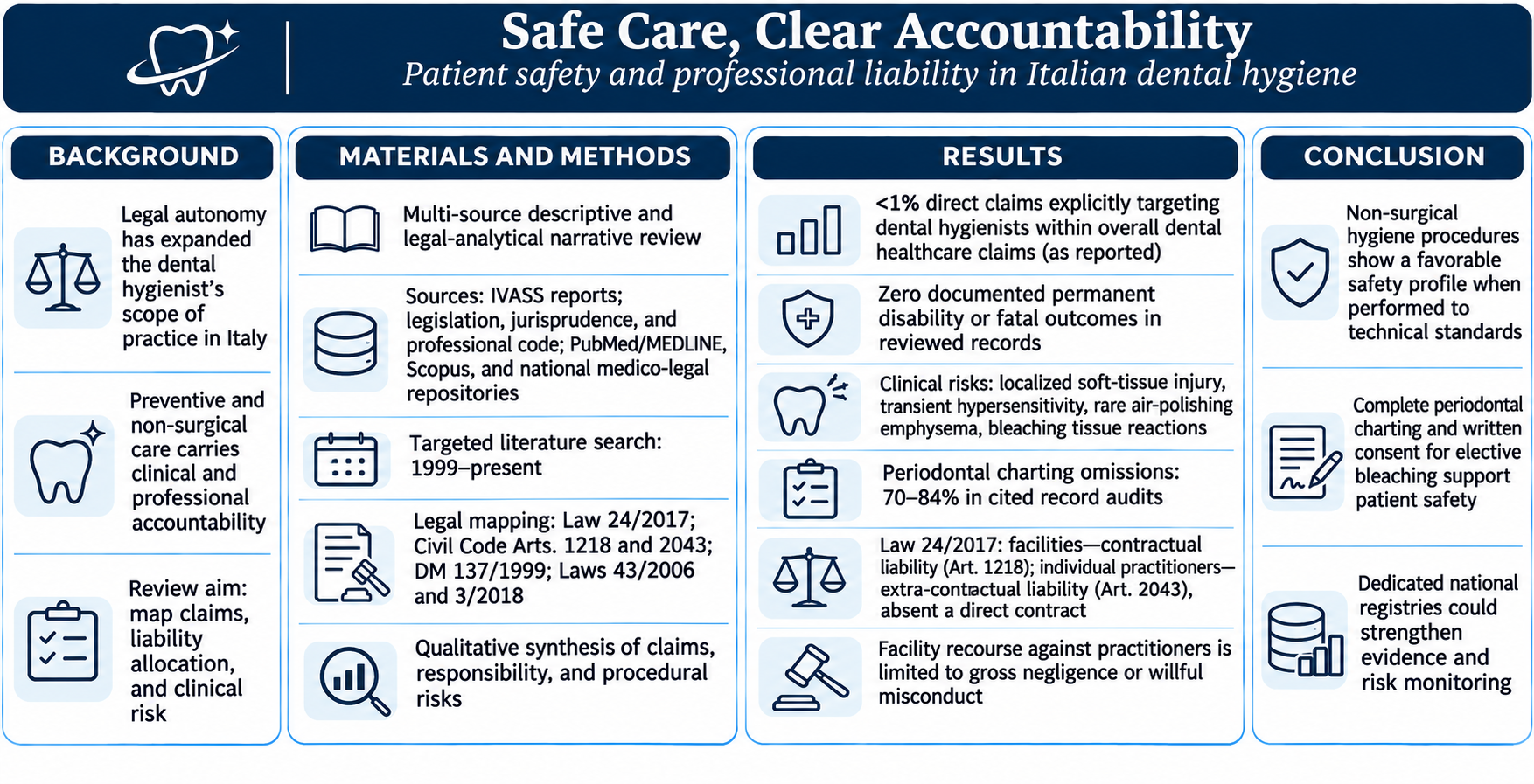
Introduction: Professional liability in dentistry has been extensively investigated, yet studies specifically evaluating the legal exposure, insurance claims, and clinical risk profiles centered on the dental hygienist in Italy remain absent. This study provides the first dedicated inquiry into professional liability within Italian dental hygiene practice, contextualizing statutory autonomy under Law No. 24/2017 (Gelli-Bianco Law) against empirical litigation records. Materials and Methods: A multi-source design was implemented, combining legislative and jurisprudential mapping (Ministerial Decree 137/1999, Law 43/2006, Law 3/2018, Law 24/2017, and Civil Code Articles 1218 and 2043) with quantitative claims metrics retrieved from the Institute for the Supervision of Insurance (IVASS). A targeted bibliographic search across PubMed/MEDLINE and specialized national repositories was conducted, prioritizing Italian empirical data and integrating high-impact international literature. Results: Direct professional liability litigation explicitly targeting dental hygienists accounts for less than 1% of overall dental healthcare claims in Italy, with zero documented cases of permanent disability or fatal outcomes. Primary clinical risk vectors are limited to localized soft-tissue trauma, transient post-operative hypersensitivity, rare emphysema from pneumatic air-polishing, aesthetic expectations in tooth bleaching, and evidentiary vulnerabilities due to incomplete periodontal charting. Conclusions: Non-surgical dental hygiene procedures are exceptionally safe clinical interventions. Legal exposure is heavily mitigated by the statutory liability architecture of Law 24/2017, which limits facility recourse against individual practitioners to instances of proven gross negligence. Maintaining meticulous documentation and written consent for elective treatments will further safeguard clinical quality and professional autonomy.
Keywords:
dental hygiene
; professional liability
; clinical risk management
; healthcare jurisprudence
1. Introduction
Over the past three decades, the professional landscape of dental hygiene in Italy has undergone a profound structural transformation [1,2]. Historically positioned as auxiliary technical personnel under direct clinical oversight, Italian dental hygienists have progressively achieved formal recognition as autonomous healthcare professionals [1]. This legislative evolution originated with Ministerial Decree No. 137/1999, which established the specific professional profile (Profilo Professionale), and was consolidated by Law No. 43/2006 and the subsequent establishment of the National Federation of Orders of Medical Radiographers and Technical, Rehabilitation and Prevention Health Professions (FNO TSRM e PSTRP) under Law No. 3/2018 [1,2,3].
This expanding scope of practice grants dental hygienists operational autonomy in preventive procedures, non-surgical periodontal therapy, oral health education, and topical therapeutic applications [4]. However, this institutional independence carries a proportional increase in clinical responsibility. In contemporary healthcare delivery, professional autonomy is intrinsically linked to legal accountability, exposing practitioners to direct patient claims and professional liability disputes [4,5].
The regulatory framework governing healthcare liability in Italy experienced a paradigm shift with the enactment of Law No. 24/2017 (commonly known as the Gelli-Bianco Law) [6]. Designed to curb defensive medicine while guaranteeing compensation for injured patients, Law 24/2017 bifurcated healthcare liability into two distinct statutory regimes: contractual liability (responsabilità contrattuale ex Art. 1218 Italian Civil Code) for healthcare facilities and dental practice owners, and extra-contractual liability (responsabilità extracontrattuale ex Art. 2043 Italian Civil Code) for individual practitioners, unless a direct contract is signed between the patient and the practitioner [6,7]. Furthermore, the law mandated professional indemnity insurance for all practicing healthcare professionals and regulated the facility’s right of recourse against practitioners solely to instances of intentional misconduct or gross negligence [6].
Within dentistry, medical malpractice claims represent a well-documented segment of civil litigation [5,8]. National supervisory data provided by the Institute for the Supervision of Insurance (IVASS) demonstrate that while overall healthcare claim frequency among allied health operators remains modest compared to surgical disciplines, the economic burden of mature claims across dental and health services remains substantial [9]. Within this framework, dental hygienists operate in a complex medico-legal space: while their overall litigation rate is substantially lower than that of general dentists or oral surgeons, they remain susceptible to claims arising from iatrogenic soft-tissue trauma, missed or unrecorded periodontal diagnoses, adverse events during cosmetic procedures (e.g., in-office bleaching), and deficiencies in informed consent or adherence to national prevention guidelines [4,8,10].
Despite the growing clinical autonomy of dental hygienists and the stringent mandates of the Gelli-Bianco law, targeted empirical literature evaluating insurance claim metrics, specific liability drivers, and litigation dynamics for dental hygienists in Italy remains scarce. Most existing legal-medical analyses treat dental practice litigation as a homogenous entity, often failing to isolate the specific procedural risks associated with dental hygiene practice or the burden-sharing mechanisms between practice owners and employed or self-employed hygienists [5,8,9].
To address this knowledge gap, this study examines the landscape of professional liability and clinical risk among Italian dental hygienists. By synthesizing data from institutional reports, jurisprudence, insurance risk assessments, and professional board directives, this paper aims to: (i) quantify the frequency and typology of liability claims involving dental hygienists in Italy, (ii) evaluate the legal mechanisms governing responsibility distribution under Law 24/2017, and (iii) propose clinical risk management strategies to enhance patient safety and mitigate litigation exposure.
2. Materials and Methods
2.1. Study Design and Institutional Data Retrieval
Given the structural scarcity of publicly accessible centralized registries for closed civil claims and insurance disputes involving allied health professions in Italy, this study adopts a multi-source descriptive and legal-analytical methodology. To the best of the authors’ knowledge, this paper represents the first dedicated investigation specifically addressing professional liability, insurance claim metrics, and litigation drivers concerning dental hygienists in Italy.
Due to the private nature of professional indemnity insurance data—which prevents direct public access to individual closed claim files—this research overcomes empirical data limitations by performing a comprehensive systematic synthesis of institutional supervisory reports, regulatory frameworks, medico-legal literature, and jurisprudence.
The methodological framework was structured into three core phases:
- Institutional and Regulatory Data Retrieval: Official administrative and statistical datasets published by the Italian Institute for the Supervision of Insurance (IVASS) were evaluated to assess macro-economic trends and claim frequency patterns within general and healthcare civil liability sectors.
- Legal and Jurisprudential Review: Statutory provisions governing healthcare responsibility—specifically Ministerial Decree No. 137/1999, Law No. 43/2006, Law No. 3/2018, and Law No. 24/2017 (Gelli-Bianco Law)—alongside the National Code of Ethics for Dental Hygienists (FNO TSRM e PSTRP), were systematically cross-referenced to define the legal boundaries of professional autonomy and burden-sharing mechanisms.
- Literature Screening and Qualitative Synthesis: A targeted search of indexed medical-legal and dental literature (including PubMed and institutional repositories) was conducted to isolate procedural risk profiles associated with dental hygiene practices (such as non-surgical periodontal therapy, scaling, and topical applications) compared to general dental litigation models.
Data were qualitatively categorized to identify primary liability drivers, clinical settings of risk exposure, and the distribution of legal responsibility between independent practitioners, employees, and dental practice facilities under current Italian civil law.
2.2. Regulatory and Jurisprudential Mapping
A comprehensive legislative and legal mapping was performed to define the statutory framework governing the scope of practice and professional liability of dental hygienists in Italy. Core legislative acts were systematically reviewed, including Ministerial Decree No. 137/1999 (establishing the professional profile), Law No. 43/2006, Law No. 3/2018 (establishing the mandatory professional order and register), and Law No. 24/2017 (the Gelli-Bianco Law governing healthcare safety and professional liability). In addition, civil law provisions—specifically Articles 1218 and 2043 of the Italian Civil Code—and the National Code of Ethics for Dental Hygienists were cross-referenced to evaluate the legal bifurcation between contractual and extra-contractual liability, conditions for institutional recourse, and mandatory insurance mandates.
2.3. Literature Search Strategy and Eligibility Criteria
A systematic bibliographic search was conducted across international biomedical databases, primarily PubMed/MEDLINE and Scopus, alongside specialized national medico-legal repositories, covering publications from 1999 to the present. The search strategy utilized Boolean operators combining terms such as “dental hygiene”, “dental hygienist”, “professional liability”, “malpractice”, “adverse events”, “periodontal charting”, “informed consent”, and “Italy”. To ensure high clinical and legal relevance to the Italian healthcare context, the search strategy prioritized peer-reviewed empirical studies, case reports, and medico-legal analyses authored by Italian investigators or directly addressing the national regulatory and operational framework. In instances where specific clinical metrics, procedural risk audits, or ethical-legal parameters lacked dedicated national literature indexed in major biomedical databases, high-impact international peer-reviewed literature retrieved from PubMed/MEDLINE was selected to provide established comparative baselines.
3. Results
The systematic evaluation of institutional data, legislative frameworks, and medico-legal literature yielded a comprehensive narrative concerning professional liability and risk exposure within Italian dental hygiene practice. Overall, the findings reveal a distinct structural dichotomy: while direct insurance claims explicitly targeting dental hygienists remain numerically constrained compared to broader dental malpractice litigation, the formal legal autonomy conferred by the national regulatory framework establishes full, independent personal accountability for clinical acts. To the best of our current knowledge, empirical records indicate that there are no documented cases of judicial or extra-judicial litigation originating from fatal events directly attributable to treatments performed by dental hygienists, confirming that non-surgical prophylaxis and hygiene procedures rank among the safest interventions within dental disciplines, particularly when executed by experienced clinical operators.
3.1. Institutional and Regulatory Data Retrieval
The multi-source descriptive and legal-analytical methodology implemented in this study generated profound insights into the macroeconomic and operational metrics governing healthcare liability in Italy. An examination of the official statistical bulletins published by the Institute for the Supervision of Insurance reveals that direct professional liability claims concerning allied health and technical healthcare operators represent a minimal numerical fraction, remaining consistently below one percent of the overall medico-legal litigation volume nationwide. Despite this low frequency of individual direct filings, mature claims spanning dental and allied health services entail a substantial economic burden and prolonged administrative resolution times, mirroring structural patterns identified in broader healthcare and dental malpractice evaluations. Furthermore, empirical observations confirm that the vast majority of professional liability disputes within dental clinical settings are resolved outside the courtroom through out-of-court financial settlements and bilateral compromises rather than formal judicial adjudications, underscoring a preference for risk mitigation and rapid financial closure by insurance carriers.
3.2. Legal and Jurisprudential Review
Regarding the statutory and jurisprudential review, the rigorous cross-referencing of core legislative provisions—specifically Ministerial Decree No. 137/1999, Law No. 43/2006, Law No. 3/2018, and Law No. 24/2017—alongside the National Code of Ethics for Dental Hygienists, delineates a precise and demanding legal architecture for the profession. The historical progression from an auxiliary support function to the formal recognition of dental hygienists as autonomous healthcare professionals entails complete independent accountability for preventive and non-surgical procedures performed at the chairside. Under the statutory framework established by the Gelli-Bianco Law, civil liability is formally bifurcated into contractual liability pursuant to Article 1218 of the Italian Civil Code, primarily affecting healthcare facilities, corporate entities, and private practice owners, and extra-contractual liability pursuant to Article 2043 in the case of individual practitioners, unless a direct professional services contract has been formally established between the patient and the hygienist. While mandatory professional indemnity insurance provides essential legal protection for the practitioner, the facility’s statutory right of recourse against the hygienist remains strictly restricted by legislative mandate exclusively to instances of gross negligence or willful misconduct, thereby establishing a high threshold for internal liability attribution.
3.3. Literature Screening and Qualitative Synthesis
Finally, the comprehensive literature screening and qualitative synthesis—informed by broader medico-legal evaluations analyzing adverse events, documentation vulnerabilities, and clinical safety in dental practice—successfully isolate the primary procedural risk profiles and clinical litigation drivers associated with contemporary dental hygiene practice. Empirical adverse event audits in dental care demonstrate that overall adverse outcomes occur at a rate of approximately 3 events per 100 patients per year, with the vast majority stemming from non-lethal, preventable technical or diagnostic deviations [11]. Within dental hygiene settings, the physical basis for clinical claims primarily centers on iatrogenic soft-tissue trauma, gingival lacerations, and thermal or mechanical injuries resulting from the improper handling of ultrasonic scaling devices or manual periodontal instruments [12]. Secondary legal liabilities frequently originate from severe omissions in periodontal screening and monitoring, specifically failures to perform, document, or effectively communicate baseline periodontal charting and deep pocket detections to the supervising dentist—a clinical documentation gap observed in up to 84% of evaluated patient records in peer-reviewed studies—which can lead to delayed diagnoses, disease progression, or the execution of incompatible secondary treatments [13]. Additionally, emerging risk vectors involve adverse local tissue reactions and chemical injuries during cosmetic procedures such as in-office bleaching, which are frequently compounded by systemic deficiencies in documenting comprehensive informed consent and respecting patient autonomy regarding alternative therapeutic options and potential procedural risks [14,15]. Furthermore, clinical safety audits and emergency medicine reporting in Italy highlight rare but distinctive iatrogenic complications associated with mechanical and pneumatic instrumentation during dental hygiene procedures. Specific clinical cases document the occurrence of cervicofacial subcutaneous emphysema—occasionally extending to pneumomediastinum—triggered by the inadvertent air entrapment through deep periodontal pockets, mucosal lacerations, or disrupted mucosal barriers during air-polishing and air-powder debridement therapy [16,17,18]. Although these events typically follow a benign clinical course when promptly recognized and managed conservatively with antibiotic coverage, they represent significant technical adverse events resulting from nozzle misdirection or high-pressure airflow application on compromised soft tissues [16,17]. Consequently, such complications underscore the critical role of operator expertise in managing pneumatic technologies and emphasize the necessity of detailing device-specific procedural risks within written informed consent protocols [18].
The empirical metrics, regulatory dimensions, and procedural risk vectors identified across institutional databases and medico-legal literature are synthetically outlined in Table 1.
4. Discussion
The analytical synthesis of empirical data, legislative frameworks, and clinical literature reveals a nuanced portrait of professional liability in Italian dental hygiene—one characterized by a striking dichotomy between regulatory exposure and documented litigation reality. A central strength and defining novelty of this investigation lies in its pioneer design: to the best of our knowledge, this study represents the first comprehensive inquiry specifically tailored to the professional figure of the dental hygienist within the Italian legal, economic, and clinical ecosystem. While previous medico-legal literature has predominantly examined dental malpractice through a generalized lens centered on the dentist or the healthcare facility, this work isolates the specific risk vectors, statutory duties, and liability profiles unique to independent dental hygiene practice.
Crucially, the empirical evidence and institutional reports retrieved in this study demonstrate that non-surgical dental hygiene procedures are remarkably safe clinical interventions. As evidenced by national insurance metrics published by IVASS [9], direct professional liability claims explicitly targeting dental hygienists represent a minimal fraction—consistently remaining below one percent—of overall healthcare litigation in Italy. Furthermore, the systematic screening of legal repositories confirms that there are no documented judicial precedents or insurance records involving permanent disabling injuries or fatal outcomes directly attributable to treatments executed by dental hygienists. This empirical finding reinforces the understanding that preventive oral prophylaxis, mechanical scaling, and periodontal maintenance rank among the safest procedures across all health professions, provided they are executed in accordance with established clinical guidelines and technical standards.
The primary explanation for this quantitative discrepancy between theoretical legal exposure and effective courtroom litigation resides in the operational structure of Italian dental practice and the civil liability architecture established by Law No. 24/2017 (the Gelli-Bianco Law) [6]. In the vast majority of clinical settings, dental hygiene services are rendered within private clinics or polyclinics where the contractual relationship—governed by Article 1218 of the Italian Civil Code [19]—attaches directly to the healthcare facility or practice owner. When a patient experiences a substandard outcome, financial compensation claims are almost universally directed against the facility’s primary insurance policy. Because Article 2043 of the Civil Code governs the extra-contractual liability of individual practitioners [20], and because the facility’s statutory right of recourse against the hygienist is strictly restricted by Law 24/2017 [6] to instances of proven gross negligence or intentional misconduct, individual practitioners remain structurally insulated from routine financial disputes.
Despite this structural insulation, analyzing procedural risk vectors remains vital for advancing patient safety and clinical diligence. Overall adverse outcome rates in dental settings remain low—approximately 3 events per 100 patients per year as quantified by Tokede et al. [11]—with specific hygiene hazards primarily restricted to localized, non-lethal soft-tissue trauma and post-treatment transient dentin hypersensitivity. As highlighted by Graziani et al. [12], transient hypersensitivity following root planing affects a substantial proportion of periodontal patients; while biologically transient and non-iatrogenic, it highlights the importance of transparent communication and pre-treatment disclosure to ensure an optimal patient experience.
A key domain for clinical diligence resides in thorough documentation, particularly regarding baseline periodontal screening. Peer-reviewed audits such as those by McAndrew et al. [13] demonstrate that complete periodontal charting and systemic recording of pocket depths are routinely omitted in up to 80% of standard patient files. In Italian medico-legal evaluation, as emphasized in national forensic dentistry analyses by Torresi, maintaining precise records of periodontal probing depth, bleeding indices, and tooth mobility serves as an invaluable diagnostic asset and protective record, demonstrating diligent monitoring and timely periodontic management [21].
Equally manageable are cosmetic interventions, such as in-office tooth bleaching. As discussed by Rao & Saha [15], aesthetic procedures carry high patient expectations regarding shade improvement. Because cosmetic treatments represent elective care, securing detailed, written informed consent that explicitly outlines realistic treatment outcomes, potential shade relapse, and mild transient sensitivity—as detailed by Cecchi & Grillo—fulfills duty-of-care obligations while reinforcing trust between practitioner and patient [22].
Technological advancements such as air-polishing and air-powder debridement further reflect the sophistication of modern preventive care. While rare technical events like subcutaneous emphysema are described in clinical literature—such as cases reviewed by Bocchialini et al. [16], Paiardi et al. [17], and La Monaca et al. [18] —these isolated occurrences almost universally resolve spontaneously and completely under simple conservative management without long-term sequelae. When operated within manufacturer guidelines and with proper nozzle orientation, these advanced pneumatic tools provide exceptional therapeutic efficacy with an outstanding safety profile.
Ultimately, the findings of this study provide strong reassurance for the profession: Italian dental hygienists deliver highly effective, minimally invasive, and exceptionally safe preventive care. The combination of high clinical safety margins, favorable legislative protections under Law 24/2017 [6], and a remarkably low litigation footprint underscores the high professional standards of modern dental hygiene practice in Italy.
Limitations of the Study
Several methodological limitations must be acknowledged when interpreting the findings of this study. First, the quantitative assessment of insurance litigation relies on aggregated national insurance databases (IVASS) and published jurisprudence, which predominantly capture formal legal actions and mature claims. Because a substantial proportion of minor dental disputes in Italy are resolved through informal, out-of-court financial settlements or bilateral agreements between practice owners and patients without registering as formal claims against individual hygienists, the absolute frequency of minor clinical grievances may be underreported. Second, the available peer-reviewed literature specifically addressing dental hygiene liability in Italy remains relatively scarce, necessitating the integration of broader dental malpractice data and high-impact international comparative studies to contextualize specific risk vectors. Finally, while this study provides a comprehensive analysis of the statutory framework under the Gelli-Bianco Law, ongoing regional variations in healthcare management and local insurance policies across Italian regions may introduce slight operational discrepancies in how recourse claims and risk management practices are implemented in individual clinical facilities.
5. Conclusions
This investigation represents the first study specifically dedicated to evaluating professional liability and clinical risk factors centered on the dental hygienist within the Italian healthcare and legal framework. By isolating the statutory profile and clinical reality of dental hygiene from generalized dental malpractice data, this work establishes an unprecedented benchmark for the discipline. The evidence confirms that non-surgical dental hygiene procedures are safe clinical interventions. Direct litigation against dental hygienists remains extremely rare in Italy, with zero recorded instances of severe disabling injuries or fatal outcomes. Minor procedural adverse events are transient, clinically manageable, and carry minimal long-term morbidity. Maintaining this high safety profile requires systematic periodontal charting, detailed written informed consent for aesthetic treatments, and strict adherence to technical guidelines. Establishing dedicated national registries will further consolidate clinical excellence and safeguard professional autonomy in Italian dental hygiene practice.
Author Contributions
Conceptualization, S.D. and G.V.; methodology, S.D.; software, S.D.; validation, S.D., G.V. and M.D.; formal analysis, S.D.; investigation, S.D.; resources, S.D.; data curation, S.D.; writing—original draft preparation, S.D.; writing—review and editing, S.D.; visualization, G.V.; supervision, M.D.; project administration, S.D. . All authors have read and agreed to the published version of the manuscript.
Funding
This research received no external funding.
Institutional Review Board Statement
Not applicable.
Informed Consent Statement
Not applicable.
Data Availability Statement
The raw data supporting the conclusions of this article will be made available by the authors on request.
Acknowledgments
During the preparation of this manuscript, the authors used Gemini AI for the purposes of checking English language. Furthermore, the authors used Chat GPT (Version GPT-5.5) for the purpose of creating the graphical abstract. The authors have reviewed and edited the output and take full responsibility for the content of this publication.
Conflicts of Interest
The authors declare no conflicts of interest.
Abbreviations
The following abbreviations are used in this manuscript:
| IVASS | Institute for the Supervision of Insurance |
| MD | Ministerial Decree |
References
- Italian Ministry of Health. Ministerial Decree No. 137 of March 15, 1999: Regulation identifying the profile and core competencies of the dental hygienist [Decreto Ministeriale 15 marzo 1999, n. 137]; Official Gazette of the Italian Republic No. 114: Rome, Italy, 1999. Available online: https://www.gazzettaufficiale.it/atto/serie_generale/caricaDettaglioAtto/originario?atto.dataPubblicazioneGazzetta=1999-05-18&atto.codiceRedazionale=099G0214&elenco30giorni=false (accessed on 01 September 2026).
- Italian Parliament. Law No. 43 of February 1, 2006: Provisions concerning nursing, midwifery, rehabilitation, health-technical, and prevention professions [Legge 1 febbraio 2006, n. 43]; Official Gazette of the Italian Republic No. 40: Rome, Italy, 2006; Available online: https://www.parlamento.it/parlam/leggi/06043l.htm (accessed on 01 September 2026).
- Italian Parliament. Law No. 3 of January 11, 2018: Provisions on clinical trials of medicines and reorganization of healthcare professions [Legge 11 gennaio 2018, n. 3]; Official Gazette of the Italian Republic No. 25: Rome, Italy, 2018; Available online: https://www.gazzettaufficiale.it/eli/id/2018/1/31/18G00019/sg (accessed on 01 September 2026).
- National Federation of Orders of Medical Radiographers and Technical; Rehabilitation and Prevention Health Professions (FNO TSRM e PSTRP). Code of Ethics for Dental Hygienists [Codice Deontologico dell’Igienista Dentale]; National Board of Dental Hygienists: Rome, Italy, 2021; Available online: https://www.tsrm-pstrp.org/wp-content/uploads/2021/11/IGIENISTI-DENTALI-Codice-deontologico-2021.pdf (accessed on 01 September 2026).
- Montagna, F.; Manfredini, D.; Nuzzolese, E. Professional liability and structure of litigation in dentistry. Minerva Stomatol English, Italian. 2008, 57(7-8), 349-54, 354-7. [Google Scholar] [PubMed]
- Italian Parliament. Law No. 24 of March 8, 2017: Provisions concerning the safety of care and the assisted person, as well as the professional liability of healthcare practitioners (Gelli-Bianco Law) [Legge 8 marzo 2017, n. 24]; Official Gazette of the Italian Republic No. 64: Rome, Italy, 2017; Available online: https://www.gazzettaufficiale.it/eli/id/2017/03/17/17G00041/s (accessed on 01 September 2026).
- Cammarano, A.; Maurici, M.; Giammatteo, J.; Cherra, F.P.; Capanna, A.; Giannini, S.; Scerbo, F.; Docimo, R. The civil liability of paediatric dentists in Italy. Trains of thought on novelties introduced by law n. 24/2017 (“Gelli-bianco” law). Eur. J. Paediatr. Dent. 2019, 20(2), 147–150. [Google Scholar] [CrossRef] [PubMed]
- Ferrara, M.; Pascale, N.; Ciavarella, M.; Bertozzi, G.; Bellettieri, A.P.; Di Fazio, A. Is It Still Time for Safety Walkaround? Pilot Project Proposing a New Model and a Review of the Methodology. Medicina 2024, 60(6), 903. [Google Scholar] [CrossRef] [PubMed] [PubMed Central]
- Institute for the Supervision of Insurance (IVASS). Statistical Bulletin: General and Healthcare Civil Liability Risks [Bollettino Statistico: I rischi da responsabilità civile generale e sanitaria]; IVASS: Rome, Italy, 2025; Available online: https://www.ivass.it/pubblicazioni-e-statistiche/statistiche/bollettino-statistico/2025/n-03-2025/BOLLETTINO_rcg_sanitaria_2025.pdf (accessed on 01 September 2026).
- Italian Ministry of Health. National Guidelines for the Promotion of Oral Health and the Prevention of Oral Diseases [Linee guida nazionali per la promozione della salute orale e la prevenzione delle patologie orali]; Ministry of Health: Rome, Italy, 2013; Available online: https://www.salute.gov.it/new/it/pubblicazione/linee-guida-nazionali-la-promozione-della-salute-orale-e-la-prevenzione-delle-1/ (accessed on 01 September 2026).
- Tokede, O.; Walji, M.; Ramoni, R.; Rindal, D.B.; Worley, D.; Hebballi, N.; Kumar, K.; van Strien, C.; Chen, M.; Navat-Pelli, S.; Liu, H.; Etolue, J.; Yansane, A.; Obadan-Udoh, E.; Easterday, C.; Enstad, C.; Kane, S.; Rush, W.; Kalenderian, E. Quantifying Dental Office-Originating Adverse Events: The Dental Practice Study Methods. J. Patient Saf. 2021, 17(8), e1080–e1087. [Google Scholar] [CrossRef] [PubMed] [PubMed Central]
- Graziani, F.; Tinto, M.; Orsolini, C.; Izzetti, R.; Tomasi, C. Complications and treatment errors in nonsurgical periodontal therapy. Periodontol. 2000 2023, 92(1), 21–61. [Google Scholar] [CrossRef] [PubMed]
- McAndrew, R.; Ban, J.; Playle, R. A comparison of computer- and hand-generated clinical dental notes with statutory regulations in record keeping. Eur. J. Dent. Educ. 2012, 16(1), e117-21. [Google Scholar] [CrossRef] [PubMed]
- Ahmed, M.A.; Alotaibi, R.M.; Alqubali, H.F.; Almutiry, H.B.; Barnawi, S.S.; Hawsawi, M.A.; Basakran, B.A.; Alsaleem, A.I. Iatrogenic mistakes in dentistry, when to disclose: a literature review. Int. J. Community Med. Public Health 2025, 12(3), 1515–1522. [Google Scholar] [CrossRef]
- Rao, M.; Saha, S. Ethical considerations in dental bleaching: Patient rights, informed consent, and professional responsibility. Am. J. Dent. 2025, 38(SIA), 4A–8A. [Google Scholar] [PubMed]
- Bocchialini, G.; Ambrosi, S.; Castellani, A. Massive Cervicothoracic Subcutaneous Emphysema and Pneumomediastinum Developing during a Dental Hygiene Procedure. Case Rep. Dent. 2017, 2017, 7016467. [Google Scholar] [CrossRef] [PubMed] [PubMed Central]
- Paiardi, S.; Baggio, S.; Pivato, C.A.; Fedeli, C.; Voza, A. Cervicofacial emphysema after a dental hygiene procedure: a case report. It J. Emerg. Med. 2018. [Google Scholar] [CrossRef]
- La Monaca, G.; Pranno, N.; Annibali, S.; Vozza, I.; Cristalli, M.P. Subcutaneous Facial Emphysema Following Open-Flap Air-Powder Abrasive Debridement for Peri-Implantitis: A Case Report and an Overview. Int. J. Environ. Res. Public Health 2021, 18(24), 13286. [Google Scholar] [CrossRef] [PubMed] [PubMed Central]
- Article 1218 of the Italian Civil Code. Available online: https://www.codice-civile-online.it/codice-civile/articolo-1218-del-codice-civile (accessed on 03 Novembre 2026).
- Article 2043 of the Italian Civil Code. Available online: https://www.codice-civile-online.it/codice-civile/articolo-2043-del-codice-civile (accessed on 03 Novembre 2026).
- Torresi, G.P. Il sondaggio parodontale in ambito di medicina legale odontoiatrica. Manag Odontoiatr. 2024, 1, 15–22. Available online: https://www.managementodontoiatrico.it/a/medicina-forense/080124-torresi/il-sondaggio-parodontale-in-ambito-di-medicina-legale-odontoiatrica (accessed on 03 Novembre 2026).
- Cecchi, R.; Grillo, A. Il consenso informato in igiene dentale: proposta di una modulistica. Odontoiatria33 2020, 42(1), 112–120. Available online: https://www.odontoiatria33.it/gestione-dello-studio/4151/il-consenso-informato-in-igiene-dentale-proposta-di-una-modulistica.html (accessed on 03 Novembre 2026).

Table 1.
Synoptic overview of clinical risk profiles, documentation vulnerabilities, and legislative/institutional framework in Italian dental hygiene practice.
Table 1.
Synoptic overview of clinical risk profiles, documentation vulnerabilities, and legislative/institutional framework in Italian dental hygiene practice.
| Category / Domain | Primary Findings & Key Metrics | Clinical & Medico-Legal Implications | Key References / Source |
| Institutional Claims & Insurance Data | Direct insurance claims explicitly targeting dental hygienists represent <1% of overall healthcare litigation in Italy. High rate of extra-judicial settlements. | Low structural claim volume; high rate of out-of-court financial settlements preferred by carriers to minimize litigation overhead. | IVASS Reports [9] Law 24/2017 [6] |
| Legal & Regulatory Framework | Formal transition from auxiliary status to autonomous healthcare professional. Civil liability split into contractual (facilities) and extra-contractual (individual practitioners). | Direct, independent personal accountability for preventive clinical acts; facility recourse limited strictly to gross negligence or willful misconduct. | MD 137/1999 [1] Law 43/2006 [2] Law 3/2018 [3] Law 24/2017 [6] |
| Adverse Event Incidence | Overall dental office-originating adverse outcomes occur at approximately 3 events per 100 patients per year. Total absence of documented fatal events | Hygiene procedures rank among the safest in dentistry; adverse outcomes are non-lethal, technical, and largely preventable. | Tokede et al. (2021) [11] |
| Periodontal Documentation Gaps | Omission or incomplete recording of baseline periodontal charting and pocket depth measurements observed in 70–84% of conventional dental records. | Represents the leading secondary legal liability vector; leads to delayed diagnosis of periodontitis or improper treatment execution. | McAndrew et al. (2012) [13] |
| Iatrogenic Soft-Tissue Traumas | Gingival lacerations, localized tissue trauma, thermal/mechanical insults, and post-treatment transient dentin hypersensitivity (up to 50–75% of non-surgical periodontal patients) | Hypersensitivity is a benign, transient outcome rather than iatrogenic damage; soft-tissue trauma stems from manual or ultrasonic handling errors. | Graziani et al. (2023) [12] |
| Cosmetic & Bleaching Procedures | Risk of localized chemical burns/tissue reactions; vulnerabilities regarding inadequate written informed consent and patient autonomy disclosure. | High frequency of patient dissatisfaction in aesthetic treatments; emphasizes the necessity of rigorous consent documentation. | Rao & Saha (2025) [15] |
| Pneumatic Complications (Air-Polishing) | Rare instances of cervicofacial subcutaneous emphysema and pneumomediastinum following high-pressure air-powder application. | Technical adverse event caused by nozzle misdirection into deep pockets (>4 mm) or compromised mucosal barriers; high relevance for informed consent warnings. | Bocchialini et al. (2017) [16] Paiardi et al. (2018) [17] La Monaca et al. (2021) [18] |
Disclaimer/Publisher’s Note: The statements, opinions and data contained in all publications are solely those of the individual author(s) and contributor(s) and not of MDPI and/or the editor(s). MDPI and/or the editor(s) disclaim responsibility for any injury to people or property resulting from any ideas, methods, instructions or products referred to in the content. |
© 2026 by the authors. Licensee MDPI, Basel, Switzerland. This article is an open access article distributed under the terms and conditions of the Creative Commons Attribution (CC BY) license (http://creativecommons.org/licenses/by/4.0/).
Copyright: This open access article is published under a Creative Commons CC BY 4.0 license, which permit the free download, distribution, and reuse, provided that the author and preprint are cited in any reuse.