
Submitted:
11 November 2026
Posted:
13 November 2026
You are already at the latest version
Abstract
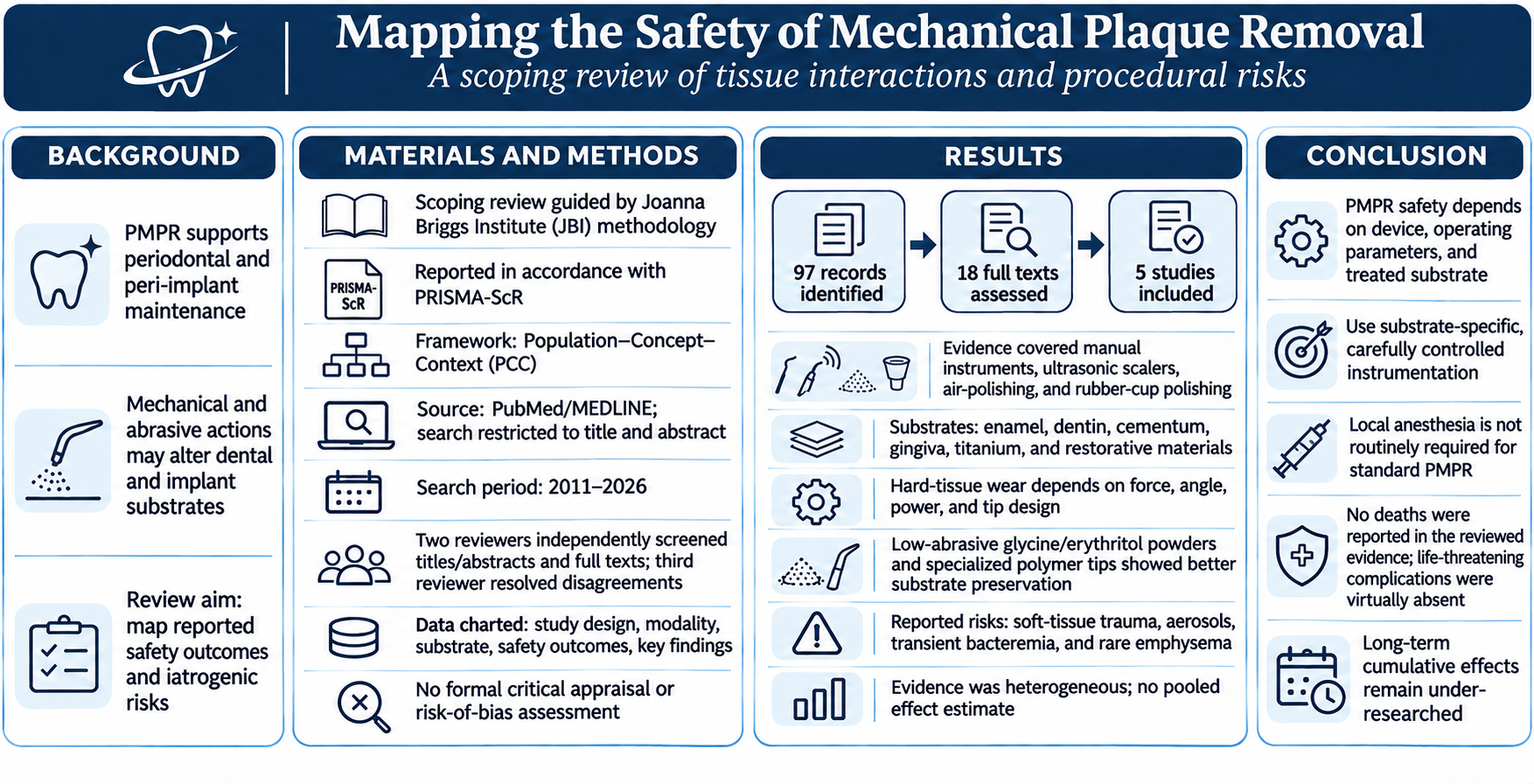
Background: Professional mechanical plaque removal (PMPR) is an established cornerstone of periodontal and peri-implant therapy, yet a comprehensive mapping of its associated iatrogenic risks and hard tissue modifications remains methodologically fragmented. This scoping review mapped the current literature regarding the safety profiles and substrate alterations resulting from contemporary PMPR modalities. Methods: Conducted in strict adherence to Joanna Briggs Institute methodology and PRISMA-ScR guidelines, a literature search was executed on PubMed/MEDLINE without date restrictions. Eligible studies were screened based on predefined Population, Concept, and Context (PCC) criteria. Two independent reviewers performed a two-stage screening process, with consensus achieved via a third reviewer. Results: From 97 initially identified records, full-text evaluation of 18 eligible articles yielded 5 pivotal studies meeting all quantitative safety criteria. The evidence demonstrates that substrate alterations—including surface roughness, abrasive wear, and structural degradation across enamel, dentin, cementum, and titanium—are critically dependent on device selection, application force, tip geometry, and powder abrasivity. Conclusions: Contemporary PMPR modalities demonstrate a high degree of clinical safety when operated within standardized thresholds; however, iatrogenic substrate degradation remains critically dependent on device selection and application parameters. Establishing standardized quantitative safety metrics is imperative to systematically minimize surface trauma while preserving anatomical and biomaterial integrity.
Keywords:
safety
; iatrogenic risk
; nonsurgical periodontal therapy
; professional mechanical plaque removal
; periodontitis
1. Introduction
Professional Mechanical Plaque Removal (PMPR) constitutes the cornerstone of non-surgical periodontal therapy and the long-term maintenance of both natural dentition and dental implants [1]. Over the past decades, clinical protocols have undergone a substantial paradigm shift, transitioning from traditional hand instrumentation and high-abrasiveness cleaning modalities to sophisticated technological systems [2]. These modern advancements include magnetostrictive and piezoelectric ultrasonic scalers, specialized polymer or metallic inserts, rubber cup polishing, and contemporary air-polishing devices utilizing low-abrasive powders such as glycine and erythritol [3]. The primary therapeutic objective remains consistent: the efficient disruption and removal of pathogenic subgingival and supragingival biofilm and calculus to arrest periodontal inflammation and prevent disease recurrence [4].
However, contemporary clinical periodontology demands an equally rigorous evaluation of treatment safety alongside therapeutic efficacy. Because the mechanisms of action underlying mechanical and powered instrumentation are inherently non-selective, the physical energy or abrasive agents delivered to the tooth or implant surface interact directly with biological structures [5]. Consequently, every clinical intervention carries an inherent potential for iatrogenic alterations, ranging from hard tissue substance loss [6] and root surface roughness to soft tissue trauma and microstructural modifications of implant abutments. Furthermore, the diversification of delivery systems has broadened the spectrum of clinical outcomes to include operational variables, such as localized tissue emphysema, aerosol dissemination, and systemic risks like transient bacteremia [7].
The scientific literature extensively addresses individual facets of PMPR safety, reflecting a growing awareness that aggressive biofilm removal can inadvertently compromise tissue integrity [8]. For instance, early consensus reports and comprehensive evaluations highlighted that conventional ultrasonic instrumentation and hand scaling, when improperly angled or subjected to excessive lateral force, can lead to measurable cementum [5] and dentin loss, as well as post-procedural dentin hypersensitivity and gingival recession [6]. Similarly, the evolution of air-polishing technologies necessitated extensive comparative analyses to contrast highly abrasive sodium bicarbonate powders with biocompatible amino acid or polyol powders, establishing distinct thresholds for soft tissue preservation and the protection of titanium implant surfaces against scratching and surface degradation [9,10,11,12]. More recent investigations continue to refine these parameters, evaluating how specific tip designs, oscillation patterns, and powder particle sizes influence surface roughness and subsequent bacterial colonization across diverse clinical substrates [13,14].
Despite the abundance of studies examining isolated safety variables [15], the existing literature remains fragmented across various technological domains and material sciences. There is a notable lack of comprehensive mapping that synthesizes the broad spectrum of safety outcomes, iatrogenic risks, and tissue interactions associated with contemporary PMPR protocols. Clinicians and researchers require an overarching framework that organizes these diverse findings without presupposing rigid evaluative hierarchies or clinical biases. Therefore, this scoping review aims to comprehensively map and report the current scientific evidence concerning the safety profile, tissue interactions, and potential risks of modern PMPR technologies, providing an objective and transparent overview of how contemporary literature addresses these critical clinical challenges.
2. Materials and Methods
2.1. Study Design and Protocol
This scoping review was conducted in accordance with the Preferred Reporting Items for Systematic Reviews and Meta-Analyses extension for Scoping Reviews (PRISMA-ScR) guidelines and followed the methodological framework for scoping studies outlined by Arksey and O’Malley, as further refined by the Joanna Briggs Institute (JBI) [16,17]. A scoping review design was selected to comprehensively map the available evidence, clarify key concepts, and identify gaps in the literature regarding the safety and iatrogenic potential of PMPR technologies, focusing of the last 15 years (2011-2026).
2.2. Eligibility Criteria
The eligibility criteria were established a priori using the Population, Concept, and Context (PCC) framework:
- Population (P): Studies involving human subjects receiving non-surgical periodontal or peri-implant therapy, as well as in vitro, ex vivo, or animal models evaluating dental or implant substrates (enamel, dentin, cementum, soft tissue, and titanium surfaces).
- Concept (C): Interventions investigating the safety profile, tissue integrity, surface alterations, iatrogenic damage, or operational/systemic risks (e.g., aerosol production, bacteremia, tissue emphysema) associated with PMPR modalities. These modalities include manual scaling, sonic and ultrasonic instrumentation, air-polishing systems (with various powder compositions), and rubber cup or paste polishing.
- Context (C): Any clinical, laboratory, or experimental dental setting.
Inclusion Criteria
Primary research articles (randomized controlled trials, non-randomized clinical studies, prospective and retrospective cohort studies, cross-sectional studies, and in vitro/ex vivo experimental studies), consensus reports, and systematic or narrative reviews that explicitly report safety-related outcomes or tissue interactions of PMPR.
Exclusion Criteria
Studies evaluating solely the therapeutic efficacy of biofilm removal without reporting safety parameters or tissue effects; articles lacking full-text availability; editorials, commentaries, and conference abstracts. No restrictions were applied regarding publication date.
2.3. Information Sources and Search Strategy
A comprehensive literature search was executed in the PubMed/MEDLINE database The search strategy was developed using a combination of keywords and targeted field descriptors joined by Boolean operators (AND, OR). To ensure high specificity, terms were constrained to Title and Abstract fields. The core search string applied was structured as follows:
(“professional mechanical plaque removal”[Title/Abstract] OR “PMPR”[Title/Abstract] OR “air polishing”[Title/Abstract] OR “ultrasonic scaling”[Title/Abstract] OR “periodontal debridement”[Title/Abstract]) AND (“substance loss”[Title/Abstract] OR “root damage”[Title/Abstract] OR “surface roughness”[Title/Abstract] OR “iatrogenic”[Title/Abstract] OR “emphysema”[Title/Abstract] OR “bacteremia”[Title/Abstract]).
The literature search was restricted to publications released over a 15-year period (2011–2026).
Reference lists of included articles and relevant review papers were manually screened to identify additional eligible studies.
2.4. Selection of Sources of Evidence
All identified records retrieved from the PubMed/MEDLINE search were systematically organized for screening against the predefined eligibility criteria. Records underwent a two-stage screening process conducted independently by two reviewers:
- ○
- Title and Abstract Screening: Initial assessment of titles and abstracts to exclude records failing to meet the eligibility criteria.
- ○
- Full-Text Evaluation: Potentially eligible articles were retrieved in full text and evaluated to confirm inclusion based on the PCC framework.
Any discrepancies between reviewers at either stage were resolved through direct discussion or, when necessary, via consultation with a third independent reviewer. Additionally, reference lists of included articles and relevant review papers were manually screened to ensure literature coverage. Data charting was performed using a standardized template to record study design, PMPR modality, target substrate, safety outcomes, and primary findings. The complete selection workflow is documented in accordance with the PRISMA-ScR flow diagram.
2.5. Data Charting and Synthesis
Data extraction was performed using a standardized data charting form designed for this review. For each included source, the following parameters were charted: author(s), year of publication, study design/model (in vivo, ex vivo, in vitro), PMPR technology evaluated, target substrate/tissue, specific safety or iatrogenic parameters assessed, and key findings regarding tissue safety or surface alterations.
Titles and abstracts were independently screened by two reviewers based on predefined eligibility criteria. Full-text articles of potentially relevant studies were subsequently retrieved and evaluated independently by both reviewers. Any discrepancies or disagreements during the screening and selection process were resolved through discussion or, if necessary, by consulting a third independent reviewer. Additionally, reference lists of all included articles and relevant review papers were manually screened to identify any further eligible studies.
In line with scoping review methodology and the JBI guidance, formal critical appraisal or risk of bias assessment of individual studies was not performed, as the primary objective was to map the extent and nature of available evidence rather than provide a pooled effect estimate. Findings were synthesized narratively and categorized into core safety domains: hard tissue integrity, soft tissue and peri-implant compatibility, and operational/systemic safety considerations.
3. Results
3.1. Synthesis of Literature Search and Selection Process
The initial comprehensive electronic search across PubMed/MEDLINE identified 97 records. No duplicate records were encountered given the single-database search strategy constrained to specified field tags. During the initial screening phase based on titles and abstracts, 79 records were excluded as they failed to meet the predefined inclusion criteria; the majority of these excluded studies focused solely on therapeutic efficacy metrics (e.g., reductions in probing depth, clinical attachment level gains, or bleeding on probing) without incorporating standardized safety or iatrogenic risk evaluations. A total of 18 full-text articles were subsequently retrieved and subjected to detailed eligibility assessment. Following full-text evaluation, 13 articles were excluded for specific methodological reasons: lack of quantitative safety or substrate degradation parameters (n = 7), evaluation of non-mechanical or exclusively chemical debridement modalities (n = 4), and absence of comparative baseline or device parameters (n = 2). Ultimately, 5 pivotal studies met all eligibility criteria and were included in the final narrative synthesis. The complete selection pathway, outlining the progression from initial record identification to final study inclusion in accordance with PRISMA-ScR guidelines, is illustrated in Figure 1.
3.2. Characteristics of Included Studies
The 5 selected studies represent a focused body of evidence published between 2011 and 2026, comprising controlled clinical trials, in vitro and ex vivo experimental substrate evaluations, and authoritative European Federation of Periodontology (EFP) expert consensus statements. The investigations evaluated a spectrum of contemporary PMPR modalities, including conventional hand instrumentation (curettes), sonic and magnetostrictive/piezoelectric ultrasonic scalers, rubber cups with abrasive prophylaxis pastes, and air-polishing devices utilizing low-abrasivity powders (glycine and erythritol) versus traditional sodium bicarbonate.
The primary target substrates evaluated across the literature encompassed natural hard dental tissues (root cementum, dentin, enamel), soft tissue structures (gingival epithelium and peri-implant mucosa), and restorative or implant biomaterials (commercially pure titanium surfaces and dental ceramics). Quantitative outcomes were predominantly assessed via surface profilometry, scanning electron microscopy (SEM), and standardized clinical safety indices. The key extracted parameters, methodological designs, and main findings are synthesized in Table 1.
3.3. Hard Tissue Integrity, Substrate Modifications, and Abrasive Wear
The direct mechanical and hydrodynamic interaction between PMPR instruments and dental hard tissues (enamel, cementum, and dentin) represents a primary focal point in the literature, revealing a delicate balance between therapeutic biofilm elimination and iatrogenic structure loss.
Ultrasonic and Sonic Instrumentation Mechanics
Evidence indicates that hard tissue alterations, measured primarily as vertical substance loss and profilometric surface roughness (Ra), are heavily modulated by operational parameters. High power settings, excessive lateral forces applied by the operator, and incorrect tip adaptation angles (such as a chisel-like perpendicular orientation rather than a tangential sweeping motion) exponentially increase cementum and dentin removal. Conversely, the implementation of specialized instrument designs—such as polymer-coated inserts, carbon-fiber tips, or micro-miniature configurations—significantly mitigates structural abrasion on exposed root surfaces while retaining sufficient debridement efficacy [20].
Manual Instrumentation Dynamics
Traditional manual instruments (curettes and scalers) demonstrate distinct abrasive patterns characterized by localized gouging, grooving, and linear scratching of the root surface. The cumulative loss of root substance is directly proportional to the number of working strokes, the sharpness of the cutting edge, and the applied lateral pressure. While manual instrumentation offers superior tactile feedback, repeated scaling strokes on exposed cementum frequently lead to extensive cratering and structural thinning [5,8,22].
Clinical Sequelae and Symptoms
Microscopically, these mechanically induced surface alterations translate into clinically tangible consequences. The removal of the protective cementum layer exposes underlying dentinal tubules, precipitating or exacerbating post-procedural dentin hypersensitivity. Furthermore, mechanical debridement in areas with thin biotypes or compromised attachment apparatuses frequently accelerates localized gingival recession, presenting a secondary clinical challenge during long-term periodontal maintenance [19].
3.4. Soft Tissue Trauma and Peri-Implant Substrate Compatibility
Soft tissue safety encompasses both acute intraoperative trauma to the periodontal and peri-implant mucosa and the microstructural preservation of biomaterial surfaces during supportive therapy.
Acute Intraoperative Soft Tissue Lesions
Clinical investigations consistently identify intraoperative soft tissue injuries—ranging from superficial gingival abrasions and mucosal lacerations to pronounced soft tissue stripping—as among the most frequent complications of subgingival instrumentation. These events occur predominantly during blind subgingival debridement in deep, tortuous periodontal pockets or in the presence of acute inflammatory tissue hyperaemia. Patient-reported outcomes, including intraoperative discomfort, pain scores, and the necessity for local anesthesia, vary widely depending on the modality employed, with powered ultrasonic instruments generally eliciting lower cumulative pain perception compared to aggressive manual root planing [19,21].
Evolution of Air-Polishing and Powder Biocompatibility
The paradigm shift toward air-polishing technologies necessitated a thorough investigation of powder composition relative to soft tissue and restorative integrity. Traditional high-abrasiveness sodium bicarbonate powders present substantial risks of gingival erosion, mucosal irritation, and pronounced surface alterations (increased roughness and matting) on exposed root surfaces, resin composites, and ceramic margins. In contrast, contemporary low-abrasive formulations utilizing amino acids (glycine) or polyols (erythritol) exhibit exceptional biocompatibility. Experimental and clinical data confirm that fine-particle glycine and erythritol powders induce negligible soft tissue trauma, promote rapid mucosal healing, and preserve the integrity of root cementum [18,21].
Implant Surface Preservation
A critical dimension of modern PMPR safety involves the maintenance of titanium and zirconia dental implant surfaces. Conventional metallic curettes or abrasive prophylaxis pastes can severely alter implant abutment topography, increasing micro-roughness which subsequently enhances bacterial colonization and peri-implant inflammation. Evidence demonstrates that low-abrasive air-polishing powders (erythritol/glycine) and specialized flexible polymer tips safely eliminate biofilm from contaminated implant surfaces without inducing macroscopic scratching, structural mass loss, or alterations in surface free energy beyond acceptable physiological thresholds [21].
3.5. Operational, Cross-Infection, and Systemic Safety Considerations
Beyond localized anatomical and histological interactions, the reviewed literature underscores critical systemic and operational risk factors associated with the delivery mechanisms of powered prophylaxis systems.
Aerosolization and Airborne Pathogen Transmission
Both ultrasonic scalers and air-polishing devices operate via the atomization of water, coolant, and oral fluids, generating dense, widespread bio-aerosols and splatter. These airborne suspensions contain high concentrations of viable bacteria, viruses, and fungi originating from saliva, plaque, and subgingival biofilm, posing a direct cross-infection hazard for dental healthcare personnel and subsequent patients. Consequently, the literature emphasizes the mandatory implementation of pre-procedural antiseptic mouthrinses, high-volume evacuation (HVE) systems, and specialized personal protective equipment (PPE) to mitigate airborne transmission risks [23].
Transient Bacteremia and Systemic Implications
The mechanical disruption of ulcerated pocket epithelium during subgingival instrumentation consistently triggers transient bacteremia, allowing oral micro-organisms to enter the systemic circulation [19]. While typically self-limiting and clinically inconsequential in immunocompetent individuals due to rapid host clearance, this phenomenon demands stringent risk stratification and prophylactic consideration in medically compromised patients, particularly those with severe cardiac conditions or susceptibilities to infective endocarditis [24].
Rare Iatrogenic Complications and Operational Hazards
Severe, albeit rare, operational complications are documented in association with pressurized equipment. Subcutaneous, facial, and cervicofacial emphysema have been reported as a consequence of compressed air intrusion during air-polishing or subgingival air-water syringe application, particularly when directed into fresh extraction sockets, unhealed surgical sites, or compromised epithelial barriers. These documented events highlight strict contraindications regarding the use of pressurized air streams in specific clinical scenarios, reinforcing the necessity for advanced operator training and precise pressure regulation [19].
4. Discussion
4.1. Principal Findings and Mechanistic Interpretation
This scoping review mapped the current evidence on the safety profile and iatrogenic potential of PMPR. The synthesized data demonstrate that iatrogenic risk exists along a continuum governed by instrument mechanics, powder composition, operator technique, and substrate biotype.
In the hard tissue domain, absolute selectivity remains unachieved. While power-driven scalers and manual curettes effectively disrupt calcified biofilms, they inherently alter underlying cementum and dentin [5,8]. Substance loss and increased surface micro-roughness (Ra) are directly driven by operational parameters—specifically lateral force, tip geometry, and generator power—which, when miscalibrated, pre-dispose surfaces to re-colonization and post-treatment hypersensitivity. Conversely, soft tissue and peri-implant safety has improved markedly with the transition from coarse sodium bicarbonate powders to low-abrasive polyols (erythritol) and amino acids (glycine). These fine-grained formulations effectively preserve cementum, titanium abutments, and restorative margins while minimizing mucosal trauma [20].
4.2. Clinical Contextualization and Practical Implications
Translating these findings into clinical practice necessitates a risk-stratified, customized approach over uniform prophylaxis protocols. When treating exposed root dentin, thin gingival biotypes, or delicate restorative margins, clinicians should avoid rigid metal tips at high power in favor of micro-miniature inserts, polymer-coated tips, or low-abrasive air-polishing [18].
For implant maintenance, low-abrasive air-polishing represents a primary choice, as metallic curettes and abrasive pastes increase titanium surface roughness and risk of re-colonization [9,12,21]. Operationally, because aerosol generation and transient bacteremia are intrinsic to powered debridement, pre-procedural mouthrinses and high-volume evacuation remain essential safety precautions. Additionally, pressurized air-polishing must be strictly avoided in fresh surgical sites to eliminate the risk of subcutaneous emphysema [13].
From a clinical delivery standpoint, the administration of local anesthesia is not routinely mandatory for standard PMPR execution. Modern subgingival debridement protocols—particularly those integrating micro-ultrasonic tips and low-abrasivity amino-acid powders (e.g., glycine or erythritol)—demonstrate superior patient tolerance and significantly reduced pain perception scores compared to aggressive manual root planing [3,13]. Consequently, effective biofilm disruption across both supragingival and subgingival domains can be routinely achieved without local anesthetic infiltration, except in specific cases of severe preexisting dentin hypersensitivity. Furthermore, evaluating PMPR through the lens of actuarial insurance data and dental malpractice registries confirms an exceptionally favorable safety profile. PMPR is characterized by a virtual absence of life-threatening or disabling systemic complications. Actuarial claims analysis indicates that legal disputes arising from non-surgical periodontal maintenance represent a minimal fraction of overall dental litigation, with reported adverse sequelae limited almost exclusively to transient post-treatment hypersensitivity, minor localized soft-tissue trauma, or self-limiting subcutaneous emphysema resulting from improper air-polishing delivery [25,26]. Thus, when performed within recommended technical thresholds, PMPR represents one of the safest procedural interventions in contemporary clinical dentistry [27]. Beyond its local hard and soft tissue safety profile, non-surgical periodontal therapy has gained substantial clinical relevance over the past decade, backed by growing evidence demonstrating its positive systemic impact—most notably in improving glycemic control among patients with diabetes mellitus [28,29].
4.3. Strengths and Methodological Limitations
The primary strength of this review lies in its broad PCC-aligned scope, which integrates hard tissue, soft tissue, and operational risks across clinical, ex vivo and in vitro models. However, several limitations must be noted. A substantial portion of surface roughness and substance loss data derives from in vitro or ex vivo designs, which lack the protective effects of saliva, tissue elasticity, and dynamic intraoral forces. Furthermore, marked variation in outcome metrics—ranging from profilometry (Ra) and microscopy to subjective pain scores—precludes quantitative synthesis. Finally, existing clinical studies focus primarily on acute post-procedural outcomes, leaving the long-term cumulative effects of multi-year maintenance under-researched.
4.4. Gaps in Evidence and Future Research Directions
Future research should prioritize prospective longitudinal studies evaluating the cumulative impact of repeated PMPR modalities on long-term tooth retention and root integrity. Additionally, establishing standardized in vitro testing parameters (calibrated forces, uniform angles) is necessary to allow meaningful comparisons of new instruments. Finally, further investigations are needed to assess the safety of contemporary PMPR systems on emerging restorative materials, such as monolithic zirconia and hybrid ceramics.
5. Conclusions
Modern PMPR has shifted from routine mechanical scaling toward deliberate, tissue-preserving care. While technological advances have reduced the risk of structural damage to root dentin, peri-implant surfaces, and restorative materials, hardware alone cannot ensure clinical safety. The primary safeguard against iatrogenic injury remains the clinician’s expertise. A trained practitioner who understands how specific instruments interact with different intraoral substrates can tailor the treatment modality to each clinical scenario, balancing thorough biofilm removal with structural preservation. Standardized, one-size-fits-all protocols should therefore give way to substrate-specific clinical decision-making. Because supportive periodontal therapy involves repeated visits over many years, high-quality long-term studies remain essential to evaluate how multiple PMPR sessions cumulatively affect tooth structure and implant surfaces over time.
Author Contributions
Conceptualization, S.D. and G.N.; methodology, S.D.; software, S.D.; validation, S.D., R.G., A.P. and G.V.; formal analysis, S.D.; investigation, S.D.; resources, S.D.; data curation, S.D.; writing—original draft preparation, S.D.; writing—review and editing, S.D.; visualization, G.V.; supervision, S.D.; project administration, G.M.N. . All authors have read and agreed to the published version of the manuscript.
Funding
This research received no external funding.
Institutional Review Board Statement
Not applicable.
Informed Consent Statement
Not applicable.
Data Availability Statement
The raw data supporting the conclusions of this article will be made available by the authors on request.
Acknowledgments
During the preparation of this manuscript, the authors used Gemini AI for the purposes of checking English language. Furthermore, the authors used Chat GPT (Version GPT-5.5) for the purpose of creating the graphical abstract. The authors have reviewed and edited the output and take full responsibility for the content of this publication.
Conflicts of Interest
The authors declare no conflicts of interest.
Abbreviations
The following abbreviations are used in this manuscript:
| PMPR | Professional Mechanical Plaque Removal |
| JBI | Joanna Briggs Institute |
| PCC | Population, Concept, and Context |
| SEM | Scanning Electron Microscopy |
| EFP | European Federation of Periodontology |
References
- Axelsson, P.; Nyström, B.; Lindhe, J. The long-term effect of a plaque control program on tooth mortality, caries and periodontal disease in adults. Results after 30 years of maintenance. J. Clin. Periodontol. 2004, 31, 749–57. [Google Scholar] [CrossRef] [PubMed]
- Manresa, C.; Sanz-Miralles, E.C.; Twigg, J.; Bravo, M. Supportive periodontal therapy (SPT) for maintaining the dentition in adults treated for periodontitis. Cochrane Database Syst. Rev. 2018, 1, CD009376. [Google Scholar] [CrossRef] [PubMed] [PubMed Central]
- Wennström, J.L.; Dahlén, G.; Ramberg, P. Subgingival debridement of periodontal pockets by air polishing in comparison with ultrasonic instrumentation during maintenance therapy. J. Clin. Periodontol. 2011, 38, 820–7. [Google Scholar] [CrossRef] [PubMed]
- Sanz, M.; Herrera, D.; Kebschull, M.; Chapple, I.; Jepsen, S.; Beglundh, T.; Sculean, A.; Tonetti, M.S. EFP Workshop Participants and Methodological Consultants. Treatment of stage I-III periodontitis-The EFP S3 level clinical practice guideline. J. Clin. Periodontol. 2020, 47, 4–60, Erratum in: J Clin Periodontol 2021, 48, 163. https://doi.org/10.1111/jcpe.13403. [Google Scholar] [CrossRef] [PubMed]
- Ritz, L.; Hefti, A.F.; Rateitschak, K.H. An in vitro investigation on the loss of root substance in scaling with various instruments. J. Clin. Periodontol. 1991, 18, 643–7. [Google Scholar] [CrossRef] [PubMed]
- Graetz, C.; Schwendicke, F.; Plaumann, A.; Rauschenbach, S.; Springer, C.; Kahl, M.; Sälzer, S.; Dörfer, C.E. Subgingival instrumentation to remove simulated plaque in vitro: influence of operators’ experience and type of instrument. Clin. Oral Investig. 2015, 19, 987–95. [Google Scholar] [CrossRef] [PubMed]
- Bollen, C.M.; Lambrechts, P.; Quirynen, M. Comparison of surface roughness of oral hard materials to the threshold surface roughness for bacterial plaque retention: a review of the literature. Dent. Mater. 1997, 13, 258–69. [Google Scholar] [CrossRef] [PubMed]
- Nyman, S.; Westfelt, E.; Sarhed, G.; Karring, T. Role of “diseased” root cementum in healing following treatment of periodontal disease. A clinical study. J. Clin. Periodontol. 1988, 15, 464–8. [Google Scholar] [CrossRef] [PubMed]
- Louropoulou, A.; Slot, D.E.; Van der Weijden, F.A. Titanium surface alterations following the use of different mechanical instruments: a systematic review. Clin. Oral Implant. Res. 2012, 23, 643–658. [Google Scholar] [CrossRef] [PubMed]
- Suárez-López Del Amo, F.; Yu, S.H.; Wang, H.L. Non-Surgical Therapy for Peri-Implant Diseases: a Systematic Review. J. Oral Maxillofac. Res. 2016, 7, e13. [Google Scholar] [CrossRef] [PubMed] [PubMed Central]
- Caporaso, L.; Bissoli, A.; Iarussi, F.; Pulcini, R.; Dolci, M.; D’Agostino, S. The Importance of The Dental Hygienist in Implantology: A Narrative Review. J. Multidiscip. Appl. Nat. Sci. 2022, 2, 19–22. [Google Scholar] [CrossRef]
- Ghaffar, H.; Taib, H.; Awang Nawi, M.A.; Hassan, A. The Effects of Different Hygiene Instrumentations on Titanium Implant Fixture Surfaces. Cureus 2024, 16, e74645. [Google Scholar] [CrossRef] [PubMed] [PubMed Central]
- Moëne, R.; Décaillet, F.; Andersen, E.; Mombelli, A. Subgingival plaque removal using a new air-polishing device. J. Periodontol. 2010, 81, 79–88. [Google Scholar] [CrossRef] [PubMed]
- Tsang, Y.C.; Corbet, E.F.; Jin, L.J. Subgingival glycine powder air-polishing as an additional approach to nonsurgical periodontal therapy in subjects with untreated chronic periodontitis. J. Periodontal Res. 2018, 53, 440–445. [Google Scholar] [CrossRef] [PubMed]
- Petersilka, G.; Faggion, C.M., Jr.; Stratmann, U.; Gerss, J.; Ehmke, B.; Haeberlein, I.; Flemmig, T.F. Effect of glycine powder air-polishing on the gingiva. J. Clin. Periodontol. 2008, 35, 324–32. [Google Scholar] [CrossRef] [PubMed]
- Tricco, A.C.; Lillie, E.; Zarin, W.; O’Brien, K.K.; Colquhoun, H.; Levac, D.; Moher, D.; Peters, M.D.; Horsley, T.; Weeks, L.; Hempel, S.; et al. PRISMA extension for scoping reviews (PRISMA-ScR): checklist and explanation. Ann. Intern Med. 2018, 169, 467–473. [Google Scholar] [CrossRef] [PubMed]
- Peters, M.D.; Godfrey, C.M.; Khalil, H.; McInerney, P.; Parker, D.; Soares, C.B. Guidance for conducting systematic scoping reviews. Int. J. Evid. Based Healthc. 2015, 13, 141–6. [Google Scholar] [CrossRef] [PubMed]
- Sigwart, L.; Wiesmüller, V.; Kapferer-Seebacher, I. Colour Changes and Surface Roughness After Air-Polishing for Tobacco Stain Removal. Int. Dent. J. 2025, 75, 1409–1419. [Google Scholar] [CrossRef] [PubMed] [PubMed Central]
- Graziani, F.; Tinto, M.; Orsolini, C.; Izzetti, R.; Tomasi, C. Complications and treatment errors in nonsurgical periodontal therapy. Periodontol. 2000 2023, 92, 21–61. [Google Scholar] [CrossRef] [PubMed]
- Abdul Hayei, N.A.; Yahya, N.A.; Safii, S.H.; Saub, R.; Vaithilingam, R.D.; Baharuddin, N.A. Influence of scaler tip design on root surface roughness, tooth substance loss and patients’ pain perception: an in vitro and a randomised clinical trial. BMC Oral Health 2021, 21, 169. [Google Scholar] [CrossRef] [PubMed] [PubMed Central]
- Bühler, J.; Amato, M.; Weiger, R.; Walter, C. A systematic review on the effects of air polishing devices on oral tissues. Int. J. Dent. Hyg. 2016, 14, 15–28. [Google Scholar] [CrossRef] [PubMed]
- Sanz, M.; Bäumer, A.; Buduneli, N.; Dommisch, H.; Farina, R.; Kononen, E.; Linden, G.; Meyle, J.; Preshaw, P.M.; Quirynen, M.; Roldan, S.; Sanchez, N.; Sculean, A.; Slot, D.E.; Trombelli, L.; West, N.; Winkel, E. Effect of professional mechanical plaque removal on secondary prevention of periodontitis and the complications of gingival and periodontal preventive measures: consensus report of group 4 of the 11th European Workshop on Periodontology on effective prevention of periodontal and peri-implant diseases. J. Clin. Periodontol. 2015, 42, S214–20. [Google Scholar] [CrossRef] [PubMed]
- Harrel, S.K.; Molinari, J. Aerosols and splatter in dentistry: a brief review of the literature and infection control implications. J. Am. Dent. Assoc. 2004, 135, 429–37. [Google Scholar] [CrossRef] [PubMed] [PubMed Central]
- Wilson, W.R.; Gewitz, M.; Lockhart, P.B.; Bolger, A.F.; DeSimone, D.C.; Kazi, D.S.; Couper, D.J.; Beaton, A.; Kilmartin, C.; Miro, J.M.; Sable, C.; Jackson, M.A.; Baddour, L.M. American Heart Association Young Hearts Rheumatic Fever, Endocarditis and Kawasaki Disease Committee of the Council on Lifelong Congenital Heart Disease and Heart Health in the Young; Council on Cardiovascular and Stroke Nursing; and the Council on Quality of Care and Outcomes Research. Prevention of Viridans Group Streptococcal Infective Endocarditis: A Scientific Statement From the American Heart Association. Circulation 2021, 143, e963–e978, Erratum in: Circulation 2021, 144, e192. https://doi.org/10.1161/CIR.0000000000001012. Erratum in: Circulation 2022, 145, e868. https://doi.org/10.1161/CIR.0000000000001066. [Google Scholar] [CrossRef] [PubMed]
- Nassar, D.; Tagger-Green, N.; Tal, H.; Nemcovsky, C.; Mijiritsky, E.; Beitlitum, I.; Barnea, E.; Kolerman, R. The Incidence and Nature of Claims against Dentists Related to Periodontal Treatment in Israel during the Years 2005-2019. Int. J. Environ. Res. Public Health 2021, 18, 4153. [Google Scholar] [CrossRef] [PubMed] [PubMed Central]
- Thomas, L.A.; Tibble, H.; Too, L.S.; Hopcraft, M.S.; Bismark, M.M. Complaints about dental practitioners: an analysis of 6 years of complaints about dentists, dental prosthetists, oral health therapists, dental therapists and dental hygienists in Australia. Aust. Dent. J. 2018, 63, 285–93. [Google Scholar] [CrossRef] [PubMed] [PubMed Central]
- Kim, S.Y.; Kang, M.K.; Kang, S.M.; Kim, H.E. Effects of ultrasonic instrumentation on enamel surfaces with various defects. Int. J. Dent. Hyg. 2018, 16, 219–224. [Google Scholar] [CrossRef] [PubMed]
- D’Agostino, S.; Valentini, G.; Dolci, M. Exploring Interleukin Levels in Type 1 Diabetes and Periodontitis: A Review with a Focus on Childhood. Children 2024, 11, 238. [Google Scholar] [CrossRef] [PubMed] [PubMed Central]
- Stoica, S.A.; Valentini, G.; Dolci, M.; D’Agostino, S. Diabetes and Non-Surgical Periodontal Therapy: What Can We Hope for? Hygiene 2022, 2, 85–93. [Google Scholar] [CrossRef]
Figure 1.
Flowchart of study selection and eligibility assessment according to PRISMA-ScR guidelines.
Figure 1.
Flowchart of study selection and eligibility assessment according to PRISMA-ScR guidelines.
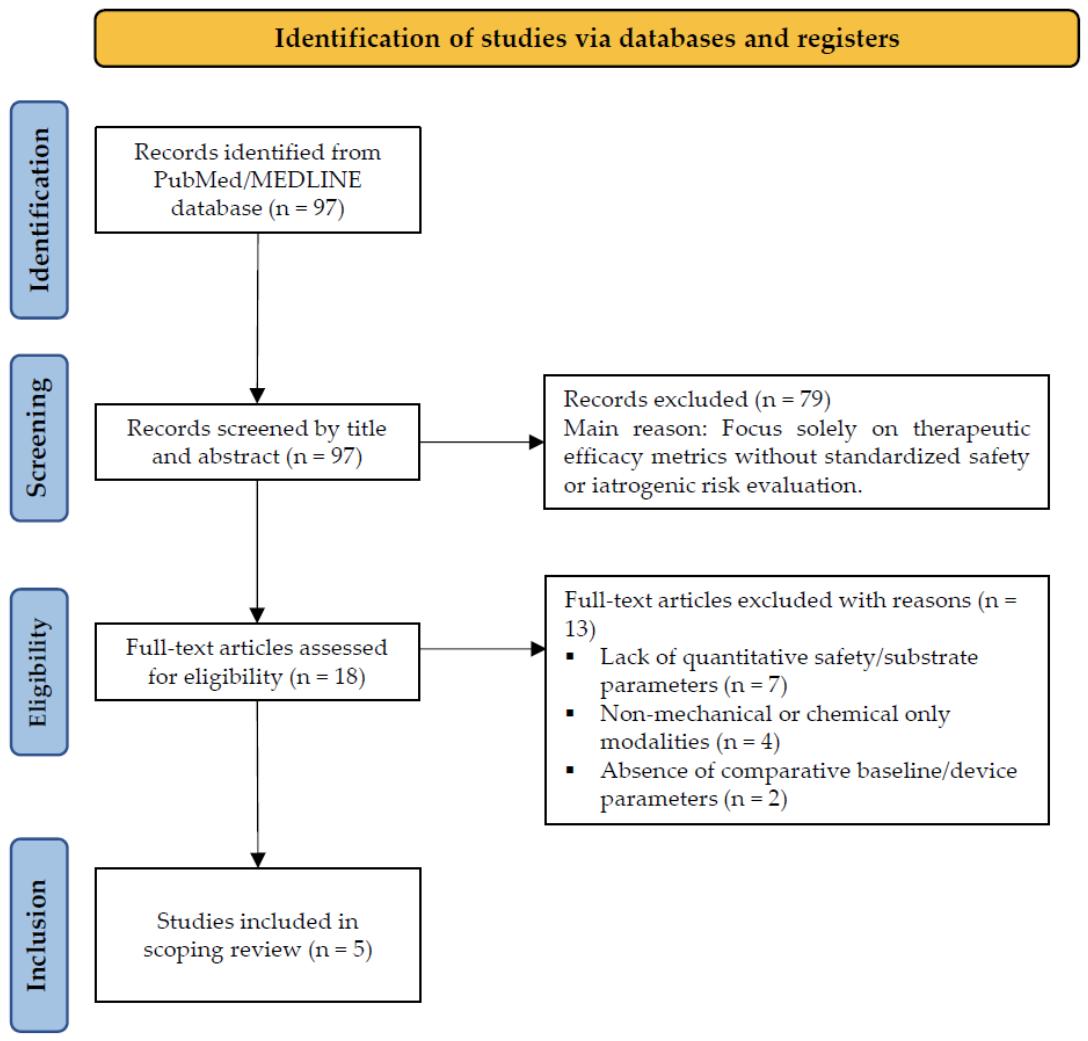

Table 1.
Main characteristics, evaluated safety parameters, and key findings of the included evidence sources on PMPR safety profiles.
Table 1.
Main characteristics, evaluated safety parameters, and key findings of the included evidence sources on PMPR safety profiles.
| Authors (Year) | Model | PMPR type | Target | Parameters evaluated | Key findings |
|---|---|---|---|---|---|
| Sigwart L. et al. (2025) [18] | Ex vivo Laboratory Study | Contemporary Air-Polishing systems (Erythritol/Glycine). | Extracted teeth, restorative materials, stained substrates. | Colour changes (ΔE), surface roughness (Ra), tobacco stain removal. | Air-polishing with low-abrasive polyol powders effectively removes extrinsic stains without inducing destructive surface roughness or color alterations beyond clinical thresholds. |
| Graziani F. et al. (2022) [19] | Comprehensive Review / Mapping Study | Manual instruments, ultrasonic scalers, air-polishing systems | Intra-oral (soft/hard tissues) and extra-oral structures | Intraoperative/postoperative complications, soft tissue lesions, instrument fracture, bacteremia, emphysema. | Broad cataloging of complications shows that soft tissue trauma and patient discomfort are common; rare systemic risks (bacteremia, emphysema) require precise clinical management. |
| Abdul Hayei NA. et al. (2021) [20] | Controlled In Vitro Laboratory Study | Ultrasonic scalers (Conventional tips vs. Polymer/Specialized tips) | Root dentin, cementum, human gingival fibroblasts | Root surface roughness, tooth substance loss, cell attachment | Ultrasonic tip design and power settings dictate root damage; polymer-coated tips significantly reduce substance loss and support better fibroblast attachment compared to conventional metal tips. |
| Bühler J. et al. (2016) [21] | Systematic Review (In vivo, ex vivo, in vitro). | Air-polishing devices (Sodium bicarbonate vs. Glycine) | Root surfaces, soft tissues, titanium implant surfaces. | Surface roughness (Ra), substance loss, soft tissue alterations, biocompatibility. |
Low-abrasive glycine powders exhibit superior biocompatibility compared to sodium bicarbonate, causing minimal soft tissue irritation and preserving cementum/titanium integrity. |
| Sanz M. et al. (2015) [22] | Expert Consensus Report / Systematic Review overview | Manual scaling, sonic, and ultrasonic instrumentation. | Periodontal tissues, root surfaces, gingiva. | Secondary prevention complications, dentin hypersensitivity, gingival recession, root substance loss. | PMPR is highly effective but non-selective; mechanical instrumentation can lead to cementum removal, post-procedural hypersensitivity, and recession if force is uncalibrated. |
Disclaimer/Publisher’s Note: The statements, opinions and data contained in all publications are solely those of the individual author(s) and contributor(s) and not of MDPI and/or the editor(s). MDPI and/or the editor(s) disclaim responsibility for any injury to people or property resulting from any ideas, methods, instructions or products referred to in the content. |
© 2026 by the authors. Licensee MDPI, Basel, Switzerland. This article is an open access article distributed under the terms and conditions of the Creative Commons Attribution (CC BY) license (http://creativecommons.org/licenses/by/4.0/).
Copyright: This open access article is published under a Creative Commons CC BY 4.0 license, which permit the free download, distribution, and reuse, provided that the author and preprint are cited in any reuse.