

Submitted:
12 November 2026
Posted:
12 November 2026
You are already at the latest version
Abstract
Background/Objectives: Early defibrillation is critical for survival after out-of-hospital cardiac arrest (OHCA), yet delays arise from interacting community, organizational, dispatch, and emergency medical services (EMS) factors. This scoping review mapped determinants of delayed defibrillation, examined temporal measurement approaches, and summarized associations with clinical outcomes. Methods: A preregistered scoping review was conducted following Joanna Briggs Institute guidance and PRISMA-ScR reporting standards. PubMed/MEDLINE, Scopus, and CINAHL were searched in February 2026. Two reviewers independently screened records, and extracted data were cross-checked. Evidence was synthesized descriptively across system-level domains and temporal categories. Results: Of 4456 records identified, 82 studies were included, predominantly observational (75/82, 91.5%). Determinants were classified as community-related (32/82, 39.0%), system-related (26/82, 31.7%), dispatch-related (18/82, 22.0%), and EMS-related (6/82, 7.3%). Fifty-two studies reported classifiable temporal metrics. Among 48 studies linking timing or early-defibrillation determinants with outcomes, 31 examined direct or multiple shock-related intervals, two examined upstream operational response times, and 15 used indirect indicators. Of the 31 studies assessing direct or multiple shock-related intervals, 30 (96.8%) indicated more favorable outcomes with shorter timing. All 28 studies using a single direct shock-related interval showed directional concordance. Conclusion. Defibrillation delays reflect interconnected system-level processes rather than EMS response time alone. Standardized temporal measurement, integrated AED and responder networks, and targeted strategies addressing geographic and socioeconomic disparities may support earlier defibrillation. These findings have implications for emergency-care organization, interprofessional coordination, and nursing education in resuscitation systems.
Keywords:
out-of-hospital cardiac arrest
; defibrillation
; automated external defibrillator
; public-access defibrillation
; emergency medical services
; first responders
; time-to-shock
; scoping review
1. Introduction
Out-of-hospital cardiac arrest (OHCA) remains a major global public health challenge, characterized by high incidence, substantial premature mortality, and marked variation in outcomes across emergency-care systems. Contemporary estimates suggest that several million OHCAs occur worldwide each year, while only a minority of affected individuals survive to hospital discharge [1]. International registry data continue to demonstrate pronounced between-system heterogeneity in resuscitation processes and outcomes. In the most recent report from the International Liaison Committee on Resuscitation Research and Registries Committee, national and regional registries showed substantial variation in bystander cardiopulmonary resuscitation (CPR), public-access automated external defibrillator (AED) use, survival, and favourable neurological outcome [2]. Global evidence synthesis has estimated survival to hospital discharge at approximately 9% among adults receiving resuscitation [3]. In Italy, a systematic review and meta-analysis similarly reported survival in approximately one in ten patients and infrequent bystander AED use [4].
OHCA survival depends on a sequence of highly time-sensitive actions rather than any single intervention. Contemporary European Resuscitation Council (ERC) guidance therefore conceptualizes cardiac arrest management as an integrated system involving early recognition, rapid emergency activation, immediate high-quality CPR, early defibrillation, first-responder networks, EMS organization, post-resuscitation care, registries, and continuous system-performance improvement [5,6]. Within this pathway, early defibrillation is particularly important for ventricular fibrillation or pulseless ventricular tachycardia because the probability of successful resuscitation declines as shock delivery is delayed. The classic survival model described by Larsen et al. demonstrated the combined influence of collapse-to-CPR, collapse-to-defibrillation, and collapse-to-advanced-care intervals [7]. Subsequent clinical studies confirmed the inverse relationship between increasing defibrillation delay and functional survival [8], and more recent evidence suggests that longer ventricular fibrillation/pulseless ventricular tachycardia duration before subsequent shocks is associated with lower probability of return of spontaneous circulation [9]. These data support a time-dependent relationship, but not a single universal percentage loss per minute applicable to every patient, rhythm, or system.
Evidence from public-access defibrillation (PAD) illustrates the potential benefit of shortening this interval. Early experience in highly organized settings demonstrated favourable outcomes when trained non-medical responders could deliver defibrillation within the first minutes after collapse [10]. Population-level registry analyses subsequently showed that expansion of PAD programmes was associated with increasing bystander defibrillation and improved neurologically favourable survival among patients with ventricular-fibrillation OHCA [11]. Systematic reviews likewise found higher survival among patients receiving PAD or bystander AED treatment than among those awaiting conventional EMS defibrillation, although effect magnitude varied across populations and response models [12,13].
However, the presence of an AED within a community does not necessarily translate into timely shock delivery. The distinction between AED availability, geographic proximity, physical accessibility, and actual use is critical. A systematic review of real-world studies found that shorter AED retrieval distance and earlier access tended to be associated with higher survival, with substantial heterogeneity in deployment strategies [14]. In Copenhagen, fewer than half of AEDs geographically covering OHCA events were accessible at the time of arrest; when the nearest device was accessible, bystander defibrillation and 30-day survival were higher [15]. Earlier systematic work identified additional barriers including public awareness, willingness to act, visibility, training, maintenance, registration, regulation, dispatch integration, and demographic or behavioural factors [16]. Thus, defibrillation delay reflects interactions between infrastructure, accessibility, behaviour, and emergency-system organization.
Emergency dispatch and first-responder systems represent another potentially modifiable component of the pre-defibrillation interval. Mobile-phone dispatch of trained lay responders can increase bystander CPR [17], while smartphone systems designed to facilitate AED retrieval and early defibrillation have demonstrated increased bystander intervention when citizen responders arrive before EMS [18]. In combined Danish and Swedish data, volunteer-responder arrival before EMS was associated with greater bystander defibrillation in both private residences and public locations [19]. A systematic review and meta-analysis subsequently found that citizen first-responder activation was associated with increased bystander CPR, AED use before ambulance arrival, ROSC, and survival compared with conventional response alone [20]. Selective dual-dispatch models involving firefighters may similarly generate clinically relevant time gains [21].
The interval to defibrillation is also shaped by geographic configuration, population density, socioeconomic conditions, EMS deployment, arrest location, and regional organization. In metropolitan Canada and France, walking access to public AEDs differed by location and socioeconomic context [22]. The relationship between community defibrillation and EMS performance is dynamic: recent Danish registry data indicate that the association between bystander defibrillation and survival differs according to EMS response time and arrest location [23]. Technological approaches including drone-based AED delivery can shorten device-arrival time in selected real-world emergencies [24]. These findings support interpreting defibrillation delay as a systems-level phenomenon produced by sequential and interacting intervals between recognition, emergency call processing, responder activation, AED retrieval, EMS arrival, patient access, rhythm assessment, and shock delivery.
At the time of the preregistered search, evidence syntheses had largely focused on PAD effectiveness, AED accessibility, bystander AED use, barriers to PAD, or specific first-responder strategies [1,12,13,14,15,16,20]. The literature remained fragmented in its temporal definitions and in the level of the response system being evaluated. Publications appearing after completion of the February 2026 search have further emphasized avoidable delay and implementation barriers [25,26], but these contributions primarily address PAD or implementation strategy rather than systematically charting how defibrillation delay is defined, measured, and associated with determinants across the full prehospital pathway.
Therefore, the primary objective of this scoping review was to systematically map system-, organizational-, dispatch-, community-, geographic-, and socioeconomic-level determinants associated with time to first defibrillation in adults with OHCA. Secondary objectives were to characterize definitions and measurement of time-to-defibrillation, identify phases of the prehospital pathway in which delays are reported, summarize reported associations with ROSC, survival, and neurological outcomes, and identify methodological and evidence gaps relevant to future system-level strategies.
2. Materials and Methods
2.1. Study Design and Reporting Framework
This study was conducted as a scoping review to map evidence on determinants associated with delayed early defibrillation in adults experiencing OHCA. The methodology was informed by updated JBI guidance for scoping reviews and the review is reported in accordance with the PRISMA extension for Scoping Reviews (PRISMA-ScR) [27,28]. Reporting of the literature search was informed by PRISMA-S to the extent permitted by the archived search records [29]. A scoping design was selected because the review question encompassed heterogeneous study designs, multiple time definitions, and determinants operating across different system levels rather than a single intervention-effect relationship. The protocol was prospectively registered on the Open Science Framework (OSF) on 4 February 2026 (DOI: 10.17605/OSF.IO/ZUWQX) [30].
2.2. Review Question and Eligibility Framework
Eligibility was structured using the Population–Concept–Context framework. Population: adults aged ≥18 years experiencing OHCA. Pediatric-only populations were excluded. Mixed populations were eligible only when adult OHCA evidence was identifiable. Concept: time to first defibrillation and determinants that could shorten or delay the interval to first shock, including AED availability or accessibility, bystander AED use, PAD, first-responder activation, dispatch processes, EMS configuration and response, geographic factors, socioeconomic conditions, organizational characteristics, and system-level interventions. Context: real-world prehospital care, including community, public and private locations, emergency dispatch, first responders, EMS pathways, and regional or national emergency-care systems.
Eligible source types comprised observational studies, registry-based analyses, interventional studies, and mixed-methods investigations reporting empirical data. In-hospital cardiac arrest-only studies, pediatric-only populations, case reports, editorials, non-empirical publications, simulation-only or manikin-only investigations without real-world OHCA data, and non-English publications were excluded. In accordance with the preregistered 15-year window, the temporal eligibility criterion was operationalized from 4 February 2011 through the final database search date. For studies published online ahead of issue assignment, the first online publication year was used for chronology and descriptive figures.
2.3. Outcomes and Evidence Domains
The primary evidence concept comprised timing of first defibrillation and determinants of that timing. For construct validity, temporal measures were separated into three levels. Direct shock-related intervals were collapse-to-shock, call-to-shock, arrival-to-shock, or multiple explicit interval sets that included a shock endpoint. Upstream operational intervals, such as EMS or first-responder response time, were retained separately because they may influence but are not equivalent to time to first shock. Proxy or indirect indicators (for example responder arrival, AED accessibility/use, or PAD without a classifiable shock interval) were synthesized separately. Secondary clinical outcomes included ROSC, survival to hospital admission or discharge, longer-term survival when available, and favourable neurological outcome. Determinants were mapped across community/bystander, dispatch/first-responder, EMS/on-scene, geographic/socioeconomic, and broader system or policy domains.
2.4. Information Sources and Search Strategy
Electronic searches were conducted in PubMed/MEDLINE and Scopus on 4 February 2026 and in CINAHL on 5 February 2026. The executed search strategy combined three broad components: OHCA; defibrillation/AED terminology; and time, delay, or interval terminology. Controlled vocabulary and free-text terms were used where applicable. The retained PubMed strategy was: ("out-of-hospital cardiac arrest"[MeSH Terms] OR "out-of-hospital cardiac arrest"[Title/Abstract] OR OHCA[Title/Abstract] OR "sudden cardiac arrest"[Title/Abstract]) AND ("Defibrillation"[MeSH Terms] OR defibrillat*[Title/Abstract] OR "automated external defibrillator"[Title/Abstract] OR AED[Title/Abstract]) AND (time[Title/Abstract] OR delay*[Title/Abstract] OR interval*[Title/Abstract]).
The search retrieved 1,444 records from PubMed/MEDLINE, 2,473 from Scopus, and 539 from CINAHL (4,456 total before deduplication). The protocol had anticipated a fourth determinant-specific search block; the executed searches retained a broader three-block formulation, and determinant relevance was applied during screening and charting. Reference-list screening and forward citation tracking were prespecified supplementary approaches; however, the retained audit files did not preserve a separate numerical yield for these routes. Accordingly, Figure 1 reports the database-derived flow only. Exact search dates, times, and counts were retained in the screening workbook. Database-adapted syntax was used for Scopus and CINAHL; the verbatim PubMed strategy was retained, whereas the complete platform-history strings for Scopus and CINAHL were not preserved in the archived working files. This limitation is reported in the Supplementary Material.
2.5. Study Selection
All retrieved records were consolidated and deduplicated before screening. Two reviewers independently assessed records against predefined eligibility criteria at title, abstract, and full-text stages. Disagreements were resolved through discussion and consensus; unresolved disagreements were adjudicated by a third senior reviewer. Reasons for full-text exclusion were documented.
Before synthesis, a structured protocol-alignment and source-verification audit was conducted for provisionally included reports, together with reconciliation of exclusion coding and PRISMA counts. Bibliographic identity, duplicate status, publication window, language, population, real-world OHCA context, and direct relevance to defibrillation timing or its determinants were rechecked for provisionally included reports. Reports identified as misclassified were reassigned before the evidence set was frozen. In the final PRISMA reconciliation, 39 reports originally coded as “full text not available” were correctly reclassified as reports not retrieved rather than assessed full texts; together with one withdrawn report, this yielded 40 reports not retrieved/withdrawn. This reconciliation changed PRISMA accounting but did not change the final set of 82 included studies. A source-level re-review of every excluded full text was not undertaken as part of this post hoc audit and is acknowledged as a limitation.
2.6. Data Charting
Data were charted using a standardized structured extraction matrix developed a priori from the review questions. Extracted entries were cross-checked by a second reviewer, with discrepancies resolved by consensus and senior adjudication when required. Extracted variables included bibliographic information; country or region; study design; data source and study period; setting; sample size; population characteristics; OHCA definition; arrest location; initial rhythm; time metric and measurement approach; AED availability and accessibility; bystander AED use and CPR; call handling and dispatcher-assisted CPR; first-responder activation; EMS response and on-scene workflow; EMS configuration; geographic, socioeconomic, and regional system characteristics; ROSC; survival; neurological outcome; effect-estimate type; direction of association; authors’ conclusions; limitations; determinant domain; and chain-of-survival phase.
The extraction database underwent structural, bibliographic, chronology, duplicate, and protocol-level validation before synthesis. Only records classified as eligible after the final audit were retained in the analytical evidence set.
2.7. Data Synthesis
Extracted data were summarized using descriptive statistics and narrative thematic synthesis. Frequencies and proportions were used for categorical characteristics. Sample size was summarized using the median, interquartile range, and range; total sample size was not summed because several publications derived from potentially overlapping registry populations. Determinants were synthesized across community, dispatch, EMS, and system domains, with additional cross-cutting mapping of AED, geographic, socioeconomic, and organizational variables. 'Earlier-time evidence' was assigned when the original study reported a shorter defibrillation-related interval, earlier AED/defibrillation access, or a system determinant explicitly associated with earlier shock opportunity. 'Shorter time better' was assigned when shorter timing was associated with a more favourable process or clinical outcome; 'unclear' was used for mixed, heterogeneous, or non-directional findings; and 'no association' was used when the study explicitly reported no relevant association. When a study contained discordant findings, the overall direction was coded as unclear. Direct shock-related intervals, upstream operational timing metrics, and proxy/indirect indicators were not treated as interchangeable constructs. Directional counts represent descriptive study-level vote counting only; studies were not weighted by sample size, precision, risk of bias, or potential registry overlap. No meta-analysis was performed because studies differed substantially in time origin, exposure definition, rhythm population, comparator, clinical outcome, effect measure, and statistical adjustment. Clinical outcome findings were therefore synthesized descriptively. The complete coding framework is provided in Supplementary Table S2.
2.8. Critical Appraisal
A formal risk-of-bias or methodological-quality appraisal was not performed. This decision was prespecified and is consistent with the principal purpose of a scoping review: mapping the extent, characteristics, concepts, and gaps of the available evidence rather than estimating a pooled treatment effect or certainty-of-evidence rating [28]. Methodological characteristics and limitations reported by the original investigators were nevertheless charted and considered during interpretation.
2.9. Protocol Deviations and Final Eligibility Audit
Three deviations or clarifications were documented. First, the protocol anticipated four search blocks, whereas the executed electronic search used three broad blocks and applied determinant relevance during screening and charting. Second, the retained archive did not preserve complete verbatim platform-history strings for Scopus and CINAHL or a separately quantified yield from prespecified citation tracking. Third, the final quality-control audit identified provisional eligibility decisions that were not fully concordant with the preregistered publication window or PCC criteria; the audit enforced the original criteria and did not broaden the population, concept, context, language, or temporal scope.
2.10. Ethics
The review used published literature exclusively and did not involve collection of individual-level participant data. Institutional ethics approval and individual informed consent were therefore not required..
3. Results
3.1. Study Selection
The electronic searches identified 4,456 records: 1,444 from PubMed/MEDLINE, 2,473 from Scopus, and 539 from CINAHL. After removal of 1,780 duplicates, 2,676 unique records were screened. A total of 2,108 records were excluded during title and abstract screening, leaving 568 reports sought for retrieval. Thirty-nine reports were not retrievable and one additional report was withdrawn, leaving 528 reports for full-text eligibility assessment. After full-text assessment and the final protocol-alignment audit, 446 reports were excluded and 82 studies were included in the final scoping review (Figure 1).
3.2. General Characteristics of Included Studies
The final evidence set comprised 82 studies assigned to publication years 2011–2025 using first online publication year where applicable (Table 1; Supplementary Table S1). Thirteen studies (15.9%) were published in 2011–2015, 33 (40.2%) in 2016–2020, and 36 (43.9%) in 2021–2025. The largest annual numbers were observed in 2017 and 2023, with 11 studies in each year (Figure 2). Most studies were observational (75/82, 91.5%); seven (8.5%) were interventional. Fifty studies (61.0%) involved mixed settings, 30 (36.6%) were predominantly urban, and two (2.4%) focused on rural settings. Among 81 studies with a numeric sample size, the median sample was 2,922 (IQR 667–11,465; range 21–553,426).
3.3. Distribution of Determinant Domains
Determinants operated across multiple levels of the prehospital response system. Community-level determinants represented the largest primary domain (32/82, 39.0%), followed by system-level determinants (26/82, 31.7%), dispatch-related determinants (18/82, 22.0%), and EMS-level determinants (6/82, 7.3%) (Table 2; Figure 3).

Table 2.
Panel A. Evidence mapping of determinants associated with timing of early defibrillation.
| Primary Determinant Domain | Representative determinants mapped | Studies, n | Evidence consistent with earlier/shorter defibrillation, n | No clear earlier-time evidence, n | Direction: shorter time better, n | Direction unclear, n | No association, n | Earlier-time evidence, % |
| Community | AED availability/accessibility; public-access and bystander defibrillation; community preparedness; citizen/volunteer responders; arrest location and public/private access | 32 | 22 | 10 | 20 | 7 | 5 | 68.8 |
| Dispatch | Call processing; dispatcher-assisted CPR/PAD; dual or multi-tier dispatch; police/fire/volunteer first-responder activation; smartphone/text-message/drone dispatch | 18 | 13 | 5 | 13 | 3 | 2 | 72.2 |
| EMS | EMS response interval; sequence and timing of defibrillation; defibrillation strategy; prehospital workflow | 6 | 4 | 2 | 4 | 1 | 1 | 66.7 |
| System | Urban–rural configuration; geography and distance; building/floor effects; socioeconomic access; AED-network density; regional organization; legislation and system-wide programmes | 26 | 11 | 15 | 10 | 11 | 5 | 42.3 |
| TOTAL | 82 | 50 | 32 | 47 | 22 | 13 | 61.0 |
Table 2.
Table 2. Panel B. Cross-cutting determinant variables represented in the evidence base.
| Variable | Studies reporting/considering variable, n | % of included studies | Interpretive note |
| AED availability | 68 | 82.9 | Infrastructure/device presence; not equivalent to timely access |
| AED accessibility | 57 | 69.5 | Physical/temporal ability to reach and use an AED |
| Bystander AED use | 67 | 81.7 | Actual pre-EMS AED application or defibrillation |
| First-responder activation | 44 | 53.7 | Citizen, volunteer, police, fire, or other activated responders |
| Call-handling time | 43 | 52.4 | Dispatch/call-processing component |
| Dispatcher-assisted CPR | 38 | 46.3 | Dispatcher-mediated early chain-of-survival action |
| EMS response time | 71 | 86.6 | Operational response interval |
| On-scene workflow delay | 7 | 8.5 | Workflow/pause/defibrillation-process delay |
| Geographic factors | 34 | 41.5 | Urban/rural, distance, location, building or spatial access |
| Socioeconomic factors | 11 | 13.4 | Area-level or individual socioeconomic/equity measures |
| Regional/system variation | 19 | 23.2 | Variation across systems, regions, policy or configuration |
3.4. Characterization of Defibrillation-Related Time Metrics
Substantial heterogeneity was observed in the definition and measurement of defibrillation-related intervals. Fifty-two studies (63.4%) reported a temporal metric assignable to a predefined category, whereas 30 (36.6%) were included on determinant evidence without a directly classifiable time-to-shock measure. Call-to-shock was most frequent (25/82, 30.5%), followed by collapse-to-shock (11/82, 13.4%), multiple metrics (7/82, 8.5%), upstream response-time measures (6/82, 7.3%), and arrival-to-shock (3/82, 3.7%) (Table 1; Figure 4). Response-time measures were retained as relevant operational latency metrics but were not interpreted as equivalent to direct shock-timing intervals; studies classified as 'multiple' were examined at study level to determine whether a shock endpoint was explicitly included.
3.5. Clinical Outcomes
ROSC was reported in 67 studies (81.7%), a survival endpoint in 64 (78.0%), and neurological outcome in 51 (62.2%). Forty-eight studies (58.5%) reported a study-level association between timing or an early-defibrillation determinant and at least one clinical outcome. Outcome categories were not mutually exclusive.
3.6. Determinants Associated with Early Defibrillation
Across all 82 studies, 50 (61.0%) contained evidence classified as consistent with earlier or shorter defibrillation, whereas 32 (39.0%) did not provide clear evidence of a reduction in defibrillation delay. By primary domain, earlier-time evidence was present in 22/32 community studies (68.8%), 13/18 dispatch studies (72.2%), 4/6 EMS studies (66.7%), and 11/26 system studies (42.3%) (Table 2). In Table 2, 'earlier-time evidence' refers to the opportunity for earlier shock, whereas 'direction: shorter time better' refers to the reported direction of a timing-process or timing-outcome association; the two variables are conceptually distinct and should not be interpreted as duplicate measures.
Community-level evidence most frequently addressed AED availability and accessibility, PAD, bystander AED use, community preparedness, citizen or volunteer responders, and public-versus-private arrest locations. A recurrent pattern was that AED presence did not guarantee timely use: physical distance, restricted access, limited visibility, incomplete registry integration, and responder availability could all impede early shock delivery.
Dispatch and first-responder evidence addressed call processing, dispatcher-assisted CPR or PAD, dual- or multi-tier dispatch, police/fire/volunteer activation, smartphone and text-message systems, and emerging drone-based delivery. Parallel dispatch could create time gain when responders arrived before conventional EMS, but the magnitude of benefit depended on activation latency, responder availability, AED retrieval, and baseline EMS response.
EMS-level evidence focused on response interval, rhythm assessment, defibrillation strategy, and workflow immediately preceding shock. System-level evidence encompassed urban–rural configuration, distance, building access, socioeconomic conditions, AED-network density, regional organization, legislation, and system-wide programmes. This domain was more heterogeneous than community or dispatch evidence.
Panel A. Primary determinant domains. “Earlier-time evidence” denotes study-level findings classified as consistent with earlier or shorter defibrillation; it is not a causal certainty measure. “Earlier-time evidence” and “shorter time better” are distinct constructs: the former maps opportunity/timing, whereas the latter maps the reported direction of a timing-process or timing-outcome association.
Variables are non-mutually exclusive and reflect evidence coverage rather than independent causal effects.
3.7. Cross-Cutting Evidence Pattern
Across domains, timely shock delivery depended on interaction between device availability, physical accessibility, cardiac-arrest recognition, emergency-call processing, responder activation, travel and retrieval time, EMS response, patient access, and the workflow required to deliver the first shock. EMS response time was represented in 71 studies (86.6%), AED availability in 68 (82.9%), bystander AED use in 67 (81.7%), AED accessibility in 57 (69.5%), first-responder activation in 44 (53.7%), call-handling time in 43 (52.4%), geographic factors in 34 (41.5%), regional/system variation in 19 (23.2%), socioeconomic factors in 11 (13.4%), and explicit on-scene workflow delay in seven (8.5%).
3.8. Association Between Defibrillation Timing and Clinical Outcomes
Forty-eight studies (58.5%) reported a study-level association between timing, earlier defibrillation, or a closely related determinant and at least one clinical outcome (Table 3). Construct-level separation identified 31 studies (37.8% of the total evidence set) that linked a direct or multiple shock-related interval to an outcome, two studies (2.4%) that linked an upstream operational response-time metric to an outcome, and 15 studies (18.3%) that relied primarily on proxy or indirect indicators such as responder arrival, AED accessibility, bystander AED use, or PAD.
Among the 31 studies with a direct or multiple shock-related timing interval and an outcome linkage, 30 (96.8%) were classified as reporting a direction consistent with shorter timing being associated with more favourable processes or outcomes, while one (3.2%) showed heterogeneous or unclear directionality. No study in this subgroup was classified as showing a clear absence of association. All 17 call-to-shock, all nine collapse-to-shock, and both arrival-to-shock studies were classified in the shorter-time-better direction (28/28 single direct shock-timing studies). Among three studies reporting multiple explicit shock-related intervals, two were classified as shorter-time-better and one as unclear. Twenty-six of the 31 studies (83.9%) reported adjusted analyses. These percentages are descriptive, unweighted study-level directional counts rather than pooled effect or certainty-of-evidence estimates, and publications from overlapping registry systems may not be statistically independent. The direct shock-timing evidence is summarized in Figure 5.
3.9. Evidence Gaps
Several recurring gaps were identified. Thirty of 82 studies (36.6%) addressed determinants without reporting a directly classifiable defibrillation-time interval, limiting estimation of how much individual interventions shortened the pathway to shock. Explicit on-scene workflow delay was reported in only seven studies (8.5%). Socioeconomic factors appeared in only 11 studies (13.4%), substantially fewer than geographic, EMS-response, or AED-related variables. Temporal exposure definitions and clinical endpoints were heterogeneous, and the evidence base was predominantly observational (75/82, 91.5%).
4. Discussion
4.1. Principal Findings
This scoping review mapped 82 studies examining determinants of early defibrillation in adult OHCA across community, dispatch, EMS, geographic, socioeconomic, organizational, and system-level domains. Four principal findings emerged. First, delay to defibrillation was not attributable to a single operational interval; evidence described a sequence of potentially cumulative delays extending from recognition and emergency-call processing through responder activation, AED identification and retrieval, travel time, EMS response, patient access, rhythm assessment, and final shock delivery. Second, substantial heterogeneity existed in how defibrillation timing was defined, and upstream operational response intervals were not equivalent to direct shock-timing measures. Third, among 31 studies linking direct or multiple shock-related intervals to outcomes, 30 (96.8%) were classified in a shorter-time-better direction; this is descriptive directional concordance, not a pooled effect or certainty rating. Fourth, many modifiable determinants operated before conventional EMS arrival, supporting interpretation of defibrillation delay as a system-performance construct rather than simply an ambulance response-time metric.
4.2. Defibrillation Delay as a Systems Phenomenon
These findings align with the contemporary shift from isolated resuscitation interventions toward systems-based OHCA care. ERC 2025 “Systems Saving Lives” guidance emphasizes first responders, EMS organization, registries, system-performance improvement, community engagement, and emerging technologies as interconnected components [5]. The ILCOR scientific statement on PAD similarly identified barriers spanning deployment, accessibility, public behaviour, dispatch integration, technology, and organization [1]. The present review extends this perspective by showing that the same fragmentation is reflected in the measurement of time itself. A conventional EMS-response interval captures only one component of collapse-to-shock delay. Systems with similar ambulance response times can therefore expose patients to different total delays if they differ in call recognition, AED access, responder activation, building access, or on-scene workflow.
4.3. AED Availability Is Not Equivalent to AED Accessibility
One of the clearest community-level themes was the distinction between AED presence and effective accessibility. AED availability was represented in 68 studies and accessibility in 57, yet multiple investigations showed that geographic coverage alone did not ensure timely use. This is consistent with the systematic review by Ruan et al. [14] and with Karlsson et al., who showed higher bystander defibrillation and survival when the nearest AED was actually accessible at the time of arrest [15]. The recent international RAND-UCLA consensus, published after completion of the present search, similarly identified 24-hour access, residential coverage, real-time registries, EMS integration, public awareness, and maintenance as major implementation issues [26]. AED-network performance should therefore be evaluated in terms of time-dependent accessibility and use, not only device counts or nominal density.
4.4. Community Responders and Dispatch as Mechanisms for Temporal Gain
Dispatch-related studies showed the highest proportion of evidence consistent with earlier defibrillation. Parallel dispatch of firefighters, police, volunteer responders, citizen responders, or other AED-equipped resources can reduce dependence on ambulance arrival as the first opportunity for shock. This finding is consistent with the meta-analysis by Scquizzato et al. [20] and with studies of mobile-phone and smartphone responder activation [17,18,19]. Importantly, responder proximity alone does not guarantee time gain: emergency-call recognition, activation latency, responder acceptance, travel, AED retrieval, patient access, and shock delivery all contribute. Future evaluations should therefore prioritize actual time gained to first shock rather than responder arrival alone.
4.5. Geography, Residential OHCA, and Equity
Geographic barriers emerged across rurality, distance from AEDs and responders, building characteristics, and regional system configuration. Rural and remote locations were frequently characterized by longer EMS response and less timely access to defibrillation, whereas public locations generally provided more opportunities for PAD than private residences. This distinction is clinically important because many OHCAs occur in residential settings, where static PAD models are inherently less efficient. The socioeconomic evidence was comparatively sparse. Heidet et al. demonstrated inequalities in AED accessibility according to socioeconomic context in metropolitan systems [22], but only 11 studies in the present review explicitly addressed socioeconomic factors. Equity should therefore be incorporated prospectively into AED-network planning and emergency-response evaluation.
4.6. The Meaning of Time-to-Shock
A central methodological finding is that 'time to defibrillation' is not a single standardized exposure. The evidence is more coherently interpreted across three construct levels: upstream operational latency (for example call processing, responder activation, EMS or first-responder response), the direct shock-related interval (for example collapse-to-shock, call-to-shock, or arrival-to-shock), and the subsequent clinical consequence (ROSC, survival, or neurological outcome). Collapse-to-shock most closely represents the complete interval from arrest to shock but can be uncertain when collapse time is imprecise. Call-to-shock is often more reproducible operationally but excludes the pre-call interval. Arrival-to-shock captures on-scene performance while ignoring preceding community and travel delays. EMS response time can influence the pathway but is upstream and should not be treated as synonymous with time to first shock. Maintaining this separation improves construct validity and explains why indiscriminate pooling of temporal measures could obscure rather than clarify the time-outcome relationship.
4.7. Relationship Between Timing and Outcomes
The directional consistency among studies measuring direct or multiple shock-related intervals is biologically plausible and consistent with classic and contemporary evidence demonstrating progressively worse outcomes with increasing delay to defibrillation [7,8,9]. It is also consistent with current BLS guidance emphasizing rapid recognition, emergency activation, and early AED use [6]. However, the 30/31 directional count is descriptive vote counting: each publication contributes equally regardless of sample size, precision, methodological quality, or potential population overlap, and favourable process endpoints are not equivalent to patient-centred clinical outcomes. Notably, all 28 studies using a single direct shock-timing interval (call-to-shock, collapse-to-shock, or arrival-to-shock) were directionally concordant, whereas the three multiple-interval studies included one unclear classification. The present review therefore cannot estimate a universal survival-loss coefficient per minute, quantify a pooled causal effect, or establish certainty of evidence. The appropriate inference is strong directional concordance across heterogeneous direct shock-timing studies, while the magnitude and causal interpretation of the association require dedicated quantitative synthesis and study-level appraisal.
4.8. Emerging Technologies
Drone-based AED delivery, smartphone responder activation, live AED registries, geolocation, predictive deployment, and digitally integrated dispatch systems seek to reduce portions of the collapse-to-shock pathway that conventional EMS optimization alone may not eliminate. Real-world drone studies have demonstrated feasibility and earlier AED delivery in selected cases [24]. Technology should nevertheless be evaluated through clinically relevant temporal endpoints: earlier notification or device arrival is meaningful only if it results in earlier AED attachment and, when indicated, earlier shock. Recent literature likewise emphasizes integration rather than technology in isolation [1,25,26].
4.9. Public-Health and Organizational Implications
The findings support several system-level implications. Where feasible, OHCA systems may benefit from capturing collapse-to-shock or call-to-shock in addition to conventional EMS response time. AED programmes may be more informatively evaluated according to effective accessibility and use rather than device counts alone. Dispatch centres can be conceptualized as active components of defibrillation systems through integration of AED registries, caller guidance, citizen responders, police/fire services, and other first responders. Spatial planning may prioritize locations in which high OHCA burden overlaps with prolonged EMS response or poor AED accessibility. Finally, registry architecture would benefit from sequential timestamps sufficiently granular to distinguish delay before the emergency call, during dispatch, during responder travel, during AED retrieval, and after professional arrival [5].
4.10. Implications for Future Conceptual Development
The multidimensional pattern identified here provides an empirical rationale for frameworks that integrate biological time dependence with operational latency. The Early Defibrillation Gap (EDG) framework represents one possible approach by conceptualizing delayed shock delivery as a mismatch between the time-dependent opportunity for effective defibrillation and the operational timing of shock delivery. The present scoping review does not validate the EDG construct; rather, it identifies the systems-level and methodological conditions that justify prospective evaluation using datasets with granular timestamps, rhythm information, responder pathways, and standardized outcomes.
4.11. Strengths
Strengths include prospective protocol registration, use of a predefined PCC framework, independent screening with senior adjudication, structured data charting with second-reviewer cross-check, and final protocol-alignment and source-verification procedures before synthesis. The review distinguished direct shock-related intervals, upstream operational timing metrics, and proxy indicators, preventing AED use, responder arrival, or EMS response time from being treated automatically as direct measurements of time to first shock. Mapping determinants across multiple system levels provided a broader view than syntheses restricted to PAD or a single responder strategy.
4.12. Limitations
Several limitations should be considered. The evidence base was predominantly observational and therefore susceptible to confounding, selection bias, temporal changes in practice, and case-mix differences. Considerable heterogeneity existed in temporal definitions, rhythm populations, outcomes, effect measures, and adjustment strategies. Determinant classification required conceptual mapping and some studies could plausibly fit more than one domain. Study-level directional counts were descriptive and unweighted; they did not account for sample size, precision, methodological quality, or potential non-independence of multiple publications derived from overlapping registry populations. The review was restricted to English-language publications and the preregistered 15-year window. The executed search used three broad concept blocks rather than the four initially anticipated in the protocol. Complete verbatim search histories for Scopus and CINAHL and a separately quantified yield from citation tracking were not preserved in the retained archive, limiting full search reproducibility. The post hoc protocol audit concentrated on provisionally included reports and PRISMA/coding reconciliation rather than source-level re-review of every excluded full text; therefore residual false-negative screening risk cannot be fully excluded. Formal risk-of-bias assessment was not undertaken, consistent with the preregistered scoping-review methodology, so directional consistency should not be interpreted as certainty-of-evidence grading. Finally, the search ended in February 2026; later publications were used only to contextualize the Discussion [25,26], and an updated database search should be performed immediately before journal submission if the review is to represent the most current evidence base.
4.13. Future Research
Future studies should prioritize standardized and decomposable temporal measures and explicitly distinguish upstream operational latency from the direct interval to shock. Registry-based investigations should distinguish collapse-to-call, call-processing, dispatch-to-arrival, patient-access, AED-retrieval, and shock-delivery intervals where data quality permits. Comparative evaluations should report effects on actual time to first shock rather than responder arrival or device delivery alone. Further research is particularly needed in residential OHCA, rural and remote communities, socioeconomically disadvantaged populations, and low-resource systems. A dedicated systematic review and meta-analysis should quantify the association between incremental delay to first defibrillation and survival or favourable neurological outcome, stratified by temporal origin, initial rhythm, effect measure, and endpoint, with formal assessment of study quality and population overlap.
5. Conclusions
Delayed defibrillation in OHCA is a multilevel systems problem rather than a single EMS-performance interval. Across 82 included studies, determinants of early shock delivery operated across community, dispatch, first-responder, EMS, geographic, socioeconomic, and organizational domains. AED availability alone did not ensure timely defibrillation; effective accessibility, responder activation, dispatch integration, geographic proximity, and system organization were recurrent components of the pathway to shock.
Definitions of defibrillation timing varied substantially, limiting direct comparison between studies and systems. After separating upstream operational response metrics from direct shock-related intervals, 30 of 31 studies linking direct or multiple shock-related timing to outcomes were classified in a shorter-time-better direction; all 28 studies using a single direct shock-timing interval were directionally concordant. These findings represent descriptive, unweighted directional concordance rather than a pooled causal estimate or certainty-of-evidence rating. Taken together, the evidence supports moving beyond isolated response-time indicators toward measurement of the complete pathway from collapse to first shock, with standardized temporal reporting, integrated AED and responder networks, granular registry data, and attention to residential, rural, and underserved populations.
Supplementary Materials
The following supporting information can be downloaded at the website of this paper posted on Preprints.org. Section S1, Search execution and reproducibility record; Table S1, Study-level characteristics of the 82 included sources; Table S2, Operational coding framework used for evidence synthesis; Table S3, Final PRISMA full-text exclusion categories; Table S4, PRISMA-ScR reporting crosswalk; Section S2, Interpretation notes for the supplementary evidence matrix.
Author Contributions
Conceptualization, A.C. and E.N.; methodology, A.C. and E.N.; validation, E.V.; formal analysis, A.C.; investigation, A.C., E.N.; data curation, E.V.; writing—original draft preparation, A.C., E.N., E.V.; writing—review and editing, A.C., E.N.; supervision, E.V. All authors have read and agreed to the published version of the manuscript.
Funding
This research received no external funding.
Institutional Review Board Statement
Not applicable.
Informed Consent Statement
Not applicable.
Data Availability Statement
Data sharing is not applicable to this article as no new data were created or analyzed in this study.
Public Involvement Statement
No public involvement in any aspect of this research.
Guidelines and Standards Statement
This manuscript was drafted in accordance with the Preferred Reporting Items for Systematic Reviews and Meta-Analyses (PRISMA) 2020 statement for systematic reviews and meta-analyses [11], following the guidance available on the EQUATOR Network https://www.equator-network.org/reporting-guidelines/prisma/ (Accessed on 14 November 2025).
Use of Artificial Intelligence
AI or AI-assisted tools were not used in drafting any aspect of this manuscript.
Conflicts of Interest
The authors declare no conflicts of interest.
Ethics approval: Not required; this review synthesizes published literature only.
Protocol registration: Open Science Framework, DOI 10.17605/OSF.IO/ZUWQX.
References
- Brooks, S.C.; Clegg, G.R.; Bray, J.; Deakin, C.D.; Perkins, G.D.; Ringh, M.; et al. Optimizing outcomes after out-of-hospital cardiac arrest with innovative approaches to public-access defibrillation: a scientific statement from the International Liaison Committee on Resuscitation. Circulation 2022, 145(13), e776–e801. [Google Scholar] [CrossRef] [PubMed]
- Nishiyama, C.; Kiguchi, T.; Okubo, M.; Al-Araji, R.; Amorim, E.; Alihodzic, H.; et al. Characteristics of out-of-hospital cardiac arrest from 2018 to 2021 across the world: third report from the International Liaison Committee on Resuscitation Research and Registries Committee. Resuscitation 2025, 217, 110852. [Google Scholar] [CrossRef] [PubMed]
- Yan, S.; Gan, Y.; Jiang, N.; Wang, R.; Chen, Y.; Luo, Z.; et al. The global survival rate among adult out-of-hospital cardiac arrest patients who received cardiopulmonary resuscitation: a systematic review and meta-analysis. Crit. Care 2020, 24(1), 61. [Google Scholar] [CrossRef] [PubMed]
- Scquizzato, T.; Gamberini, L.; D'Arrigo, S.; Galazzi, A.; Babini, G.; Losiggio, R.; et al. Incidence, characteristics, and outcome of out-of-hospital cardiac arrest in Italy: a systematic review and meta-analysis. Resusc. Plus 2022, 12, 100329. [Google Scholar] [CrossRef] [PubMed]
- Semeraro, F.; Schnaubelt, S.; Olasveengen, T.M.; Bignami, E.G.; Bottiger, B.W.; Fijacko, N.; et al. European Resuscitation Council Guidelines 2025 System Saving Lives. Resuscitation 2025, 215 (Suppl 1), 110821. [Google Scholar] [CrossRef] [PubMed]
- Smyth, M.A.; van Goor, S.; Hansen, C.M.; Fijacko, N.; Nakagawa, N.K.; Raffay, V.; et al. European Resuscitation Council Guidelines 2025 Adult Basic Life Support. Resuscitation 2025, 215 (Suppl 1), 110771. [Google Scholar] [CrossRef] [PubMed]
- Larsen, M.P.; Eisenberg, M.S.; Cummins, R.O.; Hallstrom, A.P. Predicting survival from out-of-hospital cardiac arrest: a graphic model. Ann. Emerg. Med. 1993, 22(11), 1652–1658. [Google Scholar] [CrossRef] [PubMed]
- Drennan, I.R.; Lin, S.; Thorpe, K.E.; Morrison, L.J. The effect of time to defibrillation and targeted temperature management on functional survival after out-of-hospital cardiac arrest. Resuscitation 2014, 85(11), 1623–1628. [Google Scholar] [CrossRef] [PubMed]
- Awad, E.; Klapthor, B.; Morgan, M.H.; Youngquist, S.T. The impact of time to defibrillation on return of spontaneous circulation in out-of-hospital cardiac arrest patients with recurrent shockable rhythms. Resuscitation 2024, 201, 110286. [Google Scholar] [CrossRef] [PubMed]
- Valenzuela, T.D.; Roe, D.J.; Nichol, G.; Clark, L.L.; Spaite, D.W.; Hardman, R.G. Outcomes of rapid defibrillation by security officers after cardiac arrest in casinos. N Engl. J. Med. 2000, 343(17), 1206–1209. [Google Scholar] [CrossRef] [PubMed]
- Kitamura, T.; Kiyohara, K.; Sakai, T.; Matsuyama, T.; Hatakeyama, T.; Shimamoto, T.; et al. Public-access defibrillation and out-of-hospital cardiac arrest in Japan. N Engl. J. Med. 2016, 375(17), 1649–1659. [Google Scholar] [CrossRef] [PubMed]
- Baekgaard, J.S.; Viereck, S.; Moller, T.P.; Ersboll, A.K.; Lippert, F.; Folke, F. The effects of public access defibrillation on survival after out-of-hospital cardiac arrest: a systematic review of observational studies. Circulation 2017, 136(10), 954–965. [Google Scholar] [CrossRef] [PubMed]
- Holmberg, M.J.; Vognsen, M.; Andersen, M.S.; Donnino, M.W.; Andersen, L.W. Bystander automated external defibrillator use and clinical outcomes after out-of-hospital cardiac arrest: a systematic review and meta-analysis. Resuscitation 2017, 120, 77–87. [Google Scholar] [CrossRef] [PubMed]
- Ruan, Y.; Sun, G.; Li, C.; An, Y.; Yue, L.; Zhu, M.; et al. Accessibility of automatic external defibrillators and survival rate of people with out-of-hospital cardiac arrest: a systematic review of real-world studies. Resuscitation 2021, 167, 200–208. [Google Scholar] [CrossRef] [PubMed]
- Karlsson, L.; Hansen, C.M.; Wissenberg, M.; Hansen, S.M.; Lippert, F.K.; Rajan, S.; et al. Automated external defibrillator accessibility is crucial for bystander defibrillation and survival: a registry-based study. Resuscitation 2019, 136, 30–37. [Google Scholar] [CrossRef] [PubMed]
- Smith, C.M.; Lim Choi Keung, S.N.; Khan, M.O.; Arvanitis, T.N.; Fothergill, R.; Hartley-Sharpe, C.; et al. Barriers and facilitators to public access defibrillation in out-of-hospital cardiac arrest: a systematic review. Eur. Heart J. Qual. Care Clin. Outcomes 2017, 3(4), 264–273. [Google Scholar] [CrossRef] [PubMed]
- Ringh, M.; Rosenqvist, M.; Hollenberg, J.; Jonsson, M.; Fredman, D.; Nordberg, P.; et al. Mobile-phone dispatch of laypersons for CPR in out-of-hospital cardiac arrest. N Engl. J. Med. 2015, 372(24), 2316–2325. [Google Scholar] [CrossRef] [PubMed]
- Andelius, L.; Hansen, C.M.; Lippert, F.K.; Karlsson, L.; Torp-Pedersen, C.; Ersboll, A.K.; et al. Smartphone activation of citizen responders to facilitate defibrillation in out-of-hospital cardiac arrest. J. Am. Coll. Cardiol. 2020, 76(1), 43–53. [Google Scholar] [CrossRef] [PubMed]
- Andelius, L.; Hansen, C.M.; Jonsson, M.; Gerds, T.A.; Rajan, S.; Torp-Pedersen, C.; et al. Smartphone-activated volunteer responders and bystander defibrillation for out-of-hospital cardiac arrest in private homes and public locations. Eur. Heart J. Acute Cardiovasc Care 2023, 12(2), 87–95. [Google Scholar] [CrossRef] [PubMed]
- Scquizzato, T.; Belloni, O.; Semeraro, F.; Greif, R.; Metelmann, C.; Landoni, G.; et al. Dispatching citizens as first responders to out-of-hospital cardiac arrests: a systematic review and meta-analysis. Eur. J. Emerg. Med. 2022, 29(3), 163–172. [Google Scholar] [CrossRef] [PubMed]
- Andrell, C.; Dankiewicz, J.; Todorova, L.; Olanders, K.; Ullen, S.; Friberg, H. Firefighters as first-responders in out-of-hospital cardiac arrest: a retrospective study of a time-gain selective dispatch system in the Skane Region, Sweden. Resuscitation 2022, 179, 131–140. [Google Scholar] [CrossRef] [PubMed]
- Heidet, M.; Freyssenge, J.; Claustre, C.; Deakin, J.; Helmer, J.; Thomas-Lamotte, B.; et al. Association between location of out-of-hospital cardiac arrest, on-scene socioeconomic status, and accessibility to public automated defibrillators in two large metropolitan areas in Canada and France. Resuscitation 2022, 181, 97–109. [Google Scholar] [CrossRef] [PubMed]
- Hindborg, M.; Yonis, H.; Gnesin, F.; Sorensen, K.K.; Andersen, M.P.; Eriksson, F.; et al. Bystander defibrillation and survival according to emergency medical service response time after out-of-hospital cardiac arrest: a nationwide registry-based cohort study. Prehosp Emerg. Care 2026, 30(2), 232–240. [Google Scholar] [CrossRef] [PubMed]
- Schierbeck, S.; Hollenberg, J.; Nord, A.; Svensson, L.; Nordberg, P.; Ringh, M.; et al. Automated external defibrillators delivered by drones to patients with suspected out-of-hospital cardiac arrest. Eur. Heart J. 2022, 43(15), 1478–1487. [Google Scholar] [CrossRef] [PubMed]
- Pagnoni, G.; Bolognesi, M.G.; Bricoli, S.; Rossi, L.; Arata, A.; Aschieri, D. Out-of-hospital cardiac arrest: public-access defibrillation and system approaches to minimize avoidable delay. J. Clin. Med. 2026, 15(6), 2141. [Google Scholar] [CrossRef] [PubMed]
- Thies, K.C.; Metelmann, C.; Metelmann, B.; Marks, T.; Scquizzato, T.; Deakin, C.D.; et al. Barriers and enablers to public access defibrillation: an international RAND-UCLA consensus study. Scand. J. Trauma Resusc. Emerg. Med. 2026, 34, 66. [Google Scholar] [CrossRef] [PubMed]
- Tricco, A.C.; Lillie, E.; Zarin, W.; O'Brien, K.K.; Colquhoun, H.; Levac, D.; et al. PRISMA Extension for Scoping Reviews (PRISMA-ScR): checklist and explanation. Ann. Intern Med. 2018, 169(7), 467–473. [Google Scholar] [CrossRef] [PubMed]
- Peters, M.D.J.; Marnie, C.; Tricco, A.C.; Pollock, D.; Munn, Z.; Alexander, L.; et al. Updated methodological guidance for the conduct of scoping reviews. JBI Evid. Synth. 2020, 18(10), 2119–2126. [Google Scholar] [CrossRef] [PubMed]
- Rethlefsen, M.L.; Kirtley, S.; Waffenschmidt, S.; Ayala, A.P.; Moher, D.; Page, M.J.; et al. PRISMA-S: an extension to the PRISMA Statement for Reporting Literature Searches in Systematic Reviews. Syst. Rev. 2021, 10(1), 39. [Google Scholar] [CrossRef] [PubMed]
- Cianciulli, A. Delays in Early Defibrillation in Out-of-Hospital Cardiac Arrest: A Scoping Review from a Systems and Public Health Perspective. Open Sci. Framew. 2026. [Google Scholar] [CrossRef]
- Page, M.J.; McKenzie, J.E.; Bossuyt, P.M.; Boutron, I.; Hoffmann, T.C.; Mulrow, C.D.; et al. The PRISMA 2020 statement: an updated guideline for reporting systematic reviews. BMJ 2021, 372, n71. [Google Scholar] [CrossRef] [PubMed]
Figure 1.
PRISMA 2020 flow diagram of study selection.
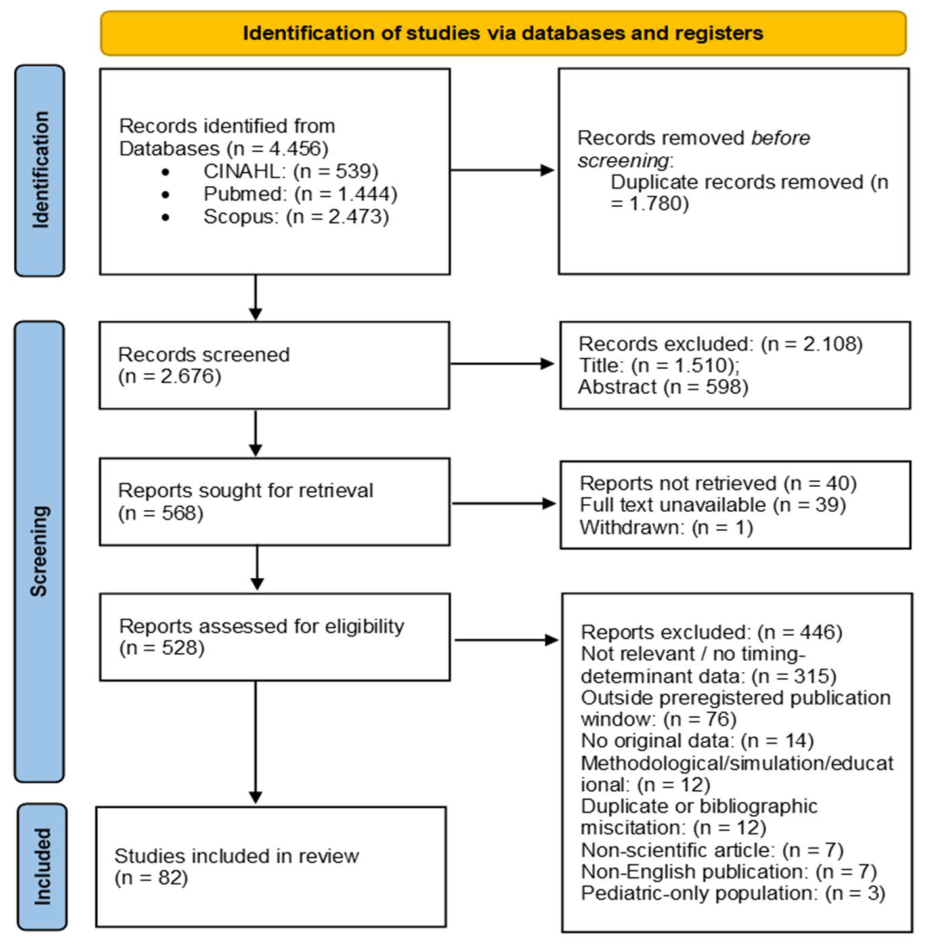
Figure 2.
Temporal distribution of included studies by publication year. Years with no included studies are displayed as zero counts.
Figure 2.
Temporal distribution of included studies by publication year. Years with no included studies are displayed as zero counts.
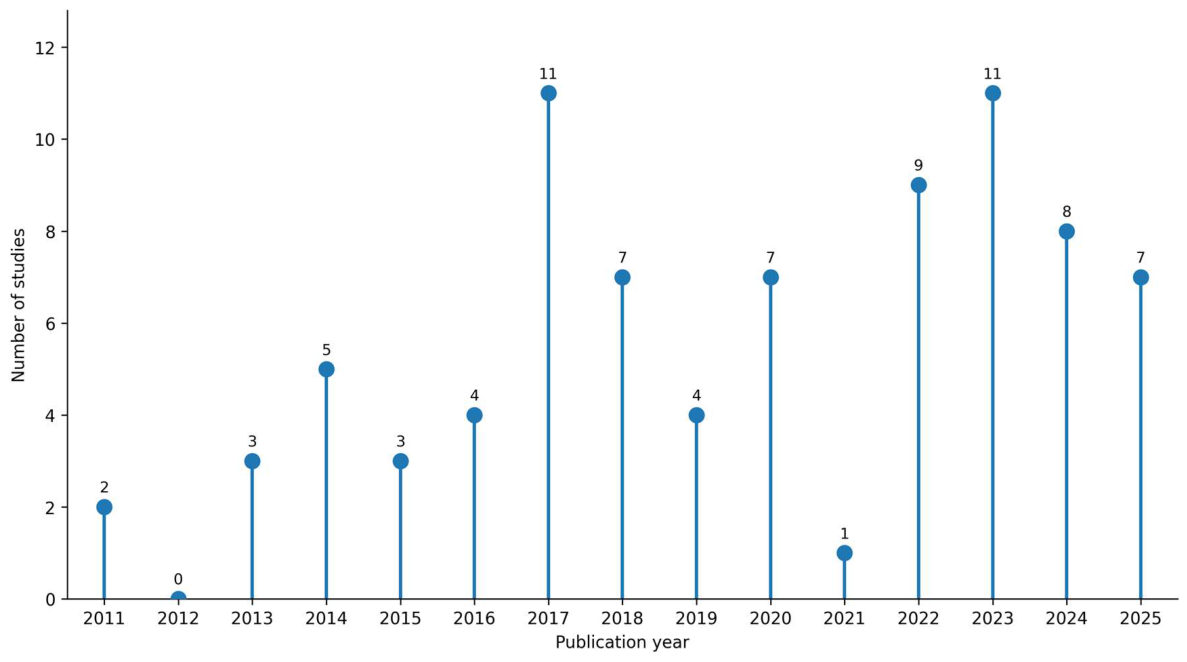
Figure 3.
Distribution of primary determinant domains across the 82 included studies.
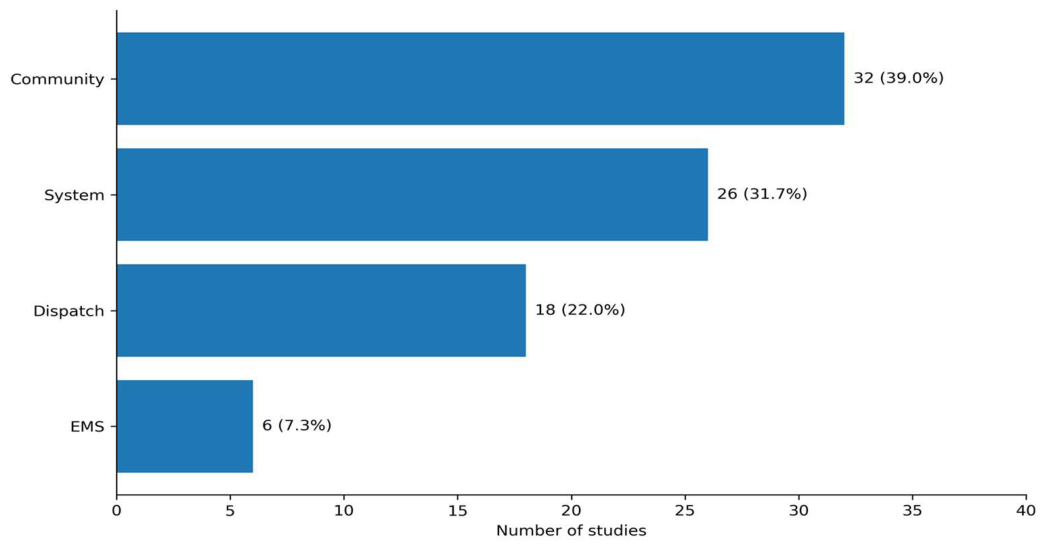
Figure 4.
Distribution of temporal metrics across included studies. Response-time measures are shown as upstream operational intervals rather than direct time-to-shock measures.
Figure 4.
Distribution of temporal metrics across included studies. Response-time measures are shown as upstream operational intervals rather than direct time-to-shock measures.
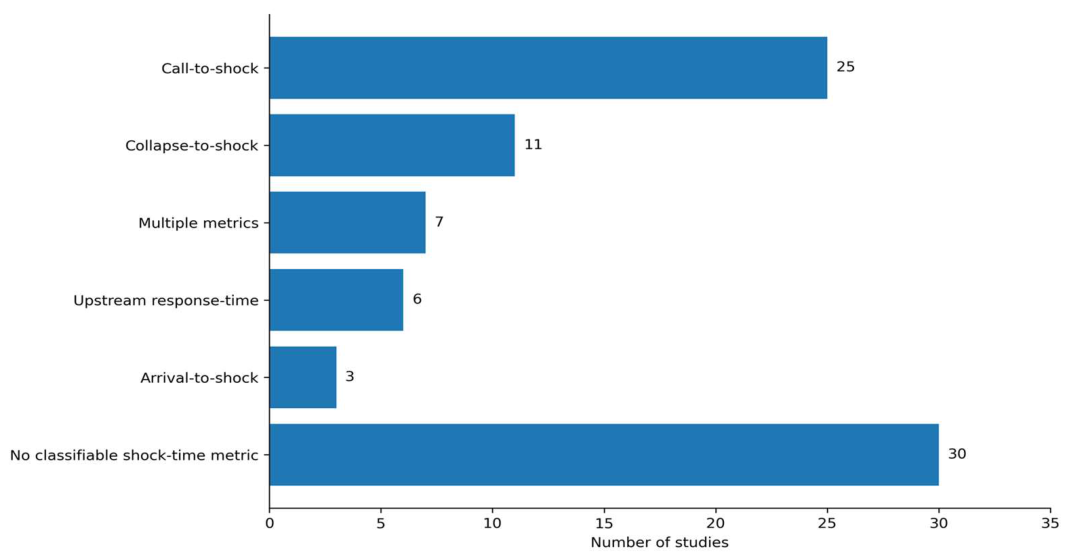
Figure 5.
Direction of evidence among the 31 studies linking a direct or multiple shock-related timing interval with an outcome. Counts represent unweighted study-level direction, not pooled effect sizes or certainty of evidence. Upstream operational response-time studies are not included in this figure.
Figure 5.
Direction of evidence among the 31 studies linking a direct or multiple shock-related timing interval with an outcome. Counts represent unweighted study-level direction, not pooled effect sizes or certainty of evidence. Upstream operational response-time studies are not included in this figure.
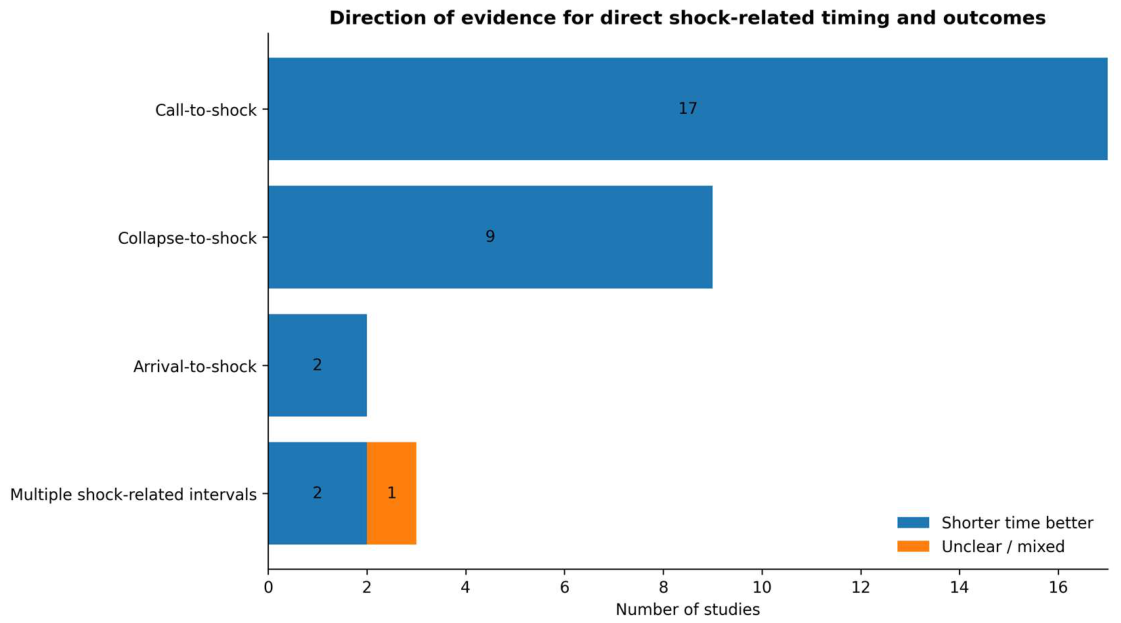
Table 1.
Characteristics of studies included in the scoping review (N = 82).
| Characteristic | Category | n | % |
| Publication period | |||
| 2011–2015 | 13 | 15.9 | |
| 2016–2020 | 33 | 40.2 | |
| 2021–2025 | 36 | 43.9 | |
| Study design | |||
| Observational | 75 | 91.5 | |
| Interventional | 7 | 8.5 | |
| Setting | |||
| Urban | 30 | 36.6 | |
| Mixed | 50 | 61.0 | |
| Rural | 2 | 2.4 | |
| Primary determinant domain | |||
| Community | 32 | 39.0 | |
| System | 26 | 31.7 | |
| Dispatch | 18 | 22.0 | |
| EMS | 6 | 7.3 | |
| Defibrillation/time metric category | |||
| Call-to-shock | 25 | 30.5 | |
| Collapse-to-shock | 11 | 13.4 | |
| Arrival-to-shock | 3 | 3.7 | |
| Response time | 6 | 7.3 | |
| Multiple | 7 | 8.5 | |
| No directly classifiable time metric | 30 | 36.6 | |
| Time measurement approach | |||
| Direct | 18 | 22.0 | |
| Multiple | 45 | 54.9 | |
| Mixed | 6 | 7.3 | |
| Proxy | 7 | 8.5 | |
| Indirect | 5 | 6.1 | |
| Not reported | 1 | 1.2 | |
| Clinical outcomes reported | |||
| ROSC | 67 | 81.7 | |
| Survival endpoint | 64 | 78.0 | |
| Neurological outcome | 51 | 62.2 | |
| Timing or early-defibrillation determinant associated with clinical outcome | 48 | 58.5 | |
| Study sample size | |||
| Median (IQR) | 2,922 (667–11,465) | ||
| Range | 21–553,426 |
Notes: * Clinical outcomes are non-mutually exclusive. † Sample-size statistics are based on 81 studies with numeric values; sample sizes were not summed because registry populations may overlap. ‡ Response-time metrics are upstream operational intervals and are not synonymous with time to first shock.
Table 3.
Relationship between defibrillation timing and reported clinical outcomes.
| Panel A. Clinical outcomes reported across the 82 included studies. | |||||||||||
| Outcome | Studies reporting outcome, n | % of included studies | |||||||||
| Return of spontaneous circulation (ROSC) | 67 | 81.7 | |||||||||
| Survival to hospital discharge / reported survival endpoint | 64 | 78.0 | |||||||||
| Neurological outcome | 51 | 62.2 | |||||||||
| Panel B. Strength of the study-level timing–outcome linkage. | |||||||||||
| Evidence category | Studies, n | Denominator, n | % | ||||||||
| Any study-level association between timing / early defibrillation determinant and outcome | 48 | 82 | 58.5 | ||||||||
| Direct or multiple shock-related timing interval linked with outcome | 31 | 82 | 37.8 | ||||||||
| Upstream operational response-time metric linked with outcome | 2 | 82 | 2.4 | ||||||||
| Proxy/indirect early-defibrillation indicator linked with outcome | 15 | 82 | 18.3 | ||||||||
| Direct or multiple shock-related timing studies: shorter time associated with better outcome/process | 30 | 31 | 96.8 | ||||||||
| Direct or multiple shock-related timing studies: unclear/heterogeneous direction | 1 | 31 | 3.2 | ||||||||
| Direct or multiple shock-related timing studies: no association | 0 | 31 | 0 | ||||||||
| Panel C. Direct or multiple shock-related timing metrics among studies linking timing with outcomes. | |||||||||||
| Timing metric | Studies, n | Shorter-time-better, n | Unclear, n | No association, n | |||||||
| Call-to-shock | 17 | 17 | 0 | 0 | |||||||
| Collapse-to-shock | 9 | 9 | 0 | 0 | |||||||
| Arrival-to-shock | 2 | 2 | 0 | 0 | |||||||
| Multiple shock-related intervals | 3 | 2 | 1 | 0 | |||||||
| TOTAL | 31 | 30 | 1 | 0 | |||||||
| Panel D. Outcomes reported among the 31 studies with a direct or multiple shock-related timing interval and outcome linkage. | |||||||||||
| Outcome | Studies reporting outcome, n | % of direct shock-timing studies | |||||||||
| Return of spontaneous circulation (ROSC) | 27 | 87.1 | |||||||||
| Survival to hospital discharge / reported survival endpoint | 28 | 90.3 | |||||||||
| Neurological outcome | 19 | 61.3 | |||||||||
Notes: In Panel B, rows 1-4 use N = 82 as the denominator; rows 5-7 use n = 31 direct or multiple shock-related timing studies. Outcome-reporting frequencies do not imply that every reported outcome was independently associated with timing. Timing categories and effect measures were not pooled because temporal origins, populations, rhythms, comparators, endpoints, and statistical models differed across studies. Directional counts are descriptive and unweighted; they do not account for study size, precision, risk of bias, or potential overlap between registry populations. Among the 31 direct or multiple shock-related timing-outcome studies, 26 (83.9%) reported adjusted analyses; odds ratios were the most frequently reported effect measure (22/31).
Disclaimer/Publisher’s Note: The statements, opinions and data contained in all publications are solely those of the individual author(s) and contributor(s) and not of MDPI and/or the editor(s). MDPI and/or the editor(s) disclaim responsibility for any injury to people or property resulting from any ideas, methods, instructions or products referred to in the content. |
© 2026 by the authors. Licensee MDPI, Basel, Switzerland. This article is an open access article distributed under the terms and conditions of the Creative Commons Attribution (CC BY) license.
Copyright: This open access article is published under a Creative Commons CC BY 4.0 license, which permit the free download, distribution, and reuse, provided that the author and preprint are cited in any reuse.