

Submitted:
12 November 2026
Posted:
12 November 2026
You are already at the latest version
Abstract
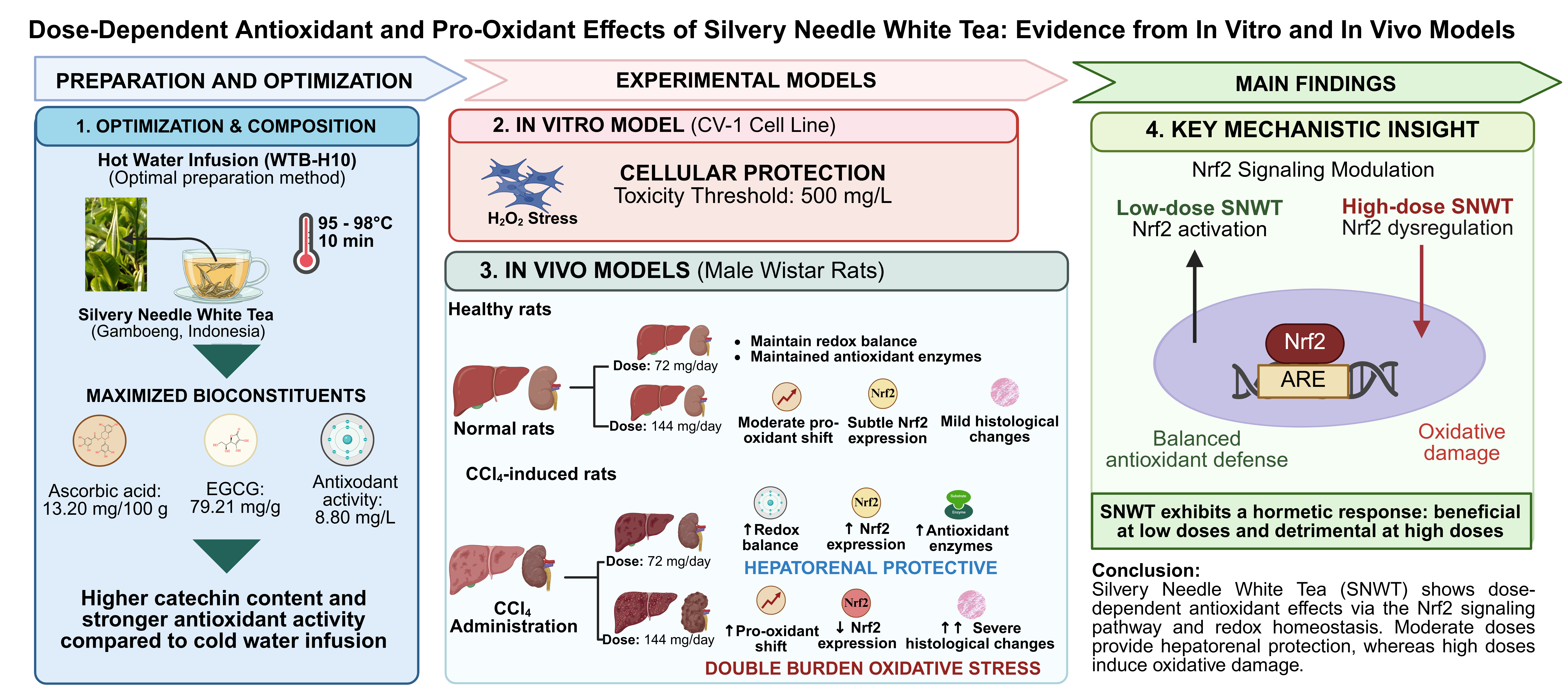
Silvery needle white tea (SNWT) is rich in catechins with potent antioxidant properties; however, its dose-dependent biological effects and safety profile remain unclear. This study evaluated the antioxidant activity and dose-dependent effects of SNWT using integrated in vitro and in vivo models. SNWT extraction was optimized using hot- and cold-water methods and characterized for total phenolic and catechin content. Antioxidant activity was assessed using DPPH assays. Cytotoxicity and cellular antioxidant activity were evaluated in CV-1 cells. In vivo effects were investigated in healthy and CCl₄-induced Wistar rats administered two dose levels, focusing on antioxidant enzyme activities, lipid profile, histopathology, and Nrf2 expression. Hot-water extraction (10 min) yielded higher catechin content and stronger antioxidant activity. In vitro, SNWT demonstrated protective effects against oxidative stress at lower concentrations, while higher concentrations induced cytotoxicity. In vivo, both doses increased catalase and glutathione peroxidase activities, whereas the higher dose was associated with elevated SGOT and greater histological alterations in liver and kidney tissues. These effects were accompanied by dose-dependent modulation of Nrf2 expression. SNWT exhibits dose-dependent antioxidant and pro-oxidant effects, suggesting a hormetic response. Lower doses confer protective effects; higher doses may induce toxicity, highlighting the importance of dose optimization for safe use.
Keywords:
catechins
; Nrf2 signaling
; oxidative stress
; hormesis
; pro-oxidant shift
; silvery needle white tea
Copyright: This open access article is published under a Creative Commons CC BY 4.0 license, which permit the free download, distribution, and reuse, provided that the author and preprint are cited in any reuse.