

Submitted:
10 November 2026
Posted:
12 November 2026
You are already at the latest version
Abstract
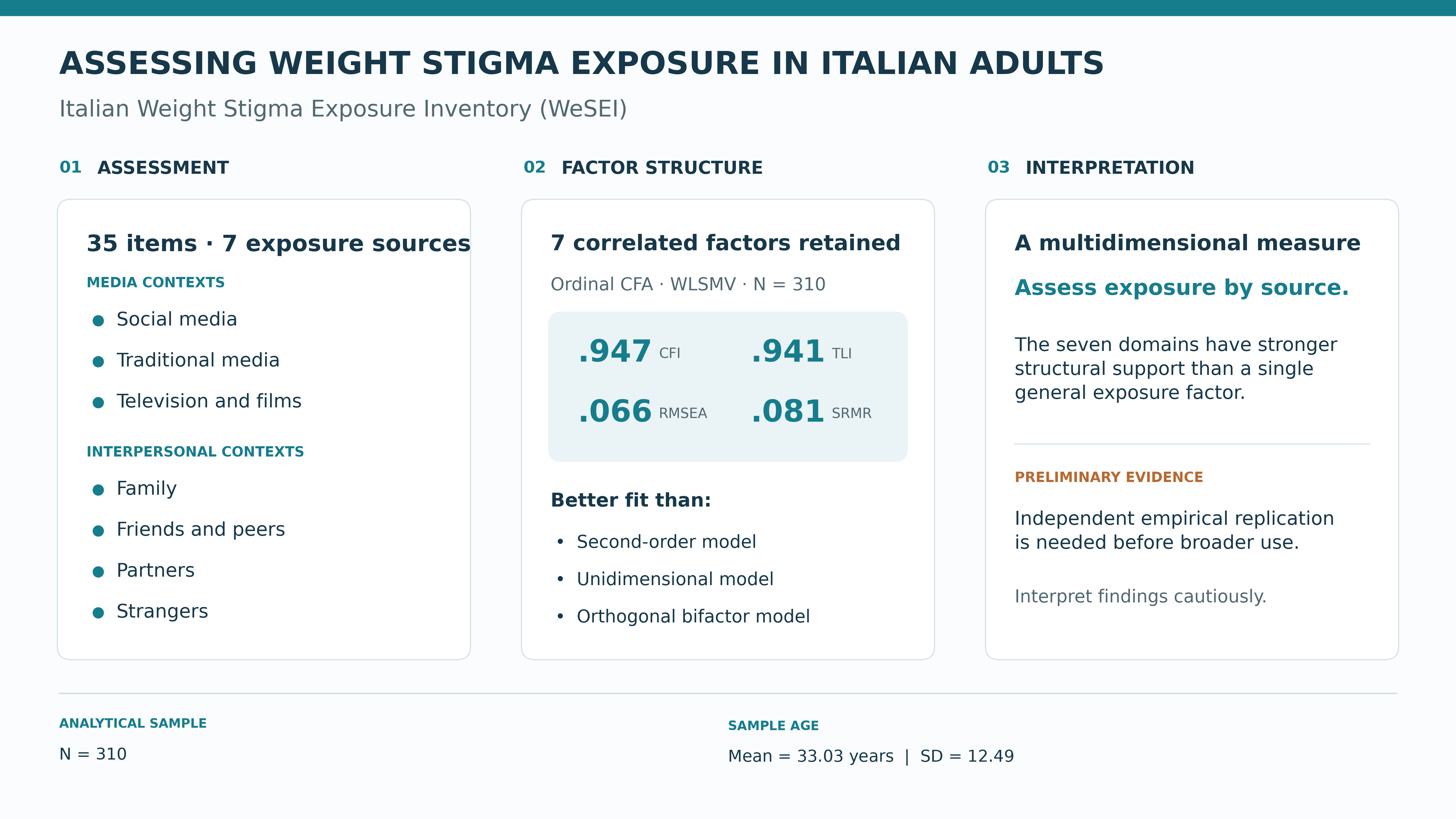
Weight stigma exposure occurs across interpersonal relationships and media environments. However, Italian assessment tools rarely assess these sources of weight stigma comprehensively. The present study examined the psychometric properties of the Italian Weight Stigma Exposure Inventory (WeSEI) among adults. A total of 310 participants (Mage = 33.03 years, SDage = 12.49) were recruited to complete an online survey. WeSEI’s 35 items were evaluated using confirmatory factor analysis. Reliability, convergent and discriminant validity, and measurement invariance across sex were also examined. The hypothesized seven correlated factors provided better fit than second-order, unidimensional, and bifactor alternatives. Subscale internal consistency was high. Average variance extracted exceeded .50 across dimensions, and all heterotrait-monotrait ratios were below .85. Changes in approximate fit indices were compatible with invariance through the strict level, although corrected difference tests did not support all equality constraints. WeSEI scores were positively associated with weight self-stigma, avoidance of physical activity and sport, and psychological distress, and negatively associated with body esteem. The findings provide preliminary support for multidimensional assessment of weight stigma exposure among Italian individuals.
Keywords:
weight stigma exposure
; WeSEI
; Italian validation
; physical activity avoidance
; psychological distress
Copyright: This open access article is published under a Creative Commons CC BY 4.0 license, which permit the free download, distribution, and reuse, provided that the author and preprint are cited in any reuse.