
Submitted:
11 November 2026
Posted:
12 November 2026
You are already at the latest version
Abstract
Network and cluster analysis are commonly used to describe polysubstance use patterns; however, these approaches are often interpreted without grounding in lived experience. In the context of an unstable and contaminated drug supply in the United States, there is a critical need to situate quantitative findings within the social and structural conditions that shape drug use. We conducted a convergent mixed-methods study with adults reporting non-prescribed drug use in the past 12 months in a large U.S. city. Participants (N=164) completed surveys assessing substance use and polysubstance co-use. Network and cluster analyses identified patterns of co-use. A subset of participants (n=9) engaged in results-elicitation interviews in which they interpreted cluster visualizations. Qualitative analysis centered on participants’ interpretations as analytic data, informed by risk environment and intersectionality frameworks. Participants interpreted clusters as representations of collective care, racialized survival, neighborhood trust, pragmatic harm reduction, and identity navigation and self-regulation, rather than pharmacological groupings or causal pathways. Interpretations varied by intersectional position, highlighting how race, gender identity, class, and trauma shape both exposure to risk and access to protection. Polysubstance clusters reflect adaptation to intersectional risk environments rather than individual pathology.
Keywords:
harm reduction
; network analysis
; participatory research
; fentanyl
; people who use drugs
1. Introduction
Polysubstance use has become a defining feature of the contemporary drug landscape, particularly amid widespread fentanyl contamination and an increasingly unstable drug supply [1]. In the United States, most overdose deaths now involve multiple substances, with combinations of opioids, stimulants, alcohol, and other drugs contributing to increasingly complex risk patterns. Overdose deaths have declined for three consecutive years, falling to an estimated 69,973 in 2025, a nearly 14% decrease from 2024 and the lowest annual total since before the COVID-19 pandemic [2]. These trends remain uneven across populations and regions, underscoring the need for responsive intervention to local contexts and lived realities. Structural inequities, including differential access to healthcare, housing instability, and criminalization, continue to shape patterns of use and vulnerability to harm.
Polysubstance use is not simply a matter of combining drugs but reflects context-dependent practices shaped by social environments, drug markets, and structural conditions. Prior research has documented the prevalence of co-use across a wide range of substances, including opioids, stimulants, alcohol, and cannabis, often within the same episode or closely overlapping time periods [3,4,5,6]. These patterns are increasingly understood as adaptive responses to changing drug supplies, particularly the proliferation of synthetic opioids such as fentanyl and the presence of contaminants such as xylazine. However, public health approaches often continue to frame polysubstance use through individual-level risk models, which can obscure the broader conditions that shape these practices.
Despite the widespread use of cluster analysis in substance use research [7,8,9,10], limited attention has been paid to how empirically derived patterns are experienced, understood, or interpreted by people who use drugs [11]. This is an important gap because people who use drugs possess situated knowledge of drug markets, social networks, and harm reduction practices that may challenge or complicate quantitative interpretations [11,12]. Participatory and mixed-methods approaches can address this gap by treating participants as knowledge producers rather than subjects of classification [11,12,13].
Risk environment theory offers a framework for addressing this limitation by emphasizing that drug-related harm arises from interactions among social, economic, policy, and physical environments rather than from individual behavior alone [14,15]. This theory rests on a multi-method, multidisciplinary approach to better understand how structural risk environments are incorporated into lived experiences [15]. Intersectionality further highlights how race, gender, and gender identity shape exposure to risk and access to care [16,17]. Collins et al. (2019) introduced the intersectional risk environment as a framework that applies a relational and intersectional perspective to explore how social location and interacting social-structural processes shape unequal outcomes among people who use drugs [18]. This framework is particularly relevant for polysubstance use research, as it provides conceptual grounding for why different groups of people who use drugs face distinct patterns and risks of polysubstance use.
In this study, we center participants’ interpretations of network and cluster analyses, positioning people who use drugs as analysts of quantitative findings. Using a convergent mixed-methods design, we combine network and cluster analyses of polysubstance use with results-elicitation interviews in which participants engage directly with visualizations of these patterns. Guided by risk environment and intersectionality frameworks, we examine how participants make sense of clusters and what these interpretations reveal about the social and structural organization of drug use. By integrating lived experience into the interpretation of quantitative models, this study aims to advance harm reduction–aligned research approaches that are responsive to the complexity of contemporary drug environments.
2. Materials and Methods
We employed a convergent mixed-methods design that integrated quantitative network and cluster analyses with qualitative results-elicitation interviews. Network and cluster analyses were treated as exploratory, descriptive techniques used to visualize aggregated patterns of polysubstance co-use. Qualitative interviews were explicitly designed to center participants’ interpretations of these quantitative outputs, positioning people who use drugs as analytic contributors rather than subjects of classification.
This approach aligns with methodological traditions that value lived expertise for interpreting complex quantitative findings and avoids deterministic or stigmatizing interpretations of polysubstance use patterns [14,19].
2.1. Recruitment and Data Collection
Participants were adults (≥18 years) who reported using any drug outside of a personal prescription within the past 12 months. Recruitment occurred across nightlife venues, community settings, informal housing contexts, and syringe service programs (SSPs) in a large urban area in the United States. Recruitment strategies were designed to reach individuals who use drugs in diverse social and structural contexts.
A total of 164 participants completed the survey. Survey measures assessed included: substance use and polysubstance co-use; trust in drug sources; harm reduction practices; adverse drug-related effects; and housing stability.
From the survey sample, 16 participants completed in-depth qualitative interviews, and 9 participants engaged directly with descriptive data and network and cluster analysis outputs during results-elicitation interviews.
2.2. Quantitative Analysis: Network and Cluster Analysis
Network and cluster analyses were conducted in R Version 4.5.1 [20] to descriptively examine patterns of polysubstance co-use across the sample. Substance-specific indicators represented self-reported past-year use and were coded as binary measures of use or non-use. The code produced for these analyses can be found at: 10.13140/RG.2.2.15893.69609 In addition to substances assessed directly in the survey, indicators for ketamine, dimethyltryptamine (DMT), lysergic acid diethylamide (LSD), and psilocybin-containing mushrooms were derived from free-text responses to the “other drug” field using string matching. Data preparation and restructuring were performed using functions from the tidyverse [21] and readr [22] packages.
To characterize substance co-use, participant-level substance indicators were transformed into a substance-by-substance co-occurrence matrix. Matrix multiplication of the binary participant-by-substance matrix was used to calculate the number of participants reporting use of each pair of substances, with diagonal elements subsequently set to zero to remove self-connections. The resulting symmetric, weighted adjacency matrix was converted to an undirected network using the igraph package [23,24,25], in which nodes represented individual substances and weighted edges represented the number of participants reporting past-year use of both substances. Network visualization was conducted using ggraph [26] and ggplot2 [27], with edge width proportional to the frequency of observed co-use and node labels positioned using ggrepel [28].
Cluster analysis was subsequently used as a descriptive approach to examine whether substances demonstrated similar patterns of co-occurrence with other substances in the network. Hierarchical agglomerative clustering was performed using the base R. A dissimilarity matrix was constructed from the substance co-use matrix using Euclidean distances, and clusters were generated using complete-linkage hierarchical clustering (hclust, method = “complete”). The resulting dendrogram was inspected to characterize patterns of similarity among substances and was partitioned using cutree. As an additional exploratory assessment of cluster structure, k-means clustering was performed on the co-use matrix after removal of zero-variance rows and columns. The number of clusters was examined using within-cluster sums of squares (elbow method), and the final k-means model was estimated with 20 random starting configurations (nstart = 20) and a prespecified random seed (set.seed(42)) to support reproducibility. Principal components analysis (prcomp) was used to visualize the resulting k-means cluster assignments in two-dimensional space.
Consistent with prior research, these analyses served as descriptive and hypothesis-generating tools rather than as predictors of outcomes or classifiers of individuals into fixed profiles [10,29]. Importantly, clustering was conducted at the substance level rather than the participant level; thus, the identified clusters represent groups of substances with similar aggregated patterns of co-use across participants, not discrete categories of people who use drugs. The cluster structure was therefore treated as a methodological input for subsequent qualitative interpretation rather than as an analytic endpoint.
3. Results
Hierarchical clustering identified several distinct substance co-use patterns, with buprenorphine and methadone, DMT and LSD, and ketamine and mushrooms exhibiting the strongest similarities in use profiles. Opioid-related substances, including fentanyl, heroin, and methamphetamine, also clustered together, whereas cannabis (during the study period, we used the terminology marijuana) demonstrated the greatest dissimilarity from all other substances (Figure 1).
The co-use network showed that cannabis occupied the most central position, with strong connections to cocaine, 3,4-Methylenedioxymethamphetamine (MDMA), Adderall, Xanax, and oxycodone, highlighting its prominence in broader polysubstance use patterns (Figure 2).
Consistent with these findings, k-means clustering identified five distinct substance groups, including clusters characterized by cannabis, cocaine, opioid/stimulant combinations (fentanyl, heroin, methamphetamine), and a psychedelic/treatment-related cluster containing LSD, DMT, ketamine, mushrooms, buprenorphine, methadone, and nitazenes (Figure 3). Together, these analyses suggest the presence of several recognizable polysubstance use profiles within the sample.
Participants (N=9) as Interpreters of Drug Use Networks
In interviews, participants rejected deterministic or purely pharmacological interpretations of network and cluster analyses. They viewed clusters as socially embedded environments shaped by care, survival, trust, and structural conditions. Their interpretations linked interpersonal relationships, social scenes and neighborhoods, drug market dynamics, and structural forces, while also showing how race, class, gender, neighborhood context, and access to resources produced uneven experiences of risk and protection.
Participants consistently interpreted clusters as representing distinct social environments and scenes rather than pharmacological groupings. Certain clusters were associated with nightlife and party contexts (e.g., MDMA, cocaine, Adderall), while others were associated with street-based or survival contexts (e.g., crack, fentanyl). “Cocaine & MDMA is probably just for partying.”
Participants interpreted networks as pathways or trajectories of use, often over time or across situations. Visual density (thicker lines, central nodes) was understood as importance or frequency, not causality. These interpretations positioned networks as dynamic, lived processes rather than static representations. When participants encountered cannabis’s centrality, they rejected “gateway drug” interpretations, instead framing cannabis as a structural constant within the drug environment: “If I’m up on one, I smoke weed to chill out… weed is very useful.” Participants emphasized that cannabis’s prominence reflects availability, safety, and functional use, not causal progression.
Fentanyl was consistently interpreted as a disruptive contaminant in the macro-level drug supply, reshaping patterns of use and risk: “Because they are using fentanyl, and they are sleeping for long periods of time. Now they have a need for stimulants, where they didn’t before.” Rather than representing intentional use, fentanyl was framed as an external force restructuring the drug ecosystem, prompting adaptive responses such as stimulant co-use.
Prescription drug clusters were interpreted through social access and network distribution rather than medical need: “Percocets is everywhere… people get them prescribed and sell them.” Unexpected clusters prompted reflection and dialogue: “Meth go with the crack? I never knew anybody that did both.”
Participants emphasized that clusters were contextual and non-deterministic: “Different neighborhoods got different stuff going on.” They used the visualizations as prompts for reflection, comparison, and validation rather than as fixed classifications. These shared interpretations form the foundation for the three intersectional risk environment analytic cases that follow.
Analytic Case 1: Participant X (Brown Woman), Clusters as Collective Care and Racialized Survival
Participant X interpreted clusters as socially embedded scenes of collective care, preparation, and survival. From a risk-environment perspective, she located harm reduction across micro (peer interactions), meso (festival environments), and macro (structural and market conditions) levels.
Through an intersectionality lens, her interpretations emphasized how race, gender, and structural inequality shape divergent drug use experiences. When shown a psychedelic/MDMA cluster, she immediately mapped it to a festival setting: “I know exactly who said that; I can see the faces. That group… that’s the festivals. The whole festival tent right there. They are into cuddle puddles and sh*t. They are at the booth checking their drugs for sure.”
She described these environments as highly organized and intentional:
“They are like the dragon con type and love cosplay. They are into like the glitter, the things, the accessories. They are dancing, they are packing, they are preparing. I think they are like the party preppers. They are in there and packing all their things like, ‘Im going to bring my strips, we are going to be responsible, it’s going to be the best time ever, it’s going to be a bonding experience, we are going to do hero doses, we are going to see God’. I think that’s great, I think that’s possible with drugs.”
Here, practices such as “cuddle puddles” serve as collective harm-reduction infrastructures, reframing polysubstance use as regulated, relational, and intentional. In contrast, when interpreting stimulant–opioid clusters among Black men, she explicitly rejected moralized narratives: “This is not recreational for them. They are surviving off their habits; they need them to survive. They are not like ‘Hey, I am going to stick one.’ They are like ‘No, I need it.’”
She further situated these patterns within structural and racialized inequality:
“I think the black boys are treating their own traumas with drugs… coming from a broken home… have a lot on their shoulders… having a real hard time fitting into society… drowning their sorrows… it’s like a false sense of productivity.”
This reflects an intersectional understanding of survival, where race, gender, trauma, and constrained opportunity converge. She also contrasted clinical and illicit drug environments through her experience with illicit ketamine: “I watch a lot of stuff… in the hospital… they are administering it… I’m pretty sure when I did it… it made me feel weird… crazy headache… felt like whippets… whippets make people brain dead…” This highlights macro-level inequalities in access to safe, regulated care and reinforces how risk is structured across environments.
Analytic Case 2: Participant Y (Black Man), Clusters as Neighborhood Trust and Pragmatic Harm Reduction
Participant Y interpreted clusters through the lens of neighborhood context and relational trust, emphasizing that harm reduction operates socially rather than technologically. From a risk environment perspective, he mapped clusters across micro (relationships), meso (neighborhoods), and macro (drug supply) levels. Through an intersectionality lens, these dynamics reflect the interplay of race, place, economic stability, and trauma.
He described trust-based harm reduction: “If I can get it from this person… I know either they done it, or they got it from somebody that they know…” He emphasized spatial variation in risk: “It’s different in different neighborhoods… over here, ain’t nobody dying.” Community stability served as protection: “Alot of these folks own their own houses… everyone looks out for each other.” Unfamiliar environments increased risk: “I am not dealing with everybody… not in an area that I know I haven’t been in.” Trust networks served as adaptive strategies in fentanyl-contaminated markets: “9/10 you got to be doing it too… so you can tell me what this is.” His life history account also illustrates how growing up in environments marked by trauma could shape experiences of safety and trust:
“My cousin got kilt, and it wasn’t just him after that. Nah, my mama died first, but before my mama died, I seen somebody get kilt, and I was 9 years old at the time. I grew up around this, whatever it is; I grew up around it. I knew what this was before I knew how to walk and talk, to tell you the truth. When I first started, it was just smoking weed and all of that, then it graduated to hanging out doing stuff with other folks, but the tragic... That’s what really did it. Seeing folks getting kilt and dying.”
This illustrates how structural violence and racialized trauma shape risk environments across the life course.
Cross-Case Synthesis
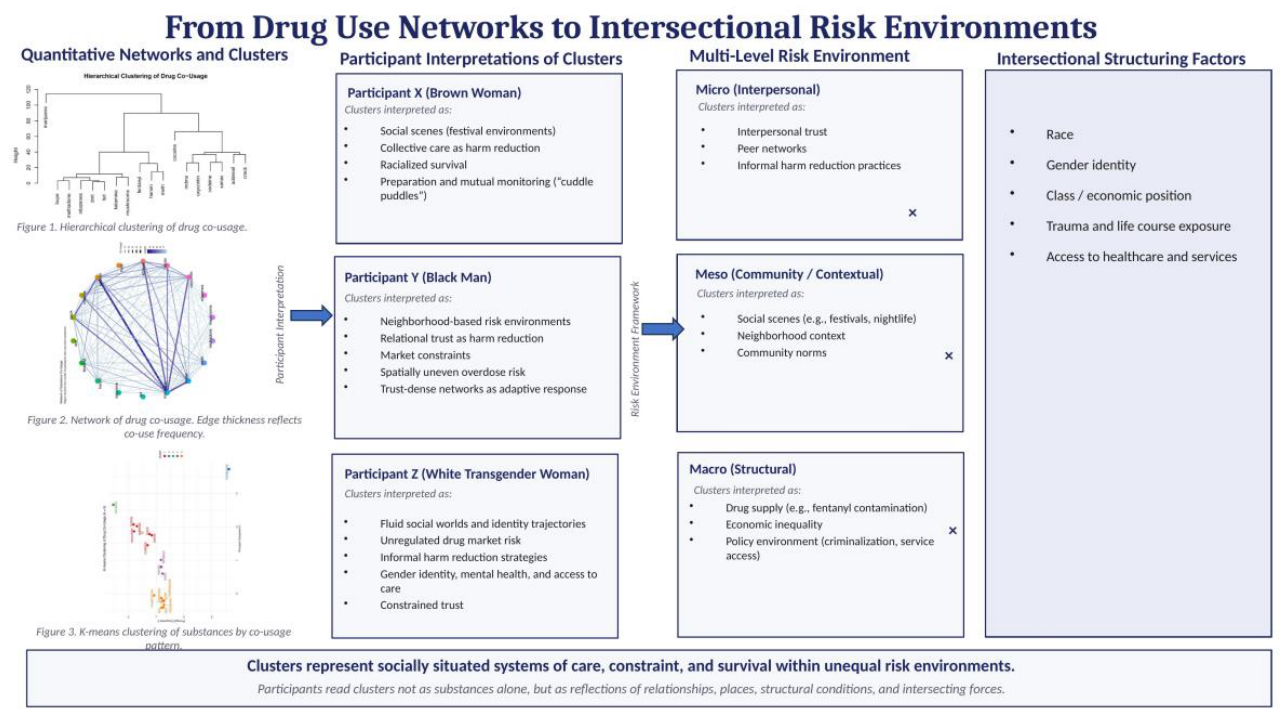
Multiple participants reframed clusters as maps of social environments rather than as indicators of individual pathology. Although participants emphasized different dimensions of the visualizations, their interpretations converged on understanding polysubstance use as an adaptive behavior shaped by relationships, place, structural inequality, and changing drug market conditions (Figure 4).
4. Discussion
This study examined how people who use drugs made sense of network and cluster analyses of polysubstance co-use, and what their interpretations reveal about the social and structural organization of drug use. Polysubstance use was common in our sample, as shown in Figure 1, Figure 2 and Figure 3, and the co-use network was densely interconnected rather than divided into distinct drug “types.” When participants engaged with these outputs, they did not interpret clusters as pharmacological categories. They read them as maps of the people, places, relationships, and conditions in which people use drugs.
Participants located polysubstance use within four interrelated processes: collective care and racialized survival, neighborhood trust, pragmatic harm reduction, and identity navigation and self-regulation. Each process maps to a different level of the risk environment [14,15] and was shaped by participants’ social positions, consistent with the intersectional risk environment [18]. Taken together, these interpretations suggest that what quantitative models identify as co-use clusters are, from the standpoint of people who use drugs, the visible traces of strategies for managing an unpredictable drug supply, unsafe living conditions, and unequal access to care.
Collective Care and Racialized Survival
Participants described polysubstance use as a collective, organized practice and, in many settings, as a condition for getting through the day. Participant X read the psychedelic and MDMA cluster as a festival scene defined by preparation: packing test strips, checking drugs at a booth, and using them together in ways designed to be both safe and meaningful. This echoes research showing that much of the harm reduction practiced by people who use drugs is relational and peer-led, often occurring outside formal services [30,31]. In these accounts, co-use is not a loss of control but a planned, socially regulated activity.
The resources that make collective care possible were not evenly distributed. The same participant contrasted festival co-use with stimulant-opioid use among Black men, framing the latter as a necessity rather than recreation and linking it to trauma, family disruption, and exclusion from stable work. We treat this as her interpretation of others’ use, not as evidence of those men’s motivations. Its analytic value lies in how sharply it separates use buffered by economics, community infrastructure, and access to drug checking from use without those buffers.
Participants also described stimulant use among unhoused people as a survival strategy, with staying awake protecting against theft and violence, as Participant X noted: “...they need them to survive”. This mirrors prior work in which people experiencing homelessness describe methamphetamine to remain alert and protect themselves and their belongings [32,33,34]. Within the intersectional risk environment, the same drug combination can occupy very different risk configurations depending on race, class, and housing, information a substance-level cluster cannot show [18,35].
Neighborhood Trust and Unintentional Polysubstance Use
Participant Y described trust as a harm reduction strategy. He bought only from people who had used the same supply or could vouch for its source, avoided unfamiliar areas, and relied on neighborhoods where residents looked out for one another. These practices align with safety strategies documented among people who use methamphetamine in the fentanyl era, including buying from trusted sources and using near others [36,37,38].
Participants’ accounts also revealed that when trust is absent, polysubstance use becomes unintentional. Participant Z’s knew what she intended to take but not what she actually took, which describes co-use driven by the supply rather than by choice, a pattern documented among people who use stimulants and seek to avoid opioids [39,40]. Recent work distinguishes intentional from unintentional opioid-stimulant co-use for this reason [41], and our findings suggest that the boundary between the two is maintained socially, through relationships, reputation, and familiarity with place, consistent with evidence that people who use drugs rely on trusted sellers and social networks to manage supply uncertainty [36,42].
This has a direct implication for quantitative work: survey measures that do not distinguish between intended and unintended exposure will overstate how much co-use clusters reflect preference. Trust networks are also unequally available. The stable housing, homeownership, and long-standing neighborhood ties that Participant Y identified as protective are themselves structured by race and class.
Pragmatic Harm Reduction: Managing Effects in a Fentanyl-Era Supply
Participants described co-use to manage drug effects: using a stimulant to counteract sedation, using cannabis to come down from a stimulant, or using one substance to sleep and another to wake. Combining stimulants and depressants is not new; heroin-cocaine (“speedball”) has long been documented [43,44], and heroin-methamphetamine co-use, referred to as “goofballing,” became increasingly common during the 2010s [45,46,47]. Co-use combinations have long histories.
What has changed is the scale and function of co-use. Methamphetamine use among people who use opioids rose sharply in the 2010s [48,49], and overdose deaths involving fentanyl and stimulants increased dramatically over the same period [50,51]. Our participants offered a mechanism consistent with these trends: fentanyl’s prolonged sedation created a need for stimulants among people who had not previously used them. Syringe services program leaders and participants across the United States have likewise described stimulant use as a way to counteract fentanyl’s depressant effects [41,52].
Cannabis also played a similar regulatory role. Participants described using it to “chill out” after stimulant use. In a Vancouver sample of people who used both cannabis and unregulated stimulants, nearly half reported using cannabis to manage stimulant cravings [53]. This offers a functional explanation for cannabis’s centrality in our network.
The historic shift, then, is not that stimulants and depressants are now combined, but that combining them has become a routine response to the supply pharmacology rather than primarily a pursuit of a particular high. Harm reduction messaging that treats co-use only as compounding risk overlooks the protective function it serves in users’ eyes; messaging that ignores the risk overlooks that stimulants may mask opioid sedation without reducing overdose risk.
Limitations, Strengths, and Future Research
Study limitations include a small sample size, with findings reflecting context-specific interpretations that may not be generalizable. Participants’ engagement with visual data may also vary based on familiarity/comfort with such representations. This study has several strengths. Its convergent mixed-methods design integrated network and cluster analyses with participant-led interpretation, contextualizing quantitative findings through lived experience. Engaging people who use drugs as knowledge producers enhanced interpretive validity and reduced stigmatizing conclusions. Using risk environment and intersectionality frameworks, along with diverse community-based recruitment and transparent analytic reporting, further strengthened the rigor and relevance of the findings.
5. Conclusions
This study shows that quantitative analysis alone cannot fully capture the meaning of polysubstance use clusters. Participants interpreted network and cluster outputs as reflections of social relationships, structural conditions, and adaptive responses to unequal risk environments, generating explanations that went beyond the statistical models. By positioning people who use drugs as collaborators in interpretation, this study highlights the value of integrating lived experience into quantitative research and offers a participatory approach to producing more relevant, contextually grounded, and less stigmatizing public health knowledge.
Author Contributions
Conceptualization, S.F.C, B.K., and D.J.S.; methodology, D.J.S., S.F.C., and L.V..; software, D.J.S., S.F.C.; validation, D.J.S., L.V., and F.S.; formal analysis, D.J.S., S.F.C., and L.V.; investigation, S.F.C., and D.J.S.; data curation, F.S., B.K., L.V., S.F.C, and R.M.; writing—original draft preparation, S.F.C., D.J.S, F.S., C.G., J.M.C., and L.N.S.; writing—review and editing, all authors; visualization, D.J.S, and F.S..; supervision, S.F.C., and D.J.S.; project administration, S.F.C. funding acquisition, B.K., and S.F.C. All authors have read and agreed to the published version of the manuscript.
Funding
This study was funded by the Injury Prevention and Research Center at Emory (IPRCE) (CDC R49CE003072 PI: Rupp; Subaward: MPI: Febres-Cordero & King). The content is solely the responsibility of the authors and does not necessarily represent the official views of the CDC or IPRCE.
Institutional Review Board Statement
Ethics approval and consent to participate. The study was conducted with Institutional Review Board (IRB) supervision from Emory University (STUDY00006583).
Informed Consent Statement
All the participants provided written informed consent. Given the sensitive nature of illicit drug use, confidentiality, voluntariness, and participant safety were emphasized across all phases. A certificate of confidentiality was provided by the Centers for Disease Control and Prevention.
Data Availability Statement
The datasets generated and analyzed during the current study are not publicly available due to ethical restrictions related to the sensitive nature of illicit drug use data and the risk of participant re-identification. De-identified quantitative and qualitative data may be made available upon reasonable request to the corresponding author and with approval from the Emory University Institutional Review Board.
Conflicts of Interest
The authors declare no conflicts of interest.
Abbreviations
The following abbreviations are used in this manuscript:
| DMT | dimethyltryptamine |
| LSD | lysergic acid diethylamide |
| MDMA | 3,4-Methylenedioxymethamphetamine |
| SSPs | syringe service programs |
References
- Centers for Disease Control and Prevention. Polysubstance overdose. 2024. Available online: https://www.cdc.gov/overdose-prevention/about/polysubstance-overdose.html?utm_source.
- Centers for Disease Control and Prevention. U.S. Overdose Deaths Decrease for Third Consecutive Year in 2025. 2026. Available online: https://www.cdc.gov/nchs/pressroom/releases/20260513.html.
- Ellis, J.D.; et al. Patterns of polysubstance use and clinical comorbidity among persons seeking substance use treatment: An observational study. J. Subst. Use Addict Treat. 2023, 146, 208932. [Google Scholar] [CrossRef]
- Rawy, M.; Abdalla, G.; Look, K. Polysubstance mortality trends in White and Black Americans during the opioid epidemic, 1999-2018. BMC Public Health 2024, 24(1), 112. [Google Scholar] [CrossRef]
- Siebers, R. Most Overdose Deaths Now Involve Multiple Substances. Pew Research Center. 2025. Available online: https://pewtrsts.org/4oYvrub.
- Tanz, L.J.; et al. Drug Overdose Deaths Involving Stimulants—United States, January 2018-June 2024. MMWR Morb. Mortal. Wkly. Rep. 2025, 74(32), 491–499. [Google Scholar] [CrossRef]
- Kamali, K.; Steer, R.A. Polydrug use by high-school students: involvement and correlates. Int. J. Addict 1976, 11(2), 337–43. [Google Scholar] [CrossRef]
- Harrington, M.; Baird, J.; Lee, C.; Nirenberg, T.; Longabaugh, R.; Mello, M. J.; Woolard, R. Identifying subtypes of dual alcohol and marijuana users: A methodological approach using cluster analysis. Addctv. Behav. 2012, 37(1), 119–123. [Google Scholar] [CrossRef]
- Elliott, L.; et al. Polysubstance use patterns and novel synthetics: A cluster analysis from three U.S. cities. PLoS ONE 2019, 14(12), e0225273. [Google Scholar] [CrossRef]
- Panlilio, L.V.; et al. Beyond abstinence and relapse: cluster analysis of drug-use patterns during treatment as an outcome measure for clinical trials. Psychopharmacology (Berl) 2020, 237(11), 3369–3381. [Google Scholar] [CrossRef]
- Mannell, J.; et al. Visual Participatory Analysis: A Qualitative Method for Engaging Participants in Interpreting the Results of Randomized Controlled Trials of Health Interventions. J. Mix Methods Res. 2021, 15(1), 18–36. [Google Scholar] [CrossRef]
- Salazar, Z.R.; et al. Research led by people who use drugs: centering the expertise of lived experience. Subst. Abus. Treat. Prev. Policy 2021, 16(1), 70. [Google Scholar] [CrossRef]
- Beck McGreevy, P.; et al. Doing community-based research during dual public health emergencies (COVID and overdose). Harm Reduct. J. 2023, 20(1), 135. [Google Scholar] [CrossRef]
- Rhodes, T. The ‘risk environment’: a framework for understanding and reducing drug-related harm. Int. J. Drug Policy 2002, 13(2), 85–94. [Google Scholar] [CrossRef]
- Rhodes, T. Risk environments and drug harms: a social science for harm reduction approach. Int. J. Drug Policy 2009, 20(3), 193–201. [Google Scholar] [CrossRef]
- Crenshaw, K. Demarginalizing the Intersection of Race and Sex: A Black Feminist Critique of Antidiscrimination Doctrine, Feminist Theory and Antiracist Politics. University of Chicago Legal Forum, 1989. 1989(8). Available online: https://chicagounbound.uchicago.edu/uclf/vol1989/iss1/8.
- Bowleg, L. The problem with the phrase women and minorities: intersectionality-an important theoretical framework for public health. Am. J. Public Health 2012, 102(7), 1267–73. [Google Scholar] [CrossRef]
- Collins, A.B.; et al. The intersectional risk environment of people who use drugs. Soc. Sci. Med. 2019, 234, 112384. [Google Scholar] [CrossRef]
- Morgan, D.L. Paradigms Lost and Pragmatism Regained:Methodological Implications of Combining Qualitative and Quantitative Methods. J. Mix. Methods Res. 2007, 1(1), 48–76. [Google Scholar] [CrossRef]
- Team, R.C. R: A language and environment for statistical computing; R Foundation for Statistical Computing: Vienna, Austria, 2025. [Google Scholar]
- Wickham, H.; et al. Welcome to the tidyverse. J. Open Source Softw. 2019, 4(43), 1686. [Google Scholar] [CrossRef]
- Wickham, H.; Hester, J.; Bryan, J. (Eds.) Read Rectangular Text Data. In Comprehensive R Archive Network (CRAN); 2024. [Google Scholar]
- Csárdi, G.; et al. Igraph Netw. Anal. Vis. R. 2026, Compr. R Arch. Netw. (CRAN). [CrossRef]
- Csárdi, G.; Nepusz, T. The igraph software package for complex network research. 2006. [Google Scholar]
- Antonov, M.; et al. igraph 1.0 enables fast and robust network analysis across programming languages. PLoS ONE 2026. 21, 8, e0355108. [Google Scholar] [CrossRef]
- Pedersen, T.L. ggraph: An Implementation of Grammar of Graphics for Graphs and Networks. Comprehensive R Archive Network (CRAN), 2025. [Google Scholar]
- Wickham, H. ggplot2: Elegant Graphics for Data Analysis; Springer-Verlag New York, 2016. [Google Scholar]
- Slowikowski, K. ggrepel: Automatically Position Non-Overlapping Text Labels with ‘ggplot2’; Comprehensive R Archive Network (CRAN), 2024. [Google Scholar]
- Schilling, L.; et al. Licit and illicit substance use patterns among university students in Germany using cluster analysis. Subst. Abus. Treat. Prev. Policy 2017, 12(1), 44. [Google Scholar] [CrossRef]
- Elkhalifa, S.; et al. Social network support and harm reduction activities in a peer researcher-led pilot study, British Columbia, Canada. Harm Reduct. J. 2020, 17(1), 57. [Google Scholar] [CrossRef]
- Piatkowski, T.; et al. How do relational practices co-constitute care for people who use drugs? The social and political dimensions of peer-led harm reduction. Int. J. Drug Policy 2024, 133, 104614. [Google Scholar] [CrossRef]
- Bungay, V.; et al. Life with jib: A snapshot of street youth’s use of crystal methamphetamine. Addctn. Res. Theory 2006, 14(3), 235–251. [Google Scholar] [CrossRef]
- Carrillo Beck, R.; Szlapinski, J.; Pacheco, N.; Sabri Laghaei, S.; Isard, R.; Oudshoorn, A.; Marshall, C. A. Violence and victimisation in the lives of persons experiencing homelessness who use methamphetamine: A scoping review. Health Soc. Care Community 2022, 30, 1619–1636. [Google Scholar] [CrossRef]
- Regmi, S.; et al. Methamphetamine-Induced Wakefulness and Sleep Management: A Qualitative Analysis of Online Narratives. J. Psychoact. Drugs 2024, 56(4), 595–602. [Google Scholar] [CrossRef]
- Godkhindi, P.; Nussey, L.; O’Shea, T. “They’re causing more harm than good”: a qualitative study exploring racism in harm reduction through the experiences of racialized people who use drugs. Harm Reduct. J. 2022, 19(1), 96. [Google Scholar] [CrossRef]
- Erinoso, O.; et al. Safety strategies and harm reduction for methamphetamine users in the era of fentanyl contamination: A qualitative analysis. Int. J. Drug Policy 2024, 128, 104456. [Google Scholar] [CrossRef]
- LaForge, K.; et al. Knowledge, attitudes, and behaviors related to the fentanyl-adulterated drug supply among people who use drugs in Oregon. J. Subst. Abus. Treat. 2022, 141, 108849. [Google Scholar] [CrossRef]
- Walters, S.M.; Felsher, M.; Frank, D. I Don’t Believe a Person Has to Die When Trying to Get High: Overdose Prevention and Response Strategies in Rural Illinois. Int. J. Environ. Res. Public Health 2023, 20(2), 1648. [Google Scholar] [CrossRef]
- Syvertsen, J.; et al. The emergence of fentanyl in a stimulant landscape: Un/intentional use, social relations, and developing communities of care. Int. J. Drug Policy 2025, 140, 104807. [Google Scholar] [CrossRef]
- Gomez, B.O.; Samayoa, E.Y.; Coffin, P.O. Mechanisms of overdose from unintentional fentanyl use when intending to use stimulants: a qualitative study of people who use stimulants and avoid opioids. Harm Reduct. J. 2026. [Google Scholar] [CrossRef]
- Andraka-Christou, B.; et al. Syringe service program leader and participant perspectives on reasons for opioid-stimulant co-use in the United States. Drug Alcohol Depend. Rep. 2025. 17, 100396. [Google Scholar] [CrossRef]
- Walters, S.M.; et al. Strategies used to reduce harms associated with fentanyl exposure among rural people who use drugs: Multi-site qualitative findings from the rural opioid initiative. Harm Reduct. J. 2024, 21(1), 154. [Google Scholar] [CrossRef]
- Leri, F.; Bruneau, J.; Stewart, J. Understanding polydrug use: review of heroin and cocaine co-use. Addiction 2003, 98(1), 7–22. [Google Scholar] [CrossRef]
- Leri, F.; et al. Heroin and cocaine co-use in a group of injection drug users in Montréal. J. Psychiatry Neurosci. 2004, 29(1), 40–47. Available online: https://pmc.ncbi.nlm.nih.gov/articles/PMC305269/. [CrossRef]
- Al-Tayyib, A.; et al. Heroin and methamphetamine injection: An emerging drug use pattern. Subst. Use Misuse 2017, 52(8), 1051–1058. [Google Scholar] [CrossRef]
- Hazani, H.M.; et al. Goofballing of Opioid and Methamphetamine: The Science Behind the Deadly Cocktail. Front. Pharmacol. 2022, 13, 859563. [Google Scholar] [CrossRef]
- Sun, R.; Sauda, T.H.; Hoopsick, R.A. Unmet needs and harm reduction preferences of syringe services program participants: Differences by co-use of illicit opioids and methamphetamine. Harm Reduct. J. 2024, 21(1). [Google Scholar] [CrossRef]
- Ellis, M.S.; Kasper, Z.A.; Cicero, T.J. Twin epidemics: The surging rise of methamphetamine use in chronic opioid users. Drug Alcohol Depend. 2018, 193, 14–20. [Google Scholar] [CrossRef]
- Jones, C.M.; Underwood, N.; Compton, W.M. Increases in methamphetamine use among heroin treatment admissions in the United States, 2008-17. Addiction 2020, 115(2), 347–353. [Google Scholar] [CrossRef]
- Ciccarone, D. The rise of illicit fentanyls, stimulants and the fourth wave of the opioid overdose crisis. Curr. Opin. Psychiatry 2021, 34(4), 344–350. [Google Scholar] [CrossRef]
- Friedman, J.; Shover, C.L. Charting the fourth wave: Geographic, temporal, race/ethnicity and demographic trends in polysubstance fentanyl overdose deaths in the United States, 2010–2021. Addiction 2023, 118(12), 2477–2485. [Google Scholar] [CrossRef]
- Rhed, B.D.; et al. Patterns of and Rationale for the Co-use of Methamphetamine and Opioids: Findings From Qualitative Interviews in New Mexico and Nevada. Front. Psychiatry 2022, 13, 824940. [Google Scholar] [CrossRef]
- Reddon, H.; et al. Cannabis use to manage stimulant cravings among people who use unregulated drugs. Addict Behav. 2024, 148, 107867. [Google Scholar] [CrossRef]
- Holborn, T.; Schifano, F.; Deluca, P. No prescription? No problem: A qualitative study investigating self-medication with novel psychoactive substances (NPS). Int. J. Drug Policy 2023, 118, 104109. [Google Scholar] [CrossRef]
- Raison, C.L.; et al. Effects of naturalistic psychedelic use on depression, anxiety, and well-being: Associations with patterns of use, reported harms, and transformative mental states. Front. Psychiatry 2022, 13, 831092. [Google Scholar] [CrossRef]
- Smith, G.; et al. Self-treatment of psychiatric conditions using ketamine: Patterns, characteristics, and retrospective insights. J. Psychopharmacol. 2026, 40(6), 933–944. [Google Scholar] [CrossRef]
- Walker, C.; et al. From chaos to kaleidoscope: Exploring factors in psychedelic self-treatment for mental health conditions. J. Psychopharmacol. 2024, 38(8), 749–760. [Google Scholar] [CrossRef]
- Shiju, S.; Tirumala, R.; Marseille, E. Self-medication with psychedelics: A scoping review and narrative synthesis of review-level evidence. Explor. Res. Clin. Soc. Pharm. 2026. 21, 100709. [Google Scholar] [CrossRef]
- Soares, C.M.; Leite, Â.; Pinto, M. Self-care practices with psychedelics—A qualitative study of users’ perspectives. J. Psychoact. Drugs 2023, 55(2), 159–169. [Google Scholar] [CrossRef]
- Bartholomaeus, T.; et al. Altered states, Authentic selves: Trans individual’s experiences with psychedelics and their implications for psychedelic-assisted psychotherapy. Int. J. Transgender Health 2026. 0, 0, 1–13. [Google Scholar] [CrossRef]
- Gaughan, S.J.; et al. Naturalistic psychedelic experiences and gender-based self-acceptance in transgender and gender-expansive people. Int. J. Transgender Health 2026. 27, 4, 1766–1781. [Google Scholar] [CrossRef]
- Chandler, C.L.; Buttram, M.E.; Ellis, M.S. Recreational ketamine use among individuals with opioid use disorder: Demographics, motivations, and polysubstance use. Subst. Use Misuse 2025, 60(9), 1375–1381. [Google Scholar] [CrossRef]
- Chaves, T.V.; Wilffert, B.; Sanchez, Z.M. The use of ketamine to cope with depression and post-traumatic stress disorder: A qualitative analysis of the discourses posted on a popular online forum. Am. J. Drug Alcohol Abus. 2020, 46(5), 613–624. [Google Scholar] [CrossRef]
Figure 1.
Hierarchical clustering of drug co-use. Dendrogram depicting collective clustering of substances based on patterns of co-use among participants. Substance pairs joining at lower heights (e.g., buprenorphine–methadone, DMT–LSD, ketamine–mushrooms) indicate greater similarity in use profiles, while substances joining at greater heights indicate less similarity. Cannabis joins the tree at the greatest height, reflecting its distinct co-use profile relative to all other substances.
Figure 1.
Hierarchical clustering of drug co-use. Dendrogram depicting collective clustering of substances based on patterns of co-use among participants. Substance pairs joining at lower heights (e.g., buprenorphine–methadone, DMT–LSD, ketamine–mushrooms) indicate greater similarity in use profiles, while substances joining at greater heights indicate less similarity. Cannabis joins the tree at the greatest height, reflecting its distinct co-use profile relative to all other substances.
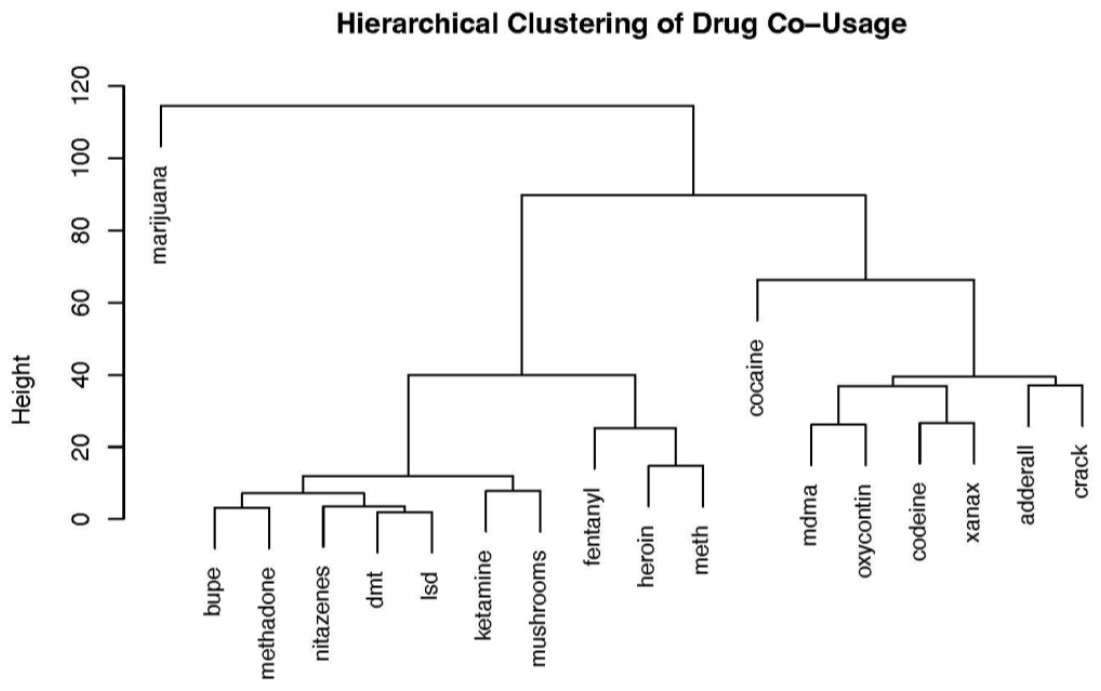
Figure 2.
Network of substance co-usage. Circular network graph illustrating co-use relationships among substances, where nodes represent individual substances and edges represent the number of participants reporting use of both substances. Edge thickness and color intensity correspond to co-usage frequency (weight), as indicated in the legend. Marijuana occupies a central position in the network, with the strongest connections to cocaine, MDMA, Adderall, Xanax, and oxycontin.
Figure 2.
Network of substance co-usage. Circular network graph illustrating co-use relationships among substances, where nodes represent individual substances and edges represent the number of participants reporting use of both substances. Edge thickness and color intensity correspond to co-usage frequency (weight), as indicated in the legend. Marijuana occupies a central position in the network, with the strongest connections to cocaine, MDMA, Adderall, Xanax, and oxycontin.
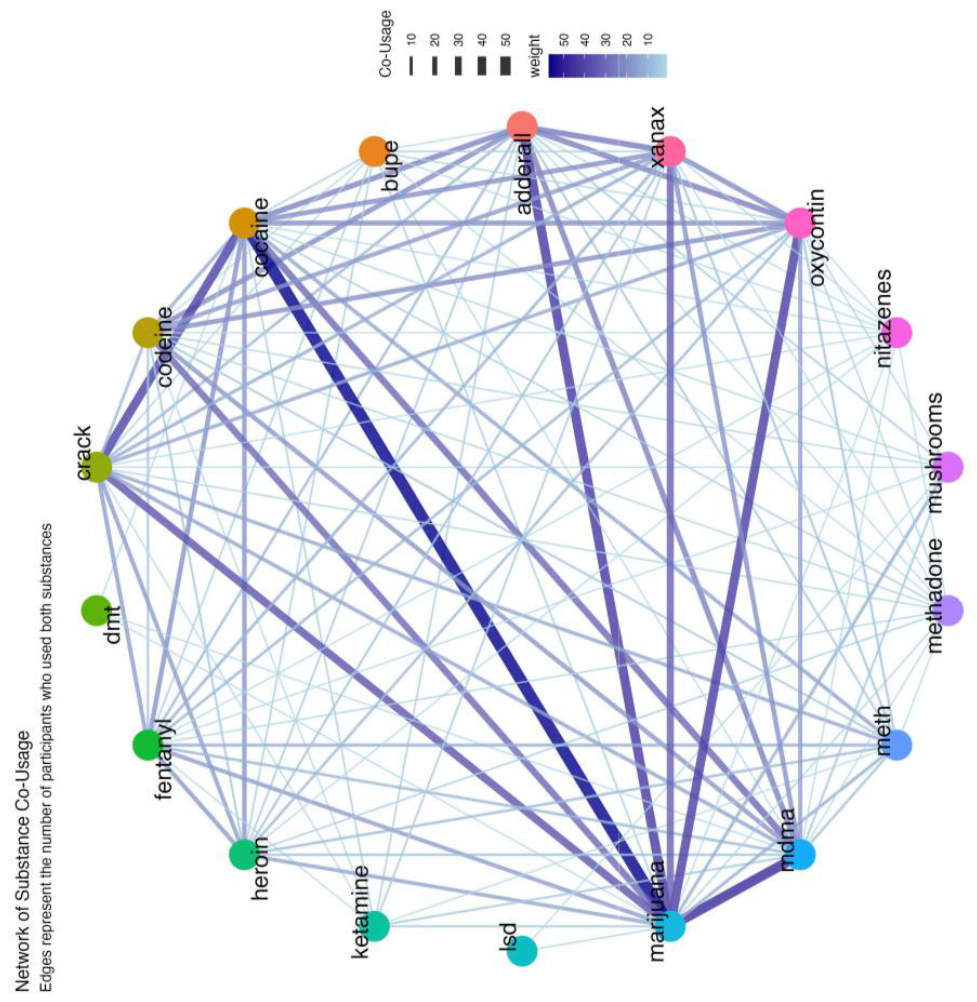
Figure 3.
K-means clustering of drug co-usage (k = 5). Principal component analysis (PCA) plot displaying five substance clusters derived from k-means clustering of co-usage data, projected onto the first two principal components. Cluster 1 (red) includes OxyContin, MDMA, Adderall, crack, Xanax, and codeine; Cluster 2 (blue) contains marijuana alone; Cluster 3 (green) contains cocaine alone; Cluster 4 (purple) includes heroin, fentanyl, and methamphetamine; and Cluster 5 (orange) includes mushrooms, ketamine, LSD, DMT, buprenorphine, nitazenes, and methadone. “X” markers denote cluster centroids.
Figure 3.
K-means clustering of drug co-usage (k = 5). Principal component analysis (PCA) plot displaying five substance clusters derived from k-means clustering of co-usage data, projected onto the first two principal components. Cluster 1 (red) includes OxyContin, MDMA, Adderall, crack, Xanax, and codeine; Cluster 2 (blue) contains marijuana alone; Cluster 3 (green) contains cocaine alone; Cluster 4 (purple) includes heroin, fentanyl, and methamphetamine; and Cluster 5 (orange) includes mushrooms, ketamine, LSD, DMT, buprenorphine, nitazenes, and methadone. “X” markers denote cluster centroids.
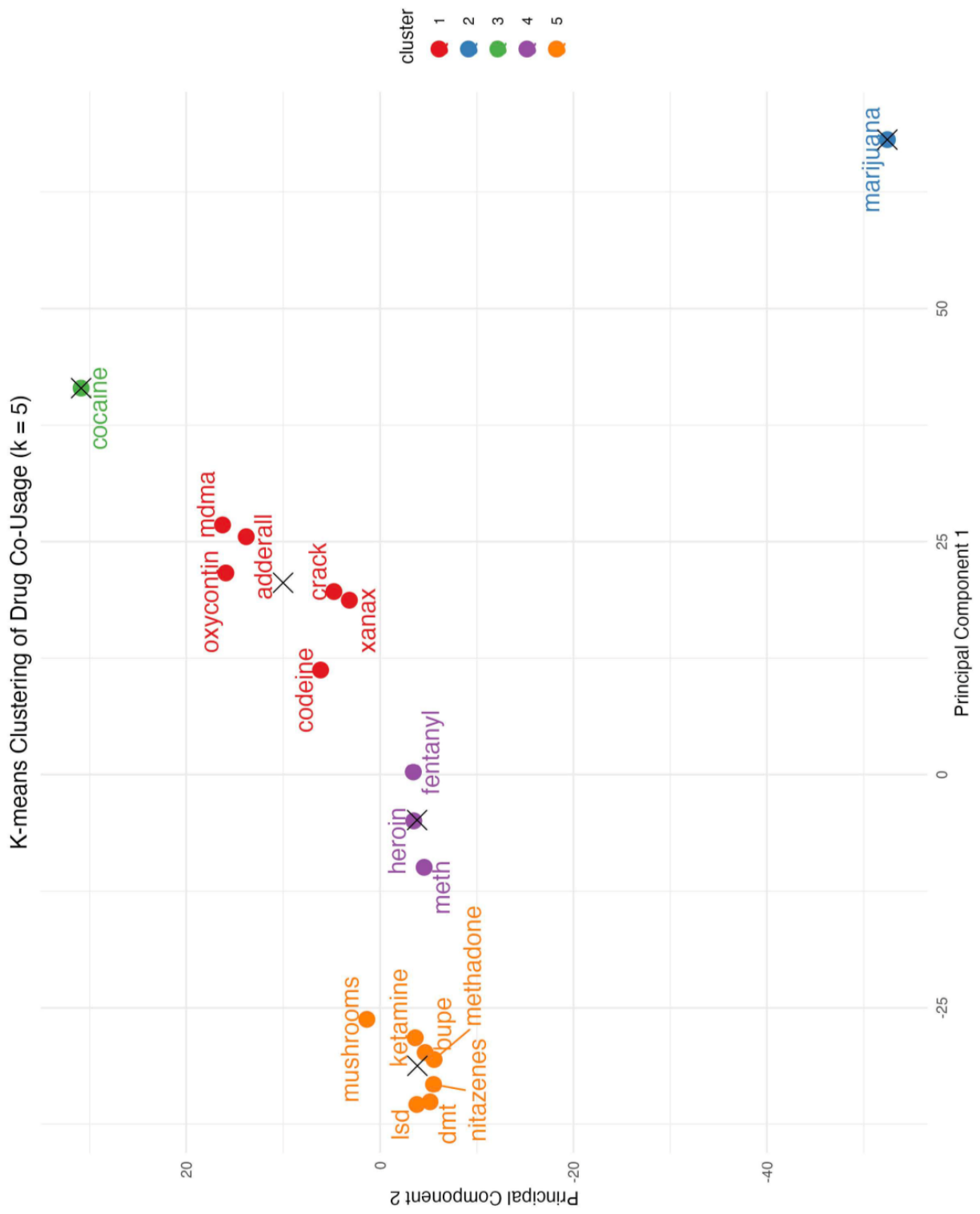
Figure 4.
From drug use networks to intersectional risk environments: participant interpretations of cluster analysis. Quantitative network and cluster analyses of polysubstance use are presented alongside participant-generated interpretations and a multi-level risk environment framework. The left panel presents three complementary quantitative analyses of polysubstance co-use: a hierarchical clustering dendrogram identifying substances with similar co-use profiles (Figure 1); a network graph in which edge thickness represents the number of participants reporting co-use of each substance pair (Figure 2); and a k-means cluster analysis grouping substances by shared usage pattern (Figure 3). The middle panel summarizes how participants interpreted clusters as socially situated environments rather than pharmacological groupings. Participants described clusters as reflecting social scenes, neighborhood dynamics, and identity-based trajectories, and emphasized that harm reduction is relational and context-dependent. The right panel situates these interpretations within a risk environment framework, illustrating how drug use is shaped across micro (interpersonal), meso (community/contextual), and macro (structural) levels. Intersectional structuring factors, including race, gender identity, class, trauma, and access to healthcare, cut across all levels, shaping differential exposure to risk and access to care. Together, the figure illustrates how participants understand drug use clusters as systems of care, constraint, and survival within unequal social and structural contexts.
Figure 4.
From drug use networks to intersectional risk environments: participant interpretations of cluster analysis. Quantitative network and cluster analyses of polysubstance use are presented alongside participant-generated interpretations and a multi-level risk environment framework. The left panel presents three complementary quantitative analyses of polysubstance co-use: a hierarchical clustering dendrogram identifying substances with similar co-use profiles (Figure 1); a network graph in which edge thickness represents the number of participants reporting co-use of each substance pair (Figure 2); and a k-means cluster analysis grouping substances by shared usage pattern (Figure 3). The middle panel summarizes how participants interpreted clusters as socially situated environments rather than pharmacological groupings. Participants described clusters as reflecting social scenes, neighborhood dynamics, and identity-based trajectories, and emphasized that harm reduction is relational and context-dependent. The right panel situates these interpretations within a risk environment framework, illustrating how drug use is shaped across micro (interpersonal), meso (community/contextual), and macro (structural) levels. Intersectional structuring factors, including race, gender identity, class, trauma, and access to healthcare, cut across all levels, shaping differential exposure to risk and access to care. Together, the figure illustrates how participants understand drug use clusters as systems of care, constraint, and survival within unequal social and structural contexts.
Disclaimer/Publisher’s Note: The statements, opinions and data contained in all publications are solely those of the individual author(s) and contributor(s) and not of MDPI and/or the editor(s). MDPI and/or the editor(s) disclaim responsibility for any injury to people or property resulting from any ideas, methods, instructions or products referred to in the content. |
© 2026 by the authors. Licensee MDPI, Basel, Switzerland. This article is an open access article distributed under the terms and conditions of the Creative Commons Attribution (CC BY) license (http://creativecommons.org/licenses/by/4.0/).
Copyright: This open access article is published under a Creative Commons CC BY 4.0 license, which permit the free download, distribution, and reuse, provided that the author and preprint are cited in any reuse.