
Submitted:
11 November 2026
Posted:
12 November 2026
You are already at the latest version
Abstract
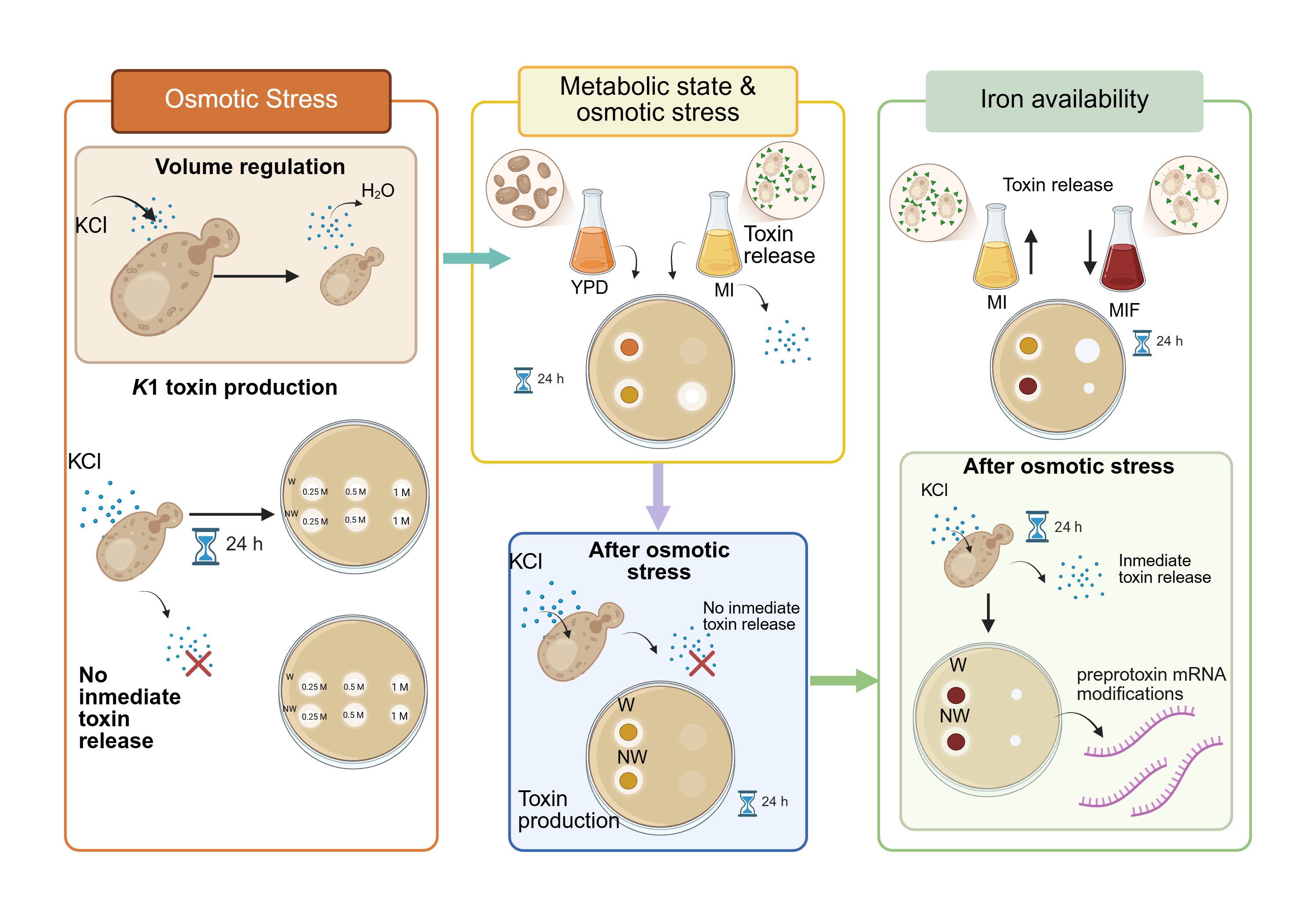
Cells continuously adapt to changing environmental conditions by integrating external signals that influence cellular physiology and stress responses. In Saccharomyces cerevisiae, osmotic stress and iron availability affect several adaptive pathways; however, their relationship with the functional expression of the Killer phenotype remains incompletely understood. Here, we investigated the effects of hyperosmotic stress and iron availability on functional Killer activity and K1 RT-PCR amplification patterns using physiological, functional, and molecular approaches. Acute hyperosmotic shock induced by KCl did not abolish detectable Killer activity under the conditions tested. Metabolic induction enhanced functional activity, indicating that the physiological state of the cells influences the observed inhibitory phenotype. Supernatants from induced cells showed detectable extracellular inhibitory activity, and larger inhibition halos were observed under iron-enriched conditions following osmotic challenge. These findings indicate that extracellular inhibitory activity differed according to the experimental conditions, although the underlying mechanism remains unresolved. In parallel, osmotic stress under iron-enriched conditions was associated with differences in K1 RT-PCR amplification patterns. Preliminary sequence analysis confirmed the identity of the K1-coding region, while highlighting potential sequence divergence under stress conditions that warrants further high-coverage validation. Together, these results show that osmotic stress, metabolic induction, and iron availability are associated with changes in the functional expression of the Killer phenotype in S. cerevisiae. Further studies combining quantitative transcript analysis and physiological characterization will be required to determine the mechanisms underlying these responses.
Keywords:
Saccharomyces cerevisiae
; osmotic stress
; iron availability
; Killer phenotype
; extracellular inhibitory activity
; K1 RT-PCR amplification patterns
Copyright: This open access article is published under a Creative Commons CC BY 4.0 license, which permit the free download, distribution, and reuse, provided that the author and preprint are cited in any reuse.