
Submitted:
11 November 2026
Posted:
12 November 2026
You are already at the latest version
Abstract
In this paper, we propose an extension of the rough set model investigated by Al-Shami, inspired by supra-topologies in an approximation space based on an arbitrary relation. We investigate a symmetric model generated by the complements of a supra-topology. This extended model is studied here as a generalization of the topological model, i.e., without a relation. We propose a general conception of generating a symmetric pair of Alexandroff topologies, providing a granular tool for the approximations investigated in the proposed model. As a corollary, we obtain a granular characterization of Al-Shami’s model and the introduced symmetric model in an approximation space based on a relation.
Keywords:
Alexandroff topology
; rough set
; Nk-neighborhood
; supra-topology
; accuracy and roughness measures
1. Introduction
In 1982, Pawlak introduced rough set theory using equivalence relations as a key notion. A natural generalization of this concept is the use of other types of binary relations [5,21]. The most far-reaching generalization of this concept is to apply any binary relation instead of the equivalence relation [16,17]. Since Pawlak’s first investigations, the combination of rough set theory and topology theory has become one of the topics of research in this area [6,13,14]. Wiweger in [13] introduced the notion of topological rough sets using a topology as the fundamental structure to construct rough approximation operators. Al-shami and Alshammari [4] extend this concept by applying a more general structure called supra-topology. In this paper, we additionally introduce a symmetric type of approximation operators, namely, generated by the family of complements of the members of a supra-topology .
In Theorems 2 and 3, we construct a pair of Alexandroff topologies generated by the families and , respectively. In Theorems 4 and 5, we show that the approximation operators generated by the families and are interpretable by the approximation operators generated by the topologies and , respectively.
The topological aspect of rough set theory is closely related to granular computing theory. The granular computing issue was first investigated by Zadeh using fuzzy set theory [20]. In the succeeding years, the foundations of granular computing have been used in many disciplines, among others, in rough set theory. Pawlak [10], Skowron and Stepaniuk [11] launched the investigation of granular computing in this area. With granulated views, one can consider the equivalence classes as elementary granules. Yao [18] used neighborhood systems for the interpretation of granules in the study of rough set approximations. W. Yao and S.E. Han [15] indicate Alexandrov topology as the fundamental structure to construct approximation operators and investigate rough sets from a granular computing perspective. In Theorems 4 and 5, we show that the approximation operators generated by and can be characterized as a granular-type approximation based on the topologies and , respectively. As a result, we obtain an assessment of the accuracy of the investigated approximations. We show that the approximations generated by the topologies and are more accurate compared to the approximations given by and .
2. Some Alexandroff Topologies Generated in a k-Supra Topological Space
Let be an equivalence relation on E. The pair is called Pawlak approximation space [9].
Naturally, the relation induces a partition of the universe E ,i.e.,
, where .
The two rough approximations, the lower and upper approximations of , are defined in the following three forms [19]:
(I) Element-based definition:
and
, where , respectively.
(II) Granular-based definition:
and
where . Equivalently,
.
(III) Subsystem-based definition:
and
where .
Equivalently, since is closed under complements,
The accuracy of rough set approximation is defined as [9]:
where denotes the cardinality of a set. For the empty set ∅, we define . If A is a union of some equivalence granules, we have and hence .
The family uniquely defines a topological space in which it is the family of all open and closed sets. So, (resp.) is the interior (resp. closure) operator in , respectively. Conversely, one can generalize the notion of rough approximation operators based on a topological space by using the topology instead of [13]. So, we have the following approximation operators:
(IV) Given a topological space , we define
,
, where .
At a general level, a family of granules in a universe E can be considered as a covering of E [10]. Original Pawlak’s granular-based definition of the approximation operators has been generalized in [12] as follows:
(V) Let and , be given. For any , we define lower and upper approximation operators as follows:
,
, where .
A subset is granularly definable iff there is such that .
A simple generalization of Pawlak’s element-based concept introduced in [16,17] consists of replacing the equivalence relation with an arbitrary relation . As a result of replacing the equivalence classes with the relational neighborhoods, namely the left (predecessor) and the right (successor) neighborhoods, i.e.,
and
for , respectively.
In this case, the ordered pair is called an approximation space.
According to Y.Y. Yao [17], we have the following definition.
(VI) Given an approximation space , we define
,
, where and .
The neighborhood form of granulation has been defined in [7] as a family of subsets of E for which there exists a map such that and every is of the form for some . If are two operators such that for all , then the operator L (resp. U) is understood as a pointwise lower (resp. upper) approximation if
(VII) (resp. ) for and for some formulas and .
The extension of the neighborhood operators in , where , is defined as follows
It is easy to see that in the case of an equivalence class of , we have the equality
Let us show some interrelations between the operators , and for and .
Lemma 1.
For any approximation space and the following hold:
- (i)
- and ,
- (ii)
- if and only if for .
Proof.
(i) If , then which means that for some , or equivalently . This means that i.e., . The proof of the equality proceeds analogously.
(ii) Assume that . If , then there exists such that . And by the assumption, , which proves that Now assume that , and let . Then, by the assumption, , which means that . □
It is easy to see that the implications generally do not hold. One of the natural questions is about the family of sets such that .
The family of such subsets was investigated by Al-Shami and Alshammari [4], where they used the families
where , i.e., according to Lemma 1, and .
In that paper, in Theorem 2, the authors have proven that the family has the structure of a supra topology [8], i.e., and is closed under arbitrary union, and they called it a k-supra topology.
So, Al-Shami and Alshammari’s investigations are a generalization of the Wiweger concept of topological rough sets [13], where the authors use an approach starting with a topological space and define the rough approximation via the interior and closure operators.
In Al-shami and Alshammari’s concept, the lower and upper approximations correspond to the supra interior and supra closure operators, which are generalizations of the interior and closure in a topological space.
In such an approach, the definition of approximations corresponds to the definition in the classic case of Pawlak approximation space, named the subsystem-based definition [17].
As a result, in [4] was establish novel rough set model depending on k-supra topologies . The triple system (E, , ) is called a k-supra topological space, where is a k-supra topology on E and .
In this model, the approximation operators are defined as follows.
Definition 1.
[4] The supra k-lower approximation and supra k-upper approximation of a subset A of a space (E, δ, ) are defined as follows.
The supra k-accuracy of a set A in (E, δ, ) is defined by
, where .
In a k-supra topological space (E, , ), the topology defined below is also considered.
Definition 2.
[2] The topology on E generated by an approximation space is given by for each .
It is easy to prove the following characterization of the topology .
Remark 1.
For any approximations space , we have
As an immediate result of Lemma 1, we obtain the following characterizations.
Remark 2.
For any approximation space , we have
- (i)
- and ,
- (ii)
- for .
One of the questions is: What properties of the relation guarantee the following natural condition for all A?
The answer follows from the theorem below.
Theorem 1.
For any approximation space , the following conditions are equivalent:
- (i)
- for all ,
- (ii)
- for all ,
- (iii)
- the relation δ is reflexive.
Proof. Assume (i) and let . Of course, which means that and consequently i.e., .
Conversely, let and . Then, by definition, , and since , we have .
Now, we will prove the equivalence . If for all ,i.e., according to Remark 2 (ii), every subset belongs to . So, for all i.e., which proves that .
Conversely, since the relation is reflexive, then for all which means that . By definition, the family is closed under arbitrary unions which implies that every subset belongs to , or equivalently . □
Corollary 1.
For any approximation space , the following conditions are equivalent:
- (i)
- for all ,
- (ii)
- the relation δ is reflexive.
According to the definition in (IV), in [2] the following type of approximations given by the topologies of type (see Definition 2) was investigated.
Definition 3.
For any approximation space the lower approximation and upper approximation generated by the topology are defined as follows
,
.
The accuracy generated by is defined by
Of course, we have the following equalities:
and
.
In this paper, we will extend this research area by introducing the notion of approximations generated by the families of type instead of in the lower approximations and, consequently, by in the upper approximations, where is a k-supra topology. Precisely:
Definition 4.
We define the c-supra k-lower approximation and the
c-supra k-upper approximation of a subset A of a space (E, δ, ) as follows
The c-supra accuracy of a set A in (E, δ, ) is defined by
So, for any approximation space one can consider two k-supra topological spaces, namely and . Additionally, in this paper, we study the families and , called c-supra topologies.
The basic tools in our investigations of the supra and c-supra approximations are some Alexandroff topologies and generated by and , respectively, where .
The construction of these topologies and the characterizations of the closure and interior operators are presented in Theorems 2 and 3, which we will prove below. Before that, to summarize, we illustrate the relationships between the families used in our research.
These relationships are shown in the diagrams in the following lemma, where the arrows mean inclusion. We assume here that the relation is serial and inverse serial, i.e., and , respectively, for all .
We will prove the presented relationships after Theorem 3.
Lemma 2.
For any approximation space , the following inclusions hold.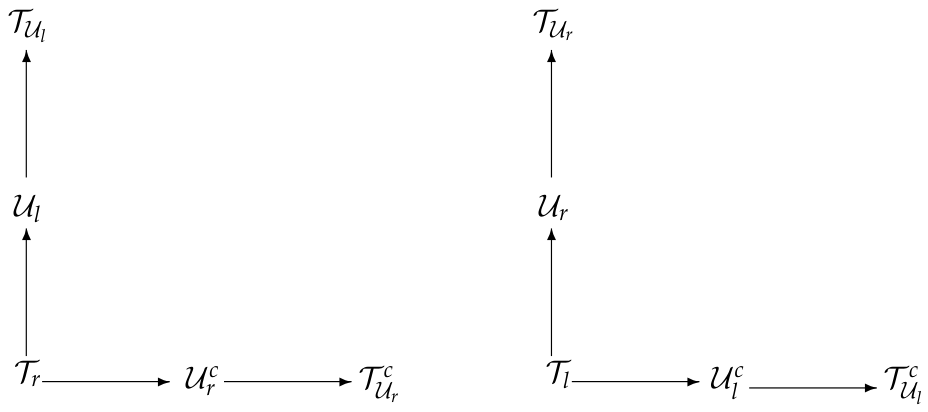
The question arises about the granule-based and element-based definitions of approximations generated by the considered families.
In Theorems 2 and 3, we show that any supra-topology defines a pair of Aleksandrov topologies [3], one of which describes approximations defined by the supra-topology and the other of which describes approximations defined by the family of its complements, as we will show in Theorems 4 and 5.
In these characterizations, we have the closures of singletons in terms of Aleksandrov topologies rather than equivalence classes.
In Theorems 4 and 5, using Theorems 2 and 3, we present a granular and topological interpretation of the approximations related to supra topologies.
These results confirm the recent research that indicates Alexandrov topology as the fundamental structure to construct approximation operators and investigate rough sets from a granular computing perspective [15].
Throughout this paper, for any family of subsets of E and any , by we will denote the intersection .
Theorem 2.
Let be a supra-topology on E. Then the family
is an Alexandroff topology such that
- (i)
- and
- (ii)
- for
Proof.
Firstly, we will prove that the operator fulfills the requirements of the Kuratowski closure operator and the operator is the interior operator corresponding to , so that their exists a topology such that and are the closure operator and interior operator in .
Next, we will prove that and, of course, for any .
So, firstly, let us prove that the operator is a Kuratowski closure operator.
It is clear that , because the family is the empty family. Since for every , the inclusion is evident. The equality follows immediately from a basic set-theoretic property, namely
For the proof of , it is enough to show that
. If , then by definition, there exists such that . For the same reason, for some . Therefore, since , we get , which means that and finishes the first part of the proof.
To show that the operator is the interior operator with respect to the operator . Firstly, let us show that is an open subset for any . For this purpose, we will prove that is closed, i.e.,
Let us assume to the contrary, that there exists such that
,i.e., and for some . So, and . Consequently, and we get a contradiction. So, since is open for all , we have
For the proof of the converse inclusion, it is enough to prove that for any open subset and any point , we have . So, let us take an open subset and . Then, , where is a closed subset. Of course, and . Therefore, if we assume, to the contrary, that for some , , i.e., , then which implies and we have a contradiction. As a consequence, we have
Now, let us prove that .
Let , i.e., . We will show that
. It is enough to prove i.e., . Let us assume to the contrary, that there exists such that
and . Then, for every point that satisfies the property , we have which means, that there exists such that and .
Now, let us take . Of course, for every such that , , hence i.e., . Consequently, for every such that , , i.e., . It is clear that and because the family is closed under arbitrary unions.
So, it shows that and proves the inclusion . For the prove that , let us take . We will show that . So, let , then for some . Thus, for every , , and consequently we have i.e., , so and hence . Of course, the topology is an Alexandroff topology because it is closed under arbitrary intersections. This completes the proof of the theorem. □
Remark 3.
Since is an Alexandroff topology, the family
, either. Of course, using the above Theorem,
. So, is equal to defined in Theorem 3 below.
Theorem 3.
For any supra-topology , the following hold:
- (i)
- ,
- (ii)
- and
- (iii)
- for
Proof. (i). We will prove that . If , where , then for some family . So, which means that and proves the inclusion . The proof of the opposite inclusion proceeds analogously.
(ii). We will show that if and only if . Since is an Alexandroff topology, then if and only if A is closed in the space or equivalently . So, it is enough to prove that the following two equalities are equivalent
- (1)
- ,
- (2)
- .
For the prove let , then, by the assumption and consequently which proves (2).
For the prove , let , then, by the assumption there exists x such that and therefore , which proves that .
The proof of (iii) proceeds analogously. □
Proof of Lemma 2.
Proof.
First, we will prove that . If , then according to Lemma 1, it is enough to show that . If , then, according to Definition 2 and Remark 1, we have . Since , then there exists such that or equivalently, . Again, by Lemma 1, we obtain . Analogously, one can show that .
Now, we will prove that . Since , then , i.e., because . For the same reason, .
The implications and follow immediately from the definitions of and , stated in Theorems 2 and 3, respectively, where . □
Immediately from Theorems 2 and 3, we have
Remark 4.
For any supra-topology on E and , we have
and . We will use the simpler notation and instead of and .
Lemma 3.
For any supra-topology on E, and , the following hold:
- (i)
- The subset is the minimal open set containing x in the space , equivalently the minimal closed set containing x in the space .
- (ii)
- The subset is the minimal closed set containing x in the space , equivalently, the minimal open set containing x in the space .
Proof. (i). It is enough to show that . So, let us take such that . Then, and consequently for some p, which gives and proves that . For the proof of the inverse inclusion let us note that . Thus, .
Now let us note that, according to Theorem 2, we have , which means that is the minimal closed set containing x in the space .
The proof of (ii) proceeds analogously. □
3. Granular Representation and Improvement of Accuracy Approximations in a k-Supra Topological Space
The theorems, proved below, present a dual characterization of the approximations generated by the families and . Namely, one of them is of the type presented in definition (VI), and the second one has the classical form of granulation given in definition (II).
Additionally, based on Theorem 3, it is easy to see that the presented approximations have the corresponding form to approximations generated by the topologies and (according to definition (IV)), which is stated in Corollary 2.
Theorem 4.
For any k-supra topological space , the following hold:
- (i)
- ,
- (ii)
Proof. (i). Firstly, we will prove that
Since , then is an open subset of A in the topological space . Consequently, according to Theorem 3(ii), we obtain .
For the proof of the converse inclusion, let us note that for any , because the family is closed under arbitrary intersections. Therefore, we have and consequently
To complete the proof, we will show the following equality
If for some such that . Then which means . So, we have
The converse inclusion is trivial, which finishes the proof.
(ii). Let us start by proving that
Of course, , and is the family of all closed subsets in the topological space . So, is a closed superset of A. Consequently, and, according to Theorem 3 (iii),
.
For the proof of the converse inclusion, let us assume that
. Then for every , or equivalently . Consequently . Since as an intersection of members of , then . So, and , so which finishes this part of the proof.
Now we will show the equality
If then for some , or equivalently, . So, which means that .
Conversly, let i.e., which implies that for some , equivalently, . So, , which finishes the proof. □
The above theorem says that the approximations generated by the families have specific properties. Namely, in the case of , according to Theorems 3 and 4 (see also (IV)), the approximations and are strictly representable by the topology generated by the family , which shows the following.
Corollary 2.
For any k-supra topological space , we have
and .
Remark 5.
Analogous to the classical Pawlak’s case, the approximations , have three versions of definition. Namely, Theorem 4 presents the granular and element-based definition, and the above corollary presents the subsystem-based definition.
The following theorem presents the granular-based and element-based characterizations and topological nature of the standard supra k-approximations and investigated in [4], which are defined in the form corresponding to the subsystem-based definition (see (III)).
The presented form of the granular and element-based definition is a generalization of the classic one proposed by [7] (see (VII)), where means , or equivalently . And, means or equivalently .
Theorem 5.
For any k-supra topological space , the following hold:
- (i)
-
,
- (ii)
-
.
Proof. (i). Since , then by definition, . Therefore, by Theorem 2 , .
It is clear that .
We will now show the inclusion
For this purpose, it is enough to notice that for any the condition implies that . Indeed, let . Since is open in , then according to Lemma 3 (i), we have .
The following inclusion is obvious
We will show the converse inclusion. So, let . Then there exists such that . Consequently, , which means
Proof of (ii). Firstly, let us note that, by definition, because the family is closed under arbitrary intersections. Of course, is the family of all closed subsets in . So, since , then and hence is closed in the space . Consequently, according to Theorem 2 (ii), .
The following two inclusions are obvious.
We will prove that the equalities in the above statements hold.
When it comes to , let us take . Then there exists such that and . So, for some , we have or equivalently, . Consequently, we obtain , which proves that
.
For the proof of the equality in , let . Thus, there exists such that and , or equivalently . So, and therefore which means that . □
According to Theorems 2 and 5, and because of , the following corollary shows the interrelations between the approximations and and the topology generated by .
Corollary 3.
For any k-supra topological space , we have
and .
In the following result, we present an assessment of the accuracy (see Definitions 1,3 and 4) of the investigated approximations in the supra-topological spaces .
Theorem 6.
For any approximation space , the following inclusions hold.
- (i)
- ,
- (ii)
- ,
- (iii)
- ,
- (iv)
- .
Proof.
According to Lemma 2 and Corollaries 2 and 3, we obtain the following inclusions:
- (i)
- ,
- (ii)
- ,
- (iii)
- ,
- (iv)
- .
From the definition of accuracy, we immediately obtain the inequalities stated in our theorem. □
Definition 5.
A subset A of a k-supra topological space is called granular supra k-exact if . Otherwise, it is called a granular supra k-rough set.
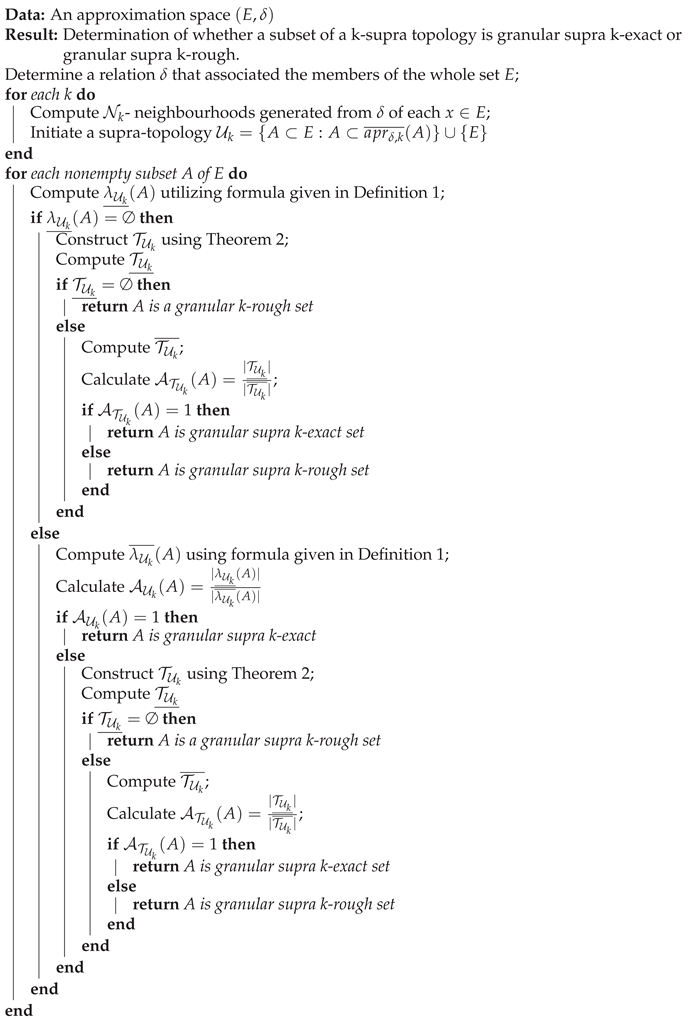
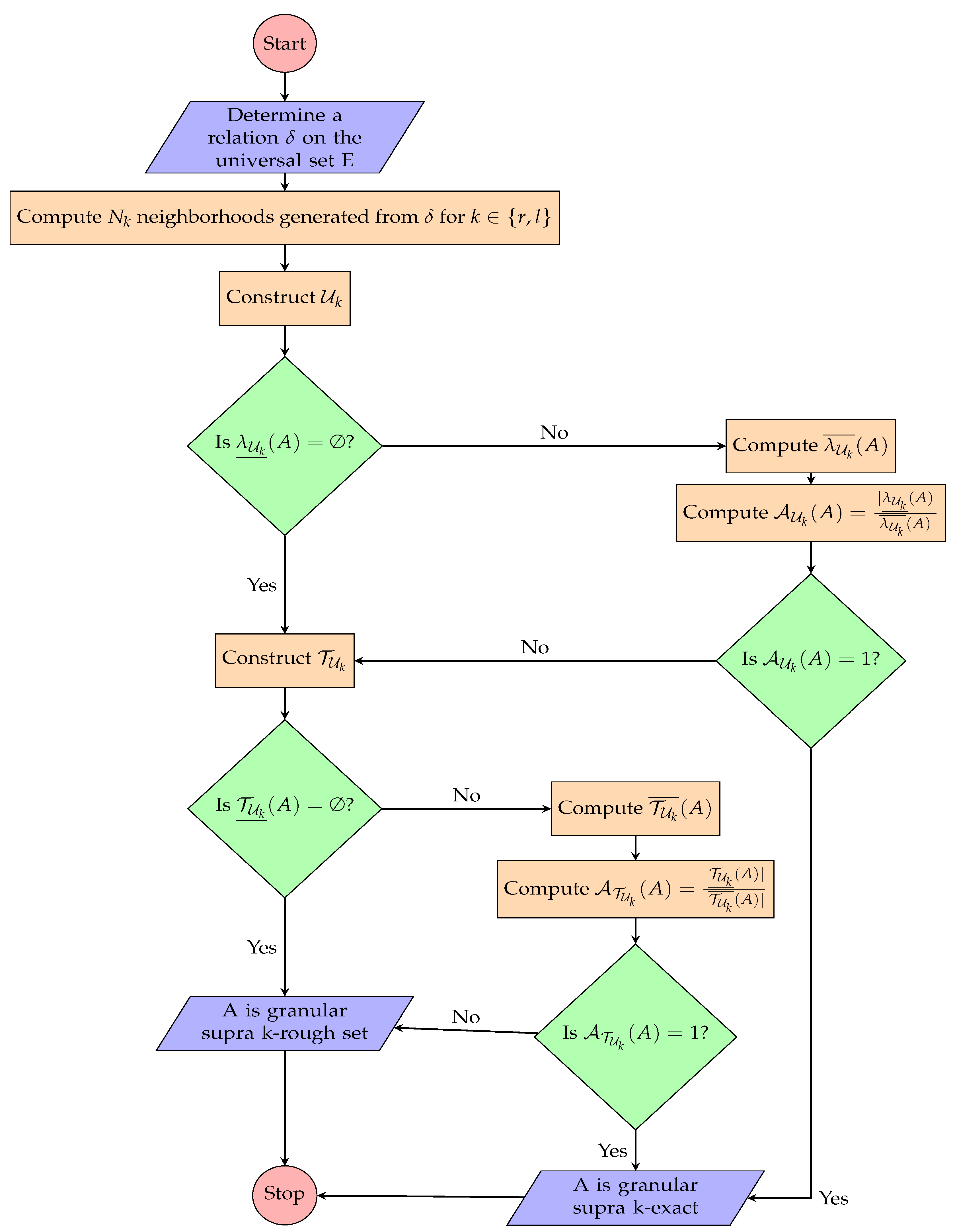
Algorithm 1 and the flowchart (in Figure 1) elaborate on how to determine whether a subset of a k-supra topology is granular supra k-exact or granular supra k-rough.
| Algorithm 1 The algorithm for determining granular supra k-exact and granular supra k-rough subsets of k-supra topologies. |
 |
4. Conclusion
Al-Shami and Alshammari [4], based on the notion of supra-topology defined in an approximation space based on the relation, have created a new rough approximation model. The presented investigations extend this concept by introducing the family of the complements of a supra-topology and consist of three aspects.
Firstly, the proposed model is studied here as a generalization of the topological model, i.e., without a relation.
Secondly, we propose a general conception of generating a symmetric pair of Alexandroff topologies, which enables the investigation of a granular aspect of the approximations in the extended model.
Thirdly, we prove that the approximations generated by the introduced topologies are more accurate than approximations generated by the basic families.
Declarations
The authors declare that no funds, grants, or other support were received during the preparation of this manuscript. The authors have no relevant financial or non-financial interests to disclose.
References
- Abd El-Monsef, M.E.; Salama, A.S.; Embaby, O.A. Granular computing using mixed neighborhood system. Jour. Inst. Math. Comput. Sci. (Computer Science Ser.) 2009, 20(2), 233–243. [Google Scholar]
- Abd El-Monsef, M.E.; Embaby, O.A.; El-Bably, M.K. Comparison between rough set approximations based on different topologies. Int. J. Granul. Comput. Rough. Sets Intell. Syst. 2014, 3(4), 292–305. [Google Scholar] [CrossRef]
- Alexandroff, P. Discrete Raume. Mat. Sb. 1937, 2, 501–519. [Google Scholar]
- Al-Shami, T. M.; Alshammari, I. Rough sets models inspired by supra-topology structures. Artif. Intell. Rev. 2023, 56(7), 6855–6883. [Google Scholar] [CrossRef] [PubMed]
- Järvinen, J.; Radeleczki, S.; Veres, L. Rough sets determined by quasiorders. Order 2009, 26(4), 337–355. [Google Scholar] [CrossRef]
- Lashin, E. F.; Kozae, A. M.; Khadra, A. A.; Medhat, T. Rough set theory for topological spaces. Int. J. Approx. Reason. 2005, 40(1-2), 35–43. [Google Scholar] [CrossRef]
- Mani, A. Granular knowledge and rational approximation in general rough sets–I. J. Appl. Non-Class. Log. 2024, 34(2-3), 294–329. [Google Scholar] [CrossRef]
- Mashhour, A. S. On supratopological spaces. Indian J. Pure Appl. Math. 1983, 14, 502–510. [Google Scholar]
- Pawlak, Z. Rough sets. Int. J. Comput. Inf. Sci. 1982, 11(5), 341–356. [Google Scholar] [CrossRef]
- Pawlak, Z. Elementary rough set granules: toward a rough set processor. In Rough-Neural Computing: Techniques for Computing with Words; Pal, S. K., Polkowski, L., Skowron, A., Eds.; Springer-Verlag, 2003; pp. 5–13. [Google Scholar]
- Skowron, A.; Stepaniuk, J. Information granules and approximation spaces. IPMU Inf. Process. Manag. Uncertain. Knowl.-Based Syst. 1998, 1354–1361. [Google Scholar]
- Ślezak, D.; Wasilewski, P. Granular Sets - Foundations and Case Study of Tolerance Spaces; An, A., Stefanowski, J., Ramanna, S., Butz, C. J., Pedrycz, W., Wang, G., Eds.; 2007; Volume 4482, pp. 435–442. [Google Scholar]
- Wiweger, A. On topological rough sets. Bull. Pol. Acad. Sci. Math. 1989, 37, 89–93. [Google Scholar]
- Yang, L.; Xu, L. Topological properties of generalized approximation spaces. Inf. Sci. 2011, 181(17), 3570–3580. [Google Scholar] [CrossRef]
- Yao, W.; Han, S. E. A topological approach to rough sets from a granular computing perspective. Inf. Sci. 2023, 627, 238–250. [Google Scholar] [CrossRef]
- Yao, Y. Y. Two views of the theory of rough sets in finite universes. Int. J. Approx. Reason. 1996, 15(4), 291–317. [Google Scholar] [CrossRef]
- Yao, Y. Y. Relational interpretations of neighborhood operators and rough set approximation operators. Inf. Sci. 1998, 111(1-4), 239–259. [Google Scholar] [CrossRef]
- Yao, Y. Rough sets, neighborhood systems, and granular computing. Proc. IEEE Canadian Conf. on Electrical and Computer Engineering, 1999; pp. 1553–1558. [Google Scholar]
- Yao, Y.; Yao, B. Covering based rough set approximations. Inf. Sci. 2012, 200, 91–107. [Google Scholar] [CrossRef]
- Zadeh, L.A. Fuzzy sets and information granularity. Fuzzy sets, fuzzy logic, and fuzzy systems: selected papers by Lotfi A Zadeh 1996, 433–448. [Google Scholar] [CrossRef]
- Zhang, Y.L.; Li, J.; Li, C. Topological structure of relational-based generalized rough sets. Fund. Inform. 2016, 147(4), 477–491. [Google Scholar] [CrossRef]
Figure 1.
Flowchart of determining granular supra k-exact and granular supra k-rough subsets of k-supra topology.
Figure 1.
Flowchart of determining granular supra k-exact and granular supra k-rough subsets of k-supra topology.
Disclaimer/Publisher’s Note: The statements, opinions and data contained in all publications are solely those of the individual author(s) and contributor(s) and not of MDPI and/or the editor(s). MDPI and/or the editor(s) disclaim responsibility for any injury to people or property resulting from any ideas, methods, instructions or products referred to in the content. |
© 2026 by the authors. Licensee MDPI, Basel, Switzerland. This article is an open access article distributed under the terms and conditions of the Creative Commons Attribution (CC BY) license (http://creativecommons.org/licenses/by/4.0/).
Copyright: This open access article is published under a Creative Commons CC BY 4.0 license, which permit the free download, distribution, and reuse, provided that the author and preprint are cited in any reuse.