

Submitted:
11 November 2026
Posted:
12 November 2026
You are already at the latest version
Abstract
In Sub-Saharan Africa, informal food vendors suffer from high levels of physical strain at work and are not engaged in workplace health promotion programs. In order to address this, the Authors conducted a study to determine the level of discomfort experienced by street food vendors in Harare and Bulawayo, and came up with some basic and cheap ergonomic solutions. A mixed methods participatory approach was implemented involving a baseline assessment (n=412) based on standard ergonomic tools, focus groups and co-design workshops, followed by a comparative evaluation (n=204). A $18.70 package was co-designed by vendors using local materials that includes an adjustable cooking platform, a padded load carrier, an anti-fatigue mat, and a peer led postural education program. Baseline assessment identified that 78.4% of vendors had high levels of physical strain, mainly in the lower back, neck and shoulders and 87.3% of tasks were identified as being at high postural risk. After 6 months of implementation, the prevalence of discomfort in the active group had reduced by 43.3% (34.2% less than in the control group; p<0.001). In addition, there were significant reductions in mean postural risk scores and improvements in work ability. This designed package has significantly lowered postural risk, physical strain and work ability, at just a small fraction of a month's median income. These can be effective, participatory, and community-based solutions that are accessible to the informal sector and can be an effective model for integrating occupational health support.
Keywords:
musculoskeletal disorders
; ergonomic interventions
; informal economy
; food vendors
; Zimbabwe
; participatory ergonomics
; occupational health
; low-resource settings
1. Introduction
Musculoskeletal disorders (MSDs) are the most common cause of disability globally, and injuries and conditions of the muscles, tendons, ligaments, nerves, discs and blood vessels make up the category. They are estimated to cost the global population around 149 million YLDs or 17% of total YLDs; and low back pain is estimated to be the single largest cause of disability in 160 countries (World Health Organization [WHO] 2022; GBD 2019 Diseases and Injuries Collaborators, 2020). Much of this load comes from work-related activities, such as repetitive motion, forceful exertion and prolonged awkward posture [1]. Despite being exposed to some of the highest ergonomic risks, the occupational literature has focused on the formal sector in high income countries, with the informal sector in low and middle income countries (LMICs) being under-researched.
Over 80% of the employment in Africa is in the informal sector [2]. In Zimbabwe, estimates of the informal sector workforce contributions to total employment are around three-quarters and the nature of occupational injuries and illnesses among informal workers is not recorded nationally [3]. One of the most apparent informal jobs is street food vending. It supports livelihoods, especially for women (67.2% of our sample), and provides cheap food to city dwellers, but requires long hours of standing and squatting, repetitive upper limb work on a fixed height stove and table, and heavy loads to/from vending sites, typically without ergonomic equipment, employer, safety officer, or access to occupational health services.
The focus on workplace safety in Zimbabwe has been the formal sector. Occupational injuries and diseases have caused the NSSA to estimate that the annual economic loss is around US$44 million with manufacturing being the second most affected sector after mining [3]. In the manufacturing context, recent research from Zimbabwe reveals that workplace accidents are still a significant issue that impacts productivity, employee health, operational efficiency, and that human factors engineering (HFE) - specifically ergonomic design and safety culture, are a potential intervention [4]. It has yet to be tested whether this logic applies to work outside of formal settings, where there is no factory floor to redesign and no capital budget to use.
One possible approach is participative ergonomics, using worker involvement to identify hazards and design and evaluate solutions [5]. The overall findings of systematic reviews are favourable for the effects of the programmes on the musculoskeletal outcomes, although these outcomes vary by the way in which programmes are implemented and supported [6,7]. The principle of worker involvement also rolls out as one of the most prominent enablers within Zimbabwean safety management: Involvement was strongly correlated with implementation [3] and 91% of the respondents in the Manufacturing sector in Mutare considered strong worker involvement and participation as one of the key factors in implementing an OSHMS. Despite this, however, the transferability of ergonomic interventions to informal vending is limited by the factors of affordability, material availability and literacy and contextual fit.
There is no known controlled, peer-reviewed evaluation of purpose-designed, low cost ergonomic interventions with food vendors in Zimbabwe to our knowledge. To achieve these four objectives, we conducted a participatory action research study in Harare and Bulawayo involving four objectives:
- to identify the prevalence, anatomical distribution and postural risk for MSDs among food vendors;
- to co-create low cost ergonomic interventions with vendors;
- to assess the effectiveness of these interventions at 3 months and 6 months for MSD symptoms, postural risk and work ability; and
- To estimate the cost per-participant of the package and contextualize within the local economy.
2. Background
2.1. Musculoskeletal Burden Among Informal Workers
In similar non-formal and low-income jobs, the burdens have been consistently high. In a cross-sectional survey of 540 farmers involved in sugarcane production in the north-eastern region of Thailand the prevalence of MSD was 88.7% and repetitive motions (adjusted OR 1.90), awkward postures (1.95), forceful exertions (2.78) and stress over future income (1.80) were each independently associated with symptoms [8]. The last of these is interesting: economic precarity seems to be part of the profile of exposure, since those that can't afford to stop work, keep going despite the pain. When the NMQ was used to assess the prevalence of MSD symptoms in Ghana’s commercial minibus drivers in Accra, 78.4% were found to have MSD symptoms over a 12-month period [9]. In Bangkok, a mixed-methods study on 213 market vendors found that their MSDs were mostly linked to static muscular activity and awkward postures that are imposed by job and workstation arrangement [10].
The data available on MSDs in the informal sector in Zimbabwe is limited. Studying work safety in the country reveals that some of the factors that frequently lead to accidents are lack of training and lack of protective equipment, and proposes that work design and the worker are interdependent areas for safety analysis. However, vendors are seldom the focus of these analyses, and there has never been a study quantifying their musculoskeletal burden, or testing interventions.
2.2. Ergonomic Exposures in Food Vending
The types of MSD exposures associated with the food vending work system are:
- static standing on hard, uneven surface for majority of a long working day (the mean for our sample was 10.6 hours);
- lexion of the trunk and head on non-adjustable cooking surface;
- repetitive and forceful upper-limb work in preparation and serving;
- asymmetric load carriage of the head and shoulders; and
- Lack of seating or resting opportunities.
The posture is set by the workstation itself and thus the exposure is structural instead of behavioural; as [10] noticed in Bangkok, advice on 'correct lifting' or 'standing straight' is unlikely to be effective without changes to the equipment being used. Human factors engineering is all about matching the task/equipment to the worker, rather than the other way around [4].
2.3. Participatory and Low Cost Ergonomic Interventions
Participatory ergonomics (PE) is especially appropriate in LMIC settings where top-down engineering controls are economically and logistically unfeasible. Based on similar interventions in other regions, there is evidence that locally produced aids can be effective: A study found a 41% reduction in the prevalence of upper-extremity MSD among fisherwomen in West Bengal who received locally produced ergonomic aids, and another article reported significant reductions in REBA among Kenyan market traders who received a combined postural education and workstation modification programme at a cost of about USD 22 per person. There is no comparable assessment for Zimbabwe.
There are parallel developments of technology-based solutions. For example, Zimbabwean Engineers designed and analysed a passive upper-limb exoskeleton that will help alleviate fatigue and MSD risk among construction workers, and has adjustable torque capability to suit individual users [11]. Passive exoskeletons are good for physically demanding tasks, but the cost of commercially available exoskeletons is about USD 5,000-8,000 and the working time of the exoskeletons is 3-5 years, which is too expensive for a median earning of USD 95 per month. Thus, the frugal and workstation level interventions and the high tech assistive devices are not mutually exclusive, the first targeting the large population with no capital, the latter the narrower set of tasks and employers that can afford them.
3. Materials and Methods
3.1. Study Design and Setting
The authors conducted a mixed methods participatory action research (PAR) study that integrated a cross-sectional baseline assessment, randomised wait-list controlled evaluation, and qualitative participatory co-design.
3.2. Informed Consent
All the participants in the study provided written informed consent and the Authors ensured that the participants with limited literacy, had to give informed consent supported by verbal explanation. Participation in the study was purely voluntary, no incentive was contingent on participation, and confidentiality was maintained through anonymised participant codes.
3.3. Participants and Recruitment
The food vendors included in the study were those who met the following criteria: age 18 years or older, vended at a study site for at least 6 months, and worked at least four days per week. We excluded vendors who had a diagnosis of systemic inflammatory arthritis or a connective tissue disorder and those with trauma or surgery to any musculoskeletal region in the last 3 months, or who were pregnant. The lists of vendors were retrieved from municipal council registration databases and stratified random sampling by gender and site was used to ensure representativeness.
3.4. Baseline Assessment Instruments
The baseline survey (n = 412) was conducted by trained research assistants using three validated instruments from March to May 2024.
Nordic Musculoskeletal Questionnaire (NMQ): The NMQ [12] was employed to quantifies the symptoms of MSD burden in other West African occupational groups [9], and the symptoms were recorded in nine anatomical regions over the last 12 months and 7 days, along with symptoms that restricted normal work.
Rapid Entire Body Assessment (REBA): Based on posture, force and load, REBA [5] rates 1 (negligible), 2–3 (low), 4–7 (medium), 8–10 (high) and 11 – 15 (very high) risk. Three tasks were observed and scored for each vendor: food preparation, serving customers, load carriage.
Work Ability Index (WAI): The WAI [13,14] was adapted and validated for informal workers in Zimbabwe and scores current work ability compared to lifetime best, ability to meet physical and mental demands of the job, diagnosed disease, estimated impairment, sick leave, own prognosis of work ability in 2 years, and mental resources. Scores range from 7 to 49 (7–27 poor, 28–36 moderate, 37–43 good, 44–49 excellent).
A structured questionnaire was also used to collect data on age, sex, years of vending and daily working hours, monthly income as well as reported productivity loss due to MSD.
3.5. Participatory Co-Design
Following the baseline survey, six focus group discussions (three in each city, 8 – 10 vendors per group, divided by sex and vending activities (cooking, transporting, serving)) were held to discuss how vendors perceive the causes of MSD, coping strategies, acceptable format of intervention, material availability, and material affordability. Shona and Ndebele were the languages used for discussions and are professionally transcribed and professionally translated, with consent, and audio recorded.
This was followed by four participatory design workshops (two in each city, 15–18 participants in each workshop). The facilitators comprised occupational health professionals, an ergonomist and a local craftsman. Participants identified risk factors, observed prototype designs, tested mock up designs and provided iterative feedback, and, finally, the equipment was fabricated by a local timber fabricator using reclaimed timber, PVC pipe, and foam off cuts and recycled rubber. The prototype–test–revise cycle is similar to agile development processes as they focus on quick iterations with the ability to respond to changing user needs [15], and the vendors were the customers whose requirements were the basis for each iteration.
3.6. Intervention Components
The Authors finalised and standardised four components for implementation. Each of the components targets a specific exposure identified in the baseline assessment and co-design process.

Table 1.
Components of the co-designed ergonomic package and unit costs.
| Component | Description and materials | Primary exposure targeted | Unit cost (USD) |
| Adjustable-height cooking platform | Collapsible wooden platform, 75–95 cm in 5 cm increments, non-slip surface; reclaimed hardwood and PVC piping | Trunk flexion; shoulder elevation at stove and preparation surface | 8.20 |
| Padded load-bearing carrier | Head and shoulder carrier with foam inserts and a redistributive shoulder harness | Cervical compression; asymmetric load carriage | 3.80 |
| Anti-fatigue mat | 50 × 60 cm mat of layered recycled tyre rubber and foam offcuts | Static standing; lower-limb loading | 2.10 |
| Rest-break programme and postural education | Three supervised 10-minute breaks per session with facilitated stretching; pictorial English/Shona/Ndebele flipchart; vendor champions trained as peer coaches | Cumulative strain; absence of recovery; low awareness | 4.60 |
| Total per participant | 18.70 |
The highlighted costs are per participant at study prices and include fabrication, materials, training and printed materials for the rest-break component. Overheads associated with programme management were not included.
3.7. Randomisation, Delivery and Follow Up
Baseline participants eligible for the study and willing to participate in the intervention phase were randomly allocated to the intervention (n = 102) group or the wait-list control (n = 102) group (stratified by site, sex and baseline severity of MSDs). From June 2024, the intervention group was provided with all four interventions at the same time. The control group was not treated during the evaluation period and was given all the treatment after the 6 month evaluation. At three months (September 2024) and six months (December 2024), the NMQ, REBA and WAI were repeated for the participants.
3.8. Statistical Analysis
Presence of MSD symptoms (NMQ), REBA score, WAI score and work-limiting pain were the secondary outcomes. Proportions with 95% confidence intervals were used to indicate prevalence. Mixed-effects logistic (binary outcomes) and linear (continuous outcomes) regression were used to estimate intervention effects, taking into account site, sex, age, and years of vending and daily working hours. The primary analysis was the intention to treat analysis with sensitivity analysis of per protocol cases. Absolute risk difference was calculated as the reciprocal of the number needed to treat (NNT). A significance level of α = 0.05 was used. NVivo 14 was used to thematic analysis the FGD data.
4. Results
4.1. Participants
412 (91.6%) out of 450 vendors approached completed the baseline survey. Most were women (67.2%); mean age was 34.8 years (SD 9.3; range 18–61) and 74.5% had completed secondary education. The mean vending experience was 7.2 years (SD 4.8) and mean working time 10.6 hours (SD 2.1) daily. Monthly income ranged from USD 40 to USD 210 (median 95; IQR 70–130). Of the respondents, 204 were randomly allocated (102 for each arm) and none of the sociodemographic parameters were significantly different between arms (all p > 0.05).
4.2. Baseline Prevalence and Distribution of MSDs
The 12-month prevalence of symptoms in at least one body region was 78.4% (95% CI 73.9–82.5%). The most affected regions were the lower back (61.2%), neck (54.6%), shoulders (47.8%), knees (38.4%) and wrists/hands (29.7%) (Table 2; Figure 1). Of those vendors who had symptoms, 54.3% reported that pain had limited their normal work during the last 12 months and 18.9% reported symptoms in the last 7 days.
4.3. Baseline Postural Risk
There was no difference between the intervention and control arms (mean baseline REBA scores 9.8 (SD 1.7) and 9.6 (SD 1.9) respectively, p = 0.38) and both were in the “high” risk category. Food preparation was the highest rated (mean 11.2, SD 1.4, “very high”), as trunk flexion was more than 60° while a neck flexion and static loading of the upper-limb was achieved. Overall, 87.3% of all task observations was recorded as a REBA score of 8 or more.
4.4. Intervention Effects at Three and Six Months
Primary and secondary outcomes are summarised in Table 3 and Figure 2. The prevalence of MSD in the intervention group were reduced from 77.5% to 43.3% (44% relative reduction) at 6 months. The difference in percentage points between the two groups was estimated using the mixed-effects model, and was 34.2 percentage points (95% CI 24.8–43.6; p < 0.001), which corresponds to an NNT of 3.0 (95% CI 2.3–4.0): For every three vendors who received the package, one fewer vendor had symptoms at six months. Work-limiting pain fell from 53.9% to 22.5%.
In the intervention group, mean REBA scores decreased by 4.7 (95% CI 4.3–5.1; p < 0.001), from “high” to “medium” risk category, and remained the same in the control group at 3 months (9.6 to 9.5). WAI improved by a mean of 6.4 points (95% CI 5.7–7.1; p < 0.001), moving from 29.4 to 35.8, which remains within the “moderate” band (28–36) but at its upper limit. Per-protocol sensitivity analyses yielded similar results to the original analyses and there were no serious adverse events that were directly caused by the interventions.
4.5. Qualitative Findings
Thematic analysis of the FGDs generated four themes:
- pain normalised as an occupational inevitability;
- economic barriers to help-seeking and protective behaviour;
- collective ownership and peer facilitation as enablers of behaviour change; and
- Acceptability of, and pride in, locally fabricated solutions.
Vendors consistently reported that the participatory design process gave them a sense of investment in the interventions, and that locally made equipment was more durable and culturally appropriate than imported alternatives.
4.6. Cost
The package cost USD 18.70 per participant (Table 1). The largest item was the cooking platform (USD 8.20 or 44% of the total). The cost is 19.7% of the median monthly income of USD 95. With the use of a simple multiplier, the cost per vendor without symptoms at 6 months was about USD 56 (95% CI USD 43-75). This is not an economic assessment but an indicative derivation. All 3,200 registered vendors at the 4 study sites would require an investment of approx. USD 59,840, before programme-management overheads, at study unit costs.
5. Discussion
5.1. Principal Findings
This study shows that a co-designed package of low-cost ergonomic interventions can substantially reduce MSD symptoms and postural risk and improve work ability among informal food vendors in Zimbabwe over six months. Baseline burden was high: nearly four in five vendors reported symptoms, and nearly nine in ten task observations scored in the high or very high REBA action categories. The interventions moved the mean REBA score from the high to the medium category, though not to low risk, and lifted work ability to the upper end of the moderate band without reaching the “good” category.
5.2. Comparison with Other Work
The baseline prevalence of 78.4% is similar to that of Ghanaian minibus drivers assessed with the same instrument [9] and lower than that of Thai sugarcane farmers (88.7%) [8]. The dominance of lower-back, neck and shoulder complaints, and the strong contribution of static and awkward postures fixed by the workstation, matches the pattern reported for market vendors in Bangkok [10]. The 44% relative reduction in symptom prevalence is close to the 41% reduction reported for fisherwomen in India, and the absolute reduction of 34.2 percentage points exceeds the 22-point reduction reported in Kenya at a slightly higher cost per participant [6,7].
These comparisons are indicative only, because populations, outcome measures, follow-up periods and study designs differ. Nevertheless the consistency across settings supports the premise that, where workstation design fixes posture, changing the workstation changes the outcome.
5.3. Mechanisms
The Authors attributed the size of the effect to three features. First, the package combined structural changes (platform, mat), load redistribution (carrier) and behavioural support (rest breaks, education), so that exposures were addressed at several points in the work system simultaneously; because components were delivered together, we cannot attribute effects to individual items. Second, the qualitative data suggest that participation itself was an active ingredient. Vendors described pain as an inevitable cost of the trade, a belief that led them to accommodate rather than mitigate symptoms, and the co-design process created a forum in which preventability was collectively recognised and locally owned solutions carried social legitimacy. Third, vendor champions trained as peer coaches provided a delivery mechanism that did not depend on external staff.
These mechanisms resonate with the HFE literature from Zimbabwean manufacturing, which identifies safety culture and ergonomic design as the levers through which human factors programmes reduce accidents [4]. In the informal sector, no employer can build a safety culture, so peer coaching and collective ownership assume that function. The finding is also consistent with evidence that employee involvement and participation are central enablers of safety management in Zimbabwean workplaces [3]. Iterative co-design, which we compare with agile development in Section 3.5 [15], may have contributed by ensuring that prototypes fitted the workflows and body sizes of actual users before they were distributed.
5.4. Cost and Feasibility
At USD 18.70 per vendor, roughly one-fifth of median monthly income, the package is within reach of self-financing for some vendors and is clearly within reach of programme financing. The cost per additional symptom-free vendor is about USD 56. By comparison, commercial passive exoskeletons cost USD 5,000–8,000 per unit [16]; the two approaches serve different populations and tasks and are complementary rather than interchangeable [4]. The use of reclaimed and recycled materials fabricated locally also lowered costs and, according to vendors, increased acceptability. This creates a modest local-demand opportunity for small-scale fabricators, who report that cheaper imports have made it harder for locally made goods to find domestic buyers [15,17].
5.5. Policy Implications
The findings support the following actions, each of which should be piloted and evaluated as it is implemented:
- The NSSA should consider developing a standardised low-cost ergonomic package for informal food vendors, building on the components validated here and on its existing occupational safety and health promotion mandate.
- Municipal authorities could incorporate ergonomic minimum standards, such as adjustable-height workstations and anti-fatigue matting, into vending-site by-laws. Because the package costs about one-fifth of a month’s median income, standards should be paired with subsidised or credit-based access so that regulation does not penalise the vendors it is meant to protect.
- The Ministry of Health and Child Care should integrate informal-sector occupational health into primary health care, with vendor MSD prevention as a priority area. Human factors approaches already shown to be acceptable in formal manufacturing [4] should be extended to the informal workforce rather than lag behind it.
- Donors and non-governmental organisations supporting informal livelihoods should include ergonomic equipment as a standard element of vendor support, and should fund peer-coach models that sustain use after distribution.
- Researchers should pursue longer-term follow-up of this cohort, formal cost-effectiveness modelling, and scale-up studies across rural, peri-urban and other informal trades.
5.6. Strength and Limitations
Strengths include the randomised wait-list design, the use of validated instruments, a high baseline response rate (91.6%), intention-to-treat analysis with per-protocol sensitivity analysis, integration of qualitative co-design with quantitative evaluation, and transparent costing of every component.
Several limitations merit acknowledgement. Intervention and control vendors shared market sites, so contamination is possible, although control outcomes were stable. Because the equipment is visible, blinding of participants and REBA observers was difficult, and self-reported symptoms may be influenced by expectation. The package was multi-component and delivered together, so the contribution of each element cannot be separated. Follow-up of six months supports conclusions about short-term effectiveness but not about durability of effects or the lifespan of the equipment. Participation was restricted to registered vendors at four urban sites, and generalisation to rural, peri-urban or unregistered vending requires further study. REBA, though validated, does not capture the full spectrum of ergonomic exposure, and complementary biomechanical measures, such as wearable motion sensors, should be considered. The cost analysis is indicative and does not include productivity gains or averted health-care costs.
6. Conclusion
In this randomised wait-list evaluation, a package of ergonomic interventions co-designed with vendors and built from locally sourced materials substantially reduced musculoskeletal symptoms and postural risk and improved work ability among informal food vendors in Harare and Bulawayo, at USD 18.70 per vendor. Food vendors are economic actors at the foundation of urban food systems across sub-Saharan Africa; their occupational health is a matter of livelihood security and social justice as well as public health. The results show that meaningful ergonomic protection for this population is achievable at a cost that vendors and public health systems can bear, and they argue for including informal workers in the human factors and ergonomic programmes that Zimbabwean occupational safety policy has so far directed at the formal sector.
References
- Punnett, L.; Wegman, D. H. Work-Related Musculoskeletal Disorders: The Epidemiologic evidence and the debate. J. Electromyogr. Kinesiol. 2004, vol. 14(no. 1), 13–23. [Google Scholar] [CrossRef] [PubMed]
- International Labour Organisation. Women and men in the informal economy: A Statistical Picture; International Labour Office, 2018. [Google Scholar]
- Mandowa, J.; Matsa, M.; Jerie, S. Factors enhancing implementation of occupational safety and health management systems in manufacturing industry of Mutare, Zimbabwe. Front. Public Health 2025, vol. 13. [Google Scholar] [CrossRef] [PubMed]
- Muhla, T.; Kanyemba, G.; Mapindu, I.; Chinguwo, N.; Mashava, D.; Goriwondo, W. Enhancing Safety in Zimbabwean Manufacturing Industry: The Role of Human Factors Engineering in Reducing Workplace Accidents. Open Access Res. J. Sci. Technol. 2025, vol. 13(no. 2), 19–30. [Google Scholar] [CrossRef]
- Hignett, S.; Wilson, J. R.; Morris, W. Finding Ergonomic Solutions: Participatory Approaches. Occup. Med. 2005, vol. 55(no. 3), 200–207. [Google Scholar] [CrossRef] [PubMed]
- Rivilis; Van Eerd, D.; Cullen, K.; Cole, D. C.; Irvin, E.; Tyson, J.; Mahood, Q. Effectiveness of participatory ergonomic interventions on health outcomes: A Systematic Review. Appl. Ergon. 2008, vol. 39(no. 3), 342–358. [Google Scholar] [CrossRef] [PubMed]
- Van Eerd, D.; Cole, D.; Irvin, E.; Mahood, Q.; Keown, K.; Theberge, N.; Village, J.; St Vincent, M.; Cullen, K. Process and Implementation of Participatory Ergonomic Interventions: A Systematic Review. Ergonomics 2010, vol. 53(no. 10), 1153–1166. [Google Scholar] [CrossRef] [PubMed]
- Phajan, T.; Nilvarangul, K.; Settheetham, D.; Laohasiriwong, W. Work-related musculoskeletal disorders among sugarcane farmers in North-Eastern Thailand. Asia-Pac. J. Public Health 2014, vol. 26(no. 3), 320–327. [Google Scholar] [CrossRef] [PubMed]
- Abledu, J. K.; Offei, E. B.; Abledu, G. K. Predictors of work-related musculoskeletal disorders among commercial minibus drivers in Accra Metropolis, Ghana. Adv. Epidemiol. 2014, vol. 2014, 1–5. [Google Scholar] [CrossRef]
- Cetthakrikul, S.; Perngparn, U. Work-related musculoskeletal disorder and health risk behaviors in market-vendors: A mixed-methods study. PeerJ 2024. [Google Scholar] [CrossRef] [PubMed]
- Tandi; Mapindu, I.; Muhla, T. M.; Chinguwo, N. K.; Tayisepi, N. Design and Analysis of a Passive Upper Limb Exoskeleton for Augmented Construction Worker Strength. Open Access Res. J. Sci. Technol. 2025, vol. 13(no. 2), 079–088. [Google Scholar] [CrossRef]
- Kuorinka; Jonsson, B.; Kilbom, A.; Vinterberg, H.; Biering-Sørensen, F.; Andersson, G.; Jørgensen, K. Standardised Nordic questionnaires for the analysis of musculoskeletal symptoms. Appl. Ergon. 1987, vol. 18(no. 3), 233–237. [Google Scholar] [CrossRef] [PubMed]
- Tuomi, K.; Ilmarinen, J.; Jahkola, A.; Katajarinne, L.; Tulkki, A. Work Ability Index; Finnish Institute of Occupational Health, 1998. [Google Scholar]
- Ilmarinen, J. The Work Ability Index (WAI). Occup. Med. 2007, vol. 57(no. 2). [Google Scholar] [CrossRef]
- Muhla, T.; Mapindu, I.; Munyau, M.; Mhlanga, S.; Mashava, D. Agility as a Strategy in Zimbabwean Manufacturing Industries. Zimb. J. Sci. Technol. 2023, vol. 18(no. 1), 1–11. [Google Scholar]
- Rafique, S.; Rana, S. M.; Björsell, N.; Isaksson, M. Evaluating the advantages of passive exoskeletons and recommendations for design improvements. J. Rehabil. Assist. Technol. Eng. 2024. [Google Scholar] [CrossRef] [PubMed]
- Muyambo, R. D.; Muhla, T.; Kanyemba, G.; Mashava, D.; Munhuwamambo, G.; Mapindu, I. Design and Development of a vertical axis wind turbine for slip stream energy harvesting. Glob. J. Eng. Technol. Adv. 2025, vol. 23(no. 3), 010–020. [Google Scholar] [CrossRef]
- Musara, D.; Sarema, B.; Mashava, D.; Chinguwo, K.; Muhla, T. M. Design of an AI Based Egg Fertility Detection System for Incubators. Open Access Res. J. Sci. Technol. 2024, vol. 12(no. 1), 001–009. [Google Scholar] [CrossRef]
Figure 1.
Baseline Prevalence of Musculoskeletal Symptoms by Body Region among food vendors in Harare and Bulawayo (n = 412).
Figure 1.
Baseline Prevalence of Musculoskeletal Symptoms by Body Region among food vendors in Harare and Bulawayo (n = 412).
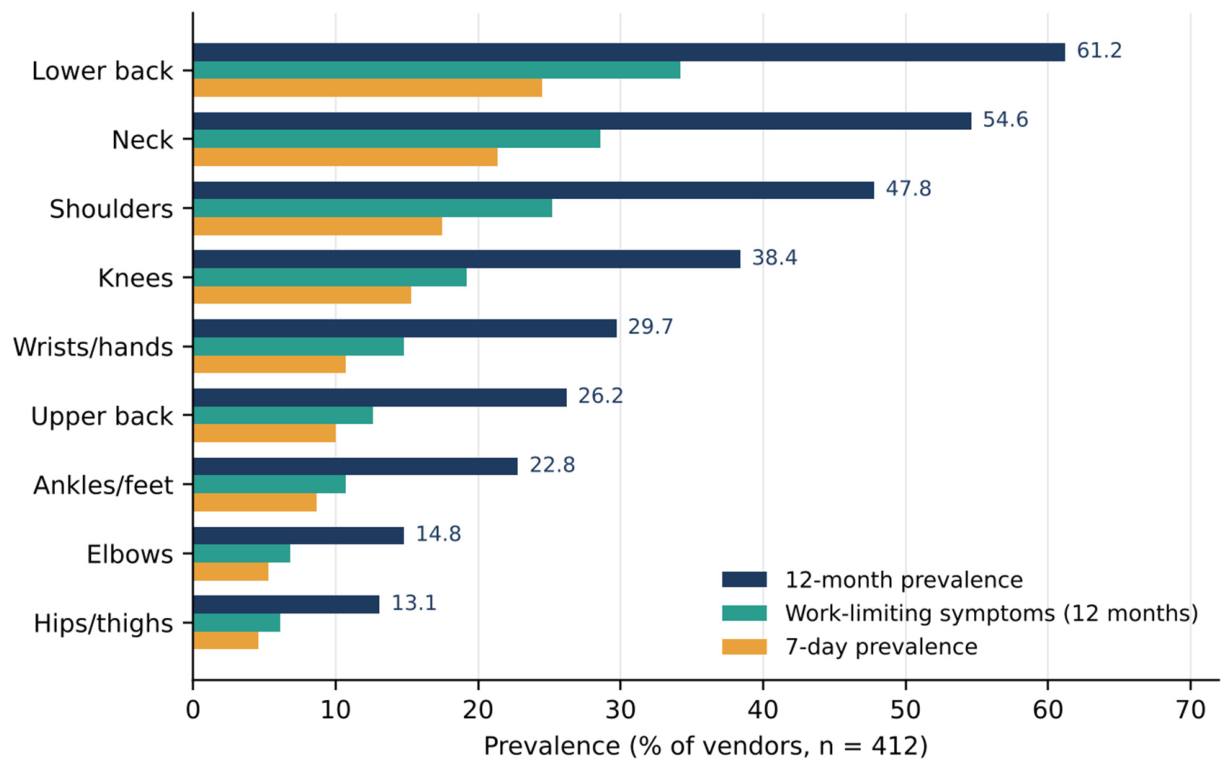
Figure 2.
Trajectories of MSD prevalence, REBA Score and Work Ability Index in the intervention and wait-list control groups.
Figure 2.
Trajectories of MSD prevalence, REBA Score and Work Ability Index in the intervention and wait-list control groups.
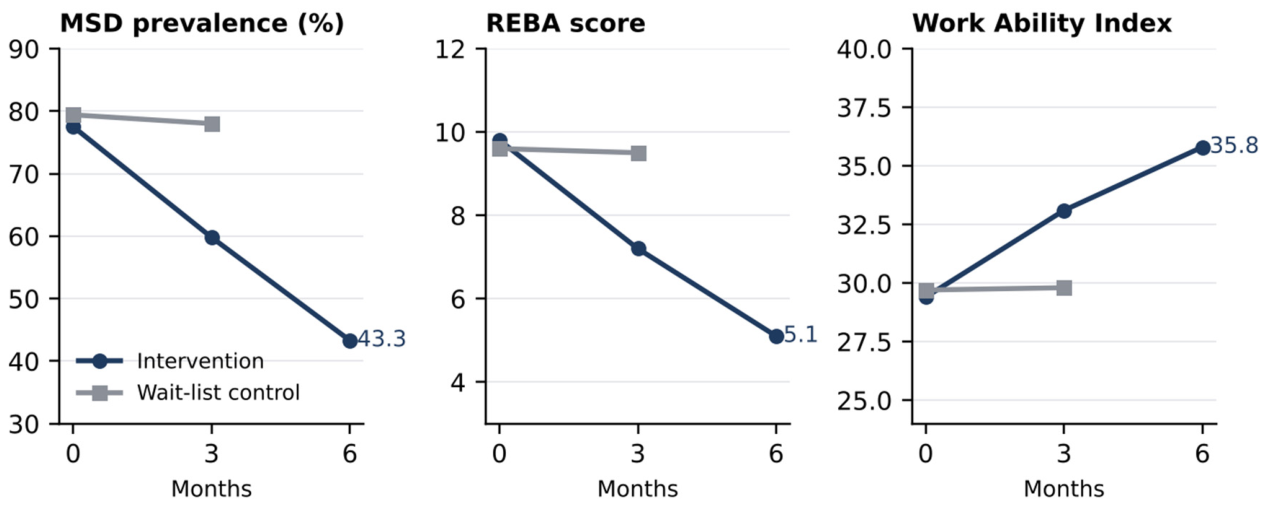
Table 2.
Baseline Prevalence of Musculoskeletal Symptoms by Anatomical Region (n=412).
| Anatomical region | 12-month prevalence, n (%) | 7-day prevalence, n (%) | Work-limiting symptoms, n (%) |
| Lower back | 252 (61.2) | 101 (24.5) | 141 (34.2) |
| Neck | 225 (54.6) | 88 (21.4) | 118 (28.6) |
| Shoulders | 197 (47.8) | 72 (17.5) | 104 (25.2) |
| Knees | 158 (38.4) | 63 (15.3) | 79 (19.2) |
| Wrists/hands | 122 (29.7) | 44 (10.7) | 61 (14.8) |
| Upper back | 108 (26.2) | 41 (10.0) | 52 (12.6) |
| Ankles/feet | 94 (22.8) | 36 (8.7) | 44 (10.7) |
| Elbows | 61 (14.8) | 22 (5.3) | 28 (6.8) |
| Hips/thighs | 54 (13.1) | 19 (4.6) | 25 (6.1) |
Table 3.
Intervention effects on primary and secondary outcomes at three and six months.
| Outcome | Int. baseline | Int. 3 mo | Int. 6 mo | Ctrl baseline | Ctrl 3 mo | Ctrl 6 mo | p (6 mo) |
| MSD prevalence (%) | 77.5 | 59.8† | 43.3† | 79.4 | 78.0 | 77.8 | <0.001 |
| REBA score, mean ± SD | 9.8 ± 1.7 | 7.2 ± 1.5† | 5.1 ± 1.3† | 9.6 ± 1.9 | 9.5 ± 1.8 | 9.4 ± 1.9 | <0.001 |
| WAI score, mean ± SD | 29.4 ± 4.2 | 33.1 ± 4.0† | 35.8 ± 3.9† | 29.7 ± 4.5 | 29.8 ± 4.3 | 30.0 ± 4.4 | <0.001 |
| Work-limiting pain (%) | 53.9 | 38.2† | 22.5† | 54.9 | 53.1 | 52.7 | <0.001 |
Disclaimer/Publisher’s Note: The statements, opinions and data contained in all publications are solely those of the individual author(s) and contributor(s) and not of MDPI and/or the editor(s). MDPI and/or the editor(s) disclaim responsibility for any injury to people or property resulting from any ideas, methods, instructions or products referred to in the content. |
© 2026 by the authors. Licensee MDPI, Basel, Switzerland. This article is an open access article distributed under the terms and conditions of the Creative Commons Attribution (CC BY) license (http://creativecommons.org/licenses/by/4.0/).
Copyright: This open access article is published under a Creative Commons CC BY 4.0 license, which permit the free download, distribution, and reuse, provided that the author and preprint are cited in any reuse.