
Submitted:
11 November 2026
Posted:
12 November 2026
You are already at the latest version
Abstract
Heavy metals in agricultural soils have been studied for half a century, but methods for measuring contamination remain far ahead of methods for turning a measurement into a decision. This review follows the problem as a chain from source identification through bioavailability and risk assessment to remediation and safe crop production, and asks at each link what the evidence can support. Three conclusions recur. Total concentration, still the most widely reported quantity, is a poor common currency: geogenic and anthropogenic inputs overlap in total load, while the fraction that reaches a crop depends on soil chemistry that total concentration does not capture. Source apportionment has become methodologically rich—receptor models, stable isotopes, machine learning—yet its uncertainty rarely reaches the risk estimates it is meant to inform. And the measures with the strongest field evidence are not the most ambitious: immobilizing amendments, water management, foliar applications and low-accumulating cultivars reduce grain cadmium by roughly 20–60% across sites, though the size of the effect is site-specific. We argue that the operational endpoint should be a verifiable crop-safety outcome rather than soil cleanup, and identify what that reframing requires of measurement and reporting.
Keywords:
agricultural soils
; heavy metals
; cadmium
; source apportionment
; bioavailability
; risk assessment
; soil remediation
; safe crop production
1. Introduction
Cadmium, lead, arsenic and the other heavy metals and metalloids have no physiological function in plants, and several have no safe threshold in humans. Cadmium is the most mobile of them in the soil–crop–food pathway: it moves from soil to the edible parts of staple crops efficiently, and chronic low-level exposure is associated with renal tubular damage, bone demineralization and, at higher doses, cancer [1,2,3,4,5]. The question for agriculture is therefore not whether a soil contains cadmium but whether that cadmium reaches the crop.
Regulation has, by contrast, concentrated on the first question. Standards around the world are written on total or pseudo-total metal concentrations, because total concentration is cheap, reproducible and defensible in court, while the alternatives are harder to standardize. The mismatch this creates is systematic. In carbonate terrain, geogenic enrichment can give a soil total cadmium close to that of a contaminated site while the crop remains compliant; acid, weakly buffered soils with a modest total load can produce grain that fails [6,7,8]. Neither result is a measurement error. Total concentration and phytoavailability are linked by soil chemistry, not by a constant.
Research has grown up around this mismatch in separate disciplines. Geochemists built source apportionment—receptor models, isotope systems, more recently machine learning—to establish where metal came from [9,10,11]. Soil chemists built speciation and bioavailability assays to establish how much is mobile [12,13,14]. Risk assessors built exposure models that turn a concentration into an intake and an intake into a hazard index [15,16]. Agronomists and remediation scientists built interventions acting on different parts of the soil–plant system [17,18,19]. Each literature is mature; the connections between them are not.
This review is organized around those connections. We follow the problem as a chain with four links—source identification, bioavailability, risk assessment, and remediation ending in safe crop production—and ask at each link what the evidence can support. This is not a comprehensive catalogue; several recent reviews cover the links individually and in more depth [20,21,22]. The concern here is with the interfaces, where the failures occur: an apportionment whose uncertainty never reaches the risk estimate, a bioavailability measurement that is not the definition the regulator uses, a remediation trial reported as a percentage reduction in soil concentration with no grain measurement. Figure 1 marks the four breaks at the joints.
The scope is global, and the evidence base is correspondingly uneven. We draw on studies from China, Europe, South and Southeast Asia, Africa and the Americas, and note where a conclusion holds across systems and where it reflects the systems most studied. Two asymmetries are worth flagging. Paddy rice dominates the bioavailability and safe-production literature far beyond its share of the global exposure burden, mainly because anaerobic–aerobic cycling makes paddy soils an unusually informative natural experiment [23,24,25]; Chinese research makes up a large part of that work, for reasons of contamination scale and policy attention [26,27,28]. Remediation studies, meanwhile, are mostly short-term trials that measure only the soil, while metal concentration in the harvested product—the outcome that matters—is reported much less often [18,29]. Section 8 returns to both.
2. Sources and Their Signatures
2.1. Geogenic Enrichment and High-Background Soils
Metals in soil come ultimately from parent material, and in most agricultural soils the geogenic contribution dominates the total inventory even where anthropogenic inputs are significant [6]. The baseline against which contamination is judged is therefore itself a geological variable, with a spatial structure that rarely follows administrative boundaries. Reimann and Garrett made the point plainly: there is no single geochemical background value, only a range that depends on the scale of observation and the statistical model used to bound it [6].
The problem is sharpest where carbonate or other metal-rich bedrock weathers into soils that are both enriched and good at holding metal in non-labile forms. Cadmium in Three Gorges soils has been attributed mainly to geogenic sources, with only part available to plants [7]. In karst terrain of southwest China, cadmium enrichment has been linked to carbonate weathering and retention, producing soils that exceed screening values across areas with no industrial history [30,31]. Crops grown on such soils can still comply: cadmium accumulation in vegetation does not track total soil concentration, and selenium–cadmium interactions in the soil–rice–human continuum modulate the effective exposure [32,33].
A contamination assessment that treats geogenic enrichment as contamination will misallocate remediation money; one that treats it as harmless will miss the high-background soils that are also acidic or otherwise primed to release metal. Total concentration cannot tell the two apart. Separating them requires a spatial argument—enrichment following lithology rather than land use—or an isotopic or speciation argument, both discussed in Section 4.
2.2. Mining, Smelting and Industrial Emissions
Point-source industrial contamination is the most spatially concentrated and, in principle, the easiest to attribute. Soils around mines and smelters commonly show concentrations several times background within a few kilometres, falling with distance and often showing a directional signature consistent with wind or drainage [34,35]. A review of mine-affected soils in China found cadmium, lead and arsenic dominant and health risk elevated close to workings [34]; integrated ecological and health risk assessments around coal mines reach similar conclusions, though the two metrics rank sites differently [36,37].
The attribution problem here is boundary definition rather than identification. Atmospheric and fluvial transport spread the footprint well beyond the site, and the contamination is often superimposed on geogenic enrichment of similar composition. Where ore body and contamination share a metal assemblage—lead–zinc or cadmium-bearing carbonate-hosted deposits, for example—total concentration cannot separate them, and isotope-based attribution earns its cost.
2.3. Agricultural Inputs
Agricultural inputs are diffuse, chronic and cumulatively large. Phosphate fertilizers carry cadmium as an impurity of the phosphate rock, and long-term application produces measurable accumulation. A New Zealand hill farm study quantified cadmium and uranium accumulation from sustained phosphate use [38], and diffusive gradients in thin films have connected phosphate-derived cadmium to uptake in wheat and potato [39]. Input inventories for England and Wales and for China both found atmospheric deposition and livestock manure to dominate anthropogenic inputs, with phosphate fertilizer dominating the cadmium input [40,41]. Isotopically labelled fertilizer experiments traced fertilizer cadmium into the soil–fertilizer–wheat system directly, a rare unambiguous attribution [42]. Chronic and low-level, these inputs seldom produce industrial-site concentrations, but they act over the whole cultivated area and over decades.
Livestock manure is the main agricultural source of copper and zinc, added to feed as growth promoters and antimicrobials and largely excreted. Repeated application enriches the plough layer in both metals [43,44,45]. Copper and zinc are less toxic than cadmium at equivalent concentrations, but they compete with cadmium for binding sites and transporters, so manure is not a straightforward hazard and can sometimes reduce cadmium uptake (Section 7).
Sewage sludge and wastewater bring a mixed metal load together with organic matter and nutrients. Long-term sludge application raises total and extractable concentrations, though phytoavailability rises less than total load because the added organic matter also binds metals [46,47]. Wastewater irrigation adds salinity and sodicity: studies in Zimbabwe, Morocco and China report metal accumulation in soil and crops under long-term irrigation, along with shifts in enzyme activity and microbial community structure [48,49,50,51]. Industrial effluent carries the same profile; leafy vegetables grown on tannery-effluent land accumulate chromium and associated metals to concentrations that register in health risk assessment [52]. Microplastics are a further co-contaminant, interacting with metals and modifying their mobility [53].
2.4. Atmospheric Deposition and Legacy Contamination
Atmospheric deposition delivers metals from industrial and non-industrial sources and is the main pathway by which contamination crosses property boundaries. Monitoring across Chinese terrestrial ecosystems has quantified wet deposition at national scale [54], and annual input budgets have been built for individual regions [55]. Deposited metal is not equivalent to the same metal aged into the soil matrix: fresh deposition is more labile, and studies using pakchoi as a receptor show deposition-derived metal to be disproportionately available relative to its share of the total [56,57]. A soil at steady state in total concentration may therefore still be accumulating phytoavailable metal.
Legacy contamination is a separate category: inputs that have stopped but whose metal remains. Lead from leaded gasoline accumulated in roadside soils for decades, and atmospherically deposited lead from historical industry persists in surface horizons long after emissions ended [58,59]. Present-day input inventories therefore underweight legacy sources, and a soil can be contaminated by a source that no longer exists. Lead isotopes are unusually effective here, because the isotopic composition of historical emissions survives in the soil and can be matched to candidate sources even after those sources have closed [59,60].
2.5. What the Markers Can and Cannot Separate
Table 1 sets the source classes against the markers commonly used to identify them, and Figure 2 rates the discriminating power of each marker for each class. Two patterns stand out. The markers that separate classes most reliably are ratios and isotopic compositions rather than concentrations, because ratios and isotopes survive dilution and mixing while concentrations do not. And the classes hardest to separate are those that most often co-occur: geogenic and mining-derived metal in ore-bearing terrain, fertilizer- and manure-derived metal in intensive systems. In both cases the limitation is the absence of contrast between candidates, not measurement precision.
Markers are ordered from most to least reliable. The final column gives the circumstance in which each stops separating the candidate sources; where absence of contrast is the constraint, no gain in analytical precision will help.
3. From Total to Available Metal
The gap between total and phytoavailable metal is not a nuisance parameter. It is the central quantity in the soil chemistry that determines whether a contamination problem exists, and the processes that open the gap are the ones remediation manipulates. They act in sequence: partitioning between solid and solution, complexation in solution, redox-driven changes in speciation, rhizosphere modification, and slow aging.
3.1. Operational Speciation and Its Limits
True chemical speciation cannot be measured directly at environmental concentrations, so the field uses operational definitions: sequential extractions that assign metal to fractions according to the reagent that releases it. The Tessier scheme and the harmonized BCR scheme are the most widely used [12,61]. Their value is comparative, not absolute. The fractions are not discrete mineral phases, redistribution during extraction is well documented, and different schemes give different apportionments for the same soil. What they do provide is a reproducible ranking of soils and a reproducible measure of change after an amendment.
Used that way, sequential extraction has been informative. BCR investigations consistently find reducible and residual fractions to dominate total metal in agricultural soils, with exchangeable and weakly acid-soluble fractions—the ones that track plant uptake—a minority of the total [62]. In long-term contaminated soils, in vitro bioaccessibility and pot-trial phytoavailability are both well below total concentration and do not decline in proportion to one another, which indicates that the two receptors sample different pools [63].
3.2. Partitioning, Ph and the Paddy Paradox
Solid–solution partitioning controls the concentration available for uptake. Sauvé and co-workers showed that the partition coefficient for a metal is governed mainly by pH, total metal burden and organic matter, with pH dominant [13]. Across the pH range of agricultural soils, cadmium partitioning changes by orders of magnitude, so two soils with identical total cadmium can differ greatly in solution concentration. This is the mechanism behind liming (Section 6) and behind the over-representation of acid soils among sites where crops exceed cadmium limits.
Redox is the second control, and in paddy soils it produces a result that is counterintuitive. In a flooded paddy, sulfate is reduced to sulfide and cadmium precipitates as insoluble sulfide phases, sharply lowering availability. The same conditions mobilize arsenic: arsenate is reduced to the more mobile arsenite, and the iron(III) oxyhydroxides are reductively dissolved. Flooding therefore lowers cadmium uptake and raises arsenic uptake; drainage does the reverse [23,24]. Field trials in Japan quantified the effect and showed it to be cultivar-dependent [23,24]; that water management cannot be optimized for cadmium and arsenic separately is now well established [25]. Isotope work on flooding–drainage alternation is resolving the mobilization pathways, which differ between the elements [64].
3.3. Organic Matter as A Two-Sided Control
Dissolved organic matter binds metals in solution and competes for solid-phase sites, so its net effect depends on which dominates. Modelling of metal binding in acid and neutral waters showed that proton and aluminium competition substantially reduces binding capacity at low pH [65]. Column experiments showed dissolved organic matter mobilizing copper and zinc as organic complexes rather than free ions [66], and in forest and agricultural soils its spectral character predicts cadmium complexation, linking composition rather than quantity to mobility [67].
The same organic amendment can therefore raise or lower cadmium availability. Added to a soil rich in dissolved organic carbon it may increase solution cadmium; where solid-phase binding sites are limiting it will decrease it. This is one reason organic amendments vary more across sites than liming [19,68].
3.4. Rhizosphere Processes and Iron Plaque
The soil that matters for uptake is within a millimetre of the root. In paddy rice, radial oxygen loss oxidizes the rhizosphere and precipitates iron(III) oxyhydroxides on the root surface as iron plaque. The plaque is a substantial sink for metals and metalloids, and its formation varies among genotypes, giving cultivar choice a plant-controlled mechanism [69,70]. The effect is element-specific: plaque sequesters arsenic effectively, while its effect on cadmium is weaker and less consistent, so a genotype selected for low arsenic uptake is not necessarily low in cadmium. Plaque explains much of the genotypic variation in arsenic uptake [71] and is now seen as part of a wider paddy iron cycle [72].
3.5. Aging and the Limits of Short-Term Trials
A metal added to soil becomes less available over months to years as it diffuses into mineral lattices, is occluded by oxide coatings and is incorporated into less soluble phases. Bioavailability measured soon after contamination therefore overestimates long-term availability, and the relevance of a remediation trial depends on its duration. Long-term contaminated soils consistently show bioaccessibility and phytoavailability well below what fresh-spike experiments predict [63].
For the remediation literature this matters directly. Amendments that add a sorbing phase may show large short-term effects reflecting the fresh reactivity of the material rather than a durable change in soil chemistry. Only multi-year field trials distinguish the two, and such trials are rare; the three- and five-year biochar trials found continued immobilization rather than decay, but cover a small fraction of the amendment literature [73,74,75].
4. Source Identification
Source apportionment methods are usually presented as competitors ranked by explained variance. A more useful question is what kind of claim each method can support. A receptor model answers how many distinguishable signatures are present and in what proportion; an isotope measurement answers whether the metal in this soil shares an origin with the metal in that source. These are different claims with different failure modes, and one will not rescue the other. Table 2 sets out the domains of validity.
Methods are ordered from compositional to provenance-based. Agreement between different classes is stronger evidence than agreement within a class, because methods of the same class share failure modes.
4.1. Receptor Models
Positive matrix factorization (PMF), introduced by Paatero and Tapper, decomposes an observation matrix into factors with non-negative contributions and profiles, weighting each observation by its analytical uncertainty [9]. It is now widely used in soil science and has separated geogenic, agricultural and industrial contributions in many settings [76,77,78]. It needs no prior source profiles and leaves an inspectable residual structure.
The weakness is that the factors are statistical constructs until someone assigns them a physical meaning. That assignment is usually made from the factor profile—cadmium and phosphorus means fertilizer, lead, zinc and antimony means traffic—and it is interpretive, not mathematical. Uncertainty analysis of PMF apportionments shows substantial confidence intervals on factor contributions and material changes with the number of factors selected [79]. Comparisons with other receptor models on the same data give broadly consistent but not identical results [80].
Because the interpretation is qualitative, apportionment uncertainty is rarely expressed in a form that can be propagated. A risk assessment built on a PMF output inherits an unknown error, and its reported confidence interval will be too narrow. This is the first break in the chain.
4.2. Isotopic Tracing
Stable isotope ratios provide a source signature that survives dilution and mixing and, unlike an element ratio, is not reproduced by coincidence. Cadmium has several stable isotopes, and industrial processing fractionates them measurably between ore, emissions, slag and product; cadmium isotope apportionment in agricultural soil has been demonstrated in the field [81] and reviewed extensively [10]. Where the question is whether cadmium in grain came from fertilizer or soil, isotope labelling answers it directly, as experiments tracing fertilizer cadmium through the soil–fertilizer–wheat system show [42].
Lead isotopes are the most mature system. The four stable isotopes come from different decay chains, so ore bodies carry distinct, characteristically non-mass-dependent compositions that industrial processing does not appreciably fractionate [59]. This makes lead isotopes unusually suited to legacy attribution: gasoline lead, smelter emissions and geogenic lead can be distinguished decades after deposition ceased, and plotting lead isotope data as mixing lines between end-members is now standard [60,82].
Zinc isotopes fractionate during high-temperature processing and during plant uptake, which makes them informative but ambiguous: an offset may reflect the source or a biological process. Work on grain filling in wheat has quantified the biological component [83], as has work on cadmium in soil–wheat systems [84]. That fractionation must be known before an offset can be attributed to a source, and for cadmium and zinc it largely is.
The binding constraint is coverage, not capability. Cadmium isotope measurements remain far fewer than cadmium concentration measurements, and the isotopic composition of plausible end-members is often unmapped for a given region. Without both sample and end-member characterization, an isotope measurement narrows the question but does not close it.
4.3. Multivariate Statistics and Machine Learning
Principal component analysis with multiple linear regression preceded the receptor models and remains in use because it is transparent and assumes little. Its limitation is that components are orthogonal and cannot represent sources that co-vary—exactly the situation where geogenic and agricultural inputs follow the same spatial gradient.
Machine learning has entered mainly as a predictive rather than an attributional tool: random forest and gradient boosting trained on soil properties, land use and spatial covariates predict metal concentration at unsampled locations with useful accuracy [11,85] and have been used to predict the outcome of immobilization [86]. Its value for source identification is real but indirect. Feature importance identifies covariates that carry information about concentration, which suggests source but is not apportionment: a covariate can be predictive without being causal, and correlated covariates partition importance arbitrarily. Studies combining machine learning with conventional apportionment report the combination as more informative than either alone [11,87].
4.4. Spatial Tools
Where candidate sources have different spatial structure, a spatial argument can beat any compositional one. Geostatistical mapping with ancillary covariates can separate enrichment that follows lithology from enrichment that follows land use, and regression kriging with random forest covariates has mapped both concentration and mobility in soil profiles [85]. Spatiotemporal kriging extends this to the time dimension, attributing the increment between surveys spatially [88,89].
For the high geological background problem, the spatial argument is often the most practical option. If enrichment tracks a geological rather than a land-use boundary, and the same enrichment appears in uncultivated reference profiles, the geogenic case can be made without isotopes. What it cannot do is exclude a superimposed anthropogenic contribution with the same pattern, which is why the strongest studies triangulate.
4.5. Triangulation and Its Limits
The methods fail differently and therefore corroborate one another when they agree. A receptor model resolving three factors, an isotope signature consistent with the assigned end-members and a spatial pattern matching the source geography together support an attribution that none supports alone. Figure 3 sets out the selection logic as a function of the question, not as a ranking.
Knowing when to stop matters as much. If two candidate sources have similar element profiles, similar isotopic compositions and the same spatial pattern, no analytical refinement will separate them. The right response is to report the apportionment as unresolved and carry the ambiguity into risk assessment, not to present a point estimate. Reporting a single percentage contribution per source, with no indication that an alternative fits the data equally well, overstates what these methods deliver.
5. Risk Assessment on an Availability Basis
Risk assessment is where the chain holds or breaks, because it turns a measurement into a judgement. Practice still runs mainly on indices calculated from total concentration, on the grounds that total concentration is what is regulated and what is reproducible. This section explains why those indices misrank risk in the cases that matter, what the alternatives measure, and how the regulatory frameworks compare.
5.1. Total-Concentration Indices
The common geochemical indices—geoaccumulation index, enrichment factor, contamination factor, Häkanson’s potential ecological risk index and the Nemerow multifactor index—compare measured concentrations with a baseline, usually a background value or upper continental crust [90]. They scale easily to provincial and national datasets, where they rank administrative units for attention [91]. All of them answer one question: how much more metal is here than there would be without human activity. That is a legitimate question, but it is not the one a food-safety regulator or a farmer is asking.
The failure is structural. Normalizing against a crustal or regional background assumes a fixed reference; in geogenically enriched terrain the reference is itself the anomaly, so the index reports contamination where there is none. In acid soils with modest total concentrations the opposite happens: the index reports low contamination while crops exceed cadmium limits. Comparisons of index-based rankings with measured crop concentrations generally find weak agreement, especially at the moderate concentrations where land-use decisions are made [92,93]. Soil–crop correlations are often significant but explain little variance, as the process understanding of Section 3 predicts [93].
5.2. Measuring the Available Fraction
Four families of measurement stand in for the available fraction—chemical extraction, diffusive gradients, in vitro digestion and the soil-to-plant transfer factor—and they are not interchangeable. Weak-reagent extraction (dilute acid, EDTA, CaCl₂) targets the solution and exchangeable pools; it is cheap and reproducible, but the operational pool is not a physiological one. Diffusive gradients in thin films (DGT) measure the labile flux to a sink, integrating resupply from the solid phase and approximating what a root experiences [14,94]. Physiologically based extraction tests simulate gastrointestinal solubilization and estimate bioaccessibility for human exposure, not plant uptake [95,96].
Figure 4.
Four families of measurement of the “available” fraction, each placed against the step of the soil–crop pathway it interrogates. Chemical extraction reports the reactive pool, diffusive gradients the labile pool, the transfer factor a ratio across the whole transfer, and in vitro digestion the fraction solubilized in the human gut, a step beyond the crop and shown separately for that reason. No two measure the same interval, so they cannot substitute for one another. Each is annotated with the receptor whose question it answers. Schematic.
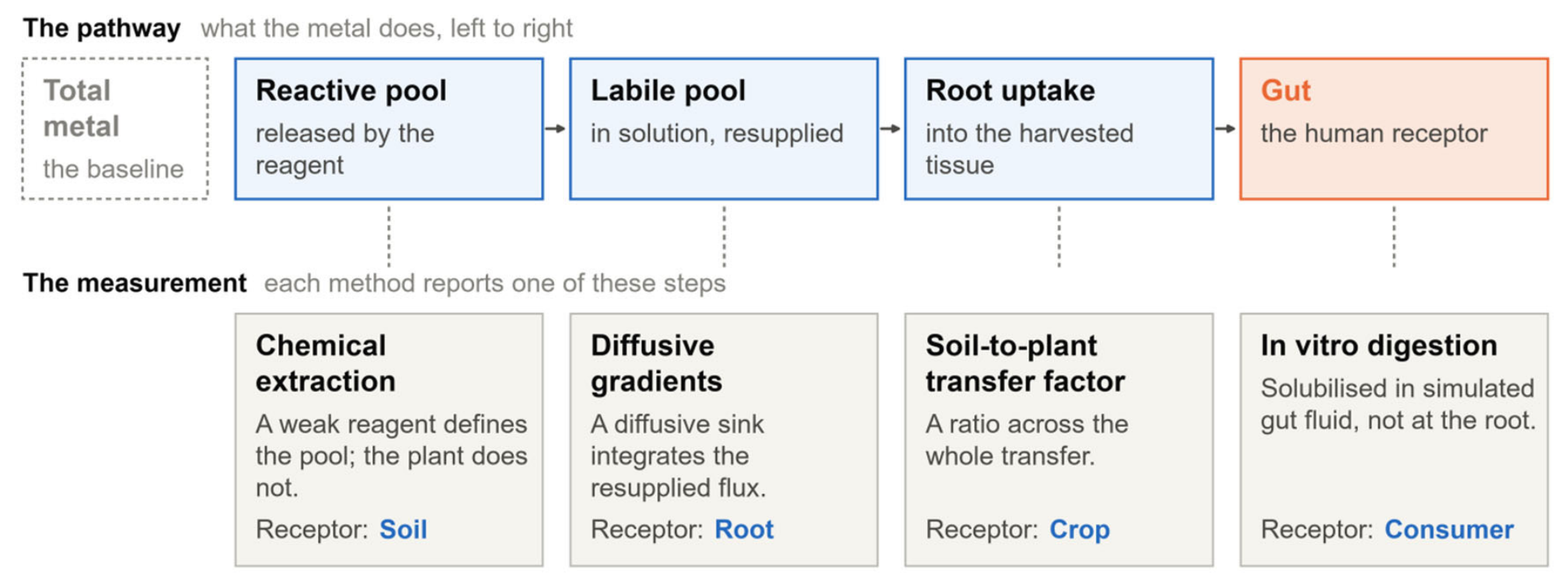
The choice should follow from the receptor. For predicting crop uptake, DGT outperforms extraction in several comparative studies because it captures the kinetic resupply a growing root induces [39]. For dietary exposure from consumed produce, in vitro gastrointestinal methods are the relevant ones [97,98]. The error to avoid is using one family as evidence about an outcome in another—citing a DGT result as evidence about human bioaccessibility, for instance. Three in vitro methods compared on polished and unpolished rice gave method-dependent bioaccessibility estimates for both arsenic and cadmium, which limits how precisely the human-side estimate can be made [99].
Bioavailability also underpins risk-based soil standards. A framework for deriving human-health-based soil quality standards back-calculates an acceptable soil concentration from an acceptable intake through a bioavailability-adjusted exposure model [100], and bioavailability and speciation have been used directly to set risk-based remediation targets at contaminated sites [101].
5.3. Health Risk Assessment and Exposure Assumptions
Human health risk assessment follows the standard structure of hazard identification, exposure assessment and risk characterization, with hazard quotients and cancer risk computed separately for ingestion, dermal contact and inhalation [15]. For agricultural soils, soil ingestion is usually a minor pathway compared with eating crops grown on the soil, so the assessment inherits every uncertainty in the soil-to-crop transfer step. Studies that assess both pathways consistently find the dietary route to dominate for cadmium and arsenic [102,103,104,105].
Exposure parameters are themselves a large source of variance. Body weight, ingestion rate, exposure duration and bioavailability factor all enter directly, and their defaults differ between jurisdictions [15]. Monte Carlo simulation propagates distributions instead of single defaults and generally widens the estimated risk range considerably [16,106]. The difference between deterministic and probabilistic results is often larger than the difference between sites, so comparisons of hazard quotients across studies are frequently comparisons of exposure assumptions rather than contamination.
For produce, the appropriate adjustment is the measured bioaccessibility of the metal in the food matrix, not in the soil, and the two differ substantially. In vitro digestion studies of rice find cadmium bioaccessibility well below unity, depending on cooking and on whether the grain is polished [97,99]. Using a soil-based bioavailability factor for dietary exposure is a common but incorrect shortcut.
5.4. Regulatory Frameworks
Three frameworks dominate the international comparison: the Chinese standards for soil environmental quality and food contaminants, the European Union maximum levels for food, and the Codex Alimentarius general standard. They rest on different principles and are not directly comparable, which causes persistent confusion. Table 3 sets out the values; the discussion below concerns structure rather than numbers.
Soil values are GB 15618-2018 screening values for pH 5.5–6.5, on an aqua regia extractable basis (mg kg⁻¹ dry soil). The EU and Codex regulate food, not soil, and set no comparable limit; the merged cells record that absence once. Food values (GB 2762-2025, Commission Regulation (EU) 2023/915, Codex CXS 193-1995) are in mg kg⁻¹ fresh weight and restricted to combinations for which all three systems set a level. Across them the three never all agree. China and Codex coincide for inorganic arsenic in rice and for cadmium in fruiting vegetables, with the EU more stringent; the EU and Codex coincide for lead in fruiting vegetables, where China permits twice their level. A Codex “no level set” is the absence of a standard, not a permissive value.
The Chinese framework regulates both ends of the chain separately. Soil risk screening and intervention values are set by pH band and land use in the soil quality standard, and food contaminant limits are set independently in the food safety standard. The design is deliberate: the soil standard defines when a soil needs attention, the food standard defines when a product may be sold, and the two can disagree—precisely the situation in high-background terrain, where screening values are exceeded while produce remains compliant. The soil standard is built on total concentration and pH, so it inherits the limitation identified in Section 5.1 by design.
The EU regulates the product, not the soil. Maximum levels are set for cadmium, lead and inorganic arsenic in specified foods, and cereal and rice levels distinguish milled from husked forms because metal concentrates in bran and germ. A soil above any particular value has no direct regulatory consequence; what matters is the harvested commodity. This makes the framework agnostic about soil chemistry and robust to geogenic enrichment, at the cost of giving no signal until a product fails.
Codex sets internationally traded maximum levels and, for cadmium in rice, is less stringent than the other two; for some commodity–metal combinations it sets no level at all. The differences are not errors but reflections of different risk-management objectives and dietary patterns. The relevant point for this review is that a soil can comply under one framework and not another, so a study reporting a compliance judgement should say which framework it applied. A substantial share of the literature does not.
Both the Chinese and European systems are under active development. Threshold values for cadmium, chromium, lead and mercury in rice have been derived and validated against field data [107], and modelling frameworks now combine soil quality assessment with early warning of ecological risk [108]. The direction is toward availability-based and receptor-based standards, but the operational definitions are unsettled, so the method dependence of Section 5.2 is a compliance problem, not only a research one.
6. Remediation
Remediation technologies are usually catalogued one by one. Grouping them by mechanism, into mobilization and immobilization, is more useful [17]. Mobilization removes metal from the soil and addresses the source; it is slow, expensive and hard to scale. Immobilization reduces availability without removing metal, is fast and cheap, and is reversible in principle. Every technology below is an instance of one or the other, and the choice is a choice about what the intervention is for: reducing exposure now or reducing the inventory permanently. Figure 5 locates the principal measures against the step of the soil–plant pathway at which each acts and the timescale over which it takes effect. A measure that acts late in the pathway cannot repair a problem that originates early in it.
6.1. Immobilizing Amendments
Liming raises pH and, through the partitioning relationship of Section 3.2, lowers cadmium in solution. It is the oldest and cheapest intervention, and its efficacy is well established. A meta-analysis in rice paddies found that liming increased yield and reduced grain cadmium, with the size of the cadmium effect depending on initial pH and application rate [109,110]. The limitations are equally well established: the effect reverses as pH drifts back, over-liming depresses micronutrient availability, and liming does nothing for arsenic, which becomes more mobile at higher pH.
Biochar and other carbonaceous amendments act through several mechanisms at once—pH elevation, sorption to the carbon surface, release of dissolved organic matter—which is why their efficacy varies more across sites than liming. A three-year field experiment confirmed continuous immobilization of cadmium and lead in paddy soil [73], a five-year trial found the same persistence [74], and a two-year experiment reduced rice cadmium uptake [111,112,113]. A longer-term analysis found the effect durable, though the mechanism shifts as the material ages [75], and improvements in soil bacterial community structure have been reported alongside the metal effect [114]. Biochar is a class of materials, not a single technology, and the properties that determine performance cannot yet be predicted from feedstock and pyrolysis conditions [115].
Clay minerals, particularly sepiolite and palygorskite, are among the best-characterized inorganic amendments for cadmium. Efficacy has been demonstrated at field scale in paddy soil [116], immobilization performance assessed systematically [117,118], and competitive sorption among nickel, cadmium, zinc and copper characterized at mineralogical level [119]. One practical interaction: flooding enhances sepiolite’s effect on cadmium [120], so amendment and water regime are not independent choices.
Phosphate and apatite amendments immobilize lead particularly effectively through sparingly soluble pyromorphite-type phases, and are effective for cadmium too; iron hydroxyl phosphate has immobilized lead, cadmium and arsenic simultaneously, notable because arsenic is the element most often made worse by immobilization [121,122]. Organic amendments, including compost, show the two-sided behaviour predicted by Section 3.3 [68,123]. The position of amendments in the wider toolbox has been reviewed comprehensively [19,124].
6.2. Phytoextraction
Phytoextraction moves metal into harvestable biomass and removes it from the site. The cadmium and zinc hyperaccumulator Sedum plumbizincicola has supported a sustained programme, with the genetic basis of hypertolerance traced to the heavy metal ATPase HMA3 [125,126] and repeated phytoextraction demonstrated across four contaminated soils [127]. Noccaea caerulescens has been evaluated in field cropping cycles [128], and the general case and its constraints reviewed [129,130,131].
Phytoextraction works, and it is slow. Removal rates even with a hyperaccumulator are typically a few hundred grams of cadmium per hectare per year, against soil inventories two orders of magnitude larger, so the technique suits moderately contaminated soil over a decade or more, not hot spots. Gong and co-workers’ field-scale review is instructive because it separates what has been demonstrated in the field from what has been demonstrated in pots, and the attrition is substantial [18]. A recurring obstacle is that harvested biomass is itself metal-bearing waste, so the technique converts a diffuse soil problem into a concentrated residue problem.
6.3. Washing and Electrokinetics
Soil washing with chelating agents removes metal quickly and efficiently, and the choice of agent trades efficacy against environmental burden. EDTA is effective but recalcitrant and mobilizes metals in a migratory form; biodegradable alternatives approach its performance at lower persistence but higher cost [132], and the technique has been reviewed as a whole [133]. The fundamental constraint is that washing requires excavation, which limits it to small areas and destroys the structure of whatever soil is treated.
Electrokinetic remediation applies a direct current to move metals toward electrode compartments and works in situ in low-permeability soils that other methods cannot reach. Mechanisms and applicability have been reviewed [134], and enhancement with biodegradable complexing agents improves removal [135]. Its limitation is scale: it is practical over small areas and shallow depths, and energy demand scales with soil volume.
6.4. Biological and Nano-Enabled Approaches
Microbially mediated remediation covers biosorption, bioaccumulation, redox transformation and microbially induced carbonate precipitation, and the underlying geomicrobiology is well characterized [136]. A critical review of carbonate precipitation sets out both the potential and the unresolved questions about long-term stability [137]; arbuscular mycorrhizal fungi combined with amendments contribute to immobilization [138], and plant–microbe interactions more broadly modulate metal stress [139]. Biological approaches operate at ambient conditions and can be self-sustaining, but performance depends on environmental conditions in ways that are hard to guarantee.
Nano-enabled amendments and agrochemicals have attracted attention for remediation and crop protection [140]. The high surface area and reactivity that make nanomaterials effective also raise unresolved questions about their fate in soil, and the literature is expanding faster than the regulation that would govern it.
6.5. Comparative Assessments
Several comparative reviews have assessed remediation technologies against efficacy, cost, duration, applicability and environmental impact [21,141,142,143]. Their rankings differ in detail but agree on the shape of the trade-off space (Table 4). Immobilization is the only strategy whose cost and speed allow it to be applied over the areas actually affected. Removal technologies cost an order of magnitude more per unit area and are realistic only for source areas. Cost-effectiveness analysis confirms the ranking but shows that ranking by cost per unit of risk reduced can invert ranking by mass of metal removed [144].
Cost categories are relative within the table, not absolute figures; ranking by cost per unit of risk reduced can differ from ranking by mass removed [144]. The field-scale column reflects the evidence reviewed in this section and in [18]; entries marked partially demonstrated rest mainly on laboratory or pot evidence.
The disagreement that matters most concerns durability. Immobilization leaves metal in place, so its benefit lasts only as long as the immobilizing phase does, and the fate of that phase under changing pH, redox and management is the central open question. The multi-year biochar trials show persistence over three to five years [73,74], encouraging but short relative to the timescale over which contaminated land must be managed. This is the weakest link in the evidence base for the strategy actually being deployed.
7. Safe Crop Production
The measures in Section 6 act on the soil. The measures here act on the soil–plant system, and they can lower metal in the harvested product without changing total soil concentration at all. For the large areas of moderately contaminated farmland where excavation is not an economic option, this is the only realistic route to a compliant product, which is why the problem is often framed as “safe utilization” rather than remediation [145].
7.1. Cultivar Selection
Genotypic variation in cadmium accumulation within a crop is large—commonly a factor of two or more in grain cadmium at the same site—and heritable. Cultivar choice is therefore the most effective single lever available to a farmer, because it requires no extra input and no change in practice. Screening programmes have identified rice cultivars with stable low accumulation across environments [146,147], and comparable variation exists among wheat cultivars [148]. The genetic and physiological basis is increasingly understood, with transporters for root uptake, xylem loading and grain partitioning all implicated [25].
Two caveats limit how far this can be pushed. Stability across environments is not guaranteed: a cultivar that is low-accumulating at one site may not be at another, because the ranking interacts with pH and redox, and programmes testing in a single environment overstate transferability [146]. Traits that reduce cadmium can also carry a yield or quality cost, and a cultivar that is safe but unproductive will not be adopted. The same constraint runs through the whole toolbox: measures are taken up when they fit existing practice and need little capital [149]. Predictive approaches that relate grain cadmium to soil properties for a defined cultivar class offer a way to match cultivar to site rather than recommend one best variety [150].
7.2. Water Management in Paddy Systems
In paddy rice, water management changes cadmium availability more than any amendment applied at realistic rates, because it changes the redox state of the plough layer. Continuous flooding maintains reducing conditions, sulfide precipitation and low cadmium availability, and the field evidence is consistent across sites [23,24]. The complication, developed in Section 3.2, is that the same treatment raises arsenic availability and the two contaminants often co-occur. Because arsenic accumulates in grain as inorganic arsenic and is regulated, a recommendation that optimizes cadmium alone can produce a product that fails on arsenic.
The practical resolutions under study are alternation rather than static flooding, and genotype-specific management. Intermittent irrigation timed to grain filling, when cadmium translocation to grain is greatest, reduces grain cadmium more than it raises grain arsenic, and the optimal schedule depends on cultivar [24,25]. Isotope studies of flooding–drainage alternation are resolving the kinetics, a prerequisite for optimizing a schedule rather than choosing between extremes [64]. Water regime and sepiolite performance interact, so water management and amendment should be designed together, not in sequence [120].
7.3. Foliar Applications and Nutrient Management
Foliar application of silicon, selenium and zinc reduces grain cadmium through processes inside the plant—competition for transporters, vacuolar sequestration, antioxidant capacity—rather than in the soil. The advantage is a targeted, dose-controlled intervention that avoids the soil-side complications of amendments. Foliar silicon and selenium reduce cadmium uptake and toxicity in rice [151]; nano-silicon reduces grain cadmium by inhibiting translocation [152]; combined silicon–selenium formulations diminish cadmium and lead translocation to grain [153]. In wheat, foliar selenium and zinc alleviate cadmium toxicity and reduce uptake [154].
Silicon has a longer history than its recent use against cadmium: silicon-mediated alleviation of abiotic stress is well characterized [155], and silicon nutrition reduces cadmium uptake and improves growth and photosynthesis in rice exposed to low cadmium [156], with comparable effects in other species [157]. Soil-applied selenium also reduces cadmium and lead accumulation in rice [158], and selenium–cadmium interaction in the soil–rice–human continuum has been documented in a high-background area [33].
Zinc is a special case because it also corrects a deficiency common in the populations at risk from cadmium. Zinc fertilization raises grain zinc and lowers grain lead and cadmium, more so in zinc-biofortified cultivars [159], and the zinc–cadmium antagonism has been characterized in wheat varieties differing in grain cadmium [160]. A measure that improves nutritional quality while reducing the contaminant is better than one that trades yield for safety.
7.4. Cropping System Design
Rotation and intercropping can reduce metal transfer by altering soil chemistry through root exudates, diluting the input of a high-risk commodity, or removing metal through a co-cropped accumulator. Comparisons of oil-crop rotations on contaminated farmland found differences in both economic return and metal removal [161]. Ratoon rice differs from main-season rice in grain cadmium and arsenic, so harvest regime is itself a safe-production variable [162]. Metal uptake in monoculture and intercropping differs between species [163], and intercropping has been evaluated for safe production and phytoremediation [164].
These interventions need no inputs and can be adopted immediately, but they change what is produced, and markets accept only what they demand. A rotation designed to minimize cadmium may yield a crop with no local buyer, and that economics does not appear in the metal balance. The agronomic optimum and the adoptable solution diverge here, and the review literature rarely addresses the gap.
7.5. Strength of the Evidence
Table 5 summarizes the measures against the strength of the evidence. The measures with the strongest and most consistent field evidence—cultivar selection, water management, zinc fertilization—are inexpensive and act within a season. The weaker evidence belongs to measures whose effects are more site-dependent or less well characterized mechanistically. The practical levers are known; the constraint is transferring their magnitudes between sites.
Evidence strength reflects the number of independent field replications and the consistency of results, not the size of the effect. Effects are given qualitatively because magnitudes are site-specific and no single transferable value is supported.
8. Integrating the Chain
8.1. the Decision Sequence
The framework proposed here, shown in Figure 1, differs from a conventional risk-assessment flow chart in three ways. Source identification produces a distribution over candidate apportionments, not a point estimate, and that distribution is carried forward. Bioavailability becomes the pivot rather than an optional refinement: a total-concentration screen decides whether further work is warranted, but the decision is made on an availability basis, with the measurement family chosen according to the receptor. And the endpoint is a crop-safety outcome, not a soil concentration, which inverts the usual order of assessment and changes which measurements are load-bearing.
If the objective is a compliant product rather than clean soil, a soil that fails a screening value but supports compliant crops does not require remediation, while a soil that passes screening but produces non-compliant crops does. Both occur, and a total-concentration workflow mishandles both. High-background terrain is the clearest case of the first; acid, weakly buffered soils with modest total loads, of the second.
The reframing also implies a verification structure the literature largely lacks. An intervention—amendment, water regime, cultivar change or a combination—should be verified by measuring the product, not the soil. A treatment plot paired with a control, with the harvested product analyzed in both, is the minimum design for a claim about safe production. By that standard, the share of field-scale studies supporting a product-level claim is much smaller than the share reporting a soil-level effect [18,29].
8.2. the Four Breaks
Four breaks recur, listed in Table 6 with the evidence that would close each.
The breaks are ordered by the stage of the chain at which they occur. The fourth separates an intervention that works from one that has been shown to work.
The first is the apportionment-to-risk break. Apportionment studies report percentage contributions with no uncertainty, so risk assessments using them understate their confidence intervals. The need is not a better receptor model but a reporting convention: intervals on apportionments, propagated into risk. Uncertainty analysis of PMF already shows the size of the effect [79]; the barrier is practice, not method.
The second is the bioavailability-definition break. Chemical extraction, DGT and in vitro digestion define the available fraction differently, and the literature substitutes one for another freely. A measurement meant to predict plant uptake and one meant to estimate human bioaccessibility answer different questions, and the method-dependent spread among in vitro assays sets a floor on the precision of the human-side estimate [99]. Studies measuring two families on the same samples are a small minority and would be disproportionately valuable.
The third is the short-term-to-long-term break. Aging reduces availability, so durability determines whether an immobilization effect has value beyond the trial. Three- and five-year data exist for biochar and show persistence [73,74,75]; comparable multi-year data are scarce for other amendments. A set of long-duration field trials across contrasting soils, with consistent reporting, would be the most useful single addition to this literature.
The fourth is the soil-to-product break, the one that matters most here. Much of the remediation and amendment literature reports effects on soil extractable metal or on pot-grown tissue, and only a minority reports concentration in the harvested edible portion under field conditions. Field and pot conditions do not reproduce the same transfer processes, so the two are not substitutable. Field-scale reviews that separate the categories make the attrition visible [18], and the gap is largest for the technologies deployed at scale.
8.3. Research Needs
Five research priorities follow, ordered by expected benefit relative to cost.
Paired bioavailability measurements across method families, with crop concentrations measured in the same study, would establish conversion factors empirically rather than assuming them. This is cheap relative to its value and could be added to ongoing field trials.
Multi-year field trials of immobilization amendments with product-level endpoints, across contrasting soils and at rates farmers would apply, would show whether biochar’s durability generalizes. Efficacy at high rates is not evidence for rates that are economically available.
Isotopic end-member characterization for sources that actually co-occur—especially in ore-bearing carbonate terrain, where geogenic and anthropogenic metal are compositionally similar—would extend the most diagnostic method beyond the few regions where it has been used [10].
Reporting conventions for apportionment uncertainty, and studies that propagate it into risk estimates, would close the first break. The methodological pieces exist; what is missing is a demonstration that propagation changes decisions.
Finally, the literature is imbalanced toward paddy rice and a few well-studied regions. Comparable field work on wheat, maize and vegetables in regions where dietary exposure is highest but soil chemistry is least studied would address the largest remaining gap. The rice work is excellent; the point is where the next study has the most value.
9. Conclusions
Heavy metal contamination of agricultural soils is a mature field with an immature decision chain. The measurement science is strong: concentrations are quantifiable at low levels, bioavailability has established operational definitions, isotopes have given source apportionment genuinely diagnostic tools, and the measures that work have been identified and replicated. What is weak is the transfer of evidence between stages.
Total concentration remains the default currency despite being a poor predictor of the outcome regulation and management care about. Geogenic enrichment in carbonate terrain produces soils that exceed screening values while supporting compliant crops; acid soils with modest total loads produce the opposite. Neither is detectable from total concentration, and both are common enough that a total-concentration workflow misallocates effort at scale.
Source apportionment has become methodologically sophisticated, with cadmium, lead and zinc isotopes providing provenance that element ratios cannot, and machine learning adding predictive power that is useful but not attribution. The recurring failure is interpretive: apportionments are reported as point estimates without uncertainty, and factor-to-source assignment is judgement rather than calculation.
On the intervention side, the strongest field evidence supports measures that are cheap and act within a season—cultivar selection, water management in paddy systems, zinc and silicon nutrition—while the technologies with the greatest removal capacity cost an order of magnitude more and apply only to source areas. Immobilizing amendments are the only class deployable over the affected area, but their benefit depends on durability shown over three to five years, not over the timescale on which contaminated land must be managed.
The reframing this review argues for is to treat the operational endpoint as a verifiable crop-safety outcome rather than a soil concentration. That changes which measurements are load-bearing, makes paired treatment-and-control designs with product-level analysis the minimum standard of evidence, and gives high-background terrain and acid soils a coherent treatment the current framework cannot provide. The methods exist. What is required is that uncertainty at each step be reported in a form the next step can use.
Author Contributions
Conceptualization, W.J. and Y.G.; methodology, L.W., L.R., K.W. and Y.G.; investigation, L.W., Z.Y., S.Y., X.J., G.B. and D.M.; resources, W.J. and Y.G.; data curation, L.W., Z.Y., L.R., S.Y. and G.B.; writing—original draft preparation, L.W.; writing—review and editing, L.W., K.W., X.J., D.M., W.J. and Y.G.; visualization, L.W. and G.B.; supervision, W.J. and Y.G.; project administration, W.J. and Y.G.; funding acquisition, W.J. and Y.G. All authors have read and agreed to the published version of the manuscript.
Funding
This work was supported by the National Key Research and Development Program of China [grant number 2022YFC2105401.2] and Jiangsu Association for Science and Technology Project “Implementation Pathways and Policy Recommendations for Soil Remediation in Jiangsu Province” (ZX2026QT00002).
Institutional Review Board Statement
Not applicable.
Informed Consent Statement
Not applicable.
Data Availability Statement
No new data were created or analyzed in this study. Data sharing is not applicable to this article.
Acknowledgments
During the preparation of this manuscript, the author(s) used DeepSeek-v4-pro was used solely for language editing and polishing of the manuscript. The authors have reviewed and edited the output and take full responsibility for the content of this publication.
Conflicts of Interest
The authors declare no conflicts of interest.
References
- Järup, L.; Åkesson, A. Current status of cadmium as an environmental health problem. Toxicol. Appl. Pharmacol. 2009, 238(3), 201–208. [Google Scholar] [CrossRef]
- Nawrot, T.; Plusquin, M.; Hogervorst, J.; Roels, H.A.; Celis, H.; Thijs, L.; Vangronsveld, J.; Van Hecke, E.; Staessen, J.A. Environmental exposure to cadmium and risk of cancer: a prospective population-based study. Lancet Oncol. 2006, 7(2), 119–126. [Google Scholar] [CrossRef]
- Satarug, S.; Baker, J. R.; Urbenjapol, S.; Haswell-Elkins, M.; Reilly, P. E. B.; Williams, D. J.; Moore, M. R. A global perspective on cadmium pollution and toxicity in non-occupationally exposed population. Toxicol. Lett. 2003, 137(1-2), 65–83. [Google Scholar] [CrossRef]
- Åkesson, A.; Bjellerup, P.; Lundh, T.; Lidfeldt, J.; Nerbrand, C.; Samsioe, G.; Skerfving, S.; Vahter, M. Cadmium-Induced Effects on Bone in a Population-Based Study of Women. Environ. Health Perspect. 2006, 114(6), 830–834. [Google Scholar] [CrossRef]
- Godt, J.; Scheidig, F.; Grosse-Siestrup, C.; Esche, V.; Brandenburg, P.; Reich, A.; Groneberg, D. A. The toxicity of cadmium and resulting hazards for human health. J. Occup. Med. Toxicol. 2006, 1(1), 22. [Google Scholar] [CrossRef]
- Reimann, C.; Garrett, R. G. Geochemical background—concept and reality. Sci. Total Environ. 2005, 350(1-3), 12–27. [Google Scholar] [CrossRef]
- Liu, Y.; Xiao, T.; Ning, Z.; Li, H.; Tang, J.; Zhou, G. High cadmium concentration in soil in the Three Gorges region: Geogenic source and potential bioavailability. Appl. Geochem. 2013, 37, 149–156. [Google Scholar] [CrossRef]
- Zhao, F. J.; Ma, Y.; Zhu, Y. G.; Tang, Z.; McGrath, S. P. Soil Contamination in China: Current Status and Mitigation Strategies. Environ. Sci. Technol. 2014, 49(2), 750–759. [Google Scholar] [CrossRef]
- Paatero, P.; Tapper, U. Positive matrix factorization: A non-negative factor model with optimal utilization of error estimates of data values. Environmetrics 1994, 5(2), 111–126. [Google Scholar] [CrossRef]
- Liang, B.; Ye, Q.; Shi, Z. Stable isotopic signature of cadmium in tracing the source, fate, and translocation of cadmium in soil: A review. J. Hazard. Mater. 2024, 472, 134531. [Google Scholar] [CrossRef]
- Zheng, J.; Wang, P.; Shi, H.; Zhuang, C.; Deng, Y.; Yang, X.; Huang, F.; Xiao, R. Quantitative source apportionment and driver identification of soil heavy metals using advanced machine learning techniques. Sci. Total Environ. 2023, 873, 162371. [Google Scholar] [CrossRef]
- Tessier, A.; Campbell, P. G. C.; Bisson, M. Sequential extraction procedure for the speciation of particulate trace metals. Anal. Chem. 1979, 51(7), 844–851. [Google Scholar] [CrossRef]
- Sauvé, S.; Hendershot, W.; Allen, H. E. Solid-Solution Partitioning of Metals in Contaminated Soils: Dependence on pH, Total Metal Burden, and Organic Matter. Environ. Sci. Technol. 2000, 34(7), 1125–1131. [Google Scholar] [CrossRef]
- Zhang, H.; Davison, W. Performance Characteristics of Diffusion Gradients in Thin Films for the in Situ Measurement of Trace Metals in Aqueous Solution. Anal. Chem. 1995, 67(19), 3391–3400. [Google Scholar] [CrossRef]
- Miletić, A.; Lučić, M.; Onjia, A. Exposure Factors in Health Risk Assessment of Heavy Metal(loid)s in Soil and Sediment. Metals 2023, 13(7), 1266. [Google Scholar] [CrossRef]
- Qu, C.; Sun, K.; Wang, S.; Huang, L.; Bi, J. Monte Carlo Simulation-Based Health Risk Assessment of Heavy Metal Soil Pollution: A Case Study in the Qixia Mining Area, China. Hum. Ecol. Risk Assess. An. Int. J. 2012, 18(4), 733–750. [Google Scholar] [CrossRef]
- Bolan, N.; Kunhikrishnan, A.; Thangarajan, R.; Kumpiene, J.; Park, J.; Makino, T.; Kirkham, M. B.; Scheckel, K. Remediation of heavy metal(loid)s contaminated soils – To mobilize or to immobilize? J. Hazard. Mater. 2014, 266, 141–166. [Google Scholar] [CrossRef]
- Gong, Y.; Zhao, D.; Wang, Q. An overview of field-scale studies on remediation of soil contaminated with heavy metals and metalloids: Technical progress over the last decade. Water Res. 2018, 147, 440–460. [Google Scholar] [CrossRef]
- Palansooriya, K. N.; Shaheen, S. M.; Chen, S. S.; Tsang, D. C. W.; Hashimoto, Y.; Hou, D.; Bolan, N. S.; Rinklebe, J.; Ok, Y. S. Soil amendments for immobilization of potentially toxic elements in contaminated soils: A critical review. Environ. Int. 2020, 134, 105046. [Google Scholar] [CrossRef]
- Rashid, A.; Schutte, B. J.; Ulery, A.; Deyholos, M. K.; Sanogo, S.; Lehnhoff, E. A.; Beck, L. Heavy Metal Contamination in Agricultural Soil: Environmental Pollutants Affecting Crop Health. Agronomy 2023, 13(6), 1521. [Google Scholar] [CrossRef]
- Lin, H.; Wang, Z.; Liu, C.; Dong, Y. Technologies for removing heavy metal from contaminated soils on farmland: A review. Chemosphere 2022, 305, 135457. [Google Scholar] [CrossRef]
- Song, J.; Song, Q.; Wang, D.; Liu, Y. Mitigation strategies for excessive cadmium in rice. Compr. Rev. Food Sci. Food Saf. 2023, 22(5), 3847–3869. [Google Scholar] [CrossRef]
- Arao, T.; Kawasaki, A.; Baba, K.; Mori, S.; Matsumoto, S. Effects of Water Management on Cadmium and Arsenic Accumulation and Dimethylarsinic Acid Concentrations in Japanese Rice. Environ. Sci. Technol. 2009, 43(24), 9361–9367. [Google Scholar] [CrossRef]
- Hu, P.; Huang, J.; Ouyang, Y.; Wu, L.; Song, J.; Wang, S.; Li, Z.; Han, C.; Zhou, L.; Huang, Y.; Luo, Y.; Christie, P. Water management affects arsenic and cadmium accumulation in different rice cultivars. Environ. Geochem. Health 2013, 35(6), 767–778. [Google Scholar] [CrossRef]
- Uraguchi, S.; Fujiwara, T. Cadmium transport and tolerance in rice: perspectives for reducing grain cadmium accumulation. Rice 2012, 5(1), 5. [Google Scholar] [CrossRef]
- Chen, R.; de Sherbinin, A.; Ye, C.; Shi, G. China's Soil Pollution: Farms on the Frontline. Science 2014, 344(6185), 691–691. [Google Scholar] [CrossRef]
- Wang, P.; Chen, H.; Kopittke, P. M.; Zhao, F. J. Cadmium contamination in agricultural soils of China and the impact on food safety. Environ. Pollut. 2019, 249, 1038–1048. [Google Scholar] [CrossRef]
- Hu, Y.; Cheng, H.; Tao, S. The Challenges and Solutions for Cadmium-contaminated Rice in China: A Critical Review. Environ. Int. 2016, 92-93, 515–532. [Google Scholar] [CrossRef]
- Chen, Y.; Liu, D.; Ma, J.; Jin, B.; Peng, J.; He, X. Assessing the influence of immobilization remediation of heavy metal contaminated farmland on the physical properties of soil. Sci. Total Environ. 2021, 781, 146773. [Google Scholar] [CrossRef]
- Li, B.; Lin, K.; Liu, X.; Ma, X.; Li, X.; Wu, Z.; Li, C.; Yu, T.; Wu, T.; Yang, Z. Mechanism of cadmium (Cd) enrichment in the soil of karst areas with high geochemical background in Southwest China. Chem. Geol. 2025, 673, 122523. [Google Scholar] [CrossRef]
- Lin, G.; Liu, C.; Zhang, Y.; Ma, L. Q. Carbonate Bedrock Shapes Soil Health: metal enrichment, nutrient limitation, and carbon sequestration in karst soil. Soil Environ. Health 2026, 4(1), 100189. [Google Scholar] [CrossRef]
- Quezada-Hinojosa, R.; Föllmi, K. B.; Gillet, F.; Matera, V. Cadmium accumulation in six common plant species associated with soils containing high geogenic cadmium concentrations at Le Gurnigel, Swiss Jura Mountains. CATENA 2015, 124, 85–96. [Google Scholar] [CrossRef]
- Yang, R.; He, Y.; Luo, L.; Zhu, M.; Zan, S.; Guo, F.; Wang, B.; Yang, B. The interaction between selenium and cadmium in the soil-rice-human continuum in an area with high geological background of selenium and cadmium. Ecotoxicol. Environ. Saf. 2021, 222, 112516. [Google Scholar] [CrossRef]
- Li, Z.; Ma, Z.; van der Kuijp, T. J.; Yuan, Z.; Huang, L. A review of soil heavy metal pollution from mines in China: Pollution and health risk assessment. Sci. Total Environ. 2014, 468-469, 843–853. [Google Scholar] [CrossRef]
- Ma, L.; Sun, J.; Yang, Z.; Wang, L. Heavy metal contamination of agricultural soils affected by mining activities around the Ganxi River in Chenzhou, Southern China. Environ. Monit. Assess. 2015, 187(12), 731. [Google Scholar] [CrossRef]
- Zerizghi, T.; Guo, Q.; Tian, L.; Wei, R.; Zhao, C. An integrated approach to quantify ecological and human health risks of soil heavy metal contamination around coal mining area. Sci. Total Environ. 2022, 814, 152653. [Google Scholar] [CrossRef]
- Long, Z.; Huang, Y.; Zhang, W.; Shi, Z.; Yu, D.; Chen, Y.; Liu, C.; Wang, R. Effect of different industrial activities on soil heavy metal pollution, ecological risk, and health risk. Environ. Monit. Assess. 2021, 193(1), 20. [Google Scholar] [CrossRef]
- Schipper, L. A.; Sparling, G. P.; Fisk, L. M.; Dodd, M. B.; Power, I. L.; Littler, R. A. Rates of accumulation of cadmium and uranium in a New Zealand hill farm soil as a result of long-term use of phosphate fertilizer. Agric. Ecosyst. Environ. 2011, 144(1), 95–101. [Google Scholar] [CrossRef]
- Pérez, A. L.; Anderson, K. A. DGT estimates cadmium accumulation in wheat and potato from phosphate fertilizer applications. Sci. Total Environ. 2009, 407(18), 5096–5103. [Google Scholar] [CrossRef]
- Nicholson, F. A.; Smith, S. R.; Alloway, B. J.; Carlton-Smith, C.; Chambers, B. J. An inventory of heavy metals inputs to agricultural soils in England and Wales. Sci. Total Environ. 2003, 311(1-3), 205–219. [Google Scholar] [CrossRef]
- Luo, L.; Ma, Y.; Zhang, S.; Wei, D.; Zhu, Y. G. An inventory of trace element inputs to agricultural soils in China. J. Environ. Manag. 2009, 90(8), 2524–2530. [Google Scholar] [CrossRef]
- Bracher, C.; Frossard, E.; Bigalke, M.; Imseng, M.; Mayer, J.; Wiggenhauser, M. Tracing the fate of phosphorus fertilizer derived cadmium in soil-fertilizer-wheat systems using enriched stable isotope labeling. Environ. Pollut. 2021, 287, 117314. [Google Scholar] [CrossRef]
- Mantovi, P.; Bonazzi, G.; Maestri, E.; Marmiroli, N. Accumulation of copper and zinc from liquid manure in agricultural soils and crop plants. Plant Soil 2003, 250(2), 249–257. [Google Scholar] [CrossRef]
- Xu, Y.; Yu, W.; Ma, Q.; Zhou, H. Accumulation of copper and zinc in soil and plant within ten-year application of different pig manure rates. Plant Soil Environ. 2013, 59(11), 492–499. [Google Scholar] [CrossRef]
- Ogiyama, S.; Sakamoto, K.; Suzuki, H.; Ushio, S.; Anzai, T.; Inubushi, K. Accumulation of Zinc and Copper in an Arable Field after Animal Manure Application. Soil Sci. Plant Nutr. 2005, 51(6), 801–808. [Google Scholar] [CrossRef]
- Kidd, P. S.; Domínguez-Rodríguez, M. J.; Díez, J.; Monterroso, C. Bioavailability and plant accumulation of heavy metals and phosphorus in agricultural soils amended by long-term application of sewage sludge. Chemosphere 2007, 66(8), 1458–1467. [Google Scholar] [CrossRef]
- Fang, W.; Delapp, R. C.; Kosson, D. S.; van der Sloot, H. A.; Liu, J. Release of heavy metals during long-term land application of sewage sludge compost: Percolation leaching tests with repeated additions of compost. Chemosphere 2017, 169, 271–280. [Google Scholar] [CrossRef]
- Mapanda, F.; Mangwayana, E. N.; Nyamangara, J.; Giller, K. E. The effect of long-term irrigation using wastewater on heavy metal contents of soils under vegetables in Harare, Zimbabwe. Agric. Ecosyst. Environ. 2005, 107(2-3), 151–165. [Google Scholar] [CrossRef]
- Muchuweti, M.; Birkett, J. W.; Chinyanga, E.; Zvauya, R.; Scrimshaw, M. D.; Lester, J. N. Heavy metal content of vegetables irrigated with mixtures of wastewater and sewage sludge in Zimbabwe: Implications for human health. Agric. Ecosyst. Environ. 2006, 112(1), 41–48. [Google Scholar] [CrossRef]
- Chaoua, S.; Boussaa, S.; El Gharmali, A.; Boumezzough, A. Impact of irrigation with wastewater on accumulation of heavy metals in soil and crops in the region of Marrakech in Morocco. J. Saudi Soc. Agric. Sci. 2019, 18(4), 429–436. [Google Scholar] [CrossRef]
- Mkhinini, M.; Boughattas, I.; Alphonse, V.; Livet, A.; Gıustı-Mıller, S.; Bannı, M.; Bousserrhıne, N. Heavy metal accumulation and changes in soil enzymes activities and bacterial functional diversity under long-term treated wastewater irrigation in East Central region of Tunisia (Monastir governorate). Agric. Water Manag. 2020, 235, 106150. [Google Scholar] [CrossRef]
- Ahmed, S.; Fatema-Tuj-Zohra; Mahdi, M. M.; Nurnabi, M.; Alam, M. Z.; Choudhury, T. R. Health risk assessment for heavy metal accumulation in leafy vegetables grown on tannery effluent contaminated soil. Toxicol. Rep. 2022, 9, 346–355. [Google Scholar] [CrossRef]
- Liao, Y. L.; Tang, Q. X.; Yang, J. Y. Microplastic characteristics and microplastic-heavy metal synergistic contamination in agricultural soil under different cultivation modes in Chengdu, China. J. Hazard. Mater. 2023, 459, 132270. [Google Scholar] [CrossRef]
- Zhu, J.; Wang, Q.; Yu, H.; Li, M.; He, N. Heavy metal deposition through rainfall in Chinese natural terrestrial ecosystems: Evidences from national-scale network monitoring. Chemosphere 2016, 164, 128–133. [Google Scholar] [CrossRef]
- Jiang, W.; Hou, Q.; Yang, Z.; Yu, T.; Zhong, C.; Yang, Y.; Fu, Y. Annual input fluxes of heavy metals in agricultural soil of Hainan Island, China. Environ. Sci. Pollut. Res. 2014, 21(13), 7876–7885. [Google Scholar] [CrossRef]
- Liu, H. L.; Zhou, J.; Li, M.; Hu, Y. M.; Liu, X.; Zhou, J. Study of the bioavailability of heavy metals from atmospheric deposition on the soil-pakchoi (Brassica chinensis L.) system. J. Hazard. Mater. 2019, 362, 9–16. [Google Scholar] [CrossRef]
- Liu, P.; Wu, Q.; Hu, W.; Tian, K.; Huang, B.; Zhao, Y. Effects of atmospheric deposition on heavy metals accumulation in agricultural soils: Evidence from field monitoring and Pb isotope analysis. Environ. Pollut. 2023, 330, 121740. [Google Scholar] [CrossRef]
- Nriagu, J. O. A silent epidemic of environmental metal poisoning? Environ. Pollut. 1988, 50(1-2), 139–161. [Google Scholar] [CrossRef]
- Komárek, M.; Ettler, V.; Chrastný, V.; Mihaljevič, M. Lead isotopes in environmental sciences: A review. Environ. Int. 2008, 34(4), 562–577. [Google Scholar] [CrossRef]
- Ellam, R. M. The graphical presentation of lead isotope data for environmental source apportionment. Sci. Total Environ. 2010, 408(16), 3490–3492. [Google Scholar] [CrossRef]
- Ure, A. M.; Quevauviller, P.; Muntau, H.; Griepink, B. Speciation of Heavy Metals in Soils and Sediments. An Account of the Improvement and Harmonization of Extraction Techniques Undertaken Under the Auspices of the BCR of the Commission of the European Communities. Int. J. Environ. Anal. Chem. 1993, 51(1-4), 135–151. [Google Scholar] [CrossRef]
- Sungur, A.; Soylak, M.; Ozcan, H. Investigation of heavy metal mobility and availability by the BCR sequential extraction procedure: relationship between soil properties and heavy metals availability. Chem. Speciat. Bioavailab. 2014, 26(4), 219–230. [Google Scholar] [CrossRef]
- Kim, K. R.; Owens, G.; Naidu, R. Heavy metal distribution, bioaccessibility, and phytoavailability in long-term contaminated soils from Lake Macquarie, Australia. Soil Res. 2009, 47(2), 166–176. [Google Scholar] [CrossRef]
- Gao, T.; Wu, Q.; Xia, Y.; Liu, Y.; Zhu, J. M.; Qi, M.; Song, C.; Liu, Y.; Sun, G.; Liu, C. Flooding-drainage alternations impact mobilization and isotope fractionation of cadmium in soil-rice systems. J. Hazard. Mater. 2022, 436, 129048. [Google Scholar] [CrossRef]
- Tipping, E. Modelling Al competition for heavy metal binding by dissolved organic matter in soil and surface waters of acid and neutral pH. Geoderma 2005, 127(3-4), 293–304. [Google Scholar] [CrossRef]
- Zhao, L. Y. L.; Schulin, R.; Weng, L.; Nowack, B. Coupled mobilization of dissolved organic matter and metals (Cu and Zn) in soil columns. Geochim. Et. Cosmochim. Acta 2007, 71(14), 3407–3418. [Google Scholar] [CrossRef]
- Zhang, X.; Li, Y.; Ye, J.; Chen, Z.; Ren, D.; Zhang, S. The spectral characteristics and cadmium complexation of soil dissolved organic matter in a wide range of forest lands. Environ. Pollut. 2022, 299, 118834. [Google Scholar] [CrossRef]
- Huang, M.; Zhu, Y.; Li, Z.; Huang, B.; Luo, N.; Liu, C.; Zeng, G. Compost as a Soil Amendment to Remediate Heavy Metal-Contaminated Agricultural Soil: Mechanisms, Efficacy, Problems, and Strategies. Water Air Soil Pollut. 2016, 227(10), 359. [Google Scholar] [CrossRef]
- Lee, C. H.; Hsieh, Y. C.; Lin, T. H.; Lee, D. Y. Iron plaque formation and its effect on arsenic uptake by different genotypes of paddy rice. Plant Soil 2012, 363(1-2), 231–241. [Google Scholar] [CrossRef]
- Li, H.; Luo, N.; Li, Y. W.; Cai, Q. Y.; Li, H. Y.; Mo, C. H.; Wong, M. H. Cadmium in rice: Transport mechanisms, influencing factors, and minimizing measures. Environ. Pollut. 2017, 224, 622–630. [Google Scholar] [CrossRef]
- Syu, C. H.; Jiang, P. Y.; Huang, H. H.; Chen, W. T.; Lin, T. H.; Lee, D. Y. Arsenic sequestration in iron plaque and its effect on As uptake by rice plants grown in paddy soils with high contents of As, iron oxides, and organic matter. Soil Sci. Plant Nutr. 2013, 59(3), 463–471. [Google Scholar] [CrossRef]
- Maisch, M.; Lueder, U.; Kappler, A.; Schmidt, C. From Plant to Paddy—How Rice Root Iron Plaque Can Affect the Paddy Field Iron Cycling. Soil Syst. 2020, 4(2), 28. [Google Scholar] [CrossRef]
- Bian, R.; Joseph, S.; Cui, L.; Pan, G.; Li, L.; Liu, X.; Zhang, A.; Rutlidge, H.; Wong, S.; Chia, C.; Marjo, C.; Gong, B.; Munroe, P.; Donne, S. A three-year experiment confirms continuous immobilization of cadmium and lead in contaminated paddy field with biochar amendment. J. Hazard. Mater. 2014, 272, 121–128. [Google Scholar] [CrossRef]
- Cui, L.; Pan, G.; Li, L.; Bian, R.; Liu, X.; Yan, J.; Quan, G.; Ding, C.; Chen, T.; Liu, Y.; Liu, Y.; Yin, C.; Wei, C.; Yang, Y.; Hussain, Q. Continuous immobilization of cadmium and lead in biochar amended contaminated paddy soil: A five-year field experiment. Ecol. Eng. 2016, 93, 1–8. [Google Scholar] [CrossRef]
- Wang, J.; Shi, L.; Zhai, L.; Zhang, H.; Wang, S.; Zou, J.; Shen, Z.; Lian, C.; Chen, Y. Analysis of the long-term effectiveness of biochar immobilization remediation on heavy metal contaminated soil and the potential environmental factors weakening the remediation effect: A review. Ecotoxicol. Environ. Saf. 2021, 207, 111261. [Google Scholar] [CrossRef]
- Guan, Q.; Wang, F.; Xu, C.; Pan, N.; Lin, J.; Zhao, R.; Yang, Y.; Luo, H. Source apportionment of heavy metals in agricultural soil based on PMF: A case study in Hexi Corridor, northwest China. Chemosphere 2018, 193, 189–197. [Google Scholar] [CrossRef]
- Wu, J.; Li, J.; Teng, Y.; Chen, H.; Wang, Y. A partition computing-based positive matrix factorization (PC-PMF) approach for the source apportionment of agricultural soil heavy metal contents and associated health risks. J. Hazard. Mater. 2020, 388, 121766. [Google Scholar] [CrossRef]
- Huang, Y.; Deng, M.; Wu, S.; Japenga, J.; Li, T.; Yang, X.; He, Z. A modified receptor model for source apportionment of heavy metal pollution in soil. J. Hazard. Mater. 2018, 354, 161–169. [Google Scholar] [CrossRef]
- Men, C.; Liu, R.; Wang, Q.; Guo, L.; Miao, Y.; Shen, Z. Uncertainty analysis in source apportionment of heavy metals in road dust based on positive matrix factorization model and geographic information system. Sci. Total Environ. 2019, 652, 27–39. [Google Scholar] [CrossRef]
- Pekey, H.; Doğan, G. Application of positive matrix factorisation for the source apportionment of heavy metals in sediments: A comparison with a previous factor analysis study. Microchem. J. 2013, 106, 233–237. [Google Scholar] [CrossRef]
- Zhang, X.; Yan, Y.; Wadood, S. A.; Sun, Q.; Guo, B. Source apportionment of cadmium pollution in agricultural soil based on cadmium isotope ratio analysis. Appl. Geochem. 2020, 123, 104776. [Google Scholar] [CrossRef]
- Yu, Y.; Li, Y.; Li, B.; Shen, Z.; Stenstrom, M. K. Metal enrichment and lead isotope analysis for source apportionment in the urban dust and rural surface soil. Environ. Pollut. 2016, 216, 764–772. [Google Scholar] [CrossRef]
- Wiggenhauser, M.; Bigalke, M.; Imseng, M.; Keller, A.; Archer, C.; Wilcke, W.; Frossard, E. Zinc isotope fractionation during grain filling of wheat and a comparison of zinc and cadmium isotope ratios in identical soil–plant systems. New Phytol. 2018, 219(1), 195–205. [Google Scholar] [CrossRef]
- Wiggenhauser, M.; Bigalke, M.; Imseng, M.; Müller, M.; Keller, A.; Murphy, K.; Kreissig, K.; Rehkämper, M.; Wilcke, W.; Frossard, E. Cadmium Isotope Fractionation in Soil–Wheat Systems. Environ. Sci. Technol. 2016, 50(17), 9223–9231. [Google Scholar] [CrossRef]
- Shaheen, A.; Iqbal, J. Spatial Distribution and Mobility Assessment of Carcinogenic Heavy Metals in Soil Profiles Using Geostatistics and Random Forest, Boruta Algorithm. Sustainability 2018, 10(3), 799. [Google Scholar] [CrossRef]
- Sun, Y.; Zhang, Y.; Lu, L.; Wu, Y.; Zhang, Y.; Kamran, M. A.; Chen, B. The application of machine learning methods for prediction of metal immobilization remediation by biochar amendment in soil. Sci. Total Environ. 2022, 829, 154668. [Google Scholar] [CrossRef]
- Xia, F.; Zhao, Z.; Niu, X.; Wang, Z. Integrated pollution analysis, pollution area identification and source apportionment of heavy metal contamination in agricultural soil. J. Hazard. Mater. 2024, 465, 133215. [Google Scholar] [CrossRef]
- Yang, Y.; Wu, J.; Christakos, G. Prediction of soil heavy metal distribution using Spatiotemporal Kriging with trend model. Ecol. Indic. 2015, 56, 125–133. [Google Scholar] [CrossRef]
- Yang, Y.; Christakos, G.; Guo, M.; Xiao, L.; Huang, W. Space-time quantitative source apportionment of soil heavy metal concentration increments. Environ. Pollut. 2017, 223, 560–566. [Google Scholar] [CrossRef]
- Hakanson, L. An ecological risk index for aquatic pollution control.a sedimentological approach. Water Res. 1980, 14(8), 975–1001. [Google Scholar] [CrossRef]
- Zhang, J.; Liu, Z.; Tian, B.; Li, J.; Luo, J.; Wang, X.; Ai, S.; Wang, X. Assessment of soil heavy metal pollution in provinces of China based on different soil types: From normalization to soil quality criteria and ecological risk assessment. J. Hazard. Mater. 2023, 441, 129891. [Google Scholar] [CrossRef]
- Huang, Y.; Chen, Q.; Deng, M.; Japenga, J.; Li, T.; Yang, X.; He, Z. Heavy metal pollution and health risk assessment of agricultural soils in a typical peri-urban area in southeast China. J. Environ. Manag. 2018, 207, 159–168. [Google Scholar] [CrossRef]
- Xiang, M.; Li, Y.; Yang, J.; Lei, K.; Li, Y.; Li, F.; Zheng, D.; Fang, X.; Cao, Y. Heavy metal contamination risk assessment and correlation analysis of heavy metal contents in soil and crops. Environ. Pollut. 2021, 278, 116911. [Google Scholar] [CrossRef]
- Lehto, N. J.; Davison, W.; Zhang, H. The use of ultra-thin diffusive gradients in thin-films (DGT) devices for the analysis of trace metal dynamics in soils and sediments: a measurement and modelling approach. Environ. Chem. 2012, 9(4), 415–423. [Google Scholar] [CrossRef]
- Ruby, M. V.; Davis, A.; Schoof, R.; Eberle, S.; Sellstone, C. M. Estimation of Lead and Arsenic Bioavailability Using a Physiologically Based Extraction Test. Environ. Sci. Technol. 1996, 30(2), 422–430. [Google Scholar] [CrossRef]
- Ruby, M. V.; Schoof, R.; Brattin, W.; Goldade, M.; Post, G.; Harnois, M.; Mosby, D. E.; Casteel, S. W.; Berti, W.; Carpenter, M.; Edwards, D.; Cragin, D.; Chappell, W. Advances in Evaluating the Oral Bioavailability of Inorganics in Soil for Use in Human Health Risk Assessment. Environ. Sci. Technol. 1999, 33(21), 3697–3705. [Google Scholar] [CrossRef]
- Omar, N. A.; Praveena, S. M.; Aris, A. Z.; Hashim, Z. Health Risk Assessment using in vitro digestion model in assessing bioavailability of heavy metal in rice: A preliminary study. Food Chem. 2015, 188, 46–50. [Google Scholar] [CrossRef]
- Karadaş, C.; Kara, D. In vitro gastro-intestinal method for the assessment of heavy metal bioavailability in contaminated soils. Environ. Sci. Pollut. Res. 2010, 18(4), 620–628. [Google Scholar] [CrossRef]
- Ma, J.; Yin, N.; Wang, P.; Cai, X.; Geng, Z.; Fan, C.; Cui, Y.; Sjödin, A. Bioaccessibility assessment of arsenic and cadmium in polished and unpolished rice: Comparison of three in vitro methods. Food Res. Int. 2024, 177, 113853. [Google Scholar] [CrossRef]
- İpek, M.; Ünlü, K. Development of human health risk-based Soil Quality Standards for Turkey: Conceptual framework. Environ. Adv. 2020, 1, 100004. [Google Scholar] [CrossRef]
- Agrelli, D.; Caporale, A. G.; Adamo, P. Assessment of the Bioavailability and Speciation of Heavy Metal(loid)s and Hydrocarbons for Risk-Based Soil Remediation. Agronomy 2020, 10(9), 1440. [Google Scholar] [CrossRef]
- Liu, L.; Zhang, X.; Zhong, T. Pollution and health risk assessment of heavy metals in urban soil in China. Hum. Ecol. Risk Assess. An. Int. J. 2015, 22(2), 424–434. [Google Scholar] [CrossRef]
- Alam, M.; Khan, M.; Khan, A.; Zeb, S.; Khan, M. A.; Amin, N. U.; Sajid, M.; Khattak, A. M. Concentrations, dietary exposure, and human health risk assessment of heavy metals in market vegetables of Peshawar, Pakistan. Environ. Monit. Assess. 2018, 190(9), 505. [Google Scholar] [CrossRef]
- Mawari, G.; Kumar, N.; Sarkar, S.; Daga, M. K.; Singh, M. M.; Joshi, T. K.; Khan, N. A. Heavy Metal Accumulation in Fruits and Vegetables and Human Health Risk Assessment: Findings From Maharashtra, India. Environ. Health Insights 2022, 16, 11786302221119151. [Google Scholar] [CrossRef]
- Karim, Z.; Qureshi, B. A. Health Risk Assessment of Heavy Metals in Urban Soil of Karachi, Pakistan. Hum. Ecol. Risk Assess. An. Int. J. 2014, 20(3), 658–667. [Google Scholar] [CrossRef]
- Panqing, Y.; Abliz, A.; Xiaoli, S.; Aisaiduli, H. Human health-risk assessment of heavy metal–contaminated soil based on Monte Carlo simulation. Sci. Rep. 2023, 13(1), 7033. [Google Scholar] [CrossRef]
- Gao, J.; Ye, X.; Wang, X.; Jiang, Y.; Li, D.; Ma, Y.; Sun, B. Derivation and validation of thresholds of cadmium, chromium, lead, mercury and arsenic for safe rice production in paddy soil. Ecotoxicol. Environ. Saf. 2021, 220, 112404. [Google Scholar] [CrossRef]
- Xia, F.; Zhao, Z.; Niu, X.; Liu, F.; Hu, B. Modelling of soil environmental quality and early warning of integrated ecological risk. Environ. Pollut. 2024, 342, 123103. [Google Scholar] [CrossRef]
- Liao, P.; Huang, S.; Zeng, Y.; Shao, H.; Zhang, J.; van Groenigen, K. J. Liming increases yield and reduces grain cadmium concentration in rice paddies: a meta-analysis. Plant Soil 2021, 465(1-2), 157–169. [Google Scholar] [CrossRef]
- ZHU, Q. H.; HUANG, D. Y.; LIU, G. S.; ZHU, G. X.; ZHU, H. H.; LIU, S. P. Effects and mechanisms of amendments on remediation of cadmium contaminated acid paddy soils. Chin. J. Eco-Agric. 2010, 18(4), 847–851. [Google Scholar] [CrossRef]
- Cui, L.; Li, L.; Zhang, A.; Pan, G.; Bao, D.; Chang, A. Biochar amendment greatly reduces rice Cd uptake in a contaminated paddy soil: A two-year field experiment. BioResources 2011, 6(3), 2605–2618. [Google Scholar] [CrossRef]
- Bian, R.; Chen, D.; Liu, X.; Cui, L.; Li, L.; Pan, G.; Xie, D.; Zheng, J.; Zhang, X.; Zheng, J.; Chang, A. Biochar soil amendment as a solution to prevent Cd-tainted rice from China: Results from a cross-site field experiment. Ecol. Eng. 2013, 58, 378–383. [Google Scholar] [CrossRef]
- Guo, Y. Biochar and rice cadmium. Nat. Food 2024, 5(2), 94–94. [Google Scholar] [CrossRef]
- Shi, L.; Guo, Z.; Peng, C.; Xiao, X.; Feng, W.; Huang, B.; Ran, H. Immobilization of cadmium and improvement of bacterial community in contaminated soil following a continuous amendment with lime mixed with fertilizers: A four-season field experiment. Ecotoxicol. Environ. Saf. 2019, 171, 425–434. [Google Scholar] [CrossRef]
- Beesley, L.; Moreno-Jiménez, E.; Gomez-Eyles, J. L.; Harris, E.; Robinson, B.; Sizmur, T. A review of biochars’ potential role in the remediation, revegetation and restoration of contaminated soils. Environ. Pollut. 2011, 159(12), 3269–3282. [Google Scholar] [CrossRef]
- Liang, X.; Han, J.; Xu, Y.; Sun, Y.; Wang, L.; Tan, X. In situ field-scale remediation of Cd polluted paddy soil using sepiolite and palygorskite. Geoderma 2014, 235-236, 9–18. [Google Scholar] [CrossRef]
- Sun, Y.; Sun, G.; Xu, Y.; Wang, L.; Liang, X.; Lin, D. Assessment of sepiolite for immobilization of cadmium-contaminated soils. Geoderma 2013, 193-194, 149–155. [Google Scholar] [CrossRef]
- Chen, G.; Shah, K. J.; Shi, L.; Chiang, P. C.; You, Z. Red soil amelioration and heavy metal immobilization by a multi-element mineral amendment: Performance and mechanisms. Environ. Pollut. 2019, 254, 112964. [Google Scholar] [CrossRef]
- Sheikhhosseini, A.; Shirvani, M.; Shariatmadari, H. Competitive sorption of nickel, cadmium, zinc and copper on palygorskite and sepiolite silicate clay minerals. Geoderma 2013, 192, 249–253. [Google Scholar] [CrossRef]
- Zhu, Q. H.; Huang, D. Y.; Liu, S. L.; Zhou, B.; Luo, Z. C.; Zhu, H. H. Flooding-enhanced immobilization effect of sepiolite on cadmium in paddy soil. J. Soils Sediments 2011, 12(2), 169–177. [Google Scholar] [CrossRef]
- MAHAR, A.; WANG, P.; LI, R.; ZHANG, Z. Immobilization of Lead and Cadmium in Contaminated Soil Using Amendments: A Review. Pedosphere 2015, 25(4), 555–568. [Google Scholar] [CrossRef]
- Yuan, Y.; Chai, L.; Yang, Z.; Yang, W. Simultaneous immobilization of lead, cadmium, and arsenic in combined contaminated soil with iron hydroxyl phosphate. J. Soils Sediments 2016, 17(2), 432–439. [Google Scholar] [CrossRef]
- Juang, K. W.; Ho, P. C.; Yu, C. H. Short-term effects of compost amendment on the fractionation of cadmium in soil and cadmium accumulation in rice plants. Environ. Sci. Pollut. Res. 2011, 19(5), 1696–1708. [Google Scholar] [CrossRef]
- Hamid, Y.; Tang, L.; Sohail, M. I.; Cao, X.; Hussain, B.; Aziz, M. Z.; Usman, M.; He, Z. L.; Yang, X. An explanation of soil amendments to reduce cadmium phytoavailability and transfer to food chain. Sci. Total Environ. 2019, 660, 80–96. [Google Scholar] [CrossRef]
- Liu, H.; Zhao, H.; Wu, L.; Liu, A.; Zhao, F.; Xu, W. Heavy metal ATPase 3 (HMA3) confers cadmium hypertolerance on the cadmium/zinc hyperaccumulator Sedum plumbizincicola. New Phytol. 2017, 215(2), 687–698. [Google Scholar] [CrossRef]
- Srivastava, N. Role of Phytochelatins in Phytoremediation of Heavy Metals Contaminated Soils. Phytoremediation 2016, 393–419. [Google Scholar] [CrossRef]
- Li, Z.; Wu, L.; Hu, P.; Luo, Y.; Zhang, H.; Christie, P. Repeated phytoextraction of four metal-contaminated soils using the cadmium/zinc hyperaccumulator Sedum plumbizincicola. Environ. Pollut. 2014, 189, 176–183. [Google Scholar] [CrossRef]
- Jacobs, A.; Drouet, T.; Noret, N. Field evaluation of cultural cycles for improved cadmium and zinc phytoextraction with Noccaea caerulescens. Plant Soil 2018, 430(1-2), 381–394. [Google Scholar] [CrossRef]
- McGrath, S. P.; Zhao, F. J. Phytoextraction of metals and metalloids from contaminated soils. Curr. Opin. Biotechnol. 2003, 14(3), 277–282. [Google Scholar] [CrossRef]
- van der Ent, A.; Baker, A. J. M.; Reeves, R. D.; Pollard, A. J.; Schat, H. Hyperaccumulators of metal and metalloid trace elements: Facts and fiction. Plant Soil 2012, 362(1-2), 319–334. [Google Scholar] [CrossRef]
- Sarwar, N.; Imran, M.; Shaheen, M. R.; Ishaque, W.; Kamran, M. A.; Matloob, A.; Rehim, A.; Hussain, S. Phytoremediation strategies for soils contaminated with heavy metals: Modifications and future perspectives. Chemosphere 2017, 171, 710–721. [Google Scholar] [CrossRef]
- Gluhar, S.; Kaurin, A.; Lestan, D. Soil washing with biodegradable chelating agents and EDTA: Technological feasibility, remediation efficiency and environmental sustainability. Chemosphere 2020, 257, 127226. [Google Scholar] [CrossRef]
- Zheng, X. J.; Li, Q.; Peng, H.; Zhang, J. X.; Chen, W. J.; Zhou, B. C.; Chen, M. Remediation of Heavy Metal-Contaminated Soils with Soil Washing: A Review. Sustainability 2022, 14(20), 13058. [Google Scholar] [CrossRef]
- Wang, Y.; Li, A.; Cui, C. Remediation of heavy metal-contaminated soils by electrokinetic technology: Mechanisms and applicability. Chemosphere 2021, 265, 129071. [Google Scholar] [CrossRef]
- Wang, Y.; Han, Z.; Li, A.; Cui, C. Enhanced electrokinetic remediation of heavy metals contaminated soil by biodegradable complexing agents. Environ. Pollut. 2021, 283, 117111. [Google Scholar] [CrossRef]
- Gadd, G. M. Metals, minerals and microbes: geomicrobiology and bioremediation. Microbiology 2010, 156(3), 609–643. [Google Scholar] [CrossRef]
- Wang, S.; Fang, L.; Dapaah, M. F.; Niu, Q.; Cheng, L. Bio-Remediation of Heavy Metal-Contaminated Soil by Microbial-Induced Carbonate Precipitation (MICP)—A Critical Review. Sustainability 2023, 15(9), 7622. [Google Scholar] [CrossRef]
- WANG, F.; CHENG, P.; ZHANG, S.; ZHANG, S.; SUN, Y. Contribution of arbuscular mycorrhizal fungi and soil amendments to remediation of a heavy metal-contaminated soil using sweet sorghum. Pedosphere 2022, 32(6), 844–855. [Google Scholar] [CrossRef]
- Narayanan, M.; Ma, Y. Mitigation of heavy metal stress in the soil through optimized interaction between plants and microbes. J. Environ. Manag. 2023, 345, 118732. [Google Scholar] [CrossRef]
- Ghorbani, A.; Emamverdian, A.; Pehlivan, N.; Zargar, M.; Razavi, S. M.; Chen, M. Nano-enabled agrochemicals: mitigating heavy metal toxicity and enhancing crop adaptability for sustainable crop production. J. Nanobiotechnology 2024, 22(1), 91. [Google Scholar] [CrossRef]
- Khalid, S.; Shahid, M.; Niazi, N.K.; Murtaza, B.; Bibi, I.; Dumat, C. A comparison of technologies for remediation of heavy metal contaminated soils. J. Geochem. Explor. 2017, 182, 247–268. [Google Scholar] [CrossRef]
- Liu, L.; Li, W.; Song, W.; Guo, M. Remediation techniques for heavy metal-contaminated soils: Principles and applicability. Sci. Total Environ. 2018, 633, 206–219. [Google Scholar] [CrossRef]
- Sánchez-Castro, I.; Molina, L.; Prieto-Fernández, M. Á.; Segura, A. Past, present and future trends in the remediation of heavy-metal contaminated soil - Remediation techniques applied in real soil-contamination events. Heliyon 2023, 9(6), e16692. [Google Scholar] [CrossRef]
- Chen, W.; Li, H. Cost-Effectiveness Analysis for Soil Heavy Metal Contamination Treatments. Water Air Soil Pollut. 2018, 229(4), 126. [Google Scholar] [CrossRef]
- Li, X. Technical solutions for the safe utilization of heavy metal-contaminated farmland in China: A critical review. Land Degrad. Dev. 2019, 30(15), 1773–1784. [Google Scholar] [CrossRef]
- Chi, Y.; Li, F.; Tam, N. F. Y.; Liu, C.; Ouyang, Y.; Qi, X.; Li, W. C.; Ye, Z. Variations in grain cadmium and arsenic concentrations and screening for stable low-accumulating rice cultivars from multi-environment trials. Sci. Total Environ. 2018, 643, 1314–1324. [Google Scholar] [CrossRef]
- Yu, H.; Wang, J.; Fang, W.; Yuan, J.; Yang, Z. Cadmium accumulation in different rice cultivars and screening for pollution-safe cultivars of rice. Sci. Total Environ. 2006, 370(2-3), 302–309. [Google Scholar] [CrossRef]
- Liu, W.; Liang, L.; Zhang, X.; Zhou, Q. Cultivar variations in cadmium and lead accumulation and distribution among 30 wheat (Triticum aestivum L.) cultivars. Environ. Sci. Pollut. Res. 2014, 22(11), 8432–8441. [Google Scholar] [CrossRef]
- Puschenreiter, M.; Horak, O.; Friesl, W.; Hartl, W. Low-cost agricultural measures to reduce heavy metal transfer into the food chain - a review. Plant Soil Environ. 2005, 51(1), 1–11. [Google Scholar] [CrossRef]
- Bai, L.; Ding, S.; Huang, X.; Chen, X.; Chen, Y.; Cao, X.; Wang, X.; Yu, X.; Dai, J. Prediction of the cadmium content in grains of low-accumulating wheat cultivars and soil cadmium threshold for safe production. J. Clean. Prod. 2023, 417, 138081. [Google Scholar] [CrossRef]
- Gao, M.; Zhou, J.; Liu, H.; Zhang, W.; Hu, Y.; Liang, J.; Zhou, J. Foliar spraying with silicon and selenium reduces cadmium uptake and mitigates cadmium toxicity in rice. Sci. Total Environ. 2018, 631-632, 1100–1108. [Google Scholar] [CrossRef]
- Chen, R.; Zhang, C.; Zhao, Y.; Huang, Y.; Liu, Z. Foliar application with nano-silicon reduced cadmium accumulation in grains by inhibiting cadmium translocation in rice plants. Environ. Sci. Pollut. Res. 2017, 25(3), 2361–2368. [Google Scholar] [CrossRef]
- Wang, C.; Rong, H.; Zhang, X.; Shi, W.; Hong, X.; Liu, W.; Cao, T.; Yu, X.; Yu, Q. Effects and mechanisms of foliar application of silicon and selenium composite sols on diminishing cadmium and lead translocation and affiliated physiological and biochemical responses in hybrid rice (Oryza sativa L.) exposed to cadmium and lead. Chemosphere 2020, 251, 126347. [Google Scholar] [CrossRef]
- Wu, C.; Dun, Y.; Zhang, Z.; Li, M.; Wu, G. Foliar application of selenium and zinc to alleviate wheat (Triticum aestivum L.) cadmium toxicity and uptake from cadmium-contaminated soil. Ecotoxicol. Environ. Saf. 2020, 190, 110091. [Google Scholar] [CrossRef]
- Liang, Y.; Sun, W.; Zhu, Y. G.; Christie, P. Mechanisms of silicon-mediated alleviation of abiotic stresses in higher plants: A review. Environ. Pollut. 2007, 147(2), 422–428. [Google Scholar] [CrossRef]
- Nwugo, C. C.; Huerta, A. J. Effects of silicon nutrition on cadmium uptake, growth and photosynthesis of rice plants exposed to low-level cadmium. Plant Soil 2008, 311(1-2), 73–86. [Google Scholar] [CrossRef]
- Liu, J.; Zhang, H.; Zhang, Y.; Chai, T. Silicon attenuates cadmium toxicity in Solanum nigrum L. by reducing cadmium uptake and oxidative stress. Plant Physiol. Biochem. 2013, 68, 1–7. [Google Scholar] [CrossRef]
- Hu, Y.; Norton, G. J.; Duan, G.; Huang, Y.; Liu, Y. Effect of selenium fertilization on the accumulation of cadmium and lead in rice plants. Plant Soil 2014, 384(1-2), 131–140. [Google Scholar] [CrossRef]
- Qaswar, M.; Hussain, S.; Rengel, Z. Zinc fertilisation increases grain zinc and reduces grain lead and cadmium concentrations more in zinc-biofortified than standard wheat cultivar. Sci. Total Environ. 2017, 605-606, 454–460. [Google Scholar] [CrossRef]
- Zhou, Z.; Zhang, B.; Liu, H.; Liang, X.; Ma, W.; Shi, Z.; Yang, S. Zinc effects on cadmium toxicity in two wheat varieties (Triticum aestivum L.) differing in grain cadmium accumulation. Ecotoxicol. Environ. Saf. 2019, 183, 109562. [Google Scholar] [CrossRef]
- Yang, Y.; Zhou, X.; Tie, B.; Peng, L.; Li, H.; Wang, K.; Zeng, Q. Comparison of three types of oil crop rotation systems for effective use and remediation of heavy metal contaminated agricultural soil. Chemosphere 2017, 188, 148–156. [Google Scholar] [CrossRef]
- Yang, D.; Peng, S.; Qi, M.; Xiong, Z.; Deng, S.; Wang, F. Comparison of grain cadmium and arsenic concentration between main and ratoon crop in rice ratooning system. Food Chem. 2023, 399, 134017. [Google Scholar] [CrossRef]
- An, L.; Pan, Y.; Wang, Z.; Zhu, C. Heavy metal absorption status of five plant species in monoculture and intercropping. Plant Soil 2011, 345(1-2), 237–245. [Google Scholar] [CrossRef]
- Liu, Y.; Huang, L.; Wen, Z.; Fu, Y.; Liu, Q.; Xu, S.; Li, Z.; Liu, C.; Yu, C.; Feng, Y. Effects of intercropping on safe agricultural production and phytoremediation of heavy metal-contaminated soils. Sci. Total Environ. 2023, 875, 162700. [Google Scholar] [CrossRef]
Figure 1.
The evidence chain from source to verified crop safety, ending with the safety of the harvested product rather than the cleanliness of the soil. Numbered circles mark four breaks: apportionment uncertainty is not carried into risk; “available” metal is defined in four incompatible ways; durability is not measured; and effects are reported on soil or pot-grown tissue rather than on the edible part. The six steps below the chain close these breaks in three phases—identify, decide and verify—and step 6 returns to step 4 when monitoring fails. Schematic.
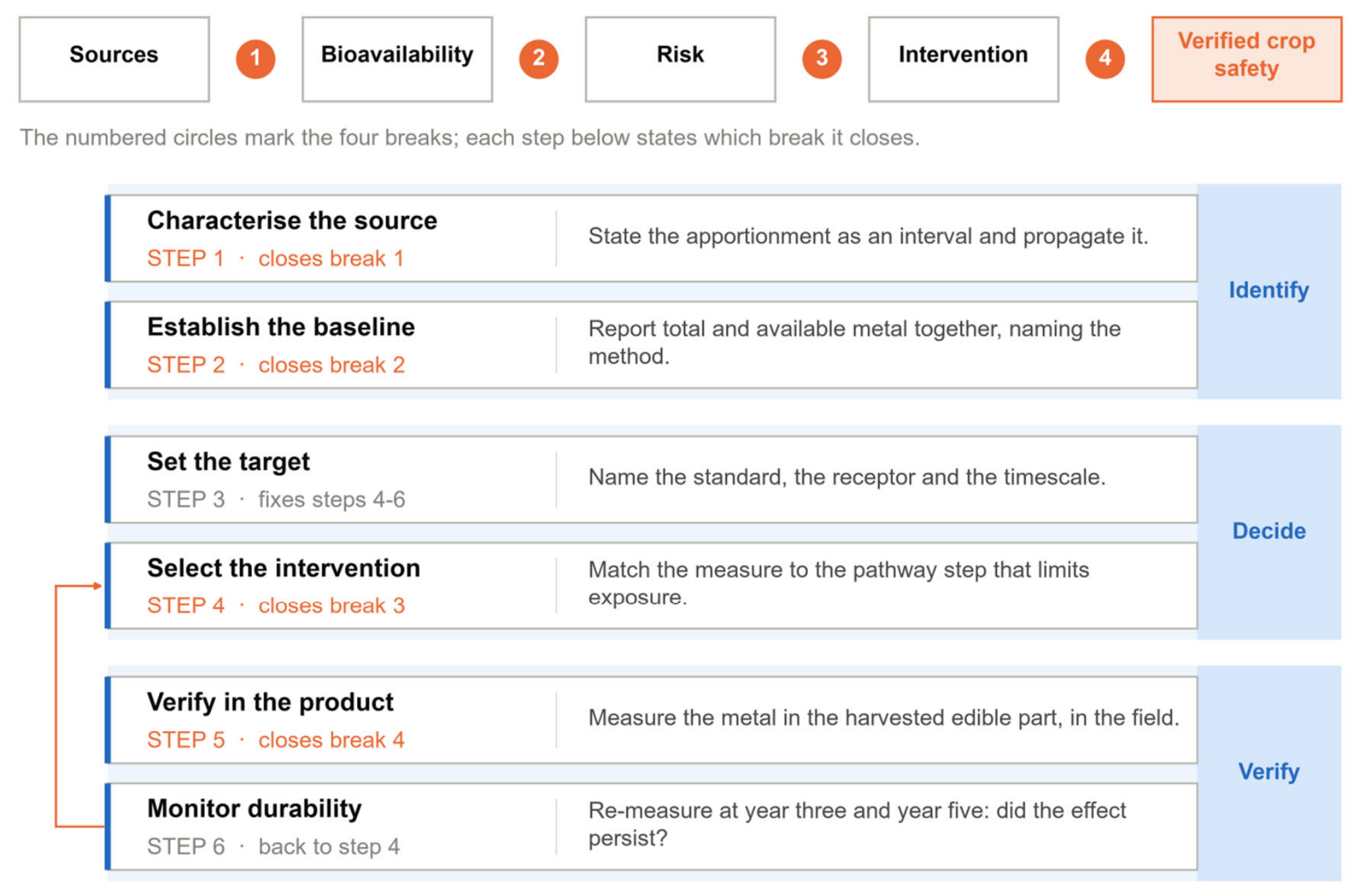
Figure 2.
Discriminating power of each diagnostic marker for each source class, rated strong, partial, weak or not diagnostic. The rating describes how reliably the marker separates the named source from the alternatives, not how precisely it measures a concentration, and the word is written into every cell so the judgement survives greyscale printing. Source classes are grouped by origin; the two pairs that are hardest to separate are adjacent and marked with a dagger. “Not diagnostic” marks a marker that carries no information about that class at all. The ratings are a synthesis judgement, not a meta-analytic result.
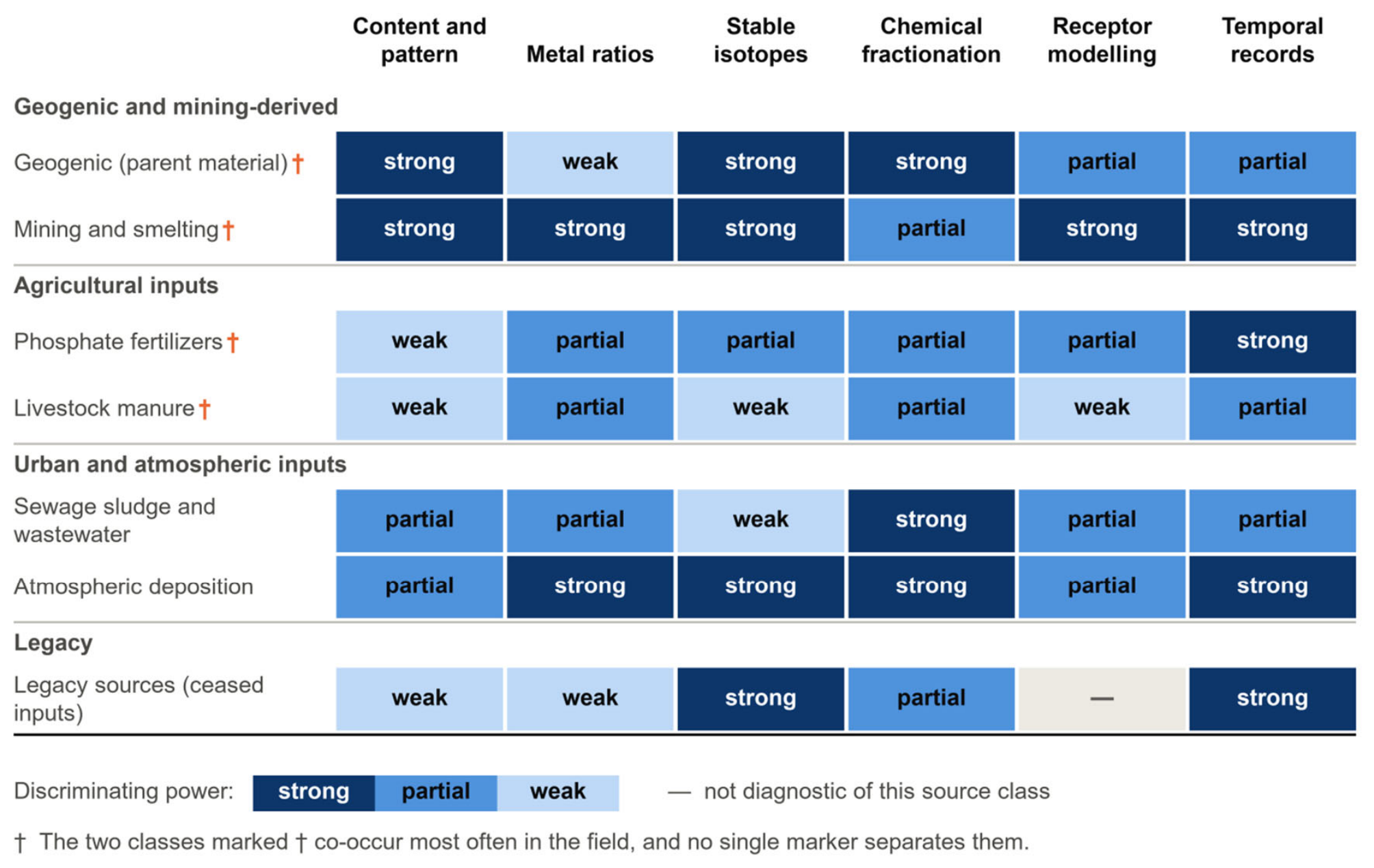
Figure 3.
Choosing an apportionment method. The four questions are asked in turn; a positive answer selects the method to its right, a negative answer moves to the next question. The final question is a fallback: where the evidence supports no attribution, exploratory analysis is reported as hypothesis-generating and its uncertainty carried forward. Schematic.
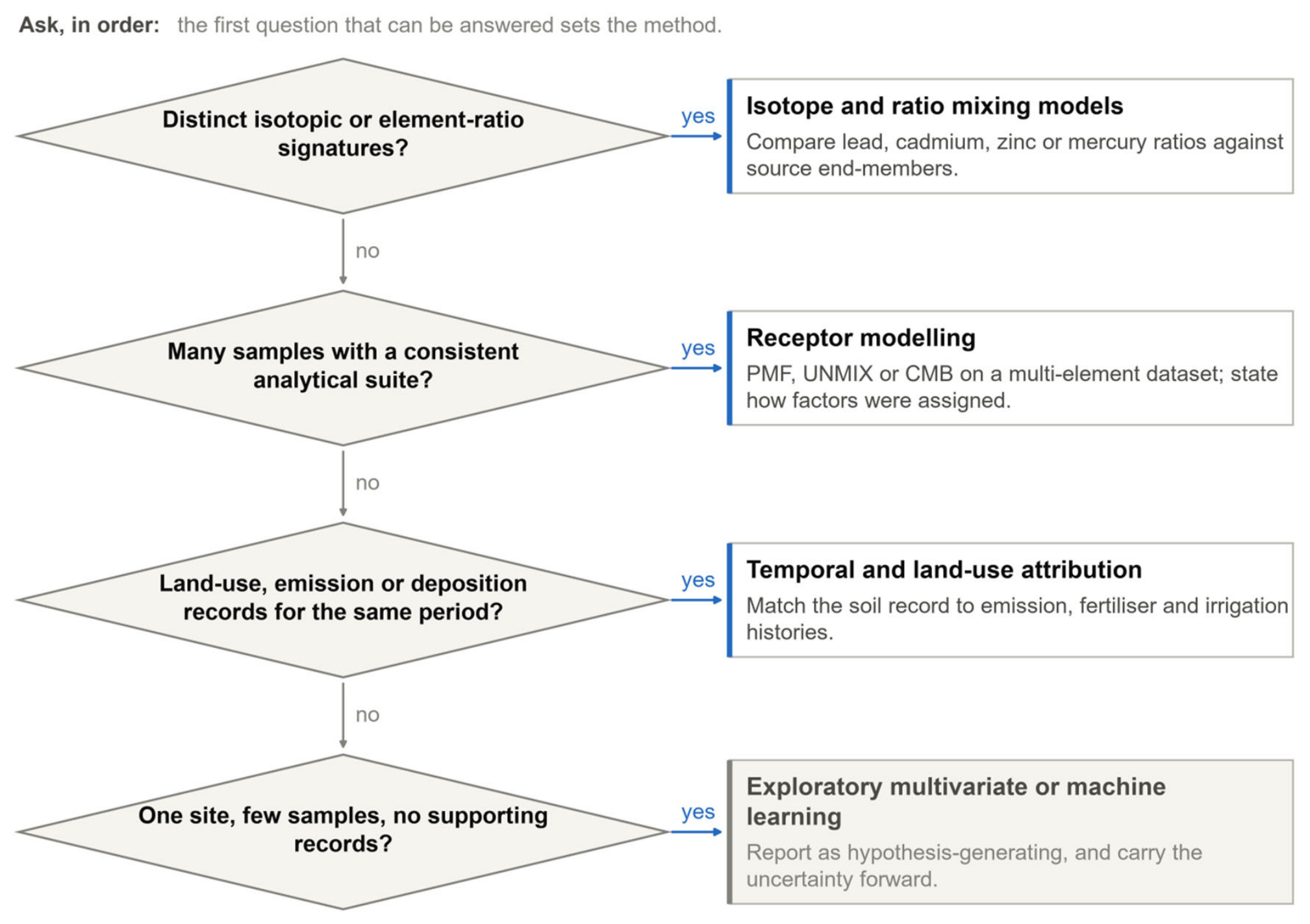
Figure 5.
Where each class of intervention acts on the soil–crop pathway, and over what timescale. A filled marker means the measure acts at that step, a half-filled marker that the step falls as a consequence of action elsewhere, and an empty cell that there is no effect. Washing and electrokinetics remove metal by desorption, so the labile pool falls with it; phytoextraction draws down available pools while total content falls only gradually. Measures acting only on soil pools cannot restore safety in a crop already taking metal up, and measures acting on the plant remove no metal from the soil. Schematic.
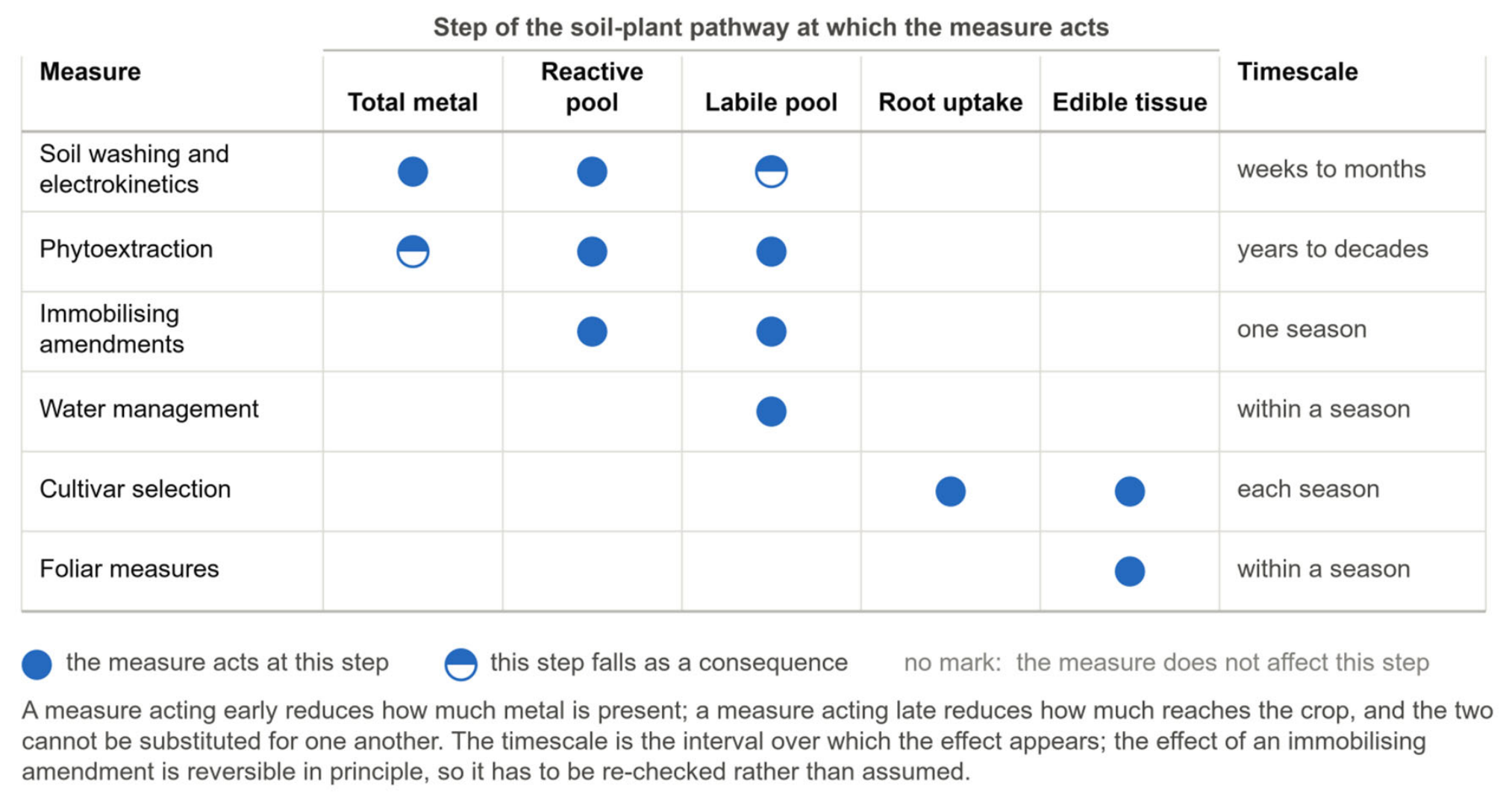

Table 1.
Sources of heavy metals in agricultural soils, their characteristic markers, and where those markers fail.
Table 1.
Sources of heavy metals in agricultural soils, their characteristic markers, and where those markers fail.
| Source class | Characteristic metals | Diagnostic markers | Where the marker fails |
|---|---|---|---|
| Geogenic (parent material) | Cd, As, Cr, Ni, Cu | Enrichment following lithological rather than land-use boundaries; presence in uncultivated reference profiles; correlation with carbonate or mafic bedrock | Co-occurring anthropogenic inputs of the same metal assemblage; no contrast between candidate sources in ore-bearing terrain |
| Mining and smelting | Cd, Pb, Zn, As, Sb | Strong spatial gradient about a point source; elevated Sb, Ag, W as process-specific tracers; slag and tailings mineralogy | Dispersion extends the footprint beyond the attributable range; overlain on geogenic enrichment of similar composition |
| Phosphate fertilizers | Cd, U | Cd:P ratio characteristic of the rock source; accumulation in the plough layer proportional to cumulative P application | Cd:P ratio overlaps with manure-derived input; rock sources vary widely so the ratio is not unique |
| Livestock manure | Cu, Zn, As | Elevated Cu and Zn together with organic-matter enrichment; Cu:Zn ratio characteristic of feed additives | Cu and Zn also derive from other inputs; the ratio shifts with feed formulation and with soil retention |
| Sewage sludge and wastewater irrigation | Cd, Pb, Cu, Zn, Ni | Mixed metal assemblage together with elevated salinity, sodicity and organic carbon; pharmaceutical residues as co-tracers | The assemblage resembles a mixed industrial signature; salinity effects are transient and confound the metal signal |
| Atmospheric deposition | Pb, Cd, As, Hg | Freshly deposited metal disproportionately labile relative to its share of the total; national-scale deposition monitoring networks | Post-deposition aging reduces lability; the deposited assemblage often mirrors the dominant regional emitter |
| Legacy sources (ceased inputs) | Pb, As, Hg | Isotopic composition preserved in soil decades after emissions ceased; subsurface concentration maximum at the depth of historical cultivation | Present-day input inventories systematically underweight it; no spatial gradient remains to map |
Table 2.
Source apportionment methods: the claim each can support and its principal failure mode.
| Method | Question it answers | Strengths | Principal failure mode | Minimum companion evidence |
|---|---|---|---|---|
| Positive matrix factorization (PMF) and related receptor models | How many distinguishable input signatures are present, and in what proportion? | Source profiles need not be known a priori; handles compositional data; residuals are inspectable | Factors are statistical constructs until assigned a physical meaning; the assignment is interpretive; uncertainty is rarely reported with the apportionment | Independent evidence for the assignment of at least the dominant factor |
| Principal component analysis with multiple linear regression | Which covarying groups of elements explain the variance? | Transparent; few assumptions; widely implemented | Components are orthogonal by construction and cannot represent sources that co-vary along the same gradient | A receptor model or spatial analysis to test the co-variance assumption |
| Multivariate geostatistics and spatial analysis | Does enrichment follow lithology or land use? | Directly addresses the geogenic case; requires no source sampling; extends to unsampled locations | Cannot exclude an anthropogenic input with the same spatial pattern; sensitive to the choice of background | Reference profiles from uncultivated land; lithological mapping |
| Cadmium stable isotopes | Does the cadmium in this soil share an origin with a candidate source? | Establishes provenance rather than resemblance; discriminates industrial processing signatures; resolved in soil-wheat systems | End-member compositions unmapped for most regions; biological fractionation during uptake must be known before an offset can be attributed to source | Characterization of candidate source end-members; fractionation factors for the crop system |
| Lead stable isotopes | What is the provenance of lead, including from sources that have ceased? | Mature and well-characterized; not appreciably fractionated by industrial processing; uniquely effective for legacy attribution | Specific to lead; the soil lead pool may be dominated by a single historical source, limiting resolution among present-day inputs | Isotopic characterization of regional ore bodies and historical emission sources |
| Zinc stable isotopes | What is the provenance of zinc, and how much of a measured offset is biological? | Fractionation during high-temperature processing gives a source signal; informative where zinc is the contaminant of concern | Fractionates during plant uptake, so source and biological signals must be separated | Quantified biological fractionation for the crop system under study |
| Machine learning (random forest, gradient boosting) | What predicts metal concentration at unsampled locations, and which covariates carry information? | High predictive accuracy; handles correlated covariates; integrates spatial and land-use data at scale | Not an attribution method: a predictive covariate need not be causal, and correlated covariates partition importance arbitrarily | Causal or isotopic confirmation of the features identified as important |
| Mass balance and input inventories | Is the observed accumulation consistent with the known inputs? | Directly quantifies fluxes; identifies implausible apportionments; national and regional inventories exist | Legacy inputs are omitted; fluxes at the soil surface are poorly constrained relative to accumulation in the profile | Soil profile dating or repeated surveys to constrain the accumulation term |
Table 3.
Maximum levels for cadmium, lead, inorganic arsenic and mercury in agricultural soil and in the harvested product under three regulatory systems.
Table 3.
Maximum levels for cadmium, lead, inorganic arsenic and mercury in agricultural soil and in the harvested product under three regulatory systems.
| Matrix and metal | China | European Union | Codex | Comment |
|---|---|---|---|---|
| Soil — GB 15618-2018 screening values | ||||
| Cd, paddy field | 0.4 | No soil limit | No soil limit | Screening value for 5.5 < pH ≤ 6.5 |
| Cd, other agricultural land | 0.3 | Same pH band | ||
| Pb, paddy / other | 100 / 90 | The lower value applies to land other than paddy | ||
| As, all agricultural land | 30 | Not differentiated by land use | ||
| Hg, paddy / other | 0.5 / 1.8 | The paddy value is the more stringent of the two | ||
| Cr, paddy / other | 250 / 150 | Same pH band | ||
| Cu, other agricultural land | 50 | Orchard land carries a separate value of 150 | ||
| Food commodities | ||||
| Cd, polished rice | 0.2 | 0.15 | 0.4 | A threefold spread across the three systems |
| Cd, husked (brown) rice | 0.2 | 0.15 | no level set | Codex regulates only the polished grain |
| Cd, fruiting vegetables | 0.05 | 0.02 | 0.05 | The Codex level excludes tomato |
| Inorganic As, polished rice | 0.2 | 0.15 | 0.2 | China and Codex agree; the EU is more stringent |
| Inorganic As, husked rice | 0.35 | 0.25 | 0.35 | The EU value also covers parboiled rice |
| Pb, fruiting vegetables | 0.1 | 0.05 | 0.05 | China permits twice the level of the other two systems |
Table 4.
Remediation technologies for heavy metal-contaminated agricultural soils: mechanism, demonstrated scale and constraints.
Table 4.
Remediation technologies for heavy metal-contaminated agricultural soils: mechanism, demonstrated scale and constraints.
| Strategy and technology | Mechanism | Demonstrated at field scale | Principal constraint | Relative cost per unit area |
|---|---|---|---|---|
| Immobilization — liming | Raises pH; increases solid-phase partitioning and reduces solution concentration | Yes, replicated; meta-analysis confirms yield gain alongside grain Cd reduction | Effect reverses as pH drifts; over-liming reduces micronutrient availability; mobilizes As | Low |
| Immobilization — biochar and organic amendments | Combined pH effect, surface sorption and dissolved organic matter release | Yes; three-year and five-year trials show continued immobilization | Efficacy varies with material properties and soil; mechanism shifts as the material ages | Low to moderate |
| Immobilization — clay minerals (sepiolite, palygorskite) | Ion exchange and specific sorption on mineral surfaces | Yes; in situ field-scale Cd remediation in paddy soil | Application rate required is high; effect interacts with water regime | Moderate |
| Immobilization — phosphate and apatite | Precipitation of sparingly soluble metal-phosphate phases | Yes, for Pb in particular; simultaneous Pb, Cd and As immobilization demonstrated | Phosphate addition risks eutrophication; effectiveness is metal-specific | Moderate |
| Phytoextraction | Accumulation of metal in harvestable biomass; removal on harvest | Yes, but removal rates are slow relative to inventory | Decade-scale timescales for moderate contamination; harvested biomass is a metal-bearing waste | Moderate, recurring |
| Soil washing | Desorption by chelating agents; metal removed in the wash solution | Yes, but requires excavation | Destroys soil structure; limited to small areas; chelator persistence and metal migration | High |
| Electrokinetic remediation | Electromigration and electroosmosis drive metal toward electrode compartments | Yes, at small scale and shallow depth | Energy requirement scales with soil volume; practical only over limited areas | High |
| Microbially mediated immobilization | Biosorption, redox transformation, carbonate precipitation | Partially; long-term stability not established | Performance sensitive to environmental conditions; durability unproven | Low to moderate |
| Nano-enabled amendments | High surface area and reactivity; targeted delivery | Limited; field-scale evidence is emerging | Fate of the nanomaterial itself in soil is unresolved | Moderate to high |
Table 5.
Safe crop production measures, their mechanism and the strength of the field evidence.
| Measure | Mechanism | Evidence strength | Site transferability | Reported effect on grain Cd |
|---|---|---|---|---|
| Low-accumulating cultivar | Heritable differences in root uptake, xylem loading and grain partitioning | Strong; screening programmes replicated across environments | Moderate; ranking interacts with soil pH and redox, so a cultivar that is low-accumulating at one site may not be at another | Commonly a factor of two or more between cultivars at the same site |
| Water management (paddy) | Maintains reducing conditions; sulfide precipitation lowers Cd availability | Strong; consistent across sites, though As responds in the opposite direction | High, within paddy systems; the optimum schedule depends on cultivar and on the As status of the soil | Larger than most amendments applied at realistic rates |
| Foliar Si / Se application | Competition for transporters, vacuolar sequestration, enhanced antioxidant capacity | Moderate to strong; replicated in rice, extended to wheat | Moderate; dose and formulation matter and the mechanism is partly cultivar-dependent | Consistent reductions reported; magnitude formulation-dependent |
| Zinc fertilization | Zn-Cd antagonism at the transporter; additionally addresses dietary Zn deficiency | Strong; effect characterized in cultivars differing in grain Cd | High; the additional nutritional benefit is robust across sites | Reductions in Cd and Pb together with increased grain Zn |
| Cropping system design (rotation, intercropping) | Root exudate modification, input dilution, co-cropped accumulation | Moderate; rotation comparisons exist but market constraints limit adoption | Site-specific; depends on available markets for the alternative crop | Variable; the mechanism is indirect |
| Soil amendment combined with water management | Amendment effect enhanced under flooding (demonstrated for sepiolite) | Moderate; interaction demonstrated but the combined optimum is not established | Moderate; requires the two interventions to be designed together | Potentially greater than either measure alone |
Table 6.
Recurring breaks in the evidence chain, their consequence, and the evidence that would close them.
Table 6.
Recurring breaks in the evidence chain, their consequence, and the evidence that would close them.
| Break | Manifestation in the literature | Consequence for decisions | Evidence that would close it |
|---|---|---|---|
| Apportionment to risk | Source contributions reported as point estimates without uncertainty; factor-to-source assignment is interpretive | The confidence interval of the resulting risk estimate is too narrow; alternative apportionments that fit the data equally well are not represented | Apportionment reported with intervals; uncertainty propagated through the risk calculation; demonstration that the propagation changes decisions |
| Bioavailability definition | Chemical extraction, diffusive gradient measurement and in vitro gastro-intestinal assays used interchangeably | A measurement valid for one receptor is used as evidence about another; method-dependent spread bounds the achievable precision | Paired measurements across method families on shared sample sets, with crop concentrations measured in the same study |
| Short term to long term | Amendments evaluated over one or two seasons; aging processes reduce availability over longer periods | Durability of the benefit is unknown for most amendments, including those being deployed at scale | Multi-year field trials across contrasting soil types at rates that would actually be applied |
| Soil to product | Effects reported on soil extractable metal or on pot-grown tissue rather than on the harvested edible portion under field conditions | Technologies are adopted on evidence that does not establish the outcome the adoption is intended to achieve | Paired treatment-and-control field designs with the harvested product analysed in both |
Disclaimer/Publisher’s Note: The statements, opinions and data contained in all publications are solely those of the individual author(s) and contributor(s) and not of MDPI and/or the editor(s). MDPI and/or the editor(s) disclaim responsibility for any injury to people or property resulting from any ideas, methods, instructions or products referred to in the content. |
© 2026 by the authors. Licensee MDPI, Basel, Switzerland. This article is an open access article distributed under the terms and conditions of the Creative Commons Attribution (CC BY) license (http://creativecommons.org/licenses/by/4.0/).
Copyright: This open access article is published under a Creative Commons CC BY 4.0 license, which permit the free download, distribution, and reuse, provided that the author and preprint are cited in any reuse.