

Submitted:
11 November 2026
Posted:
12 November 2026
You are already at the latest version
Abstract
This article analyzes discursive representations of the Chilean civil-military dictatorship (1973–1990) that circulated on social media platform X (formerly Twitter) between 2020 and 2023, focusing on discourses related to the Augusto Pinochet regime and the dissemination of fake news, disinformation, and historical revisionism in the contemporary Chilean context. The research is grounded in the dialogue between Digital Discourse Analysis—particularly the technodiscursive strategies proposed by Marie-Anne Paveau—and Dialogic Discourse Analysis, based on the contributions of Bakhtin’s Circle. The corpus includes posts from the profiles of Chilean public figures and anonymous users. In this article, two examples from each category are analyzed qualitatively, seeking to understand the discursive strategies employed and the social voices that permeate these utterances. The results show that the analyzed posts reframe historical events, producing effects of meaning that downplay human rights violations and strain collective memories. We identify denialist and revisionist discourses linked to digital disinformation, which challenge the legitimacy of historical narratives regarding the Pinochet era. We conclude that the circulation of these discourses on digital social media intensifies disputes over memory, contributes to the destabilization of democratic consensus, and undermines the credibility of historical accounts and democratic institutions.
Keywords:
dictatorship
; Bakhtin circle
; technodiscourse
; fake news
; disinformation
Introduction
The circulation of disinformation on digital social media has brought about significant changes in the ways historical truth is constructed, contested, and legitimized. The rise of digital platforms, especially social media, has not only accelerated the speed at which information circulates but has also amplified the spread of manipulated content, fake news, and revisionist narratives that contest the meanings of historical and political events. In this context, fake news has come to occupy a central place in contemporary debates on democracy, memory, and discursive production, particularly in settings marked by political polarization and the rise of far-right movements.
This study shifts the focus of analysis to the relationship between fake news, disinformation, and historical revisionism in the contemporary Chilean context. More specifically, it investigates how tweets published between 2020 and 2023 produced discursive representations of the Chilean civil-military dictatorship (1973–1990), led by Augusto Pinochet. The period selected for analysis coincides with significant political transformations in Chile, particularly the context following the 2019 social protests, Gabriel Boric’s presidential election in 2021, and the debates surrounding the drafting of a new constitution for the country. Against this backdrop, discourses aligned with the Chilean right and far-right began to employ digital disinformation strategies to defend the legacy of the Pinochet dictatorship and challenge the legitimacy of the proposals for political transformation put forward by progressive movements.
Hashtags such as #AquíFaltaPinochet and #PinochetNuestroHéroe exemplify some of these discursive strategies that circulated on X (formerly Twitter) during the period analyzed. Through posts that downplayed human rights violations, they extolled economic indicators from the dictatorial period and disseminated manipulated information about the government of Augusto Pinochet. In this way, certain profiles began to contest the meanings of Chilean historical memory. This trend highlights how historical revisionism operates in the digital sphere not only as a reinterpretation of the past but as a discursive practice linked to contemporary ideological projects. Thus, the contest over memory also becomes a contest over truth, blurring the lines between historical fact, interpretation, and discursive manipulation.
The concept of truth, in this sense, constitutes one of the main theoretical pillars of this research. Based on the principles of dialectical materialism, truth is understood as a historical and social construct, produced within the concrete relationships between subjects, practices, and collective experiences. As Barkun (2017) points out, truth is not established as a fixed and immutable essence, but as a historical process constituted within social practices. This perspective allows us to understand that discourses about the past are constantly shaped by ideological disputes and power relations. Thus, the relativization of historical truth arises not only from the circulation of false information but also from the very disputes among social groups that seek to legitimize certain versions of reality at the expense of others.
In this regard, the contributions of the Bakhtin Circle are fundamental to understanding the ideological and dialogical dimension of language. According to Valentin Volóchinov (2019), ideological signs reflect and refract the social disputes of their time, being constantly mobilized by forces that seek to stabilize certain interpretations of reality. Thus, revisionist discourses on the Chilean dictatorship can be understood as practices of ideological refraction that attempt to reinterpret historical events based on contemporary political interests. The dispute over the memory of the dictatorship, therefore, occurs not only in the field of historiography but also within the discursive dynamics of digital platforms.
When discussing historical revisionism, it is important to distinguish between historiographical revisions grounded in new documents, evidence, and academic interpretations and what is known as ideologically driven revisionism. Unlike revisions produced within the scientific field, ideological revisionism operates from pre-established perspectives, selecting information and interpretations that confirm specific political stances. In this context, fake news plays a strategic role, as it enables the rapid circulation of simplified, emotionally mobilizing narratives that are often devoid of factual evidence.
The distinction between fake news and disinformation is also essential to this research. While disinformation may involve factual errors, inaccuracies, or incorrect information without a deliberate intent to manipulate, fake news is characterized by the intentional production of fraudulent content with the aim of deceiving, discrediting institutions, or manipulating social perceptions. As Eugênio Bucci (2019) argues, fake news depends directly on the algorithmic structures of digital platforms, operating on a large scale and at high speed. Furthermore, its circulation is often linked to political, economic, and ideological interests.
In the Chilean context, the circulation of fake news about the Pinochet dictatorship highlights how digital social media platforms have become prime venues for the contestation of historical narratives. X, in particular, has established itself as an environment of intense political discourse, marked by rapid interactions, the algorithmic amplification of polarizing content, and the formation of ideologically aligned communities. In this context, social actors and historical figures linked to the Chilean right and far-right began using the platform to disseminate revisionist discourses that sought to delegitimize allegations of state violence, downplay the crimes of the dictatorship, and reinforce values associated with authoritarianism and neoliberalism.
In light of these issues, this article seeks to understand how tweets published between 2020 and 2023 shape representations of the Chilean civil-military dictatorship and contribute to the production of historical revisionism in the digital environment. To this end, we propose a dialogue between Dialogic Discourse Analysis and Digital Discourse Analysis, drawing particularly on Marie-Anne Paveau’s formulations regarding technodiscursivity. The objective is to analyze how digital discursive practices articulate strategies of circulation, engagement, and meaning-making capable of influencing memory disputes and processes of ideological legitimation in the contemporary context.
1. The Bakhtinian Perspective
The philosophy of language presented by Bakhtin’s Circle offers a theoretical and methodological framework capable of linking discursive concepts to the study of utterances on social media. One of the most important concepts for this research is the concept of chronotope. This concept seeks to understand how historical and ideological relationships between the past, present, and future unfold, such that this time-space relationship manifests in a mutable and pluralistic manner across different situational contexts.
Reflection on the chronotope begins when Bakhtin sets out to understand “the essential interconnection of the relations of space and time as they have been artistically assimilated in literature” (Bakhtin, 2018, p. 11); that is, time and space constitute the actions of subjects in the world and permeate our understanding of the world. Thus, the chronotope emerges when time and space form a unit of meaning capable of creating axiological horizons.
The chronotope as a spatiotemporal unit helps us understand the historical event that was the civil-military dictatorship in Chile. Discursive studies on the chronotope help us understand that people, through their speech (subversion, treason, the “disappeared,” national security) and their themes (revolution, censorship, repression, social order, communism)—that is, their content and compositional forms (protest songs, decrees, institutional acts, newspaper headlines, left-wing media outlets, national television addresses, etc.)—were lived and experienced by people in that space-time from 1964 to 1985 in Brazil and from 1973 to 1990 in Chile. With regard to our object of analysis, what we seek to understand is how personal and collective perceptions of the dictatorship in Chile permeated society to the point of creating social groups capable of denying the atrocities committed during this period of Chilean history.
For the Circle, the chronotope is this concept that allows us to understand the link between space and time, in a symbiotic relationship. The chronotope helps us understand how reality will always be analyzed through a spatio-temporal lens, as if the facts of history and life contributed to our understanding of the relationship between these very facts and the chronotope. Customs, temporary and enduring fashions, songs that define eras, political dates—all of this unfolds within this Bakhtinian notion.
Considering the focus of this article—in the fields of politics and history—the chronotope, as conceived by Bakhtin’s Circle, proposes the Great Chronotope and smaller chronotopic units. For example, the Chilean civil-military dictatorship, which took place between 1973 and 1990, can be understood as a Great Chronotope, as it represents a historical period shared by both the people of that era and those of today. The so-called democratic period (1990–2005), on the other hand, constitutes a new chronotope, as do the social movements for rights (2005, 2011, 2018), the chronotope of the new constitution (2021–2024), and historical revisionism (2020–2023). This research, conducted between 2023 and 2025, focuses on the years 2020 through 2023 but engages in a discursive dialogue with all these earlier chronotopes. In this way, all these moments intertwine within a Grand Chronotope, which encompasses the clashes between social progress and neoliberalism in Chile from 1970 to 2023. Thus, the smaller chronotopes may overlap depending on the subjects involved in this process.
Conceiving the chronotope as the time experienced by individuals in their exotopias allows us to understand the relationship between today’s fake news—which reflects and refracts a time experienced by society—and, in this case, Chilean society during the period from 1973 to 1990. Because this time is both recent and ancient at the same time, today’s subjects are beginning to dismantle the truth established thus far. Regarding this historical inversion, which can give rise to historical revisionism, we can say that:
From the standpoint of reality, historical inversion—in the precise sense of the term—favors the past, as more substantial and dense, over the future. Supernatural vertical superstructures, on the other hand, prefer the extratemporal and eternal over this past, regarding them as already real and, as it were, already present. (...) In their respective philosophical constructs, historical inversion corresponds to a declaration of “principles” as pure and unclouded sources of all being and a declaration of eternal values, of ideal and extratemporal forms of being (Bakhtin, 2018, p. 93).
With regard to the discussion of historical inversion, another related debate is that of historical revisionism. For Bakhtin, historical inversion and revisionism draw on the past as a source of action, as they are capable of retracing the entire path of the present. Revisionists seek to rewrite the histories of the past in the present in order to challenge the way in which a given event is being portrayed by others. In fact, historical revision and inversion are driven by social voices that defend their “principles.” These “principles” involve maintaining the status quo for a large segment of society. The key challenge in this notion of chronotope is understanding how the past and the present are linked. There is a “before” and a “now”; the future is almost impossible to make tangible, since we do not possess it as materiality, as a factor of concreteness.
For the Circle, the future is a place that does not exist due to a lack of materiality. Belief in the past and the present stems from the presence of the factual, from the concreteness of realization. The future, lacking tangibility, becomes discredited and hollow. For this reason, we may feel a sense of repetition occurring throughout our lives. This cyclical perception instills in society the idea that change cannot happen. If we live in cycles (circles), then actions do not emerge anew in the world but are repeated by various social actors. Thus, there is no novelty, but rather pseudo-novelty and repeatability. Repeated acts fall under the category of “there was,” and those that are still happening we call “there is.” Consequently, social media profiles that support Pinochet’s image—or even representatives and senators who identify with the political right—are part of this vast “pseudo-novelty” that consists of reviving authoritarian and exclusionary parameters as a means of governing and engaging in politics. The next section of this article aims to examine the relationship between this phenomenon and digital recursion.
2. Discourse in the Digital Environment
During the 1990s, the advent of the internet made this global connection possible, bringing people together regardless of where they were. In the 21st century, the rise of Big Tech companies has shaped a new epistemology in the field of technology and communication studies, while also revealing their monopoly over information and its influence on the world. Google, Apple, Facebook, Amazon, and Microsoft (GAFAM) have become the world’s major information oligarchies, holding vast amounts of personal data and acting in their own self-interest in their dealings with governments in order to profit from their platforms. Regarding Big Tech, it is worth remembering that “if you’re not paying for it, you’ve become the product” (Goodson, 2012, our translation).
Over the years, discourse on social media has evolved and taken on new dimensions. With the advent of the internet, digital platforms have created a new dimension for novel forms of interaction that give rise to social networks far broader than before. They connect social actors who would otherwise rarely come into contact with one another. Discourse does not lose its intertwining with social practice; on the contrary, it reinforces this idea, since “the rise of the digital is not reducible to either a new codification of content or the introduction of a new channel of circulation. It is a transformation of the environment that affects structures and relationships.” (Merzeau, 2009, p. 23). Engagement on digital platforms takes on a new form; that is, discourse—which is also a mechanism of control—can become a tool of resistance, but it operates in a much broader and less regulated arena: the internet. According to Paveau (2021, p. 57), “digital discourse analysis creates theoretical and methodological frameworks capable of accounting for the specific functioning of internet-native discourses,” and from this theoretical conception emerges what the author terms “technodiscourse”—a digital environment in which the dissemination of fake news proliferates. Ideology is also present in this discussion, as it is through ideology that a political and historical interweaving occurs, facilitating the articulation of social perspectives, discursive mobilizations, and broad control over organized groups.
The change in the way we communicate also gives rise to new discursive genres. If we consider a letter, for example, we need paper, a pen, or a pencil to write it by hand, and we must pay for its delivery so that the recipient can receive it—not instantly, as is the case with messages sent via email or WhatsApp. In the letter genre, the number of words is limited, since the medium—the sheet of paper—also has limitations. In contrast, with email or WhatsApp, the message is instantaneous, provided the cell phone or laptop is connected to the internet. Unlike a letter, I can access my email or WhatsApp messages from anywhere in the world. Another distinguishing feature is that a letter has a specific recipient with an address, and that recipient—or someone else at that address—will only receive the letter if they are present at the specified address.
These differences in discursive genres are essential for understanding the process by which people access information today. According to Bakhtin’s Circle, “each particular utterance is individual, but each field of language use develops its own relatively stable types of utterances, which we call discourse genres” (Bakhtin, 2016, p. 12). Thus, these substantial changes in the expressiveness of genres are part of a compositional construction. For Bakhtin (2016), thematic content, style, and compositional structure are all part of discursive genres.
The tech industry seeks to deliver messages ever more quickly and does so with the promise of effectively optimizing human communication; however, in reality, this immediacy makes us slaves to social media. Social media platforms promise greater interaction with people, yet we increasingly isolate ourselves within vast digital bubbles.
In this regard, it is worth noting that “(...) bubbles are created based on the worldview and ideology that individuals adhere to” (Azevedo, 2022, p. 25); that is, digital social media emerges with the promise of bringing people closer together, even if they are geographically distant, but it actually makes them more lonely, with each person in their own bubble reinforcing their own beliefs. At first, the bubble operates on an individual level and isolates the person, leading them to believe that their social bubble is a vast universe in which everyone sees and thinks just like them[1] .
Social bubbles create a false sense of relevance for conspiracy-theory profiles. Thus, these profiles—“isolated” in “their” ideas—promote an unprecedented carnage of dignity and ethics; and, not coincidentally, profiles that echo the same conspiracy theories are drawn together through a digital language mechanism that functions like a magnet, linking users’ personal information—a process we refer to as an algorithm in Digital Discourse Analysis. Broadly speaking, “the algorithms operating ‘beneath’ the web use statistical techniques derived from machine learning: the algorithm learns by comparing a profile with those of other internet users who have performed the same action” (Cardon, as cited in Paveau, 2021, p. 43).
Why do conspiracy-theory tweets receive large numbers of retweets, follows, and comments? For two reasons: 1) profiles were matched based on the relevance of topics both seek, and 2) the algorithm performs this statistical and mathematical function of generating a large network among profiles. Thus, a profile that once had 30 followers reading its conspiracy theories now, thanks to algorithmic matching, has 300 followers and, as a result, gains engagement for its ideas on social media. In this way, the bubbles no longer burst upon coming into contact with one another but merge to create a conspiracy-theory network.
The operation of these algorithms relies on a data architecture known in the field of information and communication technology as clustering. Data clustering is an unsupervised machine learning technique used to group elements with similar characteristics within datasets. Thus, clustering algorithms analyze patterns and automatically distribute the data into groups (clusters) without the need for predefined labels.
Consequently, this approach is widely applied in various fields, such as customer segmentation in marketing, anomaly detection in information security, and the analysis of biological data. The choice of the most appropriate algorithm depends on factors such as data volume, the distribution of data points, and the need to predefine the number of clusters. With regard to our discussion, it is the process of algorithmic clustering that causes a user profile, when accessing content that glorifies Pinochet, to encounter other profiles and platforms that engage in the same behavior. This concept helps us understand how algorithms operate within a network.
The technology of virtual ecosystems is a digital revolution, but also an anthropological, economic, and social revolution in human life. Based on this assertion, we can infer several points: I) through the phenomenon of big tech companies and Web 2.0, individuals become connected to other parts of the world; II) this connection, produced by access to digital social networks, generates what some authors refer to as “networked communication,” which transforms cultural and political identities, creating spaces for both global and local interaction simultaneously; and III) the idea of a globalized and more technologically accessible world has only served to increase social inequality in some countries, as in the case of Chile.
The use of social media, as well as its impact on actions, occurs through what Cesarino (2022) calls “influence.” According to the author, influence occurs on three scales: i) through technical infrastructure—that is, through non-technical algorithms that have the power to reach multiple users simultaneously; on this scale, the strength of influence is amplified by the ability to pierce the social bubble; ii) through the embodied cognition of ordinary users—that is, through the power that ordinary users have to create a network of algorithmic interconnections among themselves; and iii) through the tactical actions of influencers in the digital environment, which represent a blend of the robotic forces of algorithms and human action on social media. As a result of this process of influence, the individual is addressed by forces that are non-cognitive and transform thought into a kind of “platformization” of ideology or “platformization” of engagement.
Thus, when acting on social media as a networked user, the individual is entangled in a chain of digital and algorithmic networks that shapes their perceptions and beliefs. In this understanding of human behavior in the digital environment, another concept that helps us comprehend new epistemological phenomena is the conspiracy discourse present on social media.
Conspiracy or “conspirituality” is an innovative concept for understanding the interplay of ideologies. It serves as a meeting point between discourses and worldviews, but it is also a technological and epistemological tool for their deconstruction. Here, too, a distinction must be made between conspiracy and “conspirituality,” drawing on Mahl (2022), who explains that “conspiracy possesses unique epistemological explanations that refute official explanations” (Mahl as cited in Cesarino, 2022, p. 229), whereas “conspirituality” refers to the sharing of a worldview. Thus, the theorist proposes a chain of dependency between the articulation of the idea and the material practice that serves as a response to that idea. At this point, we will place greater emphasis on the notion of conspiracy theory, as it aligns more closely with the theme of this research.
Conspiracy is a technodiscursive strategy, but it does not originate in the digital environment. In other words, conspiracy is a discursive artifact historically used as an attempt to impose a worldview and as a means of destabilizing society. In the next section, we will examine how this study was organized and what criteria were used to construct the analyzed corpus.
3. Methodology
This research adopts a qualitative methodology that seeks to analyze tweets posted by public figures and anonymous users between 2020 and 2023 in Chile. Digital Discourse Analysis is a theoretical and methodological approach with an extensive body of academic literature and scientific relevance in the field of discourse studies in the digital realm. From this perspective, the production of meaning is constructed through strategies involving digital resources, which go beyond mere discursive functioning but take into account systems, software, digital platforms, and how discourse is shaped to meet the expectations of this electronic ecosystem (Paveau, 2021).
Thus, in this study, DDDA was used to analyze tweets through five types of fake news construction, namely: a) composition; b) amplification; c) relationality; d) investigability; and e) unpredictability (Paveau, 2021). Digital Discourse Analysis is a theoretical framework that emerges as a methodological approach capable of understanding that the discourses circulating on the internet possess their own ecosystems for the genesis of virtual and media-native texts. Thus, we understand that “native digital discourse is the set of verbal productions created online, regardless of the devices, interfaces, platforms, or writing tools” (Paveau, 2021, p. 28).
According to Paveau (2021), the composition aims to demonstrate how technodiscourses are constructed—from paraphrased texts to the reuse of images—thus revealing a form of semiotic hybridity. This expansion illustrates how tweets, for example, have their utterances extended through the network’s own features—such as comments, sharing tools, and retweets with or without comments, among other forms. Relationality, on the other hand, demonstrates a tweet’s relationship with others produced previously as a way of establishing, in digital terms, a technodiscursive semiosis. Investigability shows how texts on social media are material compositions and can be easily identified for purposes of criminal investigation or the spread of fake news—that is, they are subject to collection, citation, and punishment. And unpredictability is directly related to the production of digitally native discourses; thus, algorithms and bots possess the intelligence capable of equating a technodiscursive production with a human-generated utterance, thereby making it difficult to determine, for example, who owns a social media profile.
In this study, the analyzed and processed corpus was drawn from X (formerly Twitter), following a selection criterion that has been in place since the very beginning of this research: 15 tweets posted between 2020 and 2023 by public and anonymous accounts addressing potential disinformation regarding the historical period of the Chilean dictatorship (1973–1990) and that exhibit the five phases of technodiscourse production suggested by Paveau (2021); their constructions of meaning will be analyzed from the perspective of Dialogic Discourse Analysis. Two tweets from public figures and anonymous users will be presented to demonstrate how the analyses were conducted and how the data were processed.
4. Data Analysis
The first tweet to be analyzed constitutes a stage of this analytical framework—namely, relationality. To fully understand this concept, it is worth noting that “digital discourses are all embedded in a relationship: with other discourses, due to the networked nature of the web; and with a composite nature (...)” (Paveau, 2021, p. 59). In other words, relationality is a digital act that consists of linking information, trending topics, and other tweets into a technodiscursive chain among profiles on a digital social network. Thus, algorithms possess broad, instantaneous functionality with highly adaptable mechanics, such that information is shared without any sense of ethics in the digital environment, without verification of the content being shared, and with a wide reach—capable of reinforcing social bubbles in the digital ecosystem based on human interaction with certain social media profiles. Let’s see how this concept works on the X interface.
Figure 1.
A user who uses a nickname and shares a tweet, thereby generating a thread. Accessed: 11/05/2026. Source: X.
Figure 1.
A user who uses a nickname and shares a tweet, thereby generating a thread. Accessed: 11/05/2026. Source: X.
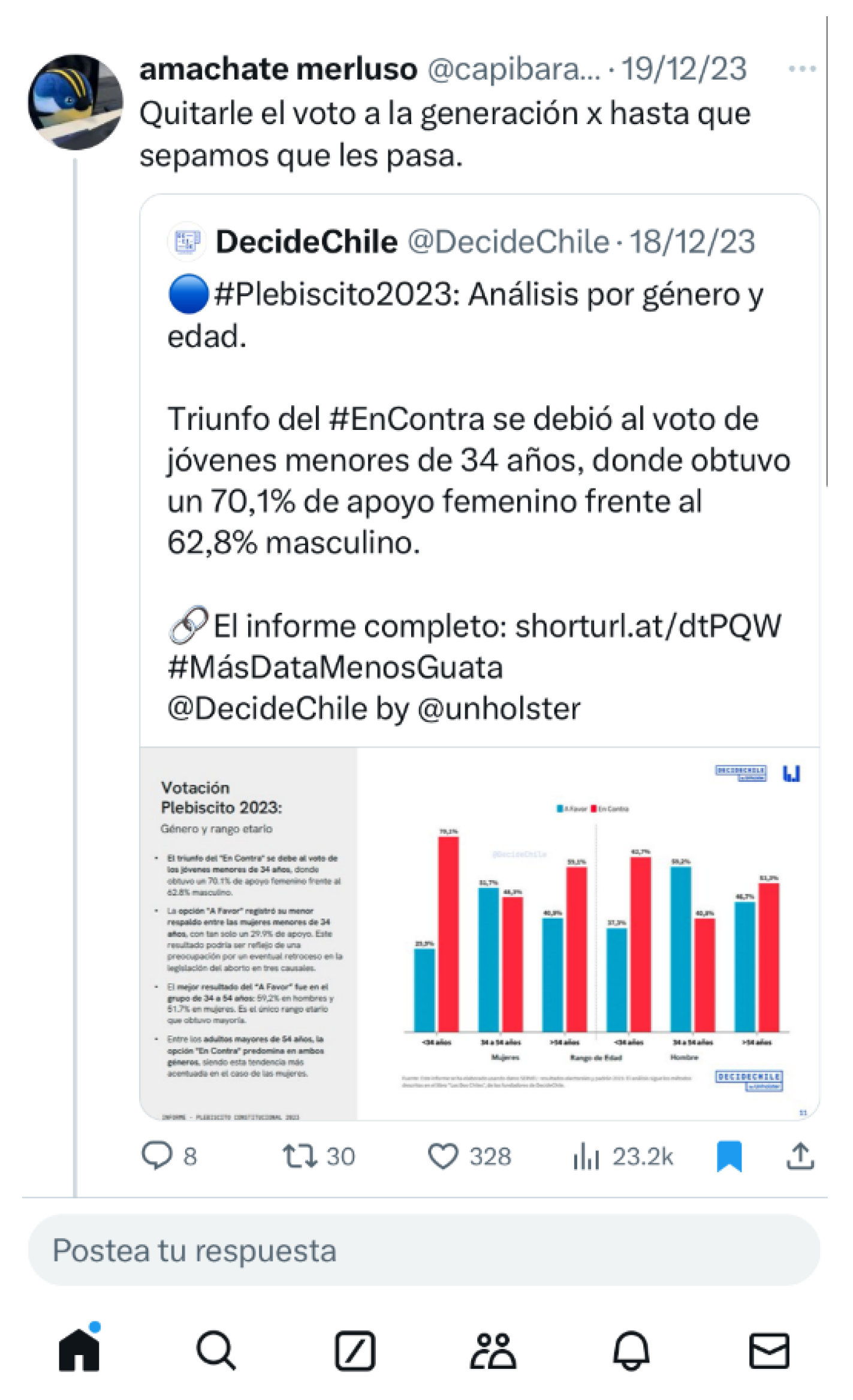
The tweet above, posted by the @decideChile profile, presents statistics based on votes tallied during the 2023 referendum, specifically analyzing votes broken down by age and gender. Shortly thereafter, another profile named @Amachate Merluso retweets the information from the tweet, creating a relational chain between the two. This relationship occurs purely as a technodiscursive strategy to repost information that has already been shared, which can be done in two ways: either by retweeting the tweet without a comment in the header, or by retweeting it with a comment. In other words, “the retweet has become an editorially optimized form, since from that point on a specific window opens for the retweeter’s potential comment, while the retweeted content remains fully preserved in its original window” (Paveau, 2021, p. 378).
In addition to ADDig, one possible way to interpret this concept of relationality is to understand that the act of retweeting generates a chain of utterances between profiles. The form of the retweet, which copies and reproduces the previous post, plays an important role in the composition of the genre and the utterance, as it assumes that the reader will interpret the data in a comprehensive and undifferentiated manner. In this way, it “quotes” the previous utterance, framing it through its own value-based lens. This chain of utterances calls into question the votes of younger people and raises doubts about their ability to make choices. The hashtag #MasDataMenosGuata in the original post argues that data should be considered the deciding factor. The retweet seeks to challenge this data.
The next tweet to be analyzed is set in 2021, the year Gabriel Boric took office as Chile’s president—the youngest president ever to take office at La Moneda Palace. At the time, the account with the username @Mister_Wolf posted several violent messages and was taken down by the social media platform itself for containing profanity. Within our analytical framework, the topic of investigability and discursive cyberviolence comes into play in the subject of analysis that follows
Figure 2.
A profile on X mentions the profile with the username @Misterwolf in order to quote verbatim that this user engages in cyberviolence. Accessed on: November 5, 2026. Source: X.
Figure 2.
A profile on X mentions the profile with the username @Misterwolf in order to quote verbatim that this user engages in cyberviolence. Accessed on: November 5, 2026. Source: X.
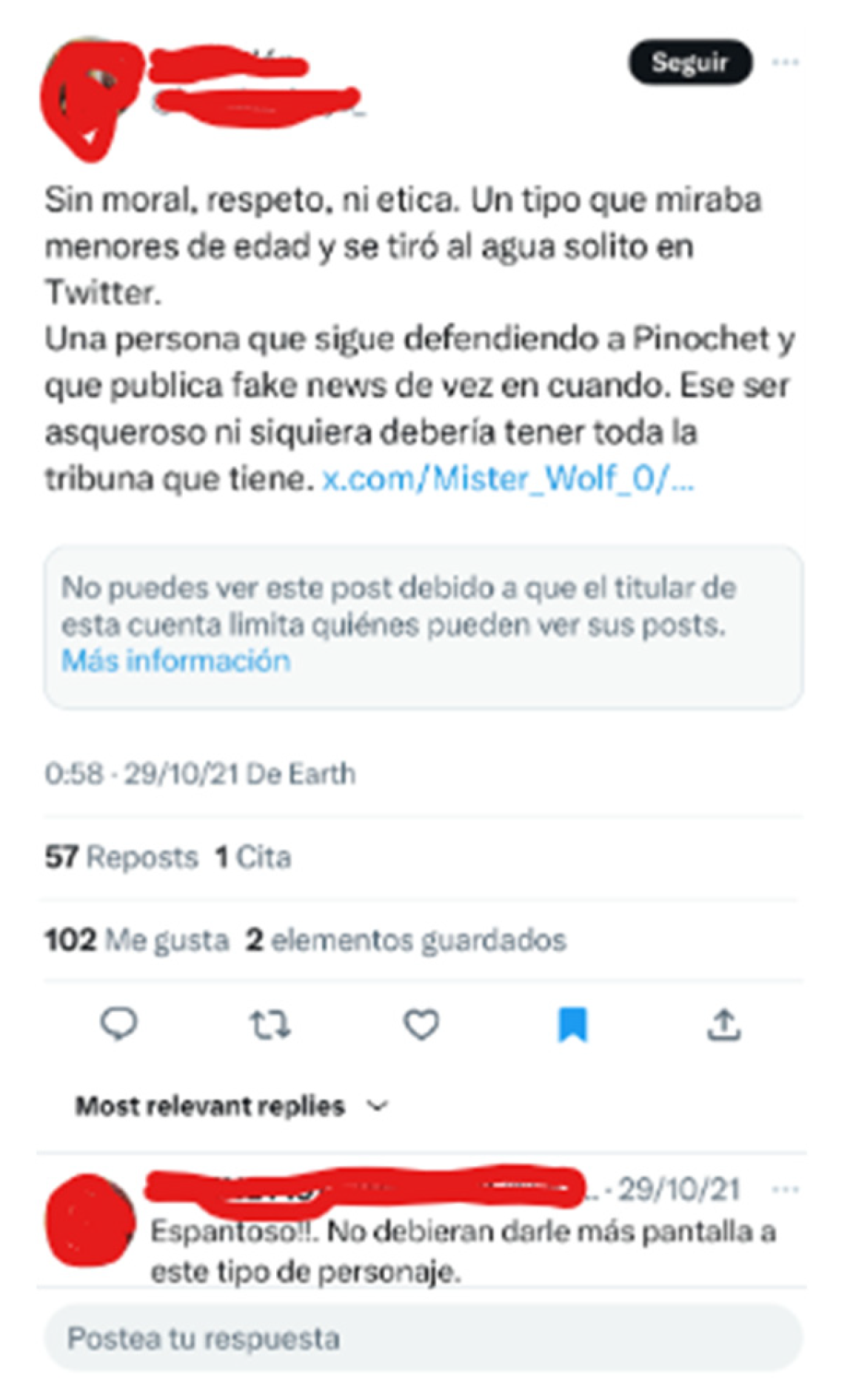
The major debate taking place on social media centers on the possibility of tracking online discourse that constitutes hate speech—which violates an individual’s dignity—and the extent to which such acts are punishable. In Chile, Law 21,633, the Framework Law on Cybersecurity and Critical Information Infrastructure, was enacted on April 8, 2024, and regulates the use of digital social media by the Chilean population[2] . In Brazil, in 2014, the Civil Rights Framework for the Internet (Law No. 12,965) guaranteed freedom of expression on digital social media and established appropriate penalties when posts on these platforms violate human dignity.[3] Following the classification criteria proposed by Blaya (2013), a user whose tweet was removed from social media is engaging in what we call “flaming”—that is, hate speech or messages bordering on criminal discourse. An old internet adage from the 2000s was “don’t feed the troll”; in other words, when you witness a criminal act on social media, report it. On digital platforms, there are several ways to take action, such as blocking the user in question, flagging the tweet as fake news, or even reporting it to X for harming a particular group and/or social community. Upon receiving this feedback from any user, X will begin to algorithmically track other reports filed against the user. Depending on the number of reports flagged and the content in question, the social media platform may suspend the user for three days, seven days, or a month, or even block and permanently ban the user from the platform.
Still on the subject of reporting, it is worth remembering that “blocking is not merely a technical gesture, but is associated with a message of interdiction” (Paveau, 2021, p. 75). Regarding the act of blocking or suspending a profile on a social media platform, privacy and violation policies already define which cases should be subject to some form of sanction; in total, there are 17 criteria that are algorithmically encoded[4] on social media platforms to serve as a search engine/detector for this type of discourse, but another important consideration is when another user acts as a legislator and reports to the social media platform a tweet that constitutes discursive cyberviolence.
The two tweets presented so far are from anonymous profiles belonging to ordinary users of the social network. The next two examples are profiles of public figures in Chile who are directly related to the topic of this research and the socio-historical issues in Chile at the time.
The tweet below was posted by Chilean Senator Iván Moreira Bastos, who in 2023—within what Wardle (2017) defined as satire—posted a tweet expressing gratitude to “President Pinochet” for having maintained a good relationship with his country’s indigenous peoples.
Figure 3.
The senator appears to justify Pinochet’s false support for indigenous peoples by the fact that he is wearing traditional Mapuche clothing. Accessed: 11/05/2026. Source: X.
Figure 3.
The senator appears to justify Pinochet’s false support for indigenous peoples by the fact that he is wearing traditional Mapuche clothing. Accessed: 11/05/2026. Source: X.
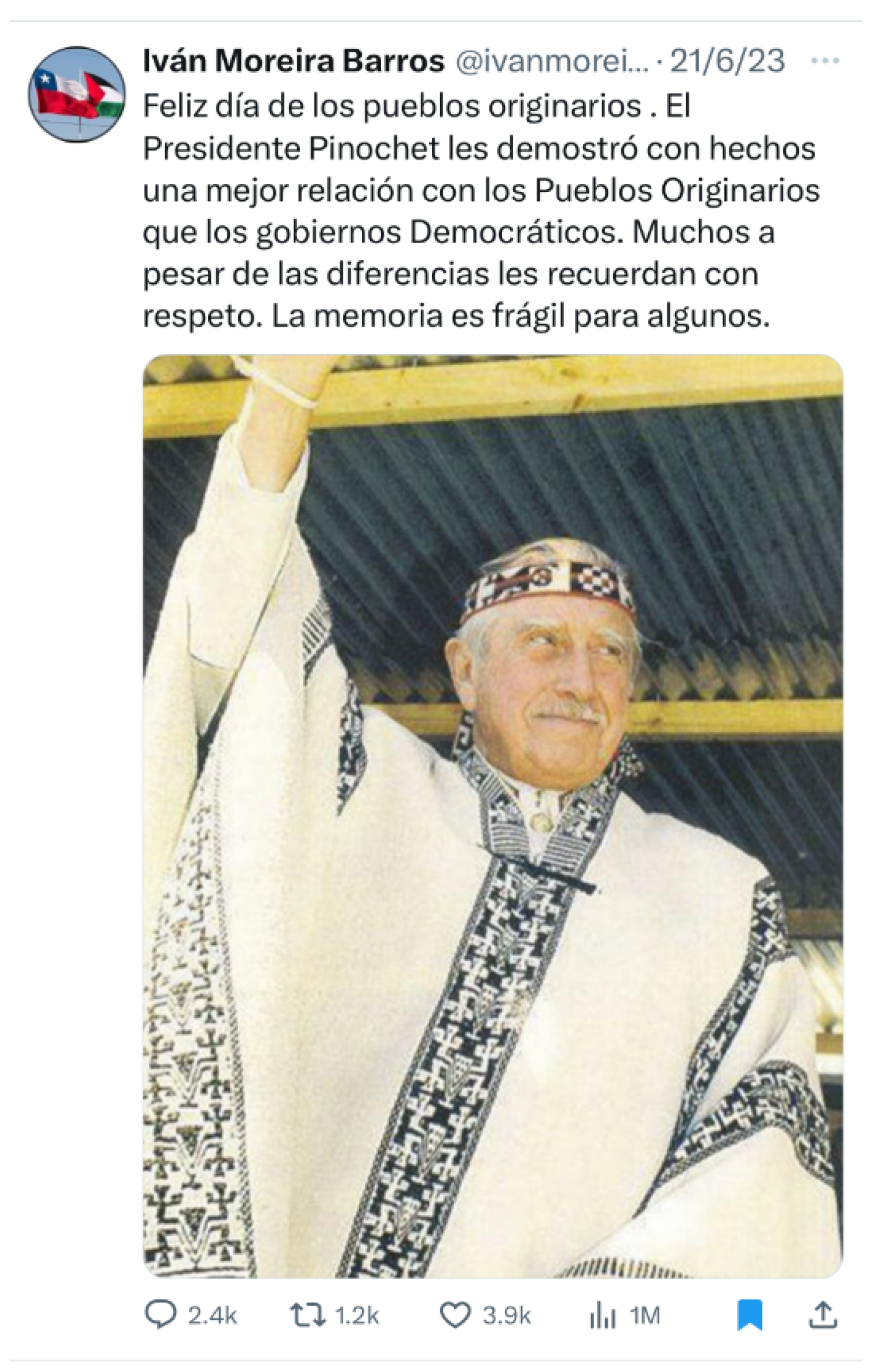
Here we examine how the figure of Pinochet continues to be a polarizing reference point in discussions about the rights of indigenous peoples. It is important to note that the senator used a photo from an event in 1989, when Pinochet was facing the second plebiscite on whether or not he would remain in power.
On that occasion, he received a title that to this day sparks major disputes and controversies: for some, it signifies recognition; for others, it signifies the subjugation of the Mapuche people. According to Volóchinov (2018, p. 177), “in general, the task of understanding is not limited to recognizing the form used, but to understanding it within a specific context, to grasping its meaning within a statement—that is, to understanding its novelty rather than recognizing its identity.” The (re)publication of the photo—no longer in the newspapers of 1989, but reposted in a tweet on the day when we no longer celebrate the “Indians” but the indigenous peoples — once again takes on new meaning and resonates with other connotations: the author of the statement assumes that it is necessary to (re)construct the image of a generous leader, referring to him as “President Pinochet.” His argument is that Pinochet demonstrated through his actions his good relationship with indigenous peoples.
As an argumentative strategy, he anticipates counterarguments and asserts, without providing concrete evidence, that, “despite the differences,” he is remembered with respect. And he accuses his interlocutors who think differently of having a poor memory, using the photo as “proof of a factual truth,” as if the facts themselves were not controversial and suspect simply because they occurred during an authoritarian regime. The disputes of the past and present are erased and silenced in this post, which removes the image from its specific context and presents it as “proof” to be identified as an “absolute truth.”
The verbal-visual language of the tweet shows how ideological signs can potentially perpetuate a distorted version of history that justifies authoritarian policies. In other words, “the word becomes a word only in living communication, in the actual utterance, inevitably under class conditions” (Volóchinov, 2018, p. 315).
The next tweet is part of a series of public profiles commenting on the outcome of the constitutional convention that took place in Chile.
Figure 4.
The profile of the former Chilean Minister of Education (2018–2020), in interaction with the profile of an anonymous person, defends the fact that the new constitution was not enacted. Accessed: 11/05/2026. Source X.
Figure 4.
The profile of the former Chilean Minister of Education (2018–2020), in interaction with the profile of an anonymous person, defends the fact that the new constitution was not enacted. Accessed: 11/05/2026. Source X.
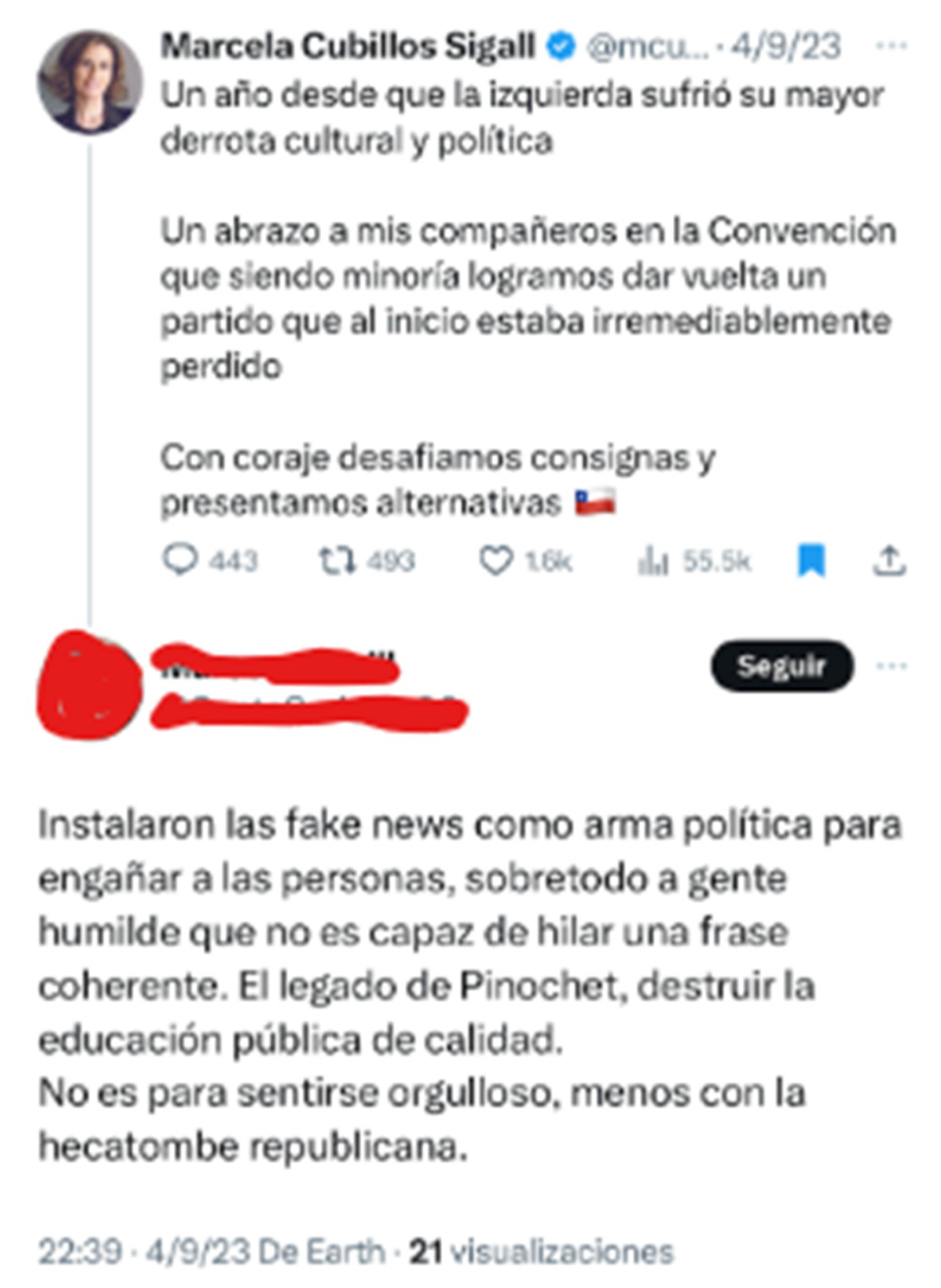
The comment feature plays a prominent role in contemporary analyses of digital discourse. Far from being considered a subordinate or ancillary manifestation of the main text, the comment is analyzed as an autonomous discursive form, intrinsically linked to the communicational dynamics of digital environments. In other words, “the online comment is one of the most frequent forms of technodiscourse on the web, appearing in numerous writing spaces” (Paveau, 2021, p. 97). In the case at hand, we see an interaction between a post by Marcela Cubillos Sigall, former Chilean Minister of Education (2018–2020), who makes a political statement about the defeat of the left and the role of political allies at a convention, and a response by Marcos O’Neill, who critically reflects on fake news and Pinochet’s legacy. The comment, in this case, not only responds to the original post but also positions itself within a discursive field of contestation and counterargument.
In line with ADDig’s approach to the digital ecosystem, we can identify here the comment’s discursive autonomy. Although the public figure’s original message is intended to be celebratory and unifying, the comment responds with a discourse that transcends the function of a mere reply, presenting direct accusations—such as the use of fake news and criticism of the political legacy. This dynamic demonstrates how comments can establish their own meanings, questioning and even destabilizing the initial discourse.
Relationality is one of the pillars necessary for this approach to be effective. Social media, the internet, the web, and other digital formats are part of a digital composite capable of creating metadiscursive and virtual relationships. Thus, the analysis highlights the dynamics of hierarchical reconfiguration typical of digital discourses. While the main text seeks to reaffirm a political stance, the critical comment acquires its own visibility, functioning as a counterpoint that can capture readers’ attention and even influence the reception of the original discourse. This characteristic illustrates how, on digital platforms, comments often break with the traditional hierarchy between the main text and the reply, assuming central roles in the production and negotiation of meaning. In short, the interaction shown in the image serves as an exemplary case for reflecting on the role of the comment in digital discourse. It is not limited to a passive response but emerges as an autonomous, performative, and ethically relevant discursive practice that actively contributes to discursive dynamics and the processes of meaning-making in the digital public sphere.
By presenting the four tweets identified in the methodology and a possible analytical framework, the research findings will be presented in the following section.
5. Results
This study presented the combination of two methodological approaches as possibilities for analyzing the corpus presented, demonstrating the potential for dialogue between ADDig and ADD, but also the limitations of this convergence. According to authors such as Gozaíni (2024), the mobilization of technodiscursive strategies to ensure that Chile’s new constitution would be rejected by the majority of the population began with discourses disseminated by X users.
The spread of fake news, as well as misinformation about the constitutional assembly process, contributed to Chilean society’s rejection of a new constitution. The results of the analysis demonstrated that there is a large market for algorithms capable of actively or passively controlling social media. The profit from these investments does not come from more formal actions like making online purchases, but rather capital is generated when users like, share, and follow certain profiles. It is important to remember that we do not pay to use social media in Brazil; in other words, we ourselves are the profitable products of these large companies that promote digital social media platforms.
Another finding revealed by the corpus analysis is just how unstable the landscape of social media is. Think of quicksand: the more we move, the deeper we sink, and we can’t escape. Thus, profiles that feature violent content, misinformation, and fake news end up attracting other profiles aligned with their views. Although they fall outside the scope of our analytical focus, WhatsApp and Telegram are equally unstable environments. There are groups advocating for Nazism in Brazil, the return of a dictatorship, and so on. This would be an instance of clustering (Cesarino, 2022), a process in which profiles are networked through the action of algorithms. With regard to tweets, in the comments section, we observed that these connections are not limited to the field of programming but consequently become ideological connections.
Throughout the analysis, we observed that, while on the one hand the executives of these companies and many of their users attempt to justify the operation of social media as an activity free from specific viewpoints, on the other hand, Bakhtinian and Circle theories have proven effective in identifying the political interests revealed in the analysis of the verbal-visual utterances that make up the tweets. It is only possible to understand the world through this lens if we accept the idea that every sign is ideological and that its users defend their interests both within and outside the discourse (Volóchinov, 2018).
By prioritizing an understanding of social media’s role through ADDig, Bakhtinian concepts provided the finishing touch to this research’s major finding: the political and ideological activity within these platforms. By joining the Circle, we came to understand that chance (Bakhtin, 2018) is not an alternative to discourse; in other words, there is no production of fake news or disinformation campaign aimed at a society that is not conceived, structured, planned, and funded.
Finally, one of the contributions of this research was the opportunity to introduce into the field of Discourse Analysis an examination of two schools of thought that are supposedly distinct and that were thought to have no possible points of convergence. However, by analyzing tweets grounded in these two analytical perspectives, it can be argued that ADDig and ADD—while retaining their distinct characteristics—can contribute in a convergent manner to other studies that seek to examine the relationship between the digital environment and the production of meaning in these discourses.
6. Concluding Remarks
The notion proposed by the Circle showed that much of the misinformation generated about a historical period stems from the fact that we inhabit a different space-time. The defense of an axiological position involves two notions: i) that the subject is displaced in space-time and therefore possesses a different chronotope; far from the larger chronotope, the subject forms perceptions based on the ground they tread and the time they experience in the present; and ii) that this displacement makes them affiliated with an ideology. Ideological affiliation arises as a responsive attitude stemming from my axiological position in the world.
The activity of the tweets, as demonstrated in the analysis, occurred collectively, since we have come to understand throughout this research that users’ performativity takes place in an organized, planned, and funded manner. As a way to “hide” from the few laws that regulate the digital environment, many use a nickname to interact on social media. The fact that users do not use their real names as their profile names sometimes serves as a strategy to avoid being found and punished. In this case, punishment occurs through the few privacy policies suggested by the platform itself.
Research Protocol and Pre-Registration
The guidelines of the Equator Network were followed, and our study complies with the “Standards for Reporting Qualitative Research: A Synthesis.” Furthermore, our study has not been pre-registered.
Statement on the Use of Artificial Intelligence
Not applicable. The authors declare that no generative artificial intelligence tools were used at any stage of the development of this manuscript.
Data Availability Statement
The data, codes, and materials supporting the results of this study are available as “supplementary files” on the Abralin Journal website.
Conflicts of Interest
The author(s) have no conflicts of interest to declare.
References
- The Forms of Time and the Chronotope of the Novel.; Bezerra, Paulo, Translator; Editora 34: São Paulo, 2018. [Google Scholar]
- AMORIM, Marília. Chronotope and Exotopia. In Bakhtin: Other Key Concepts., 2nd ed.; BRAIT, Beth, Eds.; Contexto: São Paulo, 2012; pp. 95–114. [Google Scholar]
- AZEVEDO, Matheus Sena. Fake News and Social Media: An Approach from the Perspective of Critical Discourse Analysis in the Brazilian Context. Rio de Janeiro. Thesis (Bachelor’s Degree in Languages and Literature: Portuguese and Spanish), School of Letters, Federal University of Rio de Janeiro, 2022. [Google Scholar]
- 4. BAKHTIN, Mikhail. The Genres of Discourse.; Bezerra, Paulo, Translator; Editora 34: São Paulo, 2016. [Google Scholar]
- BLAYA, Catherine. Adolescents in Cyberspace: Risk-Taking and Cyberviolence; Instituto Piaget: Lisbon, 2013. [Google Scholar]
- CESARINO, Letícia. The World Turned Upside Down: Truth and Politics in the Digital Age; Ubu Editora: São Paulo, 2022. [Google Scholar]
- 7. FARACO, Carlos Alberto. Language & Dialogue—The Linguistic Ideas of Bakhtin’s Circle; Parábola Editorial: São Paulo, 2009.
- GOODSON, Scott. If You’re Not Paying For It, You Become The Product . Forbes. 2012. Available online: https://www.forbes.com/sites/marketshare/2012/03/05/if-youre-not-paying-for-it-you-become-the-product/#390371335d6e.
- GOZAÍNI, Osvaldo Alfredo. The Symbols of Justice: Images and Meanings; EUDEBA: Buenos Aires, 2024. [Google Scholar]
- MAHL, Daniela; SCHAFFER, Mike; ZENG, Jing. Conspiracy Theories in Online Environments: An Interdisciplinary Literature Review and Agenda for Future Research. *New Media Soc.* Accessed. 2022, vol. 1(no. 1), 1–21. (accessed on 13 June 2026). [Google Scholar] [CrossRef]
- MERZEAU, Louise. From Sign to Trace, or Tailored Information; Hèrmes 5: France, 2009. [Google Scholar]
- PAVEAU, Marie-Anne. Digital Discourse Analysis: A Dictionary of Forms and Practices, 3rd ed.; Editora Pontes: Campinas, 2021. [Google Scholar]
- PICANÇO; de Lima, Deise Cristina. Discourse; Linguistics, and History: Dialogues Between Linguistics and Historical Theory Through Discourse Analysis, 2006. [Google Scholar]
- VOLÓCHINOV, Valentin. The Word in Life and the Word in Poetry: Essays, Articles, Reviews, and Poems; Editora 34: São Paulo, 2018. [Google Scholar]
- WARDLE, Claire. Fake News: It’s Complicated; First Draft: London, 2017; Available online: https://firstdraftnews.org.
[1] Although bubbles may have an anti-democratic effect, shutting down dialogue between various social groups, they can function, in small groups, for more specific purposes, such as connecting people who live in distant territories but are interested in the same topics, enabling them to circulate “glocally.” |
[2] To read the full text of the law, visit: https://www.bcn.cl/leychile/navegar?i=1202434
|
[3] To read the full text of the Brazilian Civil Rights Framework for the Internet, visit: https://www.planalto.gov.br/ccivil_03/_ato2011-2014/2014/lei/l12965.htm
|
[4] In Brazil, Law 12.965/2014, later amended and ratified by Law 13.079/2018, provides a legal framework for the operation of social media platforms in the country. |
Disclaimer/Publisher’s Note: The statements, opinions and data contained in all publications are solely those of the individual author(s) and contributor(s) and not of MDPI and/or the editor(s). MDPI and/or the editor(s) disclaim responsibility for any injury to people or property resulting from any ideas, methods, instructions or products referred to in the content. |
© 2026 by the authors. Licensee MDPI, Basel, Switzerland. This article is an open access article distributed under the terms and conditions of the Creative Commons Attribution (CC BY) license (http://creativecommons.org/licenses/by/4.0/).
Copyright: This open access article is published under a Creative Commons CC BY 4.0 license, which permit the free download, distribution, and reuse, provided that the author and preprint are cited in any reuse.