

Submitted:
10 November 2026
Posted:
12 November 2026
You are already at the latest version
Preprints on COVID-19 and SARS-CoV-2
Abstract
Background: Recovery of everyday functioning and medical care seeking are complementary dimensions of persistent symptoms after COVID-19. We examined their relationship among adults surveyed in Astana, Kazakhstan.
Methods: A secondary analysis was conducted using a cross-sectional web survey collected from 1 May 2025 to 1 February 2026. Of 408 respondents, 318 adults met eligibility criteria, 258 provided a definite symptom-persistence response, and 74 reported symptoms lasting more than 12 weeks. Functional responses were cross-tabulated with healthcare seeking. Proportions were summarized with Wilson 95% confidence intervals (CIs), and exploratory associations with unadjusted prevalence ratios (PRs).
Results: Among the 74 participants, 31 (41.9%) reported at least moderate quality-of-life impact and 37 (50.0%) had sought medical care. Incomplete activity recovery was reported by 38 of 69 participants with a definite response (55.1%). Care seeking was more frequent with incomplete than complete recovery (24/38 versus 11/31; 63.2% versus 35.5%; PR 1.78, 95% CI 1.04-3.03). Fourteen of 38 participants with incomplete recovery had not sought care (36.8%, 95% CI 23.4-52.7), as had 14 of 31 with at least moderate quality-of-life impact (45.2%, 95% CI 29.2-62.2).
Conclusion: Persistent post-COVID symptoms were frequently accompanied by incomplete functional recovery. Although care seeking was more common among participants with incomplete recovery, over one-third of this group had not sought help. Assessing return to usual activity alongside symptom persistence can support a more complete appraisal of post-COVID burden in primary care.
Keywords:
persistent post-COVID symptoms
; functional recovery
; healthcare seeking
; quality of life
; primary care
; Kazakhstan
Introduction
Persistent symptoms following SARS-CoV-2 infection can interfere with recovery of everyday functioning. The World Health Organization clinical definition of post-COVID-19 condition describes symptoms usually occurring about three months after infection, lasting at least two months, and without an alternative explanation [1]. The clinical spectrum includes fatigue, respiratory complaints, cognitive difficulties, pain, and fluctuating multisystem manifestations [2]. Their practical importance depends on both symptom burden and the extent to which people regain their usual activities.
Prevention and post-infection care address different stages of the infectious-disease burden. At the prevention stage, immunoinformatics has been used to design multi-epitope vaccine candidates for infectious disease prevention [3,4]. Planning care after infection requires evidence on whether patients regain everyday functioning and seek medical help for persistent symptoms. In primary care, functional recovery and healthcare seeking provide complementary information. Return to usual activity reflects the perceived consequences of illness in daily life, whereas consultation identifies engagement with services for those consequences. Studying these measures together can reveal whether people reporting substantial functional effects are represented among those seeking medical help.
A multinational Latin American survey assessed activity limitations and healthcare use alongside persistent symptoms [5]. In a US survey, greater functional limitation and longer symptom duration were associated with receipt of medical care [6]. These findings support integrating functional assessment into studies of post-COVID burden and examining how symptom-related consultation varies with functional status across healthcare settings.
Studies from Kazakhstan have addressed vaccine effectiveness and selected clinical and immunological characteristics of post-COVID illness [7,8]. Evidence syntheses have described the prevalence and risk factors of persistent symptoms across observational cohorts [9,10]. Individual-level evidence linking functional recovery with symptom-related healthcare seeking in Kazakhstan remains limited. Such evidence is relevant to understanding how the consequences of prolonged illness are reflected in primary-care consultation patterns.
This study examined adults reporting symptoms lasting more than 12 weeks in an Astana web survey recruited through general practice offices. The objectives were to describe recovery of usual activity and quality-of-life impact, examine their association with medical care seeking, and estimate the proportion of participants with functional consequences who had not sought help.
Materials and Methods
Design and Participants
This secondary analysis used a cross-sectional web-based survey conducted in Astana, Kazakhstan, from 1 May 2025 to 1 February 2026 within a post-COVID epidemiological surveillance protocol. Eligible participants were adults aged at least 18 years with a self-reported history of COVID-19. Reporting followed STROBE and was informed by CHERRIES for electronic surveys [11,12]. The eligible cohort was used to describe symptom persistence. Functional and healthcare-seeking analyses included participants reporting symptoms lasting more than 12 weeks.
Questionnaire and Recruitment
The study-specific questionnaire comprised 38 items covering demographic characteristics, COVID-19 history, acute illness, vaccination, persistent symptoms, functional consequences, chronic diseases, and perceived vaccination effects. It included single-choice, multiple-choice, numerical, and optional free-text responses. The instrument was pretested for comprehensibility and usability in 200 respondents and technically pilot-tested in a separate group of 50. These participants were not included in the analytical cohort. The questionnaire is provided in Supplementary Questionnaire S1.
An open QR-code invitation was distributed across 33 general practice offices during the study period. Electronic written informed consent was obtained before access to the questions. Google Forms allowed one submission per Google account; account identifiers and email addresses were not collected by the study form. Exposure to the invitation and survey openings were not individually recorded. Required closed-ended items included “do not remember” or “difficult to answer” where appropriate; optional free-text and non-applicable fields could remain blank.
Symptom Persistence and Functional Measures
Symptom persistence was defined by a yes response to the question asking whether symptoms lasted more than 12 weeks after COVID-19. No defined the comparison group; difficult-to-answer responses were retained as indeterminate and excluded from binary symptom analyses. A duration-compatible sensitivity definition required a positive response plus a subsequent duration category of 3-6 months, more than 6 months, more than one year, or symptoms still present.
Return to the previous level of daily and physical activity was recorded as complete return, partial return, no return, worse than before COVID-19, or difficult to answer. Incomplete recovery combined partial return, no return, and worse activity. Uncertain responses were excluded from the binary activity comparison. Perceived quality-of-life impact was recorded as none, slight, moderate, significant, or very strong. At least moderate impact combined the last three categories. Symptom intensity was scored from 0 to 10. Original response categories were retained in descriptive tables.
Healthcare seeking was defined by a yes response to seeking medical help for post-COVID symptoms. The principal descriptive measure was the proportion not seeking care among those with incomplete activity recovery. The corresponding proportion among participants with at least moderate quality-of-life impact was also calculated. These overlapping groups were analyzed separately.
Clinical Characteristics and Contextual Analyses
Recorded characteristics included age, sex, body mass index, smoking, chronic disease, number and calendar period of COVID-19 episodes, hospitalization, oxygen support, and vaccination before infection. Repeated infection meant at least two reported episodes. Hospitalization and/or oxygen support represented greater acute disease severity. Vaccination before infection meant receipt of at least one dose at the time of the reported episode. Contextual analyses examined symptom persistence in relation to these variables.
Statistical Analysis
Continuous variables are reported as median and interquartile range (IQR); categorical variables as counts and percentages using the available denominator. Wilson 95% confidence intervals (CIs) were calculated for proportions. Healthcare seeking was cross-tabulated with activity recovery and quality-of-life impact. Exploratory unadjusted prevalence ratios (PRs) were calculated from two-by-two tables with log-scale Wald 95% CIs; group comparisons used two-sided Fisher exact tests. The healthcare-seeking analysis was descriptive, with no multivariable adjustment or multiplicity correction.
Sensitivity analyses repeated the functional summaries within the duration-compatible subgroup. The influence of uncertain activity responses was examined by assigning all five to complete recovery and, alternatively, all five to incomplete recovery. The main analysis used available observations without imputation.
Contextual associations with symptom persistence were estimated using modified Poisson regression with robust standard errors [13]. The vaccination model adjusted for age, sex, body mass index, smoking, chronic disease, repeated infection, and infection period. A further model included hospitalization and/or oxygen support. Complete-case sample sizes and events are reported with each model. These analyses, including restrictions to confirmed infection and a single reported episode, are presented in Supplementary Table S1 and Table S5, and S6. Analyses used Python, with pandas, NumPy, and SciPy for the functional reanalysis and Matplotlib for figures.
Ethics
The Local Committee on Bioethics of the RSE on REM “National Center for Public Health,” Ministry of Health of the Republic of Kazakhstan, approved the study (Protocol No. 4, 30 April 2025; Decision No. 10/2025). Electronic written informed consent was obtained before participation. Survey responses were provided to the research team without direct personal identifiers.
Results
Study Population
Of 408 submitted questionnaires, 318 respondents met eligibility criteria. A definite symptom-persistence response was available for 258; 60 selected difficult to answer. Seventy-four of 258 reported symptoms lasting more than 12 weeks (28.7%, 95% CI 23.5-34.5). The 74 participants formed the functional subgroup: median age was 54 years (IQR 45-65), and 48 (64.9%) were women. Thirty-seven had sought medical care for persistent symptoms and 37 had not. Participant characteristics by healthcare seeking are shown in Table 1. Contextual cohort characteristics are provided in Supplementary Table S9.
Functional Recovery and Quality-of-Life Impact
Among 69 participants with a definite activity response, 38 reported incomplete recovery (55.1%, 95% CI 43.4-66.2): 30 reported partial recovery, seven no return, and one a worse activity level. Thirty-one reported complete recovery, and five were uncertain. Fifty-six of 74 reported some quality-of-life impact (75.7%, 95% CI 64.8-84.0), including 31 with at least moderate impact (41.9%, 95% CI 31.3-53.3). The complete category distributions are presented in Figure 1 and Table 2.
Symptom intensity was available for 69 participants, with a median score of 6 (IQR 5-7). Fatigue/weakness was reported by 43/74 (58.1%), dyspnea by 27/74 (36.5%), and cough by 26/74 (35.1%). Detailed symptom distributions are provided in Supplementary Table S2.
Healthcare Seeking and Functional Status
Healthcare seeking was reported by 37/74 participants (50.0%, 95% CI 38.9-61.1). Among those with a definite activity response, 24/38 with incomplete recovery had sought care compared with 11/31 with complete recovery (63.2% versus 35.5%; unadjusted PR 1.78, 95% CI 1.04-3.03; Fisher exact p = 0.030). Two of five participants with uncertain recovery had sought care (Table 2; Figure 2).
Fourteen of 38 participants with incomplete recovery had not sought medical care (36.8%, 95% CI 23.4-52.7). Non-consultation was also reported by 14/31 with at least moderate quality-of-life impact (45.2%, 95% CI 29.2-62.2). Care seeking was reported by 17/31 participants with at least moderate impact versus 20/43 with no or slight impact (54.8% versus 46.5%; unadjusted PR 1.18, 95% CI 0.75-1.85; Fisher exact p = 0.638).
Sensitivity and Contextual Findings
Forty-eight participants met the duration-compatible definition. In this subgroup, 29/45 with a definite activity response reported incomplete recovery; 10/29 had not sought care (34.5%). Seven of 20 with at least moderate quality-of-life impact had not sought care (35.0%). Sensitivity estimates are reported in Supplementary Table S8. Across all 74 symptomatic participants, assigning the five uncertain activity responses to the two extreme categories yielded incomplete-recovery proportions of 51.4% and 58.1%.
Contextual models of symptom persistence showed adjusted associations with age, chronic disease, repeated infection, and hospitalization and/or oxygen support. The adjusted vaccination PR was 1.01 (95% CI 0.67-1.54; n = 195, 64 events). Full contextual estimates are provided in Supplementary Table S1 and Table S5, and S6.
Discussion
Principal Findings
This study links self-reported functional recovery with healthcare seeking among adults reporting persistent post-COVID symptoms in Astana. More than half of participants with a definite activity response had not regained their previous activity level. Care seeking was more frequent among those with incomplete recovery, yet over one-third of this group had not sought help for their symptoms. Together, these findings identify functional consequences both among people who consult for persistent symptoms and among those who do not.
The two functional measures yielded different consultation patterns. Incomplete return to activity showed a clearer association with healthcare seeking than perceived quality-of-life impact. Return to activity refers to a concrete comparison with previous daily functioning, whereas the quality-of-life question captures a broader subjective appraisal. Their joint assessment describes different aspects of recovery and can give a more complete account than either measure alone.
Comparison with Previous Research
The association between functional limitation and consultation is consistent with findings from other settings. The Latin American survey described activity restrictions alongside the use of primary care, specialist services, and rehabilitation [5]. Fisher and colleagues found that functional impact and longer symptom duration were associated with receipt of medical care in a US sample [6]. The Astana findings extend this line of enquiry to a Central Asian sample recruited through general practice offices and provide participant-level estimates of consultation within specific functional categories.
The proportion seeking care in the present subgroup was 50%, with substantial variation by activity recovery. This joint distribution is more informative for service planning than the overall consultation proportion alone. It distinguishes participants reporting complete recovery, those with residual activity restrictions who had sought care, and those with restrictions who had not consulted. Such differentiation can support the design of follow-up assessments and subsequent studies of care pathways.
Implications for Primary Care
Assessment of return to usual activity can complement symptom screening in primary care. In this study, incomplete recovery was common even though the survey was not recruited through a specialist post-COVID service. Asking about daily and physical activity can help characterize the consequences of prolonged symptoms and guide a fuller clinical assessment of function, coexisting illness, and recovery needs.
The 14 participants with incomplete activity recovery who had not sought symptom-related help are particularly relevant to outreach and follow-up research. Consultation records alone would not capture their persistent-symptom experience. Further characterization of this group could identify whether non-consultation reflects perceived need, expectations of recovery, preferences for self-management, or difficulties obtaining appropriate services.
Functional burden should also be considered alongside the established clinical context of persistent symptoms. The contextual associations with age, chronic disease, reinfection, and greater acute severity are broadly consistent with previous evidence [14,10]. These characteristics describe susceptibility to symptom persistence, while functional recovery and consultation address the subsequent experience of illness. Combining these perspectives can make local post-COVID research more relevant to the assessment and organization of primary care.
Limitations
Voluntary QR-code recruitment and the absence of a participation denominator limit generalizability; the observed proportions are not population estimates for Astana or Kazakhstan. Infection history, symptoms, recovery, and consultation were retrospectively self-reported, and alternative diagnoses were not clinically excluded. The functional questions were single-item measures rather than validated disability or health-related quality-of-life instruments. Pretesting established usability, not psychometric validity.
The functional subgroup included 74 participants, and the healthcare-seeking comparisons were exploratory and unadjusted. Age, comorbidity, acute severity, or other characteristics may contribute to the observed associations. Sixty eligible participants had an indeterminate symptom response, and five activity responses were uncertain. Available-case analysis and sensitivity checks address the reported uncertainty but cannot eliminate selection or recall bias. This secondary analytical focus was not preregistered.
The questionnaire did not establish the sequence of consultation and recovery, reasons for non-consultation, service type, treatment, or satisfaction. Consequently, the findings do not measure treatment effectiveness or unmet healthcare need. The recalled infection episode also differed by symptom history, limiting etiological comparisons. Vaccination estimates were imprecise and should be interpreted in the context of stronger preventive evidence [15,16]. Prospective studies with validated functional measures and documented care pathways would address these gaps.
Conclusion
Incomplete functional recovery was frequent among adults reporting persistent post-COVID symptoms in Astana. Participants with incomplete recovery sought medical help more often than those reporting complete recovery, but 36.8% had not sought care for their symptoms. Assessing return to usual activity alongside symptom persistence provides a practical basis for describing post-COVID burden in primary care. The joint assessment of function and healthcare seeking identifies groups for focused follow-up and more detailed evaluation of recovery needs.
Supplementary Materials
The supporting information can be downloaded at the website of this paper posted on Preprints.org.
Author Contributions
Conceptualization, A.A. and S.K.; methodology, A.A., S.K. and N.S.; formal analysis, N.S.; data curation, S.K. and N.S.; writing-original draft preparation, S.K. and N.S.; writing-review and editing, A.A., S.K. and N.S.; visualization, N.S.; supervision, A.A.; project administration, A.A. and S.K. All authors have read and agreed to the published version of the manuscript.
Funding
This research received no external funding.
Institutional Review Board Statement
The study was approved by the Local Committee on Bioethics of the RSE on REM “National Center for Public Health,” Ministry of Health of the Republic of Kazakhstan (Protocol No. 4; Decision No. 10/2025; 30 April 2025).
Informed Consent Statement
Electronic written informed consent was obtained from all participants.
Data Availability Statement
The de-identified data are available from the corresponding author upon reasonable request, subject to applicable ethical and institutional requirements.
Conflicts of Interest
The authors declare that the research was conducted in the absence of any commercial or financial relationships that could be construed as a potential conflict of interest.
References
- Soriano, J.B.; Murthy, S.; Marshall, J.C.; Relan, P.; Diaz, J.V. A clinical case definition of post-COVID-19 condition by a Delphi consensus. Lancet Infect. Dis. 2022, 22, e102–e107. [Google Scholar] [CrossRef]
- Al-Aly, Z.; Davis, H.; McCorkell, L.; Soares, L.; Wulf-Hanson, S.; Iwasaki, A.; Topol, E.J. Long COVID science, research and policy. Nat. Med. 2024, 30, 2148–2164. [Google Scholar] [CrossRef]
- Zhang, M.; Ali, S.L.; Tian, Y.; Abduldayeva, A.; Zhou, S.; An, Y.; Li, Y.; Ni, R.; Zhang, L.; Liu, Y.; et al. EP9158H: An Immunoinformatics-Designed mRNA Vaccine Encoding Multi-Epitope Antigens and Dual TLR Agonists for Tuberculosis Prevention. Bioengineering 2025, 12, 1378. [Google Scholar] [CrossRef]
- Khatrawi, E.M.; Ali, S.L.; Ali, S.Y.; Abduldayeva, A.; Alhegaili, A.S. Designing a multi-epitope vaccine targeting UPF0721 of meningitis-causing Salmonella enterica serovar Typhimurium strain L-4126 by utilizing immuno-informatics and in silico approaches. Mol. Syst. Des. Eng. 2025, 10(7), 549–566. [Google Scholar] [CrossRef]
- Angarita-Fonseca, A.; Torres-Castro, R.; Benavides-Cordoba, V.; Chero, S.; Morales-Satán, M.; Hernández-López, B.; et al. Exploring long COVID condition in Latin America: Its impact on patients’ activities and associated healthcare use. Front Med. 2023, 10, 1168628. [Google Scholar] [CrossRef]
- Fisher, K.A.; Mazor, K.M.; Epstein, M.M.; Goldthwait, L.; Abu Ghazaleh, H.; Zhou, Y.; et al. Long COVID awareness and receipt of medical care: a survey among populations at risk for disparities. Front Public Health 2024, 12, 1360341. [Google Scholar] [CrossRef]
- Nabirova, D.; Horth, R.; Smagul, M.; Nukenova, G.; Yesmagambetova, A.; Singer, D.; Henderson, A.; Tsoy, A. Effectiveness of four vaccines in preventing SARS-CoV-2 infection in Almaty, Kazakhstan in 2021: retrospective population-based cohort study. Front. Public Heal. 2023, 11, 1205159. [Google Scholar] [CrossRef]
- Madenbayeva, A.M.; Kurmangaliyeva, S.S.; Urazayeva, S.T.; Kurmangaliyev, K.B.; Bazargaliyev, Y.S.; Kudabayeva, K.I. Impact of QazVac vaccination on clinical manifestations and immune responses in post—COVID syndrome: a cross-sectional study. Front. Med. 2025, 12, 1556623. [Google Scholar] [CrossRef]
- Kassymbek, S.; Abduldayeva, A.; Safonov, N. Global prevalence of post-COVID-19 condition (Long COVID): a systematic review and meta-analysis of observational studies. Front. Public Health 2026, 14. [Google Scholar] [CrossRef]
- Kassymbek, S.; Abduldayeva, A.; Safonov, N.; Doszhanova, G. Risk factors for post-COVID-19 condition among previously hospitalized COVID-19 patients: a systematic review and meta-analysis. Front. Public Health 2026, 14, 1911482. [Google Scholar] [CrossRef]
- Von Elm, E.; Altman, D.G.; Egger, M.; Pocock, S.J.; Gøtzsche, P.C.; Vandenbroucke, J.P.; Initiative, S. The Strengthening the Reporting of Observational Studies in Epidemiology (STROBE) statement: Guidelines for reporting observational studies. Lancet 2007, 370, 1453–1457. [Google Scholar] [CrossRef]
- Eysenbach, G. Improving the quality of Web surveys: The Checklist for reporting results of internet E-Surveys (CHERRIES). J. Med. Internet Res. 2004, 6, e34. [Google Scholar] [CrossRef]
- Zou, G. A Modified Poisson Regression Approach to Prospective Studies with Binary Data. Am. J. Epidemiol. 2004, 159, 702–706. [Google Scholar] [CrossRef]
- Tsampasian, V.; Elghazaly, H.; Chattopadhyay, R.; Debski, M.; Naing, T.K.P.; Garg, P.; Clark, A.; Ntatsaki, E.; Vassiliou, V.S. Risk Factors Associated With Post−COVID-19 Condition. JAMA Intern. Med. 2023, 183, 566–580. [Google Scholar] [CrossRef]
- Green, R.; Marjenberg, Z.; Lip, G.Y.H.; Banerjee, A.; Wisnivesky, J.; Delaney, B.C.; Peluso, M.J.; Wynberg, E.; Abduljawad, S. A systematic review and meta-analysis of the impact of vaccination on prevention of long COVID. Nat. Commun. 2025, 16, 10326. [Google Scholar] [CrossRef]
- Brannock, M.D.; Chew, R.F.; Preiss, A.J.; Hadley, E.C.; Redfield, S.; McMurry, J.A.; Leese, P.J.; Girvin, A.T.; Crosskey, M.; Zhou, A.G.; et al. Long COVID risk and pre-COVID vaccination in an EHR-based cohort study from the RECOVER program. Nat. Commun. 2023, 14, 1–12. [Google Scholar] [CrossRef]
Figure 1.
Return to usual activity (A) and quality-of-life impact (B) among participants reporting persistent symptoms (n = 74). Labels show percentages and counts.
Figure 1.
Return to usual activity (A) and quality-of-life impact (B) among participants reporting persistent symptoms (n = 74). Labels show percentages and counts.
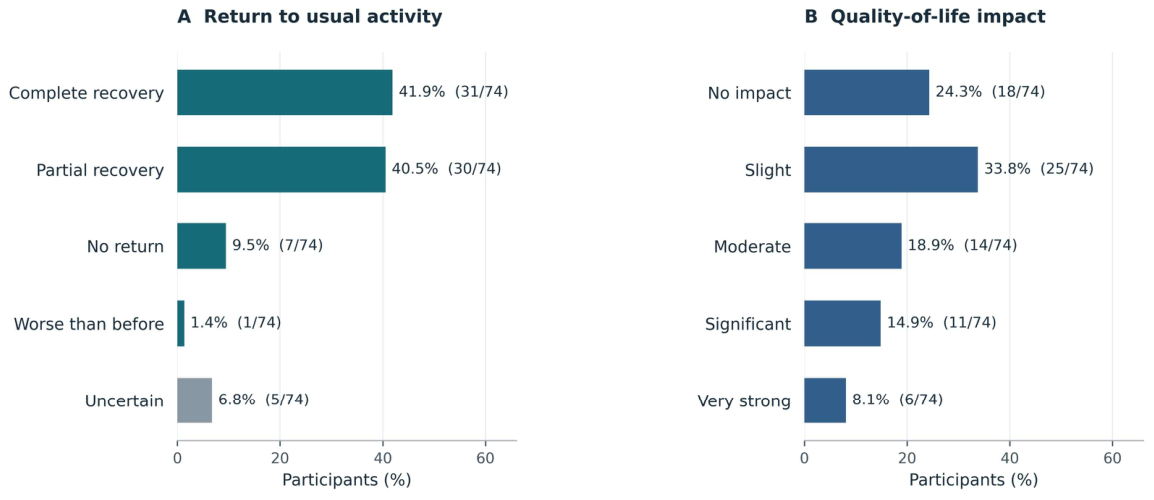
Figure 2.
Medical care seeking according to activity recovery (A) and quality-of-life impact (B). Points represent proportions and error bars Wilson 95% confidence intervals. Unadjusted prevalence ratios compare the functional groups within each panel.
Figure 2.
Medical care seeking according to activity recovery (A) and quality-of-life impact (B). Points represent proportions and error bars Wilson 95% confidence intervals. Unadjusted prevalence ratios compare the functional groups within each panel.
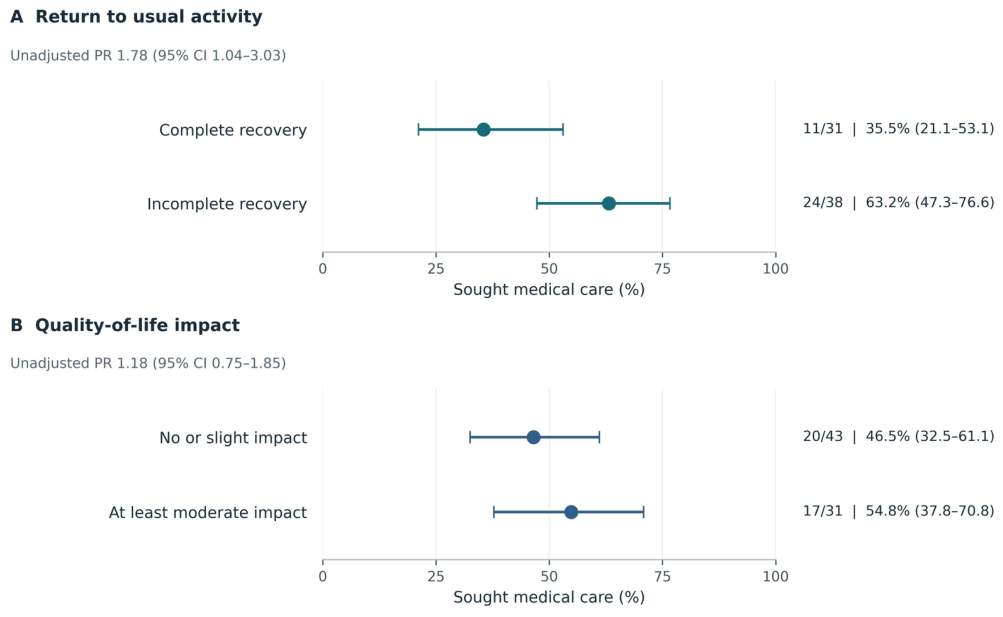

Table 1.
Characteristics of participants reporting persistent symptoms, according to healthcare seeking. Values are median [IQR] or n/N (%).
Table 1.
Characteristics of participants reporting persistent symptoms, according to healthcare seeking. Values are median [IQR] or n/N (%).
| Characteristic | Overall (n = 74) | Sought care (n = 37) | Did not seek care (n = 37) |
| Age, years | 54.0 [45.0-65.0] | 56.0 [45.0-67.0] | 52.0 [45.0-60.0] |
| Women | 48/74 (64.9) | 22/37 (59.5) | 26/37 (70.3) |
| Body mass index, kg/m² | 25.5 [23.4-28.6] (n = 73) | 25.9 [22.4-29.3] (n = 36) | 25.2 [23.9-27.6] |
| Any chronic disease | 37/74 (50.0) | 19/37 (51.4) | 18/37 (48.6) |
| At least two COVID-19 episodes | 29/72 (40.3) | 16/36 (44.4) | 13/36 (36.1) |
| Hospitalization and/or oxygen support | 47/73 (64.4) | 27/37 (73.0) | 20/36 (55.6) |
| Symptom intensity, 0-10 | 6.0 [5.0-7.0] (n = 69) | 6.0 [5.0-7.2] (n = 36) | 5.0 [4.0-7.0] (n = 33) |
Table 2.
Functional responses and healthcare seeking among participants with persistent symptoms (n = 74).
Table 2.
Functional responses and healthcare seeking among participants with persistent symptoms (n = 74).
| Functional response | Overall n/N (%) | Sought care n | Did not seek care n |
| Return to usual activity | |||
| Complete recovery | 31/74 (41.9) | 11 | 20 |
| Partial recovery | 30/74 (40.5) | 21 | 9 |
| No return | 7/74 (9.5) | 3 | 4 |
| Worse than before COVID-19 | 1/74 (1.4) | 0 | 1 |
| Uncertain | 5/74 (6.8) | 2 | 3 |
| Quality-of-life impact | |||
| No impact | 18/74 (24.3) | 8 | 10 |
| Slight impact | 25/74 (33.8) | 12 | 13 |
| Moderate impact | 14/74 (18.9) | 9 | 5 |
| Significant impact | 11/74 (14.9) | 4 | 7 |
| Very strong impact | 6/74 (8.1) | 4 | 2 |
Disclaimer/Publisher’s Note: The statements, opinions and data contained in all publications are solely those of the individual author(s) and contributor(s) and not of MDPI and/or the editor(s). MDPI and/or the editor(s) disclaim responsibility for any injury to people or property resulting from any ideas, methods, instructions or products referred to in the content. |
© 2026 by the authors. Licensee MDPI, Basel, Switzerland. This article is an open access article distributed under the terms and conditions of the Creative Commons Attribution (CC BY) license.
Copyright: This open access article is published under a Creative Commons CC BY 4.0 license, which permit the free download, distribution, and reuse, provided that the author and preprint are cited in any reuse.