

Submitted:
11 November 2026
Posted:
12 November 2026
You are already at the latest version
Abstract
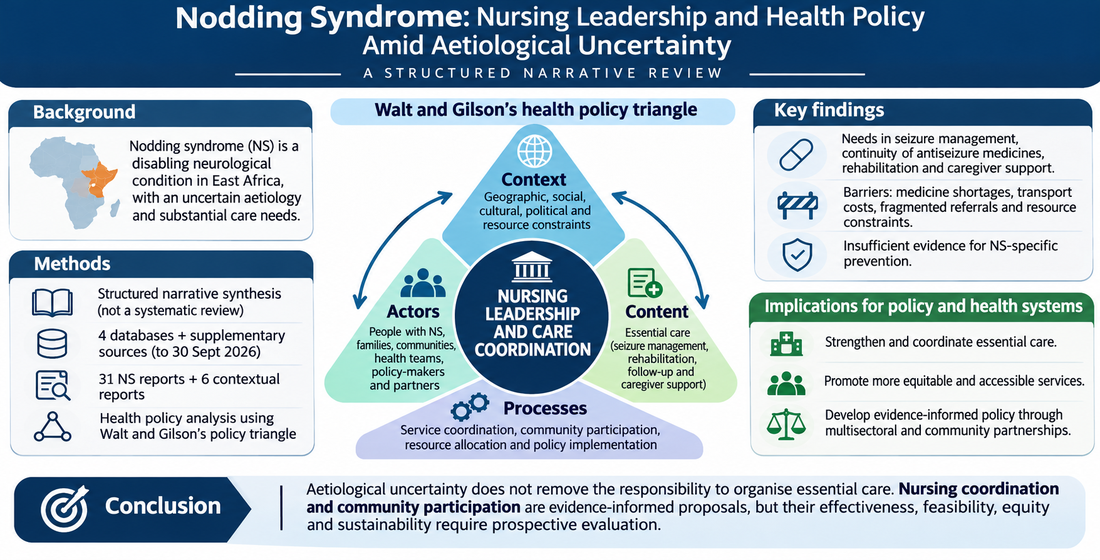
Background/Objectives: Nodding syndrome is a disabling neurological condition affecting communities in East Africa. Although its aetiology remains uncertain, affected individuals and families have substantial care needs. This review examined evidence relevant to nursing leadership, service coordination and health policy. Methods: We conducted a structured narrative synthesis of 31 reports directly addressing nodding syndrome and six contextual reports, identified through four bibliographic databases and supplementary sources up to 30 September 2026. Design-specific Joanna Briggs Institute critical appraisal informed interpretation using Walt and Gilson’s health policy triangle. This was not a formal systematic review. Results: The literature documents needs in seizure management, continuity of antiseizure medicines, rehabilitation, follow-up, caregiver support, stigma reduction and community trust. Barriers include medicine shortages, transport costs, fragmented referrals and resource constraints. Nursing activities recur across education, surveillance, follow-up and coordination, but studies rarely isolate the effects of nurse-led care. Evidence for nodding-syndrome-specific prevention remains insufficient. Conclusions: Aetiological uncertainty does not remove the responsibility to organize essential care. Nursing coordination and community participation are evidence-informed proposals for addressing documented service gaps, but their clinical effectiveness, feasibility, equity and sustainability require prospective evaluation. Proposed service models should not be presented as proven interventions or as preventing nodding syndrome.
Keywords:
nodding syndrome
; nursing leadership
; nursing management
; health policy
; care coordination
1. Introduction
Nodding syndrome (NS) is a disabling neurological disorder affecting East African communities. Its uncertain etiology complicates disease-specific prevention and treatment, but affected people require continuous, coordinated care. Geographic barriers, limited resources and fragmented services make nursing leadership relevant to community outreach, referral and continuity of care.
NS involves recurrent head-nodding seizures and substantial developmental, functional and psychosocial consequences. Associations with Onchocerca volvulus and immune mechanisms remain under investigation; causal uncertainty does not diminish the need to control seizures, prevent injuries, address disability and support families.
Studies document access barriers, gaps in rehabilitation and follow-up, caregiver burden, stigma and mistrust. Community surveillance and qualitative studies suggest feasible routes for engagement, but few studies isolate the effectiveness of nurse-led interventions.
Walt and Gilson [1] describe policy context, content, actors and processes. Applied to NS, it connects clinical needs and frontline experience with resource allocation, stakeholder engagement, service coordination and policy implementation.
Against this background, this structured narrative synthesis aims to examine how the available evidence on nodding syndrome can inform nursing leadership and the development, implementation and evaluation of health policies amid aetiological uncertainty. Using a health-policy and implementation framework, it identifies opportunities for nursing leadership in community care, policy advocacy and coordinated service delivery, while distinguishing empirical findings from proposed management responses and avoiding assumptions that nurse-led models have demonstrated effectiveness. This analysis also asks what responsibilities for care, accountability and evidence generation remain when etiological knowledge is incomplete.
2. Materials and Methods
We conducted a structured narrative evidence synthesis and health-policy analysis of quantitative, qualitative, mixed-methods, surveillance and implementation literature. Searches were disease-focused rather than restricted to nursing or policy studies. This is not a formal systematic review.
Direct NS reports formed the primary synthesis; six contextual reports informed interpretation without contributing NS-specific efficacy or prevalence estimates. The selection flow follows PRISMA 2020 for transparency (Supplementary File S3); the search audit and contextual extractions appear in S2 and S4.
Search strategy.
We searched PubMed/MEDLINE, Scopus, Web of Science Core Collection and CINAHL Complete from inception to 30 September 2026 without language restrictions, adapting title/abstract, topic, keyword or all-field searches to each database (Supplementary File S2).
Search terms included “nodding syndrome”, “nodding disease”, “head nodding”, “nodding epilepsy”, “nodding seizure(s)” and “nodding convulsions”, joined by OR. Nursing and policy terms were deliberately omitted to avoid excluding relevant disease-specific evidence.
Supplementary searches of Dialnet found six records; CUIDEN Plus yielded one nonrelevant record. These searches were tracked separately from the four-database PRISMA flow. Google Scholar was not included in the reproducible database search (Supplementary File S2).
Eligibility criteria.
Direct evidence included peer-reviewed NS reports addressing presentation, management, service access, treatment continuity, surveillance, rehabilitation, caregiver experience, psychosocial consequences, community engagement or policy responses.
Contextual evidence included indirect populations, broader onchocerciasis-associated epilepsy or vector-control studies without separately reported NS outcomes, guidelines, perspectives, secondary analyses and illustrative case reports. Contextual findings were not treated as NS-specific prevalence or efficacy evidence.
Unrelated head-nodding disorders, conference-only materials and reports lacking sufficient peer-reviewed full-text detail were excluded. Mixed cohorts counted as direct evidence only when NS findings were separable or NS was a principal subpopulation; overlapping reports were checked to avoid double-counting.
Study selection.
Two reviewers participated in selection, extraction and appraisal. The lead reviewer completed most assessments; the second independently assessed more than half of the material. Disagreements were resolved through discussion.
Records from the four databases were exported, deduplicated, screened by title and abstract, and assessed in full text against predefined eligibility criteria. Decisions and reconciliations are documented in Supplementary File S2.
Of 1,950 records (PubMed 457; Scopus 819; Web of Science 600; CINAHL 74), 1,001 duplicates were removed. Among 949 unique records, 906 were excluded at screening; 43 full texts yielded 31 direct NS reports, six contextual reports and six exclusions for inadequate full-text empirical detail.
All 31 direct reports were obtained in full and appraised, including van Bemmel’s [2] ethnography. Counts refer to reports rather than necessarily independent studies; selection details appear in Supplementary Files S2–S3.
Data extraction.
For 31 direct reports, the extraction matrix captured design, setting, population, sample, methods, clinical and service findings, barriers, limitations and nursing/policy relevance (Supplementary File S1).
OpenAI ChatGPT assisted with manuscript drafting and the organization and presentation of extracted evidence. The authors independently checked the source documents and validated all extraction fields, critical appraisal judgments, interpretations and references. The AI tool did not independently determine study eligibility, assign JBI judgments or establish conclusions.
Quantitative estimates were recorded with denominators and measures of uncertainty where reported; qualitative findings were charted thematically. Source findings were distinguished from authors’ proposed nursing models and indicators; unverified information was marked unclear. Contextual extraction appears in S4.
Health Policy Analysis.
The policy triangle proposed by Walt and Gilson [1] guided interpretation of context (historical, economic and institutional factors), content (care and resource priorities), actors (families, clinicians, communities and authorities) and process (decisions, communication, implementation and evaluation).
The framework was applied during synthesis, not eligibility screening. Because most primary studies did not evaluate policies or isolate nursing interventions, resulting management implications were treated as interpretations, not validated intervention effects.
Critical Appraisal and Confidence in the Evidence.
All 31 direct reports were appraised with design-specific Joanna Briggs Institute (JBI) checklists using yes/no/unclear/not-applicable responses, without aggregate quality scores. Item-level judgments appear in Supplementary File S5.
Appraisal found one report with minimal concerns, 24 moderate, two moderate-to-high and four high. Van Bemmel [2] had moderate concerns, principally regarding explicit reflexivity reporting. Domain confidence was judged narratively using design, limitations, consistency and directness, not formal GRADE ratings (S1).
Synthesis.
Because designs, populations and outcomes were heterogeneous, statistical pooling was inappropriate. Narrative domains covered clinical course, seizure management, service access, caregiver burden, stigma, prevention, nutrition/rehabilitation, governance and nursing contributions.
Domains were mapped to policy context, content, actors and process [1]. Evidence-to-action implications were graded cautiously according to directness and methodological limitations; proposed nurse-led effects were not represented as established outcomes.
3. Results
Study Selection and Evidence Profile.
The 31 direct reports, six contextual reports and six full-text exclusions are described in Methods and the PRISMA diagram (Supplementary File S3).
Direct evidence spanned clinical cohorts, trials, ethnography, surveillance and health-service studies, chiefly from Uganda with additional reports from South Sudan and Tanzania. Contextual evidence remained separate from NS-specific estimates.
Critical Appraisal and Confidence in the Evidence.
Across 31 appraisals, concerns were minimal (n=1), moderate (n=24), moderate-to-high (n=2) or high (n=4). Narrative confidence was moderate for clinical course, seizure management, access, caregiver burden and stigma; low for causal prevention and specific nutrition/rehabilitation effects; and low-to-moderate for governance and nursing-specific effects (Supplementary File S1).
Clinical Phenotype, Course and Symptom Management.
Moderate-confidence evidence describes recurrent seizures, variable disease trajectories and functional, cognitive, nutritional and safety needs. Small cohorts, attrition and selection bias limit generalizability, supporting individualized longitudinal assessment rather than assumptions of uniform decline [3,4,5,6,7,8,9].
Symptomatic seizure management and uninterrupted antiseizure medication (ASM) access are priorities, although comparative ASM evidence is mainly observational [7,10,11]. A phase 2 doxycycline trial does not establish a cure [12]; uncontrolled lorazepam and retrospective rehabilitation findings remain preliminary [13,14].
Nutritional and rehabilitation needs are evident, but comparative effectiveness evidence is limited; routine assessment is better supported than any specific modality [3,13,15].
Access, Continuity and Organization of services.
Moderate-confidence studies identify transport and financial barriers, medicine shortages, staffing and supervision gaps, weak follow-up and fragmented neurological, psychiatric and rehabilitation services [10,16,17,18,19]. Van Bemmel [2] describes logistical and accountability failures. Community surveillance and mHealth demonstrate operational feasibility, not improved clinical outcomes [19].
Nurses contribute to follow-up, education, medicine continuity, psychosocial care, outreach, surveillance and coordination; available studies do not isolate nursing effects from broader service changes.
Caregiver Burden, Mental Health and Gender.
Moderate-confidence qualitative, economic and implementation evidence identifies intensive supervision needs, financial losses, psychological distress and gendered caregiving burdens [20,21,22,23,24,25]. Effective standalone caregiver interventions remain insufficiently evaluated.
Stigma, Inclusion and Trust.
Moderate-confidence evidence documents misconceptions, stigma, educational exclusion and distrust in endemic communities [2,3,20,26,27,28,29]. Post-conflict tensions and fragmented services may aggravate distrust [2]. Specific anti-stigma interventions have not been robustly evaluated.
Onchocerciasis, Ivermectin/CDTI and Prevention.
Spatial and temporal associations between NS, onchocerciasis and vector-control activity do not establish a causal preventive effect of ivermectin or community-directed treatment with ivermectin (CDTI) on NS [5,30]. Confidence in NS-specific prevention remains low.
Governance, Implementation and Health-Policy Processes.
Low-to-moderate-confidence evidence describes workforce development, community engagement, surveillance, research and service integration, mainly through descriptive or feasibility studies [17,19,23,24,27,31,32]. Van Bemmel [2] highlights transport, staffing, communication and accountability failures within specialized services.
Evidence-to-Action Synthesis and Nursing Contribution.
Across domains, the most defensible priorities are longitudinal seizure care, reliable ASM supply, coordinated referrals, caregiver and mental-health support, community engagement and stigma reduction. Nursing functions are recurrent, but nurse-led model effectiveness remains inadequately tested.
Policy context includes resource scarcity, conflict history, uncertainty and mistrust; content includes continuity and integrated support; actors include patients, families, nurses, other professionals and authorities; and processes require communication, participation, supervision and feedback. Table 1 summarizes these interpretations.
Figure 1 illustrates the conceptual application of Walt and Gilson’s health policy triangle to proposed nursing coordination functions and outcomes for prospective evaluation.
Table 2 links evidence confidence with nursing responsibilities and policy/research priorities; proposed models and outcomes require prospective evaluation.
4. Discussion
Principal Interpretation
The synthesis identifies actionable service needs despite unresolved NS etiology. Moderate-confidence evidence supports prioritizing seizure care, ASM continuity, access, caregiver support and responses to stigma. Low-confidence causal prevention claims and untested nurse-led models should not be treated as established interventions.
Health-system decisions should address these needs while acknowledging uncertainty and avoiding claims of proven cures or disease-specific prevention.
Nursing Contribution: From Recurrent Functions to an Evaluable Model of Care.
Nurses repeatedly undertake follow-up, medication management, clinical surveillance, education, psychosocial support and multidisciplinary coordination. These functions justify formal consideration within integrated NS care pathways, but not attribution of independent clinical benefit.
Evidence from community health worker-delivered psychological interventions suggests potential benefits for caregiver mental health [23,24]. However, these findings should not be attributed to nurse-led models, whose independent effectiveness remains insufficiently evaluated.
The scarcity of nursing-specific intervention studies should not be interpreted solely as a limitation of this review; it is also an important finding that exposes the limited attention given to care delivery and health-service organization in the nodding syndrome literature. In settings where etiological uncertainty persists, nursing management has a critical role in supporting continuity of care, multidisciplinary coordination and affected families. However, the effectiveness of specific nurse-led models has not been established. The management priorities proposed here are therefore evidence-informed directions for service development and prospective evaluation, not interventions of demonstrated effectiveness.
At community level, nurse coordinators could support recognition, adherence and referral; in facilities, continuity, assessment and team coordination; and at district level, frontline data could inform staffing, supply chains and pathways. These proposals require appropriate authority, training, supervision and resources, not substitution for specialist services.
From Local Evidence to Health and Nursing Policies.
Service discontinuity reflects interactions among policy content, actors, context and implementation rather than biomedical uncertainty alone. Medication shortages, transport barriers and weak accountability impede care [2,10,16,29]. Van Bemmel’s example of an unsuccessful emergency transfer illustrates the consequences of absent transport resources [2].
The framework of Walt and Gilson [1] places these problems within post-conflict governance, community trust, clinical priorities and coordination processes. Implementation failures should not be attributed solely to families or frontline staff.
The transferable management lesson for other neglected or rare conditions is to define nursing coordination responsibilities, competencies, authority, information flows and measurable patient outcomes while adapting to local resources.
Community Participation, Surveillance and Prevention Claims.
Community participation and surveillance can improve the feasibility of identifying affected households and linking services [19,23,24,31], but feasibility is not evidence of better seizure control, quality of life or survival. Future evaluations should link reach, reporting and referral completion to patient outcomes.
Likewise, associations with onchocerciasis and temporal changes after ivermectin programmes justify research and established vector-control activity, not claims of proven NS-specific prevention [5,30].
Applying Walt and Gilson’s policy triangle to nodding syndrome makes it possible to translate documented service gaps into context-sensitive nursing-management proposals while retaining a clear distinction between evidence and interpretation (Table 1). Defined nursing coordination, medication-continuity monitoring, family engagement and referral pathways may offer opportunities to reduce avoidable complications and improve continuity and support for affected individuals and families. However, these potential benefits have not been established for specific nurse-led models. Prospective, locally adapted evaluation is needed to determine clinical, family-centred, implementation and economic outcomes; the proposed service responses should not be interpreted as preventing the onset of nodding syndrome.
Implications for Nursing and Health Policy.
Five management priorities emerge: reliable ASM and clinical continuity; culturally responsive community participation; caregiver, mental-health and inclusion support; workforce training, supervision and referrals; and monitoring that links implementation with patient and family outcomes.
A minimum coordinated pathway should specify longitudinal review, ASM access, safety and adverse-effect monitoring, caregiver assessment, referrals to rehabilitation and psychosocial services, community linkages and outcome review. Nurses may lead or coordinate defined components within local scope of practice; accountability remains multidisciplinary.
Prospective evaluations should specify nursing components and assess seizure control, safety, medicine continuity, caregiver distress, stigma, referral completion, reach, equity, fidelity, workload, costs and sustainability, ideally through community co-design.
Strengths and Limitations.
Strengths include separating 31 direct NS reports from six contextual reports, design-specific JBI appraisal, transparent selection and explicit distinction between empirical results and policy interpretation.
Limitations include heterogeneous designs and outcomes precluding meta-analysis, geographic concentration in Uganda, mixed cohorts requiring NS-specific disaggregation and variable primary-study reporting. Full texts were obtained for all direct reports; van Bemmel’s [2] ethnography also presented limitations in explicit reflexivity reporting.
Walt and Gilson’s framework was applied retrospectively to studies rarely designed as policy analyses. Consequently, proposed policies are interpretive, and the effectiveness, cost and sustainability of nurse-led models remain unproven. A further conceptual limitation is that policy-triangle categories organize interpretations but do not independently establish which institutional responses are ethically justified or operationally feasible.
5. Conclusions
Nodding syndrome demands a sustained health-system response despite continuing aetiological uncertainty. The available evidence identifies recurrent gaps in seizure management, uninterrupted access to antiseizure medicines, longitudinal follow-up, coordinated referrals, caregiver support and responses to stigma. These needs warrant attention irrespective of whether disease-specific preventive strategies or nurse-led models have demonstrated independent effectiveness.
An important finding of this review is the scarcity of studies directly evaluating nursing-specific interventions and the organization of care. Rather than diminishing the relevance of nursing management, this gap highlights a neglected research and service-delivery priority. Nurse managers could help define and resource responsibilities for continuity monitoring, multidisciplinary coordination, community engagement, caregiver assessment and referral pathways, with locally appropriate training, supervision and accountability. These are evidence-informed priorities for development, not proven intervention effects.
As a next step, implementation research should develop and prospectively evaluate context-adapted models of nurse-coordinated care linking community-based services, primary healthcare facilities and specialized multidisciplinary care. Such models should define nursing coordination responsibilities, referral and follow-up pathways, mechanisms for uninterrupted antiseizure medication access, and indicators of seizure control, patient safety, caregiver well-being, equity, feasibility, costs and sustainability. Policies and care pathways should be co-developed with affected communities and adapted to local health-system capacity. These are evidence-informed proposals requiring prospective evaluation, not established nurse-led interventions with demonstrated effectiveness. The central implication is that uncertainty about causation must not become uncertainty about responsibility for organizing and evaluating essential care.
The policy-triangle analysis provides an evaluable framework for nursing-management responses to documented care gaps, rather than proof of their effectiveness. Its relevance to other neglected conditions should be explored through context-specific implementation research, without assuming that improved care coordination prevents disease onset. The wider nursing inquiry is therefore not whether uncertainty can be eliminated before care is organized, but how professional responsibility, community knowledge and institutional accountability can be negotiated transparently while evidence develops.
Supplementary Materials
The following supporting information can be downloaded at the website of this paper posted on Preprints.org. Supporting information is provided as Supplementary File S1 (direct nodding syndrome evidence extraction), S2 (search, deduplication and selection audit), S3 (PRISMA 2020-style selection flow diagram), S4 (contextual report extraction) and S5 (item-level JBI critical appraisal).
Author Contributions
A.C.d.C. undertook the majority of study selection, data extraction and methodological critical appraisal. I.O.D. independently reviewed more than half of the material across these processes and participated in resolving disagreements through discussion. A.C.d.C. and M.J.G.R. undertook the majority of manuscript drafting. I.O.D. contributed to English-language revision. A.C.d.C., I.O.D. and M.J.G.R. subsequently reviewed and revised the manuscript following language revision. All authors read and approved the final version of the manuscript.
Funding
The authors received no specific funding for this work.
Institutional Review Board Statement
Not applicable. This structured evidence synthesis utilized exclusively published peer-reviewed literature and did not involve the direct recruitment of human participants or the collection of new, identifiable participant data.
Informed Consent Statement
Not applicable.
Data Availability Statement
All data underlying this structured evidence synthesis are derived from published sources. Supporting materials are supplied as Supplementary Files S1 (direct NS evidence extraction and appraisal), S2 (search, deduplication and selection audit), S3 (PRISMA 2020 flow diagram), S4 (contextual evidence extraction) and S5 (full JBI appraisal matrix). No new participant-level data were generated.; PUBLIC INVOLVEMENT STATEMENT; No public involvement in any aspect of this research.; GUIDELINES AND STANDARDS STATEMENT; The PRISMA 2020 reporting framework was used to document the identification, screening and selection of records transparently (Supplementary File S3). This work is a structured narrative review, not a formal systematic review or meta-analysis; PRISMA use does not imply full compliance with all requirements for systematic reviews.; USE OF ARTIFICIAL INTELLIGENCE; OpenAI ChatGPT was used to support language editing, manuscript organization and drafting, including assistance with organizing extracted evidence. All included articles were reviewed by the authors, who verified source information, data extraction, critical appraisal judgments, interpretations and references. The authors reviewed and edited all AI-assisted output and take full responsibility for the accuracy, integrity and final content of this manuscript.
Not applicable.
Conflicts of Interest
The authors declare that they have no conflicts of interest.
Abbreviations
ASM, antiseizure medication(s); CDTI, community-directed treatment with ivermectin; JBI, Joanna Briggs Institute; NS, nodding syndrome; PRISMA, Preferred Reporting Items for Systematic Reviews and Meta-Analyses.
References
- Walt, G.; Gilson, L. Reforming the health sector in developing countries: the central role of policy analysis. Health Policy Plan. 1994, 9(4), 353–370. [Google Scholar] [CrossRef]
- van Bemmel, K. Phone calls and political ping-pong: nodding syndrome and healthcare provision in Uganda. J. East. Afr. Stud. 2019, 13(3), 485–503. [Google Scholar] [CrossRef]
- Abd-Elfarag, G. O. E.; Mathewson, J. D.; Emmanuel, L.; Edridge, A. W. D.; Carter, J. A.; Spinganto, S.; et al. Nodding Syndrome: Clinical Characteristics, Risks Factors, Access to Treatment, and Perceptions in the Greater Mundri Area, South Sudan. Pathogens 2023, 12(2), 190. [Google Scholar] [CrossRef]
- Idro, R.; Opoka, R. O.; Aanyu, H. T.; Kakooza-Mwesige, A.; Piloya-Were, T.; Namusoke, H.; et al. Nodding syndrome in Ugandan children—clinical features, brain imaging, and complications: a case series. BMJ Open 2013, 3, 5. [Google Scholar] [CrossRef]
- Kaiser, C.; Asaba, G.; Rubaale, T.; Tukesiga, E.; Kipp, W. Onchocerciasis-Associated Epilepsy with Head Nodding Seizures—Nodding Syndrome: A Case Series of 15 Patients from Western Uganda, 1994. Am. J. Trop. Med. Hyg. 2018, 99(5), 1211–1218. [Google Scholar] [CrossRef]
- Kaiser, C.; Kipp, W.; Gumisiriza, N.; Asaba, G. Long-term observation and mortality of children with nodding syndrome in western Uganda, 1994–2018. Seizure 2026, 135, 123–128. [Google Scholar] [CrossRef]
- Kegele, J.; Wagner, T.; Kowenski, T.; Wiesmayr, M.; Gatterer, C.; Alber, M.; et al. Long-term clinical course and treatment outcomes of individuals with Nodding Syndrome. J. Neurol. Sci. 2024, 457, 122893. [Google Scholar] [CrossRef]
- Sejvar, J. J.; Kakooza, A. M.; Foltz, J. L.; Makumbi, I.; Atai-Omoruto, D. A.; Malimbo, M.; et al. Clinical, neurological, and electrophysiological features of nodding syndrome in Kitgum, Uganda: an observational case series. Lancet Neurol. 2013, 12(2), 166–174. [Google Scholar] [CrossRef]
- Winkler, A. S.; Wallner, B.; Friedrich, K.; Pfausler, B.; Unterberger, I.; Matuja, W.; et al. A longitudinal study on nodding syndrome—a new African epilepsy disorder. Epilepsia 2014, 55(1), 86–93. [Google Scholar] [CrossRef]
- Abbo, C.; Mwaka, A. D.; Opar, B. T.; Idro, R. Qualitative evaluation of the outcomes of care and treatment for children and adolescents with nodding syndrome and other epilepsies in Uganda. Infect. Dis. Poverty 2019, 8, 30. [Google Scholar] [CrossRef]
- Idro, R.; Namusoke, H.; Abbo, C.; Mutamba, B. B.; Kakooza-Mwesige, A.; Opoka, R. O.; et al. Patients with nodding syndrome in Uganda improve with symptomatic treatment: a cross-sectional study. BMJ Open 2014, 4, 11. [Google Scholar] [CrossRef]
- Idro, R.; Anguzu, R.; Ogwang, R.; Kakooza-Mwesige, A.; Opar, B. T.; Abbo, C.; et al. Doxycycline for the treatment of nodding syndrome: a randomized, placebo-controlled, phase 2 trial. Lancet Glob. Health 2024, 12, 7–e1158. [Google Scholar] [CrossRef]
- Gazda, S.; Kitara, D. L. Treatment and rehabilitation outcomes of children affected with nodding syndrome in Northern Uganda: a descriptive case series. Pan Afr. Med. J. 2018, 29, 228. [Google Scholar] [CrossRef]
- Kakooza-Mwesige, A.; Idro, R.; Ssebyala, K.; Bosa, L.; Kalume, H.; Bbosa, R.; et al. Catatonia in Ugandan children with nodding syndrome and effects of treatment with lorazepam: a pilot study. BMC Res. Notes 2015, 8, 825. [Google Scholar] [CrossRef]
- Aloka, B.; Ongeng, D.; Amito, F. O.; Omech, B.; Olum, S. Organoleptic drivers of caregiver-reported acceptability of locally formulated nutrient-dense products formulated from local ingredients for nutritional intervention in nodding syndrome in northern Uganda. BMC Nutr. 2026, 12, 88. [Google Scholar] [CrossRef]
- Atim, P.; Ochola, E.; Ssendagire, S.; Rutebemberwa, E. Health Seeking Behaviors among Caretakers of Children with Nodding Syndrome in Pader District – Northern Uganda: A Mixed Methods Study. PLoS ONE 2016, 11, 7. [Google Scholar] [CrossRef]
- Mwaka, A. D.; Kitara, D. L.; Orach, C. G. The enigmatic nodding syndrome outbreak in northern Uganda: an analysis of the disease burden and national response strategies. Health Policy Plan. 2016, 31(3), 285–292. [Google Scholar] [CrossRef]
- Nono, D.; Gumisiriza, N.; Tumwine, C.; Amaral, L. J.; Elvis Ainamani, H.; Musisi, S.; et al. Impact of COVID-19 on the well-being of children with epilepsy including nodding syndrome in Uganda: A qualitative study. Epilepsy Behav. 2023, 138, 108992. [Google Scholar] [CrossRef]
- Valdes Angues, R.; Suits, A.; Palmer, V. S.; Okot, C.; Okot, R. A.; Atonywalo, C.; et al. A real-time medical cartography of epidemic disease (Nodding syndrome) using village-based lay mHealth reporters. PLoS Neglected Trop. Dis. 2018, 12, 6. [Google Scholar] [CrossRef]
- Buchmann, K. ‘These nodding people’: Experiences of having a child with nodding syndrome in postconflict Northern Uganda. Epilepsy Behav. 2015, 42, 71–77. [Google Scholar] [CrossRef]
- Irani, J.; Rujumba, J.; Mwaka, A. D.; Arach, J.; Lanyuru, D.; Idro, R.; et al. ‘There Were Moments We Wished She Could Just Die’: The Highly Gendered Burden of Nodding Syndrome in Northern Uganda. Qual. Health Res. 2022, 32(10), 1544–1556. [Google Scholar] [CrossRef]
- Latio, L. S. Y.; Mwaka, A. D.; Orach, C. G.; Nyeko, R.; Atai-Omoruto, A. D. Economic burden of the persistent morbidity of nodding syndrome on caregivers in affected households in Northern Uganda. PLoS ONE 2020, 15, 9. [Google Scholar] [CrossRef]
- Mutamba, B. B.; Kohrt, B. A.; Okello, J.; Nakigudde, J.; Opar, B.; Musisi, S.; Bazeyo, W.; de Jong, J. Contextualization of psychological treatments for government health systems in low-resource settings: group interpersonal psychotherapy for caregivers of children with nodding syndrome in Uganda. Implement. Sci. 2018, 13, 90. [Google Scholar] [CrossRef]
- Mutamba, B. B.; Kane, J. C.; de Jong, J. T. V. M.; Okello, J.; Musisi, S.; Kohrt, B. A. Psychological treatments delivered by community health workers in low-resource government health systems: effectiveness of group interpersonal psychotherapy for caregivers of children affected by nodding syndrome in Uganda. Psychol. Med. 2018, 48(15), 2573–2583. [Google Scholar] [CrossRef]
- Nakigudde, J.; Musisi, S.; Ehnvall, A.; Airaksinen, E.; Agren, H. An exploration of caregiver burden for children with nodding syndrome (lucluc) in Northern Uganda. BMC Psychiatry 2016, 16, 255. [Google Scholar] [CrossRef]
- Buchmann, K. ‘You sit in fear’: understanding perceptions of nodding syndrome in postconflict northern Uganda. Glob. Health Action 2014, 7, 25069. [Google Scholar] [CrossRef]
- Irani, J.; Rujumba, J.; Mwaka, A. D.; Arach, J.; Lanyuru, D.; Idro, R.; et al. ‘Those who died are the ones that are cured.’ Walking the political tightrope of Nodding Syndrome in northern Uganda: Emerging challenges for research and policy. PLoS Neglected Trop. Dis. 2019, 13, 6. [Google Scholar] [CrossRef]
- Mutamba, B.; Busingye, J.; Ssebunnya, J.; Kigozi, F. Stereotypes on Nodding syndrome: responses of health workers in the affected region of northern Uganda. Afr. Health Sci. 2013, 13(4), 986–991. [Google Scholar] [CrossRef]
- Mwaka, A. D.; Abbo, C.; Kinengyere, A. A.; Opar, B. T. Is the glass half full or half empty? A qualitative exploration on treatment practices and perceived barriers to biomedical care for patients with nodding syndrome in postconflict northern Uganda. BMC Res. Notes 2015, 8, 386. [Google Scholar] [CrossRef]
- Amaral, L.-J.; Jada, S. R.; Ndjanfa, A. K.; Carter, J. Y.; Abd-Elfarag, G.; Okaro, S.; et al. Impact of annual community-directed treatment with ivermectin on the incidence of epilepsy in Mvolo, a two-year prospective study. PLoS Neglected Trop. Dis. 2024, 18, 3. [Google Scholar] [CrossRef]
- Anguzu, R.; Idro, R.; Ogwang, R.; Kakooza, A. M.; Opar, B. T.; Abbo, C.; et al. Setting up a clinical trial for a novel disease: a case study of the Doxycycline for the Treatment of Nodding Syndrome Trial – challenges, enablers and lessons learned. Glob. Health Action 2018, 11(1), 1431362. [Google Scholar] [CrossRef]
- Årdal, C.; Røttingen, J. A. Financing and collaboration on research and development for nodding syndrome. Health Res. Policy Syst. 2016, 14, 19. [Google Scholar] [CrossRef]
Figure 1.
Nursing leadership and care coordination in nodding syndrome: a conceptual framework informed by Walt and Gilson’s health policy triangle. Note. The four dimensions of Walt and Gilson’s health policy triangle (1994)—context, content, actors and process—inform proposed nursing leadership and care coordination functions in nodding syndrome. Outcomes shown are priorities for prospective evaluation, not demonstrated effects of nurse-led interventions or disease-specific prevention. ASM, antiseizure medicine; NS, nodding syndrome.
Figure 1.
Nursing leadership and care coordination in nodding syndrome: a conceptual framework informed by Walt and Gilson’s health policy triangle. Note. The four dimensions of Walt and Gilson’s health policy triangle (1994)—context, content, actors and process—inform proposed nursing leadership and care coordination functions in nodding syndrome. Outcomes shown are priorities for prospective evaluation, not demonstrated effects of nurse-led interventions or disease-specific prevention. ASM, antiseizure medicine; NS, nodding syndrome.
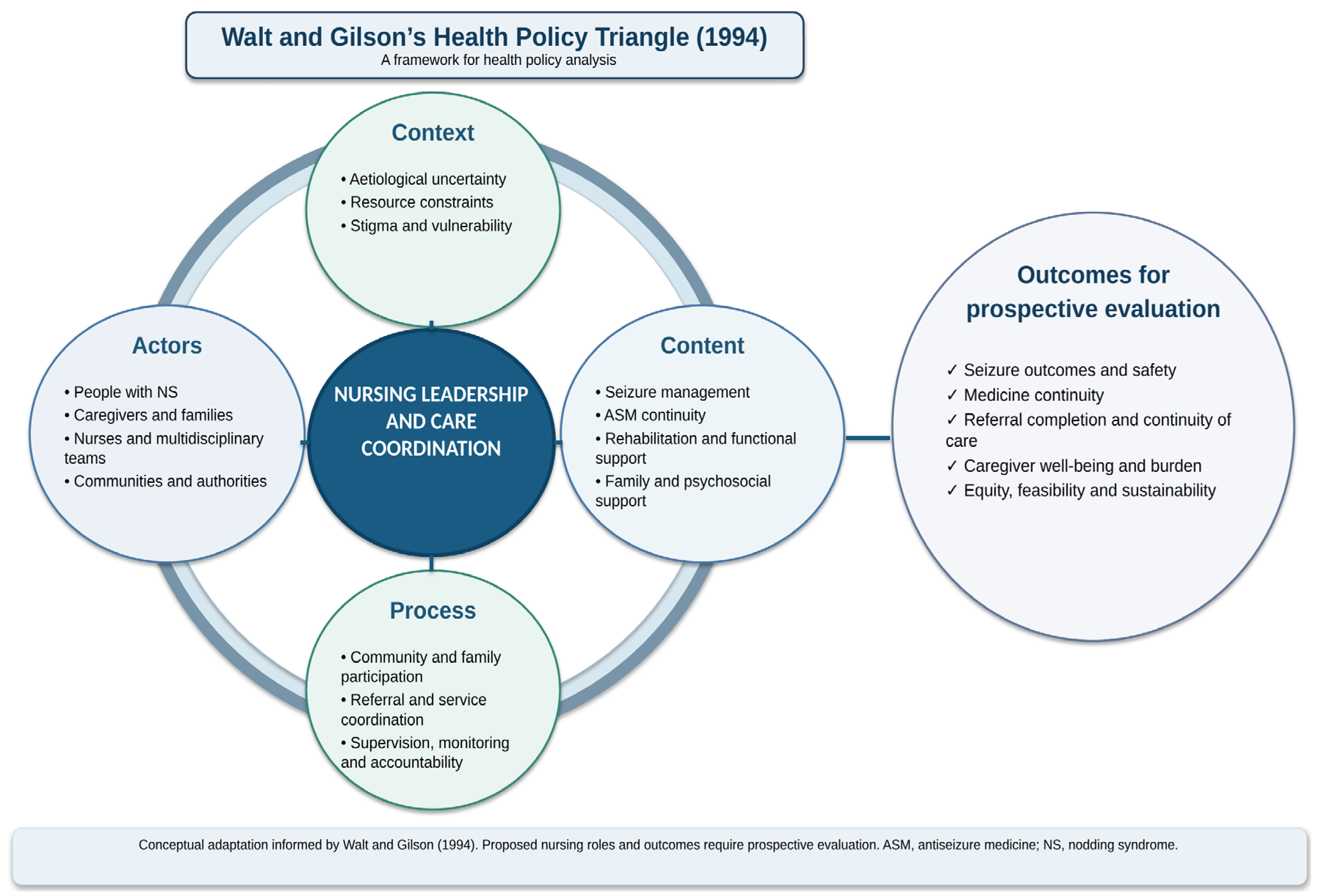

Table 1.
Applying Walt and Gilson’s policy triangle to nodding syndrome: documented service challenges, proposed nursing-management responses and outcomes for prospective evaluation.
Table 1.
Applying Walt and Gilson’s policy triangle to nodding syndrome: documented service challenges, proposed nursing-management responses and outcomes for prospective evaluation.
| Policy dimension | Evidence-related service challenges | Proposed nursing-management response | Outcomes for prospective evaluation |
|---|---|---|---|
| Context | Aetiological uncertainty, resource constraints, geographical barriers, conflict-related histories, stigma and mistrust | Assess local barriers; support culturally responsive engagement and transparent communication about uncertainty | Equity of access, continuity of contact, patient and caregiver trust |
| Content | Need for sustained seizure management, medicine access, rehabilitation, family support and referrals | Contribute to coordinated care pathways, medication-continuity monitoring, caregiver assessment and referral standards | Seizure outcomes, medicine interruptions, referral completion, caregiver well-being |
| Actors | Patients, caregivers, community informants, nurses, other professionals, local leaders and authorities have differing roles and influence | Facilitate family participation, multidisciplinary coordination and communication between communities and decision-makers | Family participation, referral coordination, acceptability and reported experience |
| Process | Gaps in communication, implementation, transport, supervision, follow-up and accountability | Support participatory planning, supervision, follow-up systems, feedback loops and implementation monitoring | Follow-up completion, time to referral, fidelity, workload, costs and sustainability |
Note. Policy dimensions are adapted from Walt and Gilson’s health policy analysis framework [1]. Service challenges reflect findings from the structured narrative synthesis; nursing-management responses are evidence-informed proposals, not evaluated interventions. Outcomes are suggested measures for prospective assessment and do not imply demonstrated benefits or disease-specific prevention.
Table 2.
Evidence-to-action synthesis for nodding syndrome: implications for nursing, health systems, and research.
Table 2.
Evidence-to-action synthesis for nodding syndrome: implications for nursing, health systems, and research.
| Evidence domain | Confidence | Key evidence statement | Nursing implications | Policy/research implications |
|---|---|---|---|---|
| Clinical phenotype, natural history, and prognosis | Moderate | Direct NS studies consistently describe phenotype and longitudinal needs; small cohorts and losses limit generalizability. | Monitor seizures, function, cognition, nutrition, safety, and changing family needs. | Maintain multidisciplinary longitudinal follow-up; prioritize prospective multicenter cohorts. |
| Symptomatic treatment, seizure control, and ASM continuity | Moderate | Evidence supports symptomatic seizure management and ASM continuity; comparative ASM evidence is largely nonrandomized. | Support adherence, medicine continuity, adverse-effect monitoring, education, and referral. | Protect uninterrupted ASM supply; evaluate pragmatic treatment and continuity strategies. |
| Onchocerciasis, ivermectin/CDTI and prevention | Low | Temporal associations are suggestive but do not establish causal prevention of NS. | Link surveillance and education with onchocerciasis programmes without causal claims. | Integrate surveillance; undertake controlled longitudinal NS-specific studies. |
| Nutrition, rehabilitation, and function | Low | Needs are documented, but comparative evidence of intervention effectiveness is sparse. | Include nutritional, functional and safety assessment and coordinate rehabilitation. | Ensure multidisciplinary access; evaluate functional and quality-of-life outcomes. |
| Access, continuity, and organization of services | Moderate | Evidence converges on geographic/financial barriers, medicine availability, follow-up gaps, and coordination problems. | Provide continuity, outreach, education, and navigation across community/facility services. | Prioritize decentralized care, medicines, referral, and implementation/cost-effectiveness evaluation. |
| Caregiver burden, mental health, and gender | Moderate | Consistent evidence shows caregiver burden, psychosocial distress, and gendered consequences. | Assess caregiver needs and distress; link families with psychosocial/social support. | Embed caregiver support; evaluate scalable, equitable and sustainable interventions. |
| Stigma, perceptions, inclusion, and trust | Moderate | Studies converge on stigma, exclusion, misconceptions, and distrust. | Use culturally safe communication, address misconceptions, and support inclusion. | Codesign and evaluate anti-stigma and inclusion strategies. |
| Governance, health policy, and implementation | Low-moderate | System-response evidence is mainly descriptive/qualitative or implementation-focused. | Contribute frontline knowledge, surveillance, coordination, and implementation feedback. | Strengthen accountability, coordination, workforce capacity, and implementation monitoring. |
| Nursing contribution | Low-moderate | Nurses contribute across care and coordination, but few studies isolate nursing as an independent intervention. | Position nurses as core coordinators without attributing untested clinical effects to nursing alone. | Define, resource and evaluate nurse-led/delivered components, outcomes, and costs. |
Note. Confidence is a narrative domain-level judgment informed by directness, consistency, study design, and formal critical appraisal; it is not a GRADE rating. ASM, antiseizure medicine; CDTI, community-directed treatment with ivermectin; NS, nodding syndrome.
Disclaimer/Publisher’s Note: The statements, opinions and data contained in all publications are solely those of the individual author(s) and contributor(s) and not of MDPI and/or the editor(s). MDPI and/or the editor(s) disclaim responsibility for any injury to people or property resulting from any ideas, methods, instructions or products referred to in the content. |
© 2026 by the authors. Licensee MDPI, Basel, Switzerland. This article is an open access article distributed under the terms and conditions of the Creative Commons Attribution (CC BY) license (http://creativecommons.org/licenses/by/4.0/).
Copyright: This open access article is published under a Creative Commons CC BY 4.0 license, which permit the free download, distribution, and reuse, provided that the author and preprint are cited in any reuse.