

Submitted:
11 November 2026
Posted:
12 November 2026
You are already at the latest version
Abstract
Brown macroalgae are potential sources of proteinaceous ingredients for marine biorefineries, but extraction yield does not necessarily predict final recovery or product suitability. This critical narrative review examines three linked dimensions of processing: protein accessibility within algal biomass, retention across successive recovery operations, and requirements of the intended product. Primary studies show that substantial protein solubilization may be followed by much lower precipitation recovery and that pretreatments can affect solubilization, precipitation, and iodine content differently. Interactions with alginates and phlorotannins are plausible contributors to recovery losses, although their quantitative effects remain insufficiently established. Reported “protein yields” also represent different analytical endpoints, including nitrogen, colorimetric protein equivalents, amino acids, dry-extract mass, and final-product recovery, frequently with incompatible denominators. We examine these distinctions across extraction technologies, downstream separations, integrated biorefineries, and peptide production. Protein-enriched solids, soluble concentrates, mixed ingredients, and peptide precursors have distinct recovery targets. A product-defined framework is proposed to guide selection of recovery streams and evaluation of proteinaceous recovery, product composition, safety, functionality, and resource requirements. Progress requires compatible measurements across processing stages and experimental tests of whether improved release translates into greater recovery of suitable final products.
Keywords:
brown macroalgae
; protein extraction
; protein recovery
; protein quantification
; mass balance
; downstream processing
; marine biorefineries
; functional ingredients
; bioactive peptides
1. Introduction: Why Brown Macroalgal Proteins Deserve Renewed Attention
Interest in brown macroalgae as sources of protein-containing ingredients has increased alongside efforts to diversify biological resources for food, feed, and marine biotechnology. Kelps and fucoids, including Saccharina latissima, Ascophyllum nodosum, Fucus vesiculosus, and Alaria esculenta, are relevant feedstocks for developing marine biorefineries in which polysaccharides and other valuable constituents may represent the principal products. Recovering additional value from their proteinaceous components offers opportunities to improve biomass utilization and develop ingredients with nutritional, technological, or biological applications [1,2,3]. However, the potential of these resources cannot be adequately evaluated from the protein or nitrogen content of untreated biomass alone. Their practical value also depends on the accessibility of proteinaceous material during processing, its recovery in a defined product, and the characteristics required for the intended application.
Previous reviews have provided extensive accounts of macroalgal protein composition, extraction technologies, nutritional properties, functionality, and potential applications [4,5,6,7]. Pérez-Roa et al. [4] examined extraction strategies across green, red, and brown macroalgae, including the influence of biomass characteristics and opportunities for sequential processing. Golshany et al. [5] focused specifically on brown-seaweed proteins, addressing extraction, analytical methods, functional properties, sustainability, and food applications. Ghelichi and Jacobsen [6] further considered biochemical constraints, protein–biomolecule interactions, purification, and biorefinery integration, while Wang et al. [7] reviewed broader aspects of seaweed composition, bioactive constituents, and applications. Building on these contributions, the present review examines how protein accessibility, recovery across successive processing operations, and final-product suitability influence the interpretation of extraction performance. Particular emphasis is placed on the original experimental measurements, the analytical basis of reported yields, and the processing fractions to which those measurements refer. This approach provides a more integrated interpretation of protein recovery than comparisons based solely on extraction percentages.
The biochemical characteristics of brown macroalgae present particular challenges for protein extraction. Protein content varies among species and biomass collections according to environmental conditions, physiological state, harvesting period, and postharvest preservation. Furthermore, a proportion of the nitrogen measured in macroalgal biomass may originate from non-protein compounds, complicating estimates based on conventional nitrogen-to-protein conversion factors. Angell et al. [8] proposed a general conversion factor close to five for seaweeds when species-specific information is unavailable, illustrating the limitations of applying the conventional factor of 6.25 indiscriminately. Although such measurements are useful for assessing biomass composition, they provide limited information about the proportion of proteinaceous material that can ultimately be recovered or its suitability for a particular application.
Protein accessibility is also influenced by the structural and chemical complexity of brown macroalgal tissues. Proteins occur within a matrix containing alginates, cellulose, sulfated polysaccharides, storage carbohydrates, minerals, and phenolic compounds. These constituents can influence protein release, co-extraction, solubility, aggregation, and subsequent separation. Interactions involving structural polysaccharides and phlorotannins may contribute to protein retention or precipitation, although their quantitative importance under specific extraction conditions remains insufficiently characterized. Moreover, successful protein solubilization does not necessarily ensure efficient downstream recovery. Separation, precipitation, concentration, and drying can alter both the distribution of proteinaceous material and the composition of the resulting product. Accordingly, extraction efficiency and final recovery represent distinct aspects of processing performance.
Experimental investigations provide compelling evidence of these differences. Veide Vilg and Undeland [9] reported that 46.4% of the initially quantified protein in S. latissima was solubilized during extraction, whereas subsequent precipitation recovered only 34.5% of that solubilized fraction, corresponding to an overall isolation yield of approximately 16.0%. These values describe successive stages of a single processing sequence and demonstrate why initial extraction performance cannot be interpreted independently of subsequent recovery. Trigo et al. [10] further showed that mild blanching reduced protein solubilization during alkaline extraction while improving subsequent precipitation, resulting in comparable overall recovery and reduced iodine content. Together, these observations demonstrate that processing conditions favoring initial protein release are not necessarily those providing the most suitable final product.
Analytical methodology introduces an additional source of variation in reported extraction performance. Nitrogen measurements, colorimetric protein assays, and amino-acid analysis quantify different chemical entities or operationally defined protein equivalents. Harrysson et al. [11], for example, reported that modified Lowry estimates of protein yield were, on average, 34.3% higher than estimates based on total amino-acid analysis across the red, green, and brown macroalgal extracts examined. Such differences complicate comparisons between studies, particularly when reported yields also refer to different processing fractions or calculation denominators. A meaningful evaluation of extraction technologies therefore requires identification of the measured constituent, analytical method, and recovery boundary, alongside the characteristics of the starting biomass.
This critical narrative review draws on experimental studies, foundational investigations of relevant biochemical interactions, and previous reviews identified through earlier searches of PubMed/MEDLINE, Scopus, and Web of Science Core Collection, supplemented by citation tracking and targeted literature examination. As complete historical search records and screening decisions are unavailable for independent reconstruction, the synthesis is not presented as systematic or exhaustive. Instead, the selected evidence is examined to clarify experimental outcomes, assess the interpretation of reported recovery measurements, and identify limitations in the mechanistic and technological understanding of brown-macroalgal protein processing.
Three closely related questions guide this review: what determines protein accessibility within the brown macroalgal matrix; how processing conditions influence the distribution and final recovery of proteinaceous material; and which compositional, functional, and safety characteristics establish the suitability of the recovered product. By integrating these considerations, the review critically evaluates existing extraction strategies and proposes a product-defined framework for guiding experimental design and process assessment. The objective is not to identify a universally superior extraction technology, but to establish how biochemical constraints, recovery measurements, and intended product requirements can be considered together to support more informative comparisons and the development of application-appropriate proteinaceous ingredients.
2. Understanding the Brown Macroalgal Matrix: Biochemical and Structural Constraints
2.1. Protein Location, Compartmentation, and Accessibility
The presence of proteins in seaweed biomass does not necessarily mean that they are accessible to extraction solvents. The biomass contains proteins participating in soluble metabolism, photosynthesis, membrane-associated processes, and other cellular functions; different protein populations are likely to differ in solubility, aggregation tendency, and interactions with surrounding macromolecules. Protein extraction can therefore be limited by at least three distinct phenomena: insufficient disruption of biological structures; inadequate solubilization of proteins that have become exposed; and retention or reassociation of proteins with other molecules during processing. These limitations should not be conflated. A mechanical treatment may improve solvent contact without overcoming unfavorable protein solubility, whereas a pH change may increase apparent solubility without improving isolation from the resulting extract.
The brown-macroalgal wall is commonly described as a cellulose-containing framework within an alginate- and sulfated-polysaccharide-rich matrix. This architecture can constrain access, but it does not identify the limiting mechanism in a particular experiment. Release may instead be governed by tissue disruption, diffusion, protein solubility, aggregation or downstream phase partitioning. Resolving these explanations requires fraction-resolved measurements, not a generic description of a resistant cell wall. Harrysson et al. [11] reported differences across multiple algal species and recovery procedures, while O’Connor et al. [12] examined the response of several seaweeds to physical pretreatment. In the latter study, the numerical differences among treatments were not statistically significant for either of the brown species tested; these data cannot be cited as proof of a method effect for those species.
These distinctions have important implications for the selection of extraction strategies. When limited access to proteins within the algal matrix is the main constraint, mechanical disruption or targeted modification of cell-wall components may improve protein release. However, if proteins become accessible but subsequently aggregate or associate with co-extracted compounds, further disruption of the biomass may offer little advantage and could complicate downstream separation. Protein accessibility should therefore be considered in relation to the biochemical characteristics of the biomass, the extraction conditions, and the behavior of the released proteins, rather than being regarded as an inherent property of a particular macroalgal species.
2.2. Alginate: Structural Polymer, Solution Modifier, and Potential Interaction Partner
Alginate is important in two different processing contexts. In the intact brown-algal wall, mannuronic- and guluronic-acid-containing chains participate in tissue organization. Once solubilized, alginate can alter the rheological behavior of a mixed extract, potentially affecting mixing, mass transfer, clarification and membrane handling. These are plausible polymer-related process effects, not demonstrations that alginate limits protein recovery in every species or treatment. Directly assigning a loss to viscosity would require matched measurements of polymer concentration, rheology, separation efficiency and protein distribution.
Alginate is anionic across much of the relevant extraction pH range. Electrostatic association with positively charged protein regions and cation-dependent changes in polymer organization are chemically plausible, but the studies discussed here do not establish protein–alginate complexation as a quantified cause of lower final protein recovery. That stronger claim would require experiments such as binding measurements, selective alginate depletion and reconstitution, or controlled changes in pH and ionic strength with fraction-resolved protein measurements. Changes following alginate lyase treatment, for example, could result from altered tissue permeability or viscosity without showing the disruption of a pre-existing protein–alginate complex.
Alginate in a recovered product need not always be considered contamination. A relatively pure protein concentrate and an intentionally mixed macromolecular ingredient have different specifications. Bojorges et al. [13] examined functional behavior of mixed brown-algal protein–polysaccharide extracts, but the respective contributions of protein and polysaccharide require component-resolved controls before a mechanism of functionality can be assigned.
2.3. Fucoidans, Storage CARBOHYDRATES, Salts, and Selective Extraction
Alginate is not the only relevant co-extracted material. Sulfated fucose-containing polysaccharides, including fucoidan-rich fractions, introduce additional charge and molecular heterogeneity; laminarin and mannitol represent different carbohydrate pools and should not be indiscriminately described as wall structural barriers. Fucoidan, alginate, storage carbohydrates, ions, and phenolics respond differently to solvent composition, pH, temperature, and fractionation. Consequently, protein-selective conditions may be incompatible with maximal recovery of other valuable products. Sequential biorefineries deliberately exploit such differences, but every additional extraction stage can alter the protein remaining in the residue and may change the meaning of subsequent “protein recovery” [3,14].
Marine salinity and the ionic composition of processing liquids are often treated as technical details, although they can influence protein charge screening, polymer behavior, precipitation, and subsequent desalting requirements. In Trigo et al. [10], reduced ionic strength after blanching was implicated in improved acid precipitation and supported through a dialysis-based model. This provides process-specific evidence that changing a non-protein component of the extract can alter protein recovery. It does not, however, imply that reducing ionic strength will always increase precipitation: the response depends on protein composition and the chemistry of the particular system.
2.4. Phlorotannin–Protein Interactions: Experimental Evidence and Implications for Protein Recovery
Phlorotannins are characteristic phenolic compounds of brown macroalgae that can interact with proteins and potentially influence their solubility and recovery during extraction. Experimental evidence supporting these interactions was provided by Stern et al. [15], who demonstrated that selected phlorotannins can induce protein precipitation under conditions dependent on pH, concentration, and the chemical characteristics of both the phlorotannins and the proteins involved. The authors also showed that certain phlorotannins can undergo oxidation and form covalent bonds with proteins. These findings establish the biochemical basis for phlorotannin–protein interactions, although their quantitative contribution to protein losses during macroalgal extraction and subsequent purification has not been directly established.
The implications of these interactions for protein recovery are likely to depend on the extraction conditions and the composition of the resulting fractions. Phlorotannins may remain soluble, be recovered alongside proteins, or associate with proteinaceous material in ways that influence its subsequent separation. However, the presence of phenolic compounds in an extract, even when accompanied by low protein recovery, does not necessarily demonstrate that protein–phlorotannin interactions are responsible for the observed outcome. Similarly, changes in pH or exposure to oxygen may influence phenolic oxidation and protein association, but the extent to which these processes affect recovery remains insufficiently characterized under practical extraction conditions.
Clarifying the contribution of phlorotannins to protein recovery will require experiments that examine the distribution of both phenolic and proteinaceous material throughout the extraction process. Particularly informative approaches would include measuring these constituents in the starting biomass, soluble extracts, residual solids, and recovered fractions, together with controlled experiments involving phenolic removal, reintroduction, and variation of pH and oxidative conditions. Such investigations could help establish whether phlorotannin–protein interactions contribute substantially to protein retention, aggregation, or losses during downstream processing. Until these relationships are demonstrated directly, phlorotannin–protein interactions should be regarded as established biochemical phenomena whose quantitative significance for brown macroalgal protein recovery remains to be determined.
2.5. Biological Heterogeneity and Postharvest Preservation
The biochemical characteristics of brown macroalgae are influenced by biological and environmental factors that can introduce substantial variability in protein extraction and recovery. Species identity, seasonal conditions, cultivation environment, tissue development, and harvest timing may affect the composition of the starting biomass, including its protein, polysaccharide, and mineral content. Consequently, extraction performance cannot be considered independently of the characteristics and history of the material being processed. Juul et al. [20] demonstrated this variability in Saccharina latissima collected from different cultivation sites and harvest periods. Both biomass nitrogen content and nitrogen extraction yields were significantly influenced by harvest conditions, although no consistent relationship with harvest season or biomass age was identified. These findings highlight the importance of evaluating extraction procedures across different biomass lots rather than assuming that results obtained from a single collection are representative of a species.
Postharvest preservation introduces an additional source of variability, as the conditions applied between harvesting and extraction can influence tissue integrity, protein accessibility, and the biochemical characteristics of the recovered material. Freezing, freeze-drying, air-drying, and other stabilization procedures may affect protein release and subsequent separation, but their effects are not necessarily consistent among species. Wong and Cheung [16], for example, investigated the influence of drying treatments on protein extraction from three Sargassum species and found that oven-drying improved both protein extractability and the in vitro digestibility of the resulting protein concentrates compared with freeze-drying. These observations demonstrate that preservation conditions can influence not only the efficiency of protein extraction but also characteristics relevant to the nutritional quality of the recovered fraction.
The species-dependent nature of these responses was further demonstrated by Wijers et al. [18], who compared fresh and differently preserved biomass from four seaweed species, including Ascophyllum nodosum and S. latissima. In their experiments, freeze-dried A. nodosum achieved a nitrogen-based protein extractability of 59.6%, whereas preservation had a more limited influence on S. latissima, for which drying at 70 °C significantly reduced extractability. Importantly, the authors also examined nitrogen remaining in the residual solids, providing information on the distribution of nitrogen-containing material between the extracted and retained fractions. Because protein extractability was estimated using Kjeldahl nitrogen, these results should be interpreted as nitrogen-based measurements rather than direct quantification of recovered intact proteins. Together with the observations of Albers et al. [17], who examined the effects of preservation on the biochemical composition and downstream processing of cultivated S. latissima, these findings emphasize that the consequences of biomass stabilization must be evaluated in relation to the species and processing conditions employed.
The importance of considering preservation within the complete recovery process is further illustrated by Abdollahi et al. [21], who investigated the influence of postharvest stabilization on the extraction, precipitation, and characterization of proteins from S. latissima. Their results showed that preservation conditions affected protein recovery as well as the structural and functional characteristics of the recovered material. Furthermore, the introduction of a freeze/thaw-assisted precipitation step improved protein precipitation and approximately doubled the overall protein yield under the experimental conditions investigated. This study is particularly relevant because it demonstrates that processing outcomes depend not only on the accessibility of proteins within the starting biomass but also on their behavior during subsequent recovery operations.
Taken together, these studies demonstrate that biomass variability and postharvest preservation are integral components of protein-recovery processes rather than merely preliminary considerations. Their effects should be evaluated using comparable biomass lots, clearly documented preservation conditions, and analytically consistent measurements of the resulting fractions. No single preservation method can be considered universally preferable for brown macroalgae, as its suitability depends on the species, processing conditions, and intended characteristics of the recovered product. Ultimately, preservation strategies should be selected according to their contribution to the overall recovery and quality of the desired proteinaceous fraction, rather than their effect on initial protein extractability alone.
2.6. Mechanistic Implications and Unresolved Experiments
Taken together, these findings indicate that the limitations affecting protein recovery from brown macroalgae arise from different, although interconnected, processes. One concerns the accessibility of proteins within the algal matrix, while another involves their solubility, aggregation, and interactions with other biomass constituents following release. Distinguishing these mechanisms will require experiments that examine the distribution of proteinaceous material across soluble and residual-solid fractions, using compatible analytical measurements, alongside controlled changes in pH, ionic strength, phenolic concentration, polysaccharide integrity, and tissue disruption. Complementary approaches, including protein-binding assays, rheological measurements, microscopy, and molecular-size characterization, could help identify the factors responsible for limited protein release or recovery under specific extraction conditions. Although the available evidence demonstrates the importance of matrix composition in protein extraction, the relative contribution of individual biochemical interactions remains insufficiently established. Furthermore, protein release into solution represents only one stage of the recovery process, and proteinaceous material retained in solid fractions may also constitute a valuable product, depending on the intended application. Figure 1 illustrates these alternative recovery routes and emphasizes the importance of identifying the relevant protein-containing fractions and analytical boundaries when evaluating overall recovery.
), final product recovery (), and combined recovery into designated products () are expressed as percentages. PF and PRP represent distinct, non-overlapping recovered protein streams and must not be double-counted. All P quantities are protein masses, not concentrations or total fraction masses, and must be measured on compatible analytical bases. Protein in other process streams (e.g., wash fractions, supernatants, or membrane permeates) and process losses are not shown; accordingly, RC does not represent complete protein mass-balance closure. Illustrations and particle distributions are schematic and are not quantitative.
3. Protein Extraction Technologies: Principles, Mechanisms, and Performance
3.1. Aqueous and Saline Extraction: Selectivity, Solubility, and Dilution
Water and aqueous saline solutions provide relatively straightforward approaches for extracting soluble proteinaceous material from brown macroalgae. Their effectiveness depends on several factors, including pH, ionic strength, temperature, extraction time, solvent-to-biomass ratio, and the biochemical characteristics of the starting material. Although these methods can operate under relatively mild conditions, the resulting extracts may contain substantial amounts of soluble polysaccharides, salts, free amino acids, and other non-protein constituents. The composition of the extracted fraction is therefore an important consideration when evaluating both protein recovery and the suitability of the material for subsequent processing.
The solvent-to-biomass ratio is particularly relevant because conditions that favor protein solubilization may also increase the volume of liquid requiring downstream processing. Veide Vilg and Undeland [9], for example, observed greater protein release from Saccharina latissima when the water-to-dry-seaweed ratio was increased during osmotic treatment. However, increasing extraction volume may produce more dilute extracts, potentially increasing the requirements for subsequent concentration, salt removal, and water handling. Improvements in initial protein release should therefore be considered alongside the composition and volume of the resulting extract and the efficiency of subsequent recovery operations.
Another important consideration is the chemical identity of the nitrogen-containing material recovered during aqueous extraction. Ummat et al. [2] investigated the extraction of proteins and free amino acids, including compounds associated with umami taste, from Ascophyllum nodosum and Fucus vesiculosus. Although free amino acids may contribute desirable properties to food ingredients, their recovery should be distinguished from that of proteinaceous material when interpreting nitrogen-based measurements. Studies involving other brown macroalgae, including Sargassum species [22,23], further illustrate the range of biomass sources investigated, although differences in extraction protocols and analytical methods must be considered when comparing their results.
Aqueous extraction also selectively recovers material that remains soluble under the conditions employed. Proteins retained within residual biomass or removed during clarification are not adequately represented by measurements restricted to the clarified extract. Evaluating protein distribution between soluble and residual-solid fractions is therefore important for identifying limitations in extraction efficiency and determining whether further processing could improve recovery. Ultimately, the suitability of aqueous extraction depends not only on the amount of proteinaceous material released but also on its composition, subsequent recoverability, and intended application.
3.2. Alkaline Extraction and pH-Shift Processing
Alkaline extraction is commonly used to promote the release of proteinaceous material from brown macroalgae by modifying protein ionization and solubility. However, changes in pH also affect other biomass constituents, including polysaccharides and phenolic compounds, potentially influencing the composition of the resulting extracts and their subsequent separation. The effectiveness of alkaline extraction therefore depends not only on the amount of proteinaceous material released but also on its behavior during downstream processing.
Juul et al. [20] investigated neutral and alkaline extraction of Saccharina latissima collected under different cultivation and harvesting conditions. Alkaline treatment increased nitrogen extraction, and the authors also quantified nitrogen recovered in a subsequently acid-precipitated fraction. These measurements provide complementary information on the distribution of nitrogen-containing material during processing, although they do not independently establish the recovery of intact proteins. Similarly, Kadam et al. [1] compared acidic, alkaline, and sequential extraction procedures using Ascophyllum nodosum, demonstrating that extraction conditions influence the recovery of protein-associated material, as estimated using nitrogen-based measurements. Together, these studies illustrate the importance of considering both extraction conditions and the analytical methods used to evaluate their performance.
In pH-shift processing, alkaline solubilization is followed by clarification and acidification to recover a protein-enriched precipitate. The efficiency of this precipitation step depends on several factors, including the charge and molecular characteristics of the extracted proteins, ionic strength, and interactions with co-extracted constituents. Importantly, the pH at which precipitation is greatest in a heterogeneous extract does not necessarily correspond to a common isoelectric point for all its constituent proteins. Veide Vilg and Undeland [9], for example, did not observe a conventional isoelectric solubility profile in extracts of S. latissima, highlighting the complexity of protein precipitation in brown macroalgal systems. Consequently, the conditions that maximize precipitation are more appropriately described as an experimentally determined processing optimum rather than a single intrinsic isoelectric point.
Although alkaline extraction can improve the release of proteinaceous material, its effectiveness must also be evaluated in relation to potential changes in protein integrity, amino-acid availability, and the chemical requirements of subsequent processing. These effects depend on the intensity and duration of treatment, temperature, and the characteristics of the extracted material. Ultimately, the success of pH-shift processing depends on the combined efficiency of protein solubilization and precipitation, together with the composition and functional properties of the recovered fraction. Evaluating these stages separately is essential for determining whether improvements in initial extraction translate into greater recovery of a suitable protein product.
3.3. Physical Pretreatments and Their Influence on Protein Extraction
Physical pretreatments, including ultrasound, high-pressure processing, thermal treatment, milling, microwave irradiation, and hydrodynamic cavitation, can modify the structural integrity of macroalgal tissues and facilitate the release of intracellular compounds. Their effectiveness depends on the characteristics of the biomass and the conditions employed, while their effects are not necessarily selective for proteins. Increased tissue disruption may therefore improve protein accessibility but can also promote the extraction of other biomass constituents, potentially influencing the composition of the resulting extracts and their subsequent separation.
O'Connor et al. [12] investigated the effects of different physical processing strategies on protein extraction from several macroalgal species, including Fucus vesiculosus and Alaria esculenta. For F. vesiculosus, the reported extractable-protein percentages were 35.1 ± 9.1% using the classical method, 23.7 ± 2.1% following high-pressure processing, and 24.3 ± 1.5% after autoclaving. The corresponding values for A. esculenta were 18.2 ± 5.3%, 15.0 ± 2.9%, and 17.1 ± 1.5%, respectively. Although the classical method produced numerically higher values, the differences among treatments were not statistically significant for either brown macroalgal species. Importantly, the processing protocols involved different extraction and separation operations, and protein recovery was estimated using nitrogen-based measurements. These findings illustrate the variability of extraction outcomes under different processing conditions but do not establish the superiority or equivalence of the investigated methods.
The importance of evaluating protein recovery independently of other extracted compounds is further illustrated by Sivagnanam et al. [24], who investigated ultrasound/microwave and enzyme-assisted processing of Ascophyllum nodosum within an integrated biorefinery approach. Although the combined processing strategies improved the recovery of selected non-protein constituents, including compounds of potential commercial interest, they did not increase the reported yields of proteins or free amino acids under the experimental conditions employed. These findings highlight the importance of evaluating physical pretreatments according to their effects on the intended product. Improvements in biomass disruption or the recovery of other valuable compounds may contribute to overall biorefinery performance without necessarily increasing the amount of proteinaceous material recovered.
3.4. Enzyme-Assisted Extraction and Selective Matrix Modification
Enzyme-assisted extraction offers opportunities to improve the recovery of proteinaceous material from brown macroalgae through the targeted modification of their biochemical constituents. Carbohydrases, including cellulases and alginate lyases, can facilitate the disruption of polysaccharide-rich structures and promote the release of associated cellular components. Proteases, in contrast, hydrolyze proteins into smaller peptides, potentially improving their solubility while altering their molecular characteristics. These enzymatic approaches may be applied independently or sequentially, depending on whether the intended product is a protein-rich fraction or a peptide-containing hydrolysate.
The potential of carbohydrase-assisted extraction was demonstrated by Vásquez et al. [25], who investigated cellulase treatment of Macrocystis pyrifera and reported a protein extraction yield of 74.6% under optimized experimental conditions. Their findings suggest that enzymatic modification of the polysaccharide matrix can facilitate the release of proteinaceous material. Similarly, Teixeira-Guedes et al. [26] examined the sequential application of carbohydrases and proteases to different macroalgae, reporting protein solubilization of up to 42% in Fucus vesiculosus. These studies demonstrate the potential of enzymatic treatments to improve extraction, although the resulting fractions may contain peptides, carbohydrates, and other co-extracted constituents. Consequently, the reported extraction yields should be interpreted according to the analytical methods employed and should not be equated with the recovery of purified proteins.
The versatility of enzymatic processing is further illustrated by studies targeting products other than intact proteins. Choulot et al. [27] investigated enzyme-assisted extraction from Fucus vesiculosus to obtain preparations enriched in compounds of potential agricultural interest, demonstrating improvements in the recovery of selected sugars, phenolics, and plant growth regulators. Jiang et al. [28] combined a cold-adapted alginate lyase with Alcalase to process Undaria pinnatifida, producing alginate oligosaccharides and protein hydrolysates exhibiting xanthine oxidase inhibitory activity. Although these approaches demonstrate the potential of enzymatic processing for obtaining valuable products, their outcomes reflect different extraction objectives and cannot be directly compared with the recovery of intact protein fractions.
The effectiveness of enzyme-assisted extraction ultimately depends on enzyme specificity, treatment conditions, biomass composition, and subsequent separation procedures. Enzymatic preparations may also introduce exogenous proteinaceous material, requiring appropriate controls when evaluating protein or peptide recovery. For processes targeting intact proteins, enzymatic modification of the polysaccharide matrix may improve accessibility while preserving the desired molecular characteristics. In contrast, when peptide production is the objective, controlled proteolysis becomes an essential processing step rather than an undesirable consequence of extraction. Distinguishing these approaches is therefore important for selecting suitable enzymatic treatments and evaluating their contribution to the recovery of the intended product.
3.5. Alternative Solvents and Sequential Biorefineries: Extraction Selectivity and Product Recovery
Alternative extraction solvents offer opportunities to modify the selectivity of protein extraction from brown macroalgae, particularly by influencing the relative recovery of proteins and other biomass constituents. Moldes et al. [29] investigated the use of deep eutectic solvents (DESs) for protein extraction from Saccharina latissima, examining the effects of solvent composition, temperature, and water addition on protein and carbohydrate recovery. Using a betaine–urea-based solvent system, the highest observed protein recovery yield (PRY, 10.6 ± 0.9%) was obtained at 40 °C without additional water, whereas the lowest carbohydrate recovery yield (CRY, 1.29 ± 0.06%) occurred at the same temperature with 47% added water. Although the abstract presents these outcomes together, the detailed experimental results identify different conditions for the two measurements. Moreover, the authors found no statistically significant differences in PRY between the tested water-addition levels for each solvent. These findings illustrate the potential of DESs to influence extraction selectivity, while emphasizing the importance of evaluating protein and carbohydrate recovery under clearly defined experimental conditions. Importantly, the reported PRY represents protein estimated in the extracted liquid relative to the initial biomass protein content, rather than recovery of a purified protein product. The practical advantages of these solvents must also be considered alongside their subsequent removal or reuse, compatibility with the intended product, and overall processing requirements.
Sequential biorefinery approaches provide a complementary strategy in which different biomass constituents are recovered through successive processing operations. Zhu et al. [3] investigated the fractionation of Alaria esculenta using hydrodynamic cavitation and reported a residual solid containing 17.19 ± 1.33% protein after the recovery of other valuable compounds. This result demonstrates protein enrichment in the remaining biomass, although it does not establish the proportion of initial protein retained throughout the process. Similarly, Ummat et al. [14] examined the sequential extraction of fucoidan, laminarin, mannitol, alginate, and protein-associated material from Ascophyllum nodosum and Fucus vesiculosus. In such processes, each extraction stage modifies the composition of the material available for subsequent recovery, making the definition of the starting fraction particularly important when interpreting extraction yields. These studies illustrate how the recovery of proteinaceous material can be integrated into broader biomass-valorization strategies, where process performance depends on the composition and recovery of multiple products rather than the yield of a single extracted constituent.

Table 1.
Principal extraction strategies and their interpretive limitations. Illustrative references are not a ranking of technologies.
Table 1.
Principal extraction strategies and their interpretive limitations. Illustrative references are not a ranking of technologies.
| Strategy | Rationale / actual target | Illustrative literature | Primary limitation |
| Aqueous / saline | Solubilize existing soluble fractions; mild extraction | Ummat et al. [2]; O’Connor et al. [12] | Dry extract or soluble N is not necessarily isolated protein; volume and dilution matter. |
| Alkaline / pH-shift | Shift charge and solubility; capture fraction after acidification | Veide Vilg & Undeland [9]; Juul et al. [20]; Trigo et al. [10] | Solubilization, pelleted N, and true protein recovery are different endpoints. |
| Physical disruption | Alter tissue integrity and mass transfer | O’Connor et al. [12]; Sivagnanam et al. [24] | Effects differ by species and conditions; no significant classical/HPP/autoclave difference for the two brown species in O’Connor [12]. |
| Carbohydrases / proteases | Modify matrix or generate hydrolysates (not the same aim) | Vásquez et al. [25]; Teixeira-Guedes et al. [26] | Enzyme-derived protein/N needs blank control; hydrolysates are not intact isolates. |
| Alternative solvents | Potential change in solvent selectivity | Moldes et al. [29] | Recovery percentage basis, residual solvent, reuse and scale require checking. |
| Cascading biorefinery | Recover different classes in successive streams | Ummat et al. [14]; Zhu et al. [3] | Protein-enriched residue is not equivalent to soluble isolate; state stream input. |
4. Beyond Solubilization: Protein Recovery, Concentration, and Purification
4.1. Protein Recovery Across Successive Processing Stages
A fundamental distinction in macroalgal protein extraction concerns the amount of proteinaceous material initially released from the biomass compared with the amount ultimately recovered in the intended product. Protein extraction generally involves several successive operations, each of which can influence the distribution and retention of proteinaceous material. Consequently, efficient solubilization does not necessarily translate into equally efficient final recovery, particularly when subsequent clarification, precipitation, washing, or drying steps result in additional material losses.
For a sequential extraction process involving solubilization, clarification, precipitation, washing, and drying, overall protein recovery can be expressed in terms of the retention achieved at each processing stage. Let P0 represent the initial mass of proteinaceous material in the starting biomass and PF the corresponding mass in the defined final product. Overall recovery, expressed as a fraction of the initial proteinaceous mass, is therefore:
For each processing stage i, a retention factor ri can be defined as the proportion of proteinaceous material entering that stage that remains in the selected product stream after the operation. For a continuous sequence of operations without additional product-bearing branches, overall recovery can consequently be expressed as:
Here, the individual factors represent retention during solubilization, clarification, precipitation, washing, and drying, respectively. Each factor is expressed as a dimensionless proportion, and overall percentage recovery is obtained by multiplying Roverall by 100. This relationship requires a consistent analytical basis across processing stages and measurements of the proteinaceous material entering and leaving each operation. When experimental studies quantify proteinaceous material only in the clarified extract, the separate contributions of solubilization and clarification cannot be determined without additional measurements. Similarly, processes involving multiple recovered fractions or recycling operations require a more comprehensive mass-balance approach.
Although mathematically straightforward, this relationship has important implications for evaluating extraction performance. If 80% of the initial proteinaceous material enters the selected soluble fraction but only half of that amount is retained during subsequent processing, overall recovery will be 40%. Conversely, improvements in downstream separation or precipitation may increase final recovery without affecting initial solubilization. The efficiency of individual extraction stages should therefore be distinguished from recovery in the final product, particularly when comparing processes that differ in their separation procedures or the characteristics of the recovered material.
A comprehensive assessment of protein recovery also requires consideration of material remaining outside the intended product stream. Depending on the extraction procedure, proteinaceous material may be retained in residual biomass, removed during clarification, remain in precipitation supernatants, or be transferred into washing liquids and membrane permeates. Measuring these fractions on a compatible analytical basis would allow a more complete evaluation of protein distribution and help identify the operations that most strongly influence recovery. However, when some fractions are not quantified, the difference between measured input and recovered material cannot automatically be interpreted as a physical protein loss. Such discrepancies may reflect unmeasured streams, incomplete analytical recovery, or measurement uncertainty. Furthermore, intermediate fractions should not be counted as independent final outputs when their proteinaceous material is subsequently transferred into another recovered fraction.
4.2. Direct Experimental Evidence: The Gap Between Release and Final Product
The distinction between initial protein solubilization and subsequent recovery is clearly illustrated by Veide Vilg and Undeland [9] in their investigation of pH-shift processing of Saccharina latissima. Under one of the experimental conditions examined, 33.6 mg of proteinaceous material was solubilized from an initial amount of 72.4 mg, corresponding to 46.4% of the starting protein. However, subsequent precipitation recovered only 34.5% of the solubilized material, resulting in an overall isolation yield of 16.01% relative to the initial protein content. These values describe successive processing stages with different denominators and demonstrate how substantial initial protein release can be followed by considerably lower recovery in the final precipitated fraction.
Harrysson et al. [11] provide a complementary example from pH-shift processing of S. latissima, reporting protein recovery of 25.1 ± 0.9% and a recovered extract containing 40.7 ± 0.5% total amino acids on a dry-matter basis. Although both measurements characterize extraction performance, they describe different properties: the first concerns the proportion of proteinaceous material recovered, whereas the second reflects the composition of the resulting product. The authors also compared protein estimates obtained using modified Lowry and total amino-acid analysis, highlighting the influence of analytical methodology on reported extraction yields. These findings emphasize the importance of distinguishing the amount of proteinaceous material recovered from its concentration in the final fraction.
The relationship between solubilization and subsequent recovery was further investigated by Trigo et al. [10], who examined mild blanching before pH-shift extraction of S. latissima. Blanching reduced protein solubilization at pH 12 but improved subsequent precipitation at pH 2, resulting in comparable overall extraction performance. The authors associated the improved precipitation with reduced ionic strength, an interpretation supported by complementary dialysis experiments, although other contributing factors cannot be excluded. Blanching at 45 °C also reduced iodine content in the resulting extracts by 49% relative to the untreated control, although residual iodine concentrations remained a limitation for their potential consumption. These findings demonstrate that processing conditions can influence protein solubilization, precipitation efficiency, and product composition in different directions, reinforcing the importance of evaluating the complete recovery process.
Aasen et al. [19] investigated a different processing objective, focusing on the retention of proteinaceous material in an enriched solid rather than its isolation from a liquid extract. In their pilot-scale processing of S. latissima, the recovered sediment retained 79.4% of the initial total amino acids and 62.8% of nitrogen, while accounting for only 39.6% of the initial dry matter and 24.2% of ash. The corresponding liquid fraction contained 23.5% of the initial total amino acids and 30.9% of nitrogen. Together, these measured fractions produced analytical mass-balance closures of 102.9% for total amino acids and 93.7% for nitrogen. These values reflect the measured distribution of different constituents and the limitations of analytical mass-balance closure, rather than direct evidence of protein formation or specific processing losses.
The selective removal of other biomass components also increased the total-amino-acid content of the retained sediment from approximately 10.1% to 19.6% of dry matter, corresponding to a 1.94-fold enrichment. This compositional improvement is distinct from the proportion of initial amino-acid mass retained and does not, by itself, establish recovery of intact proteins. Nevertheless, the study demonstrates that retaining proteinaceous material in an enriched solid can represent a useful processing strategy, particularly when the intended product does not require complete protein solubilization or purification.
Figure 2 brings together the findings of Veide Vilg and Undeland [9] and Aasen et al. [19] to illustrate these contrasting recovery strategies. Whereas the former study follows proteinaceous material from solubilization to a precipitated fraction, the latter examines its retention in a protein-enriched solid. Their results demonstrate that extraction performance must be interpreted in relation to the measured constituent, the processing fractions considered, and the characteristics of the intended final product.
4.3. Clarification and Protein Distribution Between Liquid and Solid Fractions
Clarification is an important stage in protein extraction because it determines how proteinaceous material is distributed between the liquid extract and the residual solids. During centrifugation, filtration, or other solid–liquid separation procedures, proteins may remain associated with biomass particles, form aggregates, or be retained in liquid entrapped within the separated solids. The efficiency of these operations can be influenced by several factors, including particle size, ionic conditions, and the viscosity of polysaccharide-rich extracts. Consequently, the amount of proteinaceous material recovered in the clarified liquid depends not only on its initial release from the biomass but also on its subsequent distribution during separation. Examining both liquid and solid fractions is therefore important for understanding the contribution of clarification to overall recovery.
Wijers et al. [18] provide relevant experimental evidence by examining nitrogen distribution between soluble extracts and residual pellets following protein extraction from different seaweed species. Their results showed that substantial amounts of nitrogen could remain associated with the residual biomass, demonstrating that the clarified liquid does not necessarily contain most of the initially available nitrogen. Because these measurements were based on Kjeldahl analysis, they describe nitrogen partitioning rather than the direct recovery of intact proteins. Nevertheless, the findings highlight the importance of considering residual solids when evaluating extraction efficiency. Depending on the intended application, proteinaceous material retained in these fractions may represent either a limitation to soluble-protein recovery or an opportunity to obtain a protein-enriched solid product. Distinguishing between these alternatives requires appropriate characterization of the recovered fractions and their suitability for the intended use.
4.4. Acid Precipitation: Protein Recovery and Composition of the Recovered Fraction
Acid precipitation is commonly employed following alkaline extraction to concentrate proteinaceous material into a recoverable solid fraction. Changes in pH influence protein charge, solubility, and aggregation, promoting the separation of proteins from the extraction medium. However, precipitation may also involve other constituents of the extract, including polysaccharides and phenolic compounds, depending on their physicochemical properties and interactions with proteins. Consequently, the amount of precipitated material does not necessarily reflect the quantity or purity of the recovered proteins. Evaluating precipitation efficiency therefore requires consideration of both the proteinaceous material retained in the pellet and the composition of the resulting fraction.
Juul et al. [20] provide a relevant example through their investigation of protein extraction and precipitation from Saccharina latissima. Following alkaline or neutral extraction and subsequent acid precipitation, the authors quantified nitrogen in the recovered pellets and expressed nitrogen yield relative to either the initial biomass nitrogen content or biomass dry matter. These measurements describe different aspects of recovery and should be interpreted according to their respective denominators. The study also estimated re-soluble nitrogen yield by combining nitrogen recovery in the precipitated fraction with measurements of protein solubility after redispersion. This calculation assumed that the proportion of soluble nitrogen corresponded to the experimentally determined soluble-protein fraction. Although this approach provides additional information about the potential functionality of the recovered material, it remains an indirect estimate rather than a direct measurement of soluble nitrogen.
The effectiveness of precipitation should therefore be evaluated through measurements that distinguish the recovery of proteinaceous material from the total mass and composition of the precipitate. Analytically compatible measurements of nitrogen and amino acids in the starting extract, recovered pellet, and remaining supernatant, complemented by characterization of major co-precipitated constituents, would provide a more comprehensive assessment of precipitation efficiency. Such information would help determine whether an increase in recovered material reflects greater protein retention, increased co-precipitation of other compounds, or a combination of both. Ultimately, precipitation conditions should be evaluated according to their contribution to the recovery, composition, and intended functionality of the final protein-containing product.
4.5. Membranes, Desalting, Concentration, and Drying
Membrane separation provides opportunities to concentrate and fractionate proteinaceous material following extraction, while also modifying the composition of the recovered product. Ultrafiltration can retain larger proteins and other macromolecules, whereas smaller peptides, free amino acids, salts, and other low-molecular-weight compounds may pass into the permeate. Diafiltration can further reduce the concentration of salts and other permeable constituents, although it may also remove smaller proteinaceous molecules. Importantly, membrane separation is not exclusively selective for proteins, as high-molecular-weight polysaccharides and other co-extracted compounds may be retained in the same fraction. The effectiveness of these operations depends on membrane characteristics, molecular-size distribution, aggregation, fouling, and processing conditions. Consequently, the nominal molecular-weight cutoff alone cannot reliably predict the composition or recovery of the resulting fractions.
The interpretation of membrane performance also depends on the intended product. When the objective is to obtain a concentrated macromolecular protein fraction, the retentate generally represents the principal recovery stream. Conversely, for applications targeting smaller peptides, the permeate may contain the desired material. Proteinaceous compounds transferred between these fractions should therefore be evaluated according to their intended use rather than automatically classified as processing losses. Measuring proteinaceous material in the feed, retentate, and permeate, together with the composition of the resulting fractions, is essential for assessing membrane separation efficiency and identifying opportunities to improve recovery.
Subsequent concentration and drying operations introduce additional considerations for product quality and stability. Depending on the processing conditions and composition of the recovered fraction, these treatments may influence protein aggregation, solubility, redispersibility, and functional properties. The selection of appropriate stabilization methods should therefore consider the intended application, including requirements for storage stability, sensory characteristics, and product safety. Furthermore, concentration, desalting, and drying can increase water and energy demands, making their contribution to overall processing efficiency an important consideration. Evaluating these operations within the complete recovery process, rather than as isolated steps, provides a more reliable basis for determining whether the final product meets the intended compositional and functional specifications.
4.6. Identifying Priorities for Process Optimization
Process optimization should focus on the stages that limit recovery of the intended product. When a substantial proportion of the initial proteinaceous material remains in the residual biomass, improving tissue disruption or extraction conditions may increase protein release, particularly when a soluble protein fraction is the desired outcome. Conversely, if solubilization is effective but subsequent precipitation recovery remains low, optimizing precipitation conditions and examining the proteinaceous material retained in the supernatant may be more beneficial. When recovery is satisfactory but the resulting product does not meet the required compositional, safety, or functional specifications, more selective separation or purification may become the priority. Identifying these limitations requires analytically compatible measurements across the main processing fractions, rather than relying on a single extraction percentage. This approach enables a more informed selection of processing strategies and helps determine whether improvements at individual stages translate into greater recovery and quality of the intended final product.
5. Assessing Extraction Performance: Why Protein Yield Is Not Enough
5.1. Distinguishing Extraction Yield, Protein Content, and Final Recovery
The term “protein yield” is widely used in macroalgal extraction studies, although it may refer to substantially different analytical measurements and processing outcomes. Depending on the experimental approach, reported yields may describe the total dry material extracted from the biomass, the protein content of a recovered fraction, the proportion of initial nitrogen transferred into solution, or the amount of proteinaceous material ultimately retained in a final product. These measurements provide different information about extraction performance and cannot be directly compared without considering the analytical methods, calculation denominators, and processing stages involved. For example, a high dry-extract yield may reflect substantial recovery of carbohydrates, salts, and other non-protein constituents, whereas a high protein content in a recovered fraction does not necessarily indicate efficient recovery of the proteinaceous material initially present in the biomass. Similarly, nitrogen-based extraction yields may include contributions from non-protein nitrogen and should not automatically be interpreted as recovery of intact proteins.
These differences are evident in the experimental literature summarized by recent reviews. Pérez-Roa et al. [4], for example, compiled extraction results involving protein solubilization, the composition of recovered fractions, and analytical estimates of protein concentration, illustrating the diversity of measurements used to characterize extraction performance. Golshany et al. [5] similarly examined the influence of analytical methods and nitrogen-to-protein conversion factors, while distinguishing extraction-related outcomes from protein recovery in selected processing studies. Their review also explicitly reports the overall isolation yield obtained by Veide Vilg and Undeland [9]. Building on these contributions, the present review examines the original experimental evidence to clarify how the measured constituent, the processing fraction considered, and the denominator used to calculate recovery influence the interpretation of reported results. This approach allows extraction performance to be discussed in relation to the actual material recovered rather than through comparisons of percentages with different analytical meanings.
Several measurements are particularly important for interpreting protein extraction and recovery, as summarized in Table 2. Biomass protein content describes the amount of proteinaceous material, or an analytical estimate of it, relative to the starting biomass. Dry-extract yield refers to the total recovered dry material, whereas protein content describes the proportion of that material attributed to protein using a specified analytical method. Protein solubilization and final recovery are different measures, representing the transfer of proteinaceous material into a defined soluble fraction and its subsequent retention in the intended product, respectively. Protein enrichment describes a change in the relative protein content of a fraction, while nitrogen and amino-acid recovery quantify the distribution of those measured constituents across specified processing boundaries. Although these quantities may be mathematically related, their interpretation depends on the analytical basis and the fractions examined. Distinguishing them is essential for meaningful comparisons of extraction strategies and for determining whether improvements in reported yield translate into greater recovery of the intended product.
To compare reported yields on a consistent basis, the relevant measurements must be defined for the selected recovery route. Let P0 denote the initial mass of measured proteinaceous material in the biomass, PL the corresponding mass in the clarified liquid following solid–liquid separation, PF the mass in the specified final product, and MF the total mass of that product on the same stated wet- or dry-mass basis. Four useful percentage measures can then be distinguished:
Clarified-liquid recovery describes the material measured after clarification and does not, by itself, distinguish initial solubilization from retention during solid–liquid separation. The capture ratio from clarified liquid to final product applies only when the designated final product is derived from that same liquid stream. For a retained-solid product, recovery must instead be defined for that product; an intermediate solid fraction and a downstream product obtained from it cannot be added as independent recoveries.
All ratios require compatible analytical measurements and explicitly stated processing boundaries. In particular, nitrogen-based estimates derived from Kjeldahl analysis remain proxies for proteinaceous material unless the contribution of non-protein nitrogen is addressed. Likewise, protein content estimated from such proxies should not be interpreted as independently established protein purity. The relationship between stage-specific retention and overall recovery for a single sequential process is discussed in Section 4.1.
5.2. Nitrogen-Based Assays and Conversion Factors
Kjeldahl and Dumas methods are widely used to estimate protein content in biological materials, although both quantify nitrogen rather than proteins directly. Converting measured nitrogen into apparent protein content requires a nitrogen-to-protein conversion factor, conventionally 6.25, based on the assumption that proteins contain approximately 16% nitrogen. However, this assumption may be inappropriate for macroalgae because of differences in amino-acid composition and the presence of non-protein nitrogenous compounds, including free amino acids and other nitrogen-containing metabolites. Angell et al. [8] proposed a general conversion factor close to five for seaweeds when species-specific information is unavailable. Nevertheless, the appropriate factor may vary among species and between untreated biomass and recovered fractions, particularly when extraction selectively redistributes protein and non-protein nitrogen. Consequently, nitrogen-derived protein estimates should be interpreted in relation to the composition of the material analyzed and the conversion factor employed.
The distinction between nitrogen extraction and protein recovery is illustrated by Juul et al. [20], who quantified nitrogen recovered from Saccharina latissima following extraction and subsequent acid precipitation. The authors expressed nitrogen recovery in the precipitated fraction relative to either the initial biomass nitrogen content or biomass dry matter, providing complementary measures of extraction performance. Although these measurements describe the distribution of nitrogen-containing material across processing stages, they do not independently establish the recovery of intact proteins. Importantly, when the same nitrogen-to-protein conversion factor is applied to both the initial biomass and the recovered fraction, it cancels in the calculation of percentage recovery. The resulting value therefore remains equivalent to nitrogen recovery, rather than providing additional evidence of molecular-protein recovery. Differences in the proportion of non-protein nitrogen among fractions may further influence this interpretation. Accurate reporting should therefore identify the measured nitrogen fraction, the analytical method, the conversion factor, and the denominator used to calculate extraction or recovery yields.
5.3. Colorimetric Methods, Matrix Interference, and Amino-Acid Analysis
Colorimetric methods, including Bradford and modified Lowry assays, are frequently employed to estimate protein concentrations in macroalgal extracts. These methods rely on chemical reactions whose responses depend on the properties of the proteins being analyzed, the calibration standards employed, and the composition of the sample matrix. Brown macroalgal extracts may contain phenolic compounds, polysaccharides, salts, and residual extraction reagents that influence assay performance, although the nature and magnitude of interference depend on the specific analytical procedure. Differences in protein composition may also affect the response relative to the reference standard. Consequently, measurements obtained using different colorimetric methods are not necessarily directly comparable, particularly when samples differ substantially in composition or extraction conditions. Mæhre et al. [30] demonstrated the influence of analytical methodology on protein determination in food matrices, highlighting the importance of method selection and appropriate analytical validation.
The implications of these differences are particularly evident in the comparative study by Harrysson et al. [11], who evaluated protein extraction from red, green, and brown macroalgae using different analytical approaches. Across the seaweed extracts examined, protein-yield estimates obtained using the modified Lowry method were, on average, 34.3% higher than those derived from total amino-acid analysis. This difference illustrates how analytical methodology can influence the apparent efficiency of protein extraction. However, the reported average encompasses different macroalgal groups and should not be interpreted as a universal correction factor for brown macroalgae. Total amino-acid analysis provides a more direct estimate of amino-acid residue content following hydrolysis, but its accuracy depends on hydrolysis conditions, the recovery of individual amino acids, and appropriate treatment of amino acids that are degraded or incompletely recovered during analysis. Furthermore, amino-acid measurements following hydrolysis do not necessarily distinguish residues originating from intact proteins from those initially present in peptides or free amino acids.
These analytical considerations are particularly important when comparing extraction efficiencies across studies or calculating protein recovery between successive processing stages. Reliable interpretation requires identification of the measured constituent, the analytical procedure, the calibration approach, and the fractions used to calculate recovery. Where possible, measurements of starting biomass, intermediate extracts, and final products should employ analytically compatible methods, supported by suitable blanks and controls for matrix interference. Comparisons based on different assays or analytical conventions require particular caution, especially when the resulting values are expressed using the same general term, “protein yield.” Ultimately, the choice of analytical method should reflect the intended measurement, distinguishing total nitrogen, assay-derived protein equivalents, amino-acid content, and the recovery of characterized proteinaceous material.
Table 3.
Common analytical protein measurements and appropriate qualifications.
| Method | Analytical signal | Main concern | Minimum qualification |
| Kjeldahl / Dumas | Total nitrogen; converted by factor | Non-protein N; conversion factor may differ by stream | Provide factor, N basis, and NPN treatment; label apparent protein. |
| Bradford | Dye binding to proteins vs standard | Sequence composition, surfactants and matrix effects | Matrix-matched calibration and recovery controls. |
| Lowry / BCA | Copper-related colorimetric response | Phenolics, reducing agents, chelators and protein standard | Document blanks and interference controls. |
| Total amino acids | Released amino acids after hydrolysis | Free AAs, hydrolysis recoveries, unstable residues | Identify protein-bound basis and corrections; matched fractions. |
| Peptide analysis | LC–MS peptide signals or quantified fractions | Ionization bias; hydrolysis and enzyme-origin peptides | Identification differs from absolute recovery; use calibrated standards and enzyme/background blanks. |
5.4. Interpreting Improvements in Extraction and Recovery Performance
Assessing improvements in protein extraction requires distinguishing between greater release of proteinaceous material, increased recovery in a defined product, and improvements in the composition or functional properties of that product. These outcomes are related but do not necessarily change in the same direction. An extraction procedure may increase protein solubilization without improving subsequent recovery, while additional purification may enhance product composition at the expense of overall yield. Consequently, the interpretation of processing performance depends on the analytical measurements employed, the processing stages considered, and the characteristics required of the intended product.
Several experimental studies illustrate these distinctions. Juul et al. [20] demonstrated increased nitrogen extraction under alkaline conditions in Saccharina latissima collected across different cultivation and harvesting contexts. Their findings support the effectiveness of alkaline extraction for increasing nitrogen release under the conditions investigated, although the resulting measurements do not independently establish recovery of intact proteins. Veide Vilg and Undeland [9] further demonstrated that substantial protein solubilization could be followed by considerably lower recovery during acid precipitation. Similarly, Trigo et al. [10] showed that mild blanching could reduce initial solubilization while improving subsequent precipitation, maintaining comparable overall recovery and reducing iodine content in the recovered material. Together, these studies demonstrate that improvements at individual processing stages must be interpreted in relation to their consequences for final recovery and product composition.
The importance of distinguishing extraction objectives is further illustrated by studies involving alternative solvents and multiproduct processing. Moldes et al. [29] reported the highest observed soluble-phase protein recovery and the lowest carbohydrate recovery under different solvent–water conditions, emphasizing the need to evaluate extraction selectivity using results obtained under clearly defined experimental conditions. Sivagnanam et al. [24] found that ultrasound/microwave and enzyme-assisted processing improved the recovery of selected non-protein constituents from Ascophyllum nodosum without corresponding increases in the reported protein and free-amino-acid yields. These findings illustrate how processing strategies may benefit particular product streams without necessarily improving protein extraction.
Product functionality introduces another dimension of performance. Bojorges et al. [13] demonstrated promising functional properties in mixed protein–polysaccharide fractions recovered from brown macroalgae. Although these findings indicate potential applications for such preparations, their functional performance cannot be attributed exclusively to proteins without further characterization of the contributions of individual constituents. Overall, the experimental evidence supports evaluating extraction strategies through complementary measurements of proteinaceous recovery, product composition, and application-specific performance rather than comparing technologies solely on the basis of reported extraction percentages. The principal experimental observations and their interpretive limitations are summarized in Table 4.
5.5. Interpreting Heterogeneous Evidence and Improving Comparability
The interpretation of protein extraction studies requires consideration of both favorable and inconclusive experimental outcomes. Differences in extraction performance may arise from variations in biomass composition, processing conditions, analytical methods, and the characteristics of the intended product. For example, physical or enzymatic pretreatments may improve protein release under certain conditions without necessarily increasing final recovery, while a higher protein content in a recovered fraction may be accompanied by lower overall proteinaceous mass retention. Apparently conflicting findings may therefore reflect differences in experimental design, processing objectives, or analytical measurements rather than genuine inconsistencies in the underlying biological or technological processes. Nevertheless, these explanations require appropriate experimental support, and the absence of statistically significant differences should not be interpreted as evidence of equivalent performance.
The substantial methodological heterogeneity of the available literature also limits direct quantitative comparisons between extraction technologies. Reported yields frequently involve different measured constituents, calculation denominators, and processing boundaries, preventing their use in a general ranking of extraction efficiency. More meaningful comparisons require clearly defined analytical endpoints, consistent recovery calculations, and, ideally, experimental evaluations using comparable biomass and harmonized processing conditions. Where these requirements are not satisfied, individual studies remain valuable for identifying process-dependent responses, technological trade-offs, and potential opportunities for improving recovery. Interpreting the evidence within these constraints provides a stronger foundation for evaluating extraction strategies and identifying priorities for future research.
6. From Recovered Proteins to Functional Ingredients and Bioactive Peptides
6.1. Product Suitability: Composition, Functionality, and Intended Application
The value of a recovered protein-containing fraction depends not only on its protein content but also on its composition, functional characteristics, and suitability for the intended application. Nutritional ingredients, techno-functional preparations, and substrates for bioactive peptide production have different requirements, which should guide the selection and evaluation of extraction strategies. For nutritional applications, relevant characteristics include amino-acid composition, digestibility, contaminant concentrations, sensory properties, and consistency between production batches. Ingredients intended for emulsification or foam stabilization require appropriate performance under the pH, ionic strength, temperature, and storage conditions of the target formulation. For peptide production, the accessibility of protein substrates to enzymatic hydrolysis, peptide recovery, molecular identity, and experimentally demonstrated biological activity become particularly important.
Protein purity is therefore not necessarily the principal determinant of product suitability. Although relatively purified proteins may be desirable for nutritional applications or molecular characterization, additional purification can reduce overall recovery and remove constituents that contribute to the functionality of mixed preparations. Conversely, fractions containing proteins together with polysaccharides or other biomass components may provide useful technological properties, provided their composition, performance, and safety are adequately characterized. Evaluating recovered products against clearly defined application requirements offers a more meaningful measure of processing success than protein concentration or extraction yield alone.
6.2. Nutritional Quality and Safety of Recovered Protein Fractions
The nutritional potential of proteins recovered from brown macroalgae depends on their amino-acid composition, digestibility, and availability following processing. Total nitrogen or apparent protein content alone provides insufficient information about these characteristics. In particular, the essential amino-acid profile of the starting biomass may differ from that of the recovered fraction because extraction and separation procedures can preferentially recover particular protein populations. Kadam et al. [1] demonstrated extraction-dependent differences in the amino-acid composition of preparations obtained from Ascophyllum nodosum, highlighting the importance of characterizing the recovered product rather than relying exclusively on the composition of untreated biomass.
Processing conditions can also influence nutritional quality by altering protein structure, amino-acid integrity, and susceptibility to digestion. The magnitude and direction of these effects depend on the extraction chemistry, temperature, treatment duration, and characteristics of the proteinaceous material. Consequently, the nutritional suitability of a recovered fraction should be established through appropriate compositional and digestibility measurements rather than inferred from the apparent mildness or intensity of the extraction procedure. Moreover, in vitro digestibility and simulated gastrointestinal digestion provide useful preliminary information but do not independently establish amino-acid bioavailability or nutritional performance in vivo.
The safety of brown macroalgal protein preparations requires particular attention to iodine and other potentially undesirable co-extracted constituents. Trigo et al. [10] demonstrated that mild blanching before pH-shift extraction of Saccharina latissima substantially reduced iodine content in the recovered material, although residual concentrations remained a limitation for its potential consumption. This observation illustrates why relative contaminant removal must be considered alongside the absolute concentration remaining in the final product. The suitability of protein-containing fractions for food or feed applications therefore depends on their composition, intended consumption levels, and compliance with applicable safety requirements.
6.3. Techno-Functional Properties of Protein–Polysaccharide Fractions
The technological functionality of recovered proteinaceous material depends on its molecular and physicochemical characteristics, including solubility, molecular-size distribution, surface properties, and interactions with other constituents of the formulation. These factors influence properties such as foaming, emulsification, and water- or oil-binding capacity, which may be more relevant to particular applications than protein concentration alone. Garcia-Vaquero et al. [31], for example, characterized a protein-containing extract from Himanthalia elongata and demonstrated that foaming performance was influenced by pH, while emulsifying capacity and stability varied according to both pH and the oil employed. Such findings illustrate the importance of evaluating recovered ingredients under conditions relevant to their intended use.
Mixed protein–polysaccharide fractions may offer additional functional opportunities. Bojorges et al. [13] investigated extracts obtained from Ascophyllum nodosum and Saccharina latissima using sequential processing that included enzymatic treatment. The resulting preparations contained approximately 17–25% protein and 59–62% carbohydrates, with selected fractions exhibiting high emulsifying capacity. The study also incorporated an enzyme-only blank to account for protein contributed by the enzymatic preparations. These results demonstrate the technological potential of mixed macromolecular fractions, although their functional performance reflects the properties of the complete preparation rather than necessarily those of its protein component alone.
The interactions between proteins and polysaccharides may contribute to the behavior of these preparations, but their molecular nature requires careful characterization. A mixture contains multiple constituents without necessarily implying direct molecular association, whereas a protein–polysaccharide complex involves interactions supported by appropriate physicochemical evidence. The designation conjugate generally implies a more specifically established chemical association, particularly when covalent linkage is claimed. Distinguishing these forms of association is important when interpreting the mechanisms responsible for emulsification, stabilization, or other functional properties. Accordingly, the development of mixed macroalgal ingredients should combine compositional characterization with application-specific functional measurements and, where mechanistic attribution is intended, experiments capable of distinguishing the contributions of proteins and polysaccharides.
6.4. Recovered Protein Fractions as Substrates for Bioactive Peptide Production
Recovered proteinaceous fractions can also provide substrates for controlled enzymatic hydrolysis, generating peptides with potentially useful biological activities. Early studies involving Undaria pinnatifida investigated angiotensin-converting enzyme (ACE) inhibitory peptides and antihypertensive effects in experimental systems [32,33,34]. More recent investigations have examined peptide production from other brown macroalgae, including Laminaria digitata and Macrocystis pyrifera, using enzymatic hydrolysis, fractionation, and analytical approaches to identify potentially active peptide sequences [35,36,37]. Together, these studies demonstrate the potential of brown macroalgae as sources of peptide-containing preparations, although the strength of evidence for biological activity depends on the experimental methods employed.
When peptide production is the intended objective, extraction should be evaluated according to its capacity to provide a suitable substrate for subsequent proteolysis. Relevant characteristics include the amount and composition of recoverable proteinaceous material, its accessibility to proteolytic enzymes, and the presence of compounds that may interfere with hydrolysis. Preserving the native structure of the extracted proteins is not always necessary, as partial unfolding may improve enzymatic accessibility under suitable conditions. However, the selected extraction procedure should preserve the relevant amino-acid substrate and avoid introducing compounds that compromise subsequent hydrolysis, fractionation, or characterization.
The conversion of recovered proteins into peptides also introduces additional analytical and recovery considerations. Hydrolysis changes molecular size and incorporates water into the products of peptide-bond cleavage, while commercial protease preparations may contribute exogenous proteinaceous material. Consequently, the mass of a crude hydrolysate cannot be interpreted directly as the mass of peptides recovered from the original macroalgal proteins. Meaningful recovery calculations require an analytically compatible basis, such as amino-acid residues, together with appropriate controls for enzyme-derived material and other non-seaweed inputs. The degree of hydrolysis, molecular-size distribution, total peptide recovery, and recovery of specific bioactive sequences should therefore be reported as distinct outcomes.
The importance of molecular identification and functional validation is illustrated by recent peptide studies. Pérez-Míguez et al. [38] employed HPLC–ESI–QTOF/MS to separate and identify peptides in protein hydrolysates from edible macroalgae, demonstrating the analytical approaches available for characterizing complex peptide preparations. Purcell et al. [35] investigated a hydrolysate from L. digitata, identified candidate peptide sequences, and combined computational prioritization with chemical synthesis and in vitro testing of selected peptides for ACE inhibitory activity. Their findings provide evidence of inhibitory activity associated with specific sequences, extending beyond measurements of crude hydrolysate activity. Nevertheless, the identification of active peptides does not, by itself, establish their quantitative recovery from the starting biomass or their physiological effectiveness following consumption.
These studies illustrate why peptide-oriented extraction strategies require an integrated assessment of substrate recovery, hydrolysis efficiency, peptide identification, and biological activity. Subsequent fractionation may further redistribute the resulting peptides between membrane retentates and permeates, making the selection and characterization of the intended peptide fraction essential. Evaluating these successive stages provides a more informative basis for peptide production than hydrolysis degree or crude hydrolysate yield alone.
6.5. Bioactivity Attribution and Experimental Validation
The biological activity of a recovered macroalgal fraction must be interpreted in relation to its composition and the experimental system used to evaluate it. Antioxidant, ACE inhibitory, antimicrobial, and other biological activities may arise from proteins or peptides, but phenolic compounds, sulfated polysaccharides, and other co-extracted constituents can also contribute to the observed effects. Interactions among these components and their potential interference with analytical assays further complicate interpretation. Consequently, bioactivity measured in a heterogeneous preparation cannot necessarily be attributed to a particular molecular component without additional experimental evidence.
Establishing protein- or peptide-specific activity requires an appropriate combination of fractionation, molecular characterization, analytical controls, and independent functional testing. The identification of peptide sequences through mass spectrometry provides valuable structural information, while computational predictions can help prioritize candidates for subsequent investigation. However, predicted activity and molecular docking results do not replace experimental validation. Similarly, inhibitory activity observed in vitro must be distinguished from peptide stability during digestion, bioaccessibility, systemic bioavailability, and physiological efficacy.
Rivero-Pino et al. [39] provide a relevant example through their characterization of the invasive brown macroalga Rugulopteryx okamurae. Their peptidomic investigation identified numerous peptide sequences, including candidates with predicted biological activities based on computational analyses. These findings expand the knowledge of the biochemical potential of this species and provide a basis for targeted peptide research. Nevertheless, computational prioritization of candidate sequences does not establish their biological activity experimentally, nor does it demonstrate a validated process for recovering defined bioactive peptides from the starting biomass. Further investigations combining peptide isolation, targeted functional assays, recovery measurements, and appropriate safety assessments will be necessary to evaluate their potential applications.
6.6. Selecting Extraction Strategies According to Product Requirements
The experimental evidence discussed throughout this section supports defining the intended product before selecting an extraction and recovery strategy. For nutritional ingredients, priorities may include amino-acid quality, digestibility, contaminant control, and reproducible composition. For mixed protein–polysaccharide preparations, functional performance under relevant formulation conditions may be more important than achieving the highest possible protein purity. In peptide-oriented processes, the availability of a suitable proteinaceous substrate, controlled hydrolysis, and the recovery and validation of specific peptide fractions become central considerations.
These different product requirements may favor distinct extraction conditions, separation procedures, and degrees of purification. Process optimization should therefore consider several potentially competing outcomes, including recovery of the targeted proteinaceous material, product composition, functional performance, contaminant levels, resource consumption, and processing costs. An extraction strategy that improves one aspect of performance may offer fewer advantages in another, making the selection of appropriate processing conditions dependent on the intended product and its required specifications. Evaluating these trade-offs requires clearly defined performance criteria and compatible measurements across the relevant processing stages. Where resource use and economic feasibility have not been experimentally assessed, they should be recognized as important considerations for subsequent evaluation. This broader, product-oriented perspective provides the basis for the conceptual framework developed in Section 8.
7. Emerging Perspectives: Sustainable Processing, Biorefineries, and Underexplored Brown Macroalgae
7.1. Protein Recovery in Integrated Biorefineries
Integrated biorefineries offer opportunities to improve the utilization of brown macroalgal biomass through the sequential recovery of polysaccharides, proteins, and other valuable constituents. However, the order of extraction and separation operations influences the composition of the remaining biomass and the availability of material for subsequent recovery. Protein extraction may therefore represent an early processing objective, a secondary recovery stage, or a strategy for enriching the residual solid fraction, depending on the intended product portfolio.
Ummat et al. [14] investigated the sequential extraction of fucoidan, laminarin, mannitol, alginate, and protein-related fractions from Ascophyllum nodosum and Fucus vesiculosus, demonstrating opportunities for recovering multiple constituents from the same biomass. Zhu et al. [3] similarly developed an integrated processing strategy for Alaria esculenta involving the recovery of laminarin, mannitol, and alginate, leaving a residual fraction with an increased protein content of 17.19 ± 1.33%. Importantly, this value describes the protein composition of the remaining solid material rather than the proportion of initial biomass protein recovered. Such distinctions are particularly relevant in sequential biorefineries, where the denominator used to calculate extraction performance may change between processing stages. Evaluating protein recovery within these systems therefore requires consideration of the original biomass, intermediate fractions, and final products.
The multiproduct approach investigated by Sivagnanam et al. [24] further illustrates the importance of defining processing priorities. Although ultrasound/microwave pretreatment and subsequent extraction operations improved the recovery of selected non-protein constituents from A. nodosum, they did not produce corresponding improvements in protein or free-amino-acid yields under the conditions examined. These findings demonstrate that processing strategies can favor particular biomass components without improving recovery of others. Integrated biorefinery design should therefore consider the distribution and quality of the different recovered fractions, together with their intended applications, rather than assuming that improved recovery of one constituent necessarily benefits the entire process.
7.2. Sustainability, Processing Scale, and Resource Requirements
The environmental and economic performance of macroalgal protein extraction depends on the complete processing sequence rather than the characteristics of an individual extraction method. Technologies described as environmentally friendly or relatively mild may still require substantial quantities of water, energy, processing chemicals, or additional separation operations. High solvent-to-biomass ratios increase liquid-handling requirements, while repeated pH adjustments introduce chemicals that may subsequently require removal or neutralization. Enzymatic extraction involves additional material inputs, and downstream operations such as membrane concentration, desalting, and drying can contribute substantially to processing costs and environmental burdens. The relative importance of these factors depends on the operating conditions, recovery efficiencies, and specifications of the intended final product.
Biomass preservation and handling are also relevant to processing feasibility. Brown macroalgae generally contain substantial amounts of water, making transportation, storage, and stabilization important considerations for industrial-scale operations. Aasen et al. [19] demonstrated the pilot-scale processing of Saccharina latissima using a strategy that retained a protein-enriched solid fraction as the principal product. Their findings illustrate an alternative to processes focused exclusively on recovering soluble proteins and highlight the potential importance of selecting product streams that are compatible with the characteristics of the starting biomass. However, experimental feasibility at pilot scale does not, by itself, establish the economic or environmental advantages of a particular processing route.
Pérez-Roa et al. [40] provided a complementary perspective through a comparative techno-economic and simplified environmental assessment of pH-shifting, microwave-assisted, ultrasound-assisted, enzyme-assisted, and hybrid extraction strategies. Their analysis was based on process models developed for Ulva biomass using published extraction data and economic assumptions. The results identified protein recovery, drying requirements, processing costs, and product selling price as influential variables in the modeled scenarios. Although these findings provide useful insights into the factors affecting industrial feasibility, their quantitative conclusions depend on the selected feedstock, assumed recovery efficiencies, process configurations, and economic conditions. They should therefore be interpreted as scenario-dependent estimates rather than experimentally established comparisons of brown-macroalgal extraction technologies.
For brown-macroalgal biorefineries, meaningful sustainability assessments should account for biomass sourcing, preservation, solvent and chemical consumption, energy requirements, downstream separation, and waste-stream management. Where several products are recovered, the treatment of co-products and allocation of processing burdens also influence the interpretation of environmental and economic performance. Comparisons should ultimately relate these requirements to the quantity and quality of the intended products, supported by clearly defined process boundaries and experimentally justified recovery assumptions. Such evaluations are necessary to determine whether improvements in extraction efficiency translate into genuine advantages at larger processing scales.
7.3. Underexplored Brown Macroalgae and Rugulopteryx okamurae
Underexplored brown macroalgae represent potential sources of proteinaceous material and other valuable compounds, although their suitability for particular applications depends on the availability of reliable compositional, extraction, and recovery data. The invasive brown macroalga Rugulopteryx okamurae provides a relevant example because its increasing availability in affected coastal regions has stimulated interest in biomass valorization. However, the abundance of an invasive species and the identification of potentially valuable constituents do not necessarily establish its suitability as a source of recoverable protein ingredients.
Recent studies have expanded knowledge of the biochemical composition and extraction potential of R. okamurae. Cebrián-Lloret et al. [41] characterized its major biomass constituents, including its protein and amino-acid composition, providing a basis for evaluating potential applications. Paulo et al. [42] compared extraction procedures and demonstrated that solvent composition and processing conditions influenced extract recovery and measured biological activities, particularly those associated with phenolic-rich preparations. Rivero-Pino et al. [39] further investigated the species' biochemical potential through peptidomic characterization and the identification of candidate peptide sequences with predicted biological activities. These studies establish valuable compositional and biochemical information, but they address different experimental endpoints and do not collectively demonstrate a validated processing route for the quantitative recovery of a defined protein or bioactive peptide product.
Further investigation should therefore establish the distribution of proteinaceous material between soluble extracts and residual solids, using analytically compatible nitrogen and amino-acid measurements. Particular attention should be given to the effects of biomass condition and extraction chemistry on recovery, as well as the characterization of co-extracted phenolic compounds, polysaccharides, and potentially undesirable constituents. For peptide-oriented applications, the recovery and characterization of suitable proteinaceous substrates should be linked to controlled hydrolysis, peptide identification, and experimental validation of biological activity. Such studies would help distinguish the biochemical potential of the species from its demonstrated suitability for producing specific protein-derived ingredients.
The valorization of invasive macroalgae also requires consideration of their ecological management. Biomass collection, transportation, storage, and processing should be compatible with measures intended to prevent further dispersal, while economic incentives for biomass utilization should not encourage cultivation or propagation of invasive populations. Furthermore, the availability, composition, and condition of collected biomass may vary across locations and collection periods, potentially influencing both processing performance and product consistency. Developing responsible valorization strategies therefore requires integrating experimentally validated recovery processes with appropriate biomass management, safety assessment, and evaluation of the intended applications. These considerations extend beyond R. okamurae and provide a relevant framework for investigating other underexplored brown macroalgae.
8. A Product-Defined Framework for Selecting Protein-Recovery Strategies
The relationship between protein accessibility, recovery efficiency, and product suitability provides a basis for selecting extraction strategies according to the characteristics of the intended final product. Rather than prioritizing the extraction method associated with the highest reported protein yield, process design should begin by identifying the desired product, the fraction in which it will be recovered, and the properties required for its intended application. A protein-enriched solid residue, a concentrated soluble protein fraction, a mixed protein–polysaccharide ingredient, and a substrate for bioactive peptide production represent distinct processing objectives. For a protein-enriched solid, retaining proteinaceous material within the residual biomass may be desirable, whereas soluble protein concentrates require efficient extraction followed by appropriate recovery and purification. In mixed ingredients intended for emulsification or stabilization, the retention of selected polysaccharides may contribute positively to functional performance. Peptide-oriented processes, in turn, require a proteinaceous substrate suitable for controlled hydrolysis and subsequent peptide recovery. These differences illustrate why the preferred distribution of proteinaceous material between processing fractions depends on the intended product.
Defining product requirements before selecting extraction conditions also allows processing performance to be evaluated against measurable criteria. Nutritional protein preparations should be characterized in terms of proteinaceous content, essential amino-acid composition, digestibility, and concentrations of potentially undesirable constituents. For techno-functional ingredients, relevant measurements include performance under the pH, ionic strength, temperature, and storage conditions of the intended formulation. Peptide-oriented processes require additional consideration of substrate accessibility, compatibility with proteolytic enzymes, peptide recovery, molecular identification, and experimental validation of the intended biological activity. In each case, the analytical methods and acceptance criteria should reflect the characteristics that determine product suitability. Protein recovery remains an important measure of process efficiency, but it must be interpreted alongside the composition, quality, and functionality of the recovered material.
Experimental studies illustrate how different recovery objectives influence the interpretation of processing performance. Veide Vilg and Undeland [9] demonstrated a substantial difference between protein solubilization and subsequent recovery through acid precipitation in Saccharina latissima, emphasizing the importance of evaluating successive processing stages. Trigo et al. [10] further showed that mild blanching could reduce initial protein solubilization while improving precipitation, resulting in comparable overall recovery and reduced iodine content. Aasen et al. [19] investigated an alternative processing approach in which the retained solid fraction contained 79.4% of the initial total amino acids while representing only 39.6% of the starting dry matter. These findings demonstrate that proteinaceous material can be recovered through different processing routes, with outcomes that cannot be adequately compared using a single extraction-yield measurement. The relevant question is whether the selected operations provide the intended product with the required composition and properties.
The product-defined framework presented in Figure 3 and Table 5 integrates these considerations into a structured approach for selecting and evaluating recovery strategies. Starting from the intended application, the framework identifies the preferred product stream, relevant processing operations, and measurements needed to assess recovery and product suitability. The proposed routes represent scientifically informed processing options rather than experimentally validated optima across brown macroalgal species. Their evaluation requires compatible measurements of proteinaceous material across relevant processing fractions, identification of stages limiting recovery, characterization of co-extracted constituents, and assessment of product-specific safety and functional requirements. Resource consumption and processing costs should also be considered when comparing technically feasible alternatives. This approach allows the selection of extraction strategies to be guided by the overall performance of the intended product rather than by maximizing an isolated extraction percentage.
9. Minimum Reporting Information for Future Studies
Improving the comparability and reproducibility of brown-macroalgal protein extraction studies requires clearer reporting of the biological material, processing conditions, analytical methods, and recovery calculations. The methodological differences identified throughout this review do not necessarily justify adopting standardized extraction procedures, since optimal conditions may vary according to species, biomass characteristics, and intended products. However, consistent reporting of the measured constituents, processing fractions, analytical methods, and calculation denominators would substantially improve the interpretation of published findings. The distinctions summarized in Table 2 provide a basis for defining extraction and recovery measurements, while Table 6 identifies the principal information that should accompany future experimental studies. The level of analytical characterization may vary with the objectives of each investigation, but reported conclusions should remain consistent with the measurements performed.
Biomass characterization should include taxonomic identification, collection provenance, relevant harvesting or collection conditions, preservation procedures, and the moisture or dry-mass basis used for calculations. Extraction protocols should describe the principal operating conditions, including solvent composition, solid-to-liquid ratio, pH, temperature, and treatment duration, together with the subsequent separation and recovery operations. Protein-related measurements should identify the analytical method, calibration standard or nitrogen-to-protein conversion factor, and the specific fraction analyzed. Recovery calculations should explicitly define their numerator, denominator, and corresponding processing boundaries, distinguishing initial solubilization, recovery in intermediate fractions, and retention in the final product. Where analytical methods provide indirect estimates of proteinaceous material, the results should retain the appropriate analytical designation. Experimental variability, the number and type of replicates, and relevant analytical controls should also be reported to support the interpretation of observed differences.
Studies comparing extraction technologies would benefit particularly from using comparable biomass and analytical procedures, while accounting for biological variability across independent collections or production batches. Whenever feasible, measurements should extend beyond the principal recovered fraction to include relevant residual solids, supernatants, and other process streams, allowing a more informative assessment of proteinaceous material distribution. The intended product should also be clearly defined, whether it consists of a relatively purified protein preparation, a protein-enriched solid, a mixed macromolecular ingredient, or a peptide-containing fraction. Product characterization should reflect its intended application, incorporating appropriate compositional, functional, nutritional, or safety measurements. Where claims concerning processing scale, environmental sustainability, or economic feasibility are advanced, they should be supported by corresponding information on resource consumption, material losses, and relevant processing requirements. Collectively, these reporting practices would strengthen the interpretation of experimental results and provide a more reliable foundation for comparing protein-recovery strategies across brown macroalgal species and processing systems.
10. Scope and Limitations of the Evidence
This review adopts a critical narrative approach to examine the biochemical, analytical, and technological factors influencing protein extraction and recovery from brown macroalgae. The synthesis draws on selected experimental investigations, foundational studies of relevant biochemical interactions, and previous reviews addressing seaweed protein extraction, characterization, and applications. Literature identification was informed by searches of PubMed/MEDLINE, Scopus, and Web of Science Core Collection, supplemented by citation tracking and targeted examination of studies relevant to the review's objectives. Because complete historical search records and screening decisions are not available for independent reconstruction, the literature selection cannot be considered systematic or exhaustive. Accordingly, the review emphasizes the critical interpretation of experimental evidence rather than comprehensive literature coverage, quantitative evidence pooling, or statistical comparisons of extraction technologies.
An important limitation of the available evidence is the considerable heterogeneity of experimental designs and analytical measurements. Studies differ in macroalgal species, biomass composition and preservation, extraction conditions, downstream separation procedures, and methods used to quantify proteinaceous material. Reported extraction yields may describe nitrogen transferred into solution, protein equivalents estimated by colorimetric assays, nitrogen or amino acids retained in recovered fractions, or the protein content of a final product. Although these measurements provide valuable information within their respective experimental contexts, differences in analytes, denominators, and processing boundaries restrict direct quantitative comparisons. Consequently, the findings discussed in this review should be interpreted as evidence of process-dependent responses and recovery characteristics rather than as a basis for ranking the overall effectiveness of individual technologies.
The experimental evidence also varies in its capacity to explain the mechanisms governing protein extraction and recovery. The structural complexity of brown macroalgae provides a biochemical basis for investigating the influence of cell-wall polysaccharides, phlorotannins, ionic conditions, and protein–matrix interactions. However, the contribution of individual interactions to protein retention, aggregation, or recovery losses has not been consistently quantified. Similarly, changes in extraction performance following physical, chemical, or enzymatic treatments do not necessarily identify the mechanisms responsible for the observed responses. Establishing these relationships requires experiments that combine targeted modifications of extraction conditions with measurements of proteinaceous material across relevant processing fractions and, where appropriate, direct characterization of molecular interactions.
The interpretation of recovered-product properties presents further limitations. Protein-containing extracts may include polysaccharides, phenolic compounds, salts, and other constituents that influence their nutritional, physicochemical, or biological characteristics. Functional performance measured in such preparations may reflect contributions from several components, making molecular attribution dependent on additional characterization and appropriate experimental controls. Likewise, peptide identification, computational predictions, and in vitro bioactivity assays provide different levels of evidence and should be distinguished from demonstrated physiological efficacy or product safety. These considerations are particularly relevant when evaluating relatively purified protein concentrates, mixed macromolecular ingredients, and peptide-oriented preparations, whose suitability depends on different compositional and functional requirements.
Previous reviews have established an extensive foundation concerning seaweed protein composition, extraction technologies, nutritional properties, and potential applications [4,5,6,7]. The contribution of the present synthesis lies in connecting this knowledge with the distribution of proteinaceous material across successive processing stages and the characteristics required of the intended final product. The experimental findings of Veide Vilg and Undeland [9] and Aasen et al. [19], for example, illustrate how soluble-protein recovery and the retention of proteinaceous material in processed solids represent distinct recovery objectives. Building on these observations, the product-defined framework proposed in Section 8 provides a structured basis for selecting and evaluating processing strategies. Its applicability across brown macroalgal species, extraction technologies, and product categories remains to be established experimentally. Future studies combining clearly defined product specifications, analytically compatible recovery measurements, and appropriate assessments of processing feasibility will be essential for determining whether improvements in individual operations translate into greater final-product recovery, quality, and practical suitability.
11. Conclusions and Research Priorities
The recovery of proteinaceous material from brown macroalgae is governed by interconnected biochemical, technological, and analytical factors that cannot be adequately represented by a single extraction-yield measurement. Biomass composition, cell-wall organization, and postharvest preservation influence protein accessibility, while subsequent extraction and separation operations determine the distribution of proteinaceous material among recovered and residual fractions. Although interactions involving structural polysaccharides and phlorotannins may contribute to protein retention or aggregation, their quantitative importance under specific processing conditions remains insufficiently established. Moreover, the analytical methods used to estimate protein content and recovery frequently measure different chemical entities, making the interpretation of reported yields dependent on the measured constituent, calculation denominator, and processing boundary. Ultimately, successful recovery must be evaluated in relation to the composition, safety, and functional requirements of the intended product.
The experimental evidence examined in this review illustrates the importance of distinguishing initial protein release from recovery in the final product. Studies involving Saccharina latissima have demonstrated that substantial protein solubilization may be followed by considerably lower recovery during precipitation, while alternative processing strategies can retain large proportions of the initial amino-acid content in protein-enriched solid fractions. Pretreatment may also influence successive recovery stages differently, with improvements in precipitation occurring despite reduced initial solubilization. Similarly, integrated biorefinery studies demonstrate that enhanced recovery of non-protein constituents does not necessarily improve protein-related outcomes. Together, these findings emphasize that extraction performance is determined by the complete processing sequence and the characteristics of the selected product, rather than the apparent efficiency of an individual operation.
Future research should prioritize experimentally resolved recovery balances that quantify proteinaceous material in the starting biomass, intermediate fractions, final products, and relevant residual streams using analytically compatible measurements. Particular attention should be given to identifying the mechanisms that limit recovery, including the contributions of cell-wall accessibility, protein–polysaccharide interactions, phenolic associations, and aggregation during processing. Controlled comparisons using matched biomass, together with independent biological collections, would help distinguish treatment effects from variability associated with species, harvesting conditions, and postharvest preservation. For nutritional and techno-functional applications, recovery measurements should be complemented by appropriate assessments of product composition, safety, and functional performance. Peptide-oriented processes additionally require quantitative characterization of substrate conversion, recovery of defined peptide fractions, and experimental validation of their biological activities. These investigations should ultimately be extended to assessments of processing feasibility, resource requirements, and economic and environmental performance.
The central conclusion of this review is that the most suitable protein-recovery strategy depends on the intended product and the distribution of proteinaceous material throughout processing. The product-defined framework proposed here integrates protein accessibility, stage-specific recovery, and final-product suitability as complementary considerations for experimental design and process evaluation. Its practical applicability should be examined through comparative studies that establish whether improvements in individual processing operations translate into greater recovery, improved product characteristics, or both. Advancing brown-macroalgal protein valorization will therefore depend not simply on increasing extraction yields, but on developing recovery processes that deliver well-characterized products with demonstrated suitability for their intended applications.
Author Contributions
Conceptualization, A.S.P.; methodology, A.S.P.; investigation, A.S.P.; data curation, A.S.P. and R.B.; writing—original draft preparation, A.S.P.; writing—review and editing, A.S.P., R.B., and M.J.P.; visualization, A.S.P. and R.B.; validation, A.S.P., R.B., and M.J.P.; supervision, R.B. and M.J.P.; project administration, R.B. All authors have read and agreed to the published version of the manuscript.
Funding
Afonso Silva Pinto is supported by a PhD scholarship funded by the Fundo Regional da Ciência e Tecnologia (FRCT), Government of the Azores, Portugal, under the PRO-SCIENTIA Programme (grant M3.1.b.CONTEXTO.Emp/F/014/2024). This work was supported by OKEANOS—Institute of Marine Sciences, University of the Azores (UAc), through national funds provided by FCT—Fundação para a Ciência e a Tecnologia, I.P., under project UID/05634/2025 (DOI: 10.54499/UID/05634/2025), and by the Regional Directorate for Science, Innovation and Development of the Government of the Azores through the PROSCIENTIA Incentive System (project M1.1.A/FUNC.UI&D/014/2025). Additional support was provided through the Portuguese Recovery and Resilience Plan (PRR), via FCT, under projects UID/PRR/05634/2025 (DOI: 10.54499/UID/PRR/05634/2025) and UID/PRR2/05634/2025 (DOI: 10.54499/UID/PRR2/05634/2025), funded by the European Union through the NextGenerationEU programme.
Data Availability Statement
No new experimental datasets were generated for this narrative review. All publications discussed are identified in the reference list.
Acknowledgments
The authors acknowledge Dr. Gui Menezes, Director of OKEANOS—Institute of Marine Sciences, University of the Azores, for his continued institutional support and encouragement during the preparation of this manuscript. During the preparation of this manuscript, the authors used ChatGPT (OpenAI) and Claude (Anthropic) to assist with the organization and drafting of selected passages, critical comparison of published literature, editorial revision, consistency checks, and refinement of conceptual presentation. All AI-assisted material was critically reviewed and revised by the authors, who take full responsibility for the accuracy, originality, scientific integrity, and final content of the manuscript.
Conflicts of Interest
The authors declare no conflicts of interest.
References
- Kadam, S.U.; Álvarez, C.; Tiwari, B.K.; O'Donnell, C.P. Extraction and characterization of protein from Irish brown seaweed Ascophyllum nodosum. Food Res. Int. 2017, 99, 1021–1027. [Google Scholar] [CrossRef] [PubMed]
- Ummat, V.; Garcia-Vaquero, M.; Poojary, M.M.; Lund, M.N.; O’Donnell, C.; Zhang, Z.; Tiwari, B.K. Green extraction of proteins, umami and other free amino acids from brown macroalgae Ascophyllum nodosum and Fucus vesiculosus. J. Appl. Phycol. 2021, 33, 4083–4091. [Google Scholar] [CrossRef] [PubMed]
- Zhu, X.; Healy, L.; Das, R.S.; Bhavya, M.L.; Karuppusamy, S.; Sun, D.-W.; O’Donnell, C.; Tiwari, B.K. Novel biorefinery process for extraction of laminarin, alginate and protein from brown seaweed using hydrodynamic cavitation. Algal Res. 2023, 74, 103243. [Google Scholar] [CrossRef]
- Pérez-Roa, M.E.; Gonzaga, L.J.; Lavecchia, R.; Zuorro, A. Seaweed-type-based protein extraction: A comparative review of green, red, and brown algae. Algal Res. 2025, 91, 104221. [Google Scholar] [CrossRef]
- Golshany, H.; Duan, H.; Yu, Q.; Fan, L. From ocean to table: Nutritional value, extraction technologies, and sustainable food applications of brown seaweed proteins. Crit. Rev. Food Sci. Nutr. 2026, 66, 2529–2555. [Google Scholar] [CrossRef] [PubMed]
- Ghelichi, S.; Jacobsen, C. Seaweed Proteins: Properties, Extraction, Challenges, and Prospects. J. Food Sci. 2025, 90, e70418. [Google Scholar] [CrossRef] [PubMed]
- Wang, S.; Qiu, Y.; Zhu, F. A comparative review of red, green, and brown seaweed: Bioactive components, health effects, and machine learning approaches. Food Res. Int. 2026, 234, 118420. [Google Scholar] [CrossRef] [PubMed]
- Angell, A.R.; Mata, L.; de Nys, R.; Paul, N.A. The protein content of seaweeds: A universal nitrogen-to-protein conversion factor of five. J. Appl. Phycol. 2016, 28, 511–524. [Google Scholar] [CrossRef]
- Veide Vilg, J.; Undeland, I. pH-driven solubilization and isoelectric precipitation of proteins from the brown seaweed Saccharina latissima—Effects of osmotic shock, water volume and temperature. J. Appl. Phycol. 2017, 29, 585–593. [Google Scholar] [CrossRef] [PubMed]
- Trigo, J.P.; Stedt, K.; Schmidt, A.E.M.; Kollander, B.; Edlund, U.; Nylund, G.; Pavia, H.; Abdollahi, M.; Undeland, I. Mild blanching prior to pH-shift processing of Saccharina latissima retains protein extraction yields and amino acid levels of extracts while minimizing iodine content. Food Chem. 2023, 404, 134576. [Google Scholar] [CrossRef] [PubMed]
- Harrysson, H.; Hayes, M.; Eimer, F.; Carlsson, N.-G.; Toth, G.B.; Undeland, I. Production of protein extracts from Swedish red, green, and brown seaweeds, Porphyra umbilicalis, Ulva lactuca, and Saccharina latissima, using three different methods. J. Appl. Phycol. 2018, 30, 3565–3580. [Google Scholar] [CrossRef]
- O'Connor, J.; Meaney, S.; Williams, G.A.; Hayes, M. Extraction of protein from four different seaweeds using three different physical pre-treatment strategies. Molecules 2020, 25, 2005. [Google Scholar] [CrossRef] [PubMed]
- Bojorges, H.; López-Rubio, A.; Martínez-Abad, A.; Fabra, M.J. Functional and bioactive properties of the protein-polysaccharide extracts from brown algae: Exploring novel functional ingredients. Food Hydrocoll. 2025, 162, 110967. [Google Scholar] [CrossRef]
- Ummat, V.; Sivagnanam, S.P.; Rameshkumar, S.; Pednekar, M.; Fitzpatrick, S.; Rai, D.K.; Padamati, R.B.; O’Donnell, C.; Tiwari, B.K. Sequential extraction of fucoidan, laminarin, mannitol, alginate and protein from brown macroalgae Ascophyllum nodosum and Fucus vesiculosus. Int. J. Biol. Macromol. 2024, 256, 128195. [Google Scholar] [CrossRef] [PubMed]
- Stern, J.L.; Hagerman, A.E.; Steinberg, P.D.; Mason, P.K. Phlorotannin-protein interactions. J. Chem. Ecol. 1996, 22, 1877–1899. [Google Scholar] [CrossRef] [PubMed]
- Wong, K.H.; Cheung, P.C.K. Influence of drying treatment on three Sargassum species 2. Protein extractability, in vitro protein digestibility and amino acid profile of protein concentrates. J. Appl. Phycol. 2001, 13, 51–58. [Google Scholar] [CrossRef]
- Albers, E.; Malmhäll-Bah, E.; Olsson, J.; Sterner, M.; Mayers, J.J.; Nylund, G.M.; Rupar-Gadd, K.; Abdollahi, M.; Cvijetinovic, S.; Welander, U.; Edlund, U.; Pavia, H.; Undeland, I. Influence of preservation methods on biochemical composition and downstream processing of cultivated Saccharina latissima biomass. Algal Res. 2021, 55, 102261. [Google Scholar] [CrossRef]
- Wijers, T.; Hylkema, A.; Visser, T.; Timmermans, K. Effects of preservation on protein extraction in four seaweed species. J. Appl. Phycol. 2020, 32, 3401–3409. [Google Scholar] [CrossRef]
- Aasen, I.M.; Sandbakken, I.S.; Toldnes, B.; Roleda, M.Y.; Slizyte, R. Enrichment of the protein content of the macroalgae Saccharina latissima and Palmaria palmata. Algal Res. 2022, 65, 102727. [Google Scholar] [CrossRef]
- Juul, L.; Haue, S.K.; Bruhn, A.; Boderskov, T.; Dalsgaard, T.K. Alkaline pH increases protein extraction yield and solubility of the extracted protein from sugar kelp (Saccharina latissima). Food Bioprod. Process. 2023, 140, 144–150. [Google Scholar] [CrossRef]
- Abdollahi, M.; Axelsson, J.; Carlsson, N.-G.; Nylund, G.M.; Albers, E.; Undeland, I. Effect of stabilization method and freeze/thaw-aided precipitation on structural and functional properties of proteins recovered from brown seaweed (Saccharina latissima). Food Hydrocoll. 2019, 96, 140–150. [Google Scholar] [CrossRef]
- Maldeniya, M.U.S.; Egodauyana, K.P.U.T.; Abeyrathne, E.D.N.S. Extraction of crude protein from Sargassum crassifolium, harvested from south coast of Sri Lanka and determination of functional properties of the crude extracts. J. Technol. Value Addit. 2020, 2, 39–64. [Google Scholar]
- Sushri, S.B.; Elavarasan, K.; Safeena, M.P.; Hanjabam, M.D.; Tejpal, C.S. Extraction of proteins from six seaweeds of south-east coast of India: Proximate composition and effect of process variables on protein solubilisation. Indian J. Fish. 2024, 71, 122–129. [Google Scholar] [CrossRef]
- Sivagnanam, S.P.; Alaydi, H.; Cabral, E.M.; Poojary, M.M.; Karuppusamy, S.; Tiwari, B.K. Ultrasound, microwave and enzyme-assisted multiproduct biorefinery of Ascophyllum nodosum. Food Chem. 2024, 433, 137259. [Google Scholar] [CrossRef] [PubMed]
- Vásquez, V.; Martínez, R.; Bernal, C. Enzyme-assisted extraction of proteins from the seaweeds Macrocystis pyrifera and Chondracanthus chamissoi: Characterization of the extracts and their bioactive potential. J. Appl. Phycol. 2019, 31, 1999–2010. [Google Scholar] [CrossRef]
- Teixeira-Guedes, C.; Gomes-Dias, J.S.; Cunha, S.A.; Pintado, M.E.; Pereira, R.N.; Teixeira, J.A.; Rocha, C.M.R. Enzymatic approach for the extraction of bioactive fractions from red, green and brown seaweeds. Food Bioprod. Process. 2023, 138, 25–39. [Google Scholar] [CrossRef]
- Choulot, M.; Jabbour, C.; Burlot, A.-S.; Jing, L.; Welna, M.; Szymczycha-Madeja, A.; Le Guillard, C.; Michalak, I.; Bourgougnon, N. Application of enzyme-assisted extraction on the brown seaweed Fucus vesiculosus Linnaeus (Ochrophyta, Fucaceae) to produce extracts for a sustainable agriculture. J. Appl. Phycol. 2025, 37, 1325–1340. [Google Scholar] [CrossRef]
- Jiang, J.; Jiang, Z.Q.; Yan, Q.J.; Han, S.S.; Yang, S.Q. Releasing bioactive compounds from brown seaweed with novel cold-adapted alginate lyase and Alcalase. Mar. Drugs 2023, 21, 208. [Google Scholar] [CrossRef] [PubMed]
- Moldes, D.; Requejo, P.F.; Vega, M.; Bolado, S.; Wijffels, R.H.; Kazbar, A. Protein extraction from seaweed Saccharina latissima with deep eutectic solvents. Microchem. J. 2024, 205, 111275. [Google Scholar] [CrossRef]
- Mæhre, H.K.; Dalheim, L.; Edvinsen, G.K.; Elvevoll, E.O.; Jensen, I.-J. Protein determination—Method matters. Foods 2018, 7, 5. [Google Scholar] [CrossRef] [PubMed]
- Garcia-Vaquero, M.; Lopez-Alonso, M.; Hayes, M. Assessment of the functional properties of protein extracted from the brown seaweed Himanthalia elongata (Linnaeus) S. F. Gray. Food Res. Int. 2017, 99, 971–978. [Google Scholar] [CrossRef] [PubMed]
- Suetsuna, K.; Nakano, T. Identification of an antihypertensive peptide from peptic digest of wakame (Undaria pinnatifida). J. Nutr. Biochem. 2000, 11, 450–454. [Google Scholar] [CrossRef] [PubMed]
- Sato, M.; Oba, T.; Yamaguchi, T.; Nakano, T.; Kahara, T.; Funayama, K.; Kobayashi, A.; Nakano, T. Antihypertensive effects of hydrolysates of wakame (Undaria pinnatifida) and their angiotensin-I-converting enzyme inhibitory activity. Ann. Nutr. Metab. 2002, 46, 259–267. [Google Scholar] [CrossRef] [PubMed]
- Suetsuna, K.; Maekawa, K.; Chen, J.-R. Antihypertensive effects of Undaria pinnatifida (wakame) peptide on blood pressure in spontaneously hypertensive rats. J. Nutr. Biochem. 2004, 15, 267–272. [Google Scholar] [CrossRef] [PubMed]
- Purcell, D.; Packer, M.A.; Hayes, M. Identification of bioactive peptides from a Laminaria digitata protein hydrolysate using in silico and in vitro methods to identify angiotensin-1-converting enzyme inhibitory peptides. Mar. Drugs 2023, 21, 90. [Google Scholar] [CrossRef] [PubMed]
- Biparva, P.; Mirzapour-Kouhdasht, A.; Valizadeh, S.; Garcia-Vaquero, M. Advanced processing of giant kelp (Macrocystis pyrifera) for protein extraction and generation of hydrolysates with anti-hypertensive and antioxidant activities in vitro. Antioxidants 2023, 12, 775. [Google Scholar] [CrossRef] [PubMed]
- Vásquez, V.; Martínez, R.; Rodríguez-Núñez, K.; Bernal, C. Angiotensin-I converting enzyme (ACE) inhibitory bioaccessible peptides obtained from protein extracts of Macrocystis pyrifera and Chondracanthus chamissoi seaweeds. Algal Res. 2024, 81, 103575. [Google Scholar] [CrossRef]
- Pérez-Míguez, R.; Plaza, M.; Castro-Puyana, M.; Marina, M.L. Separation and identification of peptides in hydrolysed protein extracts from edible macroalgae by HPLC-ESI-QTOF/MS. Algal Res. 2019, 39, 101465. [Google Scholar] [CrossRef]
- Rivero-Pino, F.; Gonzalez-de la Rosa, T.; Torrecillas-Lopez, M.; Barrera-Chamorro, L.; del Rio-Vazquez, J.L.; Marquez-Paradas, E.; Fernandez-Prior, A.; Garcia-Vaquero, M.; Garcia-Gomez, J.C.; Montserrat-de la Paz, S.; Claro-Cala, C.M. Characterization of Rugulopteryx okamurae algae: A source of bioactive peptides, omega-3 fatty acids, and volatile compounds. Food Chem. 2025, 473, 143084. [Google Scholar] [CrossRef] [PubMed]
- Pérez-Roa, M.E.; Gonzaga, L.J.; Lavecchia, R.; Zuorro, A. Green pathways to seaweed protein: A comparative techno-economic appraisal of pH shifting, MAE, UAE, and EAE. Food Bioprod. Process. 2025, 154, 542–557. [Google Scholar] [CrossRef]
- Cebrián-Lloret, V.; Cartan-Moya, S.; Martínez-Sanz, M.; Gómez-Cortés, P.; Calvo, M.V.; López-Rubio, A.; Martínez-Abad, A. Characterization of the invasive macroalgae Rugulopteryx okamurae for potential biomass valorisation. Food Chem. 2024, 440, 138241. [Google Scholar] [CrossRef] [PubMed]
- Paulo, C.; Matos, J.; Afonso, C.; Cardoso, C. Overcoming extraction hurdles and assessing biological activity in a major invasive seaweed species in Europe, Rugulopteryx okamurae. Mar. Drugs 2025, 23, 141. [Google Scholar] [CrossRef] [PubMed]
Figure 1.
Recovery depends on the protein-containing fraction designated as the final product. Conceptual overview of protein extraction from brown macroalgal biomass, clarification into liquid and residual-solid streams, and subsequent processing into a specified protein product or a retained protein-containing solid. P0 denotes the initial mass of protein in the starting biomass; PL, the mass of protein measured in the clarified liquid fraction; PR, the mass of protein associated with the residual solid immediately after clarification; PF, the mass of protein recovered in the final specified protein product; and PRP, the mass of protein recovered in the retained-solid product following any further processing. Soluble-phase recovery (
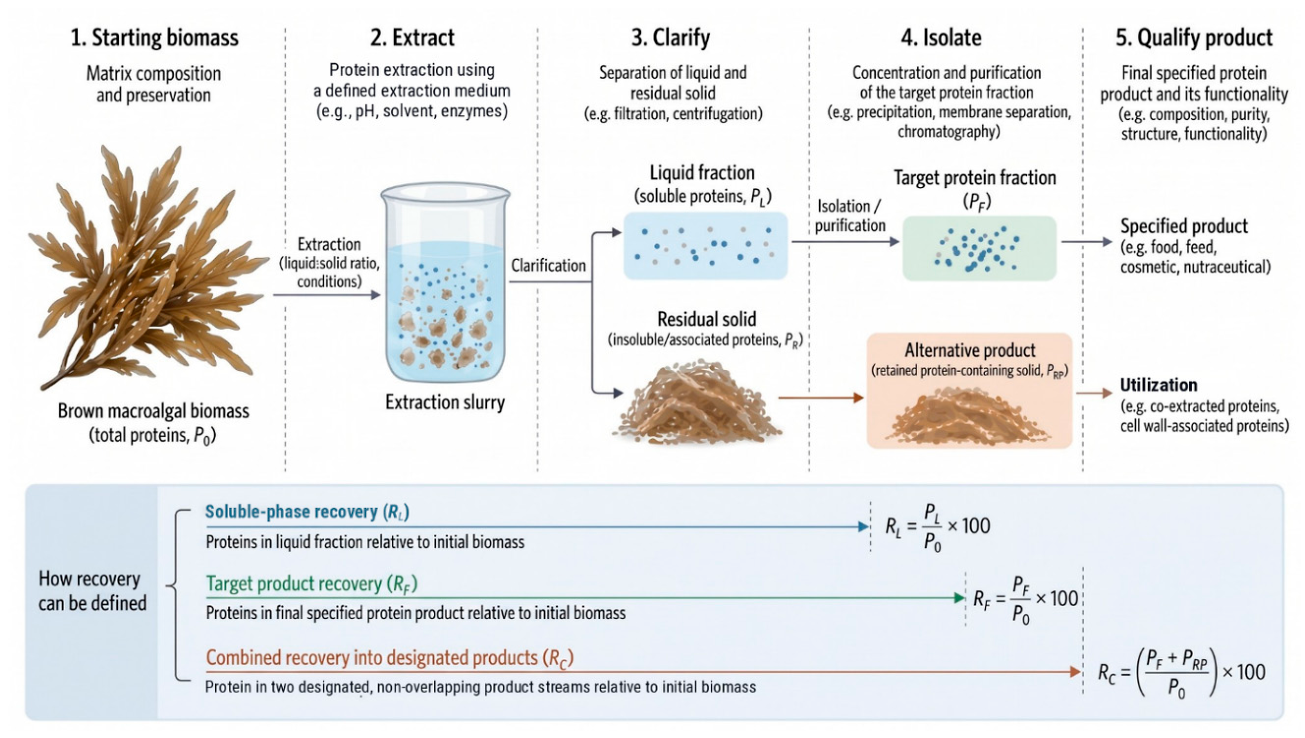
Figure 2.
Illustrative experimental distinctions between release, product recovery and analytical balance closure. (A) Veide Vilg and Undeland [9]: transfer into the extract (46.4% of starting protein) and final precipitate recovery (16.01% of starting protein), with the 34.5% conditional precipitation yield applied to the extracted fraction. (B) Aasen et al. [19]: independently measured fractions of total amino acids and nitrogen retained in the solid and present in the liquid; closures are 102.9% and 93.7%, respectively. Percentages refer to the analytes and denominators defined by each source; the panels do not represent new experiments or independently measured process losses.
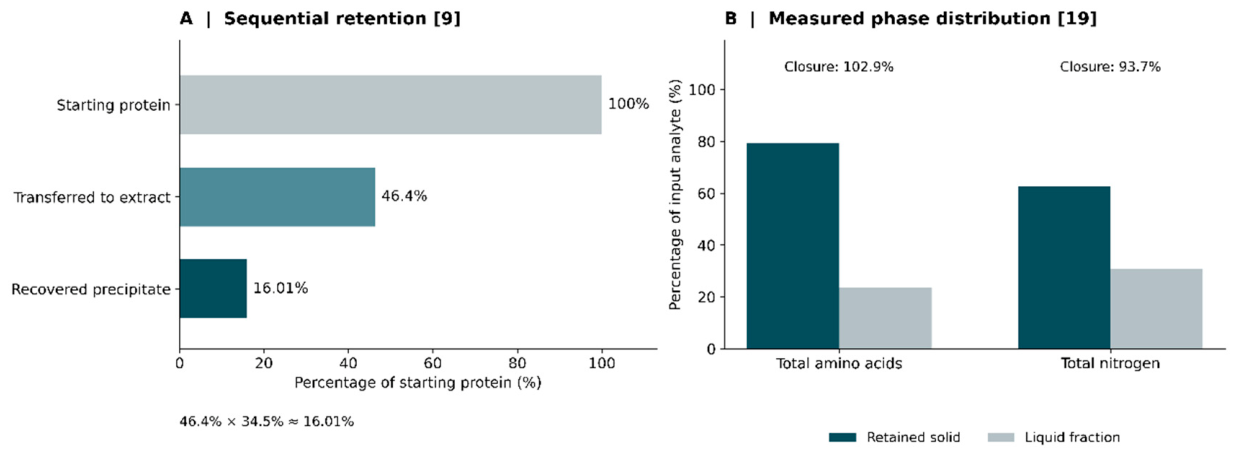
Figure 3.
Conceptual framework for selecting and evaluating brown-macroalgal protein-recovery strategies according to the intended product. The proposed framework comprises four interconnected stages: (1) defining the intended application and establishing product specifications for composition, functionality, safety, and applicable regulatory requirements; (2) characterizing the starting biomass, assessing protein accessibility within the algal matrix, and identifying technically feasible extraction and recovery strategies; (3) quantifying proteinaceous material across relevant processing fractions, including recovered products, residual solids, and other potentially valuable or discarded streams, using analytically compatible methods that account for matrix-dependent interference; and (4) evaluating the recovered product against predefined specifications, together with relevant technical, economic, and environmental considerations. The framework recognizes that brown-macroalgal cell walls contain structural polysaccharides, including cellulose, alginates, and sulfated fucans, with potentially associated phlorotannins whose distribution and interactions vary among species. Intermediate processing fractions and their downstream products represent successive recovery stages and should not be counted independently when calculating overall recovery. The feedback loop indicates that extraction conditions, recovery operations, or the intended product strategy may be reconsidered when the recovered material fails to meet the required specifications. This framework represents a conceptual synthesis of available evidence rather than an experimentally validated optimization model. Its application requires product-specific experimental assessment, complemented, where appropriate, by techno-economic and life-cycle analyses. No experimental measurements are presented.
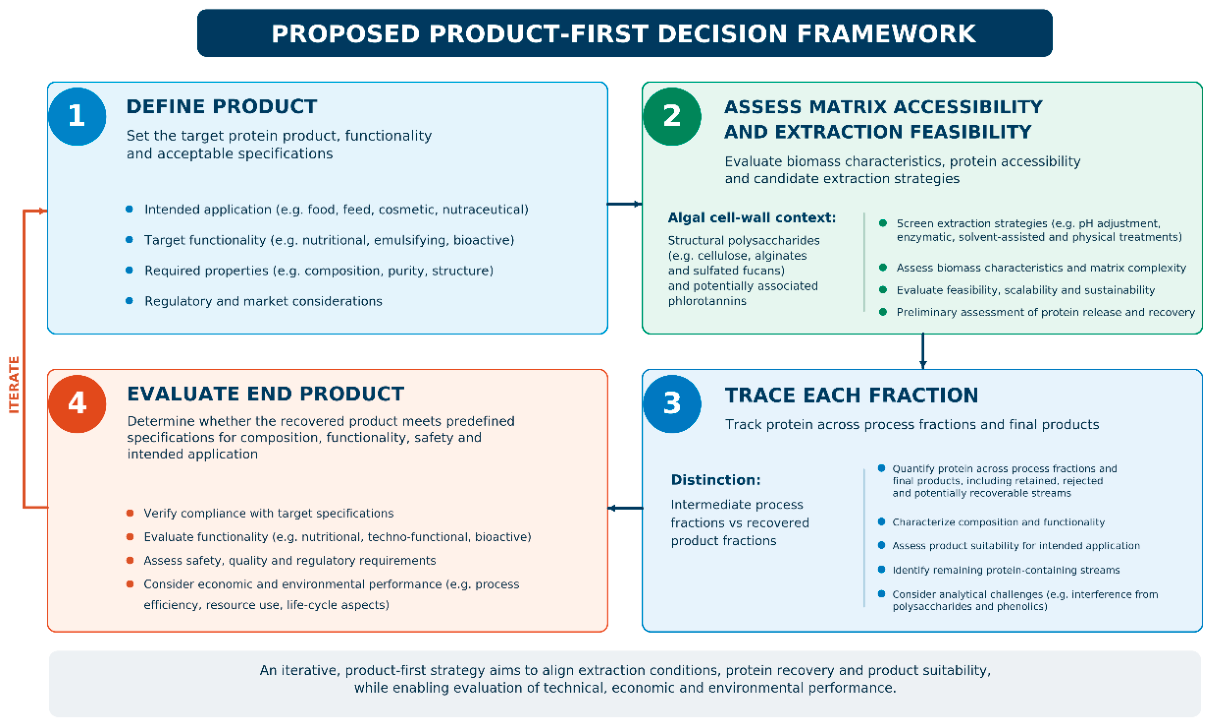
Table 2.
Distinct protein-related outcomes and their denominators. Each numerator and denominator must refer to a declared stream and compatible assay.
Table 2.
Distinct protein-related outcomes and their denominators. Each numerator and denominator must refer to a declared stream and compatible assay.
| Quantity | Numerator / denominator | What it establishes | Frequent error |
| Dry-extract yield | Dry extract mass / initial dry biomass mass | Total solid material removed | Treating non-protein solids as protein |
| Protein content of extract | Proteinaceous mass / extract mass | Product composition | Interpreting as fraction of initial protein recovered |
| Biomass-normalized extracted protein | Proteinaceous mass in extract / initial biomass mass | Extracted mass per biomass mass | Confusing with initial-protein-normalized solubilization |
| Clarified-liquid recovery | PL/P0; clarified liquid after solid–liquid separation | Material retained in clarified liquid after separation | Equating post-clarification recovery with initial solubilization or final recovery |
| Stage-specific capture | Pcaptured / Pstage-in for explicitly stated step | Retention from soluble feed to selected product | Applying to multi-step scheme without intermediate losses |
| Final protein recovery | PF/P0 (after all final-product operations) | Proteinaceous fraction of initial protein mass reaching product | Calling it product purity |
| Protein enrichment | Product protein wt% / starting protein wt% | Change in concentration (fold) | Calling it percentage mass recovery |
| Nitrogen recovery | Nitrogen in specified stream / N in initial input | Transfer of measured N | Equating to intact protein or protein-specific mass |
| Amino acid recovery | Compatible measured residue mass in product / in feed | Retention of measured amino acids on a compatible residue basis | Assuming native intact protein recovery |
Table 4.
Selected experiments illustrating why measured fraction, analytical basis and demonstrated outcome must be separated.
Table 4.
Selected experiments illustrating why measured fraction, analytical basis and demonstrated outcome must be separated.
| Study / biomass | Observation (reported basis) | Scientific inference | Qualification |
| Veide Vilg & Undeland [9], S. latissima | 46.4% soluble; 34.5% of soluble recovered; 16.01% overall | Early release is not terminal recovery. | One protocol, original analytical basis. |
| Harrysson et al. [11], mixed algal groups | Modified Lowry gave 34.3% higher estimates on average than TAA | Assay changes apparent yield. | Pooled across red, green and brown extracts; not a brown-specific conversion factor. |
| O’Connor et al. [12], Fucus vesiculosus | Classical 35.1 ± 9.1%; HPP 23.7 ± 2.1%; autoclave 24.3 ± 1.5% (F. vesiculosus) | Within-study numerical variation; no demonstrated superiority among treatments for the two brown species. | Differences among treatments were not statistically significant for either brown species; N-derived extractability, not terminal isolation. |
| Trigo et al. [10], S. latissima | 45 °C blanching decreased solubilization, enhanced precipitation, cut iodine 49% | Product composition and stages interact. | Dialysis supports the proposed ionic-strength interpretation but does not uniquely establish the mechanism; iodine remained relevant to end use. |
| Sivagnanam et al. [24], A. nodosum | US/MW and enzyme steps did not improve protein/FAA yields | Co-product gains do not prove protein gains. | The reported outcomes are specific to the tested species, treatments and measured protein/free-amino-acid endpoints; they do not support a general technology ranking. |
| Aasen et al. [19], S. latissima | Retained sediment: 79.4% total amino acids; 62.8% N; 39.6% dry matter; 24.2% ash (original Table 2). | A proteinaceous product may deliberately remain in an insoluble solid, alongside selective loss of ash/dry matter. | Total-amino-acid sediment recovery, not dry-solid yield or intact-protein recovery; reported TAA balance closure 102.9%. |
| Zhu et al. [3], Alaria esculenta | Protein-enriched final residue, 17.19 ± 1.33% protein | Stream identity matters in biorefineries. | Residue composition, not isolated-protein recovery. |
| Bojorges et al. [13], two brown seaweeds | Enzyme-treated fractions: approximately 17–25% protein and 59–62% carbohydrate; high emulsifying performance of selected fractions. | Purity is not equal to application suitability. | Extract-level functionality cannot be attributed to protein alone without component-resolved controls. |
Table 5.
Product-dependent objectives and plausible starting routes, presented as hypotheses for testing rather than universal optima.
Table 5.
Product-dependent objectives and plausible starting routes, presented as hypotheses for testing rather than universal optima.
| Target product | Product-defining evidence | Plausible starting process | Critical constraint |
| Protein-enriched solid | Composition, ash, digestibility, contaminants | Gentle washing/extraction retaining solids (Aasen et al. [19]) | Quantify protein retained; not simply enrichment fold. |
| Protein concentrate | Proteinaceous recovery and concentration; purity | Alkaline/pH-shift with verified capture | Protein loss, co-precipitation, chemical use. |
| Mixed emulsifying fraction | Emulsion/foam data under real use; mixed composition | Selective aqueous/enzyme-assisted route | Do not assign activity to proteins without controls. |
| Nutritional ingredient | AAs, digestibility, bioavailability, iodine and safety | Product-specification-guided purification | Maximal extraction may compromise specifications. |
| Proteolysis substrate | Accessible proteinaceous precursor; enzyme-compatibility | Moderately selective extraction + conditioning | Residues, enzyme blanks, salt and phenolic interference. |
| Defined peptide fraction | Identity, peptide recovery, suitable functional assay | Controlled hydrolysis + peptide fractionation | Hydrolysate mass is not target-peptide recovery. |
| Biorefinery protein stream | Multi-stream mass balance, co-products, inputs | Cascading extraction / retained residue | Denominator depends on stream boundary. |
Table 6.
Minimum reporting information proposed for future brown-macroalgal protein extraction and recovery studies.
Table 6.
Minimum reporting information proposed for future brown-macroalgal protein extraction and recovery studies.
| Domain | Minimum reportable information |
| Starting material | Species, tissue, harvest context, lot, preservation, time/storage, prior processing, wet/dry basis. |
| Analytical basis | Assays and standards for biomass/streams; nitrogen factor; non-protein N/free AAs; blanks, replicates and uncertainty. |
| Extraction and recovery | pH, chemistry, ratios, temperature, time, number of steps, centrifugation/filters, washes/drying. |
| Process boundaries | Defined input, target product, non-target streams, equations and numerators/denominators. |
| Mass balance | As feasible, input and each target/non-target stream on the same N/protein/TAA basis; report closure and uncertainty. |
| Composition and safety | Protein basis, carbohydrate/phenolics, moisture, ash/salts, iodine and other relevant elements. |
| Function / peptides | Application-specific assays; enzyme input controls, hydrolysis conditions, analytical peptide recovery and limits of in-vitro inference. |
| Resource use | Water, chemical, enzyme, heat, electricity, solvent reuse, concentration/drying requirements. |
| Data transparency | Enough original numbers and units to reproduce every derived percentage. |
Disclaimer/Publisher’s Note: The statements, opinions and data contained in all publications are solely those of the individual author(s) and contributor(s) and not of MDPI and/or the editor(s). MDPI and/or the editor(s) disclaim responsibility for any injury to people or property resulting from any ideas, methods, instructions or products referred to in the content. |
© 2026 by the authors. Licensee MDPI, Basel, Switzerland. This article is an open access article distributed under the terms and conditions of the Creative Commons Attribution (CC BY) license.
Copyright: This open access article is published under a Creative Commons CC BY 4.0 license, which permit the free download, distribution, and reuse, provided that the author and preprint are cited in any reuse.