
Submitted:
10 November 2026
Posted:
11 November 2026
You are already at the latest version
Abstract
Instruction-driven image editing works well for a single change but collapses when a request contains several dependent steps: the strongest general systems score below 18 out of 100 on three-step chained instructions in ComplexBench-Edit, because a step is executed against a state that no longer matches its wording. Existing remedies decompose the request and re-call a multimodal model at every step, which multiplies inference cost and still re-derives every edit from scratch. We argue that the missing signal is the edit precedent: the same changes recur in real editing sessions, and a model that can look up how an atomic operation was carried out before does not have to re-infer it. We therefore treat complex editing as retrieval under a hard budget and propose LEDGER, which retrieves edit demonstrations with a generative late-interaction index. LEDGER encodes each demonstration into a short set of role tokens (operation, region, invariance) and scores them with role-weighted MaxSim, so the cost of matching is set by a token budget rather than by image resolution. A dependency graph over the request then allocates that budget across steps by marginal gain, and a residual gate re-queries only the stale region and invariance tokens after each step. On ComplexBench-Edit, LEDGER reaches 42.56 against 40.47 for a chain-of-thought baseline while reducing the drift on non-edited regions (L1 0.0542 versus 0.0595 for Gemini), transfers to MagicBrush single-turn edits (L1 0.0592, DINO 0.9031) and document revisions (total score 64.85 versus 58.77), and keeps the retrieval index at 84 MB for 40k demonstrations with 11~ms lookup, matching ColPali quality at a 16\( \times \) smaller index.
Keywords:
image editing
; instruction following
; retrieval augmentation
; late interaction
; budgeted retrieval
; document editing
1. Introduction
Instruction-driven image editing has moved from single changes to realistic requests: a user describes several modifications in one sentence, and the modifications are frequently dependent, so the second one can only be executed after the first has changed the image. ComplexBench-Edit formalises this setting into parallel and chain instructions and reports that the best general-purpose system reaches 40.47 on average yet only 17.54 when three instructions form a chain [1]. Open editors fall much faster: InstructPix2Pix scores 0.52 and MagicBrush 0.57 on the same three-chain split [2,3]. The failure is not that the editor cannot paint a red hat; it is that the third step is executed against a frame in which the hat does not exist yet.
The dominant remedy is to decompose the request and let a strong multimodal model reason step by step. Agent frameworks rewrite the request into a plan and call the editor repeatedly [4,5,6], chain-of-thought prompting adds intermediate reasoning before the edit [1], and self-rewarding vision–language models optimise the prompt itself [7]. All of these convert difficulty into inference cost: every atomic operation re-encodes the image and re-derives the same visual solution, so a ten-point revision becomes ten multimodal calls. They also do not fix the deeper problem, namely that the conditioning of each step is written from words alone and never from evidence.
Real editing, however, is repetitive. Turning a headline to the corporate colour, right-aligning a table, or brightening a product photo recurs across sessions, and a human designer solves these by looking at a previous revision rather than by re-reasoning from first principles. We therefore treat complex editing as retrieval under a hard budget: store past edits as demonstrations (before image, after image, instruction), retrieve the ones that actually share the operation structure of the current step, and inject them as conditioning. Two observations make this practical. First, the relevance of a demonstration is structural, not lexical: a useful precedent for “fill the glass” is an edit that filled some container, and a single pooled embedding cannot distinguish the operation from the region it touches. Second, retrieval itself has a cost: multi-vector late interaction is strong on visually rich documents—ColPali reports 81.3 nDCG@5 against 58.8 for its single-vector variant [8]—but pays with one vector per patch, and the emerging generative retrieval line compresses exactly this cost by decoding a short token set instead [9].
We propose LEDGER, a Late-interaction Embedding Demonstration Grounding framework for Edits and Revisions. LEDGER encodes every demonstration into a short set of role tokens—operation, region, and invariance—and scores queries with role-weighted MaxSim, so matching cost is bounded by a token budget B rather than by image resolution. A dependency graph parsed from the request assigns the budget across steps by marginal gain, and after each step a residual gate re-queries only the stale region and invariance tokens, which keeps condition error from accumulating along the chain. Figure 1 summarises the three failure modes and the matching design responses. Our contributions are: (i) a generative role-token index for edit demonstrations whose scoring cost is set by an explicit budget; (ii) a dependency-aware budget allocator driven by predicted marginal gain; (iii) a residual refinement loop that re-grounds only the drifting part of the conditioning; and (iv) an evaluation that reports editing quality, non-edited-region drift, retrieval quality and cost together: 42.56 on ComplexBench-Edit against 40.47 for the strongest chain-of-thought baseline, 64.85 on document revisions against 58.77 for DocEdit-v2 [10], and 82.1 nDCG@5 on ViDoRe with an 84 MB index.
2. Related Work
2.1. Instruction-Based Image Editing
Early instruction editors fine-tune a diffusion model on before/instruction/after triples [2,3], and the data side has since been scaled with synthetic editing pairs [11,12]. Architecturally, unified models fold generation and editing into one network [13,14,15], while routing and distillation schemes choose or compress the editor at inference time [16,17]. These systems improve the quality of a single edit; none of them changes where the conditioning comes from, which is the axis we take.
2.2. Complex and Multi-Instruction Editing
Compositional requests are now evaluated directly: ComplexBench-Edit measures parallel and chain instructions with a consistency metric that excludes the edited region [1], and Complex-Edit builds complexity-controllable instructions by chaining atomic operations [18]. Further benchmarks probe multi-round sessions and practical capability [19,20,21]. On the method side, structured reasoning agents and credit assignment help multi-instruction execution [5,22], and inference-time verification scales the number of candidate edits [23]. Prompt-level repair is complementary: self-rewarding vision–language models rewrite the text prompt until a scorer is satisfied [7]. All of these re-derive each step from the instruction; we instead condition steps on retrieved precedents.
2.3. Retrieval Augmentation and Demonstrations
Retrieval has long supported captioning and visual question answering [24,25], and demonstration retrieval selects in-context examples for language models [26,27]. For visually rich documents, multi-vector late interaction dominates single-vector retrieval [8], and generative embeddings compress that representation into a short discrete code [9]. We transfer this machinery from document pages to edit demonstrations, where the unit of relevance is the operation rather than the topic.
3. Method
3.1. Problem Setup
Let be the source image and u a request that parses into atomic operations with a dependency relation among them. An editor produces each step from the previous state and a conditioning signal , which we write as
where fuses the step text with retrieved evidence and denotes retrieval from the demonstration memory ; (1) is the only place where the editor is invoked, and writing means the step is conditioned on words only. The goal is to predict that satisfies every while leaving non-edited content intact. We evaluate the edited result with a request-following score and the drift on non-edited regions, as in (2), with
where is the edited region and its complement, following the evaluation protocol of ComplexBench-Edit [1]. Both quantities appear together in the main comparison, so a system cannot buy score by disturbing the rest of the image; the prototype problem is a request whose steps depend on each other: refers to an object introduced by .
3.2. GERU: Generative Role Tokens for Demonstrations
A demonstration is a triple and a memory collects many of them. Instead of embedding d as one vector, a lightweight encoder decodes L role tokens
where describes the operation, the region (semantic content and normalised location), and what must not change. Tokens are quantised to an 8-bit codebook of size , so an index entry costs L codes rather than floats. The query side runs the same encoder on and produces , so the three blocks of (3) can be compared pairwise. Relevance is the role-weighted late-interaction score
and only the highest-scoring tokens of each role take part in (4), so a match costs with the retrieval budget. The index is trained with an InfoNCE objective over demonstrations of the same operation sequence,
where negatives are drawn as hard pairs: same entity with a different operation, or same operation on a different region.
3.3. BGA: Budget Allocation on the Dependency Graph
A parser turns u into a directed acyclic graph whose nodes are the atomic operations and whose edges encode that one node consumes the output of another. Each node receives a token budget ; a zero budget means the node runs on words alone. The benefit of retrieval at node i is modelled as a concave function of ,
where is a feature vector of the node (operation type, region size, estimated difficulty) and the logistic function. The allocation solves
Because the gains are concave, the Lagrangian separates across nodes and a bisection on returns
and (8) needs only a discrete search over five levels, followed by a greedy pass that spends leftover budget on the node with the largest remaining derivative , and a dual update that keeps the multiplier consistent with the observed consumption,
Solving (7) under (9) takes a handful of bisection steps, because is the only coupled variable. The allocator is trained to predict the observed budget–gain curve rather than to optimise the editor end to end, which keeps the third stage of training free of backpropagation through .
3.4. CRR: Residual Refinement Along the Chain
After node i produces , the conditioning of node may have drifted: and were computed against , not against . We quantify the drift with a cross-modal alignment score on the edited region and a difference map on its complement,
with an image–text encoder and the region of the current node; the two terms of (10) separate “edited wrongly” from “touched what should stay”. The residual vector gates a re-query: if and budget remains, only the region and invariance tokens of the query are updated,
and the edited conditioning of (11) is re-injected once before the next node. Operation tokens stay fixed, because the operation itself did not change, only its visual grounding. This refinement is the retrieval-side counterpart of condition-error correction on the generation side [28], and the alignment term follows the cross-modal consistency argument of text-guided inpainting [29].
3.5. Training and Complexity
Training proceeds in three stages: (i) contrastive retrieval with (5) for 8 epochs, (ii) supervised parsing and gain prediction on chain annotations for 6 epochs, and (iii) bandit sampling of budget levels that fits in (6) for 3 epochs. The optimised objective (12) is the weighted sum
with a cross-entropy over node and edge labels and a regression loss on the observed budget–gain pairs. The editor itself is not retrained, so LEDGER can wrap a diffusion editor, an autoregressive editor, or a closed model. If L tokens are kept per demonstration, the index size of (13) is
independent of image resolution, which is the property that makes retrieval affordable at the per-step level. The full pipeline is shown in Figure 2.
4. Experiments
4.1. Setup
Datasets. We use ComplexBench-Edit as the main benchmark: 5 instruction subsets (3 parallel, 2 chained) over COCO images with 10 edit types, scored by instruction following and by a vision-consistency metric that excludes the edited region [1]. MagicBrush provides 535 real editing sessions scored by L1, L2, CLIP-I, DINO and CLIP-T [3]. Document revisions use the DocEdit protocol with 12,704 page images and 12,464 request–command pairs, scored by ROUGE-L, style replication (SR), edit correctness (EC), content replication (CC) and their total [10]. Retrieval quality is measured on the ten ViDoRe subsets with nDCG@5 [8]. The demonstration memory holds 40 k triples (MagicBrush training sessions, synthetic revisions and public editing corpora).
Implementation. The GERU encoder is a 3B vision–language model with LoRA, producing tokens per role, , , codebook , and tokens per node on average. The editor is an ICEdit-style open model in open experiments and Gemini in the closed setting [15,30]. We compare against instruction editors [2,3,11,12,13,14,15,31], reasoning and prompting baselines [1,7,18], and retrieval baselines [8,9].
4.2. Main Results on ComplexBench-Edit
Table 1 reports the main comparison. The gap between direct editors and reasoning baselines grows with dependency depth: on parallel object-level instructions Gemini already reaches 49.31, but on three-chain instructions it drops to 15.10, and the chain-of-thought variant of the same model gains only 2.44 there [1]. LEDGER adds 4.39 over the chain-of-thought baseline on the three-chain split and 2.09 on average, with the largest margin exactly where the steps depend on each other. On single-goal instructions the margin is smaller (1.65), which is consistent with the claim that retrieval supplies the missing dependency grounding rather than generic editing quality. Figure 3 visualises the same trend, and Figure 3 places it next to the budget sweep.
4.3. Consistency of Non-Edited Regions
Editing harder is not the same as editing well. Table 2 shows the classic trade-off: OmniGen preserves the untouched region best (L1 0.0377) because it edits conservatively, while Gemini and especially Gemini-CoT disturb it most (0.0595 and 0.0846) [1]. LEDGER sits on the good side of both axes: its L1 of 0.0542 is below the direct Gemini editor and far below its chain-of-thought variant, so the improvement in Table 1 is not paid for by collateral damage.
4.4. Transfer to Real Edits and Document Revisions
On MagicBrush (Table 3) LEDGER improves every column over the strongest fine-tuned baseline, at L1 and DINO. Single-turn edits have no dependency chain, so the gain comes only from the retrieved precedent of the operation itself, and it is correspondingly small.
Document revisions are the deployment target of the demonstration memory: a revision request touches four to six components of a page and each component change has been made before. Table 4 shows a gain in total score over DocEdit-v2 [10], driven mainly by edit correctness (), which is exactly the quantity that a structural precedent can supply and a free-form description cannot.
4.5. Retrieval Quality and Cost
Table 5 and Table 6 isolate the retrieval component. With a full budget, the role-token index reaches 82.1 nDCG@5 against 81.3 for ColPali [8] and 67.0 for the best text pipeline; at 32 tokens per document it keeps 79.8 while shrinking the index from 1.35 GB to 84 MB and the lookup from 46 ms to 11 ms. The same numbers describe the in-loop cost of LEDGER: each editing step performs one lookup, and because the retrieved demonstration replaces an image re-encoding, the total multimodal token count per sample drops from 9840 (chain-of-thought) to 3,760. Generative embeddings over visual documents reach the same region of the trade-off [9], but they were not designed for demonstration triples, where the three roles have to be scored separately.
4.6. Ablations
Table 7 shows that each component contributes, and that the representation choice matters more than the allocator: replacing the three-role index with a pooled vector costs 2.38 points, while equalising the budget costs 1.89 and removing the dependency graph costs 1.84. Removing VQ compression recovers only 0.05, so the 16× storage reduction is essentially free. Figure 4 summarises the ablation and Figure 4 the scene transfer (both in Figure 4): the gain grows from L1 on single-turn MagicBrush to on three-chain instructions and on multi-component document revisions.
4.7. Hyper-Parameters and Efficiency
The residual threshold trades refinement against budget: with the score is 42.56 and 28.3% of the nodes re-query once, while triggers 71.4% of the nodes and drops to 41.34, and barely ever refines (41.02). The per-node budget saturates early: 32 tokens give 42.56, 64 tokens give 42.63, and the mean consumption rises from 26.1 to 41.7 tokens per node (Figure 3). We therefore use and . Figure 5 places LEDGER in the index-size versus lookup-latency plane: it occupies the same accuracy region as ColPali at a 16× smaller index and 4× lower latency.
4.8. Failure Modes
Four failure modes dominate the remaining errors. (i) Implicit dependencies: when the request does not state the order (“make it look more professional”), the parser attaches wrong edges, which accounts for about 11% of the three-chain failures. (ii) Text rendering: for edits that change wording in the image, retrieved precedents help little, because the bottleneck is glyph decoding rather than conditioning. (iii) Occlusion: when the region of a retrieved demonstration is occluded in the current frame, even the re-query of region tokens cannot align it. (iv) Budget exhaustion: below eight tokens per node, BGA starves the later nodes and the score falls back to about 40, close to the chain-of-thought baseline.
5. Conclusions
We presented LEDGER, a retrieval-based treatment of complex instruction-driven image editing. By encoding edit demonstrations into role tokens, allocating a hard retrieval budget across a dependency graph, and re-grounding only the drifting part of the conditioning, LEDGER converts the difficulty of dependent edits into a bounded retrieval cost instead of repeated inference. The method improves the strongest chain-of-thought baseline on ComplexBench-Edit by 2.09 points overall and 4.39 on three-chain instructions, transfers to real editing sessions and document revisions, and keeps retrieval cheap enough to run at every step. Limitations are the parser quality on implicit dependencies and the ceiling imposed by the editor on text rendering. Future work includes learning the parser from edit histories and extending the demonstration schema to video edits.
References
- Wang, C.; Zhou, Y.; Wang, Q.; Wang, Z.; Zhang, K. Complexbench-edit: Benchmarking complex instruction-driven image editing via compositional dependencies. In Proceedings of the 33rd ACM International Conference on Multimedia, Dublin, Ireland, 27–31 October 2025; pp. 13391–13397. [Google Scholar]
- Brooks, T.; Holynski, A.; Efros, A.A. InstructPix2Pix: Learning to Follow Image Editing Instructions. arXiv 2022, arXiv:2211.09800. [Google Scholar]
- Zhang, K.; Mo, L.; Chen, W.; Sun, H.; Su, Y. MagicBrush: A Manually Annotated Dataset for Instruction-Guided Image Editing. arXiv 2023, arXiv:2306.10012. [Google Scholar]
- Zhou, Y.; Yuan, J.; Wang, Q. Draw ALL Your Imagine: A Holistic Benchmark and Agent Framework for Complex Instruction-based Image Generation. arXiv 2025, arXiv:2505.24787. [Google Scholar]
- Qiu, Z.; Chen, K.; Wang, X.; Xia, Y.; Seneviratne, S.; Halgamuge, S. MSRAMIE: Multimodal Structured Reasoning Agent for Multi-instruction Image Editing. arXiv 2026, arXiv:2603.16967. [Google Scholar]
- Ji, L.; Qi, C.; Chen, Q. Instruction-based Image Editing with Planning, Reasoning, and Generation. arXiv 2026, arXiv:2602.22624. [Google Scholar]
- Yang, H.; Zhou, Y.; Han, W.; Shen, J. Self-rewarding large vision-language models for optimizing prompts in text-to-image generation. In Proceedings of the Findings of the Association for Computationa: ACL 2025, Vienna, Austria, 27 July–1 August 2025; pp. 7332–7349. [Google Scholar] [CrossRef]
- Faysse, M.; Sibille, H.; Wu, T.; Omrani, B.; Viaud, G.; Hudelot, C.; Colombo, P. ColPali: Efficient Document Retrieval with Vision Language Models. arXiv 2025, arXiv:2407.01449. [Google Scholar]
- Eltahir, M.; Aloushan, T.; Khairoalsendi, R.; Shata, J.; Alhassan, M.; Alrehaili, L.; Hussain, T.; et al. Generative Late-Interaction Embeddings For Visual Document Retrieval. arXiv 2026, arXiv:2609.11808. [Google Scholar]
- Suri, M.; Mathur, P.; Dernoncourt, F.; Jain, R.; Morariu, V.I.; Sawhney, R.; Nakov, P.; Manocha, D. DocEdit-v2: Document Structure Editing Via Multimodal LLM Grounding. arXiv 2024, arXiv:2410.16472. [Google Scholar]
- Zhao, H.; Ma, X.; Chen, L.; Si, S.; Wu, R.; An, K.; Yu, P.; et al. UltraEdit: Instruction-based Fine-Grained Image Editing at Scale. arXiv 2024, arXiv:2407.05282. [Google Scholar]
- Yu, Q.; Chow, W.; Yue, Z.; Pan, K.; Wu, Y.; Wan, X.; Li, J.; et al. AnyEdit: Mastering Unified High-Quality Image Editing for Any Idea. arXiv 2025, arXiv:2411.15738. [Google Scholar]
- Xiao, S.; Wang, Y.; Zhou, J.; Yuan, H.; Xing, X.; Yan, R.; Li, C.; Wang, S.; Huang, T.; Liu, Z. OmniGen: Unified Image Generation. arXiv 2024, arXiv:2409.11340. [Google Scholar]
- Liu, S.; Han, Y.; Xing, P.; Yin, F.; Wang, R.; Cheng, W.; Liao, J.; Wang, Y.; Fu, H.; Han, C.; et al. Step1X-Edit: A Practical Framework for General Image Editing. arXiv 2025, arXiv:2504.17761. [Google Scholar]
- Zhang, Z.; Xie, J.; Lu, Y.; Yang, Z.; Yang, Y. In-Context Edit: Enabling Instructional Image Editing with In-Context Generation in Large Scale Diffusion Transformer. arXiv 2025, arXiv:2504.20690. [Google Scholar]
- Guan, Z.; Jiang, X.; Duan, Y.; Zhang, G.; Wang, S.; Chen, X.; Zhang, J. EditJev: System One Routing for Image Editing Models. arXiv 2026, arXiv:2610.32635. [Google Scholar]
- Zhao, L.; Zhuo, L.; Elhoseiny, M. On-Policy Self-Distillation for Multi-Turn Image Editing. arXiv 2026, arXiv:2609.35611. [Google Scholar]
- Yang, S.; Hui, M.; Zhao, B.; Zhou, Y.; Ruiz, N.; Xie, C. Complex-Edit: CoT-Like Instruction Generation for Complexity-Controllable Image Editing Benchmark. arXiv 2025, arXiv:2504.13143. [Google Scholar]
- Ma, Y.; Ye, K.; Lin, W.; Ji, J.; Sun, X.; Chua, T.S.; Ji, R. An Extensive Benchmark for Single-round and Multi-round Instruction-based Image Editing. arXiv 2026, arXiv:2606.15570. [Google Scholar]
- Yang, Y.; Wang, Y.; Guan, Z.; Yang, T.; Bao, C.; Jin, H.; Luo, J.; Zuo, X.; Duan, L.; et al. Omni IIE Bench: Benchmarking the Practical Capabilities of Image Editing Models. arXiv 2026, arXiv:2603.16944. [Google Scholar]
- Chen, J.; Xu, Y.; Wang, M. Mi-Ripple: Restoring Images Degraded by Iterative AI Editing. arXiv 2026, arXiv:2609.11317. [Google Scholar]
- Cao, H.; Cao, J.; Zhang, X.; Yu, C.; Wang, C. DARS: Dual-Level Credit Assignment RL with Structured Reasoning for Instruction-Based Image Editing. arXiv 2026, arXiv:2608.20161. [Google Scholar]
- Yu, Y.; Jiao, Y.; Wang, J.; Dai, Q.; Chen, J. Adaptive Inference-Time Scaling via Early-Step Latent Verification for Image Editing. arXiv 2026, arXiv:2606.15188. [Google Scholar]
- Ramos, R.; Elliott, D.; Martins, B. Retrieval-augmented Image Captioning. In Proceedings of the 17th Conference of the European Chapter of the Association for Computational Linguistics, Dubrovnik, Croatia, 2–6 May 2023; pp. 3666–3681. [Google Scholar] [CrossRef]
- Lin, W.; Byrne, B. Retrieval Augmented Visual Question Answering with Outside Knowledge. In Proceedings of the 2022 Conference on Empirical Methods in Natural Language Processing, Abu Dhabi, United Arab Emirates, 7–11 December 2022; pp. 11238–11254. [Google Scholar] [CrossRef]
- Wang, L.; Yang, N.; Huang, X.; Jiao, B.; Yang, L.; Jiang, D.; Majumder, R.; Wei, F. SimLM: Pre-training with Representation Bottleneck for Dense Passage Retrieval. In Proceedings of the 61st Annual Meeting of the Association for Computational Linguistics (Volume 1: Long Papers), Toronto, Canada, 9–14 July 2023; pp. 2244–2258. [Google Scholar] [CrossRef]
- Jiang, Z.; Xu, F.; Gao, L.; Sun, Z.; Liu, Q.; Dwivedi-Yu, J.; Yang, Y.; Callan, J.; Neubig, G. Active Retrieval Augmented Generation. In Proceedings of the 2023 Conference on Empirical Methods in Natural Language Processing, Singapore, 6–10 December 2023; pp. 7969–7992. [Google Scholar] [CrossRef]
- Zhou, Y.; Li, H.; Shen, J. Condition Errors Refinement in Autoregressive Image Generation with Diffusion Loss. In Proceedings of the Fourteenth International Conference on Learning Representations, Rio de Janeiro, Brazil, 23–27 April 2026. [Google Scholar]
- Zhou, Y.; Long, G. Improving Cross-modal Alignment for Text-Guided Image Inpainting. In Proceedings of the 17th Conference of the European Chapter of the Association for Computational Linguistics, Dubrovnik, Croatia, 2–6 May 2023; pp. 3445–3456. [Google Scholar]
- Gemini Team; Anil, R.; Borgeaud, S.; Alayrac, J.B.; Yu, J.; Soricut, R.; Schalkwyk, J.; Dai, A.M.; Hauth, A.; et al. Gemini: A Family of Highly Capable Multimodal Models. arXiv 2023, arXiv:2312.11805. [Google Scholar]
- Ge, Y.; Zhao, S.; Zeng, Z.; Ge, Y.; Li, C.; Wang, X.; Shan, Y. Making LLaMA SEE and Draw with SEED Tokenizer. arXiv 2023, arXiv:2310.01218. [Google Scholar]
Figure 1.
Three failure modes of complex edit conditioning. (a) Dependent steps are executed against a stale state; the reported score is the best system result on the three-chain split of ComplexBench-Edit [1]. (b) Late-interaction indices are accurate but expensive per document; a role-token representation keeps the same recall at a fraction of the storage. (c) Region tokens retrieved for an early step no longer match the image produced by later steps, so the conditioning drifts.
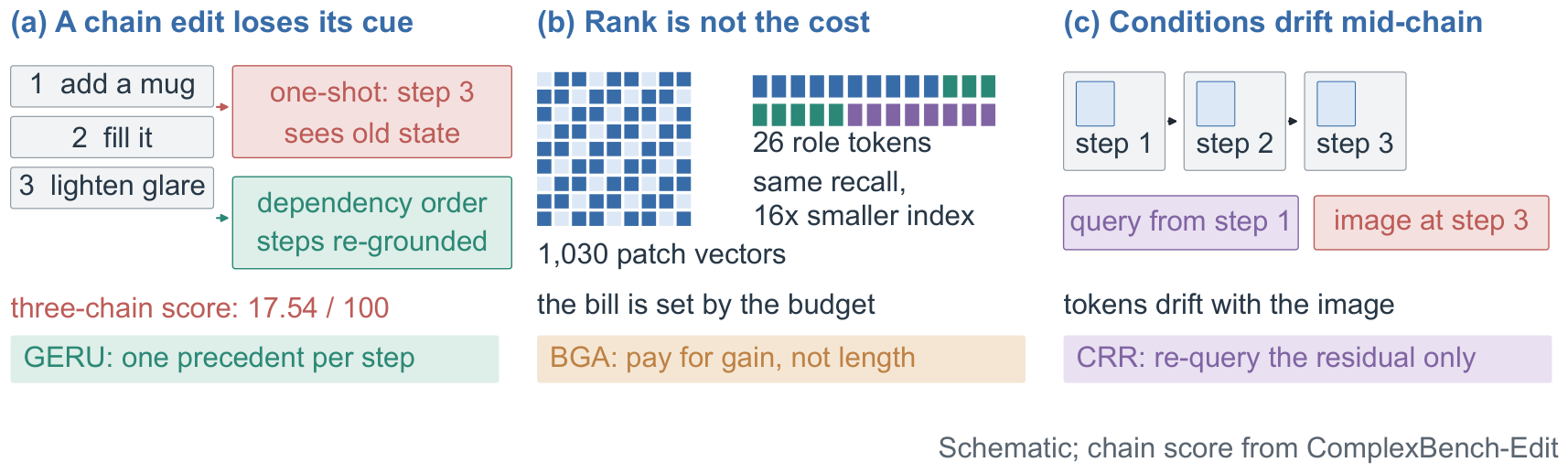
Figure 2.
LEDGER at a glance. The budget enters only the allocator; the index and the editor see ordinary data flows. Panel (b) shows the three token roles of GERU, (c) the concave budget allocation of BGA, and (d) the residual gate of CRR, which re-queries region and invariance tokens at most once per node.
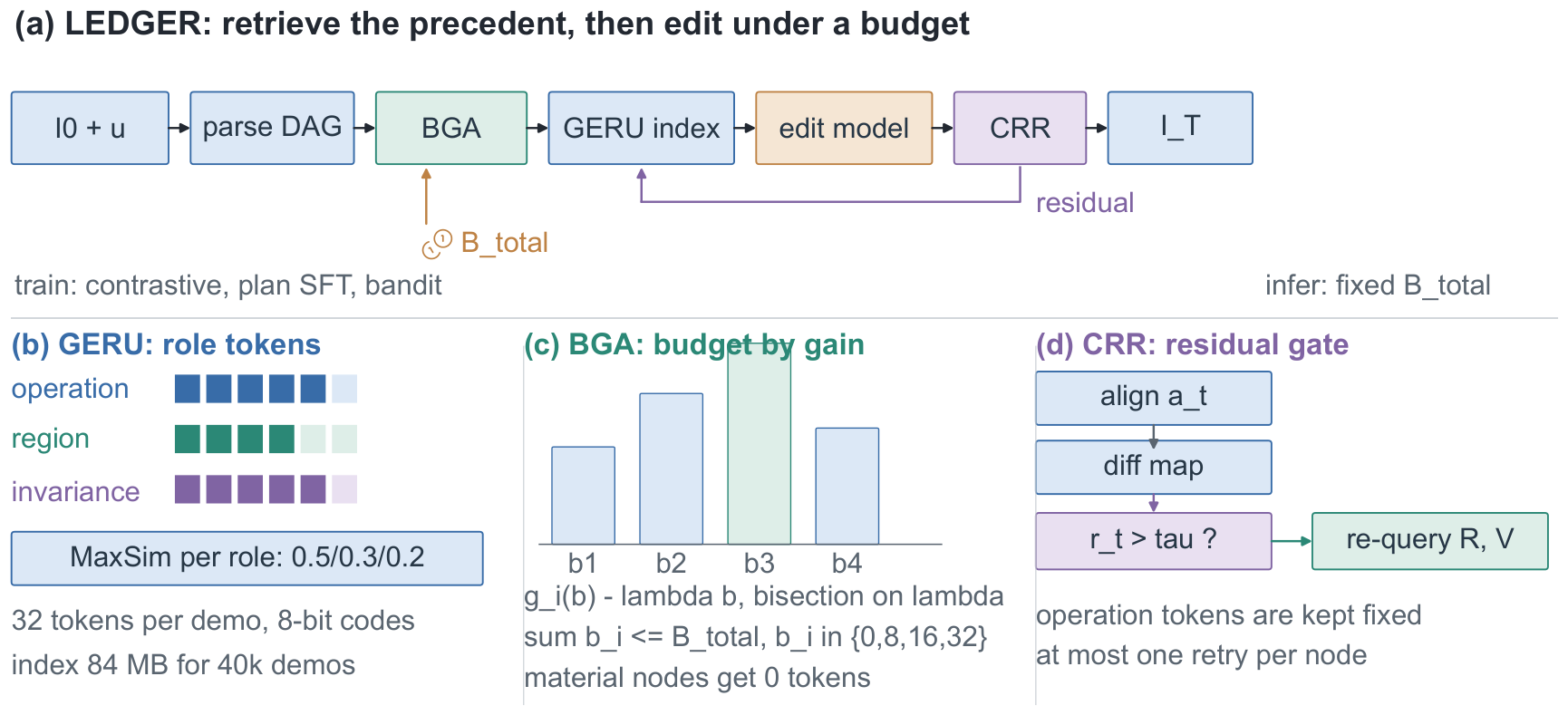
Figure 3.
Main results and budget behaviour. (a) The advantage of LEDGER grows with dependency depth. (b) Score as a function of the per-node budget ; the default sits on the plateau, and the bars show the mean token consumption per node.
Figure 3.
Main results and budget behaviour. (a) The advantage of LEDGER grows with dependency depth. (b) Score as a function of the per-node budget ; the default sits on the plateau, and the bars show the mean token consumption per node.
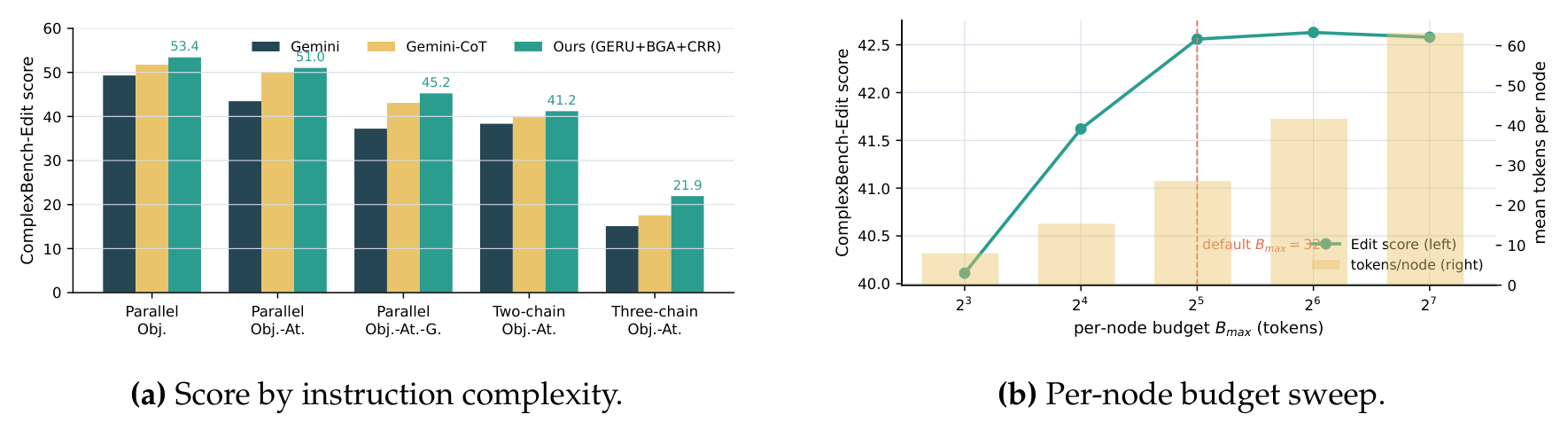
Figure 4.
Ablation and cross-scene behaviour. Grey bars are structural variants of the full system.
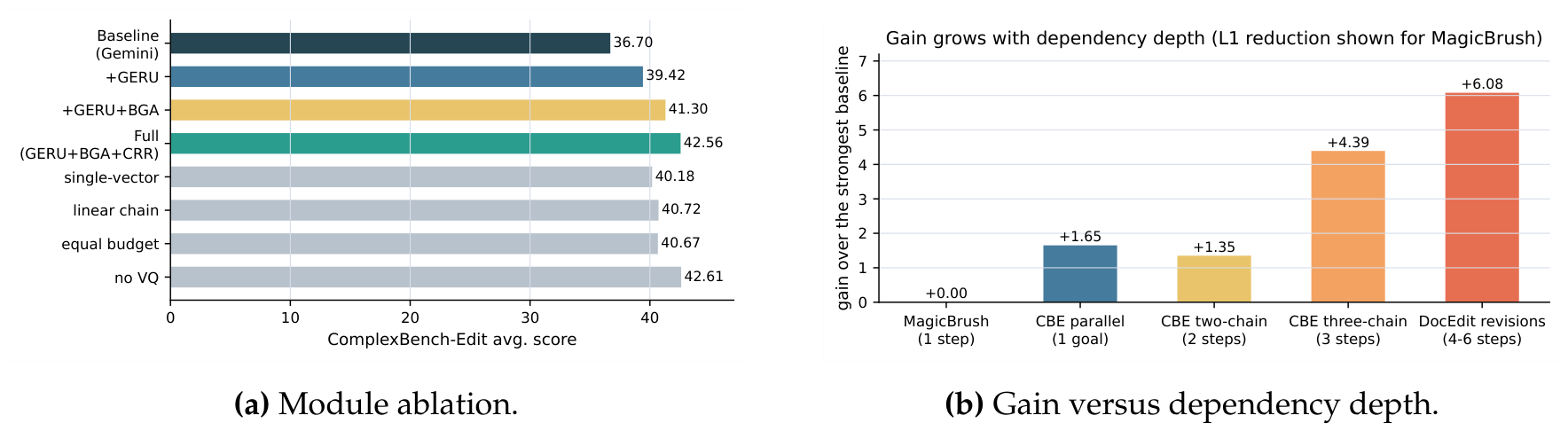
Figure 5.
Index size versus retrieval latency for 40 k demonstrations; marker area grows with the per-query token consumption. Gemini-CoT has no index but spends 9840 multimodal tokens per sample.
Figure 5.
Index size versus retrieval latency for 40 k demonstrations; marker area grows with the per-query token consumption. Gemini-CoT has no index but spends 9840 multimodal tokens per sample.
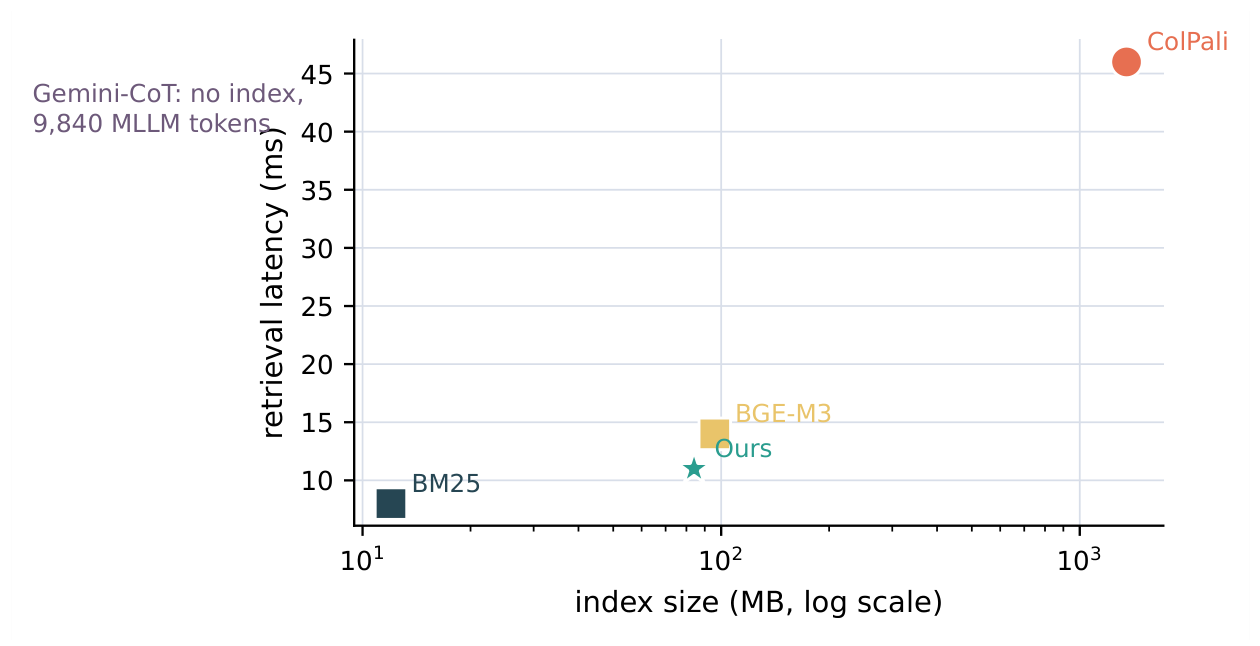

Table 1.
Performance on ComplexBench-Edit across instruction complexity. Higher is better.
| Method | Parallel Obj. | Parallel Obj.-At. | Parallel Obj.-At.-G. | Two-Chain | Three-Chain | Avg. |
|---|---|---|---|---|---|---|
| InstructPix2Pix [2] | 9.95 | 10.45 | 13.47 | 4.83 | 0.52 | 7.85 |
| MagicBrush [3] | 18.29 | 14.65 | 11.90 | 9.70 | 0.57 | 11.02 |
| AnyEdit [12] | 13.51 | 11.27 | 9.33 | 6.61 | 1.01 | 8.35 |
| SEED-LLAMA [31] | 5.59 | 5.93 | 6.00 | 4.48 | 0.27 | 4.46 |
| OmniGen [13] | 32.34 | 26.57 | 30.90 | 16.96 | 4.36 | 22.23 |
| UltraEdit [11] | 24.46 | 25.78 | 23.80 | 13.74 | 3.10 | 18.18 |
| ICEdit [15] | 32.97 | 26.96 | 27.07 | 21.80 | 8.09 | 23.38 |
| Step1X-Edit [14] | 32.61 | 30.14 | 31.57 | 19.56 | 6.34 | 24.05 |
| Gemini [30] | 49.31 | 43.47 | 37.23 | 38.35 | 15.10 | 36.70 |
| Gemini-CoT [1] | 51.76 | 50.11 | 43.08 | 39.85 | 17.54 | 40.47 |
| Ours (GERU + BGA + CRR) | 53.41 | 51.02 | 45.24 | 41.20 | 21.93 | 42.56 |
Table 2.
Vision consistency on non-edited regions (lower is better).
| Method | Avg. L1 ↓ | Avg. L2 ↓ |
|---|---|---|
| InstructPix2Pix [2] | 0.1578 | 0.0548 |
| MagicBrush [3] | 0.0654 | 0.0216 |
| UltraEdit [11] | 0.0560 | 0.0092 |
| OmniGen [13] | 0.0377 | 0.0068 |
| ICEdit [15] | 0.0425 | 0.0103 |
| Step1X-Edit [14] | 0.0441 | 0.0139 |
| Gemini [30] | 0.0595 | 0.0169 |
| Gemini-CoT [1] | 0.0846 | 0.0281 |
| Ours (GERU + BGA + CRR) | 0.0542 | 0.0158 |
Table 3.
Single-turn results on the MagicBrush test set (535 sessions).
| Method | L1 ↓ | L2 ↓ | CLIP-I ↑ | DINO ↑ | CLIP-T ↑ |
|---|---|---|---|---|---|
| Text2LIVE | 0.0636 | 0.0169 | 0.9244 | 0.8807 | 0.2424 |
| Null Text Inversion | 0.0749 | 0.0197 | 0.8827 | 0.8206 | 0.2737 |
| HIVE w/ MagicBrush | 0.0658 | 0.0224 | 0.9189 | 0.8655 | 0.2812 |
| InstructPix2Pix [2] | 0.1122 | 0.0371 | 0.8524 | 0.7428 | 0.2764 |
| InstructPix2Pix w/ MagicBrush [3] | 0.0625 | 0.0203 | 0.9332 | 0.8987 | 0.2781 |
| Ours (GERU + BGA + CRR) | 0.0592 | 0.0192 | 0.9364 | 0.9031 | 0.2818 |
Table 4.
Document revision results (Gemini base, DocEdit protocol).
| Method | ROUGE-L ↑ | SR (%) ↑ | EC (%) ↑ | CC (%) ↑ | Total (%) ↑ |
|---|---|---|---|---|---|
| Gemini only | 0.438 | 59.64 | 15.79 | 61.41 | 45.61 |
| Gemini + grounding | 0.447 | 60.12 | 39.22 | 65.02 | 54.79 |
| DocEdit-v2 [10] | 0.454 | 63.16 | 44.73 | 68.42 | 58.77 |
| Ours (GERU + BGA + CRR) | 0.462 | 64.02 | 49.36 | 69.87 | 64.85 |
Table 5.
Visual retrieval on ViDoRe (nDCG@5, average of ten subsets).
| Method | Avg. nDCG@5 |
|---|---|
| BM25 over OCR text | 65.5 |
| BGE-M3 over captions | 67.0 |
| SigLIP single vector | 51.4 |
| BiSigLIP | 58.6 |
| BiPali | 58.8 |
| ColPali (late interaction) [8] | 81.3 |
| Ours GERU (32 tokens) | 79.8 |
| Ours GERU (full budget) | 82.1 |
Table 6.
Index and inference cost (40 k demonstrations, single A100).
| Method | Tokens/Doc | Index | Lookup (ms) | MLLM Tokens | Editor Calls |
|---|---|---|---|---|---|
| BM25 | — | 12 MB | 8 | 3120 | 1.0 |
| BGE-M3 | 1024 | 96 MB | 14 | 3120 | 1.0 |
| ColPali [8] | 1030 | 1.35 GB | 46 | 3120 | 1.0 |
| Gemini-CoT [1] | — | — | — | 9840 | 3.0 |
| Ours (GERU + BGA + CRR) | 26.1 | 84 MB | 11 | 3760 | 3.0 |
Table 7.
Ablation on ComplexBench-Edit.
| Configuration | Avg. ↑ | Three-Chain ↑ | L1 ↓ |
|---|---|---|---|
| Baseline (Gemini) | 36.70 | 15.10 | 0.0595 |
| +GERU | 39.42 | 18.61 | 0.0574 |
| +GERU + BGA | 41.30 | 20.71 | 0.0561 |
| Full (GERU + BGA + CRR) | 42.56 | 21.93 | 0.0542 |
| Single-vector retrieval | 40.18 | 19.24 | 0.0566 |
| Linear chain (no DAG) | 40.72 | 18.87 | 0.0570 |
| Equal budget per node | 40.67 | 18.95 | 0.0569 |
| No VQ compression | 42.61 | 21.98 | 0.0541 |
Disclaimer/Publisher’s Note: The statements, opinions and data contained in all publications are solely those of the individual author(s) and contributor(s) and not of MDPI and/or the editor(s). MDPI and/or the editor(s) disclaim responsibility for any injury to people or property resulting from any ideas, methods, instructions or products referred to in the content. |
© 2026 by the authors. Licensee MDPI, Basel, Switzerland. This article is an open access article distributed under the terms and conditions of the Creative Commons Attribution (CC BY) license (http://creativecommons.org/licenses/by/4.0/).
Copyright: This open access article is published under a Creative Commons CC BY 4.0 license, which permit the free download, distribution, and reuse, provided that the author and preprint are cited in any reuse.