

Submitted:
10 November 2026
Posted:
11 November 2026
You are already at the latest version
Abstract
Background: The scope of medical curricula is expanding due to the growth of knowledge. Traditional medical curricula have long been criticized for being overloaded, lacking integration, and failing to provide meaningfulness, particularly in the pre-clinical phase. Model degree programs offer didactically innovative solutions to many of these classic problems. The model degree program at Witten/Herdecke University (UW/H): The UW/H model degree program in medicine demonstrates a high degree of integration and meaningfulness, in part due to its consistent implementation of problem-based learning and early clinical exposure. These aspects are set to be further strengthened by the newly introduced seminar concept presented in this study. Clinically oriented, interdisciplinary module-concluding seminars (CIMCS): The CIMCS are integrative summarizing seminars held at the end of a POL module, designed to help students contextualize the previously acquired basic knowledge within a broader clinical context. The CIMCS are led by clinicians, which authentically convey the relevance of the basic knowledge and facilitate the transfer of knowledge to future practice by providing a sense of meaning. Conclusion: CIMCS represent an easily transferable concept for improving the integration of basic knowledge into clinical contexts. The targeted involvement of clinicians to facilitate clinically oriented integration in summarizing seminars is an effective approach that conserves resources and enhances the meaningfulness of medical education.
Keywords:
curriculum development
; curricular integration
; meaning-making
; interdisciplinary teaching
; motivation
; clinical contextualization
Background
The scope of medical curricula has expanded significantly in recent decades as a result of the continuous growth of knowledge and increased demands on medical competencies [1-3]. New content was often integrated into existing curricula on an additive basis, while at the same time regulatory requirements such as the Medical Licensing Regulations (ÄApprO), the IMPP object catalogues, and the NKLM reinforced the need for comprehensive coverage of the contents in Germany. This has led, particularly in traditional, discipline-based degree programs, to highly condensed curricula with limited opportunities for integrated and self-directed learning. Such traditional medical degree programs have long been criticized for the fact that their strictly discipline-based structure does little to motivate students to learn, and that the motivational aspect is generally given too little consideration in curriculum design [4]. A fragmented approach to learning, resulting from the separation of individual core subjects, combined with predominantly theory-based instruction, means that the clinical relevance and professional significance of the course material become apparent only late in the process - if at all - which leads to a decline in motivation to learn this material. Specialized disciplinary instruction can thus result in an inadequate connection between biomedical basics and clinical inquiries and medical practice, which forms the base for future professional activity. Furthermore, a lack of competencies including communicative and practical skills, causes uncertainty and anxiety among some students as they transition to the clinical phase of their studies, due to the lack of necessary skills for patient contact [5].
Insufficient consideration of the motivational aspect in curriculum design [4] is problematic, as numerous studies show that motivation is closely linked to positive effects on learning [6]. High levels of intrinsic motivation among medical students are associated with better learning outcomes, the use of more effective learning strategies, greater perseverance in the learning process, and overall better academic performance [7, 8]. If, on the other hand, the motivational aspect is neglected in curriculum development, this can lead to lower levels of engagement, more superficial learning, and reduced academic performance. It is therefore essential to systematically incorporate motivation as an integral part of a curriculum design that promotes learning.
A response to the curricular issues came with the amendment of the Medical Licensing Regulations in 2002 through the introduction of the so-called model curriculum clause (§41 ÄApprO). This gives medical schools the opportunity to test alternative curricular approaches outside the traditional academic framework. Model medical degree programs aim to promote motivation, practical relevance, and coherence in learning by early patient contact, interdisciplinary teaching formats, and greater curricular integration [9]. This is intended to reinforce the perceived coherence, particularly in the pre-clinical phase.
The Model Medical Degree Program at Witten/Herdecke University (UW/H)
The UW/H model medical degree program is characterized by problem-based learning (PBL), a strong patient-centered approach, a strong practical focus, a deep integration of theory and practice, and the option to take an integrated accompanying course in anthroposophical medicine [10-12]. The curriculum thus incorporates key elements that provide meaning and foster motivation. As the central teaching concept, POL ensures a strong integration of the core subjects and places them in a clinical context, a fact that students perceive as meaningful [13, 14]. Furthermore, collaborative problem-solving in small groups promotes a deeper understanding and longer-lasting knowledge retention, as learners contribute different perspectives, actively apply their knowledge, and take an active role in shaping the learning process (self-directed learning; SDL) [14, 15]. In line with the principle of constructive alignment [16], the content of the state examination replacing exams (Multiple Assay Questions) is assessed in a case-based and integrated manner, which further contributes to the development of meaning [17].
Early exposure to clinical practice and hands-on experience with patients are perceived by students as meaningful, as they help reduce competence related uncertainty and anxiety during the transition from the preclinical to the clinical phase of study, they deepen understanding of basic knowledge by contextualizing theoretical content and at the same time, they foster the development of an individual understanding of the professional role for future medical practice [18-23]. At UW/H, these aspects are implemented through semester-long diagnostic courses (semesters 1 through 4), two preclinical outpatient rotations in the 2nd and 3rd semesters, and clinical presentations. Clinical seminars affiliated with the POL structure begin in the first semester to promote the development of a clinical perspective on the paper cases. In addition, UW/H offers a longitudinally integrated curriculum for professional identity development, which teaches the communication skills necessary for the medical profession at an early stage [24, 25].
Since the winter semester 2024, UW/H has been conducting Germany’s first pilot program for a Longitudinal Integrated Clerkship (LIC), which offers some students an alternative structure for their first two clinical semesters [26]. Students perceive the support they provide to patients over extended periods at the LIC as meaningful, in part because they see themselves as part of the team and experience the opportunity to actively contribute to the process [26, 27]. Incorporating such an LIC phase at the start of clinical training can help further strengthen patient-centered care and create a meaningful experience.
To further promote the development of meaning within the curriculum and to make the relevance of the basic sciences to future medical practice even more apparent, the clinically oriented, interdisciplinary module-concluding seminars (CIMCS) presented here were introduced in the winter semester of 2025/26.
Clinically Oriented, Interdisciplinary Module-Concluding Seminars (CIMCS)
Synoptic and integrative courses enable students to place previously taught material into a broader context and thereby develop a coherent understanding of complex medical issues [28]. Linking this to clinical contexts can further enhance the perception of relevance and the transfer of knowledge into future medical practice [6, 29]. Hence, greater involvement of clinicians in teaching would be desirable both for the integration of course content and for student motivation. However, this is countered by the high demand for clinically active physicians in the healthcare sector and the challenge that many clinicians no longer possess the same in-depth knowledge in specific areas of the basic sciences as specialists in those disciplines [30]. Combining the strengths of basic science experts (specialized knowledge) and clinicians (clinical relevance and integration) thus represents an ideal approach, including from a health economics perspective.
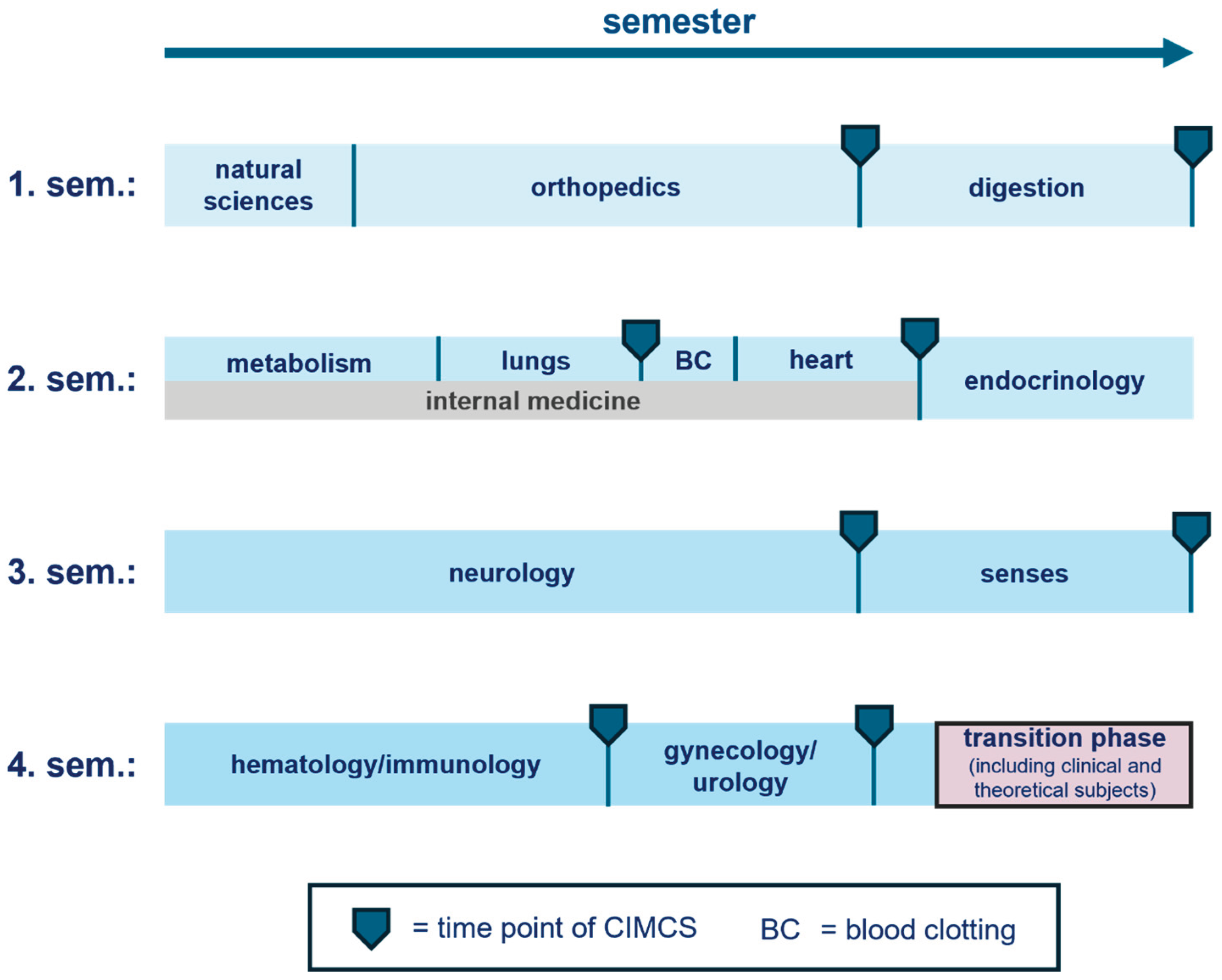
Consequently, in the pre-clinical phase of the UW/H model curriculum, the clinically oriented interdisciplinary module-concluding seminars (CIMCS) were introduced for the first time as optional courses in the winter semester of 2025/26. The CIMCS complement the existing instruction provided by the lecturers of the basic subjects (POL consultation hours) through the resource-efficient use of clinicians to enhance the integration of basic theoretical knowledge in a clinical context. The CIMCS are 2- to 3-hour seminars held at the end of thematically related POL cases (modules), led by clinically active faculty members, which summarize the content of the module’s basic science courses from a clinical perspective. A total of 8 CIMCS were introduced in the preclinical phase (see Fig. 1). The CIMCS in the first semester were conducted with the active participation of preclinical lecturers in order to reflect the interdisciplinary exchange between the basic science courses and clinical teaching in terms of personnel as well. In the remaining semesters, the CIMCS were led by a clinician.
Figure 1.
Structure of the preclinical phase of the UW/H model medical degree program, showing the thematic POL modules and the placement of the corresponding clinically oriented, interdisciplinary finale module seminars (CIMCS) at the end of each thematic module.
Figure 1.
Structure of the preclinical phase of the UW/H model medical degree program, showing the thematic POL modules and the placement of the corresponding clinically oriented, interdisciplinary finale module seminars (CIMCS) at the end of each thematic module.
The CIMCS are designed as structured courses that combine lecture-based instruction with integrated interactive components. At the beginning, clinical instructors provide an overview of the module’s key content and place it within a clinical context. Interactive elements include quizzes or small-group activities followed by brief presentations and reflection.
The content of the CIMCS builds systematically on the content of the POL cases covered earlier in the module. The POL paper cases and an overview of the corresponding topics from the consultation hours are provided to instructors in advance to enable them to assess the students’ current level of knowledge and design the seminar accordingly.
The importance of basic course knowledge is illustrated, for example, through a case study on a lung disease, which explains why an understanding of physiological lung parameters is crucial for the correct diagnosis of the condition in question.
Evaluation of CIMCS
The CIMCS recorded a total of 266 registrations for the winter semester of 2025/26 (1st semester: 80 students (30.1%), 2nd semester: 97 students (36.5%), 3rd semester: 41 students (15.4%), 4th semester: 48 students (18.0%)), with the registrations applying for all CIMCS in each semester. The exact number of participants for each seminar was not documented. The CIMCS were evaluated at the end of each seminar, either during the session or via email, using a LimeSurvey questionnaire. A total of 93 evaluation responses were recorded. Satisfaction with the course (Mann-Whitney U test, two-tailed: p=0.022) and with the instructor (Mann-Whitney U test, two-tailed: p=0.000) is higher than the average for all courses evaluated via the central campus management system (mean ± standard deviation on a 6-point Likert scale: 1 = strongly agree, 2 = agree, 3 = somewhat agree, 4 = somewhat disagree, 5 = disagree, 6 = strongly disagree).
Statement to be evaluated: Overall, I am satisfied with the course:
CIMCS: 1.72±0.98 (n=93)
All other courses: 1.99±1.17 (n=790)
Statement to be evaluated: Overall, I am satisfied with the lecturer:
CIMCS: 1.36±0.60 (n=92),
All other courses: 1.97±1.22 (n=1204)
Moreover, three CIMCS-specific closed-ended questions using a 5-point Likert scale were asked to assess the clarity of the explanation of the relationship between preclinical basic sciences and clinical content, as well as the need for input from lecturers of preclinical basic science courses.
Question: To what extent were the connections between the basic preclinical subjects (e.g., anatomy, physiology, biochemistry) and the clinical content clearly explained in this seminar? (Likert scale: 1 = very clearly, 2 = clearly, 3 = somewhat, 4 = not very, 5 = not at all)
CIMCS: 1.69±0.82 (n=91)
Question: How clearly and in sufficient detail were the connections to the basic preclinical subjects presented? (Likert scale: 1 = very good, 2 = good, 3 = somewhat, 4 = not very much, 5 = not at all)
CIMCS: 1.77±0.80 (n=91)
Question: Would you have liked to see faculty members from the preclinical basic subjects involved in the seminar? (Likert scale: 1 = no, not necessary, 2 = somewhat no, 3 = to some extent, 4 = somewhat yes, 5 = yes, definitely)
CIMCS: 2.61±1.40 (n=62 out of 68 evaluation responses from semesters 2 to 4)
Based on the evaluation data collected so far, the CIMCS appear to have clearly explained the connection between the preclinical basic subjects and the clinical content, and to have effectively demonstrated the links to the preclinical basics. Since the majority of evaluating students do not wish for preclinical lecturers to be involved in the CIMCS (32 students against, 17 in favor), for resource reasons, it is being considered to have clinicians teach the CIMCS exclusively in the future.
The qualitative feedback indicates that the CIMCS helped students establish a clinical connection to their basic knowledge and provided a good overview of the previous POL paper cases. However, it also suggests scope for improvement, for example regarding the implementation of specific interaction or group phases.
Conclusion
The CIMCS concept presented in this study represents a health economic solution for contextualizing and giving meaning to preclinical education by targeted involvement of clinicians in the clinically oriented integration of basic knowledge acquired during the previous modules. Clinicians are particularly well-suited to convey the relevance of theoretical principles to clinical practice, which facilitates the transfer of knowledge to future medical practice [6, 29]. Furthermore, the concept can be easily adapted to other curricula, as it requires relatively little additional teaching time and can be integrated into a wide variety of thematic modules. Although instructional design that identifies significant meta-concepts early on is beneficial to the learning process [31, 32], the CIMCS appear at the end of each module in our curriculum due to the POL-based teaching approach. This preserves the problem-oriented nature of the learning sequence and initially allows students to independently organize and activate their prior knowledge. In non-POL-based teaching modules, a similar format can easily be incorporated at the beginning, or the module can be divided into two units: one providing a meaningful overview at the start and another integrating the content into clinical practice at the end.
Statements and Declarations
The authors declare that they have no conflicts of interest, financial or otherwise.
Acknowledgments
The authors would like to thank everyone involved in the development and implementation of the CIMCS for their cooperation and support in carrying out these courses.
References
- Anderson, M.B. A Snapshot of Medical Students' Education at the Beginning of the 21st Century: Reports from 130 Schools. Acad. Med. 2000, 75 Suppl, 9. [Google Scholar] [CrossRef] [PubMed]
- Frenk, J. C.L.; Bhutta, Z.A.; Cohen, J.; Crisp, N.; Evans, T.; Fineberg, H.; Garcia, P.; Ke, Y.; Kelley, P.; Kistnasamy, B.; Meleis, A.; Naylor, D.; Pablos-Mendez, A.; Reddy, S.; Scrimshaw, S.; Sepulveda, J.; Serwadda, D.; Zurayk, H. Health professionals for a new century: transforming education to strengthen health systems in an interdependent world. Lancet 2010, 376(9756), 1923–58. [Google Scholar] [CrossRef] [PubMed]
- Densen, P. Challenges and opportunities facing medical education. Trans. Am. Clin. Climatol. Assoc. 2011, 122, 48–58. [Google Scholar] [PubMed]
- Kusurkar, R.A.; Croiset, G.; Fau - Mann, K.V.; Mann Kv Fau - Custers, E.; Custers, E.; Fau - Ten Cate, O.; Ten Cate, O. Have motivation theories guided the development and reform of medical education curricula? A review of the literature. Acad. Med. 2012, 87(6), 735–43. [Google Scholar] [CrossRef] [PubMed]
- Radcliffe, C.; Lester, H. Perceived stress during undergraduate medical training: a qualitative study. Med. Educ. 2003, 37(1), 32–8. [Google Scholar] [CrossRef] [PubMed]
- Pelaccia, T.; Viau, R. Motivation in medical education. Med. Teach. 2017, 39(2), 136–40. [Google Scholar] [CrossRef] [PubMed]
- Sobral, D.T. What kind of motivation drives medical students' learning quests? Med. Educ. 2004, 38(9), 950–7. [Google Scholar] [CrossRef] [PubMed]
- Kusurkar, R.A. T.C.T.; Vos, C.M.; Westers, P.; Croiset, G. How motivation affects academic performance: a structural equation modelling analysis. Adv. Health Sci. Educ. 2013, 18, 57–69. [Google Scholar] [CrossRef] [PubMed]
- Recommendations of The German Science and Humanities Council on the further development of medical education 2014. Available online: https://www.wissenschaftsrat.de/download/archiv/pm_2114.
- Schlett, C.L.; Doll, H.; Dahmen, J.; Polacsek, O.; Federkeil, G.; Fischer, M.R.; et al. Job requirements compared to medical school education: differences between graduates from problem-based learning and conventional curricula. BMC Med. Educ. 2010, 10(1). [Google Scholar] [CrossRef] [PubMed]
- Butzlaff, M.; Hofmann, M. Der Modellstudiengang Medizin an der Universität Witten/Herdecke - auf dem Weg zur lebenslang lernfähigen Arztpersönlichkeit. In Handbuch Qualität in Studium und Lehre; Fuhrmann, M., Güdler, J., Kohler, J., Pohlenz, P., Schmidt, U., Eds.; Raabe Fachverlag für Wissenschaftsinformation: Stuttgart, 2014; p. E 8.20. Available online: https://www.hqsl-bibliothek.de/de/handbuch/.
- Frost, K.; Edelhäuser, F.; Hofmann, M.; Tauschel, D.; Lutz, G. History and development of medical studies at the University of Witten/Herdecke - an example of "continuous reform. GMS J. Med. Educ. 2019, 36(5), Doc61. [Google Scholar] [CrossRef] [PubMed]
- Pedersen, S. Motivational Orientation in a Problem-Based Learning Environment. J. Interact. Learn. Res. 2003, 14(1), 51–77. [Google Scholar]
- Saudagar, F.N.I.; Madadin, M.S. Undergraduates' perceptions of problem-based learning approach to developing skills and attitude at a College of Medicine in the Eastern Province, Saudi Arabia. J. Fam. Community Med. 2025, 32, 354–61. [Google Scholar] [CrossRef] [PubMed]
- Schmidt, H.G.; Rotgans, J.; Yew, E.H. The process of problem-based learning: what works and why. Med. Educ. 2011, 45(8), 792–806. [Google Scholar] [CrossRef] [PubMed]
- Biggs, J. Enhancing teaching through constructive alignment. High Educ. 1996, 32(3), 347–64. [Google Scholar] [CrossRef]
- Strayhorn, J., Jr. Aspects of motivation in preclinical medical training: a student's viewpoint. Med. Educ. 1973, 48(12), 1104–10. [Google Scholar]
- Dornan, T.; Bundy, C. What can experience add to early medical education? Consensus survey. BMJ 2004, 329(7470), 834. [Google Scholar] [CrossRef] [PubMed]
- Dornan, T.; Littlewood, S.; Margolis, S.; Scherpbier, A.; Spencer, J.; Ypinazar, V. How can experience in clinical and community settings contribute to early medical education? A BEME systematic review. Med. Teach. 2006, 28(1), 3–18. [Google Scholar] [CrossRef] [PubMed]
- Das, P.; Biswas, S.; Singh, R.; Mukherjee, S.; Ghoshal, S.; Pramanik, D. Effectiveness of early clinical exposure in learning respiratory physiology among the newly entrant MBBS students. J. Adv. Med. Educ. Prof. 2017, 5(1), 6–10. [Google Scholar] [PubMed]
- AkbariRad, M.; Khadem-Rezaiyan, M.; Ravanshad, S.; Rafiee, M.; Firoozi, A.; Zolfaghari, S.A.; et al. Early clinical exposure as a highly interesting educational program for undergraduate medical students: an interventional study. BMC Med. Educ. 2023, 23(1), Epub 20230501. [Google Scholar] [CrossRef] [PubMed]
- Shaban, E.E.; Elmelliti, H.A.-O.; Shaban, A.; Shaban, A.; Zaki, H.A.-O. Impact of early clinical exposure on medical students' competency development: a systematic review of evidence from Asian and African countries. BMC Med. Educ. 2025, 25, 1723. [Google Scholar] [CrossRef] [PubMed]
- Albrecht, F.; Lutz, G.; Atzeni, G.; Berberat, P.O.; Matcau, P.; Jedlicska, N.; et al. Insights into the meaning of medical students' studies. An online survey at two medical faculties. GMS J. Med. Educ. 2024, 41(4), Doc45. [Google Scholar] [CrossRef] [PubMed]
- DA Kiessling, C.; Fabry, G.; Hölzer, H.; Langewitz, W.; Mühlinghaus, I.; Pruskil, S.; Scheffer, S.; Schubert, S. Basler Consensus Statement "Kommunikative und soziale Kompetenzen im Medizinstudium": Ein Positionspapier des GMA-Ausschusses Kommunikative und soziale Kompetenzen. GMS Z. Med. Ausbild. 2008, 25(2). [Google Scholar]
- Kiessling, C.; Mennigen, F.; Schulte, H.; Schwarz, L.; Lutz, G. Communicative competencies anchored longitudinally - the curriculum "personal and professional development" in the model study programme in undergraduate medical education at the University of Witten/Herdecke. GMS J. Med. Educ. 2021, 38(3), Doc57. [Google Scholar] [CrossRef] [PubMed]
- Sadenius, J.; Becker, C.; Espenkott, C.; Keyes, D.; Schoerner, T.; Scheffer, C. Towards a Meaningful Role for Medical Students in Healthcare: Longitudinal Integrated Clerkship at Witten/Herdecke University. MIND Bull. Mind-Body Med. Res. 2024, 2, 9–12. [Google Scholar] [CrossRef]
- Worley, P.; Couper, I.; Strasser, R.; Graves, L.; Cummings, B.A.; Woodman, R.; et al. A typology of longitudinal integrated clerkships. Med. Educ. 2016, 50(9), 922–32. [Google Scholar] [CrossRef] [PubMed]
- Harden, R.M. The integration ladder: a tool for curriculum planning and evaluation. Med. Educ. 2000, 34(7), 551–7. [Google Scholar] [CrossRef] [PubMed]
- Malau-Aduli, B.; Lee, A.; Cooling, N.; Catchpole, M.; Jose, M.; Turner, R. Retention of knowledge and perceived relevance of basic sciences in an integrated case-based learning (CBL) curriculum. BMC Med. Educ. 2013, 13, 139. [Google Scholar] [CrossRef] [PubMed]
- Bandiera, G.; Boucher, A.; Neville, A.; Kuper, A.; Hodges, B. Integration and timing of basic and clinical sciences education. Med. Teach. 2013, 35(5), 381–7. [Google Scholar] [CrossRef] [PubMed]
- Ausubel, D.P. The use of advance organizers in the learning and retention of meaningful verbal material. J. Educ. Psychol. 1960, 51(5), 267–72. [Google Scholar] [CrossRef]
- Stone, C.L. A meta-analysis of advance organizer studies. J. Exp. Educ. 1983, 51, 194–9. [Google Scholar] [CrossRef]
Disclaimer/Publisher’s Note: The statements, opinions and data contained in all publications are solely those of the individual author(s) and contributor(s) and not of MDPI and/or the editor(s). MDPI and/or the editor(s) disclaim responsibility for any injury to people or property resulting from any ideas, methods, instructions or products referred to in the content. |
© 2026 by the authors. Licensee MDPI, Basel, Switzerland. This article is an open access article distributed under the terms and conditions of the Creative Commons Attribution (CC BY) license (http://creativecommons.org/licenses/by/4.0/).
Copyright: This open access article is published under a Creative Commons CC BY 4.0 license, which permit the free download, distribution, and reuse, provided that the author and preprint are cited in any reuse.