

Submitted:
10 November 2026
Posted:
11 November 2026
You are already at the latest version
Abstract
Background: Whiplash-associated disorders (WAD) are associated with persistent pain, disability, sensorimotor dysfunction, and psychological distress. Digital rehabilitation and virtual reality (VR) interventions have emerged as potential approaches to enhance rehabilitation delivery, accessibility, self-management, and patient engagement. However, evidence relating specifically to individuals with WAD has not previously been synthesised.Objective: To evaluate the effectiveness and feasibility of VR and digital rehabilitation interventions for adults with WAD.Methods: A systematic review was conducted in accordance with PRISMA guidelines. Electronic databases were searched from inception to September 2026. Eligible studies included adults with WAD receiving VR or digital rehabilitation interventions. Outcomes included pain, disability, movement-related and sensorimotor outcomes, psychological outcomes, work outcomes, service utilisation, and implementation outcomes. Findings were synthesised using a Synthesis Without Meta-analysis (SWiM) approach, with exploratory meta-analysis undertaken where appropriate. Certainty of evidence was evaluated using GRADE. Results: Fourteen studies met the inclusion criteria, comprising three VR studies and eleven digital intervention studies. Digital interventions consistently improved pain, disability, cervical function, psychological outcomes, adherence, and service utilisation. Moderate-certainty evidence supported improvements in disability, movement-related outcomes, psychological outcomes, and service utilisation. Internet-supported neck-specific exercise achieved outcomes comparable to physiotherapist-led rehabilitation while substantially reducing therapist contact. VR interventions demonstrated particular promise for influencing movement behaviour, movement confidence, psychological adaptation, and rehabilitation engagement. However, evidence for improvements in pain and disability was inconsistent and generally derived from small feasibility or experimental studies, resulting in low or very low certainty evidence. Conclusions: Digital rehabilitation interventions appear capable of delivering clinical outcomes comparable to conventional rehabilitation while improving accessibility and reducing healthcare utilisation. VR interventions may provide additional value for addressing movement-related fear, sensorimotor dysfunction, and rehabilitation engagement. Nevertheless, evidence remains limited, and future research should prioritise understanding mechanisms of action, implementation processes, and patient characteristics associated with treatment response.
Keywords:
whiplash-associated disorder
; virtual reality
; digital health
; telerehabilitation
; rehabilitation
; pain
; disability
; sensorimotor function
; implementation
; systematic review
Introduction
Whiplash-associated disorders (WAD) are among the most common sequelae of motor vehicle collisions and acceleration-deceleration injuries. The injuries are classified according to the Quebec Task Force on Whiplash-Associated Disorders classification system, ranging from Grade 0 (no neck symptoms or signs) to Grade IV (neck symptoms accompanied by fracture or dislocation) (Spitzer et al., 1995). WAD represents a substantial public health burden due to its impact on pain, disability, healthcare utilisation, work participation, and quality of life.
Systematic review evidence indicates that approximately one-third of people with WAD experience depression (Al-Khazali et al., 2022), while 10-20% experience post-traumatic stress disorder (Cronin et al., 2026). Persistent symptoms are also common, with chronic pain reported in between 23.4% and 50% of individuals following injury (Cronin et al., 2026; Dickson et al., 2022). The socioeconomic consequences are considerable, with annual costs estimated at approximately £3 billion in the United Kingdom and $42 billion in the United States (Walton & Elliott, 2017). Despite this burden, recovery remains achievable, with evidence suggesting that many individuals recover within the first three months following injury (He et al., 2024).
Persistent WAD is increasingly conceptualised as a biopsychosocial condition involving interactions between physical, psychological, and behavioural factors. Individuals with chronic WAD frequently demonstrate altered sensorimotor function, including deficits in cervical proprioception, impaired postural stability, and altered motor control, alongside psychological factors such as fear of movement, pain catastrophising, reduced self-efficacy, and psychological distress (Dickson et al., 2022). These factors contribute to avoidance behaviours, reduced rehabilitation engagement, and ongoing disability. Furthermore, poor recovery expectations, passive coping strategies, and post-traumatic stress symptoms have been consistently identified as predictors of persistent pain and disability following whiplash injury (Campbell et al., 2018).
Consequently, contemporary rehabilitation approaches advocate interventions that address both physical and psychological contributors to recovery rather than focusing solely on tissue pathology (Ahern et al., 2020; Chaplin et al., 2023; Lin et al., 2019). Although current management commonly incorporates education, exercise therapy, sensorimotor retraining, psychologically informed care, and self-management strategies, treatment effects remain modest for many individuals, highlighting the need for innovative approaches that can enhance engagement while targeting multiple dimensions of recovery simultaneously (Ahern et al., 2020; Chaplin et al., 2023).
Digital rehabilitation interventions have emerged as a promising approach to support rehabilitation delivery and self-management. These interventions include telehealth and telerehabilitation platforms, internet-based exercise programmes, mobile applications, wearable and sensor-based technologies, gamified rehabilitation systems, virtual reality (VR), augmented reality (AR), and mixed reality (MR). Such technologies can support assessment, exercise prescription, behavioural change, remote monitoring, and rehabilitation delivery, while potentially improving accessibility, scalability, patient engagement, and healthcare efficiency.
Within this broader digital health landscape, VR represents one of the most immersive rehabilitation technologies. VR enables users to interact with computer-generated environments through varying levels of immersion and sensory feedback (Ahern et al., 2020; Tao et al., 2021). Proposed mechanisms include attentional distraction from pain, graded exposure to feared movements, enhanced motivation and self-efficacy, improved body awareness, and facilitation of motor learning through repetitive practice and real-time feedback (Chaplin et al., 2023; Tao et al., 2021). These characteristics may be particularly relevant to WAD given the importance of sensorimotor dysfunction and movement-related fear in persistent symptoms.
Evidence from systematic reviews and meta-analyses suggests that both VR and broader digital health interventions can improve pain, disability, physical function, self-management, adherence, and psychological outcomes across musculoskeletal conditions (Ahern et al., 2020; Chaplin et al., 2023; Lin et al., 2019; Valentijn et al., 2022). Reviews of VR interventions have reported improvements in pain, disability, fear of movement, balance, patient satisfaction, and rehabilitation engagement among individuals with chronic neck and spinal pain (Ahern et al., 2020; Chaplin et al., 2023; Kantha et al., 2023). Similarly, digital health interventions have demonstrated benefits for musculoskeletal pain management more broadly (Valentijn et al., 2022). However, while reviews such as that of Valentijn et al. (2022) included whiplash within their eligibility criteria, WAD-specific evidence was limited and not synthesised separately.
Despite increasing interest in digital rehabilitation, evidence relating specifically to individuals with WAD remains fragmented. Existing reviews have largely focused on mixed musculoskeletal populations, chronic spinal pain, or non-specific neck pain rather than WAD specifically (Ahern et al., 2020; Ye et al., 2023). Recent reviews have also highlighted substantial uncertainty regarding the mechanisms underpinning digital rehabilitation, long-term effectiveness, implementation processes, adherence, engagement, and the characteristics of individuals most likely to benefit from technology-assisted interventions (Moreno-Ligero et al., 2023; E-Taawy et al., 2024; Wang et al., 2026). Furthermore, previous reviews have predominantly emphasised quantitative effectiveness outcomes and have given limited attention to patient experiences, acceptability, feasibility, usability, engagement, implementation considerations, and potential mechanisms of action (Strain et al., 2024; Valentijn et al., 2022). Given the rapid growth of digital, sensor-based, virtual reality, and technology-assisted approaches in WAD assessment and rehabilitation since 2020 (Monaro et al., 2021), an updated synthesis of evidence is warranted.
The aim of this systematic review is to evaluate the effectiveness and feasibility of virtual reality and digital rehabilitation interventions for adults with whiplash-associated disorders (WAD). Specifically, the review will examine the effects of these interventions on pain, disability, cervical function, sensorimotor outcomes, psychosocial outcomes, and health-related quality of life, while also evaluating feasibility outcomes including adherence, retention, intervention acceptability, usability, and adverse events.
Methods
This systematic review will be conducted and reported in accordance with the Preferred Reporting Items for Systematic Reviews and Meta-Analyses (PRISMA 2020; Page et al., 2020) statement. Literature searches will be developed and reported following the PRISMA-S extension (Rethlefsen et al., 2021) for reporting literature searches. Where meta-analysis is not feasible, findings will be synthesised according to the Synthesis Without Meta-analysis (SWiM; Campbell et al., 2020) reporting guideline.
Eligibility Criteria
Eligibility criteria were developed using the Population, Intervention, Comparator, Outcome and Study Design (PICOS) framework.
Population
Studies involving adults (≥18 years) diagnosed with WAD Grades I-III according to the Quebec Task Force Classification (spitzer et al., 1995) were eligible. Whiplash is defined as an acceleration-deceleration mechanism of energy transfer to the cervical spine resulting in neck pain and associated symptoms. Studies involving acute, subacute, and chronic WAD populations will be included. Where possible, findings will be considered according to symptom duration. Studies involving participants with cervical fracture, dislocation, spinal cord injury, or other serious cervical pathology were excluded. Studies that do not reveal the diagnosis of the patient were excluded. Studies with mixed diagnosis were only be included if WAD specific data can be obtained from the results or following an email reaching out to the corresponding author.
Interventions
Eligible interventions will include virtual reality and digital rehabilitation technologies delivered as standalone interventions or as adjuncts to conventional rehabilitation. Interventions may include: (1) Fully immersive virtual reality, (2) Semi-immersive virtual reality, (3), Augmented reality, (4) Mixed reality, (5) Exergaming interventions, (6) Serious gaming interventions. (7) Gamified rehabilitation programmes, (8) Head-mounted display technologies, (9) Motion-tracking rehabilitation systems, (10) Interactive digital rehabilitation platforms, and (11) Digital exercise programmes incorporating gaming or virtual environments.
Comparators
Eligible comparator groups will include: (1) Usual care, (2) Physiotherapy, (3) Exercise therapy, (4) Education, (5) Wait-list control, (6) Sham intervention and (7) No intervention.
Outcomes
Studies were eligible if they reported at least one clinical, behavioural, implementation, feasibility, or qualitative outcome related to digital or virtual reality rehabilitation for whiplash-associated disorders. Pain was designated as the primary outcome (measures such as pain intensity; Hawker et al., 2011 or the Neck Disability Index; Vernon and Mior, 1991) were included. Secondary outcomes included disability, physical functioning, cervical movement, sensorimotor function, psychological health, self-management, health-related quality of life, and other rehabilitation-related outcomes. Studies were also eligible if they reported outcomes relating to feasibility (e.g., recruitment, retention, adherence), acceptability (e.g., satisfaction, usability, engagement), implementation (e.g., fidelity, barriers and facilitators to delivery, adoption), or qualitative experiences and perceptions of intervention use. This broader outcome framework was adopted to capture both intervention effectiveness and factors influencing the successful integration of digital and virtual rehabilitation approaches into practice.
Study Designs
The review included randomised controlled trials, controlled clinical trials, non-randomised intervention studies, cohort studies, pilot studies, feasibility studies, and mixed-methods studies evaluating digital or virtual reality interventions for individuals with whiplash-associated disorders. Studies were eligible if they reported at least one clinical, implementation, feasibility, acceptability, adherence, engagement, usability, or qualitative outcome relevant to intervention delivery or effectiveness. Pain was considered the primary outcome of interest, while secondary outcomes included disability, physical function, cervical movement, sensorimotor function, psychological outcomes, health-related quality of life, and other rehabilitation-related outcomes. Studies reporting qualitative findings relating to participant experiences, perceptions, barriers, facilitators, or intervention acceptability were also included. Case reports, case series, conference abstracts, editorials, commentaries, study protocols, review articles, non-human studies, and other publications lacking original empirical data were excluded.
Information Sources
Electronic searches will be conducted in the following electronic databases from inception until September 2026: MEDLINE, Embase, CINAHL, SPORTDiscus, PsycINFO, Cochrane Central Register of Controlled Trials (CENTRAL), Web of Science and Scopus.
Reference lists of included studies and relevant systematic reviews will also be screened to identify potentially eligible studies, and forward citation chasing will also occur (Hinde and Spackman, 2015).
Search Strategy
The search strategy was developed in accordance with PRISMA-S (Rethlefsen et al., 2021) recommendations and combined controlled vocabulary terms and free-text keywords related to: (a) Whiplash-associated disorders. (b) virtual reality technologies. And (c) digital rehabilitation interventions. Search terms included, but will not be limited to, “whiplash”, “whiplash-associated disorder”, “WAD”, “virtual reality”, “augmented reality”, “mixed reality”, “exergaming”, “gamification”, “serious games”, “digital rehabilitation”, and related terms. Boolean operators, truncation, and database-specific indexing terms were used as appropriate. The full search strategy for MEDLINE and adaptations for all other databases were reported within the supplementary file.
Selection Process
All references identified through the searches were imported into reference management software Covidence© and duplicate records were automatically removed. Two reviewers independently screened titles and abstracts against the eligibility criteria in line with Cochrane processes (Higgins et al., 2024). Full texts of potentially eligible studies will then be independently assessed by two reviewers, and any disagreements could be resolved with a third independent reviewer. The study selection process will be presented using a PRISMA 2020 flow diagram.
Data Collection Process
A standardised data extraction form was developed and piloted before use. Two reviewers independently extracted data from included studies. The following information was extracted: Study characteristics (authors, year, country, design), Participant characteristics, WAD classification and symptom duration, Intervention characteristics, Comparator characteristics, Outcome measures, Follow-up periods, Quantitative outcome data, Feasibility outcomes, Acceptability outcomes and adverse events. Any discrepancies in extracted data will be resolved through discussion or consultation with a third reviewer.
Risk of Bias Assessment
Risk of bias was independently assessed by two reviewers, with disagreements resolved through discussion and, where necessary, consultation with a third reviewer. The following tools were used according to study design: (a) RoB 2 (Risk of Bias 2 Tool; Sterne et al., 2019) for randomised controlled trials. (b) ROBINS-I (Risk of Bias in Non-randomised Studies of Interventions; Sterne et al., 2016) for non-randomised intervention studies. Risk-of-bias assessments is presented in tabular and graphical formats within the results section.
Data Synthesis and Certainty Assessment
Where at least three studies are sufficiently homogeneous in terms of participants, interventions, comparators, and outcomes, a meta-analysis was undertaken. Meta-analysis was only possible around disability outcomes. Given the small number of studies and the desire to retain clinical interpretability, a narrative SWiM synthesis (Campbell et al., 2020) was retained as the primary analysis, with quantitative pooling considered exploratory. Results was synthesised according to the following outcome domains: Pain outcomes, disability outcomes, movement-related and sensorimotor outcomes, psychological outcomes, work outcomes, service utilisation outcomes and adherence/implementation outcomes.
The certainty of evidence for each primary outcome will be assessed using the Grading of Recommendations Assessment, Development and Evaluation (GRADE; Guyatt et al., 2008) framework. Evidence will be rated as high, moderate, low, or very low certainty based on consideration of: Risk of bias, inconsistency, indirectness, imprecision, and publication bias. A Summary of Findings table will be produced across outcomes.
Results
Search Output
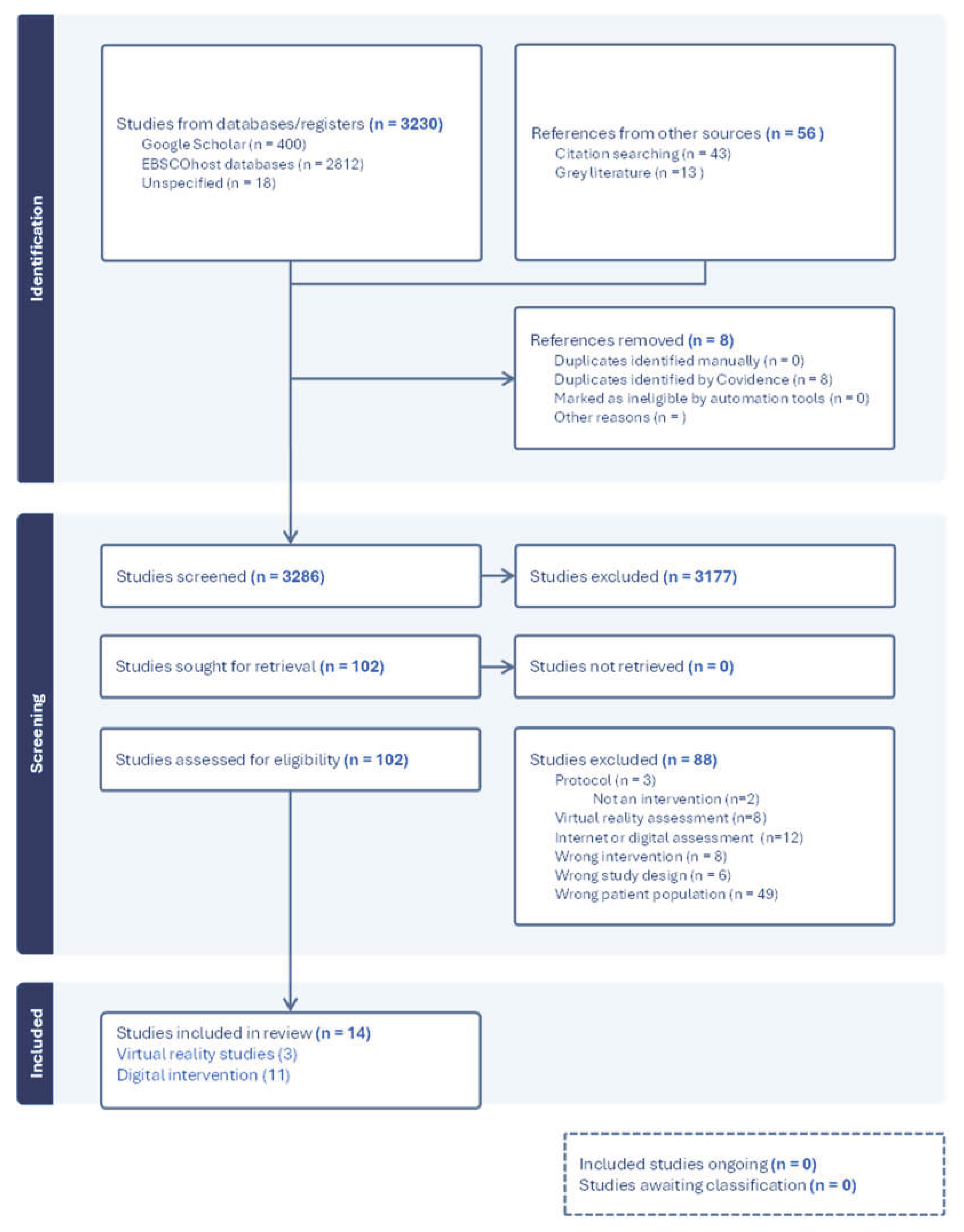
A total of 3286 studies were screened. Of which 102 were considered at the level of full text screening and a total of 88 studies did not meet the inclusion criteria. Fourteen studies met the eligibility criteria and were included in the review. These comprised three virtual reality (VR) interventions (Harvie et al., 2015; Harvie et al., 2020; Glavare et al., 2021) and eleven digital rehabilitation interventions (Bring et al., 2015; Barun et al., 2024; Muñoz-Sánchez et al., 2026; Peterson and Peolsson, 2023; Peolsson et al., 2024a; 2024b; Peterson et al., 2024; Peterson et al., 2025; Zetterberg et al., 2026; Rodríguez-Bagó et al., 2025; Rodríguez-Bagó et al., 2026). Several digital publications represented secondary analyses arising from the same randomized controlled trial of internet-supported neck-specific exercise conducted by Peterson and Peolsson and colleagues. This often provided specific outcomes or follow up data from the original study (Peterson and Peolsson, 2023). Please see the supplementary file for reasons for exclusions and article details.
Demographics
VR Studies
Across three studies, a total of 44 participants were included in the analysis. Participants were adults with persistent or chronic neck pain, with mean ages ranging from approximately 42 to 55 years. Two studies were predominantly female, with women representing 75% of participants in both the Glavare et al. (2021) study (9/12) and Harvie et al. (2015) study (18/24), whereas the 2020 case series (Harvie et al., 2020) included 5 males and 3 females among the analysed participants. The populations were heterogeneous, comprising individuals with both traumatic and non-traumatic neck pain. Whiplash-associated disorders (WAD) were represented across all studies, although WAD-specific samples were not recruited and exact WAD grades were generally not reported. In the Swedish feasibility study (Glavare et al., 2021), 9 of 12 participants had WAD-related neck pain, while the Australian studies (Harvie et al., 2015; 2020) included individuals with neck pain following motor vehicle accidents consistent with WAD. Neurological involvement and severe WAD presentations were excluded where reported. Symptom duration was generally chronic, with the 2020 case series (Harvie et al., 2020) reporting durations ranging from 5 to 384 months, indicating substantial variability in chronicity and clinical presentation across participants. See Table 1 for full demographic details.
Other Digital or Telerehabilitation Interventions
After removing the secondary analyses and counting only unique primary study samples, the evidence base comprised 764 participants across five independent studies. Participants were predominantly adults of working age, with reported mean ages ranging from approximately 35 to 41 years. Across studies reporting gender, females consistently represented the majority of participants, ranging from 53.5% to 79%, resulting in approximately 468 females (61%) and 296 males (39%) across the available datasets. Most studies focused exclusively on individuals with whiplash-associated disorders (WAD), with acute/subacute populations recruited within 2 weeks to 3 months following injury in three studies, while two Swedish studies (Peolsson et al., 2024a;2024b; Peterson and Peolsson, 2023; Peterson et al., 2024; Peterson et al., 2025) examined chronic WAD populations with symptoms persisting between 6 months and 5 years. WAD grades I-III were represented, although several studies did not specify grade distributions. Where reported, Grade II WAD was the most common classification. The studies were conducted across four countries (Sweden, Croatia, Mexico, and Spain) and primarily recruited individuals with ongoing neck pain, disability, and functional limitations following road traffic-related whiplash injury. See Table 2 for demographic details.
Quality Assessment
A full quality assessment and summary of risk of bias scores across VR interventions and digital can be seen in the supplementary files.
Virtual Reality Interventions
Overall, the VR evidence base appears limited by small samples and non-randomized designs. The principal threats to validity arise from confounding variables, participant selection, and incomplete outcome data rather than outcome measurement itself. Consequently, confidence in estimates of VR effectiveness remained lower than for the higher-quality digital rehabilitation trials.
Digital and Telerehabilitation Interventions
Overall, the digital literature demonstrates a clear division between higher-quality randomized evidence and lower-quality non-randomized implementation studies. Serious risk of bias was largely confined to quasi-experimental and observational investigations, whereas the randomized neck-specific exercise programme and its associated secondary analyses provided the most methodologically robust evidence within the review.
Synthesis
A narrative synthesis of outcomes is provided across a range of reported domains for both VR interventions or digital interventions. A certainty assessment statement accompanies each outcome level assessment and full details of evidence used for the summary paragraphs are provided in the summary Table 1. For details of certainty assessment and information regarding the meta-analysis please see supplementary file.
Pain Outcomes
Virtual Reality Interventions
Three studies evaluated pain outcomes. Harvie et al. (2015) reported that visual-proprioceptive manipulation influenced movement-evoked pain thresholds and pain-free cervical movement, suggesting that VR can alter pain-related movement behaviour. In contrast, Harvie et al. (2020) and Glavare et al. (2021) found limited evidence of sustained improvements in pain intensity. Collectively, the evidence suggests that VR may influence pain-related movement responses in the short term, although evidence for durable improvements in pain remains limited. Low-certainty evidence supported this outcome.
GRADE assessment: Low-certainty evidence
Digital and Telerehabilitation Interventions
Five studies contributed evidence relating to pain outcomes. Muñoz-Sánchez et al. (2026), Bring et al. (2015), Barun et al. (2024), and Peterson and Peolsson (2023) all reported improvements in pain over time. Secondary analyses from Peterson et al. (2025) further suggested that improvements in pain occurred alongside improvements in psychological and functional outcomes. Although benefits were observed consistently, digital interventions rarely demonstrated superiority over comparator interventions. Low-certainty evidence supported this outcome.
GRADE assessment: Low-certainty evidence
Disability Outcomes
Virtual Reality Interventions
Only Glavare et al. (2021) reported disability outcomes, finding no significant improvement in neck-related disability following VR-supported rehabilitation. As a result, evidence supporting VR for disability reduction remains highly uncertain. Very low-certainty evidence supported this outcome.
GRADE assessment: Very low-certainty evidence
Digital and Telerehabilitation Interventions
Disability outcomes were reported by Muñoz-Sánchez et al. (2026), Bring et al. (2015), Barun et al. (2024), Peterson and Peolsson (2023), and Peolsson et al. (2024). Across studies, consistent reductions in disability were observed irrespective of the specific digital delivery format. Improvements were generally maintained during follow-up and were comparable to those achieved through conventional physiotherapy. Moderate-certainty evidence supported this outcome. Please see Figure 2 for the meta-analysis.
GRADE assessment: Moderate-certainty evidence
Movement-Related and Sensorimotor Outcomes
Virtual Reality Interventions
Three studies evaluated movement-related outcomes. Harvie et al. (2015) demonstrated immediate effects of visual feedback manipulation on pain-free cervical movement, whereas Harvie et al. (2020) found little evidence that repeated illusion-enhanced training translated into sustained functional improvements. Glavare et al. (2021) reported successful progression through movement-based VR exercises but did not provide objective movement outcomes. Overall, VR appeared to influence movement behaviour and movement confidence more consistently than pain or disability. Low-certainty evidence supported this outcome.
GRADE assessment: Low-certainty evidence.
Digital and Telerehabilitation Interventions
The strongest evidence originated from the neck-specific exercise programme reported by Peterson and Peolsson (2023) and associated analyses by Peterson et al. (2024) and Peterson et al. (2025). These studies demonstrated improvements in cervical mobility, neck muscle function, and movement-related recovery. Additional evidence from Peolsson et al. (2024) indicated improvements in dizziness-related outcomes. Taken together, the evidence suggests that digitally delivered neck-specific rehabilitation can improve multiple aspects of cervical and sensorimotor function while requiring substantially reduced therapist contact. Moderate-certainty evidence supported this outcome.
GRADE assessment: Moderate-certainty evidence
Psychological Outcomes
Virtual Reality Interventions
Psychological outcomes were reported only by Glavare et al. (2021), who identified improvements in kinesiophobia, depression, pain interference, life control, and quality of life following VR-supported rehabilitation. Although findings were encouraging, confidence in these estimates remains limited because evidence originated from a single feasibility study. Very low-certainty evidence supported this outcome.
GRADE assessment: Very low-certainty evidence
Digital and Telerehabilitation Interventions
Psychological benefits were reported across several intervention formats. Bring et al. (2015) and Barun et al. (2024) reported improvements in pain catastrophising, fear of movement, self-efficacy, and health-related quality of life. Similar findings were observed by Zetterberg et al. (2026), while Peterson et al. (2025) highlighted the close relationship between psychological adaptation and clinical recovery. Overall, digital rehabilitation was consistently associated with improvements in psychological wellbeing across both acute and chronic WAD populations. Moderate-certainty evidence supported this outcome.
GRADE assessment: Moderate-certainty evidence
Work Outcomes
Virtual Reality Interventions
No work-related outcomes were reported in the VR studies.
Digital and Telerehabilitation Interventions
Work-related outcomes were reported by Barun et al. (2024), Peterson and Peolsson (2023), Peolsson et al. (2024), and Rodríguez-Bagó et al. (2025, 2026). Across studies, digital interventions were associated with improvements in work ability and work-related disability, although superiority over comparator interventions was rarely observed. Peterson and Peolsson (2023) and Peolsson et al. (2024) demonstrated comparable improvements between internet-supported and physiotherapist-led neck-specific exercise, while Rodríguez-Bagó et al. (2025, 2026) showed that telerehabilitation could reduce treatment burden without negatively affecting occupational recovery. Overall, digital interventions appeared capable of supporting work-related functioning while maintaining outcomes comparable to conventional rehabilitation.
GRADE assessment: Low-certainty evidence
Service Utilisation Outcomes
Virtual Reality Interventions
Service utilisation was not evaluated in VR studies.
Digital and Telerehabilitation Interventions
Evidence from Peterson and Peolsson (2023), Peterson et al. (2024), Peterson et al. (2025), Rodríguez-Bagó et al. (2025), and Rodríguez-Bagó et al. (2026) consistently demonstrated reduced physiotherapy utilisation associated with digital delivery. Peterson and Peolsson (2023) reported that internet-supported neck-specific exercise achieved comparable clinical outcomes with substantially fewer physiotherapy contacts, while Rodríguez-Bagó et al. (2025, 2026) demonstrated similar reductions in therapist utilisation across hybrid and AI-supported telerehabilitation models. Collectively, the evidence suggests that digital rehabilitation can reduce healthcare resource requirements while maintaining clinical and occupational outcomes.
GRADE assessment: Moderate-certainty evidence
Adherence/Implementation Outcomes
Virtual reality interventions
Implementation outcomes were reported by Glavare et al. (2021) and Harvie et al. (2020). Glavare et al. (2021) reported positive participant experiences relating to engagement, motivation, feedback, and progression through VR-based rehabilitation activities. In contrast, Harvie et al. (2020) identified some tolerability challenges, including participant withdrawal associated with motion sickness. Overall, VR interventions appeared feasible and acceptable for some individuals with chronic neck pain; however, implementation evidence remained limited and was derived primarily from small feasibility studies.
GRADE assessment: Very low evidence
Digital interventions
Implementation evidence was reported by Barun et al. (2024), Muñoz-Sánchez et al. (2026), Peterson and Peolsson (2023), Rodríguez-Bagó et al. (2025), and Rodríguez-Bagó et al. (2026). Across studies, digital interventions demonstrated favourable implementation characteristics, including good acceptability, high retention, moderate-to-high adherence, positive user experiences, and reduced healthcare utilisation. Barun et al. (2024) and Muñoz-Sánchez et al. (2026) reported particularly positive adherence findings, while Peterson and Peolsson (2023) demonstrated that internet-supported exercise could be delivered with substantially fewer therapist contacts while maintaining participation. Additional evidence from Rodríguez-Bagó et al. (2025, 2026) suggested that telerehabilitation was acceptable to patients and could be integrated successfully into routine care. Despite these encouraging findings, implementation reporting was inconsistent across studies and rarely informed by established implementation science frameworks.
GRADE assessment: Moderate evidence

Table 3.
A summary of change across outcome domains separated by interventions for Virtual Reality and Digital.
Table 3.
A summary of change across outcome domains separated by interventions for Virtual Reality and Digital.
| Outcome Domain | Intervention Type | Study | Change Score | Clinically Meaningful* | p-value | Effect Size | Overall GRADE (Studies) |
|---|---|---|---|---|---|---|---|
| Pain | VR | Harvie et al. (2015) | Pain-free ROM +6% to -7% depending on visual manipulation | * | .001-.006 | d=0.67-0.80 | Low (n=3) |
| Harvie et al. (2020) | Pain-free movement -0.1° to +2.8° | No | >.05 | NR | |||
| Glavare et al. (2021) | Pain severity reduction | No | .574 | NR | |||
| Digital | Muñoz-Sánchez et al. (2026) | Pain 6.5→0 | * | .01 | NR | Low (n=5) | |
| Bring et al. (2015) | Pain reduced in all groups | * | <.001 | NR | |||
| Barun et al. (2024) | VAS 5.4→2.4 | * | <.001 | NR | |||
| Peterson & Peolsson (2023) | Neck pain -17.8 mm to -19.5 mm | * | <.001 | d=0.96-1.29 | |||
| Disability | VR | Glavare et al. (2021) | NDI unchanged (21.5→21.5) | No | .327 | NR | Very Low (n=1) |
| Digital | Muñoz-Sánchez et al. (2026) | NDI 11→0 | * | .01 | NR | Moderate (n=5) | |
| Barun et al. (2024) | NDI -20% | * | <.001 | NR | |||
| Bring et al. (2015) | Disability -12 points | * | .002-.018 | NR | |||
| Peterson & Peolsson (2023) | NDI -10.1% and -9.3% | * | <.001 | d=1.19-1.33 | |||
| Peolsson et al. (2024) | Work disability reduction | * | <.001 | ηp²=0.20-0.28 | |||
| Movement / Sensorimotor | VR |
Harvie et al. (2015) | Pain-free ROM +13% shift | * | <.001 | η²p=0.29; d=0.67-0.80 | Low (n=3) |
| Harvie et al. (2020) | Minimal movement changes | No | >.05 | NR | |||
| Glavare et al. (2021) | Progression of exercise levels only | N/A | NR | NR | |||
| Digital | Peterson et al. (2024) | ROM +13.1° to +20.3° | * | <.001 | ES=0.64-1.43 | Moderate (n=4) | |
| Peterson et al. (2024) | Endurance +11.5s to +95.9s | * | <.001 | ES=0.22-1.30 | |||
| Peolsson et al. (2024) | DHI improved 9-11 points | * | <.05 | ES=0.75-1.25 | |||
| Peterson et al. (2025) | ROM predicts recovery | Yes | <.05 | Multivariate model | |||
| Psychological | VR | Glavare et al. (2021) | TSK -8.5 points | * | .011 | NR | Very Low (n=1) |
| Glavare et al. (2021) | Depression -3.5 points | * | .023 | NR | |||
| Glavare et al. (2021) | EQ-5D +0.6 | * | .005 | NR | |||
| Digital | Bring et al. (2015) | Catastrophising ↓ | * | .002 | NR | Moderate (n=4) | |
| Bring et al. (2015) | Fear of movement ↓ | * | <.001 | NR | |||
| Barun et al. (2024) | PCS -31% | * | .01 | NR | |||
| Zetterberg et al. (2026) | Anxiety, depression, FABQ improvements | * | .001-.010 | ηp²=0.042-0.096 | |||
| Peterson et al. (2025) | Psychological factors associated with recovery | Yes | <.001 | R² 0.31-0.37 | |||
| Work Outcomes | VR | None | Not reported | - | - | - | Not assessed |
| Digital |
Barun et al. (2024) | No difference in work limitation | .770 | NR | Low (n=3) | ||
| Peolsson et al. (2024) | Work ability improved | <.001 | ηp²=0.13-0.28 | ||||
| Rodríguez-Bagó et al. (2025) | Reduced physiotherapy use; similar sickness absence | NS | NR | ||||
| Rodríguez-Bagó et al. (2026) | Similar return-to-work outcomes | .508 | NR | ||||
| Service Utilisation | VR | None | Not reported | - | - | Not assessed | |
| Digital |
Peterson & Peolsson (2023) | ~20 fewer physiotherapy visits | N/A | N/A | Moderate (n=4) | ||
| Rodríguez-Bagó et al. (2025) | 2-7 fewer sessions | N/A | N/A | ||||
| Rodríguez-Bagó et al. (2026) | 3 fewer sessions | .010-.044 | |||||
| Implementation / Adherence | VR |
Glavare et al. (2021) | 11/12 would continue intervention | N/A | Very Low (n=2) | ||
| Harvie et al. (2020) | Motion sickness and withdrawal reported | N/A | |||||
| Digital |
Barun et al. (2024) | Higher adherence with app use | .005 | Moderate (n=5) | |||
| Muñoz-Sánchez et al. (2026) | Adherence 72.8-92.8% | N/A | |||||
| Peterson & Peolsson (2023) | Retention 80-90%; compliance 75% | .006 | |||||
| Rodríguez-Bagó et al. (2025; 2026) | High usability and satisfaction | N/A |
Discussion
This review synthesised evidence relating to virtual reality (VR) and digital rehabilitation interventions for individuals with whiplash-associated disorders (WAD). Overall, digital interventions demonstrated the most consistent evidence of benefit across disability, movement-related outcomes, psychological outcomes, adherence, and service utilisation, whereas VR interventions demonstrated particular promise for improving movement behaviour, rehabilitation engagement, movement-related confidence, and selected psychological outcomes. Importantly, superiority over conventional rehabilitation was rarely demonstrated. Instead, the evidence suggests that digital and VR approaches may represent alternative methods of delivering effective rehabilitation, each with distinct mechanisms and potential advantages.
Different Mechanisms may Underpin VR and Digital Interventions
One of the clearest findings from this review was that VR and digital interventions appear to influence different aspects of recovery. Digital interventions consistently demonstrated improvements in pain, disability, cervical function, psychological wellbeing, adherence, and service utilisation, with benefits often maintained for up to 15 months. Importantly, these improvements were generally comparable to outcomes achieved through physiotherapist-supervised care despite requiring substantially fewer healthcare resources. This suggests that digital rehabilitation may primarily function as an effective method of supporting self-management and ongoing rehabilitation rather than providing superior clinical effects.
These findings align with broader reviews of digital pain interventions, which suggest that digital rehabilitation can improve pain, disability, quality of life, self-management, emotional functioning, and healthcare accessibility across musculoskeletal and chronic pain populations (Moreno-Ligero et al., 2023; Bartels et al., 2025; E-Taawy et al., 2024). However, these reviews consistently highlight that the mechanisms underpinning such improvements remain poorly understood and that evidence regarding long-term implementation, engagement, and behavioural pathways remains limited. Recent qualitative and mixed-methods syntheses further suggest that successful digital interventions may work through supporting self-management, behavioural adaptation, goal setting, self-efficacy, and changes in patients’ relationships with pain rather than through technological delivery alone (Strain et al., 2024; Valentijn et al., 2022). Similarly, recent network meta-analytic evidence has argued that the therapeutic content delivered through digital platforms may be more important than the technology itself and that future work should focus on understanding how these interventions influence behaviour, self-management, adherence, and recovery processes (Wang et al., 2026). In contrast, VR interventions appeared more likely to influence movement-related outcomes, movement confidence, sensorimotor function, and psychological responses. While improvements in pain and disability were reported less consistently, VR interventions appeared capable of modifying movement-related behaviours through visual feedback, graded exposure, attentional distraction, and sensorimotor retraining. Similar mechanisms have been proposed by Bahat et al. (2015, 2018), Nusser et al. (2021), Guo et al. (2024), and Glavare et al. (2021), who consistently described improvements in movement quality, movement accuracy, proprioception, motor control, and movement confidence.
Supporting this interpretation, Fidalgo-Herrera et al. (2020) identified movement quality, movement consistency, and movement speed as important contributors to recovery following WAD. These findings suggest that VR may initially influence recovery mechanisms rather than directly affecting pain or disability outcomes.
This interpretation is also supported by recent reviews of sensor-based rehabilitation and digital musculoskeletal care, which conclude that movement retraining, biofeedback, real-time monitoring, and behavioural reinforcement may be key therapeutic mechanisms, but remain incompletely evaluated (Garofano et al., 2025; Wang et al., 2026; E-Taawy et al., 2024)
The Value and Relevance of VR for Fear of Movement and Psychological Adaptation
Psychological outcomes emerged as an important area of benefit for both intervention types. Digital interventions consistently improved fear avoidance, pain catastrophising, self-efficacy, anxiety, depression, and health-related quality of life. These improvements were frequently maintained during longer-term follow-up, highlighting the potential value of behavioural and self-management approaches within WAD rehabilitation.
The VR literature suggests a slightly different pattern. Although evidence remains limited, improvements were frequently observed in kinesiophobia, movement confidence, pain interference, and depression. Glavare et al. (2021) reported improvements in depression, pain interference, life control, and kinesiophobia following VR-supported rehabilitation. Similarly, Tejera et al. (2020) found that kinesiophobia was the only outcome demonstrating superiority to exercise at 3 months (d = 0.65).
Emerging qualitative evidence across chronic pain populations suggests that successful digital interventions may help individuals reframe their relationship with pain, improve confidence in self-management, increase participation, and modify attitudes and behaviours towards pain (Strain et al., 2024). Broader reviews have similarly highlighted the importance of self-management support, behaviour change, patient empowerment, and active engagement as central features of successful digital rehabilitation interventions (Moreno-Ligero et al., 2023; Valentijn et al., 2022). These observations align closely with the improvements in movement confidence, kinesiophobia, life control, self-efficacy, and psychological wellbeing observed in the present review.
Several authors have proposed that VR may reduce fear through immersive distraction, external attentional focus, visual feedback, and graded movement exposure (Ahern et al., 2020; Tao et al., 2021; Chaplin et al., 2023). Evidence from excluded studies further supports this interpretation, as VR interventions frequently encouraged movement exploration and challenged movement avoidance behaviours. Notably, broader VR reviews have proposed that immersive technologies may facilitate behavioural exposure, reduce threat appraisal, increase engagement, and promote adherence to rehabilitation activities, although evidence for these mechanisms remains largely theoretical and requires formal testing (Wang et al., 2026; E-Taawy et al., 2024; Moreno-Ligero et al., 2023). Collectively, these findings suggest that VR may be particularly valuable for individuals presenting with elevated fear of movement, reduced movement confidence, or prominent sensorimotor dysfunction.
Clinical Equivalence may be More Important than Superiority
A recurring finding across both the included and excluded literature was that VR frequently improved outcomes without consistently outperforming conventional rehabilitation. Similar findings have been reported by Bahat et al. (2015), Tejera et al. (2020), and Cetin et al. (2025), where VR often produced outcomes comparable to exercise-based rehabilitation. This should not necessarily be interpreted negatively. Rather than suggesting limited value, these findings may indicate that VR is capable of achieving similar rehabilitation outcomes through different pathways. Interestingly, Guo et al. (2024) provided an important contrast, demonstrating superior improvements in pain, disability, movement function, and satisfaction when VR was combined with conventional rehabilitation rather than replacing it. This supports emerging recommendations that digital rehabilitation should be viewed as a complement to, rather than a replacement for, conventional care. Contemporary reviews increasingly advocate blended rehabilitation models that combine clinician support, exercise therapy, behavioural interventions, and technology-assisted self-management, with evidence suggesting that guided approaches may be more effective and sustainable than technology-only interventions (E-Taawy et al., 2024; Wang et al., 2026; Moreno-Ligero et al., 2023). This raises the possibility that VR may be most effective when integrated into existing rehabilitation programmes rather than delivered as a standalone intervention.
Importantly, this pattern is consistent with recent syntheses of digital and virtual rehabilitation interventions, which frequently report outcomes comparable to conventional rehabilitation despite reductions in therapist contact and healthcare utilisation (Moreno-Ligero et al., 2023; E-Taawy et al., 2024; Bartels et al., 2025). Recent network meta-analytic evidence concluded that exercise-based VR and telerehabilitation interventions appear promising, but there is currently insufficient evidence to conclude superiority over established rehabilitation approaches (Wang et al., 2026).
Consequently, an important future question may no longer be whether VR is superior to physiotherapy, but rather which patients are most likely to benefit from the addition of VR and under what circumstances.
The key strengths adherence, engagement and self-management
One of the strongest findings from this review was the favourable implementation profile of digital interventions. High adherence, high retention, positive patient experiences, and reductions in physiotherapy utilisation were consistently reported across studies. Importantly, reductions in therapist contact did not appear to compromise clinical outcomes, suggesting that digitally delivered rehabilitation may offer a scalable and resource-efficient approach to WAD management.
This finding is strongly supported by wider digital health literature. Reviews of digital pain management consistently identify engagement, adherence, usability, accessibility, goal setting, feedback, and self-management support as central determinants of intervention success (Moreno-Ligero et al., 2023; Strain et al., 2024; Valentijn et al., 2022; Bartels et al., 2025; E-Taawy et al., 2024). In many cases, these implementation characteristics appear more consistently associated with positive outcomes than any specific technological platform.
Related evidence appears to support this interpretation. Bandong et al. (2019) demonstrated strong clinician acceptability and engagement with digital care pathways, while Garcia et al. (2022) highlighted the potential for successful long-term self-managed rehabilitation. Similarly, Glavare et al. (2021) reported that 11 of 12 participants wished to continue using VR-based rehabilitation after programme completion. Collectively, these findings suggest that one of the greatest contributions of technology-supported rehabilitation may be its ability to support engagement, adherence, self-management, and behavioural maintenance.
Reviews of telemedicine and digital health have similarly highlighted increased accessibility, improved continuity of care, reduced travel burden, improved efficiency, enhanced patient engagement, and greater opportunities for remote monitoring as key advantages of technology-assisted care (E-Taawy et al., 2024; Moreno-Ligero et al., 2023; Valentijn et al., 2022; Bartels et al., 2025). These implementation benefits may be particularly relevant for individuals with persistent WAD who require long-term support and ongoing exercise participation.
This may also explain why digital interventions demonstrated stronger long-term outcomes than VR interventions, as improvements may arise through sustained behavioural change rather than the immediate effects of the technology itself. Indeed, recent reviews suggest that the greatest contribution of digital rehabilitation may derive from supporting behavioural maintenance, exercise persistence, self-efficacy, and self-management rather than from direct technological effects (Strain et al., 2024; Moreno-Ligero et al., 2023; Valentijn et al., 2022; Wang et al., 2026).
Implications for Future Research
Consistent with previous reviews, an important priority for future research is moving beyond effectiveness studies and towards understanding mechanisms, implementation processes, and the characteristics of individuals most likely to benefit from technology-assisted rehabilitation. Recent reviews repeatedly identify these areas as some of the most important unresolved questions within digital pain management.
Several priorities emerge from the current review. First, future VR studies should move beyond traditional clinical outcomes alone and investigate whether movement confidence, movement quality, movement speed, proprioception, and sensorimotor function act as mechanisms underpinning longer-term recovery. Evidence currently suggests that VR may influence these domains before changes are observed in disability or pain. Second, future studies should examine whether patients with elevated kinesiophobia, fear avoidance, sensorimotor dysfunction, or low rehabilitation engagement derive greater benefit from VR-supported care. Third, implementation outcomes should be assessed using validated implementation frameworks rather than relying solely on adherence, retention, and satisfaction metrics. Finally, future research should investigate integrated biopsychosocial recovery pathways involving movement quality, kinesiophobia, self-efficacy, catastrophising, adherence, and disability. Evidence from Fidalgo-Herrera et al. suggests that biomechanical improvements alone are unlikely to fully explain recovery from WAD.
Future studies should also incorporate implementation science frameworks and examine engagement trajectories, intervention fidelity, digital usage analytics, scalability, accessibility, cost-effectiveness, and long-term sustainability. Such work may be particularly important given that implementation outcomes may represent one of the strongest advantages of digital rehabilitation approaches.
Limitations and Clinical Implications
The findings suggest that digital rehabilitation interventions can provide outcomes comparable to conventional physiotherapy while substantially reducing healthcare utilisation, making them a potentially valuable component of contemporary WAD management. Digital interventions appear particularly useful for supporting disability improvement, long-term symptom management, adherence, and self-management. VR interventions may offer additional value through improving movement confidence, reducing fear of movement, enhancing engagement, and addressing sensorimotor dysfunction, although stronger evidence is required before firm clinical recommendations can be made.
These findings are consistent with broader digital health literature suggesting that technology-assisted interventions may contribute to effective, accessible, and scalable rehabilitation pathways. However, substantial uncertainty remains regarding mechanisms of action, optimal intervention design, long-term implementation, and the extent to which specific technological features contribute to outcomes beyond established rehabilitation content.
Overall, the evidence suggests that VR and digital interventions should not necessarily be viewed as competing approaches. Rather, they may offer complementary contributions within a broader biopsychosocial rehabilitation pathway, with digital interventions supporting long-term self-management and VR interventions providing targeted support for movement-related and psychological barriers to recovery.
Supplementary Materials
The following supporting information can be downloaded at the website of this paper posted on Preprints.org.
Author Contributions
Megan Barber: literature searching, study screening, data extraction, risk of bias assessment, data synthesis, manuscript preparation. Andrew Soundy: Conceptualisation, methodology, supervision, study screening, interpretation of findings, manuscript review and editing.
Funding
No specific funding was received for this study.
Data Availability Statement
All data generated or analysed during this study are included within the published article and its supplementary materials.
Conflicts of Interest
The authors declare no conflicts of interest.
References
- Ahern, M. M.; Dean, L. V.; Stoddard, C. C.; Agrawal, A.; Kim, K.; Cook, C. E.; Garcia, A. N. The effectiveness of virtual reality in patients with spinal pain: A systematic review and meta-analysis. Pain Pract. 2020, 20(6), 656–675. [Google Scholar] [CrossRef]
- Al-Khazali, H. M.; Ashina, H.; Iljazi, A.; Al-Sayegh, Z.; Lipton, R. B.; Ashina, M.; Ashina, S.; Schytz, H. W. Psychiatric sequelae following whiplash injury: A systematic review . Front. Psychiatry 2022, 13, 814079. [Google Scholar] [CrossRef]
- Bahat, H. S.; Takasaki, H.; Chen, X.; Bet-Or, Y.; Treleaven, J. Cervical kinematic training with and without interactive virtual reality training for chronic neck pain: A randomized clinical trial. Man. Ther. 2015, 20(1), 68–78. [Google Scholar] [CrossRef]
- Bahat, H. S.; Croft, K.; Carter, C.; Hoddinott, A.; Sprecher, E.; Treleaven, J. Remote kinematic training for patients with chronic neck pain: A randomised controlled trial. Eur. Spine J. 2018, 27, 1309–1323. [Google Scholar] [CrossRef]
- Bartels, et al. Digital approaches to chronic pain: A brief meta-review of eHealth interventions- Current evidence and future directions. Curr. Opin. Psychol. 2025, 62, 101976. [Google Scholar] [CrossRef]
- Barun, B.; Divić, Z.; Martinović Kaliterna, D.; Poljičanin, A.; Benzon, B.; Aljinović, J. Mobile app intervention increases adherence to home exercise program after whiplash injury: A randomized controlled trial (RCT). Diagnostics 2024, 14(23), 2729. [Google Scholar] [CrossRef]
- Bandong, A. N.; Mackey, M.; Leaver, A.; Ingram, R.; Sterling, M.; Ritchie, C.; Kelly, J.; Rebbeck, T. My Whiplash Navigator: Process evaluation of design and implementation. JMIR Form. Res. 2019, 3(3), e12216. [Google Scholar] [CrossRef]
- Bring, A.; Åsenlöf, P.; Söderlund, A. What is the comparative effectiveness of current standard treatment, against an individually tailored behavioural programme delivered either on the Internet or face-to-face for people with acute whiplash associated disorder? A randomized controlled trial. Clin. Rehabil. 2015, 29(5), 457–468. [Google Scholar] [CrossRef]
- Campbell, L.; Smith, A.; McGregor, L.; Sterling, M. Psychological Factors and the Development of Chronic Whiplash-Associated Disorder(s): A Systematic Review. Clin. J. Pain 2018, 34(8), 755–768. [Google Scholar] [CrossRef]
- Campbell, M.; McKenzie, J. E.; Sowden, A.; Katikireddi, S. V.; Brennan, S. E.; Ellis, S.; Hartmann-Boyce, J.; Ryan, R.; Shepperd, S.; Thomas, J.; Welch, V.; Thomson, H. Synthesis without meta-analysis (SWiM) in systematic reviews: Reporting guideline . BMJ 2020, 368, l6890. [Google Scholar] [CrossRef]
- Cetin, H.; Kose, N.; Oge, H. K. Virtual reality and motor control exercises to treat chronic neck pain: Randomized controlled trial. In Musculoskeletal Science and Practice; 2022/2025. [Google Scholar]
- Chaplin, E.; Karatzios, C.; Benaim, C. Clinical applications of virtual reality in musculoskeletal rehabilitation: A scoping review. Healthcare 2023, 11(24), 3178. [Google Scholar] [CrossRef]
- Cronin, P. K.; Cirillo, M. N.; Schoenfeld, A. L.; Choi, A. L.; Koehlmoos, T. P.; Schoenfeld, A. J. The development of chronic pain conditions following whiplash exposure . Spine 2026, 51(9), 652–658. [Google Scholar] [CrossRef]
- Dickson, C.; de Zoete, R. M. J.; Stanton, T. R. From where we’ve come to where we need to go: Physiotherapy management of chronic whiplash-associated disorder . Front. Pain Res. 2022, 2, 795369. [Google Scholar] [CrossRef]
- E-Taawy, S. N.; Pergoizzi, J. V.; Vasiiu-Fetes, I.; Ahmed, R. S.; LeQuang, J. K.; Azahrani, T.; Varrassi, G.; Awaeh, F. I.; Asubaie, A. T.; Nagiub, M. S. Innovative applications of telemedicine and other digital health solutions in pain management: A literature review . Pain Ther. 2024, 13(4), 791–812. [Google Scholar] [CrossRef]
- Fidalgo-Herrera, A. J.; Martínez-Beltrán, M. J.; de la Torre-Montero, J. C.; Moreno-Ruiz, J. A.; Barton, G. Artificial intelligence prediction of the effect of rehabilitation in whiplash associated disorder. PLoS ONE 2020, 15(12), e0243816. [Google Scholar] [CrossRef]
- Garcia, L.; Birckhead, B.; Krishnamurthy, P.; Mackey, I.; Sackman, J.; Salmasi, V.; Louis, R.; Castro, C.; Maddox, R.; Maddox, T.; Darnall, B. D. Durability of the treatment effects of an 8-week self-administered home-based virtual reality program for chronic low back pain: 6-month follow-up study of a randomized clinical trial. J. Med. Internet Res. 2022, 24(5), e37480. [Google Scholar] [CrossRef]
- Garofano, M.; Del Sorbo, R.; Calabrese, M.; et al. Remote rehabilitation and virtual reality interventions using motion sensors for chronic low back pain: A systematic review of biomechanical, pain, quality of life, and adherence outcomes . Technol. 13 2025, 186. [Google Scholar] [CrossRef]
- Glavare, M.; Stålnacke, B. M.; Häger, C. K.; Löfgren, M. Virtual reality exercises in an interdisciplinary rehabilitation programme for persons with chronic neck pain: A feasibility study. J. Rehabil. Med. Clin. Commun. 2021, 4, jrmcc00067. [Google Scholar] [CrossRef]
- Guo, Q.; Zhang, L.; Han, L. L.; Gui, C.; Chen, G.; Ling, C.; Wang, W.; Gao, Q. Effects of virtual reality therapy combined with conventional rehabilitation on pain, kinematic function, and disability in patients with chronic neck pain: Randomized controlled trial. JMIR Serious Games 2024, 12, e42829. [Google Scholar] [CrossRef]
- Guyatt, G. H.; Oxman, A. D.; Vist, G. E.; Kunz, R.; Falck-Ytter, Y.; Alonso-Coello, P.; Schünemann, H. J. GRADE: An emerging consensus on rating quality of evidence and strength of recommendations. BMJ 2008, 336(7650), 924–926. [Google Scholar] [CrossRef]
- Hawker, G. A.; Mian, S.; Kendzerska, T.; French, M. Measures of adult pain: Visual Analog Scale for Pain (VAS Pain), Numeric Rating Scale for Pain (NRS Pain), McGill Pain Questionnaire (MPQ), Short-Form McGill Pain Questionnaire (SF-MPQ), Chronic Pain Grade Scale (CPGS), Short Form-36 Bodily Pain Scale (SF-36 BPS), and Measure of Intermittent and Constant Osteoarthritis Pain (ICOAP) . Arthritis Care Res. 2011, 63(S11), S240–S252. [Google Scholar] [CrossRef]
- He, Y.; Gao, J.; Liu, Y.; Qian, J. Global trends and hotspots related to whiplash injury: A visualization study . Medicine 2024, 103(29), e38777. [Google Scholar] [CrossRef]
- Higgins, J. P. T.; Thomas, J.; Chandler, J.; Cumpston, M.; Li, T.; Page, M. J.; Welch, V. A. (Eds.) Cochrane handbook for systematic reviews of interventions (Version 6.5); Cochrane., 2024; Available online: https://www.training.cochrane.org/handbook.
- Hinde, S.; Spackman, E. Bidirectional citation searching to completion: An exploration of literature searching methods. Pharmacoeconomics 2015, 33(1), 5–11. [Google Scholar] [CrossRef]
- Kantha, P.; Lin, J. J.; Hsu, W. L. The effects of interactive virtual reality in patients with chronic musculoskeletal disorders: A systematic review and meta-analysis. Games Health J. 2023, 12(1), 1–12. [Google Scholar] [CrossRef]
- Lin, H. T.; Li, Y. I.; Hu, W. P.; Huang, C. C.; Du, Y. C. A scoping review of the efficacy of virtual reality and exergaming on patients with musculoskeletal system disorder. J. Clin. Med. 2019, 8(6), 791. [Google Scholar] [CrossRef]
- Moreno-Ligero, M.; Moral-Munoz, J. A.; Salazar, A.; Failde, I. mHealth intervention for improving pain, quality of life, and functional disability in patients with chronic pain: Systematic review . JMIR mHealth uHealth 11 2023, e40844. [Google Scholar] [CrossRef]
- Nusser, M.; Knapp, S.; Kramer, M.; Krischak, G. Effects of virtual reality-based neck-specific sensorimotor training in patients with chronic neck pain: A randomized controlled pilot trial. J. Rehabil. Med. 2021, 53, jrm00151. [Google Scholar] [CrossRef]
- Page, M. J.; McKenzie, J. E.; Bossuyt, P. M.; Boutron, I.; Hoffmann, T. C.; Mulrow, C. D.; Shamseer, L.; Tetzlaff, J. M.; Akl, E. A.; Brennan, S. E.; Chou, R.; Glanville, J.; Grimshaw, J. M.; Hróbjartsson, A.; Lalu, M. M.; Li, T.; Loder, E. W.; Mayo-Wilson, E. McDonald, S., ... Moher, D. The PRISMA 2020 statement: An updated guideline for reporting systematic reviews . BMJ 2021, 372, n71. [Google Scholar] [CrossRef]
- Peterson, G.; Peolsson, A. Efficacy of neck-specific exercise with internet support versus neck-specific exercise at a physiotherapy clinic in chronic whiplash-associated disorders: Multicenter randomized controlled noninferiority trial. J. Med. Internet Res. 2023, 25, e43888. [Google Scholar] [CrossRef]
- Peterson, G.; Nilsing Strid, E.; Jönsson, M.; Hävermark, J.; Peolsson, A. Effect of neck-specific exercises with and without internet support on cervical range of motion and neck muscle endurance in chronic whiplash-associated disorders: Analysis of functional outcomes of a randomized controlled trial . J. Rehabil. Med. 2024, 56, jrm34785. [Google Scholar] [CrossRef]
- Peterson, G.; Ljunggren, S.; Peolsson, A. Factors related to pain and disability outcomes after an internet-delivered or physiotherapist-led exercise program for individuals with chronic whiplash symptoms: Secondary analysis of a randomized controlled study. JMIR Hum. Factors 2025, 12, e67991. [Google Scholar] [CrossRef]
- Peolsson, A.; Wirqvist, S.; Kammerlind, A.-S.; Peterson, G. Effectiveness of neck-specific exercises with and without internet-based support on dizziness/unsteadiness in chronic whiplash-associated disorders: Secondary analyses of a randomised controlled trial . PLoS ONE 2024, 19(10), e0311145. [Google Scholar] [CrossRef]
- Peolsson, A.; Nilsing Strid, E.; Peterson, G. Novel internet support for neck-specific rehabilitation improves work-related outcomes to the same extent as extensive visits to a physiotherapy clinic in individuals with chronic whiplash-associated disorders: A prospective randomised study . J. Occup. Rehabil. 2024, 34, 873–883. [Google Scholar] [CrossRef]
- Rethlefsen, M. L.; Kirtley, S.; Waffenschmidt, S.; Ayala, A. P.; Moher, D.; Page, M. J.; Koffel, J. B.; PRISMA-S Group. PRISMA-S: An extension to the PRISMA statement for reporting literature searches in systematic reviews . Syst. Rev. 2021, 10(1), 39. [Google Scholar] [CrossRef]
- Rodríguez-Bagó, M.; Martínez-Martínez, J. M.; Ortner-Sancho, J.; Farrús-Esteban, X.; Sampere-Valero, M.; Ronda-Pérez, E. Combined treatment of face-to-face physical therapy and telerehabilitation in workers with whiplash syndrome. Telemed. E-Health 2025, 31(2), 212–221. [Google Scholar] [CrossRef]
- Rodríguez-Bagó, M.; Martínez-Martínez, J. M.; González González, J. C.; Sampere-Valero, M.; Ronda-Pérez, E. Integrating artificial intelligence in physical therapy: A quasi-experimental study comparing conventional treatment with a hybrid intervention using telerehabilitation for workers with whiplash syndrome. Inform. Health Soc. Care 2026, 51(1), 85–98. [Google Scholar] [CrossRef]
- Spitzer, W. O.; Skovron, M. L.; Salmi, L. R.; Cassidy, J. D.; Duranceau, J.; Suissa, S.; Zeiss, E. Scientific monograph of the Quebec Task Force on Whiplash-Associated Disorders: Redefining “whiplash” and its management. Spine 1995, 20((8) Suppl., 1S–73S. [Google Scholar]
- Strain, et al. Systematic review and narrative synthesis of the experiences of individuals with chronic pain participating in digital pain management interventions. PLoS ONE 2024, 19(7), e0306455. [Google Scholar] [CrossRef]
- Sterne, J. A. C.; Savović, J.; Page, M. J.; Elbers, R. G.; Blencowe, N. S.; Boutron, I.; Cates, C. J.; Cheng, H. Y.; Corbett, M. S.; Eldridge, S. M.; Emberson, J. R.; Hernán, M. A.; Hopewell, S.; Hróbjartsson, A.; Junqueira, D. R.; Jüni, P.; Kirkham, J. J.; Lasserson, T. Li, T., ... Higgins, J. P. T. RoB 2: A revised tool for assessing risk of bias in randomised trials . BMJ 2019, 366, l4898. [Google Scholar] [CrossRef]
- Sterne, J. A. C.; Hernán, M. A.; Reeves, B. C.; Savović, J.; Berkman, N. D.; Viswanathan, M.; Henry, D.; Altman, D. G.; Ansari, M. T.; Boutron, I.; Carpenter, J. R.; Chan, A. W.; Churchill, R.; Deeks, J. J.; Hróbjartsson, A.; Kirkham, J.; Jüni, P.; Loke, Y. K. Pigott, T. D., ... Higgins, J. P. T.ROBINS-I: A tool for assessing risk of bias in non-randomised studies of interventions . BMJ 2016, 355, i4919. [Google Scholar] [CrossRef]
- Tao, G.; Garrett, B.; Taverner, T.; Cordingley, E.; Sun, C. Immersive virtual reality health games: A narrative review of game design. J. Neuroeng. Rehabil. 2021, 18(31). [Google Scholar] [CrossRef]
- Tejera, D. M.; Beltran-Alacreu, H.; Cano-de-la-Cuerda, R.; Hernández, J. V. L.; Martín-Pintado-Zugasti, A.; Calvo-Lobo, C.; Gil-Martínez, A.; Fernández-Carnero, J. Effects of virtual reality versus exercise on pain, functional, somatosensory and psychosocial outcomes in patients with non-specific chronic neck pain: A randomized clinical trial. Int. J. Environ. Res. Public Health 17 2020, 5950. [Google Scholar] [CrossRef]
- Vernon, H.; Mior, S. The Neck Disability Index: A study of reliability and validity . J. Manip. Physiol. Ther. 1991, 14(7), 409–415. [Google Scholar]
- Valentijn, et al. Digital Health Interventions for Musculoskeletal Pain Conditions: Systematic Review and Meta-analysis of Randomized Controlled Trials. J. Med. Internet Res. 2022, 24(9), e37869. [Google Scholar] [CrossRef]
- Walton, D. M.; Elliott, J. M. An integrated model of chronic whiplash-associated disorder. J. Orthop. Sports Phys. Ther. 2017, 47(7), 462–471. [Google Scholar] [CrossRef]
- Wang, et al. Effects of Digital Health Interventions in Chronic Musculoskeletal Pain: Systematic Review and Bayesian Network Meta-Analysis of Randomized Controlled Trials. J. Med. Internet Res. 2026, 28, e95903. [Google Scholar] [CrossRef]
- Ye, G. M.; Koh, R. G.; Jaiswal, K.; Soomal, H.; Kumbhare, D. P. The use of virtual reality in the rehabilitation of chronic nonspecific neck pain: A systematic review and meta-analysis. Clin. J. Pain 2023, 39(7), 491–500. [Google Scholar]
- Zetterberg, H.; Boersma, K.; Peolsson, A.; Peterson, G. Efficacy of neck-specific exercises with and without internet-based support on psychological factors in chronic whiplash-associated disorders: Secondary analyses of a randomized controlled trial. Pain Med. 2026, 27(7), 794–803. [Google Scholar] [CrossRef]
Figure 2.
A standardised mean difference forest plot for disability outcomes compare standard care/control with digital intervention.
Figure 2.
A standardised mean difference forest plot for disability outcomes compare standard care/control with digital intervention.
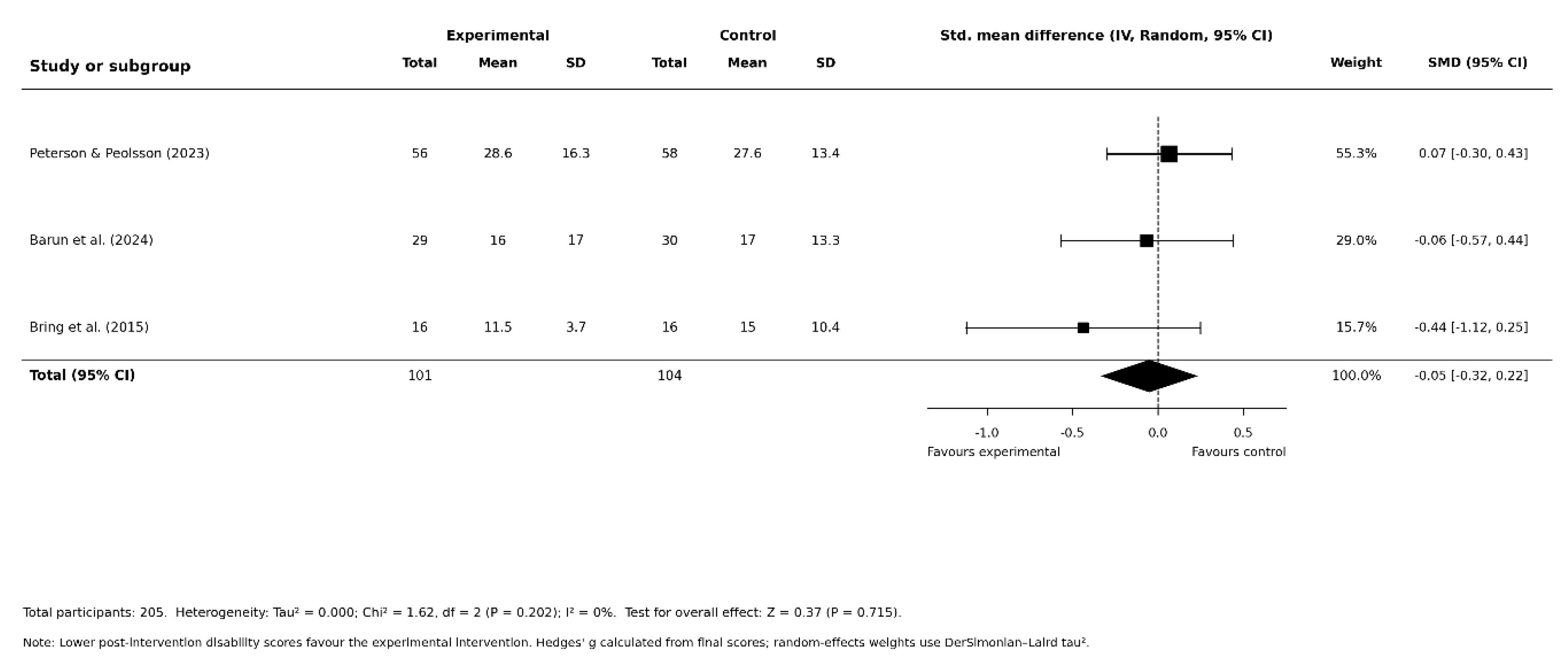
Table 1.
The demographic characteristics of the Virtual Reality (VR) studies.
| Authors and Year | Country | Study Design | Sample Size and Participant Characteristics | WAD Classification and Duration | Intervention Details |
Comparator Details | Outcomes Measured | Follow-up Periods |
|---|---|---|---|---|---|---|---|---|
| Glavare M, Stålnacke BM, Häger CK, Löfgren M (2021) |
Sweden | Single-arm pre-post feasibility study embedded within an interdisciplinary rehabilitation programme (IRP). | 12 adults with chronic neck pain participating in an Interdisciplinary Rehabilitation Programme (IRP); mean age 42 years (SD 7); 75% female (9/12), 25% male (3/12). |
Mixed chronic neck pain population; 9 participants had WAD-related neck pain. Neurological WAD was excluded. Exact WAD grades not reported. | VR exercises integrated into interdisciplinary rehabilitation | No comparator group | Feasibility; symptom severity before and after each VR session (pain, dizziness, nausea, body fatigue, mental fatigue, stress, relaxation); participant experiences. | Assessments conducted before and after the 6-week rehabilitation programme |
| Harvie DS, Broecker M, Smith RT, Meulders A, Madden VJ, Moseley GL (2015) |
Australia | Randomized, double-blinded, within-subject repeated-measures study. | 24 adults with persistent neck pain and pain during neck rotation; mean age 45 years (SD 15); 75% female (18/24), 25% male (6/24). | Not specified. Whiplash participants included, but WAD grades not reported. | VR-based manipulation of visual feedback during neck rotation |
Accurate visual feedback (neutral condition) | Pain-free range of motion (movement-evoked pain threshold during axial neck rotation). | Single session no follow-up |
| Harvie DS, Smith RT, Moseley GL, Meulders A, Michiels B, Sterling M (2020) | Australia | Multiple-baseline replicated single-case series with four phases (Baseline, VR, VR-enhanced, Follow-up) | Twelve adults recruited; 8 completed and analysed. Adults aged 26-70 years with persistent neck pain >3 months and pain during head rotation. Mean age of analysed sample approximately 55 years; 5 males and 3 females. Participants had mild-to-moderate disability and moderate pain intensity | Mixed persistent neck pain population. Both traumatic and non-traumatic neck pain included. Several participants had neck pain following motor vehicle accidents consistent with WAD, but exact WAD grades were not reported. WAD Grade IV and neurological deficits were excluded. Symptom duration ranged from 5 months to 384 months among recruited participants. | Home-based immersive VR neck rotation exercises delivered through Samsung Gear VR headset. Participants performed head-rotation exercises twice daily. “VR-enhanced” condition provided amplified visual feedback, creating the illusion that participants rotated their neck further than was actually performed. Intervention duration approximately 3-4 weeks with repeated training sessions. | Active comparator consisted of identical VR neck exercises without visual manipulation (“VR” phase), plus baseline and follow-up observation phases without intervention. | Primary outcomes: movement-evoked pain threshold (pain-free cervical ROM) and self-reported pain intensity. Secondary descriptive outcomes included Neck Disability Index (NDI), Tampa Scale of Kinesiophobia (TSK), Depression Anxiety Stress Scale (DASS), adherence, and adverse events including motion sickness. | Outcomes collected twice daily throughout all phases. Study phases included jittered baseline (5-14 days), VR exercise (5-14 days), VR-enhanced exercise (21-28 days), and follow-up (5-14 days). |
Table 2.
The demographic details of the digital intervention studies.
| Authors and Year | Country | Study Design | Sample size and Participant Characteristics | WAD Classification and Duration | Intervention Details |
Comparator Details | Outcomes Measured | Follow-up Periods |
|---|---|---|---|---|---|---|---|---|
| Barun B., Divić Z., Martinović Kaliterna D., Poljičanin A., Benzon B., & Aljinović J. (2024) |
Croatia | Randomized controlled trial (RCT) with a parallel-group, active-control design. Allocation was concealed, analyses were performed using an intention-to-treat approach, and physiotherapists and data analysts were blinded |
68 enrolled, 60 were randomized 59 completed it and were analysed (29 intervention and 30 in control group). Adults with whiplash injury following a car accident; NDI >5 (10%); smartphone users. Median age for intervention group was 37 years old; 66% female |
Acute/subacute WAD within 3 months of injury. Specific WAD grade not reported |
WIApp mobile application + standard physiotherapy care | Standard physiotherapy care alone | Exercise adherence, Neck Disability Index (NDI), pain intensity (VAS), perceived recovery scale, | Baseline and 6-month follow-up |
| Bring A, Åsenlöf P, Söderlund A, 2015 |
Sweden | Multicentre, prospective, three-arm randomized controlled trial (RCT) with concealed allocation | 55 adults with acute Whiplash Associated Disorder (WAD) Grades I-II (n = 55). Mean age 35.7 years (Internet group), 35.3 years (face-to-face group), and 36.0 years (control group); age range 18-65 years. Female: 37 (67%); Male: 18 (33%). |
Internet (WAD I = 7, WAD II = 11). Face to face (WAD I =3, WAD II = 15). Control (WAD I = 4, WAD II = 15 Participants recruited 2-4 weeks after injury |
Individually tailored behavioural programme delivered either via internet or face-to-face physio sessions | Standard treatment consisting of self-care instructions only | Pain Disability Index | Baseline (2-4 weeks post-injury), 3,6 and 12 months post intervention |
| Muñoz-Sánchez LA, Aguirre-García MC, Figueroa-García J, Rojano-Mejía D, 2026 |
Mexico | Longitudinal before-and-after single-group study. | 14 enrolled 12 completed the 6-week follow up. 14 adults with acute cervical sprain/whiplash (Grade I–II). Mean age 34.9 years (SD 9.4). Female: 64.3% (9/14); Male: 35.7% (5/14). |
Grade I: 64.3% (n=9); Grade II: 35.7% (n=5). | Telerehabilitation based neck-specific exercise programme | None before and after design | Neck Disability Index (NDI/IDC) and pain intensity using Visual Analogue Scale (VAS). | Follow up after 2 weeks and then 6 weeks |
| Peolsson A, Nilsing Strid E, Peterson G. 2024a |
Sweden | Prospective multicentre randomized controlled trial with 3-month intervention and 15-month follow-up | 140 individuals with chronic moderate-to-severe whiplash-associated disorder (WAD); mean age 40.5 years (SD 11.5); 79% female (110/140). |
WAD Grade II–III. Grade II: 64% overall (89/140); remainder Grade III. | Neck-specific exercise with internet support with 4 physio visits | Neck-specific exercises delivered through 24 physiotherapy visits | Work Ability Score (WAS) | 3 and 15 months |
| Peolsson A, Wirqvist S, Kammerlind A-S, Peterson G (2024b) | Sweden | Secondary analysis of a prospective multicentre randomised controlled trial (RCT) with concealed allocation and assessor blinding. Intention-to-treat analysis performed. | 82 participants (secondary analysis) who reported dizziness at baseline (42 NSEIT; 40 NSE). Adults aged 18–63 years with chronic WAD, persistent neck pain, neck disability, and self-reported dizziness/unsteadiness. Mean age approximately 40 years. Females comprised 82% (67/82) and males 18% (15/82). Baseline NDI approximately 40% | Chronic WAD Grades II and III. Mean duration since injury approximately 28.5 months. WAD Grade II: 56% (46/82); WAD Grade III: 44% (36/82). Participants required symptoms for ≥6 months and ≤5 years post-injury. | Neck-Specific Exercise with Internet Support (NSEIT): 12-week neck-specific exercise programme delivered through an internet platform with videos, exercise progression, pain education, and four physiotherapy visits. Exercises individually tailored. | Neck-Specific Exercise (NSE): Same exercise programme and education delivered through supervised physiotherapy sessions twice weekly for 12 weeks (up to 24 sessions). | Dizziness Handicap Inventory (DHI), dizziness at rest (VAS), dizziness during activity (VAS), unsteadiness (VAS), standing on one leg with eyes closed (SOLEC), exercise compliance. | Baseline, 3-month follow-up (end of intervention), and 15-month follow-u |
| Peterson G, Peolsson A 2023 |
Sweden | Prospective multicentre randomized controlled trial with 3-month intervention and 15-month follow-up | 140 individuals with chronic moderate-to-severe whiplash-associated disorder (WAD); mean age 40.5 years (SD 11.5); 79% female (110/140). |
WAD Grade II–III. Grade II: 64% overall (89/140); remainder Grade III | Neck-specific exercise with internet support with full physio visits | Neck-specific exercises delivered through 24 physiotherapy visits | Neck Disability Index (NDI), | 3 and 15 months |
| Peterson G, Nilsing Strid E, Jönsson M, Hävermark J, Peolsson A. 2024 |
Sweden | Prospective multicentre randomized controlled trial with 3-month intervention and 15-month follow-up | 140 (secondary analysis) individuals with chronic moderate-to-severe whiplash-associated disorder (WAD); mean age 40.5 years (SD 11.5); 79% female (110/140). | WAD Grade II–III. Grade II: 64% overall (89/140); remainder Grade III | Neck-specific exercise with internet support with full physio visits | Neck-specific exercises supervised by a physio twice weekly for 12 weeks | Active cervical ROM, cranio-cervical flexion test, neck muscle endurance | 3 and 15 months |
| Peterson G, Ljunggren S, Peolsson A 2025 |
Sweden | Prospective multicentre randomized controlled trial with 3-month intervention and 15-month follow-up | 140 (secondary analysis) individuals with chronic moderate-to-severe whiplash-associated disorder (WAD); mean age 40.5 years (SD 11.5); | WAD Grade II–III. Grade II: 64% overall (89/140); remainder Grade III | Neck-specific exercise with internet support with full physio visits | Neck-specific exercises supervised by a physio twice weekly for 12 weeks | Factors associated with NDI, neck pain VAS and PSFS improvement | 3 and 15 months |
| Rodríguez-Bagó M, Martínez-Martínez JM, Ortner-Sancho J, Farrús-Esteban X, Sampere-Valero M, Ronda-Pérez E 2025 |
Spain | Pre-post intervention study plus observational cohort comparison | 387 participants Workers aged 16–65 years with cervical whiplash syndrome (n = 387; telerehabilitation n = 176, standard care n = 211). Mean age not reported. Female: 58.7%; Male: 41.3%. |
Not reported. Cervical whiplash syndrome only | Hybrid face-to-face physio and telerehabilitation | Conventional centre-based physiotherapy | Duration of sickness absence; acceptability and usability questionnaire | On returning to work sickness absence outcomes assessed |
| Rodríguez-Bagó M, Martínez-Martínez JM, González González JC, Sampere-Valero M, Ronda-Pérez E (2026) |
Spain | Non-randomized controlled comparison | 43 participants. Workers aged 16–65 years with cervical whiplash syndrome; telerehabilitation n = 15, conventional care n = 28). Age distribution: 51.2% ≤40 years, 48.8% >40 years. Female: 53.5%; Male: 46.5%. | Not reported. Cervical whiplash syndrome only | AI-supervised telerehabilitation combined with face-to-face physio | Conventional centre-based physiotherapy alone | Duration of sickness absence; acceptability and usability outcomes | Follow-up until completion of treatment and return to work |
| Zetterberg, H., Boersma, K., Peolsson, A., & Peterson, G 2026 |
Sweden | Secondary analysis of a multi-centre randomized control trial | 140 participants (secondary analysis). Adults with chronic WAD (6 months to 5 years post-injury) | WAD grade II-III | Neck-specific exercise with internet-based support and 4 physio visits | Clinic-based neck-specific exercise supervised twice weekly | Pain Catastrophizing Scale (PCS) Fear-Avoidance Beliefs Questionnaire (FABQ) Self-Efficacy Scale (SES) |
3 months and 15 months |
Disclaimer/Publisher’s Note: The statements, opinions and data contained in all publications are solely those of the individual author(s) and contributor(s) and not of MDPI and/or the editor(s). MDPI and/or the editor(s) disclaim responsibility for any injury to people or property resulting from any ideas, methods, instructions or products referred to in the content. |
© 2026 by the authors. Licensee MDPI, Basel, Switzerland. This article is an open access article distributed under the terms and conditions of the Creative Commons Attribution (CC BY) license.
Copyright: This open access article is published under a Creative Commons CC BY 4.0 license, which permit the free download, distribution, and reuse, provided that the author and preprint are cited in any reuse.