

Submitted:
10 November 2026
Posted:
11 November 2026
You are already at the latest version
Abstract
The twin transformation—the coordinated pursuit of smart (digital) and green (sustainable) manufacturing—has become a central agenda in manufacturing research and policy. However, existing studies operate almost exclusively at the firm level: how smart and green transformations are coordinated at the industry-chain level lacks a theoretical account, and the convergence (“ronghehua”) dimension prominent in Chinese industrial policy discourse has not been conceptualized. This article develops a conceptual framework of chain-leader-orchestrated twin transformation. It argues that chain-leader firms act as organizational intermediaries that supply chain-level public goods through four mechanisms—capability spillover, standard transmission, scenario orchestration, and factor orchestration—and that convergence, the integrative capacity spanning actors, chain stages, and chains, constitutes the organizational condition and amplifier of smart–green synergy. Three theoretical propositions are derived. Four publicly documented cases from Xi'an's manufacturing sector provide illustrative evidence. The framework extends twin transformation research from the firm to the industry-chain level and draws policy implications for inland central cities that organize industrial transformation around chain leaders and new factor endowments. Empirical testing of the propositions constitutes the agenda for future research.
Keywords:
twin transformation
; chain-leader firm
; industry chain
; smart transformation
; green transformation
1. Introduction
Manufacturing is undergoing two profound transformations at the same time. The first is smart transformation: digital and intelligent technologies—artificial intelligence, digital twins, and the industrial internet—are penetrating production, organization, and coordination, with data emerging as a key factor of production. The second is green transformation: under tightening resource and environmental constraints and China's dual-carbon goals, manufacturing must achieve systemic improvements in energy efficiency, emissions, and circularity. European policy discourse has labeled the coordinated pursuit of the two the “twin transition”, and the concept has rapidly entered academic research, generating conceptual frameworks, maturity models, and pathway studies [1,2]. In China, the Outline of the Fifteenth Five-Year Plan for National Economic and Social Development calls for “adhering to the directions of smart, green, and integrated development and accelerating the building of a manufacturing powerhouse” [3]. In this formulation, convergence—“ronghehua” in the original—is elevated to a transformation direction on a par with smart and green development, pointing to inter-industry and inter-chain integration.
The literature on twin transformation, however, exhibits a marked asymmetry in its unit of analysis: the overwhelming majority of studies focus on the individual firm or plant. Whether in maturity models grounded in organizational design theory [4], roadmapping methodologies developed for the plant level [5], or surveys and systematic reviews of twin transformation capabilities in small and medium-sized enterprises (SMEs) [6,7], the analytical object is a single firm learning to digitalize and become sustainable at the same time. This orientation overlooks a fact that is particularly consequential for understanding the Chinese experience: smart and green transformations in manufacturing are largely organized and diffused along industry chains. Chain-leader firms—the core firms with governance capacity within a chain—transmit digital platforms, data standards, and green procurement requirements upstream and downstream, and their problem-setting and problem-solving practices shape the transformation pathways of hundreds of suppliers. In other words, at the industry-chain level there is a question that firm-level research cannot answer: who organizes transformation within the chain, and through what mechanisms are the two transformations made to reinforce rather than undermine each other?
A second, related gap concerns the convergence dimension of Chinese industrial policy and research discourse. Xue et al. [8] constructed a macro-level analytical framework for the coordinated digital–green transformation of manufacturing, comprising scenario pulling, technology driving, organizational synergy, and environmental support, which has become an important reference for policy discussion. Yet in that framework, who carries the “organizational synergy” dimension at the chain's meso level, and how it operates, remain unexplained; and convergence itself has not been incorporated into the conceptual apparatus of the international twin transformation literature.
Against these gaps, this article draws on industrial economics and global value chain (GVC) governance theory to develop a conceptual framework of chain-leader-orchestrated twin transformation. The core claim is as follows. At the industry-chain level, the synergy between smart and green transformation is not a simple superposition of two technologies but a form of “public good” that must be organized and supplied. Chain-leader firms, by virtue of their market power, digital capabilities, and dominant position in the chain's division of knowledge, assume this organizational role through four mechanisms: capability spillover, standard transmission, scenario orchestration, and factor orchestration. Convergence—the integrative capacity that spans actors, chain stages, and chains—constitutes the organizational condition under which the two transformations couple, and amplifies their combined effect. To give the framework empirical texture, the article uses Xi'an's manufacturing sector as the setting and draws on four publicly traceable cases as illustrative evidence: FAST's high-end smart factory, Shaanxi Automobile Group's (SHACMAN) supplier-driven diffusion of new-energy transformation, the chain-completion investment of the Xinye Shidai 8-inch wafer fab, and photonics–semiconductor cross-chain collaboration supported by a computing-power–green-electricity base. Xi'an is chosen for three reasons. First, it is a typical inland central city with dense science and education resources, so its transformation pathway is instructive for the many non-coastal cities. Second, its manufacturing spans automotive, semiconductor and photonics, and aerospace chains in which chain leaders are prominent and case information is publicly abundant. Third, Xi'an has recently issued a dense stream of new-style industrial policies on scenario opening and factor provision, offering a rare policy window through which to observe convergence at work.
This article is a theory-building conceptual paper: the cases serve to illustrate how the mechanisms operate in reality, and the empirical testing of the propositions is left to future research. The remainder of the paper is organized as follows. Section 2 reviews the twin transformation and value chain governance literatures and specifies the research gaps. Section 3 defines the core concepts and presents the conceptual framework and propositions. Section 4 presents the illustrative evidence from Xi'an. Section 5 discusses theoretical contributions, policy implications, and boundary conditions. Section 6 concludes and notes limitations and directions for future research.
2. Literature Review and Theoretical Background
2.1. Twin Transformation Research: Progress and the Firm-Level Bias
The policy origin of the twin transformation concept is the convergence of the European Green Deal and the EU digital strategy. Its central insight is that digitalization and sustainability, if pursued separately, may offset each other: the energy consumption and electronic waste generated by digitalization erode green gains, while greening without digital capability struggles to break cost and technology bottlenecks. Christmann et al. [1] proposed the “twin transformation butterfly” metaphor, likening digital and sustainability capabilities to the two wings of a butterfly that must develop in synchrony for the firm to “fly”. Breiter et al. [2], drawing on the dynamic capabilities perspective, developed a capability maturity model that traces the ladder from “twin transformation climbing” to “twin transformation flying”. Fatemi et al. [4] grounded a maturity blueprint in organizational design theory, spanning strategy, structure, processes, people, incentives, and technology. On more specific topics, Spaltini et al. [5] developed a roadmapping methodology for the plant level, Taddei et al. [9] systematically reviewed circular supply chains in the Industry 4.0 era, and Burinskienė and Nalivaikė [6] and Abilakimova et al. [7] examined the micro-practices of, and barriers to, twin transformation in European SMEs.
The consensus of this literature is that the difficulty of twin transformation lies not in any single technology but in the coordination of the two transformations. Yet, as several studies themselves acknowledge, existing knowledge is built almost entirely at the firm or plant level, and little is known about coordination mechanisms across firm boundaries—chains, clusters, and regions [4,7]. This limitation has two specific consequences. First, firm-level research cannot explain the uneven diffusion of transformation capability: within otherwise similar regions, why do chain leaders commonly build smart factories while the long tail of the chain remains at an early stage of automation. Second, firm-level research struggles with the energy rebound problem of digitalization: rising computing power and equipment density raise the energy baseline, a contradiction that a single firm cannot resolve internally and whose resolution typically depends on regional green electricity supply and factor organization—beyond the boundary of firm-level analysis.
2.2. Value Chain Governance and the Chain Leader: From Production Coordination to Transformation Coordination
The coordinating role of lead firms within chains has a long theoretical pedigree in the GVC governance literature. Gereffi et al. [10] showed that lead firms govern their chains through multiple structures, from market-like to quasi-hierarchical, depending on transaction complexity, codifiability, and supplier capability, and that knowledge flows, standard setting, and upgrading paths within the chain are endogenous to its governance structure. The dynamic capabilities literature adds that the capacity of core firms to build, bundle, and leverage resources in turbulent environments underpins their chain dominance [11,12]. On the green dimension, Porter and van der Linde [13] demonstrated that well-designed environmental regulation can trigger innovation offsets, so green transformation need not come at the cost of competitiveness—a foundation for the argument that chain leaders can convert green constraints into chain-level innovation.
Connecting these three literatures with twin transformation research yields a clear theoretical inference. If the essence of twin transformation is a coordination problem, and if GVC theory shows that coordination at the chain level has historically been performed by lead firms, then the organizer of twin transformation at the industry-chain level must be the chain-leader firm, whose governance content expands from production coordination to transformation coordination. To the best of our knowledge, this inference has not been systematically developed in the twin transformation literature: how a chain leader simultaneously organizes smart and green transformation across the chain, through which mechanisms the two transformations couple, and under what conditions they constrain each other all remain untheorized. Relatedly, China's recent practice with the “chain chief system” (lianchang zhi) and chain-leader cultivation policies has accumulated a research base. Studies have defined the institutional function of the chain chief as the first responsible person for chain governance [14], interpreted the chain chief system as a new form of locally led industrial policy [15], and, using a quasi-natural experiment, found that the co-governance of chain chiefs and chain leaders improves the economic and environmental performance of chain firms [16]. However, this literature concentrates on the government side of institutional design; the transformation-organizing mechanisms of the chain leader itself—that is, how the chain leader supplies the public conditions required for transformation along the chain—remain to be theorized.
2.3. Regional Factor Endowments and Convergence: A Third Dimension in the Chinese Context
The regional preconditions of twin transformation were foreshadowed in innovation systems research. Regional innovation system theory holds that innovation is the product of systemic interaction among firms, institutions, and infrastructure within a region [17]. For twin transformation, the region supplies not only generic innovation conditions but also factors specific to the two transformations: computing power and green electricity. The convergence dimension of Chinese industrial policy discourse goes beyond vertical coordination within a single chain: it points to cross-chain meshing (e.g., photonics with semiconductors), cross-industry penetration (e.g., automotive with electronics), and factor-level coupling (e.g., computing power with green electricity). No concept in the international literature corresponds directly to this dimension. The closest is the discussion of circular supply chains and cross-chain synergy [9], but that work focuses on material flows, whereas convergence emphasizes the cross-chain recombination of knowledge and factors and its amplification of twin transformation.
Recent Chinese research supports the policy logic of convergence. Using a configurational analysis of survey data from 331 Chinese manufacturers, Wang et al. [18] identified five differentiated, equifinal driving paths of digital–green synergy, and showed that none of the six antecedent conditions is individually necessary for high synergy: outcomes are decided by how technological, organizational, and environmental conditions combine. This finding is consistent with our position. If high synergy is the product of combinations of conditions, then the architect of the combination—in the chain context, the alliance of chain-leader firms and local government—becomes the focus of theoretical attention.
2.4. Summary: Three Research Gaps
In sum, three interrelated gaps structure the literature: (1) a unit-of-analysis gap—twin transformation research remains at the firm level and lacks a mechanism theory of the industry-chain level; (2) an organizer gap—who coordinates twin transformation at the chain level, and through what mechanisms, is unanswered; and (3) a conceptual gap—convergence has not been incorporated into the conceptual system of twin transformation, and its status as an organizational condition for synergy has not been articulated. The framework developed below responds to these gaps in turn.
3. The Conceptual Framework and Theoretical Propositions
3.1. Core Concepts
Chain-level twin transformation refers to a transformation process in which smart and green transformation advance simultaneously and form positive feedback at the level of the industry chain as a whole. Its defining difference from firm-level twin transformation is that the transformation capability of any link in the chain is not determined entirely by the firm itself but partly by the chain's public conditions—shared platforms, common standards, and accessible factors; and these public conditions must be organized and supplied.
Smart transformation denotes the penetration and reconfiguration of production, organization, and coordination by digital and intelligent technologies; its economic substance is the factorization of data and the reduction of coordination costs. Green transformation denotes the transformation dimension centered on resource and energy efficiency and environmental constraints; its substance is the internalization of environmental externalities. The tension between the two is that smart transformation itself raises energy consumption and the carbon footprint of computing; without structural green supply to offset it, synergy may degenerate into offsetting. Energy economics research on the rebound effect has shown that consumption expansion triggered by efficiency improvements can partially or even fully offset efficiency gains [19,20]; the same mechanism applies in the context of smart transformation.
Convergence is the third dimension introduced into the conceptual system by this article: the integrative capacity that spans actors (chain leader–chain firms–platform institutions), chain stages (R&D–manufacturing–services), and chains (photonics–semiconductors; automotive–electronics). We define convergence as the organizational condition and amplifier of smart–green synergy: convergence is not itself a third “transformation”, but it determines whether the two transformations couple at all, and the direction of the net effect once they do.
3.2. Four Chain-Leader Intermediation Mechanisms
The logical starting point of the framework is an organizational question: who supplies the chain's public goods? Our answer is the chain-leader firm, whose supplying activities can be summarized in four mechanisms (Figure 1).
M1: Capability spillover. The chain leader outputs to chain member firms, at low marginal cost, the digital platforms, industrial software, data standards, and equipment interfaces accumulated in building its own smart factory. Having already paid the trial-and-error costs and fixed investment during its own smart transformation, the leader enables member firms to board the smart track at a cost far below self-development. This explains why a chain leader's smart factory often becomes the “capability mother machine” of the whole chain.
M2: Standard transmission. Through procurement standards, supplier admission assessment, and tiered supplier management, the chain leader embeds green and digital requirements into trading relations. Compared with administrative regulation, the transmission advantage of leader-set standards is that they ride on orders: incentives are immediate, constraints are embedded, and the market logic of “meet the standard or exit the chain” is far more binding than subsidy guidance.
M3: Scenario orchestration. The chain leader sets the questions and member firms answer them: the leader converts real production needs into well-defined technical problems and opens validation scenarios to member firms, while local government complements this with public scenario lists that enlarge the supply of scenarios. Scenario orchestration compresses the search and trial-and-error costs between technology supply and demand, so that the direction of transformation is set by real needs rather than by the unilateral imagination of technology suppliers.
M4: Factor orchestration. The chain leader and local government jointly organize the concentrated supply of new factors—computing power, green electricity, talent, and pilot-testing facilities. Factor orchestration lowers the fixed cost of transformation for the chain as a whole: when small and medium member firms can rent computing power and green electricity on demand, the entry threshold of twin transformation is converted from a capital barrier into an operating expense.
The four mechanisms do not operate in isolation: M1 lowers the capability threshold, M2 supplies incentives and constraints, M3 calibrates the direction of transformation, and M4 cuts fixed costs. Together they constitute the supply system of chain-level public goods.
3.3. Three Theoretical Propositions
On the basis of the framework's logic, we advance three propositions.
Proposition 1 (capability spillover and the synergy threshold). Other things equal, the spillover of the chain leader's digital capability (M1) is a precondition for chain member firms to achieve smart–green synergy. Where the chain leader is absent or its capabilities remain closed, twin transformation in the chain's long tail exhibits “isolation”: advanced practice in individual firms fails to diffuse along the chain, and the chain's overall level of synergy is markedly lower than in chain-leader-brokered settings.
Proposition 2 (chain completion and baseline leapfrogging). Major chain-completion investment—supplying a missing link of the chain—resets the chain's technological baseline, simultaneously raising the starting point of both smart and green transformation, producing a “baseline leapfrogging” effect. The effect holds on the condition that the new link is built to a new-generation technological standard: what is added is not backward capacity but an advanced link that resets the digital interfaces and energy-efficiency norms of the entire chain at one stroke.
Proposition 3 (convergence and the net synergy effect). The greater the degree of convergence—the tighter the cross-chain meshing and the deeper the computing-power–green-electricity coupling—the more positive the net effect of smart–green synergy. Where regional green electricity supply is ample, the energy increment brought by smart transformation is absorbed structurally and rebound risk is defused by regional factor endowments; where green electricity is scarce, the energy increment of smart transformation translates directly into an internal contradiction of twin transformation.
4. Illustrative Evidence from Xi'an
4.1. Case Selection and Sources
This section uses four publicly documented cases from Xi'an's manufacturing sector to illustrate the conceptual framework. Case selection follows a theoretical sampling logic: the four cases correspond to different mechanisms and proposition-relevant settings of the framework—FAST corresponds to the micro-foundation of intra-firm coupling of the twin transformation; SHACMAN corresponds to the along-chain diffusion of capability spillover and standard transmission; the Xinye Shidai wafer fab corresponds to chain completion and baseline leapfrogging; and photonics–semiconductor cross-chain collaboration and the computing-power–green-electricity base correspond to scenario orchestration, factor orchestration, and the convergence dimension. Within the constraint of mechanism coverage, we selected chains for which information is publicly abundant and traceable item by item. All materials come from public reporting and the officially released texts of policy documents (see the References); the specific figures and quotations cited in the text are reproduced from the original sources. As illustrative evidence, the function of the cases is to show how the mechanisms operate in reality and to give the propositions empirical texture; testing the propositions is the task of subsequent empirical research.
4.2. Case 1: FAST's High-End Smart Factory—the Micro-Foundation of Intra-Firm Coupling
FAST (Shaanxi Fast Auto Drive Refco Group Ltd.), a leading commercial-vehicle transmission manufacturer based in Shaanxi, operates a high-end smart factory that is a representative site for observing how smart and green transformation couple within the firm. According to public reporting, the factory relies on six core technologies, including digital twins, the Internet of Everything, and closed-loop data management, to connect the data links of “man, machine, material, method, and environment” across all elements; its machining lines have reached a 100% automation rate; it can sustain up to six hours of unattended “lights-out” production; and its systems collect more than 30,000 production data points per second [21]. The factory's operations director summarized the essence of “lights-out” as “stable, automated production without human intervention” rather than literally switching off the lights.
Viewed through the framework, the case displays the micro-foundation of twin transformation: the concrete form of smart transformation on the shop floor—unattended operation and closed-loop data—is at the same time the channel through which green transformation is realized, for lights-out operation and data closure mean that energy, materials, and equipment status become measurable and controllable throughout the process; greening thereby shifts from end-of-pipe treatment to process-embedded improvement. Intra-firm smart–green coupling is the preconditioning unit for chain-level synergy: without this micro-foundation, the four mechanisms M1–M4 have nothing to transmit. The same chain offers a diffusing sample: Xigu Guangtong's 5G smart factory used digital twins and artificial intelligence to shorten equipment response time by 60% and to raise inspection efficiency to 15 times the manual benchmark [21], indicating that the micro-foundation is not an isolated instance.
4.3. Case 2: SHACMAN's New-Energy Transformation—Diffusion Under Chain-Leadership
SHACMAN's new-energy smart factory presents a full picture of mechanisms M1 and M2 in operation. Public reporting shows that a new-energy heavy truck rolls off the line every 4.8 min on average; the chain leader drives more than 400 suppliers, nearly half of which are located in Shaanxi [21,22]. Along the chain, Zhide Auto Electronics exceeded RMB 210 million in output value in 2024, up 90% year-on-year under the chain leader's drive; in Geely's Xi'an industrial park, 16 parts companies including Yanfeng and Tuopu have reached an 82% occupancy rate, and Yanfeng's two plants can supply 800 seats to Geely in a single day [21].
What the case displays is the supply and diffusion of chain-level public goods: what the chain leader's smart factory—with its 4.8-min takt—outputs to member firms is not the orders themselves but the capabilities and standards required to reorganize production around the new takt; suppliers must rebuild their own processes around the leader's digital collaboration interfaces and green procurement requirements to remain on the chain. “The leader sets the questions and the members answer” thus acquires concrete mechanism content: the question is the reorganization of the leader's production system, and the answer is the members' capability follow-through. This is consistent with Proposition 1: the boundary of the possible for member firms' transformation is set by the leader's spillover capability.
4.4. Case 3: The Xinye Shidai 8-Inch Wafer Fab—Chain Completion and Baseline Leapfrogging
The semiconductor chain provides the counterpart for Proposition 2. Before the Xinye Shidai 8-inch wafer fab went into production, Xi'an's semiconductor sector “had design, had packaging and testing, but lacked wafer fabrication”, and local design firms had to send their wafers to the Yangtze River Delta or the Pearl River Delta for foundry work; after the fab started production, local engineers could coordinate face to face with the manufacturing link within a half-hour drive [21]. The policy record confirms that chain completion was a designed system: the Implementation Plan for Promoting the High-Quality Development of the Semiconductor and Photonics Industries in Xi'an lists “fully safeguarding the earliest production and effectiveness of two 8-inch power-semiconductor wafer manufacturing projects, undertaking the tape-out and foundry production of design firms” as the foremost measure for upgrading wafer manufacturing, and explicitly states that wafer manufacturing will “link up” design, packaging and testing, and materials and equipment, building a complete industry chain of “design-led, manufacturing-dominated, packaging-and-testing-supported, with key materials and equipment as complements” [23].
The framework meaning of the case lies in what link is completed and how. Wafer fabrication is doubly intensive in capital and technology; completing the chain by building a new advanced production line resets, in one stroke, the chain's digital interfaces (design–manufacturing data exchange) and its energy-efficiency norms (the unit-energy standards of a new line). Before completion, the chain's synergy radius was truncated by geographic distance; after completion, it contracted to a “half-hour industrial circle”, changing the frequency and density of cross-stage knowledge flows. This is precisely the “baseline leapfrogging” of Proposition 2: the significance of chain completion lies not in adding one link but in resetting the synergy baseline of the whole chain. The leapfrogging effect also contains its boundary condition: it holds only when the added link embodies advanced technology; adding backward capacity would instead entrench low-end lock-in.
4.5. Case 4: Photonics–Semiconductor Cross-Chain Collaboration and the Computing-Power–Green-Electricity Base—Two Layers of Convergence
The fourth group of cases corresponds to the convergence dimension of Proposition 3. The first layer is cross-chain meshing. In the first half of 2026, Xi'an held nine special matchmaking events around the semiconductor and photonics chains, producing 17 collaboration outcomes [21]. The Implementation Plan for the Semiconductor and Photonics Industries encourages chain leaders, specialized “little giant” firms, and listed science-and-technology firms to grow in echelons, and, demand-led, “advances the cross-chain supply and coordination between the automotive and photonics chains”, bringing makers of automotive-grade chips and power devices into the chains [22,23]. Photonics and semiconductors were originally two separate chains; matchmaking mechanisms cause the two chains to recombine knowledge at the levels of materials, devices, and processes—a direct presentation of the cross-chain dimension of convergence. The commercial aerospace chain displays another route: the sector in Xi'an gathers nearly 4000 firms and has long been “strong in components, weak in systems integration”; in 2026, four local actors—Sanjiao Defence, Xice Testing, Ruitou Energy, and the Shaanxi Institute of Aerospace Power—jointly registered a chain-leader platform company, for the first time building systems-integration capacity with market-based capital [21]. The chain-leader platform is itself an organizational product of convergence.
The second layer is factor-base coupling. Xi'an's Yanta Artificial Intelligence Innovation and Development Center has built 500 PFLOPS of AI computing power with rent-as-you-go elastic supply, so firms can rent on demand without building machine rooms; in August 2026, Shaanxi's first “token supermarket” went online, splitting model calls and data services into minimum-priced billing units; and by the end of August 2026, Xi'an's installed renewable generation capacity had reached 4.197 gigawatts, 55.13% of the city's total installed capacity, with distributed photovoltaics at 3.870 gigawatts—already exceeding thermal power [21]. The scale-up of computing power and the high share of green electricity appear together, constituting the structural offsetting condition for the energy increment of smart transformation—precisely the situational element of Proposition 3. The institutionalization on the policy side deserves note. In July 2026, the General Office of the Xi'an Municipal People's Government issued the Implementation Plan for Accelerating Scenario Cultivation and Opening to Promote the Large-Scale Application of New Scenarios, which proposes the pathway of “technological breakthrough–scenario validation–industrial application–system upgrading”, explicitly encourages “chain-leader enterprises to open internal scenarios such as production lines, supply chains, and laboratories, take the lead in forming innovation consortiums, and drive the integration of large, medium, and small enterprises”, and announced a first batch of 33 open application-scenario opportunities [22,24]. A municipal official summarized the shift as “in the past we 'gave policies'; now we are shifting to 'giving scenarios”' [22]. The plan's designed closed loop of “scenario release–technology matching–pilot validation–large-scale application–industrial agglomeration” [24] forms a public–private echo with the chain leader's scenario supply: scenario opening (M3) and factor orchestration (M4) have become institutionalized in the policy layer.
Taken together, the four cases cover the four mechanisms and the main settings involved in the three propositions (Table 1).
5. Discussion
5.1. Theoretical Contributions
The theoretical contribution of this article is threefold. First, it extends the unit of analysis of twin transformation research from the firm to the industry chain. Existing frameworks [1,2,4] answer how a single firm develops digital and sustainability capabilities in synchrony; this article answers how a chain diffuses the two transformations in synchrony. The extension responds directly to the literature's self-acknowledged inattention to cross-boundary coordination [4,7] and imports GVC governance theory [10] into twin transformation analysis: the leader's governance content expands from production coordination to transformation coordination, and its governance object extends from product quality and cost to the technological trajectory and energy-efficiency level of member firms.
Second, the article supplies an organizational answer to the provision of chain-level public goods. “Coordination” is a keyword the twin transformation literature repeatedly stresses, but its organizer is tacitly assumed to be the firm itself or the government. We show that in the industry-chain setting, the coordinator is the alliance of chain-leader firms and local government: the leader supplies capabilities, standards, and scenarios (M1–M3), while government organizes factors and public scenarios (M4 and the scenario lists). This answer meso-izes the “organizational synergy” dimension of the macro framework of Xue et al. [8] and aligns with the inference of configurational research—if high synergy has no single necessary condition, then the architect of the condition combination is where explanation should focus [18]. Relative to the chain-chief literature, which concentrates on the government side of institutional design [14,15,16], what this article contributes is precisely the mechanism portrait of the chain-leader side.
Third, the article conceptualizes convergence and incorporates it into the twin transformation system. The international literature has no direct counterpart to this Chinese policy concept; we define it as the integrative capacity spanning actors, stages, and chains, and argue that its function is the organizational condition and amplifier of smart–green synergy. This is a theoretical distillation of a Chinese policy concept and, at the same time, an analytical interface for comparative research: the European twin transition relies on regulation- and carbon-price-based market coordination, whereas the Chinese setting exhibits organization-based coordination of “chain-leader brokerage plus factor orchestration”; comparing the performance of the two modes is a valuable research topic.
5.2. Policy Implications
Three implications follow. First, chain-leader policy should shift from granting privileges to assigning functions. The value of a chain leader lies not in its size but in whether it actually performs capability spillover, standard transmission, and scenario supply; in evaluating chain-leader cultivation, the transformation follow-through of member firms (the share of suppliers connected to digital collaboration interfaces, and the coverage of green procurement standards) is more informative than the leader's own smart-manufacturing honors. Xi'an's practice of writing into a municipal implementation plan that “chain-leader enterprises open internal scenarios such as production lines, supply chains, and laboratories, take the lead in forming innovation consortiums” [24], and institutionalizing the question-setting–answering mechanism through special matchmaking events and scenario opportunity lists [21,22], provides an operational template for the policy encoding of chain-leader functions.
Second, factor orchestration is the transformation lever of inland cities. With 500 PFLOPS of rent-as-you-go computing power, token-level pricing of model calls, and a 55.13% renewable share of installed capacity, Xi'an converts the fixed costs of twin transformation into rentable operating costs [21]. For inland central cities rich in science and education but relatively scarce in industrial capital, attracting and retaining chain increments through new-factor supply may be more leveraged than plant-by-plant investment promotion: once the factor base is in place, the locational stickiness of leaders and member firms follows.
Third, green electricity supply should be planned jointly with computing-power expansion. The policy meaning of Proposition 3 is direct: without regional green electricity to offset it, the energy increment of smart transformation turns into a self-contradiction of twin transformation. The synchronized evolution in Xi'an of computing-power expansion and distributed photovoltaics overtaking thermal power [21] suggests that compute planning and power-structure planning should be treated as one integrated issue rather than two plans belonging to different departments.
5.3. Boundary Conditions
The applicability of the framework has three boundaries. First, chain-leader brokerage presupposes that the leader has sufficient market power and digital capability; in chains where market power is dispersed (e.g., fully competitive links) or the leader's own capability is insufficient, mechanisms M1–M3 cannot operate, and chain-level twin transformation degenerates into a problem of direct government regulation. Second, standard transmission is exposed to “greenwashing” risk: member firms may cope with leader standards through compliance outsourcing or data manipulation, and the mechanism's effectiveness depends on the balance between the leader's verification capability and the members' switching costs. Third, the framework does not treat industry heterogeneity: process manufacturing (e.g., chemicals) and discrete manufacturing (e.g., automotive) differ markedly in chain structure, energy-efficiency constraints, and the codifiability of technology, and the relative weights of the four mechanisms should differ accordingly—this article is based mainly on Xi'an's discrete-manufacturing and electronics chains, and extension to process manufacturing should proceed with caution.
6. Conclusions, Limitations, and Future Research
Addressing the firm-level bias of twin transformation research and the conceptual blank of convergence, this article has proposed a framework of chain-leader-orchestrated twin transformation, summarized the chain functions of chain-leader firms into four mechanisms—capability spillover, standard transmission, scenario orchestration, and factor orchestration—defined convergence as the organizational condition and amplifier of smart–green synergy, and advanced three theoretical propositions. Four publicly documented cases from Xi'an's manufacturing sector provided illustrative evidence. The central message is that chain-level twin transformation is essentially a process of public-good supply that must be organized, and that the alliance of chain-leader firms and local government is its supplier.
Three limitations should be acknowledged. First, the evidence is illustrative and secondary: the four cases were selected to fit framework elements, so constructive selection preference cannot be ruled out; the specific figures in the cases are reproduced from media reporting and policy documents and, while sourced item by item, the statistical calibers of the media-reported portions were not independently verified for this article. Second, the setting is a single city: extrapolation of the framework to other regions—especially export-oriented coastal chains and process-manufacturing chains—is not supported by the present evidence. Third, the three propositions have not been empirically tested; their validity, conditions of validity, and effect sizes remain open questions.
Future research can proceed along three paths. First, configurational testing of Propositions 1–3: taking the leader's spillover capability, standard coverage, scenario supply, and factor endowments as conditional variables, and testing the condition combinations of high-synergy chains; the fsQCA method and the configurational paths of Wang et al. [18] provide a template. Second, comparative multi-case research: using first-hand interviews to compare mechanism portfolios across different types of leaders (state-owned versus private; single-leader versus platform-type), thereby testing the four-mechanism division proposed here. Third, quasi-experimental designs built from policy lists such as smart-factory and green-factory rosters to identify the net effect of chain-leadership on member firms' transformation; the quasi-natural experimental design of the chain-chief literature [16] offers a methodological precedent. Together these constitute the research agenda for testing the framework.
Author Contributions
Conceptualization, methodology, formal analysis, investigation, writing—original draft preparation, writing—review and editing, and funding acquisition, X.X. The author has read and agreed to the published version of the manuscript.
Funding
This research was funded by the Xi'an Social Science Planning Fund Project (2026), grant number Y26JX45.
Institutional Review Board Statement
Not applicable.
Informed Consent Statement
Not applicable.
Data Availability Statement
No new data were created or analyzed in this study. All case materials are drawn from publicly available policy documents, government websites, and news reports, which are listed in full in the References and were last accessed on 10 November 2026.
Acknowledgments
During the preparation of this manuscript, the author used AI-based tools (WorkBuddy, powered by the GLM large language model) for the purposes of language polishing and information collection. The author has reviewed and edited the output and take full responsibility for the content of this publication.
Conflicts of Interest
The author declares no conflicts of interest.
Abbreviations
The following abbreviations are used in this manuscript:
| AI | artificial intelligence |
| fsQCA | fuzzy-set qualitative comparative analysis |
| GVC | global value chain |
| SME | small and medium-sized enterprise |
References
- Christmann, C.; Crome, C.; Graf-Drasch, V.; Oberländer, A.M.; Schmidt, L. The Twin Transformation Butterfly. Bus. Inf. Syst. Eng. 2024, 66, 489–505. [Google Scholar] [CrossRef]
- Breiter, C.; Crome, C.; Oberländer, A.M.; Schnaak, F. Dynamic Capabilities for the Twin Transformation Climb: A Capability Maturity Model. Inf. Syst. Front. 2024, 26, 2205–2226. [Google Scholar] [CrossRef]
- The Outline of the Fifteenth Five-Year Plan for National Economic and Social Development of the People's Republic of China; Xinhua News Agency: Beijing, China, 13 March 2026; Available online: https://www.gov.cn/yaowen/liebiao/202603/content_7062633.htm (accessed on 10 November 2026).
- Fatemi, S.; Smiljic, S.; Behdani, B. Twin Transformation in Manufacturing: A Maturity Model Blueprint Grounded in Organizational Design Theory. Procedia Comput. Sci. 2026, 277, 749–761. [Google Scholar] [CrossRef]
- Spaltini, M.; Terzi, S.; Taisch, M. Development and Implementation of a Roadmapping Methodology to Foster Twin Transition at Manufacturing Plant Level. Comput. Ind. 2024, 154, 104025. [Google Scholar] [CrossRef]
- Burinskienė, A.; Nalivaikė, J. Digital and Sustainable (Twin) Transformations: A Case of SMEs in the European Union. Sustainability 2024, 16, 1533. [Google Scholar] [CrossRef]
- Abilakimova, A.; Bauters, M.; Ogunyemi, A.F. Systematic Literature Review of Digital and Green Transformation of Manufacturing SMEs in Europe. Prod. Manuf. Res. 2025, 13, 2443166. [Google Scholar] [CrossRef]
- Xue, C.; Qu, X.; Wang, L.; Yang, Y.; Chen, K. Zhizao Ye Shuzhihua Lüsehua Xietong Zhuanxing de Lilun Fenxi yu Tuijin Lujing [Theoretical Analysis and Advancement Paths of the Coordinated Digital–Green Transformation of Manufacturing]. Bull. Chin. Acad. Sci. (In Chinese) 2026, 41, 1560–1573. [Google Scholar] [CrossRef]
- Taddei, E.; Sassanelli, C.; Rosa, P.; Terzi, S. Circular Supply Chains in the Era of Industry 4.0: A Systematic Literature Review. Comput. Ind. Eng. 2022, 170, 108268. [Google Scholar] [CrossRef]
- Gereffi, G.; Humphrey, J.; Sturgeon, T. The Governance of Global Value Chains. Rev. Int. Political Econ. 2005, 12, 78–104. [Google Scholar] [CrossRef]
- Sirmon, D.G.; Hitt, M.A.; Ireland, R.D. Managing Firm Resources in Dynamic Environments to Create Value: Looking Inside the Black Box. Acad. Manag. Rev. 2007, 32, 273–292. [Google Scholar] [CrossRef]
- Teece, D.J.; Pisano, G.; Shuen, A. Dynamic Capabilities and Strategic Management. Strateg. Manag. J. 1997, 18, 509–533. [Google Scholar] [CrossRef]
- Porter, M.E.; van der Linde, C. Green and Competitive: Ending the Stalemate. Harv. Bus. Rev. 1995, 73, 120–134. [Google Scholar]
- Research Group of the Institute of Industrial Economics; CASS; Qu, Y. Chanyelian Lianchang de Lilun Neihan jiqi Gongneng Shixian [The Theoretical Connotation and Functional Realization of the Chain Chief]. China Ind. Econ. (In Chinese) 2022, 7, 5–24. [Google Scholar] [CrossRef]
- Liu, Z.; Kong, L. Shuang Xunhuan Geju Xia de Lianchangzhi: Difang Zhudaoxing Chanye Zhengce de Xin Xingtai he Gongneng Tansuo [The Chain Chief System under the Dual-Circulation Pattern: A New Form of Locally Led Industrial Policy and an Exploration of Its Functions]. J. Shandong Univ. (Philosophy and Social Sciences) (In Chinese) 2021, 1, 110–118. [Google Scholar] [CrossRef]
- Zeng, H.; Liu, C.; Zhou, Q.; Jin, Y.; Gong, F. Difang Chanyelian Zhengce Chuangxin Neng Shixian Qiye “Jingji–Huanjing” Shuangying Ma?—Jiyu Chanyelian “Lianchangzhi” de Zhun Ziran Shiyan [Can Local Industry-Chain Policy Innovation Achieve a Win–Win for Firms' Economy and Environment? A Quasi-Natural Experiment Based on the Chain Chief System]. J. Financ. Econ. (In Chinese) 2026, 52, 36–48. [Google Scholar] [CrossRef]
- Asheim, B.T.; Gertler, M.S. The Geography of Innovation: Regional Innovation Systems. In The Oxford Handbook of Innovation; Fagerberg, J., Mowery, D.C., Nelson, R.R., Eds.; Oxford University Press: Oxford, UK, 2005; pp. 291–317. [Google Scholar] [CrossRef]
- Wang, X.; Shen, X.; Zeng, J. Zhizao Qiye Shuzihua yu Lüsehua Xietong de Duoyuan Qudong Lujing—Jiyu TOE Kuangjia de Zutai Fenxi [Multiple Driving Paths of the Digital–Green Synergy of Manufacturing Firms: A Configurational Analysis Based on the TOE Framework]. Sci. Technol. Prog. Policy (In Chinese) 2026, 43, 91–101. [Google Scholar] [CrossRef]
- Greening, L.A.; Greene, D.L.; Difiglio, C. Energy Efficiency and Consumption—The Rebound Effect—A Survey. Energy Policy 2000, 28, 389–401. [Google Scholar] [CrossRef]
- Sorrell, S.; Dimitropoulos, J. The Rebound Effect: Microeconomic Definitions, Limitations and Extensions. Ecol. Econ. 2008, 65, 636–649. [Google Scholar] [CrossRef]
- Xi'an News Net. Yu Wusheng Chu, Tingjian “Hongming”—Xi'an Xinjiudongneng Zhuanhuan de “Sizhongzou” [Hearing the “Roar” in Silence: A “Quartet” in Xi'an's Conversion of Old and New Growth Drivers]. 9 November 2026. Available online: https://www.xiancn.com/content/2026-11/09/content_7559104.htm (accessed on 10 November 2026).
- Net, Xinhua. Chang'an Chang “Xin”, Zhi Ling Weilai—Xi'an Juli Dazao Xinzhi Shengchanli Fazhan Gaodi [Xi'an Concentrates on Building a Highland for the Development of New Quality Productive Forces]. 9 November 2026. Available online: https://www.xinhuanet.com/fortune/20261109/331f3dad7dd148bb889229ea5ee96ab9/c.html (accessed on 10 November 2026).
- General Office of the Xi'an Municipal People's Government. Xi'an Shi Cujin Bandaoti ji Guangzi Chanye Gaozhiliang Fazhan Shishi Fang'an [Implementation Plan of Xi'an City for Promoting the High-Quality Development of the Semiconductor and Photonics Industries]. 30 April 2026. Available online: https://gxj.xa.gov.cn/zfxxgk/zcfg/dfzc/2068977146060713986.html (accessed on 10 November 2026).
- General Office of the Xi'an Municipal People's Government. Xi'an Shi Jiasu Changjing Peiyu he Kaifang Tuidong Xinchangjing Daguimo Yingyong Shishi Fang'an [Implementation Plan of Xi'an City for Accelerating Scenario Cultivation and Opening to Promote the Large-Scale Application of New Scenarios]. 12 July 2026. Available online: https://xadrc.xa.gov.cn/xxgk/zfwj/bmwj/2077198025722716162.html (accessed on 10 November 2026).
Figure 1.
Conceptual framework of chain-leader-orchestrated twin transformation of manufacturing industry chains. The chain leader supplies chain-level public goods through four mechanisms (M1–M4); convergence operates as the organizational condition and amplifier of smart–green synergy; the regional factor base underpins both layers. Illustrative Xi'an indicators are shown at the bottom.
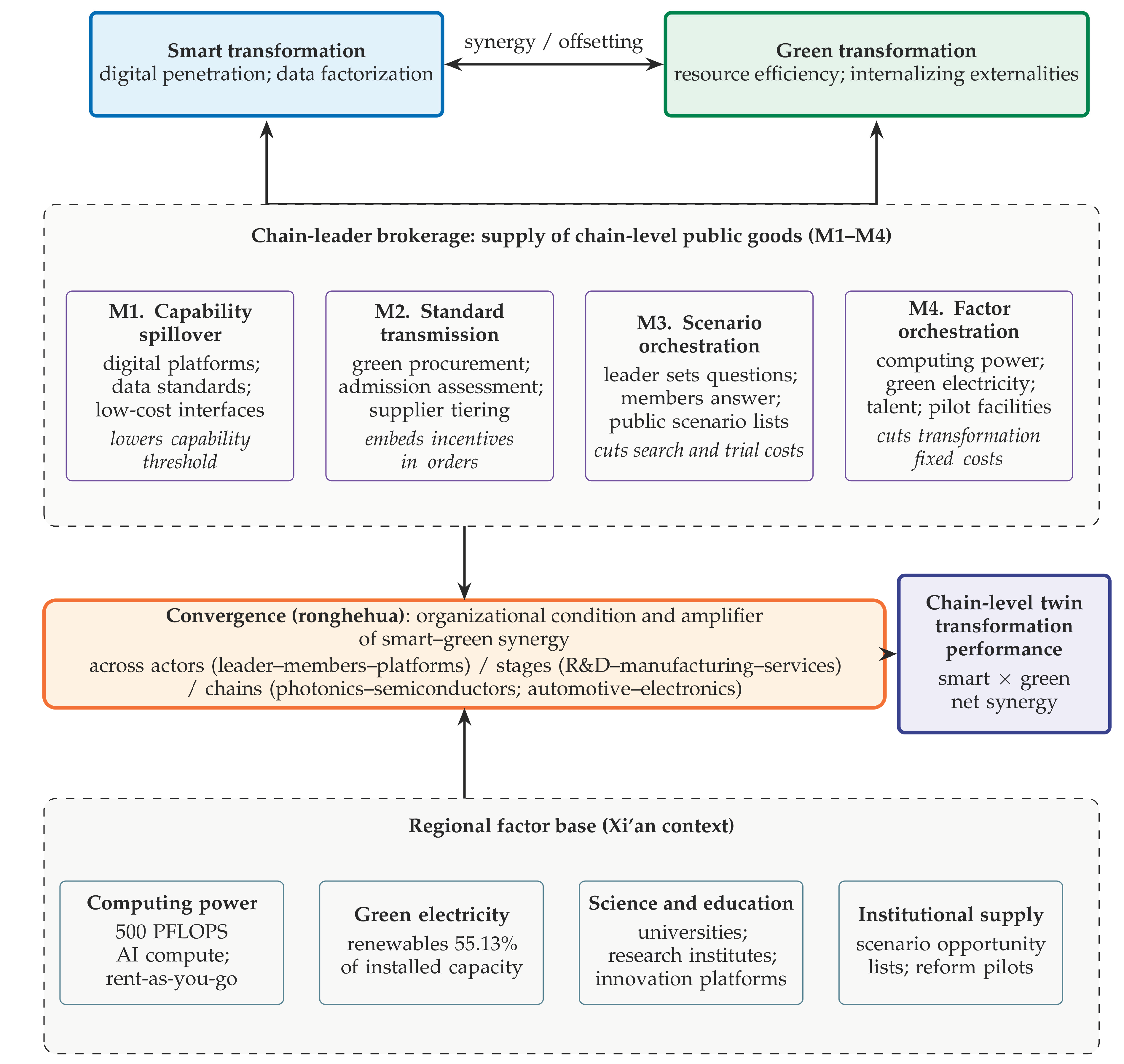

Table 1.
Mapping of the Xi'an cases to framework elements.
| Case | Mechanism(s)/Proposition | Framework Meaning |
|---|---|---|
| FAST's high-end smart factory | micro-foundation (intra-firm form of twin-transformation coupling) | source of the leader's spillover capability |
| SHACMAN's drive of 400+ suppliers | M1 capability spillover; M2 standard transmission; Proposition 1 | the boundary of the possible for member firms is set by the leader |
| Xinye Shidai 8-inch wafer fab | M4 factor orchestration (chain-completion investment); Proposition 2 | chain completion resets the chain's synergy baseline |
| Photonics–semiconductor cross-chain collaboration; computing-power–green-electricity base | M3 scenario orchestration; M4 factor orchestration; Proposition 3 | convergence decides the direction of the net synergy effect |
Disclaimer/Publisher’s Note: The statements, opinions and data contained in all publications are solely those of the individual author(s) and contributor(s) and not of MDPI and/or the editor(s). MDPI and/or the editor(s) disclaim responsibility for any injury to people or property resulting from any ideas, methods, instructions or products referred to in the content. |
© 2026 by the authors. Licensee MDPI, Basel, Switzerland. This article is an open access article distributed under the terms and conditions of the Creative Commons Attribution (CC BY) license (http://creativecommons.org/licenses/by/4.0/).
Copyright: This open access article is published under a Creative Commons CC BY 4.0 license, which permit the free download, distribution, and reuse, provided that the author and preprint are cited in any reuse.