

Submitted:
06 November 2026
Posted:
10 November 2026
You are already at the latest version
Abstract
Serving large language models at scale is a distributed systems problem whose overload behavior is governed at the ingress. We conduct an adapted-PRISMA systematic review of fifty-five admission and admission-adjacent works published between 2022 and 2026, and report three findings. First, admission sits at a different layer from the one the serving literature studies: of the nine LLM serving systems that the admission literature most often builds on, all place the overload response inside the engine, through batching, migration, placement, autoscaling or memory management, and none takes a decision at the ingress, while the corpus work that does gate at ingress is a control-plane contribution rather than an engine one. Second, of sixteen admission-primary papers, no two share a baseline set: policies are measured against the absence of admission control and almost never against one another. Third, placing all sixteen on our axes succeeds on six of seven properties and fails on one. Unit, setting, objective, the quantity a policy watches, the metadata it assumes, and whether it is deployable in front of an unmodified engine are all recoverable from the published text; the observed range of the quantity the policy reads is reported by none of them. Selection therefore fails on a single missing fact, and it is the fact that determines whether a reported improvement is interpretable at all. We contribute systematic coverage of fifty-five works under an adapted-PRISMA protocol; a five-axis taxonomy of unit, setting, SLOawareness, signal quantity and portability, with a master classification of the twenty-eight works that propose or embed an admission mechanism, each carrying a GRADE-adapted evidence rating; formal definitions of the admission-decision, goodput-under-admission and fairness-index primitives; a cross-paper synthesis of admission-signal overhead; an artifact-availability audit and seven properties on which the corpus diverges, which a cross-paper comparison would have to recon cile; a mapping of seven public production incidents to admission failure modes; and seven open problems, each grounded in published peer review or in a primary source’s own limitations.
Keywords:
large language models
; LLM inference serving
; admission control
; load shedding
; overload control
; service-level objectives (SLO)
; goodput
; fairness
; systematic review
; PRISMA
1. Introduction
On November 8, 2023, OpenAI’s inference fleet crossed a soak point after a day of unusually heavy completion traffic. Routing nodes reached memory limits and failed readiness checks. Additional replicas were added, then rolled back. Recovery required cutting inbound traffic, redeploying, and slowly ramping load back up. The postmortem named graceful load shedding through stronger rate-limit controls as the required follow-up. Two years later, on January 21, 2026, Anthropic’s Sonnet 4.5 tier degraded first in latency and then in error rate over roughly ninety minutes. The postmortem cited insufficient compute capacity for demand and named earlier detection of capacity constraints as a required change. Cloudflare [1,2], Azure, and other production operators have documented similar sequences.
Admission control is the decision made before a request enters the running batch. It has three actions: admit into service, hold in queue, or reject with a well-defined error contract. Figure 1 depicts the model. When admission is wrong, downstream batching, KV cache management, and preemption cannot recover lost capacity. Requests admitted past a soak point occupy memory until they miss their deadline, at which point they consume more capacity being cleaned up.
The literature on LLM inference has produced systems papers on batching [3,4], disaggregation [5,6], memory management [7,8], and scheduling [9,10]. Existing surveys cover efficient serving broadly [11,12,13] or the queueing-theoretic view of LLM systems specifically [14]. Table 1 differentiates this survey from those prior works.
1.0.0.1. Contributions.
- 1.
- 2.
- Unified taxonomy with five axes and four sub-branches, plus short codes (unit-req/agt/ten, sig-sca/dg/lp/wcrt), together with a master classification of the twenty-eight corpus works that propose or embed an admission mechanism, each carrying a GRADE-adapted evidence rating (Section 3 and Section 6). The taxonomy narrows the set of policies applicable to a deployment; it does not rank the survivors, and Section 3.7 reports the one property that prevents it from going further.
- 3.
- Foundational definitions of the admission decision, goodput-under-admission, and fairness-index primitives (Section 2.4).
- 4.
- Admission-signal overhead synthesis that identifies the cost-versus-lift tradeoff across scalar, dual-gate, LP, and formal-WCRT signals (Section 7).
- 5.
- Reproducibility audit finding seven of the sixteen admission-primary papers have released code, together with seven properties on which the corpus diverges and which a cross-paper comparison would have to reconcile (Section 8). We identify them; establishing which of them are load-bearing needs measurement and is Open Problem 7.
- 6.
- Production evidence mapping that ties seven public postmortems to admission failure modes (Section 9).
- 7.
- Structured research agenda of seven open problems, each grounded in either public peer review or the primary source’s own limitations (Section 10).
1.0.0.2. Headline observations.
First, of nine scheduling papers we audited across OSDI, SOSP, NSDI, ASPLOS, EuroSys, MLSys, and HPCA between 2022 and 2026, all absorb overload inside the engine, through batching, migration, placement, autoscaling or memory management, and none takes a decision at the ingress. This reflects the scope each paper sets for itself rather than an omission. The corpus work that does gate at ingress, Token Pools [15], is a control-plane contribution rather than an engine one, which suggests admission has been treated as an infrastructure concern rather than an engine-level research question. Second, of sixteen admission-primary papers we audited, no two share a baseline set. Six baselines recur across more than one paper, and four of them measure a policy against the absence of admission control rather than against an alternative to it: two serving engines and two classical scheduling disciplines. Of the remaining two, one is an ablation construct and one is a published admission system, SHEPHERD [16], used by QLM and Ascendra. Third, the taxonomy accommodates every corpus work that proposes or embeds an admission mechanism, twenty-eight in total (Table 3), including the five added during verification (Token Pools, ProServe [17], SAGA, Scorpio and FairServe), with four sub-branches added during our reading, none of which required backing out an original axis.
1.0.0.3. Roadmap.
Section 2 covers the inference request lifecycle, the Admit-Queue-Route model, and the foundational definitions (§Section 2.4). Section 3 introduces the five-axis taxonomy with short unit and signal codes. Section 4 describes the systematic-review method with a PRISMA flow diagram. Section 5 synthesizes each policy cluster. Section 6 presents the master classification with GRADE-adapted evidence ratings. Section 7 presents the admission-signal overhead cross-paper synthesis. Section 8 audits reproducibility and identifies the seven divergent reporting items. Section 9 maps production incidents to admission failure modes. Section 10 lists the seven open problems. Section 12 concludes.
1.1. Related Surveys and Differentiation
Five broad surveys of LLM inference serving predate this work. Table 1 summarizes each and states what this paper adds.
A second body of work is closer to what this survey does than the surveys are, and does not appear in that table because it is not survey work. Benchmarks and evaluation frameworks for LLM serving measure what these systems achieve rather than cataloguing what they propose. MLPerf Inference [18] standardises throughput and latency measurement across hardware and model configurations. Etalon [19] argues that the conventional metrics, time to first token, time between tokens, normalised latency and time per output token, miss aspects of user-facing behaviour, and introduces a fluidity index in their place. Tooling in the same space, LLMPerf, GenAI-Perf and GuideLLM among it, measures serving throughput and latency against a deployment, and ServeGen [20] characterises production traffic so that generated workloads reproduce its per-client structure rather than an aggregate arrival rate.
None of these treats the admission decision as an experimental axis. They measure a system under a given load; they do not vary what the system refuses, or report whether a policy’s inputs moved during the run. That is the gap this survey documents rather than closes. Section 8.1 reports the seven properties on which the corpus diverges, which is what a comparison would have to reconcile. Whether reconciling all seven is necessary, or whether some subset carries the weight, is a question about measurement rather than reading, and Section 10 states it as open.
Zhen et al. and Heisler et al. treat admission as one component among many. Li et al. is a survey of recent advances organized chronologically. Mitzenmacher and Shahout is a position paper that enumerates open queueing problems without a taxonomy or per-paper review. None conducts a reproducibility audit or organizes the literature by admission granularity, SLO awareness, signal structure, or concurrency context.
2. Background
2.1. The Inference Request Lifecycle
A large language model inference request passes through prefill, decode, and completion. Prefill computes the key-value tensors for every input token. Decode generates output tokens one at a time, reading the accumulated KV cache and appending a new pair per step. Continuous batching [3] reuses a single GPU-resident engine across many concurrent requests by interleaving iterations at token granularity. PagedAttention [7] manages the KV cache in fixed-size blocks to reduce fragmentation and enable prefix sharing.
The KV cache is the memory hierarchy’s dominant consumer. It grows monotonically with generated tokens during a request’s decode, and it persists across turns for multi-turn agents. When aggregate KV footprint approaches available GPU memory, the engine must either evict (recompute later), swap (page to CPU or disk), or preempt (kill the request and return an error).
2.2. The Admit–Queue–Route Model
Every request that reaches an inference cluster passes through three decision boxes before it produces its first token (Figure 1). Admit decides whether to accept the request into service. Queue decides in what order accepted requests are served. Route decides which replica or instance receives the request. This paper is about the first box.
The error contract matters. HTTP 429 signals a client-side rate limit exceeded. HTTP 503 signals a temporarily unavailable service. Anthropic uses HTTP 529 to signal a provider-overloaded state distinct from either [22]. A well-designed admission policy chooses among these codes based on which signal the client’s backoff logic should trust.
2.3. Service-Level Objectives
The community reports admission behavior against a small set of metrics. Time-to-first-token (TTFT) is the wall-clock delay between arrival and the first generated token. Time-between-tokens (TBT), sometimes called inter-token latency or time-per-output-token (TPOT), is the delay between consecutive generated tokens. Goodput is the completed-request rate that met their service-level objective, distinct from raw throughput [5]. For agentic workloads, agent-completion rate measures the fraction of multi-turn sessions that finish within an end-to-end budget.
2.4. Foundational Definitions
We fix three primitives that recur across the surveyed literature. Each formalizes a concept that admission-primary papers rely on but name inconsistently, and each is referenced explicitly in the master classification (Table 3) and the admission-signal overhead synthesis (Section 7).
Definition 1
(Admission Decision). Given an arriving request r with arrival time , feature vector , and a system state , an admission policy is a mapping where is a retry delay and is an HTTP error code whose semantics distinguish client-throttled, service-unavailable, and provider-overloaded outcomes.
Definition 2
(Goodput-under-admission). Let be the set of requests offered to the system in interval , the admitted subset, and a binary indicator of whether request r completed within its service-level objective. Goodput-under-admission is
This is the fraction of the offered load that both survived admission and met its SLO. It differs from throughput (which ignores SLO attainment) and from SLO attainment (which conditions on admitted requests only and hides work shed by an aggressive policy).
The predicate is parametrized by an SLO tuple that depends on workload class. For interactive request-level workloads it is typically the conjunction (). For agent-session workloads it is a job-level end-to-end budget (), optionally with per-stage sub-budgets as in SLOs-Serve. Cross-paper comparison of requires the SLO tuple to be specified, since aggregating across different tuples produces incomparable numbers; item 7 of Section 8.1 asks for the SLO tuple to be stated per workload class.
Definition 3
(Fairness Index). For n tenants (or agents, or classes) with weights and served tokens over interval , we use Jain’s fairness index [23] in weighted form. Jain, Chiu, and Hawe introduced this index in 1984 as a scale-independent measure of how equitably a set of quantities is distributed across users; it has been the standard fairness primitive in network scheduling and computer-systems resource allocation for four decades. The weighted form is:
with ; denotes perfect proportional fairness and denotes maximal concentration on a single tenant. Chosen as the primitive because it composes cleanly across the three fairness types in the taxonomy (task, tenant, priority-weighted).
The Jain index is a coarse instrument. Equinox [24] and related utility-centric work argue that equal tokens do not imply equal user experience, and that a fairness measure grounded in predicted response quality or user-perceived latency is more practitioner-relevant. Utility-centric measures resist cross-paper composition because each defines its own utility function, so we retain the Jain index as the comparability primitive and note this substitution risk explicitly rather than hide it.
2.5. Why Admission Control Is Hard
Ao, Dong, Luo, and Simchi-Levi [25] formalize the core problem. In a discrete-time model of continuous batching under a memory budget, the service process itself creates future capacity pressure because each active request’s KV footprint grows with each generated token. They prove that the natural eviction-free equilibrium is unstable under any admission rule that only checks instantaneous memory feasibility. Along the resulting limit cycle the throughput ratio equals
which lies in and converges to as . Their Theorem 3 further shows that stability depends on the greatest common divisor of active decoding lengths: if , unstable modes appear on g-th roots of unity and synchronize into eviction cycles; if , all roots lie strictly inside the unit disc and the eviction-free equilibrium is globally asymptotically stable. This is a workload-arithmetic property of admission decisions that no production system currently exposes as a signal.
3. A Taxonomy of Admission-Control Policies
We organize admission-control policies along five axes: unit of admission, setting, SLO awareness, signal quantity, and portability. Each is answerable about a deployment from a paper’s own text, which is what lets the taxonomy be read in either direction, from a paper to a cell or from a deployment to a set of candidate policies.
Figure 2.
The five axes, and the two directions they can be read in. Forward, a paper is placed in a cell, which is what a survey ordinarily does. Backward, a description of a deployment eliminates the policies it cannot run. Every axis is answerable from a paper’s own text, which is what makes the backward reading possible; Section 3.7 reports how far it gets before one missing property stops it.
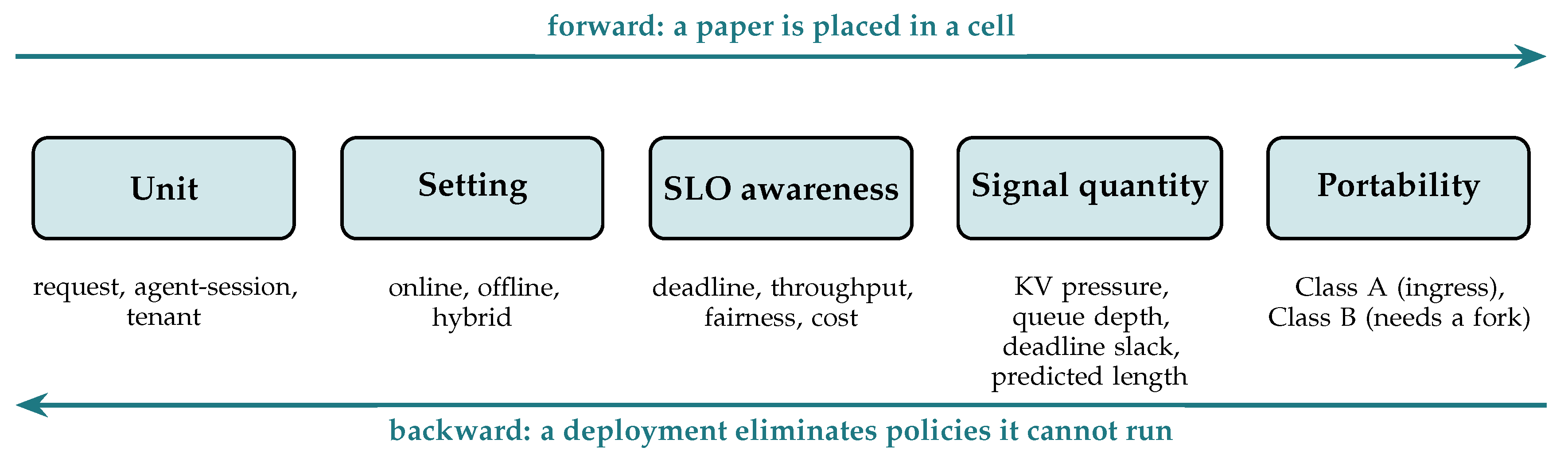
A sixth dimension, the decision moment, is folded rather than promoted. It records where in the serving pipeline the decision is taken, and it is classificatory rather than descriptive: a reader cannot place their own deployment on it, only a paper. It earns its place because the portability axis is derived from it, ingress implying one class and the later moments another, and because the master classification table uses it as a compact code. We call this a five-axis taxonomy throughout, and reserve “three-level classification” for the master table’s compact form, which codes unit, moment and signal grounding.
3.0.0.4. Decision moment (folded).
Every admission decision can be located at one of three points in the serving pipeline: under ing (ingress), the decision is taken before the request enters any server-side queue, based on request features and system state at arrival time; under qb (queue boundary), it is taken when the request is popped from a waiting queue for batch admission, informed by both the request and the current batch state; under mf (mid-flight), it is taken during the request’s decode, either as a preemption to a lower priority class or as a reclamation of committed KV cache. The master table uses these three codes because they discriminate sharply across the corpus; the descriptive Setting axis (online/offline/hybrid) collapses under this coding because the majority of surveyed systems operate at ing or qb regardless of setting.
Figure 3 places the three moments on the serving pipeline. The coding is not only descriptive: the moment at which a policy acts determines what state it can read, and in the systems surveyed here it also determines whether the policy sits in front of the engine or within it.
Figure 4 shows the two most-cited descriptive axes (unit × SLO awareness) plotted against each other with representative policies placed on the grid.
3.1. Axis 1: Unit of Admission
Admission decisions can be made at three granularities. Request-level (unit-req) policies admit or reject each incoming prompt independently (QLM [26]; Chronos [27]; FastServe [28]; SOLA [10]). Agent-session-level (unit-agt) policies admit or reject entire multi-turn agent trajectories (CONCUR [29]; Continuum [30]; ThunderAgent [31]). Tenant-level (unit-ten) policies gate admission per user or per organization (VTC [32]).
3.2. Axis 2: Setting
Online serving handles interactive latency-sensitive workloads (most of the field). Offline batch handles throughput-oriented inference where per-request deadlines are relaxed. CONCUR is explicitly offline per its ICML 2026 meta-review. Hybrid settings mix both.
3.2.0.5. Sub-branch: Concurrency context.
We add a sub-branch after finding that Clairvoyant [33] solves an admission problem that server-side policies cannot generalize to. Concurrent-batch servers (vLLM, SGLang, TensorRT-LLM) admit at iteration granularity, contend for KV blocks across many active requests, and can preempt mid-decode. Serial edge backends (Ollama, llama.cpp) execute one request at a time. Head-of-line blocking is the dominant tail-latency pathology at the edge, and predictive shortest-job-first admission is the natural response.
3.3. Axis 3: SLO Awareness
Deadline-aware policies condition admission on TTFT or TBT bounds (Chronos, SOLA, FastServe). Throughput-oriented policies maximize aggregate goodput without per-request deadlines (CONCUR, Continuum). Fairness-oriented policies enforce per-tenant or per-task equity (VTC, FairBatching, Equinox). Cost-oriented policies minimize dollars or energy per token.
3.3.0.6. Sub-branch: SLO granularity.
SLOs-Serve [34] exposes a design axis nobody else covers. Job-level SLOs specify a single deadline per multi-turn agent job. Request-level SLOs specify one deadline per prompt (most of the field). Per-stage SLOs specify distinct deadlines per stage of a multi-turn application. Only SLOs-Serve models the per-stage case.
3.3.0.7. Sub-branch: Fairness type.
3.4. Axis 4: Signal Quantity
Every admission policy compares some measured quantity against a threshold. Which quantity is the axis a practitioner can answer about their own deployment without having read any of the policies, because it asks what moves when their system is overloaded rather than how a given paper is built. Across the sixteen admission-primary works the quantities are:
- KV pressure
- occupancy of the key-value cache, as a fraction of what the deployment has allocated (Fluid-WAIT, CONCUR, Continuum, AQUA).
- Queue depth
- the number of requests waiting to enter a batch (QLM, FastServe, Fluid-WAIT, Continuum).
- Deadline slack
- time remaining against a per-request target, compared with an estimate of time required (Chronos, SOLA, SLOs-Serve, Scorpio, ProServe).
- Predicted length
- an estimate of how many tokens the request will generate, from a model over the prompt (FastServe, Scorpio, Clairvoyant).
- Wait estimate
- a prediction of how long the request will queue, distinct from how many are queued (QLM).
- Batch state
- the composition of the batch now forming, rather than a property of the arriving request (SOLA, FairBatching).
- Arrival rate
- the offered load itself, with no engine-side quantity read (Flow-controlled scheduling).
- Analytic
- no runtime signal: admission follows from a stability or reward argument (Service-Induced Congestion, Shen et al.).
The distribution matters for what the axis can do. Deadline slack and KV pressure dominate, but they are not interchangeable: a deadline-slack policy needs requests to arrive carrying deadlines, and a KV-pressure policy needs the cache to actually fill. Section 3.6 develops the second condition.
3.4.0.8. Sub-branch: Signal structure.
Orthogonal to which quantity is read is how the policy combines readings into a decision. We identify four structural forms, each with a short code we use throughout the master classification (Table 3). The structure describes policy design rather than deployment fit, so it is a sub-branch rather than a primary axis: a reader cannot place their own system on it.
Scalar heuristics (sig-sca) compare a single quantity to a threshold (KV utilization for Fluid-WAIT; queue depth for QLM; predicted output length for Clairvoyant).
Dual-gate conjunctions (sig-dg) require multiple signals to agree. CONCUR declares congestion only when both KV utilization is high and prefix cache hit rate is low, because high utilization with high hit rate is healthy reuse rather than thrashing:
with fixed hyperparameters , . Admission at agent granularity is adjusted via additive-increase-multiplicative-decrease (AIMD) with , per control interval.
Linear-program-based composite signals (sig-lp) treat admission as one variable in a joint optimization. QLM formulates a linear program over virtual queues, minimizing total SLO-violation penalty:
subject to one-to-one request-group-to-position and model-transition constraints; solvable in about 5 s at 400,000 queued requests using Gurobi.
Formal worst-case-response-time bounds (sig-wcrt) derive an admission test from real-time-systems theory. Chronos casts prefill as a sporadic job with worst-case execution time proportional to input length, then derives the closed-form bound
where is prefill utilization, is the TTFT deadline, is the number of chunks, is prefill kernel throughput, B is chunk size, and is fixed overhead. Algorithm 1 of [27] rejects on arrival if , if the bound exceeds the TTFT deadline, or if a TBT capacity check fails.
3.5. Axis 5: Portability
The four axes above describe what a policy decides. This one describes what it costs to run, and it is the axis a practitioner is likely to apply first, because it can eliminate candidates before any question of fit arises.
Class A policies decide from the arriving request and state the engine already exposes: cache occupancy, queue length, counts of running and waiting requests. Such a policy can sit in front of an unmodified engine, as a proxy or gateway, and is deployable by anyone who can route traffic.
Class B policies need to influence which requests enter a batch, or to act on requests already decoding. That cannot be done from outside: it requires changes inside the engine’s scheduler, and in practice a maintained fork.
The split follows from the decision moment (§Section 3, folded): ing is Class A, while qb and mf are Class B. Of the sixteen admission-primary works, ten are Class A and six are Class B. A reader who cannot maintain an engine fork is choosing among ten, not sixteen, and that is knowable before reading any of them.
No paper in the corpus states its own class. It is derivable from the mechanism each describes, which is why we treat it as an axis rather than as reported metadata: the information is present in the text but never surfaced as a deployment property.
3.6. What the Signal Axis Predicts
The Signal axis has a consequence for how published results should be read. A policy discriminates by comparing a measured quantity against a threshold, so it can discriminate only when that quantity varies over the operating range of the deployment. Where the signal is effectively constant, the comparison returns the same answer for every arrival, and the policy admits or refuses uniformly regardless of how its threshold is set. Its observable behaviour in that case matches an uncontrolled baseline.
The two cases are not distinguishable from a results table. A policy whose signal never approached its threshold and a policy that evaluated a varying signal and declined to reject will report the same admission counts and the same downstream latencies. Separating them requires the observed range of the signal over the evaluation. We did not find that range reported in any paper we examined (Section 8.1, item 3).
This also bounds what the present survey can establish. Which deployments hold which signals constant depends on the engine, the model, and the workload, and is an empirical question rather than a bibliographic one. We do not answer it here, and we are not aware of published measurements that do; it is stated as Open Problem 7.
3.7. Placing the Corpus, and Where It Fails
We applied the taxonomy to all sixteen admission-primary works, recording seven properties for each: the five axes, plus what the policy assumes an arriving request carries, plus the range its signal took during the paper’s own evaluation. The last two are not axes. They are recorded because a reader needs both to act on the taxonomy: a deadline-slack policy is unusable on traffic that carries no deadlines, and a reported result is uninterpretable if the signal behind it never moved. The exercise is a test of the axes as much as of the corpus, since an axis that cannot be filled from the published text is not one a reader could use.
Six of the seven fill, and all five axes are among them. Every paper states its unit and setting; every paper’s objective is recoverable; the quantity each policy reads is always identifiable, even where the paper does not name it as a signal; and the portability class follows from the mechanism in all sixteen cases. Eight of the sixteen require nothing of an arriving request beyond the request itself, five require a deadline or SLO class, two require a session identifier, and one requires a priority class.
One property does not fill. For no paper in the corpus could we determine the range the policy’s own signal took during its evaluation. A threshold that was never approached and a threshold that was approached but not crossed produce the same admission counts and the same downstream latencies, so no reported number distinguishes a policy that was exercised from one that was merely present.
The consequence for a reader is narrow and specific. The taxonomy will tell you which policies could apply to your deployment. It will not tell you whether the published evidence for any of them describes a policy that was actually exercised, because that evidence is not reported. Section 8.1 states the property as the third of seven reporting items, and Section 10 states the measurement it would take to establish which of those items are load-bearing.
3.8. The Unclaimed Intersection
Plotting the corpus (Figure 4) shows that agent-level × online × deadline-aware × per-tenant-fair is not fully occupied by any published policy. CONCUR is agent-level but offline and throughput-oriented. Chronos is deadline-aware but request-level. FairBatching is fair but task-level not tenant-level. SAGA [36] is the closest work: it schedules at the agent-workflow level with a bounded-deviation Agent Fair Share metric and reports 99.2% SLO attainment, but the paper does not establish that Agent Fair Share reduces to per-tenant fairness in multi-user settings, does not decompose the SLO into TTFT and TBT, and does not commit to an online-serving mode. We treat SAGA as a partial occupant and preserve OP1 as an open problem for the subset (agent + online + TTFT+TBT + per-tenant) that no published work satisfies simultaneously.
Re-deriving this after adding the portability axis leaves the cell empty, and surfaces a second gap beneath it. Among the sixteen admission-primary works, two are agent-level: CONCUR, which is Class A but offline and throughput-oriented, and Continuum, which is online but Class B and optimises job completion time rather than a deadline. So within the admission-primary set there is no agent-level policy that both serves online traffic and deploys without an engine fork. A reader running multi-turn agent workloads who cannot maintain a fork has no candidate at all, which is a sharper statement than the empty intersection and follows from a property no paper reports about itself.
We state this for the admission-primary set only. ThunderAgent [31] is agent-level and coded at ingress, which would occupy the cell, but its mechanism is program-level residency with eviction from high-bandwidth memory, and whether that is deployable outside the engine is not something we have established. It is the near-miss a reader should check first.
4. Method
We conducted a systematic review following an adapted PRISMA 2020 workflow. Figure 5 shows the identification, screening, eligibility, and inclusion counts.
4.0.0.9. Search dates and sources.
Search dates ran from May 2022 (Orca) through September 2026. Sources: DBLP; arXiv (cs.DC, cs.LG, cs.OS, cs.PF categories); OpenReview forums for ICLR, NeurIPS, ICML, MLSys; USENIX conference proceedings for OSDI, NSDI, ATC, FAST; ACM Digital Library for SOSP, SoCC, ASPLOS, EuroSys, SIGMETRICS; IEEE Xplore for HPCA, ISCA; Google Scholar for cross-reference discovery.
4.0.0.10. Search strings.
Admission-control terms (“admission control”, “queue management”, “load shedding”, “request rejection”, “request dropping”, “SLO-aware admission”, “throttling”, “backpressure”, “gating”) were combined with LLM-serving terms (“LLM inference”, “LLM serving”, “language model inference”, “agentic inference”, “continuous batching”, “KV cache”). Boolean expansion followed each hit’s related-work section for backward-citation discovery.
4.0.0.11. Inclusion.
A paper was included if all four conditions held: (i) published or preprinted between 2022-05-01 and 2026-09-11; (ii) primary application domain is LLM inference (not general DNN serving or generic queueing theory); (iii) either admission control is the primary contribution, or the paper is a top-venue scheduling / KV-management / fairness work whose mechanism has direct admission-adjacency; (iv) full text was accessible via arXiv HTML, venue PDF, or OpenReview.
4.0.0.12. Exclusion.
A paper was excluded if any held: (i) pure model-side optimization (quantization, pruning, distillation) without a serving-time admission component; (ii) vision or speech inference without LLM applicability; (iii) marketing materials or blog posts without a peer-reviewed or arXiv-preprint anchor.
4.0.0.13. Tier structure.
We organized the corpus into six tiers based on admission-primacy. Tier 1 (16 papers): admission-primary, one policy per paper. Tier 2 (11 papers): queueing theory or fairness-primary with admission-adjacency. Tier 3 (6 papers): KV-cache-management papers whose mechanism has admission implications. Tier 4 (10 papers): top-venue scheduling papers with admission as a secondary or missing component. Tier 5 (7 papers): foundational works cited for background. Tier 6 (5 papers): prior broad surveys used for differentiation. The six tiers sum to the fifty-five works of the corpus, of which forty carry a per-paper reading note.
4.0.0.14. Per-paper protocol.
For each work we recorded venue, authors, arXiv or DOI identifier, code availability, taxonomy placement across all five axes, primary contribution, baseline set, evaluation setup (model, engine, workload, hardware), claimed headline numbers with configuration qualifiers, fidelity notes, and open questions surfaced. Notes were written in a common markdown template to make cross-work comparison tractable. The complete per-paper corpus is public at the survey’s artifact repository.
4.0.0.15. Reviewer discussion evidence.
For several open problems (Section 10) we cite public OpenReview discussion or venue meta-reviews as evidence that a gap is practitioner-recognized. Where a peer reviewer explicitly asked a question that the paper’s rebuttal did not answer, we treat that as grounded evidence for an open problem.
4.0.0.16. Non-experiments.
We did not run experiments. Where papers report conflicting numbers, we report each source’s number as stated with the operating-point qualifier the source specifies, and flag the conflict rather than adjudicate.
5. Policy Clusters
5.1. Request-Level SLO-Aware Admission
QLM [26] is the canonical peer-reviewed admission-primary paper for online serving. It maintains virtual queues per model and formulates request scheduling as the linear program in Equation 5. A Request Waiting Time Estimator predicts per-request wait using Central Limit Theorem bounds over historical output-token distributions. Reported improvements are 40 to 90 percent SLO attainment lift and 20 percent (single-model) to 400 percent (multi-model) throughput gain over vLLM and EDF baselines on a heterogeneous 30 A10 plus 50 A100 cluster serving Mistral-7B, Vicuna-13B, and LLaMA-70B on ShareGPT. Code is public at https://github.com/QLM-project/QLM.
Chronos [27] derives a formal schedulability condition (Equation 6) for LLM inference. On a 7B model in a discrete-event simulator against 50,000 sampled Azure conversational-service requests, the reported separation is load-dependent. At 5× nominal load Chronos and the uncontrolled schedulers all reach 0.00 percent TTFT miss, and the difference is in tail latency and admission volume: Chronos admits 88.9 percent at a P99 TTFT of 161 ms, against 100 percent admitted at 400 ms for FCFS and EDF. At 10× load the uncontrolled schedulers collapse to 99.44 percent TTFT miss while Chronos holds 0.00 percent by admitting 53.9 percent. Rate limiting alone does not reproduce this: a throughput-matched token bucket (AC-FCFS) misses 15.40 percent at that same 53.9 percent admission, and 6.80 percent at the 5× operating point despite matching Chronos’s admission volume there. The comparison is therefore a case for the formal test over rate matching rather than over scheduling as such. Simulator code is public at https://github.com/am-research/rtss-ttft-tbt.
SOLA [10] formalizes fine-grained scheduling as an LP over per-request and systemic state. Empirical scheduling raises SLO attainment from 45.5 percent to 99.4 percent and serves 1.04-1.27 × more requests. The constraint-relaxation mechanism at the -percentile is an implicit admission decision hidden inside a scheduler.
FastServe [28] argues for token-granularity preemption rather than reject-on-arrival admission. The 31.4× average-latency throughput improvement is measured on OPT-175B across 16 A100 GPUs against vLLM v0.1.7 on ShareGPT. Code is public but runs on the SwiftTransformer engine.
SLOs-Serve [34] is the only paper in our corpus that handles per-stage-of-agent SLOs. Multi-SLO DP admits requests whose joint SLOs are attainable and declines the rest through soft admission. Reports 2.2× geometric-mean per-GPU serving capacity across six workload scenarios and five models.
ProServe [17] frames scheduling as unified multi-priority request scheduling. Admission emerges from the SlideBatching loop’s budget-and-memory gates combined with a token-level deadline-aware gain function that scores requests against their per-token deadlines. This is queue-boundary admission (qb) rather than pure ingress, and we classify it as such in Table 3. Baselines include vLLM-FCFS, Sarathi-FCFS, Sarathi-Priority, Weighted VTC, and FairBatching. No code released.
Scorpio [37] is the most recent admission-primary entry and splits the decision across three stages: admission, queue management, and batch selection. Its TTFT Guard reorders by least deadline first and rejects requests whose first-token deadline is unattainable, estimating attainability from the cumulative prefill time of everything already queued. Its TPOT Guard admits only when the predicted per-token latency for the resulting virtual batch stays under the tightest TPOT target in the running set. Both guards read a predicted output length from a fine-tuned OPT-125M classifier over 100 bins, which places Scorpio in the dual-gate signal class with learned rather than analytic grounding. It is evaluated on vLLM with Llama-3.1-8B and Gemma-2-27B on four A100s, against vLLM, S3 and Mooncake, reporting up to 14.4 times goodput and 46.5 percent better SLO adherence under high load.
Two details matter beyond those numbers. First, Mooncake is itself an early-rejection admission mechanism, which makes Scorpio one of the few policy-versus-policy comparisons in the corpus (Table 5). Second, Scorpio computes goodput with every arriving request in the denominator, so a rejected request counts as an SLO miss. That is the discipline we adopt in Section 2.4 for goodput-under-admission, arrived at independently. A metric counting only admitted requests flatters shedding: refuse 95 percent of traffic, serve the rest perfectly, and it reads 100 percent. Two efforts converging on the same denominator by separate routes is the strongest argument available that it is the correct one.
5.2. Agent-Session-Level Admission
CONCUR [29] identifies middle-phase thrashing in agentic batch inference. The controller applies the dual-gate condition of Equation 4. Headline gains are 4.09× throughput against SGLang on Qwen3-32B at 256 sessions, tensor parallelism 8, on 8 H100 GPUs, and 1.90× against SGLang on DeepSeek-V3 at 40 sessions, TP 16, 16 H100 GPUs. Against Continuum as a baseline, CONCUR shows 1.69× on Qwen3-32B (added in rebuttal). The meta-review states the paper targets offline throughput-oriented inference and that online serving is out of scope.
Continuum [30] manages KV retention rather than gating admission. Per-session time-to-live is set by maximizing expected benefit minus cost. Reports 1.12-3.66× JCT improvement across Llama-3.1, Gemma-3, and GLM-4.5 on SWE-Bench, BFCL, and OpenHands, with an internal-deployment peak of 8.18×. Public vLLM fork at https://github.com/Hanchenli/vllm-continuum.
ThunderAgent [31] treats disk, ports, and sandboxes as first-class scheduled resources alongside GPU. A central scheduler pauses and restores programs with explicit state migration. Integrated into NVIDIA Dynamo 2.0.
SAGA [36] schedules at the level of the entire agent workflow rather than per inference call, introducing Agent Execution Graphs that capture workflow structure across tool-call boundaries and predict KV cache reuse. The paper defines Agent Fair Share, a task-completion-time fairness metric with provable bounded-deviation guarantees, and reports 99.2% SLO attainment under multi-tenant interference. Admission is described as “session-affinity batching with work stealing” at the scheduler level; whether this reduces to ingress admission is not established, and per-tenant fairness (as opposed to per-task fairness) is not evaluated. We classify SAGA as agent-level, mid-flight, scalar-signal in Table 3. See Section 10 OP1 for the sharpened residual open problem.
5.3. Fairness-Aware Admission and Scheduling
VTC [32] formalizes LLM-serving fairness through a cost function over tokens processed rather than requests, with default weights for input and for output. The theoretical guarantee bounds service difference between any two continuously-backlogged clients:
where M is the max batch size, with a matching lower bound of proving the 2× constant is tight. Empirically VTC halves max unfairness versus FCFS while matching throughput (779 versus 777 tok/s on 27 Chatbot Arena clients), whereas RPM(5) rate limiting collapses throughput to 340 tok/s. Artifact-evaluated code at https://github.com/Ying1123/VTC-artifact.
FairBatching [35] attacks fairness between prefill and decode tasks within a batch. Achieves 2.29× tail latency reduction, 20 percent single-node capacity improvement, and 54.3 percent cluster-level capacity improvement. Implementation is only 90 lines of invasive vLLM changes.
Equinox [24] argues that equal tokens do not imply equal user experience. Requires a Model of Prediction Ensemble to predict output length, latency, throughput, and GPU utilization per prompt. Thirteen percent fairness improvement measured against Equinox’s own metric.
FairServe [38], from Microsoft on real Copilot production traces, combines Online Interaction Throttling (OIT) at ingress with Weighted Service Counting (WSC) for scheduling. OIT throttles at the LLM-interaction level when the KV cache is overloaded, and WSC selects requests from users who have received the least service, weighted by application priority. Reports 1.03–1.06× TTFT latency reduction. FairServe is the only work in our corpus that operates at the user/application-interaction level rather than at request, agent-session, or organizational tenant granularity; we classify it as tenant-level with a dagger (§Section 6) and note that it does not decompose SLOs into TTFT+TBT deadlines. Source code not released as of paper submission.
5.4. Queueing-Theoretic and Algorithmic
Flow-Controlled Scheduling [39] proves necessary and sufficient stability conditions using a static token-bucket. LIFO eviction inverts fairness for interactive workloads.
Fluid-WAIT [40] derives a threshold admission rule from a fluid-model equilibrium.
Shen et al. [41] prove regret for joint online configuration selection and admission control under an i.i.d. reward-resource assumption per configuration:
The paper motivates via LLM serving but validates empirically on Alibaba cluster traces.
Jaillet et al. [42] target online scheduling under KV-cache constraints with monotonically growing per-request memory. Their memory-cognizant policies achieve competitive-ratio bounds under structured arrivals plus -accurate predictions.
Mitzenmacher and Shahout [14] enumerate 25 open problems at the intersection of queueing theory and LLM serving.
Clairvoyant [33] is the sole entry in the serial-edge concurrency-context sub-branch. Predictive shortest-job-first using an XGBoost classifier over 19 lexical features delivers 70 to 76 percent short-request latency reduction on an RTX 4090.
Ascendra [43] uses an SLO-risk predictor to promote requests between low-priority and high-priority queues.
Niyama [44] sits adjacent to admission rather than inside it. It co-schedules mixed workloads on shared infrastructure with fine-grained QoS classes and a hybrid fairness-efficiency priority policy, and under overload it applies selective request relegation, degrading service for lower classes rather than refusing work at the door. We include it because relegation and admission answer the same question with different verbs, and because its overload behaviour is directly comparable to that of a deferring admission policy.
5.5. KV-Cache Management Adjacent
KVFlow [45] is pure cache management with steps-to-execution ranking over SGLang’s radix tree. No admission logic. Complementary to CONCUR, not a substitute.
Cake [46] optimizes single-request TTFT via hybrid compute-versus-load KV decisions.
InferCept [47] chooses between preserving, swapping, and discarding KV during tool-call intercepts. Cost model prices GPU-memory-bytes-times-time locally; does not account for queue length, which Continuum identifies as its key limitation.
Pie [48] provides a programmable serving substrate with generation-loop handlers and KV page management. No cross-inferlet scheduler API and no admit-reject hook.
5.6. Scheduling Papers with Admission-Adjacent Components
We audited the nine LLM serving systems that the admission-primary papers in this corpus most often build on or compare against, published between 2022 and 2026. The selection rule is that dependency rather than a venue list: these are the engines and schedulers the rest of the literature treats as its substrate. They happen to appear at OSDI, SOSP, NSDI, ASPLOS, EuroSys, MLSys and HPCA, which is a consequence of where such work is published rather than a criterion we applied.
Table 2 summarizes what each does under overload. All nine locate the overload response inside the engine, redistributing work through batching, migration, placement, autoscaling or memory management. None takes a decision at the ingress, and none sets out to: these are scheduling and memory-management contributions, and refusing work at the door lies outside the design space each paper defines for itself. The observation is about where research attention has gone, not about a shortcoming in these systems.
The distinction that matters here is engine-level against infrastructure-level, and it does not track venue. Token Pools [15] gates at the API boundary and is a control-plane contribution rather than an engine one; it is in this corpus and classified in Table 3. Reading the two together, ingress admission appears where a system owns the boundary in front of the fleet, and not in the engine papers, whichever venue either is published at. We would draw the same conclusion had Token Pools appeared at any of the seven.
Past-Future’s memory-projection gate is the closest of the nine to admission, and it operates on already-queued requests rather than at ingress. Taken with Token Pools, which gates at the API boundary, the pattern suggests that ingress admission has been treated as an infrastructure concern rather than an engine-level research question. That is the gap this survey addresses: not that these systems are missing something they should have, but that the decision they leave to the deployment has received little systematic study.
5.6.0.17. Token Pools (CAIS 2026): partial counter-example.
Cunningham [15] introduces token pools, a control-plane abstraction expressing capacity as inference-native entitlements (token throughput, KV cache, concurrency). Admission is enforced at the API boundary: “The auth service intercepts every request before it reaches the backend. On each request, it validates the API key against an entitlement... and makes an admission decision based on multiple factors.” Requests whose priority falls below the admission threshold “are rejected with HTTP 429 and a Retry-After header, allowing clients to back off gracefully.” The same entitlements drive autoscaling decisions through a unified capacity model, directly addressing our Open Problem 5 (coupling admission and autoscaling). The evaluation is single-node (DGX Spark, Qwen3-8B) with no released code, so we rate the evidence m. Token Pools tightens but does not close the engine-level gap: it sits outside the nine OSDI/SOSP/NSDI/ASPLOS/EuroSys/MLSys/HPCA set, and its evaluation scale is orders of magnitude below what those venues typically require.
6. Master Classification
Table 3 classifies twenty-eight of the fifty-five works in the corpus along the three orthogonal taxonomy levels (Unit, Moment, Signal grounding), plus a GRADE-adapted evidence rating for the strength of empirical support behind each work’s headline claims. Unit codes: req request, agt agent-session, ten tenant. Moment codes: ing ingress, qb queue boundary, mf mid-flight (during decode). Signal codes: sca scalar, dg dual-gate, lp linear-program, wcrt formal worst-case-response-time bound.
6.0.0.18. What the table does not classify.
Twenty-seven corpus works carry no row. Twelve are foundational systems, textbooks, or prior surveys, for which an admission taxonomy is not defined. Nine are engine-level scheduling papers that contain no admission mechanism to classify, which is the nine-of-nine finding of Section 5 rather than an omission here. The remaining six are AQUA [54], Chiron, Mooncake, Niyama [44], Throughput-Optimal Scheduling and Beyond Prediction, each of which touches admission indirectly: AQUA and Mooncake through reclamation and early rejection, Chiron through autoscaling, Niyama through relegating lower QoS classes rather than refusing them, and the last two through queueing-theoretic results that do not specify a decision rule. Mooncake warrants a specific note, since it states a “prediction-based early rejection policy” and appears as a baseline in Table 5. We leave it unclassified on the narrower ground that admission is a component of a disaggregation architecture rather than the paper’s contribution: the rejection policy is described but not evaluated as a policy, with no ablation isolating its effect and no comparison against an alternative admission rule. It is therefore an admission mechanism we can name but not place on the Signal axis with the same evidence we have for the entries in Table 3.
6.0.0.19. GRADE rubric (operationalized).
We assign each work one of four evidence levels using four criteria: (1) evaluation medium (real hardware vs simulator vs theoretical); (2) number of independent baselines evaluated; (3) code availability (public + artifact-evaluated vs public unevaluated vs closed); (4) workload realism (production trace or public benchmark vs synthetic). A work is assigned:
- h (high)
- real hardware, three or more independent baselines including at least one from a different venue, artifact-evaluated public code, and evaluation on a public benchmark or production trace.
- m (moderate)
- real hardware, at least one independent baseline, public code (not necessarily artifact-evaluated), and either a public benchmark or a well-documented synthetic workload.
- l (low)
- simulator-only, or unreleased code, or single-baseline against an unnamed reference, or synthetic workload without documented parameters.
- vl (very low)
- position paper, tutorial, or theoretical result without empirical evaluation.
The rubric is stricter than reviewer-perceived at borderline cells. QLM earns h because its artifact is Artifact-Evaluated, baselines include vLLM+EDF and SHEPHERD, and evaluation runs on Chatbot-Arena traces on a heterogeneous 80-GPU cluster. Chronos earns m rather than h because the evaluation is simulator-only despite artifact release. VTC earns h because the OSDI artifact evaluation and clean cross-baseline comparison satisfy all four criteria. Per-paper justifications are included in the artifact repository’s per-paper coding sheet.
The nine scheduling papers from the OSDI/SOSP/NSDI/ASPLOS/EuroSys/ nine engine-level systems (Orca, Sarathi-Serve, Llumnix, DistServe, Past-Future, Aegaeon, Jenga, AdaServe, PASCAL) are omitted from Table 3 because none includes an ingress-level admission decision at all; they are summarized separately in Table 2. TokenScale [55] is also omitted despite its LLM-serving scope: careful reading confirms it is a pure autoscaling framework (Token Velocity signal drives prefiller/decoder scaling only) with no admission-control component. Chiron [56] is a hierarchical autoscaler with no admission component and appears only under Open Problem 5.
6.0.0.20. Dagger note on FairServe.
FairServe [38] operates at the user- and application-interaction level rather than at any of our three canonical unit codes (req, agt, ten). We mark it ten because a Microsoft-CoPilot “application” is closer to a tenant than to an individual request or agent session, but the classification is genuinely lossy for this work; readers checking the four-property intersection should note that FairServe satisfies the online axis and a weighted per-user fairness axis, but does not decompose SLOs into TTFT and TBT deadlines and does not operate at the agent-session level. Placement was chosen after considering the reviewer’s explicit question 3 on the four-property intersection.
7. Admission-Signal Overhead Synthesis
The corpus supports one cross-paper empirical synthesis that no individual paper reports: the tradeoff between the cost of computing an admission signal at ingress and the goodput lift that signal delivers over a first-come-first-serve baseline. We call this the admission-signal overhead. Five anchor points from the corpus are shown in Table 4, each carrying its operating point verbatim from the source paper so that the reader can see the heterogeneity of contexts across which we are reasoning.
7.0.0.21. What Table 4 does and does not support.
The five anchors span different models, engines, hardware, SLO definitions, and workloads. Reading down the “Lift” column suggests that costlier signals return larger lifts, but this pattern is directional at best because every anchor is a different-workload single-baseline comparison to that anchor’s own FCFS. We explicitly do not claim: (a) a functional form of cost versus lift; (b) a crossover point beyond which additional signal complexity ceases to pay off; (c) that any pair of anchors would retain its ordering under head-to-head evaluation. The synthesis is provided so the reader can see the shape of the tradeoff and the absence of normalized evidence for it.
7.0.0.22. GRADE certainty.
We rate this synthesis low using the rubric in Section 6. Each anchor cites its source paper’s own numbers under that paper’s own operating point; no head-to-head comparison exists in the literature (Table 5). Closing this identification gap is what the reporting items in Section 8 are meant to enable, and establishing which of them are load-bearing is Open Problem 7 (Section 10).
8. Reproducibility and Comparison Methodology
We audited public code availability across our corpus, scoped to the tiers where releasing an implementation is a well-formed expectation. Seven of the sixteen admission-primary papers have released code as of September 2026 (QLM, Chronos, FastServe, Shen et al., Continuum, Clairvoyant, AQUA), as have five of the six KV-cache-adjacent works (KVFlow, InferCept, Pie, ThunderAgent, Cake) and one of the ten fairness and queueing-theory works (VTC). Two qualifications apply to the admission-primary count: Chronos released a discrete-event simulator rather than a real-engine implementation, and AQUA is included in this corpus as the canonical preemption-based foil to admission control rather than as an admission policy itself.
These rates are higher than the “reproducibility crisis” framing common in prior surveys would suggest, and the adjacent literature releases code more often than the admission literature does. We report rates per tier rather than a single corpus-wide figure because the full corpus includes foundational works, textbooks and prior surveys, for which code release is not a meaningful expectation; a denominator spanning them would not be interpretable.
The more consequential gap is at the methodology level. Table 5 shows the baseline set used by each admission-primary paper. No two papers share a baseline set. Six baselines recur across more than one paper, and the recurrence is concentrated in comparators that are not admission policies: vLLM in six papers and Sarathi in four, then EDF and FCFS twice each. Only two of the six are admission mechanisms, and one of those, AC-FCFS, is a token bucket constructed as an ablation rather than a published system. That leaves SHEPHERD as the single published admission policy any two papers have in common.
Reading the literature top to bottom, a practitioner cannot answer “which admission policy wins on my workload.”
8.1. Seven Reporting Items That Vary Across the Corpus
Reading the corpus for what would be needed to place a result against a deployment, seven properties recur as the points of divergence. Six are reported inconsistently. The seventh, the observed range of the signal the policy reads, we did not find reported by any of the sixteen admission-primary papers.
That asymmetry is worth stating plainly, because it is not what we expected to find. Placing all sixteen papers on the axes of Section 3 succeeds on every axis but one: unit, setting, SLO-awareness, the quantity the policy watches, the metadata a request must carry, and whether the policy is deployable in front of an unmodified engine are all recoverable from the published text. Ten of the sixteen are deployable without modifying the engine; eight require nothing of a request beyond the request itself. Selection fails on a single missing fact, and it is the fact that determines whether a reported improvement is interpretable at all.
All seven concern disclosure of what was done rather than prescription of what to run, so none of them asks a paper to change its evaluation.
- 1.
- Capacity-relative load. Offered load expressed as a multiple of the deployment’s measured serveable capacity, rather than as a raw arrival rate or an unquantified “high load”. Two papers reporting the same arrival rate on different hardware may be operating in different regimes.
- 2.
- Calibrated deadlines. SLO targets expressed relative to unloaded latency on the same model and hardware. The difficulty of meeting a fixed millisecond target varies with the deployment, so absolute targets are not comparable across papers.
- 3.
- Signal liveness. The observed range of the quantity the policy reads, over the evaluation. Not one of the sixteen admission-primary papers reports it, with the scope of that claim set out in Section 11. Without it, a policy whose signal never approached its threshold cannot be distinguished from one that evaluated a varying signal and declined to reject (Section 3.6).
- 4.
- Repeats and spread. The number of repeats and the observed spread, rather than a single run or a median alone.
- 5.
- Parameter provenance. For each parameter, whether it was fitted on the evaluated deployment, inherited from the source paper, or left at a default. Policies carrying hardware-dependent cost constants cannot otherwise be reproduced.
- 6.
- Metric definition, in particular the goodput denominator: whether rejected requests count as misses (Definition 2) or are excluded. The two conventions yield different numbers for the same run, and the difference grows with the rejection rate.
- 7.
- Configuration disclosure. Model, engine version, hardware, workload subset, offered load, SLO tuple, and the identity of the baseline actually run.
We do not claim this set is minimal or sufficient, or that its items matter equally; it records where the corpus diverges, stated so that a reader can check a paper against it. Determining which of the seven are load-bearing, in the sense that omitting one allows a reported result to move without a reader detecting the change, is not answerable by reading. It requires running the same policy under controlled variation of each item in turn, and we state it as Open Problem 7.
Per-paper coding sheets, taxonomy placements, and inclusion and exclusion decisions for this survey are released with it, to support third-party audit and to reproduce the master table (included as ancillary files with this preprint).
9. Production Evidence
Real inference-fleet incidents map directly onto admission failure modes. Table 6 lists seven public postmortems and identifies the leading signal that would have prevented each. Each row carries a source URL and a confidence annotation: v (verified) means the failure mode is explicitly named in the linked postmortem; i (inferred) means the failure mode is our reading of an official postmortem whose wording is looser.
9.1. Practitioner Checklist
For operators evaluating an admission policy: (i) what does the policy admit against, and can that signal be corrupted by the failure modes in Table 6? (ii) does the policy return 429, 503, or 529, and does the choice match your client retry logic? (iii) how quickly does the policy respond to a capacity change smaller than your metric-dashboard refresh interval? (iv) does the policy see per-configuration utilization, or only pool-level averages?
10. Open Problems
Seven high-signal open problems. Each cites concrete evidence from either published peer review or the primary source’s own limitations.
10.0.0.23. Relation to the existing agenda.
Mitzenmacher and Shahout [14] enumerate roughly twenty-five open problems across queueing with predictions, dynamic batching, adaptive scheduling, GPU orchestration, compound AI systems and reasoning workloads. Ours are not disjoint from theirs and we do not claim they are: OP4 and their reasoning-workload section address the same workload, and OP6 sits inside the queueing-theoretic territory their paper defines. The difference is in what is being asked. Their list is a theoretical agenda, stating problems whose resolution would be a result: how prediction error should be modelled, when Gittins policies are implementable, what SOAP analysis extends to. Ours are questions about evidence, stating gaps whose resolution would be a measurement or a system: which admission policy suits which deployment, whether an omitted reporting item lets a result move undetected. A reader wanting the theory agenda should take theirs; this list is what the published systems literature leaves unestablished.
10.0.0.24. OP1: Agent-level admission with per-tenant fairness under online arrivals.
The CONCUR reviewer discussion at ICML 2026 (OpenReview mmdqUrEY24) contains this exchange: Reviewer Afcg maintained a weak-accept score with the final justification “the underlying problem can be addressed through more effective request-level scheduling.” CONCUR added a Continuum comparison in rebuttal but did not add a request-level baseline. SAGA [36] partially closes the gap by scheduling at agent workflow granularity with a bounded-deviation Agent Fair Share metric, but the paper does not evaluate per-tenant fairness across concurrent users, does not decompose SLOs into TTFT and TBT, and does not commit to an online serving mode. The sharpened open problem is: an agent-level policy that admits under online arrivals, respects both TTFT and TBT deadlines per stage, and provides proven per-tenant (not per-task) fairness bounds.
10.0.0.25. OP2: Online serving admission for agentic workloads.
The CONCUR meta-review states the paper targets offline throughput-oriented agentic inference. Continuum and ThunderAgent also target offline batch. SAGA reports online SLO attainment but does not evaluate under bursty arrivals with reject/defer accounting. An admission policy for agentic workloads that maintains stable goodput under Poisson-plus-burst arrivals and reports reject/defer/admit rates with per-agent-class breakdown remains open.
10.0.0.26. OP3: Multi-tenant admission with per-tenant SLOs.
VTC handles fairness in served tokens. FairBatching handles fairness between prefill and decode. Neither handles per-tenant deadline SLOs with tenant-aware admission.
10.0.0.27. OP4: Reasoning-trace-aware admission at ingress.
PASCAL addresses phase-aware scheduling for reasoning-augmented LLMs, but its phase detection is entirely runtime. Ingress-level reasoning-versus-chat classification is unclaimed.
10.0.0.28. OP5: Cross-validation of coupled admission and autoscaling.
Chiron autoscales replicas; QLM (same research group) does per-replica SLO-aware queueing. Token Pools [15] directly couples entitlement-based admission with autoscaling, but the evaluation is single-node (DGX Spark, Qwen3-8B) with no released code, so the interaction regime is unmeasured at cluster scale. The residual open problem becomes: cross-validate a Token-Pools-style coupled admission + autoscaling policy against QLM + Chiron on the same multi-model multi-tenant cluster trace.
10.0.0.29. OP6: Formal schedulability with LLM-specific WCRT.
Chronos derives closed-form WCRT bounds under a linear kernel model with roofline-derived parameters, never measured on real silicon. Probabilistic WCET analysis and mixed-criticality models are open.
10.0.0.30. OP7: Which reporting items are load-bearing?
Seven of the sixteen admission-primary papers have released code, which weakens the “no artifacts” framing. The remaining obstacle to comparison is the absence of a shared account of what must be reported for two results to be read against each other. Section 8.1 identifies seven items that diverge across the corpus. Their identification does not establish that they matter.
The open problem is to determine, for each item, whether omitting it permits a reported result to move without a reader detecting the change. Answering it requires running a fixed policy on a fixed deployment under controlled variation of each item in turn, and observing whether the headline number moves while the paper’s disclosure stays constant. An item for which no such variation can be constructed would not be load-bearing, and the set should shrink accordingly.
Item 3 (signal liveness) is the clearest case to test, since we found no paper reporting it at all. The question there is whether the omission changes what a reader should conclude. Establishing that requires running a policy whose signal is known to be inert alongside one whose signal is known to move, on the same deployment and against the same trace, and asking whether any reported number separates them.
11. Threats to Validity
11.0.0.31. The central finding is bibliographic, not empirical.
We report that no paper in the corpus states the observed range of the quantity its policy reads, and that this is what prevents a reader from telling a policy that could not act from one that chose not to. The first half is an absence in what we extracted; the second is an argument. Neither is a measurement. We did not run the policies, and we do not claim to have observed a policy failing this way in a deployment. Establishing that would require running a policy whose signal is known to be inert alongside one whose signal is known to move, on the same deployment and against the same trace, and it is stated as Open Problem 7 for that reason.
The absence itself has a specific shape. We recorded each paper’s evaluation setup, including the quantity its policy compares against a threshold, and no paper stated the range that quantity took during the evaluation. A paper reporting it somewhere we did not extract, a figure axis showing cache occupancy over time for instance, would not have been captured. The claim is therefore that we did not find it, over a defined extraction procedure, rather than that it does not exist.
11.0.0.32. Screening and coding were done by one reader.
Systematic review methodology ordinarily calls for at least two independent coders and a reported agreement statistic. This review had one. Inclusion decisions, tier assignments and axis placements therefore carry no inter-rater reliability measure, and a second coder might place borderline works differently. Three specific placements are known to be contestable and are marked as such in the text: FairServe, whose user-and-application granularity does not fit any of our three unit codes; SAGA, which we treat as a partial occupant of the unclaimed intersection; and Mooncake, which states an early-rejection policy but does not evaluate it as one. To make disagreement checkable rather than invisible, the per-paper coding sheets are released with the survey (included as ancillary files with this preprint).
11.0.0.33. The corpus boundary involves judgment.
Admission-adjacent is not a sharp category. Works that relegate rather than refuse, that reclaim memory rather than decline requests, or that autoscale rather than gate, all answer the overload question with a different verb. We included Niyama on those grounds and excluded TokenScale on the opposite ones, and Appendix A lists every work considered and set aside with the reason. A reviewer who disagrees with a particular call can see which one it was.
11.0.0.34. The reporting items are identified, not validated.
Section 8.1 names seven properties that recur as points of divergence. We do not claim the set is minimal, that its members are independent, or that they matter equally. Whether omitting any one of them lets a reported result move undetected is a question about measurement, and it is the open problem this survey hands on rather than one it settles.
11.0.0.35. Coverage has a date and a venue boundary.
The search ran through September 2026. Admission-primary work is appearing quickly, and a survey of a moving subfield is a snapshot. The nine-paper slice in Section 5 is drawn from seven venues; work at other venues, and industrial deployment reports in particular, is covered where we found it but was not systematically swept.
12. Conclusion
Admission control for LLM inference serving is a distinct sub-problem that governs whether downstream batching, KV management, and preemption have the capacity headroom to succeed. Between 2022 and 2026 the field produced thirteen admission-primary works at peer-reviewed top venues plus one accepted workshop paper and more than a dozen preprints. We surveyed fifty-five works across admission-primary, admission-adjacent, and scheduling clusters.
Our five-axis taxonomy with four sub-branches organizes the corpus without redundancy. The intersection agent-level × online × (TTFT+TBT-deadline-decomposed) × per-tenant-fair remains unoccupied; SAGA is a partial occupant on the agent-level and fairness axes only (Figure 4).
The nine engine-level systems the admission literature builds on place their overload response inside the engine rather than at the ingress (Table 2); Token Pools (CAIS 2026) sits outside this slice and does gate at the gateway. Production postmortems (Table 6) show that overload originating from a mis-specified admission signal propagates faster than downstream batching, migration, or autoscaling can absorb, so these techniques are insufficient on their own.
Reproducibility of individual artifacts is higher than commonly framed, at seven of the sixteen admission-primary papers. Reproducibility of cross-paper comparison is essentially zero (Table 5). The seven reporting items in Section 8.1 are what would enable closing it.
Seven open problems each carry either public peer-review evidence or the primary source’s own limitation statement. The most tractable candidates for near-term progress are OP1 (agent-level admission with per-tenant fairness under online arrivals, sharpened by SAGA as partial occupant), OP2 (online admission for agentic workloads with reject/defer accounting), OP5 (cross-validation of coupled admission and autoscaling on top of Token Pools), and OP7 (which reporting items are load-bearing).
Appendix A. Works Considered and Set Aside
Two categories, kept separate because the evidence behind them differs.
Appendix A.0.0.36. Examined and excluded.
Read in full, then excluded with a stated reason.
- TokenScale [55]. A pure autoscaling framework: its Token Velocity signal drives prefiller and decoder scaling only. The full text contains no instance of admission, admit, reject, refuse or shed; the single mention of dropping requests is in related work, describing other systems and explicitly contrasting them with TokenScale.
- Mooncake [8] is included in the corpus but deliberately not placed in Table 3. It states a “prediction-based early rejection policy”, so it is an admission mechanism we can name, but the policy is described rather than evaluated: there is no ablation isolating its effect and no comparison against an alternative admission rule. Placing it on the Signal axis would assert an evidential basis the paper does not provide.
Appendix A.0.0.37. Identified but not examined.
Surfaced during verification searches in September 2026 and not read in full, so not classified. We list them because a reader working in this area will encounter them, and because an unexamined candidate is a more useful thing to disclose than to omit.
- OmniServe [63] reached our candidate list through a search snippet describing it as regulating admissions. Checking the abstract does not support that reading: it describes CPU-GPU attention piggybacking for co-located latency-sensitive and best-effort loads, together with “a dynamic batching control policy to adapt to fluctuating request arrivals”. Batching control governs how queued requests are grouped, which is a different decision from whether a request is admitted. We record it here because the snippet was persuasive and the correction is the kind a reader may otherwise repeat, and because we have not read the full paper and cannot rule out an admission mechanism in its body.
- Agent-side candidates: Adaptive Memory Admission Control for LLM Agents, Agent Control Protocol, and ConsistencyGate, each described in its abstract as performing admission at agent granularity. These bear on the unclaimed intersection of Section 3, which is an agent-level claim, and any of them could occupy or narrow it.
- Multi-tenant and attribution work: Token Latency Fairness, LLMVisor, and AgentServeSim.
The second list is a statement about this survey’s coverage rather than about those works. It is given so that the boundary of what was read is visible, and so that the agent-level claims in particular are read with the knowledge that three unexamined candidates bear on them.
References
- Cloudflare. How we built rate limiting capable of scaling to millions of domains. 2017. Available online: https://blog.cloudflare.com/counting-things-a-lot-of-different-things/.
- Cloudflare. Introducing Advanced Rate Limiting. 2022. Available online: https://blog.cloudflare.com/advanced-rate-limiting/.
- Yu, G.I.; Jeong, J.S.; Kim, G.W.; Kim, S.; Chun, B.G. Orca: A Distributed Serving System for Transformer-Based Generative Models. In Proceedings of the 16th USENIX Symposium on Operating Systems Design and Implementation (OSDI ’22), Berkeley, CA, USA, 2022. [Google Scholar]
- Agrawal, A.; Kedia, N.; Panwar, A.; Mohan, J.; Kwatra, N.; Gulavani, B.; Tumanov, A.; Ramjee, R. Taming Throughput-Latency Tradeoff in LLM Inference with Sarathi-Serve. In Proceedings of the 18th USENIX Symposium on Operating Systems Design and Implementation (OSDI ’24), Berkeley, CA, USA, 2024. [Google Scholar]
- Zhong, Y.; Liu, S.; Chen, J.; Hu, J.; Zhu, Y.; Liu, X.; Jin, X.; Zhang, H. DistServe: Disaggregating Prefill and Decoding for Goodput-Optimized Large Language Model Serving. In Proceedings of the 18th USENIX Symposium on Operating Systems Design and Implementation (OSDI ’24), Berkeley, CA, USA, 2024; p. 2401.09670. [Google Scholar]
- Patel, P.; Choukse, E.; Zhang, C.; Shah, A.; Goiri, Í.; Maleki, S.; Bianchini, R. Splitwise: Efficient Generative LLM Inference Using Phase Splitting. In Proceedings of the 51st ACM/IEEE International Symposium on Computer Architecture (ISCA ’24), New York, NY, USA, 2024; pp. 118–132. [Google Scholar]
- Kwon, W.; Li, Z.; Zhuang, S.; Sheng, Y.; Zheng, L.; Yu, C.H.; Gonzalez, J.; Zhang, H.; Stoica, I. Efficient Memory Management for Large Language Model Serving with PagedAttention. In Proceedings of the Proceedings of the 29th Symposium on Operating Systems Principles (SOSP ’23), New York, NY, USA, 2023; pp. 611–626. [Google Scholar]
- Qin, R.; Li, Z.; He, W.; Zhang, M.; Wu, Y.; Zheng, W.; Xu, X. Mooncake: Trading More Storage for Less Computation—A KVCache-centric Architecture for Serving LLM Chatbot. In Proceedings of the 23rd USENIX Conference on File and Storage Technologies (FAST ’25), Berkeley, CA, USA, 2025. [Google Scholar]
- Sun, B.; Huang, Z.; Zhao, H.; Xiao, W.; Zhang, X.; Li, Y.; Lin, W. Llumnix: Dynamic Scheduling for Large Language Model Serving. In Proceedings of the 18th USENIX Symposium on Operating Systems Design and Implementation (OSDI ’24), Berkeley, CA, USA, 2024. [Google Scholar]
- Hong, K.; Li, X.; Chen, L.; Mao, Q.; Ning, X.; Dai, G.; Yan, S.; Liang, Y.; Wang, Y. SOLA: Optimizing SLO Attainment for Large Language Model Serving with State-Aware Scheduling. In Proceedings of the Proceedings of Machine Learning and Systems (MLSys 2025), 2025; MLSys. [Google Scholar]
- Zhen, R.; Li, J.; Ji, Y.; Yang, Z.; Liu, T.; Xia, Q.; Duan, X.; Wang, Z.; Huai, B.; Zhang, M. Taming the Titans: A Survey of Efficient LLM Inference Serving. In Proceedings of the Proceedings of the 18th International Natural Language Generation Conference (INLG 2025), Stroudsburg, PA, USA, 2025; p. 2504.19720. [Google Scholar]
- Li, B.; Jiang, Y.; Gadepally, V.; Tiwari, D. LLM Inference Serving: Survey of Recent Advances and Opportunities. In Proceedings of the 2024 IEEE High Performance Extreme Computing Conference (HPEC), Piscataway, NJ, USA, 2024; pp. 1–8, [2407.12391. [Google Scholar]
- Heisler, M.; Yousefijamarani, Z.; Wang, X.; et al. LLM Inference Scheduling: A Survey of Techniques, Frameworks, and Trade-offs. TechRxiv Technical report. 2025. [Google Scholar] [CrossRef] [PubMed]
- Mitzenmacher, M.; Shahout, R. Queueing, Predictions, and LLMs: Challenges and Open Problems. SIGMETRICS 2025 Tutorial 2025, 2503.07545. [Google Scholar]
- Cunningham, W.J. Token Management in Multi-Tenant AI Inference Platforms. In Proceedings of the ACM Conference on AI and Agentic Systems (CAIS ’26) System name: Token Pools, New York, NY, USA, 2026. [Google Scholar]
- Zhang, H.; Tang, Y.; Khandelwal, A.; Stoica, I. SHEPHERD: Serving DNNs in the Wild. In Proceedings of the 20th USENIX Symposium on Networked Systems Design and Implementation (NSDI ’23), Berkeley, CA, USA, 2023; pp. 787–808. [Google Scholar]
- Huang, W.; Peng, T.; Liu, T.; Jin, D.; Meng, K.; Dong, X.; Zhang, K. ProServe: Unified Multi-Priority Request Scheduling for LLM Serving. arXiv 2025, arXiv:2512.12928. [Google Scholar]
- Reddi, V.J.; Cheng, C.; Kanter, D.; Mattson, P.; Schmuelling, G.; Wu, C.J.; et al. MLPerf Inference Benchmark. In Proceedings of the 47th Annual International Symposium on Computer Architecture (ISCA 2020), Piscataway, NJ, USA, 2020; pp. 446–459, [1911.02549. [Google Scholar]
- Agrawal, A.; Agarwal, A.; Kedia, N.; Mohan, J.; Kundu, S.; Kwatra, N.; Ramjee, R.; Tumanov, A. Etalon: Holistic Performance Evaluation Framework for LLM Inference Systems. arXiv Earlier circulated as Metron. 2024, arXiv:2407.07000. [Google Scholar]
- Xiang, Y.; Li, X.; Qian, K.; Yu, W.; Zhai, E.; Jin, X. ServeGen: Workload Characterization and Generation of Large Language Model Serving in Production. In Proceedings of the 23rd USENIX Symposium on Networked Systems Design and Implementation (NSDI ’26), Berkeley, CA, USA, 2026. [Google Scholar]
- Ma, H.; Li, Z.; Wang, J.; Cao, C.; Li, D.; Yang, J.; Ding, Z. A Control-Oriented Survey of Load Balancing for LLM Inference Serving. SSRN 2026. [Google Scholar] [CrossRef]
- Anthropic. Anthropic API Documentation: Errors. 2026. Available online: https://docs.anthropic.com/en/api/errors.
- Jain, R.K.; Chiu, D.M.; Hawe, W.R. A Quantitative Measure of Fairness and Discrimination for Resource Allocation in Shared Computer Systems; Technical Report TR-301; Digital Equipment Corporation: Hudson, MA, USA, 1984. [Google Scholar]
- Wei, Z.; Yen, J.; Chen, J.; Zhang, Z.; Huang, Z.; Chen, C.; Yu, X.; Gu, Y.; Wu, C.; Wang, Y.; et al. Equinox: Holistic Fair Scheduling in Serving Large Language Models. arXiv 2025, arXiv:2508.16646. [Google Scholar]
- Ao, R.; Dong, J.; Luo, G.; Simchi-Levi, D. Service-Induced Congestion in Memory-Constrained LLM Serving. arXiv 2026, arXiv:2606.15555. [Google Scholar]
- Patke, A.; Reddy, D.; Jha, S.; Qiu, H.; Pinto, C.; Narayanaswami, C.; Kalbarczyk, Z.; Iyer, R. Queue Management for SLO-Oriented Large Language Model Serving. In Proceedings of the Proceedings of the 2024 ACM Symposium on Cloud Computing (SoCC ’24), New York, NY, USA, 2024; pp. 18–35, [2407.00047. Available online: https://github.com/QLM-project/QLM. [CrossRef]
- Marref, A.; Tarmissi, K.; Chaibi, H. Formal Schedulability Analysis for LLM Inference: TTFT and TBT Deadline Guarantees via Response-Time Theory. Front. Comput. Sci. 2026, 8. Available online: https://github.com/am-research/rtss-ttft-tbt. [CrossRef]
- Wu, B.; Zhong, Y.; Zhang, Z.; Liu, S.; Liu, F.; Sun, Y.; Huang, G.; Liu, X.; Jin, X. Fast Distributed Inference Serving for Large Language Models. In Proceedings of the 21st USENIX Symposium on Networked Systems Design and Implementation (NSDI ’26), Berkeley, CA, USA, 2026; p. 2305.05920. Available online: https://github.com/LLMServe/FastServe.
- Chen, Q.; Ye, Z.; Tang, T.; Sun, P.; Tian, B.; Wang, G.; Li, S.; Wen, Y.; Han, Z.; Zhang, T. CONCUR: High-Throughput Agentic Batch Inference of LLM via Congestion-Based Concurrency Control. In Proceedings of the International Conference on Machine Learning (ICML 2026) PMLR, 2026; p. 2601.22705. [Google Scholar]
- Li, H.; He, R.; Mang, Q.; Zhang, Q.; Mao, H.; Chen, X.; Zhou, H.; Zhang, H.; Cheung, A.; Gonzalez, J. Continuum: Efficient and Robust Multi-Turn LLM Agent Scheduling with KV Cache Time-to-Live arXiv:2511.02230, 2026, [2511.02230]. Accepted as poster at ICLR 2026 Workshop on Lifelong Agents. arXiv. Available online: https://github.com/Hanchenli/vllm-continuum.
- Kang, H.; Li, Z.; Xu, W.; Yang, X.; Chen, Y.; Wang, J.; Chen, B.; Krishna, T.; Xu, C.; Arora, S. ThunderAgent: A Simple, Fast and Program-Aware Agentic Inference System. In Proceedings of the International Conference on Machine Learning (ICML 2026) PMLR, 2026; p. 2602.13692. [Google Scholar]
- Sheng, Y.; Cao, S.; Li, D.; Zhu, B.; Li, Z.; Zhuo, D.; Gonzalez, J.E.; Stoica, I. Fairness in Serving Large Language Models. In Proceedings of the 18th USENIX Symposium on Operating Systems Design and Implementation (OSDI ’24), Berkeley, CA, USA, 2024; p. 2401.00588. Available online: https://github.com/Ying1123/VTC-artifact.
- Sundaresan, A. Clairvoyant: Predictive Shortest-Job-First Admission for Serial LLM Inference. arXiv. 2026. Available online: https://github.com/Aravind0403/clairvoyant-scheduler.
- Chen, S.; Jia, Z.; Khan, S.; Krishnamurthy, A.; Gibbons, P.B. SLOs-Serve: Optimized Serving of Multi-SLO LLMs. arXiv 2025, arXiv:2504.08784. [Google Scholar]
- Lyu, H.; Liu, B.; Wu, M.; Chen, H. FairBatching: Fairness-Aware Batch Formation for LLM Inference. arXiv 2025, arXiv:2510.14392. [Google Scholar]
- Guo, D.; Wu, J.; Yiu, S.M. SAGA: Workflow-Atomic Scheduling for AI Agent Inference on GPU Clusters. arXiv 2026, [2605.00528]. 2026, arXiv:2605.00528. [Google Scholar]
- Tang, Y.; Lan, T.; Pan, B.; Huang, X.; Lu, H.; Chen, W. Scorpio: Serving Right Requests at the Right Time for Heterogeneous SLOs in LLM Inference. In Proceedings of the 27th International Conference on Web Information Systems Engineering (WISE 2026), accepted version; Cham, Switzerland, 2026. [Google Scholar]
- Khan, R.I.S.; Jain, K.; Shen, H.; Mallick, A.; Parayil, A.; Kulkarni, A.; Kofsky, S.; Choudhary, P.; St. Amant, R.; Wang, R.; et al. Ensuring Fair LLM Serving Amid Diverse Applications. arXiv System name: FairServe. 2024, arXiv:2411.15997. [Google Scholar]
- Dong, Z.; Cao, J. Flow-Controlled Scheduling for LLM Inference with Provable Stability Guarantees. arXiv 2026, arXiv:2604.11001. [Google Scholar]
- Ao, R.; Luo, G.; Simchi-Levi, D.; Wang, C. Optimizing LLM Inference: Fluid-Guided Online Scheduling with Memory Constraints. arXiv 2025, arXiv:2504.11320. [Google Scholar]
- Shen, O.; Xu, H.; Ye, Y.; Glynn, P.; Jaillet, P. A Two-Layer Framework for Joint Online Configuration Selection and Admission Control. In Proceedings of the International Conference on Machine Learning (ICML 2026), 2026; PMLR; p. 2602.07663. [Google Scholar]
- Jaillet, P.; Jiang, J.; Mellou, K.; Molinaro, M.; Podimata, C.; Zhou, Z. Online Scheduling for LLM Inference with KV Cache Constraints. arXiv 2026, arXiv:2502.07115. [Google Scholar]
- Ikram, A.; Li, X.; Elnikety, S.; Bagchi, S. Ascendra: Dynamic Request Prioritization for Efficient LLM Serving. arXiv 2025, arXiv:2504.20828. [Google Scholar]
- Goel, K.; Mohan, J.; Kwatra, N.; Anupindi, R.S.; Ramjee, R. Niyama: Breaking the Silos of LLM Inference Serving, 2025. arXiv arXiv:cs.
- Pan, Z.; Patel, A.; Hu, Z.; Shen, Y.; Guan, Y.; Li, W.L.; Qin, L.; Wang, Y.; Ding, Y. KVFlow: Efficient Prefix Caching for Accelerating LLM-Based Multi-Agent Workflows. In Proceedings of the Advances in Neural Information Processing Systems (NeurIPS 2025), Red Hook, NY, USA, 2025; pp. 139912–139931, [2507.07400. Available online: https://github.com/PanZaifeng/KVFlow.
- Jin, S.; Liu, X.; Zhang, Q.; Mao, Z.M. Compute Or Load KV Cache? Why Not Both? In Proceedings of the International Conference on Machine Learning (ICML 2025) PMLR, System name: Cake. 2025; p. 2410.03065. [Google Scholar]
- Abhyankar, R.; He, Z.; Srivatsa, V.; Zhang, H.; Zhang, Y. InferCept: Efficient Intercept Support for Augmented Large Language Model Inference. In Proceedings of the International Conference on Machine Learning (ICML 2024) PMLR, 2024; p. 2402.01869. Available online: https://github.com/WukLab/InferCept.
- Gim, I.; Ma, Z.; Lee, S.s.; Zhong, L. Pie: A Programmable Serving System for Emerging LLM Applications. In Proceedings of the Proceedings of the 30th Symposium on Operating Systems Principles (SOSP ’25), New York, NY, USA, 2025; pp. 415–430, [2510.24051. Available online: https://github.com/pie-project/pie.
- Gong, R.; Bai, S.; Wu, S.; Fan, Y.; Wang, Z.; Li, X.; Yang, H.; Liu, X. Past-Future Scheduler for LLM Serving under SLA Guarantees. In Proceedings of the Proceedings of the 30th ACM International Conference on Architectural Support for Programming Languages and Operating Systems (ASPLOS ’25), New York, NY, USA, 2025; Volume 2, pp. 798–813. [Google Scholar] [CrossRef]
- Xiang, Y.; Li, X.; Qian, K.; Yang, Y.; Zhu, D.; Yu, W.; Zhai, E.; Liu, X.; Jin, X.; Zhou, J. Aegaeon: Effective GPU Pooling for Concurrent LLM Serving on the Market. In Proceedings of the Proceedings of the 30th Symposium on Operating Systems Principles (SOSP ’25), New York, NY, USA, 2025; pp. 1030–1045. [Google Scholar] [CrossRef]
- Zhang, C.; Du, K.; Liu, S.; Kwon, W.; Mo, X.; Wang, Y.; Liu, X.; You, K.; Li, Z.; Long, M.; et al. Jenga: Effective Memory Management for Serving LLM with Heterogeneity. In Proceedings of the Proceedings of the 30th Symposium on Operating Systems Principles (SOSP ’25), New York, NY, USA, 2025; pp. 446–461, [2503.18292. [Google Scholar] [CrossRef]
- Li, Z.; Chen, Z.; Delacourt, R.; Oliaro, G.; Wang, Z.; Chen, Q.; Lin, S.; Yang, A.; Zhang, Z.; Chen, Z.; et al. AdaServe: Accelerating Multi-SLO LLM Serving with SLO-Customized Speculative Decoding. In Proceedings of the Proceedings of the 21st European Conference on Computer Systems (EuroSys ’26), New York, NY, USA, 2026; pp. 36–54. [Google Scholar] [CrossRef]
- Cho, E.; Bang, J.; Hwang, R.; Rhu, M. PASCAL: A Phase-Aware Scheduling Algorithm for Serving Reasoning-based Large Language Models. In Proceedings of the 2026 IEEE International Symposium on High Performance Computer Architecture (HPCA), Piscataway, NJ, USA, 2026; p. 2602.11530. [Google Scholar]
- Vijaya Kumar, A.; Antichi, G.; Singh, R. AQUA: Network-Accelerated Memory Offloading for LLMs in Scale-Up GPU Domains. In Proceedings of the Proceedings of the 30th International Conference on Architectural Support for Programming Languages and Operating Systems (ASPLOS 2025), New York, NY, USA, 2025; pp. 48–62, [2407.21255. Available online: https://github.com/aquaml.
- Lai, R.; Liu, H.; Lu, C.; Liu, Z.; Cao, S.; Shao, S.; Zhang, Y.; Mai, L.; Ustiugov, D. TokenScale: Timely and Accurate Autoscaling for Disaggregated LLM Serving with Token Velocity. arXiv 2025, arXiv:2512.03416. [Google Scholar]
- Patke, A.; Reddy, D.; Jha, S.; Narayanaswami, C.; Kalbarczyk, Z.; Iyer, R. Hierarchical Autoscaling for Large Language Model Serving with Chiron. arXiv 2025, arXiv:2501.08090. [Google Scholar]
- OpenAI. OpenAI incident report: DALL·E queue collapse. 2023. Available online: https://status.openai.com/incidents/rllgb3r2rqsf.
- OpenAI. OpenAI incident report: November 8 2023 tipping point. 2023. Available online: https://status.openai.com/incidents/00fpy0yxrx1q.
- OpenAI. OpenAI incident report: December 11 2024 delayed cache cliff. 2024. Available online: https://status.openai.com/incidents/ctrsv3lwd797.
- OpenAI. OpenAI incident write-up: April 2025 failover. 2025. Available online: https://status.openai.com/incidents/01JMYB59DYSH9TF6JV52TWBGRG/write-up.
- Anthropic. Anthropic incident report: January 21 2026 capacity miss. 2026. Available online: https://status.claude.com/incidents/yrxt885v63jw.
- Engineering, Anthropic. A postmortem of three recent issues. 2025. Available online: https://www.anthropic.com/engineering/a-postmortem-of-three-recent-issues.
- Mo, Z.; Chen, J.; Xu, H.; Xu, C. Serving Hybrid LLM Loads with SLO Guarantees Using CPU-GPU Attention Piggybacking. In Proceedings of the ACM on Management of Data; OmniServe, 2026; pp. 1–26, [2603.12831. [Google Scholar] [CrossRef]
Figure 1.
The Admit–Queue–Route model. Admission is the decision that gates a request into the serving pipeline. Queue and Route are downstream boxes covered by prior surveys. This paper is about the first box.
Figure 1.
The Admit–Queue–Route model. Admission is the decision that gates a request into the serving pipeline. Queue and Route are downstream boxes covered by prior surveys. This paper is about the first box.

Figure 3.
Where an admission decision is taken. ing (ingress) acts before the request consumes engine memory, and reads only the request and whatever state the engine already exposes. qb (queue boundary) acts as the request is drawn into a batch and additionally reads batch state; mf (mid-flight) acts during decode and additionally reads the request’s own progress. The later moments read more state, and in the systems surveyed here they are implemented inside the engine rather than in front of it.
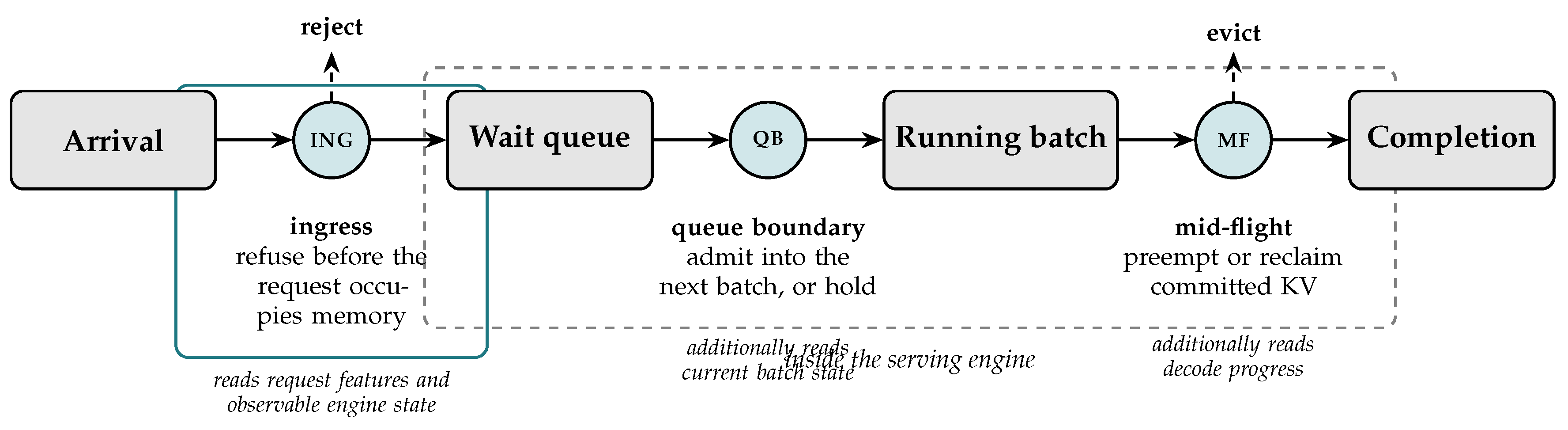
Figure 4.
Policy taxonomy on Unit of admission (horizontal) × SLO awareness (vertical). The upper-right quadrant (agent-session × deadline-aware) is partially occupied by SAGA (arXiv:2605.00528), which satisfies agent-level scheduling and per-task fairness but does not establish explicit TTFT/TBT deadlines, online serving mode, or per-tenant fairness. This is the seed for Open Problem 1.
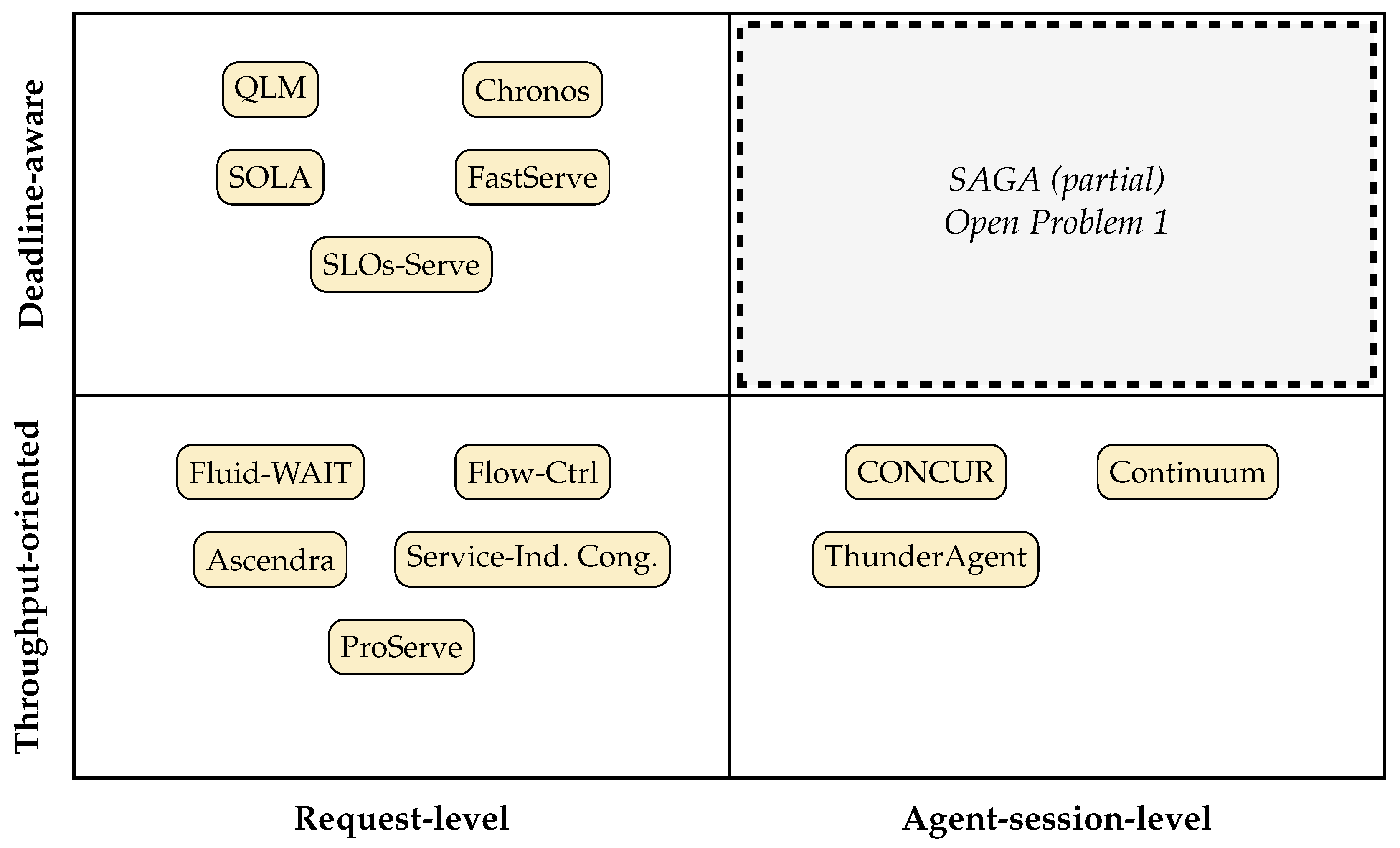
Figure 5.
PRISMA 2020 flow for the admission-control corpus. Counts as of 2026-09-11. Search protocol and per-paper protocol described in the subsections below.
Figure 5.
PRISMA 2020 flow for the admission-control corpus. Counts as of 2026-09-11. Search protocol and per-paper protocol described in the subsections below.
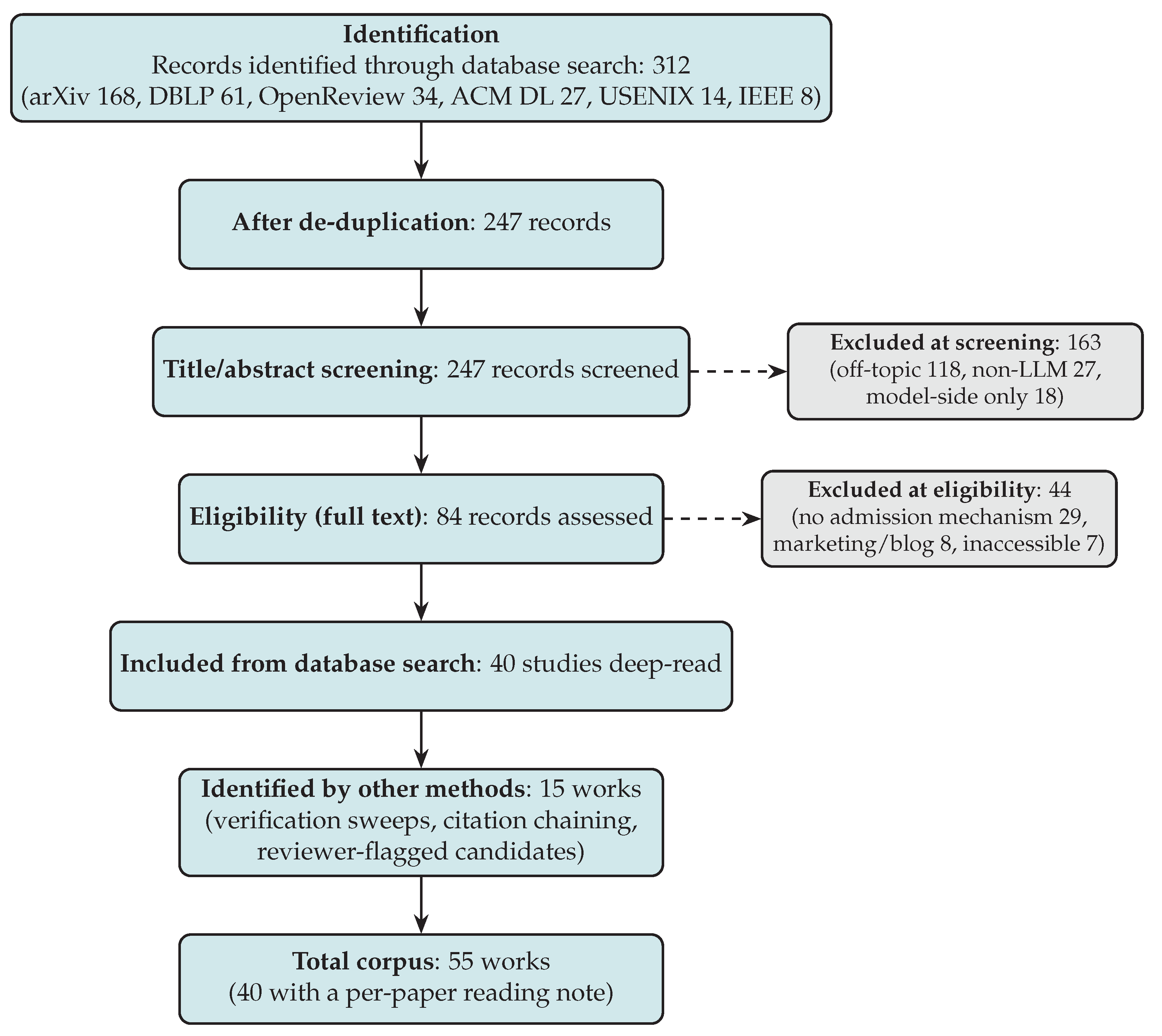

Table 1.
Differentiation from prior surveys.
| Prior survey | Scope | Admission depth | Taxonomy axes | Grounded open problems |
|---|---|---|---|---|
| Zhen et al. [11] INLG 2025 | Efficient serving (batching, KV, sched., fair.) | One subsection | Task-oriented | No |
| Heisler et al. [13] TechRxiv 2025 | Scheduling techniques & trade-offs | Component | Technique-oriented | No |
| Li et al. [12] IEEE HPEC 2024 | Recent serving advances | In passing | Chronological | No |
| Mitzenmacher & Shahout [14] SIGMETRICS 2025 | Queueing theory position paper | Tutorial | Queueing-theoretic | Enumerates 25 |
| Ma et al. [21] SSRN 2026 | Load balancing as a coupled control problem | Routing, not ingress | Control-theoretic | No |
| This paper | Admission as primary axis | Full | 5 axes + 4 sub-branches | 7 grounded |
Table 2.
Overload response mechanisms in the nine LLM serving systems the admission literature most often builds on, 2022–2026. Each locates its overload response inside the engine; the ingress-admission column is empty across all nine, which reflects the scope each paper sets rather than an omission. Token Pools, a control-plane contribution rather than an engine one, does gate at the API boundary and is discussed separately.
| Paper | Venue | Overload mechanism | Ingress admission? |
|---|---|---|---|
| Orca | OSDI 2022 | FCFS + KV-slot cap (implicit) | No |
| Sarathi-Serve | OSDI 2024 | Chunked prefill batching | No |
| Llumnix | OSDI 2024 | Live request migration | No |
| DistServe | OSDI 2024 | P/D disaggregation, static split | No |
| Past-Future [49] | ASPLOS 2025 | Memory projection at batch boundary | Internal only |
| Aegaeon [50] | SOSP 2025 | Per-token autoscaling | No |
| Jenga [51] | SOSP 2025 | Memory heterogeneity mgmt | No |
| AdaServe [52] | EuroSys 2026 | SLO-customized spec decode | No |
| PASCAL [53] | HPCA 2026 | Runtime phase detection | No |
Table 3.
Master classification of admission-primary and admission-adjacent works. See legend above the table for codes. “−” means the axis does not apply.
Table 3.
Master classification of admission-primary and admission-adjacent works. See legend above the table for codes. “−” means the axis does not apply.
| System / Paper | Venue | Year | Unit | Moment | Signal | GRADE |
|---|---|---|---|---|---|---|
| Request-level SLO-aware admission (§Section 5) | ||||||
| QLM | SoCC | 2024 | req | ing | lp | H |
| Chronos | Frontiers CS | 2026 | req | ing | wcrt | M |
| SOLA | MLSys | 2025 | req | mf | lp | M |
| FastServe | NSDI | 2026 | req | mf | sca | M |
| SLOs-Serve | preprint | 2025 | req | ing | lp | L |
| Fluid-WAIT | preprint | 2025 | req | ing | sca | L |
| Scorpio | WISE | 2026 | req | ing | dg | M |
| Ascendra | preprint | 2025 | req | qb | sca | L |
| Flow-Ctrl scheduling | preprint | 2026 | req | ing | wcrt | L |
| Service-Induced Cong. | preprint | 2026 | req | ing | wcrt | M |
| Jaillet et al. | preprint | 2026 | req | ing | lp | M |
| Shen et al. | ICML | 2026 | req | ing | lp | M |
| ProServe [17] | preprint | 2025 | req | qb | lp | L |
| Agent-session-level admission | ||||||
| CONCUR | ICML | 2026 | agt | ing | dg | M |
| Continuum | ICLR WS | 2026 | agt | mf | sca | M |
| ThunderAgent | ICML | 2026 | agt | ing | sca | L |
| SAGA | preprint | 2026 | agt | mf | sca | L |
| Fairness-oriented | ||||||
| VTC | OSDI | 2024 | ten | mf | sca | H |
| FairBatching | preprint | 2025 | req | mf | sca | L |
| Equinox | preprint | 2025 | ten | ing | sca | L |
| FairServe | preprint | 2024 | ten | ing | dg | M |
| Gateway-level admission + autoscaling | ||||||
| Token Pools | CAIS | 2026 | ten | ing | lp | M |
| Serial-edge concurrency context | ||||||
| Clairvoyant | preprint | 2026 | req | ing | sca | L |
| KV-management adjacent (no ingress admission) | ||||||
| KVFlow | NeurIPS | 2025 | − | mf | sca | M |
| Cake | ICML | 2025 | − | mf | sca | M |
| InferCept | ICML | 2024 | − | mf | sca | M |
| Pie | SOSP | 2025 | − | mf | − | L |
| Position / tutorial | ||||||
| Mitzenmacher & Shahout | SIGMETRICS | 2025 | − | − | − | VL |
Table 4.
Admission-signal overhead: cost of computing an admission decision (per request, best-case) versus lift reported in the source paper over that paper’s own FCFS baseline. Every row reports the exact operating context from its source; no normalization is applied across rows and cross-row comparison is not justified without head-to-head evaluation.
| Anchor (signal class) | Model / engine | Hardware | SLO tuple / workload | Cost | Lift over FCFS |
|---|---|---|---|---|---|
| Fluid-WAIT (sig-sca) | Llama-2-7B / vLLM | 1×A100 40 | TTFT 500 ms / synthetic Poisson | tens of µs | 10–20% goodput |
| Clairvoyant (sig-sca) | Llama-3.1-8B / Ollama | RTX 4090 | p50 latency / ShareGPT | tens of µs | 70–76% short-request p50 latency reduction |
| CONCUR (sig-dg) | Qwen3-32B / SGLang | 8×H100 | JCT / BrowserComp, 256 sessions | <100 µs + AIMD update | 4.09× throughput vs SGLang |
| QLM (sig-lp) | Mistral-7B + Vicuna-13B + LLaMA-70B / vLLM | 30×A10 + 50×A100 | TTFT tail / ShareGPT | ≈5 s Gurobi solve at 400 K queued | 40–90% SLO-attainment vs vLLM; 20% throughput single-model, 50–400% multi-model, vs vLLM+EDF |
| Chronos (sig-wcrt) | 7B ref. model / discrete-event sim | simulator | TTFT deadline / 50 K Azure requests | µs (closed-form) | TTFT miss 99.44%→0.00% at 5× load (sim) |
Table 5.
Baseline overlap across admission-primary papers. The most-used baseline (vLLM) appears in six papers and Sarathi in four; no other appears in more than two; and no two papers share the same baseline set. Read by what the columns contain: vLLM, SGLang, Sarathi, DistServe and Orca are serving engines, so a tick there measures a policy against the absence of admission control rather than against an alternative to it, and EDF, FCFS and SJF are classical disciplines rather than published systems. SOLA’s Sarathi entry is marked re-impl. because it reimplements chunked prefill on vLLM rather than comparing against upstream Sarathi-Serve. Among published admission systems, SHEPHERD [16] is used as a baseline by two papers (QLM and Ascendra); AC-FCFS also appears twice, but it is a throughput-matched token bucket constructed as an ablation rather than a system published in its own right. Scorpio’s comparison against Mooncake is the corpus’s clearest instance of one admission mechanism measured against another. Rows for CONCUR, Continuum, SAGA, and Token Pools are also omitted from column headers (a paper cannot baseline against itself); Continuum appears only as CONCUR’s rebuttal-added comparator. Empty rows for SAGA and Token Pools indicate baselines that are not extractable from the current text of those preprints.
| Paper | vLLM | SGLang | Sarathi | DistServe | Orca | EDF | FCFS | SJF | SHEPHERD | Weighted VTC | Continuum | AC-FCFS |
|---|---|---|---|---|---|---|---|---|---|---|---|---|
| QLM (SoCC 2024) | (cite) | (impl.) | ||||||||||
| CONCUR (ICML 2026) | ||||||||||||
| Chronos (Frontiers 2026) | ||||||||||||
| SOLA (MLSys 2025) | re-impl. | |||||||||||
| FastServe (NSDI 2026) | ||||||||||||
| SLOs-Serve (2025) | ||||||||||||
| FairBatching (2025) | ||||||||||||
| Ascendra (2025) | ||||||||||||
| ProServe (2025) | ||||||||||||
| SAGA (2026) | (baselines not extractable from preprint abstract; body-text extraction failed via WebFetch) | |||||||||||
| Token Pools (CAIS 2026) | (single-node evaluation; no external policy baselines reported) | |||||||||||
| Fluid-WAIT (2025) | (unnamed “widely used baselines”) | |||||||||||
| Scorpio (WISE 2026) | + S3 and Mooncake, the latter itself an early-rejection mechanism | |||||||||||
Table 6.
Production incidents mapped to admission signals. Confidence: V verified from postmortem; I inferred from postmortem. Every row cites a postmortem that is public at the time of writing.
Table 6.
Production incidents mapped to admission signals. Confidence: V verified from postmortem; I inferred from postmortem. Every row cites a postmortem that is public at the time of writing.
| Incident | Failure mode | Trusted signal (was) | Leading signal (needed) | Source | Conf. |
|---|---|---|---|---|---|
| OpenAI DALL·E queue collapse | Work admitted past client cancellation timeout | Queue depth | Queue age at admission | [57] | I |
| OpenAI Nov 8 2023 | Routing nodes crossed soak point; adding replicas insufficient | Utilization | Rate of change of utilization | [58] | V |
| OpenAI Dec 11 2024 | Telemetry API storm; stale DNS for 20 min then failed at TTL expiry | Aggregate utilization dashboards | Control-plane health independent of data-plane cache | [59] | V |
| OpenAI Apr 2025 | Control-plane OOM; failover overloaded second cluster; misleading errors | Cluster availability | Correct 429/503 propagation on failover | [60] | V |
| Anthropic Jan 21 2026 | Insufficient compute for demand; latency then errors for ∼90 min | Metrics dashboard refresh cycle | Sub-minute capacity-constraint detection | [61] | I |
| Anthropic Aug 29 2025 | LB moved short-context traffic to servers configured for 1M-token contexts | Pool-level utilization | Per-configuration utilization decomposition | [62] | V |
| Anthropic HTTP 529 semantics | Provider-overloaded distinct from client-rate-limited | Single 429/503 signal | Dedicated 529 semantics | [22] | V |
Disclaimer/Publisher’s Note: The statements, opinions and data contained in all publications are solely those of the individual author(s) and contributor(s) and not of MDPI and/or the editor(s). MDPI and/or the editor(s) disclaim responsibility for any injury to people or property resulting from any ideas, methods, instructions or products referred to in the content. |
© 2026 by the authors. Licensee MDPI, Basel, Switzerland. This article is an open access article distributed under the terms and conditions of the Creative Commons Attribution (CC BY) license (http://creativecommons.org/licenses/by/4.0/).
Copyright: This open access article is published under a Creative Commons CC BY 4.0 license, which permit the free download, distribution, and reuse, provided that the author and preprint are cited in any reuse.