

Submitted:
06 November 2026
Posted:
10 November 2026
You are already at the latest version
Abstract
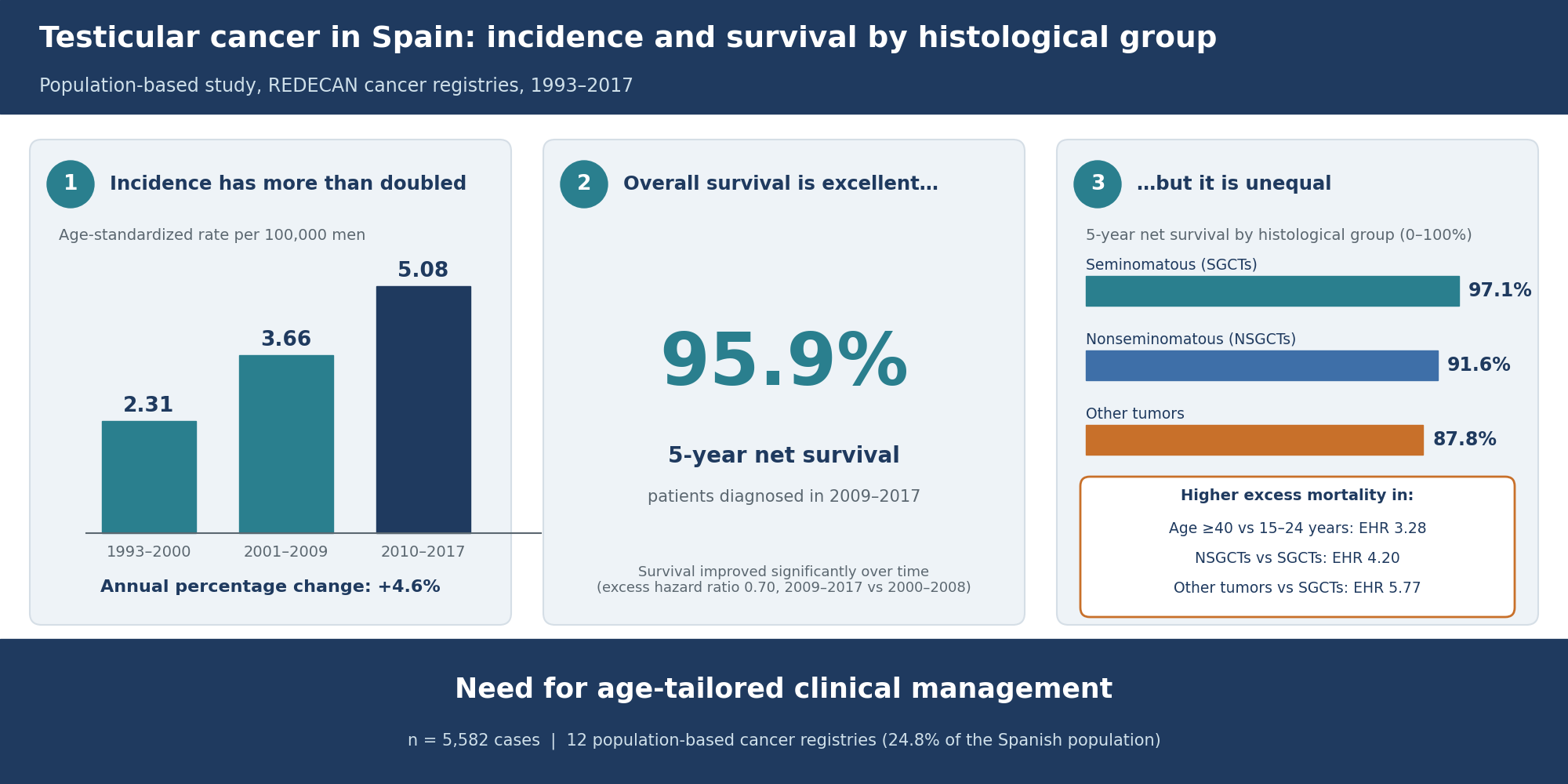
Background: Testicular cancer (TC) incidence has risen globally, yet population-based net survival and flexible parametric modeling across histological subtypes in Spain remain insufficiently characterized. Methods: Incident TC cases (1993–2017) were obtained from the Spanish Network of Cancer Registries (REDECAN). Age-standardized incidence rates (ASIR, 2013 European standard) and temporal trends (Joinpoint regression APC) were analyzed by age and histology, including seminomatous germ cell tumors (SGCTs), nonseminomatous germ cell tumors (NSGCTs), and others. Five-year overall survival (OS, Kaplan-Meier) and net survival (NS, Pohar-Perme, ICSS-3 standardized) for 2000–2017 were evaluated. Multivariable flexible parametric models estimated excess hazard ratio (EHR) of mortality. Results: A total of 5,582 cases were analyzed. ASIR increased from 2.31 per 100,000 in 1993–2000 to 5.08 in 2010–2017 (APC=4.6, 95%CI: 4.1; 5.3). Five-year OS and NS reached 94.3% and 95.9% in 2009–2017, respectively. SGCTs demonstrated superior 5-year NS (97.1%) compared to NSGCTs (91.6%) and others (87.8%). Multivariable flexible models revealed significantly higher excess mortality for age ≥40 years (EHR=3.28, 95%CI: 1.95; 5.52 vs 15–24 years), NSGCTs (EHR=4.20, 95%CI: 2.79; 6.30 vs SGCTs), and 'Others' (EHR=5.77), while survival improved in 2009–2017 (EHR=0.70, 95%CI: 0.51; 0.96). Conclusions: TC incidence in Spain more than doubled over 25 years. Survival is generally excellent but exhibits marked disparities by histology and age, emphasizing the need for age-tailored clinical management.
Keywords:
testicular cancer
; survival
; Spain
; population registry
; seminoma
; incidence
Introduction
Testicular cancer (TC) is infrequent among men, representing less than 1% of their malignancies in Spain [1]. However, these cancers are of particular concern because they affect mainly young age groups, including adolescents, that are commonly referred to as Adolescents and Young Adults (AYAs), which have specific healthcare needs [2,3]; among patients aged 15 to 39 years, it is the most frequent cancer in men and the third including both sexes [4,5].
The incidence of TC has been increasing since the second half of the 20th century in almost all countries, including Spain, although the causes of this trend are poorly understood [6]. Known risk factors are cryptorchidism and family and personal history, while multiple environmental agents have been suggested, such as bisphenol A, phthalates, and polychlorinated biphenyls [7,8]; exposure to these factors alone cannot explain the temporal and spatial differences in the incidence of TC. Moreover, the incidence in Europe itself is notably heterogeneous, with Spain having one of the lowest values [9,10,11].
Given the lack of epidemiological indicators of TC in Spain coming from population-based cancer registries (PBCRs) for more than a decade and considering that extant studies do not differentiate histological types of TC, the members of the Spanish Network of Cancer Registries (REDECAN) agreed to collaborate (https://redecan.org/es) to better understand the incidence, trends and survival associated with TC, with a particular focus on histological groups.
Materials and Methods
Cases and Study Population
This was a descriptive epidemiological study based on data from 12 Spanish population-based cancer registries (PBCRs) (Asturias, Baleares, Canarias, Castellón, Euskadi, Girona, Granada, La Rioja, Murcia, Navarra, Salamanca and Tarragona) that span the full latitudinal range of Spain. The population covered by these registries was 12,176,214 people (24.8%) [12]. They are all associated with REDECAN (https://redecan.org/es) and regularly publish high-quality data in "Cancer Incidence in Five Continents" (https://ci5.iarc.fr/ci5-xii). Anonymized population-based data on incident cases of TC registered between 1993 and 2017 were collected. These cases (N=5,642) were defined by topography code (C62.0, C62.1, or C62.9 according to 3rd Edition of the International Classification of Diseases for Oncology, ICD-O-3), corresponding to malignant neoplasm of “undescended testis”, “descended” and “not otherwise specified”, respectively. Cases without microscopic diagnosis and hematological malignancies were excluded (N=5,582 final).
Date at diagnosis, age at diagnosis, topography and histology (morphology) and vital status were collected. Age was stratified into four groups (0–14, 15–24, 25–39 and ≥40 years), following the most common AYA definitions and the age groups with the highest incidence rates reported in the literature. The 0-14 years group was excluded in the survival analysis. Three periods were established, 1993–2000, 2001–2009 and 2010–2017; for the survival analyses, however, the periods were 2000–2008 and 2009–2017, due to lack of information for earlier cases. All registries provided complete data except for four provinces: Asturias, which contributed data from 1993 to 2015; the Balearic Islands (1993-2013); Castellón (2004 -2017); and Salamanca (2011- 2017).
To differentiate germ cell tumors (GCTs), the morphology codes were grouped into three categories: seminomatous germ cell tumors (SGCTs: 9061/3, 9062/3, 9064/3), nonseminomatous (NSGCTs: 9065/3, 9070-72/3, 9080-85/3, 9100-1/3), and “Others”, which included spermatocytic GCTs (9063/3), other cancers not related to GCTs and nonspecific codes.
Statistical Analyses
Descriptive analysis, 95% confidence interval (95% CIs) and exact tests to compare the data between groups were performed.
Both crude (CIR) and age-standardized annual incidence rates (ASIR, by the direct method using the 2013 European Standard Population as the reference) were calculated per 100,000 men/year. Standardized rates were also calculated for each age group and histological group, along with their relative risks, taking as the reference group the first category for period and age groups, and NSGCTs for the histological group because it had an intermediate incidence. The 95%CI for rates was estimated using the Tiwari method [13].
The temporal trends in ASIR were analyzed by means of the annual percentage change (APC) using log-linear regression with the Joinpoint Regression Program v4.6.0 (National Cancer Institute, Bethesda, MD, USA).
Overall survival (OS) was estimated using the Kaplan‒Meier method. Log-rank and generalized Wilcoxon tests were used for comparison of survival curves following correction with the Holm‒Bonferroni method [14]. Net survival (NS) was calculated using the Pohar-Perme estimator [15]. The OS and NS rates at 1, 3 and 5 years were standardized by age according to the weighting of the International Cancer Survival Standard 3 (ICSS-3). To verify the differences in NS between groups, flexible parametric univariable and multivariable survival models were used to estimate the excess hazard ratio of mortality up to five years after diagnosis [16]. The latest follow-up date was December 31, 2022, with 10.2 years as mean follow-up (standard deviation 5.3 years). Statistical significance was α=0.05. Stata v14.2 software was used.
The study was carried out in accordance with Regulation EU 2016/679 General Data Protection Regulation (GDPR) [17]. The project was approved by the Ethics Committee of the Virgen de la Arrixaca Hospital (Code 2023-11-17-HCUVA).
Results
Study Population
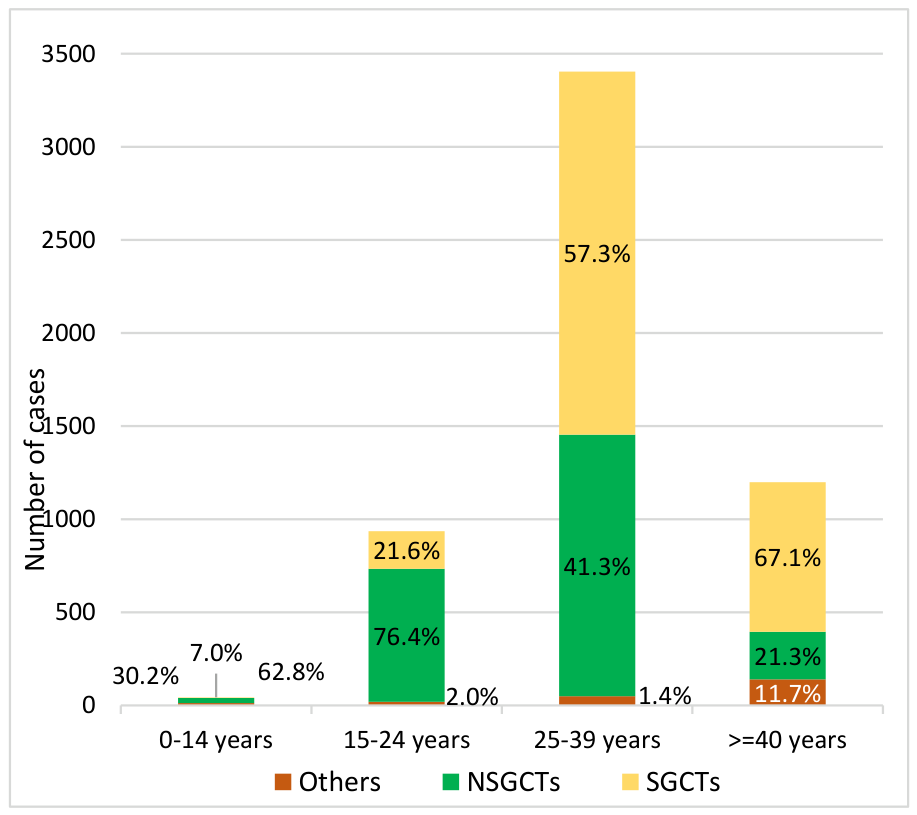
By age, 0.8% (43 cases) were <15 years, 16.8% (936) 15–24, 61.0% (3,404) 25–39, and 21.5% (1,199) ≥40 (1,019 aged 40–59). Tumors comprised 53.0% SGCTs, 43.0% NSGCTs, and 4.0% other types (Table 1). The mean age of diagnosis of SGCTs was 35.9 years and 29.2 for NSGCTs. Most SGCTs (1,950; 65.9%) occurred in patients aged 25–39, representing 57.3% of their diagnoses (Figure 1).
Appendix Figure A.1 details historical shifts by age; the proportion of SGCTs increased in the 15–24 and 25–39 age groups, but the increase was statistically significant only in 25–39 (Fisher’s exact test, p = 0.001).

Table 1.
Number of cases, crude and standardized incidence rate per 100,000 men and relative risk of testicular cancer in Spain by age group, period and histological group from 1993 to 2017.
Table 1.
Number of cases, crude and standardized incidence rate per 100,000 men and relative risk of testicular cancer in Spain by age group, period and histological group from 1993 to 2017.
| Strata | N | % | Crude incidence rate | Standardized incidence rate [95% CI] | Standardized relative risk [95% CI] | |
| Total | 5582 | 100 | 4.46 | 3.79 [3.69; 3.89] | ||
| Age group | ||||||
| 0-14 years | 43 | 0.8% | 0.22 | 0.22 [0.16; 0.30] | 1 (Ref.) | |
| 15-24 years | 936 | 16.8% | 5.87 | 5.78 [5.42; 6.17] | 26.33 [19.43; 36.64] | |
| 25-39 years | 3404 | 61.0% | 10.98 | 10.94 [10.58; 11.32] | 49.82 [36.99; 68.98] | |
| ≥40 years | 1199 | 21.5% | 2.04 | 1.80 [1.70; 1.91] | 8.21 [6.07; 11.40] | |
| Period | ||||||
| 1993-2000 | 977 | 17.5% | 2.82 | 2.31 [2.16; 2.46] | 1 (Ref.) | |
| 2001-2009 | 2150 | 38.5% | 4.58 | 3.66 [3.50; 3.82] | 1.58 [1.46; 1.71] | |
| 2010-2017 | 2455 | 44.0% | 5.66 | 5.08 [4.88; 5.28] | 2.20 [2.04; 2.37] | |
| Histological group | ||||||
| SGCTs | 2959 | 53.0% | 2.37 | 2.00 [1.93; 2.07] | 1.25 [1.18; 1.32] | |
| NSGCTs | 2402 | 43.0% | 1.92 | 1.60 [1.54; 1.67] | 1 (Ref.) | |
| Others | 221 | 4.0% | 0.18 | 0.19 [0.17; 0.22] | 0.12 [0.10; 0.14] | |
CI: Confidence intervals; Ref.: reference category for age-adjusted relative risk. Source: REDECAN (Spanish Network of Cancer Registries).
Figure 1.
Number of testicular cancer cases and proportional share between main histological types within the age groups during 1993-2017. SGCTs: seminomatous germ cell tumors; NSGCTs: nonseminomatous germ cell tumors. Source: REDECAN (Spanish Network of Cancer Registries).
Figure 1.
Number of testicular cancer cases and proportional share between main histological types within the age groups during 1993-2017. SGCTs: seminomatous germ cell tumors; NSGCTs: nonseminomatous germ cell tumors. Source: REDECAN (Spanish Network of Cancer Registries).
Incidence Trends
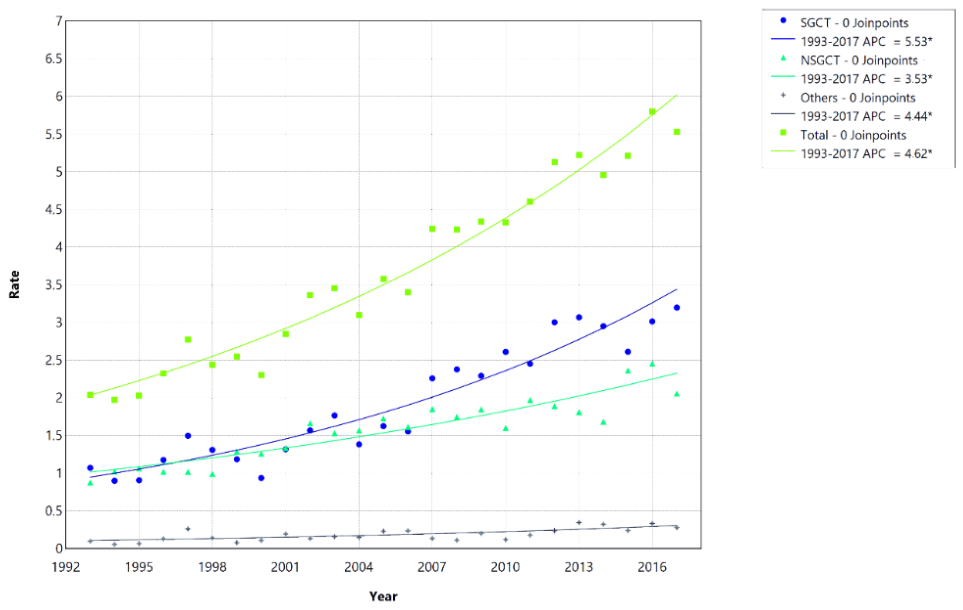
Table 1 details incidence rates. Mean annual CIR rose from 2.82/100,000 men (1993–2000) to 5.66 (2010–2017), yielding ASIR of 2.31 and 5.08. Total APC was 4.6 (95%CI: 4.1; 5.3; Figure 2A). By age, significant increases spanned 1993–2017 for 15–24 years (APC: 1.8; 95%CI: 0.8; 2.4), 1993–2008 for 25–39 (APC: 7.4; 95%CI: 6.4; 9.3), and 2005–2017 for ≥40 (APC: 9.2; 95%CI: 7.0; 16.1), with no significant trend in 0–14. All histological types showed continuous increases without inflection points (Figure 2B): SGCTs (APC: 5.5; 95%CI: 4.6; 6.8), NSGCTs (APC: 3.5; 95%CI: 2.8; 4.4), and “Others” (APC: 4.4; 95%CI: 2.5; 7.5).
Figure 2.
A. Trends in testicular cancer incidence rates in Spain from 1993 to 2017, categorized by age groups. APC: annual percentage change (from Joinpoint analysis); * significant APC (p<0.05). Rate: age-standardized annual incidence rate per 100,000 men. Source: REDECAN (Spanish Network of Cancer Registries).
Figure 2.
A. Trends in testicular cancer incidence rates in Spain from 1993 to 2017, categorized by age groups. APC: annual percentage change (from Joinpoint analysis); * significant APC (p<0.05). Rate: age-standardized annual incidence rate per 100,000 men. Source: REDECAN (Spanish Network of Cancer Registries).
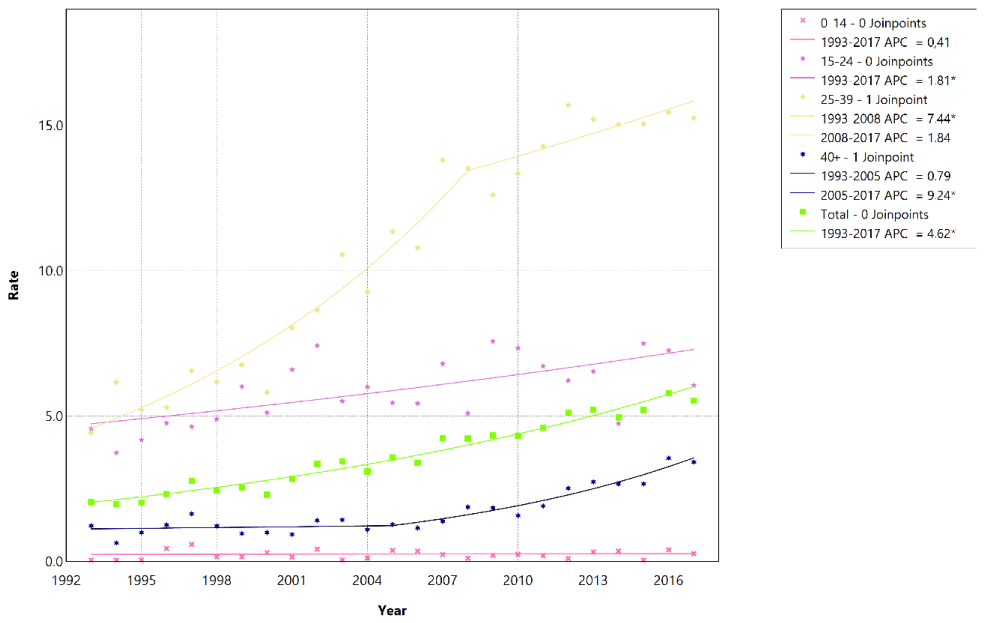
Figure 2.
B. Trends in testicular cancer incidence rates in Spain from 1993 to 2017, for the total and each main histological group. APC: annual percentage change (from Joinpoint analysis). * significant APC (p<0.05). Rate: age-standardized annual incidence rate per 100,000 men. SGCT: seminomatous germ cell tumors; NSGCT: nonseminomatous germ cell tumors. Source: REDECAN (Spanish Network of Cancer Registries).
Figure 2.
B. Trends in testicular cancer incidence rates in Spain from 1993 to 2017, for the total and each main histological group. APC: annual percentage change (from Joinpoint analysis). * significant APC (p<0.05). Rate: age-standardized annual incidence rate per 100,000 men. SGCT: seminomatous germ cell tumors; NSGCT: nonseminomatous germ cell tumors. Source: REDECAN (Spanish Network of Cancer Registries).
Survival
Table 2 shows OS and NS figures at 1, 3 and 5 years by subgroups while Kaplan-Meier curves are depicted in Appendix Figure A.2. OS and NS rates described and discussed in the main text are always at 5-year. When analyzed by age groups, the OS for period 2000–2017 was highest in the 25–39 year group, with a value of 96.6% (95%CI: 95.9; 97.2), while for ≥40 was the lowest, at 89.6% (95%CI: 87.6; 91.3). The OS increased over time, from 91.0% (95%CI: 88.0; 93.3) in 2000–2008 to 94.3% (95%CI: 92.5; 95.7) in 2009–2017, although it was not significant (p=0.066). When the data were analyzed by histological type, SGCTs cases had the highest OS, at 96.0% (95%CI: 94.0; 97.2), followed by NSGCTs: 90.9% (95%CI: 87.5; 93.4) and “Others”: 81.2% (95%CI: 66.3; 88.2); the differences among all the histological groups were significant.
Regarding NS, the 5-year rates were similar to those of the OS, being the highest survival age group again the 25–39 years: 97.0% (95%CI: 96.3; 97.6), while the group with the lowest NS was the ≥40: 92.6% (95%CI: 90.3; 94.5). The NS rate significantly increased between the two periods, from 92.8% (95%CI: 90.3; 94.6) to 95.9% (95%CI: 94.6; 96.9). When the NS rate was analyzed by histological type, the SGCTs group, as for the OS, had the best outcome (97.1%; 95%CI: 95.8; 98.0), while the “Others” group had the worst (87.8%; 95%CI: 79.5; 92.9).
Table 3 presents the Excess Hazard Ratios (EHR) of mortality at 5 years from the multivariable flexible parametric model. Compared with patients aged 15–24, those aged ≥40 had significantly higher excess mortality (EHR=3.28, 95%CI: 1.95; 5.52), whereas no significant difference was observed for those aged 25–39 (p = 0.355). The NS rate also increased significantly in the second period compared with the first (EHR=0.70, 95%CI: 0.51; 0.96), an effect not observed for OS. NSGCTs and “Others” had higher excess mortality than SGCTs (EHR=4.20, 95%CI: 2.79; 6.30 and 5.77, 95%CI: 3.19; 10.45, respectively).
Appendix Tables A.1–A.4 summarize OS and NS by age, histology and period. Within age groups, OS differed significantly by histological type, except among patients aged 15–24 years. In the 25–39, OS was 98.7% (95%CI: 98.0; 99.1) for SGCTs, significantly higher than for NSGCTs (94.0%; 95%CI: 92.5; 95.2; p <0.001, Wilcoxon) and “Others” (85.0%; 95%CI: 69.6; 93.0; p <0.001, Wilcoxon). Among patients aged ≥40 years, OS was 93.3% (95%CI: 91.1; 95.0), 87.0% (95%CI: 81.8; 90.8) and 73.5% (95%CI: 64.5; 80.6) for SGCTs, NSGCTs and “Others”, respectively. OS increased over time for all histological types, particularly “Others”, although differences between periods within each histological type were not significant.
Table 2.
Standardized overall survival (OS) and net survival (NS) rates at 1, 3 and 5 years after the diagnosis of testicular cancer by age group, period and histological group in Spain from 2000 to 2017.
Table 2.
Standardized overall survival (OS) and net survival (NS) rates at 1, 3 and 5 years after the diagnosis of testicular cancer by age group, period and histological group in Spain from 2000 to 2017.
| N | Deaths | OS Rate | 95% CI | NS Rate* | 95% CI | |
| Age group | ||||||
| 15-24 years | ||||||
| 1 | 690 | 7 | 99.0% | [97.9; 99.5] | 99.0% | [97.9; 99.6] |
| 3 | 664 | 18 | 96.4% | [94.7; 97.6] | 96.5% | [94.8; 97.7] |
| 5 | 631 | 3 | 96.0% | [94.2; 97.2] | 96.2% | [94.4; 97.4] |
| 25-39 years | ||||||
| 1 | 2889 | 38 | 98.7% | [98.2; 99.1] | 98.8% | [98.4; 99.2] |
| 3 | 2789 | 50 | 97.0% | [96.3; 97.6] | 97.3% | [96.6; 97.8] |
| 5 | 2601 | 11 | 96.6% | [95.9; 97.2] | 97.0% | [96.3; 97.6] |
| ≥40 years | ||||||
| 1 | 981 | 46 | 95.6% | [94.1; 96.7] | 96.3% | [94.8; 97.3] |
| 3 | 914 | 38 | 91.8% | [90.0; 93.3] | 93.6% | [91.6; 95.2] |
| 5 | 794 | 21 | 89.6% | [87.6; 91.3] | 92.6% | [90.3; 94.5] |
| Period | ||||||
| Full (2000-2017) | ||||||
| 1 | 4560 | 91 | 97.3% | [96.2; 98.0] | 97.6% | [96.9; 98.2] |
| 3 | 4367 | 106 | 94.4% | [93.0; 95.5] | 95.4% | [94.4; 96.2] |
| 5 | 4026 | 35 | 93.1% | [91.6; 94.4] | 94.8% | [93.6; 95.7] |
| 2000-2008 | ||||||
| 1 | 1912 | 45 | 96.4% | [94.2; 97.8] | 96.9% | [95.3; 97.9] |
| 3 | 1858 | 54 | 92.5% | [89.6; 94.6] | 93.6% | [91.4; 95.3] |
| 5 | 1842 | 15 | 91.0% | [88.0; 93.3] | 92.8% | [90.3; 94.6] |
| 2009-2017 | ||||||
| 1 | 2652 | 46 | 97.7% | [96.4; 98.5] | 98.1% | [97.3; 98.7] |
| 3 | 2512 | 52 | 95.5% | [93.7; 96.7] | 96.4% | [95.3; 97.3] |
| 5 | 2187 | 20 | 94.3% | [92.5; 95.7] | 95.9% | [94.6; 96.9] |
| Histological group | ||||||
| SGCTs | ||||||
| 1 | 2509 | 27 | 98.6% | [97.7; 99.1] | 98.8% | [98.0; 99.3] |
| 3 | 2428 | 27 | 97.0% | [95.2; 98.0] | 97.7% | [96.6; 98.4] |
| 5 | 2213 | 16 | 96.0% | [94.0; 97.2] | 97.1% | [95.8; 98.0] |
| NSGCTs | ||||||
| 1 | 1895 | 48 | 95.9% | [93.3; 97.5] | 96.0% | [94.0; 97.3] |
| 3 | 1799 | 65 | 91.7% | [88.4; 94.0] | 92.0% | [89.6; 93.9] |
| 5 | 1691 | 11 | 90.9% | [87.5; 93.4] | 91.6% | [89.0; 93.6] |
| Others | ||||||
| 1 | 160 | 16 | 92.2% | [84.1; 96.1] | 94.1% | [88.7; 97.0] |
| 3 | 144 | 14 | 84.5% | [70.0; 91.1] | 88.6% | [81.1; 93.3] |
| 5 | 126 | 8 | 81.2% | [66.3; 88.2] | 87.8% | [79.5; 92.9] |
* Data from the province of Salamanca (65 cases) are excluded because the province did not provide an updated life table. N: number of cases contributing information to the Kaplan–Meier estimate during the corresponding follow-up interval. Deaths: number of deaths observed during that interval. CI: Confidence intervals; SGCTs: seminomatous germ cell tumors; NSGCTs: nonseminomatous germ cell tumors. Source: REDECAN (Spanish Network of Cancer Registries).
Table 3.
Age-standardized excess hazard ratios (EHRs) for mortality derived from flexible parametric models for individuals with testicular cancer in Spain from 2000 to 2017.
Table 3.
Age-standardized excess hazard ratios (EHRs) for mortality derived from flexible parametric models for individuals with testicular cancer in Spain from 2000 to 2017.
| Variables | Univariable model* | Multivariable model** | ||||
| Age group | EHR | 95% CI | p | EHR | 95% CI | p |
| 15-24 years | 1.00 (Ref.) | 1.00 (Ref.) | ||||
| 25-39 years | 0.79 | [0.50; 1.25] | 0.308 | 1.25 | [0.78; 1.99] | 0.355 |
| ≥40 years | 1.80 | [1.11; 2.93] | 0.018 | 3.28 | [1.95; 5.52] | <0.001 |
| Period | ||||||
| 2000-2008 | 1.00 (Ref.) | 1.00 (Ref.) | ||||
| 2009-2017 | 0.72 | [0.52; 1.00] | 0.047 | 0.70 | [0.51; 0.96] | 0.029 |
| Histological group | ||||||
| SGCTs | 1.00 (Ref.) | 1.00 (Ref.) | ||||
| NSGCTs | 3.84 | [2.50; 5.88] | <0.001 | 4.20 | [2.79; 6.30] | <0.001 |
| Others | 8.96 | [4.87; 16.50] | <0.001 | 5.77 | [3.19; 10.45] | <0.001 |
EHR: Excess hazard ratio standardized by age at 5 years after diagnosis; Ref.: reference category for age-adjusted excess hazard ratio. * Model with the variable presented as the only predictor. ** Model with all variables presented as a predictor set. CI: Confidence intervals; SGCTs: seminomatous germ cell tumors; NSGCTs: nonseminomatous germ cell tumors. Source: REDECAN (Spanish Network of Cancer Registries).
Discussion
TC incidence has been increasing in Europe and Spain, although the causes remain largely unknown [5,6,10,18,19]. This is also true for our study, as ASIR more than doubled from 1993 to 2017 (APC=4.6), a figure in line with the results for Spain (APC=4.3 for the period 1978–2012) of a European study that analyzed data from the “Cancer Incidence in Five Continents (CI5)” publication; in it, the ASIR adjusted to the global population in Spain rose from 1.3 in 1980 to 4.2 cases per 100,000 in 2010; despite being one of the greatest relative increases in Europe, incidence remains among the lowest.
In our study the average ASIR for 2010–2017, 5.1, was higher than REDECAN’s projection for 2015 (4.3) [1]. In some countries with the highest incidences, it seems that values have plateaued [20]; for Spain, a study predicted that from 2015, the incidence would begin to decrease [21]; however, our trend analysis does not seem to confirm this.
Regarding histological groups, it is worth mentioning that the current World Health Organization (WHO) classification of 2022 [22] distinguishes, on a molecular basis, between prepubertal and postpubertal GCTs. We could not apply this distinction in our study; however, the use of the “classical” (strictly morphological) classification should not imply a significant decrease in quality, since only 1% of the GCTs are of the prepubertal type according to the literature. Moreover, the histological classification that we used allows comparisons with previous and current studies, since, to our knowledge, the molecular classification has not yet been applied in epidemiological studies involving the general population.
Our data show that incidence of both GCTs types increased significantly over time, more so in the SGCTs, which raised its proportion over the 25–39 years group. In a global study [9], the predominant histological type depended on the country, SGCTs generally being the most common. Other studies in Europe have also reported an increase in the proportion of SGCTs [23], but to our knowledge, none has provided explanations for these trends.
The mean age of diagnosis of SGCTs was greater than that of NSGCTs in our study, which is in accordance with others’ findings; it should be noted that mean age values are quite variable by countries, and ours are in the low–medium part of the range [24,25,26,27,28]. According to Joinpoint analysis, the greatest increase in incidence occurred in men aged 25–39 years from 1993 to 2008 and in those ≥40 years from 2005 to 2017; this change in trend toward the two older age groups has also been described in the literature [6,28,29]. Despite this "ageing" of TC patients, the greatest proportion of incident cases continues to occur in the AYA group. Prior to adolescence, TC has been rare, 0.8% of the total, in line with the average for Europe [10,30,31].
Regarding survival, our 5-year OS across the final period, 2009–2017 (94.3%), is consistent with that described for Europe (except for the Eastern part of the continent) and for the Caucasians of North America [26,32,33,34]. Multiple studies have indicated that individuals with SGCTs have better outcomes [35,36]. Our survival figures greatly varied across the histological types, and the differences were significant. OS for the SGCTs group is very good, particularly in the 25-39 years age group (98.7%).
Considering NS, the best published values are those presented in a Dutch study from 2024 about the prior decade, at 99.5% for SGCTs and 98.1% for NSGCTs. As in our study, the Dutch one showed that SGCTs group had better outcomes and that NS for all histological types increased over the study period [5]. Similar results (99% for SGCTs and 96% for NSGCTs) were obtained in a population-based study in Canada about cases occurring between 2000 and 2010 [26] and in a study in the United States with data collected until 2017 for a population of European descent [37]; our NS data are not as good as those reported above, and the differences between the two main histological types are greater, suggesting room for improvement.
With regard to periods, survival during the first was worse than that of the second period, whereas when analyzed by age group, the worst OS rate corresponded to those ≥40 years, but no statistically significant differences were found among the other groups. This worse prognosis in people older than 40 is a common finding in most related studies, even after stratification by stage and histological type, and can be attributed to the greater toxicity of chemotherapy containing cisplatin in this age group [38]. NS rates by age groups were very similar to the OS rates, with the greatest difference observed in the ≥40 group.
To better characterize the differences in both OS and NS rates by histological type, we further analyzed survival according to multiple combinations of histology, period and age, since we expected interactions among these variables because all of them affect survival while age and period also affect the proportion of the different histological types. We found that although the differences were statistically significant only for those aged 25-39 and ≥40 years, the best OS and NS rates within each age group always occurred for those with SGCTs, followed by the NSGCTs; other studies have shown disparate results regarding the worse outcomes of patients with GCTs when older than 40 years, while there is a consensus with us for NSGCTs [35,36,37,38].
Strengths and Limitations
Strengths of this study include its population-based coverage of 15 Spanish territories for incidence that encompass full latitudinal span of the country. Another indicator of quality is the high proportion of microscopic verification (99%) of the cases. All the participating PBCRs follow the same coding system (ICD-O) with the same registration criteria provided internationally by the IARC (International Agency for Research on Cancer) and the ENCR (European Network of Cancer Registries) and use a common methodology for case registration and survival status monitoring. To our knowledge, this is the first study providing incidence and survival data across histological subtypes in Spain.
Limitations include coverage restricted to 25% of the Spanish population, with a widespread but non-homogeneous distribution; incomplete temporal coverage in a few registries and lack of information on tumor stage at diagnosis. Finally, histological data do not reflect the molecular novelties brought by the 2022 WHO classification.
Conclusions
Testicular cancer incidence in Spain increased more than twofold, although overall burden was partially counterbalanced by widespread survival improvements. The high impact on young patients highlights the necessity for specialized AYA healthcare resources. Differences in the outcomes across histological types vary widely depending on the age group considered; this is striking and has been scarcely explored in previous literature, warranting further investigation on this topic. In Spain, net survival has improved over 18 years; these results should encourage the continuous optimization of the diagnosis and treatment of testicular cancer.
Supplementary Materials
The following supporting information can be downloaded at the website of this paper posted on Preprints.org.; Appendix Figure A.1; Appendix Figure A.2.; Appendix Tables A.1–A.4.
Author Contributions
Conceptualization, Ricardo José Vaamonde-Martín and María Dolores Chirlaque-López; Methodology, Ricardo José Vaamonde-Martín, Mónica Ballesta-Ruiz and María Dolores Chirlaque-López; Formal analysis, Mónica Ballesta-Ruiz; Investigation, Ricardo José Vaamonde-Martín and Mónica Ballesta-Ruiz; Resources, Antonia Sánchez-Gil, Aina Romaguera-Palomé, María-Isabel Palacios-Castaño, Marcela Guevara-Eslava, Claudia Plá-González, Pilar Gutiérrez-Meléndez, Patricia Camporro-Burguillo, Montserrat Cristina Garrido-Martín, Xitama Nayra Álvarez-Díaz, Ana Vizcaino-Batllés, Marta De-La-Cruz, Amaia Aizpurua-Atxega, Amaia Onaindia-Agundez and María Dolores Chirlaque-López; Data curation, Ricardo José Vaamonde-Martín, Mónica Ballesta-Ruiz, Antonia Sánchez-Gil and Ana María Corbalán-Fernández; Writing – original draft, Ricardo José Vaamonde-Martín and Mónica Ballesta-Ruiz; Writing – review & editing, Ricardo José Vaamonde-Martín, Mónica Ballesta-Ruiz, Antonia Sánchez-Gil, Ana María Corbalán-Fernández, Gemma Alonso-Sánchez, Aina Romaguera-Palomé, Daniel Redondo-Sánchez, María-Isabel Palacios-Castaño, Marta Muncunill-Farreny, Marcela Guevara-Eslava, Claudia Plá-González, Pilar Gutiérrez-Meléndez, Patricia Camporro-Burguillo, Montserrat Cristina Garrido-Martín, Xitama Nayra Álvarez-Díaz, Ana Vizcaino-Batllés, Marta De-La-Cruz, Amaia Aizpurua-Atxega, Amaia Onaindia-Agundez and María Dolores Chirlaque-López; Supervision, María Dolores Chirlaque-López.
Institutional Review Board Statement
The study was conducted in accordance with the Declaration of Helsinki and approved by the Ethics Committee of the Virgen de la Arrixaca Hospital (Code 2023-11-17-HCUVA).
Informed Consent Statement
Patient consent was waived because the study used anonymized data from population-based cancer registries, and no patient was contacted.
Data Availability Statement
The data presented in this study are not publicly available because they derive from individual-level records held by population-based cancer registries and are subject to privacy and legal restrictions. Aggregated data supporting the findings are provided in the article and its appendix. Individual-level data may be requested from the corresponding author and are subject to approval by the participating REDECAN registries.
Acknowledgments
We thank the personnel from the cancer registries members of REDECAN for their contribution to data collection.
Conflicts of Interest
The authors declare no conflicts of interest.
References
- Galceran, J.; Ameijide, A.; Carulla, M.; et al. Cancer incidence in Spain, 2015. Clin. Transl. Oncol. 2017, 19, 799–825. [Google Scholar] [CrossRef] [PubMed]
- Sleeman, S.H.E.; Reuvers, M.J.P.; Manten-Horst, E.; Verhees, B.; Patterson, P.; Janssen, S.H.M.; Husson, O. “Let Me Know If There’s Anything I Can Do for You”, the Development of a Mobile Application for Adolescents and Young Adults (AYAs) with Cancer and Their Loved Ones to Reconnect after Diagnosis. Cancers 2022, 14, 1178. [Google Scholar] [CrossRef] [PubMed]
- Ferrari, A.; Stark, D.; Peccatori, F.A.; Fern, L.; Laurence, V.; Gaspar, N.; Bozovic-Spasojevic, I.; Smith, O.; De Munter, J.; Derwich, K.; et al. Adolescents and young adults (AYA) with cancer: a position paper from the AYA Working Group of the European Society for Medical Oncology (ESMO) and the European Society for Paediatric Oncology (SIOPE). ESMO Open 2021, 6, 100096. [Google Scholar] [CrossRef] [PubMed]
- European Cancer Information System (ECIS). Incidence and mortality estimates. Available online: https://ecis.jrc.ec.europa.eu/explorer.php (accessed on 25 March 2025).
- van der Meer, D.J.; Karim-Kos, H.E.; Elzevier, H.W.; et al. The increasing burden of testicular seminomas and non-seminomas in adolescents and young adults (AYAs): incidence, treatment, disease-specific survival and mortality trends in the Netherlands between 1989 and 2019. ESMO Open 2024, 9, 102231. [Google Scholar] [CrossRef] [PubMed]
- Brönimann, S.; Mun, D.-H.; Hackl, M.; Yang, L.; Shariat, S.F.; Waldhoer, T. Increase and plateauing of testicular cancer incidence in Austria—a time trend analysis of the past four decades. Eur. Urol. Open Sci. 2023, 49, 104–109. [Google Scholar] [CrossRef] [PubMed]
- Faja, F.; Esteves, S.; Pallotti, F.; et al. Environmental disruptors and testicular cancer. Endocrine 2022, 78, 429–435. [Google Scholar] [CrossRef] [PubMed]
- Yazici, S.; Del Biondo, D.; Napodano, G.; et al. Risk factors for testicular cancer: environment, genes and infections—is it all? Medicina 2023, 59, 724. [Google Scholar] [CrossRef] [PubMed]
- Gurney, J.K.; Florio, A.A.; Znaor, A.; et al. International trends in the incidence of testicular cancer: lessons from 35 years and 41 countries. Eur. Urol. 2019, 76, 615–623. [Google Scholar] [CrossRef] [PubMed]
- Huyghe, E.; Plante, P.; Thonneau, P.F. Testicular cancer variations in time and space in Europe. Eur. Urol. 2007, 51, 621–628. [Google Scholar] [CrossRef] [PubMed]
- Escobar, D.; Daneshmand, S. Disparities in Testicular Cancer: A Review of the Literature. Cancers 2024, 16, 3433. [Google Scholar] [CrossRef] [PubMed]
- Instituto Nacional de Estadística (INE). Estadística del Padrón continuo. Available online: https://www.ine.es (accessed on 18 March 2025).
- Tiwari, R.C.; Clegg, L.X.; Zou, Z. Efficient interval estimation for age-adjusted cancer rates. Stat. Methods Med. Res. 2006, 15, 547–569. [Google Scholar] [CrossRef] [PubMed]
- Holm, S. A simple sequentially rejective multiple test procedure. Scand. J. Stat. 1979, 6, 65–70. [Google Scholar] [CrossRef]
- Pohar Perme, M.; Stare, J.; Estève, J. On estimation in relative survival. Biometrics 2012, 68, 113–120. [Google Scholar] [CrossRef] [PubMed]
- Royston, P.; Lambert, P.C. Flexible Parametric Survival Analysis Using Stata: Beyond the Cox Model; Stata Press: College Station, TX, USA, 2011. [Google Scholar]
- Regulation (EU) 2016/679 of the European Parliament and of the Council of 27 April 2016 on the protection of natural persons with regard to the processing of personal data and on the free movement of such data, and repealing Directive 95/46/EC (General Data Protection Regulation). Available online: https://eur-lex.europa.eu/eli/reg/2016/679/oj/eng (accessed on 03 March 2026).
- Cayuela, L.; Cabrera Fernández, S.; Pereyra-Rodríguez, J.J.; Hernández-Rodríguez, J.C.; Cayuela, A. Rising testicular cancer incidence in Spain despite declining mortality: an age-period-cohort analysis. Actas Urol. Esp. 2024, 48, 596–602. [Google Scholar] [CrossRef] [PubMed]
- Verhoeven, R.H.A.; Karim-Kos, H.E.; Coebergh, J.W.W.; et al. Markedly increased incidence and improved survival of testicular cancer in the Netherlands. Acta Oncol. 2014, 53, 342–350. [Google Scholar] [CrossRef] [PubMed]
- Brandt, M.P.; Gust, K.M.; Bon, D.; et al. Trend analysis and regional tumor incidence in Germany for testicular cancer between 2003 and 2014. Andrology 2019, 7, 408–414. [Google Scholar] [CrossRef] [PubMed]
- Znaor, A.; Skakkebaek, N.E.; Rajpert-De Meyts, E.; et al. Testicular cancer incidence predictions in Europe 2010–2035: a rising burden despite population ageing. Int. J. Cancer 2020, 147, 820–828. [Google Scholar] [CrossRef] [PubMed]
- Moch, H.; Amin, M.B.; Berney, D.M.; et al. The 2022 World Health Organization classification of tumours of the urinary system and male genital organs—Part A: renal, penile, and testicular tumours. Eur. Urol. 2022, 82, 458–468. [Google Scholar] [CrossRef] [PubMed]
- Dieckmann, K.-P.; Richter-Simonsen, H.; Kulejewski, M.; et al. Testicular germ-cell tumours: a descriptive analysis of clinical characteristics at first presentation. Urol. Int. 2018, 100, 409–419. [Google Scholar] [CrossRef] [PubMed]
- Stang, A.; McMaster, M.L.; Sesterhenn, I.A.; Rapley, E.; Huddart, R.; Heimdal, K.; McGlynn, K.A.; Oosterhuis, J.W.; Greene, M.H. Histological Features of Sporadic and Familial Testicular Germ Cell Tumors Compared and Analysis of Age-Related Changes of Histology. Cancers 2021, 13, 1652. [Google Scholar] [CrossRef] [PubMed]
- Burkhamer, J.; Kriebel, D.; Clapp, R. The increasing toll of adolescent cancer incidence in the US. PLoS ONE 2017, 12, e0172986. [Google Scholar] [CrossRef] [PubMed]
- Leveridge, M.J.; Siemens, D.R.; Brennan, K.; et al. Temporal trends in management and outcomes of testicular cancer: a population-based study. Cancer 2018, 124, 2724–2732. [Google Scholar] [CrossRef] [PubMed]
- Stang, A.; Trocchi, P.; Kajüter, H.; Trabert, B.; Oosterhuis, J.W.; McGlynn, K.A. Age-incidence patterns of seminoma and nonseminoma among males and females in Germany and the United States, 2008–2016. Andrology 2023, 11, 65–72. [Google Scholar] [CrossRef] [PubMed]
- Ruf, C.G.; Isbarn, H.; Wagner, W.; Fisch, M.; Matthies, C.; Dieckmann, K.-P. Changes in epidemiologic features of testicular germ cell cancer: age at diagnosis and relative frequency of seminoma are constantly and significantly increasing. Urol. Oncol. Semin. Orig. Investig. 2014, 32, 33.e1–33.e6. [Google Scholar] [CrossRef] [PubMed]
- Mangone, L.; Marinelli, F.; Bisceglia, I.; et al. Incidence and survival of testicular cancers in a province in Northern Italy and their association with second tumors. Biology 2023, 12, 1409. [Google Scholar] [CrossRef] [PubMed]
- Kusler, K.A.; Poynter, J.N. International testicular cancer incidence rates in children, adolescents and young adults. Cancer Epidemiol. 2018, 56, 106–111. [Google Scholar] [CrossRef] [PubMed]
- Rescorla, F.J. Pediatric germ cell tumors. Semin. Pediatr. Surg. 2012, 21, 51–60. [Google Scholar] [CrossRef] [PubMed]
- Kier, M.G.; Lauritsen, J.; Mortensen, M.S.; et al. Prognostic factors and treatment results after bleomycin, etoposide, and cisplatin in germ cell cancer: a population-based study. Eur. Urol. 2017, 71, 290–298. [Google Scholar] [CrossRef] [PubMed]
- Leonenko, K.; Petrosina, E.; Zolovs, M.; et al. Testicular cancer in Latvia: incidence trends and prognostic outcomes across a 23-year study. BMC Cancer 2025, 25, 1474. [Google Scholar] [CrossRef] [PubMed]
- Fedorenko, Z.P.; Mikhailovich, Y.I.; Goulak, L.O.; Ryzhov, A.Y.; Gorokh, Y.L.; Soumkina, O.V. Incidence and long-term effects of treatment of malignant germ cell neoplasms in Ukraine. Exp. Oncol. 2020, 42, 66–74. [Google Scholar] [CrossRef] [PubMed]
- Stang, A.; Jansen, L.; Trabert, B.; et al. Survival after a diagnosis of testicular germ cell cancers in Germany and the United States, 2002–2006: a high resolution study by histology and age. Cancer Epidemiol. 2013, 37, 492–497. [Google Scholar] [CrossRef] [PubMed]
- Mason, J.B.; Srivastava, A.; Lanzotti, N.J.; et al. Variations in germ cell tumor histology by age and implications for cancer-specific survival among pediatric and adult males: a population-based study. Urol. Oncol. Semin. Orig. Investig. 2024, 42, 292.e17–292.e26. [Google Scholar] [CrossRef] [PubMed]
- Almeida, A.A.; Wojt, A.; Metayer, C.; et al. Racial/ethnic differences in trends of testicular germ cell tumor incidence in the United States, 1992–2021. Cancer 2025, 131, e35706. [Google Scholar] [CrossRef] [PubMed]
- Verhoeven, R.H.A.; Gondos, A.; Janssen-Heijnen, M.L.G.; Saum, K.U.; Brewster, D.H.; Holleczek, B.; Crocetti, E.; Rosso, S.; Hakulinen, T.; et al. Testicular cancer in Europe and the USA: survival still rising among older patients. Ann. Oncol. 2013, 24, 508–513. [Google Scholar] [CrossRef] [PubMed]
Disclaimer/Publisher’s Note: The statements, opinions and data contained in all publications are solely those of the individual author(s) and contributor(s) and not of MDPI and/or the editor(s). MDPI and/or the editor(s) disclaim responsibility for any injury to people or property resulting from any ideas, methods, instructions or products referred to in the content. |
© 2026 by the authors. Licensee MDPI, Basel, Switzerland. This article is an open access article distributed under the terms and conditions of the Creative Commons Attribution (CC BY) license (http://creativecommons.org/licenses/by/4.0/).
Copyright: This open access article is published under a Creative Commons CC BY 4.0 license, which permit the free download, distribution, and reuse, provided that the author and preprint are cited in any reuse.