
Submitted:
06 November 2026
Posted:
10 November 2026
You are already at the latest version
Abstract
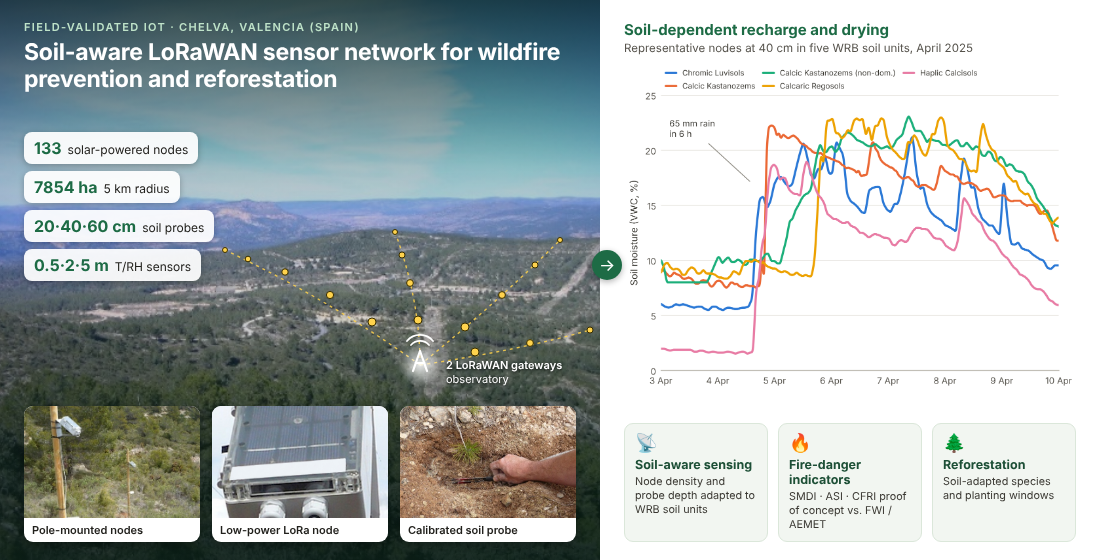
Ground-level soil-moisture and microclimatic data are scarce in Mediterranean forests, although they are relevant for wildfire prevention and reforestation planning. This paper presents the design, deployment and field operation of a large-scale LoRaWAN-based wireless sensor network in a fire-prone Mediterranean forest in Valencia (Spain). The network comprises 133 operational low-power nodes within a circular area of approximately 7854 ha (5 km radius), deployed according to the WRB soil classification, with multi-depth soil-moisture probes, multi-height temperature and relative humidity sensors, two redundant gateways and solar-powered autonomous operation supported by an explicit energy budget. During a spring campaign (April–May 2025), the network captured a common soil-moisture recharge event followed by soil-dependent drying, with higher retention in calcic Kastanozems and faster drying in haplic Calcisols; mean volumetric water content ranged from 13% to 20% among soil units. As a proof of concept, the measurements were converted into a soil moisture deficit index referenced to field capacity and a relative atmospheric stress index, combined into a locally defined composite indicator that is positioned against the Canadian FWI System and the AEMET fire-danger index. The results demonstrate the feasibility of soil-aware, low-cost in situ monitoring that can complement operational fire-danger products and support reforestation planning.
Keywords:
wireless sensor networks
; LoRaWAN
; Internet of Things
; forest fire prevention
; soil moisture
; environmental monitoring
; reforestation
; low-power design
; Mediterranean ecosystems
Copyright: This open access article is published under a Creative Commons CC BY 4.0 license, which permit the free download, distribution, and reuse, provided that the author and preprint are cited in any reuse.