
Submitted:
09 November 2026
Posted:
10 November 2026
You are already at the latest version
Abstract
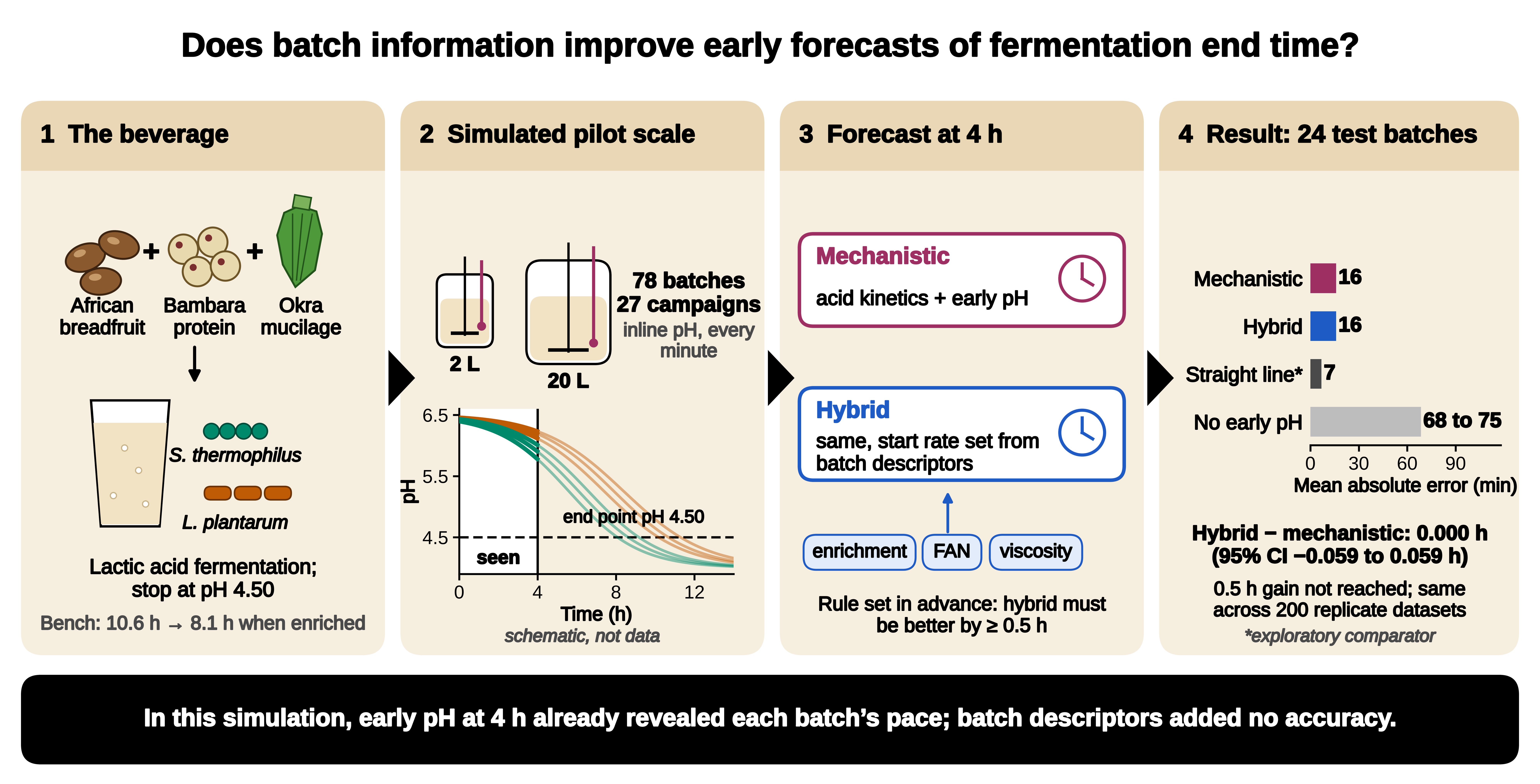
Early end-point prediction could support scheduling of an African breadfruit (Treculia africana) beverage enriched with Bambara groundnut protein and okra mucilage. In a specified stochastic scenario (78 batches, 27 campaigns, 2 and 20 L), seven models predicted the time to pH 4.50 from information available 4 h after inoculation. In 12 held-out 20 L campaigns, the adapted mechanistic model and a hybrid that corrected its rate prior with matrix descriptors each had a mean absolute error of 0.265 h; the paired difference was 0.000 h (95% confidence interval −0.059 to 0.059 h), failing the pre-specified 0.5 h improvement. Early fitted log rates correlated strongly with the generator’s baseline rates (r = 0.9995) but were biased upwards by 0.16 log units. In paired ablations, matching the kinetic constants and removing shrinkage towards the prior reduced the mechanistic error most. Over 200 independent replications, the hybrid minus mechanistic difference averaged +0.003 h (Monte Carlo standard error 0.003 h), and a linear extrapolation of early pH was most accurate. Conformal 90% intervals covered both batches in 10 of 12 test campaigns. These findings apply to one simulated scenario with a shared kinetic structure and error-free descriptors.
Keywords:
African breadfruit
; Bambara groundnut protein
; okra mucilage
; fermentation end point
; hybrid modelling
; mechanistic model
; conformal prediction
; process simulation
Copyright: This open access article is published under a Creative Commons CC BY 4.0 license, which permit the free download, distribution, and reuse, provided that the author and preprint are cited in any reuse.