

Submitted:
07 November 2026
Posted:
10 November 2026
You are already at the latest version
Abstract
Background: Restoring useful motor function remains a major unmet need after complete spinal cord injury (SCI). A PTPσ-targeting peptide designated NVG-291, which relieves proteoglycan-mediated inhibition of axonal growth, and thymosin beta-4 (TB-4), which has cytoprotective and anti-inflammatory actions, offer complementary mechanisms that may enhance the response to rehabilitation. Objective: To evaluate 12-month motor and functional outcomes of the investigator-initiated NuRaX combination protocol (NVG-291 plus TB-4) compared with placebo, each added to conservative rehabilitation. Methods: In this single-center, randomized, double-blind, placebo-controlled study conducted at the NuRaX Center in partnership with Ege Hospital in Baku, Azerbaijan, 30 participants with complete (AIS A) SCI were assigned in a 1:1 ratio to the combination protocol (n = 15) or saline placebo (n = 15). Combination treatment comprised NVG-291 2.5 mg and TB-4 1.5 mg subcutaneously every 14 days for 12 months (cumulative 65 mg and 39 mg, respectively), plus a single 3.5 mg paraspinal NVG-291 dose at the T11–T12 vertebral level; placebo injections were matched in volume, route and timing. Both groups received the same rehabilitation program without stimulation or robotic equipment. Outcomes included lower extremity motor score (LEMS), walker-supported standing duration and 100-m walking completion without orthoses or physical assistance. All assessments were independently re-screened by blinded external consultants. Results: Mean LEMS increased by 7.6 points with combination treatment and by 0.6 points with placebo (between-group difference, 7.0 points; 95% CI, 4.8 to 9.2); the baseline-adjusted difference was 7.39 points (95% CI, 5.86 to 8.92). Standing duration increased by 4.01 minutes more with combination treatment (95% CI, 2.37 to 5.65). At 12 months, 13 of 15 combination participants (86.7%) and 1 of 15 placebo participants (6.7%) completed 100 m with a walker, without orthoses or physical assistance. No AIS grade conversion or change in bladder or bowel function was reported. No adverse events or injection-site reactions were documented. Conclusions: In participants with complete SCI, the NuRaX combination of NVG-291 and TB-4 added to conservative rehabilitation was associated with greater improvement in lower-limb motor scores, standing endurance and walker-supported walking than placebo with the same rehabilitation over 12 months. These findings support further evaluation in larger, prospectively registered, randomized trials.
Keywords:
spinal cord injury
; PTPσ
; NVG-291
; thymosin beta-4
; rehabilitation
; placebo-controlled study
; lower extremity motor score
Introduction
Spinal cord injury (SCI) is a life-altering condition that produces persistent motor, sensory and autonomic impairment, with consequences that extend well beyond mobility to independence, participation and quality of life. Although its incidence and causes vary across populations, the need for therapies that restore meaningful function is shared across healthcare settings [1,2]. Advances in acute management and rehabilitation have improved survival and long-term care, yet neurological recovery after established complete injury remains modest. Effective restorative strategies are therefore likely to require two complementary elements: biological interventions that overcome the molecular barriers to neural repair, and structured rehabilitation that allows any resulting neural change to be translated into useful activity [3,4].
One of the best-characterized barriers to repair is the accumulation of chondroitin sulfate proteoglycans (CSPGs) in the glial scar and perineuronal nets after injury. CSPGs inhibit axonal growth and synaptic plasticity largely through the neuronal receptor protein tyrosine phosphatase sigma (PTPσ). Peptides that mimic the intracellular wedge domain of PTPσ relieve this inhibition and, in experimental SCI models, have promoted axonal sprouting, regeneration, remyelination and recovery of locomotor and autonomic function, including when treatment was started in the chronic phase [5,6,7]. PTPσ-targeting peptides, including NVG-291, have since progressed to early clinical evaluation, and their translation has highlighted the importance of careful product characterization, standardized neurological assessment and attention to rehabilitation exposure [8,9].
Thymosin beta-4 (TB-4) is a 43-amino-acid, G-actin-sequestering peptide that regulates cell migration, survival and tissue repair [10]. A broad experimental literature describes anti-inflammatory, anti-apoptotic, angiogenic and oligodendrogenic actions of TB-4 in neural and non-neural tissues. In spinal cord-derived neural stem/progenitor cells, TB-4 attenuated oxidative stress-induced injury and inflammatory signaling through the TLR4/MyD88 pathway. These cytoprotective and immunomodulatory properties make TB-4 an attractive partner for a strategy aimed at relieving extracellular growth inhibition [11,12,13].
The NuRaX protocol evaluated in this study is an investigator-initiated clinical program developed by the NuRaX Clinic. It is independent of other development programs for PTPσ-targeting peptides, and the investigational product used here has a separate origin. Both NVG-291 and TB-4 were manufactured and supplied for this clinical work by Neuraxes Pharmaceuticals. The designation “NVG-291” in this report refers to the Neuraxes-supplied preparation as identified in its product documentation, with batch numbers and certificates of analysis provided in Supplementary File 2.
We hypothesized that combining these two peptides would act on complementary stages of the repair process. NVG-291 was expected to release CSPG-PTPσ-mediated inhibition of axonal growth and plasticity [5,6,7], whereas TB-4 was expected to create a more favorable tissue environment by limiting inflammation and oxidative stress, supporting cell survival and promoting oligodendrocyte-mediated myelination [11,12,13]. We further hypothesized that structured, task-specific rehabilitation would engage and consolidate the neural connections made available by this combined pharmacological approach, so that the combination added to rehabilitation would produce greater functional gains than rehabilitation alone. To test this, we compared the NuRaX combination protocol, which also included a single paraspinal administration, with placebo in participants with complete (AIS A) SCI receiving the same conservative rehabilitation program. The primary focus was on lower-extremity motor scores, standing endurance and walker-supported walking over 12 months, with neurological classification and bladder and bowel function assessed as separate outcome domains.
Methods
Study Design and Setting
This single-center, placebo-controlled, parallel-group study was conducted at the NuRaX Center in partnership with Ege Hospital in Baku, Azerbaijan, with 1:1 allocation and 12-month follow-up. Because participants received investigator-assigned investigational treatment or placebo, the study is interventional in design (see Registration under Declarations). Enrollment, treatment, clinical assessment and participant-data analysis were undertaken by the NuRaX multidisciplinary team, comprising neurosurgery, neurology and neurorehabilitation services. All 30 participants were initially screened by the NuRaX team and subsequently underwent independent, blinded re-screening by consultants from different hospitals in Azerbaijan, the United States and Greece to verify the participant assessments and analyses for the entire cohort. The reporting structure was informed by CONSORT 2025 [14]. The present analysis uses participant-level summary records, product certificates and investigator-supplied clinical information.
Allocation and Masking
Participants were randomly assigned in a 1:1 ratio to the NuRaX combination protocol or to placebo, and the study was conducted in a double-blind manner. To further safeguard the integrity of the outcome data, all participant assessments were independently re-screened by blinded external consultants from centers in Azerbaijan, the United States and Greece.
Active and placebo preparations were administered using the same routes, schedule and administration procedures. Syringe calibration and complete active and placebo preparation records were reviewed and analyzed to confirm consistency of injection volumes and preparation procedures between groups, supporting the maintenance of blinding throughout the treatment period.
Participants and Neurological Classification
Thirty participants were recorded as having complete SCI, classified as American Spinal Injury Association Impairment Scale (AIS) grade A. Vertebral injury labels ranged from T3 to L3, and time since injury ranged from 3 to 75 months. Participants P1–P15 received combination treatment and P16–P30 received placebo. P30 was 16 months post injury at enrollment. Ages, injury characteristics and baseline motor and functional findings were obtained from participant records. All injury-level strata in this report refer to recorded vertebral labels.
Investigators reported combined light-touch and pinprick scores (maximum 224) of 48 for T3–T6 injuries, 72 for T7–T9 injuries, 110 for T10–T12 injuries and 140 for L1–L3 injuries, together with complete absence of voluntary anal contraction (VAC) and deep anal pressure (DAP) in all participants. No spasticity was reported at recruitment, and Modified Ashworth Scale (MAS) scores were recorded as zero. Injury levels and boundaries labeled zone of partial preservation (ZPP) were documented using vertebral labels [15]. AIS classifications and aggregate motor scores are reported and analyzed as recorded.
Investigational Treatment and Placebo
Both investigational peptides were supplied by Neuraxes Pharmaceuticals. Combination treatment comprised NVG-291 2.5 mg and TB-4 1.5 mg administered subcutaneously every 14 days over the 12-month treatment period, corresponding to 26 administrations and cumulative subcutaneous totals of 65 mg NVG-291 and 39 mg TB-4. In addition, a single 3.5 mg dose of NVG-291, diluted in 3.5 mL of sterile water for injection (1 mg/mL), was administered paraspinally at the T11–T12 vertebral level at the start of treatment, giving a total NVG-291 exposure of 68.5 mg across both routes.
For subcutaneous administration, each peptide was prepared at a concentration of 10 mg/mL, corresponding to injection volumes of 0.25 mL (25 syringe units) for NVG-291 and 0.15 mL (15 syringe units) for TB-4. Participants in the placebo group received normal saline (0.9% sodium chloride) on the same schedule and by the same routes, with volumes matched to the active treatment: a single 3.5 mL paraspinal injection at the T11–T12 vertebral level and subcutaneous injections of 25 and 15 syringe units every 14 days. Active and placebo injections were therefore identical in volume, route and timing. Syringe calibration and active and placebo preparation records were reviewed to confirm consistency of administered volumes between groups (see Allocation and masking). No participant was receiving other active medications during the study.
Product Characterization
Both investigational products were supplied with manufacturer-issued certificates of analysis, which confirm the identity, purity and safety-related quality of each batch used in the study. The NVG-291 certificate was issued by NEURAXES Pharmaceutical (COA No. NVG 291 -38653; lot NVG291-38653) and identifies the product as “NVG-291 (TAT-ISP),” reflecting its structure as the intracellular sigma peptide (ISP) linked to a TAT cell-penetrating sequence that facilitates tissue and cellular uptake. Reversed-phase high-performance liquid chromatography (RP-HPLC) showed a purity of 99.12%, indicating that the preparation consisted almost entirely of the intended peptide. Ultra-performance liquid chromatography–mass spectrometry (UPLC-MS) recorded a molecular mass of 4,288.82 Da, and liquid chromatography–tandem mass spectrometry (LC-MS/MS) peptide mapping conformed to the reference sequence, together confirming the identity of the peptide. Endotoxin content was below 0.10 EU/mg, and the product met sterility requirements under United States Pharmacopeia (USP) chapter <71>, supporting its suitability for parenteral use. The certificate lists subcutaneous administration as the intended route.
The TB-4 certificate (document NXR-COA-TB4-40100; product code NXR-TB4-5ML; lot NTB4-40100) reports a molecular weight of 4963.3 Da, consistent with the expected mass of thymosin beta-4. RP-HPLC purity was 99.35% and peptide content was 97.92%, indicating a highly pure preparation with a well-defined amount of active peptide per vial. LC-MS/MS sequence testing conformed to the reference sequence, confirming peptide identity. Endotoxin content was below 0.10 EU/mg, and the product complied with microbial-limit specifications.
Taken together, these certificates indicate that both peptides were of high purity, confirmed identity and compliance with the reported microbiological specifications . All results are reported as provided by the manufacturer, and the full certificates of analysis for both products are included in Supplementary File 2.
Rehabilitation Program
Participants in both groups received the same structured conservative rehabilitation program, which focused on trunk control, lower-limb strengthening and therapist-guided functional practice. No electrical or other forms of neuromodulatory stimulation and no robotic devices were used. This approach was chosen deliberately so that rehabilitation could be continued at home or in a local rehabilitation center when clinically appropriate, supporting the applicability of the protocol in routine clinical settings. The program followed a progressive, phase-based structure. During weeks 1–4, training comprised positioning, range-of-motion and stretching exercises, quadriceps activation, bridging and sitting balance. During weeks 5–8, the program advanced to resisted knee extension, supported standing and weight shifting. Weeks 9–16 emphasized therapist-assisted stepping, knee stability and endurance training. During months 4–6, activities progressed to supported over ground walking practice, turning and, where appropriate, training on uneven surfaces and stairs. From month 7 onward, goals focused on transfers, short-distance mobility and activities of daily living. These phases describe the components and intended progression of the program; the pace of advancement was individualized according to each participant’s tolerance and performance. Throughout training, therapists provided manual guidance and physical assistance, which was progressively reduced as participants’ performance improved. This training support was kept separate from outcome assessment: standing duration and 100-m walking were evaluated using a walker only, without orthoses or physical assistance from another person. Rehabilitation exposure was standardized at 2 hours per day in both groups, ensuring that participants in the combination and placebo groups received an equivalent rehabilitation dose.
Outcomes
Outcomes were assessed at baseline and at 12 months. The primary motor outcome was the bilateral lower extremity motor score (LEMS), calculated as the sum of right and left lower-limb motor totals on a 0–50 scale in accordance with the International Standards for Neurological Classification of Spinal Cord Injury (ISNCSCI). LEMS values are reported as recorded aggregate scores. All participants had complete baseline and 12-month data, and no values were imputed [15].
Functional outcomes were standing duration and the ability to complete a 100-m walk using a walker, without orthoses or physical assistance from another person. Walking assessments were performed with a standard walker on a smooth, straight and level surface. Participants were required to complete the 100-m distance continuously, without rest periods, and completion time was measured for each participant with a standard stopwatch. Completion time was recorded for all participants who finished the task. These outcomes specifically capture walker-supported functional performance and were selected as clinically meaningful milestones for people with complete SCI.
Additional outcomes included the recorded sensory and motor zone of partial preservation (ZPP) labels, light-touch and pinprick scores, voluntary anal contraction (VAC), deep anal pressure (DAP) and clinical observations of bladder and bowel function. Validated autonomic scales, urodynamic studies and changes in bladder and bowel management routines were not included in the outcome assessment. Safety was monitored through clinical observation throughout the study, with adverse events and injection-site reactions recorded in the participant records.
Statistical Analysis
All 30 participants had complete baseline and 12-month motor and functional data and were included in the analysis according to their assigned group; no data were imputed. Continuous variables are summarized as mean (SD) or median (range), and categorical variables as counts and percentages. In accordance with CONSORT recommendations, baseline characteristics are presented descriptively without significance testing.
The principal analysis compared the change in LEMS from baseline to 12 months between groups using Welch’s t-test, which does not assume equal variances, with the mean difference reported with its 95% confidence interval. Within-group changes were assessed with paired t-tests. A two-sided Mann–Whitney U test (asymptotic, with tie and continuity correction) was performed as a rank-based sensitivity analysis.
To account for baseline variability, two post-hoc analysis of covariance (ANCOVA) models estimated the between-group difference in 12-month LEMS, the first adjusting for baseline LEMS and the second adjusting for both baseline LEMS and age. Both models used heteroskedasticity-consistent (HC3) standard errors with t-based 95% confidence intervals. These models were specified as sensitivity analyses to assess the robustness of the principal comparison.
For standing duration, participants unable to stand were assigned a value of zero minutes, and the between-group difference in change was compared using Welch’s t-test. The proportion of participants completing the 100-m walking task was compared using a two-sided Fisher’s exact test; the absolute risk difference is reported with a Newcombe 95% confidence interval and the risk ratio with a log-scale 95% confidence interval. Walking completion times were summarized among participants who completed the task, and non-completers were not assigned a time value. ZPP and autonomic outcomes are reported descriptively.
All tests were two-sided, and P values are reported as nominal values without adjustment for multiple comparisons. Analyses were performed in Python using the NumPy, SciPy and statsmodels libraries.
Results
Participant Characteristics and Available Follow-Up
The analysis included 15 participants per group, with 12-month results present in each supplied record. Mean age was 31.3 (SD 6.9) years in the combination group and 32.5 (SD 6.7) years in the placebo group. Median ages were 30 years (range 23–48) and 34 years (21–42), respectively (Table 1). Each group comprised nine men and six women.
Ages are reported as per original databases from participant records. Injury bands denote recorded vertebral injury bands, not neurological levels of injury. Standing inability was coded as zero for duration analyses. Standing used a walker without orthoses or physical assistance from another person.
Median time since injury was 10 months in the combination group and 12 months in the placebo group. Baseline mean LEMS differed by 1.0 point, but dispersion was greater in the combination group. Time since injury ranged from 3 to 60 months in the combination group and 4 to 75 months in the placebo group. No injury-duration subgroup analyses were performed.
Recorded Motor Outcomes
Baseline LEMS means were similar between groups, but variability was greater in the combination group: 22.3 (SD 7.4) versus 21.3 (SD 2.2). Given this heterogeneity, the unadjusted comparison is presented alongside post-hoc baseline-adjusted sensitivity analyses. Mean bilateral LEMS increased from 22.3 (SD 7.4) to 29.9 (SD 5.1) with combination treatment and from 21.3 (SD 2.2) to 21.9 (SD 1.8) with placebo, corresponding to mean changes of +7.6 (SD 3.9) and +0.6 (SD 0.7) points. The unadjusted between-group change difference was 7.0 points (95% CI 4.8–9.2; Welch t = 6.82, df = 14.99; P < 0.001). ANCOVA adjusting for baseline LEMS estimated a 7.39-point difference in 12-month LEMS (95% CI 5.86–8.92); additional adjustment for age estimated 7.36 points (95% CI 5.78–8.94). Both models used HC3 heteroskedasticity-robust covariance and yielded nominal P < 0.001 (Table 5). These analyses support consistency of the association after adjustment for the included covariates, but do not exclude residual confounding, allocation bias or measurement error. Participant-level ages and scores are provided in Table 2 and graphically in Figure 1.
All fifteen combination participants gained motor points. Placebo changes ranged from zero to two points. Within-group paired tests yielded t(14) = 7.54 (P < 0.001) for combination treatment and t(14) = 3.15 (P = 0.007) for placebo. The rank-based change comparison gave U = 215.0 (P < 0.001).
Recorded ZPP Boundaries and Sacral Findings
Two combination participants had a one-label caudal change in the recorded motor boundary: P9, L2 to L3, and P10, L3 to L4. Other treatment-group boundaries were unchanged (Table 3; Figure 2). Placebo boundaries were reported as unchanged in the source material. These boundaries are vertebral labels, not ISNCSCI neurological ZPP segments.
VAC and DAP were recorded as absent at baseline and 12 months in both groups. Investigators reported that light-touch and pinprick scores remained unchanged from baseline (48/224 for T3–T6, 72/224 for T7–T9, 110/224 for T10–T12 and 140/224 for L1–L3 vertebral-label injuries), and no AIS A-to-B conversion was reported. Bladder and bowel observations were assessed separately from AIS classification [15].
Standing and Walking
Mean standing duration increased from 2.13 to 8.85 minutes with combination treatment and from 1.47 to 4.17 minutes with placebo, including inability as zero. Mean changes were 6.71 (SD 2.61) and 2.70 (SD 1.62) minutes; the between-group change difference was 4.01 minutes (95% CI 2.37–5.65; P < 0.001). The proportion recorded as able to stand increased from 8/15 to 15/15 and from 7/15 to 13/15. Unlike the duration comparison, the between-group comparison of standing ability at 12 months was not statistically significant (Fisher P = 0.483).

Table 4.
Walker-supported standing and walking without orthoses or human physical assistance.
| Combination group (P1–P15) | ||||
| Participant | Standing baseline | Standing 12 mo | Walking baseline | Walking 12 mo |
| P1 | Not able | 10 min | Not able | 100 m in 5 min |
| P2 | 5 min | 15 min | Not able | 100 m in 3 min |
| P3 | 5 min | 12 min | Not able | 100 m in 5 min |
| P4 | Not able | 7 min | Not able | 100 m in 10 min |
| P5 | Not able | 9 min | Not able | 100 m in 8 min |
| P6 | 5 min | 12 min | Not able | 100 m in 7 min |
| P7 | 3 min | 7 min | Not able | 100 m in 8 min |
| P8 | 2 min | 11 min | Not able | 100 m in 11 min |
| P9 | 5 min | 13 min | Not able | 100 m in 8 min |
| P10 | 5 min | 8.5 min | Not able | 100 m in 10.5 min |
| P11 | 2 min | 7.2 min | Not able | Not able |
| P12 | Not able | 10 min | Not able | 100 m in 15 min |
| P13 | Not able | 3 min | Not able | Not able |
| P14 | Not able | 3 min | Not able | 100 m in 12 min |
| P15 | Not able | 5 min | Not able | 100 m in 7 min |
| Placebo group (P16–P30) | ||||
| Participant | Standing baseline | Standing 12 mo | Walking baseline | Walking 12 mo |
| P16 | Not able | 2 min | Not able | Not able |
| P17 | 2 min | 7 min | Not able | Not able |
| P18 | 3 min | 6 min | Not able | Not able |
| P19 | Not able | 2 min | Not able | Not able |
| P20 | Not able | 4 min | Not able | Not able |
| P21 | Not able | 3 min | Not able | Not able |
| P22 | 2 min | 5 min | Not able | Not able |
| P23 | 3 min | 7 min | Not able | Not able |
| P24 | 2 min | 5 min | Not able | Not able |
| P25 | 7 min | 12 min | Not able | 100 m in 10 min |
| P26 | 3 min | 7 min | Not able | Not able |
| P27 | Not able | 0.5 min | Not able | Not able |
| P28 | Not able | Not able | Not able | Not able |
| P29 | Not able | Not able | Not able | Not able |
| P30 | Not able | 2 min | Not able | Not able |
“Not able” was retained as recorded; inability was assigned zero only in standing-duration analyses, and also walking time. Investigators confirmed walker use, no orthoses and no physical assistance from another person during standing and walking tests. The findings describe walker-supported performance, not unaided or community ambulation.
No participant was recorded as able to walk at baseline. At 12 months, 13/15 combination participants (86.7%) and 1/15 placebo participants (6.7%) completed 100 m with a walker, without orthoses or physical assistance from another person. The absolute difference was 80.0 percentage points (Newcombe 95% CI 46.3–91.1; Fisher P < 0.001); the risk ratio was 13.0 (95% CI 1.94–87.25). The wide relative-effect interval reflects the small cohort and single placebo completer. Among the 13 combination completers, median time was 8 minutes (range 3–15) and mean time was 8.42 (SD 3.25) minutes. The placebo completer, P25, took 10 minutes. These completer-only observations do not support any unbiased between-group comparison of walking speed or establish unaided/community ambulation. Standing and walking records are illustrated in Figure 3 and Figure 4.
Table 5.
Exploratory between-group motor and functional comparisons.
| Outcome/analysis | Combination | Placebo | Effect (95% CI) | P value |
| LEMS change, mean (SD); Welch | 7.6 (3.9) | 0.6 (0.7) | 7.0 points (4.8–9.2) | <0.001 |
| LEMS change; Mann–Whitney | n = 15 | n = 15 | U = 215.0; rank comparison | <0.001 |
| 12-month LEMS; baseline-adjusted ANCOVA | n = 15 | n = 15 | 7.39 points (5.86–8.92) | <0.001 |
| 12-month LEMS; baseline + age ANCOVA | n = 15 | n = 15 | 7.36 points (5.78–8.94) | <0.001 |
| Standing-duration change, min: mean (SD); Welch | 6.71 (2.61) | 2.70 (1.62) | 4.01 min (2.37–5.65) | <0.001 |
| Walker-supported standing at 12 months; Fisher | 15/15 (100%) | 13/15 (86.7%) | Count comparison | 0.483 |
| Walker-supported 100-m completion; Fisher and Newcombe CI | 13/15 (86.7%) | 1/15 (6.7%) | RD 80.0 pp (46.3–91.1) | <0.001 |
| Walker-supported 100-m completion; log-scale ratio CI | 13/15 | 1/15 | RR 13.0 (1.94–87.25) | Not separate test |
Effects are combination minus placebo, except the risk ratio (combination divided by placebo). RD, risk difference; pp, percentage points; RR, risk ratio. ANCOVA models are post hoc and use HC3 robust covariance with t-based intervals. All P values are two-sided, nominal and unadjusted for multiple testing; Fisher P for walking completion is 0.0000219. All contrasts use 15 records per group.
Bladder, Bowel and Safety Findings
Investigators reported no observed bladder or bowel improvement over follow-up. No numerical autonomic effect estimate was calculated because standardized participant-level autonomic measurements were not collected for this analysis. This qualitative autonomic finding is reported separately from neurological classification. No adverse events or injection-site reactions were documented in the supplied records for either group.
Discussion
The principal finding of this study was a substantially greater improvement in recorded lower-limb motor scores and walker-supported function with the NuRaX combination protocol than with placebo over 12 months of conservative rehabilitation. The between-group difference in mean LEMS change was 7.0 points, and the post-hoc baseline-adjusted estimate was closely concordant (7.39 points), indicating that the motor benefit was not driven by differences in baseline LEMS. This motor improvement was accompanied by longer standing duration and a markedly higher proportion of participants completing 100 m with a walker. The motor-score advantage was consistent across rank-based and post-hoc baseline- and age-adjusted analyses, underscoring the robustness of the finding. Taken together, these results provide a strong and coherent preliminary signal of benefit that supports progression to larger confirmatory trials.
The walking results show that this motor improvement translated into meaningful task performance. None of the participants was able to complete the walking task at baseline; at 12 months, 13 of 15 combination participants (86.7%) completed 100 m, compared with only one placebo participant (6.7%). Notably, participants achieved this with a standard walker alone, without orthoses or physical assistance from another person. For individuals with complete SCI, independently covering 100 m with a walker represents a clinically relevant functional milestone, offering greater mobility, participation in daily activities and independence, and providing a foundation for further progression in future studies.
Standing endurance followed the same pattern. Mean standing duration increased by 6.71 minutes with combination treatment, compared with 2.70 minutes with placebo, a between-group difference of 4.01 minutes. The more modest gain in the placebo group reflects the expected contribution of rehabilitation and repeated task practice, while the larger gain in the combination group indicates an additional benefit beyond rehabilitation alone. By 12 months, all 15 combination participants (100%) were able to stand with a walker, compared with 13 of 15 placebo participants (86.7%). Because most participants in both groups could already stand at some level, the proportion able to stand was less sensitive to change than standing duration, which better captured the magnitude of improvement. Standing endurance and walking completion therefore provide complementary measures of functional recovery, and both favored the combination protocol.
Functional Improvement and Neurological Classification
The functional gains in the combination group were achieved in participants who remained classified as AIS A, without reported A-to-B conversion, and with VAC and DAP absent and light-touch and pinprick scores unchanged at 12 months in both groups. This pattern is informative rather than contradictory. Motor performance, sacral sparing and autonomic function are distinct outcome domains, and AIS grade is determined by sacral sensory and motor findings rather than by lower-limb motor capacity or bladder/bowel status. AIS A denotes absence of sacral sparing, not anatomical transection, and preserved but clinically silent connections can exist below the level of a complete injury [15]. The observation that LEMS, standing endurance and walker-supported walking improved while sacral and sensory measures remained stable suggests that the changes most likely occurred in motor pathways serving the lower limbs, which is consistent with the plasticity-based rationale for the combination protocol [5,6,7]. Bladder, bowel and sacral recovery may require longer follow-up, different dosing or more sensitive measures and remain important targets for future studies.
The recorded motor boundaries add descriptive support to this interpretation. Two combination participants (P9 and P10) showed a one-label caudal shift in the recorded motor boundary, whereas placebo boundaries were reported as unchanged. These shifts are directionally consistent with the motor-score gains in the same group. Because injury levels and ZPP boundaries were recorded using vertebral rather than neurological labels, and segment-specific key-muscle and sensory examinations were not available, these findings are best regarded as supportive observations; confirmation of neurological-level change will require complete ISNCSCI examinations and, ideally, electrophysiological measures in future trials [16,17].
The magnitude of the motor change is also notable in relation to the expected course of complete injury. Natural-history data from thoracic AIS A registries show generally limited motor recovery, and studies of cervical sensorimotor-complete injury indicate that most spontaneous motor recovery occurs early and then plateaus [17]. Participants in the present study entered a median of 10–12 months after injury (range 3–75 months), when spontaneous recovery would generally be expected to have slowed. Although these registry cohorts differ in timing and level classification and are not direct comparators, the contemporaneous placebo group provides the most relevant internal reference. Under identical rehabilitation and follow-up, placebo participants showed a mean LEMS change of only +0.6 points, compared with +7.6 points in the combination group. This concurrent comparison supports the interpretation that the observed motor and functional gains exceed what would be expected from rehabilitation and the natural course alone, while confirmation in larger trials with verifiable allocation and masking remains warranted.
Pharmacological Rationale and Interaction with Rehabilitation
The two peptides were selected because they act on distinct and potentially complementary barriers to repair after SCI. NVG-291 is a peptide mimetic of the intracellular regulatory wedge domain of PTPσ, the principal neuronal receptor for chondroitin sulfate proteoglycans (CSPGs) that accumulate in the glial scar and perineuronal nets after injury. CSPG engagement of PTPσ suppresses growth-cone motility and traps dystrophic axon endings within the lesion.
By interfering with this signaling, the wedge-domain peptide has been shown in experimental SCI models to permit axonal sprouting and regeneration, enhance plasticity of spared circuits, support oligodendrocyte precursor survival and remyelination, and improve locomotor and bladder function, including when administered in the chronic phase [5,6,7].
TB-4 is a 43-amino-acid G-actin-sequestering peptide with a different profile. It attenuates NF-κB-dependent and Toll-like receptor/MyD88-mediated inflammatory signaling, reduces oxidative stress and apoptosis, promotes angiogenesis and cell migration, and stimulates oligodendrogenesis and myelination, partly through induction of microRNA-146a [11,12,13,19,20]. In a rat SCI model, TB-4 increased neuronal and oligodendrocyte survival, raised myelin basic protein levels, reduced microglial/macrophage activation and pro-inflammatory cytokine expression, and decreased lesion-cavity size. Together, these actions provide a pharmacological rationale in which NVG-291 targets extracellular growth inhibition, while TB-4 supports a less inflammatory, better-vascularized and myelination-permissive tissue environment in which new or spared connections may be consolidated.
Rehabilitation provides the training-based component of this rationale. Plasticity unmasked by reducing CSPG-mediated inhibition is thought to be activity-dependent, so that newly available connections are more likely to be strengthened when they are repeatedly engaged during task-specific training. In this study, both groups received the same conservative rehabilitation program, emphasizing trunk control, lower-limb strengthening and therapist-guided practice without stimulation or robotic equipment. Under these identical conditions, the placebo group showed minimal change in LEMS (mean +0.6 points) and only one participant achieved 100-m walker-supported walking, indicating that rehabilitation alone was not sufficient to produce meaningful motor gains in this chronic AIS A cohort. In contrast, every participant in the combination group gained motor points (mean +7.6 points), and 13 of 15 completed the walking task. The difference between arms, which received the same rehabilitation, therefore points to the peptide combination as the factor associated with the additional benefit. It is consistent with the hypothesis that the combination enhances the response to rehabilitation rather than replacing it. Several considerations will help to define this effect more precisely. Because the study did not include NVG-291-alone or TB-4-alone arms, the relative contribution of each peptide, and whether their effects are additive or synergistic, remain to be established. Direct measures of axonal connectivity, such as motor evoked potentials or imaging, were not obtained and would strengthen mechanistic interpretation in future studies. Rehabilitation exposure was standardized by protocol but not quantified session by session, and home feasibility, adherence and cost effectiveness were not measured.
These findings also align with the broader rehabilitation literature. Activity-based therapy studies in motor-incomplete SCI and locomotor-training reports in initially complete injuries highlight the importance of structured training for functional recovery. The present results extend this context by suggesting that pharmacological modulation of the post-injury environment may allow chronic participants with complete injuries to respond to conventional, low-technology rehabilitation that, on its own, produced little change. Because the program used no stimulation or robotic equipment, the observed gains were obtained with an approach that could, in principle, be delivered in ordinary local rehabilitation centers. Future trials with factorial or monotherapy arms and quantified training dose are warranted to confirm this drug–rehabilitation interaction.
Product Identity and Applicability
The NuRaX protocol is an investigator-initiated treatment program that brings together a PTPσ-targeting peptide designated NVG-291, TB-4, a single paraspinal administration and structured conservative rehabilitation. Both peptides were supplied by Neuraxes Pharmaceuticals, and their batch numbers and certificates of analysis are provided in Supplementary File 2 to support transparency and reproducibility. Because the benefits observed in this study arose from this specific combination, dosing schedule and route of administration, the findings are best understood as reflecting the NuRaX protocol as a whole. Future studies using the same well-characterized products and protocol will help to build on these results and to extend them to larger and more diverse groups of people living with SCI.
Strengths and Limitations
This study has several notable strengths. It included a concurrent placebo group that received the same structured rehabilitation program, allowing the additional effect of the peptide combination to be assessed against an internal reference rather than against historical controls. Follow-up extended to 12 months, and complete outcome data were available for all 30 participants, providing a sustained view of change over time. Participant-level motor and functional records are reported in full, enhancing transparency and permitting independent appraisal of individual trajectories. Participant assessments were also independently re-screened by blinded external consultants from centers in Azerbaijan, the United States and Greece. The between-group difference in LEMS was consistent across unadjusted, rank-based and baseline- and age-adjusted analyses, supporting the robustness of the primary association within this dataset. Finally, the outcomes selected, namely lower-limb motor score, standing endurance and 100-m walker-supported walking, are clinically meaningful for people with complete SCI. The rehabilitation program also required no stimulation or robotic equipment, which supports its potential applicability in routine clinical settings.
Several limitations should be considered when interpreting these findings, and each offers clear direction for future research. The sample was modest in size and included participants with a range of injury levels and times since injury. Although this heterogeneity reflects real-world clinical populations, larger cohorts will allow more precise estimates and subgroup analyses. Baseline motor-score variability was greater in the combination group, which was addressed through baseline-adjusted sensitivity analyses. Prospectively specified primary endpoints will strengthen inferential precision in future studies. While the consistency of the statistical findings is encouraging, it does not substitute for this documentation, and future trials should be prospectively registered as interventional studies with fully documented randomization and blinding. Injury levels were recorded using vertebral rather than neurological labels, and segment-specific ISNCSCI examinations were not calculated, which limits comparison of baseline neurological status and the interpretation of neurological outcomes and directs for future study on neurological level rather than vertebral level.
No adverse events or injection-site reactions were documented during the study, which is encouraging. However, systematic event solicitation, laboratory monitoring and validated autonomic assessments were not part of the available records, and the sample size limits the detection of less common events. A comprehensive safety profile will therefore require dedicated monitoring in larger studies. Building on these observations, future trials should be prospectively registered as interventional studies and should incorporate prospectively specified endpoints, verifiable allocation and masking procedures, complete ISNCSCI examinations, standardized blinded mobility assessments, quantified rehabilitation exposure and systematic safety surveillance. Such trials, ideally including monotherapy arms, will help to confirm the present findings and to clarify the individual and combined contributions of each peptide [10,14,20].
Conclusions
In this single-center, placebo-controlled study involving 30 participants with complete (AIS A) spinal cord injury, the NuRaX combination of an NVG-291-designated peptide and TB-4, added to conservative rehabilitation, was associated with greater improvement in lower-extremity motor scores, longer walker-supported standing and a higher proportion of participants completing 100 m with a walker than placebo with the same rehabilitation over 12 months. No adverse events were documented. These findings support further evaluation of the combination in larger, prospectively registered, randomized trials with complete ISNCSCI assessments, monotherapy comparisons and systematic safety monitoring.
Authors’ contributions
P.M.: conceptualization, methodology, investigation, principal investigator, writing – original draft. I.L.: investigation, data curation, formal analysis. N.A.: writing – review and editing. R.I.: investigation, neurological classification, writing – review and editing. M.A.: writing – review and editing. G.M: writing – review and editing. A.J.F: writing – review and editing . U.J.: safety oversight, writing – review and editing. All authors read and approved the final manuscript and agree to be accountable for its content.
Funding
Neuraxes Pharmaceuticals sponsored this study and NVG-291 and thymosin β4 were procured and supplied by Neuraxes Pharmaceuticals; batch numbers and certificates of analysis are provided in Supplementary File 2.
Ethics approval and consent to participate
Approved by the NuRaX Institutional Review Board/Ethics Committee (approval number NUX-2025-NVG-TB-CODR-2787; 13 February 2025). Written informed consent to participate and to publish de-identified data was obtained from all participants. The study was conducted in accordance with the Declaration of Helsinki (2013).
Registration
This study involved investigator-assigned investigational treatment or placebo and is therefore interventional in design. It was initially registered in Nurax Clinics study model on 10th March 2025 under an randomized double blinded study. The first participant provided consent on 15th March 2025, and enrollment began on 11th March 2025. Ethical approval was taken from EGE hospital where this study performed. This study was not registered under any clinical trial.
Consent for publication
Obtained from all participants for the publication of de-identified clinical data and, where applicable, images or video stills.
Availability of data and materials
The de-identified individual participant dataset supporting the findings, the study protocol, the standardised knee-locking and other operating procedures, and the analysis code are available from the corresponding author on reasonable request, subject to journal requirements and to the applicable data-protection regulations
Acknowledgments
The authors thank the rehabilitation team, the study coordinators and, above all, the participating participants and their families.
Competing interests
Neuraxes Pharmaceuticals, USA, provided financial support and supplied both investigational products. Neuraxes Pharmaceuticals had no role in study design, data collection, analysis, interpretation, manuscript preparation, or the decision to publish. Neuraxes Pharmaceuticals has no corporate, licensing or contractual relationship with NervGen Pharma Corp.; the provenance and licensing of the supplied material are the responsibility of Neuraxes Pharmaceuticals. The authors declare no other competing interests.
Use of artificial intelligence
No generative artificial intelligence tool was used to generate clinical data, results or conclusions. Any use of such tools was limited to language editing and formatting of the manuscript, and the authors accept full responsibility for the content. Only for graphical design for rehab protocol designed using ChatGpt version 5.0 and these rehab graphical protocol attached in the supplementary file 3 as well.
Abbreviations
AIS, ASIA Impairment Scale; ANCOVA, analysis of covariance; CSPG, chondroitin sulfate proteoglycan; DAP, deep anal pressure; ISNCSCI, International Standards for Neurological Classification of Spinal Cord Injury; LEMS, lower extremity motor score; MAS, Modified Ashworth Scale; PTPσ, protein tyrosine phosphatase sigma; SCI, spinal cord injury; TB-4, thymosin beta-4; VAC, voluntary anal contraction; ZPP, zone of partial preservation.
References
- Lee, B.B.; Cripps, R.A.; Fitzharris, M.; Wing, P.C. The global map for traumatic spinal cord injury epidemiology: update 2011, global incidence rate. Spinal Cord. 2014, 52(2), 110–116. Available online: https://www.nature.com/articles/sc2012158. [CrossRef] [PubMed]
- Singh, A.; Tetreault, L.; Kalsi-Ryan, S.; Nouri, A.; Fehlings, M.G. Global prevalence and incidence of traumatic spinal cord injury. Clin. Epidemiol. 2014, 6, 309–331. Available online: https://www.dovepress.com/global-prevalence-and-incidence-of-traumatic-spinal-cord-injury-peer-reviewed-fulltext-article-CLEP. [CrossRef] [PubMed]
- Hu, X.; Xu, W.; Ren, Y.; Wang, Z.; He, R.; Ma, B.; et al. Spinal cord injury: molecular mechanisms and therapeutic interventions. Signal Transduct. Target. Ther. 2023, 8(1), 245. Available online: https://www.nature.com/articles/s41392-023-01477-6. [CrossRef] [PubMed]
- Kwon, B.K.; Okon, E.B.; Plunet, W.; Baptiste, D.; Fouad, K.; Hillyer, J.; et al. A systematic review of directly applied biologic therapies for acute spinal cord injury. J. Neurotrauma 2011, 28(8), 1589–1610. Available online: https://www.liebertpub.com/doi/10.1089/neu.2009.1150. [CrossRef] [PubMed]
- Lang, B.T.; Cregg, J.M.; DePaul, M.A.; Tran, A.B.; Xu, K.; Dyck, S.M.; et al. Modulation of the proteoglycan receptor PTPσ promotes recovery after spinal cord injury. Nature 2015, 518(7539), 404–408. Available online: https://www.nature.com/articles/nature13974. [CrossRef] [PubMed]
- Hosseini, S.M.; Alizadeh, A.; Shahsavani, N.; Chopek, J.; Ahlfors, J.E.; Karimi-Abdolrezaee, S. Suppressing CSPG/LAR/PTPσ axis facilitates neuronal replacement and synaptogenesis by human neural precursor grafts and improves recovery after spinal cord injury. J. Neurosci. 2022, 42(15), 3096–3121. Available online: https://www.jneurosci.org/content/42/15/3096. [CrossRef]
- Milton, A.J.; Kwok, J.C.F.; McClellan, J.; Randall, S.G.; Lathia, J.D.; Warren, P.M.; et al. Recovery of forearm and fine digit function after chronic spinal cord injury by simultaneous blockade of inhibitory matrix chondroitin sulfate proteoglycan production and the receptor PTPσ. J. Neurotrauma 2023, 40(23-24), 2500–2521. Available online: https://pubmed.ncbi.nlm.nih.gov/37606910/. [CrossRef] [PubMed]
- Mikol, D.D.; DePaul, M.A.; Lawrence, B.; Toews, J.; Collett, N.; Lukashev, M. A placebo-controlled Phase 1 study in healthy subjects assessing NVG-291, which targets CNS receptor protein tyrosine phosphatase sigma (PTPσ) [conference abstract]. Alzheimer’s Dement. 2022, 18(S10), e059663. Available online: https://alz-journals.onlinelibrary.wiley.com/doi/10.1002/alz.059663. [CrossRef]
- Mikol, D.; Toews, J.; Mulcahy, S.; DePaul, M.A.; Collett, N.; Guest, J.; et al. NVG-291 Phase 1 results and Phase 1b/2a study design in individuals with spinal cord injury [conference abstract]. Arch. Phys. Med. Rehabil. 2024, 105(4), e18. Available online: https://www.archives-pmr.org/article/S0003-9993(24)00143-6/abstract. [CrossRef]
- Kondiles, B.R.; Rana, S.; Weiner, D.; Blesch, A.; St. John, J.; Haag-Molkenteller, C.; et al. Lessons learned and recommendations from a SCOPE spinal cord injury neurorestorative clinical trials update. Neurotrauma Rep. 2025, 6(1), 210–231. Available online: https://www.liebertpub.com/doi/10.1089/neur.2024.0163. [CrossRef] [PubMed]
- Bock-Marquette, I.; Maar, K.; Maar, S.; Lippai, B.; Faskerti, G.; Gallyas, F.; et al. Thymosin beta-4 denotes new directions towards developing prosperous anti-aging regenerative therapies. Int. Immunopharmacol. 2023, 116, 109741. Available online: https://www.sciencedirect.com/science/article/pii/S1567576923000644. [CrossRef] [PubMed]
- McGuire, F.; Hughes, E.; Maak, T.; Cushman, D.M. Thymosin beta-4 and TB-500 in tissue healing, regeneration, and musculoskeletal repair: a scoping review. Appl. Sci. 2026, 16(12), 6202. Available online: https://www.mdpi.com/2076-3417/16/12/6202. [CrossRef]
- Li, H.; Wang, Y.; Hu, X.; Ma, B.; Zhang, H. Thymosin beta 4 attenuates oxidative stress-induced injury of spinal cord-derived neural stem/progenitor cells through the TLR4/MyD88 pathway. Gene 2019, 707, 136–142. Available online: https://pubmed.ncbi.nlm.nih.gov/31054361/. [CrossRef] [PubMed]
- Hopewell, S.; Chan, A.W.; Collins, G.S.; Hróbjartsson, A.; Moher, D.; Schulz, K.F.; et al. CONSORT 2025 statement: updated guideline for reporting randomized trials. Nat. Med. 2025, 31(6), 1776–1783. Available online: https://www.nature.com/articles/s41591-025-03635-5. [CrossRef] [PubMed]
- ASIA and ISCoS International Standards Committee. The 2019 revision of the International Standards for Neurological Classification of Spinal Cord Injury (ISNCSCI)—What’s new? Spinal Cord. 2019, 57(10), 815–817. Available online: https://pubmed.ncbi.nlm.nih.gov/31530900/. [CrossRef] [PubMed]
- Aimetti, A.A.; Kirshblum, S.; Curt, A.; Mobley, J.; Grossman, R.G.; Guest, J.D. Natural history of neurological improvement following complete (AIS A) thoracic spinal cord injury across three registries to guide acute clinical trial design and interpretation. Spinal Cord. 2019, 57(9), 753–762. Available online: https://www.nature.com/articles/s41393-019-0299-8. [CrossRef] [PubMed]
- Steeves, J.D.; Kramer, J.K.; Fawcett, J.W.; Cragg, J.; Lammertse, D.P.; Blight, A.R.; et al. Extent of spontaneous motor recovery after traumatic cervical sensorimotor complete spinal cord injury. Spinal Cord. 2011, 49(2), 257–265. Available online: https://www.nature.com/articles/sc201099. [CrossRef] [PubMed]
- Jones, M.L.; Evans, N.; Tefertiller, C.; Backus, D.; Sweatman, M.; Tansey, K.; et al. Activity-based therapy for recovery of walking in individuals with chronic spinal cord injury: results from a randomized clinical trial. Arch. Phys. Med. Rehabil. 2014, 95(12), 2239–2246.e2. Available online: https://pubmed.ncbi.nlm.nih.gov/25102384/. [CrossRef] [PubMed]
- Zhu, H.; So, K.F.; Feng, X.; Niu, F.; Guest, J.D. Kunming locomotor training: neurological, functional, and autonomic outcomes in complete spinal cord injury. Curr. Opin. Neurol. 2025, 38(6), 644–653. Available online: https://pubmed.ncbi.nlm.nih.gov/41143726/. [CrossRef] [PubMed]
- Scheuren, P.S.; Kramer, J.L.K. Next-gen spinal cord injury clinical trials: lessons learned and opportunities for future success. eBioMedicine 2024, 109, 105381. Available online: https://pubmed.ncbi.nlm.nih.gov/39383609/. [CrossRef] [PubMed]
Figure 1.
Recorded bilateral lower extremity motor scores at baseline and 12 months. Each line connects the two recorded measurements for one participant (15 per group); no intermediate values are implied. Squares and error bars show group means ± SD. Mean change was +7.6 points with combination treatment and +0.6 with placebo; the unadjusted between-group difference in change was 7.0 points (95% CI 4.8–9.2; exploratory Welch P < 0.001), and the post-hoc ANCOVA adjusted for baseline LEMS estimated 7.39 points (95% CI 5.86–8.92). The recorded bilateral scale is 0–50; aggregate scores were not independently reconstructed from individual key-muscle examinations.
Figure 1.
Recorded bilateral lower extremity motor scores at baseline and 12 months. Each line connects the two recorded measurements for one participant (15 per group); no intermediate values are implied. Squares and error bars show group means ± SD. Mean change was +7.6 points with combination treatment and +0.6 with placebo; the unadjusted between-group difference in change was 7.0 points (95% CI 4.8–9.2; exploratory Welch P < 0.001), and the post-hoc ANCOVA adjusted for baseline LEMS estimated 7.39 points (95% CI 5.86–8.92). The recorded bilateral scale is 0–50; aggregate scores were not independently reconstructed from individual key-muscle examinations.
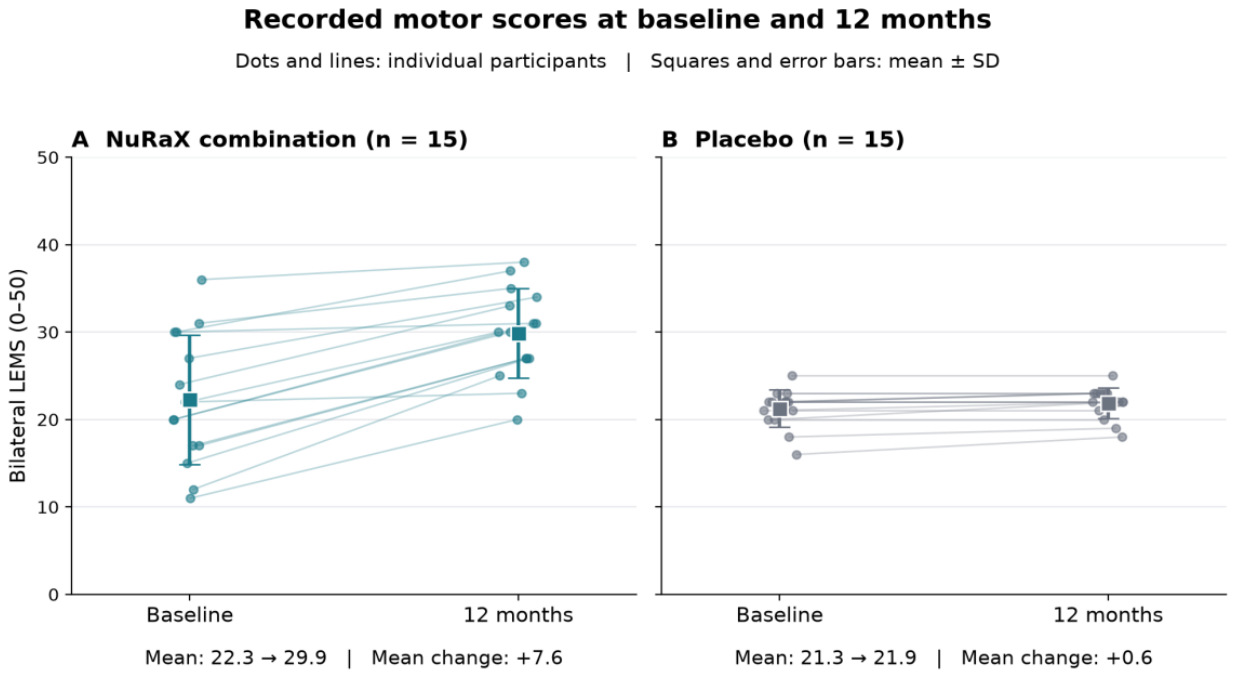
Figure 2.
Recorded sensory and motor boundaries labeled ZPP in the combination group (vertebral labels, not neurological levels). The matrix displays baseline and 12-month investigator-recorded vertebral labels for P1–P15; these are not validated ISNCSCI neurological ZPP boundaries. Right/left labels were identical in the supplied records. The highlighted entries are the two recorded motor-boundary changes: P9, L2 to L3, and P10, L3 to L4. These categorical labels do not quantify axonal regeneration. Placebo boundaries were reported unchanged.
Figure 2.
Recorded sensory and motor boundaries labeled ZPP in the combination group (vertebral labels, not neurological levels). The matrix displays baseline and 12-month investigator-recorded vertebral labels for P1–P15; these are not validated ISNCSCI neurological ZPP boundaries. Right/left labels were identical in the supplied records. The highlighted entries are the two recorded motor-boundary changes: P9, L2 to L3, and P10, L3 to L4. These categorical labels do not quantify axonal regeneration. Placebo boundaries were reported unchanged.
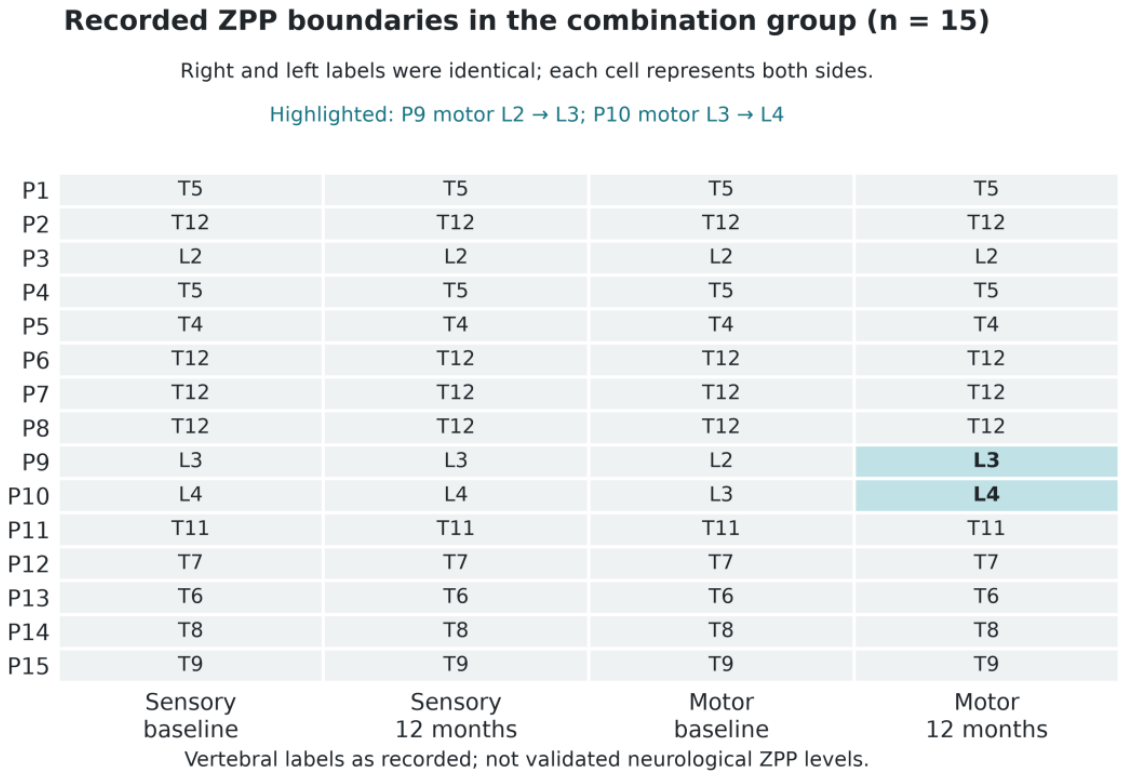
Figure 3.
Walker-supported standing duration without orthoses at baseline and 12 months. Each line connects the two recorded values for one participant; black points and bars show means ± SD. Inability to stand was assigned zero minutes. Mean duration changed from 2.13 to 8.85 minutes with combination treatment and from 1.47 to 4.17 minutes with placebo. The between-group change difference was 4.01 minutes (95% CI 2.37–5.65). Standing used a walker without orthoses or physical assistance from another person. Duration and the binary ability to stand are separate outcomes.
Figure 3.
Walker-supported standing duration without orthoses at baseline and 12 months. Each line connects the two recorded values for one participant; black points and bars show means ± SD. Inability to stand was assigned zero minutes. Mean duration changed from 2.13 to 8.85 minutes with combination treatment and from 1.47 to 4.17 minutes with placebo. The between-group change difference was 4.01 minutes (95% CI 2.37–5.65). Standing used a walker without orthoses or physical assistance from another person. Duration and the binary ability to stand are separate outcomes.
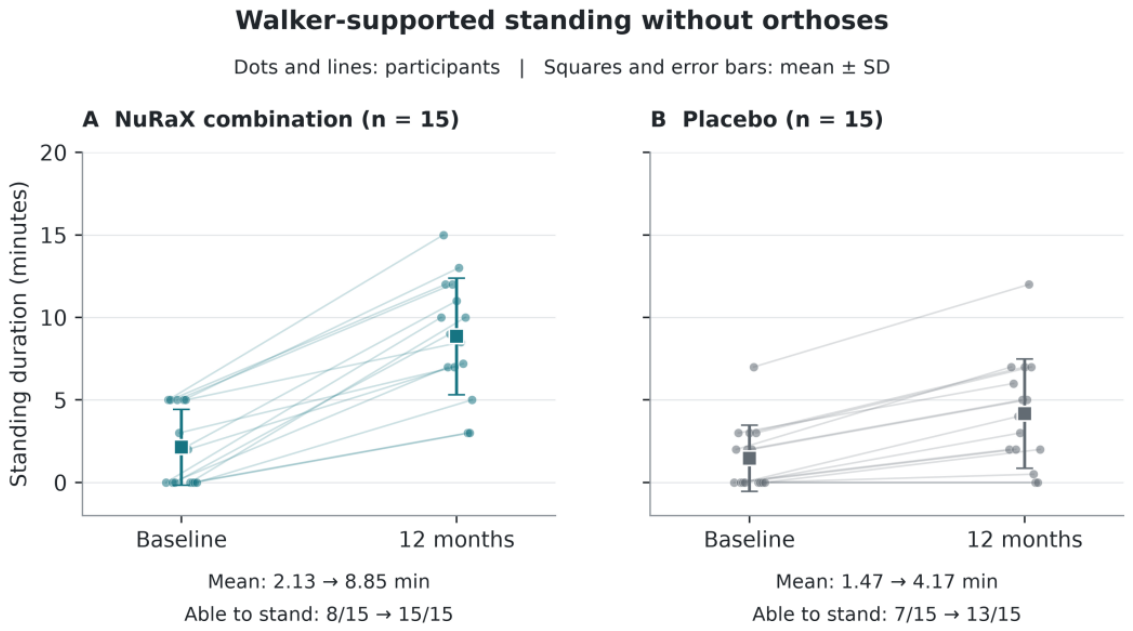
Figure 4.
Walker-supported 100-m walking completion and completion times without orthoses. Panel A shows baseline and 12-month completion proportions using all 15 participants per arm: 0/15 to 13/15 with combination treatment and 0/15 to 1/15 with placebo. The 12-month absolute difference was 80.0 percentage points (95% CI 46.3–91.1; Fisher P < 0.001). Panel B shows times among completers only; noncompleters were not assigned zero time. The single placebo completer was P25. Participants used a walker without orthoses or physical assistance from another person. These results do not establish unaided or community ambulation.
Figure 4.
Walker-supported 100-m walking completion and completion times without orthoses. Panel A shows baseline and 12-month completion proportions using all 15 participants per arm: 0/15 to 13/15 with combination treatment and 0/15 to 1/15 with placebo. The 12-month absolute difference was 80.0 percentage points (95% CI 46.3–91.1; Fisher P < 0.001). Panel B shows times among completers only; noncompleters were not assigned zero time. The single placebo completer was P25. Participants used a walker without orthoses or physical assistance from another person. These results do not establish unaided or community ambulation.
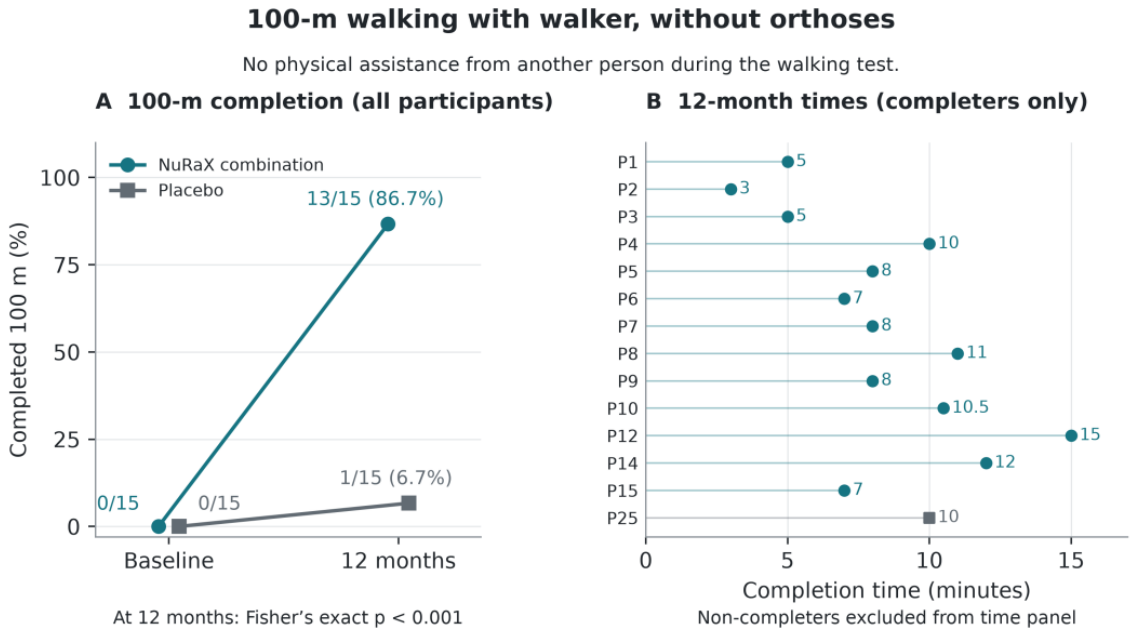
Table 1.
Baseline participant characteristics.
| Characteristic | NVG-291 + TB-4 (n = 15) | Placebo (n = 15) |
| Age, years: mean (SD) | 31.3 (6.9) | 32.5 (6.7) |
| Age, years: median (range) | 30 (23–48) | 34 (21–42) |
| Men/women, n | 9/6 | 9/6 |
| Time since injury, months: median (range) | 10 (3–60) | 12 (4–75) |
| Recorded vertebral injury bands, n | T3–T9: 7; T10–T12: 5; L1–L3: 3 | T3–T9: 6; T10–T12: 6; L1–L3: 3 |
| Recorded bilateral LEMS, mean (SD) | 22.3 (7.4) | 21.3 (2.2) |
| Standing duration, minutes: mean (SD) | 2.13 (2.29) | 1.47 (2.00) |
| Able to stand with walker, without orthoses, n (%) | 8 (53.3) | 7 (46.7) |
| Able to walk, n (%) | 0 (0) | 0 (0) |
Table 2.
Participant ages and recorded bilateral lower extremity motor scores.
| Combinationgroup (P1–P15) | ||||
| Participant | Age (years) |
LEMS baseline Out of 50 |
LEMS 12 months Out of 50 |
Change (points) |
| P1 | 23 | 20 | 31 | +11 |
| P2 | 28 | 24 | 33 | +9 |
| P3 | 32 | 36 | 38 | +2 |
| P4 | 30 | 17 | 27 | +10 |
| P5 | 23 | 20 | 30 | +10 |
| P6 | 37 | 22 | 30 | +8 |
| P7 | 25 | 27 | 34 | +7 |
| P8 | 28 | 30 | 37 | +7 |
| P9 | 42 | 31 | 35 | +4 |
| P10 | 33 | 30 | 31 | +1 |
| P11 | 29 | 22 | 23 | +1 |
| P12 | 34 | 11 | 20 | +9 |
| P13 | 31 | 15 | 27 | +12 |
| P14 | 48 | 12 | 25 | +13 |
| P15 | 27 | 17 | 27 | +10 |
| Placebo group (P16–P30) | ||||
| Participant | Age (years) |
LEMS baseline Out of 50 |
LEMS 12 months Out of 50 |
Change (points) |
| P16 | 28 | 20 | 22 | +2 |
| P17 | 33 | 21 | 22 | +1 |
| P18 | 24 | 22 | 22 | 0 |
| P19 | 41 | 16 | 18 | +2 |
| P20 | 31 | 20 | 20 | 0 |
| P21 | 35 | 22 | 23 | +1 |
| P22 | 34 | 22 | 23 | +1 |
| P23 | 37 | 18 | 19 | +1 |
| P24 | 39 | 22 | 23 | +1 |
| P25 | 21 | 22 | 22 | 0 |
| P26 | 22 | 21 | 21 | 0 |
| P27 | 42 | 22 | 22 | 0 |
| P28 | 38 | 23 | 23 | 0 |
| P29 | 28 | 25 | 25 | 0 |
| P30 | 35 | 23 | 23 | 0 |
Table 3.
Recorded sensory and motor boundaries labeled ZPP in the combination group (investigator-recorded vertebral labels; not validated ISNCSCI neurological ZPP boundaries).
Table 3.
Recorded sensory and motor boundaries labeled ZPP in the combination group (investigator-recorded vertebral labels; not validated ISNCSCI neurological ZPP boundaries).
| Participant | Sensory ZPP (R/L) baseline | Sensory ZPP 12 mo | Motor ZPP (R/L) baseline | Motor ZPP 12 mo |
| P1 | T5/T5 | T5/T5 | T5/T5 | T5/T5 |
| P2 | T12/T12 | T12/T12 | T12/T12 | T12/T12 |
| P3 | L2/L2 | L2/L2 | L2/L2 | L2/L2 |
| P4 | T5/T5 | T5/T5 | T5/T5 | T5/T5 |
| P5 | T4/T4 | T4/T4 | T4/T4 | T4/T4 |
| P6 | T12/T12 | T12/T12 | T12/T12 | T12/T12 |
| P7 | T12/T12 | T12/T12 | T12/T12 | T12/T12 |
| P8 | T12/T12 | T12/T12 | T12/T12 | T12/T12 |
| P9 | L3/L3 | L3/L3 | L2/L2 | L3/L3 |
| P10 | L4/L4 | L4/L4 | L3/L3 | L4/L4 |
| P11 | T11/T11 | T11/T11 | T11/T11 | T11/T11 |
| P12 | T7/T7 | T7/T7 | T7/T7 | T7/T7 |
| P13 | T6/T6 | T6/T6 | T6/T6 | T6/T6 |
| P14 | T8/T8 | T8/T8 | T8/T8 | T8/T8 |
| P15 | T9/T9 | T9/T9 | T9/T9 | T9/T9 |
R/L, right/left. Entries are investigator-recorded vertebral labels and must not be interpreted as validated neurological ZPP measurements. P9 and P10 had recorded motor-label changes; other treatment boundaries were stable. Placebo boundaries were reported unchanged; only combination-group labels are tabulated here.
Disclaimer/Publisher’s Note: The statements, opinions and data contained in all publications are solely those of the individual author(s) and contributor(s) and not of MDPI and/or the editor(s). MDPI and/or the editor(s) disclaim responsibility for any injury to people or property resulting from any ideas, methods, instructions or products referred to in the content. |
© 2026 by the authors. Licensee MDPI, Basel, Switzerland. This article is an open access article distributed under the terms and conditions of the Creative Commons Attribution (CC BY) license (http://creativecommons.org/licenses/by/4.0/).
Copyright: This open access article is published under a Creative Commons CC BY 4.0 license, which permit the free download, distribution, and reuse, provided that the author and preprint are cited in any reuse.