
Preprint
Article

This version is not peer-reviewed.

Eating Dysregulation as a Dynamic Marker of Passive Suicidal Ideation: A One-Year Longitudinal Ecological Momentary Assessment (EMA) Study

Submitted:

09 November 2026

Posted:

10 November 2026

You are already at the latest version

Abstract

Eating dysregulation has been associated with suicide risk, but its short-term relationship with suicidal ideation remains unclear. Given its dynamic nature, appetite-related disturbances may be suitable for real-time monitoring using Ecological Momentary Assessment (EMA). This study examined the prospective association between daily eating dysregulation and passive suicidal ideation over 12 months. A prospective EMA study was conducted in 550 psychiatric outpatients with recent suicidal ideation or suicide attempts. Participants completed daily smartphone-based assessments through the MEmind app. Linear mixed-effects models evaluated between-person (mean levels) and within-person (daily fluctuations) associations between eating dysregulation and passive suicidal ideation, adjusting for age, sex, time, and missingness. A total of 81,023 EMA responses were analyzed. No significant linear changes over time were observed. Higher average eating dysregulation was associated with greater passive suicidal ideation (b = 10.11, p < .001). Within individuals, days with higher-than-usual eating dysregulation were also associated with increased passive suicidal ideation (b = 2.32, p < .05). The model explained 27% of the variance. Eating dysregulation is both a stable and dynamic correlate of passive suicidal ideation. Daily variations in eating behavior may serve as a real-time marker of suicide risk, highlighting the potential of EMA to support early detection and personalized prevention strategies.

Keywords: 
;  ;  ;  ;  ;  

1. Introduction

Appetite is a complex phenomenon involving the integration of physiological and psychological signals that regulate the desire to eat (Valassi et al., 2008; Fasano, 2025). Psychologically, appetite encompasses more than just hunger; it comprises hedonic and motivational aspects, including the desire to eat even when there is no urgent need for energy (Fasano, 2025; Lowe & Butryn, 2007). Furthermore, external factors such as the social environment, mealtimes and stress influence what, how much and when a person wants to eat (Woods & Begg, 2016). Therefore, appetite is not a simple homeostatic impulse, but rather a multifaceted construct that varies between individuals and over time (Fasano, 2025; Dakin et al., 2025).
Eating dysregulation refers to a multidimensional disruption in the normal regulation of eating, encompassing not only irregular or maladaptive eating behaviours (e.g., binge eating, restriction or loss of control), but also instability and mismatch in subjective appetite signals, such as fluctuations in hunger, satiety, and desire to eat that are incongruent with physiological needs or contextual demands (Tan & Chow, 2014). From a dimensional perspective, it can be conceptualised as a dynamic continuum of alterations in appetite regulation, ranging from mild day-to-day variability to more severe and persistent patterns. It is a highly prevalent condition, affecting approximately 2–5% of the population, with a significant clinical impact, resulting in elevated morbidity and mortality, substantial healthcare costs, and adverse effects on quality of life (Attia & Walsh, 2025). Studying appetite and eating habits from nutritional and mental health perspectives enables the identification of modifiable risk factors and improvement of prevention and intervention strategies (Fond et al., 2020).
In addition to having a significant impact on clinical practice and public health, eating dysregulation and maladaptive eating habits are associated with an increased risk of suicide (Skinner et al., 2017). Problematic eating behaviors measured dimensionally, such as purging or binging, have been linked with more severe suicidal behaviors and overall suicide risk even in individuals without formal diagnoses (Sutphin et al., 2024). Depressive and anxiety symptoms, which are often induced or exacerbated by changes in appetite and eating habits, further increase this risk in affected populations (Attia & Walsh, 2025; Chen et al., 2025). Recognising this association may facilitate the detection of suicidal thoughts and timely interventions (Joiner et al., 2022; Porras-Segovia et al., 2021a).
In recent years, Ecological Momentary Assessment (EMA) has emerged as a promising methodology for capturing the dynamic nature of these processes and minimising recall bias (Shiffman et al., 2008) when examining short-term variability in suicidal states. This is particularly achieved through the use of smartphones to collect repeated data in real time in natural settings (Carretro et al., 2020; Sedano-Capdvelia et al., 2021; Loewen et al., in press; Lopez-Morinigo et al., 2021).
As a variable that fluctuates daily and is not stable over time, appetite can be measured using EMA (Elsworth et al., 2024). EMA monitoring has proven effective in identifying temporal fluctuations in eating habits, particularly during periods of negative emotional symptoms (Schaefer et al., 2020). In addition, this approach has enabled the detection of small yet significant associations between hunger and various psychological states in studies involving large sample sizes, due to the collection of multiple measurements at different times of the day (de Rivaz et al., 2022).
Despite these advances, previous studies have reported limitations in the generalisability of their findings. These limitations include the reliance on subjective assessments of stress and eating habits, and low levels of negative affectivity observed in some samples (Reichenberger et al., 2021). However, many studies have relied on relatively short follow-up periods (de Rivaz et al., 2022; Reichenberger et al., 2021; Smith et al., 2019; MacIntyre et al., 2021). Importantly, although EMA has been increasingly applied to the study of suicidal ideation, very few studies have examined appetite or eating-related variables as prospective predictors of suicidal states within EMA frameworks, with most research focusing instead on affective or cognitive factors. This gap limits our understanding of potentially modifiable, behaviourally anchored risk markers that fluctuate in daily life (Kim et al., 2026). Overall, the current evidence base highlights the need for prospective designs involving frequent measurements in order to improve the identification of temporal risk factors and examine potential causal mechanisms in this field (MacIntyre et al., 2021; Smith & Juarascio, 2019).
This study aims to analyse the prospective relationship between daily fluctuations in eating dysregulation, conceptualised as a dynamic composite of appetite-related experiences, and passive suicidal ideation, assessed using EMA over a 12-month follow-up period.It is hypothesised that within-person increases in eating dysregulation will be associated with concurrent and short-term increases in passive suicidal ideation.

2. Materials and Methods

Methods

Setting & Design

This is a prospective study nested within the cohort of the SmartCrisis 2.0 clinical trial (For a full description of the protocol see Barrigon et al., 2022)
The protocol adhered to the principles of the Declaration of Helsinki and was approved by the Research Ethics Committee of the Fundación Jiménez Díaz Hospital. The study involved four university hospitals within the Community of Madrid (Spain): the Fundación Jiménez Díaz, Rey Juan Carlos, Villalba General, and Infanta Elena University Hospitals.

Sample

Participants were drawn from the psychiatric outpatient services and emergency units of the involved hospitals. To be eligible, individuals had to be 18 years or older, fluent in Spanish, able to give informed consent, and have consistent access to an internet-enabled personal smartphone. They also needed to have made a suicide attempt or received emergency care for suicidal thoughts within the previous month. Exclusion criteria included unwillingness to install the study’s mobile app, not owning a compatible smartphone, or being unable to comprehend or sign the consent form. Written informed consent was obtained from all participants before enrolment, and no monetary compensation was offered.

EMA Measures

Participants took part in abaseline interview during which the MEmind application was installed on their smartphones to deliver the EMA protocol. The app issued short, daily questionnaires for a period of 12 months. Each day, a single notification was sent between 09:00 and 21:00, prompting participants to complete 2–4 items randomly drawn from a larger set of 34. For analysis, items relevant to the constructs of interest were grouped, although non-relevant items were left in the rotation. The randomized item presentation was designed to minimize burden and reduce the likelihood of fatigue or attrition, which are frequent issues in EMA research (Tonkin et al., 2023). Responses were captured using 0–100 or 0-4 visual analogue scales.
Table 1 provides the mapping of EMA items onto broader psychological constructs. Positively worded items were reverse-scored so that higher values uniformly indicated greater symptom severity or risk. Items within each domain were then aggregated to create composite construct scores.
To safeguard participant privacy, personal information and usernames were placed with coded identifiers. All data were secured with AES-256 encryption (256-bit keys) and handled through a professional key-management system that underwent independent security compliance audits.

Data Analysis

Preliminary Analysis. All analyses were conducted in R (version 4.5.1). We first fit unconditional (intercept-only) multilevel models to estimate the proportion of variance attributable to within- versus between-person differences. Intraclass correlation coefficients (ICCs) from these models quantified the degree to which each construct varied across individuals rather than across days. We also calculated the root mean square of successive differences (RMSSD) to index temporal instability, reflecting the average day-to-day fluctuation in each construct. To test whether suicidal thinkingor eating dysregulation showed systematic trends over the study period, we fit linear models using days since the first EMA survey as the sole predictor.
Mixed-effect Models. We used linear mixed-effects models with random intercepts for participants to examine associations between eating dysregulation and passive suicidal ideation. To distinguish within-person from between-person effects, we decomposed daily eating dysregulation into two components. First, we person-mean centered the daily eating dysregulation scores so that each observation reflected how much higher or lower that day’s score was compared with that individual’s own average level (within-person component) (Kleiman, 2017). Second, we calculated each participant’s mean level of eating dysregulation across all EMA days and entered this as a separate between-person predictor. This approach allows us to estimate (1) whether individuals who, on average, have more regulated eating report lower suicidal ideation (between-person effect), and (2) whether days when a participant reports more regulated eating than usual correspond to lower suicidal ideation (within-person effect). Model fit was evaluated using marginal and conditional R2, quantifying variance explained by fixed effects alone and by the full model, respectively. Model residuals were approximately symmetric and closely followed the expected normal line in Q–Q plots, with only mild deviations in the tails, indicating that the linear mixed-effects specification provided a reasonable approximation to the data.
Covariates and Missingness. Models were first run without covariates, then re-estimated controlling for age, sex, and time. Time (days since first EMA) was included to account for potential linear changes in suicidal ideation or eating dysregulation across the study. To address missing EMA data, we calculated the proportion of missing days for each participant across the 12-month window, defined as the number of days without any EMA responses divided by the total expected study period. This missingness index was included as a covariate in all adjusted models.

3. Results

Participants

The initial EMA sample included 585 individuals. Thirty-five participants were excluded for providing fewer than three EMA responses, resulting in a final analytic sample of 550. The mean age was 44.1 years (SD = 14.4). Gender distribution was 64.4% female, 34.9% male, and 0.7% other.

Descriptives of EMA

Across the 12-month monitoring period, participants completed 81,023 EMA entries (M = 147.32 per person, SD = 170.06). Given the rotating 2–4 item design, this corresponded to an average of 0.40 completed EMA items per day, yielding a compliance rate of 17.3%. Table 2 summarizes descriptive and variability estimates for passive suicidal ideation and eating dysregulation. Intraclass correlation coefficients (ICCs; 0.11–0.46) indicate that most variability occurred within individuals over time rather than between participants. RMSSD values (0.939–39.45) further demonstrate substantial day-to-day fluctuation in these constructs, highlighting meaningful temporal instability at the individual level.

Results of EMA Only Mixed Effect Models

Passive suicidal ideation showed no significant linear change over time when modelled with days as the sole predictor (ps> .05). Likewise, eating dysregulation did not exhibit a significant time trend (ps> .05), indicating that neither construct demonstrated systematic change across the 12-month assessment period.
In the unadjusted mixed-effects model, participants who, on average, exhibited more dysregulated eating reported higher passive suicidal ideation (between-person effect: b = 9.51, 95% CI [5.57, 13.44], p < .001). The within-person effect was not statistically significant, indicating that days with greater-than-usual eating dysregulation were not reliably associated with higher passive ideation (b = 2.21, 95% CI [–0.01, 4.43], p = .051).
After adjusting for age, sex, time, and missingness, both the between-person and within-person effects were significant. Participants with higher average dysregulated eating continued to report greater passive suicidal ideation (b = 10.11, 95% CI [6.43, 13.83], p < .001). Additionally, on days when individuals experienced more dysregulated eating than their own typical level, they also reported higher passive ideation (b = 2.32, 95% CI [0.11, 4.55], p < .05). As illustrated in Figure 1, the left panel shows a positive association between participants’ mean dysregulated eating (between-person effect) and their mean passive suicidal ideation. In contrast, the right panel shows a positive association between daily deviations (within-person effect) from the participant’s own mean against that day’s passive suicidal ideation. The adjusted model explained a small proportion of variance in passive suicidal ideation, with fixed effects accounting for about 9% (marginal R2 = 0.09), but the full model, including random intercepts accounted for 27% (conditional R2 = 0.27).

4. Discussion

This study used year-long EMA to examine whether eating dysregulation was associated with daily fluctuations in passive suicidal ideation among psychiatric outpatients recently evaluated for suicidal thoughts or behaviors. Several key findings emerged. Both passive suicidal ideation and eating dysregulation showed substantial day-to-day variability, highlighting their dynamic nature. Participants who exhibited higher average levels of eating dysregulation across the year reported higher overall passive suicidal ideation. A similar pattern emerged within individuals: on days when participants experienced greater-than-usual dysregulation in their eating, they also reported higher passive suicidal ideation. Together, these findings underscore the importance of distinguishing between-person and within-person processes in suicide risk and identify eating-related dysregulation as both a stable and dynamic correlate of passive suicidal thinking.
The results of the present study are consistent with previous research indicating that fluctuations in appetite may serve as early markers of affective dysregulation, preceding acute increases in suicidal thoughts (Skinner et al., 2017; Sutphin et al., 2024). Similarly, establishing associations between appetite and negative affective states using EMA aligns with existing literature (Schaefer et al., 2020; de Rivaz et al., 2022).
Furthermore, this study shows that short-term increases in eating dysregulation within the same individual are linked to concurrent rises in suicidal thoughts, beyond differences seen in overall average functioning. This finding contrasts with day-to-day associations reported in some previous EMA studies (de Rivaz et al., 2022; Reichenberger et al., 2021) and may be partly explained by the characteristics of the current sample. Participants were psychiatric outpatients who had recently been treated for suicidal thoughts or behaviors. This is a group characterised by elevated stress, negative emotional states and heightened clinical vulnerability. Additionally, the 12-month follow-up period was longer than in most previous studies (de Rivaz et al., 2022; Reichenberger et al., 2021; Smith et al., 2019 MacIntyre et al., 2021), and the large number of observations per participant probably increased the statistical power to detect small, yet clinically significant, short-term associations, as suggested by intensive EMA research designs (MacIntyre et al., 2021; Smith & Juarascio, 2019). These findings emphasise the importance of long-term, adequately powered EMA designs for identifying subtle temporal risk processes that may be obscured in shorter or less intensive studies.
From a clinical perspective, the findings of this study suggest that monitoring eating dysregulation using EMA could contribute to the early detection of periods of increased suicide risk in vulnerable patients. EMA can identify subtle and transient changes that are difficult to detect through conventional clinical assessments, enabling more timely and personalised interventions (Carretero et al., 2020; Sedano-Capdevila et al., 2021). Furthermore, integrating appetite-related indicators into digital monitoring systems could enhance suicide risk prediction models and inform prevention strategies based on real-time data. Considering eating dysregulation as an additional clinical warning sign could be particularly beneficial duringoutpatient follow-up.
Future studies might combine active EMA with passive sensing, such as collecting dataon activity, sleep or smartphone use, to improve risk state detection and reduce participant burden (Porras-Segovia et al., 2021b). Likewise, EMA can be used not only for assessment purposes, but also to inform ecological momentary interventions (EMIs), which have demonstrated promise in the context of suicide prevention (Jiménez-Muñoz et al., 2022). Extending this approach to adolescent populations is particularly relevant, given that emotional and dietary regulation is still developing in this age group.

Strengths and Limitations

The main strengths of this study include its prospective design, the use of EMA over a 12-month period and the inclusion of a high-risk clinical sample. The large number of observations enabled both between-person and within-person fluctuations to be examined, providing a more detailed understanding of the dynamic processes involved in suicidal ideation. However, the study has several limitations. Firstly, the EMA completion rate was moderate, which could introduce selection biases or limit the generalisability of the results. Secondly, the measures were based on self-reports, which are susceptible to subjective biases. Furthermore, although several relevant covariates were controlled for, direct measures of daily depressive or anxiety symptoms were not included, preventing the exploration of possible mediating effects. Finally, the results may not be generalisable to non-clinical populations or to other age groups, such as adolescents.

5. Conclusions

The present study suggests that eating dysregulation is associated with higher average levels and daily increases in passive suicidal ideation in high-risk psychiatric patients. These findings reinforce the dynamic nature of suicide risk and highlight the clinical relevance of appetite and eating behavior. EMA is presented as a valuable tool for improving our understanding of, and ability to prevent, suicide, and opens up new opportunities for developing personalised, real-time monitoring and intervention strategies.

Author Contributions

Conceptualization, A.P.S. and E.B.G.; Methodology, A.P.S., E.B.G., P.C., and J.L.C.; Formal analysis, F.M.H; Supervision, A.L, M.L.B. and L.M.I.; Writing-original draft, A.L., F.M.H., I.P.C., M.L.B. and L.M.I.; Writing – review & editing, A.L., M.L.B., L.M.I., P.C. and J.L.C.

Funding

This research was supported by CIBER -Consorcio Centro de Investigación Biomédica en Red- (CB/07/09/0025), the Instituto de Salud Carlos III with the support of the European Regional Development Fund (ISCIII PI23/00614), Project PMP24/00026, funded by the Carlos III Health Institute (ISCIII) and the “European Union NextGenerationEU/Recovery and Resilience Facility (RRF)/PRTR.” by Fundació La Marató de TV3 (202226-31), by CaixaResearch Health 2023 LCF/PR/HR23/52430033, by the American Foundation for Suicide Prevention (LSRG-1-005-16) the Madrid Regional Government (AGES-3-CM), and by the Instituto de Salud Carlos III. with the support of the European Regional Development Fund (ISCIII JR22/00011; MV25/00040; ISCIII PI20/01555; TED2021-131120B-I00).

Institutional Review Board Statement

Not applicable. This article does not contain any studies with human or animal subjects performed by any of the authors.

Data Availability Statement

The data that support the findings of this study are available from the author upon reasonable request.

Acknowledgments

Not applicable.

Conflicts of Interest

The authors declare no conflict of interest.

Abbreviations

The following abbreviations are used in this manuscript:
EMA Ecological Momentary Assessment
ICCs Intraclass correlation coefficients
RMSSD Root mean square of successive differences

References

  1. Attia, E., and B. T. Walsh. 2025. Eating Disorders: A Review. JAMA 333, 14: 1242–52. [Google Scholar] [CrossRef] [PubMed]
  2. Barrigon, M. L., A. Porras-Segovia, P. Courtet, J. Lopez-Castroman, S. Berrouiguet, M. M. Pérez-Rodríguez, A. Artes, MEmind Study Group, and E. Baca-Garcia. 2022. Smartphone-based Ecological Momentary Intervention for secondary prevention of suicidal thoughts and behaviour: protocol for the SmartCrisis V.2.0 randomised clinical trial. BMJ open 12, 9: e051807. [Google Scholar] [CrossRef] [PubMed]
  3. Carretero, P., J. J. Campana-Montes, and A. Artes-Rodriguez. 2020. Ecological Momentary Assessment for Monitoring Risk of Suicide Behavior. Current topics in behavioral neurosciences 46: 229–245. [Google Scholar] [CrossRef] [PubMed]
  4. Chen, L. C., Y. M. Bai, S. J. Tsai, C. M. Cheng, and M. H. Chen. 2025. Eating disorders, psychiatric comorbidities, and suicide. Journal of affective disorders 382: 290–295. [Google Scholar] [CrossRef] [PubMed]
  5. Dakin, C., G. Finlayson, and R. J. Stubbs. 2025. Exploring the underlying psychological constructs of self-report eating behavior measurements: Toward a comprehensive framework. Psychological review 132, 5: 1241–65. [Google Scholar] [CrossRef] [PubMed]
  6. de Rivaz, R., J. Swendsen, S. Berthoz, M. Husky, K. Merikangas, and P. Marques-Vidal. 2022. Associations between Hunger and Psychological Outcomes: A Large-Scale Ecological Momentary Assessment Study. Nutrients 14, 23: 5167. [Google Scholar] [CrossRef] [PubMed]
  7. Elsworth, R. L., E. C. Hinton, A. N. Flynn, L. H. Merrell, J. P. Hamilton-Shield, N. S. Lawrence, and J. M. Brunstrom. 2024. Development of Momentary Appetite Capture (MAC): A versatile tool for monitoring appetite over long periods. Appetite 194: 107154. [Google Scholar] [CrossRef] [PubMed]
  8. Fasano, A. 2025. The Physiology of Hunger. New england journal of medicine 392, 4: 372–81. [Google Scholar] [CrossRef] [PubMed]
  9. Fond, G., A. H. Young, O. Godin, M. Messiaen, C. Lançon, P. Auquier, and L. Boyer. 2020. Improving diet for psychiatric patients: High potential benefits and evidence for safety. Journal of affective disorders 265: 567–569. [Google Scholar] [CrossRef] [PubMed]
  10. Jiménez-Muñoz, L., I. Peñuelas-Calvo, I. Díaz-Oliván, L. Gutiérrez-Rojas, E. Baca-García, and A. Porras-Segovia. 2022. Suicide Prevention in Your Pocket: A Systematic Review of Ecological Momentary Interventions for the Management of Suicidal Thoughts and Behaviors. Harvard review psychiatry 30, 2: 85–99. [Google Scholar] [CrossRef] [PubMed]
  11. Joiner, T. E., M. Robison, S. McClanahan, M. Riddle, J. Manwaring, R. D. Rienecke, D. Le Grange, A. Duffy, P. S. Mehler, and D. V. Blalock. 2022. Eating disorder behaviors as predictors of suicidal ideation among people with an eating disorder. The International journal of eating disorders 55, 10: 1352–1360. [Google Scholar] [CrossRef] [PubMed]
  12. Kim, H., S. J. Heo, S. Park, J. Lee, G. Do, and J. Y. Park. 2026. Predicting suicidal and self-harm ideation using ecological momentary assessment: deep learning analysis in a general population sample. BMC psychiatry 26, 1: 192. [Google Scholar] [CrossRef] [PubMed]
  13. Kleiman, E. 2017. Understanding and analyzing multilevel data from real-time monitoring studies: An easily-accessible tutorial using R. OSF Preprints. [Google Scholar] [CrossRef]
  14. Loewen, Á., F. M. Herrmann, I. Peñuelas-Calvo, L. Mata-Iturralde, E. Baca-García, P. Courtet, and A. Porras-Segovia. in press. Young people at risk of suicide. Ecological momentary assessment and digital safety planning in a case series. Frontiers in Psychiatry.
  15. Lopez-Morinigo, J. D., M. L. Barrigón, A. Porras-Segovia, V. G. Ruiz-Ruano, A. S. Escribano Martínez, P. J. Escobedo-Aedo, S. Sánchez Alonso, L. Mata Iturralde, L. Muñoz Lorenzo, A. Artés-Rodríguez, A. S. David, and E. Baca-García. 2021. Use of ecological momentary assessment through a passive smartphone-based app (eB2) by patients with schizophrenia: Acceptability study. Journal of Medical Internet Research 23, 7: e26548. [Google Scholar] [CrossRef] [PubMed]
  16. Lowe, M. R., and M. L. Butryn. 2007. Hedonic hunger: a new dimension of appetite? Physiology & behavior 91, 4: 432–9. [Google Scholar] [CrossRef] [PubMed]
  17. MacIntyre, R. I., K. E. Heron, R. D. Crosby, S. G. Engel, S. A. Wonderlich, and T. B. Mason. 2021. Measurement of the influences of social processes in appetite using ecological momentary assessment. Appetite 161: 105126. [Google Scholar] [CrossRef] [PubMed]
  18. Porras-Segovia, A., E. Baca-García, P. Courtet, M. Wainberg, and M. A. Oquendo. 2021a. If suicide were COVID-19: A neglected cause of premature death. The Journal of Clinical Psychiatry 82, 2: 20l13702. [Google Scholar] [CrossRef] [PubMed]
  19. Porras-Segovia, A., A. Cobo, I. Díaz-Oliván, A. Artés-Rodríguez, S. Berrouiguet, J. Lopez-Castroman, P. Courtet, M. L. Barrigón, M. A. Oquendo, and E. Baca-García. 2021b. Disturbed sleep as a clinical marker of wish to die: A smartphone monitoring study over three months of observation. Journal of affective disorders 286, 330–337. [Google Scholar] [CrossRef] [PubMed]
  20. Reichenberger, J., B. Pannicke, A. K. Arend, K. Petrowski, and J. Blechert. 2021. Does stress eat away at you or make you eat? EMA measures of stress predict day to day food craving and perceived food intake as a function of trait stress-eating. Psychology & health 36, 2: 129–147. [Google Scholar] [CrossRef] [PubMed]
  21. Schaefer, L. M., S. G. Engel, and S. A. Wonderlich. 2020. Ecological momentary assessment in eating disorders research: recent findings and promising new directions. Current opinion in psychiatry 33, 6: 528–533. [Google Scholar] [CrossRef] [PubMed]
  22. Sedano-Capdevila, A., A. Porras-Segovia, H. J. Bello, E. Baca-García, and M. L. Barrigon. 2021. Use of Ecological Momentary Assessment to Study Suicidal Thoughts and Behavior: a Systematic Review. Current psychiatry reports 23, 7: 41. [Google Scholar] [CrossRef] [PubMed]
  23. Shiffman, S., A. A. Stone, and M. R. Hufford. 2008. Ecological momentary assessment. Annual review of clinical psychology 4: 1–32. [Google Scholar] [CrossRef] [PubMed]
  24. Skinner, K. D., S. M. Rojas, and J. C. Veilleux. 2017. Connecting Eating Pathology with Risk for Engaging in Suicidal Behavior: The Mediating Role of Experiential Avoidance. Suicide & life-threatening behavior 47, 1: 3–13. [Google Scholar] [CrossRef] [PubMed]
  25. Smith, A. R., E. A. Velkoff, J. D. Ribeiro, and J. Franklin. 2019. Are Eating Disorders and Related Symptoms Risk Factors for Suicidal Thoughts and Behaviors? A Meta-analysis. Suicide & life-threatening behavior 49, 1: 221–239. [Google Scholar] [CrossRef] [PubMed]
  26. Smith, K. E., and A. Juarascio. 2019. From Ecological Momentary Assessment (EMA) to Ecological Momentary Intervention (EMI): Past and Future Directions for Ambulatory Assessment and Interventions in Eating Disorders. Current psychiatry reports 21, 7: 53. [Google Scholar] [CrossRef] [PubMed]
  27. Sutphin, T. M. S., A. D. Hicks, and D. McCord. 2024. Eating Behaviors Associated With Suicidal Behaviors and Overall Risk. Journal of psychiatric practice 30, 5: 343–348. [Google Scholar] [CrossRef] [PubMed]
  28. Tan, C. C., and C. M. Chow. 2014. Stress and emotional eating: The mediating role of eating dysregulation. Personality and individual differences 66: 1–4. [Google Scholar] [CrossRef]
  29. Tonkin, S., J. Gass, J. Wray, E. Maguin, M. Mahoney, C. Colder, S. Tiffany, and L. W. Hawk, Jr. 2023. Evaluating Declines in Compliance With Ecological Momentary Assessment in Longitudinal Health Behavior Research: Analyses From a Clinical Trial. Journal of medical Internet research 25: e43826. [Google Scholar] [CrossRef] [PubMed]
  30. Valassi, E., M. Scacchi, and F. Cavagnini. 2008. Neuroendocrine control of food intake. Nutrition, metabolism and cardiovascular diseases 18, 2: 158–68. [Google Scholar] [CrossRef] [PubMed]
  31. Woods, S. C., and D. P. Begg. 2016. Regulation of the Motivation to Eat. Current topics in behavioral neurosciences 27: 15–34. [Google Scholar] [CrossRef] [PubMed]
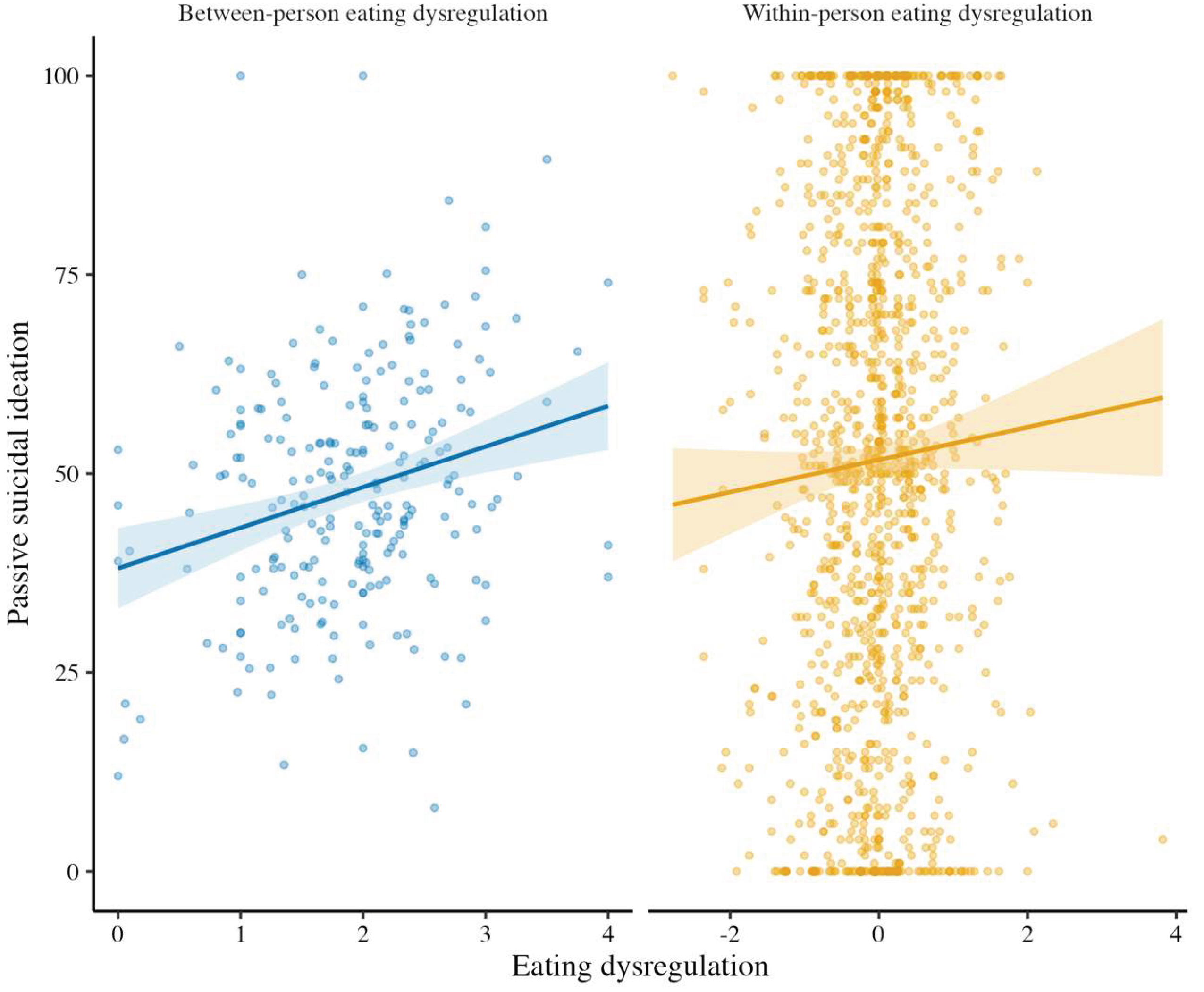
Figure 1. Mixed-effect Models of eating dysregulation and passive suicidal ideation. Note. The left panel shows the between-person association (0–4 EMA scale; higher scores indicate more dysregulation). The right panel shows the within-person association (-4–4 EMA sale. Solid lines are least-squares regression fits, and shaded bands are 95% confidence intervals. Passive suicidal ideation scores range from 0 to 100, with higher scores indicating greater ideation.
Preprints 243246 g001
Table 1. EMA items and constructs.
Variable Description
Passive suicidal ideation (n = 14,594)
Do you have thoughts that you would be better off dead or of hurting yourself in some way?
My wish to live is
My wish to die is
Eating dysregulation (n = 5,182)
My appetite is
When I eat I feel fullness
In the last few days, I have been hungry
In the last few days when I eat, the food tastes…
Compared to when I was younger, food tastes…
Table 2. Descriptive and variability statistics for EMA.
Descriptive statistics Variability
statistics
Variable M SD Range % nonzero ICC RMSSD
Passive suicidal ideation 44.843 33.243 0-100 89.9 0.106 39.451
Eating dysregulation 1.88 0.953 0-4 92.6 0.46 0.939
Note. M = mean; SD = standard deviation; % nonzero = proportion of responses greater than zero; ICC = intraclass correlation coefficient, indexing the proportion of variance attributable to between-person differences; RMSSD = root mean square of successive differences, calculated as the average within-person variability across consecutive days.
Disclaimer/Publisher’s Note: The statements, opinions and data contained in all publications are solely those of the individual author(s) and contributor(s) and not of MDPI and/or the editor(s). MDPI and/or the editor(s) disclaim responsibility for any injury to people or property resulting from any ideas, methods, instructions or products referred to in the content.
Copyright: This open access article is published under a Creative Commons CC BY 4.0 license, which permit the free download, distribution, and reuse, provided that the author and preprint are cited in any reuse.
