

Submitted:
08 November 2026
Posted:
10 November 2026
You are already at the latest version
Abstract
Background: India has the largest number of preterm births in the world, roughly 3 million a year, and about one in six newborns is born with low birth weight (LBW). Preterm birth and LBW reduce nephron endowment and roughly double the lifetime risk of chronic kidney disease (CKD). Yet structured kidney follow-up of neonatal intensive care unit (NICU) and special newborn care unit (SNCU) graduates is rare in India, and no risk stratification tool exists for this population. Aim: To review the evidence linking preterm birth and LBW to CKD, describe the Indian care pathway for at-risk infants, draw on recent clinician-perspective research on clinical decision support (CDS) tools, and propose an India-adapted framework for CKD risk prediction in children. Key points: (1) Risk factors that can be captured at NICU/SNCU discharge — gestational age, birth weight, small-for-gestational-age status, neonatal acute kidney injury, nephrotoxic drug exposure, and congenital anomalies of the kidney and urinary tract (CAKUT) — allow simple tiered risk stratification. (2) International data show clinicians want CDS tools that fit workflow, integrate with records and give actionable advice with family education. (3) In India, paper-based discharge summaries, the Mother and Child Protection Card, Rashtriya Bal Swasthya Karyakram (RBSK) and the Ayushman Bharat Digital Mission (ABDM) offer practical delivery routes. (4) Low-cost tests — blood pressure, urine dipstick for protein, serum creatinine with bedside Schwartz eGFR — suit resource-limited follow-up. (5) Over-referral to scarce paediatric nephrologists and false reassurance must be designed against. Conclusion: A tiered, low-cost, family-centred CKD risk tool for children born preterm or LBW is feasible in India and is needed. We outline a research agenda, starting with a multi-stakeholder qualitative study of Indian clinicians and families.
Keywords:
chronic kidney disease
; preterm birth
; low birth weight
; clinical decision support
; risk stratification
; India
; nephron endowment
1. Introduction
Complications of preterm birth are the leading cause of death among children under five worldwide [1]. India carries the world’s largest burden of preterm birth: about 3 million of the estimated 13.4 million preterm births worldwide in 2020, a national rate near 13% [2]. In the National Family Health Survey-5 (2019–21), about 18% of newborns with a recorded weight weighed under 2,500 g [3]. Survival of these infants has improved sharply with the expansion of SNCUs, newborn stabilisation units and private NICUs, so a growing cohort of Indian children now carries the long-term risks of being born early or small.
The kidney is one of those risks. In a Swedish cohort of over 4 million births, preterm birth was associated with roughly twice the risk of CKD from childhood into mid-adulthood, and about three times the risk after extremely preterm birth [4]. A systematic review found LBW associated with around 70% higher odds of CKD in later life [5]. The mechanism — a reduced and less resilient nephron endowment — is well described [6,7].
These findings matter more in India than almost anywhere. CKD is common, often detected late, and frequently attributed to “unknown” causes [8,9]. Indian newborns have a distinctive “thin-fat” phenotype [10], and Indian birth cohorts link early growth patterns to adult cardiometabolic disease [11] — the same diabetes and hypertension that act as “second hits” on a reduced nephron mass. Adult kidney disease in India may therefore partly begin in the NICU.
Despite this, kidney surveillance after NICU or SNCU discharge is not part of routine Indian practice, and no tool helps clinicians decide which child needs which follow-up. A recent US qualitative study by Sanderson et al. explored how neonatologists, general paediatricians and paediatric nephrologists view CDS tools for CKD risk after preterm birth [12]. Every participant endorsed the need for such a tool, while warning about false reassurance, over-referral and family burden. Those concerns apply with greater force in India, where subspecialty access is thinner and records are often on paper.
This Perspective (a) summarises the evidence linking preterm birth and LBW to CKD, (b) describes the Indian follow-up pathway for at-risk newborns, (c) translates international clinician-perspective findings to Indian conditions, and (d) proposes a tiered, low-cost risk stratification framework and a research agenda.
2. Biological Basis: Low Nephron Endowment and Second Hits
Nephrogenesis is completed by about 34–36 weeks’ gestation, and most nephrons form in the third trimester. A baby born at 28 weeks therefore finishes building its kidneys outside the uterus, under conditions that are hostile to normal development.
- Reduced nephron number. Human nephron number varies about ten-fold between individuals and rises with birth weight [13]. Brenner’s hyperfiltration hypothesis proposes that fewer nephrons lead to single-nephron hyperfiltration, glomerular hypertrophy, hypertension and progressive glomerulosclerosis [14].
- Neonatal acute kidney injury (AKI). In the multinational AWAKEN cohort, which included an Indian centre, neonatal AKI was common and independently associated with death and longer hospital stay [17].
- Nephrotoxic exposure. Aminoglycosides, vancomycin, NSAIDs for patent ductus arteriosus, and contrast add injury; quality programmes such as Baby NINJA show this harm is preventable [18].
The first hit (low endowment) is often silent in early childhood. Clinical CKD typically appears after “second hits”: obesity, type 2 diabetes, hypertension, recurrent AKI or pregnancy [7,19]. Even so, early signs are detectable. In a US cohort of children born extremely preterm, reduced eGFR, albuminuria or elevated blood pressure were already present in a substantial proportion by 2 years’ corrected age [20]. This window between birth and clinical CKD is where prediction and prevention can work.
3. Kidney Follow-Up After NICU and SNCU Discharge in India
India has built strong systems for keeping small and sick newborns alive, but kidney health is not yet part of what happens after they go home. The India Newborn Action Plan drove a nationwide network of district SNCUs and newborn stabilisation units [21]. High-risk newborn follow-up clinics, where they exist, focus on neurodevelopment, retinopathy of prematurity, hearing and growth. Kidney outcomes are seldom tracked.
Care after discharge is split between tertiary NICUs, district hospitals, private paediatricians and community health workers. Rashtriya Bal Swasthya Karyakram (RBSK) screens children from birth to 18 years for the “4 Ds” — defects at birth, diseases, deficiencies and developmental delays — and refers them to District Early Intervention Centres [22]. ASHAs visit preterm and LBW infants under home-based newborn and young-child care programmes. Families carry the Mother and Child Protection (MCP) Card [23]. None of these currently carry a kidney-risk flag.

Table 1.
Kidney surveillance after preterm/LBW birth in India: gaps and existing assets.
| Domain | Current practice (usual) | Gap | Asset to build on |
| Discharge documentation | Handwritten or local-software summary | Neonatal AKI, peak creatinine and nephrotoxin courses rarely recorded | Standardised SNCU discharge format; SNCU online reporting |
| Risk communication | Verbal advice to parents | Families unaware of kidney risk | MCP Card; vernacular counselling by nurses and ASHAs |
| Blood pressure | Rarely measured before school age | Paediatric cuffs and reference tables often unavailable | Low-cost cuffs; AAP 2017 normative tables [24] |
| Urine testing | Done only when symptomatic | No routine proteinuria screen | Dipstick costs a few rupees per test |
| Kidney function | Serum creatinine widely available | Jaffe vs enzymatic variation; adult eGFR equations misused | Bedside Schwartz eGFR [25,26] |
| Imaging | Antenatal and postnatal ultrasound common | Findings not linked to a follow-up plan | CAKUT flag at discharge |
| Specialist access | Paediatric nephrologists concentrated in metro tertiary centres | Long travel, out-of-pocket cost | Tele-nephrology; eSanjeevani teleconsultation |
| Digital records | Mostly paper outside large hospitals | No longitudinal record across facilities | ABHA ID and Ayushman Bharat Digital Mission [27] |
The practical upshot: Indian clinicians already have the cheap tests needed (BP, dipstick, creatinine, ultrasound). What is missing is a rule for who should get them, when, and who acts on an abnormal result.
4. What Clinicians Want From a CKD Risk Tool: Lessons for India
The only published study of clinician views on CDS for CKD risk after preterm birth comes from the United States [12]. Sanderson et al. interviewed 25 neonatologists, general paediatricians and paediatric nephrologists (December 2023–April 2024). Clinicians wanted tools that fit workflow, sit inside the electronic health record, give clear actionable recommendations and include caregiver education. Their main worries were false reassurance, over-referral to nephrology, and burden on families with poor subspecialty access. All 25 endorsed the need for a paediatric CKD risk stratification tool. General principles of CDS design point the same way: tools fail when they add clicks, fire too often or give advice clinicians cannot act on [28].
Each of these findings changes shape in the Indian setting.
Table 2.
US clinician priorities for a CKD risk CDS tool and their Indian translation.
| Priority or concern (US study [12]) | Indian context | Design implication for India |
| EHR integration | Most SNCUs and private clinics lack a full EHR | Paper-first design: a one-page checklist and an MCP Card sticker, with an optional mobile/web version linked to ABHA |
| Efficient workflow | Very high outpatient volumes and short consultations | ≤ 6 inputs available at discharge; output is a single colour tier |
| Actionable recommendations | Variable access to tests by district | Each tier names tests that a district hospital can do: BP, dipstick, creatinine, ultrasound |
| Caregiver education | Diverse languages and literacy levels | Pictorial leaflets in regional languages; counselling by nurses and ASHAs |
| False reassurance | “Low risk” may be read as “no risk” | Even the lowest tier carries a lifelong message: BP check at every visit, avoid NSAIDs, report swelling |
| Over-referral to nephrology | Very few paediatric nephrologists, in metro centres only | Most children managed by paediatricians; referral only for defined red flags; tele-nephrology first |
| Family burden | Travel, lost wages, out-of-pocket cost | Align kidney checks with existing immunisation and high-risk follow-up visits |
Two concerns are specific to India and were not prominent in the US data. First, sex and social bias in follow-up: families may be less likely to return for girls, and follow-up falls off when families migrate for work. Second, test quality: creatinine assays and reporting vary across laboratories, so a tool must state which eGFR equation to use and when to repeat an abnormal value.
5. A Proposed Indian Framework for CKD Risk Stratification
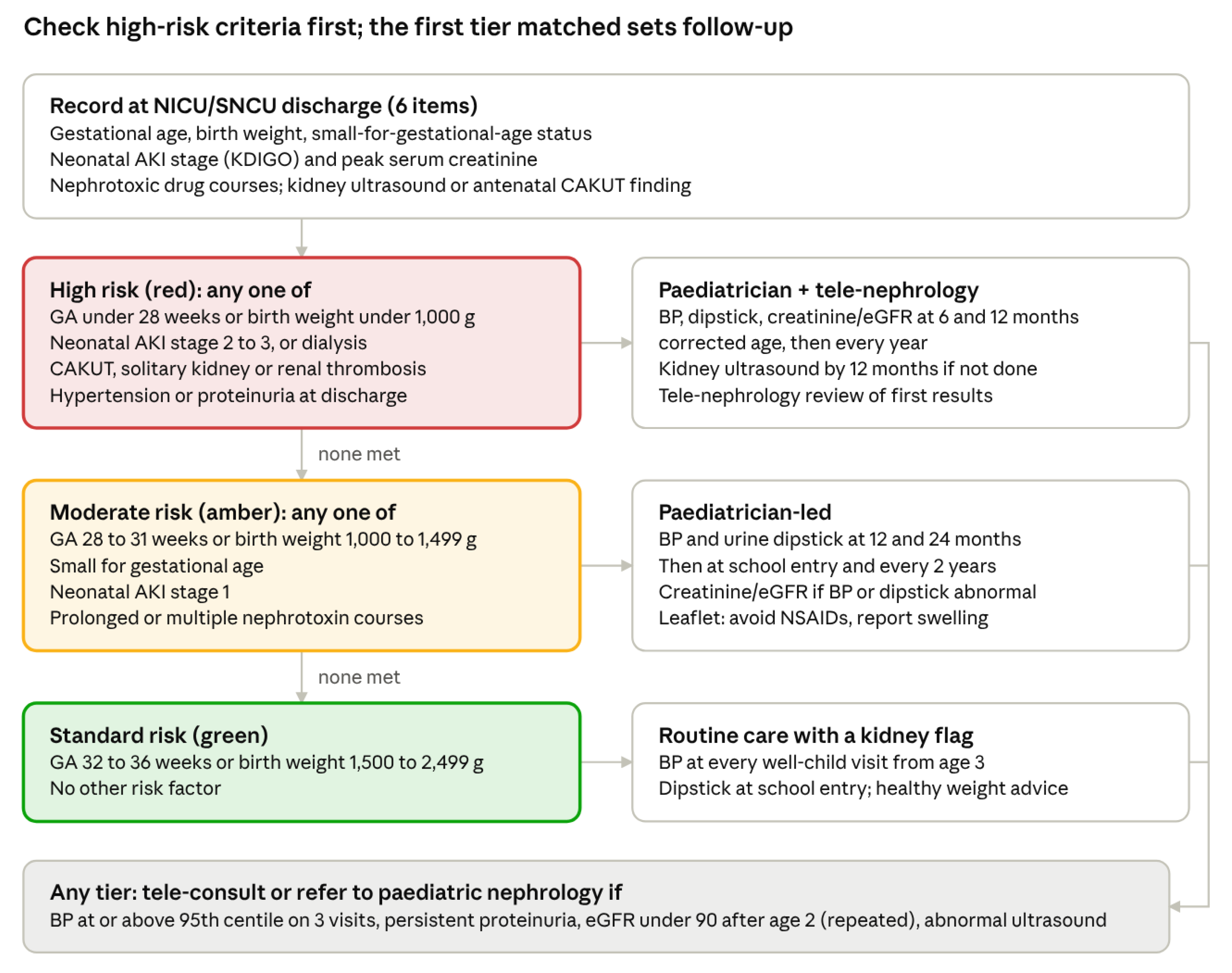
We propose a three-tier framework that uses six items already known at NICU or SNCU discharge and only tests available at a district hospital (Figure 1). It is a starting point for consensus and validation, not a validated prediction model. It draws on the modified Delphi consensus on kidney health monitoring of NICU graduates [29], KDIGO CKD guidance [30], and the paediatric blood pressure guideline [24].
The clinician checks high-risk criteria first; the first tier whose criteria are met sets the follow-up plan. The red-flag box applies to every tier.
Design principles
- Inputs captured once, at discharge. Six items fit on a discharge summary and the MCP Card. Missing data default the child to the higher tier.
- Colour output, not a score. Red, amber and green are familiar from Indian growth charts and triage, and survive photocopying and handwritten transfer.
- Cheap, repeatable tests. BP with an appropriately sized cuff, urine dipstick, and serum creatinine with the bedside Schwartz equation (eGFR = 0.413 × height in cm ÷ serum creatinine in mg/dL) [25]. Where an enzymatic creatinine is not available, abnormal results should be repeated before labelling.
- Piggy-back on existing visits. Kidney checks are timed to immunisation, high-risk follow-up and RBSK contacts, so families make no extra trips.
- Paediatrician-led, nephrologist-supported. Most children never need a nephrologist. Abnormal results go first to tele-nephrology review, keeping scarce in-person slots for children who need them.
- Family-centred messaging. Every tier, including green, receives a short lifelong message: kidney check at every visit, no over-the-counter painkillers such as ibuprofen, healthy weight, and BP checks in adolescence and pregnancy.
Formal prediction models for CKD progression already exist for children with established CKD [31], but none predicts CKD onset from neonatal data. The framework above should therefore be treated as a hypothesis to be tested in Indian cohorts.
6. Implementing a Kidney Risk Tool in the Indian Health System
A tool succeeds only if it is used at discharge and acted on at follow-up. We suggest delivery through three routes that already reach these children.
- Facility level. Add the six inputs and the tier to the standard SNCU and NICU discharge summary, and to SNCU online reporting. Private NICUs can add them to existing software templates.
- Family level. A colour sticker or stamp on the MCP Card, with a pictorial leaflet in the family’s language. The card travels with the child when families migrate.
- Digital level. A simple web or mobile calculator that links the tier to the child’s ABHA ID under the Ayushman Bharat Digital Mission [27], so the risk flag follows the child across public and private providers. Tele-nephrology through eSanjeevani or institutional platforms can review abnormal results.
Professional bodies — the Indian Society of Pediatric Nephrology, National Neonatology Forum and Indian Academy of Pediatrics — are natural conveners for a joint consensus statement and training modules.
Table 3.
Unintended consequences to design against.
| Risk | Why it matters in India | Mitigation |
| False reassurance | Green tier read as “kidneys are fine” | Lifelong message on every tier; BP checks continue |
| Over-referral | Very few paediatric nephrologists | Paediatrician-managed tiers; defined red flags; tele-review first |
| Misread infant eGFR | GFR is physiologically low until about age 2 | Use eGFR thresholds only after age 2; earlier, track trend and creatinine against age norms |
| Laboratory variation | Jaffe creatinine over-reads at low values | Repeat abnormal values, preferably with enzymatic assay, before labelling CKD |
| Family anxiety and cost | Out-of-pocket spending, lost wages | Tests timed to existing visits; free tests under public programmes |
| Inequity in follow-up | Lower return for girls, migrant and rural families | Track follow-up by sex and residence; ASHA reminders |
| Alert fatigue | Many preterm children qualify | Only three tiers; most children in green need no extra tests |
7. Research Agenda for India
The framework needs Indian evidence at every step. We propose six linked studies.
- A multi-stakeholder qualitative study. Semi-structured interviews with neonatologists, general paediatricians (public and private), paediatric nephrologists, SNCU nurses, ASHAs and parents of preterm children, sampled purposively across regions and levels of care, in the participants’ own languages. Analysis by reflexive thematic analysis [32] and reporting to COREQ [33]. This would be the Indian counterpart of Sanderson et al. [12] and would add the family and frontline-worker voice that the US study did not include.
- A national Delphi consensus. Convened by ISPN, NNF and IAP to agree risk criteria, test schedule and referral thresholds.
- A prospective multicentre cohort. NICU and SNCU graduates followed to 2 and 5 years with BP, urine albumin-to-creatinine ratio, creatinine and cystatin C eGFR, and kidney length, to test how well the tiers discriminate and calibrate.
- Indian reference data. Normative BP, kidney size and eGFR equations for Indian children, including those born preterm.
- An implementation trial. A stepped-wedge rollout across districts, measuring follow-up completion, early detection, family experience and cost.
- Prevention in the NICU. Nephrotoxin stewardship and neonatal AKI surveillance programmes in Indian NICUs, adapted from Baby NINJA [18].
8. Conclusions
India’s success in saving preterm and LBW newborns creates a large, growing population at roughly double the lifetime risk of CKD. The information needed to identify children at highest risk is already available at discharge, and the tests to monitor them cost little. What is missing is a simple, shared rule linking risk to action. International clinician views and Indian health-system realities point to the same design: a tiered, paper-first, digitally linkable, family-centred tool led by paediatricians and supported by nephrologists. Building and validating such a tool with Indian clinicians and families is a practical step towards preventing adult kidney failure that begins at birth.
Author Contributions
Mrinmoy Das — conceptualisation, literature review, writing (original draft), visualisation, and writing (review and editing). Chandra Raj Dutta — literature review, critical revision for important intellectual content, and writing (review and editing). Both authors approved the final version and agree to be accountable for all aspects of the work.
Funding
This work received no specific grant from any funding agency in the public, commercial or not-for-profit sectors.
Ethics approval
Not applicable; this article involves no human participants, animals or patient data.
Data Availability Statement
No new data were generated or analysed in this article.
Conflicts of interest
The authors declare no conflicts of interest.
Use of AI-assisted technology
An AI writing assistant (Claude, Anthropic) was used to prepare an initial draft and to check reference details. The authors reviewed, edited and verified all content and references, and take full responsibility for the manuscript.
References
- World Health Organization. Born too soon: decade of action on preterm birth. Geneva: WHO; 2023.
- Ohuma, E.O.; Moller, A.B.; Bradley, E.; et al. National, regional, and global estimates of preterm birth in 2020, with trends from 2010: a systematic analysis. Lancet 2023, 402, 1261–71. [Google Scholar] [CrossRef]
- International Institute for Population Sciences (IIPS); ICF. National Family Health Survey (NFHS-5), 2019–21: India. Mumbai: IIPS; 2021.
- Crump, C.; Sundquist, J.; Winkleby, M.A.; Sundquist, K. Preterm birth and risk of chronic kidney disease from childhood into mid-adulthood: national cohort study. BMJ 2019, 365, l1346. [Google Scholar] [CrossRef]
- White, S.L.; Perkovic, V.; Cass, A.; et al. Is low birth weight an antecedent of CKD in later life? A systematic review of observational studies. Am. J. Kidney Dis. 2009, 54, 248–61. [Google Scholar] [CrossRef]
- Luyckx, V.A.; Brenner, B.M. Low birth weight, nephron number, and kidney disease. Kidney Int. Suppl. 2005, (97), S68–77. [Google Scholar] [CrossRef]
- Low Birth Weight and Nephron Number Working Group. The impact of kidney development on the life course: a consensus document for action. Nephron 2017, 136, 3–49.
- Jha, V.; Garcia-Garcia, G.; Iseki, K.; et al. Chronic kidney disease: global dimension and perspectives. Lancet 2013, 382, 260–72. [Google Scholar] [CrossRef]
- Rajapurkar, M.M.; John, G.T.; Kirpalani, A.L.; et al. What do we know about chronic kidney disease in India: first report of the Indian CKD registry. BMC Nephrol. 2012, 13, 10. [Google Scholar] [CrossRef]
- Yajnik, C.S.; Fall, C.H.; Coyaji, K.J.; et al. Neonatal anthropometry: the thin-fat Indian baby. The Pune Maternal Nutrition Study. Int. J. Obes. Relat. Metab. Disord. 2003, 27, 173–80. [Google Scholar] [CrossRef]
- Bhargava, S.K.; Sachdev, H.S.; Fall, C.H.; et al. Relation of serial changes in childhood body-mass index to impaired glucose tolerance in young adulthood. N Engl. J. Med. 2004, 350, 865–75. [Google Scholar] [CrossRef]
- Sanderson, K.; Kistler, C.E.; Velarde, M.; Grewe, M.E.; O’Shea, T.M.; Flythe, J.E. Pediatric clinician perspectives on clinical decision support tools for chronic kidney disease risk after preterm birth. Pediatr. Nephrol. 2026, 41, 4449–59. [Google Scholar] [CrossRef]
- Hughson, M.; Farris, A.B.; Douglas-Denton, R.; Hoy, W.E.; Bertram, J.F. Glomerular number and size in autopsy kidneys: the relationship to birth weight. Kidney Int. 2003, 63, 2113–22. [Google Scholar] [CrossRef]
- Brenner, B.M.; Garcia, D.L.; Anderson, S. Glomeruli and blood pressure. Less of one, more the other? Am. J. Hypertens. 1988, 1, 335–47. [Google Scholar] [CrossRef]
- Rodríguez, M.M.; Gómez, A.H.; Abitbol, C.L.; et al. Histomorphometric analysis of postnatal glomerulogenesis in extremely preterm infants. Pediatr. Dev. Pathol. 2004, 7, 17–25. [Google Scholar] [CrossRef]
- Sutherland, M.R.; Gubhaju, L.; Moore, L.; et al. Accelerated maturation and abnormal morphology in the preterm neonatal kidney. J. Am. Soc. Nephrol. 2011, 22, 1365–74. [Google Scholar] [CrossRef]
- Jetton, J.G.; Boohaker, L.J.; Sethi, S.K.; et al. Incidence and outcomes of neonatal acute kidney injury (AWAKEN): a multicentre, multinational, observational cohort study. Lancet Child Adolesc. Health 2017, 1, 184–94. [Google Scholar] [CrossRef]
- Stoops, C.; Stone, S.; Evans, E.; et al. Baby NINJA (Nephrotoxic Injury Negated by Just-in-time Action): reduction of nephrotoxic medication-associated acute kidney injury in the neonatal intensive care unit. J. Pediatr. 2019, 215, 223–8.e6. [Google Scholar] [CrossRef]
- Abitbol, C.L.; Rodriguez, M.M. The long-term renal and cardiovascular consequences of prematurity. Nat. Rev. Nephrol. 2012, 8, 265–74. [Google Scholar] [CrossRef]
- Hingorani, S.; Schmicker, R.; Ahmad, K.A.; et al. Prevalence and risk factors for kidney disease and elevated BP in 2-year-old children born extremely premature. Clin. J. Am. Soc. Nephrol. 2022, 17, 1129–38. [Google Scholar] [CrossRef]
- Ministry of Health and Family Welfare; Government of India. India Newborn Action Plan. New Delhi: MoHFW; 2014.
- Ministry of Health and Family Welfare; Government of India. Rashtriya Bal Swasthya Karyakram: operational guidelines. New Delhi: MoHFW; 2013.
- Ministry of Health and Family Welfare; Ministry of Women and Child Development; Government of India. Mother and Child Protection Card, 2018 version. New Delhi: MoHFW; 2018.
- Flynn, J.T.; Kaelber, D.C.; Baker-Smith, C.M.; et al. Clinical practice guideline for screening and management of high blood pressure in children and adolescents. Pediatrics 2017, 140, e20171904. [Google Scholar] [CrossRef]
- Schwartz, G.J.; Muñoz, A.; Schneider, M.F.; et al. New equations to estimate GFR in children with CKD. J. Am. Soc. Nephrol. 2009, 20, 629–37. [Google Scholar] [CrossRef]
- Pierce, C.B.; Muñoz, A.; Ng, D.K.; Warady, B.A.; Furth, S.L.; Schwartz, G.J. Age- and sex-dependent clinical equations to estimate glomerular filtration rates in children and young adults with chronic kidney disease. Kidney Int. 2021, 99, 948–56. [Google Scholar] [CrossRef]
- National Health Authority; Government of India. Ayushman Bharat Digital Mission. Available from: https://abdm.gov.in [accessed 8 November 2026].
- Sutton, R.T.; Pincock, D.; Baumgart, D.C.; Sadowski, D.C.; Fedorak, R.N.; Kroeker, K.I. An overview of clinical decision support systems: benefits, risks, and strategies for success. npj Digit Med. 2020, 3, 17. [Google Scholar] [CrossRef]
- Starr, M.C.; Harer, M.W.; Steflik, H.J.; et al. Kidney health monitoring in neonatal intensive care unit graduates: a modified Delphi consensus statement. JAMA Netw. Open 2024, 7, e2435043. [Google Scholar]
- Kidney Disease: Improving Global Outcomes (KDIGO) CKD Work Group. KDIGO 2024 clinical practice guideline for the evaluation and management of chronic kidney disease. Kidney Int. 2024, 105(4S), S117–S314.
- Furth, S.L.; Pierce, C.; Hui, W.F.; et al. Estimating time to ESRD in children with CKD. Am. J. Kidney Dis. 2018, 71, 783–92. [Google Scholar] [CrossRef]
- Braun, V.; Clarke, V. Using thematic analysis in psychology. Qual. Res. Psychol. 2006, 3, 77–101. [Google Scholar] [CrossRef]
- Tong, A.; Sainsbury, P.; Craig, J. Consolidated criteria for reporting qualitative research (COREQ): a 32-item checklist for interviews and focus groups. Int. J. Qual. Health Care 2007, 19, 349–57. [Google Scholar] [CrossRef]
Figure 1.
Proposed three-tier kidney risk framework for children born preterm or LBW in India (expert opinion; requires validation).
Figure 1.
Proposed three-tier kidney risk framework for children born preterm or LBW in India (expert opinion; requires validation).
Disclaimer/Publisher’s Note: The statements, opinions and data contained in all publications are solely those of the individual author(s) and contributor(s) and not of MDPI and/or the editor(s). MDPI and/or the editor(s) disclaim responsibility for any injury to people or property resulting from any ideas, methods, instructions or products referred to in the content. |
© 2026 by the authors. Licensee MDPI, Basel, Switzerland. This article is an open access article distributed under the terms and conditions of the Creative Commons Attribution (CC BY) license (http://creativecommons.org/licenses/by/4.0/).
Copyright: This open access article is published under a Creative Commons CC BY 4.0 license, which permit the free download, distribution, and reuse, provided that the author and preprint are cited in any reuse.