

Submitted:
07 November 2026
Posted:
10 November 2026
You are already at the latest version
Abstract
This manuscript investigates how One-Person Companies (OPCs) can scale organizational functions that have traditionally depended on teams. Drawing upon the literature on digital entrepreneurship, AI-driven organizations, agent-based systems, and One-Person Laboratories, the study examines the transformation of OPCs from a legal and organizational construct into a technology-enabled operating model. As its primary contribution, the manuscript proposes the OPC Capability Stack, a conceptual framework that explains how a single individual can dissociate operational scale from organizational scale through the integration of four interdependent layers: Founder (Human Capital), AI Agents (Functional Layer), Cloud Computing (Token Capital), and Digital Platforms (Market Layer). The framework argues that organizational scalability emerges not from workforce expansion, but from the coordinated orchestration of human judgment, computational resources, autonomous agents, and digital distribution mechanisms. The study further positions artificial intelligence as a capability amplifier that augments, rather than replaces, human decision-making and accountability. The proposed framework contributes to the emerging literature on AI-enabled organizations by offering a structured model for understanding how individual operators can achieve department-scale outcomes while preserving human governance, responsibility, and strategic control.
Keywords:
one-person company
; ubiquitous computing
; human capital
; token capital
; OPC capability stack
1. Introduction
The guiding research question of this investigation seeks to answer: "How can a one-person company scale organizational functions that have traditionally depended on teams?"
To address this question, this manuscript proposes the OPC Capability Stack, a conceptual framework describing how human capital, AI agents, computational infrastructure, and digital platforms combine to enable a One-Person Company (OPC) to dissociate operational scale from organizational scale. Unlike previous studies that have examined OPCs from legal perspectives [1], entrepreneurial perspectives [2], or AI-driven automation perspectives [3], the proposed framework integrates these dimensions into a unified architecture of organizational operation. In doing so, this study contributes to the emerging literature on AI-augmented organizations by offering an explanatory model for the scalability of firms operated by a single individual.
This study introduces the concept and presents evidence suggesting that AI agents function as organizational multipliers capable of transforming individual operations into scalable organizational structures. Within this context, the One-Person Company (OPC) evolves from a legal-organizational category centered on individual ownership into an agentically scalable productive architecture in which a founder coordinates specialized autonomous systems to reduce coordination costs, accelerate execution, and expand operational capacity. However, such scalability remains constrained by the reliability of these systems, accountability, compliance requirements, and the founder’s cognitive capacity.
The experience of contemporary entrepreneurship has been profoundly transformed by digital technologies that reduce the need for startup capital, large teams of specialized professionals, and extensive physical infrastructure for creating new ventures [2].
Until relatively recently, during the early 2000s, establishing a service-based company typically required raising capital from local investors, hiring teams to perform core functions, and leasing physical office space. Today, however, entrepreneurs operate within optimized digital ecosystems in which key resources can be accessed, automated, or simulated through technology [2].
Within this context, the OPC emerges as an organizational form in which a single individual retains full control and coordinates all business activities, frequently supported by technological resources [1,4].
This configuration represents a departure from traditional models based on teams and hierarchies while preserving established legal principles such as limited liability and separate legal personality [1].
The practical relevance of this phenomenon is reinforced by public statements from OpenAI CEO Sam Altman, who referred to a wager among technology executives regarding the emergence of the first one-person company valued at one billion dollars, a scenario that would have been inconceivable without AI [4].
Similarly, Anthropic CEO Dario Amodei estimated a 70% to 80% probability that such a milestone could occur as early as 2026 [4].
1.1. OPC Legal Historical Sources
The emergence of sole-owner businesses as formally structured legal entities is relatively recent, becoming more clearly established during the twentieth century [1].
The concept was consolidated through German legislation in 1980 and French legislation in 1985, both of which formally recognized the possibility of establishing a company with a single shareholder. Prior initiatives attempted to introduce individual liability structures within traditional corporate arrangements but were largely unsuccessful [1].
An OPC possesses a legal foundation distinct from the founder’s natural person status, ensuring both asset separation and limited liability [1].
This separation allows the owner to be liable only up to the amount of invested capital, thereby protecting personal assets. Furthermore, the company maintains its own legal identity, enabling it to enter contractual obligations and operate in the marketplace as an autonomous entity. Another relevant characteristic is the hybrid nature of the OPC, which combines elements of both capital-based and person-based business structures, giving rise to debates regarding its legal classification. Nonetheless, by definition, its defining characteristic remains the complete concentration of ownership and control in a single individual [1].
From a pragmatic perspective, four central characteristics define the contemporary OPC [1]:
- 1.
- Financial autonomy arising from the recognition of the founder’s separate legal identity, which exempts the owner from personal liability for the company’s debts;
- 2.
- The absence of automatic classification of the sole shareholder as a merchant, since the separation between personal and corporate identities, combined with limited liability, prevents such designation;
- 3.
- The requirement to include the expressions “One-Person Company” and “Limited Liability Company” in the business name when the shareholder’s name is used as the corporate name;
- 4.
- Capital requirements associated with limited liability entities at incorporation, although sole-owner companies are typically not subject to minimum capital requirements.
1.2. Digital Entrepreneurship Reconfiguration
The contemporary entrepreneurial ecosystem results from the deep intertwining of digital platforms and artificial intelligence technologies within broader socio-technical systems [2].
Business opportunities, for example, can be identified through crowdsourcing mechanisms and AI-enabled tools. Technical expertise is increasingly substituted by low-code platforms. Global talent becomes available on demand, capital can be mobilized through crowdfunding platforms, and distribution occurs instantaneously through online marketplaces [2].
More recently, beginning in 2022, generative AI has enabled entrepreneurs to simulate entire startup teams, blurring the boundary between human decision-making and machine-augmented cognition. Although foundational entrepreneurial assumptions remain, particularly the principle of effectuation according to which entrepreneurs begin with the means available to them, those means have become substantially more abundant and scalable [2].
The current technological context may be understood as an emerging configuration in which entrepreneurial outcomes are enabled through mechanisms that reduce dependence on human labor, preserve capital, and enhance value creation, as illustrated in Figure 1 [2].
Artificial intelligence constitutes an external condition that simultaneously alters opportunities and constraints while reshaping the cognitive, behavioral, and social dimensions of entrepreneurship. This transformation is particularly pronounced within micro-enterprises, where resource asymmetries have historically constrained competitiveness [2].
1.3. Historical Challenges for OPCs
Despite their advantages in terms of decision-making agility, OPCs have historically faced four interrelated structural limitations that constrained their growth potential, all ultimately stemming from the fact that they depend on a single worker [3,5]:
i) Productive capacity limitation. By definition, sole-owner firms operate with fewer people, less decision-making time, and fewer financial resources than larger organizations to perform daily responsibilities [5]. Consequently, transforming an idea into a business traditionally required raising capital, hiring teams to perform core organizational functions, and establishing physical infrastructure because a single individual could not independently sustain the workload associated with sales, marketing, finance, operations, and product development [2].
ii) Cognitive limitation. In a sole-owner business, the founder simultaneously occupies the roles of chief decision-maker, strategic promoter, and principal executor, frequently serving as both technical specialist and manager [5]. This concentration imposes an execution ceiling on human processing capacity because the attention, judgment, and memory of a single individual become scarce organizational resources. As a result, the primary bottleneck shifts from execution itself to the founder’s cognitive capacity to coordinate increasingly complex systems [3,6].
iii) Operational limitation. Essential business functions such as enterprise sales, regulatory compliance, organizational resilience, and customer trust-building require human coordination and do not scale automatically, thereby imposing a substantial burden on the sole operator responsible for maintaining them simultaneously [3]. Compounding this challenge, micro-enterprises often prioritize immediate economic survival, limiting their ability to pursue long-term strategic orientation [5].
iv) Scale limitation. For decades, the team was regarded as the smallest viable productive unit because the combined demands of coordination, technical execution, resource management, and deliverable preparation exceeded what a single individual could sustainably support under competitive conditions [3,6].
This structural resource asymmetry historically constrained the competitiveness of micro-structures relative to larger and more established organizations [2]. Taken together, these limitations help explain why the growth of an OPC into a larger enterprise has historically depended on hiring additional personnel. The following sections build upon these challenges to examine how digital platforms, cloud computing, and AI agents [2,3,6] reduce cognitive burden while not entirely eliminating each of these structural boundaries.
2. One-Person Company
OPCs are situated within the broader universe of microenterprises, which represent the most common organizational form in the global economy. The European Commission formally introduced the microenterprise category in 2005, defining it as organizations employing fewer than ten individuals. However, this definition does not explicitly distinguish firms with employees from sole-owner businesses in which only the owner performs operational activities [5].
In OPCs, the founder simultaneously assumes managerial, operational, and strategic responsibilities, reducing coordination costs while increasing decision-making agility. This structure enables closer engagement with customers and stakeholders, fostering direct and personalized relationships. At the same time, the absence of a workforce constrains traditional operational capacity, creating dependence on external tools and solutions to scale activities [5].
From an economic perspective, sole-owner firms exert substantial impact, both because of their prevalence and because of their capacity to innovate in local and digital contexts. They also exhibit significant potential for adopting sustainable practices and flexible business models given the centralization of decision-making authority in the entrepreneur [5].
2.1. OPC in the Brazilian Context
Although the OPC [1] and the Brazilian Individual Microentrepreneur (Microempreendedor Individual - MEI) [7] share the characteristic of being operated by a single individual, they represent conceptually distinct models. The OPC is a legal entity with a separate legal personality and clear asset separation [5] between the individual and the business, whereas the MEI, in the Brazilian context, constitutes a simplified mechanism for formalizing an individual as an entrepreneur [7].
Under the OPC model, the owner’s liability is limited to the firm’s capital, providing stronger legal protection [1]. By contrast, although the MEI provides legal formalization, its asset separation is more limited, which may expose the entrepreneur to greater risks depending on the specific legal framework [7]. Furthermore, OPCs can operate with greater flexibility regarding growth, organizational structure, and complexity [5], whereas MEIs are subject to revenue caps, a predefined list of permitted activities, and restrictions allowing the hiring of only one employee [7].
Another important distinction is that the OPC is embedded within a scalable organizational logic that is increasingly digital and automated, often supported by advanced technological capabilities [3]. In contrast, the MEI was conceived primarily as an instrument for economic inclusion and business formalization, frequently operating with comparatively low technological intensity [7]. Therefore, while the MEI represents a simplified regulatory category, the OPC constitutes a potentially sophisticated organizational model oriented toward efficiency and scalability [1,3,7].
2.2. High-Impact Individual Contributor
The implications of the OPC extend beyond solo founders and can also be observed within established organizations. This condition emerges when a single professional, equipped with appropriate AI tools and deep business knowledge, generates an impact equivalent to that of an entire team within a department. Such individuals are referred to as High-Impact Individual Contributors (High ICs) [3,6].
Just as AI redefines the founder of an OPC as a strategic orchestrator rather than a traditional manager [3], within corporate environments it repositions the High IC as an orchestrator of systems capable of performing functions that were previously assigned to entire teams [6]. Artificial intelligence technologies are shifting the primary constraint from labor volume to the quality of judgment and depth of domain expertise, as illustrated in Figure 2 [2,3].
This phenomenon may be understood as a form of cognitive externalization in which analytical and problem-solving activities become partially supported by AI-enabled systems [2].
Within this context, the distinguishing characteristic of the High IC is no longer isolated execution but rather the ability to integrate people, models, agents, and services into coherent operational workflows.
From a structural perspective, this body of evidence converges toward an operational model in which the individual contributor remains at the center of execution, retaining domain expertise and technical judgment while orchestrating AI capabilities that absorb functions previously performed by multiple members of a team [3,6].
2.3. Human Capability Amplification
Human capability amplification constitutes one of the most significant consequences of AI adoption in organizational contexts, particularly when examined through the lenses of individual productivity and professional learning [8,9,10].
Evidence suggests that AI reduces performance inequality by elevating the outcomes of less experienced workers, functioning as a mechanism for disseminating best practices and accelerating human learning [8,10].
In a customer-support study [8], observed effects included improved employee learning, increased personnel retention, and enhanced customer sentiment, indicating benefits extending beyond simple measures of operational speed [8].
These findings suggest that reducing coordination requirements does not eliminate teams, which continue to dominate the production of high-impact knowledge, but rather redefines the smallest accountable productive unit [6].
From an organizational perspective, research involving Small and Medium-Sized Enterprises (SMEs) explicitly recommends prioritizing the long-term retention and development of human capabilities alongside productivity gains, treating AI as a tool and learning support mechanism rather than as a substitute for human expertise [9].
Within this context, an individual who independently performs the work traditionally associated with a team represents the internal manifestation of the One-Person Company. Such a professional expands delivery capacity through the orchestration of AI capabilities and business expertise while ensuring that judgment, literacy, and governance remain under human responsibility [3,6,11].
2.4. OPC Use Cases
The OPC represents the most advanced manifestation of this entrepreneurial reconfiguration, functioning as a human-AI collaboration model in which a founder [4] or an employee [3] coordinates a collection of specialized agents that perform virtually all operational work.
The most concrete empirical evidence of financial gains emerged in June 2025, when Maor Shlomo, a solo founder without external funding, sold his AI application platform Base44 to Wix for USD 80 million in cash only six months after launch. During that period, the business reached 250,000 users and profitability exclusively through AI-mediated operations [4,12].
Comparable cases, including Medvi [13] and Fathom AI [14,15], demonstrate that founders either scale horizontally through extensive use of general-purpose AI tools or deploy specialized agents as functional co-workers responsible for programming, marketing, research, and operational activities [3]. This configuration dramatically reduces the time between ideation and capital generation, enabling firms to reach hundreds of thousands or even millions of dollars in Annual Recurring Revenue (ARR) within a matter of months and, in some instances, scale to hundreds of millions of dollars [3].
Acceleration effects have also been observed among employees in organizational settings. One study identified an average productivity increase of 15% in customer-support activities within a Fortune 500 company through the use of a generative AI assistant [8].
In another experiment [10], access to ChatGPT reduced writing-task completion time by 40% and increased output quality by 18%, while simultaneously reducing productivity gaps between workers, particularly benefiting early-career professionals and individuals with lower initial skill levels [10].
3. Digital Transformation and Artificial Intelligence
Digital transformation has significantly expanded the capabilities of OPCs by lowering traditional barriers to entry and operation [2]. Digital platforms provide access to global resources, process automation, and the instantaneous distribution of products and services. Within this context, AI plays a central role as a mechanism for amplifying individual productive capacity [2].
AI-based tools enable the automation of activities such as software development, marketing, customer service, and data analytics, reducing reliance on human teams [3]. This phenomenon compresses coordination costs, allowing a single individual to manage complex operations with efficiency comparable to that of larger organizations [6]. Through cloud-computing resources, an OPC can access computational power comparable to that available to companies listed among the Fortune 500.
Cloud computing [17] represents one of the most important structural enablers of OPCs operating at a scale competitive with large corporations. It provides ubiquitous, on-demand access to a shared pool of configurable computing resources, including but not limited to networks, servers, storage, applications, and managed services that can be provisioned and released with minimal effort [17]. This architecture is characterized by five essential attributes: on-demand self-service, broad network access, resource pooling, rapid elasticity, and measured service. Collectively, these characteristics create the technological foundation upon which individual entrepreneurs can operate data-intensive and AI-intensive workloads without prior investment in physical assets [17].
From an economic perspective, the pay-as-you-go model converts capital expenditures (CAPEX) into variable operational expenditures (OPEX), eliminating many of the barriers that historically produced resource asymmetries between small and large firms [2,17]. This reconfiguration is decisive for contemporary entrepreneurship because digital platforms transform previously scarce resources into accessible services, enabling entrepreneurs to identify opportunities, mobilize infrastructure, and scale operations under conditions comparable to those of established organizations [2].
Within the specific context of AI-enabled OPCs, cloud computing provides the technological foundation [17] for high-performance computing resources such as Graphics Processing Units (GPUs), Large Language Models (LLMs), managed services, and data pipelines. These capabilities enable a single individual to orchestrate autonomous agents and automated systems whose productive capacity may be comparable to that of entire departments within companies listed in indexes such as the Fortune 500 [3].
Consequently, cloud computing acts as a technological equalizer that dissociates operational scale from organizational scale, empirically supporting the viability of modern OPCs as minimum productive units capable of competing globally [2,3].
The literature on agent-based organizations suggests that tasks can be distributed across interconnected autonomous systems operating through coordinated rules and predefined workflows [18]. This logic aligns directly with the functioning of modern OPCs, in which the entrepreneur acts as an orchestrator of technological systems [4,18].
Building upon this concept, the notion of the One-Person Laboratory has been proposed [6], demonstrating that AI reduces both operational and coordination costs in complex activities while shifting the focal point toward decision-making and strategic supervision [6]. A similar shift is observable in OPCs, where the primary bottleneck transitions from execution to the founder’s cognitive capacity to manage increasingly complex systems [3,6].
3.1. Ubiquitous Computing = Human Capital + Token Capital
The contemporary landscape of ubiquitous computing can be understood through the observation that the most profound technologies are those that become invisible, blending into everyday life until they become indistinguishable from it [19]. Formulated decades before its full technical realization, this perspective anticipated a stage in which computing power would cease to reside within a single artifact and instead become an environmental resource accessible through simple acts of natural-language interaction [19]. Today, this ubiquity materializes through cloud computing and ultra-high-speed networks that provide on-demand access to a shared and configurable pool of computational resources provisioned with minimal effort [17].
As a consequence, computing transitions from being a scarce fixed asset to becoming a continuous and measurable utility accessible to any individual regardless of organizational scale [17,19]. It is upon this ubiquitous layer that the founder of an OPC, or a High-Impact Individual Contributor within an organization, mobilizes infrastructure comparable to that of major corporations [2,3].
From this premise, contemporary productivity can be understood as the combination of two forms of capital. The first is Human Capital, defined in economic theory as the stock of knowledge, skills, judgment, and business expertise that enhances individual productivity [20]. The second, referred to here as Token Capital, constitutes a conceptual extension of digital capital understood as the accumulation of digital competencies and technologies, as well as the conception of AI as a General-Purpose Technology (GPT) [21].
Token Capital may be understood, non-exhaustively, as the productive capacity derived from on-demand access to AI models, inference capabilities (measured in tokens), and Application Programming Interfaces (APIs) [17,21]. Accordingly, the equation proposes that productive outcomes emerge from the combined contribution of these two forms of capital operating atop a ubiquitous computing infrastructure, rather than from either form independently [3,19].
In this manuscript, Token Capital is employed as an operational extension of the notions of intelligence on tap and digital labor introduced in the Microsoft Work Trend Index 2025. It refers to AI capacity delivered through models, agents, and computational services that can be acquired, allocated, and scaled on demand to expand an organization’s execution capabilities [22].
The term does not refer to tokenized financial assets, cryptocurrencies, or any autonomous form of capital, but rather to mobilizable access to the computational and inference capacity required to perform tasks and digital workflows [22]. Its relationship with Human Capital is complementary. The Work Trend Index 2026 indicates that, as agents assume a greater share of execution, humans expand their agency in defining intentions, exercising judgment, evaluating outcomes, and assuming responsibility. Value creation therefore depends on the combination of AI capacity and human capabilities rather than the substitution of the latter [23].
The nature of this relationship is symbiotic rather than substitutive, as anticipated by human-computer symbiosis theory. Humans remain responsible for establishing objectives, formulating hypotheses, defining criteria, and evaluating outcomes, whereas machines execute routinizable work that prepares the conditions for decision-making. This distinction is captured by the observation that instructions directed at computers specify procedures, whereas instructions directed at humans specify goals [24].
Without domain expertise and sound judgment, mere access to AI models does not translate into value creation, which explains why productivity gains remain dependent upon professional literacy and experience [8,21]. Consequently, the proposition that AI functions as an amplifier of human capability rather than a substitute for human beings becomes evident and central to contemporary work [8,24]. AI is a tool and should be treated as such.
When the broader concept of ubiquitous computing is applied specifically to the OPC ecosystem and its internal organizational counterpart, the equation defines the minimum efficient productive unit as the combination of Human Capital and Token Capital mediated by ubiquitous computing [3,6]. This combination dissolves the historical resource asymmetry between small and large firms [2]. Nevertheless, the ultimate constraint remains human, as judgment, literacy, and governance continue to reside under individual responsibility [6,8].
3.2. AI Agents in the OPC Context
The conceptual architecture underlying OPC configurations is connected to the literature on agent-based virtual organizations, in which domain knowledge is represented through ontologies and organizational structures are decomposed into agents that interact through formal messaging patterns [18].
Individual computational resource profiles are determined by the work model and the organization’s core business activities. Alignment between demands and capabilities is achieved through semantic reasoning over these profiles [18].
System adaptability is achieved through three complementary mechanisms, while human adaptability is supported through digital learning processes [18]:
- Modification of relevant ontologies;
- Adjustment of resource profiles;
- Redefinition of interaction structures among agents.
This technological framework provides the technical vocabulary necessary to explain how a single human operator can sustain complex operations through semantic coordination among agents [18].
Another challenge faced by founders concerns the design of the AI-agent architecture itself, including both which agents are adopted and how they are composed. These architectural decisions produce measurable effects on the organizational operation of the OPC [4].
Recent research indicates that agent-control mechanisms (centralized versus decentralized) and workflow structures (sequential versus parallel) differentially influence the cognitive processing fluency of external evaluators, generating direct consequences for investment intentions and word-of-mouth communication [4]. Centralized control and sequential workflows tend to increase cognitive fluency; however, when both characteristics coexist, their marginal contribution diminishes, resembling a substitution effect between visual cues of simplicity [4]. This finding extends the information-systems research agenda on human-agent interaction toward one-to-many configurations characteristic of OPCs [4], in which a single human supervises multiple agents.
3.3. Reliability Boundary of AI Agents
The operational viability of the agents sustaining OPCs depends directly upon the reliability of the Large Language Models on which they are built, whose capabilities, limitations, and risks remain only partially understood [25].
The Holistic Evaluation of Language Models (HELM) framework [25] proposes evaluating seven dimensions simultaneously: (i) accuracy; (ii) calibration; (iii) robustness; (iv) fairness; (v) bias; (vi) toxicity; and (vii) efficiency. These dimensions are assessed across multiple scenarios to ensure that considerations beyond accuracy are not neglected during evaluation [25]. Prior to the introduction of HELM, models were evaluated on average across only 17.9% of these critical scenarios, revealing the historical fragility of benchmarking practices used to support deployment decisions [25].
Complementarily, the Model Cards framework [26] argues that the absence of standardized performance-documentation procedures is particularly problematic when models are deployed in high-impact domains such as healthcare, human resources, education, and law, precisely the contexts in which OPC founders frequently operate [26].
Although frameworks such as HELM and Model Cards provide important mechanisms for evaluating and documenting model behavior, AI agents constitute a broader unit of analysis than an isolated LLM. An agent combines models, memory, external tools, APIs, and execution mechanisms into workflows capable of completing end-to-end tasks, thereby extending its scope beyond text generation alone.
As a result, agent reliability depends not only on the quality of generated responses but also on the ability to correctly use tools, successfully complete tasks, recover from failures, and operate in accordance with security and governance requirements.
4. OPC Capability Stack
The primary contribution of this manuscript is the proposition of the OPC Capability Stack, a conceptual framework that organizes the elements required for a One-Person Company (OPC) to achieve operational scale through the combination of Human Capital, AI Agents, Token Capital, and Digital Platforms, as illustrated in Figure 3.
The operational capacity of a One-Person Company does not reside in any isolated technological layer. Rather, it emerges from the structured combination of human capital and digital resources mediated by ubiquitous computing [3,6].
To directly address the research question guiding this study, "How can a one-person company scale organizational functions that have traditionally depended on teams?", this manuscript proposes the OPC Capability Stack, a conceptual framework that organizes four interdependent layers through which value is created and ultimately returned to the human operator [2,3].
Each layer contributes to the central mechanism of the modern OPC: the dissociation of operational scale from organizational scale [3,6]. Unlike a traditional hierarchical structure, the framework keeps the human actor at the center, functioning as a strategic orchestrator of the remaining layers rather than as a manager of subordinates [3,4].
4.1. Founder - Strategic Layer
The Founder constitutes the strategic layer and the highest-value component within the entire architecture. The Founder remains responsible for strategy formulation, prioritization, judgment, governance, and decision-making based on the information and recommendations generated by technological systems [3,6].
In this position, AI expands the individual’s execution capacity but does not transfer decision-making responsibility, domain expertise, or organizational accountability to technological systems [3,4]. The literature on AI-enabled OPCs describes precisely this shift, in which the founder is repositioned from a traditional executor to a strategic orchestrator [3].
As expected, the primary constraint of the operation moves away from execution itself and becomes the founder’s cognitive capacity to manage increasingly complex systems [3,6]. For this reason, the ultimate limitation of the OPC remains human, as judgment, literacy, and governance continue to reside under individual responsibility [6,8].
4.2. AI Agents - Functional Layer
The functional layer consists of AI Agents that assume specific operational responsibilities, acting as specialized digital collaborators for tasks that were previously distributed among multiple members of a team [3,18].
Their primary function is to reduce coordination costs and expand the founder’s operational capacity, enabling each agent to function as a functional co-author whose output contributes to an aggregate result comparable to that of an entire department [3,4].
Table 1 illustrates this decomposition by associating recurring business functions with corresponding AI agents [3].
It is important to emphasize that Table 1 does not represent a rigid organizational structure, an exhaustive taxonomy, or a catalog of tools. Instead, it serves as a functional abstraction illustrating how activities traditionally performed by organizational departments can be partially absorbed by specialized agents coordinated by a single human operator [3,18].
The configuration of these agents, including not only which agents are selected but also how they are structured in terms of centralized or decentralized control and sequential or parallel workflows, produces measurable effects on the interpretability and evaluation of the OPC itself [4].
4.3. Cloud Computing - Infrastructure Layer
The infrastructure layer is provided by cloud computing, which transforms advanced computational resources into services that can be accessed on demand with minimal provisioning effort [17].
This layer enables an OPC to utilize computational capabilities comparable to those of large organizations without requiring proportional investments in physical assets [3,17].
Within the context of this framework, this layer corresponds to the concept of Token Capital introduced in Section 3.1, understood as the productive capacity derived from on-demand access to AI models, inference capabilities, and application programming interfaces (APIs) [17,21].
4.4. Digital Platforms - Market Layer
The market layer consists of digital platforms that enable distribution, monetization, customer acquisition, and access to global markets at a scale previously reserved for larger organizations [2].
Through these platforms, global talent becomes available on demand, capital can be mobilized through crowdfunding mechanisms, and products and services can be distributed instantaneously through online marketplaces [2].
4.5. Practical Contributions
The four layers of the framework become manifest through concrete modes of operation that can be organized along a continuum of increasing autonomy, in which human responsibility remains constant while delegation to AI progressively increases [3,4]:
At the first level, Human-AI Teams keep the professional at the center of operations, with AI functioning as an amplifier of human performance. This is consistent with human-computer symbiosis theory, which assigns the responsibility for defining objectives to humans while machines execute routinizable tasks [8,24].
At the second level, Digital Labor represents the delegation of real operational responsibilities to agents functioning as digital workers that absorb activities previously performed by different members of a team [3].
At the third level, Agentic Workflows coordinate multiple agents through formal interaction patterns, corresponding directly to the architecture of agent-based virtual organizations [18].
At the fourth level, Autonomous Organizations represent the boundary of the spectrum, in which a founder coordinates specialized agents responsible for executing the entirety of operational work. Nevertheless, this autonomy remains constrained by both the reliability of the underlying models and the cognitive limitations of the human operator [3,4,25].
5. Conclusion
This manuscript sought to answer how a company operated by a single individual can scale organizational functions that have traditionally depended on teams. The theoretical synthesis developed in this study suggests that such scalability becomes possible when the founder combines domain knowledge, judgment, and decision-making responsibility with AI Agents, on-demand computational infrastructure, and Digital Platforms. This configuration reduces coordination costs, compresses stages of the entrepreneurial process, and expands operational capacity without requiring proportional growth in organizational structure. However, it does not eliminate the dependencies on infrastructure, trust, governance, and human oversight that continue to condition the operation of the OPC.
The primary scientific contribution of this study is the OPC Capability Stack, a conceptual framework that integrates four interdependent layers: the Founder as the strategic Human Capital layer; AI Agents as the functional execution and coordination layer; Cloud Computing/Token Capital as the on-demand computational infrastructure layer; and Digital Platforms as the market access, distribution, and value-capture layer. The framework explains that the capability of an OPC does not derive from any isolated technology, but rather from the articulation of these layers through two complementary flows: a downward flow of strategic direction, delegation, and governance led by the founder; and an upward flow of operational outputs and economic value generated by technological systems and ultimately subjected to human judgment.
In this way, the OPC Capability Stack provides an organizational answer to the research question by demonstrating how Human Capital and computational resources can be combined to conditionally dissociate Operational Scale from Organizational Scale.
From a theoretical perspective, the framework extends the digital entrepreneurship literature by shifting the unit of analysis from the isolated adoption of technological tools to the organizational architecture through which human resources, agents, infrastructure, and platforms are integrated. This interpretation brings the OPC closer to the notion of the minimum accountable unit proposed in the One-Person Laboratory literature, without implying that individuals or autonomous systems universally replace teams, specialization, or supporting institutions.
From a practical perspective, the framework may guide founders and organizations in identifying the capabilities that should remain under human control, the functions that may be delegated to agents, the computational resources required, and the mechanisms necessary for market access. Nevertheless, its application should preserve accountability, traceability, escalation criteria, and human oversight, particularly in regulated activities or contexts characterized by severe consequences of error.
Beyond its implications for digital entrepreneurship, the framework also suggests potential consequences for the evolution of professional careers. In AI-augmented environments, growth in organizational impact may no longer depend exclusively on increasing the number of subordinates or expanding hierarchical structures. As agents assume an increasing share of execution activities, professionals may extend their reach through the orchestration of digital capabilities, combining domain knowledge, judgment, and systems coordination to generate outcomes previously associated with entire teams.
From this perspective, career progression is likely to place increasing value on orchestration capability, decision-making quality, and the generation of organizational impact, even in the absence of formal expansion of the team under management.
As a conceptual proposition, the OPC Capability Stack still requires empirical validation to determine the sectors, tasks, and institutional conditions under which its layers effectively generate sustainable gains in scale. Future studies may operationalize and test the relationships among the four layers, compare OPCs with conventional teams under equivalent resource conditions, examine alternative agent orchestration structures, and evaluate how reliability, literacy, regulation, computational access, and platform dependence affect framework outcomes.
Further research should also investigate the limits at which reductions in coordination costs cease to compensate for the increasing complexity of supervision, as well as the circumstances under which OPCs should evolve into hybrid or team-based configurations.
Accordingly, the future relevance of the model will depend not only on the evolution of AI capabilities but also on evidence demonstrating that its application enables the creation of value in a reliable, governable, and humanly accountable manner.
Additionally, future research may explore an explicit governance layer within the framework itself, investigating mechanisms for objective setting, prioritization, agent supervision, decision quality, and accountability in contexts characterized by high levels of AI-enabled operational autonomy.
For linguistic refinement, particularly regarding English language fluency, readability, and semantic consistency, Microsoft 365 Copilot was utilized as an artificial intelligence–assisted writing support tool.
Data Availability Statement
No additional datasets were generated, collected, or used in this study. All information necessary to understand the research, its methodology, and its findings is provided within the manuscript. Therefore, no supplementary data are available for replication of the study.
Acknowledgments
The author would like to express sincere gratitude to Microsoft Brazil for the support provided throughout the development of this research. The infrastructure, resources, and institutional support made available were fundamental to the completion of this work and reflect an ongoing commitment to the advancement of scientific research in Brazil. The author also extends special thanks to Maira Roversi and Marcondes Farias for their careful review of the manuscript, insightful comments, constructive feedback, and valuable discussions, all of which contributed significantly to improving the quality and rigor of this study. Any opinions, findings, conclusions, or recommendations expressed in this manuscript are solely those of the author and do not necessarily reflect the views, official policies, or positions of Microsoft Brazil or any other organization referenced in this study.
Conflicts of Interest
The author declares that there are no conflicts of interest, financial or otherwise, between the research presented in this manuscript and their employment relationship with their affiliated institution. The research was conducted independently, without any influence, interference, or preferential treatment from the institution, and the institution had no role in the research design, data analysis, interpretation of results, or preparation of this manuscript.
References
- Althunibat, A.O.; Al-Kafaween, K.A.; AlTayeb, A.A. The Significance of the One-Person Company and Its Legal Nature. In Business Analytical Capabilities and Artificial Intelligence-enabled Analytics: Applications and Challenges in the Digital Era; Springer, 2024; Volume 2, pp. 135–143. [Google Scholar]
- Kleinert, S.; Vismara, S. The reconfiguration of entrepreneurship: how digital platforms and artificial intelligence transform the entrepreneurial process. Eurasian Bus. Rev. 2026, 1–24. [Google Scholar] [CrossRef]
- Kshetri, N. Artificial Intelligence-Driven One-Person Companies: The Reconfiguration of Entrepreneurship, Work, and Scale. IT Prof. 2026, 28, 19–26. [Google Scholar] [CrossRef]
- Wang, F.; Shan, G.; Wu, Y.; Yin, J.; Gu, J. Available at SSRN 68793182026; How AI Agent Deployment Structure Shapes Investor Evaluations: A Processing Fluency Perspective on One-Person Companies.
- Keck, W. Do we really think small first? How to go further with CSR on micro enterprises. Uwf UmweltWirtschaftsForum 2016, 24, 361–367. [Google Scholar] [CrossRef]
- He, C.; Zhou, X.; Wang, D.; Xu, H.; Liu, W.; Miao, C. The One-Person Laboratory Should Be a First-Class Unit of Evaluation in Dry-Lab AI Research. 2026. [Google Scholar] [CrossRef]
- Brasil. Governo Federal. Portal do Empreendedor — Empresas & Negócios 2026. Acesso em. 7 jul 2026.
- Brynjolfsson, E.; Li, D.; Raymond, L. Generative AI at Work. Q. J. Econ. 2025, 140, 889–942. Available online: https://academic.oup.com/qje/article-pdf/140/2/889/61701561/qjae044.pdf. [CrossRef]
- Kopkow, A.; Bangerl, M.M.; Pammer-Schindler, V. High Expectations, High Hurdles: A Survey with Professionals in Austrian SMEs on their GenAI Usage, Concerns, and Literacy. Proc. 2025 Mensch Und Comput. 2025, 2025, 637–647. [Google Scholar] [CrossRef]
- Noy, S.; Zhang, W. Experimental evidence on the productivity effects of generative artificial intelligence. https://www.science.org/doi/pdf/10.1126/science.adh2586. Science 2023, 381, 187–192. [Google Scholar] [CrossRef]
- Dell’Acqua, F.; McFowland, E., III; Mollick, E.R.; Lifshitz-Assaf, H.; Kellogg, K.; Rajendran, S.; Krayer, L.; Candelon, F.; Lakhani, K.R. Navigating the jagged technological frontier: Field experimental evidence of the effects of AI on knowledge worker productivity and quality. Harvard business school technology & operations mgt. Unit working paper, 2023.
- Nasdaq. Wix Further Expands into Vibe Coding with Acquisition of Base44, a Hyper-Growth Startup that Simplifies Web and App Creation with AI 2025. Acesso em: 7 jul. 2026.
- The New York Times. How A.I. Helped One Man (and His Brother) Build a $1.8 Billion Company 2026. Acesso em. 7 jul 2026.
- TechCrunch. AI notetaker Fathom raises $17M 2024. Acesso Em, 7 jul 2026.
- Fathom, A.I. About Us 2026, Acesso em, 7 jul 2026.
- Peng, S.; Kalliamvakou, E.; Cihon, P.; Demirer, M. The Impact of AI on Developer Productivity: Evidence from GitHub Copilot, 2023. arXiv arXiv:cs.SE/2302.06590.
- Mell, P.; Grance, T.; et al. The NIST definition of cloud computing. 2011. [Google Scholar] [CrossRef]
- Szymczak, M.; Frackowiak, G.; Ganzha, M.; Gawinecki, M.; Paprzycki, M.; Park, M.W. Resource Management in an Agent-based Virtual Organization — Introducing a Task Into the System. In Proceedings of the 2007 IEEE/WIC/ACM International Conferences on Web Intelligence and Intelligent Agent Technology - Workshops; IEEE, 2007; pp. 458–462. [Google Scholar] [CrossRef]
- Weiser, M. The Computer for the 21st Century. Sci. Am. 1991, 265, 94–104. [Google Scholar] [CrossRef]
- Becker, G.S. Human Capital: A Theoretical and Empirical Analysis, with Special Reference to Education; National Bureau of Economic Research, Columbia University Press: New York, 1964. [Google Scholar]
- Baily, M.N.; Brynjolfsson, E.; Korinek, A. Machines of Mind: The Case for an AI-Powered Productivity Boom. In Commentary; Acesso em; The Brookings Institution, 2023. [Google Scholar]
- Microsoft. 2025 Work Trend Index Annual Report: The Year the Frontier Firm Is Born. Work trend index annual report. Accessed. Microsoft, 2025. (accessed on 6 July 2026).
- Microsoft. 2026 Work Trend Index Annual Report: Agents, Human Agency, and the Opportunity for Every Organization. Work trend index annual report, Microsoft. Accessed. 2026. (accessed on 6 July 2026).
- Licklider, J.C.R. Man-Computer Symbiosis. IRE Trans. Hum. Factors Electron. 1960, HFE-1, 4–11. [Google Scholar] [CrossRef]
- Liang, P.; Bommasani, R.; Lee, T.; Tsipras, D.; Soylu, D.; Yasunaga, M.; Zhang, Y.; Narayanan, D.; Wu, Y.; Kumar, A.; et al. Holistic evaluation of language models. arXiv 2022, arXiv:2211.09110. [Google Scholar]
- Mitchell, M.; Wu, S.; Zaldivar, A.; Barnes, P.; Vasserman, L.; Hutchinson, B.; Spitzer, E.; Raji, I.D.; Gebru, T. Model cards for model reporting. In Proceedings of the Proceedings of the conference on fairness, accountability, and transparency, 2019; pp. 220–229. [Google Scholar]
Figure 1.
Founder as Strategic Orchestrator in an AI-Enabled One-Person Company. The founder retains strategic direction, judgment, governance, and accountability while AI agents and digital capabilities extend operational execution and scale. Source: The Author, 2026
Figure 1.
Founder as Strategic Orchestrator in an AI-Enabled One-Person Company. The founder retains strategic direction, judgment, governance, and accountability while AI agents and digital capabilities extend operational execution and scale. Source: The Author, 2026
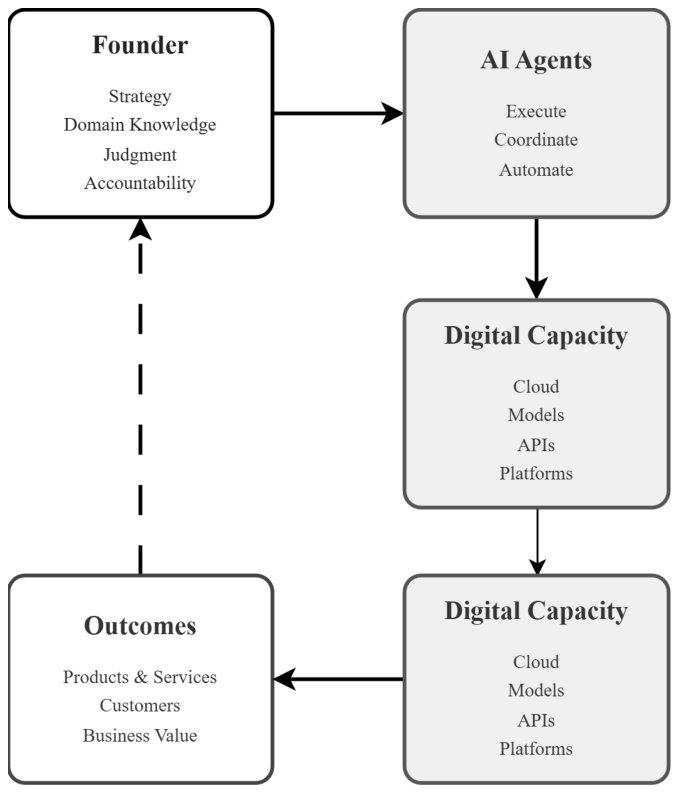
Figure 2.
High-Impact Individual Contributor as an AI-Augmented Professional. The High IC combines domain knowledge and human judgment with people and digital capabilities, orchestrating these resources to amplify individual impact. Source: The Author, 2026
Figure 2.
High-Impact Individual Contributor as an AI-Augmented Professional. The High IC combines domain knowledge and human judgment with people and digital capabilities, orchestrating these resources to amplify individual impact. Source: The Author, 2026
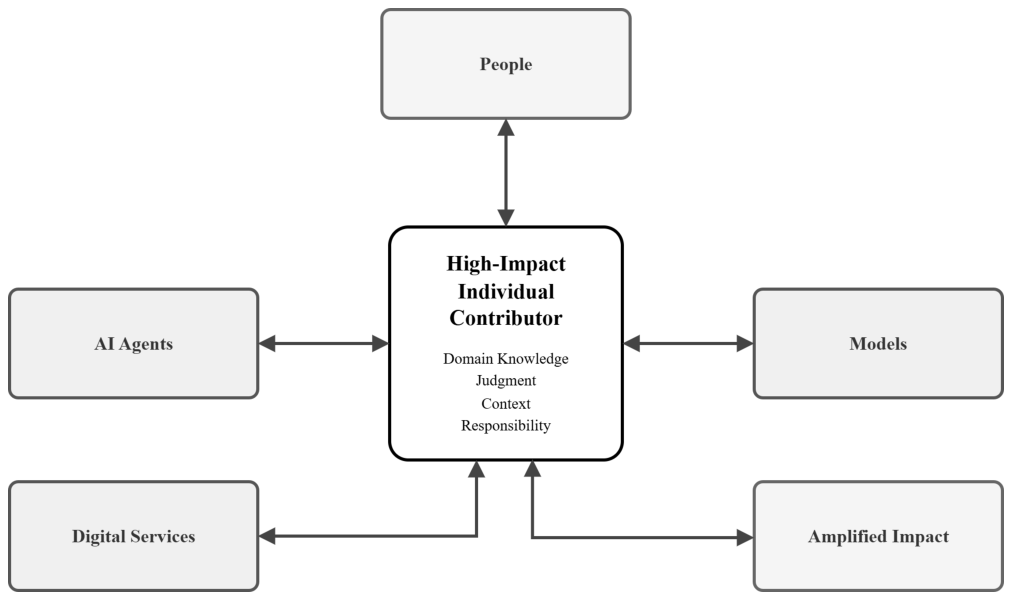
Figure 3.
The OPC Capability Stack. Human capability is amplified through the coordinated interaction of Human Capital, AI Agents, Token Capital, and Digital Platforms, while strategic direction, judgment, governance, and accountability remain human. Source: The Author, 2026
Figure 3.
The OPC Capability Stack. Human capability is amplified through the coordinated interaction of Human Capital, AI Agents, Token Capital, and Digital Platforms, while strategic direction, judgment, governance, and accountability remain human. Source: The Author, 2026
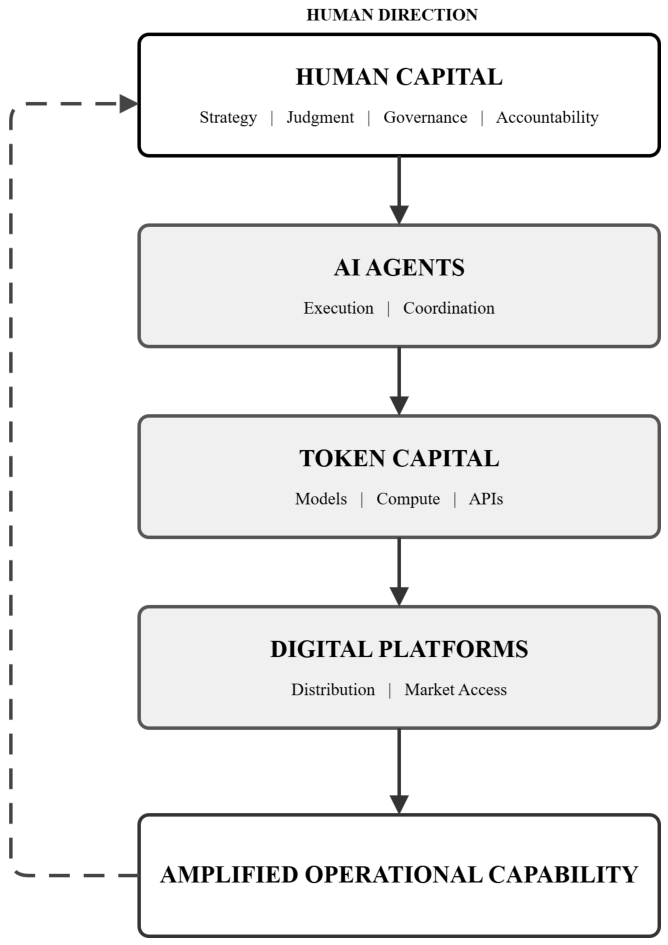

Table 1.
Illustrative AI Agent Functions within an OPC. Source: Author, 2026
| Business Function | AI Agent |
|---|---|
| Marketing | Campaign Agent |
| Sales | Prospecting Agent |
| Finance | Accounting Agent |
| Human Resources | Recruiting Agent |
| Customer Support | Support Agent |
| Development | Coding Agent |
Disclaimer/Publisher’s Note: The statements, opinions and data contained in all publications are solely those of the individual author(s) and contributor(s) and not of MDPI and/or the editor(s). MDPI and/or the editor(s) disclaim responsibility for any injury to people or property resulting from any ideas, methods, instructions or products referred to in the content. |
© 2026 by the authors. Licensee MDPI, Basel, Switzerland. This article is an open access article distributed under the terms and conditions of the Creative Commons Attribution (CC BY) license (http://creativecommons.org/licenses/by/4.0/).
Copyright: This open access article is published under a Creative Commons CC BY 4.0 license, which permit the free download, distribution, and reuse, provided that the author and preprint are cited in any reuse.