

Submitted:
06 November 2026
Posted:
09 November 2026
You are already at the latest version
Abstract
Controlled hypoalbuminemia due to high albumin leakage (Alb-L) improves mortality in dialysis patients with mild weight loss and/or inflammation. However, no study has investigated whether it reduces mortality in old-old patients who tend to have progressively worsening hypoalbuminemia, weight loss, and inflammation over time. To address this question, this study retrospectively analyzed 227 dialysis patients aged ≥75 years who were classified into a high Alb-L group (≥3 g/session, n = 93) and a low Alb-L group (<3 g/session, n = 134). Propensity score matching was performed to compare 3-year all-cause mortality, yielding 93 matched patients in each group. In our facilities, hypoalbuminemia due to high Alb-L was acceptable down to serum Alb (S-Alb) of 3.0 g/dL in patients without overt weight loss and/or inflammation. Survival was assessed using Kaplan–Meier survival curves with patients censored when their Alb-L category changed during annual follow-up assessments. Mortality was significantly lower in the high Alb-L group than in the low Alb-L group (P = 0.007, log-rank test). Adjusted Cox proportional hazards regression analysis showed that mortality remained significantly lower in the high Alb-L group (adjusted hazard ratio [HR] 0.397, 95% confidence interval 0.184-0.859, P = 0.019). In a sensitivity analysis using the overlap weighting method in all 227 patients without censoring for changes in Alb-L category, the HR for high Alb-L remained below 1.0, but was not statistically significant relative to low Alb-L. In exploratory hypothesis-generating stratified subgroup analyses, body mass index (BMI) ≥20 kg/m2, high-sensitivity C-reactive protein (hs-CRP) level ≥0.3 mg/dL, and a group with BMI <22 kg/m2 and/or hs-CRP level ≥0.3 mg/dL were associated with lower mortality rates in high Alb-L than in low Alb-L, while no associations were observed for BMI <20 kg/m2, hs-CRP level <0.3 mg/dL, and a group with BMI ≥22 kg/m2 and hs-CRP <0.3 mg/dL. Although low Alb-L was associated with reduced S-Alb and BMI, and elevated serum creatinine (S-Cr) after 3 years, high Alb-L were associated with increased BMI, decreased S-Cr, and the prevention of reduced S-Alb level. Furthermore, in patients without inflammation, either high or low Alb-L was associated with elevated hs-CRP level after 3 years. In contrast, controlled hypoalbuminemia due to high Alb-L was associated with decreased hs-CRP level in patients with mild inflammation, but low Alb-L was not. Controlled hypoalbuminemia due to high Alb-L was associated with lower mortality relative to low Alb-L in exploratory analyses of patients aged ≥75 years with mild weight loss and/or inflammation.
Keywords:
albumin leakage
; hypoalbuminemia
; mortality
; inflammation
; protein-energy wasting
; malnutrition
; elderly
1. Introduction
A meta-analysis demonstrated that mortality was significantly higher among older patients on hemodialysis (HD), especially those aged ≥75 years, than among non-elderly patients [1]. In the Japanese Society for Dialysis Therapy Renal Data Registry (JRDR) 2023 survey analyzed by the Web-based Analysis of Dialysis Data Archives [2], the average age of prevalent patients was 70.1±12.6 years, with patients aged ≥65 years accounting for 69.7% of all patients (65 to <75 years, 28.5%; 75 to <85 years, 29.8%; and ≥85 years 11.3%), and age-specific mortality rates were 8.3% in patients aged 65 to <75 years, 14.4% in those aged 75 to <85 years, and 29.3% in those aged ≥85 years.
In the JRDR 2015 survey, serum albumin (S-Alb) and normalized protein catabolism rate (nPCR) were lower and serum C-reactive protein (CRP) was higher in patients aged ≥75 years than in those aged 60 to <75 years [3]. Lower S-Alb, lower body mass index (BMI), lower serum creatinine (S-Cr), and higher CRP have been also shown to be independently associated with higher mortality in prevalent dialysis patients [4,5,6]. In incident HD patients aged ≥75 years, lower S-Alb, BMI, and S-Cr levels, and higher CRP level were independently associated with early death [7,8]. The number of older HD patients, who have higher mortality, has increased around the world. The concurrent presence of protein-energy wasting (PEW) and inflammation markedly increase mortality risk, with their combined effect being much greater than either individually [9]. It is therefore crucial to implement all possible treatments before patients progress to PEW and inflammation.
Marked hypoalbuminemia occurs not only due to PEW and inflammation, but also due to high albumin leakage (Alb-L). At our facility, for patients who do not exhibit overt PEW or inflammation, we generally aim for Alb-L ≥3.0 g/session, adjusting this amount based on the patient's symptoms and S-Alb levels. Hypoalbuminemia due to high Alb-L in such patients was considered acceptable down to 3.0 g/dL as measured by a photometric method with bromocresol green (BCG). Controlled hypoalbuminemia due to high Alb-L improves not only symptoms such as pruritus, restless legs syndrome, and fatigue, but also mortality [10,11,12]. We do not increase Alb-L in patients with overt weight loss and/or inflammation; this suggests that the mechanism for reduced mortality due to high Alb-L is increased human mercaptoalbumin (HMA) production via controlled hypoalbuminemia in patients with insufficient HMA production such as pre-PEW, early-stage PEW, or mild inflammation [12,13].
However, in clinical practice, the amount of Alb-L is often decreased in older elderly patients who are prone to have progressively worsening hypoalbuminemia, weight loss, and inflammation over time, and it remains unclear whether controlled hypoalbuminemia due to high Alb-L improves mortality in older elderly patients. We therefore investigated whether controlled hypoalbuminemia due to high Alb-L decreases mortality relative to low Alb-L in patients aged ≥75 years.
2. Materials and Methods
2.1. Study Design and Patient Selection
A total of 944 patients undergoing maintenance dialysis with HD or online hemodiafiltration (OHDF) were identified in our corporation database as of 1 July 2017 across seven facilities in Tokushima Prefecture, Japan. In the OLD-OLD study, a total of 227 patients aged ≥75 years undergoing HD using super high-flux membranes with in vitro β2-microglobulin (β2-MG) clearance ≥70 mL/min, or OHDF were selected based on previously reported exclusion criteria [11]. Patients were divided with Alb-L ≥3 g/session (high Alb-L: n=93) and Alb-L <3 g/session (low Alb-L: n=134) because mortality was significantly lower for Alb-L >3 g/session compared with <3 g/session in both patients on super high-flux HD and OHDF [11], and were recruited to prepare a PSM model (Figure 1).
The duration of each dialysis session was 4 h, with a blood flow rate of 250-350 mL/min. The membrane surface area was 2.1-2.5 m2 in HD and 2.0-3.0 m2 in OHDF, and both the dialysate flow rate (QD) in HD and total QD (QD plus the substitution volume) in OHDF were fixed at 500 mL/min.
2.2. Data Collection
Clinical data were retrospectively extracted mainly from medical records. All blood tests were measured centrally (BML, Inc., Japan). The Alb level was measured by a turbidimetric immunoassay for dialysate and by a photometric method using BCG for serum. The amount of Alb-L was measured by collecting whole dialysis waste liquid for 4 h. The average value was assigned according to the membrane types in HD, and membrane types and substitution volume in OHDF, which was reported elsewhere [10].
2.3. Outcomes
The primary endpoint was three-year all-cause mortality between the high and low Alb-L groups, assessed using a PSM model and an adjusted Cox proportional hazards model. The secondary endpoints were 3-year all-cause mortality by exploratory stratified analyses based on cut-off values for S-Alb, BMI, S-Cr, hs-CRP, and a group with BMI and hs-CRP, and by exploratory hypothesis-generating subgroup stratified analyses based on those cut-off values in each stratum to compare between the high and low Alb-L groups. Furthermore, changes for S-Alb level, BMI, S-Cr level, and hs-CRP level within-group comparisons and between-group comparisons during 3 years were included.
2.4. Preparation of PSM Pairs
Propensity scores were matched in high Alb-L vs. low Alb-L, and were calculated using age, sex, dialysis vintage, presence or absence of diabetes mellitus (DM), presence or absence of cardiovascular disease (CVD, including angina pectoris, myocardial infarction, atrial fibrillation, heart failure, stroke, peripheral artery disease, and limb amputation), administration of calcimimetics, administration of erythropoietin stimulating agents, Kt/V, β2-microgloburin, BMI, S-Cr, nPCR, S-Alb, hs-CRP, systolic blood pressure, hemoglobin, corrected calcium, and phosphate.
Propensity scores were matched for 93 pairs. Multivariable logistic regression analysis was performed with the two patient groups, categorized by high Alb-L and low Alb-L, as dependent variables. The 18 covariates listed above were used as independent variables. After logit transformation, each patient’s propensity score was calculated to 14 decimal places. Regardless of the number of cases, patients in the two groups were paired by nearest available matching at a 1:1 ratio, within calipers of 0.185566 (0.2 multiplied by the standard deviation of the logit value) for all patients in both groups [14].
2.5. Statistical Analysis
Survival was determined from the medical records, which included information on death and transfer to other hospitals. A daily survival analysis was performed for the two groups, including deaths and transfers, using the Kaplan–Meier method. In the survival analyses, death was defined as the event, whereas transfer to another hospital was treated as a censoring event. In the Kaplan–Meier survival analysis, patients were also censored annually when their Alb-L category changed between high and low Alb-L groups. As a result, only patients who remained in the same Alb-L group during the first and second years and without death or censoring events were eligible for further follow-up.
Differences in survival between the two groups after PSM were assessed using the log-rank test, and unadjusted and adjusted hazard ratios (HRs) were estimated using a Cox proportional hazards model. Balance between groups after PSM was primarily assessed using standardized mean differences (SDMs), together with conventional statistical comparisons. All-cause mortality was compared using a Cox model adjusted for covariates that remained imbalanced after PSM. Covariates were selected for this Cox model based on comprehensive consideration of SMDs, statistical comparisons, clinical relevance, and potential residual confounding. Specifically, age and Hb, which showed statistically significant between-group differences after matching and had relatively large SDMs, were included as covariates and the association between the groups and all-cause mortality was evaluated after adjusting for these factors.
We conducted a sensitivity analysis using the overlap weighting method (OWM). A daily survival analysis was performed for the two groups, using the Kaplan–Meier method, without censoring patients for annual changes in Alb-L category. Death was treated as the event, and transfer to another hospital was treated as a censoring event. For all 227 patients, we applied overlap weighting to ensure balance patient characteristics between the groups and compared all-cause mortality using propensity scores. The weights used for the OWM were calculated from propensity scores derived from logistic regression, with 18 baseline covariates serving as explanatory variables. The OWM was applied to adjust for the measured baseline covariates, and the analysis utilized a weighted Cox proportional hazards model incorporating only the variable of Alb-L (high or low) as the explanatory variable to estimate the HR and its 95% confidence interval (CI) and to test the association between high Alb-L and all-cause mortality.
The exploratory stratified analyses for all-cause mortality after PSM were carried out based on S-Alb level for threshold of 3.0 g/dL, BMI for threshold of 20 kg/m2, S-Cr level for threshold of 6.5 mg/dL, hs-CRP level for threshold of 0.3 mg/dL and 2.0 mg/dL, and a group with BMI and hs-CRP for thresholds of 22 kg/m2 and 0.3 mg/dL between the groups. The statistical significance of differences between the groups was assessed using the log-rank test. Then, we performed exploratory hypothesis-generating subgroup stratified analyses based on those thresholds in each stratum between high and low Alb-L groups. The stratified analyses were not performed for any group containing fewer than 20 patients.
For four variables (S-Alb, BMI, S-Cr, and hs-CRP levels), comparisons were performed using data from the matched cohort of 186 patients (93 patients in each group). Two types of comparisons were conducted for within-group comparisons for high and low Alb-L groups, and between-group comparisons during the study. For the within-group comparisons, changes from baseline to 1, 2, and 3 years were evaluated separately within each Alb-L group using the Wilcoxon signed-rank test for paired samples. For the between-group comparisons, differences between high and low Alb-L groups at baseline and after 1, 2, and 3 years were assessed using the Mann–Whitney U test for independent samples.
All analyses were performed using SPSS Statistics for Windows (ver. 26, IBM Corp., Armonk, NY). Two-tailed P-values of <0.05 were considered statistically significant.
2.6. Ethical Consideration
This study was approved by the Research Ethics Committee of Kawashima Hospital on April 7, 2026, and registered in the UMIN Clinical Trials Registry (UMIN000061262 registered April 14, 2026 - prospectively registered, https://center6.umin.ac.jp/cgi-bin/ctr/ctr_view_reg.cgi?recptno=R000070101). All clinical investigations were conducted according to the principles of the Declaration of Helsinki. The need to obtain informed consent was waived by the Research Ethics Committee of Kawashima Hospital. The research information was disclosed to patients before enrollment based on the Ethical Guidelines for Life Science and Medical Research Involving Human Subjects.
3. Results
The mean observation periods for high and low Alb-L groups were 543.3±293.6 and 528.6±294.4 days, respectively. The numbers of deaths, transfers to other hospitals, and censored cases for Alb-L groups including missing values were respectively 9, 2, and 32 in high Alb-L and 24, 0, and 19 in low Alb-L.
3.1. Comparison of Three-Year All-Cause Mortality Between the High and Low Alb-L Groups
Table 1 compares variables before and after PSM. In the matched high and low Alb-L groups, Alb-L was 4.3±1.5and 1.8±0.5 g/session, respectively (P<0.001). After matching, age was lower and Hb level was higher in the high Alb-L group than in the low Alb-L group. Although there were no significant differences in BMI and hs-CRP level between the groups, mean hs-CRP level and mean BMI were respectively above and below the normal range.
Three-year all-cause mortality was significantly lower in high Alb-L than in low Alb-L (P=0.007, log-rank test) as shown in Figure 2. The survival rates after 1, 2, and 3 years were 94.6%, 85.4% and 80.7% for high Alb-L and 87.1%, 70.2%, and 48.2% for low Alb-L, respectively. Unadjusted Cox regression analysis showed a significantly lower hazard of three-year all-cause mortality in high Alb-L than in low Alb-L (HR 0.364, 95% CI 0.169-0.783, P=0.010). In Cox regression analysis, adjusted for significant covariates after matching (age and Hb), the hazard of 3-year all-cause mortality remained significantly lower in high Alb-L (adjusted HR 0.397, 95% CI 0.184-0.859, P=0.019).
After applying the OWM, the absolute values of the SMDs for all covariates were less than 0.001 (Table S1). The number of deaths was 30 in the high Alb-L group and 61 in the low Alb-L group. No significant difference in survival was observed between the two groups after OWM (P=0.261, robust score test) (Figure S1). Although the hazard of all-cause mortality was significantly lower in the high Alb-L group than in the low Alb-L group in the unadjusted Cox model (HR, 0.634, 95% CI, 0.411-0.978, P=0.039, robust Wald test), the association was attenuated and was no longer statistically significant in the overlap-weighted Cox model (HR, 0.764, 95% CI, 0.474-1.233, P=0.271, robust Wald test).
3.2. Comparison of Three-Year All-Cause Mortality by Exploratory Stratified Analyses Based on Thresholds for S-Alb Level, BMI, S-Cr Level, hs-CRP Level, and a Group with BMI and hs-CRP Level
Because numbers of patients with hs-CRP level ≥2.0 mg/dL were 19, its stratified analysis did not perform. The mortality rates on S-Alb level ≥3.0 g/dL, S-Cr level ≥6.5 mg/dL, hs-CRP level <0.3 mg/dL, and a group with BMI ≥22 kg/m2 and hs-CRP <0.3 mg/dL were significantly lower than those on <3.0 g/dL, <6.5 mg/dL, ≥0.3 mg/dL, and <22 kg/m2 and/or ≥0.3 mg/dL group as shown in Table 2.
3.3. Comparison of Three-Year All-Cause Mortality by Exploratory Hypothesis-Generating Subgroup Stratified Analyses Based on Thresholds for S-Alb Level, BMI, S-Cr Level, hs-CRP Level, and a Group with BMI and hs-CRP Level in Each Stratum Between the High and Low Alb-L Groups
The mortality rates in BMI ≥20 kg/m2, hs-CRP level ≥0.3 mg/dL, and a group with BMI <22 kg/m2 and/or hs-CRP level ≥0.3mg/dL were significantly lower among high Alb-L than among low Alb-L (P=0.013, P=0.028, and P=0.046, log-rank test), but not with S-Alb level <3.0 g/dL, BMI <20 kg/m2, or a group with ≥22 kg/m2 and <0.3 mg/dL as shown in Table 3. The mortality rate on S-Alb ≥3.0 g/dL tended to decrease by high Alb-L relative to low Alb-L (P=0.053, log-rank test).
3.4. Comparison of Changes for S-Alb Level, BMI, S-Cr Level, and hs-CRP Level After 3 Years Between the High and Low Alb-L Groups
Although there was a significant reduction from the baseline S-Alb level of 3.2±0.5 g/dL in the low Alb-L group after 3 years (P<0.001), there was no change from the baseline of 3.3±0.3 g/dL in the high Alb-L group. However, S-Alb did not significantly differ between the groups during the study. Although BMI significantly decreased from baseline in the low Alb-L group (P=0.001), it significantly increased in the high Alb-L group (P=0.004), though there were no significant differences in BMI between the groups during the study. S-Cr significantly increased from baseline in the low Alb-L group (P=0.007) but significantly decreased in the high Alb-L group (P=0.008). There was a significant difference in S-Cr between the groups at 2 years, but not 1 and 3 years. There was no significant difference in hs-CRP levels between the groups. Although both the high and the low Alb-L groups showed significant increases in hs-CRP in patients with hs-CRP of <0.3 mg/dL (P=0.033 or P<0.001, respectively), hs-CRP levels significantly decreased in patients in the high Alb-L group with hs-CRP ≥0.3 mg/dL (P=0.001), but not in the low Alb-L group. However, there were no significant differences between the groups, regardless of inflammation status during the study (Figure S2-S5).
4. Discussion
Controlled hypoalbuminemia (≥3.0 g/dL by the BCG method) due to high Alb-L was associated with lower 3-year all-cause mortality relative to low Alb-L in older patients aged ≥75 years, particular in exploratory analyses of patients with pre-PEW, early-stage PEW, or mild inflammation. However, in a sensitivity analysis using OWM, the HR for the high Alb-L group over the entire follow-up period was less than 1.0, indicating a tendency in the same direction as that observed in the primary analysis, but statistical significance was lost. Consequently, the robustness of the primary analysis results could not be fully confirmed. Additionally, high Alb-L was associated with preserved nutritional status and possible muscle mass loss. Furthermore, it was associated with reduced inflammatory status only in patients with inflammation.
The Dialysis Outcomes and Practice Patterns Study (DOPPS) demonstrated that CRP of >0.3 mg/dL is a risk factor for mortality, and only Japanese HD patients had a median CRP level within the normal range of ≤0.3 mg/dL, while the median levels in other participating countries exceeded 0.5 mg/dL [6]. Prognosis is poor in older patients on dialysis, especially those aged ≥75 years [1]. In the JRDR 2006-2007 survey, S-Alb <3.0 g/dL, BMI <20 kg/m2, S-Cr <6.5 mg/dL, and CRP >2.0 mg/dL were independently associated with early death in incident HD patients aged ≥75 years [7]. In the present study, S-Alb <3.0 g/dL, S-Cr <6.5 mg/dL, hs-CRP ≥0.3 mg/dL, and a group with BMI <20 kg/m2 and/or hs-CRP level ≥0.3 mg/dL were associated with increased mortality in exploratory analyses. S-Cr level can be a good indicator for muscle mass, and muscle mass has been reported to modify the association between BMI and mortality in HD patients [5]. Since weight loss, decreased muscle mass, and inflammation are associated with sarcopenia, a precursor condition of frailty and PEW, it is important to prevent decreases in S-Alb, S-Cr, and BMI, as well as an increase in hs-CRP.
Hypoalbuminemia was reported to be a risk factor for death in Japanese HD patients in 1991-1992 [4] and 2006-2007 [7]. Because Alb-L in HD was suppressed before the introduction of OHDF in 2012, the higher mortality associated with hypoalbuminemia was caused by the presence of severe PEW and marked inflammation, not by high Alb-L. Hypoalbuminemia also causes adverse conditions such as edema, hypovolemia, and increased production of fibrinogen and other substances. On the other hand, in 2004, it was noted that S-Alb has limited utility as a predictor of mortality [15], and in 2012, it was reported that the predictive accuracy is low for nutritional status based on S-Alb in addition to age, sex, DM, and CVD [16]. In Europe and the United States, where chronic inflammation is a common comorbidity [6], the coexistence of hypoalbuminemia and inflammation has been considered a sign of poor prognosis [17,18]. Therefore, conditions for HD and OHDF have long been established to remove uremic toxins including a broader range of middle molecules while minimizing Alb-L to ≤3.4 g/session [17].
In Japan, where chronic inflammation is less common [6], mild hypoalbuminemia itself has been not considered an independent predictor of increased mortality. We have reported that controlled hypoalbuminemia due to high Alb-L improved symptoms such as itching and also improved survival [10,11,12]. In our institutions, the lower limit of the acceptable S-Alb level (BCG method) due to high Alb-L has been set at 3.0 g/dL in patients without overt PEW or marked inflammation. In the present exploratory stratified analyses, high Alb-L was not associated with improved mortality in patients with S-Alb <3.0 g/dL and tended to reduce mortality in patients with S-Alb ≥3.0 g/dL. In the 3-year longitudinal data for patients with S-Alb ≥3 g/dL, there were some patients whose S-Alb temporarily fell below 3.0 g/dL as seen from the mean ± standard deviation (Figure S2). Therefore, we can infer that among the group of patients whose S-Alb was consistently maintained at ≥3 g/dL, the mortality might be significantly lower in high Alb-L than in low Alb-L. At our facilities, the analysis method changed from the BCG to the bromocresol purple method in 2022. Because S-Alb ≤3.5 g/dL measured using BCG would be reduced by 0.3 g/dL when measured using bromocresol purple, the acceptable level for S-Alb was changed to 2.7 g/dL from 3.0 g/dL following this change. However, the crude annual mortality rate in 2023 was lower in our facilities than in the JRDR overall [2] (6.8% vs. 11.0%).
At Japanese facilities other than ours, high-performance membranes capable of efficiently removing a wider range of middle molecules while minimizing Alb-L, have been used in HD for over 30 years. As the results, the average β2-MG levels in 2017 were same for both HD and OHDF, at 27.0 mg/L, marking a difference from the situation in other countries [19]. Recently, an increasing number of facilities are inducing controlled hypoalbuminemia due to high Alb-L using predilution and postdilution OHDF, based on our reports in which we first demonstrated that mortality is not significantly different between Japanese-style predilution OHDF and postdilution OHDF [20]. Then, mortality rates were found to be lower in high Alb-L than in low Alb-L for both super high-flux HD with in vitro β2-MG clearance ≥50 mL/min and OHDF integrating predilution and postdilution, and equivalent between HD and integrated OHDF among patients with similar Alb-L and S-Alb levels [10]. Mortality is also significantly lower in high Alb-L super high-flux HD with in vitro β2-MG clearance ≥70 mL/min than in low Alb-L integrated OHDF [11].
However, the aforementioned studies [10,11,12,20] included a mix of patients aged <75 years and ≥75 years, and the effect of high Alb-L on mortality reduction in patients aged ≥75 years is unknown. In clinical practice, Alb-L is decreased with age (<65 years, 5.3±2.6 g/session; 65-74 years, 3.8±2.4 g/session; 75-84 years, 2.9±1.6 g/session; and ≥85 years, 2.2±1.5 g/session) [11]. This reduction is presumably related to lower S-Alb, higher CRP, and weight loss with aging. In the present study, controlled hypoalbuminemia due to high Alb-L was associated with lower mortality than low Alb-L in patients aged ≥75 years, and showed associations with pre-PEW, early-stage PEW, and mild inflammation in exploratory analyses, but not with progressive PEW (BMI <20 kg/m2) and not with the absence of PEW and inflammation (a group with BMI ≥22 kg/m2 and hs-CRP <0.3 mg/dL). To reduce mortality in old-old patients with BMI <20 kg/m2, the administration of calcimimetics may be useful given that calcimimetic use is reported to decrease mortality in patients aged ≥72 years with BMI <20 kg/m2 relative to non-use [21].
The mechanism by which high Alb-L improves survival outcomes is not entirely clear. One possible contributor is the removal of large-middle molecules, which is strongly correlated with Alb-L [22,23], as fibroblast growth factor 23 levels have been associated with mortality in HD and OHDF patients [24]. However, its levels before and after postdilution OHDF remain high at 785.5±125.5 and 667.2±94.1 pg/mL [25]. When removal rate of α1-microglobulin (α1-MG) was 42.0±12.3%, serum α1-MG levels were 103.1±18.4 mg/L before OHDF and 68.4±15.3 mg/L after OHDF, which were still 3.4 to 6.8 times higher than in healthy individuals (10-20 mg/L) [10]. Since further increasing the removal amounts of large-middle molecules leads to severe hypoalbuminemia, it is impossible to normalize these concentrations. On the other hand, controlled hypoalbuminemia can remove by diffusion more of the free form of indoxyl sulfate that binds to albumin at a high rate. However, high Alb-L is not highly effective at removing the total amount of indoxyl sulfate including its Alb-binding form. [23].
S-Alb is composed of a mixture of HMA, reversible oxidized human non-mercaptoalbumin-1 (HNA-1), and irreversible HNA-2. HMA production in the liver is stimulated by hypoalbuminemia due to high Alb-L [26]. S-Alb levels before and after 12 weeks were unchanged in postdilution OHDF with Alb-L of 0.6±0.8 g/session, but were significantly increased in super high-flux HD with Alb-L of 4.2±2.8 g/session [27]. However, that study did not report CRP levels. In the present study, high Alb-L of 4.3±1.5 g/session with hs-CRP of 0.508±1.349 mg/dL prevented the reduction in S-Alb, though there was a decrease in S-Alb after 3 years with low Alb-L of 1.8±0.5 g/session and hs-CRP of 0.882±2.020 mg/dL. However, a significant longitudinal decrease in S-Alb levels within a group—observed within a context where there is no significant difference between groups—must be interpreted with caution.
In patients without overt weight loss and/or inflammation, high Alb-L will result in either controlled hypoalbuminemia or uncontrolled hypoalbuminemia. Controlled hypoalbuminemia improves albumin quality by increasing the HMA level over several days. In cases where clinical symptoms such as itching are present and S-Alb levels are above the acceptable level, further increasing the amount of Alb-L may lead to improvement of these clinical symptoms. Uncontrolled hypoalbuminemia reduces S-Alb below 3.0 g/dL via profound impairment of HMA production in patients with progressive PEW and/or inflammation, or other conditions. In these patients, Alb-L must be reduced until the S-Alb level reaches at least 3.0 g/dL.
Randomized controlled trials (RCTs) have suggested that hypoalbuminemia is associated with improved survival outcomes. An RCT on membrane permeability, which compared mortality between high-flux and low-flux membranes, demonstrated that mortality was significantly lower with high-flux membrane compared with low-flux membrane in patients with S-Alb ≤4.0 g/dL, but not in patients >4.0 g/dL [28]. Given the high prevalence of chronic inflammation among European patients on dialysis, it seems that the decrease in S-Alb levels resulting from slightly higher Alb-L with a high-flux membrane improved survival. Out of 5 European RCTs that compared mortality between high-volume postdilution OHDF and HD with high-flux or low-flux membranes [29,30,31,32,33], 2 RCTs [29,33] demonstrated that OHDF significantly decreased mortality relative to HD. Only the ESHOL study showed that, over time, S-Alb was significantly decreased from 4.1 g/dL at baseline to 3.9 g/dL after 36 months on OHDF [29]. The CONVINCE study did not analyze S-Alb for reasons that remain unclear [33]. However, the CONTRAST study, the Turkish RCT, and the FRENCHIE study [30,31,32], which failed to demonstrate a survival advantage of OHDF, showed no significant reduction in S-Alb levels in OHDF. Since European-style postdilution OHDF is not adjusted to achieve higher Alb-L because chronic inflammation is a common comorbidity, the mean S-Alb and CRP levels in 3 RCTs [30,31,32] were from 3.8 to 4.1 g/dL at baseline and during follow-up, and from 1.0 to 1.7 mg/dL at baseline. A meta-analysis of 5 European RCTs [34] showed that mortality decreased as total convection volume (CV) increased. Although total CV determines the amount of large-middle molecular removal, the paper did not provide data on S-Alb levels during the course of the study for each total CV level.
Since high-volume postdilution OHDF with low Alb-L membranes is associated with increased Alb-L relative to HD with low Alb-L membranes, we consider that the primary mechanism by which high total CV in postdilution OHDF with low Alb-L membranes reduced mortality [34] was the mitigation of oxidative stress through HMA production by hypoalbuminemia due to higher Alb-L. This would result from increased transmembrane pressure even with a high blood flow rate through the high total CV. Furthermore, we must recognize that those RCTs were limited by heterogeneity of inclusion criteria and major methodological shortcomings, including informational selection bias and exclusion of patients with poor treatment outcomes in the OHDF group following randomization [35]. Additionally, those RCTs were typically conducted in patients under the age of 75 years without PEW, and there was a low prevalence of DM, because age, DM history, and BMI in the OHDF arm were respectively 64.5±14.4 years, 22.8%, and not reported [29]; 64.1±14.0 years, 26.0%, and 25.2±5.0 kg/m2 [30]; 56.4±13.0 years, 36.3%, and 24.9±4.9 kg/m2 [31]; and 62.5±13.5 years, 33.7%, and 27.4±5.6 kg/m2 [33]. In an RCT involving elderly participants with a mean age of 76.3±6.1 years, the mean BMI was 26.3±5.1 kg/m², with 19.7% of participants had a BMI ≥30 kg/m² [32]. Based on the above, these RCTs did not necessarily reflect clinical practice. There is a need for RCTs capable of overcoming these significant biases and the problem of patient selection not reflecting real-world clinical practice in existing RCTs.
The postdialysis HMA ratio was higher than the predialysis HMA ratio in HD patients, and the adjusted odds ratios were found to be 2.5 and 25.6, respectively, for cardiovascular mortality in patients with a pre-HD HMA fraction of <40% versus ≥40% and a post-HD HMA fraction of <60% versus ≥60% [36]. Given that the half-life of Alb is approximately 21 days, the increase in postdialysis HMA level appears to be conversion from HNA-1 during an HD session. This conversion might be suppressed by older age, weight loss, and CVD [36]. The liver immediately synthesizes free α1-MG upon upregulation of the α1-MG-bikunin precursor gene by reactive oxygen species and other substances with short half-lives in blood [37,38]. Because strong oxidative stress at the initiation of and during dialysis induces a marked increase in production of free α1-MG, which has potent antioxidant activity, we hypothesized that free α1-MG rapidly reacts with substances that are reversibly bound to the 34 residues on HNA-1, resulting in conversion to HMA during dialysis. HNA-2 reacted irreversibly and cannot be converted to HNA-1 and HMA. In contrast, from post-dialysis to the next dialysis session, the antioxidant capacity is mainly attributable to the very large amount of HMA [12], as shown in Figure 3. The daily production of HMA and free α1MG in healthy individuals is 10-15 g and 200-300 mg, respectively, which is 33.3-75.0 times higher for HMA.
CRP is a pentameric protein synthesized by the liver in response to inflammation and has a molecular weight of approximately 115 kDa [39]. Thus, CRP cannot be removed by HD or OHDF [40]. Because the most significant signal for stimulation of CRP synthesis is mediated by interleukin-6 (IL-6) [39], the CRP level can decrease by inhibiting IL-6 production through the use of a bisphenol A-free membrane [41], acetate-free dialysate [42], and ultrapure dialysis water [43]. In children with inflammation, hs-CRP levels were significantly reduced in postdilution OHDF compared with high-flux HD, but there was no difference in IL-6 between the groups [44]. On the other hand, a meta-analysis of 24 RCTs, including 22 RCTs of postdilution OHDF, demonstrated that CRP was significantly lower in OHDF than in HD, but hs-CRP and IL-6 were not [45]. This discrepancy may have been influenced by the number of RCTs (CRP, n=12; hs-CRP, n=3; IL-6, n=7) or other aspects. Furthermore, secondary outcomes for inflammatory change over time, which were prespecified in the CONTRAST study, demonstrated that CRP and IL-6 levels increased in low-flux HD but remained stable in postdilution OHDF, with both CRP and IL-6 showing significant differences between the groups [46]. Because CRP levels at baseline in postdilution OHDF and low-flux HD were both 0.4 (0.1 to 1.0) mg/dL, there was a mixture of patients with and without inflammation. Additionally, most patients were undergoing dialysis with low Alb-L. In a crossover study in which the same patients and membrane without inflammation underwent a 3-week crossover between predilution OHDF with Alb-L of 2.5±0.4 g/session and postdilution OHDF with Alb-L of 3.5±0.5 g/session. The results showed no significant differences in hs-CRP and IL-6 levels between the groups during the study [47].
In the present study, fluctuation in hs-CRP differed depending on the presence or absence of inflammation and the amount of Alb-L. Both high Alb-L and low Alb-L were associated with elevated hs-CRP levels during the 3-year study period in patients without inflammation. However, only high Alb-L with controlled hypoalbuminemia was associated with decreased hs-CRP over 3 years in patients with impaired HMA production and increased oxidative stress due to inflammation. This suggests that controlled hypoalbuminemia due to high Alb-L might improve inflammation only in patients with mild inflammation through a reduction in oxidative stress by producing HMA [26]. The reduction in oxidative stress primarily suppresses the activation of the NF-κB and MAPK pathways, thereby inhibiting production of inflammatory cytokines and reducing hepatic CRP production mediated by IL-6 [48]. On the other hand, it is possible that either high Alb-L or high total CV may lower CRP by removing IL-6, which is a medium-middle molecule, as shown in Figure 4. Calcimimetics reduced hs-CRP levels after 1 year only in patients with hs-CRP levels of 0.3 mg/dL or higher, although this effect was not observed after 2 years [21]. While calcimimetics reduced oxidative stress [49], the sustained reduction in hs-CRP levels over 3 years with high Alb-L suggests that the effect is strengthened by controlled hypoalbuminemia due to high Alb-L promoting production of HMA.
In the present study, controlled hypoalbuminemia due to high Alb-L might be associated with increased BMI and decreased S-Cr level. Slight weight loss every 6 months in COSMOS study 2005-2007 [50] and during 4 months in the DOPPS 2002-2018 [51] was strongly associated with increased mortality. After stratification by BMI category, this was particularly pronounced in the non-obese categories, especially in underweight patients [50]. Thus, controlled hypoalbuminemia due to high Alb-L may also improve survival by promoting weight gain. On the other hand, S-Cr, a marker of muscle mass volume was a stronger predictor of mortality than weight loss [52], and decreased S-Cr levels were positively associated with mortality regardless of BMI range in the JRDR [5]. HD decreases circulating amino acids [53], accelerates muscle protein breakdown, and increases the release of amino acids from muscles [54]. High Alb-L decreases serum levels of amino acids, which can stimulate muscle protein synthesis and suppress muscle protein breakdown [55] and can also decrease S-Cr levels. Controlled hypoalbuminemia due to high Alb-L was associated with the prevention of decreased S-Alb, elevated BMI, and decreased S-Cr in addition to improved survival. Therefore, amino acid supplementation may help maintain muscle mass and further improve nutritional status, potentially leading to better survival outcomes.
This study had some limitations. First, the number of patients was the relatively small in comparison with a nationwide database. To address this issue, we applied a caliper width of 0.2 times the standard deviation of the logit propensity score for all cases, which is a widely used approach in PSM [14]. However, some residual imbalance remained after matching. To mitigate this issue, we additionally adjusted for these covariates in the Cox proportional hazards regression models. This approach enabled us to further control for any remaining imbalance in these key variables. Because this study focused on HD patients using super high-flux membranes with in vitro β2-MG clearance ≥70 mL/min, which are associated with lower mortality, and on OHDF patients, the limited number of events led to a low events-per-variable ratio, which may have reduced the precision of the estimates. Therefore, our findings should be interpreted as exploratory rather than definitive. Second, post-matching outcome regression should ideally account for the matched design. Although our primary analysis did not explicitly stratify on matched pairs, future studies using larger samples should apply stratified or robust approaches to further strengthen statistical inference. The lack of perfect matching is considered representative of actual clinical practice: after matching, patients in the high Alb-L group were younger and higher Hb level. This cohort study suggests that high Alb-L may be associated with improved survival, as demonstrated by Cox proportional hazards regression models adjusted for residual imbalances remaining after matching, although residual confounding cannot be excluded. Third, even after PSM, substantial imbalances remained in several key covariates; given the relatively small sample size and high rate of censoring, simply adjusting for these variables in a Cox model was insufficient to fully resolve this concern. Therefore, while the PSM analysis was designated as the primary analysis, the OWM was added as a sensitivity analysis. The additional survival analysis was performed using the full pre-PSM cohort of 227 cases, fixing group assignments at baseline, and without censoring for subsequent changes in Alb-L category. Furthermore, when only the high and low Alb-L groups were entered into the Cox model after adjustment for confounding by the OWM, the results were consistent in direction with the primary analysis. Fourth, due to the retrospective observational design, causality cannot be determined.
Finally, data on the residual kidney function was not available, although all HD and OHDF patients had a dialysis vintage >3 months. Well-designed prospective studies with larger sample sizes and prespecified subgroup analyses, and ideally RCTs are needed to confirm these findings and establish the causal relationship between Alb-L and survival.
5. Conclusion
This study first proposed that controlled hypoalbuminemia (≥3.0 g/dL by the BCG method) due to high Alb-L was associated with lower 3-year all-cause mortality relative to low Alb-L in exploratory analyses of patients aged ≥75 years with pre-PEW, early-stage PEW, or mild inflammation. The mechanism is suggested mainly to improve oxidative stress due to elevated HMA production by controlled hypoalbuminemia in patients with insufficient HMA production. Because controlled hypoalbuminemia due to high Alb-L might be associated with preserved nutritional status and decreased muscle mass, amino acid supplementation may help maintain muscle mass and further improve nutritional status, potentially leading to better survival outcomes. Furthermore, controlled hypoalbuminemia due to high Alb-L might be associated with reduced inflammatory status in patients aged ≥75 years with pre-existing mild inflammation.
Most existing RCTs on this topic had serious bias and the enrolled patients were typically under the age of 75 years, potentially with a low prevalence of conditions such as DM. Thus, there is a need for well-designed RCTs with free from significant bias that reflect real-world clinical practice.
Since there did not appear to be any significant differences in unobserved background factors such as quality of healthcare management in our organization, which has seven facilities that follow our internal guidelines to ensure unified basic healthcare management, our cohort studies with central measurements of blood tests can be regarded as highly reliable. To verify our findings showing that controlled hypoalbuminemia due to high Alb-Lis associated with improved survival in patients with pre-PEW, early-stage PEW, or mild inflammation, it would be useful to perform an analysis that integrates data from the 5 European RCTs mentioned above, especially for OHDF patients with BMI of 20-22 kg/m², corresponding to 21.5-23.5 kg/m² for Europeans, based on our suggestion and/or hs-CRP of 0.3-1.7 mg/dL corresponding to CRP of 0.5-1.7 mg/dL based on the World Health Organization’s definition of inflammation and the highest mean values observed in the Turkish RCT. In particular, we propose comparing all-cause mortality between patients with S-Alb levels of 3.0-3.5 g/dL (BCG method) and those with ≥3.8 g/dL. Additionally, it is necessary to compare the differences in S-Alb levels across the different CV groups throughout the course of the integrated RCTs.
Supplementary Materials
The following supporting information can be downloaded at: Table S1. Comparison of variables before and after overlap weighting between high and low albumin leakage (Alb-L) groups. Figure S1. Comparison of two-year all-cause mortality between high and low albumin leakage (Alb-L) groups using the Kaplan–Meier survival curves by an overlap weighting method without propensity score matching and censoring patients for annual change in Alb-L category; Figure S2. Change of serum albumin levels between high and low albumin leakage (Alb-L) groups during the study; Figure S3. Change of body mass index (BMI) between high and low albumin leakage (Alb-L) groups during the study; Figure S4. Change of serum creatinine levels between high and low albumin leakage (Alb-L) groups during the study; Figure S5. Change of high-sensitivity C-reactive protein (hs-CRP) levels between high and low albumin leakage (Alb-L) groups during the study. A) All patients B) Patients with hs-CRP ≥0.3 mg/dL C) Patients with hs-CRP <0.3 mg/dL.
Author Contributions
K.O. was responsible for the research idea and study design, and contributed to the drafting of the manuscript. M.T., H.M., D. H., S. A., R. M., T.I., T.K., and J.M. contributed to the design, interpretation of data and revision of the manuscript.
Funding
This research received no specific grant from any funding agency in the public, commercial or not-for-profit sectors.
Institutional Review Board Statement
This study was approved by the Research Ethics Committee of Kawashima Hospital on April 7, 2026 (approval number 1433-1439). All clinical investigations were conducted according to the principles of the Declaration of Helsinki.
Informed Consent Statement
The need to obtain informed consent was waived by the Research Ethics Committee of Kawashima Hospital. The research information was disclosed to patients before enrollment based on the Ethical Guidelines for Life Science and Medical Research Involving Human Subjects.
Data Availability Statement
The data supporting the findings of this study are available from Japan Institute of Statistical Technology (https://www.jiost.com/). The data are available from the authors upon reasonable request and with the permission of the Research Ethics Committee of Kawashima Hospital. If someone wants to request the data from this study, please contact Kazuyoshi Okada (kokada@ckdjapan.jp).
Acknowledgments
We are grateful to all of the staff in our medical corporation for providing a similar quality of healthcare management and dialysis conditions across facilities. We are also grateful to Dr. Shigeaki Ohtsuki of Japan Institute of Statistical Technology for performing the statistical analysis.
Conflicts of Interest
K.O., M.T., T.I., and J.M. received funding for specific clinical research (Japan Registry of Clinical Trials registration number jRCTs032220723) from Nipro Co., Ltd. and specific clinical research (Japan Registry of Clinical Trials with the registration number jRCTs062190020) from Asahi Kasei Medical Co., Ltd.. K.O. reports personal fees from Kyowa Kirin Co., Ltd., Bayer Yakuhin, Ltd., Ono Pharmaceutical Co., Ltd., Kissei Pharmaceutical Co., Ltd., AstraZeneca Plc., Torii Pharmaceutical Co., Ltd, Sanwa Kagaku Kenkyusho Co., Kowa Co., Ltd., Nippon Boehringer Ingelheim Co., Ltd., Eli Lilly Japan K.K., and Vantive Japan. M. T. reports personal fees from Nippon Boehringer Ingelheim Co., Ltd., Eli Lilly Japan K.K., Toray Medical Co., Ltd., Novartis Pharm Co. Ldt., Otsuka Pharmaceutical Co., Ltd., Nova Biomedical Co., Ldt., and JMS Co. Ldt. H.M. reports personal fees from JMS Co. Ldt. and Fuso Pharmaceutical Industries, Ltd.. T.I. reports personal fees from Nipro Co., Ltd., Kyowa Kirin Co., Ltd., AstraZeneca Plc., Torii Pharmaceutical Co., Ltd., Otsuka Pharmaceutical Co., Ltd., Terumo Co. Ltd., JMS Co. Ldt., and Fuso Pharmaceutical Industries, Ltd.. T.K. reports personal fees from Kyowa Kirin Co., Ltd., personal fees from Astellas Pharma Inc., personal fees from Bayer Yakuhin, Ltd., grants and personal fees from Ono Pharmaceutical Co., Ltd., grants from Kissei Pharmaceutical Co., Ltd., personal fees from Mitsubishi Tanabe Pharma Corporation, personal fees from Vantive Japan, personal fees from AstraZeneca Plc., personal fees from Torii Pharmaceutical Co., Ltd, personal fees from Sanwa Kagaku Kenkyusho Co., Ltd, and personal fees from Kaneka Medical products. J.M. reports personal fees from Kyowa Kirin Co., Ltd., Ono Pharmaceutical Co., Ltd., Kissei Pharmaceutical Co., Ltd., Vantive Japan, AstraZeneca Plc., Torii Pharmaceutical Co., Ltd, Sanwa Kagaku Kenkyusho Co., Nippon Boehringer Ingelheim Co., Ltd., Eli Lilly Japan K.K., Novartis Pharm Co. Ldt., Otsuka Pharmaceutical Co., Ltd., Chugai Parmaceutical Co., Ltd., Terumo Co. Ltd., and JMS Co. Ldt.. D. H., S. A., and R. M. have no Conflict of Interest.
Abbreviations
The following abbreviations are used in this manuscript:
| Alb-L | albumin leakage |
| α1-MG | α1-microglobulin |
| BCG | bromocresol green |
| β2-MG | β2-microglobulin |
| BMI | body mass index |
| CRP | C-reactive protein |
| CV | convection volume |
| CVD | cardiovascular disease |
| DM | diabetes mellitus |
| DOPPS | Dialysis Outcomes and Practice Patterns Study |
| HD | hemodialysis |
| HMA | human mercaptoalbumin |
| HNA | human non-mercaptoalbumin |
| hs-CRP | high-sensitivity C-reactive protein |
| IL-6 | interleukin-6 |
| JRDR | Japanese Society for Dialysis Therapy Renal Data Registry |
| nPCR | normalized protein catabolism rate |
| OHDF | online hemodiafiltration |
| PEW | protein-energy wasting |
| PSM | propensity score matching |
| QD | dialysate flow rate |
| RCTs | randomized controlled trials |
| S-Alb | serum albumin |
| SMDs | standardized mean differences |
| S-Cr | serum creatinine |
References
- Song, Y.H.; Cai, G.Y.; Xiao, Y.F.; Chen, X.M. Risk factors for mortality in elderly haemodialysis patients: a systematic review and meta-analysis. BMC. Nephrol. 2020, 21, 377. [Google Scholar] [CrossRef] [PubMed]
- Masaki, T.; Hanafusa, N.; Abe, M.; Joki, N.; Hoshino, J.; Taniguchi, M.; Kikuchi, K.; Hasegawa, T.; Goto, S.; Komaba, H.; et al. Annual dialysis data report 2023, Japanese Society for Dialysis Therapy (JSDT) Renal Data Registry. Ren. Replace. Ther. 2026, 12, 61. [Google Scholar] [CrossRef]
- Masakane, I.; Taniguchi, M.; Nakai, S.; Tsuchida, K.; Goto, S.; Wada, A.; Ogata, S.; Hasegawa, T.; Hamano, T.; Hanafusa, N.; et al. Annual Dialysis Data Report 2015, JSDT Renal Data Registry. Ren. Renal. Replace. 2018, 4, 19. [Google Scholar] [CrossRef]
- Iseki, K.; Kawazoe, N.; Fukiyama, K. Serum albumin is a strong predictor of death in chronic dialysis patients. Kidney. Int. 1993, 44, 115–119. [Google Scholar] [CrossRef] [PubMed]
- Sakao, Y.; Ojima, T.; Yasuda, H.; Hashimoto, S.; Hasegawa, T.; Iseki, K.; Tsubakihara, Y.; Kato, A. Serum creatinine modifies associations between body mass index and mortality and morbidity in prevalent hemodialysis patients. PLoS. ONE. 2016, 11, e0150003. [Google Scholar] [CrossRef] [PubMed]
- Bazeley, J.; Bieber, B.; Li, Y.; Morgenstern, H.; de Sequera, P.; Combe, C.; Yamamoto, H.; Gallagher, M.; Port, F.K.; Robinson, B.M. C-reactive protein and prediction of 1-year mortality in prevalent hemodialysis patients. Clin. J. Am. Soc. Nephrol. 2011, 6, 2452–2461. [Google Scholar] [CrossRef] [PubMed]
- Okada, H.; Ono, A.; Tomori, K.; Inoue, T.; Hanafusa, N.; Sakai, K.; Narita, I.; Moriyama, T.; Isaka, Y.; Fukami, K.; et al. Development of a prognostic risk score to predict early mortality in incident elderly Japanese hemodialysis patients. PLoS. ONE. 2024, 19, e0302101. [Google Scholar] [CrossRef] [PubMed]
- Oliva, J.S.; Roa, L.M.; Lara, A.; Garrido, S.; Salgueira, M.; Palma, A.; Milán, J.A.; Martín-Reyes, G. Survival and factors predicting mortality in hemodialysis patients over 75 years old. J. Nephrol. 2013, 26, 129–135. [Google Scholar] [CrossRef] [PubMed]
- de Mutsert, R.; Grootendorst, D.C.; Axelsson, J.; Boeschoten, E.W.; Krediet, R.T.; Dekker, F.W. Excess mortality due to interaction between protein-energy wasting, inflammation and cardiovascular disease in chronic dialysis patients. Nephrol. Dial. Transplant. 2008, 23, 2957–2964. [Google Scholar] [CrossRef] [PubMed]
- Okada, K.; Tashiro, M.; Michiwaki, H.; Inoue, T.; Shima, H.; Minakuchi, J.; Kawashima, S. Effects of high albumin leakage on survival between online hemodiafiltration and super high-flux hemodialysis: the HISTORY study. Ren. Replace. Ther. 2022, 8, 52. [Google Scholar] [CrossRef]
- Okada, K.; Tashiro, M.; Michiwaki, H.; Inoue, T.; Shima, H.; Minakuchi; J. Kawashima, S. Comparison of survival for super high-flux hemodialysis (SHF-HD) with high albumin leakage versus online hemodiafiltration or SHF-HD with low albumin leakage: the SUPERB study. Ren. Replace. Ther. 2023, 9, 32. [Google Scholar] [CrossRef]
- Okada, K.; Tashiro, M.; Michiwaki, H.; Inoue, T.; Shima, H.; Minakuchi, J. Improved survival on super high flux-albumin leaking hemodialysis and online hemodiafiltration in patients with mild hypoalbuminemia: evidence and a hypothesis. Ren. Replace. Ther. 2024, 10, 27. [Google Scholar] [CrossRef]
- Okada, K.; Tashiro, M.; Michiwaki, H.; Yamaguchi, S.; Inoue, T.; Kuragano, T.; Minakuchi, J. Improved survival with high albumin leakage in patients with protein-energy wasting and inflammation on hemodialysis and online hemodiafiltration. Sci. Rep. 2025, 15, 28090. [Google Scholar] [CrossRef] [PubMed]
- Austin, P.C. Optimal caliper widths for propensity-score matching when estimating differences in means and differences in proportions in observational studies. Pharm. Stat. 2011, 10, 150–161. [Google Scholar] [CrossRef] [PubMed]
- Kalantar-Zadeh, K.; Kopple, J.D.; Humphreys, M.H.; Block, G. Comparing outcome predictability of markers of malnutrition-inflammation complex syndrome in haemodialysis patients. Nephrol. Dial. Transplant. 2004, 19, 1507–1519. [Google Scholar] [CrossRef] [PubMed]
- Gama-Axelsson, T.; Heimbürger, O.; Stenvinkel, P.; Bárány, P.; Lindholm, B.; Qureshi, A.R. Serum albumin as predictor of nutritional status in patients with ESRD. Clin. J. Am. Soc. Nephrol. 2012, 7, 1446–1453, Erratum in: Clin. J. Am. Soc. Nephrol. 2012, 7, 1915. [Google Scholar] [CrossRef]
- van Gelder, M.K.; Abrahams, A.C.; Joles, J.A.; Kaysen, G.A.; Gerritsen, K.G.F. Albumin handling in different hemodialysis modalities. Nephrol. Dial. Transplant. 2018, 33, 906–913. [Google Scholar] [CrossRef] [PubMed]
- Ward, R.A.; Beck, W.; Bernardo, A.A.; Alves, F.C.; Stenvinkel, P.; Lindholm, B. Hypoalbuminemia: a price worth paying for improved dialytic removal of middle-molecular-weight uremic toxins? Nephrol. Dial. Transplant. 2019, 34, 901–907. [Google Scholar] [CrossRef] [PubMed]
- Nitta, K.; Masakane, I.; Hanafusa, N.; Taniguchi, M.; Hasegawa, T.; Nakai, S.; Goto, S.; Wada, A.; Hamano, T.; Hoshino, J.; et al. Annual dialysis data report 2017, JSDT Renal Data Registry. Ren. Replace. Ther. 2019, 5, 53. [Google Scholar] [CrossRef]
- Okada, K.; Tashiro, M.; Michiwaki, H.; Inoue, T.; Shima, H.; Minakuchi, J.; Kawashima, S. Effects of Japanese-style online hemodiafiltration on survival and cardiovascular events. Ren. Replace. Ther. 2021, 7, 70. [Google Scholar] [CrossRef]
- Okada, K.; Tashiro, M.; Harr, D.; Araki, S.; Mochizuki, R.; Inoue, T.; Kuragano, T.; Minakuchi, J. Continuous calcimimetic use with erythropoiesis-stimulating agent co-administration within a target hemoglobin range is associated with lower mortality in dialysis patients. 2026. [Google Scholar] [CrossRef] [PubMed]
- Kim, T.H.; Kim, S.H.; Kim, T.Y.; Park, H.Y.; Jung, K.S.; Lee, M.H.; Jhee, J.H.; Lee, J.E.; Choi, H.Y.; Park, H.C. Removal of large middle molecules via haemodialysis with medium cut-off membranes at lower blood flow rates: an observational prospective study. BMC. Nephrol. 2020, 21, 2. [Google Scholar] [CrossRef] [PubMed]
- Kim, Y.G.; Lee, S.H.; Jung, S.W.; Jung, G.T.; Lim, H.J.; Kim, K.P.; Jo, Y.I.; Jin, K.; Moon, J.Y. The medium cut-off membrane does not lower protein-bound uremic toxins. Toxins 2022, 14, 779. [Google Scholar] [CrossRef] [PubMed]
- Komaba, H.; Fuller, D.S.; Taniguchi, M.; Yamamoto, S.; Nomura, T.; Zhao, J.; Bieber, B.A.; Robinson, B.M.; Pisoni, R.L.; Fukagawa, M. Fibroblast growth factor 23 and mortality among prevalent hemodialysis patients in the Japan Dialysis Outcomes and Practice Patterns study. Kidney. Int. Rep. 2020, 5, 1956–1964. [Google Scholar] [CrossRef] [PubMed]
- Miao, L.Y.; Zhu, B.; He, X.Z.; Liu, J.F.; Jin, L.N.; Li, X.R.; Xue, L.N.; Huang, T.; Shen, J.Q.; Xing, C.Y. Effects of three blood purification methods on serum fibroblast growth factor-23 clearance in patients with hyperphosphatemia undergoing maintenance hemodialysis. Exp. Ther. Med. 2014, 7, 947–952. [Google Scholar] [CrossRef] [PubMed]
- Naga, i K.; Tsuchida, K.; Hirose, D.; Michiwaki, H.; Hann, M.; Kanayama, H.O.; Doi, T.; Minakuchi, J. The effect of albumin leakage in hemodialysis patients on redox status of serum albumin. J. Artif. Organs. 2016, 19, 310–314. [Google Scholar] [CrossRef] [PubMed]
- Thammathiwat, T.; Tiranathanagul, K.; Limjariyakul, M.; Chariyavilaskul, P.; Takkavatakarn, K.; Susantitaphong, P.; Meesangnin, S.; Wittayalertpanya, S.; Praditpornsilpa, K.; Eiam-Ong, S. Super high-flux hemodialysis provides comparable effectiveness with high-volume postdilution online hemodiafiltration in removing protein-bound and middle-molecule uremic toxins: A prospective cross-over randomized controlled trial. Ther. Apher. Dial. 2021, 25, 73–81. [Google Scholar] [CrossRef] [PubMed]
- Locatelli, F.; Martin-Malo, A.; Hannedouche, T.; Loureiro, A.; Papadimitriou, M.; Wizemann, V.; Jacobson, S.H.; Czekalski, S.; Ronco, C.; Vanholder, R. Effect of membrane permeability on survival of hemodialysis patients. J. Am. Soc. Nephrol. 2009, 20, 645–654. [Google Scholar] [CrossRef] [PubMed]
- Maduell, F.; Moreso, F.; Pons, M.; Ramos, R.; Mora-Macià, J.; Carreras, J.; Soler, J.; Torres, F.; Campistol, J.M.; Martinez-Castelao, A. High-efficiency postdilution online hemodiafiltration reduces all-cause mortality in hemodialysis patients. J. Am. Soc. Nephrol. 24 2013, 487–497. [Google Scholar] [CrossRef] [PubMed]
- Grooteman, M.P.C.; van den Dorpel, M.A.; Bots, M.L.; Penne, L.; van der Weerd, N.C.; Mazairac, A.H.A.; den Hoedt, C.H.; van der Tweel, I.; Lévesque, R.; Nubé, M.J.; et al. Effect of online hemodiafiltration on all-cause mortality and cardiovascular outcomes. J. Am. Soc. Nephrol. 2012, 23, 1087–1096. [Google Scholar] [CrossRef] [PubMed]
- Ok, E.; Asci, G.; Toz, H.; Ok, E.S.; Kircelli, F.; Yilmaz, M.; Hur, E.; Demirci, M.S.; Demirci, C.; Duman, S.; et al. Mortality and cardiovascular events in online haemodiafiltration (OL-HDF) compared with high-flux dialysis: results from the Turkish OL-HDF Study. Nephrol. Dial. Transplant. 2013, 28, 192–202. [Google Scholar] [CrossRef] [PubMed]
- Morena, M.; Jaussent, A.; Chalabi, L.; Leray-Moragues, H.; Chenine, L.; Debure, A.; Thibaudin, D.; Azzouz, L.; Patrier, L.; Maurice, F.; et al. Treatment tolerance and patient-reported outcomes favor online hemodiafiltration compared to high-flux hemodialysis in the elderly. Kidney. Int. 2017, 91, 1495–1509. [Google Scholar] [CrossRef] [PubMed]
- Blankestijn, P.J.; Vernooij, R.W.M.; Hockham, C.; Strippoli, G.F.M.; Canaud, B.; Hegbrant, J.; Barth, C.; Covic, A.; Cromm, K.; Cucui, A.; et al. Effect of hemodiafiltration or hemodialysis on mortality in kidney failure. N. Engl. J. Med. 2023, 389, 700–709. [Google Scholar] [CrossRef] [PubMed]
- Vernooij, R.W.M.; Hockham, C.; Strippoli, G.; Green, S.; Hegbrant, J.; Davenport, A.; Barth, C.; Canaud, B.; Woodward, M.; Blankestijn, P.J.; et al. Haemodiafiltration versus haemodialysis for kidney failure: an individual patient data meta-analysis of randomised controlled trials. Lancet 2024, S0140-6736(24)01859-2. [Google Scholar] [CrossRef] [PubMed]
- Battaglia, Y.; Shroff, R.; Meijers, B.; Nistor, I.; Alfano, G.; Franssen, C.; Luyckx, V.; Liakopoulos, V.; Mantovani, A.; Baciga, F. Haemodiafiltration versus high-flux haemodialysis-a Consensus Statement from the EuDial Working Group of the ERA. Nephrol. Dial. Transplant. 2025, 40, 1590–1614. [Google Scholar] [CrossRef] [PubMed]
- Terawaki, H.; Takada, Y.; Era, S.; Funakoshi, Y.; Nakayama, K.; Nakayama, M.; Ogura, M.; Ito, S.; Hosoya, T. The redox state of albumin and serious cardiovascular incidence in hemodialysis patients. Ther. Apher. Dial. 2010, 14, 465–471. [Google Scholar] [CrossRef] [PubMed]
- Olsson, M.G.; Allhorn, M.; Bülow, L.; Hansson, S.R.; Ley, D.; Olsson, M.L.; Schmidtchen, A.; Akerström, B. Pathological conditions involving extracellular hemoglobin: molecular mechanisms, clinical significance, and novel therapeutic opportunities for α1-microglobulin. Antioxid. Redox. Signal. 2012, 17, 813–846. [Google Scholar] [CrossRef] [PubMed]
- Bergwik, J.; Kristiansson, A.; Allhorn, M.; Gram, M.; Åkerström, B. Structure, functions, and physiological roles of the lipocalin α1-microglobulin (A1M). Front. Physiol. 2021, 12, 645650. [Google Scholar] [CrossRef] [PubMed]
- Zhou, H.H.; Tang, Y.L.; Xu, T.H.; Cheng, B. C-reactive protein: structure, function, regulation, and role in clinical diseases. Front. Immunol. 2024, 15, 1425168. [Google Scholar] [CrossRef] [PubMed]
- Nguyen, T.C.; Le Thi, H.V.; Nguyen, P.Q.; Nguyen Thi, H.V.; Le Nguyen, N.T.; Tran, V.S. Short-term efficacy and safety of hemodialysis using super high-flux dialyzers compared with online hemodiafiltration: An exploratory cross-sectional study in Vietnam. Cureus 2026, 18, e103997. [Google Scholar] [CrossRef] [PubMed]
- Bosch-Panadero, E.; Mas, S.; Sanchez-Ospina, D.; Camarero, V.; Pérez-Gómez, M.V.; Saez-Calero, I.; Abaigar, P.; Ortiz, A.; Egido, J.; González-Parra, E. The choice of hemodialysis membrane affects bisphenol A levels in blood. J. Am. Soc. Nephrol. 2016, 27, 1566–1574. [Google Scholar] [CrossRef] [PubMed]
- Okada, K.; Tashiro, M.; Michiwaki, H.; Tanaka, Y.; Yamashita, S.; Inoue, T.; Shima, H.; Minakuchi, J. Acetate-containing bicarbonate dialysate increases all-cause mortality more than acetate-free bicarbonate dialysate containing citrate in hemodialysis patients. Ren. Renal. Replace. 2024, 10, 44. [Google Scholar] [CrossRef]
- Di Iorio, B.; Di Micco, L.; Bruzzese, D.; Nardone, L.; Russo, L.; Formisano, P.; D'Esposito, V.; Russo, D. Ultrapure dialysis water obtained with additional ultrafilter may reduce inflammation in patients on hemodialysis. J. Nephrol. Erratum in: J. Nephrol. 2017, 30, 883. https://doi.org/10.1007/s40620-017-0441-7.. 2017, 30, 795–801. [Google Scholar] [CrossRef] [PubMed]
- Ağbaş, A.; Canpolat, N.; Çalışkan, S.; Yılmaz, A.; Ekmekçi, H.; Mayes, M.; Aitkenhead, H.; Schaefer, F.; Sever, L.; Shroff, R. Hemodiafiltration is associated with reduced inflammation, oxidative stress and improved endothelial risk profile compared to high-flux hemodialysis in children. PLoS. One. 2018, 13, e0198320. [Google Scholar] [CrossRef] [PubMed]
- Wathanavasin, W.; Jaturapisanukul, S.; Janwetchasil, P.; Thongprayoon, C.; Cheungpasitporn, W.; Fülöp, T. Effects of hemodiafiltration versus hemodialysis on uremic toxins, inflammatory markers, anemia, and nutritional parameters: A systematic review and meta-analysis. Toxins 2026, 18, 86. [Google Scholar] [CrossRef] [PubMed]
- den Hoedt, C.H.; Bots, M.L.; Grooteman, M.P.; van der Weerd, N.C.; Mazairac, A.H.; Penne, E.L.; Levesque, R.; ter Wee, P.M.; Nubé, M.J.; Blankestijn, P.J.; et al. Online hemodiafiltration reduces systemic inflammation compared to low-flux hemodialysis. Kidney. Int. 2014, 86, 423–432. [Google Scholar] [CrossRef] [PubMed]
- Okada, K.; Michiwaki, H.; Mori, H.; Tashiro, M.; Inoue, T.; Shima, H.; Ohshima, K.; Minakuchi, J.; Kawashima, S. Removal performance of pre- and post-dilution online hemodiafiltration using identical hemodiafilters in the same patients. J. Artif. Organs. 2023, 26, 309–315. [Google Scholar] [CrossRef] [PubMed]
- Matsushita, M.; Nakamura, T.; Moriizumi, H.; Miki, H.; Takekawa, M. Stress-responsive MTK1 SAPKKK serves as a redox sensor that mediates delayed and sustained activation of SAPKs by oxidative stress. Sci. Adv. 2020, 6, eaay9778. [Google Scholar] [CrossRef] [PubMed]
- Imafuku, T.; Tanaka, M.; Tokunaga, K.; Miyamura, S.; Kato, H.; Tanaka, S.; Nakano, T.; Hirata, K.; Kadowaki, D.; Maeda, H.; et al. Effect of cinacalcet on the redox status of albumin in secondary hyperparathyroidism patients receiving hemodialysis. Biol. Pharm. Bull. 2020, 43, 1583–1590. [Google Scholar] [CrossRef] [PubMed]
- Cabezas-Rodriguez, I.; Carrero, J.J.; Zoccali, C.; Qureshi, A.R.; Ketteler, M.; Floege, J.; London, G.; Locatelli, F.; Gorriz, J.L.; Rutkowski, B.; et al. Influence of body mass index on the association of weight changes with mortality in hemodialysis patients. Clin. J. Am. Soc. Nephrol. 2013, 8, 1725–1733. [Google Scholar] [CrossRef]
- Komaba, H.; Zhao, J.; Yamamoto, S.; Nomura, T.; Fuller, D.S.; McCullough, K.P.; Evenepoel, P.; Christensson, A.; Zhao, X.; Alrukhaimi, M.; et al. Secondary hyperparathyroidism, weight loss, and longer term mortality in haemodialysis patients: results from the DOPPS. J. Cachexia. Sarcopenia. Muscle. 2021, 12, 855–865. [Google Scholar] [CrossRef] [PubMed]
- Kalantar-Zadeh, K.; Streja, E.; Molnar, M.Z.; Lukowsky, L.R.; Krishnan, M.; Kovesdy, C.P.; Greenland, S. Mortality prediction by surrogates of body composition: an examination of the obesity paradox in hemodialysis patients using composite ranking score analysis. Am. J. Epidemiol. 2012, 175, 793–803. [Google Scholar] [CrossRef] [PubMed]
- Hendriks, F.K.; Smeets, J.S.J.; Broers, N.J.H.; van Kranenburg, J.M.X.; van der Sande, F.M.; Kooman, J.P.; van Loon, L.J.C. End-Stage Renal Disease Patients Lose a Substantial Amount of Amino Acids during Hemodialysis. J. Nutr. 2020, 150, 1160–1166. [Google Scholar] [CrossRef] [PubMed]
- Ikizler, T.A.; Pupim, L.B.; Brouillette, J.R.; Levenhagen, D.K.; Farmer, K.; Hakim, R.M.; Flakoll, P.J. Hemodialysis stimulates muscle and whole body protein loss and alters substrate oxidation. Am. J. Physiol. Endocrinol. Metab. 2002, 282, E107-116. [Google Scholar] [CrossRef] [PubMed]
- Kaspy, M.S.; Hannaian, S.J.; Bell, Z.W.; Churchward-Venne, T.A. The effects of branched-chain amino acids on muscle protein synthesis, muscle protein breakdown and associated molecular signalling responses in humans: an update. Nutr. Res. Rev. 2024, 37, 273–286. [Google Scholar] [CrossRef] [PubMed]
Figure 1.
Flow diagram of patients in the study.
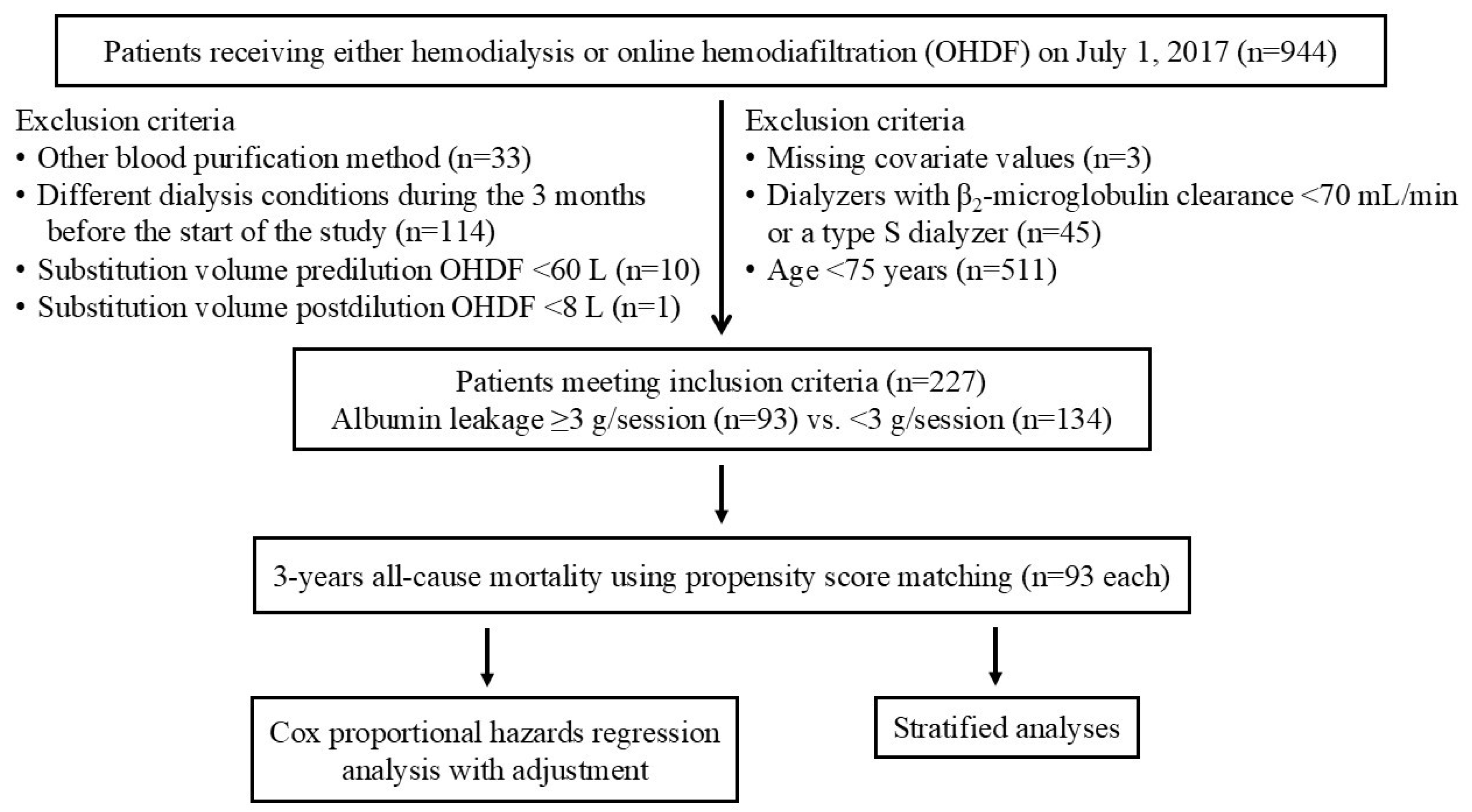
Figure 2.
Comparison of three-year all-cause mortality between the high and low albumin leakage (Alb-L) groups using the Kaplan–Meier survival curve. Reference: Low Alb-L.
Figure 2.
Comparison of three-year all-cause mortality between the high and low albumin leakage (Alb-L) groups using the Kaplan–Meier survival curve. Reference: Low Alb-L.
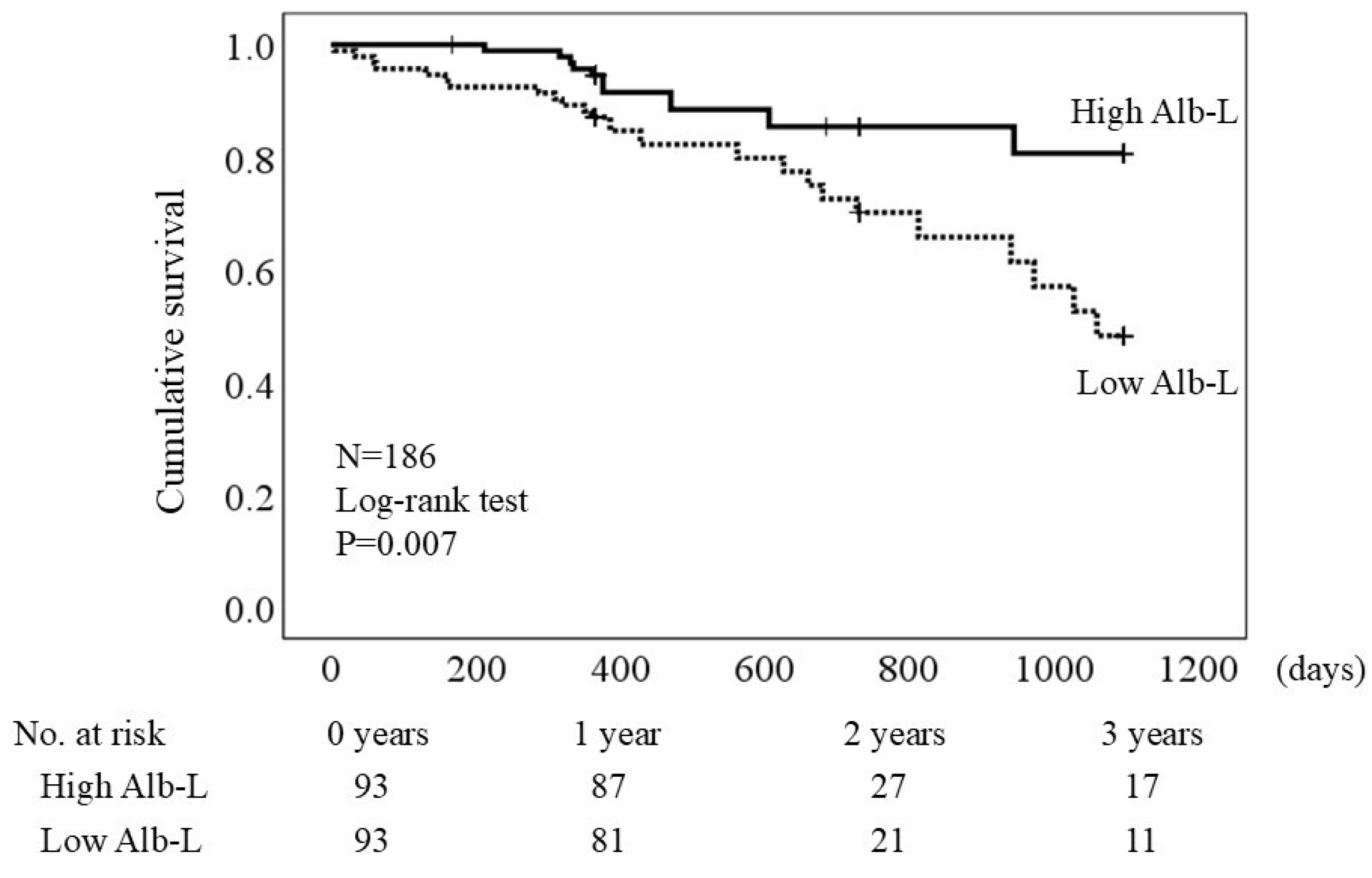
Figure 3.
Potential mechanism underlying improved survival on high albumin leakage in dialysis patients without overt weight loss and/or inflammation. AMBP, α1-microglobukin-bikunin precursor; α1-MG, α1-microglobukin; CVD, cardiovascular disease; HMA, human mercaptoalbumin; HNA-1, human non-mercaptoalbumin-1; PEW, protein-energy wasting. *The increase or decrease in serum level depends on the amount of albumin leakage.
Figure 3.
Potential mechanism underlying improved survival on high albumin leakage in dialysis patients without overt weight loss and/or inflammation. AMBP, α1-microglobukin-bikunin precursor; α1-MG, α1-microglobukin; CVD, cardiovascular disease; HMA, human mercaptoalbumin; HNA-1, human non-mercaptoalbumin-1; PEW, protein-energy wasting. *The increase or decrease in serum level depends on the amount of albumin leakage.
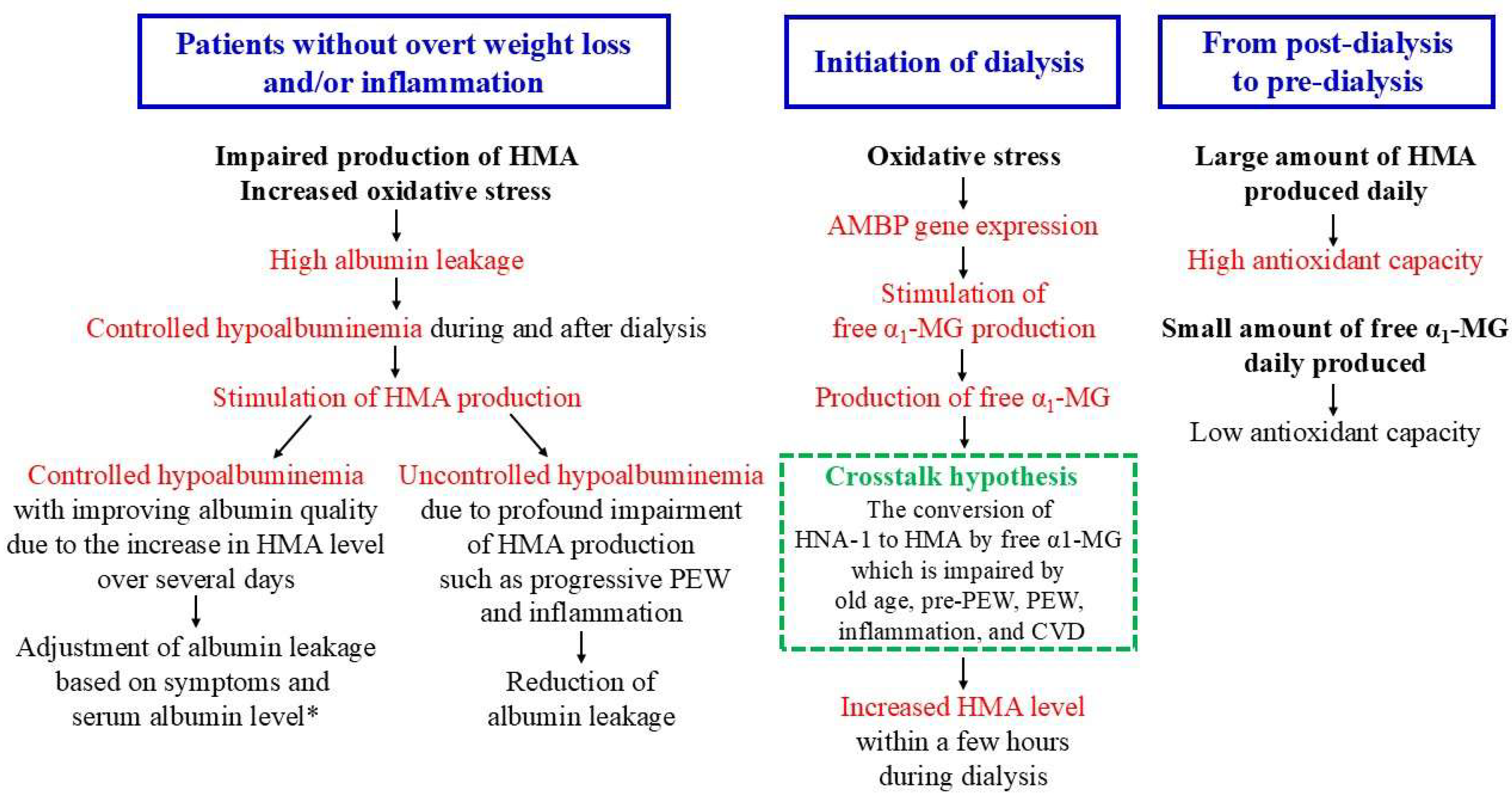
Figure 4.
Potential mechanism underlying the reduction in serum C-reactive protein (CRP) level with high albumin leakage in dialysis patients with inflammation. CV, convection volume; HMA, human mercaptoalbumin; IL-6, interleukin-6.
Figure 4.
Potential mechanism underlying the reduction in serum C-reactive protein (CRP) level with high albumin leakage in dialysis patients with inflammation. CV, convection volume; HMA, human mercaptoalbumin; IL-6, interleukin-6.
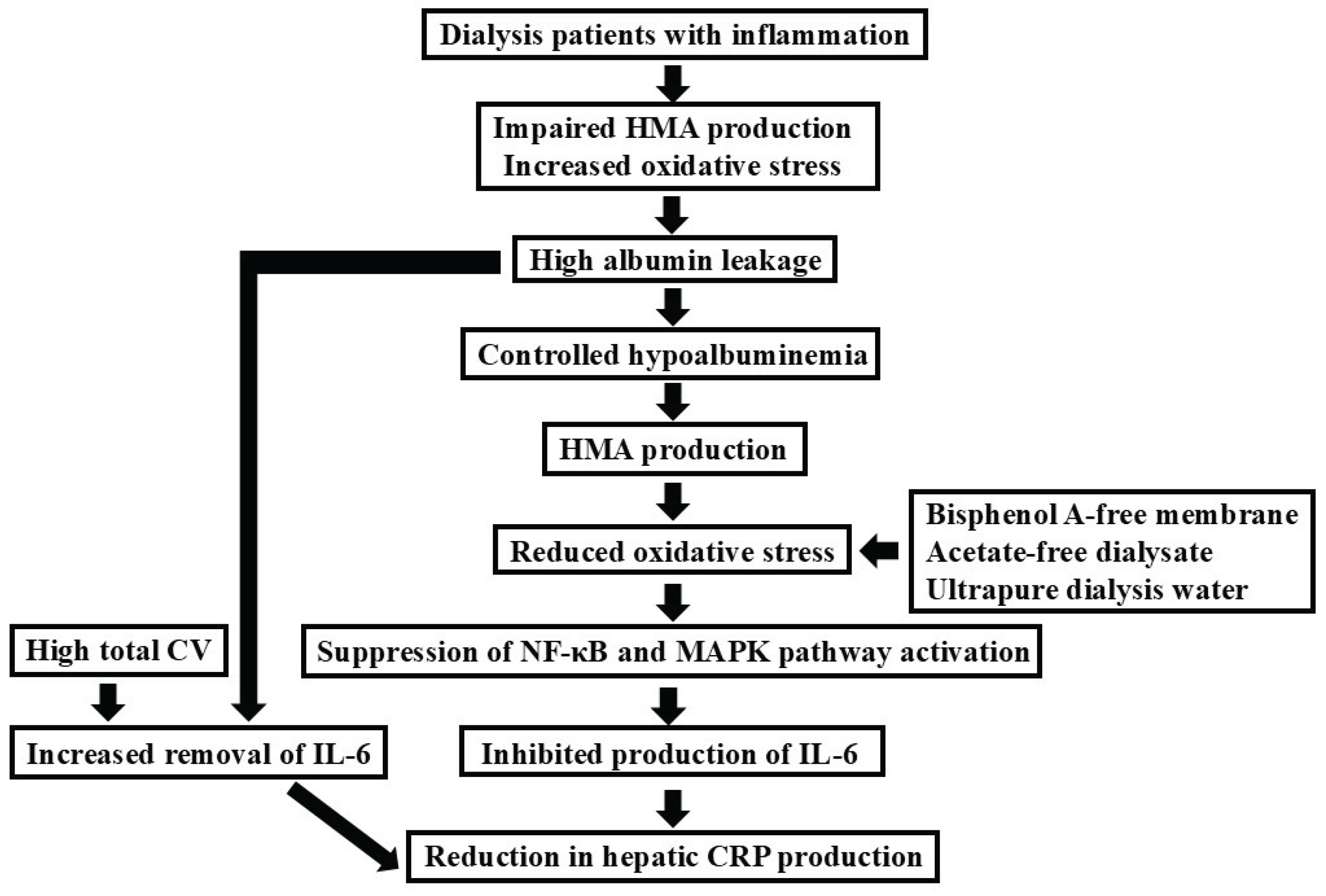

Table 1.
Comparison of variables before and after propensity score matching between the high and low albumin leakage (Alb-L) groups.
Table 1.
Comparison of variables before and after propensity score matching between the high and low albumin leakage (Alb-L) groups.
| Item | Before matching | After matching | ||||||
| High Alb-L | Low Alb-L | P value | SMD | High Alb-L | Low Alb-L | P value | SMD | |
| N | 93 | 134 | 93 | 93 | ||||
| Age, yr | 79.3±3.4 | 81.6±4.6 | <0.001 | 0.569 | 79.3±3.4 | 80.6±4.4 | 0.040 | 0.331 |
| Sex, male/female, % | 65.6/34.4 | 61.9/38.1 | 0.674 | 0.077 | 65.6/34.4 | 63.4/36.6 | 0.878 | 0.046 |
| Dialysis vintage, mo | 102.7±88.6 | 88.5±100.0 | 0.054 | 0.150 | 102.7±88.6 | 116.4±108.1 | 0.388 | 0.139 |
| Diabetes mellitus, % with/without | 33.3/66.7 | 40.3/59.7 | 0.330 | 0.146 | 33.3/66.7 | 37.6/62.4 | 0.646 | 0.090 |
| Cardioavscular disease, % with/without | 62.4/37.6 | 55.2/44.8 | 0.338 | 0.147 | 62.4/37.6 | 61.3/38.7 | 1.000 | 0.023 |
| Calcimimetics, % with/without | 25.8/74.2 | 14.9/85.1 | 0.060 | 0.273 | 25.8/74.2 | 17.2/82.8 | 0.211 | 0.210 |
| Erythropoietin stimulating agents, % with/without | 86.0/14.0 | 91.0/9.0 | 0.283 | 0.157 | 86.0/14.0 | 92.5/7.5 | 0.236 | 0.211 |
| Kt/V | 1.71±0.29 | 1.69±0.35 | 0.909 | 0.062 | 1.71±0.29 | 1.68±0.31 | 0.553 | 0.100 |
| β2-microglobulin, mg/L | 26.2±5.6 | 26.7±6.2 | 0.532 | 0.085 | 26.2±5.6 | 27.2±6.4 | 0.251 | 0.166 |
| Body mass index, kg/m2 | 22.1±3.6 | 21.6±3.5 | 0.427 | 0.141 | 22.1±3.6 | 21.8±3.2 | 0.922 | 0.088 |
| Creatinine, mg/dL | 9.20±2.20 | 8.22±2.44 | 0.002 | 0.422 | 9.20±2.20 | 8.68±2.41 | 0.097 | 0.225 |
| Normalized protein catabolism rate, g/kg/day | 0.82±0.17 | 0.77±0.17 | 0.088 | 0.294 | 0.82±0.17 | 0.78±0.17 | 0.116 | 0.235 |
| Albumin, g/dL | 3.3±0.3 | 3.2±0.4 | 0.725 | 0.283 | 3.3±0.3 | 3.2±0.5 | 0.868 | 0.243 |
| High-sensitivity C-reactive protein, mg/dL | 0.508±1.349 | 0.815±1.806 | 0.117 | 0.193 | 0.508±1.349 | 0.882±2.020 | 0.052 | 0.218 |
| Systolic blood pressure, mmHg, predialysis | 143±23 | 140±24 | 0.498 | 0.128 | 143±23 | 141±23 | 0.803 | 0.087 |
| Hemoglobin, g/dL | 11.0±1.4 | 10.7±1.1 | 0.073 | 0.238 | 11.0±1.4 | 10.6±1.1 | 0.044 | 0.318 |
| Corrected calcium, mg/dL | 9.2±0.7 | 9.3±0.8 | 0.778 | 0.133 | 9.2±0.7 | 9.4±0.8 | 0.270 | 0.266 |
| Phosphorus, mg/dL | 5.0±1.2 | 4.7±1.3 | 0.102 | 0.240 | 5.0±1.2 | 4.8±1.3 | 0.383 | 0.160 |
Data are presented as mean ±standard deviation or %. Percentages may not total 100 because of rounding. SMD denotes absolute standardized mean difference.
Table 2.
Comparison of three-year all-cause mortality by exploratory stratified analyses based on thresholds for serum albumin (S-Alb) level, body mass index (BMI), serum creatinine (S-Cr) level, high-sensitivity C-reactive protein (hs-CRP) level, and a group with BMI and hs-CRP level.
Table 2.
Comparison of three-year all-cause mortality by exploratory stratified analyses based on thresholds for serum albumin (S-Alb) level, body mass index (BMI), serum creatinine (S-Cr) level, high-sensitivity C-reactive protein (hs-CRP) level, and a group with BMI and hs-CRP level.
| Stratification items | Group (death/total) | Reference group (death/total) | Hazard ratio (95% confidence interval) | Log-rank test |
| S-Alb level | >3.0 g/dL (20/158) | <3.0 g/dL (13/28) | 0.224 (0.111-0.451) | P<0.001 |
| BMI | >20 kg/m2 (20/131) | <20 kg/m2 (13/55) | 0.519 (0.256-1.049) | P=0.063 |
| S-Cr level | >6.5 mg/dL (25/166) | <6.5 mg/dL (8/20) | 0.181 (0.079-0.414) | P<0.001 |
| hs-CRP level | >0.3 mg/dL (22/66) | <0.3 mg/dL (11/120) | 0.227 (0.110-0.468) | P<0.001 |
| BMI and hs-CRP level | >22 kg/m2 and <0.3 mg/dL (4/52) | <22 kg/m2 and/or >0.3 mg/dL (29/134) | 0.287 (0.101-0818) | P=0.013 |
Table 3.
Comparison of three-year all-cause mortality by exploratory hypothesis-generating subgroup stratified analyses based on thresholds for serum albumin (S-Alb) level, body mass index (BMI), serum creatinine (S-Cr) level, high-sensitivity C-reactive protein (hs-CRP) level, and a group with BMI and hs-CRP level in each stratum between the high and low albumin leakage (Alb-L) groups.
Table 3.
Comparison of three-year all-cause mortality by exploratory hypothesis-generating subgroup stratified analyses based on thresholds for serum albumin (S-Alb) level, body mass index (BMI), serum creatinine (S-Cr) level, high-sensitivity C-reactive protein (hs-CRP) level, and a group with BMI and hs-CRP level in each stratum between the high and low albumin leakage (Alb-L) groups.
| Stratification items | High Alb-L (death/total) |
Low Alb-L (death/total) |
Hazard ratio (95% confidence interval) (reference: Alb-L <3g/session) | Log-rank test | |
| S-Alb level | <3.0 g/dL | 3/10 | 10/18 | 0.427 (0.117-1.556) | P=0.184 |
| >3.0 g/dL | 6/83 | 14/75 | 0.401 (0.154-1.046) | P=0.053 | |
| BMI | <20 kg/m2 | 4/28 | 9/27 | 0.492 (0.150-1.612) | P=0.232 |
| >20 kg/m2 | 5/65 | 15/66 | 0.298 (0.108-0.823) | P=0.013 | |
| S-Cr level | <6.5 mg/dL | 1/7 | 7/13 | 0.188 (0.023-1.538) | P=0.082 |
| >6.5 mg/dL | 8/86 | 17/80 | 0.462 (0.199-1.073) | P=0.066 | |
| hs-CRP level | <0.3 mg/dL | 5/68 | 6/52 | 0.734 (0.224-2.410) | P=0.609 |
| >0.3 mg/dL | 4/25 | 18/41 | 0.315 (0.106-0.934) | P=0.028 | |
| BMI and hs-CRP level | <22 kg/m2 and/or >0.3 mg/dL | 8/63 | 21/71 | 0.445 (0.197-1.007) | P=0.046 |
| >22 kg/m2 and <0.3 mg/dL | 1/30 | 3/22 | 0.203 (0.021-1.963) | P=0.127 | |
Disclaimer/Publisher’s Note: The statements, opinions and data contained in all publications are solely those of the individual author(s) and contributor(s) and not of MDPI and/or the editor(s). MDPI and/or the editor(s) disclaim responsibility for any injury to people or property resulting from any ideas, methods, instructions or products referred to in the content. |
© 2026 by the authors. Licensee MDPI, Basel, Switzerland. This article is an open access article distributed under the terms and conditions of the Creative Commons Attribution (CC BY) license (http://creativecommons.org/licenses/by/4.0/).
Copyright: This open access article is published under a Creative Commons CC BY 4.0 license, which permit the free download, distribution, and reuse, provided that the author and preprint are cited in any reuse.